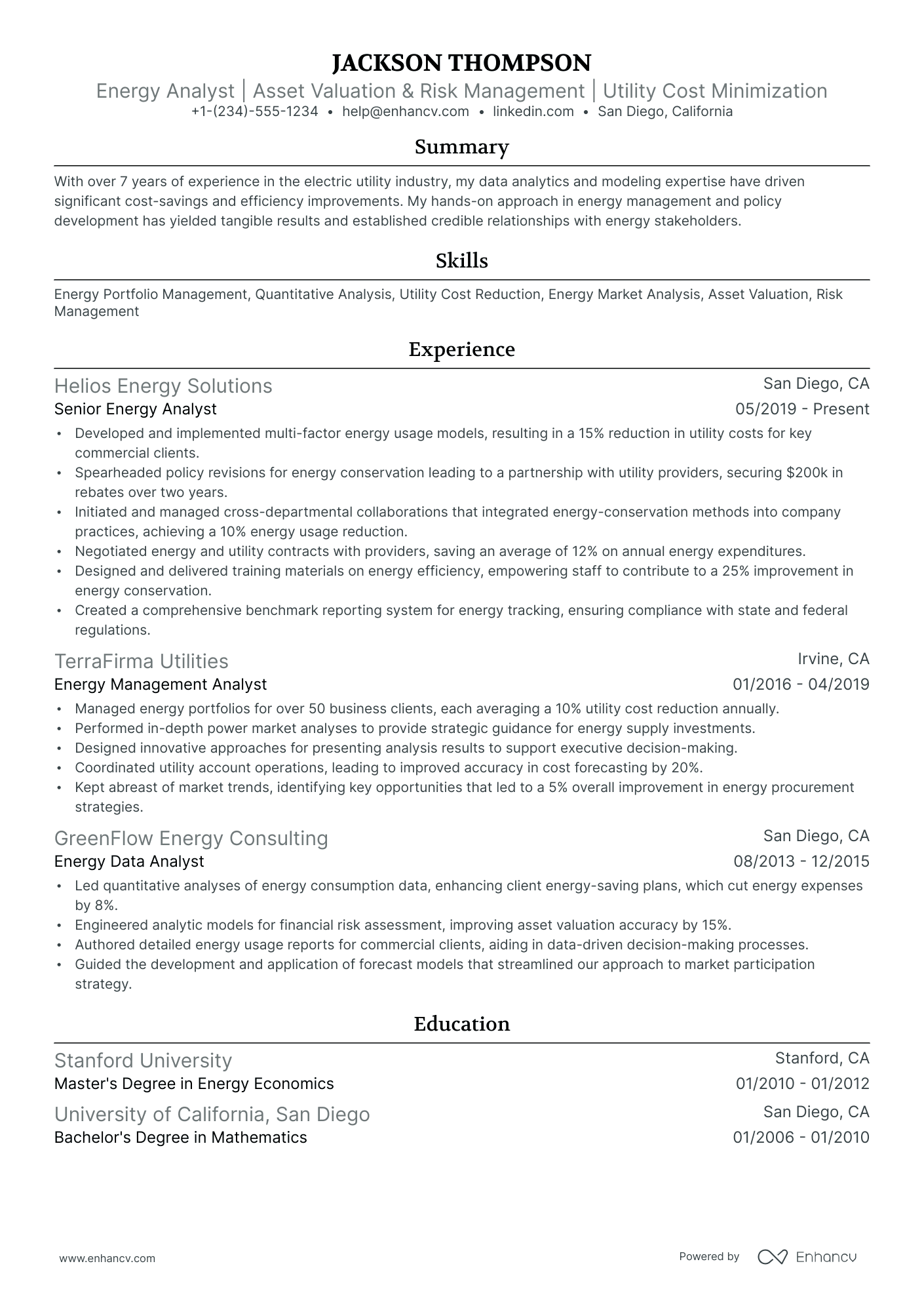
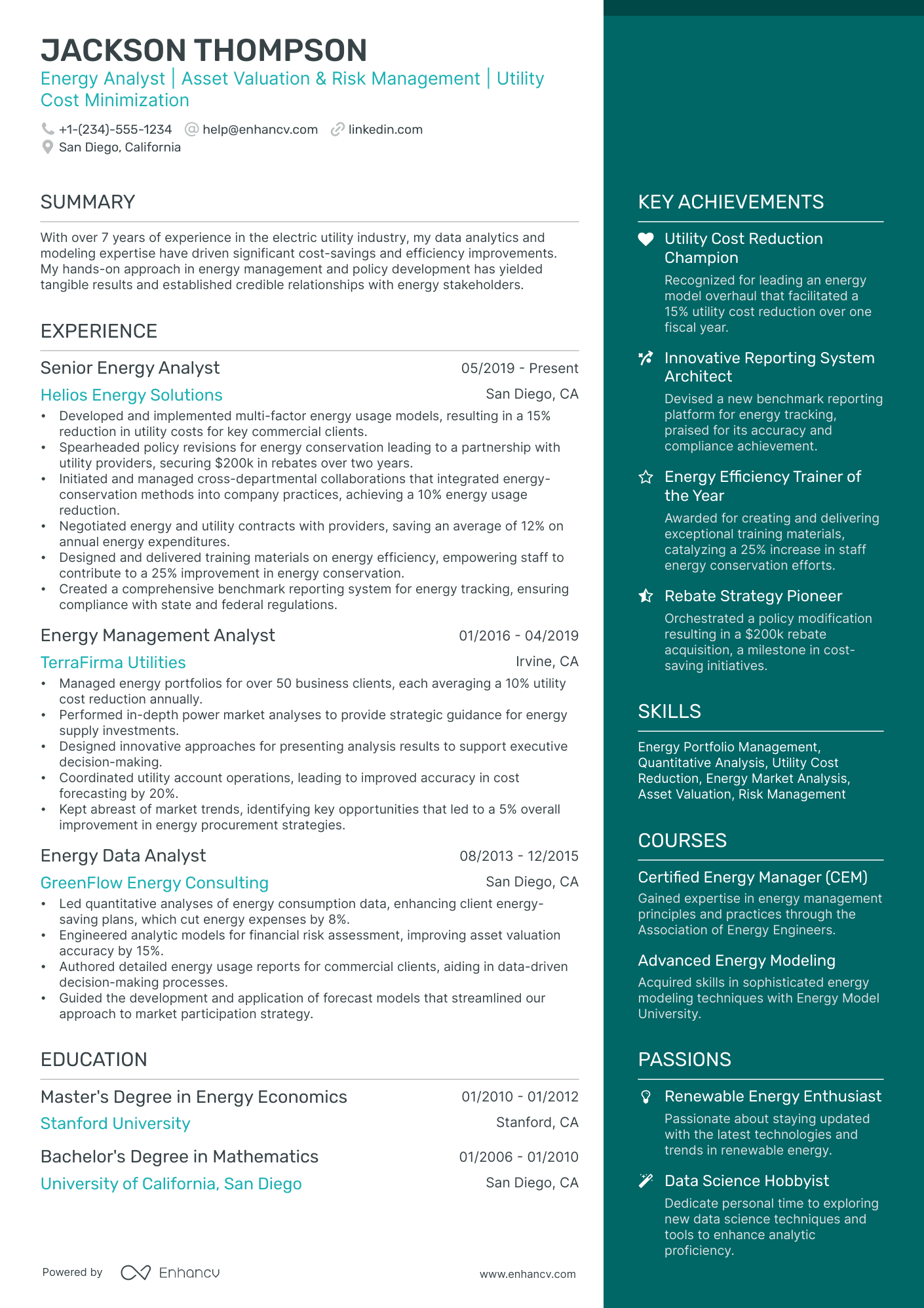
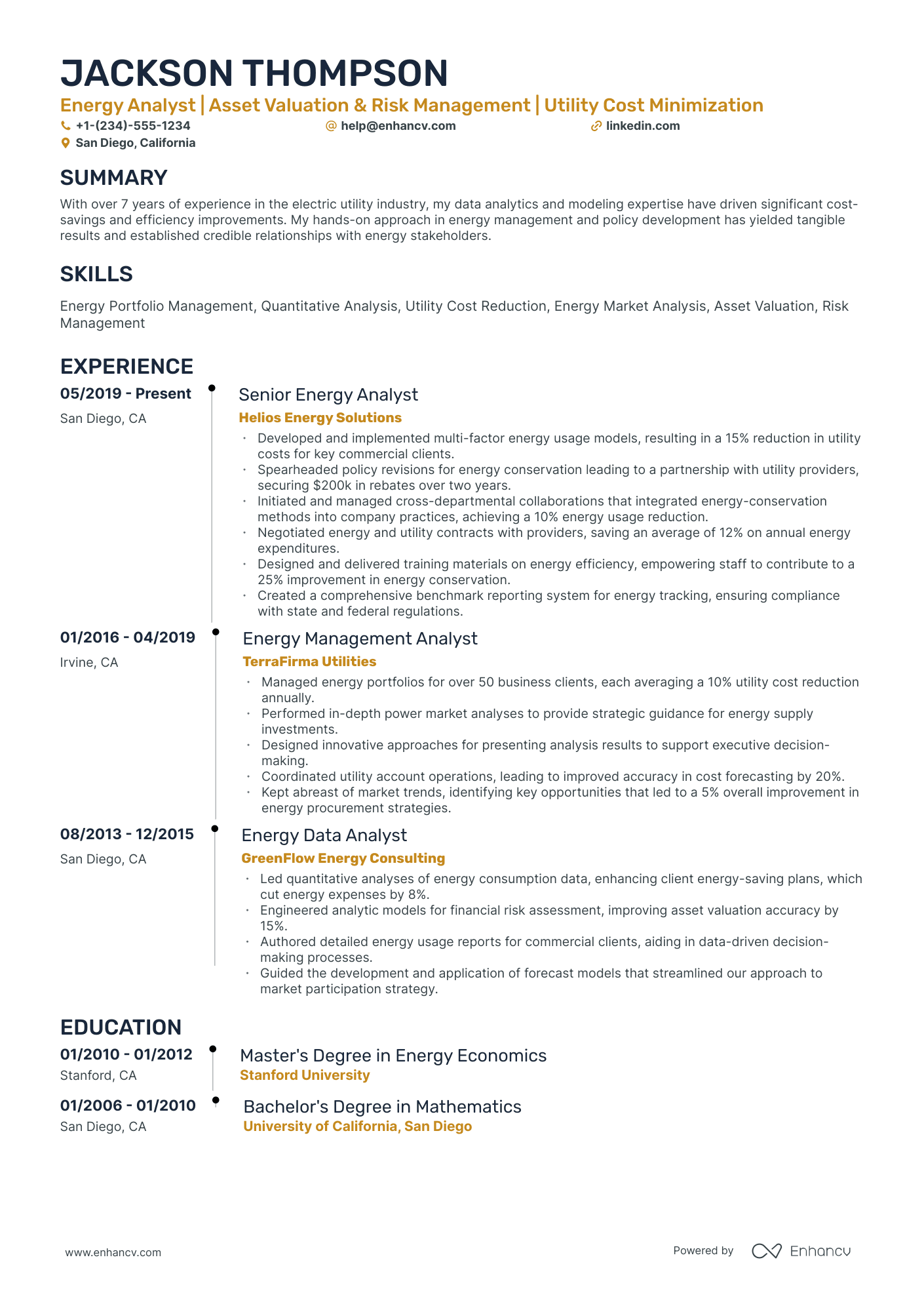
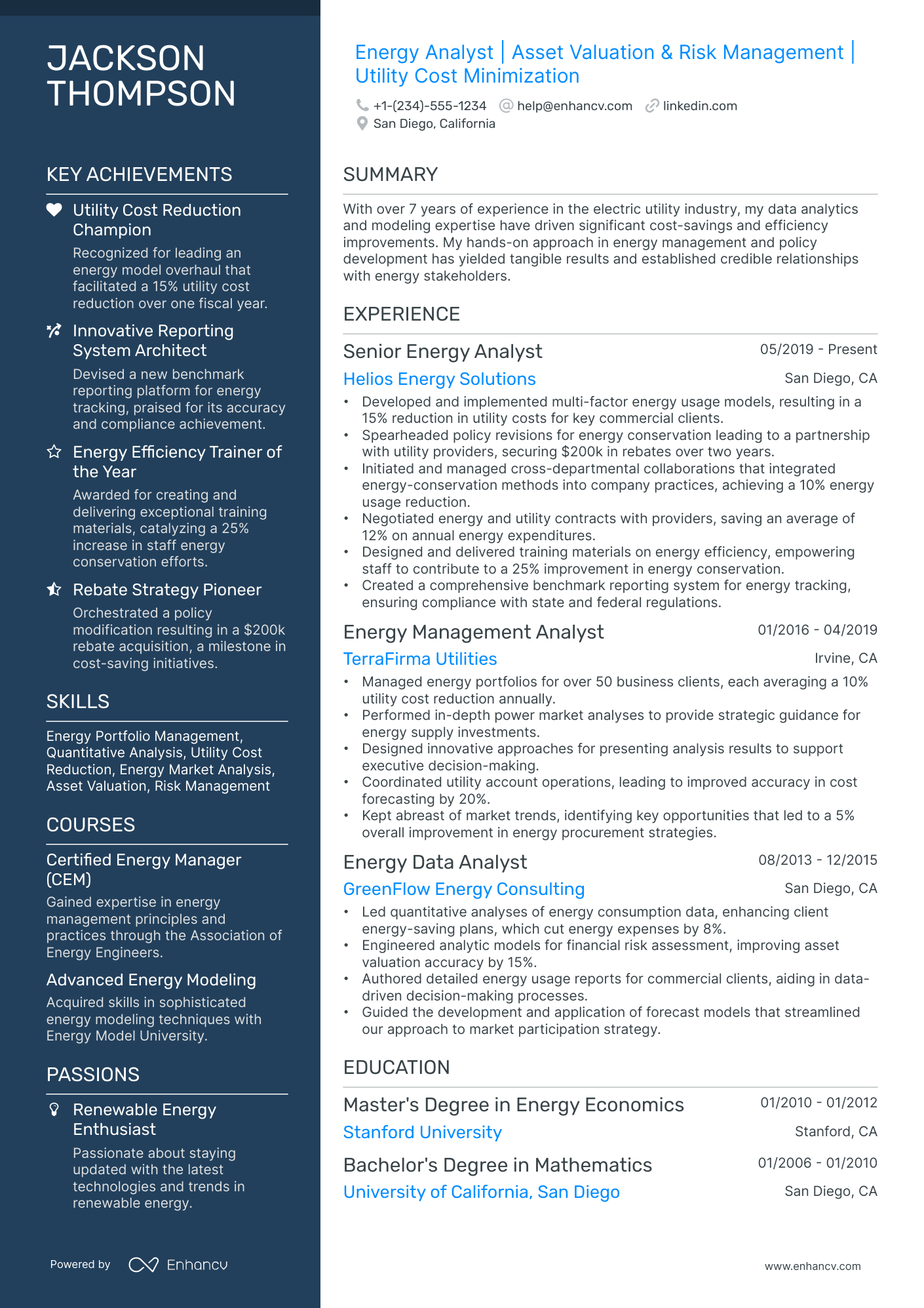
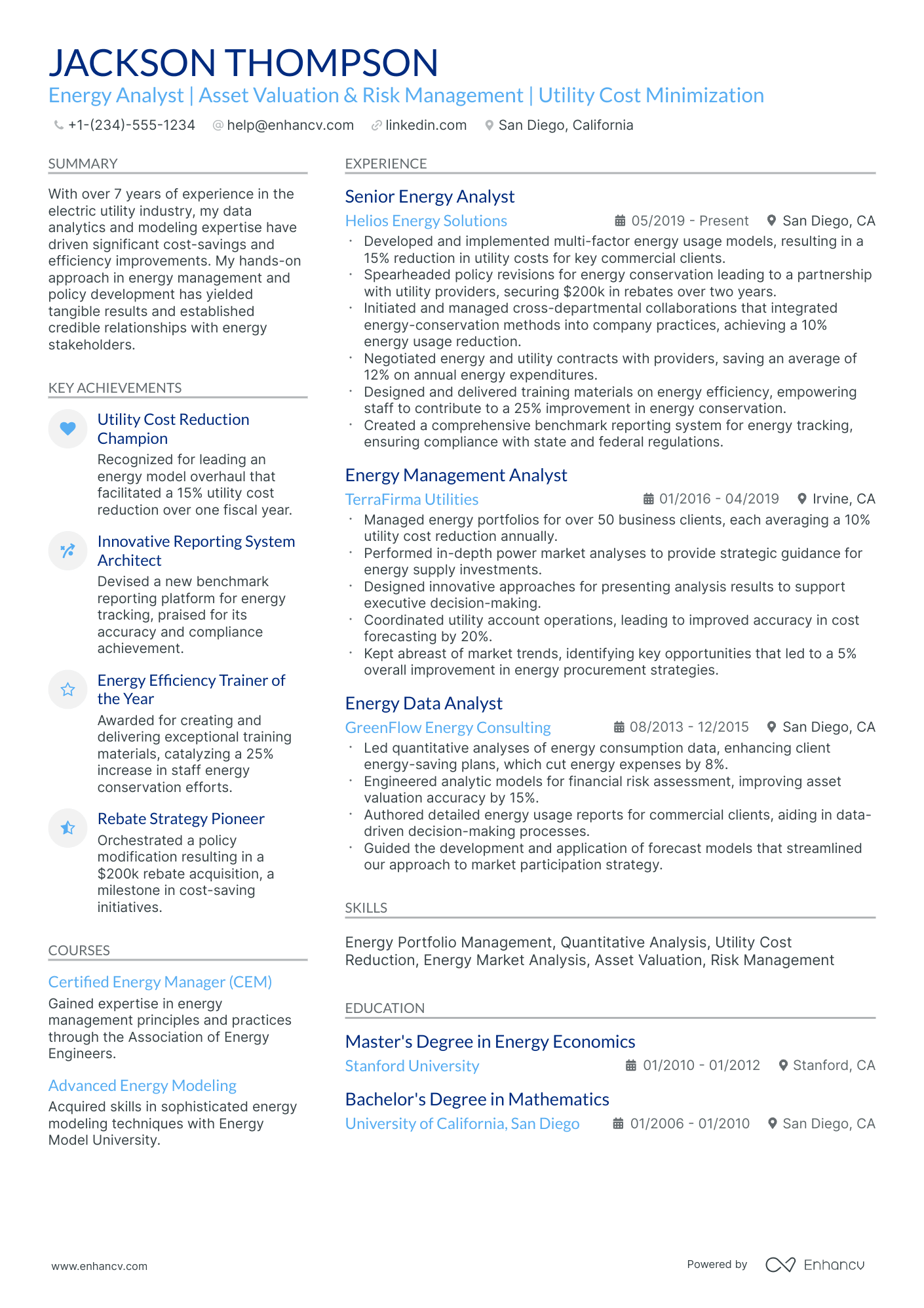
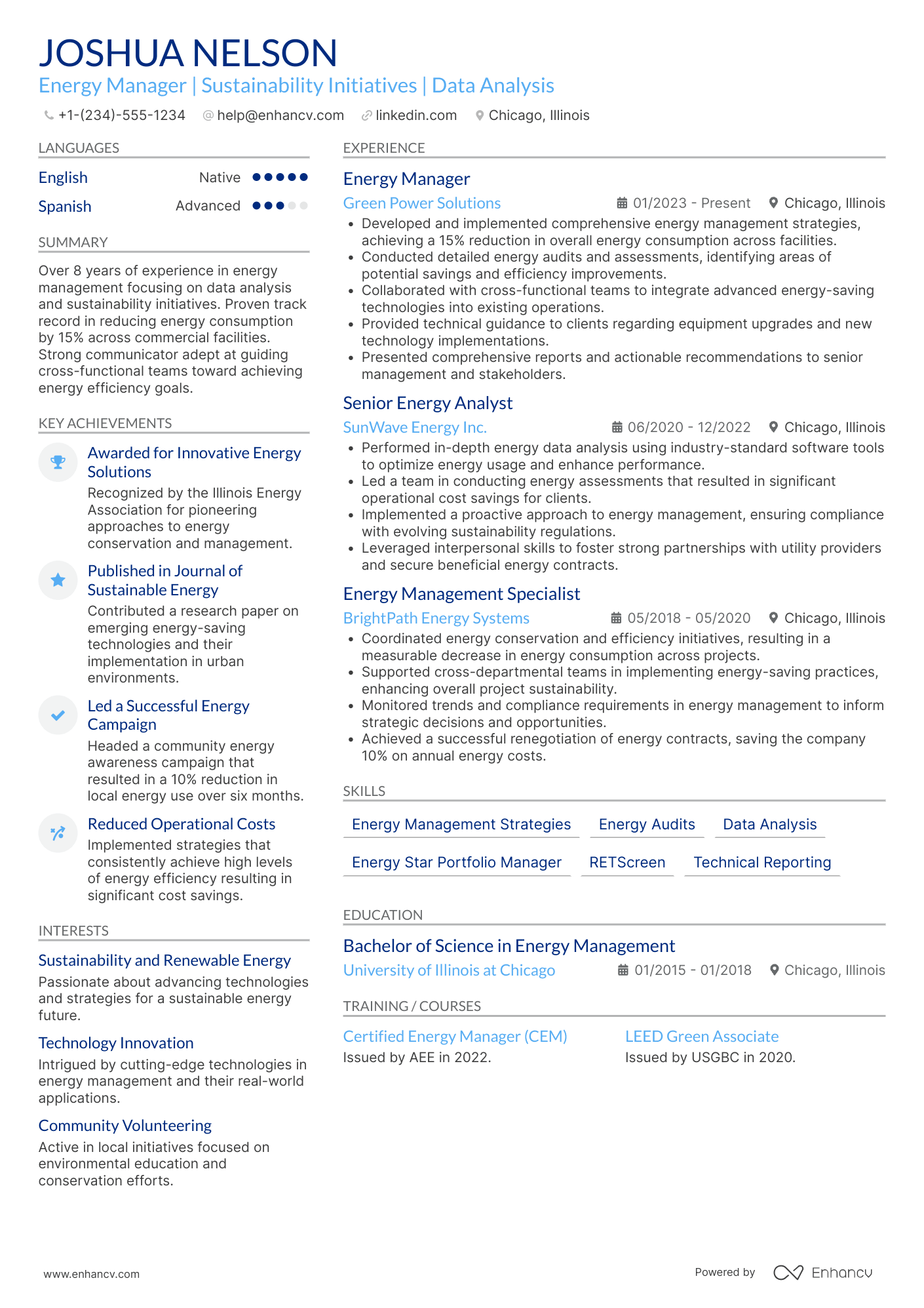
Many energy manager resumes fail because they list audits, dashboards, and compliance tasks without quantifying avoided costs, verified savings, and project payback. In today's hiring process, energy manager resume content gets filtered by ATS screening and skimmed fast. Knowing how to make your resume stand out is essential in this competitive field.
A strong resume shows what changed because of you. Highlight annual kilowatt-hour and therm reductions, utility spend cut, peak demand lowered, emissions reduced, and payback achieved. Include portfolio size, sites supported, capital delivered, and measurement and verification results.

Key takeaways
- Quantify energy savings, cost reductions, and payback periods instead of listing routine duties.
- Use reverse-chronological format for experienced candidates and hybrid format for career changers.
- Tailor every experience bullet to mirror the job posting's tools, KPIs, and standards.
- Anchor each skill claim to a specific project, metric, or verified outcome.
- Place certifications like CEM or LEED AP near education to signal specialized credibility fast.
- Write a three-to-four-line summary with your domain focus, core tools, and top achievement.
- Build your resume in Enhancv to structure sections that pass ATS screening and recruiter review.
Job market snapshot for energy managers
We analyzed 84 recent energy manager job ads across major US job boards. These numbers help you understand employer expectations, industry demand, experience requirements at a glance.
What level of experience employers are looking for energy managers
| Years of Experience | Percentage found in job ads |
|---|---|
| 1–2 years | 1.2% (1) |
| 3–4 years | 3.6% (3) |
| 5–6 years | 58.3% (49) |
| 7–8 years | 3.6% (3) |
| 9–10 years | 2.4% (2) |
| 10+ years | 3.6% (3) |
| Not specified | 29.8% (25) |
Energy manager ads by area of specialization (industry)
| Industry (Area) | Percentage found in job ads |
|---|---|
| Healthcare | 53.6% (45) |
| Finance & Banking | 20.2% (17) |
| Education | 11.9% (10) |
Top companies hiring energy managers
| Company | Percentage found in job ads |
|---|---|
| Accenture | 52.4% (44) |
Role overview stats
These tables show the most common responsibilities and employment types for energy manager roles. Use them to align your resume with what employers expect and to understand how the role is structured across the market.
Day-to-day activities and top responsibilities for a energy manager
| Responsibility | Percentage found in job ads |
|---|---|
| Power bi | 54.8% (46) |
| Ai | 53.6% (45) |
| Analytics | 53.6% (45) |
| Oracle | 53.6% (45) |
| Tableau | 52.4% (44) |
| Coupa | 51.2% (43) |
| Lean | 51.2% (43) |
| Sap ariba | 51.2% (43) |
| Six sigma | 51.2% (43) |
| Process improvement | 38.1% (32) |
| Procurement technology | 35.7% (30) |
| Automation | 31.0% (26) |
Type of employment (remote vs on-site vs hybrid)
| Employment type | Percentage found in job ads |
|---|---|
| On-site | 89.3% (75) |
| Hybrid | 9.5% (8) |
How to format a energy manager resume
Recruiters evaluating energy manager candidates prioritize evidence of energy reduction initiatives, utility cost savings, regulatory compliance expertise, and cross-functional project leadership. A clean, well-structured resume format ensures these signals surface quickly during both automated screening and the initial human review.

I have significant experience in this role—which format should I use?
Use a reverse-chronological format to present your energy management career in a clear, linear progression that highlights growing scope and accountability. Do:
- Lead with your most recent role and emphasize scope of oversight—number of facilities, energy budgets managed, and teams directed.
- Feature domain-specific expertise such as ISO 50001 implementation, energy auditing platforms (e.g., EnergyCAP, ENERGY STAR Portfolio Manager), and utility rate analysis.
- Quantify outcomes tied to cost savings, consumption reductions, or sustainability targets you owned and delivered.
I'm junior or switching into this role—what format works best?
A hybrid format works best because it lets you lead with relevant energy management skills and certifications while still providing a chronological work history that shows professional context. Do:
- Place a dedicated skills section near the top highlighting competencies like energy auditing, HVAC optimization, building automation systems, and renewable energy integration.
- Include project-based experience—such as academic capstone projects, sustainability committee work, or energy assessments performed during internships—even if your job titles weren't energy-specific.
- Connect each action to a measurable result so reviewers can assess your potential impact.
Why not use a functional resume?
A functional resume strips away the timeline and context that hiring managers need to evaluate how your energy management capabilities developed and where they were applied, making it harder to verify accountability for specific projects or results.
- Edge-case exception: A functional format may be acceptable if you're transitioning from a related field (e.g., facilities maintenance or mechanical engineering) with no direct energy management titles, or if you have significant resume gaps—but only if every listed skill is anchored to a specific project, certification, or measurable outcome rather than presented as a standalone claim.
Once you've established a clean, readable format, the next step is deciding which sections to include so each one reinforces your qualifications as an energy manager.
What sections should go on a energy manager resume
Recruiters expect to see how you've reduced energy costs, improved efficiency, ensured compliance, and delivered measurable sustainability results. Understanding what to put on a resume helps you prioritize the right content for energy management roles.
Use this structure for maximum clarity:
- Header
- Summary
- Experience
- Skills
- Projects
- Education
- Certifications
- Optional sections: Awards, Publications, Leadership
Strong experience bullets should emphasize quantified savings, efficiency gains, emissions reductions, program scale, stakeholder alignment, and verified results.
Is your resume good enough?
Drop your resume here or choose a file. PDF & DOCX only. Max 2MB file size.
Once you’ve organized the key components of your resume, the next step is learning how to write your energy manager resume experience so each role supports them with clear, relevant impact.
How to write your energy manager resume experience
The experience section is where you prove you've delivered measurable results in energy management—not just held a position. Hiring managers prioritize demonstrated impact, such as energy cost reductions, sustainability milestones, and successful implementation of energy-efficient systems, over descriptive task lists. Building a targeted resume ensures each bullet point speaks directly to the role's requirements.
Each entry should include:
- Job title
- Company and location (or remote)
- Dates of employment (month and year)
Three to five concise bullet points showing what you owned, how you executed, and what outcomes you delivered:
- Ownership scope: the energy programs, building portfolios, utility accounts, sustainability initiatives, or facility systems you were directly accountable for managing and improving.
- Execution approach: the energy auditing methodologies, building management systems, energy modeling software, regulatory frameworks, or procurement strategies you used to guide decisions and deliver work.
- Value improved: the changes you drove in energy consumption, operational efficiency, carbon emissions, regulatory compliance, equipment reliability, or occupant comfort across your areas of responsibility.
- Collaboration context: how you partnered with facilities teams, engineers, contractors, utility providers, executive leadership, or regulatory bodies to advance energy management objectives.
- Impact delivered: the outcomes you achieved expressed through verified reductions, cost savings, certification attainments, or portfolio-wide performance improvements rather than routine activities.
Experience bullet formula
A energy manager experience example
✅ Right example - modern, quantified, specific.
Energy Manager
Riverton Manufacturing Group | Columbus, OH
2021–Present
Multi-site automotive components manufacturer operating five plants with twenty-four-seven production and ISO 50001-aligned energy goals.
- Led ISO 50001 energy management system rollout across five plants, building an energy baseline in EnergyCAP and Power BI; cut electricity intensity by 11% year over year and improved audit readiness to a zero-major-nonconformance outcome.
- Implemented submetering and fault detection using Schneider Electric EcoStruxure, Modbus gateways, and OSIsoft PI; reduced compressed-air waste by 18% and avoided $240K in annual utility spend through targeted leak repair and controls tuning.
- Negotiated utility tariffs and demand response participation with the local utility using interval data analysis in Excel and Python; lowered peak demand by 2.6 MW and captured $310K in annual incentives and bill credits.
- Delivered retro-commissioning program with facilities engineers and controls contractors, optimizing HVAC schedules and VFD setpoints in the building automation system; reduced natural gas use by 9% and improved temperature compliance from 92% to 98%.
- Built a capital project pipeline with finance and plant managers, validating savings via International Performance Measurement and Verification Protocol (IPMVP) Option B metering; secured $1.8M in funding and achieved a weighted average payback of 2.4 years.
Now that you've seen how a strong experience section comes together, let's look at how to adapt yours to match a specific job posting.
How to tailor your energy manager resume experience
Recruiters evaluate your energy manager resume through both applicant tracking systems and manual review. Tailoring your resume to the job description ensures your qualifications connect directly with what the hiring team needs.
Ways to tailor your energy manager experience:
- Match energy management software and monitoring platforms listed in the posting.
- Mirror the exact terminology used for energy audits or assessments.
- Reflect specific KPIs like consumption reduction or cost savings targets.
- Include relevant industry experience such as commercial or industrial sectors.
- Emphasize compliance with standards like ISO 50001 when specified.
- Highlight collaboration with facilities teams or sustainability departments if referenced.
- Align your work with utility rebate programs or demand response frameworks mentioned.
- Reference building automation systems or HVAC optimization methods from the description.
Tailoring means aligning your real accomplishments with the role's stated requirements, not forcing disconnected keywords into your experience.
Resume tailoring examples for energy manager
| Job description excerpt | Untailored | Tailored |
|---|---|---|
| Lead building energy audits using ASHRAE Level II standards and develop energy conservation measures (ECMs) for commercial facilities exceeding 100,000 sq. ft. | Conducted energy audits and made recommendations for improvements. | Led ASHRAE Level II energy audits across 12 commercial facilities totaling 1.4M sq. ft., identifying ECMs that reduced annual energy consumption by 18%. |
| Manage utility tracking and benchmarking using ENERGY STAR Portfolio Manager, ensuring compliance with local benchmarking ordinances and reporting deadlines. | Tracked energy usage and created reports for management. | Managed ENERGY STAR Portfolio Manager benchmarking for a 35-property portfolio, maintaining 100% compliance with municipal benchmarking ordinances and improving average scores from 62 to 78 over two years. |
| Oversee implementation of demand response programs and negotiate utility incentive agreements to offset capital costs of retrofit projects. | Helped reduce energy costs through various programs. | Negotiated $1.2M in utility incentive agreements across three demand response programs, offsetting 40% of capital costs for LED and HVAC retrofit projects across six sites. |
Once you’ve aligned your experience with the role’s priorities, quantify your energy manager achievements to show the measurable impact of that work.
How to quantify your energy manager achievements
Quantifying your achievements shows how your work cuts costs, lowers emissions, improves reliability, and reduces risk. Focus on energy spend, kilowatt-hour savings, peak demand, equipment uptime, compliance results, and project delivery timelines.
Quantifying examples for energy manager
| Metric | Example |
|---|---|
| Cost savings | "Reduced annual electricity spend by $420K by optimizing building automation system schedules and renegotiating time-of-use rates across twelve facilities." |
| Energy efficiency | "Cut energy intensity by 14% (kBtu per square foot) in one year using submetering, retro-commissioning, and a 250-point energy conservation measure backlog." |
| Peak demand | "Lowered monthly peak demand by 1.8 MW by implementing demand response controls in Schneider Electric EcoStruxure and shifting chiller loads off-peak." |
| Reliability | "Improved critical HVAC uptime from 97.6% to 99.4% by adding predictive maintenance alerts from a computerized maintenance management system and tightening preventive maintenance cycles." |
| Compliance risk | "Passed three ISO 50001 internal audits with zero major findings by standardizing measurement and verification plans and closing twenty-two corrective actions within thirty days." |
Turn vague job duties into measurable, recruiter-ready resume bullets in seconds with Enhancv's Bullet Point Generator.
Once you've crafted strong bullet points to showcase your experience, the next step is ensuring your resume also highlights the right hard and soft skills energy manager roles demand.
How to list your hard and soft skills on a energy manager resume
Your skills section shows you can reduce energy spend, improve efficiency, and meet compliance targets, and recruiters and ATS scan this section to confirm role fit fast; aim for a balance of mostly hard skills supported by job-specific soft skills. energy manager roles require a blend of:
- Product strategy and discovery skills.
- Data, analytics, and experimentation skills.
- Delivery, execution, and go-to-market discipline.
- Soft skills.
Your skills section should be:
- Scannable (bullet-style grouping).
- Relevant to the job post.
- Backed by proof in experience bullets.
- Updated with current tools.
Place your skills section:
- Above experience if you're junior or switching careers.
- Below experience if you're mid/senior with strong achievements.

Hard skills
- Energy management systems (EMS)
- Building management systems (BMS)
- Utility bill analysis, rate modeling
- Measurement and verification (IPMVP)
- Energy audits, ASHRAE Level I–III
- Retro-commissioning (RCx)
- Demand response program management
- Renewable energy procurement, PPAs
- Carbon accounting, GHG Protocol
- ISO 50001 energy management
- HVAC optimization, controls tuning
- Excel, Power BI, SQL
Soft skills
- Translate data into actions
- Prioritize by payback and risk
- Align stakeholders on scope
- Lead cross-functional initiatives
- Present ROI to executives
- Negotiate with utilities and vendors
- Manage competing site priorities
- Document decisions and assumptions
- Drive accountability to deadlines
- Communicate tradeoffs clearly
- Resolve issues during implementation
- Build operator and tenant buy-in
How to show your energy manager skills in context
Skills shouldn't live only in a dedicated skills list. Explore resume skills examples to see how energy management competencies can be woven throughout your resume.
They should be demonstrated in:
- Your summary (high-level professional identity)
- Your experience (proof through outcomes)
Here's what that looks like in practice.
Summary example
Senior energy manager with 12 years optimizing commercial building portfolios using ENERGY STAR Portfolio Manager and ISO 50001 frameworks. Led cross-functional retrofitting programs that cut annual energy spend by $2.4M across 60+ facilities.
- Signals senior-level depth immediately
- Names industry-standard tools and frameworks
- Quantifies cost savings with hard metrics
- Implies leadership and cross-functional collaboration
Experience example
Senior Energy Manager
Meridian Property Group | Chicago, IL
June 2018–Present
- Deployed real-time energy monitoring via SkySpark analytics, reducing portfolio consumption by 18% across 42 commercial properties within two years.
- Partnered with facilities, procurement, and finance teams to negotiate utility contracts, saving $1.1M annually through demand-response enrollment.
- Designed and implemented an ISO 50001 energy management system, achieving certification and improving audit compliance scores by 34%.
- Every bullet includes a measurable outcome
- Skills surface naturally through real accomplishments
Once you’ve demonstrated your energy management strengths through measurable results and role-specific examples, the next step is adapting that approach for an energy manager resume when you have no direct experience.
How do I write a energy manager resume with no experience
Even without full-time experience, you can demonstrate readiness through projects and training. Our guide on writing a resume without work experience covers strategies that apply directly to entry-level energy management candidates. Consider showcasing:
- Campus building energy audit project
- Internship in facilities or utilities
- Energy modeling class capstone
- Metering and data analysis lab
- ISO 50001 training certificate
- Utility rebate or incentive project
- Building automation system shadowing
Focus on:
- Documented energy savings calculations
- Metering, benchmarking, and baselines
- Maturity with energy management software
- Compliance, safety, and reporting
Resume format tip for entry-level energy manager
Use a hybrid resume format because it highlights projects and technical skills upfront while still showing a clear timeline for education and experience. Do:
- Put projects above work history.
- Quantify results with kilowatt-hours and dollars.
- Name tools like ENERGY STAR Portfolio Manager.
- List methods: baseline, regression, measurement and verification.
- Include relevant coursework with outcomes.
- Built an ENERGY STAR Portfolio Manager baseline for three campus buildings, analyzed monthly utility bills, and identified a nine percent reduction opportunity worth $4,200 annually.
Even without direct experience, your educational background can demonstrate the foundational knowledge and relevant training that qualify you for an energy manager role.
How to list your education on a energy manager resume
Your education section helps hiring teams confirm you have the technical and analytical foundation required for energy manager roles. It validates relevant training quickly.
Include:
- Degree name
- Institution
- Location
- Graduation year
- Relevant coursework (for juniors or entry-level candidates)
- Honors & GPA (if 3.5 or higher)
Skip month and day details—list the graduation year only.
Here's a strong education entry tailored to an energy manager resume.
Example education entry
Bachelor of Science in Mechanical Engineering
University of Michigan, Ann Arbor, MI
Graduated 2019
GPA: 3.7/4.0
- Relevant Coursework: Energy Systems Design, Building Science, Thermodynamics, Sustainable Engineering Practices
- Honors: Dean's List (six semesters), Tau Beta Pi Engineering Honor Society
How to list your certifications on a energy manager resume
Certifications on a resume show an energy manager's commitment to ongoing learning, proficiency with key tools and standards, and alignment with current industry expectations.
Include:
- Certificate name
- Issuing organization
- Year
- Optional: credential ID or URL
- Place certifications below education when your most relevant certifications are older, and your degree is more recent and central to the role.
- Place certifications above education when they are recent, role-critical, or required, and they strengthen your energy manager fit immediately.
Best certifications for your energy manager resume
- Certified Energy Manager (CEM)
- Certified Measurement and Verification Professional (CMVP)
- Leadership in Energy and Environmental Design Accredited Professional (LEED AP)
- Certified Energy Auditor (CEA)
- ISO 50001 Energy Management Systems Lead Auditor
- Building Energy Modeling Professional (BEMP)
- Project Management Professional (PMP)
Once you’ve positioned your credentials so they’re easy to verify, move to your energy manager resume summary to show how those qualifications translate into immediate value.
How to write your energy manager resume summary
Your resume summary is the first thing a recruiter reads. A strong one instantly signals you're qualified for the energy manager role.
Keep it to three to four lines, with:
- Your title and total years of experience in energy management.
- Domain focus such as commercial buildings, industrial facilities, or renewable energy.
- Core tools and skills like EMS platforms, ENERGY STAR Portfolio Manager, or ISO 50001.
- One or two quantified achievements tied to cost savings or efficiency gains.
- Soft skills linked to real outcomes, such as cross-functional collaboration that accelerated project timelines.

PRO TIP
At this level, lead with practical skills, certifications, and measurable contributions from internships or early roles. Avoid vague phrases like "passionate self-starter" or "motivated team player." Recruiters want to see specific tools you've used and tangible results you've delivered, even if modest.
Example summary for a energy manager
Energy manager with three years of experience optimizing commercial building systems. Reduced facility energy costs by 18% using ENERGY STAR Portfolio Manager. Skilled in utility audits and cross-department coordination.
Optimize your resume summary and objective for ATS
Drop your resume here or choose a file.
PDF & DOCX only. Max 2MB file size.
Now that your summary captures your energy management expertise and value, make sure your resume header presents the essential contact and professional details recruiters need to reach you.
What to include in a energy manager resume header
A resume header lists your key identifiers and contacts, helping an energy manager stand out in searches, build credibility, and pass recruiter screening fast.
Essential resume header elements
- Full name
- Tailored job title and headline
- Location
- Phone number
- Professional email
- GitHub link
- Portfolio link
Including a LinkedIn link helps recruiters confirm roles, dates, and scope fast, which speeds up screening decisions.
Do not include photos on a energy manager resume unless the role is explicitly front-facing or appearance-dependent.
Keep your header consistent with your application profiles, and use a clear job title that matches the posting's wording.
Energy manager resume header
Jordan Lee
Energy Manager | Commercial Building Energy Optimization
Denver, CO
(303) 555-01XX
your.name@enhancv.com
github.com/yourname
yourwebsite.com
linkedin.com/in/yourname
Once your header clearly identifies you and your role, add additional sections to highlight supporting details that strengthen your energy manager resume.
Additional sections for energy manager resumes
Extra resume sections help you stand out when your core qualifications match other candidates, especially for showcasing niche expertise or industry credibility. For example, listing language skills on your resume can differentiate you when managing multi-regional energy portfolios.
- Languages
- Certifications and licenses
- Publications and white papers
- Professional affiliations
- Volunteer energy auditing experience
- Conference presentations
- Awards and recognitions
Once you've strengthened your resume with relevant additional sections, pairing it with a well-crafted cover letter can further set your application apart.
Do energy manager resumes need a cover letter
An energy manager resume rarely requires a cover letter, but it often helps. Understanding what a cover letter is and when to use one matters most in competitive searches or when hiring managers expect a clear narrative. It can also tip decisions when your resume needs context.
Use a cover letter when it can add clarity or proof:
- Explain role and team fit by matching your experience to the site, portfolio, and stakeholders you'd support as an energy manager.
- Highlight one or two projects with outcomes: energy savings, cost reduction, peak demand cuts, emissions reductions, or measurement and verification results.
- Show you understand the business context by referencing the product, users, or operations you'll impact, such as facilities, manufacturing, or real estate.
- Address career transitions or non-obvious experience by connecting transferable skills, such as data analysis, project management, or utility negotiations, to energy manager work.
Drop your resume here or choose a file.
PDF & DOCX only. Max 2MB file size.
Once you’ve decided whether to include a cover letter to add context beyond your resume, the next step is using AI to strengthen your energy manager resume efficiently and consistently.
Using AI to improve your energy manager resume
AI can sharpen your resume's clarity, structure, and impact. It helps you refine language and highlight measurable results. But overuse dulls authenticity. Once your content feels clear and role-aligned, step away from AI assistance. If you're curious about which AI is best for writing resumes, choose tools that prioritize accuracy over generic outputs.
Here are 10 practical prompts to strengthen specific sections of your energy manager resume:
Strengthen your summary
Quantify experience bullets
Align skills section
Improve action verbs
Refine project descriptions
Tailor certifications
Tighten education entries
Remove filler language
Target industry keywords
Sharpen accomplishment statements
Conclusion
A strong energy manager resume proves impact with measurable outcomes, like reduced energy use, lower costs, and fewer emissions. It highlights role-specific skills, including audits, data analysis, utility management, and project delivery. A clear structure makes results and responsibilities easy to scan.
Today’s hiring market rewards energy managers who show verified savings and repeatable process improvements. Keep your resume focused, consistent, and specific, so employers see readiness for current needs and near-future goals.