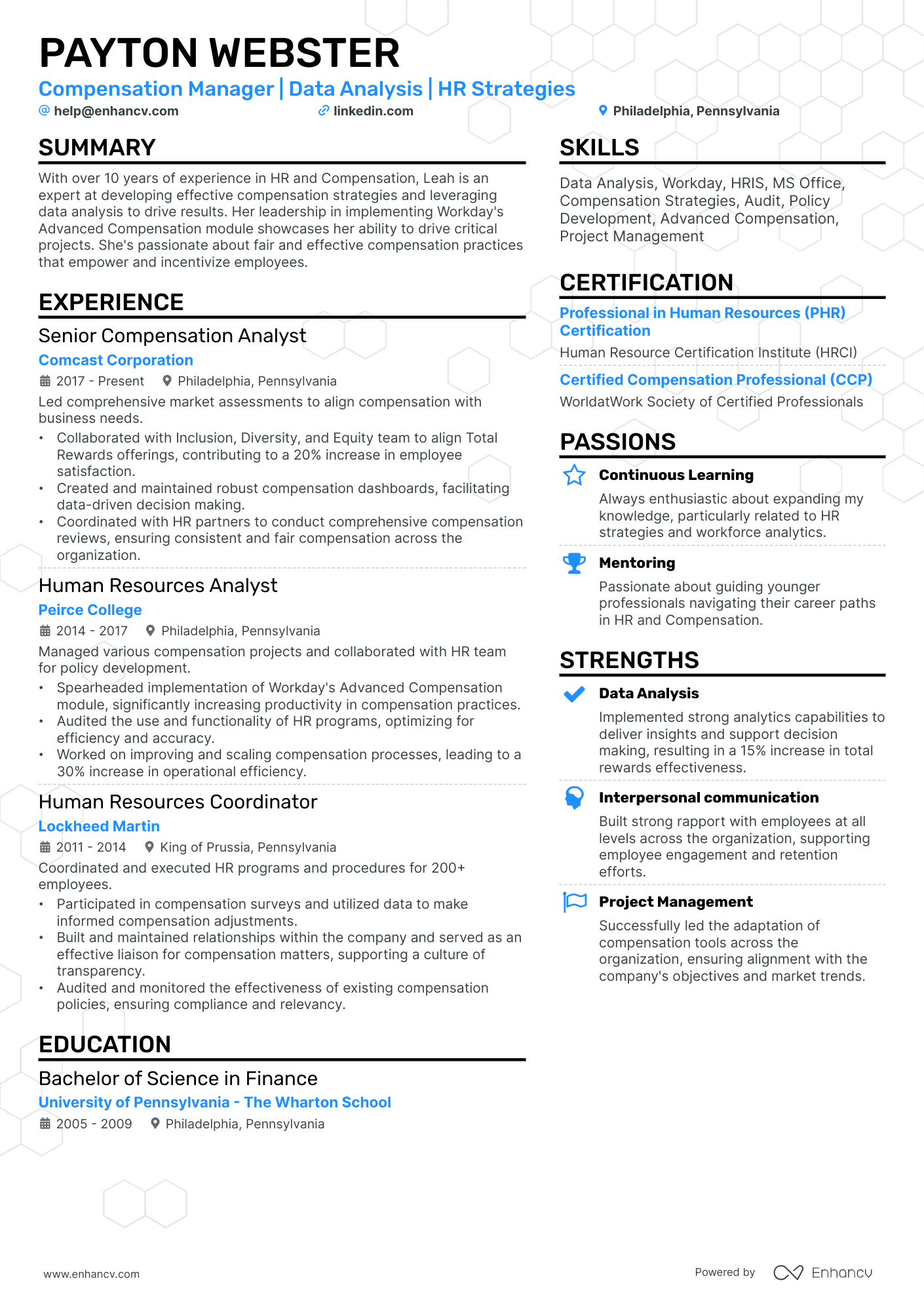
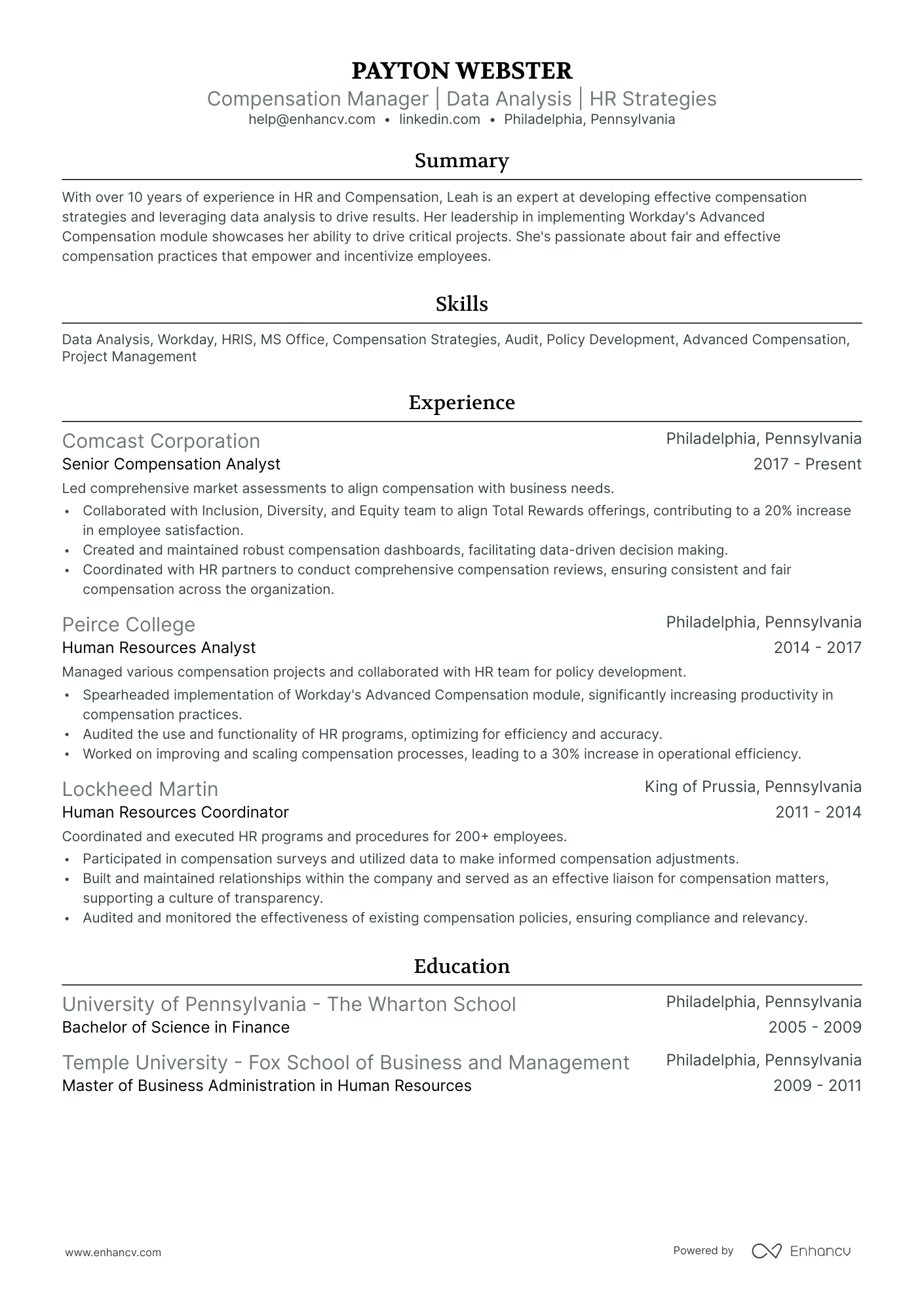
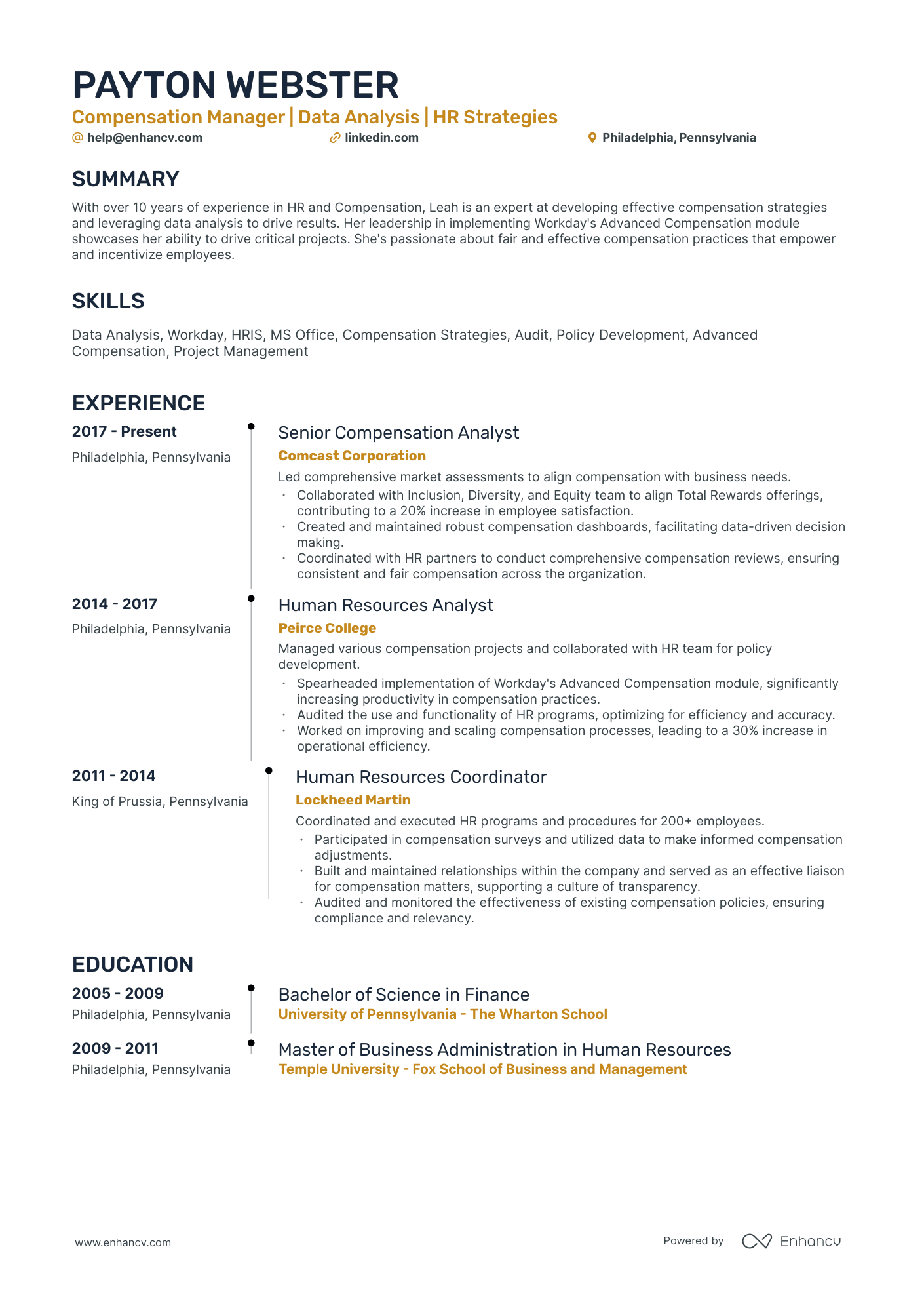
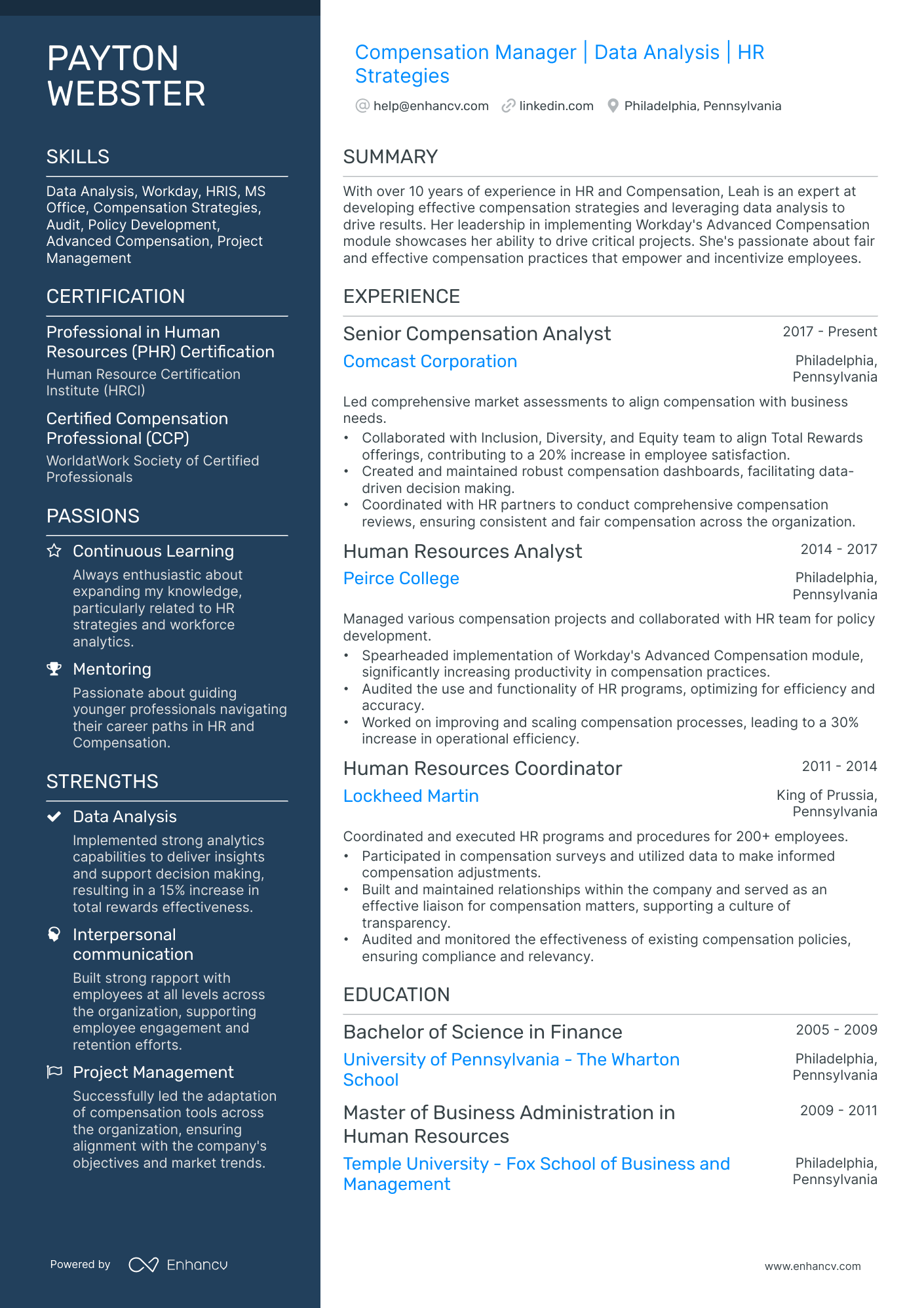
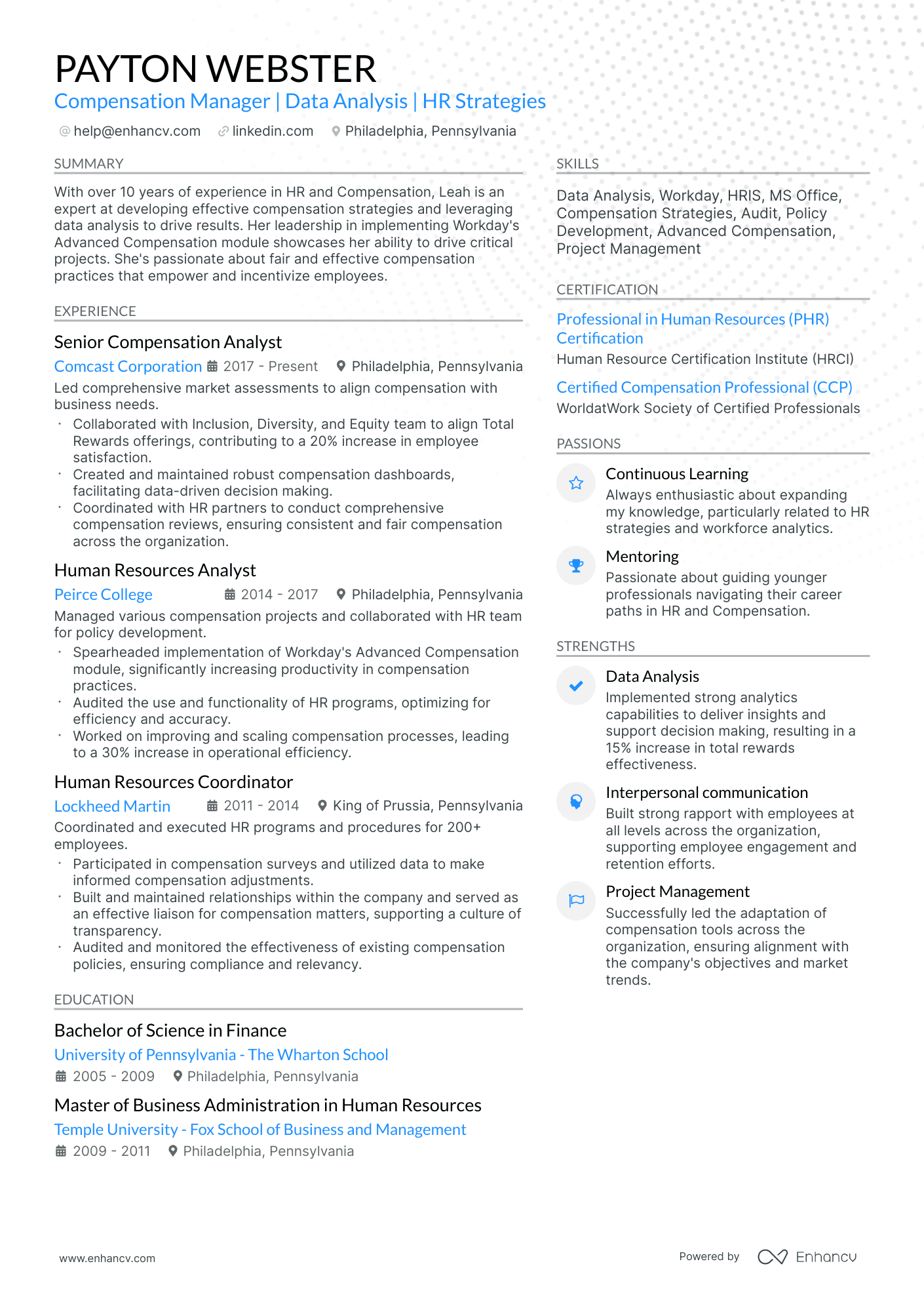
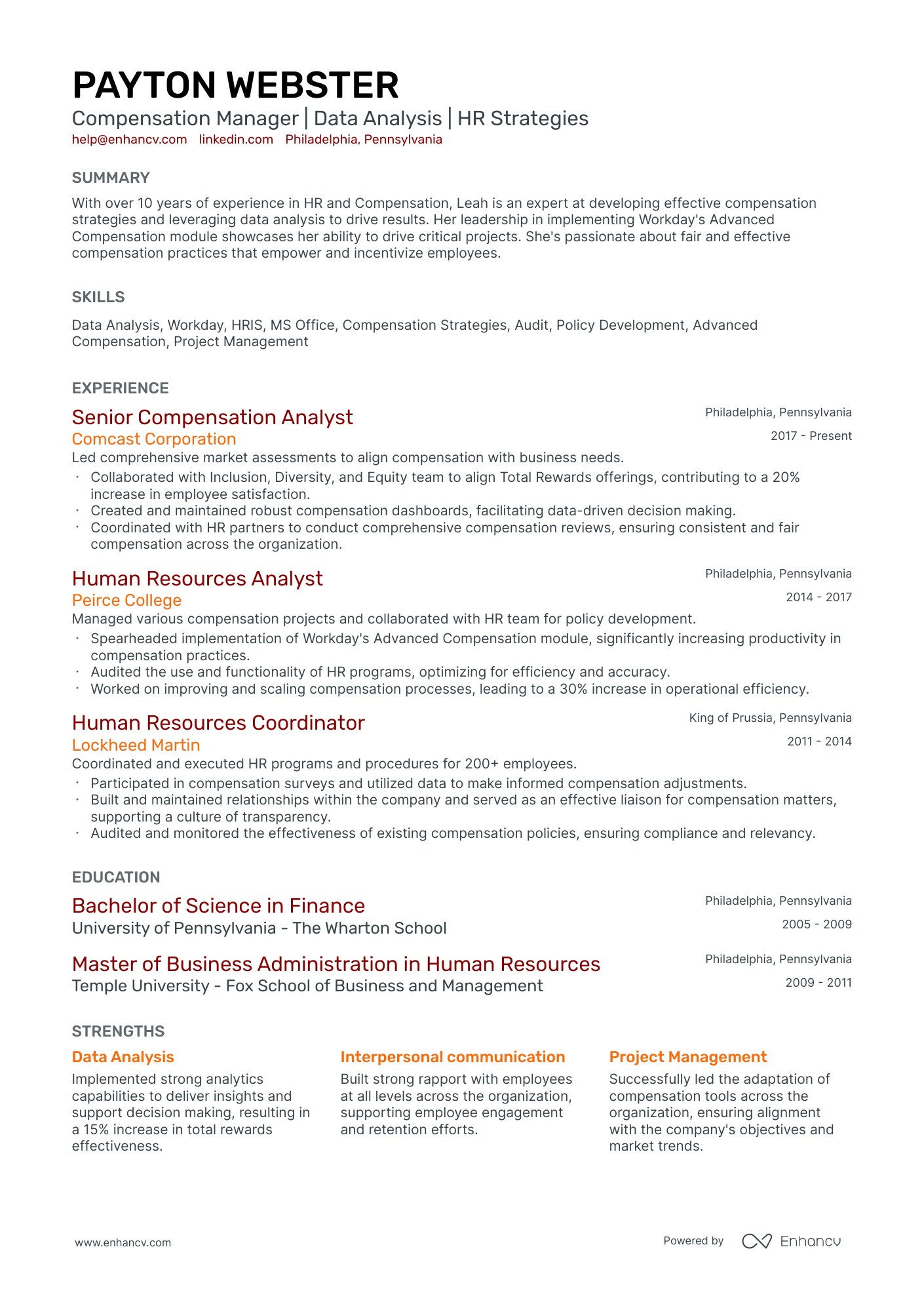
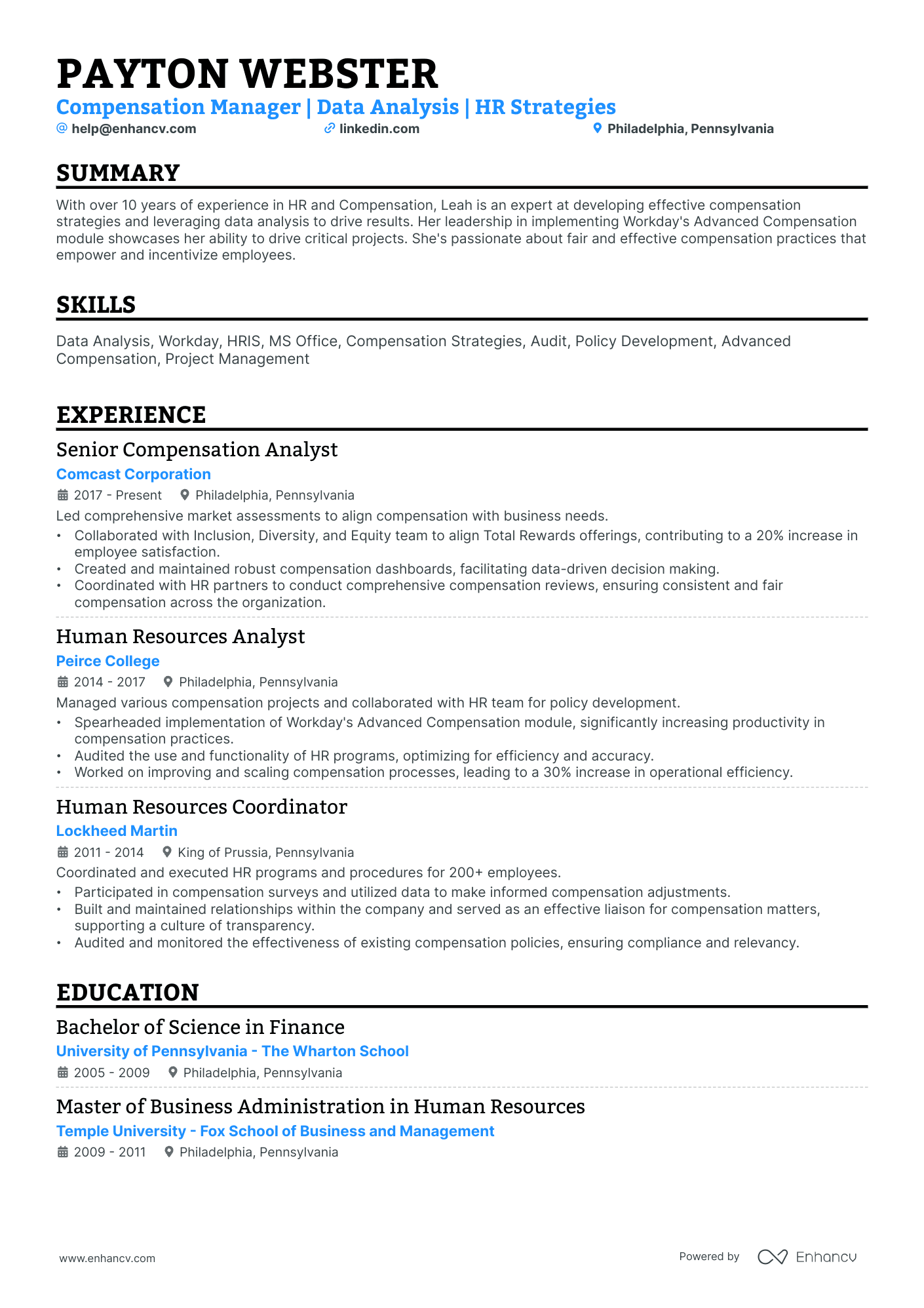
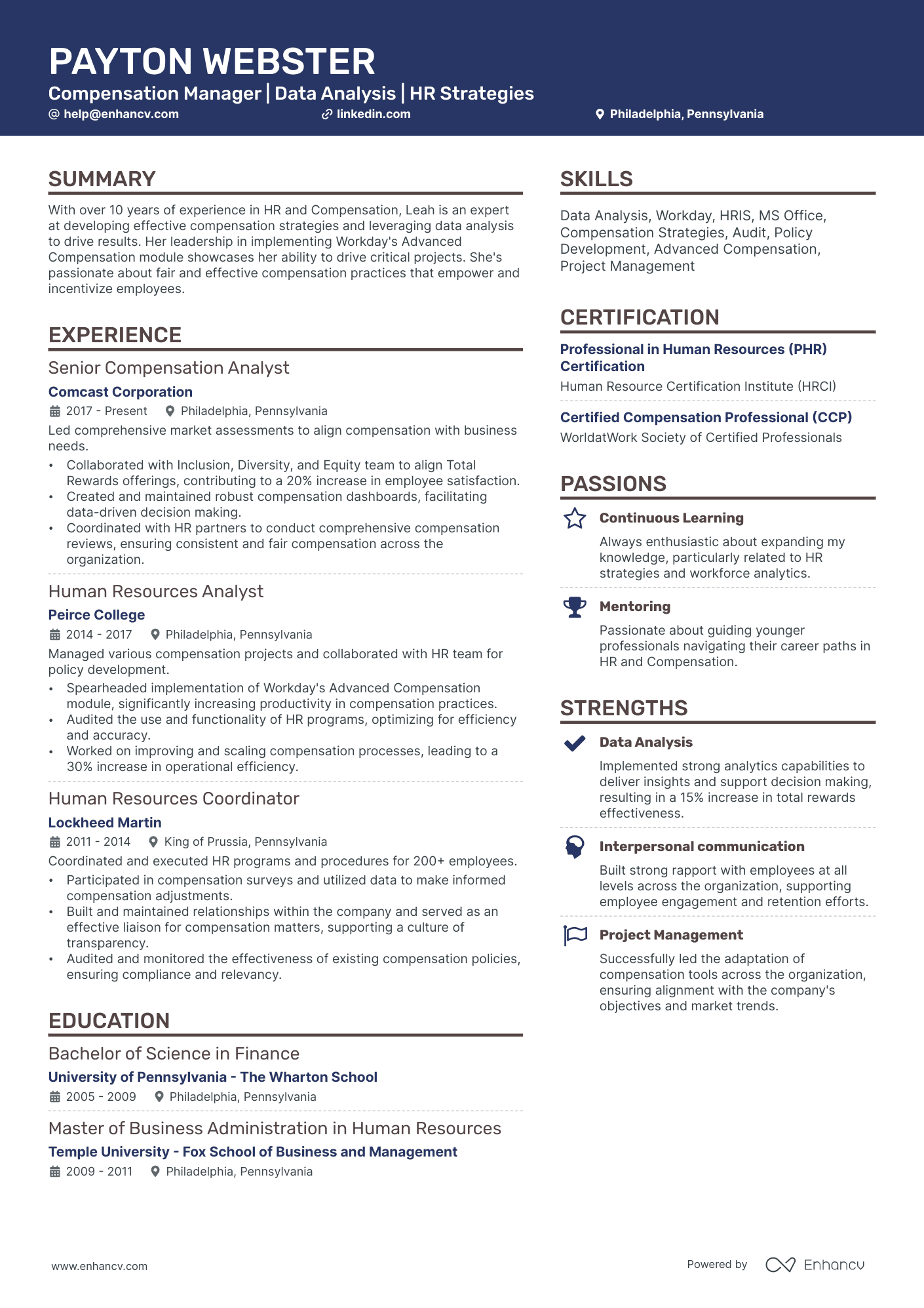
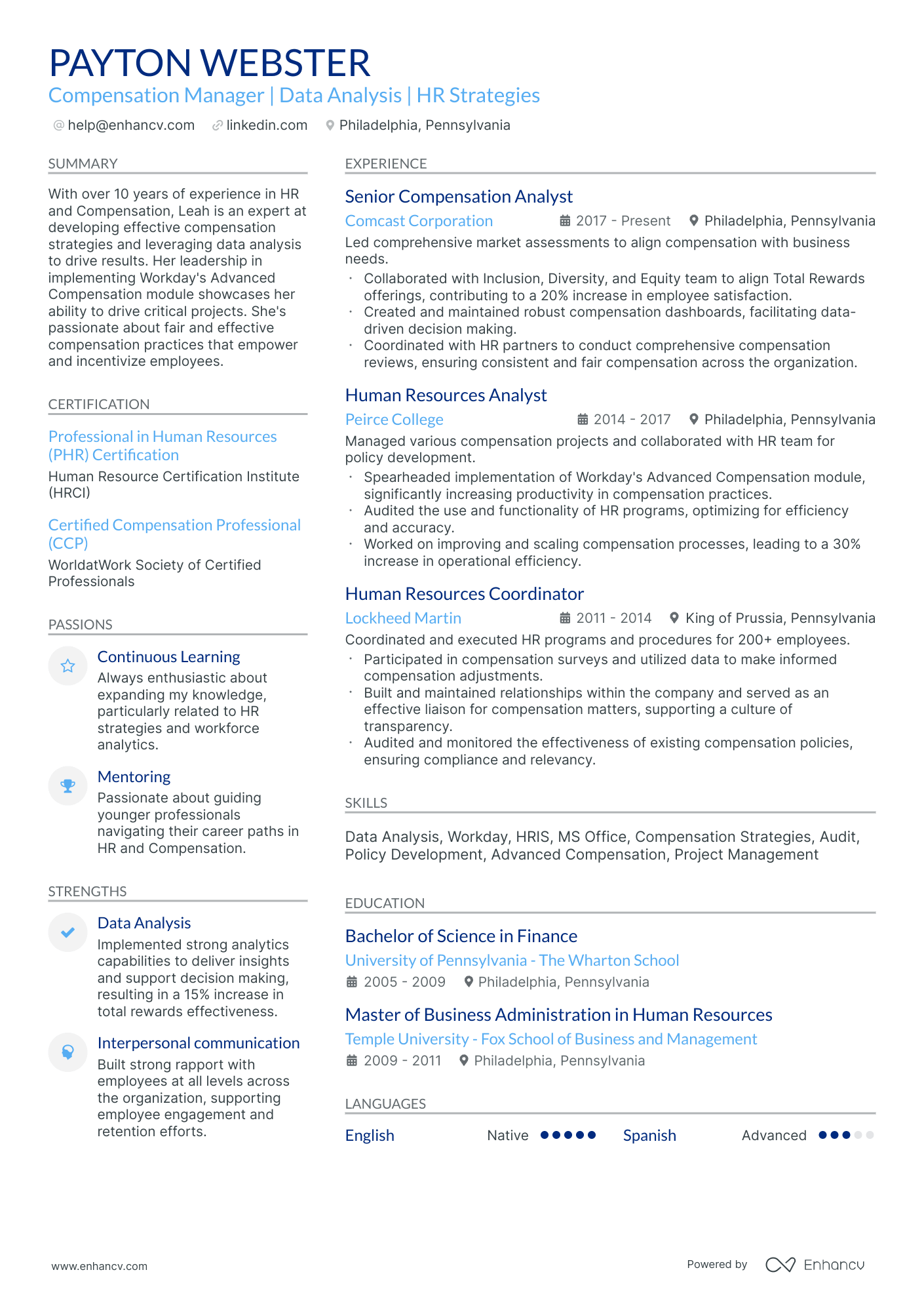
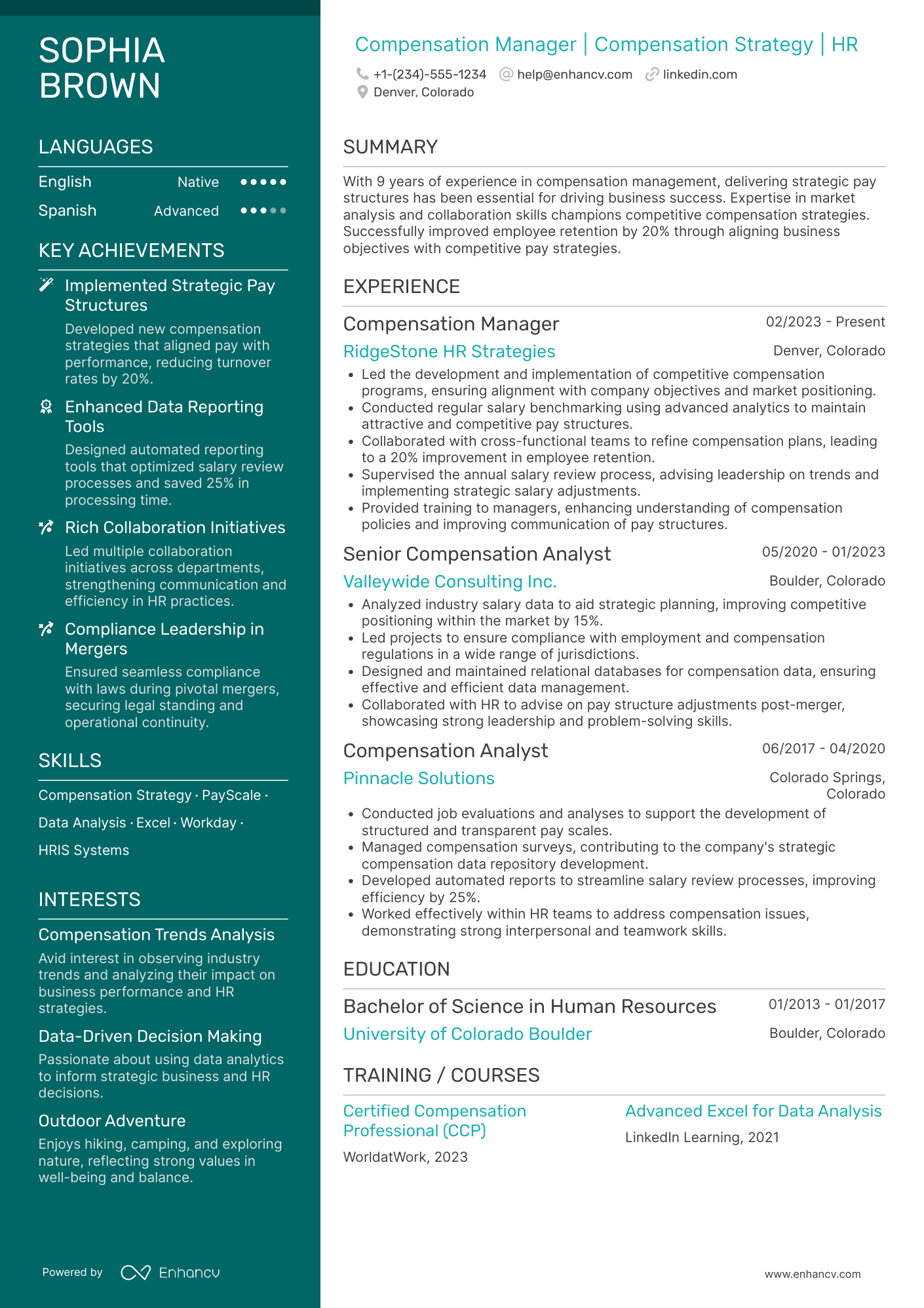
Many compensation manager resume submissions fail because they list software and tasks but don't show measurable pay outcomes or governance impact. That gap gets filtered by ATS screening and lost in fast recruiter scans, especially when competition is high.
A strong resume shows what you changed and why it mattered. Knowing how to make your resume stand out starts with highlighting pay equity improvements, reduced offer declines, tighter salary range adherence, faster cycle times, audit-ready documentation, and the budget scope you managed. Quantify results with clear metrics.

Key takeaways
- Quantify compensation outcomes like pay equity gains, cycle time reductions, and cost savings in every bullet.
- Use reverse-chronological format for experienced candidates and hybrid format for career switchers.
- Tailor resume language to mirror the exact tools, platforms, and terminology in each job posting.
- Demonstrate skills through measurable results in your experience section, not just in a skills list.
- Pair certifications like CCP or PHR with your education section to strengthen recruiter confidence.
- Use AI to refine clarity and fill metric gaps, but stop before it overrides your authentic voice.
- Build your resume faster with Enhancv to ensure clean formatting and ATS-ready structure.
Job market snapshot for compensation managers
We analyzed 93 recent compensation manager job ads across major US job boards. These numbers help you understand top companies hiring, employer expectations, salary landscape at a glance.
What level of experience employers are looking for compensation managers
| Years of Experience | Percentage found in job ads |
|---|---|
| 1–2 years | 1.1% (1) |
| 3–4 years | 2.2% (2) |
| 5–6 years | 26.9% (25) |
| 7–8 years | 16.1% (15) |
| 9–10 years | 9.7% (9) |
| 10+ years | 8.6% (8) |
| Not specified | 44.1% (41) |
Compensation manager ads by area of specialization (industry)
| Industry (Area) | Percentage found in job ads |
|---|---|
| Finance & Banking | 67.7% (63) |
| Healthcare | 16.1% (15) |
Top companies hiring compensation managers
| Company | Percentage found in job ads |
|---|---|
| Acrisure | 14.0% (13) |
| PwC | 10.8% (10) |
Role overview stats
These tables show the most common responsibilities and employment types for compensation manager roles. Use them to align your resume with what employers expect and to understand how the role is structured across the market.
Day-to-day activities and top responsibilities for a compensation manager
| Responsibility | Percentage found in job ads |
|---|---|
| Excel | 36.6% (34) |
| Hris | 26.9% (25) |
| Data analysis | 25.8% (24) |
| Project management | 22.6% (21) |
| Workday | 21.5% (20) |
| Compensation frameworks | 11.8% (11) |
| Change management | 10.8% (10) |
| Hr technology design | 10.8% (10) |
| Job architecture design | 10.8% (10) |
| Market pricing | 10.8% (10) |
| Data visualization | 9.7% (9) |
| Powerpoint | 9.7% (9) |
Type of employment (remote vs on-site vs hybrid)
| Employment type | Percentage found in job ads |
|---|---|
| On-site | 71.0% (66) |
| Hybrid | 19.4% (18) |
| Remote | 9.7% (9) |
How to format a compensation manager resume
Recruiters evaluating compensation manager resumes prioritize evidence of structured pay program design, salary benchmarking expertise, and cross-functional collaboration with HR leadership and finance teams. A clear, well-organized resume format ensures these signals—along with analytical tools proficiency and regulatory compliance knowledge—surface quickly during both human review and applicant tracking system (ATS) parsing.

I have significant experience in this role—which format should I use?
Use a reverse-chronological format to present your compensation management experience in a clear, linear progression that highlights growing scope and accountability. Do:
- Lead with your most recent role and emphasize the breadth of programs, employee populations, and budgets you've owned or influenced.
- Feature core tools and domains prominently—HRIS platforms (Workday, SAP SuccessFactors), market pricing software (PayScale, Mercer WIN), job evaluation frameworks, and FLSA/pay equity compliance.
- Quantify outcomes tied to business impact, including cost savings from compensation restructuring, retention improvements, or pay equity audit results.
I'm junior or switching into this role—what format works best?
A hybrid format works best, allowing you to lead with a focused skills section while still presenting your work history in reverse-chronological order. Do:
- Place a skills section near the top that highlights compensation-relevant competencies such as data analysis, market benchmarking, HRIS administration, and total rewards fundamentals.
- Include project-based experience—internships, compensation survey participation, job evaluation exercises, or benefits administration work—that demonstrates applied knowledge even without a formal compensation manager title.
- Connect every listed skill or project to a specific action and a measurable or observable result.
Why not use a functional resume?
A functional format strips away the timeline and context that recruiters need to evaluate how your compensation knowledge was applied, in which environments, and with what level of independence—making it harder to assess your readiness for the role. A functional resume is acceptable only if you're making a career pivot from a related field (such as financial analysis, benefits administration, or HR generalist work) with no direct compensation title, or if you have a significant gap in employment history—but even then, every listed skill must be tied to a specific project, task, or outcome rather than presented in isolation.
Once you've established a clean, readable format, the next step is deciding which sections to include so each one reinforces your qualifications.
What sections should go on a compensation manager resume
Recruiters expect a compensation manager resume to show clear ownership of compensation strategy, analytics, and program execution across the organization. Understanding which resume sections to include helps you structure your content for maximum clarity:
- Header
- Summary
- Experience
- Skills
- Projects
- Education
- Certifications
- Optional sections: Awards, Leadership, Languages
Your experience bullets should highlight measurable business impact, program outcomes, scope of responsibility, and results delivered through compensation design, governance, and data-driven decisions.
Is your resume good enough?
Drop your resume here or choose a file. PDF & DOCX only. Max 2MB file size.
Once you’ve organized your resume with the right structure and supporting sections, focus next on writing your compensation manager experience to show impact and fit.
How to write your compensation manager resume experience
Your experience section should highlight the compensation programs, structures, and strategies you've shipped—along with the tools, methodologies, and frameworks you used to deliver them. Hiring managers prioritize demonstrated impact on pay equity, total rewards optimization, and organizational alignment over descriptive task lists. Building a targeted resume ensures each entry speaks directly to the role you're pursuing.
Each entry should include:
- Job title
- Company and location (or remote)
- Dates of employment (month and year)
Three to five concise bullet points showing what you owned, how you executed, and what outcomes you delivered:
- Ownership scope: the compensation programs, salary structures, incentive plans, job architectures, or market pricing initiatives you were directly accountable for managing or building.
- Execution approach: the compensation tools, HRIS platforms, benchmarking surveys, statistical models, or regulatory frameworks you applied to analyze data, design pay structures, and inform decisions.
- Value improved: the changes you drove in pay equity, internal compression, offer competitiveness, retention, compliance accuracy, or operational efficiency within the compensation function.
- Collaboration context: how you partnered with HR business partners, finance teams, senior leadership, legal counsel, or external survey vendors to align compensation strategy with broader business and talent objectives.
- Impact delivered: the outcomes your work produced—expressed through organizational scale, business results, or strategic influence—rather than a summary of recurring responsibilities or day-to-day activities.
Experience bullet formula
A compensation manager experience example
✅ Right example - modern, quantified, specific.
Compensation Manager
Brightline Health | Austin, TX (Remote)
2022–Present
High-growth, multi-state healthcare technology company scaling from five hundred to two thousand employees across corporate and clinical teams.
- Led annual merit and bonus cycles for two thousand employees using Workday, delivering a ninety-eight percent on-time completion rate and cutting cycle time by twenty-five percent through automated validations and manager dashboards.
- Built and maintained job architecture and leveling across eight job families, partnering with HR business partners and functional leaders to reduce out-of-band offers by thirty percent and improve internal mobility fill rate by twelve percent.
- Managed market pricing and pay ranges using Radford and Mercer survey data in Payfactors, improving compa-ratio alignment by eight points and reducing pay equity exceptions by forty percent year over year.
- Implemented pay equity analyses in Python and Excel Power Query, partnering with Legal and People Analytics to remediate identified gaps within one quarter and lower regression-adjusted variance by twenty percent.
- Standardized offer review and approval workflows in Workday and Jira, collaborating with Talent Acquisition and Finance to cut offer turnaround time from three days to one day and reduce compensation-related rework by thirty-five percent.
Now that you've seen how a strong experience section comes together, let's look at how to adjust yours to match the specific role you're targeting.
How to tailor your compensation manager resume experience
Recruiters evaluate your compensation manager resume through both applicant tracking systems and manual review, so tailoring your resume to the job description is essential. Tailoring ensures the most relevant qualifications surface immediately during both screening methods.
Ways to tailor your compensation manager experience:
- Match compensation platforms and HRIS tools listed in the job description.
- Mirror the exact pay structure terminology the employer uses.
- Reflect specific compliance standards like FLSA or pay equity regulations mentioned.
- Quantify results using the same KPIs the posting prioritizes.
- Highlight relevant industry experience when the role specifies a sector.
- Align your job leveling or salary banding methodology with theirs.
- Emphasize cross-functional collaboration with HR and finance if referenced.
- Include market pricing or benchmarking approaches the employer names.
Tailoring means connecting your real accomplishments to what the employer needs rather than forcing unrelated keywords into your experience section.
Resume tailoring examples for compensation manager
| Job description excerpt | Untailored | Tailored |
|---|---|---|
| Design and administer base pay structures, salary ranges, and job architecture using MarketPay and Workday Advanced Compensation | Helped manage employee pay and worked on compensation projects. | Designed and administered base pay structures and salary ranges for 2,500+ employees using MarketPay for market pricing and Workday Advanced Compensation for plan configuration and cycle management. |
| Conduct annual compensation benchmarking using Radford and Mercer survey data to ensure market competitiveness across engineering and product roles | Researched salary data and made recommendations about pay. | Conducted annual compensation benchmarking for 300+ engineering and product roles using Radford and Mercer survey data, resulting in a 15% reduction in offer-to-acceptance turnaround time by aligning ranges to the 65th percentile of market. |
| Partner with HRBPs and finance to model cost impacts of proposed pay equity adjustments and ensure compliance with state and federal pay transparency laws | Collaborated with team members on compensation-related compliance tasks. | Partnered with HRBPs and finance to model cost impacts of pay equity adjustments across four business units, ensuring full compliance with California and Colorado pay transparency laws while closing identified pay gaps within a $1.2M budget. |
Once you’ve aligned your experience with the role’s priorities, quantify those results to show the impact behind each contribution.
How to quantify your compensation manager achievements
Quantifying your achievements proves business impact beyond policy updates. Focus on cycle time, accuracy, compliance risk, cost savings, and pay equity outcomes across employees, countries, and job levels.
Quantifying examples for compensation manager
| Metric | Example |
|---|---|
| Cycle time | "Cut annual merit cycle completion time from 21 to 12 days by redesigning workflows in Workday and building manager dashboards in Excel." |
| Data accuracy | "Reduced compensation data errors from 3.8% to 0.9% by adding validation rules, audit checks, and a weekly exception report for 4,200 employees." |
| Compliance risk | "Passed two internal audits with zero findings by updating Fair Labor Standards Act job exemption documentation and standardizing approval trails in ServiceNow." |
| Cost savings | "Lowered total reward program spend by $1.2M annually by renegotiating survey subscriptions and tightening eligibility for retention bonuses across three regions." |
| Pay equity | "Closed 78% of unexplained pay gaps by running pay equity analyses in PayScale and partnering with HR business partners on targeted adjustments within budget." |
Turn vague job duties into measurable, recruiter-ready resume bullets in seconds with Enhancv's Bullet Point Generator.
Once you've crafted strong bullet points that highlight your accomplishments, the next step is ensuring your resume also showcases the right mix of hard and soft skills that compensation manager roles demand.
How to list your hard and soft skills on a compensation manager resume
A well-built skills section shows you can build compliant, competitive pay programs, and recruiters and an ATS (applicant tracking system) scan this section to match you to the job post—aim for a hard-skill-heavy mix with targeted soft skills that support execution. compensation manager roles require a blend of:
- Product strategy and discovery skills.
- Data, analytics, and experimentation skills.
- Delivery, execution, and go-to-market discipline.
- Soft skills.
Your skills section should be:
- Scannable (bullet-style grouping).
- Relevant to the job post.
- Backed by proof in experience bullets.
- Updated with current tools.
Place your skills section:
- Above experience if you're junior or switching careers.
- Below experience if you're mid/senior with strong achievements.

Hard skills
- Job architecture and leveling
- Salary structure design
- Market pricing and benchmarking
- Pay equity analysis
- Incentive plan design
- Annual compensation cycle planning
- Merit and bonus modeling
- Sales compensation plan governance
- Executive compensation support
- HRIS compensation modules, Workday, SAP SuccessFactors
- Advanced Excel, Power BI, Tableau
- Compensation compliance and audits
Soft skills
- Translate strategy into pay programs
- Partner with HR and finance leaders
- Influence without direct authority
- Present pay recommendations clearly
- Negotiate offers and exceptions
- Drive decisions with data narratives
- Manage sensitive information discreetly
- Align stakeholders on tradeoffs
- Document policies and rationale
- Lead cross-functional project timelines
- Challenge assumptions with evidence
- Resolve escalation cases quickly
How to show your compensation manager skills in context
Skills shouldn't live only in a dedicated skills list. Explore resume skills examples to see how top candidates weave competencies throughout their applications.
They should be demonstrated in:
- Your summary (high-level professional identity)
- Your experience (proof through outcomes)
Here's what strong compensation manager entries look like in practice.
Summary example
Compensation manager with 10 years in healthcare, skilled in Workday, market pricing, and pay equity analysis. Led a salary restructuring initiative that reduced turnover by 18% while keeping labor costs within budget.
- Signals senior-level healthcare experience
- Names specific tools like Workday
- Quantifies retention impact with metrics
- Highlights strategic and collaborative thinking
Experience example
Senior Compensation Manager
Brevian Health Partners | Remote
March 2019–Present
- Redesigned the company's five-tier pay structure using MarketPay data, closing a 12% gender pay gap within 18 months.
- Partnered with HR business partners and finance to build incentive models that improved sales retention by 22%.
- Automated quarterly compensation reporting in Workday, cutting manual processing time by 35% across three regional teams.
- Every bullet includes measurable proof
- Skills surface naturally through real outcomes
Once you’ve demonstrated your compensation manager strengths through results and relevant examples, the next step is applying that approach to a compensation manager resume with no experience by translating transferable work into role-aligned evidence.
How do I write a compensation manager resume with no experience
Even without full-time experience, you can demonstrate readiness through transferable projects and relevant coursework. If you're building a resume without work experience, focus on applied compensation knowledge:
- Compensation survey benchmarking project
- HR internship pay band analysis
- Excel-based salary structure modeling
- Job evaluation using point-factor
- Offer review and compa-ratio audit
- Pay equity analysis using regression
- Bonus plan modeling and cost projections
- HRIS data cleanup and reporting
Focus on:
- Pay structure design and governance
- Market pricing and survey sources
- Pay equity analysis and documentation
- HRIS and Excel reporting outputs
Resume format tip for entry-level compensation manager
Use a combination resume format. It highlights projects and technical skills first while still showing relevant education and internships. Do:
- Lead with a "Compensation Projects" section.
- Quantify results with ranges and counts.
- List tools: Excel, Workday, PayScale.
- Show methods: job evaluation, regression.
- Add a clean, relevant coursework line.
- Built an Excel salary structure model using market survey data and compa-ratios, reducing pay range overlap by 18% across 40 roles.
Even without direct experience, your educational background can serve as a strong foundation for your compensation manager resume—so presenting it effectively matters.
How to list your education on a compensation manager resume
Your education section helps hiring teams confirm you have the foundational knowledge needed. It signals expertise in finance, human resources, or business—core areas for any compensation manager.
Include:
- Degree name
- Institution
- Location
- Graduation year
- Relevant coursework (for juniors or entry-level candidates)
- Honors & GPA (if 3.5 or higher)
Skip month and day details—list the graduation year only.
Here's a strong education entry tailored for a compensation manager resume.
Example education entry
Bachelor of Science in Human Resources Management
University of Illinois at Urbana-Champaign, Champaign, IL
Graduated 2019
GPA: 3.7/4.0
- Relevant Coursework: Compensation & Benefits Strategy, Labor Economics, Organizational Behavior, Financial Analysis
- Honors: Dean's List (six consecutive semesters), Beta Gamma Sigma Honor Society
How to list your certifications on a compensation manager resume
Certifications on a resume show a compensation manager's commitment to learning, proficiency with compensation tools, and alignment with current pay practices and compliance expectations.
Include:
- Certificate name
- Issuing organization
- Year
- Optional: credential ID or URL
- Place certifications below education when your degree is recent and more relevant than older credentials.
- Place certifications above education when they are recent, role-specific, or required for your target compensation manager roles.
Best certifications for your compensation manager resume
- Certified Compensation Professional (CCP)
- Global Remuneration Professional (GRP)
- Certified Benefits Professional (CBP)
- Professional in Human Resources (PHR)
- Senior Professional in Human Resources (SPHR)
- SHRM Certified Professional (SHRM-CP)
- Certified Payroll Professional (CPP)
Once you’ve positioned your credentials where recruiters can spot them, use your compensation manager resume summary to quickly connect those qualifications to the value you bring.
How to write your compensation manager resume summary
Your resume summary is the first thing a recruiter reads, so it sets the tone for everything that follows. A strong one instantly connects your compensation expertise to what the hiring team needs.
Keep it to three to four lines, with:
- Your title and total years of experience in compensation or total rewards.
- Domain focus, such as industry sector, company size, or compensation program type.
- Core tools and skills like HRIS platforms, market pricing software, or pay equity analysis.
- One or two measurable achievements, such as cost savings or retention improvements.
- Soft skills tied to real outcomes, like cross-functional collaboration that streamlined pay structures.

PRO TIP
At the compensation manager level, emphasize program ownership, data-driven decision-making, and business impact. Highlight how your strategies influenced retention, pay equity, or budget efficiency. Avoid vague descriptors like "passionate" or "results-oriented." Instead, show results with numbers and specific scope.
Example summary for a compensation manager
Compensation manager with eight years of experience designing pay structures and incentive programs. Led a company-wide pay equity audit that reduced turnover by 14%. Skilled in MarketPay, Workday, and cross-functional stakeholder alignment.
Optimize your resume summary and objective for ATS
Drop your resume here or choose a file.
PDF & DOCX only. Max 2MB file size.
Now that your summary effectively communicates your value, make sure the header framing it presents your professional details accurately and consistently.
What to include in a compensation manager resume header
A resume header is the top section with your key identifiers, and it boosts visibility, credibility, and recruiter screening for a compensation manager role.
Essential resume header elements
- Full name
- Tailored job title and headline
- Location
- Phone number
- Professional email
- GitHub link
- Portfolio link
A LinkedIn link helps recruiters verify experience quickly and supports screening.
Don't include a photo on a compensation manager resume unless the role is explicitly front-facing or appearance-dependent.
Match your header title to the job posting and align your headline with compensation, pay equity, and job architecture responsibilities.
Example
Compensation manager resume header
Jordan Taylor
Compensation Manager | Total Rewards, Pay Equity, Job Architecture
Chicago, IL
(312) 555-78XX
jordan.taylor@enhancv.com github.com/jordantaylor yourwebsite.com linkedin.com/in/jordantaylor
Once you’ve established your identity and contact details at the top, add targeted additional sections to reinforce your fit and provide supporting context.
Additional sections for compensation manager resumes
Adding extra sections strengthens your resume when they highlight specialized expertise or credentials that set you apart from other candidates. For example, listing language skills on your resume can be especially valuable for compensation managers working across global teams or multi-region pay structures.
- Languages
- Certifications (e.g., CCP, GRP, PHR)
- Professional affiliations
- Publications
- Awards and recognition
- Continuing education
- Volunteer experience in HR or compensation consulting
Once you've strengthened your resume with relevant additional sections, the next step is pairing it with a well-crafted cover letter to make your application even more competitive.
Do compensation manager resumes need a cover letter
A cover letter isn't required for every compensation manager role, but it often helps in competitive searches or formal hiring processes. If you're unsure where to start, understanding what a cover letter is and how it complements your resume can clarify when it's worth including. It can make the difference when your resume needs context or when the team expects a clear narrative.
Use a cover letter to add value beyond your resume:
- Explain role and team fit: Connect your compensation manager experience to the company's pay philosophy, operating model, and stakeholders.
- Highlight one or two outcomes: Cite a pay equity review, salary structure redesign, or incentive plan change, and include the measurable result.
- Show business context: Reference the product, users, or growth stage, and explain how you'd align compensation decisions to those realities.
- Address transitions: Clarify a move between industries, a shift into a compensation manager role, or non-obvious experience that supports the work.
Drop your resume here or choose a file.
PDF & DOCX only. Max 2MB file size.
Once you’ve decided whether to include a cover letter to add context beyond your resume, the next step is using AI to refine your compensation manager resume for clarity, relevance, and impact.
Using AI to improve your compensation manager resume
AI can sharpen your resume's clarity, structure, and impact. It helps identify weak phrasing and missed details. But overuse dulls authenticity. Once your content feels clear and role-aligned, step away from AI entirely. If you're wondering which AI is best for writing resumes, the answer depends on your specific needs—but the prompts below work across most tools.
Here are 10 practical prompts to strengthen specific sections of your compensation manager resume:
- Strengthen your summary. "Rewrite my compensation manager resume summary to highlight years of experience, core competencies, and measurable outcomes in under four sentences."
- Quantify experience bullets. "Review my compensation manager experience bullets and suggest specific metrics, percentages, or dollar figures to demonstrate measurable impact."
- Align skills to job posts. "Compare my compensation manager skills section against this job description and identify missing keywords I should add."
- Tighten action verbs. "Replace weak or repeated verbs in my compensation manager experience section with stronger, more precise action verbs."
- Improve project descriptions. "Rewrite my compensation manager project descriptions to clearly state the goal, my role, and the business result."
- Clarify certification relevance. "Explain how each certification listed on my compensation manager resume connects to core job responsibilities."
- Refine education details. "Suggest improvements to my compensation manager education section that emphasize coursework or honors relevant to compensation strategy."
- Remove filler language. "Identify and remove vague or unnecessary words from every section of my compensation manager resume."
- Target senior-level tone. "Adjust the tone of my compensation manager resume to reflect senior-level strategic leadership without exaggerating responsibilities."
- Check section consistency. "Review my entire compensation manager resume for inconsistent formatting, tense shifts, or mismatched date formats."
Stop using AI once your resume sounds accurate, specific, and aligned with real experience. AI should never invent experience or inflate claims—if it didn't happen, it doesn't belong here.
Conclusion
A strong compensation manager resume proves impact with measurable outcomes, like pay equity gains, budget savings, and faster cycle times. It highlights role-specific skills, including job evaluation, salary benchmarking, incentive design, and compliance. Clear structure makes your scope, tools, and results easy to scan.
Today’s hiring market rewards compensation manager candidates who show strong analysis, sound judgment, and clean communication. Keep your resume focused, consistent, and results-driven, so employers can see you’re ready to deliver from day one.