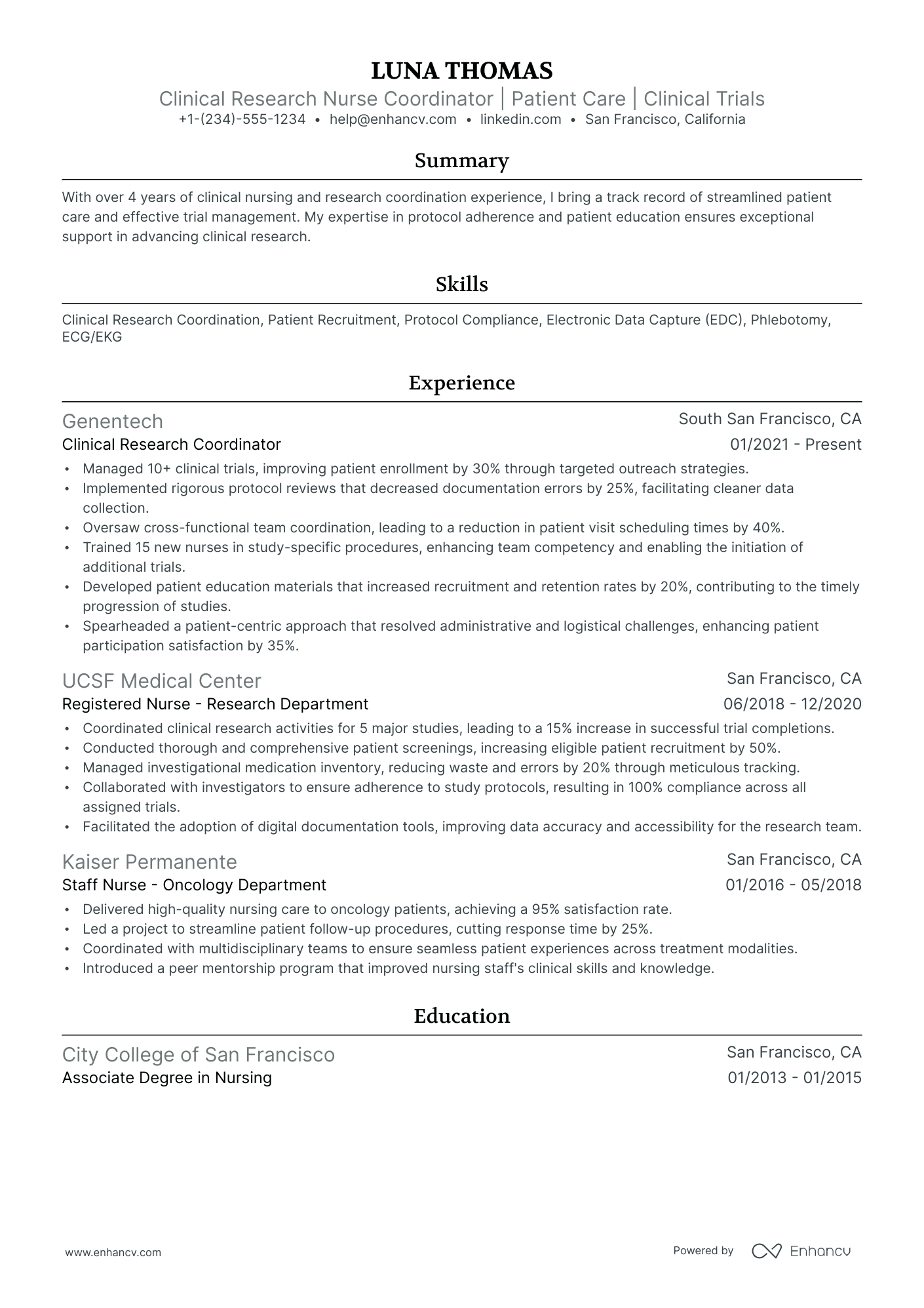
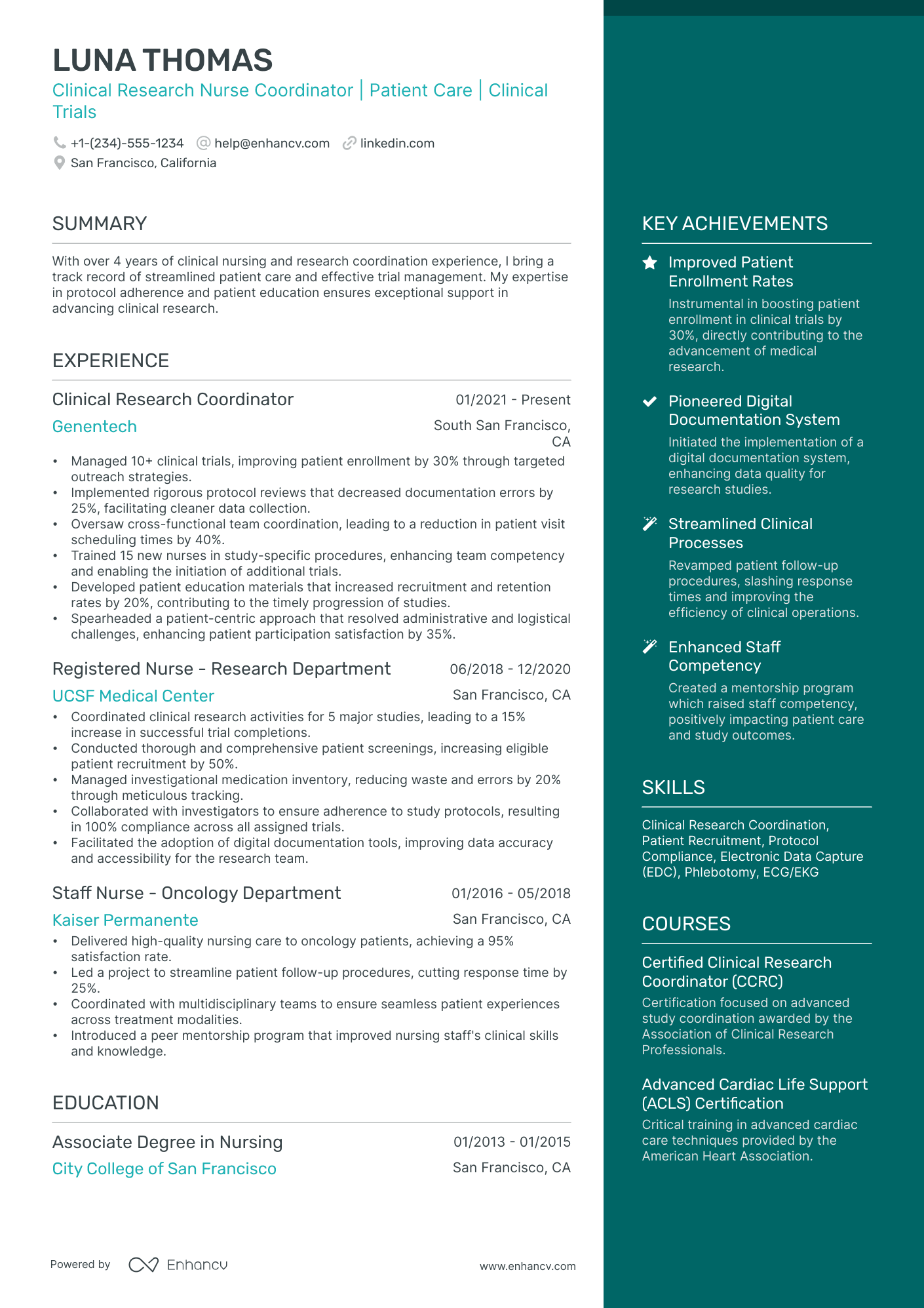
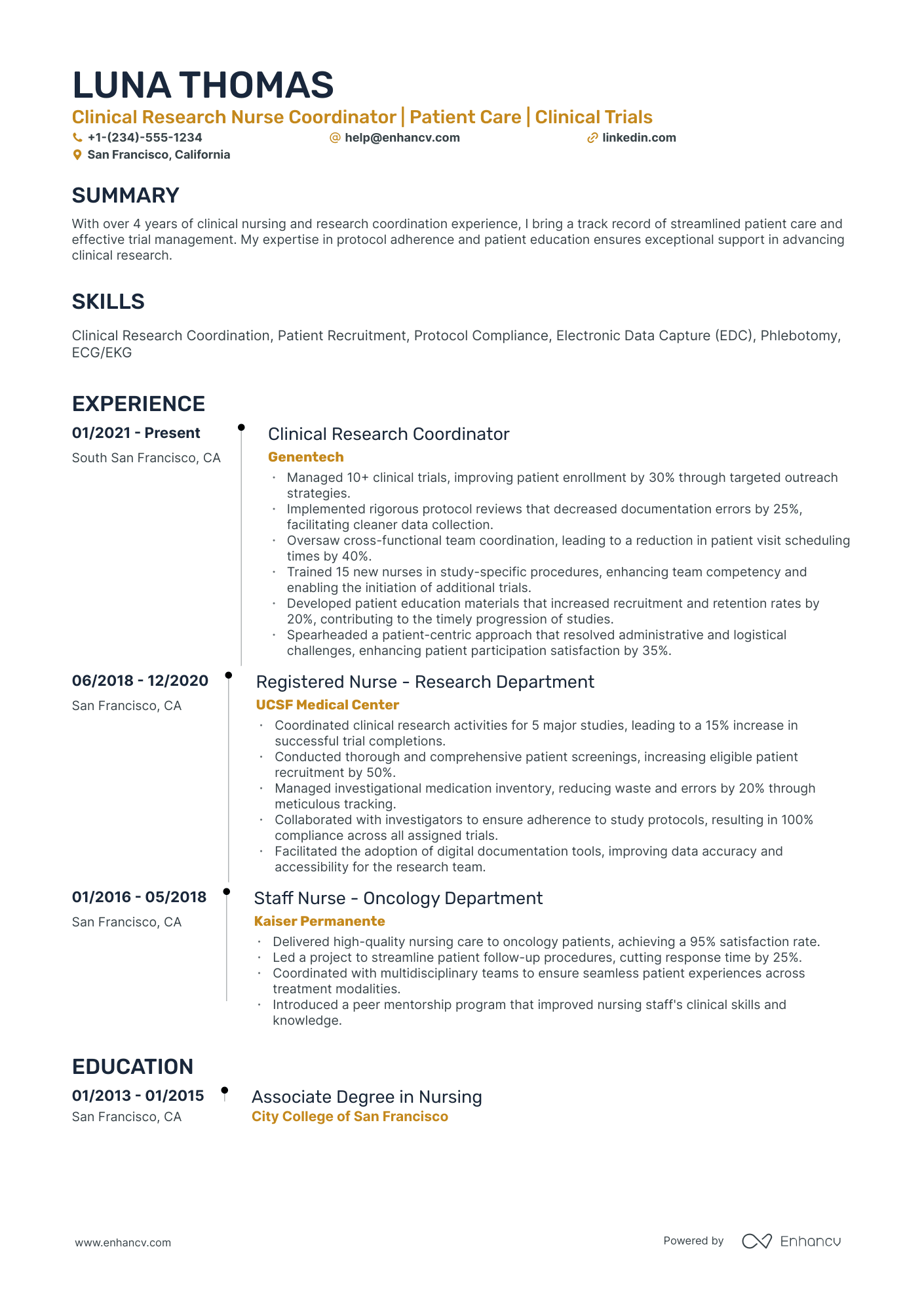
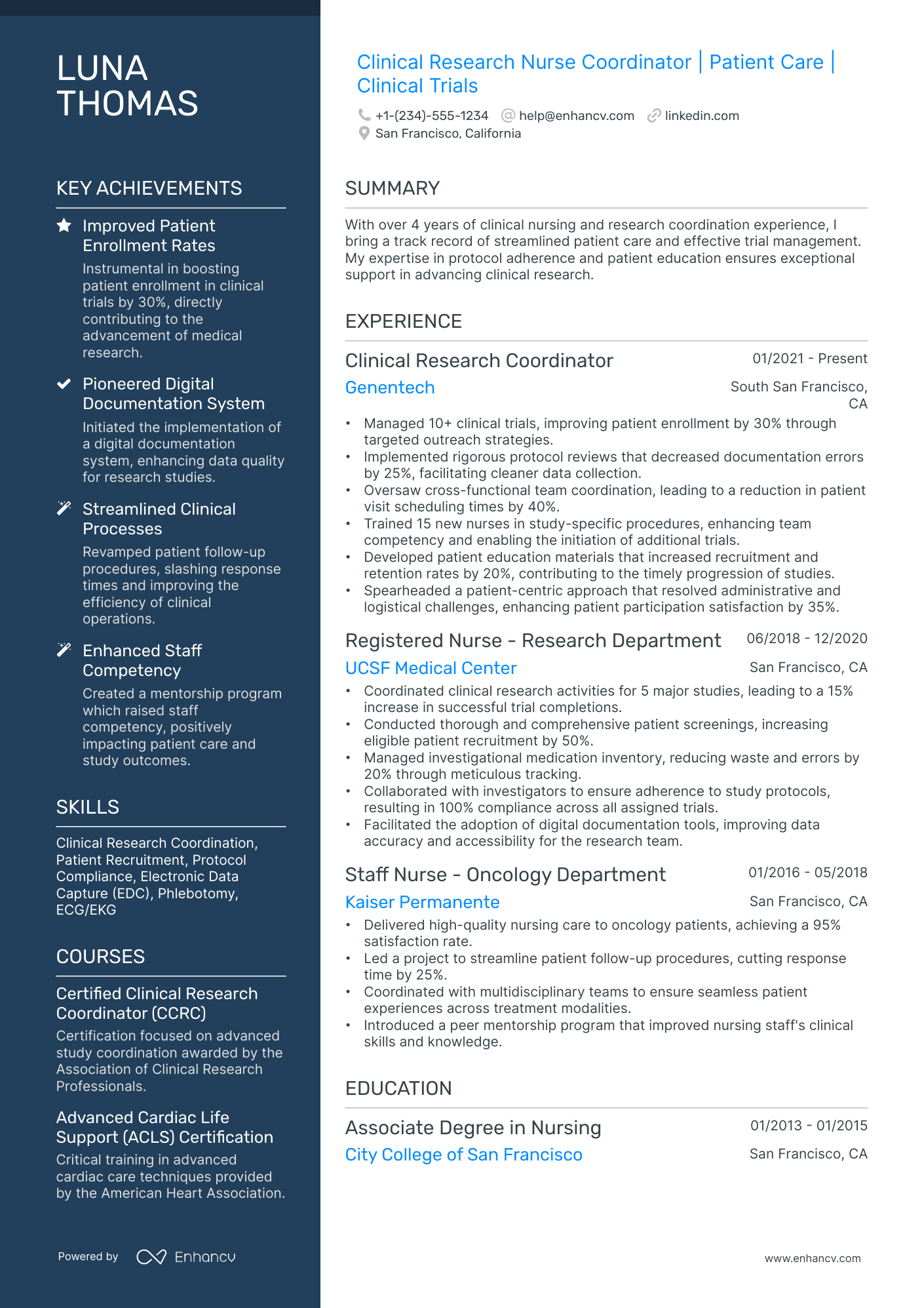
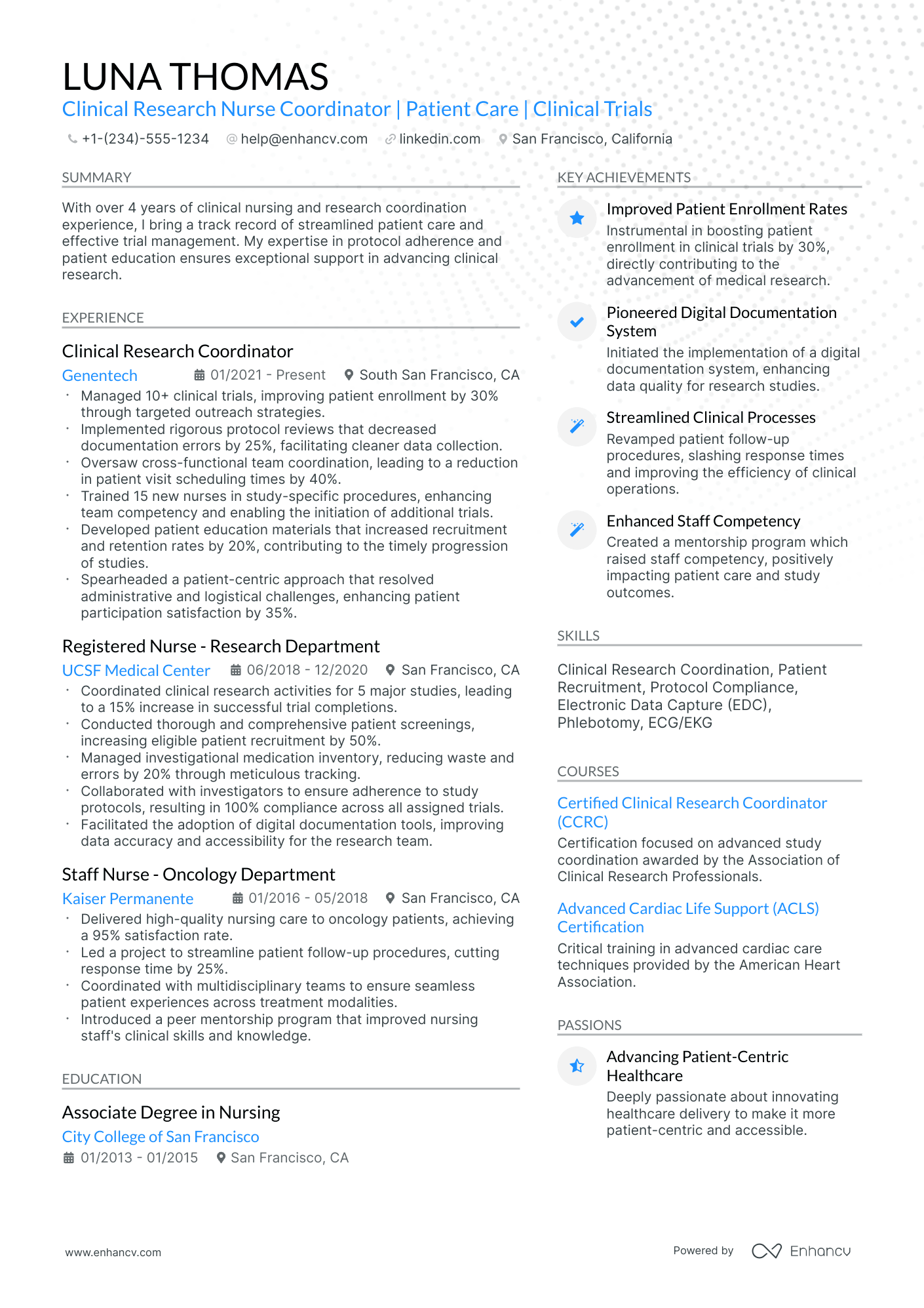
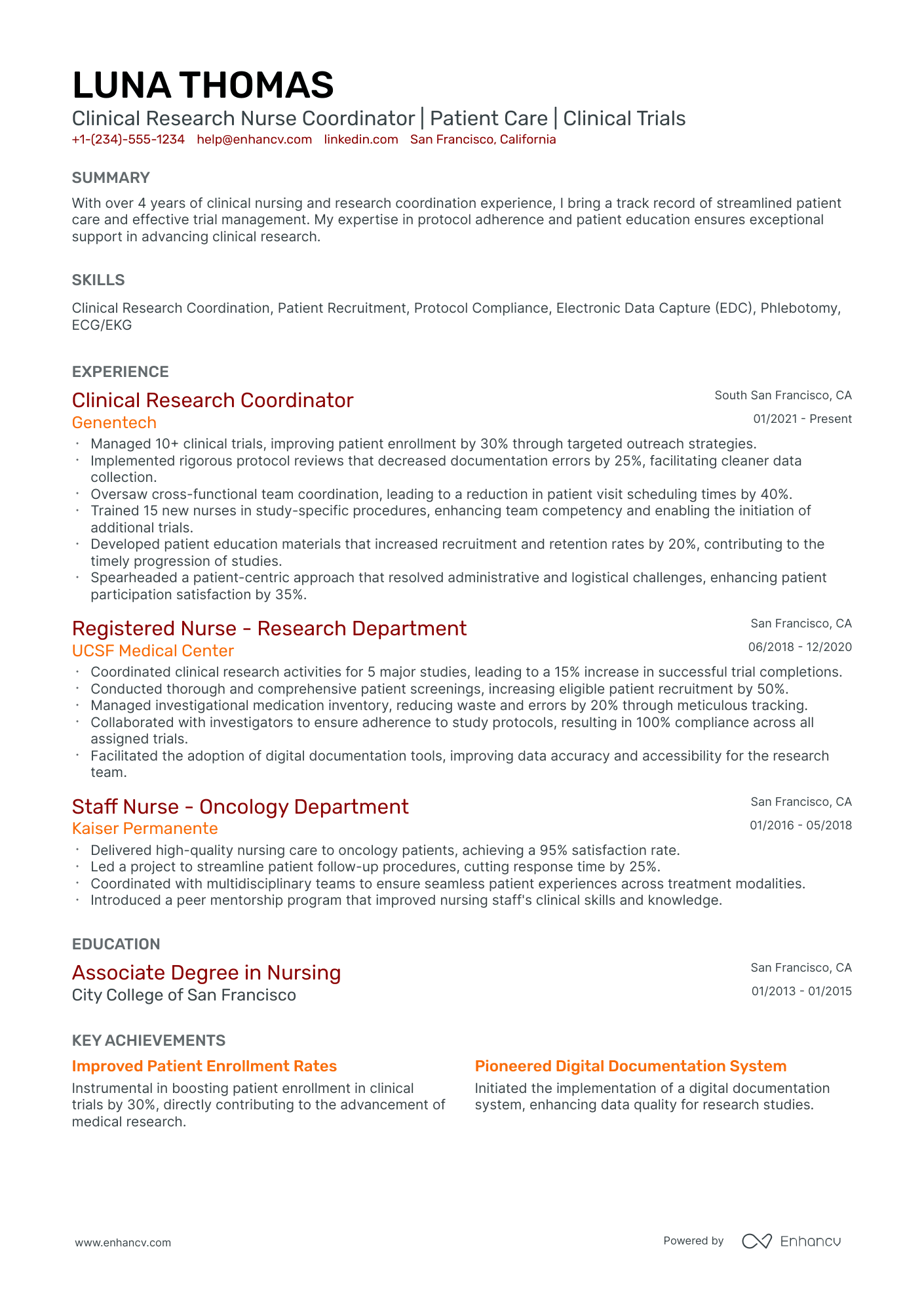
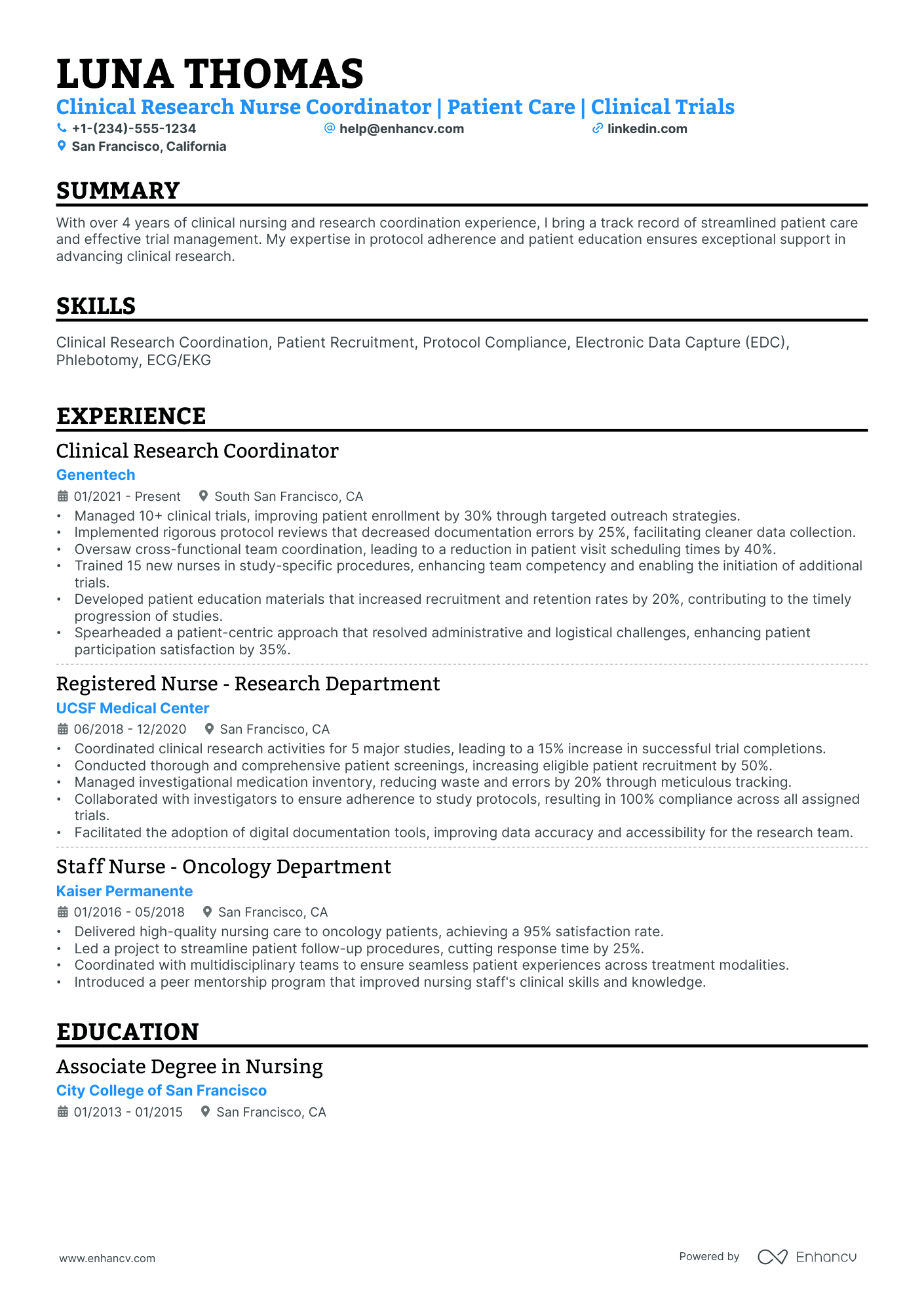
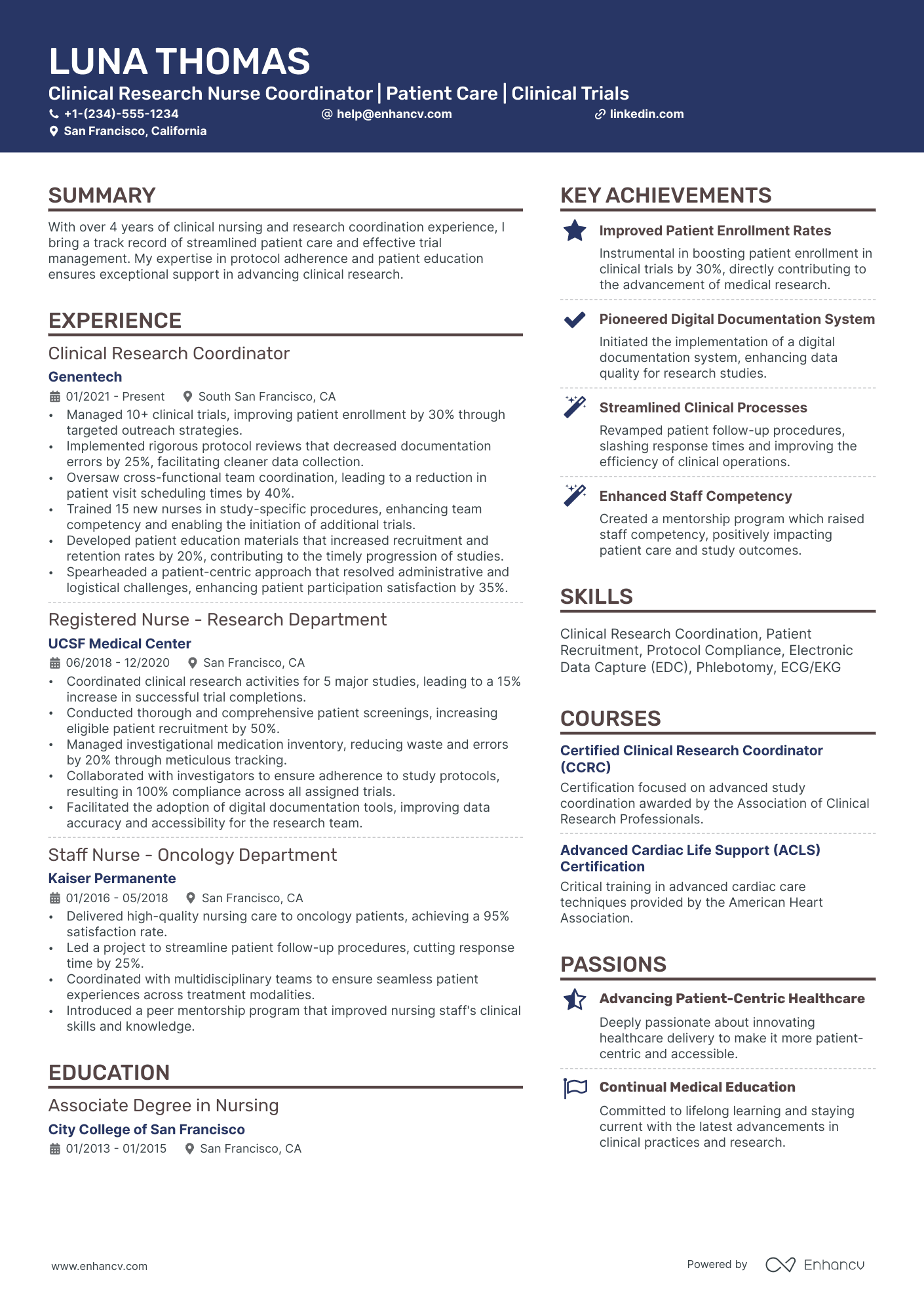
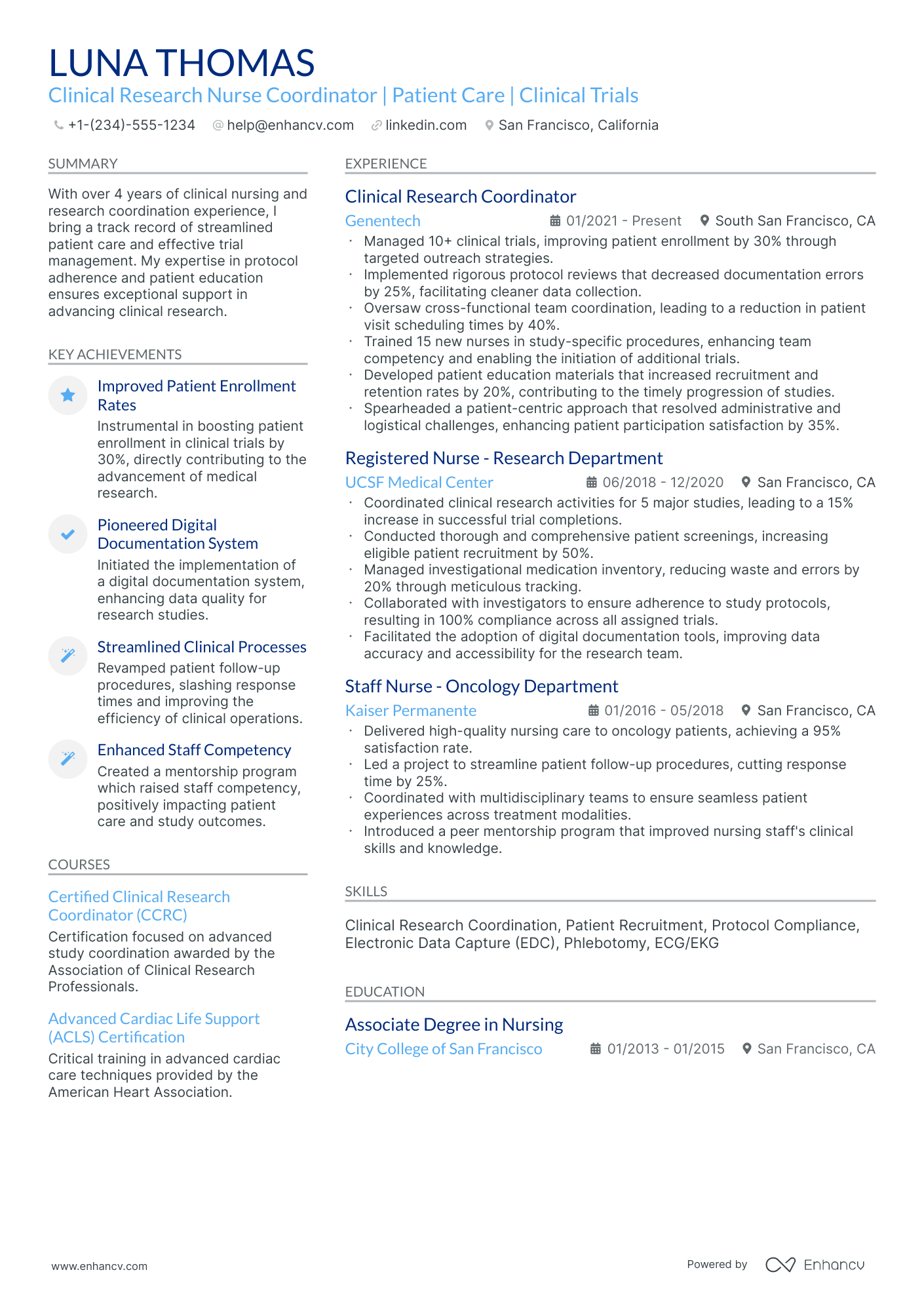
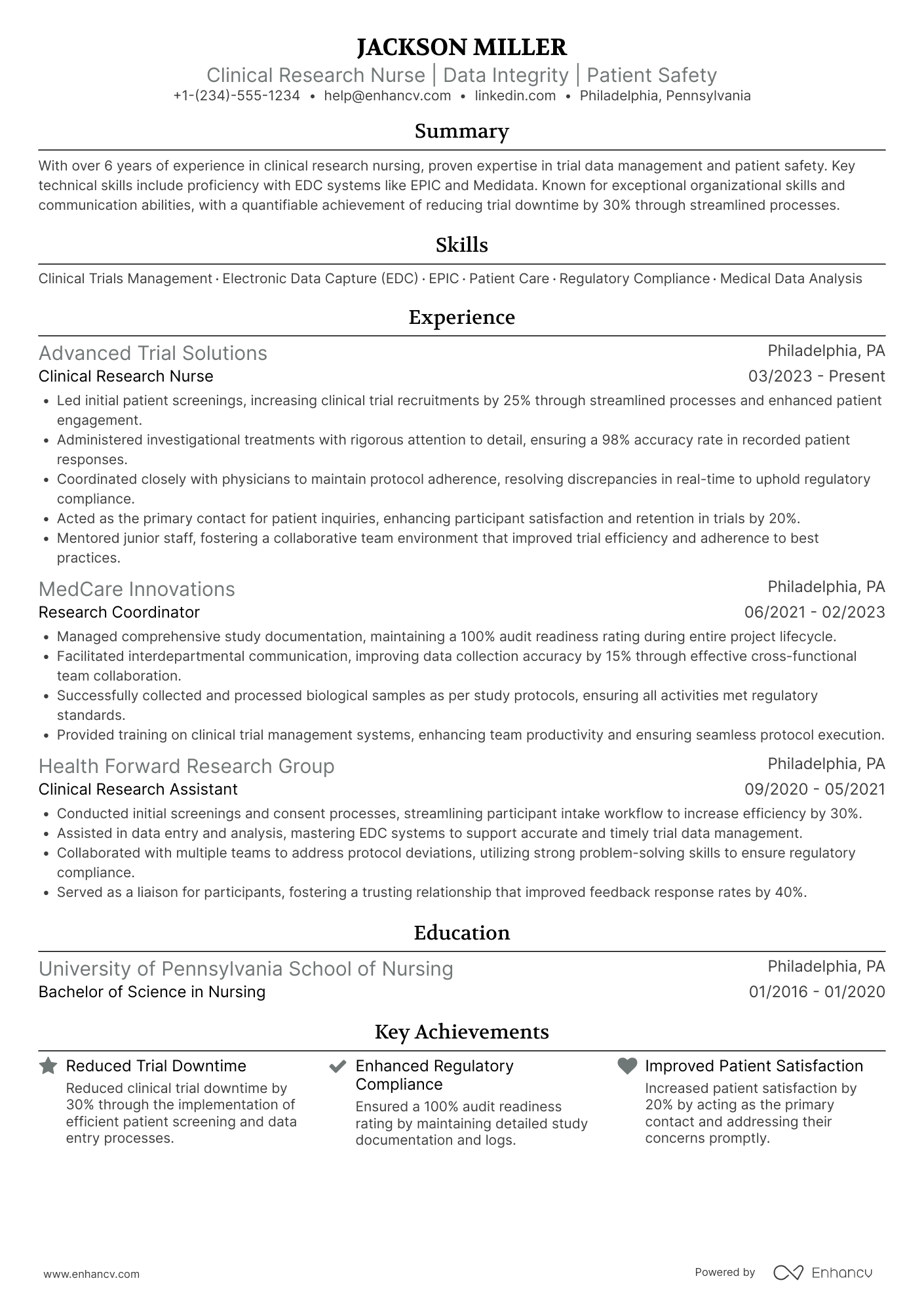
Many clinical research nurse resume drafts fail because they bury protocol compliance, subject safety, and data quality behind generic bedside duties. That lack of role clarity hurts during ATS screening and fast recruiter scans in a crowded market.
A strong resume shows what you improved and delivered. Knowing how to make your resume stand out is essential—you should highlight enrollment volume, retention gains, audit readiness, deviation reductions, query turnaround time, and on-time visit completion across multiple studies and sites. Quantify safety reporting accuracy, training impact, and monitoring feedback outcomes.

Key takeaways
- Quantify enrollment volume, protocol deviations, and query turnaround time in every experience bullet.
- Use reverse-chronological format if you have clinical trial experience; use hybrid if you're transitioning.
- Tailor each resume to the job posting's therapeutic area, EDC platforms, and regulatory language.
- Tie every listed skill to a specific action and measurable result, not just a keyword.
- Place certifications like CCRP or GCP near your education to signal specialized research readiness.
- Write a three- to four-line summary linking your trial phases, tools, and strongest outcome.
- Use Enhancv's Bullet Point Generator to turn vague duties into recruiter-ready, quantified statements.
Job market snapshot for clinical research nurses
We analyzed 126 recent clinical research nurse job ads across major US job boards. These numbers help you understand employer expectations, skills in demand, top companies hiring at a glance.
What level of experience employers are looking for clinical research nurses
| Years of Experience | Percentage found in job ads |
|---|---|
| 1–2 years | 18.3% (23) |
| 3–4 years | 20.6% (26) |
| 5–6 years | 2.4% (3) |
| 10+ years | 0.8% (1) |
| Not specified | 57.1% (72) |
Clinical research nurse ads by area of specialization (industry)
| Industry (Area) | Percentage found in job ads |
|---|---|
| Healthcare | 53.2% (67) |
| Education | 22.2% (28) |
| Finance & Banking | 22.2% (28) |
Top companies hiring clinical research nurses
| Company | Percentage found in job ads |
|---|---|
| Actalent | 23.0% (29) |
| Science 37 | 10.3% (13) |
Role overview stats
These tables show the most common responsibilities and employment types for clinical research nurse roles. Use them to align your resume with what employers expect and to understand how the role is structured across the market.
Day-to-day activities and top responsibilities for a clinical research nurse
| Responsibility | Percentage found in job ads |
|---|---|
| Clinical research | 57.1% (72) |
| Nursing | 23.8% (30) |
| Basic life support | 19.0% (24) |
| Gcp | 13.5% (17) |
| Excel | 12.7% (16) |
| Microsoft office | 12.7% (16) |
| Rn licensure | 12.7% (16) |
| Phlebotomy | 11.9% (15) |
| Word | 11.9% (15) |
| Clinical trials | 11.1% (14) |
| Good clinical practice | 10.3% (13) |
| Data collection | 9.5% (12) |
How to format a clinical research nurse resume
Recruiters evaluating clinical research nurse resumes prioritize clinical trial experience, regulatory knowledge (GCP, FDA, IRB protocols), and patient safety competencies. A clear, well-structured format ensures these signals surface quickly during both human review and applicant tracking system (ATS) scans. Choosing the right resume format is the first step toward making that happen.

I have significant experience in this role—which format should I use?
Use a reverse-chronological format to showcase your depth of clinical research experience and growing responsibilities across trials and therapeutic areas. Do:
- Lead with your most recent role and clearly define scope: number of active protocols, patient enrollment volume, and site or multi-site oversight responsibilities.
- Highlight role-specific expertise including electronic data capture (EDC) systems, adverse event reporting, informed consent processes, and therapeutic area specializations such as oncology, cardiology, or immunology.
- Quantify outcomes tied to trial performance, regulatory compliance, and patient safety metrics.
I'm junior or switching into this role—what format works best?
A hybrid format works best, allowing you to lead with relevant clinical and research skills while supporting them with your work history. Do:
- Place a dedicated skills section near the top featuring competencies like GCP compliance, specimen processing, informed consent administration, and EDC platforms such as Medidata Rave or Oracle Clinical.
- Include clinical rotations, research assistantships, study coordinator work, or any transitional experience that involved protocol adherence, patient monitoring, or data integrity tasks.
- Connect every listed skill or project to a concrete action and a measurable or observable result.
Why not use a functional resume?
A functional format strips away the timeline context that hiring managers need to verify your hands-on exposure to specific trial phases, regulatory environments, and patient populations. Avoid the functional format unless you have no direct clinical research experience and are building your candidacy entirely on transferable skills.
- Edge-case exception: A functional format may be acceptable if you're a bedside nurse or allied health professional transitioning into clinical research with no prior trial experience, or if you're re-entering the workforce after a significant gap—but even then, every skill listed must be tied to a specific project, clinical scenario, or outcome to maintain credibility with reviewers.
Once your format establishes a clean, scannable structure, the next step is deciding which sections to include so every part of your resume serves a clear purpose.
What sections should go on a clinical research nurse resume
Recruiters expect to see clear evidence that you can manage clinical trials, protect patient safety, and deliver compliant study outcomes. Understanding what to put on a resume for this role ensures you include the right details from the start.
Use this structure for maximum clarity:
- Header
- Summary
- Experience
- Skills
- Projects
- Education
- Certifications
- Optional sections: Publications, Research, Languages
Strong experience bullets should emphasize measurable study outcomes, protocol adherence, enrollment and retention performance, cross-functional coordination, and audit-ready documentation.
Is your resume good enough?
Drop your resume here or choose a file. PDF & DOCX only. Max 2MB file size.
Once you’ve organized your resume with the right elements, the next step is to write your clinical research nurse experience section so it clearly supports each part.
How to write your clinical research nurse resume experience
Your experience section should demonstrate the clinical research work you've shipped—protocols managed, patient populations served, regulatory milestones achieved, and data integrity outcomes delivered using role-specific tools and methods. Hiring managers prioritize demonstrated impact over descriptive task lists, so every bullet should connect what you did to a measurable result. Building a targeted resume ensures each entry speaks directly to the role you're pursuing.
Each entry should include:
- Job title
- Company and location (or remote)
- Dates of employment (month and year)
Three to five concise bullet points showing what you owned, how you executed, and what outcomes you delivered:
- Ownership scope: the clinical trials, patient cohorts, study protocols, or site operations you were directly accountable for as a clinical research nurse.
- Execution approach: the regulatory frameworks, electronic data capture systems, clinical monitoring tools, or evidence-based assessment methods you used to guide decisions and deliver compliant, high-quality research.
- Value improved: changes to patient safety, protocol adherence, data accuracy, enrollment efficiency, adverse event response times, or audit readiness that resulted from your work.
- Collaboration context: how you coordinated with principal investigators, sponsors, institutional review boards, data management teams, or multidisciplinary care teams to advance study objectives.
- Impact delivered: outcomes expressed through trial completion milestones, regulatory compliance results, enrollment targets, patient retention improvements, or reductions in protocol deviations—framed as results rather than activities.
Experience bullet formula
A clinical research nurse experience example
✅ Right example - modern, quantified, specific.
Clinical Research Nurse (Oncology)
Riverside Academic Medical Center | Boston, MA
2022–Present
Five-hundred-bed academic hospital running Phase I–III oncology trials across twelve disease programs.
- Coordinated end-to-end execution for twenty-four active oncology protocols (Phase II–III), maintaining ninety-eight percent on-time visit completion and reducing protocol deviations by thirty-two percent through standardized source documentation in Epic and REDCap.
- Performed informed consent discussions and ongoing patient education for one hundred ten participants, improving consent comprehension scores by eighteen percent using teach-back and eConsent workflows in Advarra, while meeting International Council for Harmonisation Good Clinical Practice requirements.
- Managed investigational product workflows with pharmacy and sponsors, reconciling one hundred percent accountability in Interactive Response Technology systems (such as Interactive Web Response Systems) and cutting query turnaround time from five days to two days.
- Collected, processed, and shipped biospecimens for pharmacokinetic and biomarker endpoints, achieving ninety-seven percent first-pass acceptance by central labs through barcode chain-of-custody, temperature monitoring, and pre-analytical checklists aligned to protocol.
- Resolved data discrepancies by partnering with principal investigators, clinical research coordinators, and sponsor clinical research associates, closing an average of forty-five EDC (electronic data capture) queries per month and improving monitoring visit readiness from eighty-four percent to ninety-five percent.
Now that you've seen how a strong experience section comes together, let's look at how to adjust those details to match a specific job posting.
How to tailor your clinical research nurse resume experience
Recruiters evaluate clinical research nurse resumes through both human review and applicant tracking systems, screening for specific qualifications and relevant expertise. Tailoring your resume to the job description increases your chances of passing both layers of review.
Ways to tailor your clinical research nurse experience:
- Match clinical trial management systems and EDC platforms named in the posting.
- Mirror the exact regulatory standards like GCP or ICH referenced.
- Use the same terminology for patient enrollment and screening processes.
- Highlight protocol compliance and adverse event reporting if mentioned.
- Include therapeutic area experience that aligns with the study focus.
- Reflect collaboration models with principal investigators and study sponsors.
- Emphasize monitoring workflows or site management frameworks they reference.
- Align your metrics with the KPIs listed for recruitment or retention.
Every tailored bullet should reflect your real accomplishments reframed to match the job's stated requirements, not keywords forced into place.
Resume tailoring examples for clinical research nurse
| Job description excerpt | Untailored | Tailored |
|---|---|---|
| "Coordinate Phase I–III oncology clinical trials, ensuring compliance with FDA regulations and Good Clinical Practice (GCP) guidelines." | Assisted with clinical trials and helped ensure compliance with regulations. | Coordinated 12 Phase I–III oncology clinical trials simultaneously, maintaining 100% compliance with FDA regulations and GCP guidelines across all study milestones. |
| "Perform patient screening, informed consent, and adverse event monitoring using Oracle Clinical and EDC systems." | Handled patient interactions and entered data into electronic systems. | Screened an average of 30 patients per month for trial eligibility, administered informed consent, and documented adverse events in real time using Oracle Clinical and Medidata Rave EDC systems. |
| "Collaborate with principal investigators and sponsor monitors to manage protocol amendments and ensure IRB submission timelines are met." | Worked with team members on study updates and submitted required paperwork. | Partnered with principal investigators and three sponsor monitors to implement 15 protocol amendments, meeting all IRB submission deadlines within a 48-hour turnaround window. |
Once you align your experience with the role’s clinical and protocol needs, quantify your clinical research nurse achievements to show the impact of that work.
How to quantify your clinical research nurse achievements
Quantifying your achievements proves you improved study delivery, participant safety, and data integrity. Focus on enrollment volume, visit cycle time, protocol deviation rates, audit findings, and query turnaround time across your studies and sites.
Quantifying examples for clinical research nurse
| Metric | Example |
|---|---|
| Enrollment volume | "Enrolled 28 participants in six months across two Phase II oncology trials, meeting 100% of monthly targets in Medidata Rave." |
| Visit cycle time | "Cut screening-to-randomization time from 21 to 14 days by standardizing lab scheduling and same-day source verification." |
| Protocol compliance | "Reduced protocol deviations by 35% quarter over quarter by implementing pre-visit checklists and sponsor-required reconsent tracking." |
| Data query turnaround | "Brought average electronic data capture query resolution from five days to two days, clearing 120+ queries per month in Medidata Rave." |
| Audit readiness | "Completed three sponsor monitoring visits and one internal audit with zero major findings by maintaining 98% source-to-electronic data capture consistency." |
Turn vague job duties into measurable, recruiter-ready resume bullets in seconds with Enhancv's Bullet Point Generator.
Once you've refined how your experience reads on the page, it's equally important to ensure the right hard and soft skills are front and center on your clinical research nurse resume.
How to list your hard and soft skills on a clinical research nurse resume
Skills show you can run protocol-driven patient care, protect data integrity, and support compliance—recruiters and ATS scan this section to match keywords fast, so aim for a balanced mix of role-specific hard skills and job-relevant soft skills. A well-organized skills section makes your qualifications immediately visible to both human reviewers and automated systems. Clinical research nurse roles require a blend of:
- Product strategy and discovery skills.
- Data, analytics, and experimentation skills.
- Delivery, execution, and go-to-market discipline.
- Soft skills.
Your skills section should be:
- Scannable (bullet-style grouping).
- Relevant to the job post.
- Backed by proof in experience bullets.
- Updated with current tools.
Place your skills section:
- Above experience if you're junior or switching careers.
- Below experience if you're mid/senior with strong achievements.

Hard skills
- Good Clinical Practice (GCP)
- International Council for Harmonisation E6 (ICH E6)
- Informed consent documentation
- Protocol adherence and deviations
- Adverse event reporting
- Serious adverse event triage
- Source documentation, ALCOA+
- Electronic data capture, Medidata Rave, REDCap
- Electronic medical records, Epic, Cerner
- Clinical trial management systems
- Specimen collection and processing
- Drug accountability and investigational product handling
Soft skills
- Patient education and teach-back
- Cross-functional coordination with sponsors
- Clear escalation of safety issues
- Accurate handoffs across shifts
- Prioritization under protocol timelines
- Documentation discipline under audit
- Conflict resolution with patients and families
- Stakeholder updates with action items
- Follow-through on corrective actions
- Consent conversations under pressure
- Collaborative problem-solving on deviations
- Ownership of visit readiness checks
How to show your clinical research nurse skills in context
Skills shouldn't live only in a bulleted list on your resume. Explore examples of resume skills in action to see how top candidates integrate them throughout their applications.
They should be demonstrated in:
- Your summary (high-level professional identity)
- Your experience (proof through outcomes)
Here's what strong, skill-integrated writing looks like in practice.
Summary example
Clinical research nurse with 10+ years in oncology trials, skilled in EDC systems, protocol compliance, and adverse event reporting. Led site coordination across three Phase III studies, improving patient retention by 22% through proactive engagement strategies.
- Signals senior-level oncology expertise
- Names role-specific tools and methods
- Quantifies a meaningful patient outcome
- Highlights communication and engagement skills
Experience example
Clinical Research Nurse
Lakeview Medical Research | Chicago, IL
March 2018–Present
- Coordinated 12 concurrent clinical trials using Medidata Rave, reducing data entry errors by 34% through standardized query resolution workflows.
- Collaborated with principal investigators and pharmacy staff to streamline informed consent processes, cutting enrollment timelines by 18%.
- Monitored adverse events for 200+ participants per year, ensuring 100% compliance with FDA reporting requirements and ICH-GCP guidelines.
- Every bullet contains measurable proof.
- Skills appear through real accomplishments.
Once you’ve tied your clinical research nurse abilities to specific responsibilities and outcomes, the next step is to apply that same approach when building a clinical research nurse resume with no experience.
How do I write a clinical research nurse resume with no experience
Even without full-time experience, you can demonstrate readiness through clinical training and academic projects. Our guide on writing a resume without work experience covers strategies that apply directly to clinical research nurse candidates entering the field. Consider building from:
- Nursing school clinical rotations
- Capstone or senior research project
- Institutional review board shadowing
- Electronic health record documentation practice
- Informed consent role-play simulations
- Good Clinical Practice coursework certificate
- Quality improvement data collection project
- Vaccination or screening clinic volunteering
Focus on:
- Protocol adherence and documentation accuracy
- Informed consent and patient screening
- Data capture in electronic systems
- Safety reporting and adverse events
Resume format tip for entry-level clinical research nurse
Use a hybrid resume format because it highlights clinical research nurse skills and projects first, while still showing clinical training and work history. Do:
- Add a "Clinical Research Nurse Projects" section.
- List tools: electronic health record, REDCap.
- Quantify outcomes: counts, time, accuracy.
- Map each bullet to the protocol.
- Include certifications: Good Clinical Practice.
- Completed a capstone chart review using REDCap and electronic health record exports, abstracting 120 records with 98% field completeness verified by faculty audit.
Once you've structured your resume around transferable skills and relevant clinical rotations, the next step is presenting your education—often your strongest asset as a new graduate.
How to list your education on a clinical research nurse resume
Your education section lets hiring teams confirm you hold the clinical and research training a clinical research nurse needs. It validates your foundational nursing knowledge quickly.
Include:
- Degree name
- Institution
- Location
- Graduation year
- Relevant coursework (for juniors or entry-level candidates)
- Honors & GPA (if 3.5 or higher)
Skip month and day details—list the graduation year only.
Here's a strong education entry tailored for a clinical research nurse resume.
Example education entry
Bachelor of Science in Nursing
University of Pennsylvania, Philadelphia, PA
Graduated 2021
GPA: 3.7/4.0
- Relevant Coursework: Clinical Pharmacology, Biostatistics, Evidence-Based Research Methods, Patient Assessment
- Honors: Magna Cum Laude, Sigma Theta Tau International Honor Society
How to list your certifications on a clinical research nurse resume
Certifications on your resume show your commitment to learning, your proficiency with clinical research tools, and your relevance to regulated research settings as a clinical research nurse.
Include:
- Certificate name
- Issuing organization
- Year
- Optional: credential ID or URL
- List certifications below education when your highest degree is recent and your certifications are older or less relevant to clinical research nurse work.
- List certifications above education when they are recent, role-relevant, or required, especially if they strengthen your clinical research nurse qualifications.
Best certifications for your clinical research nurse resume
- Certified Clinical Research Professional (CCRP)
- Association of Clinical Research Professionals Certified Professional (ACRP-CP)
- Certified Clinical Research Coordinator (CCRC)
- Good Clinical Practice (GCP) Certification
- Human Subjects Protection (HSP) Certification
- International Air Transport Association (IATA) Dangerous Goods Regulations Training
- Basic Life Support (BLS)
Once you’ve positioned your credentials so they’re easy to verify, use your clinical research nurse resume summary to highlight the qualifications they support and set context for the rest of your resume.
How to write your clinical research nurse resume summary
Your resume summary is the first thing a recruiter reads. A strong one immediately connects your clinical research experience to the role's requirements.
Keep it to three to four lines, with:
- Your title and total years of clinical research nursing experience.
- The therapeutic areas, trial phases, or research settings you know best.
- Core skills like protocol implementation, FDA regulatory compliance, or EDC systems.
- One or two measurable results, such as enrollment targets met or protocol deviations reduced.
- Interpersonal strengths shown through real outcomes, like patient retention or team coordination.

PRO TIP
At this level, focus on specific clinical skills, relevant certifications, and early contributions to research teams. Highlight familiarity with tools like Medidata Rave or OnCore. Avoid vague phrases like "passionate team player" or "seeking growth opportunities." Replace them with concrete details that show what you've done.
Example summary for a clinical research nurse
Clinical research nurse with three years of experience supporting Phase II–III oncology trials. Skilled in protocol compliance, adverse event reporting, and Medidata Rave. Improved participant retention by 18% through structured follow-up processes.
Optimize your resume summary and objective for ATS
Drop your resume here or choose a file.
PDF & DOCX only. Max 2MB file size.
Now that your summary captures your clinical research expertise at a glance, make sure your header provides the essential contact details recruiters need to actually reach you.
What to include in a clinical research nurse resume header
A well-crafted resume header lists your key identifiers and contact details, helping clinical research nurse candidates boost visibility, credibility, and pass recruiter screening faster.
Essential resume header elements
- Full name
- Tailored job title and headline
- Location
- Phone number
- Professional email
- GitHub link
- Portfolio link
A LinkedIn link lets recruiters confirm your work history quickly and supports fast screening.
Don't include a photo on a clinical research nurse resume unless the role is explicitly front-facing or appearance-dependent.
Match your header job title to the posting and mirror key clinical research nurse keywords used by the employer.
Example
Clinical research nurse resume header
Jordan Patel
Clinical research nurse | Oncology trials, protocol compliance, and patient safety
Boston, MA
(617) 555-12XX
jordan.patel@enhancv.com
github.com/jordanpatel
jordanpatel.com
linkedin.com/in/jordanpatel
Once your contact details and credentials are clearly presented at the top, add targeted additional sections to reinforce your clinical research qualifications and support the rest of your resume.
Additional sections for clinical research nurse resumes
Adding extra sections helps you stand out when your core qualifications match other clinical research nurse candidates competing for the same role.
These sections highlight specialized knowledge, professional engagement, and unique strengths that hiring managers value:
- Publications and research presentations
- Professional affiliations and memberships
- Languages
- Continuing education and specialized training
- Certifications in Good Clinical Practice (GCP)
- Volunteer clinical or community health experience
- Hobbies and interests
Once you've strengthened your resume with relevant additional sections, the next step is pairing it with a well-crafted cover letter to make your application even more competitive.
Do clinical research nurse resumes need a cover letter
A cover letter isn't required for every clinical research nurse role, but it often helps in competitive postings or formal hospital and sponsor hiring processes. If you're unsure where to start, learn what a cover letter is and how it complements your resume. It can make a difference when the hiring team expects context beyond the resume.
Use a cover letter to add details your resume can't show:
- Explain role and team fit by linking your experience to the study phase, therapeutic area, site setup, and cross-functional workflow.
- Highlight one or two relevant projects or outcomes, such as enrollment improvements, protocol deviation reduction, audit readiness, or faster startup timelines.
- Show understanding of the product, users, or business context by referencing the indication, patient population, endpoints, and the sponsor or site priorities.
- Address career transitions or non-obvious experience by mapping transferable skills, such as bedside nursing to trials, or coordinator work to monitoring support.
Drop your resume here or choose a file.
PDF & DOCX only. Max 2MB file size.
Once you’ve decided whether to include a cover letter to support your application, you can use AI to improve your clinical research nurse resume so it communicates your qualifications clearly and efficiently.
Using AI to improve your clinical research nurse resume
AI can sharpen your resume's clarity, structure, and impact. It helps reframe bullet points and align language with job descriptions. If you're wondering which AI is best for writing resumes, the answer depends on how much control you want over tone and formatting. But overuse strips authenticity. Once your content feels clear and role-aligned, step away from AI.
Here are 10 practical prompts to strengthen specific sections of your clinical research nurse resume:
- Strengthen your summary. "Rewrite my clinical research nurse resume summary to highlight protocol expertise, patient safety focus, and regulatory knowledge in three concise sentences."
- Quantify experience bullets. "Add measurable outcomes to these clinical research nurse experience bullets, focusing on patient enrollment numbers, protocol adherence rates, and audit results."
- Align skills with job posts. "Compare my clinical research nurse skills section against this job description and suggest missing keywords related to clinical trials and compliance."
- Sharpen action verbs. "Replace weak or passive verbs in my clinical research nurse experience section with strong, specific action verbs tied to research coordination tasks."
- Refine certification details. "Rewrite my clinical research nurse certifications section to clearly state credential names, issuing bodies, and renewal dates in consistent formatting."
- Improve education entries. "Restructure my clinical research nurse education section to emphasize coursework, clinical rotations, and research methods relevant to trial-site nursing."
- Clarify project contributions. "Rewrite my clinical research nurse project descriptions to specify my individual role, the study phase, therapeutic area, and key deliverables."
- Tighten regulatory language. "Review my clinical research nurse resume for vague compliance references and replace them with specific mentions of FDA, ICH-GCP, or IRB standards."
- Remove redundant phrasing. "Identify and eliminate repeated or filler phrases across my clinical research nurse resume without losing clinical detail or measurable results."
- Tailor for ATS screening. "Adjust my clinical research nurse resume formatting and keyword placement so applicant tracking systems can parse each section accurately."
Stop using AI once your resume sounds accurate, specific, and aligned with real experience. AI should never invent experience or inflate claims—if it didn't happen, it doesn't belong here.
Conclusion
A strong clinical research nurse resume shows measurable outcomes, role-specific skills, and a clear structure. It highlights enrollment results, protocol adherence, data quality, and safety reporting. It uses clean headings, focused bullets, and consistent formatting to make key details easy to scan.
This approach shows you can deliver in today’s hiring market and adapt to near-future needs. Your clinical research nurse resume should prove you can manage trials, coordinate teams, and protect participants while meeting timelines. Keep it precise, results-driven, and easy to review.