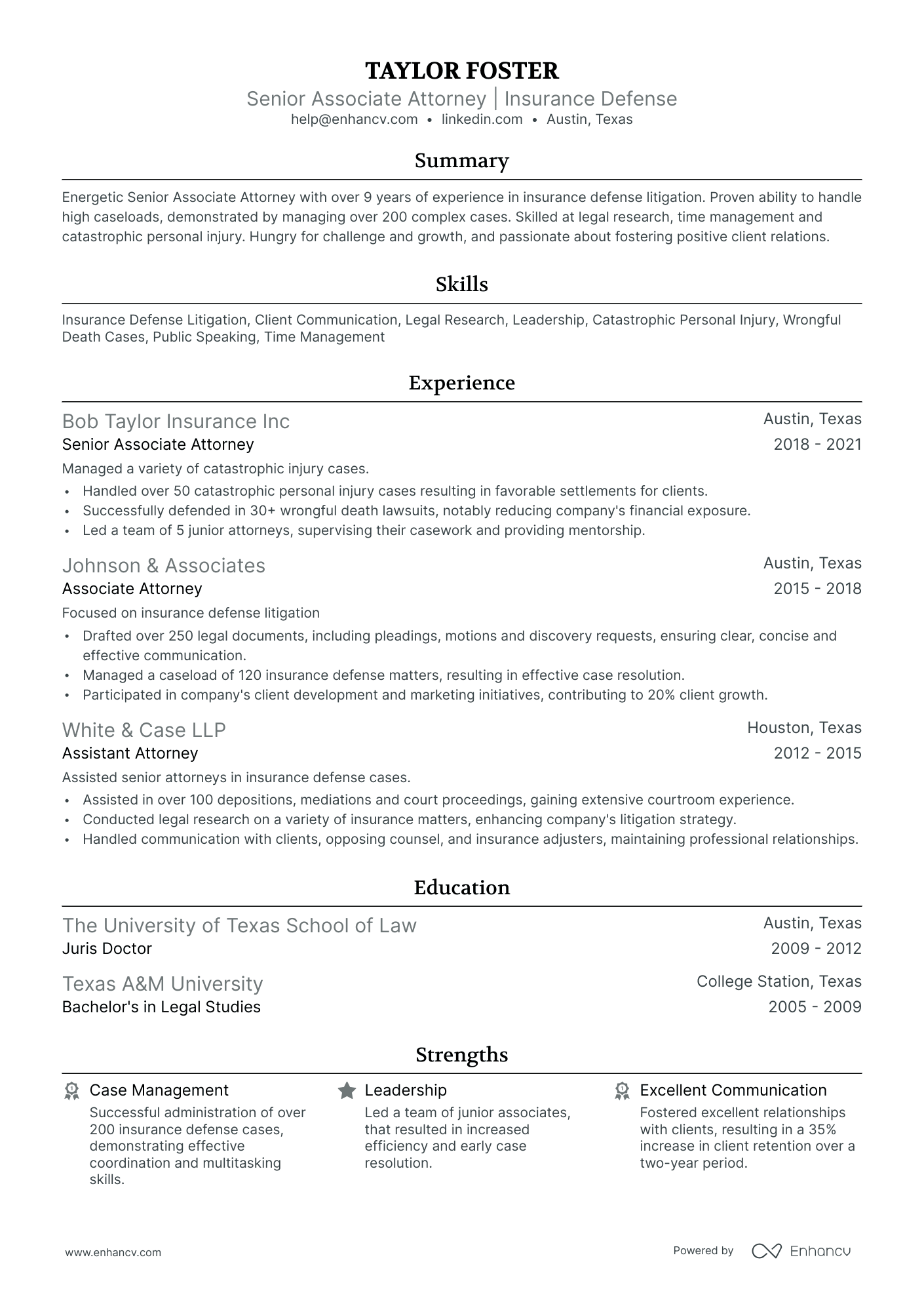
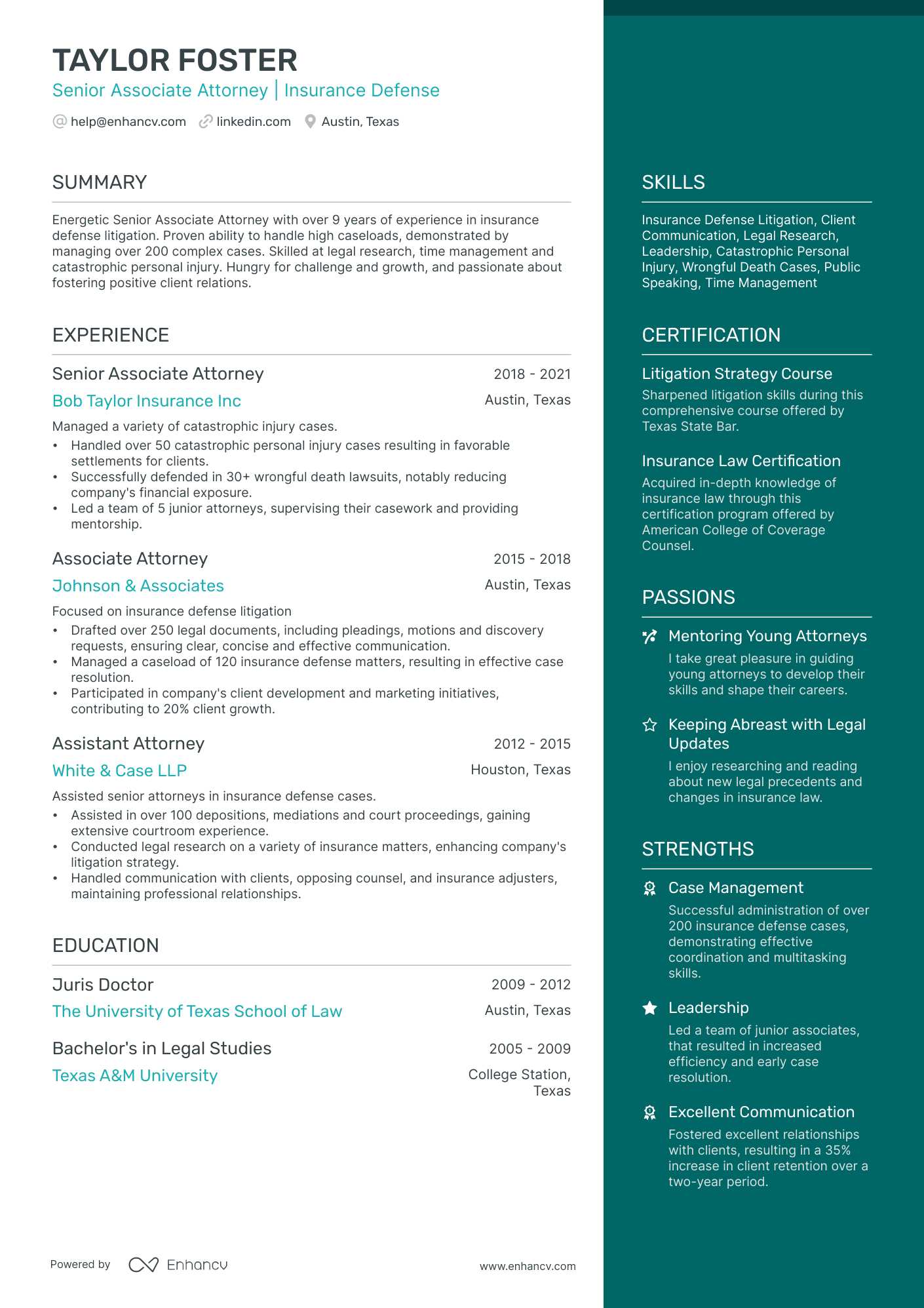
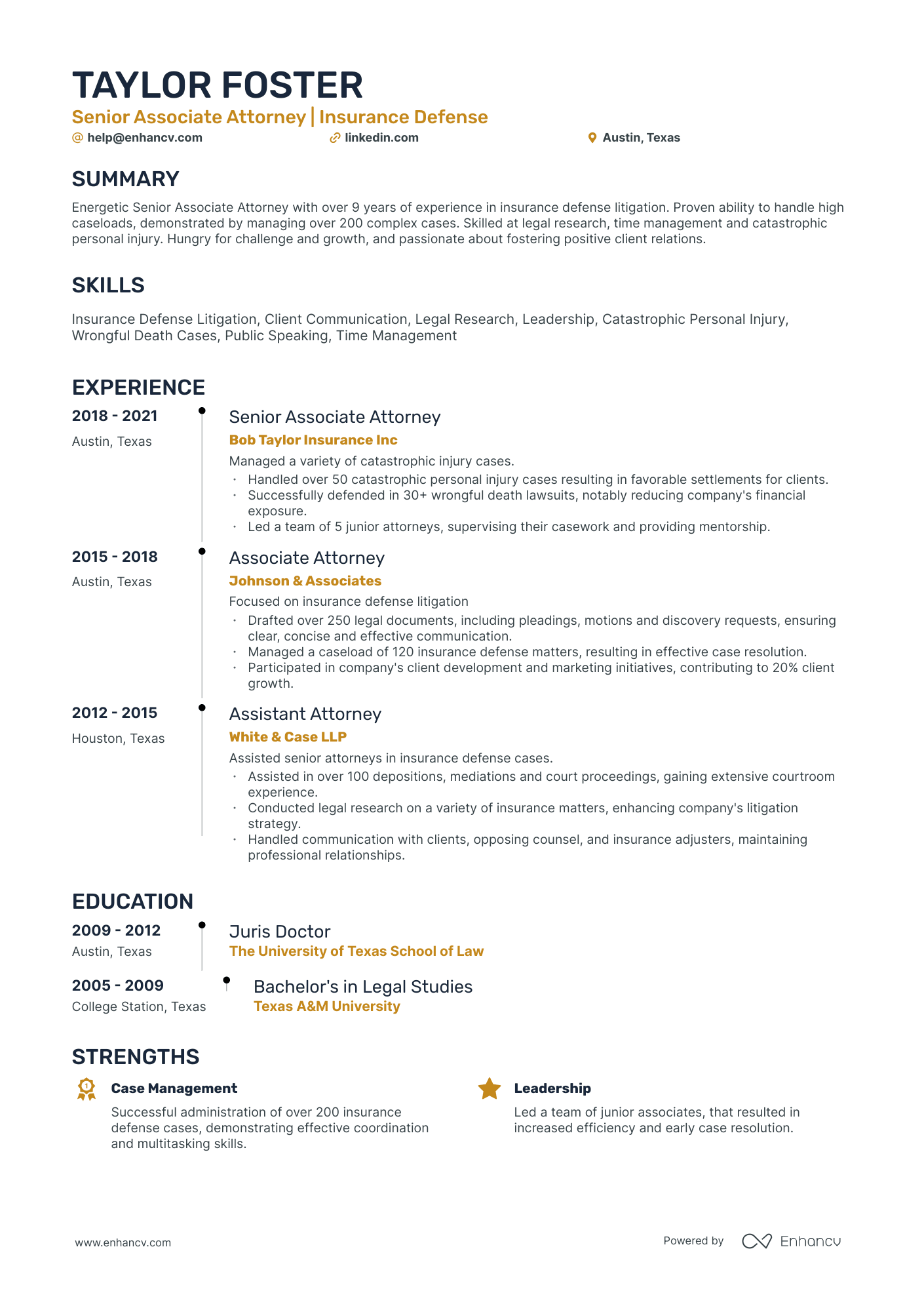
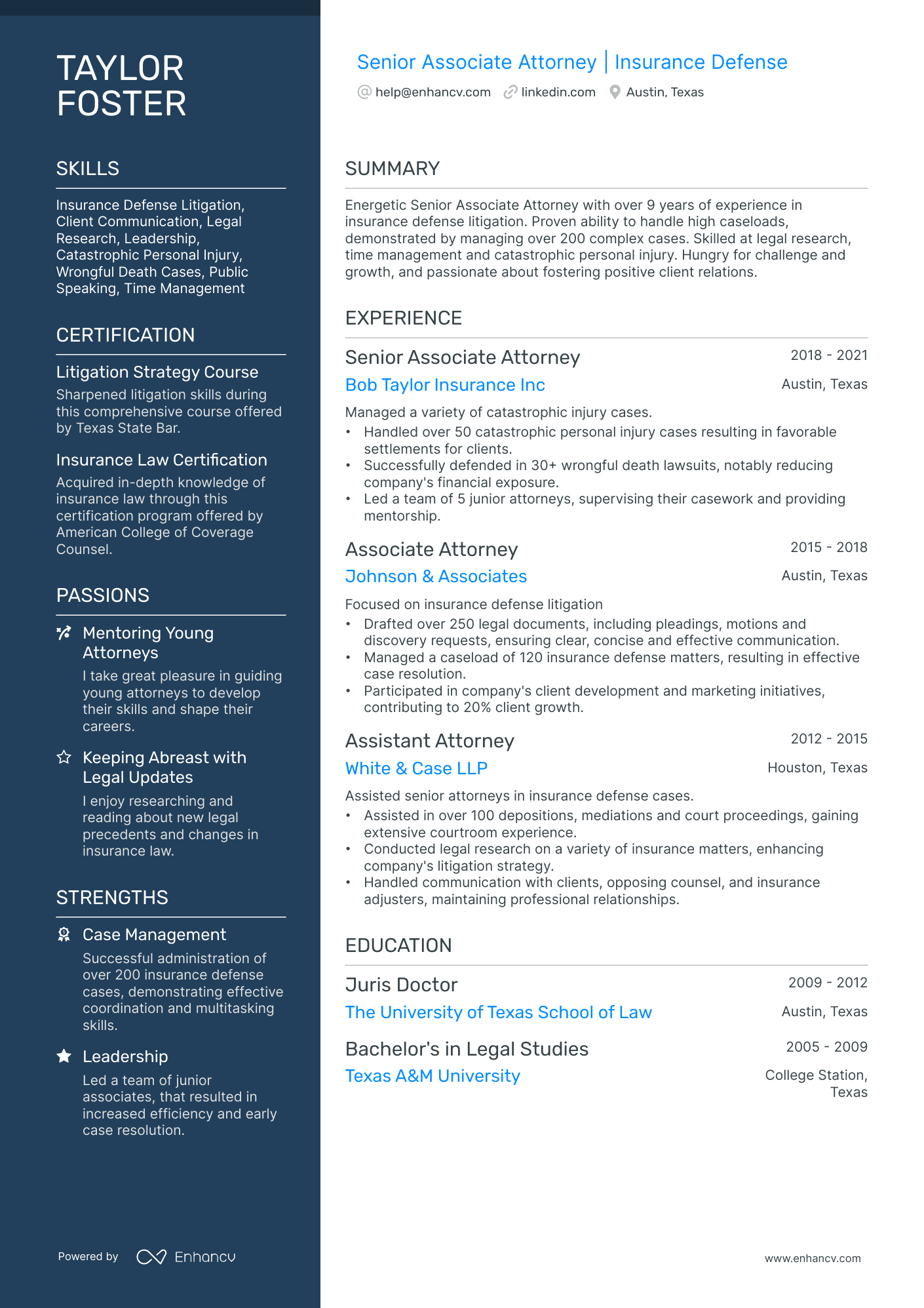
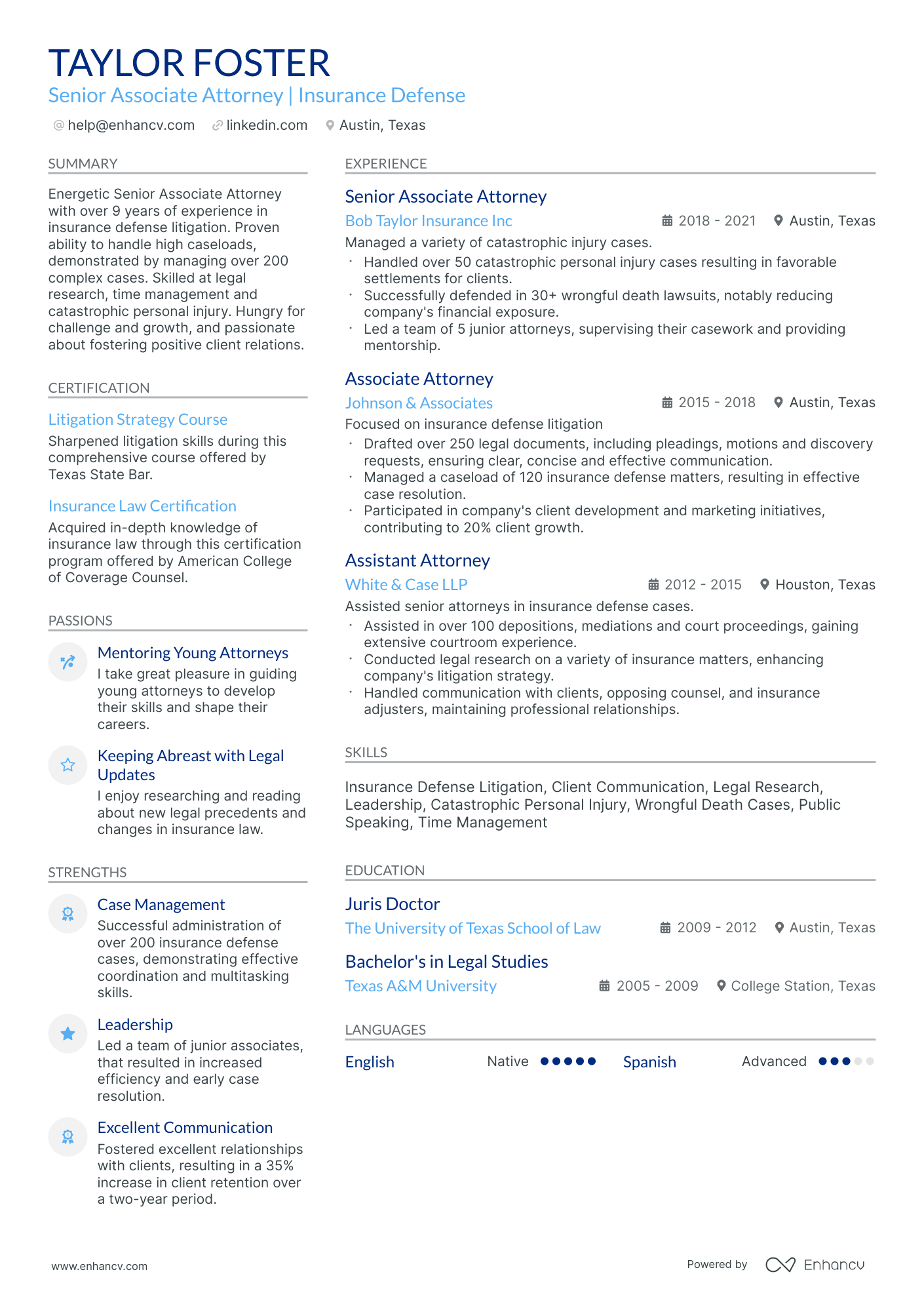
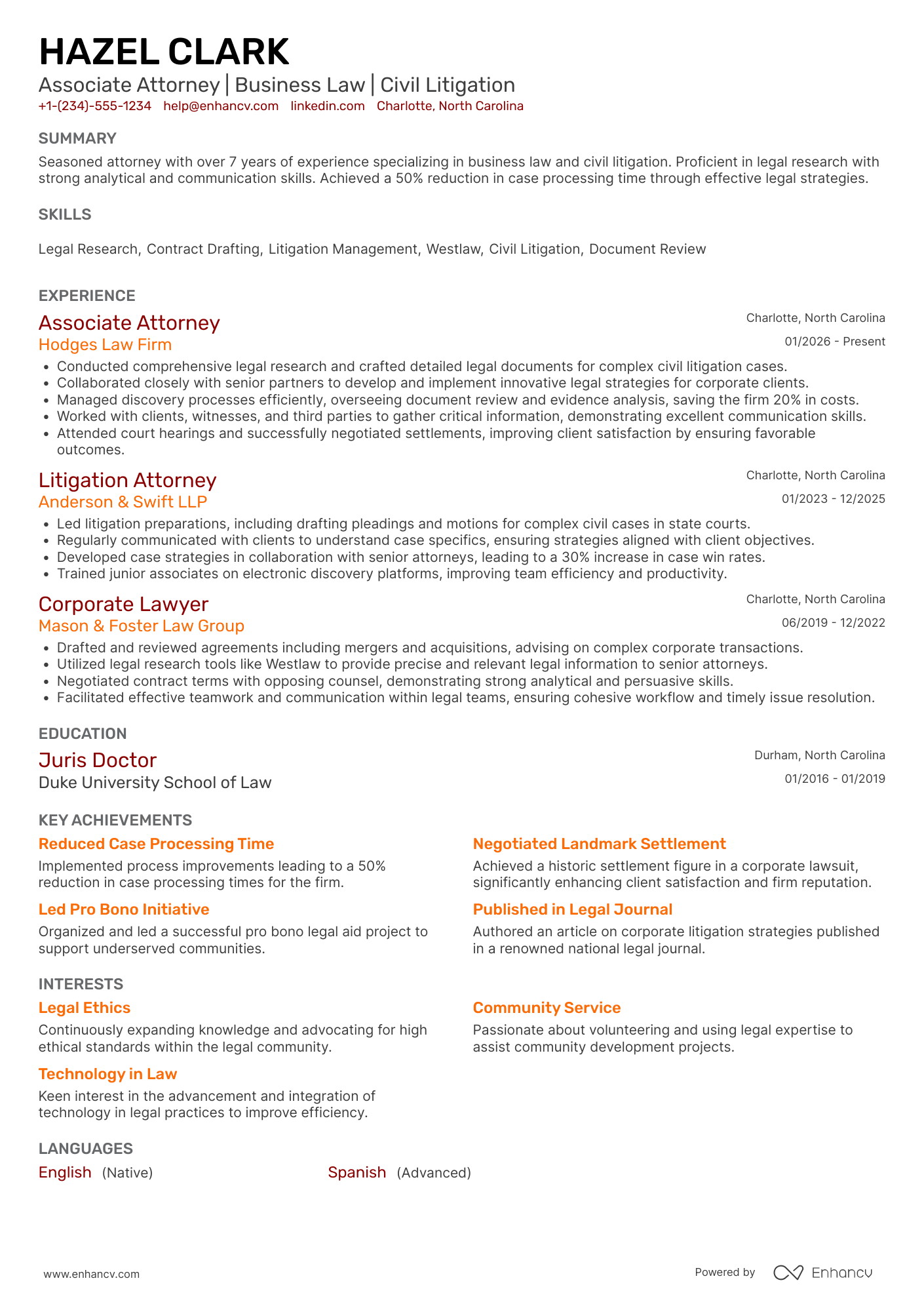
Many associate attorney resume drafts fail because they read like job descriptions, burying case outcomes and practice focus under dense bullets. That hurts in ATS screening and fast recruiter scans, where high competition rewards clear, relevant proof.
A strong resume shows what you delivered and why it mattered, so you stand out quickly. Understanding how to make your resume stand out means highlighting favorable rulings, settlement amounts, motion win rates, deal values, contract volume, research that shaped strategy, and error-free filings under tight deadlines.

Key takeaways
- Quantify case outcomes, deal values, and motion win rates instead of listing daily responsibilities.
- Use reverse-chronological format for experienced attorneys and hybrid format for career changers.
- Mirror the job posting's practice area language and tool names in your experience bullets.
- Anchor every skill claim to a specific matter, result, or measurable outcome.
- Place bar admissions and certifications where recruiters expect them—directly after education.
- Write a three- to four-line summary that names your practice focus and one standout metric.
- Use Enhancv to turn routine legal tasks into concise, results-driven resume bullets.
Job market snapshot for associate attorneies
We analyzed 238 recent associate attorney job ads across major US job boards. These numbers help you understand regional hotspots, top companies hiring, salary landscape at a glance.
What level of experience employers are looking for associate attorneies
| Years of Experience | Percentage found in job ads |
|---|---|
| 1–2 years | 9.2% (22) |
| 3–4 years | 2.9% (7) |
| 5–6 years | 2.1% (5) |
| 7–8 years | 1.3% (3) |
| Not specified | 84.5% (201) |
Associate attorney ads by area of specialization (industry)
| Industry (Area) | Percentage found in job ads |
|---|---|
| Finance & Banking | 86.1% (205) |
| Healthcare | 4.6% (11) |
Top companies hiring associate attorneies
| Company | Percentage found in job ads |
|---|---|
| Lewis Brisbois Bisgaard & Smith LLP | 62.2% (148) |
| Kelley Kronenberg | 7.6% (18) |
| Mandarich Law Group | 4.6% (11) |
Role overview stats
These tables show the most common responsibilities and employment types for associate attorney roles. Use them to align your resume with what employers expect and to understand how the role is structured across the market.
Day-to-day activities and top responsibilities for a associate attorney
| Responsibility | Percentage found in job ads |
|---|---|
| Depositions | 27.3% (65) |
| Legal research | 26.1% (62) |
| Litigation | 26.1% (62) |
| Discovery | 21.4% (51) |
| Legal writing | 16.4% (39) |
| Motions | 14.7% (35) |
| Arbitrations | 13.4% (32) |
| Hearings | 13.4% (32) |
| Case management | 13.0% (31) |
| Motion practice | 12.6% (30) |
| Pleadings | 11.8% (28) |
| Trials | 9.7% (23) |
Type of employment (remote vs on-site vs hybrid)
| Employment type | Percentage found in job ads |
|---|---|
| Hybrid | 61.8% (147) |
| On-site | 35.7% (85) |
| Remote | 2.5% (6) |
How to format a associate attorney resume
Recruiters reviewing associate attorney resumes prioritize substantive legal experience, practice area depth, and measurable contributions to case outcomes or client matters. Choosing the right resume format ensures these signals surface quickly during both human review and applicant tracking system (ATS) parsing.

I have significant experience in this role—which format should I use?
Use a reverse-chronological format to showcase your progression through increasingly complex legal matters and growing client responsibility. Do:
- Lead with your most recent position and clearly define your practice area scope, caseload size, and level of client-facing ownership.
- Highlight core legal skills and tools relevant to your practice—contract drafting, discovery platforms like Relativity, regulatory compliance frameworks, or transaction management.
- Quantify outcomes wherever possible, including case results, deal values, cost savings, or efficiency improvements tied to your direct contributions.
I'm junior or switching into this role—what format works best?
A hybrid format works best, allowing you to feature relevant legal skills and practice area knowledge prominently while supporting them with internships, clerkships, or transitional experience. Do:
- Place a skills section near the top of your resume that highlights practice-relevant competencies such as legal research, brief writing, regulatory analysis, or client intake.
- Include law school clinics, externships, moot court, pro bono work, or paralegal experience as substantive entries that demonstrate applied legal skills.
- Connect every action to a clear result—show how your research shaped a motion, how your drafting contributed to a filing, or how your analysis supported a favorable settlement.
Why not use a functional resume?
A functional format strips away the timeline and context that legal hiring managers rely on to evaluate practice area depth, matter complexity, and professional growth—all of which are essential for assessing an associate attorney candidate.
- A functional format may be acceptable if you're transitioning from a non-legal career, returning to practice after an extended absence, or pivoting between substantially different practice areas—but only if every skill listed is anchored to specific projects, matters, or measurable outcomes.
Once your resume's layout and structure are set, the next step is deciding which sections to include so each one reinforces your qualifications as an associate attorney.
What sections should go on a associate attorney resume
Recruiters expect you to present your legal experience, practice focus, and bar eligibility in a clean, standard resume format. Knowing which resume sections to include ensures nothing critical gets overlooked.
Use this structure for maximum clarity:
- Header
- Summary
- Experience
- Skills
- Projects
- Education
- Certifications
- Optional sections: Awards, Publications, Languages
Strong experience bullets should emphasize matter type, scope, and results—such as deal size, case outcomes, motion wins, time saved, risk reduced, or revenue protected.
Is your resume good enough?
Drop your resume here or choose a file. PDF & DOCX only. Max 2MB file size.
Now that you’ve organized the key resume components, the next step is to write your associate attorney experience section so it fits that structure and supports your strongest qualifications.
How to write your associate attorney resume experience
Your experience section is where you prove you've delivered meaningful legal work—not just participated in it. Hiring managers reviewing associate attorney resumes prioritize demonstrated impact, such as cases resolved, motions won, or contracts negotiated, over generic descriptions of daily responsibilities.
Each entry should include:
- Job title
- Company and location (or remote)
- Dates of employment (month and year)
Three to five concise bullet points showing what you owned, how you executed, and what outcomes you delivered:
- Ownership scope: the case types, practice areas, client portfolios, or legal matters you were directly responsible for managing or advancing as an associate attorney.
- Execution approach: the legal research methods, drafting frameworks, discovery tools, compliance standards, or litigation strategies you applied to move matters forward and inform counsel decisions.
- Value improved: changes to case outcomes, contract quality, regulatory compliance, turnaround time, risk exposure, or client satisfaction resulting from your legal work.
- Collaboration context: how you coordinated with partners, co-counsel, opposing counsel, paralegals, corporate stakeholders, or regulatory bodies to drive case strategy and meet deadlines.
- Impact delivered: outcomes framed as resolved matters, favorable rulings, closed transactions, reduced liability, or expanded client relationships rather than a list of tasks performed.
Experience bullet formula
A associate attorney experience example
✅ Right example - modern, quantified, specific.
Associate Attorney
Hawthorne & Pierce LLP | Chicago, IL
2022–Present
Mid-size litigation firm representing insurers and mid-market employers in complex civil disputes.
- Led discovery in twelve active matters using Relativity and CaseMap—reviewed 85,000+ documents, cut outside vendor spend by 18%, and met 100% of court-ordered deadlines.
- Drafted and argued eight dispositive motions (Rule 12 and summary judgment) in Westlaw and LexisNexis-driven research—won five outright dismissals and reduced estimated exposure by $1.6M.
- Negotiated settlements in collaboration with clients, opposing counsel, and mediators—closed nine cases within sixty days of mediation and lowered average indemnity payments by 22%.
- Took and defended fourteen depositions using deposition outlines in CaseMap and trial-prep checklists—improved impeachment-ready exhibit organization and reduced prep time per witness by 25%.
- Built a standardized matter dashboard in Clio Manage and Excel for partners and clients—improved status reporting cadence from monthly to weekly and reduced client escalation emails by 30%.
Now that you've seen how to structure your experience entries, let's focus on aligning them with the specific requirements of each job posting.
How to tailor your associate attorney resume experience
Recruiters evaluate your associate attorney resume through both applicant tracking systems and human review. Tailoring your resume to the job description increases your chances of clearing both filters.
Ways to tailor your associate attorney experience:
- Match practice areas and legal specializations listed in the posting.
- Mirror the firm's terminology for litigation or transactional workflows.
- Reference specific legal research platforms or case management tools named.
- Highlight compliance and regulatory experience relevant to the posting.
- Emphasize client counseling or negotiation skills when the role requires them.
- Include bar admissions and jurisdictional experience the employer specifies.
- Reflect collaboration structures such as partner support or team-based discovery.
- Align your drafting experience with document types the posting mentions.
The goal is to present your real accomplishments using language that directly reflects what the employer is asking for, not to force keywords where they don't belong.
Resume tailoring examples for associate attorney
| Job description excerpt | Untailored | Tailored |
|---|---|---|
| "Represent clients in state and federal court proceedings, including drafting motions, conducting depositions, and managing cases from inception through trial in commercial litigation matters." | Assisted with various legal tasks and helped prepare documents for court cases. | Managed a caseload of 15+ commercial litigation matters in state and federal court, drafting dispositive motions, conducting depositions, and first-chairing three bench trials resulting in favorable outcomes for clients. |
| "Conduct due diligence, draft and negotiate purchase agreements, and coordinate closings for M&A transactions ranging from $10M to $500M under the supervision of senior partners." | Reviewed contracts and supported transactional work for corporate clients. | Conducted due diligence across 12 M&A transactions valued between $25M and $200M, drafting and redlining purchase agreements and coordinating concurrent closings with cross-functional teams of outside counsel, accountants, and client stakeholders. |
| "Research and advise clients on regulatory compliance issues related to SEC reporting requirements, including preparing Form 10-K, 10-Q, and 8-K filings." | Performed legal research and helped clients with compliance-related questions. | Researched and drafted memoranda on SEC reporting obligations for four publicly traded clients, preparing and reviewing Form 10-K, 10-Q, and 8-K filings to ensure timely compliance and reduce disclosure risk. |
Once you’ve aligned your experience with the role’s priorities, the next step is to quantify your associate attorney achievements to show the impact behind that fit.
How to quantify your associate attorney achievements
Quantifying your achievements proves business impact beyond legal knowledge. For associate attorneys, focus on cycle time, matter volume, risk reduction, recovery amounts, and accuracy—plus the tools, jurisdictions, and stakeholders you supported.
Quantifying examples for associate attorney
| Metric | Example |
|---|---|
| Cycle time | "Cut contract turnaround time from 12 to seven business days by standardizing fallback clauses and using Microsoft Word redlines and DocuSign workflows." |
| Volume handled | "Managed 45 active matters across employment and commercial disputes, drafting 18 motions and responding to 22 discovery requests within court deadlines." |
| Risk reduction | "Reduced confidentiality carve-out exceptions by 30% across vendor agreements by implementing a clause checklist aligned to company policy and state privacy requirements." |
| Revenue recovery | "Negotiated a $275,000 settlement in a breach-of-contract dispute and secured payment within 30 days through structured release terms and lien waivers." |
| Accuracy | "Lowered citation and filing defects from five per quarter to one by using Westlaw citations, court-specific templates, and a two-step pre-filing review." |
Turn your everyday tasks into measurable, recruiter-ready resume bullets in seconds with Enhancv's Bullet Point Generator.
Now that your bullet points clearly convey your impact, it's time to ensure your resume also highlights the right mix of hard and soft skills that associate attorney roles demand.
How to list your hard and soft skills on a associate attorney resume
Your skills section shows your practice-ready capabilities, helps recruiters quickly match you to matters, and lets an ATS (applicant tracking system) confirm keyword fit—most associate attorney resumes land best with a hard skills focus supported by targeted soft skills. associate attorney roles require a blend of:
- Product strategy and discovery skills.
- Data, analytics, and experimentation skills.
- Delivery, execution, and go-to-market discipline.
- Soft skills.
Your skills section should be:
- Scannable (bullet-style grouping).
- Relevant to the job post.
- Backed by proof in experience bullets.
- Updated with current tools.
Place your skills section:
- Above experience if you're junior or switching careers.
- Below experience if you're mid/senior with strong achievements.

Hard skills
- Legal research, Westlaw, LexisNexis
- Drafting pleadings and motions
- Discovery strategy and management
- Deposition preparation and outlines
- Contract drafting and redlining
- Due diligence review
- E-discovery platforms (Relativity)
- Case management systems
- Litigation holds and preservation
- Federal and state court filings
- Bluebook and local citation rules
- Privilege logs and reviews
Soft skills
- Translate legal risk for clients
- Write clear, persuasive arguments
- Own tasks end to end
- Prioritize across tight deadlines
- Collaborate with partners and paralegals
- Align strategy with client goals
- Ask precise, clarifying questions
- Negotiate positions and concessions
- Maintain confidentiality under pressure
- Manage stakeholder expectations
- Communicate status without prompting
- Spot issues early and escalate fast
How to show your associate attorney skills in context
Skills shouldn't live only in a bulleted list on your resume. Explore curated resume skills examples to see how top candidates present their competencies.
They should be demonstrated in:
- Your summary (high-level professional identity)
- Your experience (proof through outcomes)
Here's what that looks like in practice.
Summary example
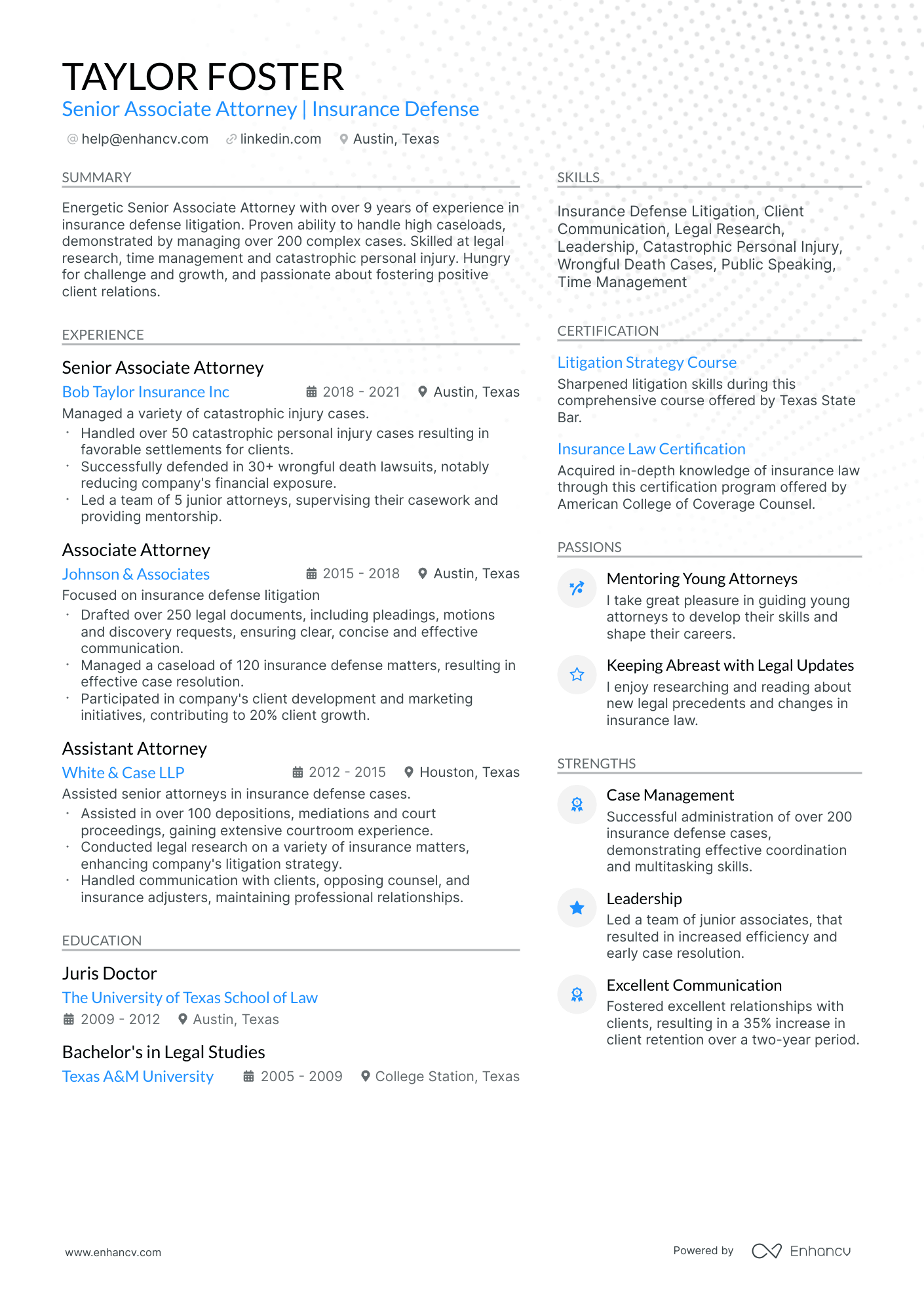
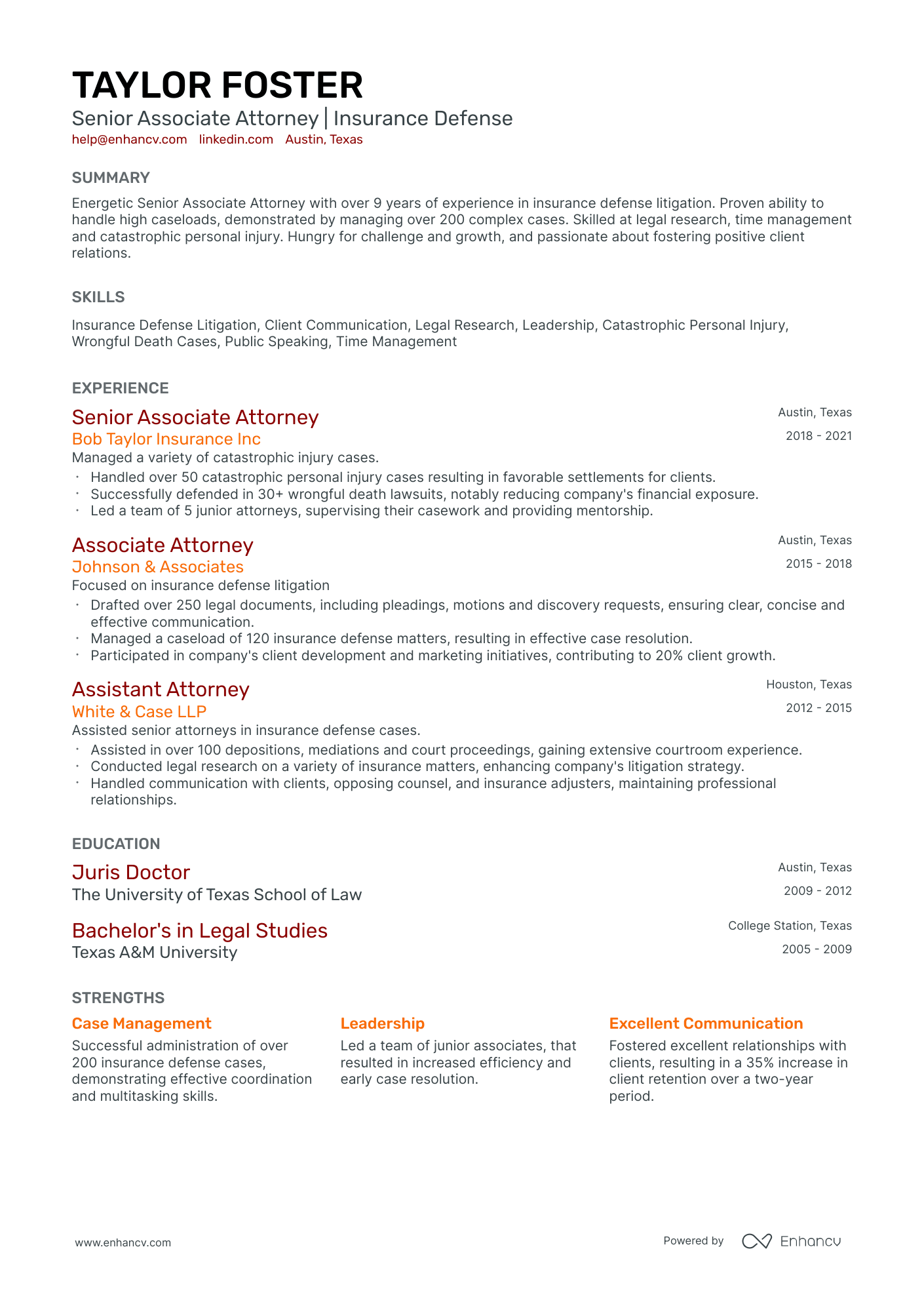
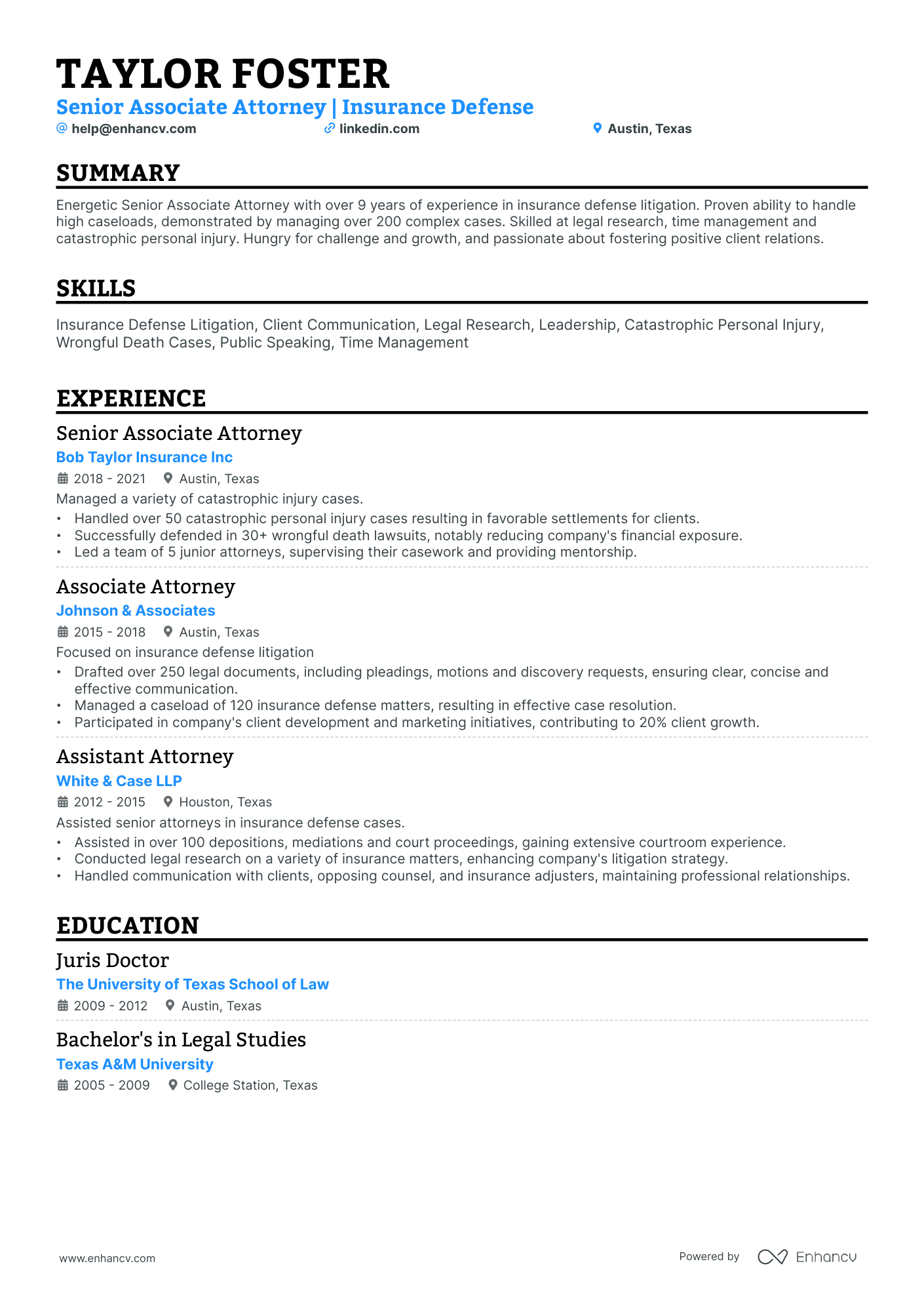
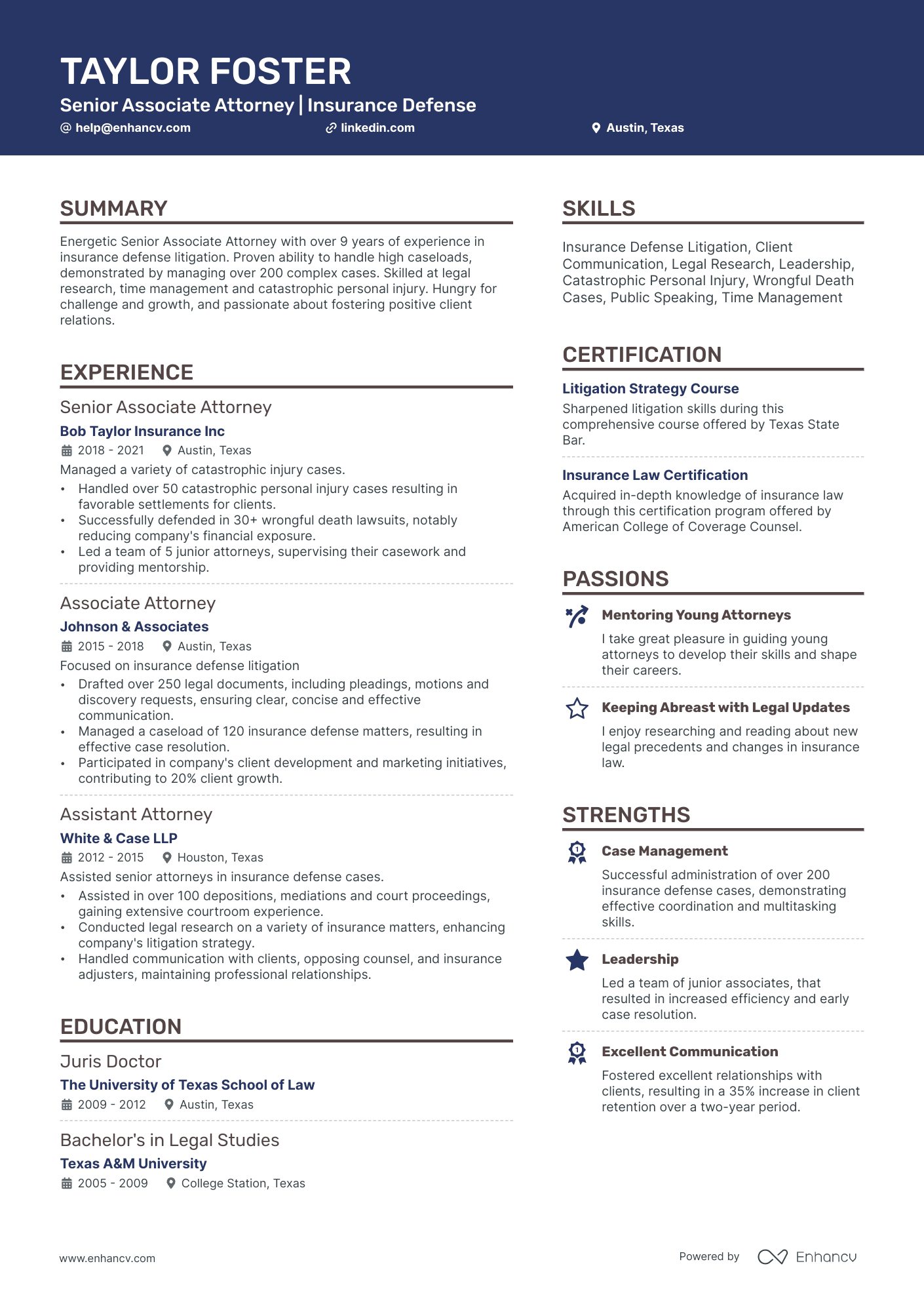
Senior associate attorney with nine years in complex commercial litigation. Skilled in e-discovery management, Relativity, and federal court procedure. Led a five-attorney trial team to secure a $12M favorable verdict while mentoring three junior associates.
- Reflects senior-level experience clearly
- Names role-relevant tools like Relativity
- Includes a specific dollar-figure metric
- Highlights mentorship as a soft skill
Experience example
Senior Associate Attorney
Caldwell & Reeves LLP | Chicago, IL
June 2018–March 2025
- Managed a 200-case docket using Clio and drafted dispositive motions that achieved dismissal in 74% of filed matters.
- Collaborated with partners and paralegals to streamline document review in Relativity, cutting discovery timelines by 30%.
- Negotiated settlements averaging $1.8M across 15 product liability cases, consistently exceeding client recovery targets.
- Every bullet includes a measurable outcome
- Skills surface naturally through real accomplishments
Once you’ve anchored your associate attorney strengths in real examples, the next step is to apply that approach to building an associate attorney resume with no experience.
How do I write a associate attorney resume with no experience
Even without full-time experience, you can demonstrate readiness through:
- Clinic client intake and counseling
- Law review or journal editing
- Moot court or trial advocacy
- Judicial internship or externship
- Bar association committee work
- Pro bono legal aid matters
- Contract drafting coursework projects
- Document review simulation projects
If you're building a resume without work experience, focus on:
- Practice-area aligned writing samples
- Research and citation accuracy
- Drafting: motions, briefs, contracts
- Case management and filing familiarity
Resume format tip for entry-level associate attorney
Use a hybrid resume format. It highlights legal skills and projects first, while still showing internships and leadership without overstating work history. Do:
- Lead with a "Legal Experience" section.
- Add one writing sample link.
- Quantify outcomes: hours, matters, results.
- List tools: Westlaw, LexisNexis, PACER.
- Tailor coursework to the practice area.
- Drafted and filed five clinic motions using Westlaw research and Bluebook citations, contributing to two granted continuances and zero clerk rejections.
Even without traditional work experience, your education section can carry significant weight on your resume—here's how to make it count.
How to list your education on a associate attorney resume
Your education section lets hiring teams confirm you hold the required legal credentials. It validates your foundational knowledge and academic preparation for the associate attorney role.
Include:
- Degree name
- Institution
- Location
- Graduation year
- Relevant coursework (for juniors or entry-level candidates)
- Honors & GPA (if 3.5 or higher)
Avoid listing month or day details—use the graduation year only.
Here's a strong education entry tailored for an associate attorney resume.
Example education entry
Juris Doctor (JD)
Georgetown University Law Center, Washington, D.C.
Graduated 2021
GPA: 3.7/4.0
- Relevant Coursework: Civil Litigation, Contract Law, Legal Research and Writing, Corporate Governance, Constitutional Law
- Honors: Dean's List (six semesters), Moot Court Board Member
How to list your certifications on a associate attorney resume
Certifications show an associate attorney's commitment to ongoing learning, proficiency with legal tools, and alignment with current practice needs.
Include:
- Certificate name
- Issuing organization
- Year
- Optional: credential ID or URL
- Place certifications below education when they are older, less relevant, or secondary to your law degree and bar admission.
- Place certifications above education when they are recent and directly relevant to the associate attorney role you target.
Best certifications for your associate attorney resume
- Certified E-Discovery Specialist (CEDS)
- Relativity Certified Administrator (RCA)
- ACEDS Certified E-Discovery Specialist
- Certified Information Privacy Professional/United States (CIPP/US)
- Certified Compliance and Ethics Professional (CCEP)
- Certified Fraud Examiner (CFE)
- Lean Six Sigma Yellow Belt
Once you’ve positioned your credentials where hiring teams can spot them quickly, shift to your associate attorney resume summary to frame those qualifications in a clear, results-focused snapshot.
How to write your associate attorney resume summary
Your resume summary is the first thing a recruiter reads. A strong one immediately signals you're qualified for an associate attorney role.
Keep it to three to four lines, with:
- Your title and one to three years of relevant legal experience.
- Practice area or industry focus, such as corporate law, litigation, or real estate.
- Core skills like legal research, contract drafting, motion practice, or due diligence.
- One or two quantified achievements that show early impact on cases or clients.
- Soft skills tied to real outcomes, such as collaboration that improved case preparation efficiency.

PRO TIP
At the associate level, emphasize specific practice areas, tools, and measurable contributions. Highlight skills like Westlaw proficiency, deposition preparation, or client communication. Avoid vague phrases like "passionate legal professional" or "hardworking team player." Recruiters want evidence of what you've done, not aspirational statements about your character.
Example summary for a associate attorney
Associate attorney with two years in commercial litigation. Managed discovery for 15+ cases and drafted motions that contributed to a 90% favorable ruling rate. Skilled in Westlaw, e-discovery platforms, and client communication.
Optimize your resume summary and objective for ATS
Drop your resume here or choose a file.
PDF & DOCX only. Max 2MB file size.
Now that your summary effectively frames your legal qualifications, make sure the header presenting your contact details is equally polished and professional.
What to include in a associate attorney resume header
A resume header lists your key identifiers and contact details, helping your associate attorney application stay visible, credible, and easy to screen.
Essential resume header elements
- Full name
- Tailored job title and headline
- Location
- Phone number
- Professional email
- GitHub link
- Portfolio link
A LinkedIn link lets recruiters confirm your roles and dates fast, which supports quick screening.
Don't include a photo on a associate attorney resume unless the role is explicitly front-facing or appearance-dependent.
Keep your header identical across your resume, bar admissions, and LinkedIn so recruiters can match records without confusion.
Associate attorney resume header
Jordan Taylor
Associate attorney | Litigation and legal research
Chicago, IL
(312) 555-01XX
your.name@enhancv.com
github.com/yourname
yourwebsite.com
linkedin.com/in/yourname
Once your contact details, licensure, and key credentials are clear at the top, add targeted additional sections to reinforce your qualifications and round out the resume.
Additional sections for associate attorney resumes
When your core qualifications match other candidates, strategic additional sections help you stand out and demonstrate deeper professional credibility.
- Bar admissions and court memberships
- Publications and legal scholarship
- Pro bono work and legal clinics
- Languages
- Professional associations and bar committee involvement
- Continuing legal education and certifications
- Hobbies and interests
Once you've rounded out your resume with the right supplementary sections, it's worth turning your attention to the document that accompanies it—your cover letter.
Do associate attorney resumes need a cover letter
An associate attorney cover letter isn't always required, but it often helps in competitive searches or firms that expect one. If you're unsure where to start, understanding what a cover letter is and how it complements your resume can clarify the approach. It can make a difference when your resume needs context, or when hiring managers compare similar credentials.
Use a cover letter to add value in these situations:
- Explain role or team fit by connecting your practice area, matter types, and preferred work style to the associate attorney role.
- Highlight one or two relevant projects or outcomes, including your contribution, the result, and what it shows about your judgment.
- Show understanding of the business context by referencing the firm's clients, industries, or risk profile, and how that shapes your approach.
- Address career transitions or non-obvious experience by clarifying why the move makes sense and how your skills transfer to an associate attorney role.
Drop your resume here or choose a file.
PDF & DOCX only. Max 2MB file size.
Even when you submit an associate attorney resume without a cover letter, AI tools can help you strengthen the resume itself, which is the focus of the next section.
Using AI to improve your associate attorney resume
AI can sharpen your resume's clarity, structure, and impact. It helps tighten language and highlight measurable results. But overuse strips authenticity fast. Once your content reads clearly and fits the role, step away from AI. For practical guidance, explore these ChatGPT resume writing prompts tailored for legal professionals.
Here are 10 practical prompts to strengthen specific sections of your associate attorney resume:
- Strengthen summary focus: "Rewrite my associate attorney resume summary to emphasize litigation experience, client management skills, and measurable case outcomes in under four sentences."
- Quantify experience bullets: "Add specific metrics and measurable results to each experience bullet on my associate attorney resume without inventing any details."
- Tighten action verbs: "Replace weak or passive verbs in my associate attorney experience section with precise, high-impact legal action verbs."
- Align skills section: "Review my associate attorney skills section and remove any entries that don't directly relate to this specific job description."
- Improve project descriptions: "Rewrite the project descriptions on my associate attorney resume to clearly state my role, actions taken, and final outcomes."
- Refine education details: "Edit the education section of my associate attorney resume to highlight relevant coursework, honors, and law review participation."
- Clarify certification entries: "Restructure the certifications section on my associate attorney resume so each entry lists the credential, issuing body, and date."
- Remove redundant phrasing: "Identify and eliminate any repetitive or filler language across all sections of my associate attorney resume."
- Tailor to job posting: "Compare my associate attorney resume against this job posting and suggest specific edits to improve keyword alignment."
- Sharpen bullet structure: "Reformat each experience bullet on my associate attorney resume to follow a consistent action-result structure with concise language."
Stop using AI once your resume sounds accurate, specific, and aligned with real experience. AI should never invent experience or inflate claims—if it didn't happen, it doesn't belong here.
Conclusion
A strong associate attorney resume proves impact with measurable outcomes, shows role-specific skills, and stays easy to scan. Use clear sections, consistent formatting, and direct language. Highlight results like motions won, matters closed, hours billed, and client outcomes.
Hiring teams want an associate attorney who can deliver now and grow fast. Keep your experience focused, quantify work where possible, and match skills to the role. A clean structure helps your strengths stand out in today’s market.