After testing Resume Now with both entry-level and senior-level profiles, my takeaway is clear: Resume Now is built for speed, not strategy.
It walks you through a structured, wizard-style process, offers prewritten content suggestions, and produces a formatted resume quickly. You don’t make many design decisions. You don’t control layout deeply. You simply move forward until the document is done.
That simplicity is its biggest strength.
It’s also its biggest limitation.
Resume Now works well for first-time job seekers or anyone who needs a resume urgently. But for experienced professionals who need control over density, hierarchy, and tailoring, the tool can feel generic and restrictive.
It finishes the resume—it doesn’t elevate it.

Key takeaways
- Resume Now is optimized for speed and completion, not customization or narrative control.
- The wizard-style builder reduces friction but limits layout flexibility.
- Prewritten bullet suggestions help overcome writer’s block but often feel generic.
- Templates are conservative and ATS-safe, but visually uniform.
- The subscription model includes introductory pricing that can surprise users if not monitored.
- It works best for straightforward, early-career profiles.
- Senior professionals or career changers may find it too rigid for strategic positioning.
What Resume Now is—and what it is not
Resume Now is a guided resume generator. It’s designed to move you from a blank page to a finished document as quickly as possible.
It is not a design-forward editor.
It is not a strategy platform.
It is not built for heavy customization.
The core philosophy is simple: reduce decisions, reduce friction, reduce time.
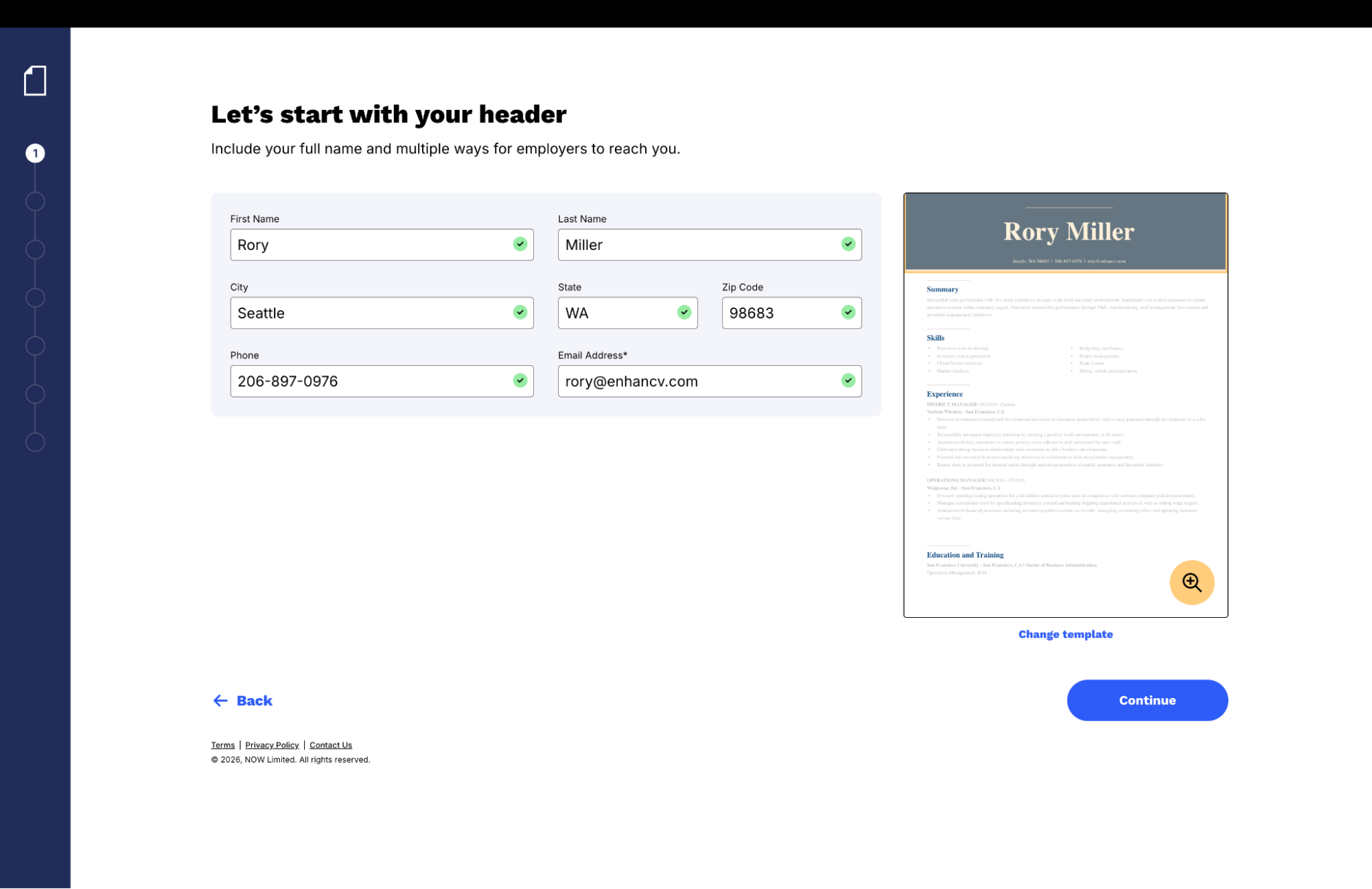
From the moment you begin, the builder walks you through a step-by-step wizard. You choose a template, enter job titles, select suggested bullet points, and proceed section by section. There’s no blank canvas. There’s no drag-and-drop layout control. There are very few opportunities to experiment.
For many users, this feels reassuring. The system prevents you from making design mistakes because it never gives you the chance to.
Ownership context
It’s also worth understanding the company behind the product.
Resume Now is owned by BOLD, the same parent company behind Zety (see my fullZety deep-dive review). The broader suite of tools across these brands is structurally very similar: wizard-based builders, prewritten content libraries, cover letter generators, and subscription-based access.
In practice, the core experience between Resume Now and Zety is nearly identical.

The differences are primarily:
- Template styling
- Branding and positioning
- Minor interface adjustments
The underlying philosophy—guided completion over customization—remains the same.
This isn’t inherently negative. It simply means Resume Now is part of a larger ecosystem of career tools built on the same framework.
But that safety comes at a cost.
If you are an experienced professional who needs to reorder resume sections, adjust content density, or emphasize specific achievements strategically, Resume Now offers limited flexibility. The structure is fixed. The hierarchy is predetermined. The resume conforms to the template—not the other way around.

In short:
- Resume Now helps you complete a resume.
- It doesn’t help you differentiate one.
That distinction becomes more important as your career becomes more complex.
Onboarding and first impressions
The onboarding process tells you immediately who this product is built for.
Resume Now doesn’t begin with design decisions or strategy questions. It begins with momentum.
The initial flow
The first steps are linear and guided:
- Choose a template. You select from a small set of traditional layouts.
- Enter a job title. The system uses this to generate suggested content.
- Add work experience. You select prewritten bullet points or type your own.
- Move section by section. The wizard advances automatically.
- Preview and download.
There is no dashboard. No canvas. No free exploration. You are moved forward one screen at a time.
For users who feel overwhelmed by design tools, this is calming. The system makes most decisions for you.
Parsing and data input
Resume Now does not emphasize robust resume parsing in the same way modern AI builders do. Instead of deeply importing and restructuring existing content, it leans heavily on structured input fields and predefined suggestions.
This means:
- You are building within a controlled framework.
- You are less likely to break formatting.
- You are also less likely to customize flow or hierarchy.
First impression
The experience feels efficient and transactional. Within minutes, you have a presentable resume draft. That’s the product’s core promise—and it delivers on that promise reliably.
What it doesn’t offer during onboarding is strategic guidance. There’s no deep keyword analysis, no applicant tracking system (ATS) scoring, no structural optimization layer. The goal is completion, not competitive positioning.
For early-career professionals, that may be enough. For senior professionals, the absence of flexibility becomes noticeable almost immediately.
If onboarding reveals the philosophy behind Resume Now, its core features show how that philosophy plays out in practice.
Core features
What stood out to me most is that every core feature in Resume Now exists to answer one question:
“How fast can we get this resume finished?”
That focus makes the platform efficient. It also explains its limitations.
Prewritten content engine
Resume Now’s defining feature is its library of prewritten bullet points. When you enter a job title, the system generates role-specific statements you can click to insert into your resume.
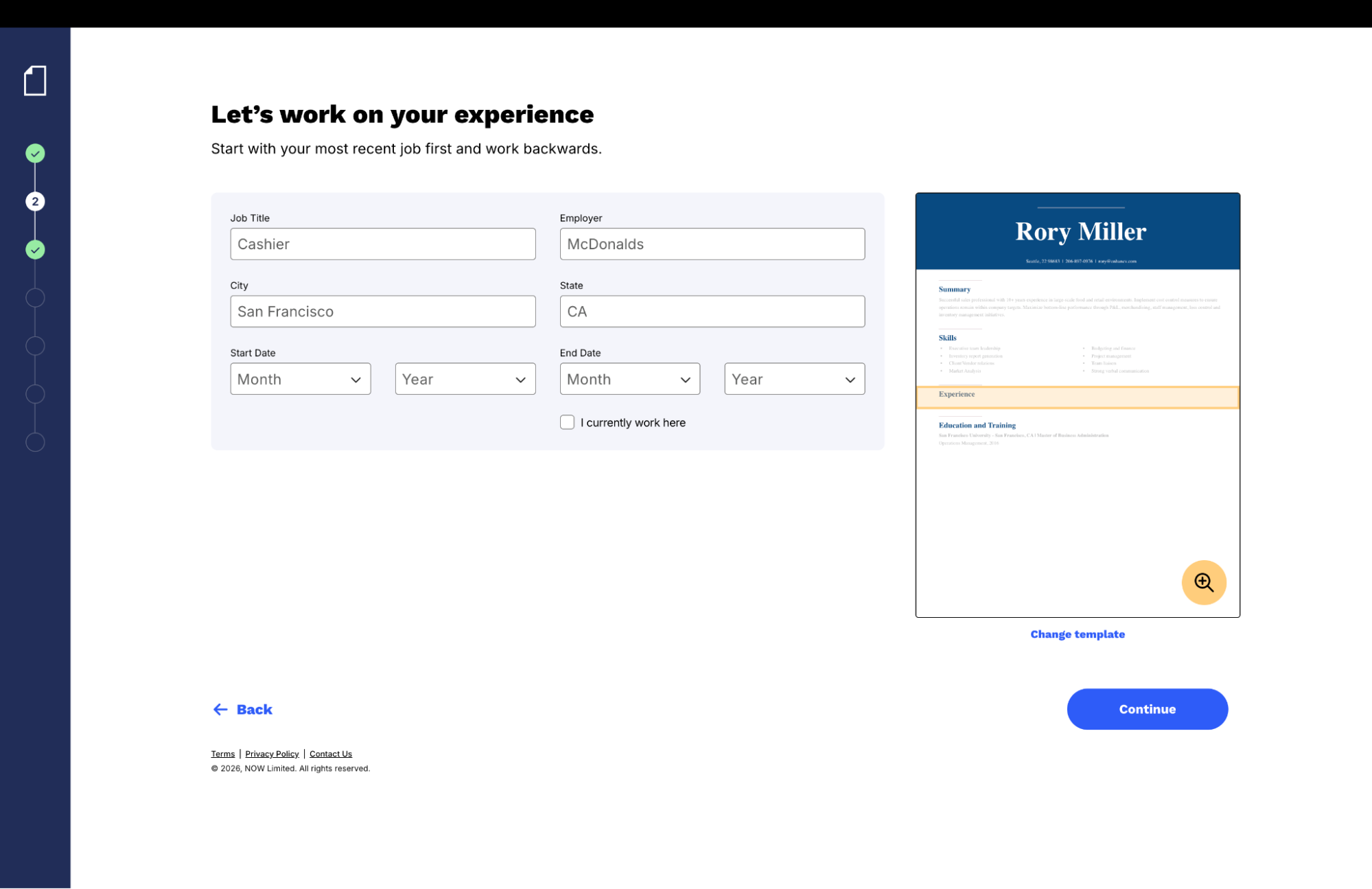
What works well:
- Eliminates blank-page anxiety.
- Speeds up early drafts.
- Helpful for common job titles.
- Reduces the cognitive load of phrasing responsibilities.
For entry-level roles or standardized positions, this can be genuinely useful.
Where it falls short:
- Content often feels generic.
- Bullets aren’t tailored to a specific job description.
- Requires manual editing to reflect real achievements.
- Lacks measurable impact unless you rewrite.
The engine helps you assemble a resume quickly. It doesn’t help you differentiate yourself meaningfully.
Best for: First-time job seekers or straightforward roles
Watch out for: Over-reliance on generic phrasing
Templates review
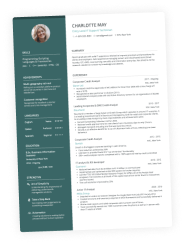
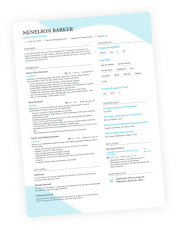
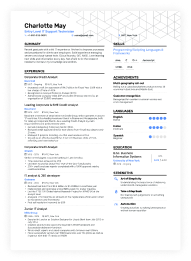
Resume Now offers clean, conservative templates. They’re single-column, text-first, and structurally uniform.
Differences between templates are subtle—mostly spacing and typography rather than layout innovation.
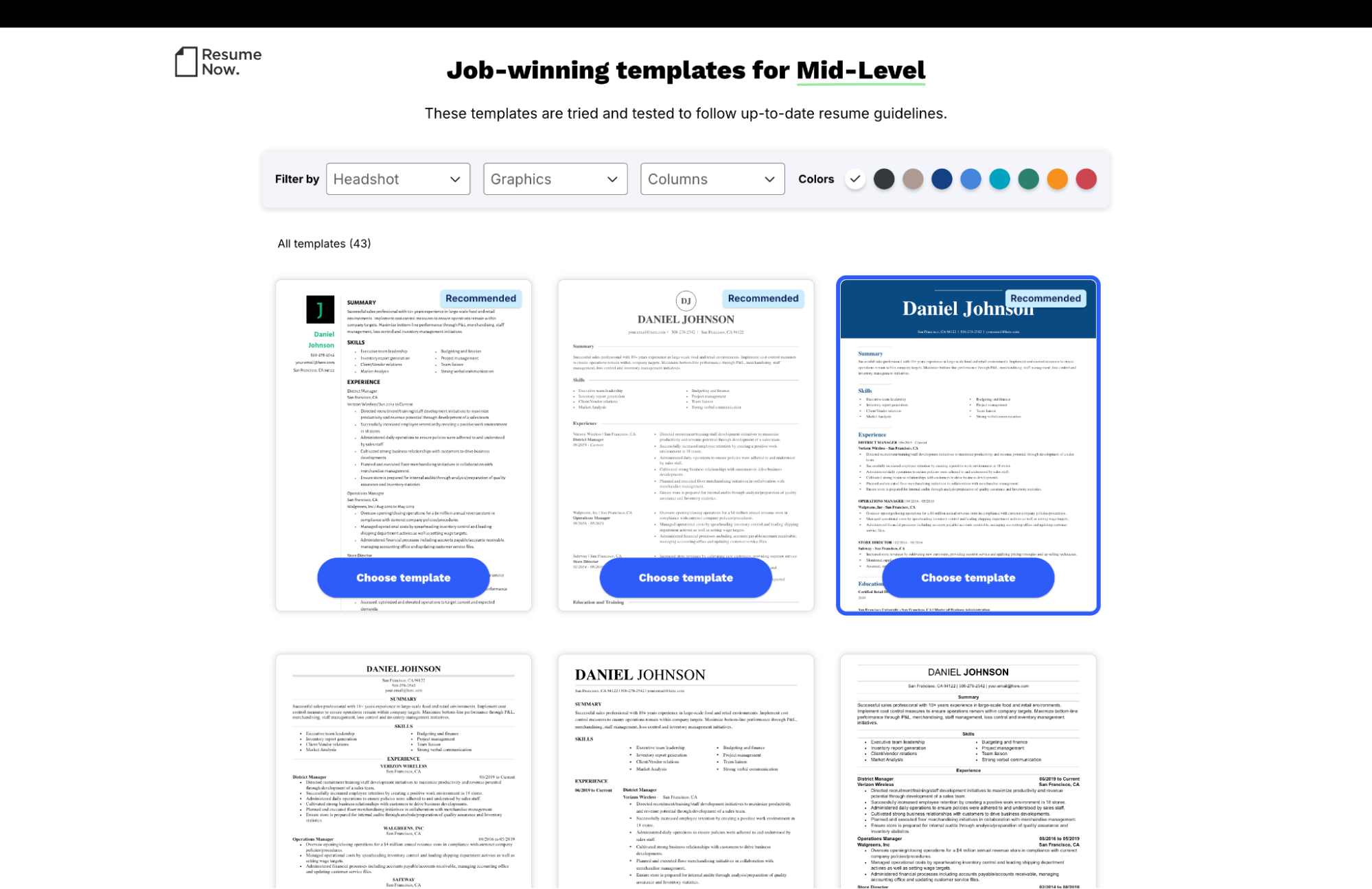
Strengths:
- ATS-readable by default
- No risky graphics or formatting
- Clean visual hierarchy
- Safe for traditional industries
Limitations:
- No drag-and-drop rearrangement
- No resume margin or density control
- Minimal layout experimentation
- Limited visual distinction between resumes
For early-career professionals, these templates are sufficient. For senior professionals with dense work histories, they can feel spatially restrictive.
The resume conforms to the template—not the other way around.
Best for: Conservative industries and straightforward profiles
Watch for: Limited ability to control information density
ATS compatibility: claims vs reality
Resume Now markets its templates as ATS-friendly.
In practice, the designs are simple enough to parse cleanly. There are no multi-column risks or graphical disruptions. From a structural standpoint, they’re safe.
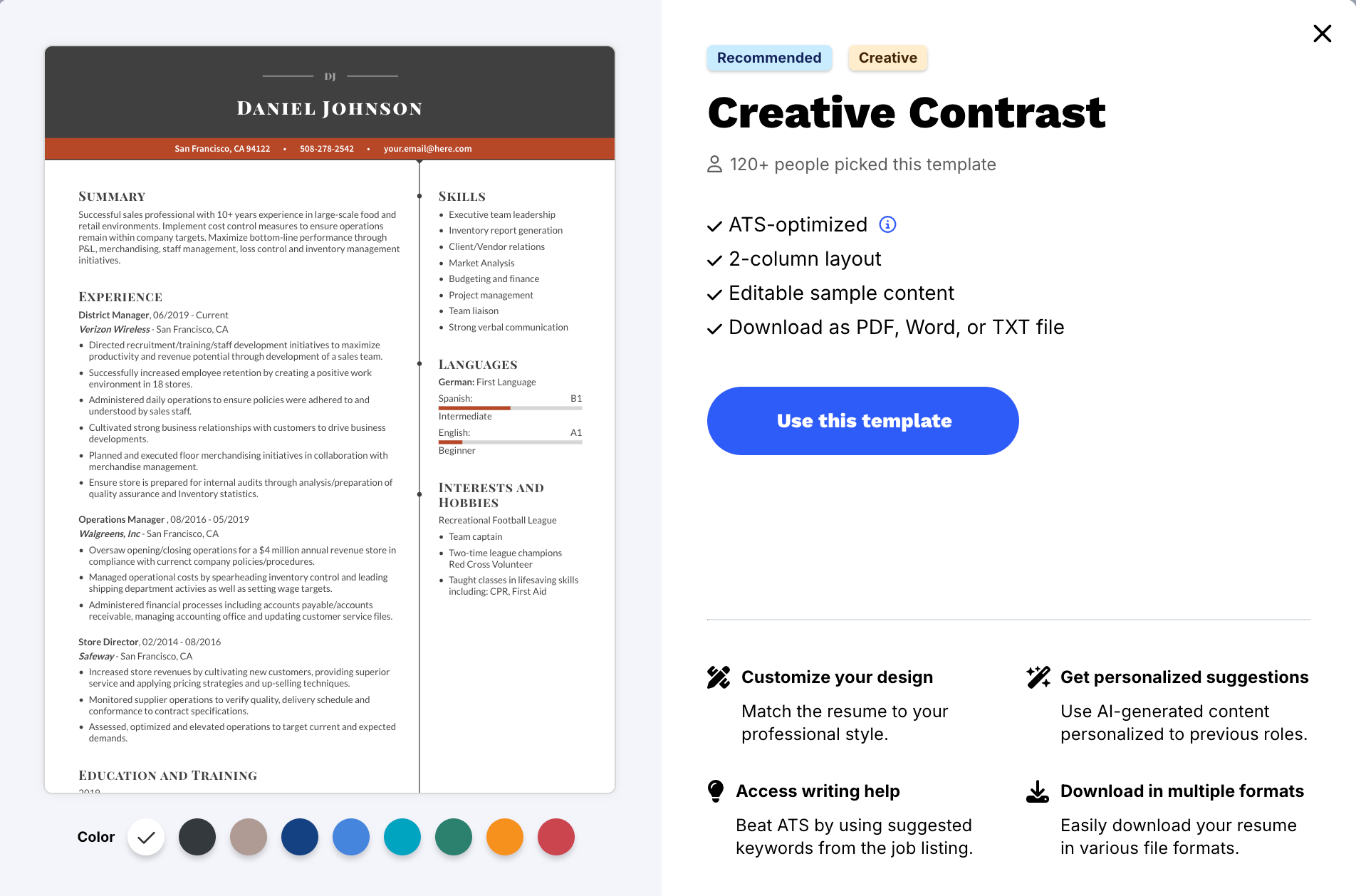
However, the tool doesn’t offer:
- Keyword targeting against job descriptions
- ATS scoring or diagnostics
- Real-time optimization feedback
You’re protected from formatting errors. You’re not guided toward keyword competitiveness.
It’s ATS-safe by simplicity—not by analysis.
Best for: Avoiding formatting mistakes
Watch for: Lack of keyword optimization tools
Editing experience
The editing workflow is wizard-driven and controlled. You fill in fields. You select suggested content. You move forward.
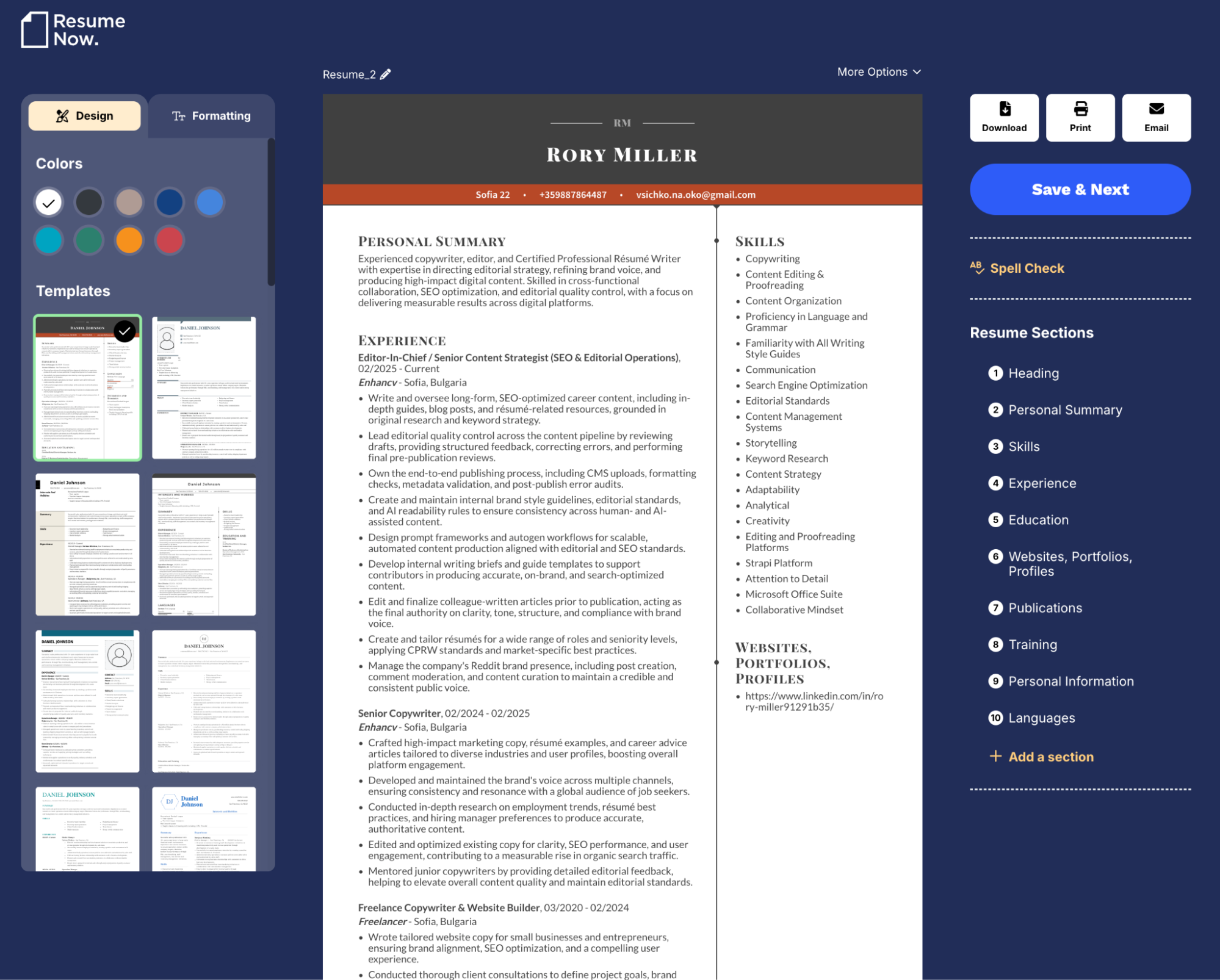
You do not:
- Drag sections.
- Reorder layout freely.
- Adjust spacing or structure manually.
This removes overwhelm. It also removes flexibility. The experience feels transactional. You’re completing a process rather than crafting a narrative.
For users who dislike design decisions, this is comforting. For experienced professionals who want narrative control, it can feel constraining.
Best for: Users who prefer guided workflows
Watch for: Limited customization freedom
Customization limits
Resume Now doesn’t encourage heavy personalization.
There’s no advanced layout control. No multi-column experimentation. No dynamic density adjustments for fitting senior-level content.
This makes the product predictable. It also makes resumes visually similar.
If your goal is simply to generate a competent document quickly, that predictability works. If your goal is to compete at a senior level, the lack of strategic control becomes more noticeable.
Best for: Fast, standardized resumes
Watch for: Difficulty tailoring for competitive roles
Resume Now cover letter builder
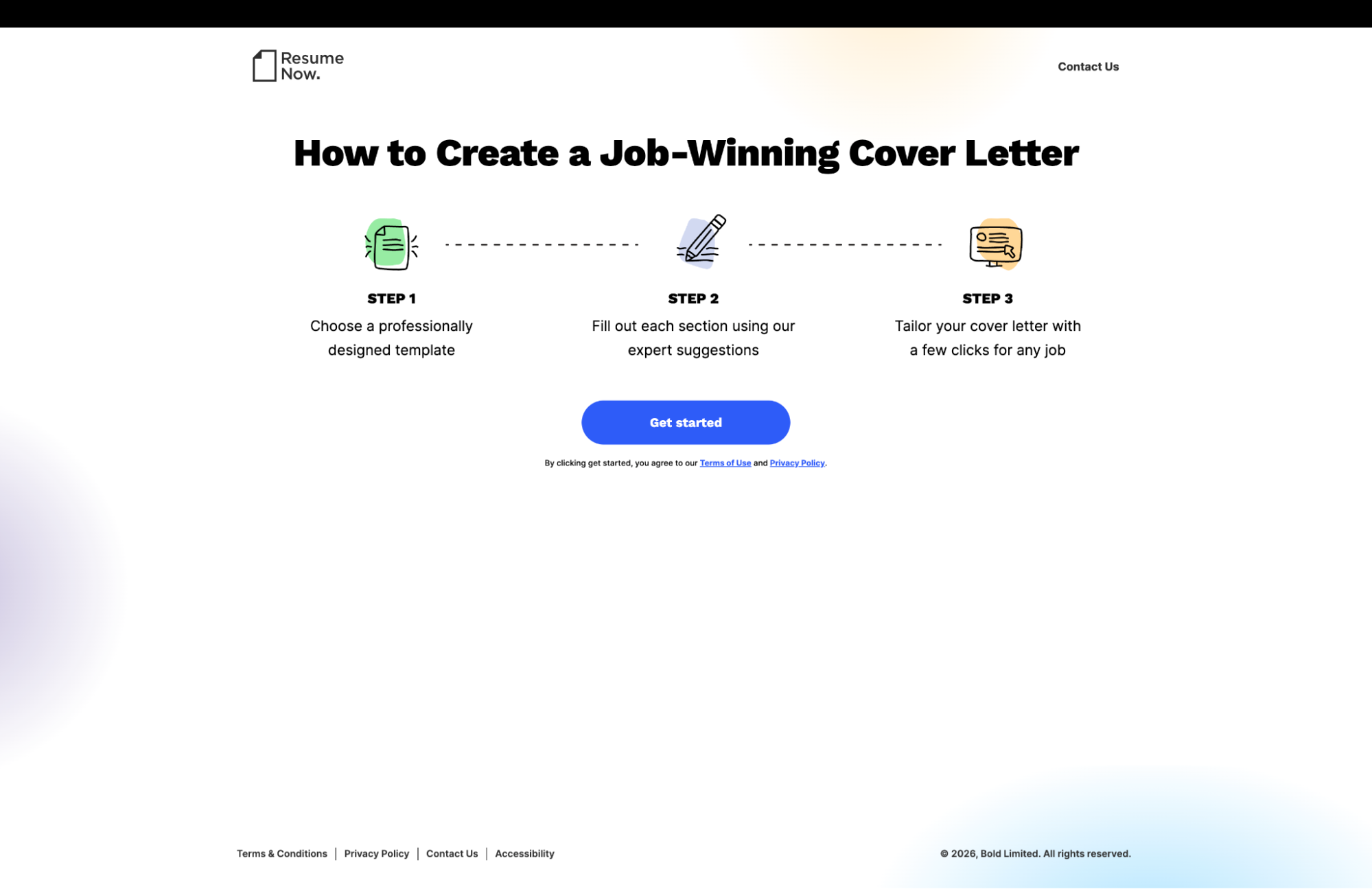
In addition to its resume tool, Resume Now includes a structured cover letter generator.
The workflow mirrors the resume builder: you select a template, answer guided prompts, and choose from prewritten content suggestions. The goal is speed and completion rather than customization.
Strengths:
- Fast generation of a basic, professional cover letter.
- Clean formatting suitable for traditional industries.
- Helpful prompts for users unsure how to structure a letter.
Limitations:
- No deep tailoring to specific job descriptions.
- Limited narrative flexibility.
- Output can feel templated without heavy editing.
Like the resume builder, the cover letter tool is efficient. It produces a presentable document quickly, but it doesn’t provide advanced AI-driven personalization.
Best for: Quick, standardized cover letters
Watch for: Generic tone if not revised carefully
Drop your resume here or choose a file.
PDF & DOCX only. Max 2MB file size.
Resume Now online CV maker
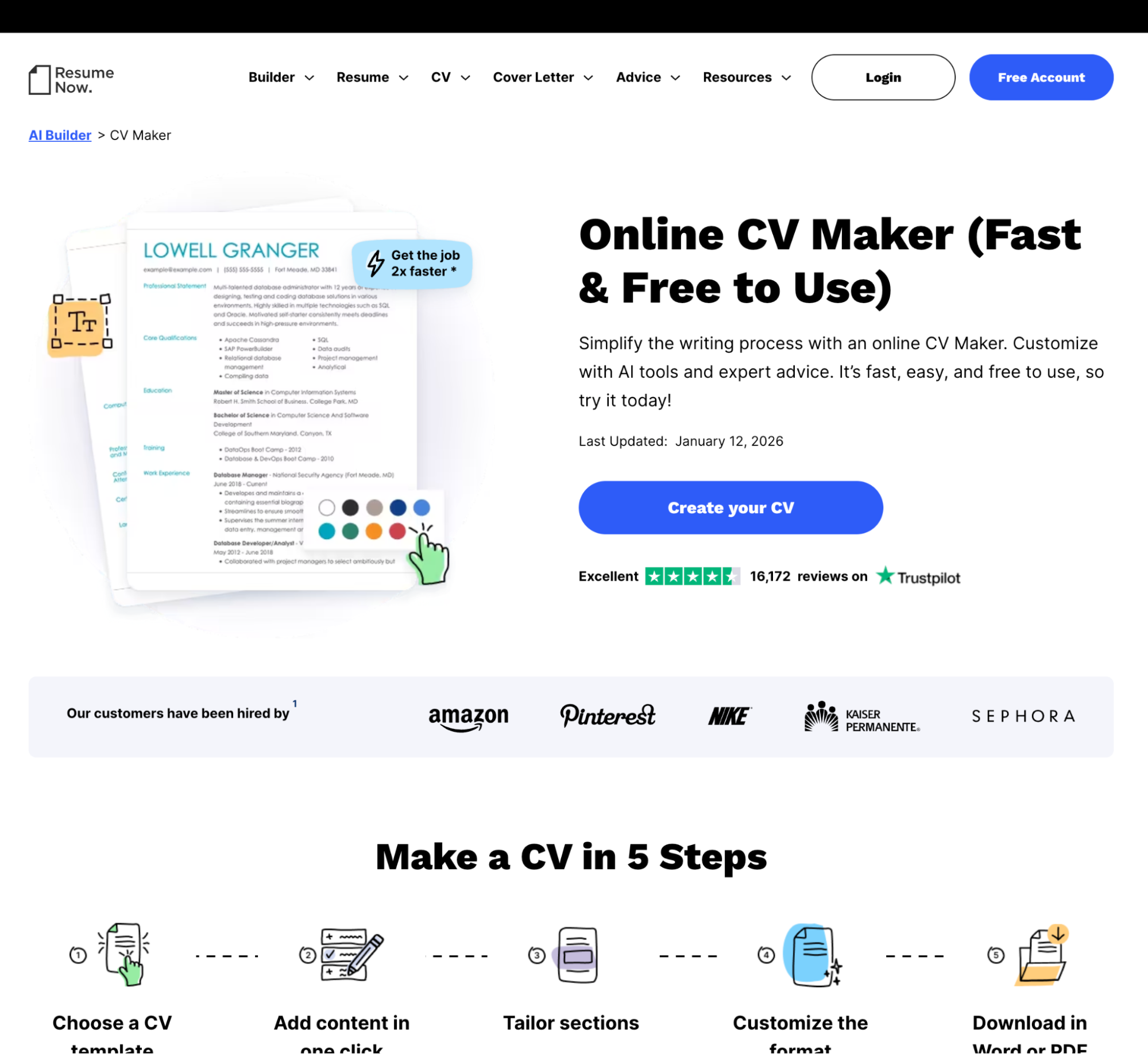
Resume Now also offers an online CV maker, positioned for academic or international job markets where longer, more detailed career documents are expected.
The structure remains wizard-based and template-driven. Instead of strategic layout control, you move through predefined sections such as education, research, certifications, and work history.
Strengths:
- Simple structure for longer academic-style documents.
- Consistent formatting across multi-page output.
- Beginner-friendly interface.
Limitations:
- Limited control over hierarchy and density.
- Not optimized for highly customized academic CVs.
- Lacks advanced formatting for research-heavy profiles.
For users who simply need a longer version of their resume, the CV tool works. For research-intensive or publication-heavy professionals, the rigidity may become restrictive.
Best for: Basic multi-page CVs
Watch for: Limited customization for academic or research careers
The product experience is only part of the equation. With Resume Now, understanding the pricing model is just as important as understanding the builder itself.
Pricing, plans, and refunds
Resume Now operates on a subscription model built around introductory access.
Unlike one-time-payment builders, the platform typically advertises a low upfront trial price, followed by recurring billing unless canceled within the trial window.
Note: Pricing details below reflect publicly available information at the time of writing (February 2026) and may change.
Resume Now pricing breakdown
| Tier | Price | Key Features |
|---|---|---|
| 14-day Limited Access | 0~$1.45 for 14 days (trial) | Short trial access with basic resume builder and templates; auto-renews into subscription if not canceled. |
| 14-day Full Access | ~$1.85 for 14 days (trial) | Full access to resume and cover letter builder, job database view, and editing tools; auto-renews if not canceled. |
| Monthly Subscription | ~$23.95 per month | Unlimited downloads, full templates, resume and cover letter exports (PDF/DOCX). |
| Annual Access | ~$70.20 per year (~$5.85/mo) | Full access billed annually; includes all features. |
Quick notes
- Resume Nowpromotions sometimes market themselves as a “free resume builder,” but true formatted downloads require one of the paid plans.
- After the trial period, billing automatically converts to the standard subscription (~$23.95/month) unless you cancel prior to renewal.
Transparency considerations
The pricing terms are disclosed, but the structure can catch users off guard if they don’t monitor renewal dates carefully.
A recurring theme in online feedback centers less on product functionality and more on billing management.
Many complaints focus on:
- Missing the trial cancellation window.
- Unexpected renewal charges.
- Confusion about downgrade timing.
This doesn’t mean the billing model is hidden. It means it requires attention.
Pricing philosophy
Resume Now is priced for quick conversion. It assumes users need immediate access, complete the resume, and either cancel promptly or continue paying for editing access.
This works well if:
- You finish your resume quickly.
- You track subscription dates carefully.
It becomes expensive if you treat it as a long-term resume management platform.
The product is inexpensive to start. However, it‘s less forgiving if you forget to stop.
To see how that pricing structure feels outside of theory, it helps to look at what real users report after signing up.
What real users say
To validate my own impressions, I reviewed user feedback across Trustpilot and Reddit. The sentiment around Resume Now is noticeably more divided than with strictly ATS-focused builders.
The split is clear: users praise the ease of use, while many criticize the billing model.
Trustpilot sentiment
On Trustpilot, reviews tend to cluster around two themes: simplicity and subscription friction.
Positive feedback often highlights:
- Very easy-to-follow interface
- Fast resume generation
- Helpful prewritten bullet suggestions
- Clean, professional-looking templates
- Ability to produce a resume quickly under time pressure
Users who approach Resume Now as a fast drafting tool often report satisfaction. The wizard-style flow is frequently described as intuitive and beginner-friendly.
Negative reviews, however, focus heavily on:
- Trial-to-subscription conversions
- Missed cancellation windows
- Unexpected recurring charges
- Difficulty navigating billing or refund processes
Notably, the criticism is less about template quality and more about subscription management. The product itself is rarely described as broken—it’s described as transactional.
The emotional tone in negative reviews tends to center on billing expectations rather than design flaws.
Reddit sentiment
Reddit discussions are more skeptical and less filtered.
Resume Now is often described as:
- “Quick but basic”
- “Good for fast drafts”
- “Overpriced for what it does”
- “Fine if you cancel immediately”
Users on Reddit frequently compare Resume Now to other builders and note that:
- The templates are safe but unremarkable.
- The content suggestions are generic.
- The subscription model requires careful attention.
A recurring theme is that Resume Now works, however it doesn’t differentiate. It’s rarely described as a long-term resume platform, but rather as a quick solution.
Overall user consensus
Across platforms, the feedback follows a clear pattern:
- Resume Now is easy to use.
- It produces acceptable results quickly.
- Its subscription model requires vigilance.
Users who understand what they’re buying—a fast, guided resume generator—tend to be satisfied.
Users who expect advanced customization, AI optimization, or transparent long-term pricing are more likely to feel disappointed.
Let’s put the positives and the negatives side-by-side.
Pros and cons of Resume Now
| ✅ Pros | ❌ Cons |
|---|---|
| Extremely easy to use, even for first-time job seekers. | Subscription model requires close attention to cancellation timing. |
| Fast, guided wizard reduces decision fatigue. | Introductory pricing can feel misleading if not monitored. |
| Prewritten bullet suggestions eliminate blank-page anxiety. | Content suggestions often sound generic and require rewriting. |
| Conservative templates are ATS-safe by default. | Very limited layout and design customization |
| Clean, traditional formatting suitable for most industries. | Not ideal for senior-level or dense career histories |
| Produces a complete resume quickly under time pressure | Lacks advanced AI tailoring or keyword optimization tools |
This table reinforces the core narrative: Resume Now is optimized for efficiency and ease. It’s not optimized for strategic differentiation.
Taken together, the functionality and user sentiment point clearly toward a specific type of job seeker for whom Resume Now makes sense.
Who Resume Now is best for
Resume Now is best suited for users who prioritize speed and simplicity over customization.
It works particularly well for:
- Students and early-career professionals who need structured guidance.
- Straightforward career paths that fit neatly into standard resume sections.
- Users under time pressure who need a complete, presentable resume quickly.
- People who prefer a step-by-step wizard rather than design control.
- Applicants targeting traditional industries where conservative formatting is expected.
In these cases, Resume Now delivers exactly what it promises: a fast, formatted resume without overthinking.
It’s less suitable for:
- Senior professionals with 10+ years of experience who need higher information density.
- Career changers who must strategically reframe their narrative.
- High-volume applicants tailoring resumes to multiple job descriptions.
- Candidates competing in saturated markets where visual hierarchy and differentiation matter.
- Users who want deep control over layout, spacing, and structure.
As careers become more complex, so do resume needs. Resume Now handles completion well. It doesn’t handle nuance as effectively.
Final verdict
Resume Now isn’t strategic. It’s streamlined.
It trades flexibility for speed and customization for completion. If your definition of confidence is having a finished, properly formatted resume in under an hour, Resume Now delivers exactly that.
But it doesn’t try to elevate your positioning.
There’s no deep tailoring engine. No advanced layout control. No structural optimization layer guiding you toward competitive differentiation. The tool assumes that a clean, standard resume is enough.
For early-career professionals or anyone needing a fast solution, that assumption often holds. For experienced professionals competing in tighter markets, it may not.
Resume Now helps you finish the document. It does not help you maximize it. And whether that matters depends entirely on where you are in your career.
Make one that's truly you.