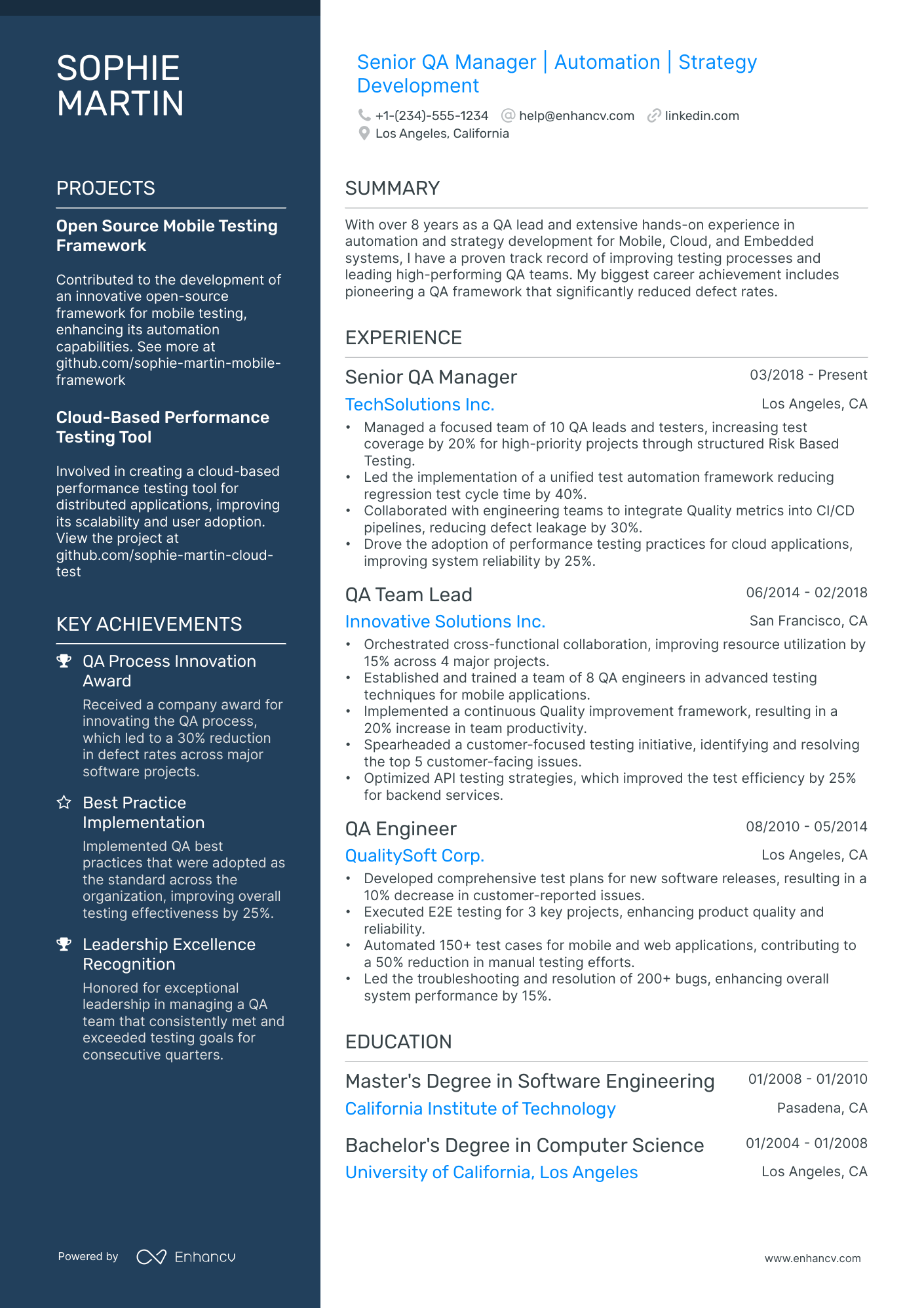
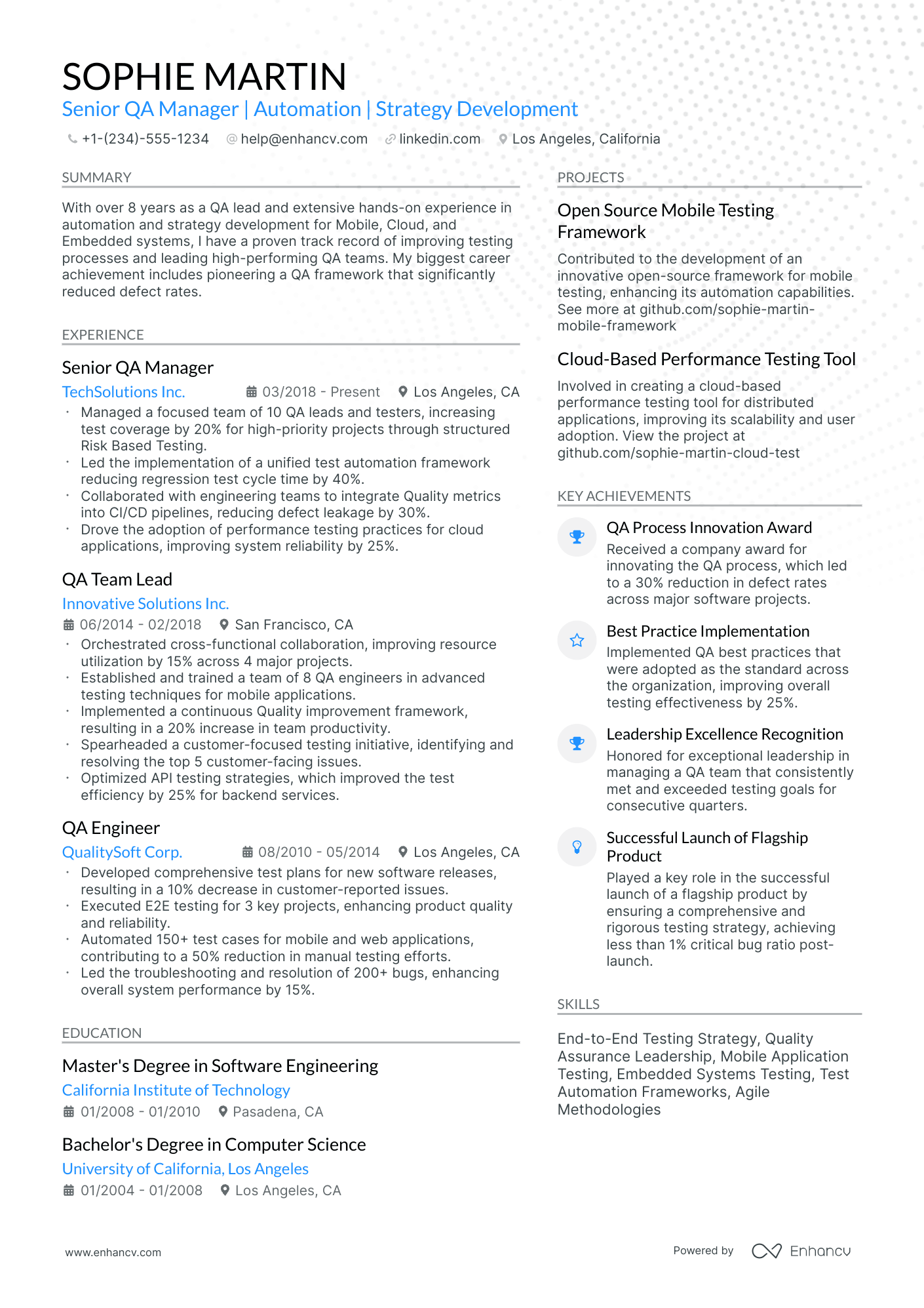
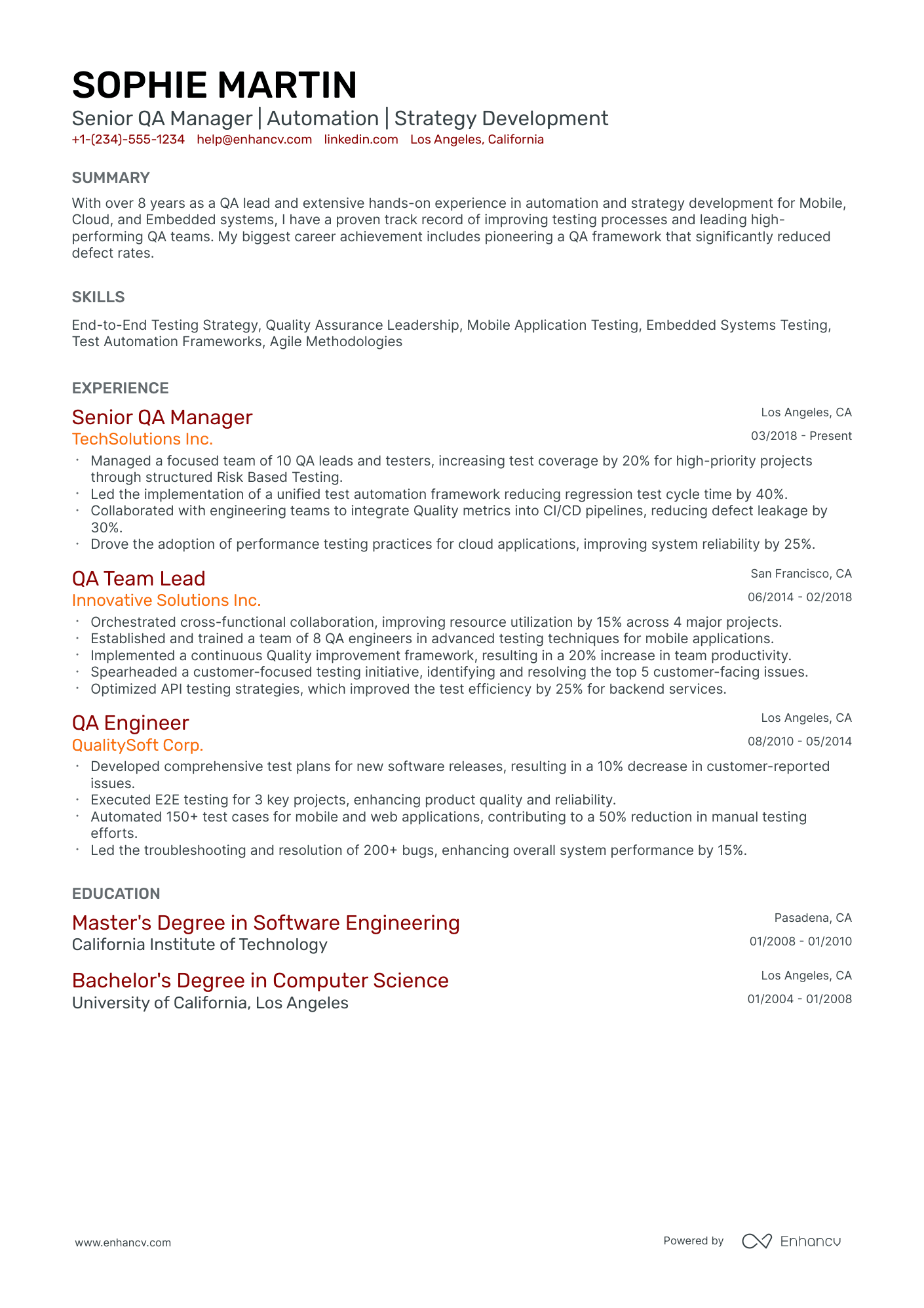
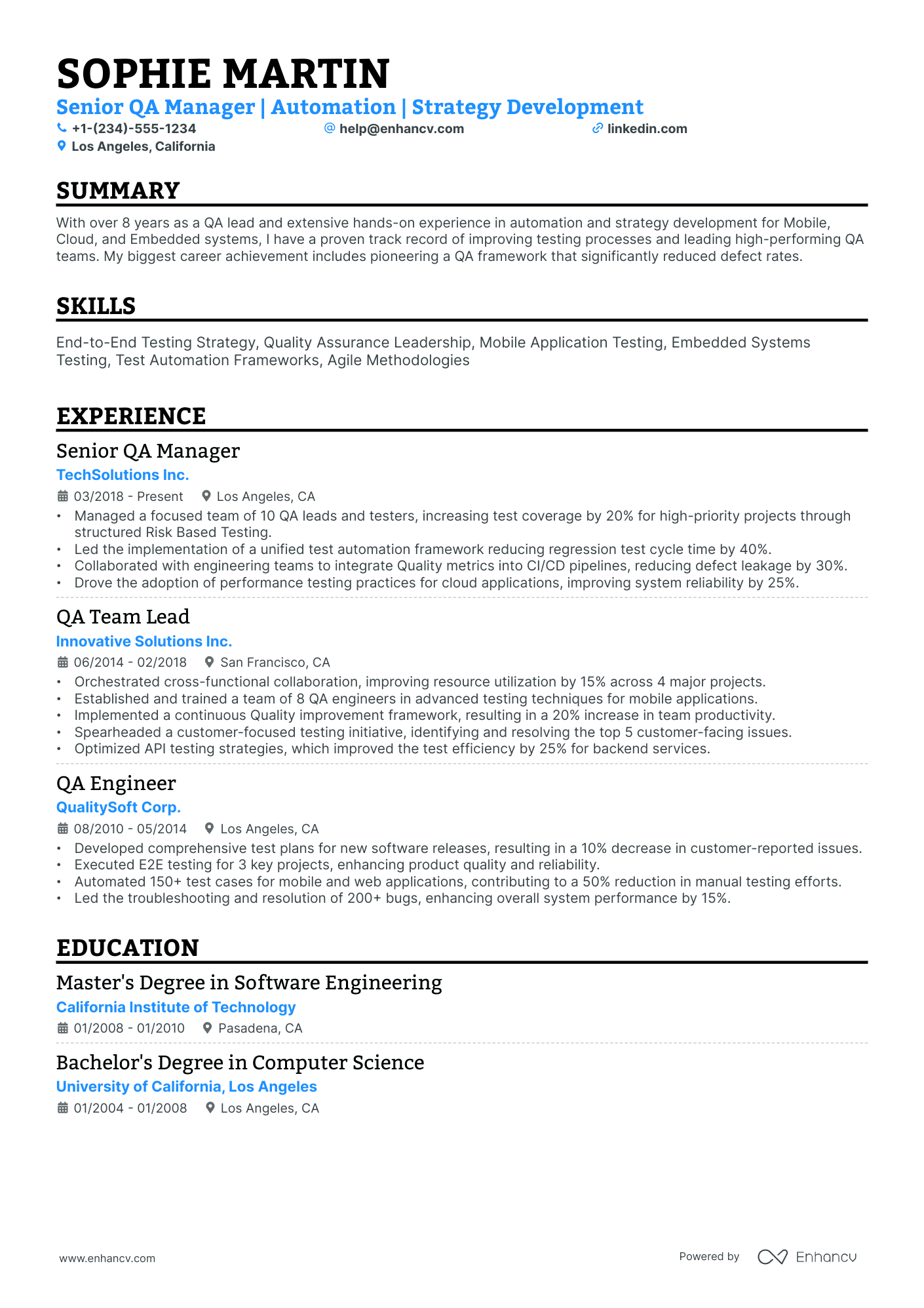
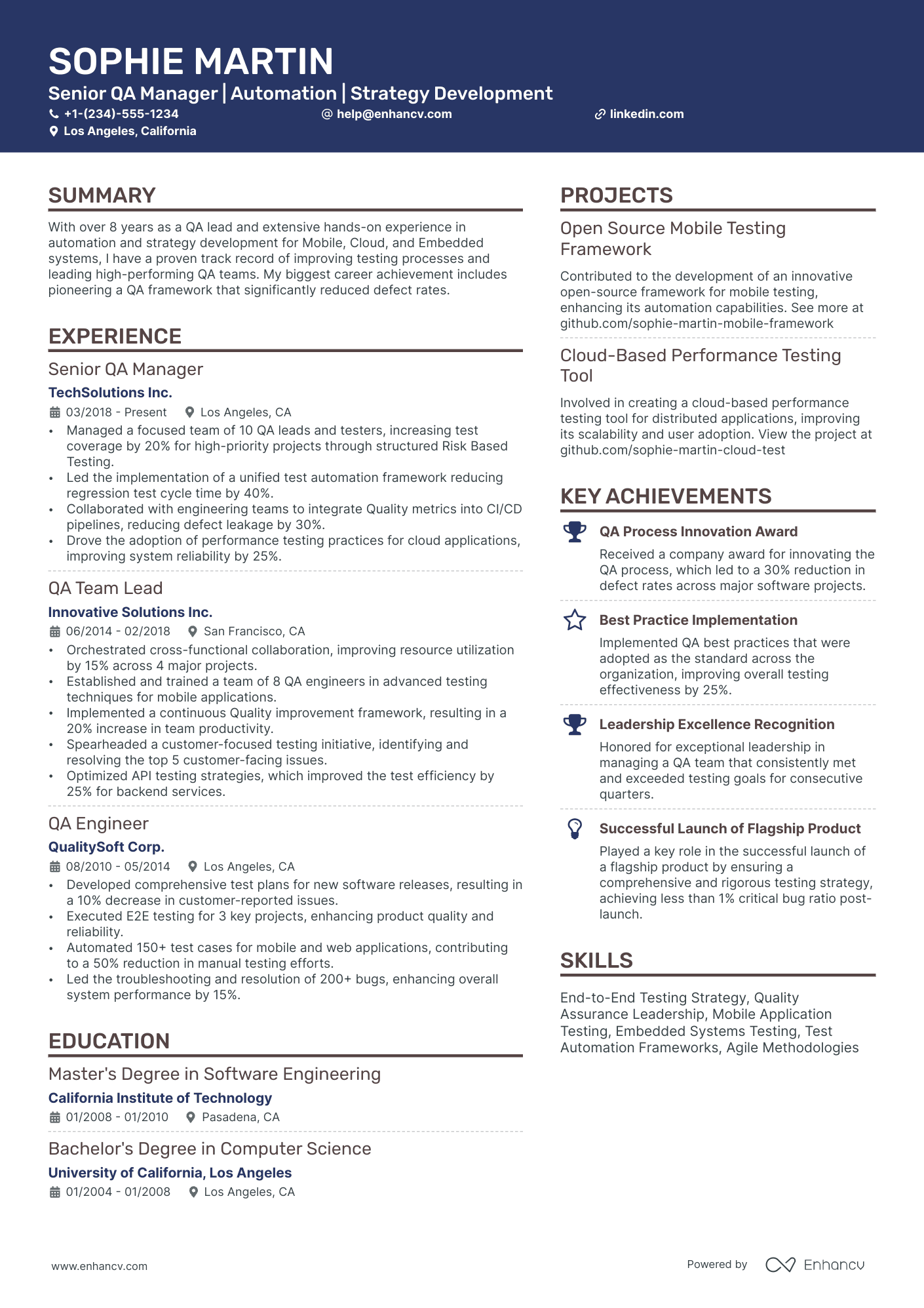
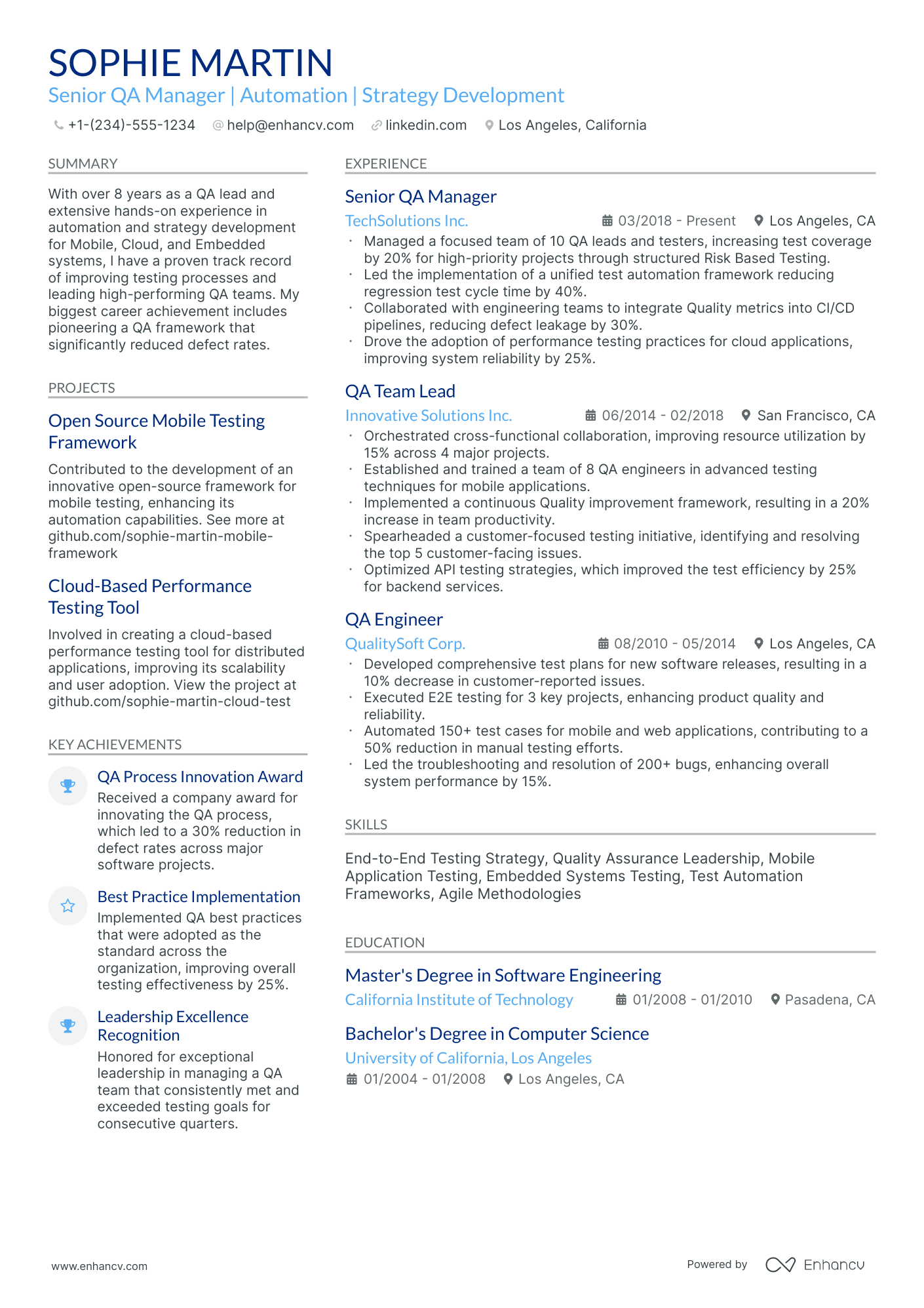
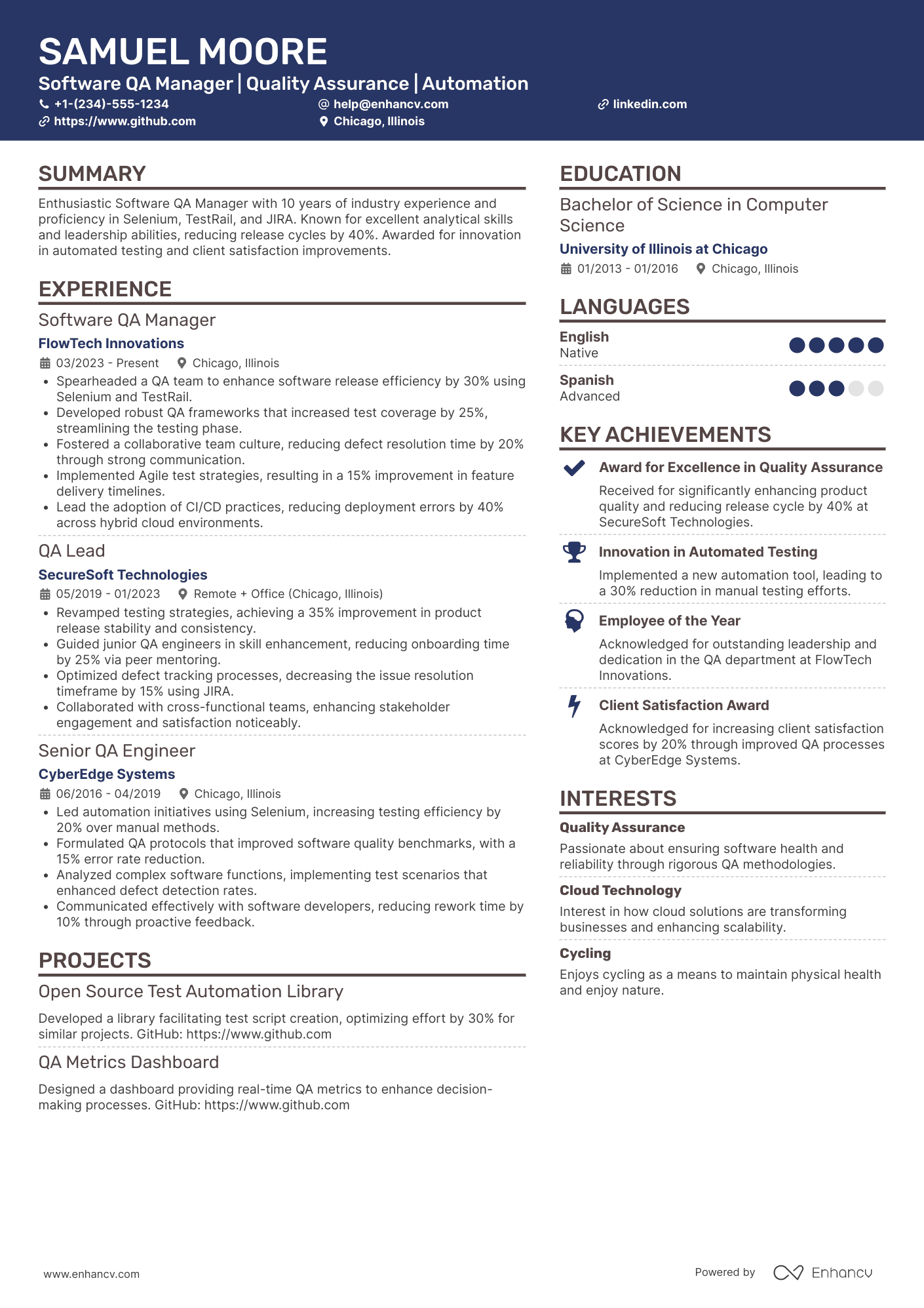
Many software QA manager resume submissions fail because they read like tool inventories and test task logs, not leadership evidence. That gets filtered by ATS keywords and loses in fast recruiter scans in a crowded market.
A strong resume shows how you improved outcomes, not just what you used. Knowing how to make your resume stand out means highlighting defect escape reduction, faster release cycles, higher automation coverage, fewer flaky tests, and measurable customer-impact improvements. Include scope, team size, and delivery reliability.

Key takeaways
- Quantify quality outcomes like defect reduction, automation coverage, and release cycle improvements in every bullet.
- Use reverse-chronological format to highlight growing QA leadership scope and team accountability.
- Tailor each resume to the job posting's tools, methodologies, and quality KPIs.
- Show ownership, execution approach, and business impact—not just daily testing tasks.
- Place skills above experience if you're junior or transitioning into QA management.
- Pair hard skills with proof in your experience bullets so claims aren't unsupported.
- Use Enhancv to turn vague responsibilities into measurable, recruiter-ready resume bullets.
How to format a software QA manager resume
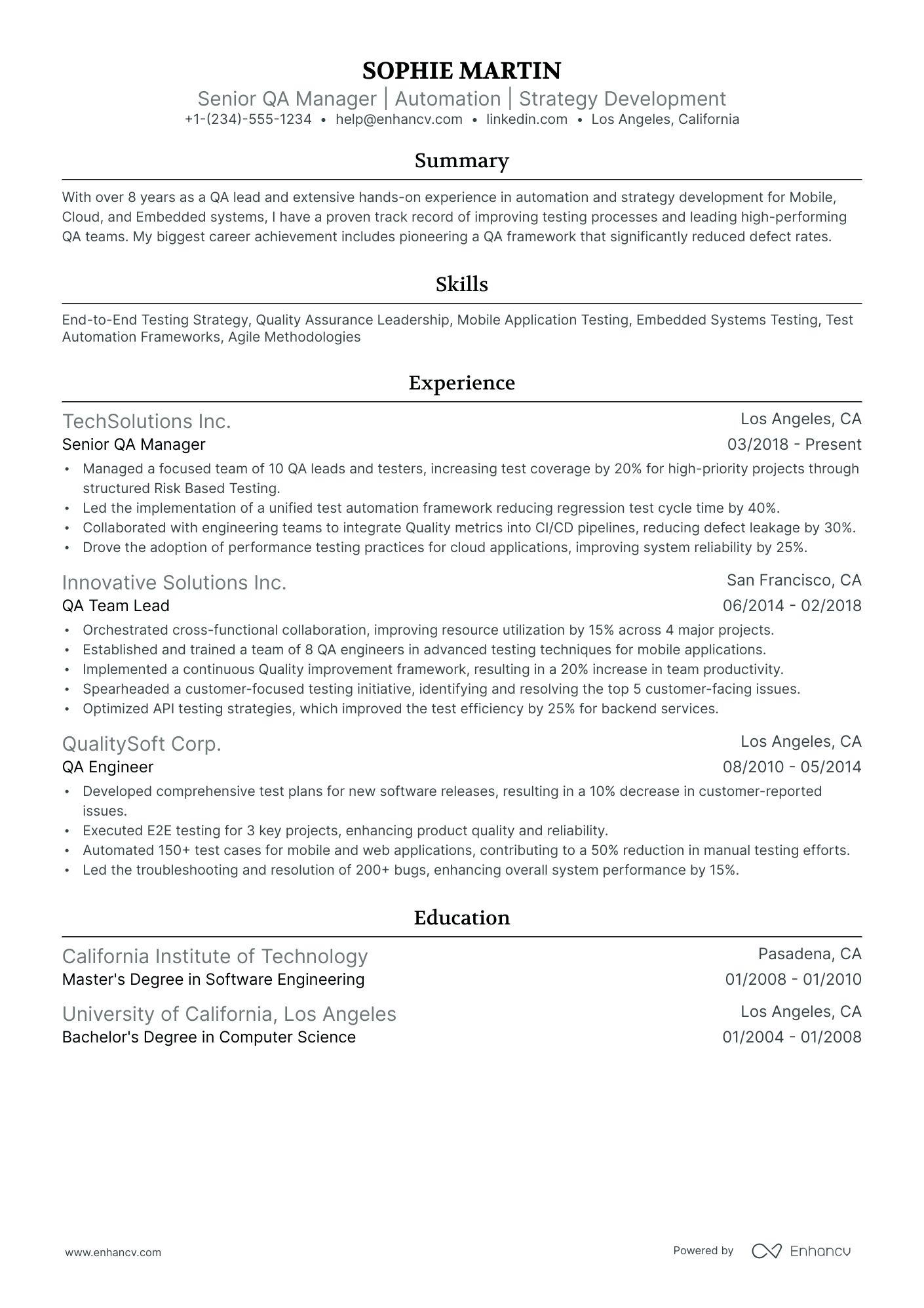
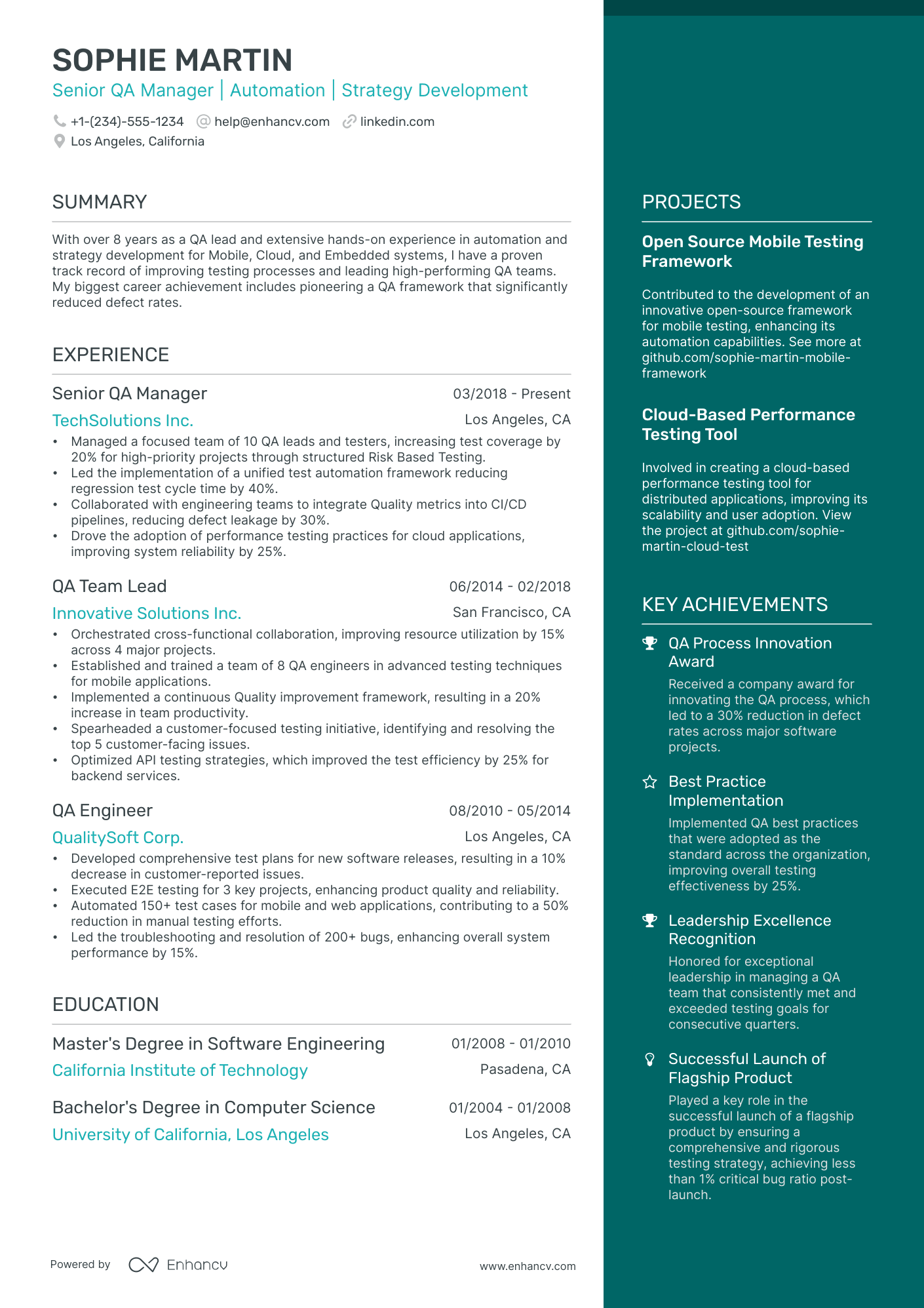
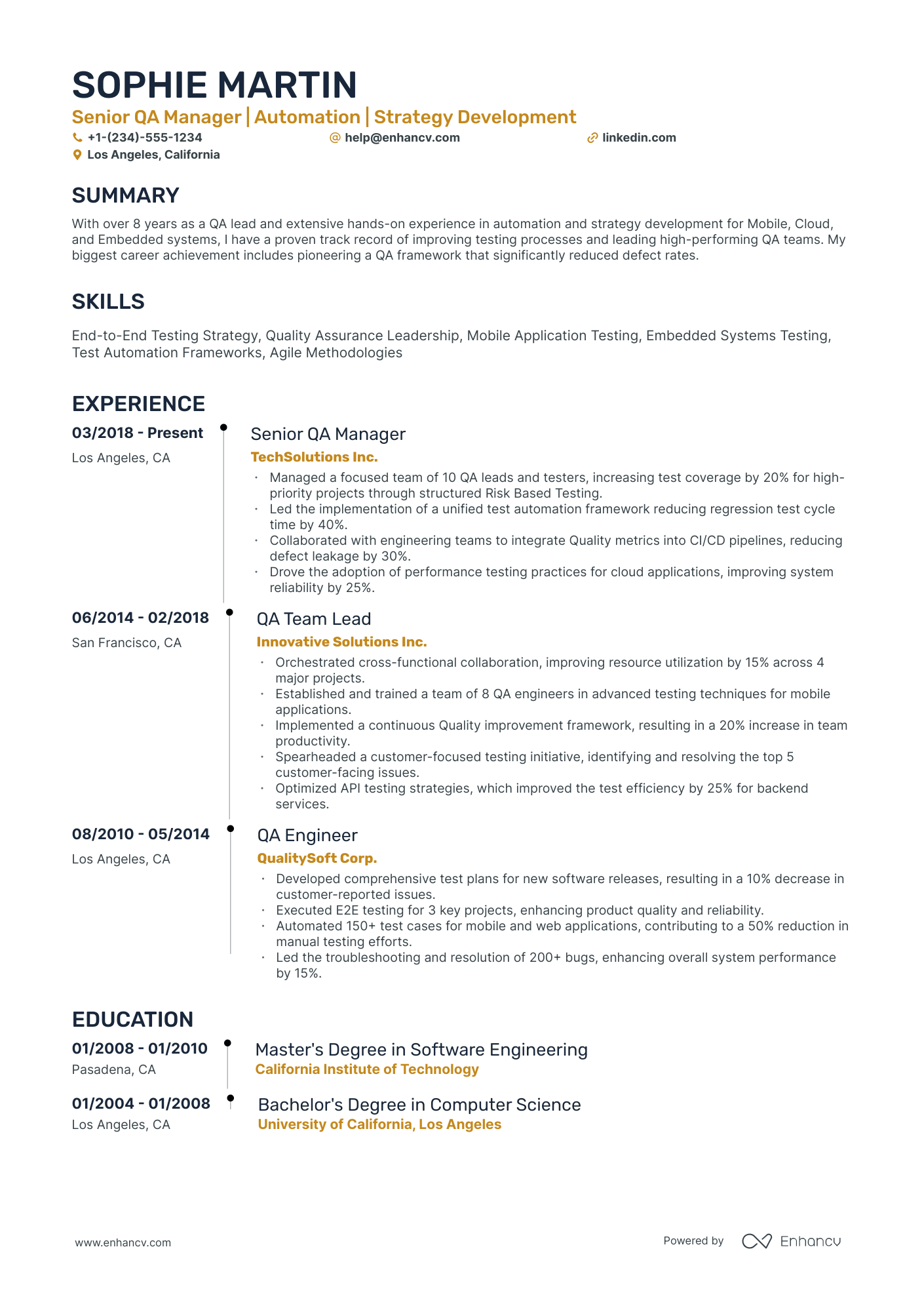
Recruiters evaluating software QA manager resumes prioritize leadership over testing teams, process improvement initiatives, and measurable quality outcomes across release cycles. Choosing the right resume format ensures these signals surface quickly during both human review and applicant tracking system (ATS) parsing.

I have significant experience in this role—which format should I use?
Use a reverse-chronological format to showcase your management trajectory and expanding scope of quality assurance ownership. Do:
- Lead with your most recent role and emphasize team size, cross-functional scope, and decision-making authority over QA strategy.
- Highlight proficiency in role-specific tools and domains such as Selenium, JIRA, CI/CD pipeline integration, test automation frameworks, and regulatory compliance standards.
- Quantify outcomes tied to business impact—reduced defect rates, improved release velocity, or cost savings from process optimization.
- "Led a 14-person QA team across three product lines, implementing automated regression testing that reduced post-release defects by 38% and shortened release cycles from 4 weeks to 10 days."
I'm junior or switching into this role—what format works best?
Use a hybrid format to balance your transferable skills with any relevant QA or management experience you do have. Do:
- Place a focused skills section near the top featuring test methodology knowledge, automation tools, and leadership or coordination abilities.
- Include project-based experience—such as leading QA efforts on a product launch, managing a testing sprint, or mentoring junior testers—even if it wasn't a formal management role.
- Connect every action to a clear outcome so recruiters see your ability to drive quality results, not just participate in processes.
- Test automation skill → built and maintained an end-to-end Selenium test suite for a SaaS platform → caught 25% more regression bugs before production, reducing hotfix deployments by half.
Why not use a functional resume?
A functional format strips away the timeline and context that recruiters need to evaluate how your QA management responsibilities grew and how consistently you delivered results. Avoid a functional resume unless you have no other way to present your qualifications coherently.
- A functional format may be acceptable if you're making a career change from a senior QA engineer or developer role into QA management and have limited formal management titles—but only if you anchor every listed skill to specific projects, team outcomes, and measurable results.
Once your layout and formatting choices are in place, the next step is deciding which sections to include so each one works within that structure.
What sections should go on a software QA manager resume
Recruiters expect a software QA manager resume to show leadership in quality strategy, team execution, and measurable improvements to release outcomes. Understanding which resume sections to include ensures maximum clarity:
- Header
- Summary
- Experience
- Skills
- Projects
- Education
- Certifications
- Optional sections: Awards, Open-source work, Languages
Strong experience bullets should emphasize quantifiable impact, quality outcomes, scope of ownership, and results across teams, releases, and test strategy.
Is your resume good enough?
Drop your resume here or choose a file. PDF & DOCX only. Max 2MB file size.
Once you’ve organized your resume with the right core components, the next step is to write your software QA manager resume experience so those sections show clear impact and fit the role.
How to write your software QA manager resume experience
The experience section is where you prove you've shipped reliable software, led QA teams through complex release cycles, and driven measurable improvements in product quality. Hiring managers prioritize demonstrated impact—defect reduction, test coverage gains, release velocity improvements—over descriptive task lists that merely catalog daily responsibilities. Writing a targeted resume ensures each entry aligns with the specific role you're pursuing.
Each entry should include:
- Job title
- Company and location (or remote)
- Dates of employment (month and year)
Three to five concise bullet points showing what you owned, how you executed, and what outcomes you delivered:
- Ownership scope: the QA programs, product lines, testing environments, or teams you were directly accountable for as a software QA manager.
- Execution approach: the testing frameworks, automation tools, CI/CD pipelines, defect tracking systems, or methodologies you used to plan test strategies and deliver release-ready software.
- Value improved: the changes you drove in defect escape rates, test coverage, regression cycle times, release stability, or overall software reliability through your QA leadership.
- Collaboration context: how you partnered with development leads, product managers, DevOps engineers, or external vendors to align quality standards across the software delivery lifecycle.
- Impact delivered: the business-level outcomes your QA management produced—expressed through improvements in release confidence, customer satisfaction, production stability, or team capacity rather than a list of activities performed.
Experience bullet formula
A software QA manager experience example
✅ Right example - modern, quantified, specific.
Software QA Manager
NimbusPay | Remote
2021–Present
Scaled quality for a cloud payments platform serving 2M+ monthly active users in a regulated, high-availability environment.
- Led a twelve-person QA org across three squads, raising automated regression coverage from 35% to 82% using Playwright, Cypress, and pytest while cutting release verification time from two days to four hours.
- Implemented a risk-based test strategy and quality gates in Jira and GitHub Actions, reducing escaped defects by 41% and improving on-time releases from 76% to 93%.
- Built a performance and reliability program with k6, JMeter, and Datadog, catching latency regressions pre-release and improving p95 API response time by 18% during peak traffic.
- Partnered with product managers, designers, and engineering leads to define acceptance criteria and shift-left testing, decreasing requirement-related rework by 27% and increasing sprint predictability.
- Established defect triage, root-cause analysis, and audit-ready evidence workflows for PCI and SOC 2 controls, cutting critical vulnerability remediation time by 33% and eliminating repeat compliance findings.
Now that you've seen how a strong experience section comes together, let's focus on adjusting those details to match the specific job you're applying for.
How to tailor your software QA manager resume experience
Recruiters evaluate your software QA manager resume through both human review and applicant tracking systems. Tailoring your resume to the job description ensures your qualifications align directly with what hiring teams prioritize.
Ways to tailor your software QA manager experience:
- Match testing tools and automation frameworks named in the job description.
- Mirror the exact terminology used for QA methodologies or standards.
- Reflect KPIs or success criteria the posting highlights for quality outcomes.
- Include domain experience when the role specifies an industry focus.
- Emphasize compliance or security testing if the posting references those areas.
- Highlight team leadership scope that matches the role's management structure.
- Align your SDLC involvement with the workflows or models they describe.
- Reference CI/CD or DevOps integration when the job listing mentions them.
Tailoring means aligning your real achievements with stated job requirements, not inserting keywords where they don't genuinely belong.
Resume tailoring examples for software QA manager
| Job description excerpt | Untailored | Tailored |
|---|---|---|
| "Lead a team of QA engineers to implement automated testing frameworks using Selenium and Jenkins across our CI/CD pipeline" | Led a team of testers and helped improve testing processes. | Led eight QA engineers in building a Selenium-based automated testing framework integrated with Jenkins CI/CD pipelines, increasing test coverage from 40% to 85% across three product lines. |
| "Define and enforce quality metrics, including defect escape rate and test execution efficiency, for enterprise SaaS applications" | Tracked quality metrics and reported results to leadership. | Established defect escape rate and test execution efficiency benchmarks for an enterprise SaaS platform, reducing production defect leakage by 32% over two quarters through root cause analysis and process standardization. |
| "Collaborate with development and product teams to embed shift-left testing practices using JIRA and TestRail for end-to-end traceability" | Worked with other teams to make sure products were tested before release. | Partnered with development and product teams to implement shift-left testing practices, using JIRA and TestRail to maintain end-to-end traceability and cutting average defect detection time by 45% during sprint cycles. |
Once you’ve aligned your software QA manager experience with the role’s priorities, the next step is to quantify your software QA manager achievements so employers can quickly see the impact of your work.
How to quantify your software QA manager achievements
Quantifying your achievements shows how your QA leadership improved product quality, delivery speed, and risk control. Focus on defect leakage, test automation coverage, release cycle time, incident rates, and cost savings from earlier detection.
Quantifying examples for software QA manager
| Metric | Example |
|---|---|
| Defect leakage | "Cut production defect leakage from 2.8% to 1.1% in two quarters by adding risk-based test plans and tightening Jira triage SLAs." |
| Automation coverage | "Increased automated regression coverage from 35% to 72% using Playwright and Jenkins, reducing manual test hours by 120 per sprint." |
| Release cycle time | "Reduced release validation time from five days to two days by parallelizing suites and introducing smoke tests in GitHub Actions." |
| Incident reliability | "Lowered Sev 1 and Sev 2 incidents from 14 to six per quarter by adding contract tests and monitoring gates with Datadog." |
| Cost avoidance | "Prevented an estimated $180,000 in rework by shifting left with API tests in Postman and enforcing quality gates in SonarQube." |
Turn vague job duties into measurable, recruiter-ready resume bullets in seconds with Enhancv's Bullet Point Generator.
Once you've crafted strong, impact-driven bullet points for your experience section, it's equally important to strategically present the hard and soft skills that qualify you for a software QA manager role.
How to list your hard and soft skills on a software QA manager resume
Your skills section shows how you drive quality outcomes, and recruiters and ATS scan it to confirm you match the role's tools and methods—aim for a balanced mix of hard skills and execution-focused soft skills. software QA manager roles require a blend of:
- Product strategy and discovery skills.
- Data, analytics, and experimentation skills.
- Delivery, execution, and go-to-market discipline.
- Soft skills.
Your skills section should be:
- Scannable (bullet-style grouping).
- Relevant to the job post.
- Backed by proof in experience bullets.
- Updated with current tools.
Place your skills section:
- Above experience if you're junior or switching careers.
- Below experience if you're mid/senior with strong achievements.

Hard skills
- Test strategy and planning
- Risk-based testing
- Agile, Scrum, Kanban
- Jira, Azure DevOps
- TestRail, Zephyr Scale
- Selenium, Cypress, Playwright
- API testing: Postman, REST Assured
- Mobile testing: Appium, BrowserStack
- Performance testing: JMeter, k6
- CI/CD: Jenkins, GitHub Actions
- SQL, test data management
- Defect triage and root cause analysis
Soft skills
- Cross-functional stakeholder alignment
- Clear test status reporting
- Quality advocacy in planning
- Prioritization under deadlines
- Coaching and mentoring testers
- Constructive conflict resolution
- Decision-making with risk tradeoffs
- Ownership of release readiness
- Driving process improvements
- Negotiating scope and timelines
- Facilitating bug triage meetings
- Partnering with engineering leadership
How to show your software QA manager skills in context
Skills shouldn't live only in a bulleted list on your resume. Explore resume skills examples to see how top candidates weave competencies throughout their documents.
They should be demonstrated in:
- Your summary (high-level professional identity)
- Your experience (proof through outcomes)
Here's what that looks like in practice.
Summary example
Senior QA manager with 10+ years in fintech, leading teams of 15+ engineers across Selenium and Jira-driven workflows. Reduced production defects by 40% through risk-based testing strategies and cross-functional collaboration with product and engineering.
- Reflects senior-level experience clearly
- Names role-relevant tools directly
- Quantifies quality improvement with metrics
- Highlights cross-functional collaboration skills
Experience example
Software QA Manager
Bridgepoint Financial Technologies | Remote
March 2019–January 2024
- Directed a 12-person QA team using TestRail and CI/CD pipelines, cutting release cycle time by 30% over two years.
- Partnered with product managers and developers to implement shift-left testing, reducing critical post-release bugs by 55%.
- Established automated regression suites in Selenium, saving 20 hours of manual testing effort per sprint.
- Every bullet includes measurable proof
- Skills surface naturally through outcomes
Once you’ve framed your quality assurance leadership strengths through concrete examples, the next step is to apply that approach to structuring a software QA manager resume when you don’t have direct experience.
How do I write a software QA manager resume with no experience
Even without full-time experience, you can demonstrate readiness through:
- Capstone QA test strategy project
- Volunteer QA lead for nonprofit
- Internship coordinating test execution
- Open-source project QA ownership
- University research software validation
- Freelance test planning and reporting
- Test automation course portfolio
If you're building a resume without work experience, focus on:
- Test strategy, scope, and risk
- Metrics, dashboards, and reporting
- Defect triage and prioritization
- Tooling: Jira, TestRail, Selenium
Resume format tip for entry-level software QA manager
Use a hybrid resume format because it highlights QA leadership skills and projects first, while still showing education and any work history. Do:
- Lead with a summary naming software QA manager.
- Add a projects section above work.
- Quantify results with defect, coverage metrics.
- List tools with proficiency levels.
- Link to test plans and repos.
- Led capstone QA test strategy in Jira and TestRail, built Selenium smoke suite, and cut escaped defects by 30% across three releases.
Once you've positioned your transferable skills and relevant projects to offset limited professional experience, your education section becomes the next key area to strengthen your candidacy.
How to list your education on a software QA manager resume
Your education section helps hiring teams confirm you hold the foundational knowledge needed for a software QA manager role. It validates technical training and academic credibility quickly.
Include:
- Degree name
- Institution
- Location
- Graduation year
- Relevant coursework (for juniors or entry-level candidates)
- Honors & GPA (if 3.5 or higher)
Avoid listing specific months or days. Use the graduation year only for a cleaner format.
Here's a realistic education entry tailored to the software QA manager role.
Example education entry
Bachelor of Science in Computer Science
University of Illinois at Urbana-Champaign, Champaign, IL
Graduated: 2016
GPA: 3.7/4.0
- Relevant Coursework: Software Testing & Verification, Systems Engineering, Database Management, Statistical Quality Control
- Honors: Dean's List (six semesters), Graduated Magna Cum Laude
How to list your certifications on a software QA manager resume
Certifications on your resume show your commitment to continuous learning, prove tool proficiency, and signal industry relevance for a software QA manager in fast-changing quality environments.
Include:
- Certificate name
- Issuing organization
- Year
- Optional: credential ID or URL
- Place certifications below education when your degree is recent and your certifications are older or less relevant to software QA manager work.
- Place certifications above education when they are recent, role-relevant, or required for the software QA manager roles you target.
Best certifications for your software QA manager resume
ISTQB Certified Tester Advanced Level Test Manager (CTAL-TM) ISTQB Certified Tester Foundation Level (CTFL) Certified ScrumMaster (CSM) PMI Agile Certified Practitioner (PMI-ACP) Certified Software Quality Engineer (CSQE) AWS Certified Cloud Practitioner Microsoft Certified: Azure Fundamentals
Once you’ve shown your credentials in a clean, relevant way, shift to your software QA manager resume summary to quickly connect those qualifications to the value you bring.
How to write your software QA manager resume summary
Your resume summary is the first thing a recruiter reads, so it needs to earn attention fast. A strong summary for a software QA manager role signals leadership, technical depth, and measurable quality outcomes.
Keep it to three to four lines, with:
- Your title and total years of experience in QA or software testing.
- The domain or industry you've worked in, such as SaaS, fintech, or healthcare.
- Core tools and methodologies like Selenium, JIRA, CI/CD pipelines, or Agile frameworks.
- One or two quantified achievements, such as defect reduction rates or release cycle improvements.
- Soft skills tied to real outcomes, like mentoring junior testers or cross-functional collaboration that shortened delivery timelines.

PRO TIP
At the manager level, emphasize team leadership, process ownership, and business impact over individual technical tasks. Highlight how you've built or scaled QA teams, improved release quality, or reduced production defects. Avoid vague descriptors like "passionate" or "detail-oriented" without tying them to results. Skip motivational language entirely.
Example summary for a software QA manager
Software QA manager with eight years of experience leading testing teams in SaaS environments. Built a 12-person QA team and reduced production defects by 40% through automated regression frameworks.
Optimize your resume summary and objective for ATS
Drop your resume here or choose a file.
PDF & DOCX only. Max 2MB file size.
Now that your summary captures your QA leadership value, make sure your header presents the essential contact and professional details recruiters need to reach you.
What to include in a software QA manager resume header
A well-crafted resume header is the top section with your identity and contact details, and it boosts visibility, credibility, and recruiter screening for a software QA manager.
Essential resume header elements
- Full name
- Tailored job title and headline
- Location
- Phone number
- Professional email
- GitHub link
- Portfolio link
A LinkedIn link helps recruiters verify your experience quickly and supports screening.
Don't include a photo on a software QA manager resume unless the role is explicitly front-facing or appearance-dependent.
Keep your header to two lines, mirror the job posting's title, and use consistent formatting so recruiters can scan it in seconds.
Example
Software QA manager resume header
Jordan Kim
Software QA manager | Test strategy, automation oversight, cross-functional leadership
Austin, TX
(512) 555-01XX
jordan.kim@enhancv.com github.com/jordankim yourwebsite.com linkedin.com/in/jordankim
Once your header clearly identifies who you are and how to reach you, add optional sections to provide supporting details that reinforce the same profile.
Additional sections for software QA manager resumes
When your core sections don't fully capture your expertise, additional sections can strengthen your credibility and set you apart from other software QA manager candidates.
- Languages
- Certifications (ISTQB, CSTE, CSM)
- Publications and technical writing
- Conference presentations and speaking engagements
- Professional affiliations (ASQ, IEEE)
- Open source contributions
- Hobbies and interests
Once you've rounded out your resume with the right supplementary sections, it's equally important to pair it with a strong cover letter that reinforces your qualifications.
Do software QA manager resumes need a cover letter
A cover letter isn't required for a software QA manager, but it helps in competitive searches or when hiring managers expect one. If you're unsure what a cover letter is or how it complements your resume, it can make a difference when your resume needs context or when you're targeting a specific product team.
Use a cover letter to add clarity your resume can't:
- Explain role and team fit by matching your leadership style to the team's test strategy, release cadence, and cross-functional workflow.
- Highlight one or two relevant projects or outcomes, such as reducing escaped defects, improving automation coverage, or shortening release validation time.
- Show understanding of the product, users, and business context by referencing quality risks that matter, like uptime, compliance, or customer-impacting defects.
- Address career transitions or non-obvious experience by connecting past domains, tools, or team sizes to the software QA manager role you want.
Drop your resume here or choose a file.
PDF & DOCX only. Max 2MB file size.
Even when you decide a cover letter won’t add much value, using AI to improve your software QA manager resume helps you strengthen the document that hiring teams review first.
Using AI to improve your software QA manager resume
AI can sharpen your resume's clarity, structure, and impact. It helps refine language and highlight measurable results. But overuse strips authenticity. Once your content feels clear and role-aligned, step away from AI. If you're wondering which AI is best for writing resumes, start with tools that focus on structure and quantification rather than generic rewording.
Here are 10 practical prompts to strengthen specific sections of your software QA manager resume:
Strengthen summary focus
Quantify experience bullets
Tighten skills relevance
Improve action verbs
Align with job posting
Clarify project contributions
Refine certification descriptions
Eliminate redundancy
Enhance education relevance
Improve readability overall
Conclusion
A strong software QA manager resume shows measurable outcomes, role-specific skills, and a clear structure. It highlights quality metrics, release impact, and team results. It also shows test strategy, automation oversight, risk management, and cross-functional leadership.
Hiring teams want proof you can deliver stable releases and improve quality at scale. Keep your resume focused, scannable, and consistent, so your experience matches today’s expectations and near-future needs.