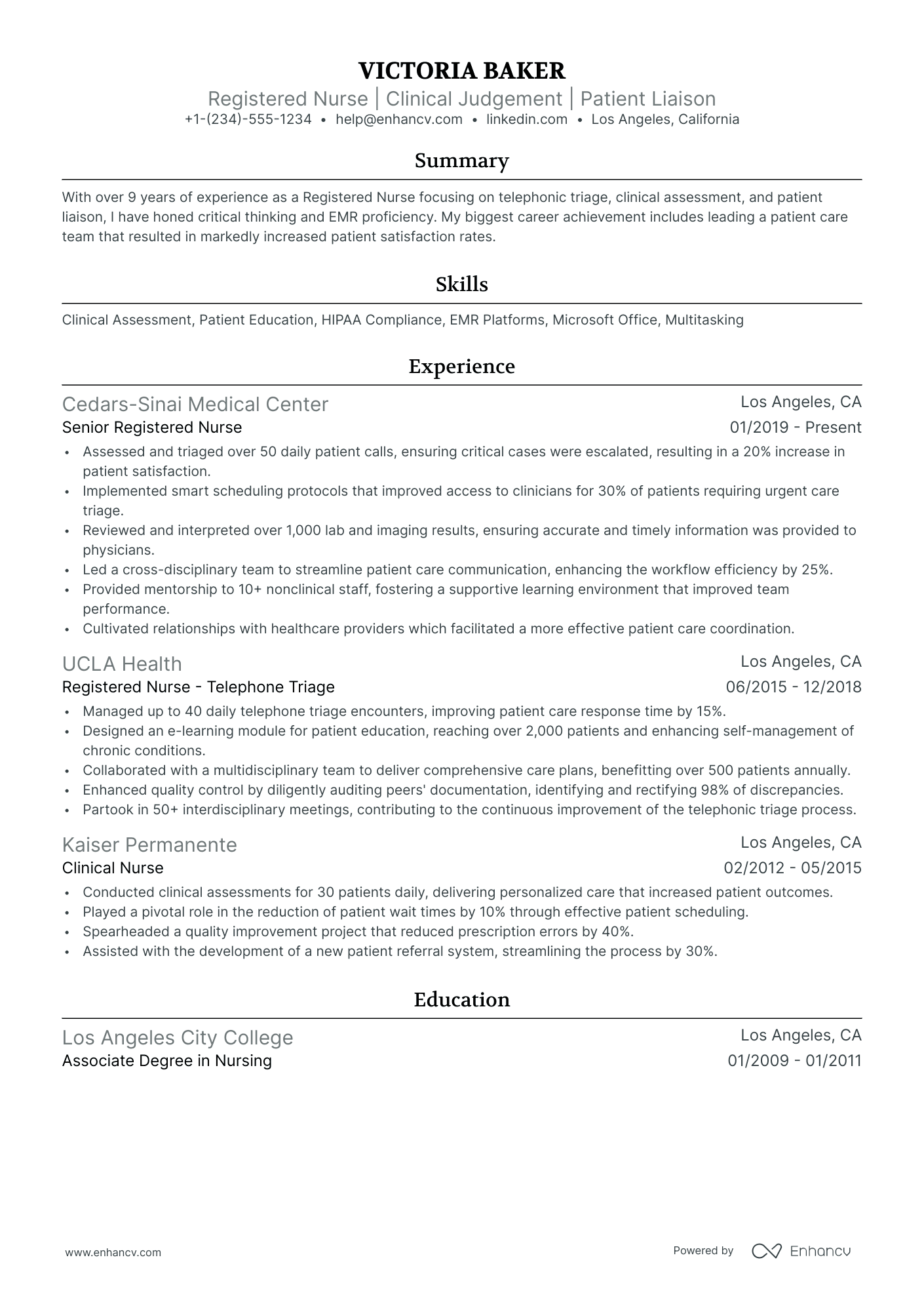
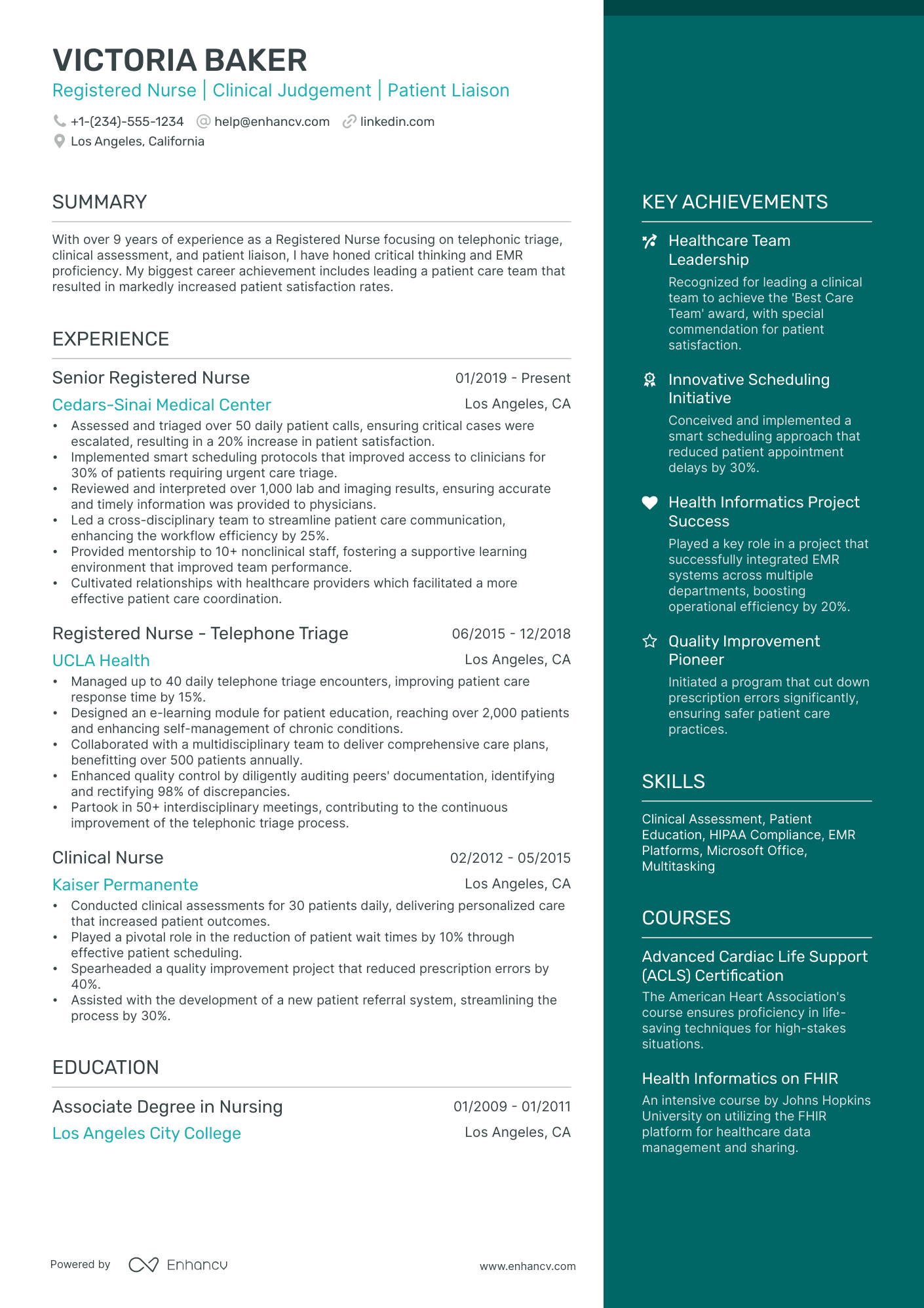
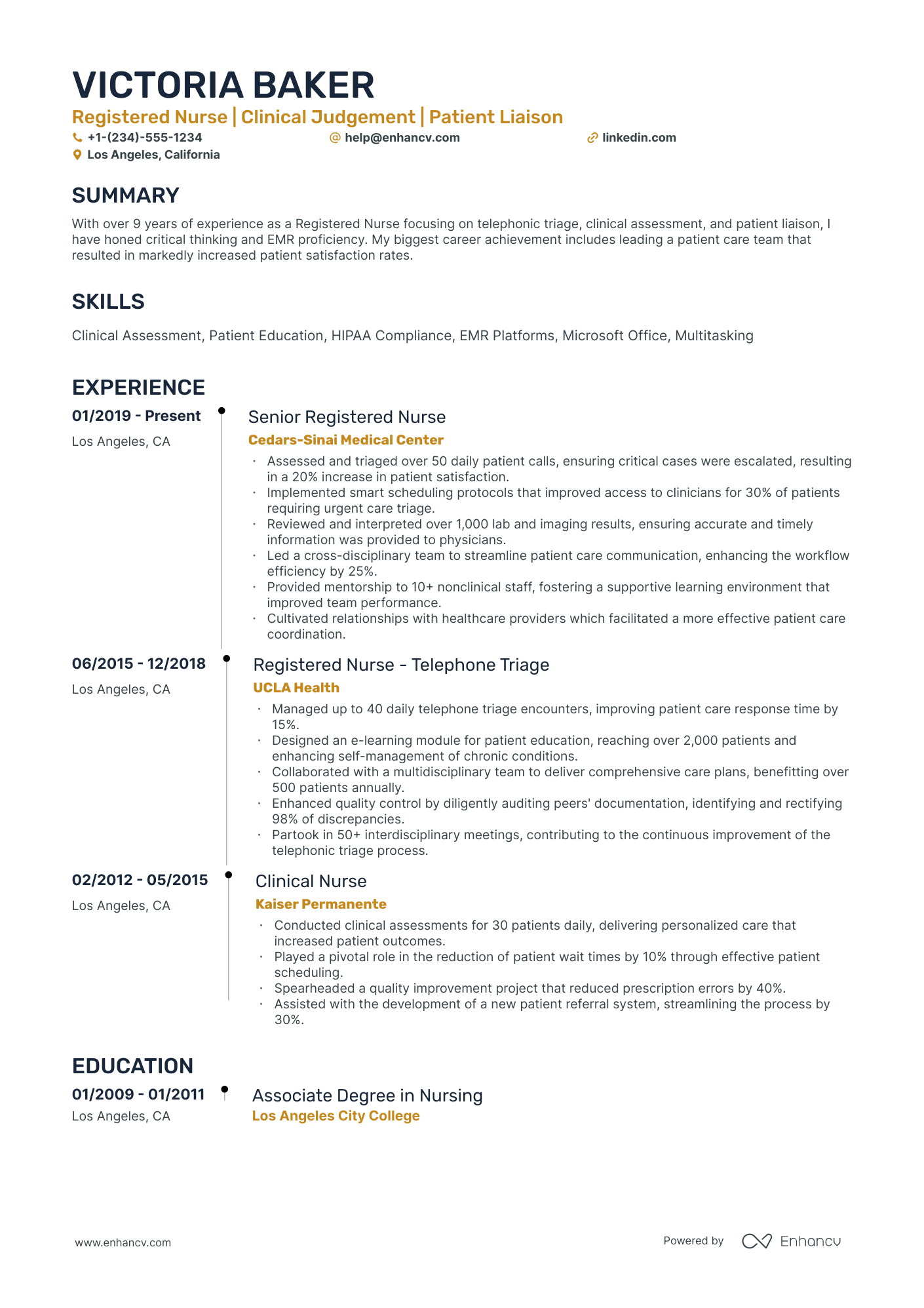
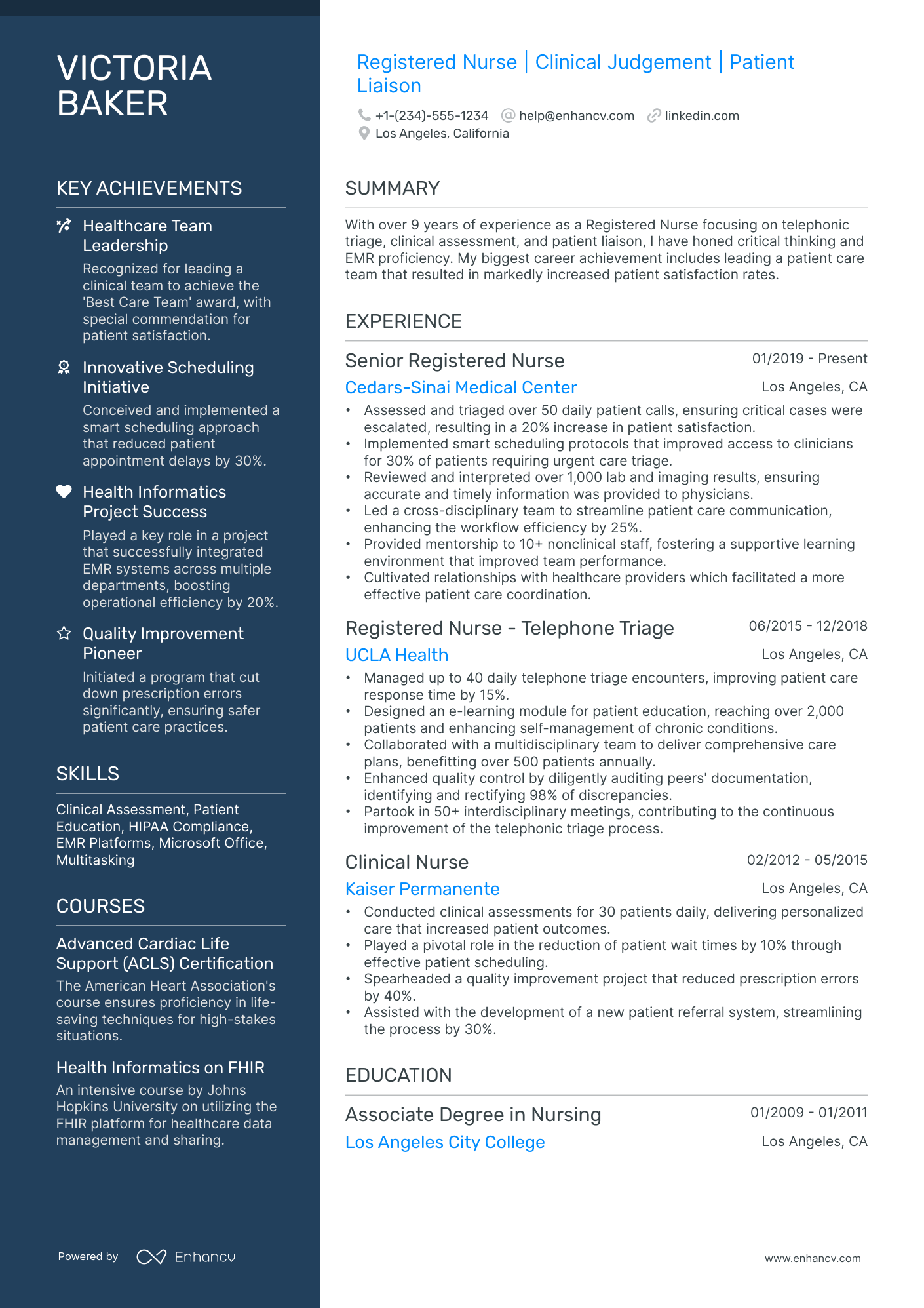
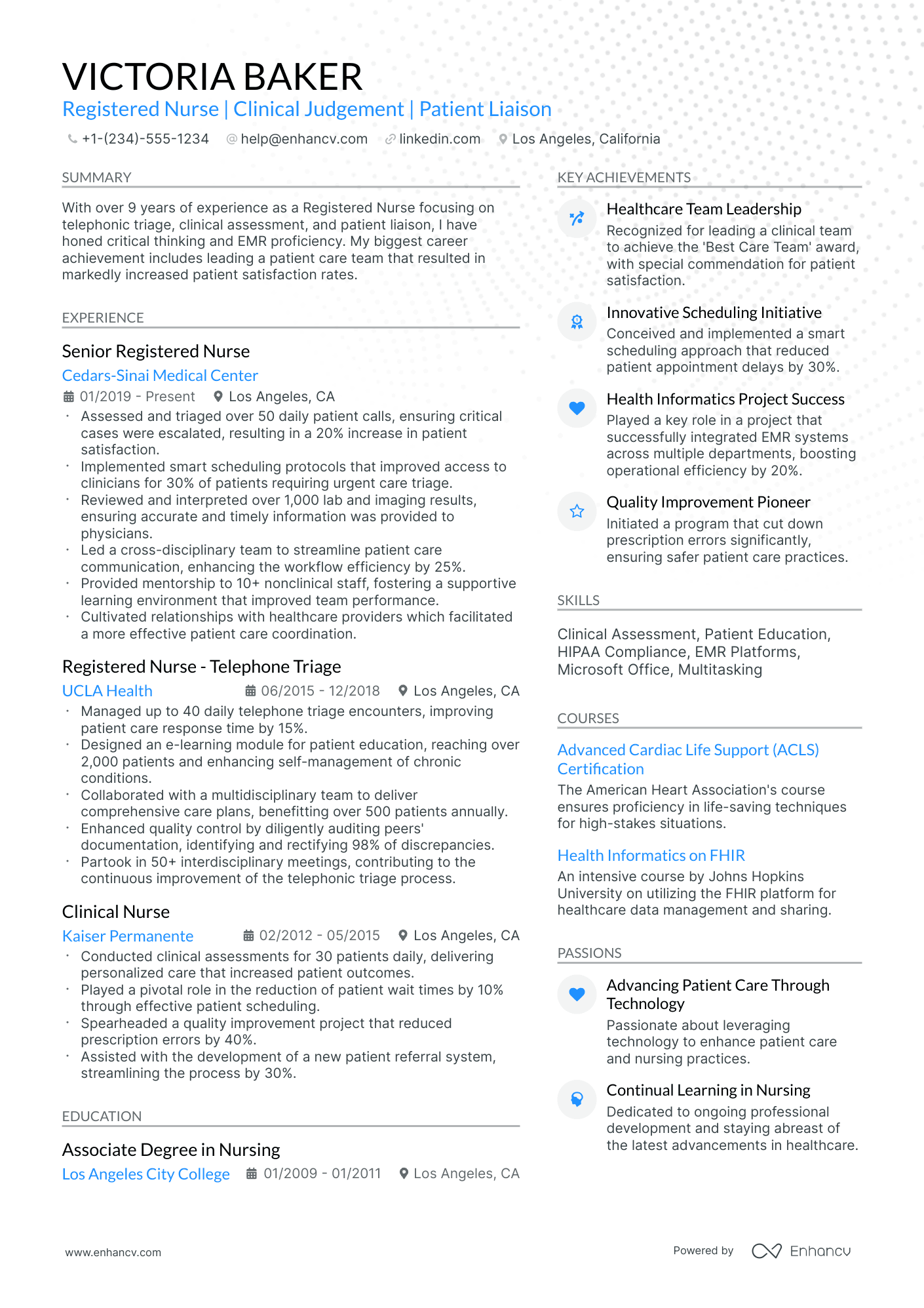
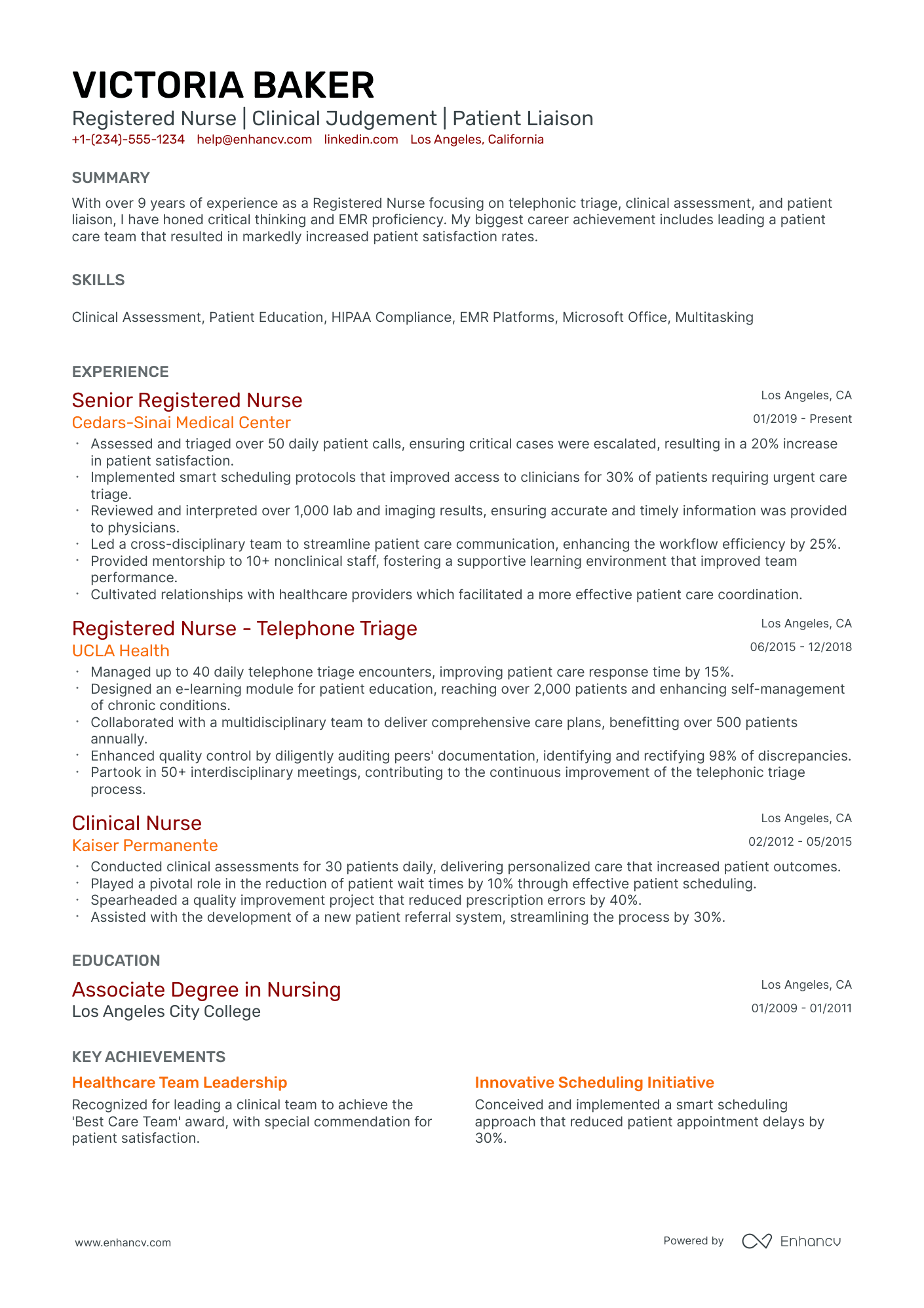
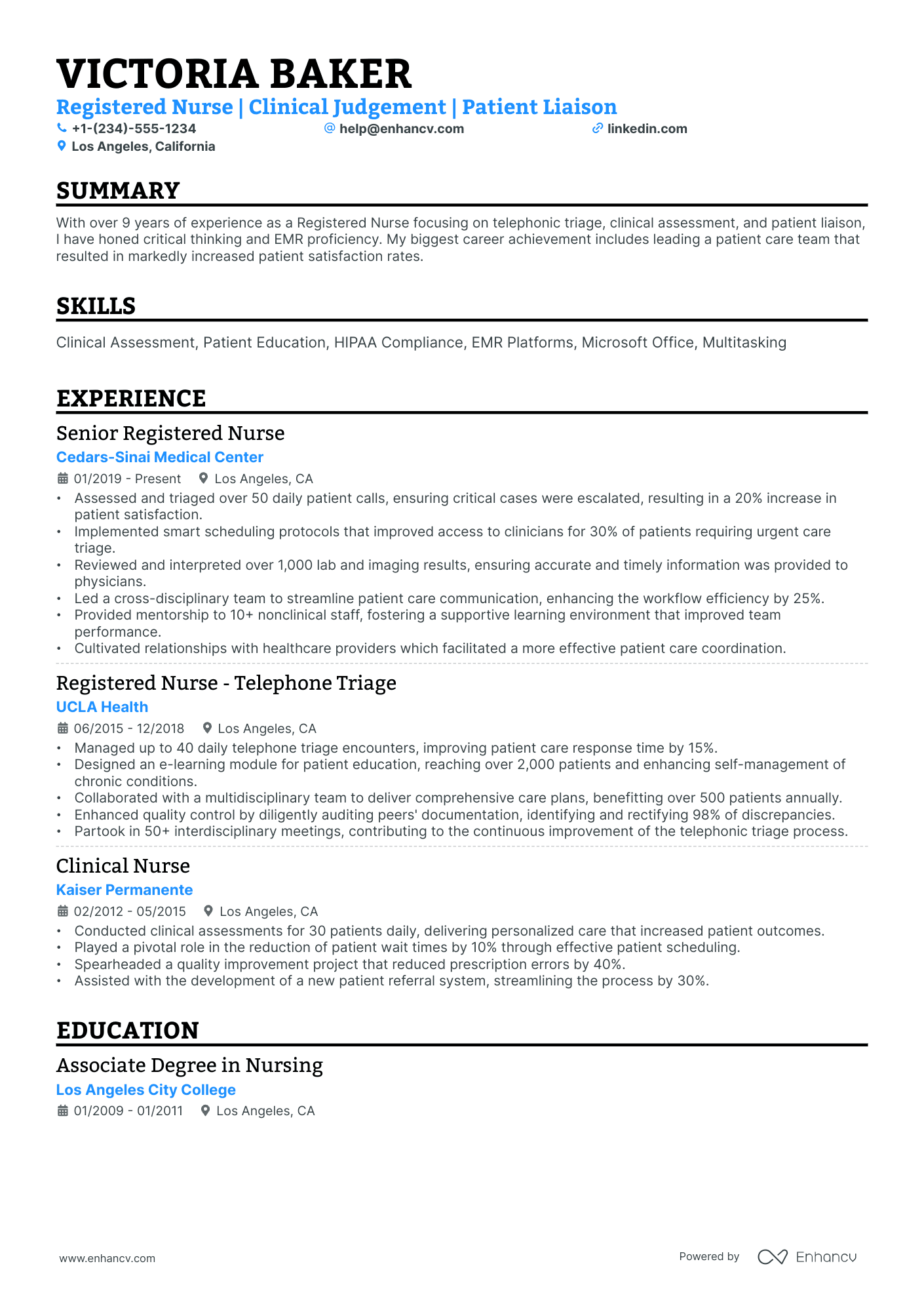
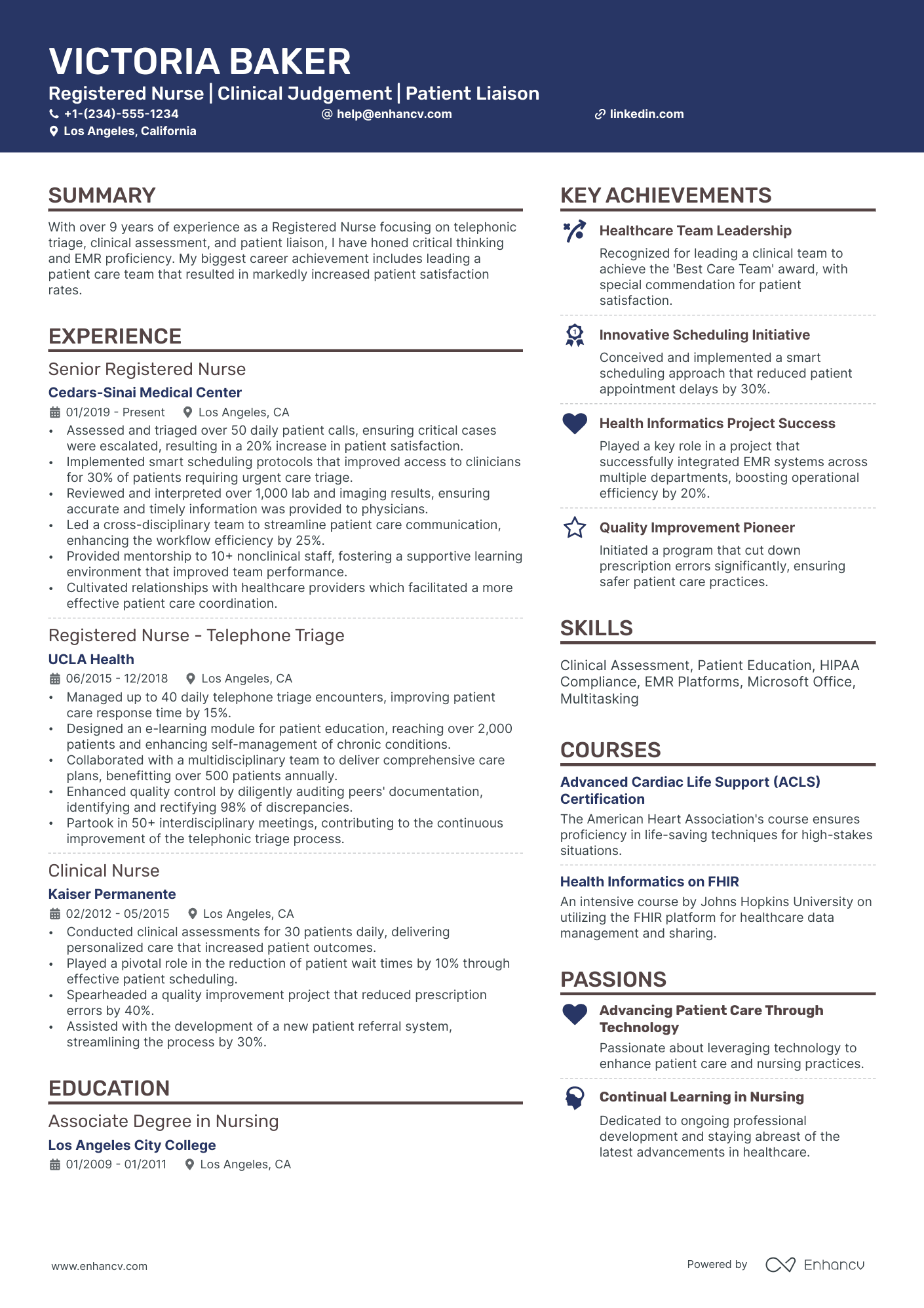
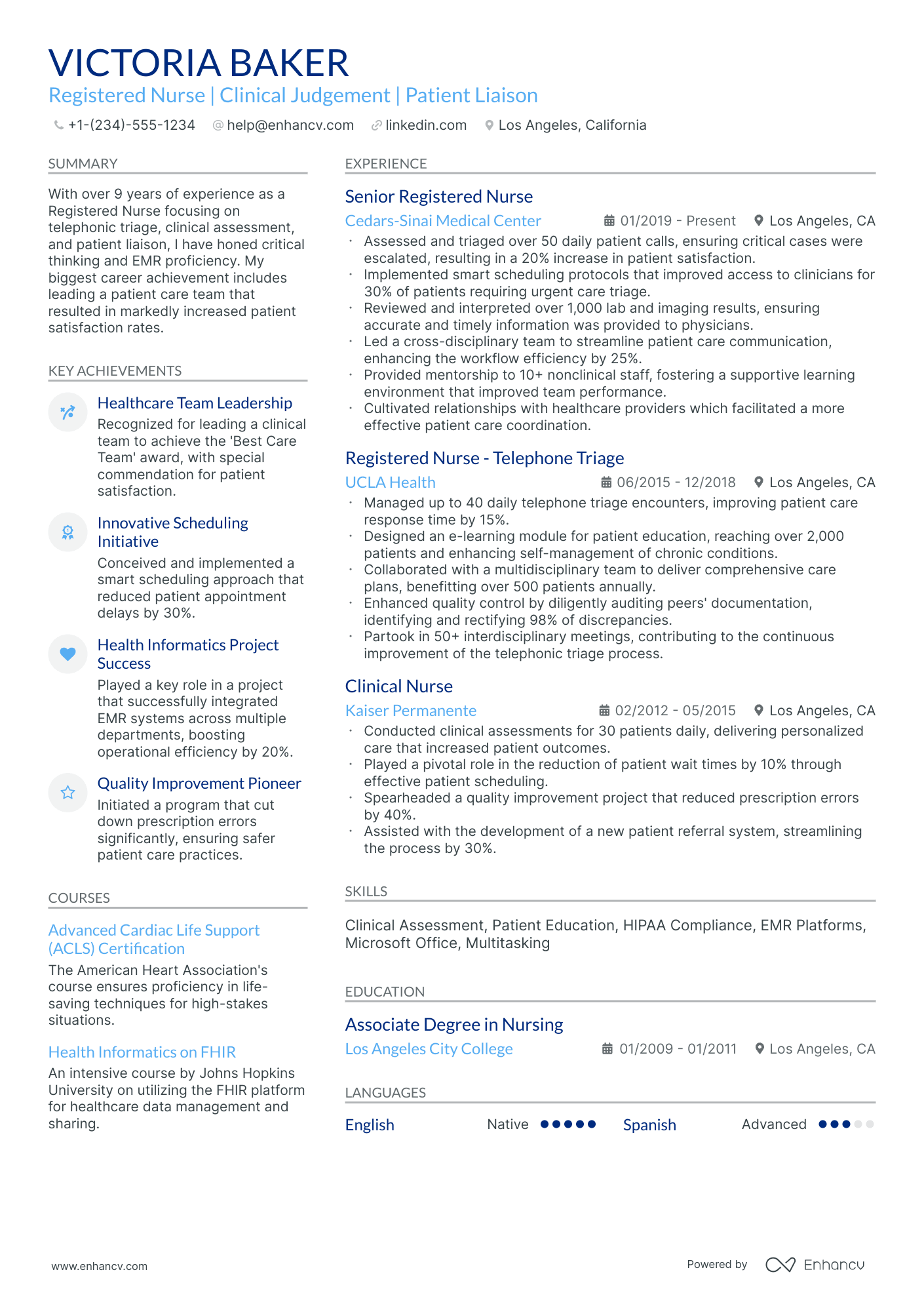
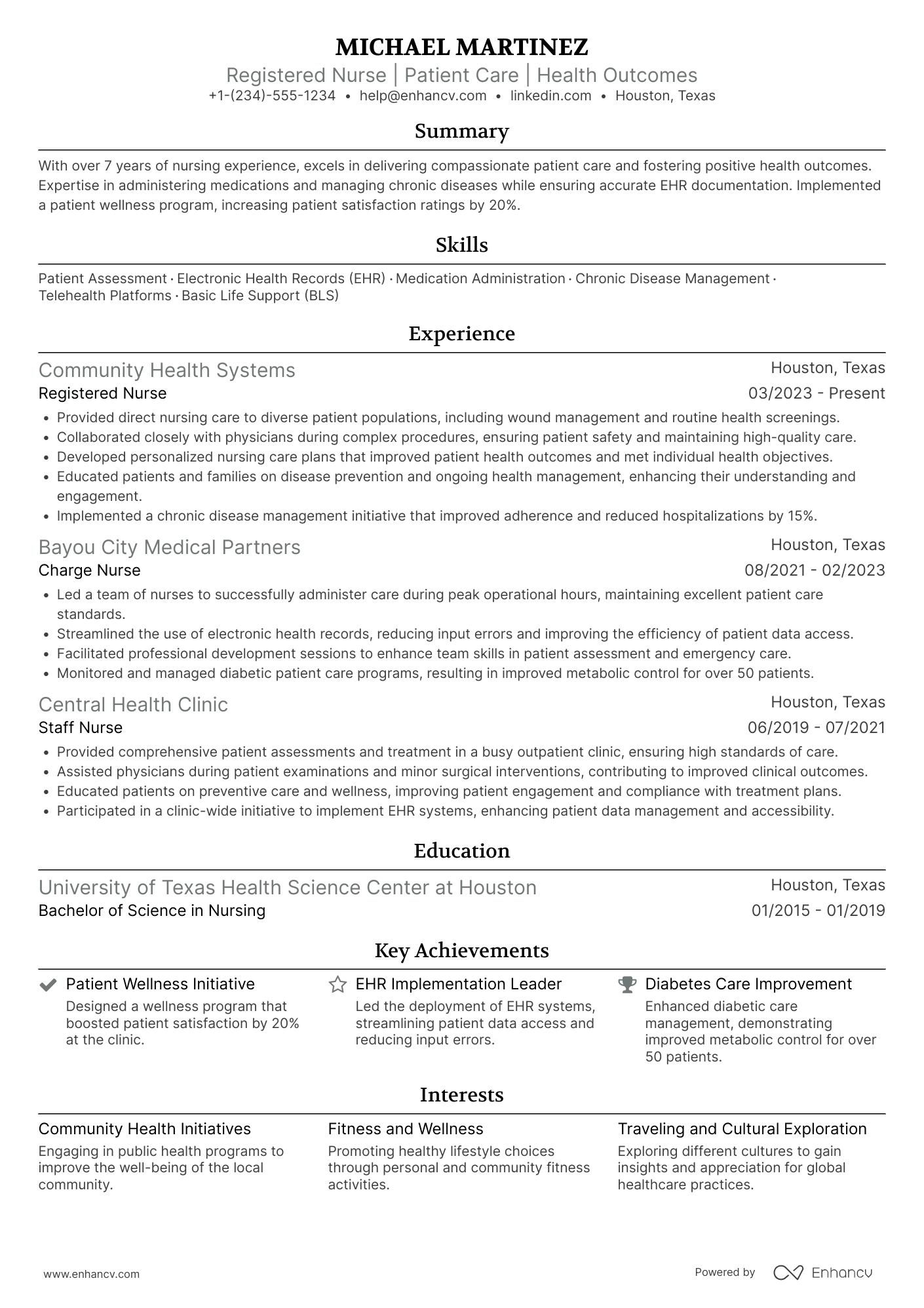
Many practice nurse resumes fail because they read like duty logs and bury clinical impact in dense paragraphs. That hurts you in ATS screening, fast recruiter scans, and a crowded field where clear value wins interviews.
A strong resume shows what improved because you were there. Knowing how to make your resume stand out means highlighting reduced wait times, higher immunization uptake, better chronic disease control, fewer medication errors, stronger patient satisfaction, and smoother recall systems across a defined patient panel.

Key takeaways
- Quantify patient outcomes, caseload size, and efficiency gains in every experience bullet.
- Use reverse-chronological format if experienced; use a hybrid format if junior or switching careers.
- Tailor clinical terminology, EHR platforms, and protocols to match each job posting.
- Place skills above experience when you're entry-level, below it when you're senior.
- Tie every listed skill to a measurable result in your summary or experience section.
- Write a cover letter when you need to explain career gaps or non-obvious clinical transitions.
- Use Enhancv's tools to sharpen bullet points, then stop editing before AI overrides your real voice.
Job market snapshot for practice nurses
We analyzed 6,884 recent practice nurse job ads across major US job boards. These numbers help you understand employer expectations, salary landscape, top companies hiring at a glance.
What level of experience employers are looking for practice nurses
| Years of Experience | Percentage found in job ads |
|---|---|
| 1–2 years | 6.1% (421) |
| 3–4 years | 0.7% (45) |
| 5–6 years | 0.1% (8) |
| 7–8 years | 0.0% (1) |
| 10+ years | 1.9% (133) |
| Not specified | 91.1% (6269) |
Practice nurse ads by area of specialization (industry)
| Industry (Area) | Percentage found in job ads |
|---|---|
| Healthcare | 64.8% (4463) |
| Finance & Banking | 23.2% (1596) |
| Government | 9.7% (671) |
| Education | 2.1% (144) |
Top companies hiring practice nurses
| Company | Percentage found in job ads |
|---|---|
| Indian Health Service | 4.7% (326) |
| Department of Veterans Affairs | 4.4% (304) |
| PruittHealth | 3.4% (233) |
| Life Care Centers of America | 3.1% (211) |
| North Shore Healthcare Support Center | 2.6% (178) |
| American Senior Communities | 2.5% (172) |
| Res-Care, Inc. | 2.3% (160) |
| BAYADA Home Health Care | 2.2% (151) |
| UnitedHealth Group Inc. | 2.0% (140) |
| Enhabit Inc. | 1.9% (131) |
Role overview stats
These tables show the most common responsibilities and employment types for practice nurse roles. Use them to align your resume with what employers expect and to understand how the role is structured across the market.
Day-to-day activities and top responsibilities for a practice nurse
| Responsibility | Percentage found in job ads |
|---|---|
| Licensed practical nurse | 19.8% (1360) |
| Cpr | 17.0% (1170) |
| Patient care | 17.0% (1170) |
| Medication administration | 16.5% (1137) |
| Documentation | 14.5% (1000) |
| Cpr certification | 14.2% (980) |
| Nursing | 12.6% (866) |
| Basic life support | 7.8% (540) |
| Bls | 6.5% (445) |
| Lpn | 6.2% (426) |
| Infection control | 4.8% (331) |
| Wound care | 4.5% (309) |
How to format a practice nurse resume
Recruiters reviewing practice nurse resumes prioritize clinical competencies, patient care experience, and familiarity with primary care or general practice workflows. A clean, well-structured resume format ensures these signals—along with certifications and care delivery outcomes—are immediately visible to both hiring managers and applicant tracking systems.

I have significant experience in this role—which format should I use?
Use a reverse-chronological format to lead with your most recent and relevant clinical experience in practice nursing. Do:
- Highlight the scope of your patient caseload, practice setting, and any ownership of clinical programs such as chronic disease management or immunization clinics.
- Feature role-specific skills and tools prominently, including electronic health records (e.g., EMIS, SystmOne), triage protocols, cervical screening, wound care, and patient education frameworks.
- Quantify outcomes tied to patient care quality, efficiency, or practice performance metrics.
I'm junior or switching into this role—what format works best?
A hybrid format works best, letting you balance transferable clinical skills with any direct or adjacent healthcare experience you've gained so far. Do:
- Place a dedicated skills section near the top of your resume, listing relevant competencies such as phlebotomy, vital signs monitoring, patient triage, and health promotion.
- Include clinical placements, volunteer roles, or transitional experience in GP surgeries, community health settings, or hospital wards to demonstrate practical exposure.
- Connect every skill or action to a clear patient care or operational outcome, even if the setting wasn't a general practice.
Why not use a functional resume?
A functional format strips away the clinical timeline that hiring managers rely on to verify your hands-on nursing experience, care settings, and professional development—making it harder for them to trust your readiness for patient-facing responsibilities. A functional format may only be acceptable if you're transitioning into practice nursing from a different nursing specialty, re-entering the workforce after a career break, or have limited formal employment history—but even then, every listed skill must be tied to specific clinical projects, placements, or measurable patient outcomes.
Once your layout and formatting choices are in place, the next step is deciding which sections to include so each one serves a clear purpose on your resume.
What sections should go on a practice nurse resume
Recruiters expect you to present patient care, clinical support, and administrative coordination in a clean, consistent format. Understanding what to put on a resume helps you prioritize the right content for your practice nurse application.
Use this structure for maximum clarity:
- Header
- Summary
- Experience
- Skills
- Projects
- Education
- Certifications
- Optional sections: Awards, Volunteering, Languages
In your experience bullets, emphasize measurable patient outcomes, clinic workflow improvements, scope of responsibility, and results you delivered.
Is your resume good enough?
Drop your resume here or choose a file. PDF & DOCX only. Max 2MB file size.
Once you’ve organized your resume with the right core components, the next step is writing your practice nurse experience section so each role supports those elements with clear, relevant evidence.
How to write your practice nurse resume experience
The experience section of your practice nurse resume should highlight the clinical work you've delivered, the healthcare tools and methods you've applied, and the measurable outcomes you've achieved for patients and practices. Hiring managers prioritize demonstrated impact—improved patient outcomes, streamlined workflows, and consistent care delivery—over descriptive task lists. Building a targeted resume ensures each entry speaks directly to the role you're pursuing.
Each entry should include:
- Job title
- Company and location (or remote)
- Dates of employment (month and year)
Three to five concise bullet points showing what you owned, how you executed, and what outcomes you delivered:
- Ownership scope: the patient populations, clinical caseloads, care programs, chronic disease management plans, or treatment areas you were directly accountable for within the practice.
- Execution approach: the clinical protocols, electronic health record systems, triage frameworks, diagnostic tools, or evidence-based care methods you used to assess patients and deliver treatment.
- Value improved: changes to patient health outcomes, care quality, appointment efficiency, immunization rates, screening compliance, infection control, or clinical risk reduction tied to your nursing interventions.
- Collaboration context: how you worked alongside GPs, specialists, health visitors, allied health professionals, administrative staff, or external agencies to coordinate patient care and support multidisciplinary objectives.
- Impact delivered: outcomes expressed through patient satisfaction improvements, practice performance gains, reduced wait times, expanded service capacity, or public health contributions rather than routine activity descriptions.
Experience bullet formula
A practice nurse experience example
✅ Right example - modern, quantified, specific.
Practice Nurse
Riverside Family Medicine | Columbus, OH
2022–Present
High-volume primary care clinic serving 18,000+ active patients across adult, pediatric, and chronic care programs.
- Streamlined immunization and travel vaccine workflows in the electronic health record (Epic) and state immunization registry, cutting appointment cycle time by 18% and improving on-time documentation to 99%.
- Led chronic disease reviews for 420+ patients with diabetes and hypertension using evidence-based protocols and point-of-care testing (HbA1c, lipid panels), increasing controlled HbA1c rates by 11% in twelve months.
- Implemented telephone triage and same-day escalation pathways with physicians and front-desk staff using SBAR and standardized templates, reducing avoidable urgent care referrals by 14% quarter over quarter.
- Coordinated preventive screening outreach with care coordinators using patient portal messaging (MyChart) and call lists, raising cervical screening compliance from 71% to 83% and closing 260+ care gaps.
- Strengthened infection prevention and vaccine cold-chain compliance through monthly audits and staff training, achieving zero cold-chain breaches and reducing clinical incident reports by 22%.
Now that you've seen how a strong experience section comes together, let's look at how to adapt yours to match the specific role you're applying for.
How to tailor your practice nurse resume experience
Recruiters evaluate practice nurse resumes through both human review and applicant tracking systems, so tailoring your resume to the job description increases your chances of advancing. Tailoring means adjusting how you present your real experience to reflect what each employer prioritizes.
Ways to tailor your practice nurse experience:
- Match clinical software and EHR platforms named in the job posting.
- Mirror the exact terminology used for patient assessment protocols.
- Reflect specific vaccination or immunization programs the role requires.
- Highlight chronic disease management experience relevant to the practice setting.
- Emphasize infection control and clinical compliance standards the employer references.
- Include wound care or triage workflows outlined in the job description.
- Align your quality improvement contributions with KPIs the posting mentions.
- Reference multidisciplinary team collaboration models the role describes.
Tailoring means aligning your genuine accomplishments with what the employer values rather than forcing keywords into your experience sections.
Resume tailoring examples for practice nurse
| Job description excerpt | Untailored | Tailored |
|---|---|---|
| Conduct cervical screening, immunizations, and chronic disease management for patients with COPD and diabetes using SystmOne clinical software. | Assisted with various clinical procedures and patient care tasks in a busy healthcare setting. | Performed cervical screening, administered childhood and flu immunizations, and managed a caseload of 120+ patients with COPD and Type 2 diabetes, documenting all care plans and outcomes in SystmOne. |
| Triage patient calls, assess clinical urgency using the Manchester Triage System, and escalate to GPs where appropriate while maintaining same-day appointment availability. | Handled phone calls from patients and helped schedule appointments as needed. | Triaged 30–40 patient calls daily using the Manchester Triage System, accurately assessing clinical urgency and escalating complex cases to GPs—helping the practice maintain 95% same-day appointment availability. |
| Lead the practice's Quality and Outcomes Framework (QOF) targets by coordinating annual health reviews, maintaining accurate disease registers, and supporting audit compliance. | Participated in quality improvement activities and helped the team meet its goals. | Coordinated annual health reviews for 800+ patients across hypertension, asthma, and mental health registers, directly contributing to the practice achieving 98% of its QOF targets and passing CQC audit requirements. |
Once you’ve aligned your experience with the role’s needs, the next step is to quantify your practice nurse achievements so hiring managers can see the impact of that work.
How to quantify your practice nurse achievements
Quantifying your achievements shows how your care improves outcomes, reduces risk, and speeds access. Track patient volume, vaccination uptake, chronic disease control, documentation accuracy, and safe prescribing through audits, clinic reports, and electronic health record dashboards.
Quantifying examples for practice nurse
| Metric | Example |
|---|---|
| Patient throughput | "Managed an average of 28 same-day appointments per shift while maintaining triage documentation within 15 minutes in EMIS Web." |
| Quality outcomes | "Improved hypertension control from 62% to 74% in six months by running monthly reviews and medication adherence calls for a 180-patient cohort." |
| Risk reduction | "Cut vaccine cold-chain incidents from five per quarter to zero by introducing twice-daily temperature logs and automated alerts on a digital thermometer system." |
| Compliance accuracy | "Raised QOF exception coding accuracy from 88% to 97% after a quarterly audit and standardized templates in SystmOne." |
| Revenue delivery | "Generated £24,000 in annual QOF revenue by closing 120 care gaps through targeted recalls for diabetes, chronic obstructive pulmonary disease, and asthma reviews." |
Turn your everyday tasks into measurable, recruiter-ready resume bullets in seconds with Enhancv's Bullet Point Generator.
With strong, action-driven bullet points in place, the next step is making sure your hard and soft skills are clearly highlighted throughout your practice nurse resume.
How to list your hard and soft skills on a practice nurse resume
Your skills section shows you can deliver safe, efficient patient care—recruiters scan them fast and an ATS (applicant tracking system) matches them to the job post—so aim for a balanced mix of clinical hard skills and role-specific soft skills. practice nurse roles require a blend of:
- Product strategy and discovery skills.
- Data, analytics, and experimentation skills.
- Delivery, execution, and go-to-market discipline.
- Soft skills.
Your skills section should be:
- Scannable (bullet-style grouping).
- Relevant to the job post.
- Backed by proof in experience bullets.
- Updated with current tools.
Place your skills section:
- Above experience if you're junior or switching careers.
- Below experience if you're mid/senior with strong achievements.

Hard skills
- Triage and clinical assessment
- Immunizations and vaccine protocols
- Chronic disease management
- Wound care and dressings
- Phlebotomy and specimen handling
- Electrocardiogram acquisition
- Point-of-care testing
- Medication reconciliation
- Safeguarding and risk assessment
- Electronic health records, Epic, Cerner
- Infection prevention and control
- Basic life support (BLS)
Soft skills
- Patient education and teach-back
- Clear handoffs using SBAR
- Prioritize high-risk patients
- De-escalate distressed patients
- Coordinate care with providers
- Set boundaries and manage workload
- Document clearly and objectively
- Escalate concerns early
- Follow protocols with judgment
- Advocate for patient safety
- Close the loop on follow-ups
- Collaborate across clinic workflows
How to show your practice nurse skills in context
Skills shouldn't live only in a bulleted list on your resume. Browse examples of resume skills to see how other professionals present their competencies effectively.
They should be demonstrated in:
- Your summary (high-level professional identity)
- Your experience (proof through outcomes)
Here's how strong practice nurse examples look in action.
Summary example
Practice nurse with 12 years in chronic disease management and immunization programs. Skilled in spirometry, wound care, and EMIS Web documentation. Reduced missed diabetic reviews by 30% through proactive patient recall and motivational interviewing.
- Reflects senior-level clinical experience
- Names role-specific tools and methods
- Includes a clear measurable outcome
- Highlights patient-centered soft skills
Experience example
Senior Practice Nurse
Greenfield Medical Centre | Birmingham, UK
March 2018–Present
- Managed a caseload of 400+ diabetic patients using EMIS Web, improving annual review completion rates by 25% over two years.
- Collaborated with GPs and health care assistants to redesign the cervical screening pathway, increasing uptake by 18% within one year.
- Led weekly respiratory clinics using spirometry and pulse oximetry, reducing unnecessary secondary care referrals by 15%.
- Every bullet contains measurable proof
- Skills appear naturally within achievements
Once you’ve demonstrated how your nursing abilities translate into real clinical contributions, the next step is applying that same approach to building a practice nurse resume when you have no experience.
How do I write a practice nurse resume with no experience
Even without full-time experience, you can demonstrate readiness through clinical placements and volunteer work. If you're building a resume without work experience, focus on supervised clinical activities that show your capability:
- Clinical placements in primary care
- Community vaccination clinic shifts
- Health screening and triage events
- Patient education workshops delivered
- Shadowing practice nurse consultations
- Electronic health record documentation practice
- Infection control audit participation
- Basic life support certification renewals
Focus on:
- Primary care workflows and triage
- Accurate electronic health record notes
- Vaccination protocol and cold chain
- Measurable results from clinical work
Resume format tip for entry-level practice nurse
Use a hybrid resume format. It highlights clinical skills and supervised experience substitutes while keeping your education and placements easy to scan. Do:
- Put clinical placements above unrelated jobs.
- List tools: electronic health record systems, spirometry.
- Add protocols used: immunizations, wound care.
- Quantify outcomes: patients, accuracy, time.
- Include licenses, training, and dates.
- Documented thirty triage encounters in an electronic health record during a primary care placement, cutting missing vitals from twelve percent to two percent.
Even without hands-on experience, your educational background can demonstrate the clinical knowledge and training that qualify you for a practice nurse role—making it essential to present effectively on your resume.
How to list your education on a practice nurse resume
Your education section lets hiring teams quickly confirm you hold the clinical training and foundational knowledge a practice nurse role requires. It builds immediate credibility.
Include:
- Degree name
- Institution
- Location
- Graduation year
- Relevant coursework (for juniors or entry-level candidates)
- Honors & GPA (if 3.5 or higher)
Skip month and day details—list the graduation year only.
Here's a strong education entry tailored for a practice nurse resume.
Example education entry
Bachelor of Science in Nursing
University of Pennsylvania, Philadelphia, PA
Graduated 2021
GPA: 3.7/4.0
- Relevant Coursework: Primary Care Nursing, Pharmacology, Health Assessment, Chronic Disease Management, and Patient Education
- Honors: Dean's List (six consecutive semesters), Sigma Theta Tau International Honor Society member
How to list your certifications on a practice nurse resume
Certifications on your resume show a practice nurse's commitment to learning, proficiency with clinical tools, and alignment with current healthcare standards and patient needs.
Include:
- Certificate name
- Issuing organization
- Year
- Optional: credential ID or URL
- Place certifications below education when they are older, less relevant to your target role, or secondary to your nursing degree.
- Place certifications above education when they are recent, required for the role, or closely match the practice nurse duties in the job posting.
Best certifications for your practice nurse resume
Basic Life Support (BLS) Advanced Cardiovascular Life Support (ACLS) Pediatric Advanced Life Support (PALS) IV Therapy Certification Immunization Certification Wound Care Certification Infection Prevention and Control Certification
Once you’ve positioned your licenses and credentials where hiring managers can spot them, shift to your practice nurse resume summary to show how those qualifications translate into your value in the role.
How to write your practice nurse resume summary
Your resume summary is the first thing a recruiter reads. A strong one immediately signals you're qualified and worth interviewing for a practice nurse role.
Keep it to three to four lines, with:
- Your title and total years of nursing experience in primary care or clinical settings.
- The type of practice, patient population, or specialty area you've worked in.
- Core clinical skills such as triage, wound care, immunizations, or chronic disease management.
- One or two measurable achievements, like patient volumes managed or screening targets met.
- Interpersonal strengths tied to real results, such as patient education that improved adherence rates.

PRO TIP
At a practice nurse level, emphasize hands-on clinical skills, relevant certifications, and early wins that show reliability. Highlight specific procedures you're proficient in and patient outcomes you've contributed to. Avoid vague phrases like "passionate about healthcare" or "team player." Replace them with concrete examples that prove your value.
Example summary for a practice nurse
Practice nurse with three years of experience in GP clinics, skilled in triage, immunizations, and chronic disease monitoring. Improved cervical screening uptake by 18% through targeted patient outreach.
Optimize your resume summary and objective for ATS
Drop your resume here or choose a file.
PDF & DOCX only. Max 2MB file size.
Now that your summary communicates your clinical value at a glance, make sure your header provides the essential contact and credential details recruiters need to reach you.
What to include in a practice nurse resume header
A resume header is the top section with your key identifiers, and it boosts visibility, credibility, and recruiter screening for a practice nurse role.
Essential resume header elements
- Full name
- Tailored job title and headline
- Location
- Phone number
- Professional email
- GitHub link
- Portfolio link
A LinkedIn link helps recruiters verify experience quickly and supports screening.
Don't include a photo on a practice nurse resume unless the role is explicitly front-facing or appearance-dependent.
Keep your header consistent with your application, use a job-specific title, and match contact details across every document.
Example
Practice nurse resume header
Avery Morgan
Practice Nurse | Primary Care, Immunizations, Patient Education
Austin, TX
(512) 555-01XX
avery.morgan@enhancv.com
github.com/averymorgan
averymorganrn.com
linkedin.com/in/averymorgan
Once your contact details and professional identifiers are set, you can strengthen your application by adding relevant additional sections that support the rest of your practice nurse resume.
Additional sections for practice nurse resumes
When your core qualifications match other applicants, well-chosen additional sections help you stand out with role-specific credibility. For example, listing language skills on your resume can demonstrate your ability to communicate with diverse patient populations.
- Languages
- Certifications and licenses
- Volunteer experience
- Professional memberships
- Continuing education
- Publications
- Community health initiatives
Once you've strengthened your resume with relevant additional sections, pairing it with a well-crafted cover letter can further set your application apart.
Do practice nurse resumes need a cover letter
A cover letter isn't required for a practice nurse, but it helps when roles are competitive or hiring teams expect one. If you're unsure what a cover letter is and how it complements your resume, it's essentially a one-page document that adds context beyond your qualifications. It can make a difference when your resume needs context or when you want to show clear fit fast.
Use a cover letter to add value in these situations:
- Explain role and team fit: Connect your clinical strengths to the practice nurse workflow, patient population, and how the team delivers care.
- Highlight one or two outcomes: Share a specific improvement, such as higher vaccination uptake, better chronic disease monitoring, or fewer missed follow-ups.
- Show you understand the context: Reference the practice's services, patient needs, and priorities, such as access, continuity, safety, or patient experience.
- Address transitions or non-obvious experience: Clarify a shift from hospital to primary care, a return to work gap, or transferable skills from another setting.
Drop your resume here or choose a file.
PDF & DOCX only. Max 2MB file size.
Even when you choose to submit a cover letter to add context beyond your resume, AI tools can help you strengthen the resume itself by improving clarity, structure, and keyword alignment.
Using AI to improve your practice nurse resume
AI can sharpen your resume's clarity, structure, and impact. It helps you find stronger phrasing and tighten loose bullets. But overuse strips authenticity fast. Once your content feels clear and role-aligned, step away from AI entirely. For practical prompt ideas, explore this guide on ChatGPT resume writing.
Here are 10 prompts you can copy and paste to strengthen specific sections of your practice nurse resume:
- Sharpen the summary: "Rewrite my practice nurse resume summary to highlight clinical strengths, patient volume, and specialty focus in three concise sentences."
- Quantify experience bullets: "Add measurable outcomes—like patient numbers, accuracy rates, or time saved—to these practice nurse experience bullets."
- Tighten skills formatting: "Reorganize my practice nurse skills section into clinical, technical, and interpersonal categories using parallel structure."
- Align with job posting: "Compare my practice nurse resume experience section against this job description and flag missing keywords or qualifications."
- Strengthen action verbs: "Replace weak or repeated verbs in my practice nurse experience bullets with specific, high-impact clinical action verbs."
- Refine certifications section: "Reformat my practice nurse certifications section so each entry includes credential name, issuing body, and expiration date."
- Improve education details: "Rewrite my practice nurse education section to emphasize relevant clinical rotations, honors, and coursework."
- Clarify project contributions: "Rewrite this practice nurse quality improvement project description to clearly state my role, actions taken, and patient outcomes."
- Remove redundant phrasing: "Identify and remove filler words, clichés, or redundant phrases from my entire practice nurse resume."
- Check tone consistency: "Review my practice nurse resume for inconsistent tone or tense and suggest edits so every section reads professionally."
Stop using AI once your resume sounds accurate, specific, and aligned with real experience. AI should never invent experience or inflate claims—if it didn't happen, it doesn't belong here.
Conclusion
A strong practice nurse resume proves impact with measurable outcomes and relevant role-specific skills. Use clear structure, consistent headings, and concise bullets. Highlight patient education, chronic disease management, immunizations, triage, and accurate documentation.
Keep every section easy to scan and focused on results. Show how you improve patient outcomes, reduce wait times, and support safe, efficient care. This approach positions you well for today’s hiring market and the near future.