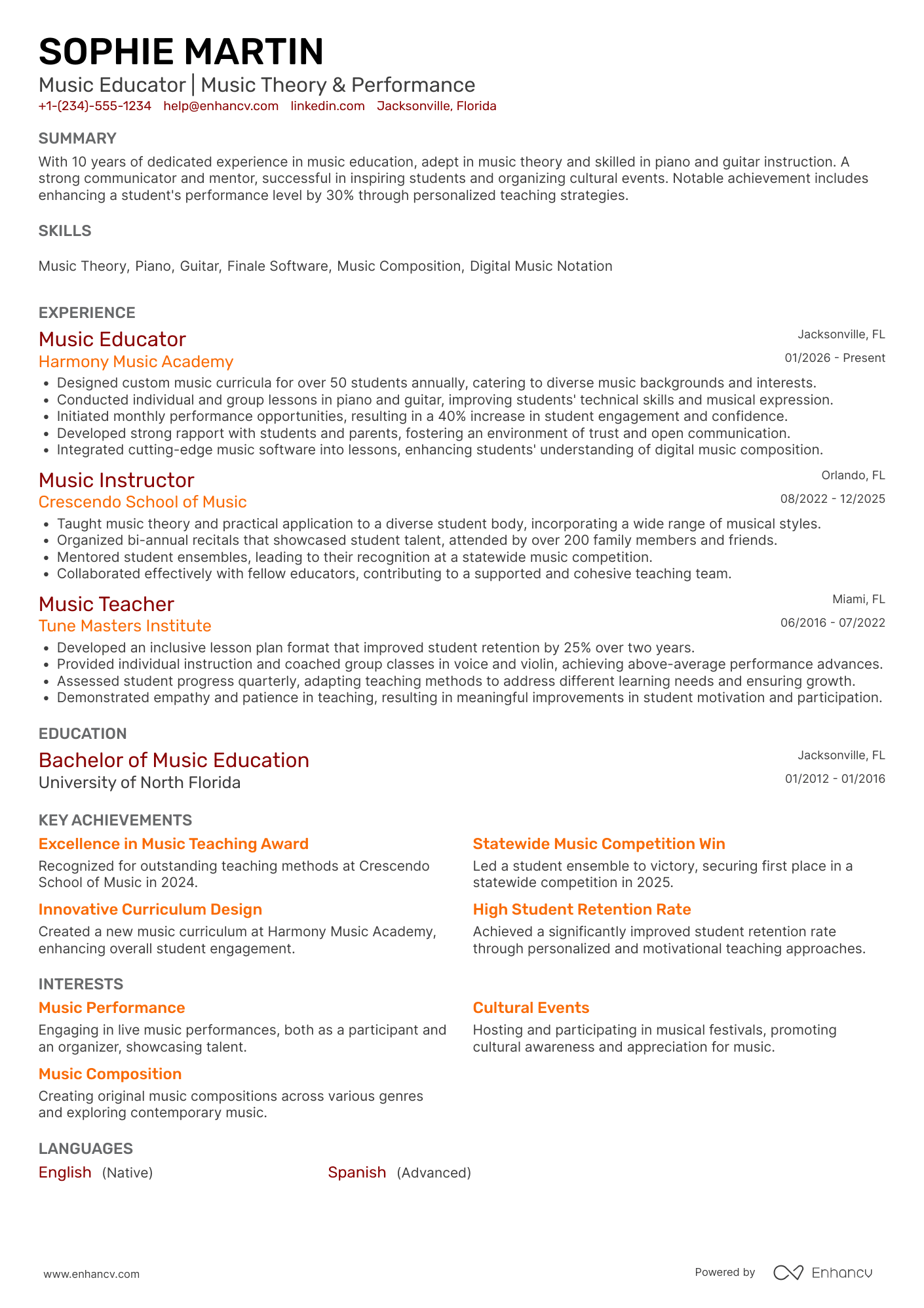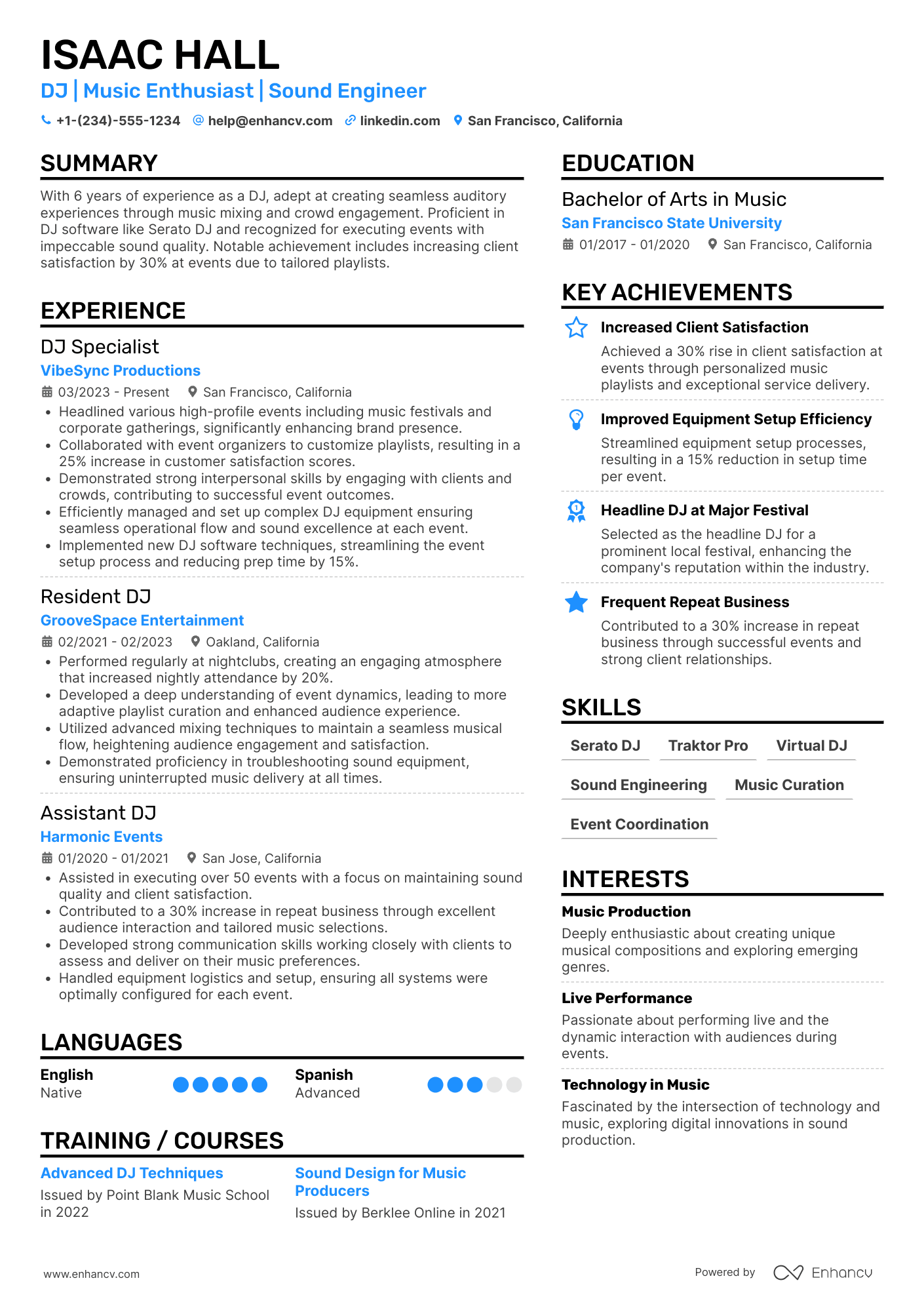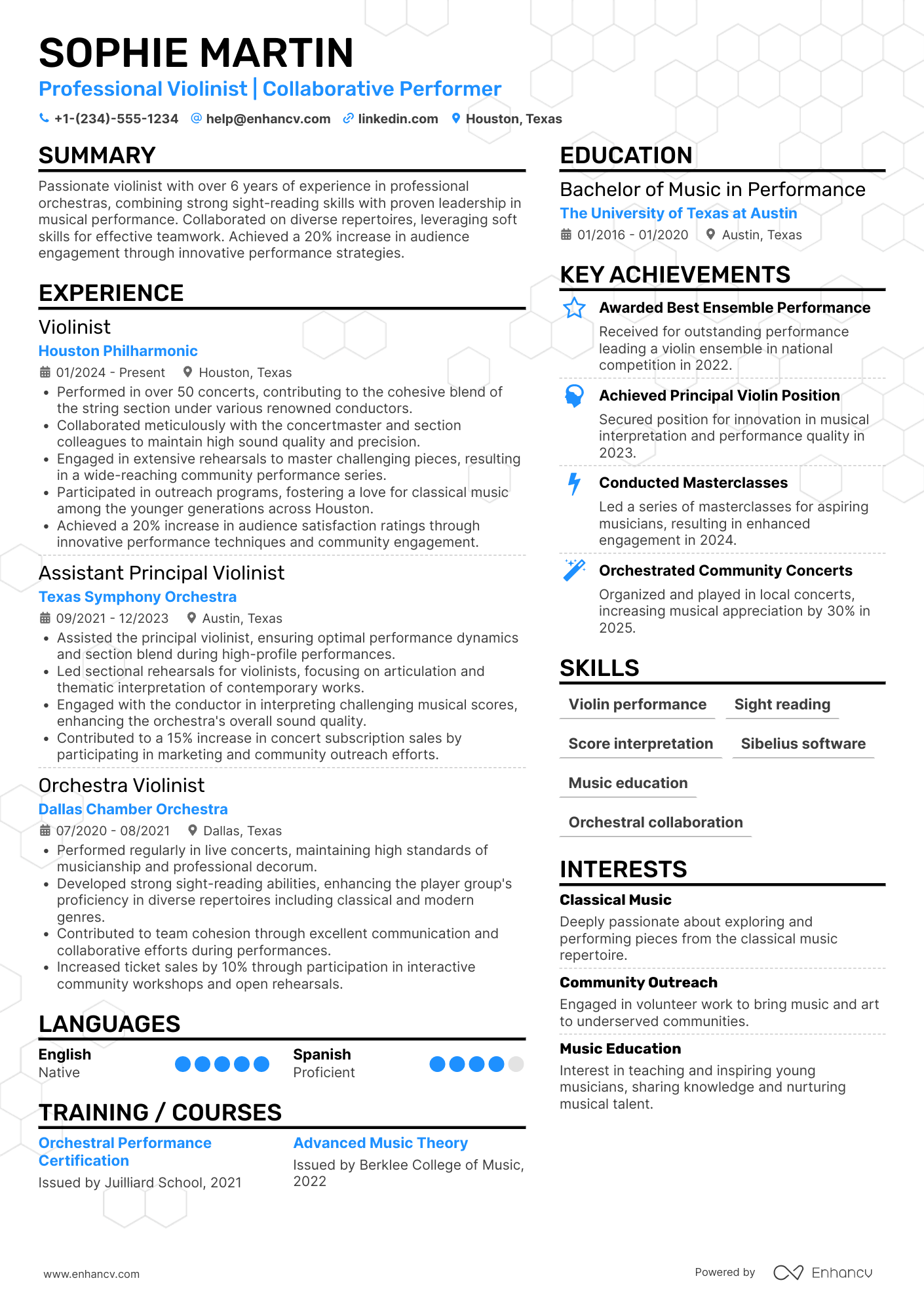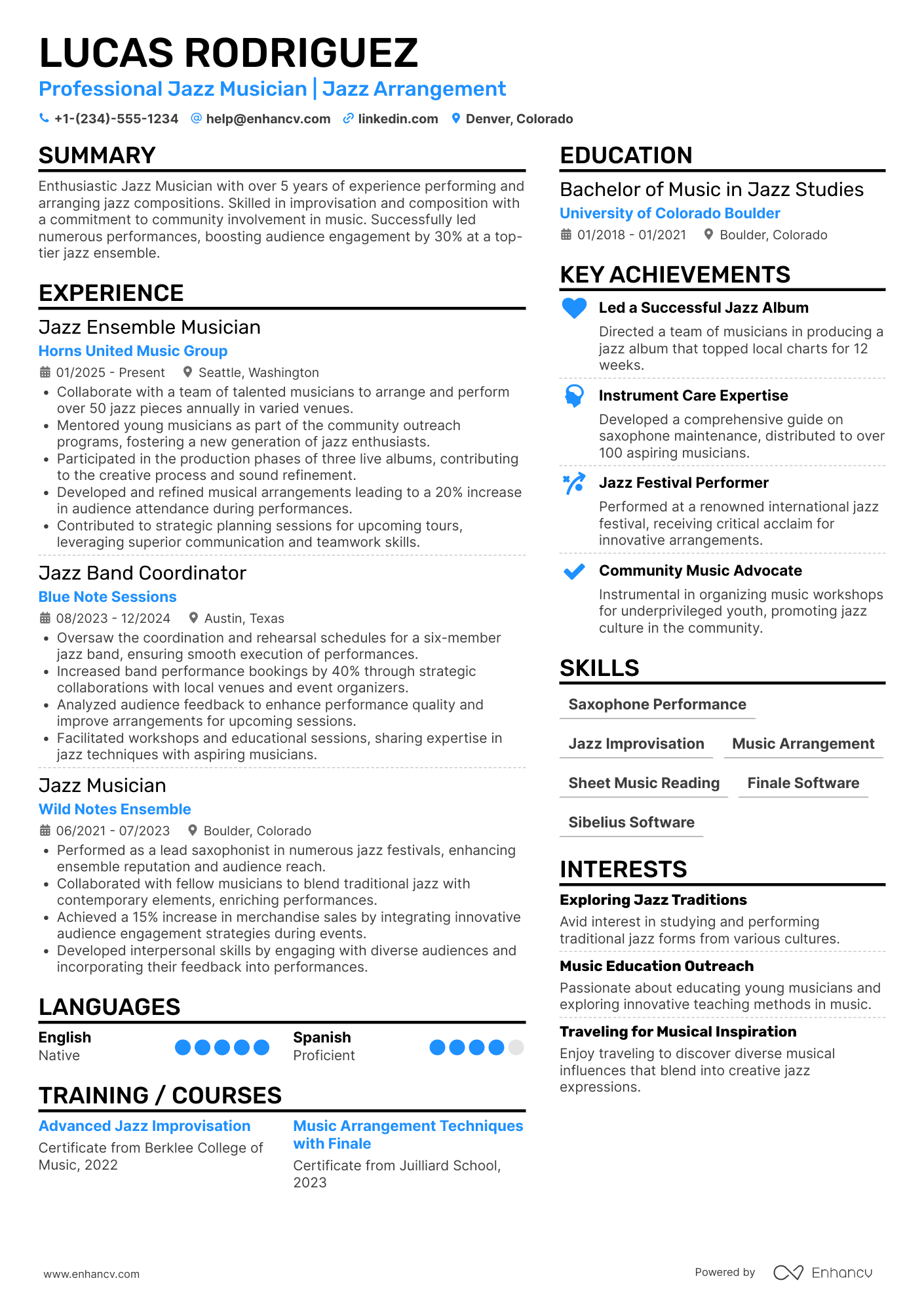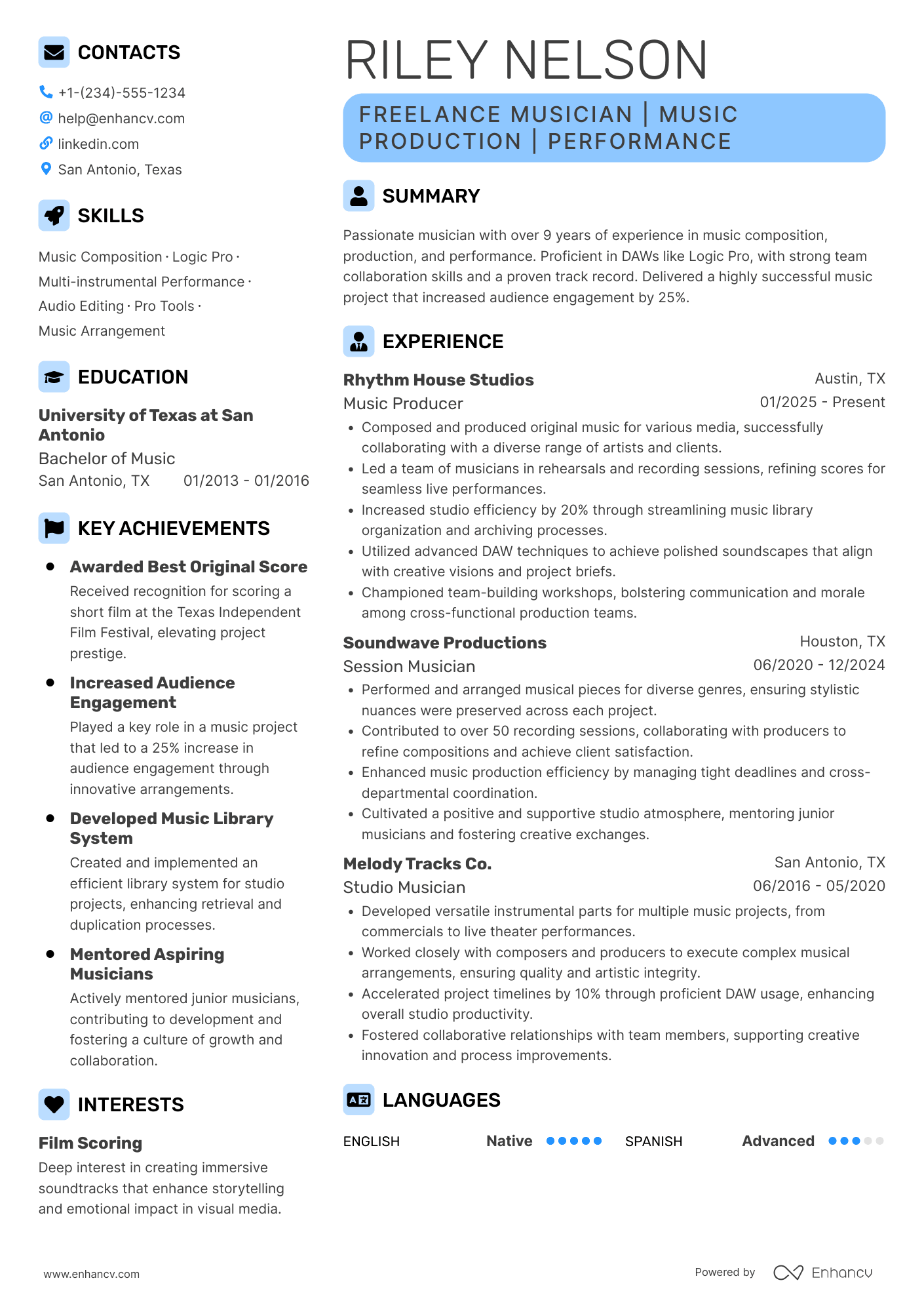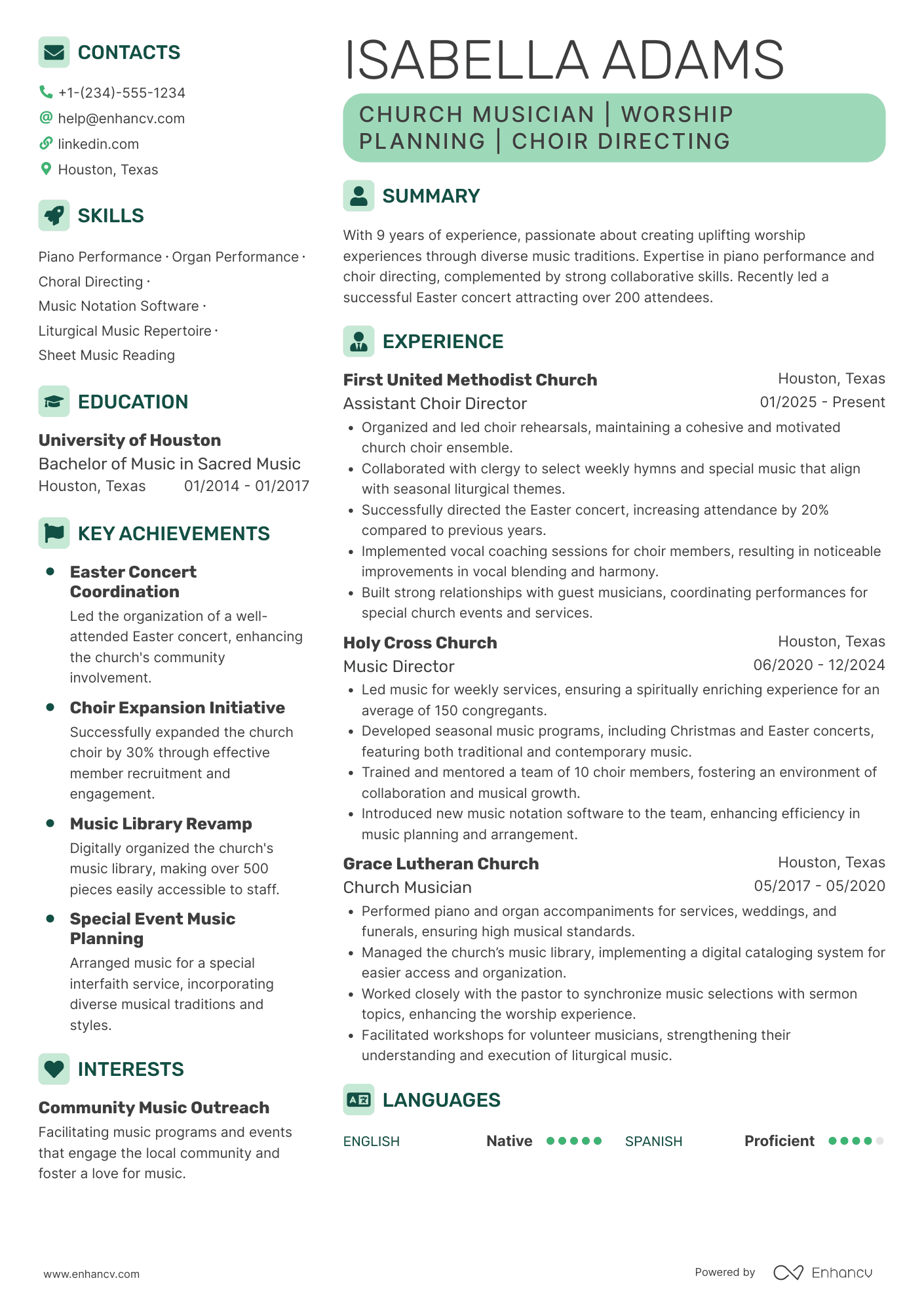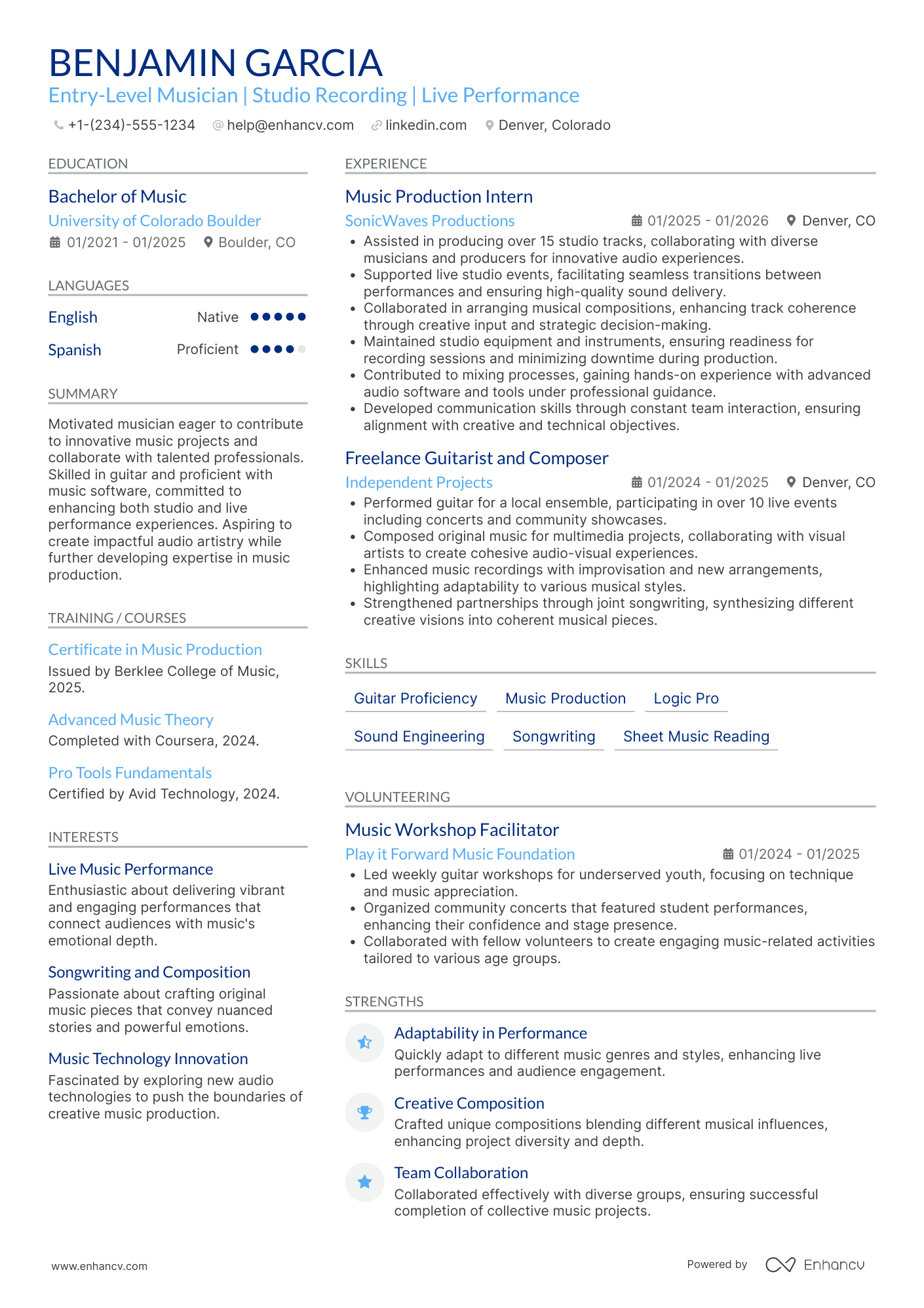
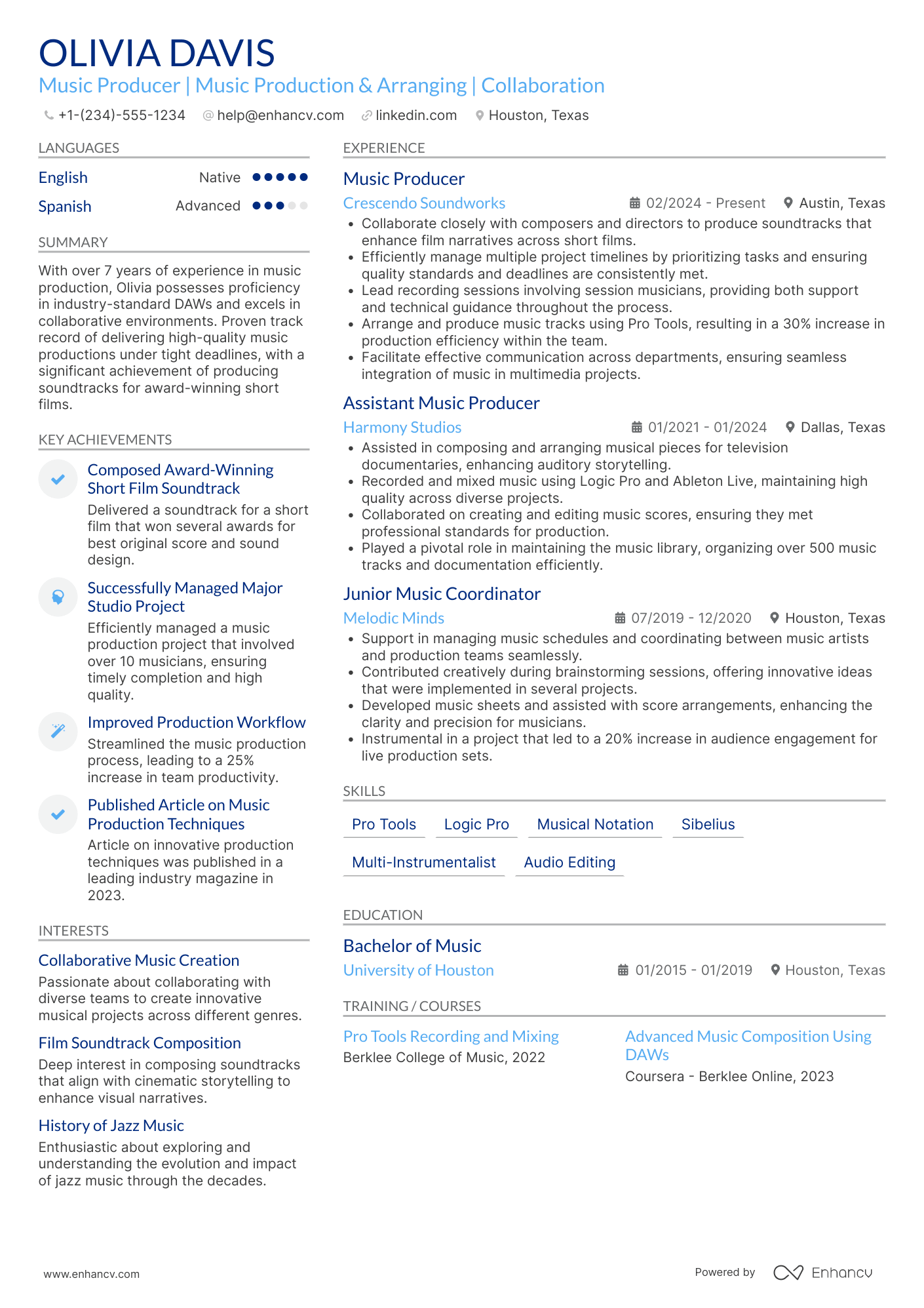
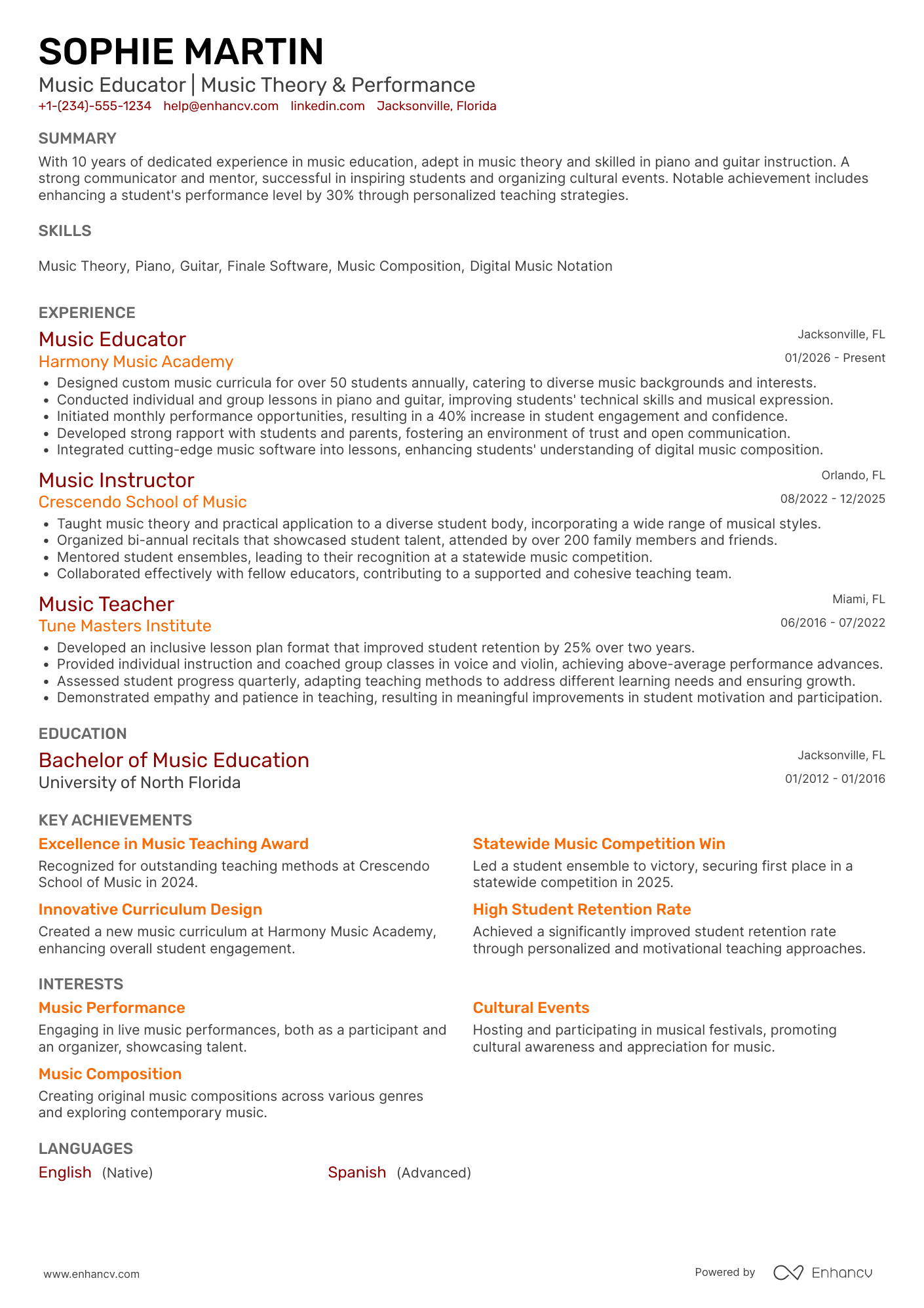
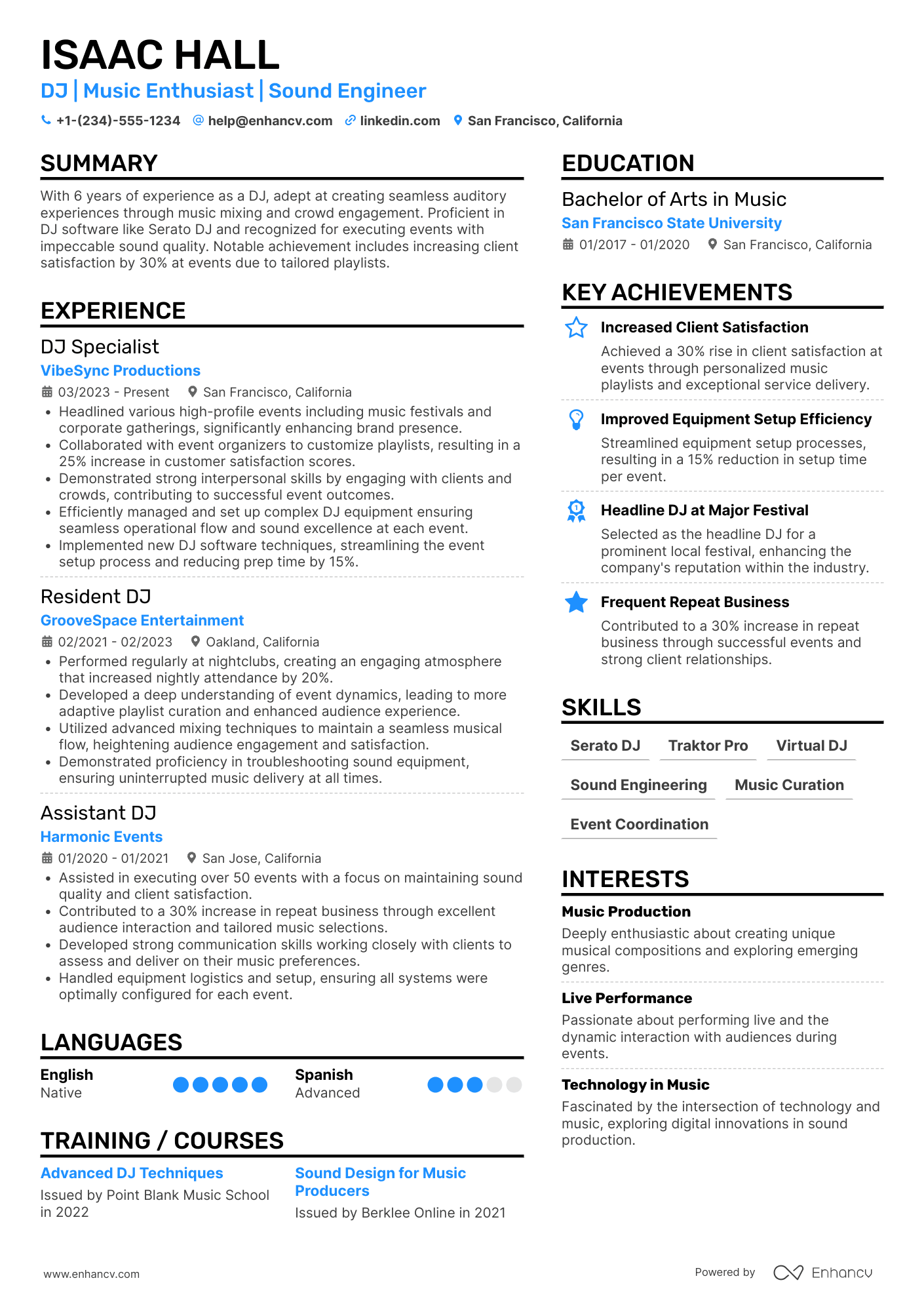
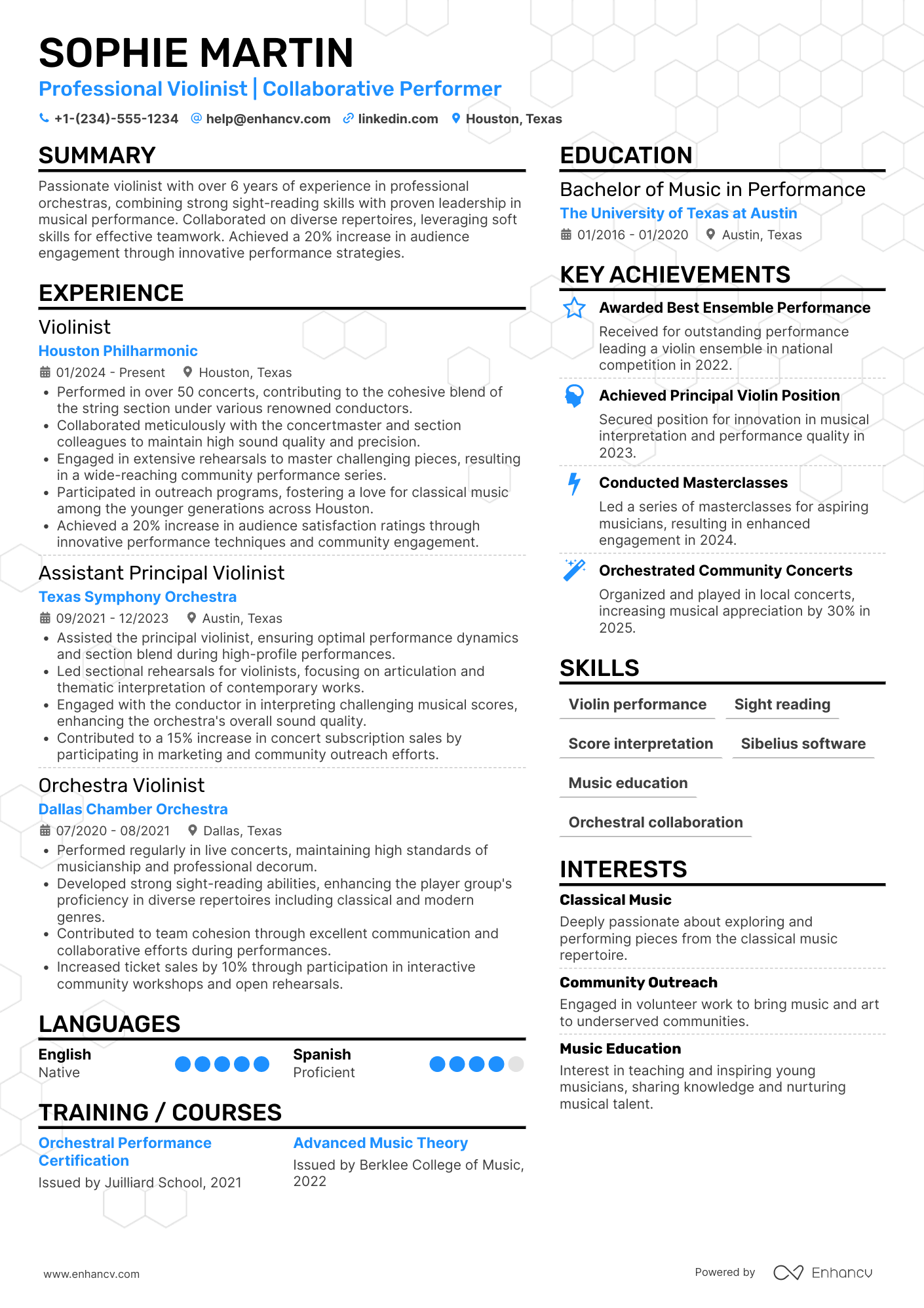
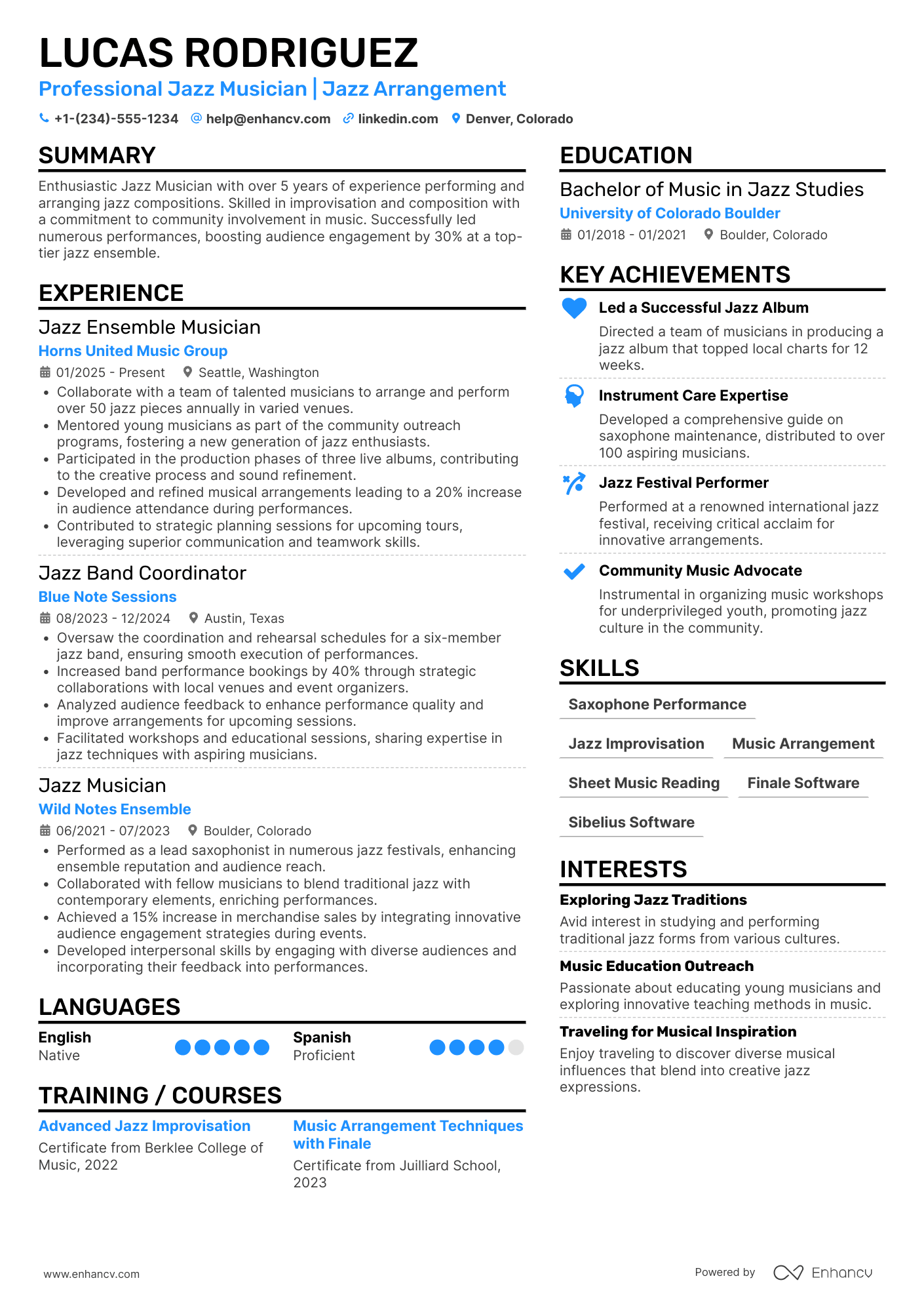
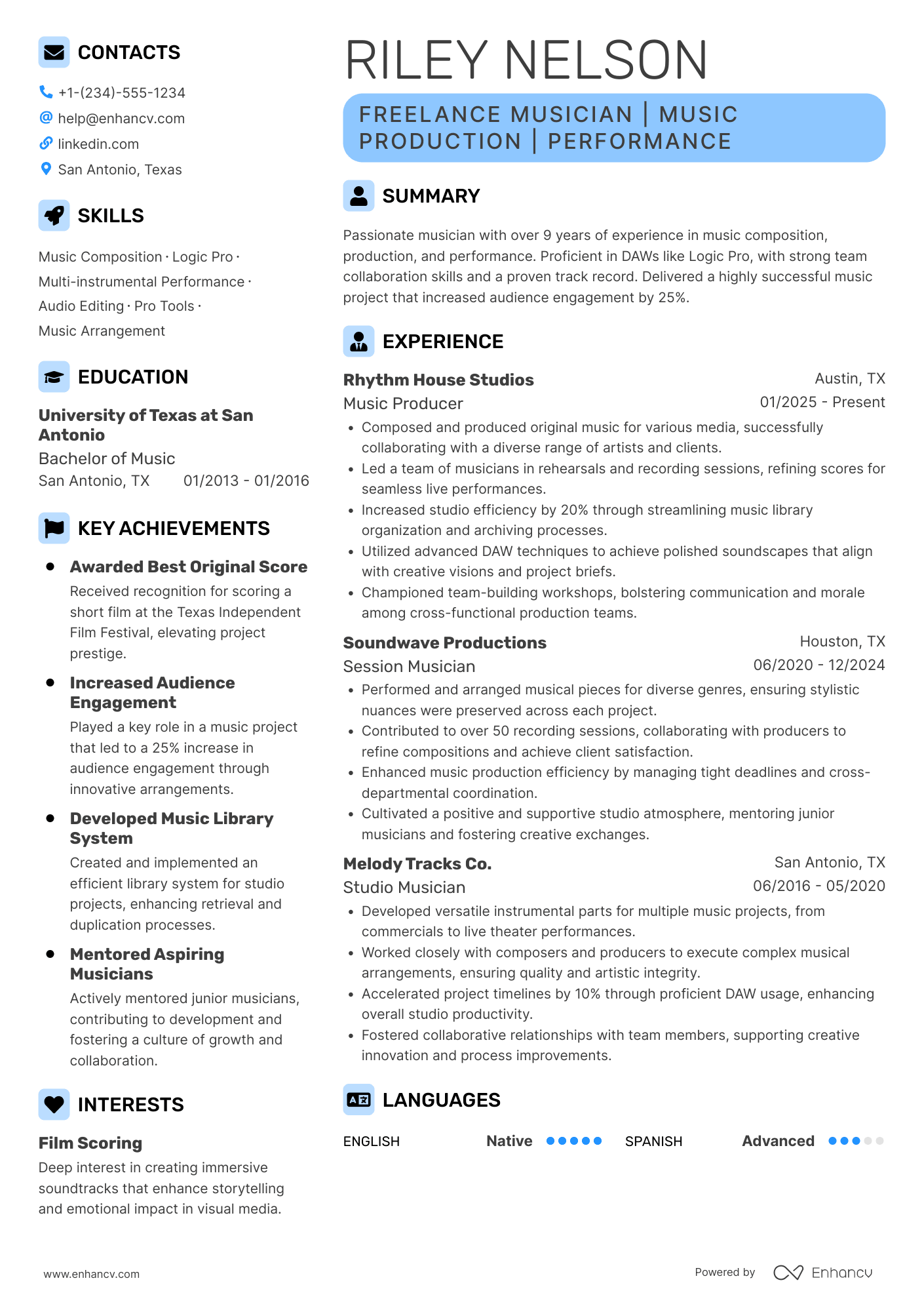
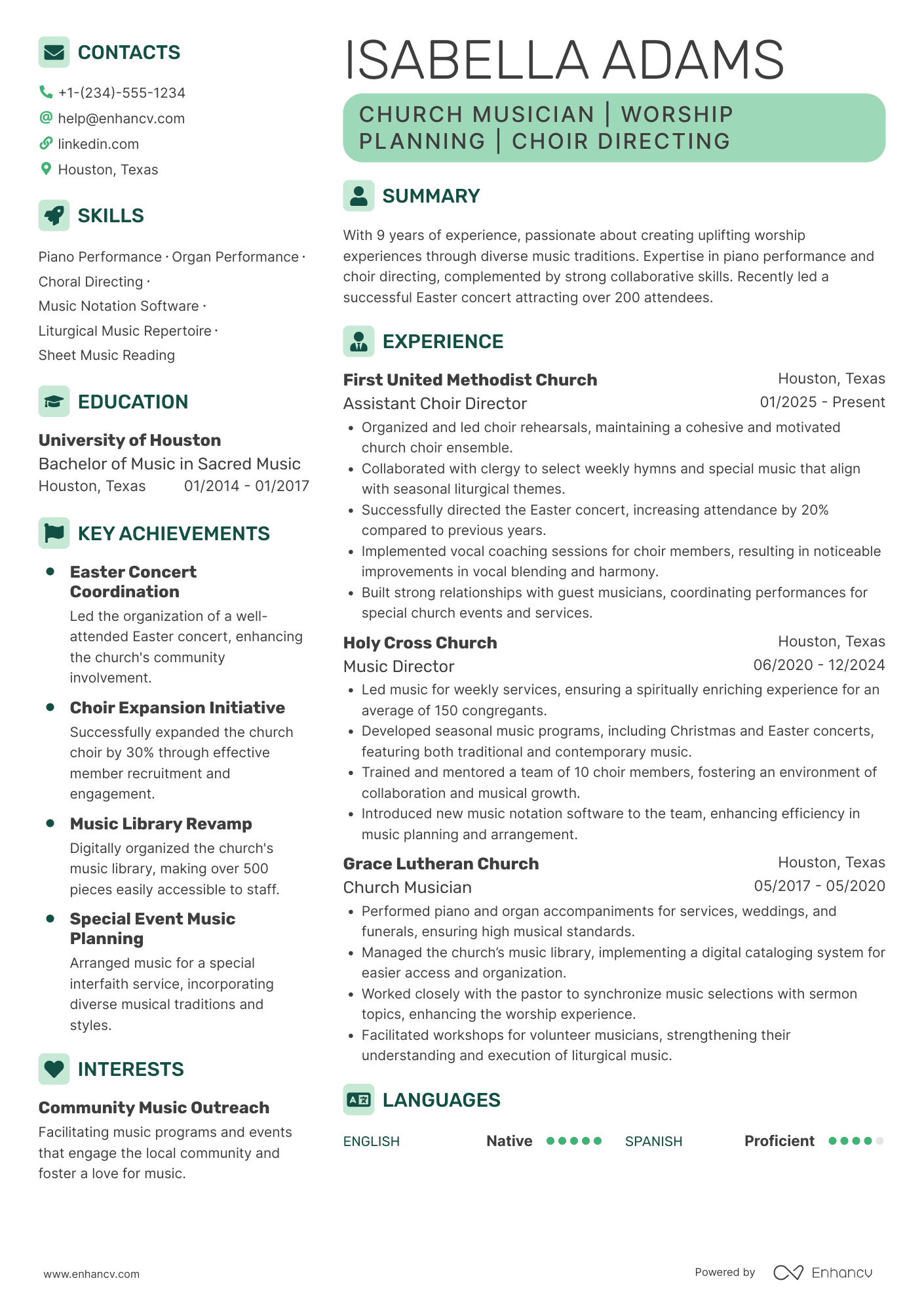
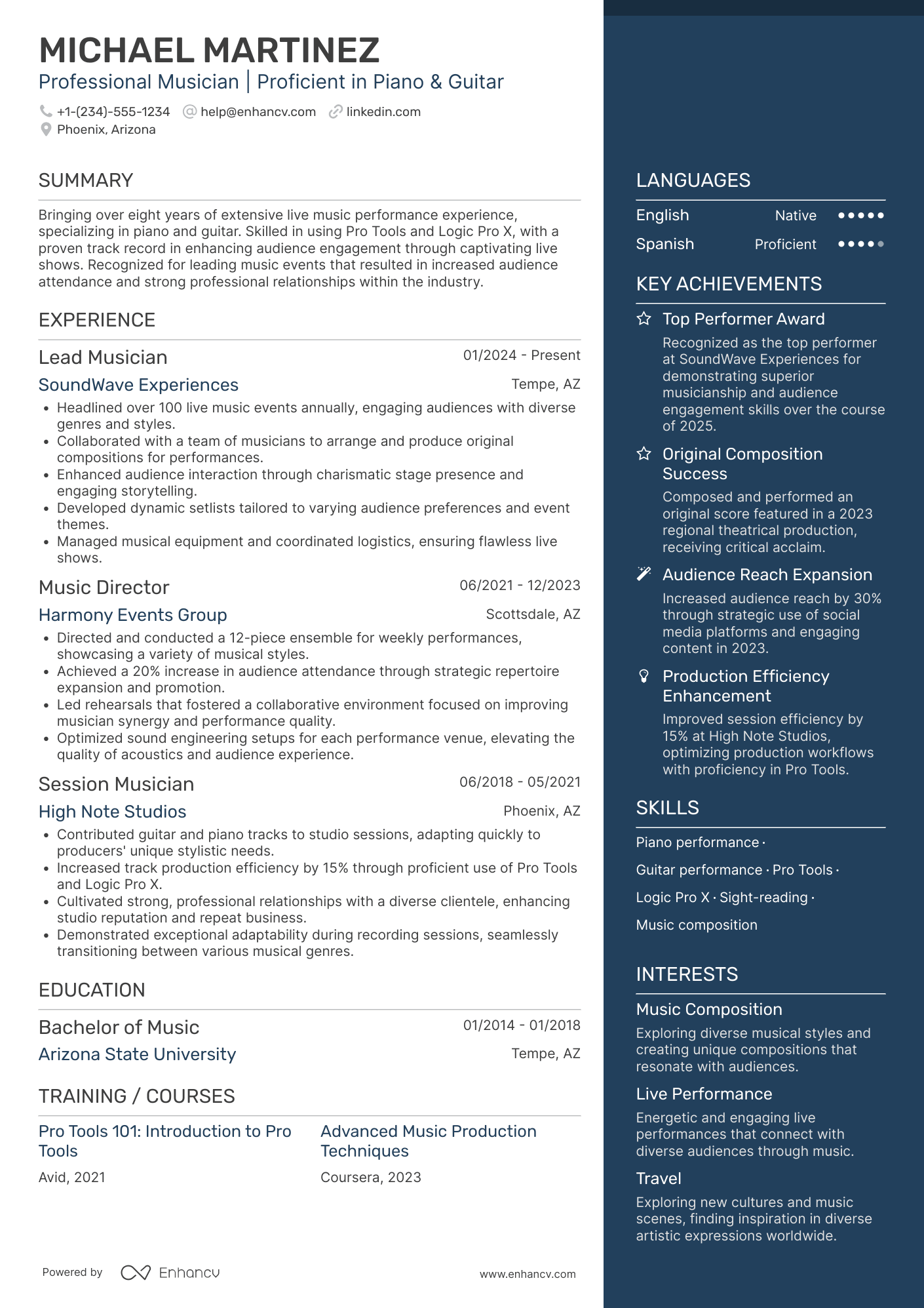
Many musician resume drafts fail because they read like a gig log, not proof of value. That makes you easy to skip during ATS screening and rapid recruiter scans, especially when roles draw heavy competition.
A strong resume shows outcomes and credibility. Knowing how to make your resume stand out means you highlight ticket sales lifted, streaming growth, audience size, tour dates delivered on time, recording budgets managed, and reviews or placements earned. You quantify session volume, repertoire scope, and reliability across venues and collaborators.

Key takeaways
- Quantify achievements like audience growth, revenue, and show volume to prove real impact.
- Use reverse-chronological format for experienced musicians and hybrid format for career changers.
- Tailor every experience bullet to mirror the job posting's language and priorities.
- Demonstrate skills in your summary and experience entries, not just in a skills list.
- Replace vague duty descriptions with specific outcomes, tools, and measurable results.
- Enhancv can help you turn loose accomplishments into focused, recruiter-ready bullet points.
- Pair your resume with a cover letter when your fit isn't obvious from credits alone.
How to format a musician resume
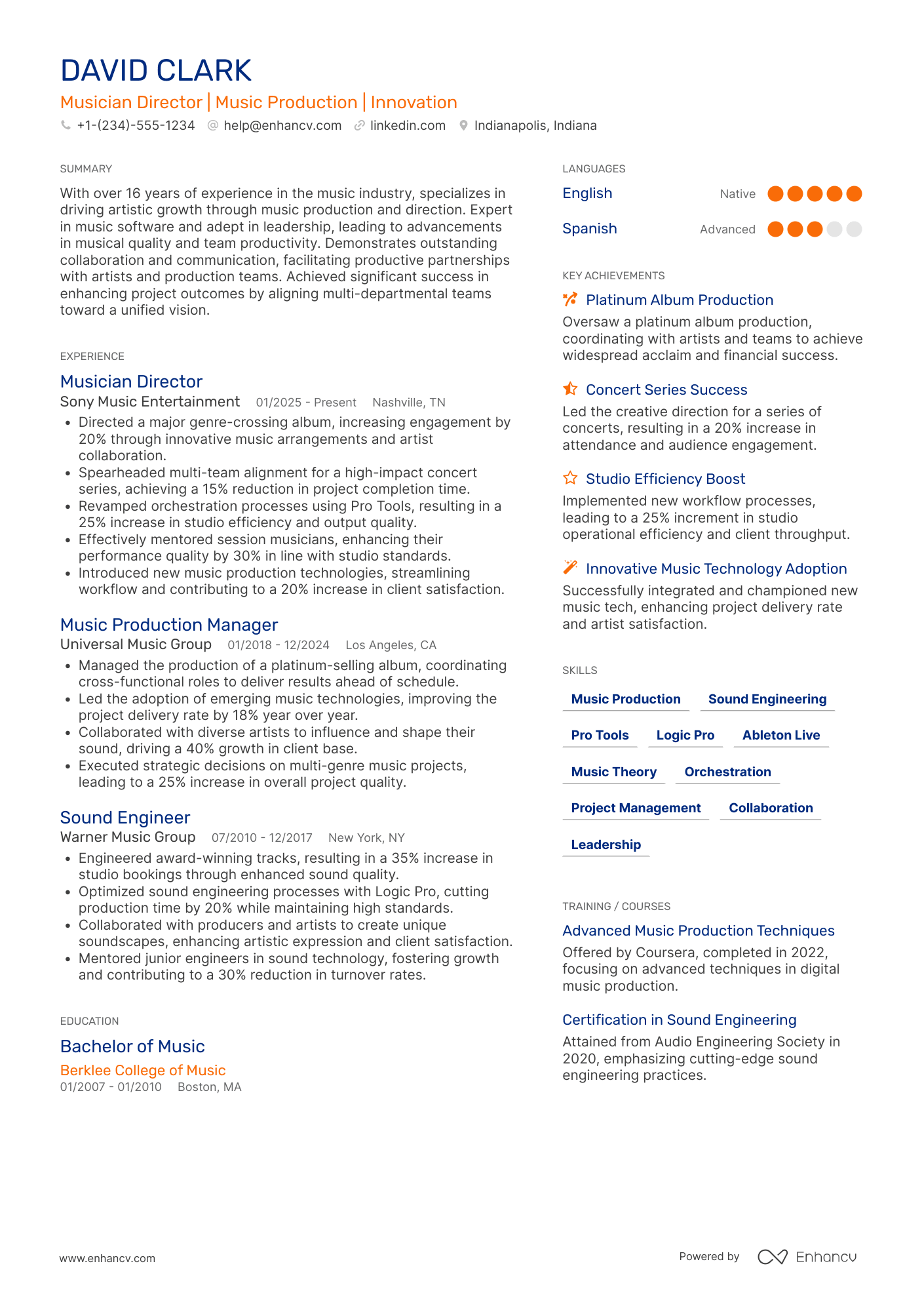
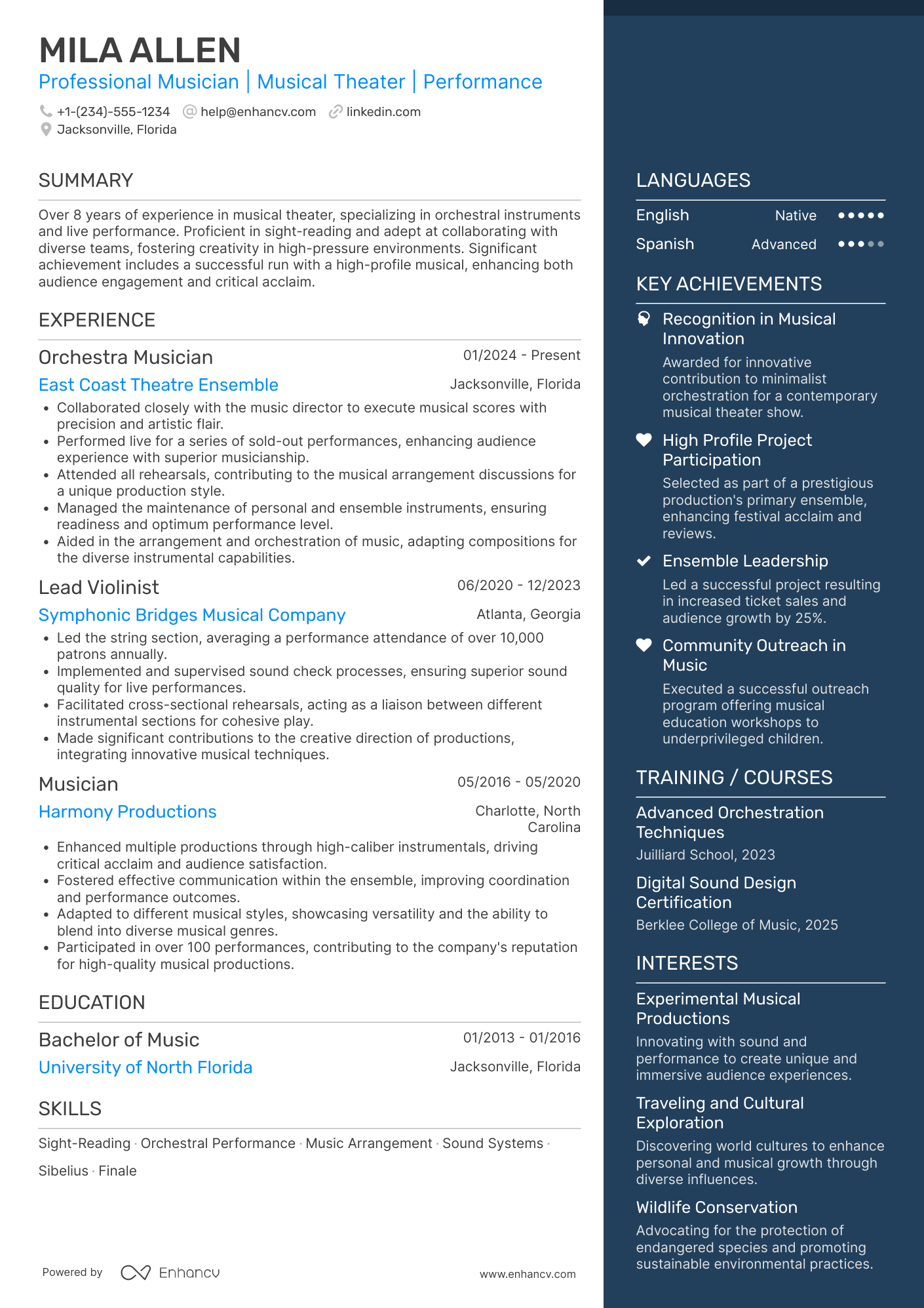
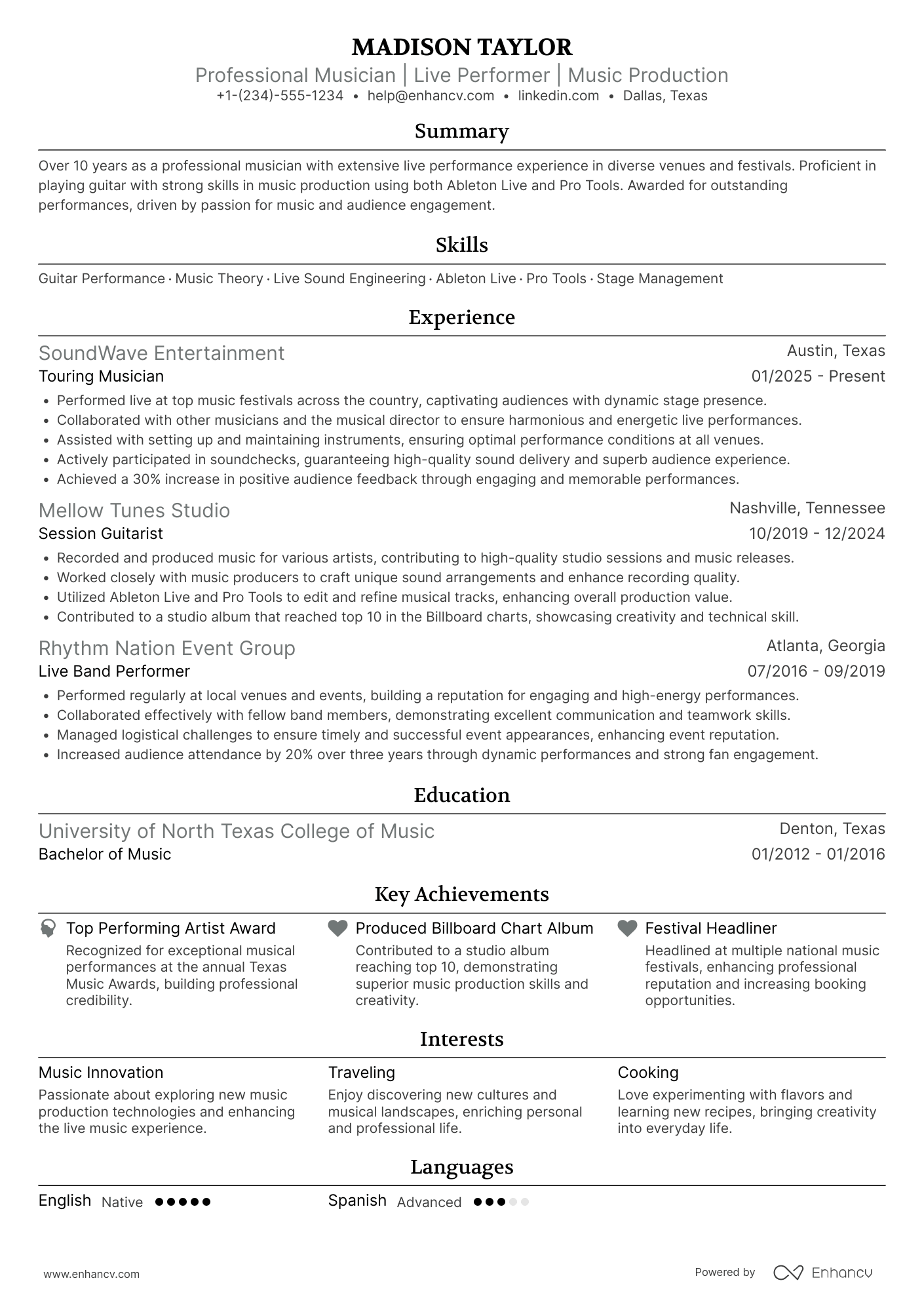
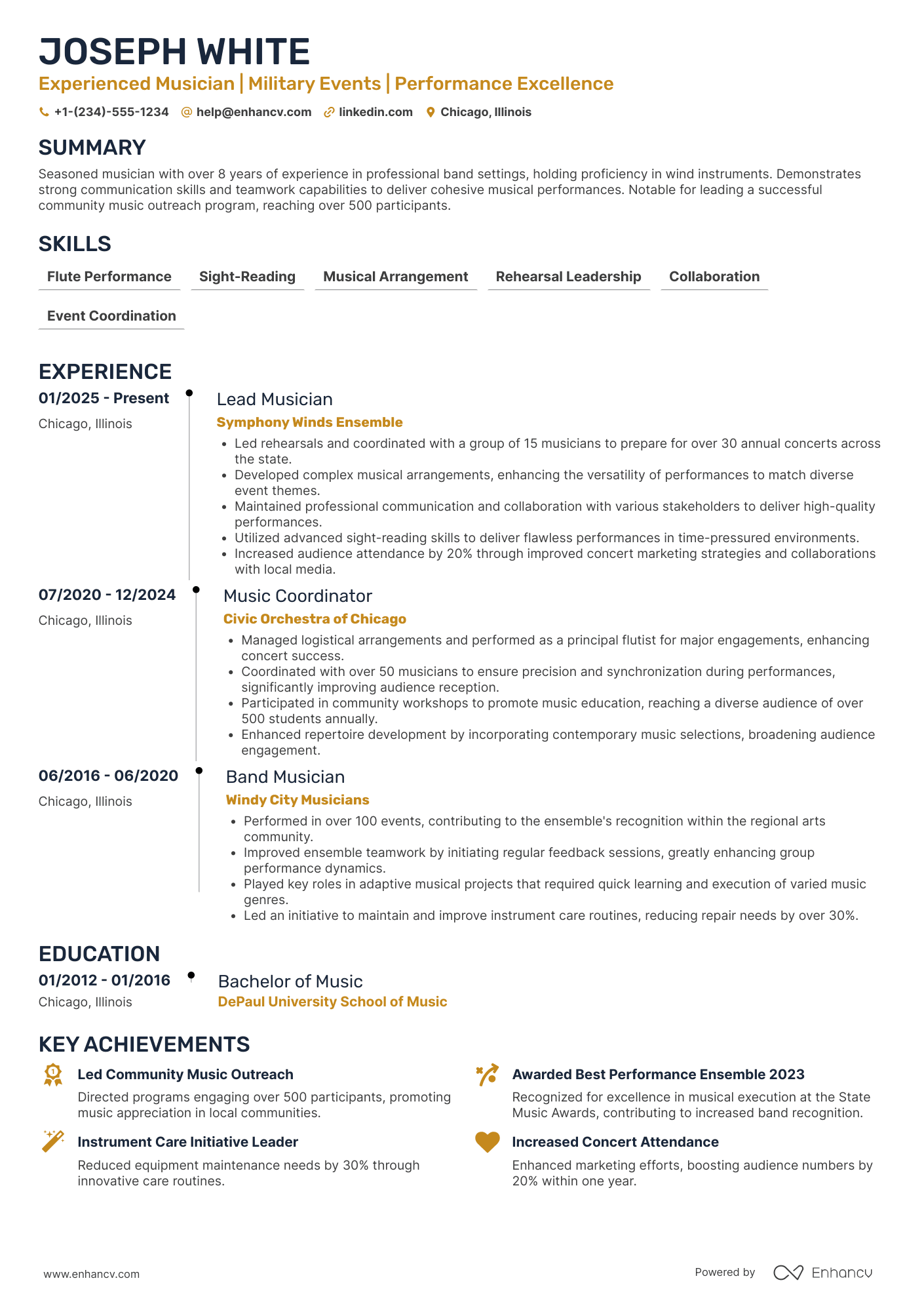
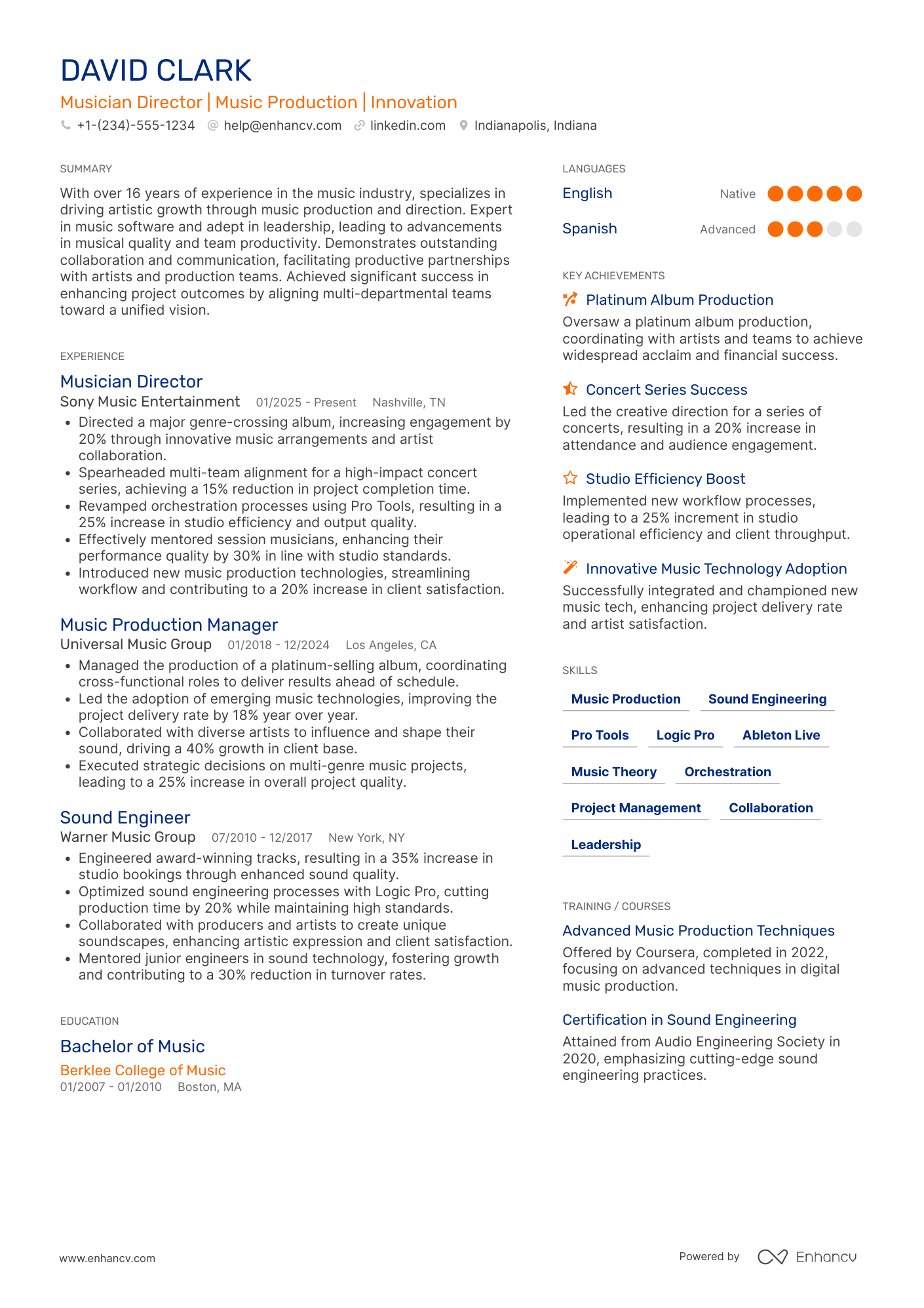
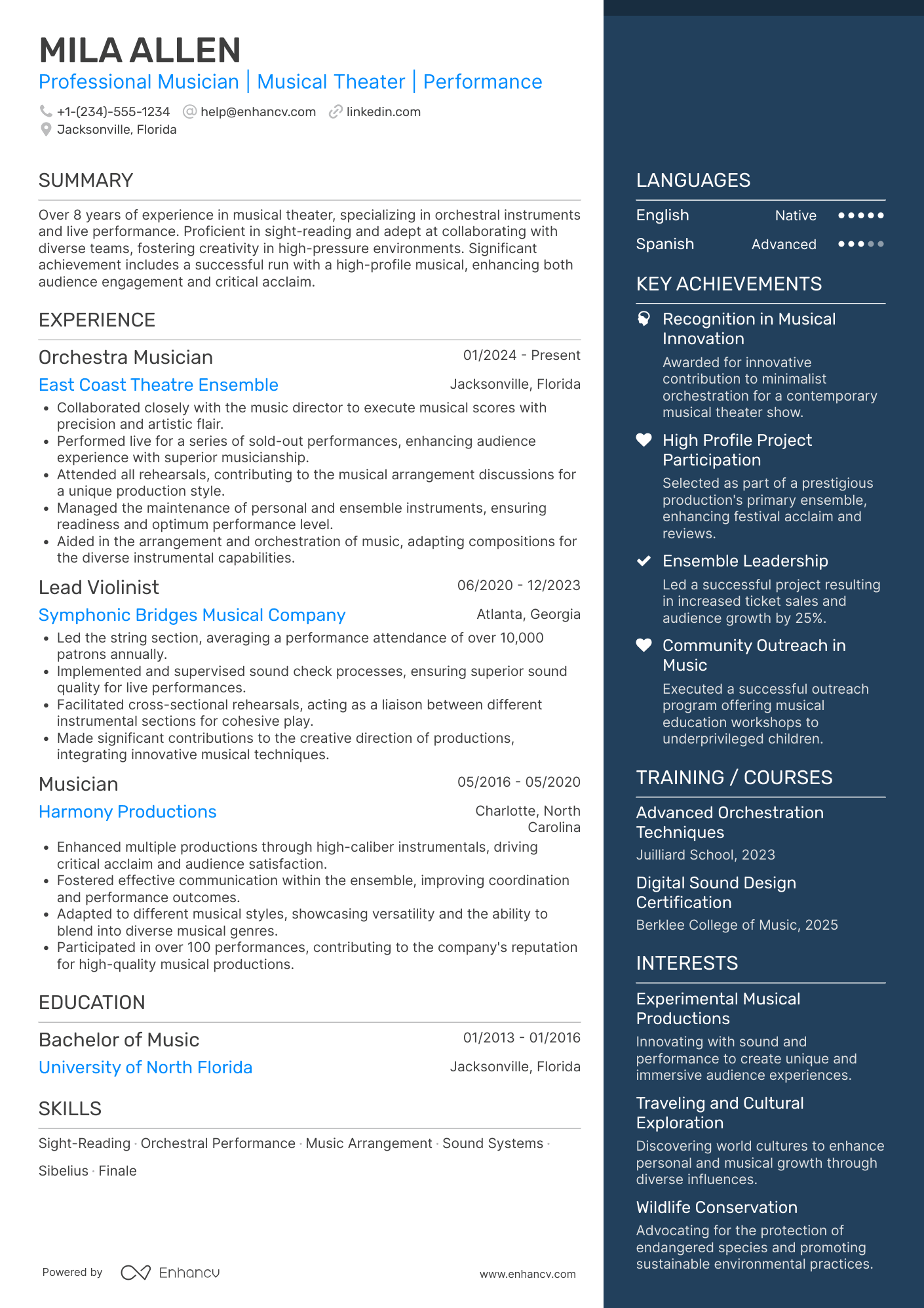
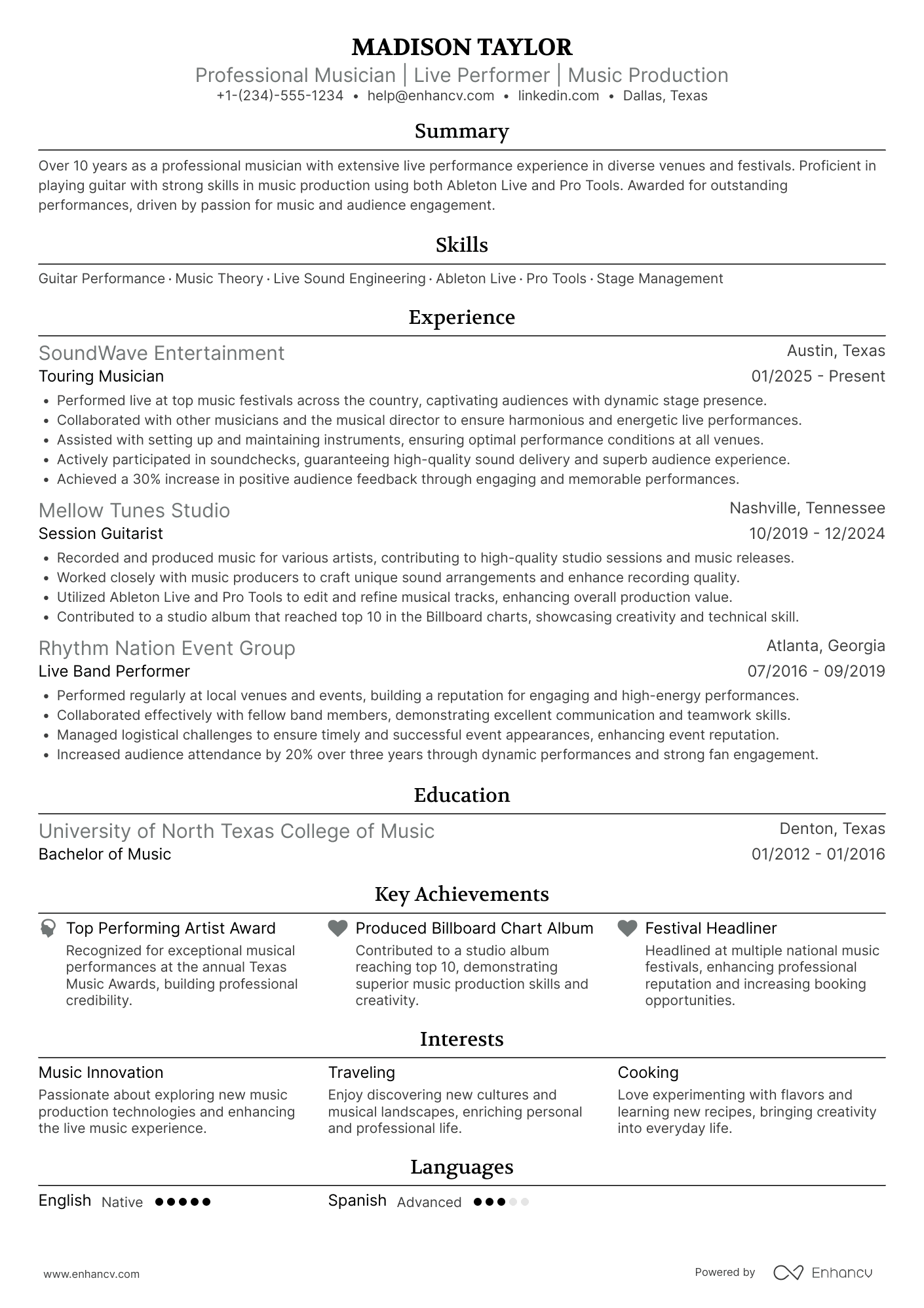
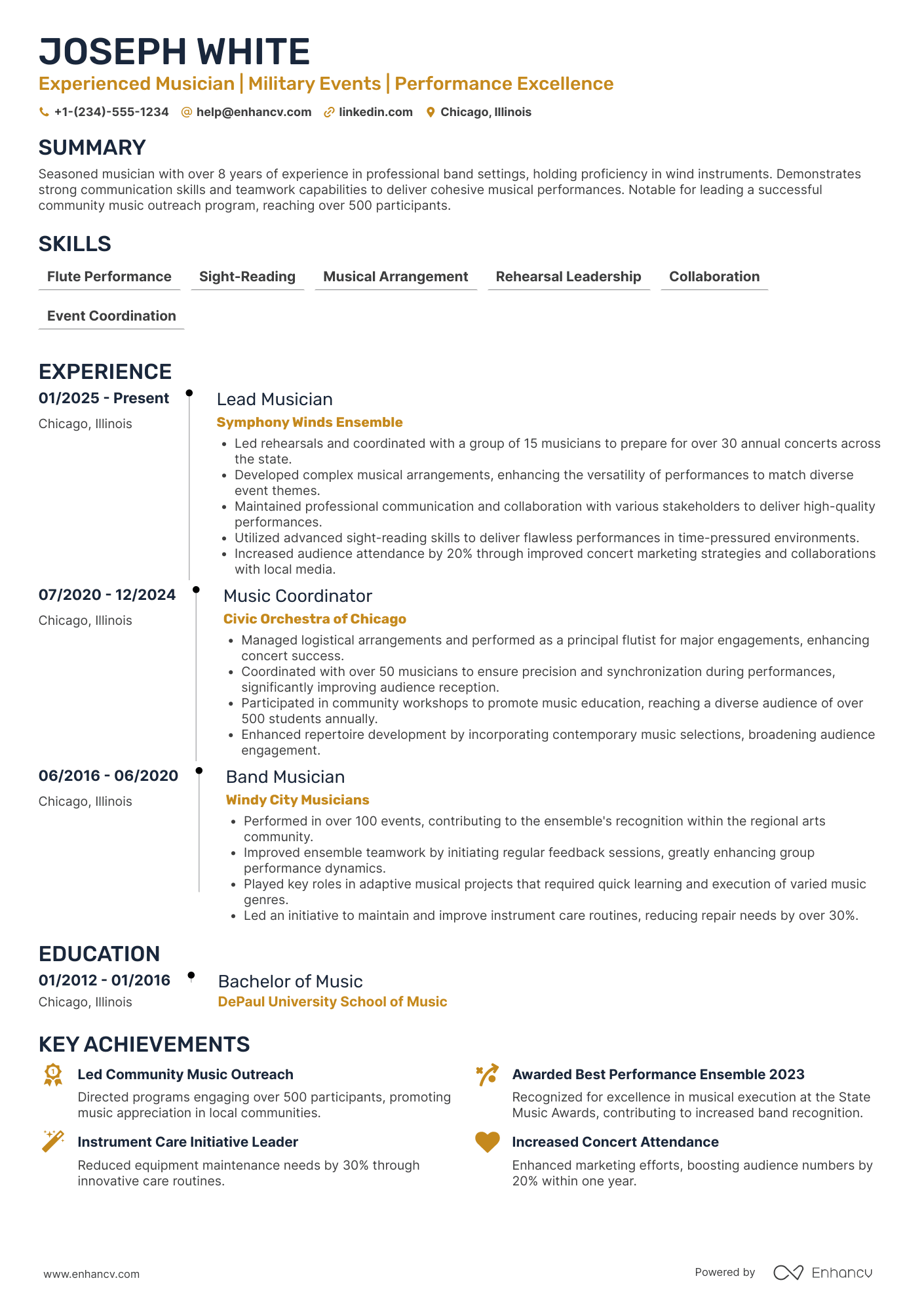
Recruiters evaluating musician resumes prioritize versatile performance skills, genre range, collaborative experience, and a documented history of live performances, recordings, or teaching engagements. A clean, well-structured resume format ensures these signals surface quickly, especially when resumes pass through an applicant tracking system (ATS) before reaching a human reviewer.

I have significant experience as a musician—which format should I use?
Use a reverse-chronological format to showcase your performance history, ensemble roles, and recording credits in a clear, progression-driven timeline. Do:
- Lead each entry with your role scope and ensemble or organizational context (e.g., principal cellist, session guitarist, music director for a touring production).
- Highlight instrument proficiencies, genre specializations, DAW and notation software expertise, and relevant music theory or pedagogy credentials.
- Quantify outcomes wherever possible—audience sizes, number of recordings, students taught, revenue generated from performances, or catalog placements.
I'm junior or switching into a musician role—what format works best?
A hybrid format works best because it lets you lead with transferable musical skills and training while still grounding them in real performance, project, or educational experience. Do:
- Place a dedicated skills section near the top listing instruments, software (Pro Tools, Ableton Live, Sibelius), vocal range, or genre fluency so recruiters see your capabilities immediately.
- Include relevant projects, recitals, session work, busking experience, community ensembles, or coursework that demonstrates applied musical ability.
- Connect every skill or project to a concrete action and a visible result so hiring managers understand your real-world impact.
Why not use a functional resume?
A functional resume strips away the timeline of your musical development, making it difficult for recruiters to assess how your skills have grown through progressively complex performances, collaborations, or teaching roles.
- Career changers entering music: You have strong transferable skills (audio engineering, event production, music education coursework) but limited professional performance credits.
- Recent graduates or self-taught musicians: You have training, personal projects, or informal gigs but no formal employment history in music yet.
Once you've established a clean, readable format, the next step is filling it with the right sections to showcase your musical expertise.
What sections should go on a musician resume
Recruiters expect to quickly find your performance history, core musical strengths, and measurable results. Understanding which resume sections to include ensures nothing important gets overlooked.
Use this structure for maximum clarity:
- Header
- Summary
- Experience
- Skills
- Projects (include only if appropriate for this role or seniority)
- Education
- Certifications (only if relevant to the role)
- Optional sections: Awards, Publications, Languages
Strong experience bullets should emphasize performance outcomes, audience or client impact, scope of engagements, and results you drove.
Is your resume good enough?
Drop your resume here or choose a file. PDF & DOCX only. Max 2MB file size.
Now that you’ve identified the key parts to include, the next step is to write your musician resume experience so each role clearly supports those sections.
How to write your musician resume experience
The work experience section of your musician resume is where you prove you've delivered real results—not just performed tasks. Hiring managers want to see the work you shipped, the instruments and production tools you used, and the measurable outcomes you created, because demonstrated impact always outweighs a descriptive list of duties.
Each entry should include:
- Job title
- Company and location (or remote)
- Dates of employment (month and year)
Three to five concise bullet points showing what you owned, how you executed, and what outcomes you delivered:
- Ownership scope: the ensembles, recordings, productions, setlists, or musical projects you were directly accountable for as a musician.
- Execution approach: the instruments, music production software, arranging techniques, rehearsal methods, or performance frameworks you relied on to prepare and deliver your work.
- Value improved: changes to sound quality, audience engagement, production efficiency, repertoire accessibility, or performance consistency that resulted from your contributions as a musician.
- Collaboration context: how you coordinated with bandmates, producers, sound engineers, music directors, booking agents, or venue staff to achieve shared creative and commercial goals.
- Impact delivered: outcomes tied to audience growth, revenue from performances or recordings, successful tours, expanded repertoire, or strengthened brand presence—expressed as results rather than activity.
Experience bullet formula
A musician experience example
✅ Right example - modern, quantified, specific.
Touring Music Director & Keyboardist
Aurora Lane | Nashville, TN
2021–Present
Led live production and musical direction for a national pop artist touring theaters and festivals across the US.
- Directed rehearsals and live shows using Ableton Live, MainStage, and MIDI routing (RME interface), cutting setup and soundcheck time by 35% across forty-two dates.
- Arranged and programmed show stems, click, and timecode in Pro Tools and Ableton Live, improving show-to-show consistency and reducing onstage performance errors by 40%.
- Coordinated with front-of-house and monitor engineers to standardize patch lists, snapshots, and in-ear monitor mixes, reducing mid-show technical incidents from six per month to two.
- Managed a five-musician band and collaborated with tour management and venue production teams to align set changes, cues, and run-of-show, enabling on-time starts on 95% of performances.
- Negotiated contractor rates, backline rentals, and rehearsal budgets with vendors and the artist’s manager, lowering weekly touring costs by 12% while maintaining production quality.
Now that you've seen how to structure your experience entries, let's look at how to adjust them to match the specific role you're applying for.
How to tailor your musician resume experience
Recruiters evaluate your musician resume through both manual review and applicant tracking systems, scanning for alignment between your background and the role's requirements. Tailoring your resume to the job description by mirroring the posting's language and priorities increases your chances of passing both filters.
Ways to tailor your musician experience:
- Match specific instruments genres or ensemble types listed in the posting.
- Use the same terminology for music production software or recording platforms.
- Mirror performance metrics like audience size or booking frequency mentioned.
- Include relevant teaching or workshop experience when the role requires instruction.
- Highlight sight-reading improvisation or arranging skills referenced in the description.
- Emphasize live performance recording session or studio collaboration experience accordingly.
- Reference specific music theory standards or certification frameworks the posting names.
- Align your touring residency or freelance background with the stated engagement model.
Tailoring means aligning your real accomplishments with what the role demands, not forcing keywords where they don't belong.
Resume tailoring examples for musician
| Job description excerpt | Untailored | Tailored |
|---|---|---|
| "Seeking a versatile musician proficient in Pro Tools and Ableton Live for studio session work, recording across jazz, R&B, and gospel genres" | Experienced musician comfortable working in various studio settings. | Recorded 40+ studio sessions in Pro Tools and Ableton Live across jazz, R&B, and gospel projects, collaborating with producers to deliver polished tracks within tight production schedules. |
| "Lead guitarist needed for 60-date national tour with in-ear monitor setup, responsible for maintaining consistent tone across arena and theater venues" | Played guitar on multiple tours and adapted to different stage setups. | Performed as lead guitarist on a 55-date national tour using in-ear monitors, maintaining consistent tone and signal chain across 12 arena and 43 theater venues. |
| "Piano instructor for community music school teaching group classes (ages 7–14) using the Suzuki method, with student recital coordination each semester" | Taught piano lessons to students of different ages and skill levels. | Taught weekly Suzuki method group piano classes to 30+ students ages 7–14, coordinating end-of-semester recitals that increased student retention by 25% year over year. |
Once you’ve aligned your experience with the role’s priorities, the next step is to quantify your musician achievements so hiring managers can quickly see the impact behind those choices.
How to quantify your musician achievements
Quantifying shows the real impact of your music beyond talent. Using numbers on your resume helps you focus on audience growth, revenue, show volume, production speed, and quality signals like approvals, retention, and low rework.
Quantifying examples for musician
| Metric | Example |
|---|---|
| Audience growth | "Grew monthly listeners from 12,000 to 28,500 in six months by optimizing Spotify for Artists metadata and pitching eight playlists." |
| Revenue | "Generated $18,400 in merch revenue across twelve shows by bundling items, adding QR code checkout, and tracking inventory in Square." |
| Delivery volume | "Performed 46 paid gigs in four months across three venues, maintaining on-time load-in and set times with zero cancellations." |
| Turnaround time | "Cut rehearsal-to-set readiness from ten days to six by using Ableton Live session templates and weekly sectionals." |
| Quality control | "Reduced live sound issues by 60% by standardizing stage plots, using in-ear monitoring, and running a pre-show line check checklist." |
Turn vague job duties into measurable, recruiter-ready resume bullets in seconds with Enhancv's Bullet Point Generator.
Once you've crafted strong bullet points for your experience section, you'll want to apply that same precision to presenting your hard and soft skills throughout your musician resume.
How to list your hard and soft skills on a musician resume
Your skills section shows your performance range and reliability, and recruiters and an ATS (applicant tracking system) scan them to match you to the role; aim for a balanced mix of role-specific hard skills and execution-focused soft skills.
musician roles require a blend of:
- Product strategy and discovery skills.
- Data, analytics, and experimentation skills.
- Delivery, execution, and go-to-market discipline.
- Soft skills.
Your skills section should be:
- Scannable (bullet-style grouping).
- Relevant to the job post.
- Backed by proof in experience bullets.
- Updated with current tools.
Place your skills section:
- Above experience if you're junior or switching careers.
- Below experience if you're mid/senior with strong achievements.

Hard skills
- Pro Tools, Logic Pro, Ableton Live
- Microphone technique and placement
- Live sound mixing, stage plots
- Signal flow, gain staging
- MIDI programming, virtual instruments
- Click tracks, in-ear monitoring
- Sight-reading, chart interpretation
- Arrangement and orchestration
- Rehearsal planning and setlist design
- Music theory, ear training
- Studio session workflow, comping
- Copyright, licensing, PRO registration
Soft skills
- Rehearsal leadership and facilitation
- Clear musical direction and feedback
- Fast adaptation to new charts
- Tight timing and cue awareness
- Collaborative problem-solving on stage
- Self-directed practice and preparation
- Calm execution under pressure
- Proactive communication with venues
- Reliable punctuality and readiness
- Constructive conflict resolution
- Audience and client needs focus
- Ownership of set quality and flow
How to show your musician skills in context
Skills shouldn't live only in a dedicated skills list.
They should be demonstrated in:
- Your summary (high-level professional identity)
- Your experience (proof through outcomes)
Here's what this looks like in practice. You can also explore curated resume skills examples to see how other professionals present their abilities.
Summary example
Versatile session musician with 12 years of experience in studio recording and live performance. Proficient in Pro Tools, Ableton Live, and orchestral arrangement. Contributed guitar and keys to 30+ commercially released tracks across film and advertising.
- Reflects senior-level experience clearly
- Names industry-standard production tools
- Includes a concrete, measurable outcome
- Highlights versatility as a soft skill
Experience example
Lead Session Guitarist
Meridian Sound Collective | Nashville, TN
June 2019–March 2024
- Recorded guitar parts for 18 commercial sync placements using Pro Tools, generating over $140K in licensing revenue for clients.
- Collaborated with a rotating team of six producers and engineers to arrange and mix tracks, reducing average project turnaround by 20%.
- Directed live ensemble rehearsals for showcase events, improving set cohesion and cutting preparation time from five days to three.
- Every bullet contains measurable proof.
- Skills appear naturally within achievements.
Once you’ve tied your musical abilities to real performance outcomes, the next step is to apply that same approach to writing a musician resume with no experience so your strengths still come through clearly.
How do I write a musician resume with no experience
Even without full-time experience, you can demonstrate readiness through:
- School ensembles and recitals
- Church or community gigs
- Open mics and jam sessions
- Self-released tracks on platforms
- Home studio recording projects
- Music lessons and certifications
- Volunteer event performances
- Collaborative songwriting sessions
If you're building a resume without work experience, focus on:
- Repertoire, genre, and instrument
- Recordings, links, and credits
- Tools: DAWs, mics, notation
- Performance volume and outcomes
Resume format tip for entry-level musician
Use a combination resume to feature skills and projects first, then list limited work history. It keeps attention on evidence you can show. Do:
- Add a Projects section above Work.
- Link to recordings, videos, or EPK.
- List tools: Logic Pro, Pro Tools.
- Quantify gigs, rehearsals, and releases.
- Tailor repertoire to each role.
- Recorded and mixed three original tracks in Logic Pro, using an Audio-Technica AT2020 and EQ, then released on SoundCloud, reaching 1,200 plays in thirty days.
Even without traditional work experience, your educational background can demonstrate relevant training and qualifications that strengthen your candidacy.
How to list your education on a musician resume
Your education section helps hiring teams confirm you have foundational training in music theory, performance, or production. It validates the skills your experience already demonstrates.
Include:
- Degree name
- Institution
- Location
- Graduation year
- Relevant coursework (for juniors or entry-level candidates)
- Honors & GPA (if 3.5 or higher)
Skip month and day details—list the graduation year only.
Here's a strong education entry tailored to a musician:
Example education entry
Bachelor of Music in Performance
Berklee College of Music, Boston, MA
Graduated 2021
GPA: 3.7/4.0
- Relevant Coursework: Advanced Music Theory, Ensemble Performance, Studio Recording Techniques, Songwriting Workshop
- Honors: Dean's List (six semesters), Outstanding Performance Award in Jazz Studies
How to list your certifications on a musician resume
Certifications on a resume show a musician's commitment to learning, proficiency with tools, and up-to-date industry knowledge. They also signal you can meet professional standards in performance, production, education, and safety.
Include:
- Certificate name
- Issuing organization
- Year
- Optional: credential ID or URL
- Place certifications below education when your degree is recent and more relevant than your credentials.
- Place certifications above education when they are recent, role-specific, and more relevant than older schooling.
Best certifications for your musician resume
- ABRSM Practical Music Exams (Grade Certifications)
- Trinity College London Music Performance Certificates
- Berklee Online Professional Certificate
- Avid Pro Tools User Certification
- Apple Logic Pro Certification
- Dante Certification (Level 1–3)
- CPR and First Aid Certification
Once you’ve positioned your certifications where hiring managers can verify them quickly, you can write your musician resume summary to highlight those credentials and tie them to the role.
How to write your musician resume summary
Your resume summary is the first thing a recruiter reads. A strong one instantly signals you have the talent and experience worth exploring further.
Keep it to three to four lines, with:
- Your title and total years of performing or recording experience.
- Genre, style, or industry focus such as orchestral, session, or live performance.
- Core instruments, software, or technical skills like Pro Tools, Ableton, or sight-reading.
- One or two measurable achievements such as performances given or albums recorded.
- Collaborative skills tied to real outcomes like ensemble coordination or audience engagement.

PRO TIP
At an early-career level, emphasize your primary instruments, relevant training, and any standout performances or recordings. Highlight specific skills and concrete contributions rather than vague passion statements. Avoid lines like "passionate musician seeking opportunities" or "hardworking team player." Recruiters want proof, not promises.
Example summary for a musician
Versatile session guitarist with three years of studio and live experience across jazz and indie rock. Proficient in Pro Tools and Ableton Live. Recorded on 12 commercially released tracks and performed at 40+ ticketed events.
Optimize your resume summary and objective for ATS
Drop your resume here or choose a file.
PDF & DOCX only. Max 2MB file size.
Now that your summary captures your artistic identity and key qualifications, make sure the header above it presents your contact details correctly so hiring managers can easily reach you.
What to include in a musician resume header
A resume header lists your key contact and professional links so recruiters can find you fast, trust your profile, and screen you efficiently.
Essential resume header elements
- Full name
- Tailored job title and headline
- Location
- Phone number
- Professional email
- GitHub link
- Portfolio link
A LinkedIn link lets recruiters confirm roles, dates, and references quickly, which supports faster screening.
Don't include a photo on a musician resume unless the role is explicitly front-facing or appearance-dependent.
Keep your header to two lines, match the job's musician wording, and use working links that open on the first click.
Musician resume header
Jordan Rivera
Musician | Session Guitarist and Live Performer
Austin, TX | (512) 555-13XX | your.name@enhancv.com github.com/yourname yourwebsite.com linkedin.com/in/yourname
With your key identifying details and contact information in place, you can strengthen your application by adding additional sections that highlight relevant experience and credentials.
Additional sections for musician resumes
When your core qualifications match other applicants, well-chosen additional sections can set you apart and reinforce your credibility.
- Languages
- Hobbies and interests
- Publications and recordings
- Awards and competitions
- Masterclasses and workshops
- Professional affiliations and unions
- Volunteer performances and community outreach
Once you've rounded out your resume with the right supplementary sections, it's worth pairing it with a cover letter to give hiring managers even more context about your musical background.
Do musician resumes need a cover letter
A cover letter isn't required for every musician resume, but it helps in competitive roles or when hiring managers expect one. If you're unsure what a cover letter is or when to use one, it can make a difference when your fit, context, or career story isn't obvious from credits alone.
Use a cover letter to add clarity your musician resume can't:
- Explain role and team fit: Match your skills to the ensemble, studio workflow, schedule, and expectations for the musician role.
- Highlight one or two relevant projects or outcomes: Name the project, your contribution, and a measurable result, like faster session turnaround or cleaner live mixes.
- Show understanding of the product, users, or business context: Reference the audience, venue, label, or client goals, and how your musician work supports them.
- Address career transitions or non-obvious experience: Connect transferable skills, explain gaps briefly, and show why you're ready to work as a musician in this setting.
Drop your resume here or choose a file.
PDF & DOCX only. Max 2MB file size.
Even when you decide a cover letter won’t add value to your application, you can still strengthen your materials by using AI to improve your musician resume.
Using AI to improve your musician resume
AI can sharpen your resume's clarity, structure, and overall impact. It helps tighten language and highlight relevant strengths. But overuse strips away authenticity. Once your content reads clearly and aligns with the role, step away from AI. If you're exploring options, learn which AI is best for writing resumes before committing to a tool.
Here are 10 practical prompts to strengthen specific sections of your musician resume:
- Strengthen your summary. "Rewrite this musician resume summary to highlight my top performance skills and career focus in under four sentences."
- Quantify experience bullets. "Add measurable results to these musician experience bullets, such as audience sizes, number of performances, or revenue generated."
- Tighten skills language. "Review this musician skills section and remove vague terms. Replace them with specific, industry-relevant skills."
- Align with job posting. "Compare this musician resume to the following job description. Suggest edits to better match the role's requirements."
- Improve project descriptions. "Rewrite these musician project entries to clearly state my role, the outcome, and any collaboration details."
- Refine education section. "Edit this musician education section to emphasize coursework, honors, or training most relevant to live performance roles."
- Clarify certification entries. "Reformat this musician certifications section so each entry clearly states the credential, issuing body, and completion date."
- Remove redundant phrasing. "Scan this musician resume for repeated or filler language. Suggest concise alternatives for every flagged instance."
- Strengthen action verbs. "Replace weak or generic verbs in this musician experience section with strong, specific action verbs."
- Improve overall readability. "Review this full musician resume for sentence length, formatting consistency, and logical flow. Suggest specific fixes."
Stop using AI once your resume sounds accurate, specific, and aligned with real experience. AI should never invent experience or inflate claims—if it didn't happen, it doesn't belong here.
Conclusion
A strong musician resume highlights measurable outcomes, role-specific skills, and a clear structure. It shows impact through bookings, audience growth, stream counts, revenue, or repeat clients. It stays easy to scan, with consistent formatting and focused sections.
This approach proves you’re ready for today’s hiring market and the next hiring cycle. It helps hiring managers compare you quickly and trust your fit. Keep your musician resume direct, detailed, and built around results.
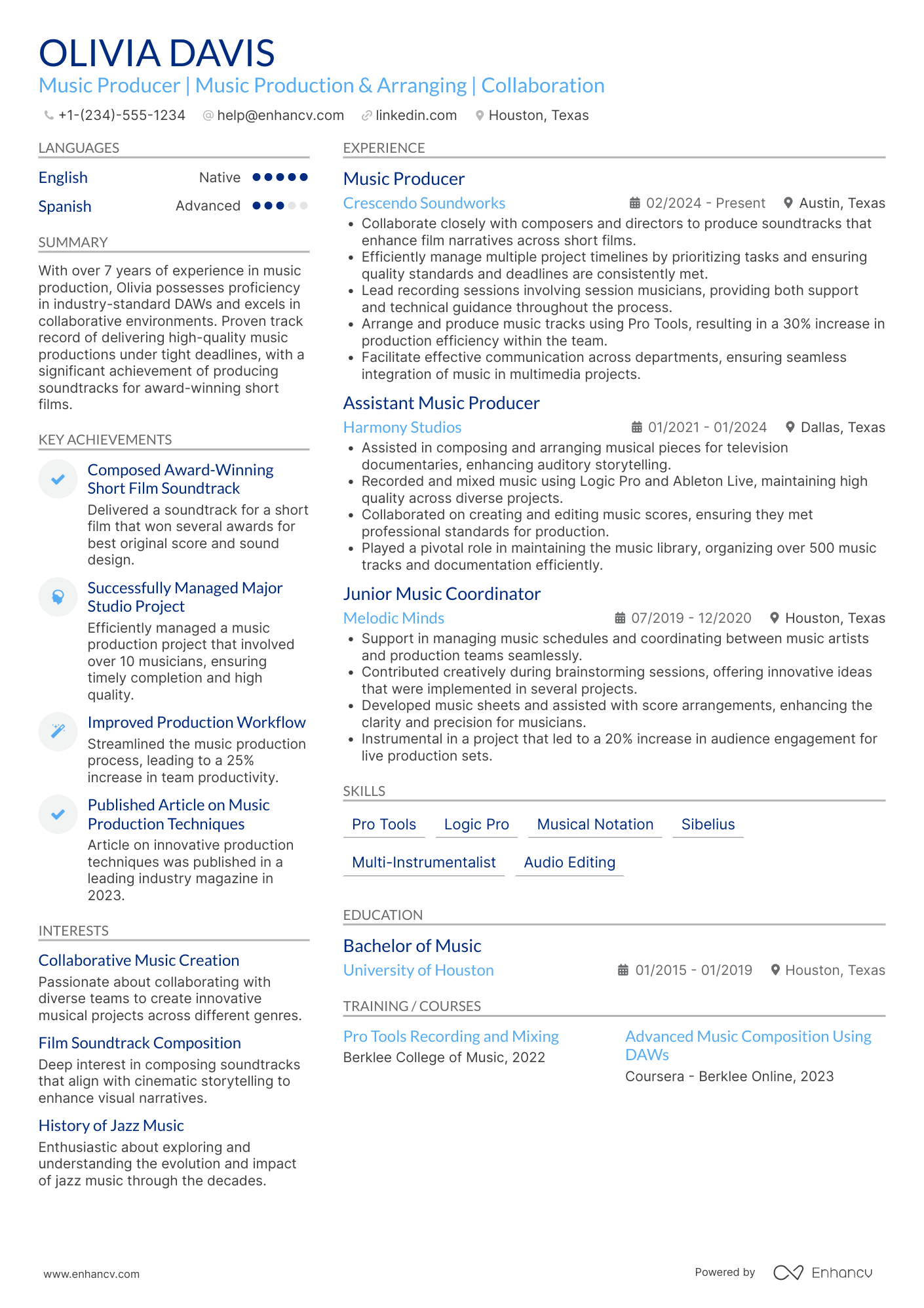
Musician resume examples
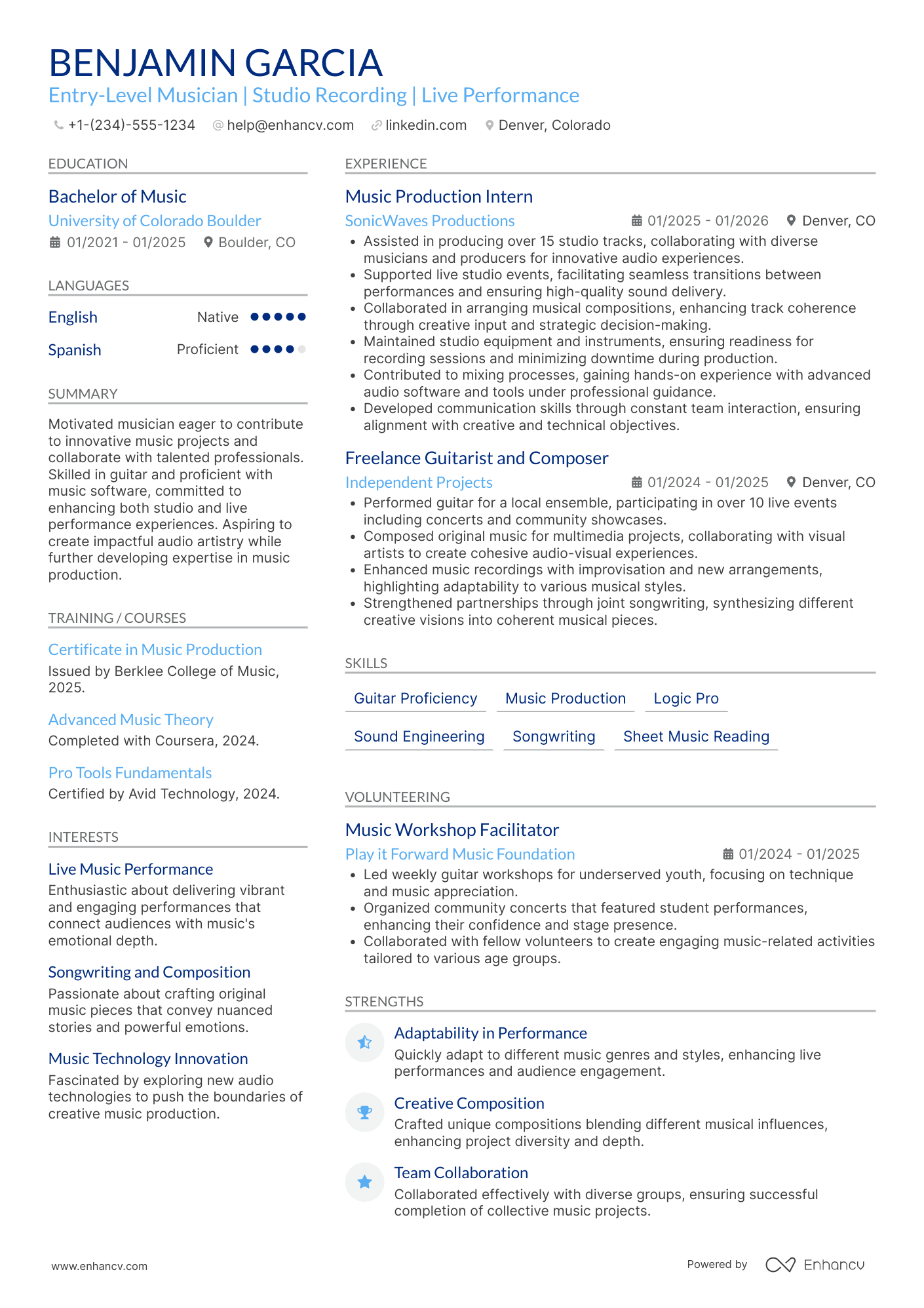
By Experience
By Role