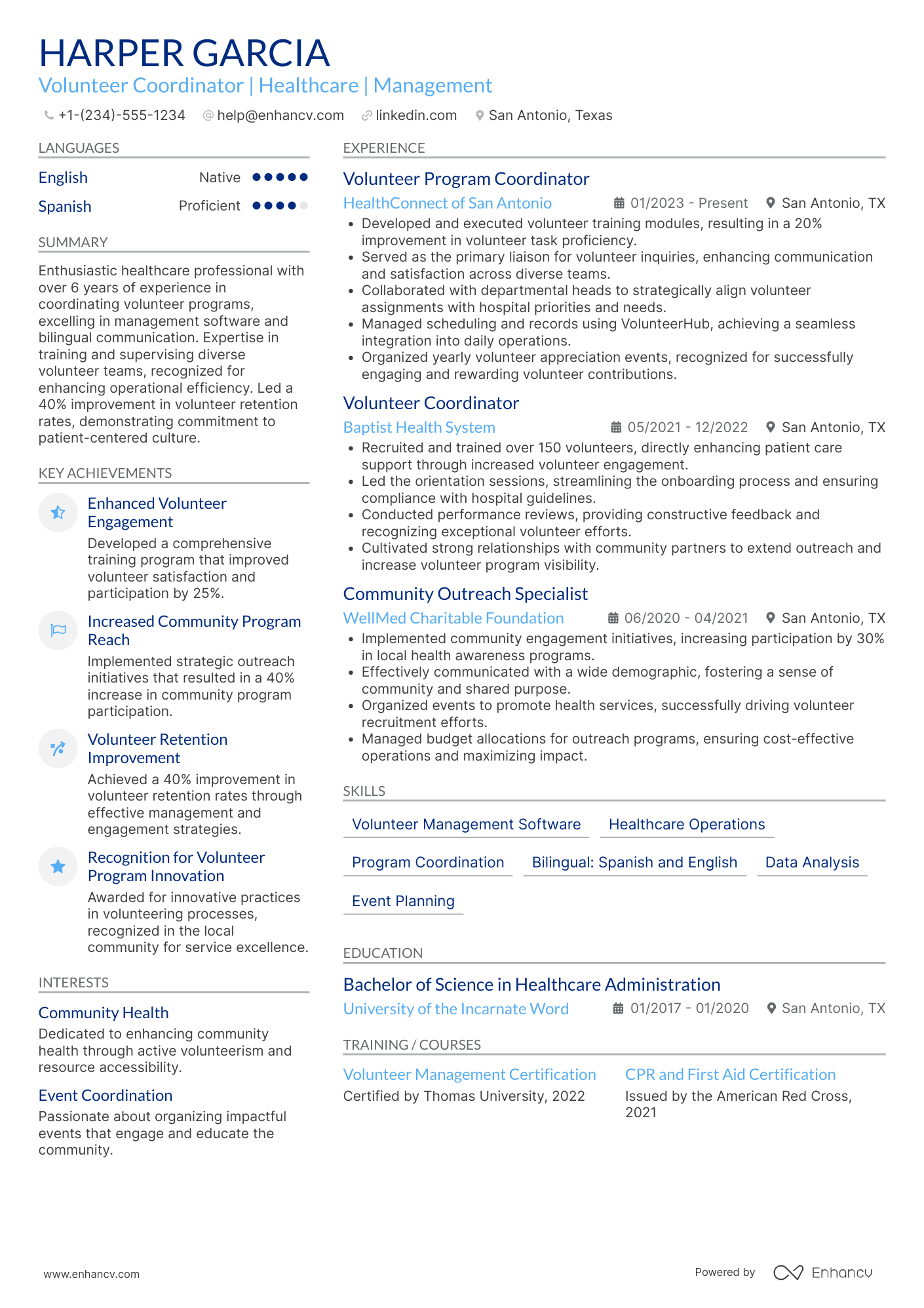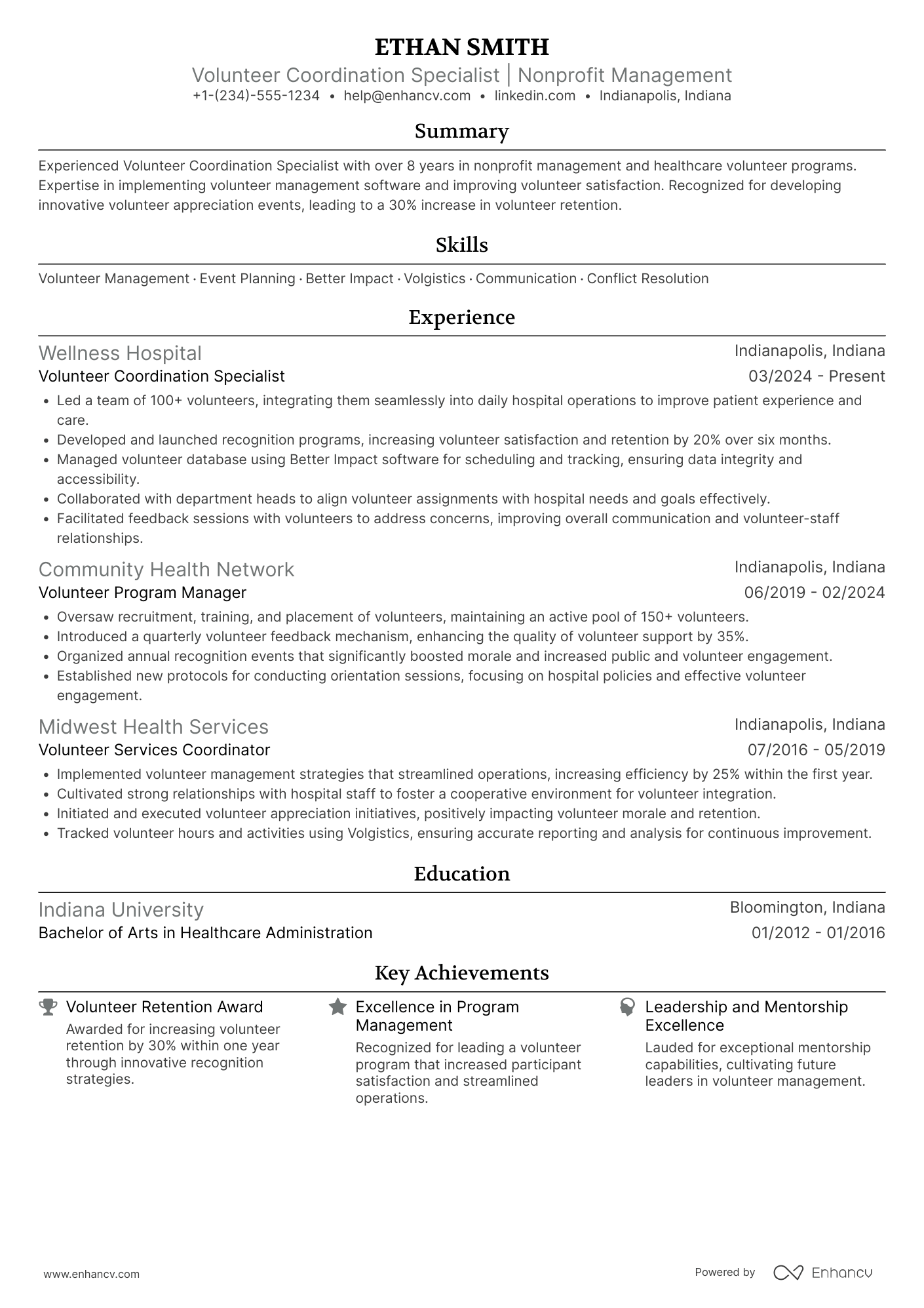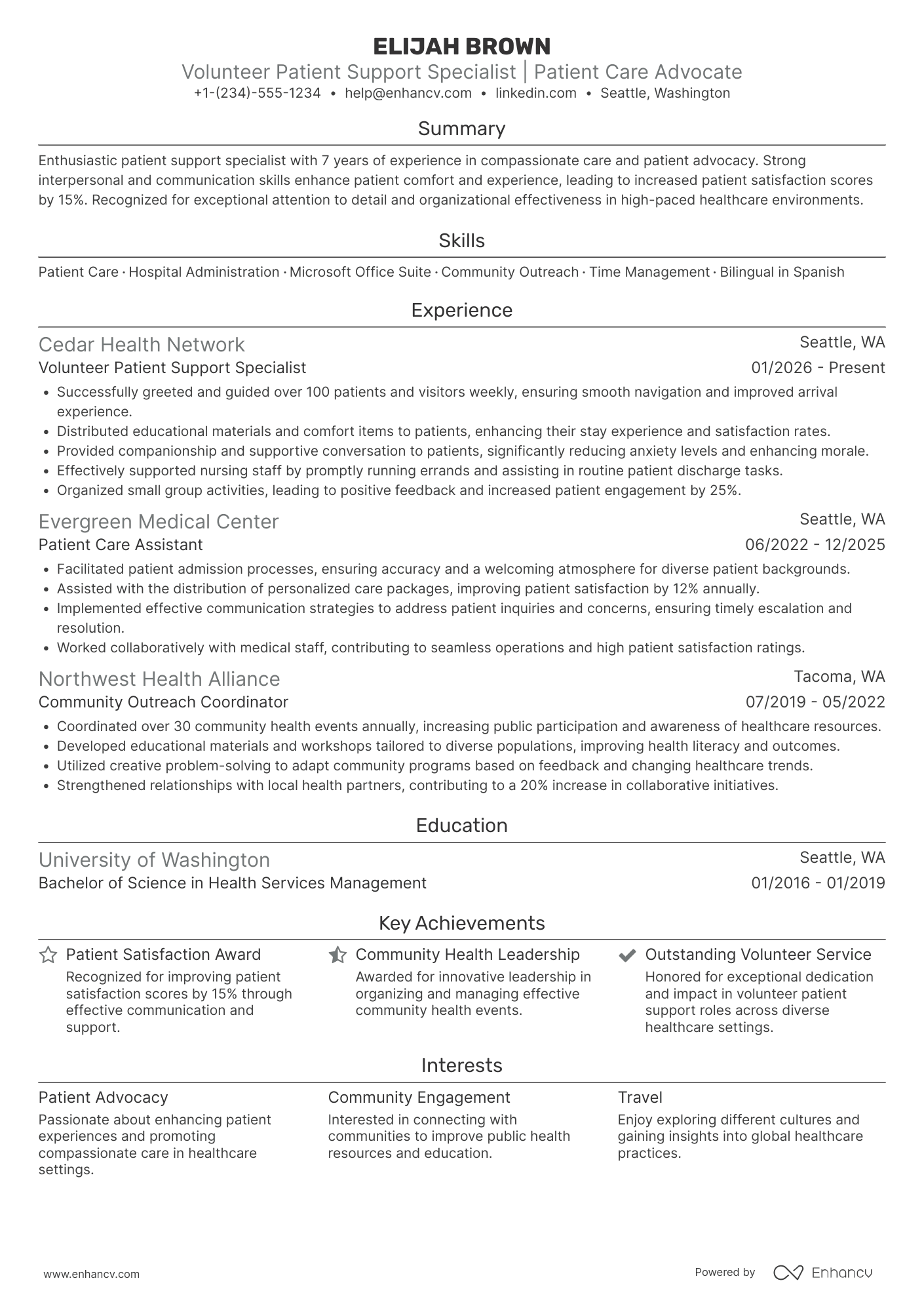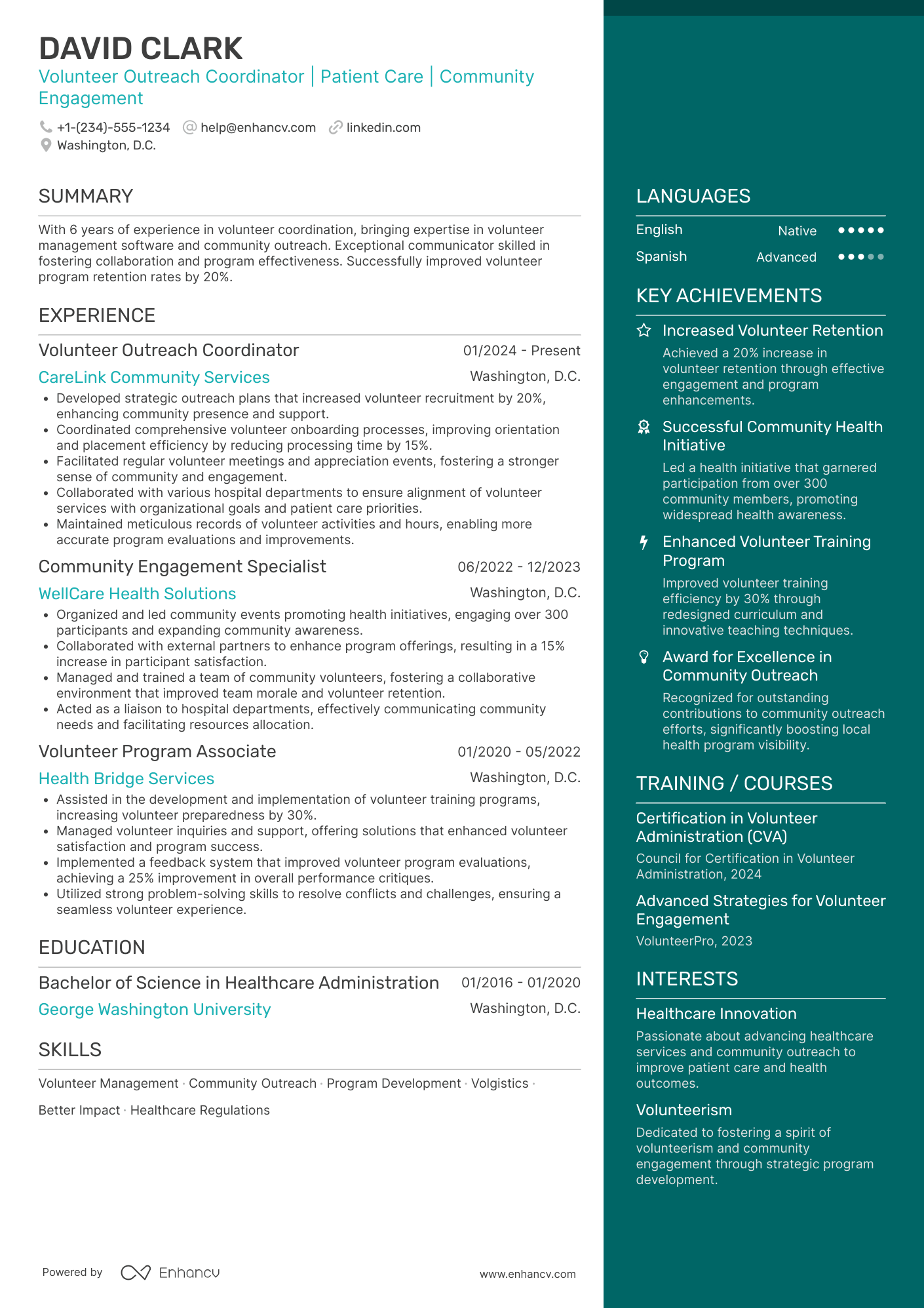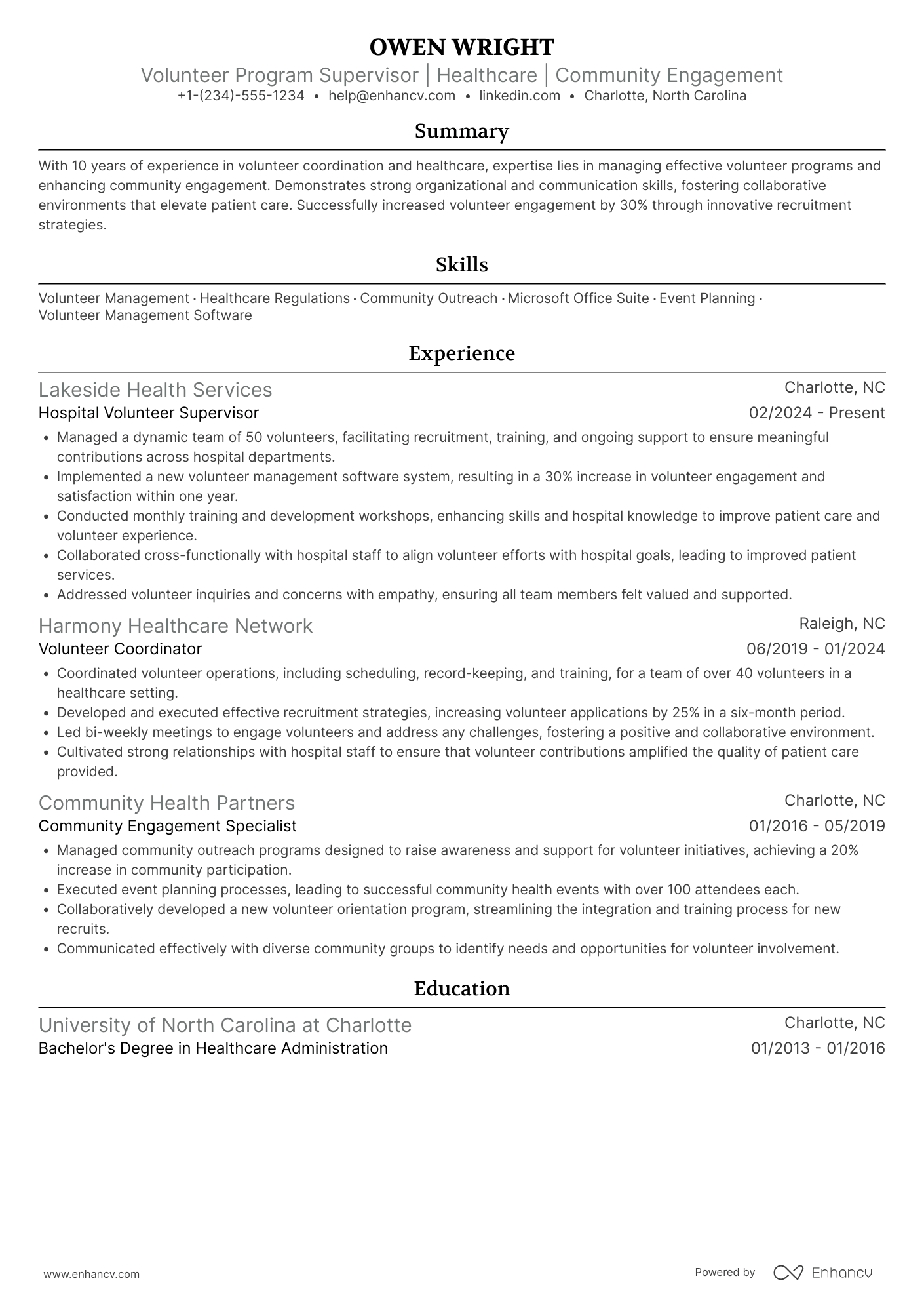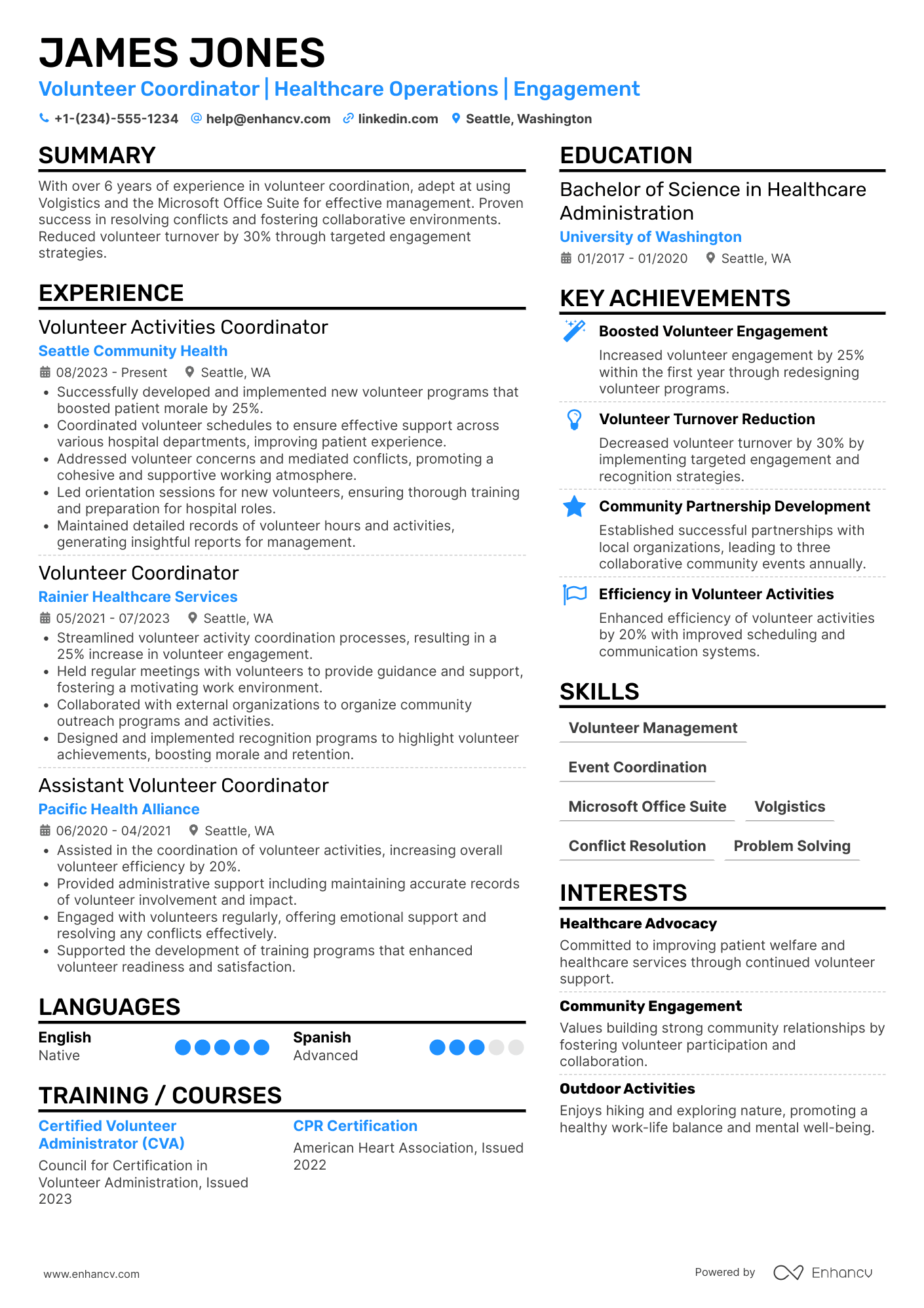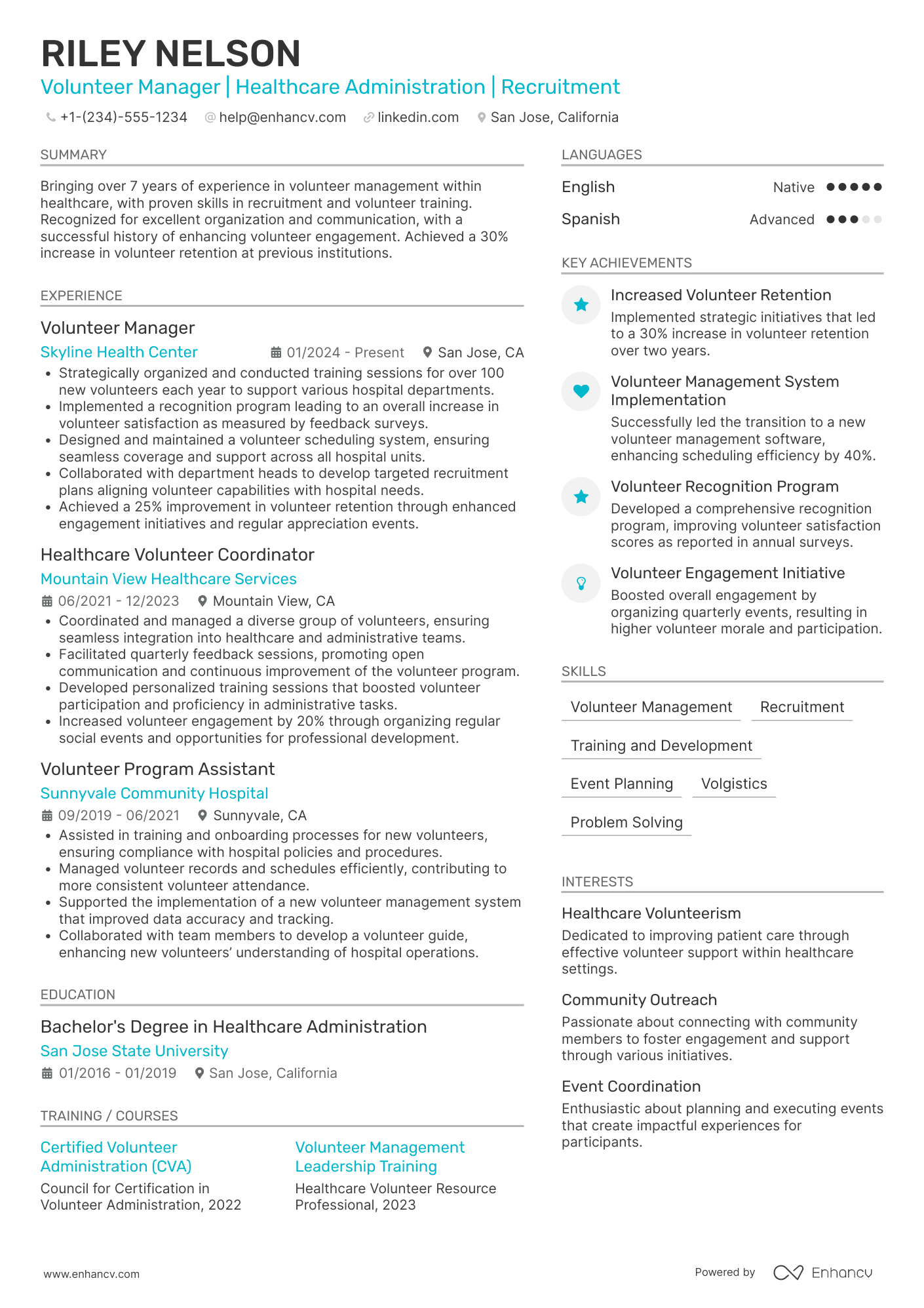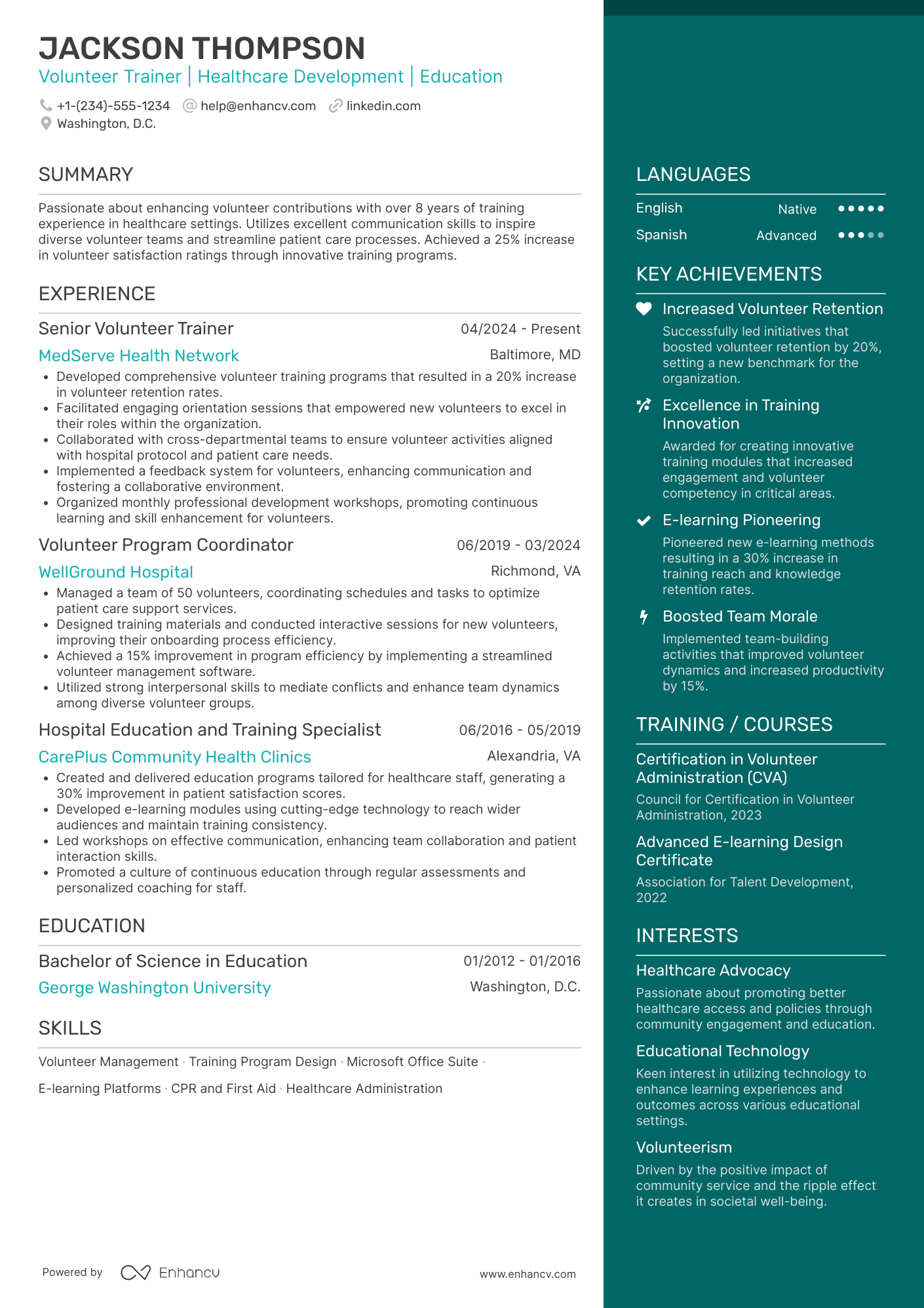
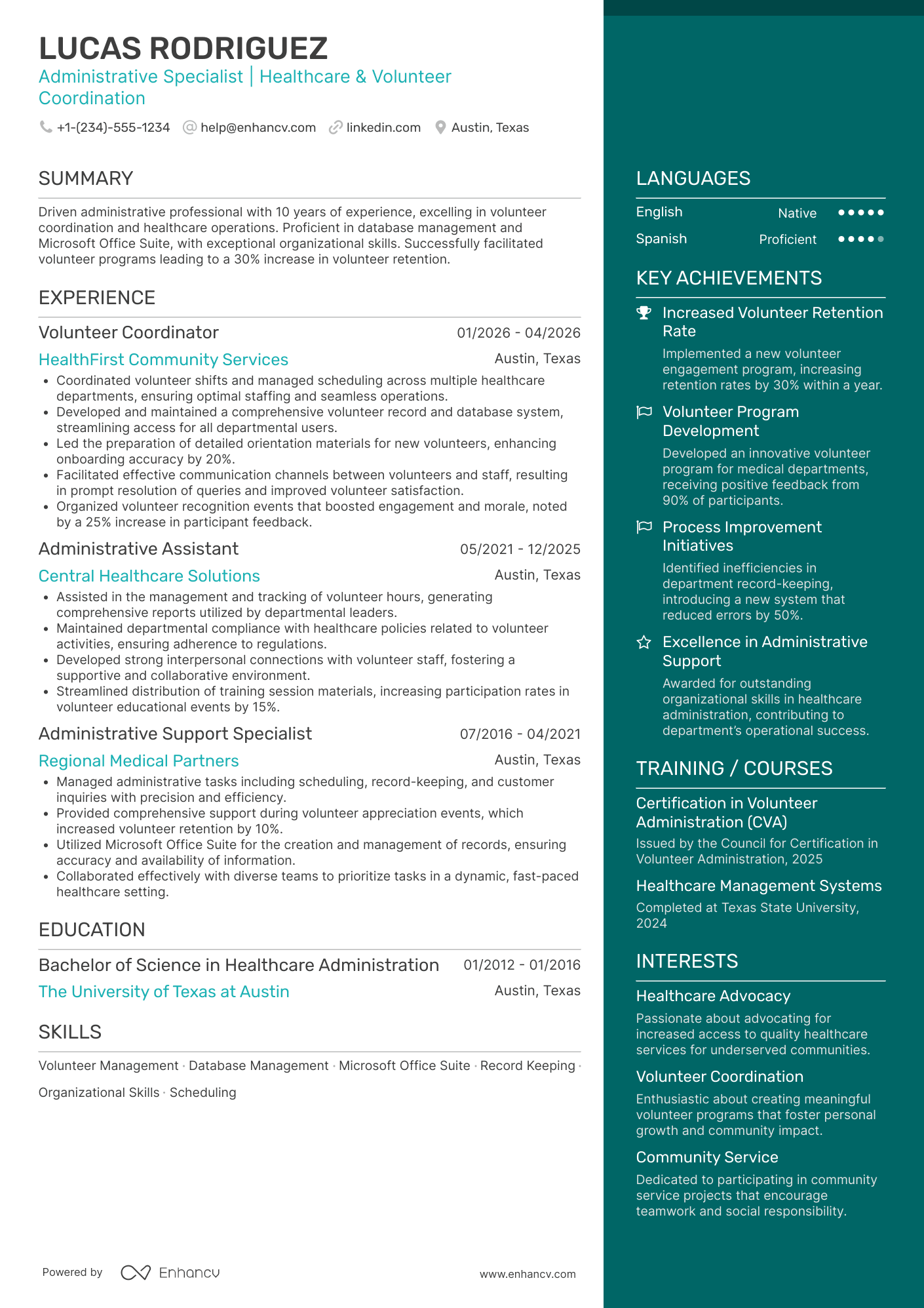
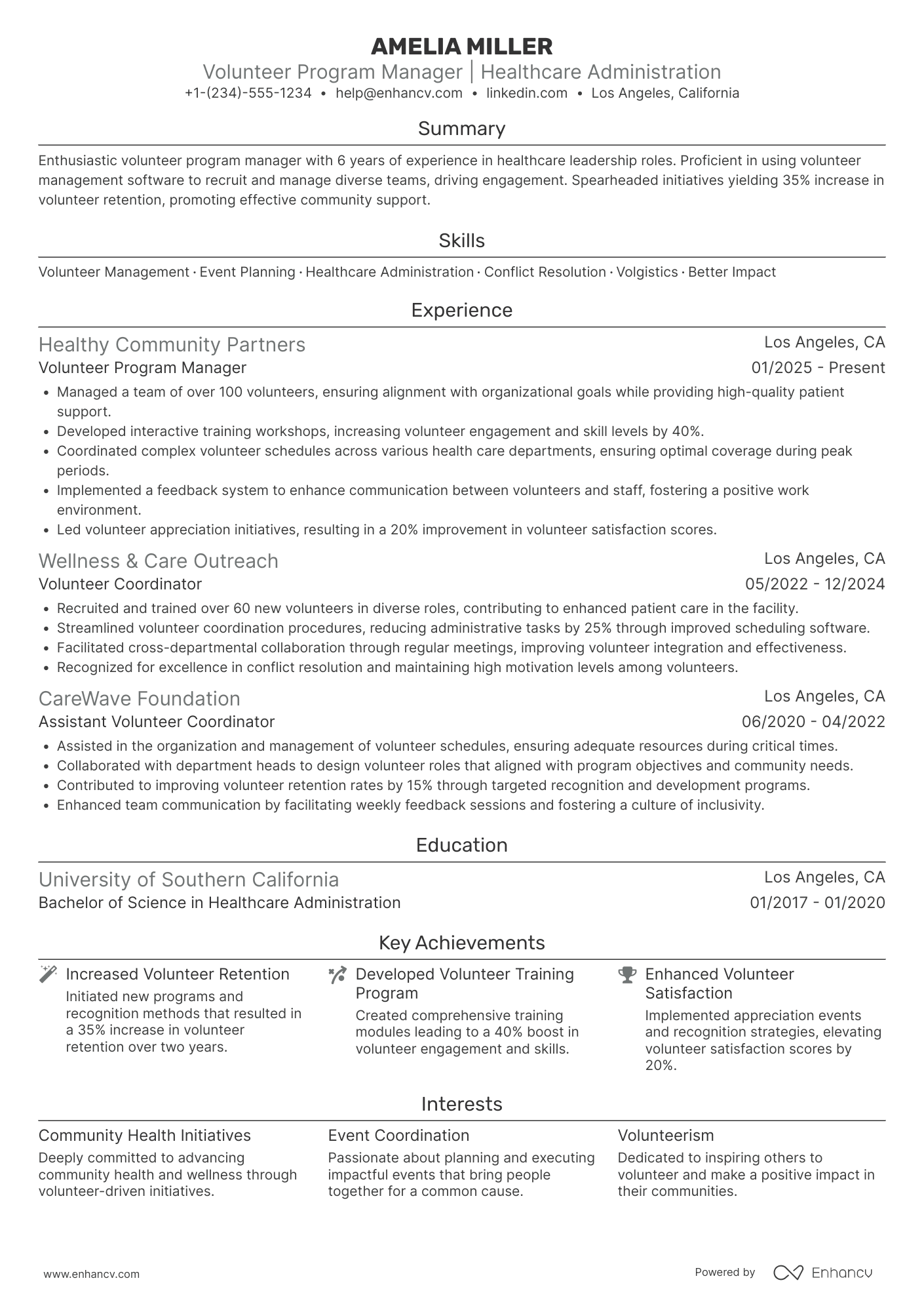
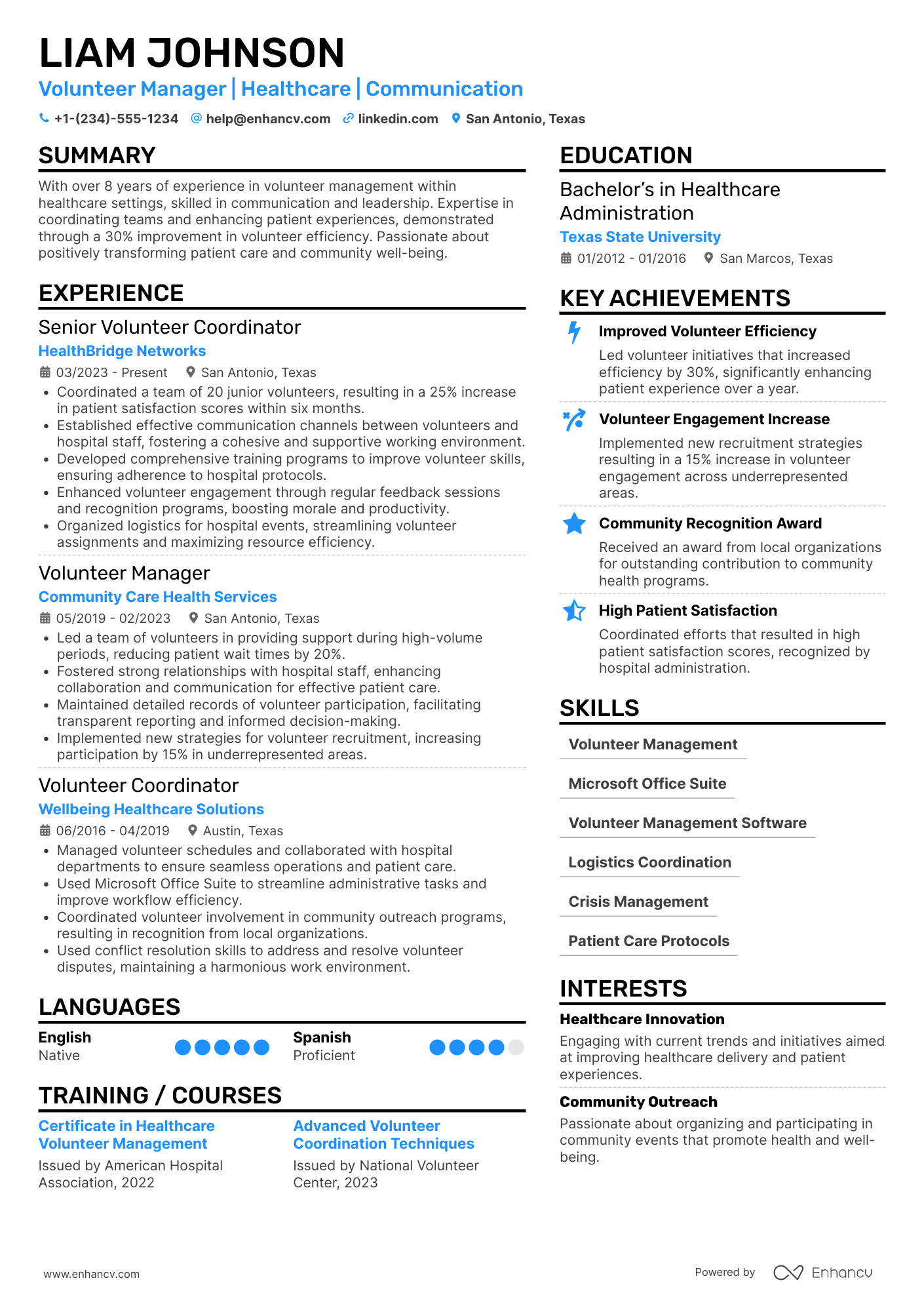
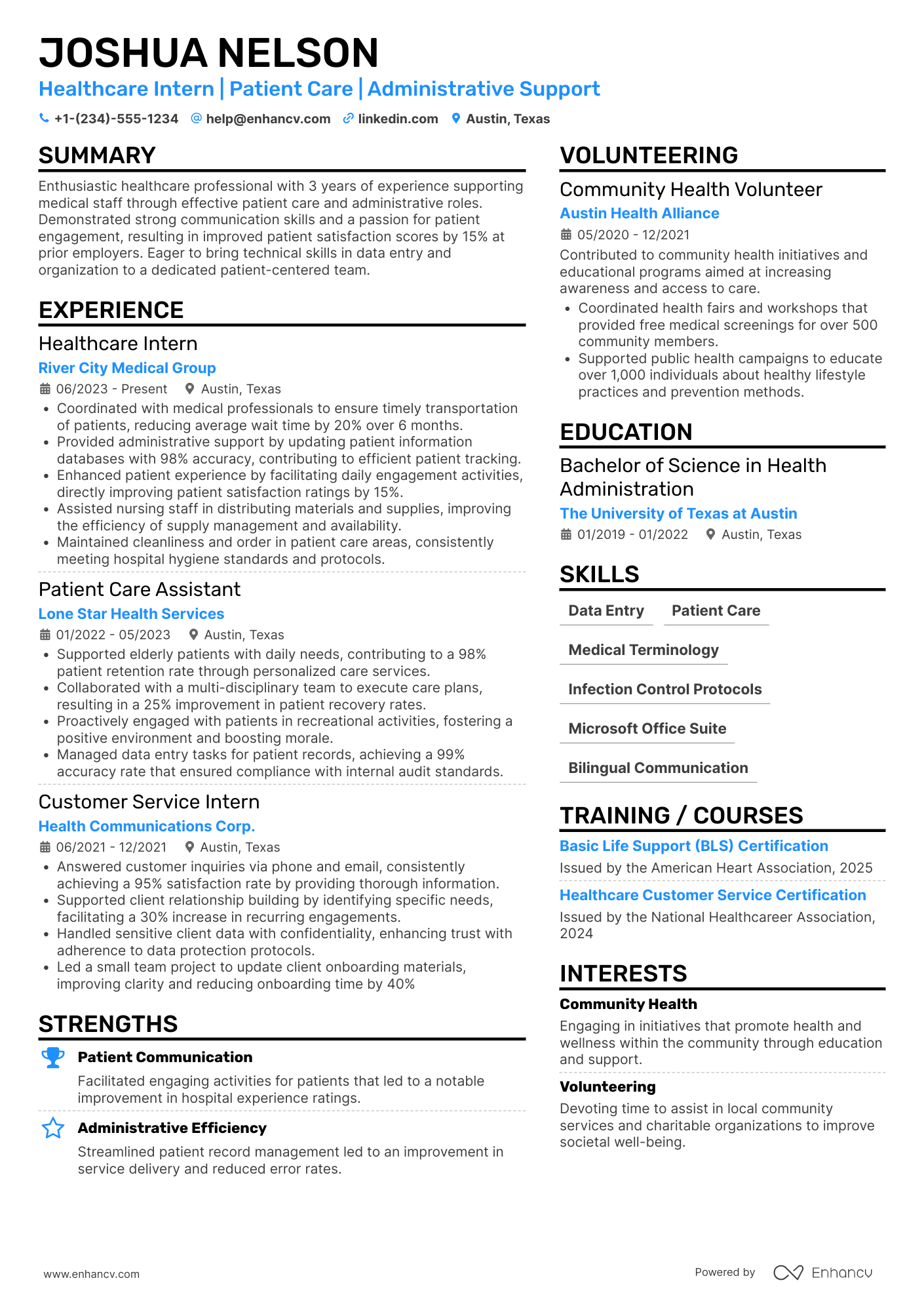
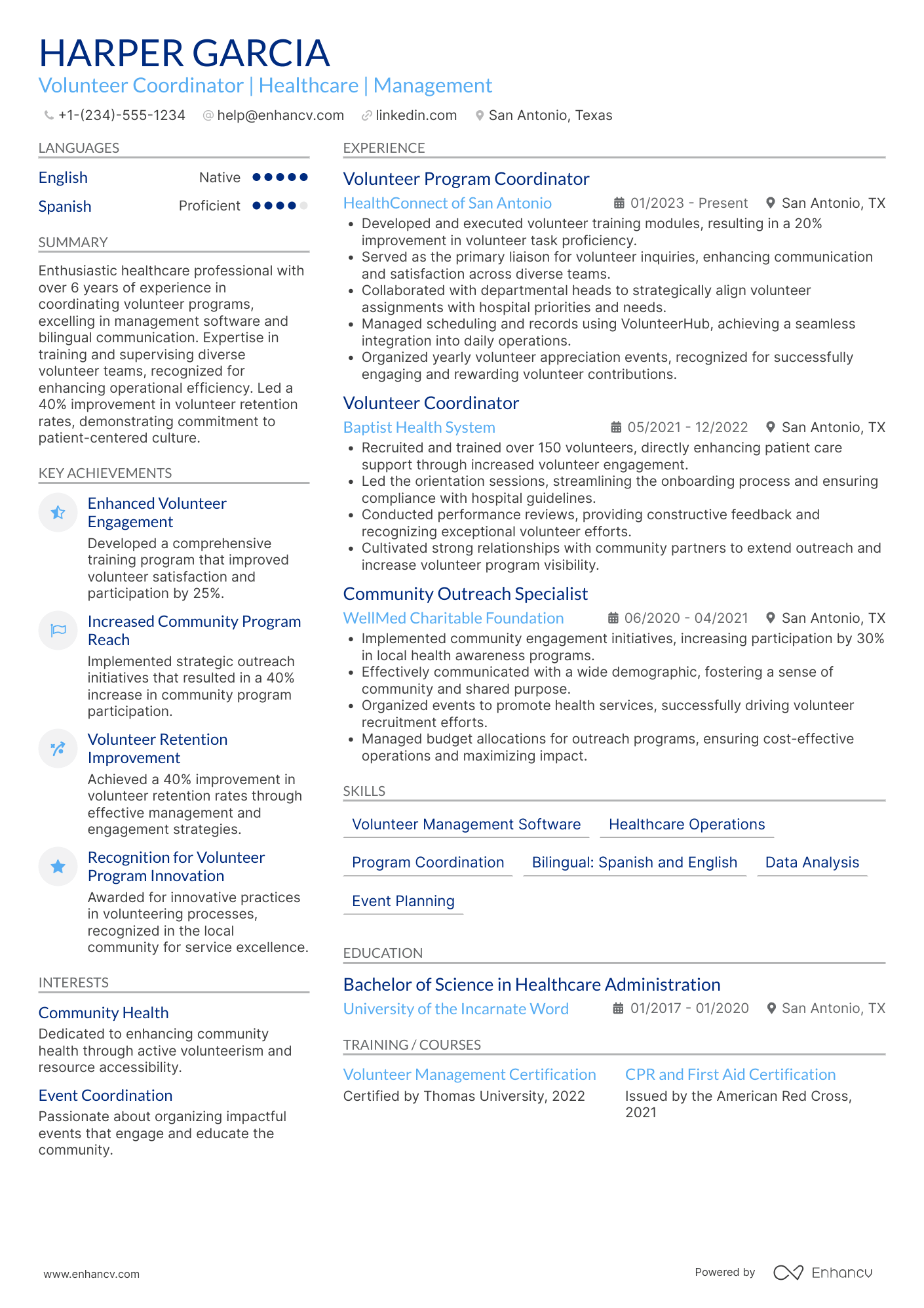
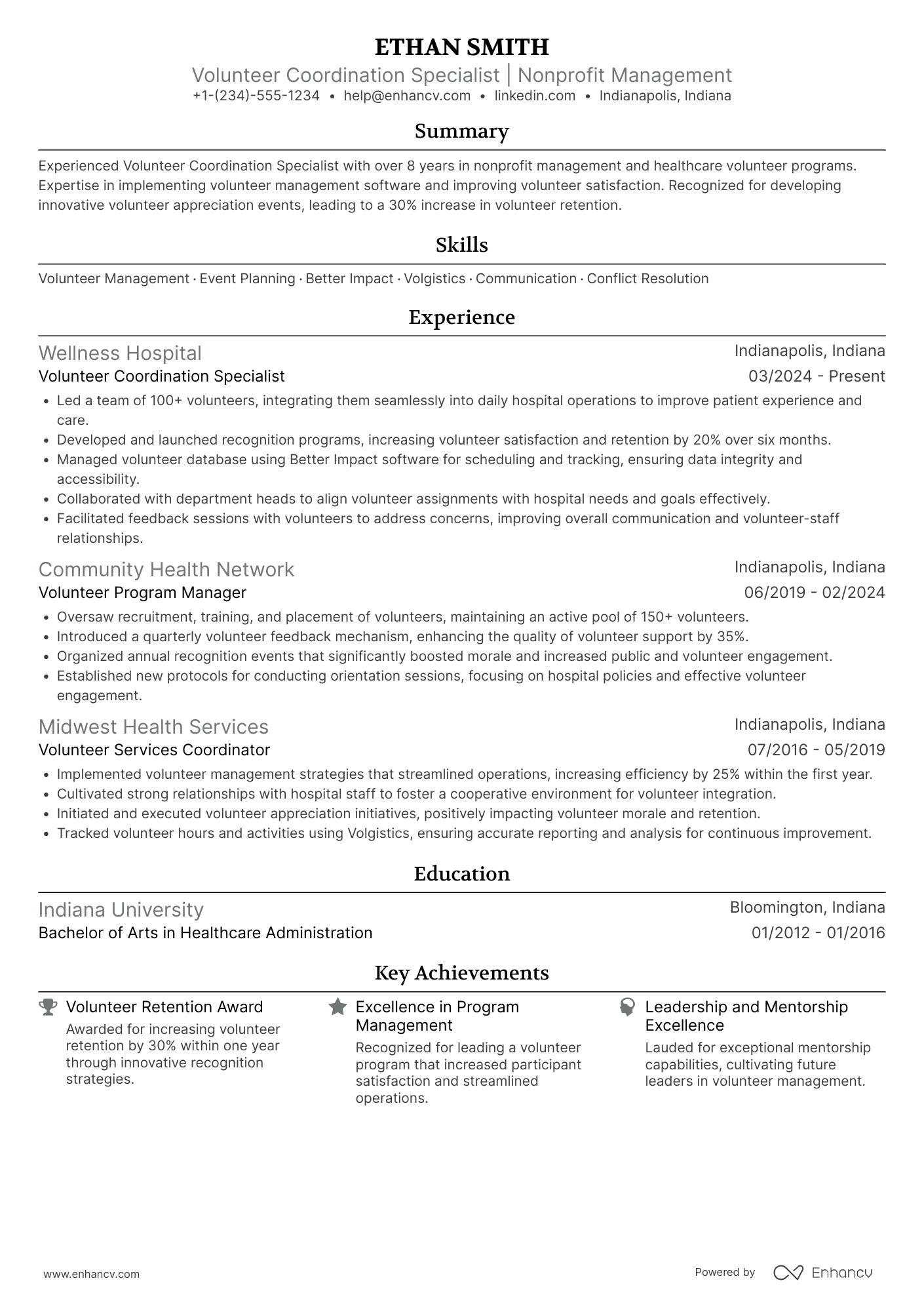
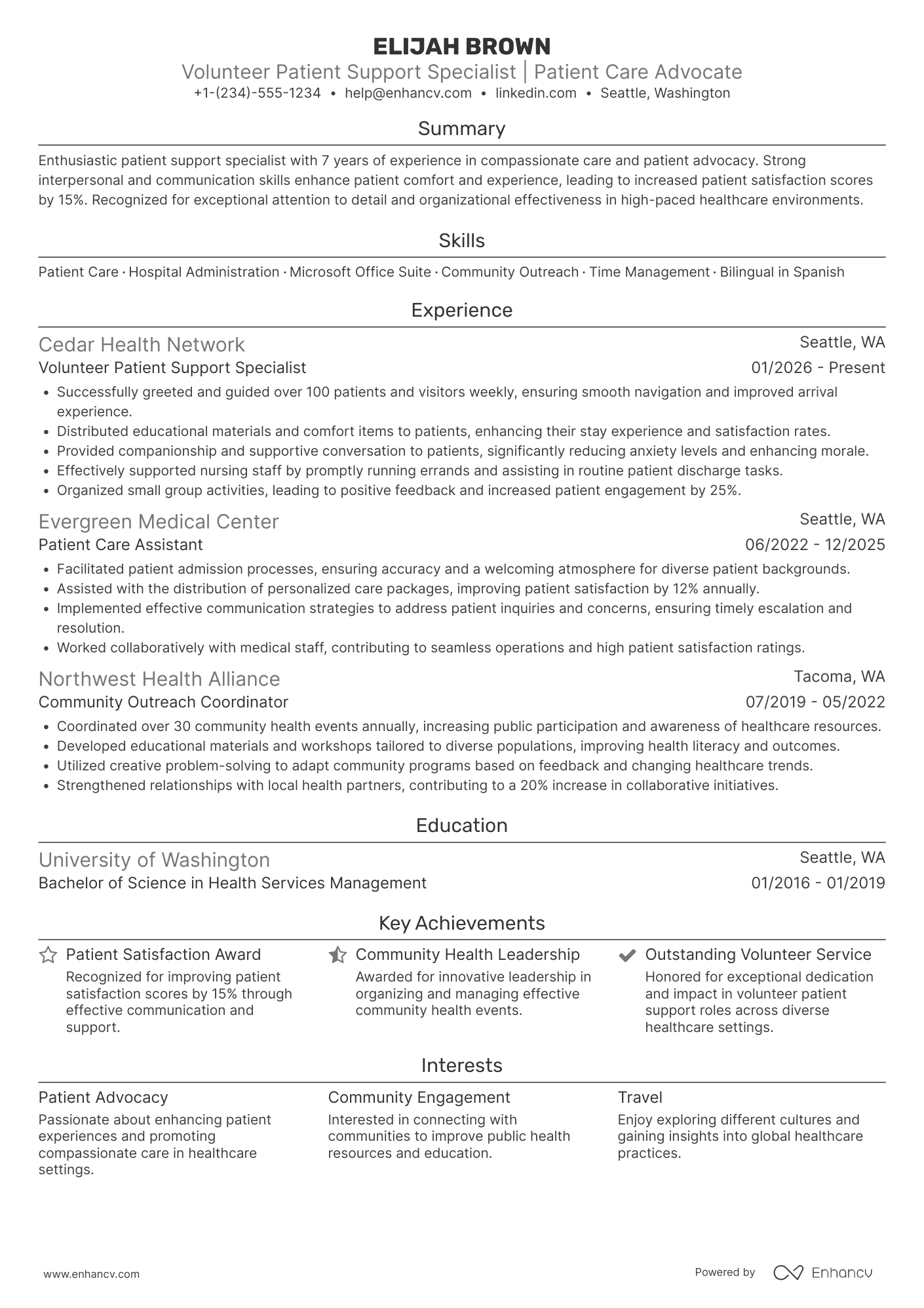
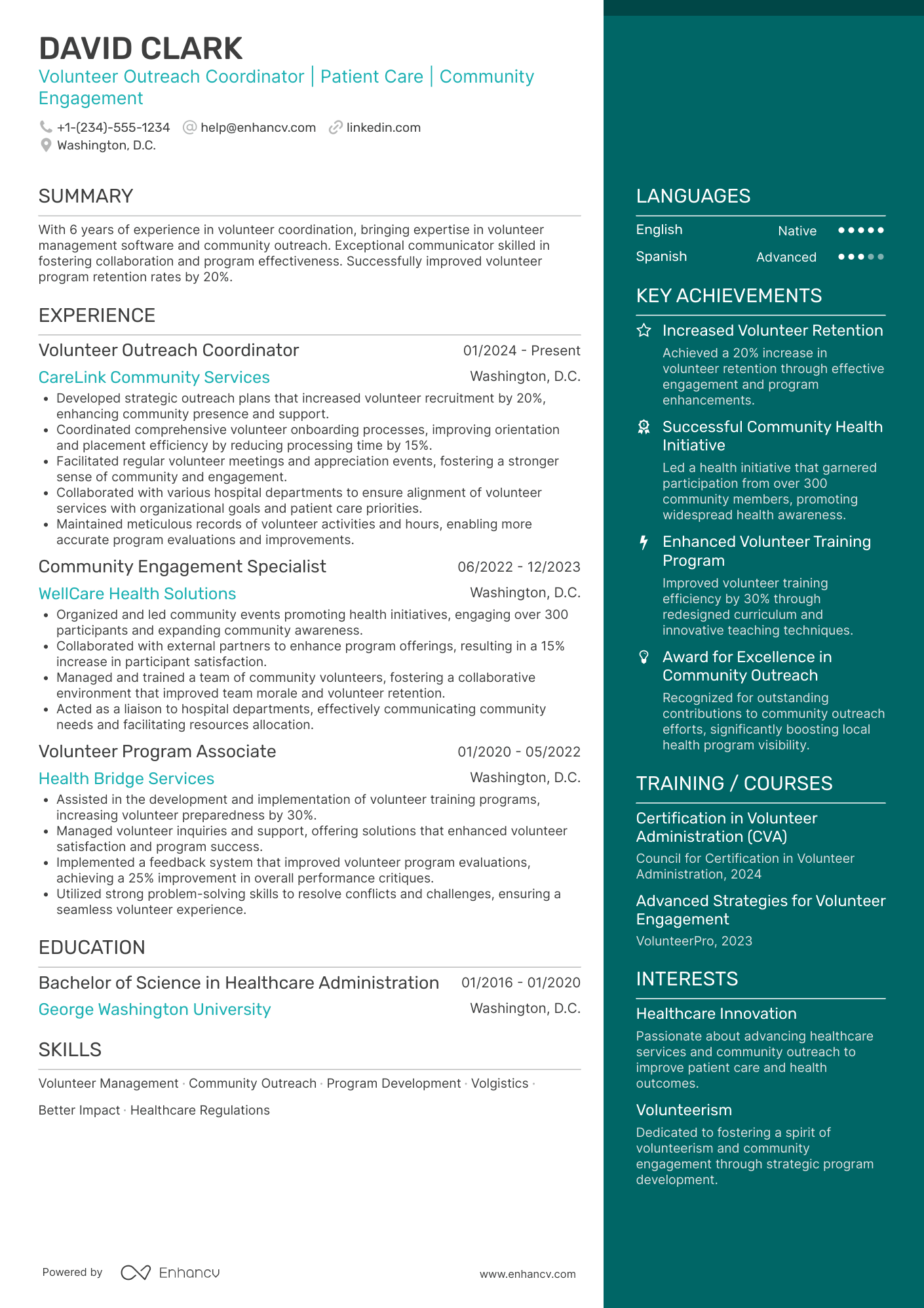
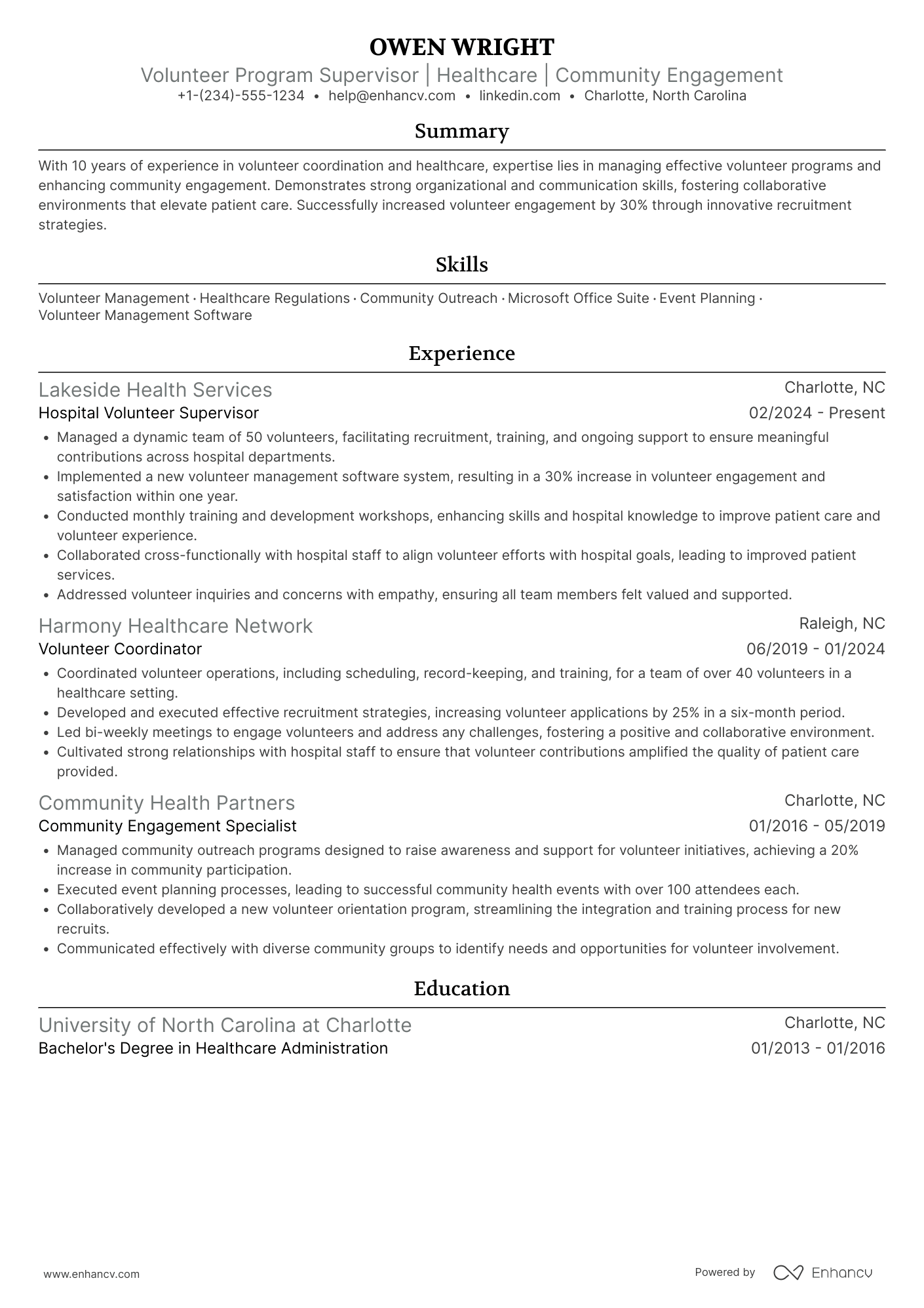
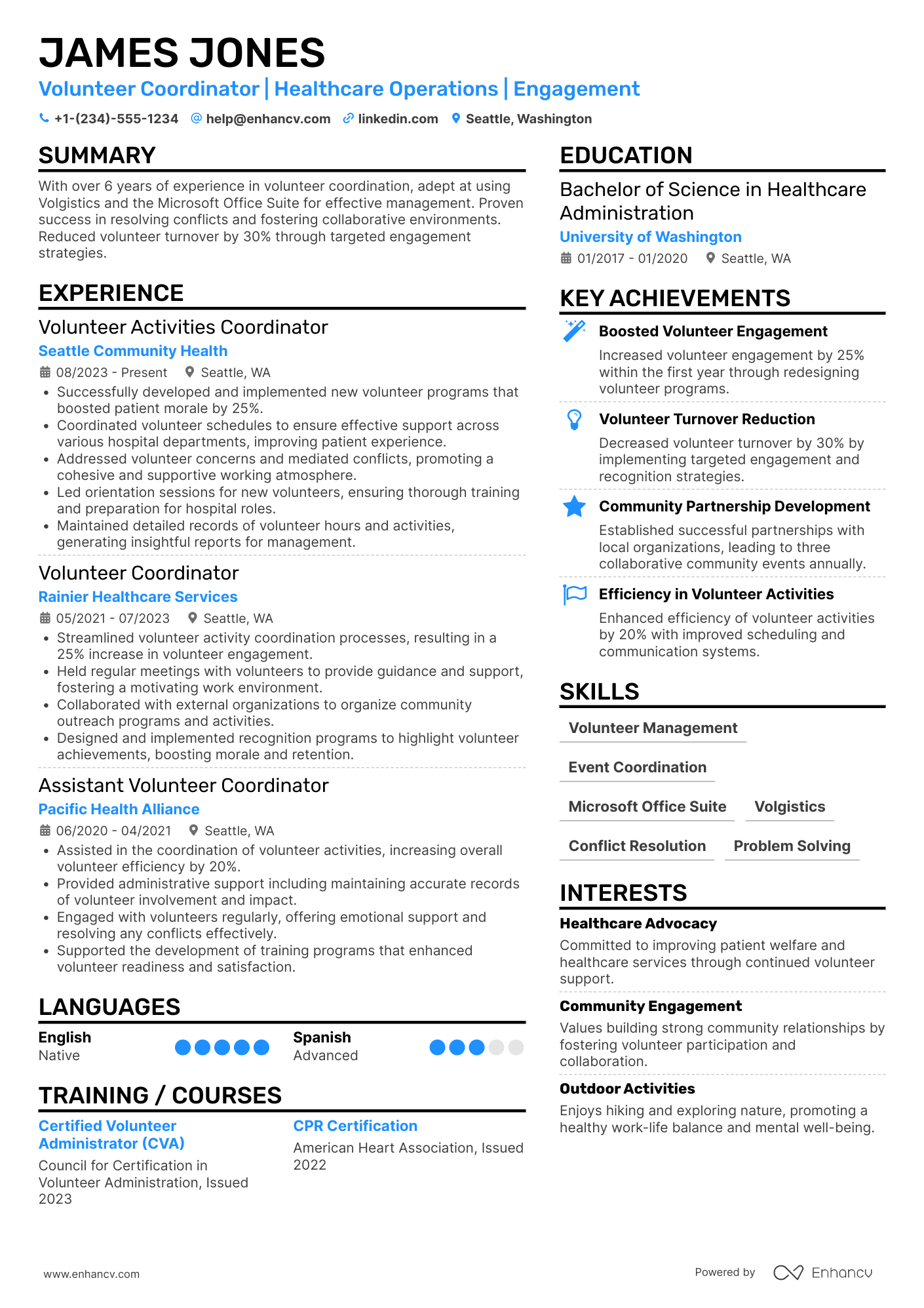
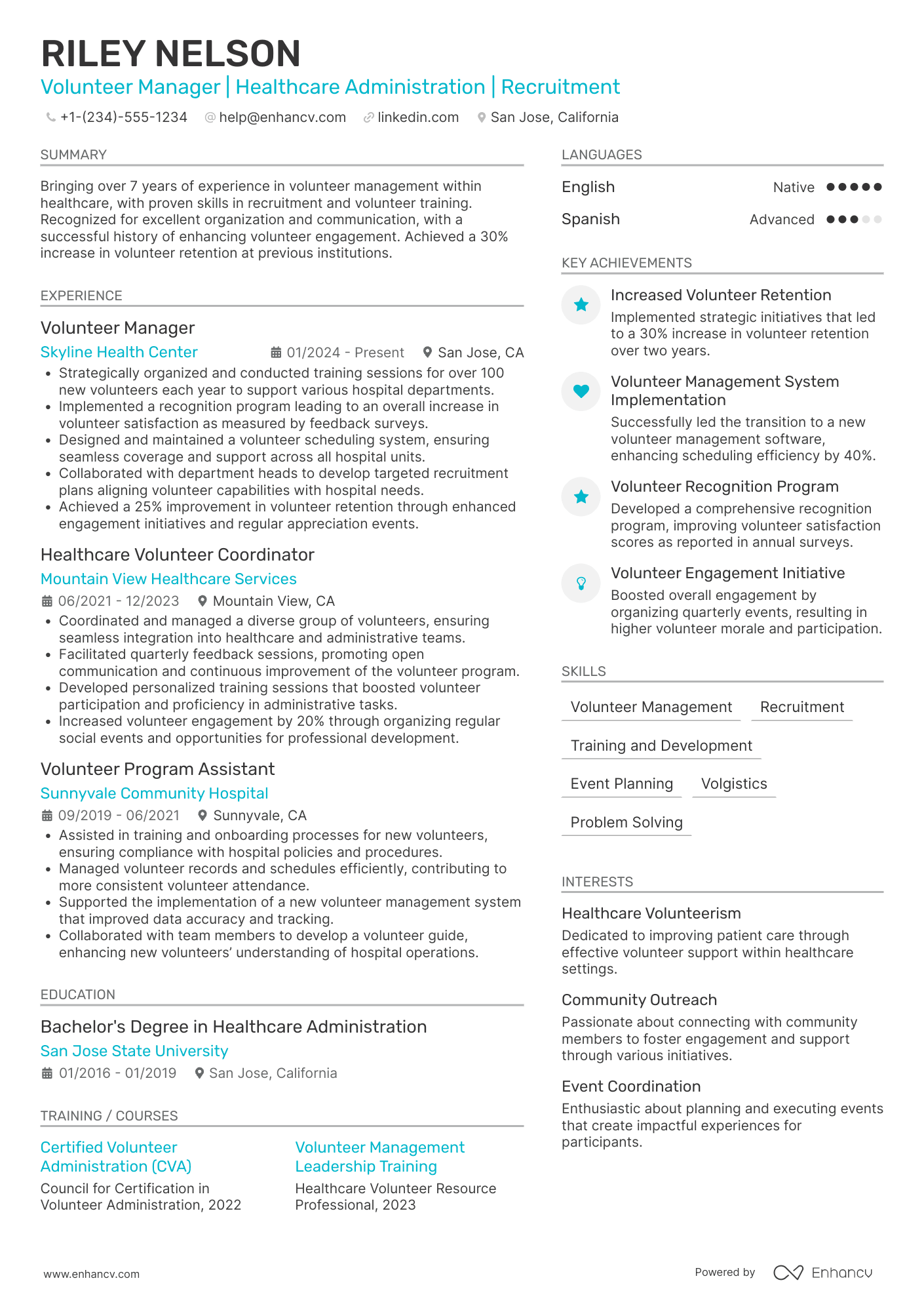
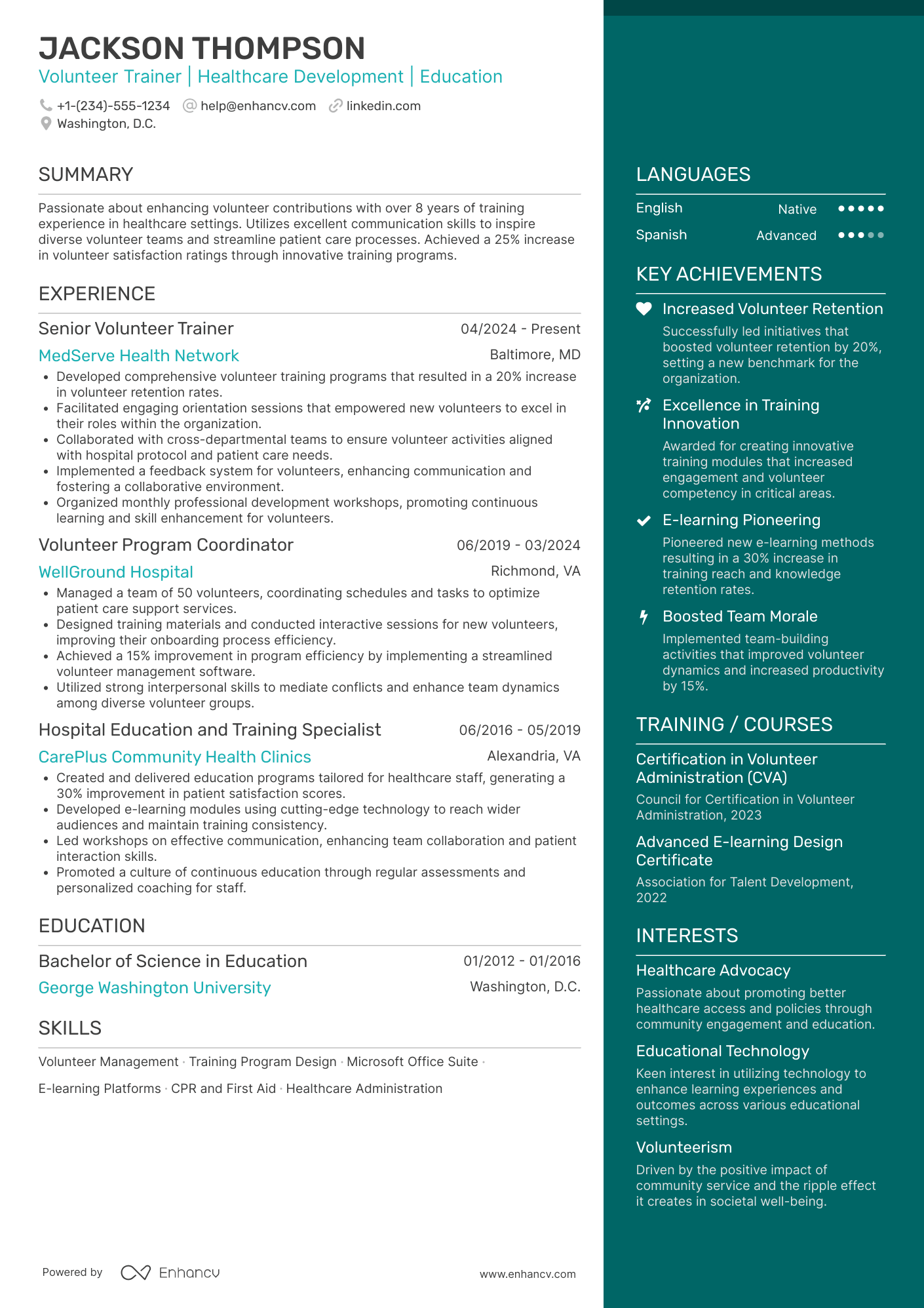
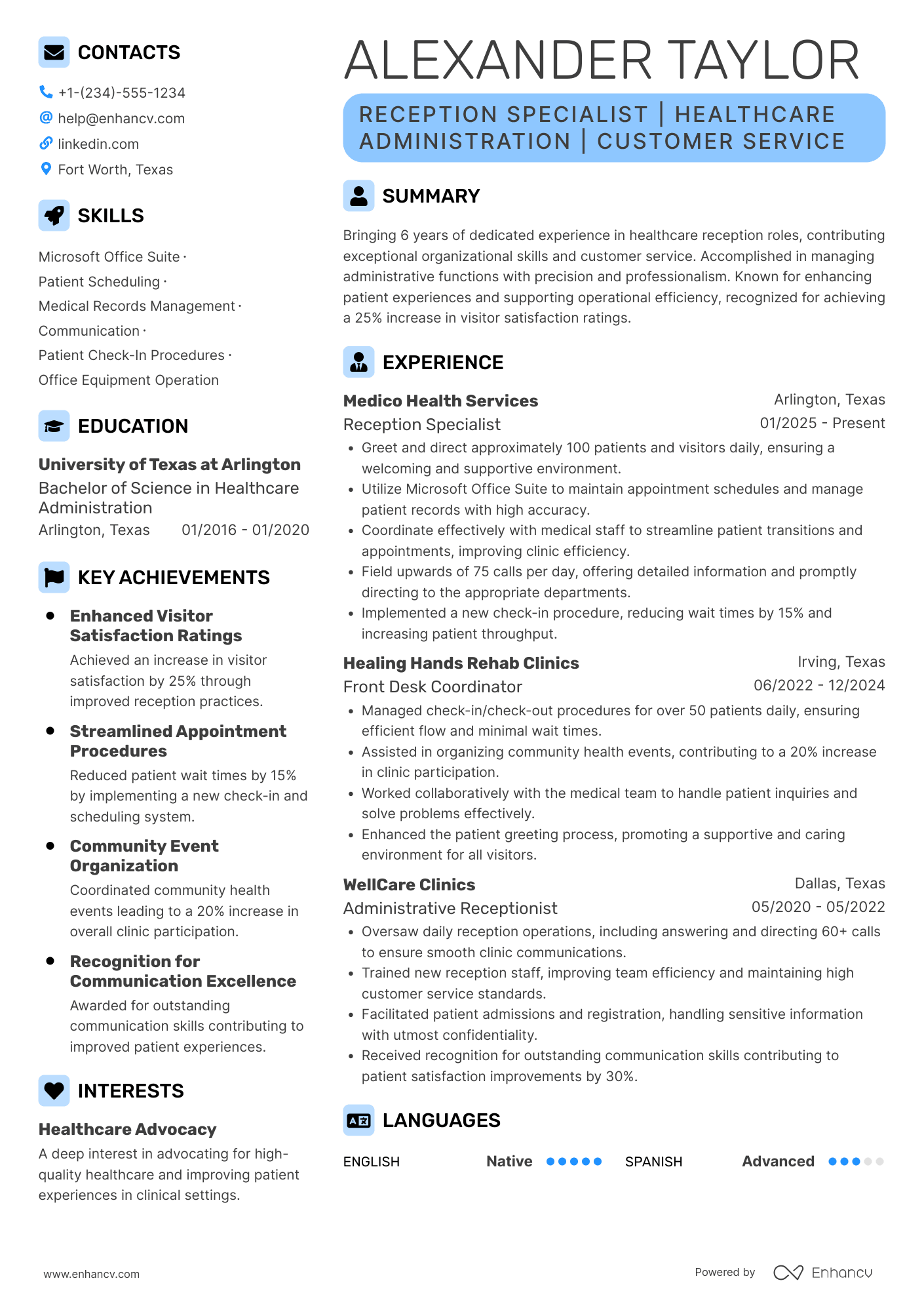
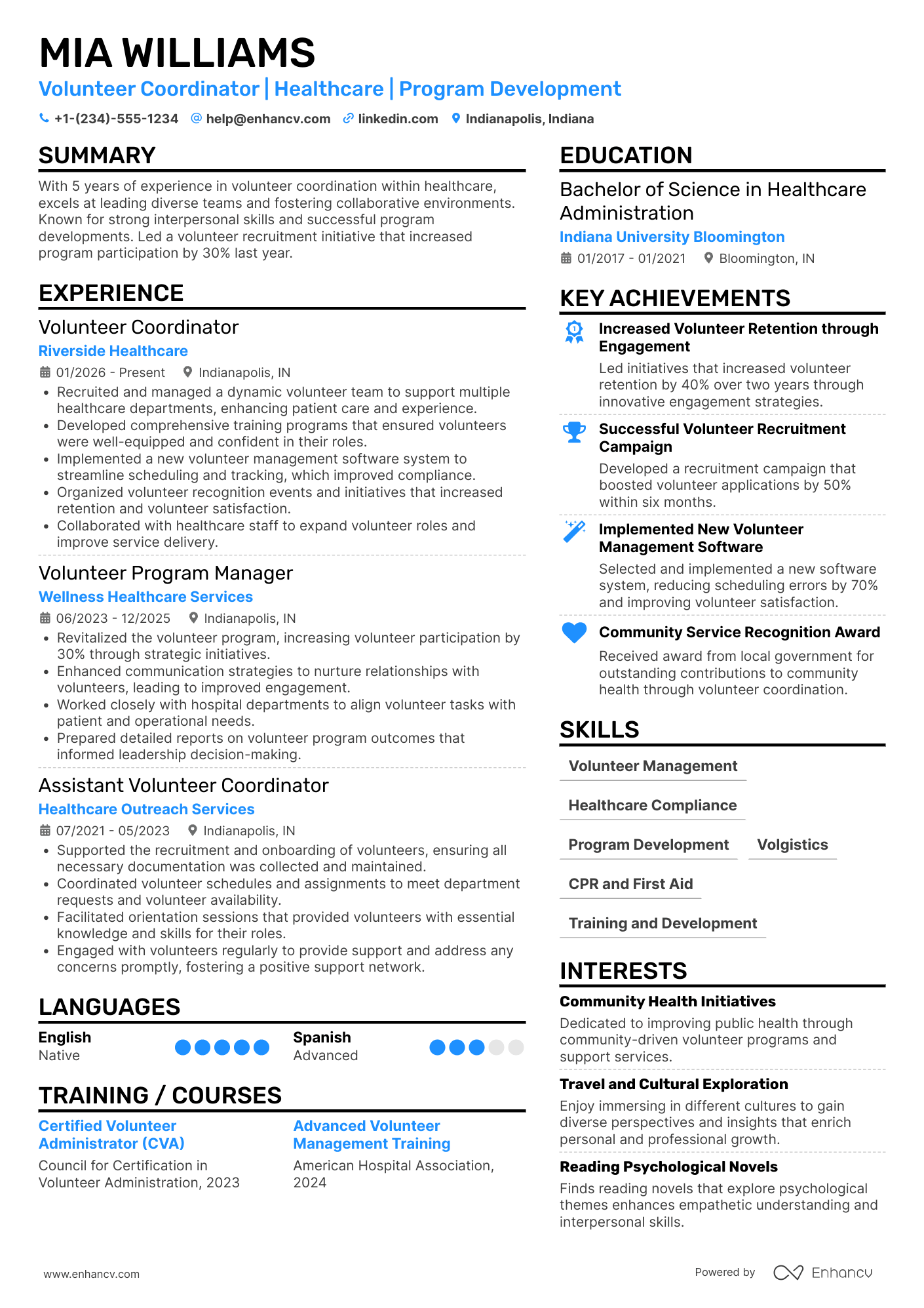
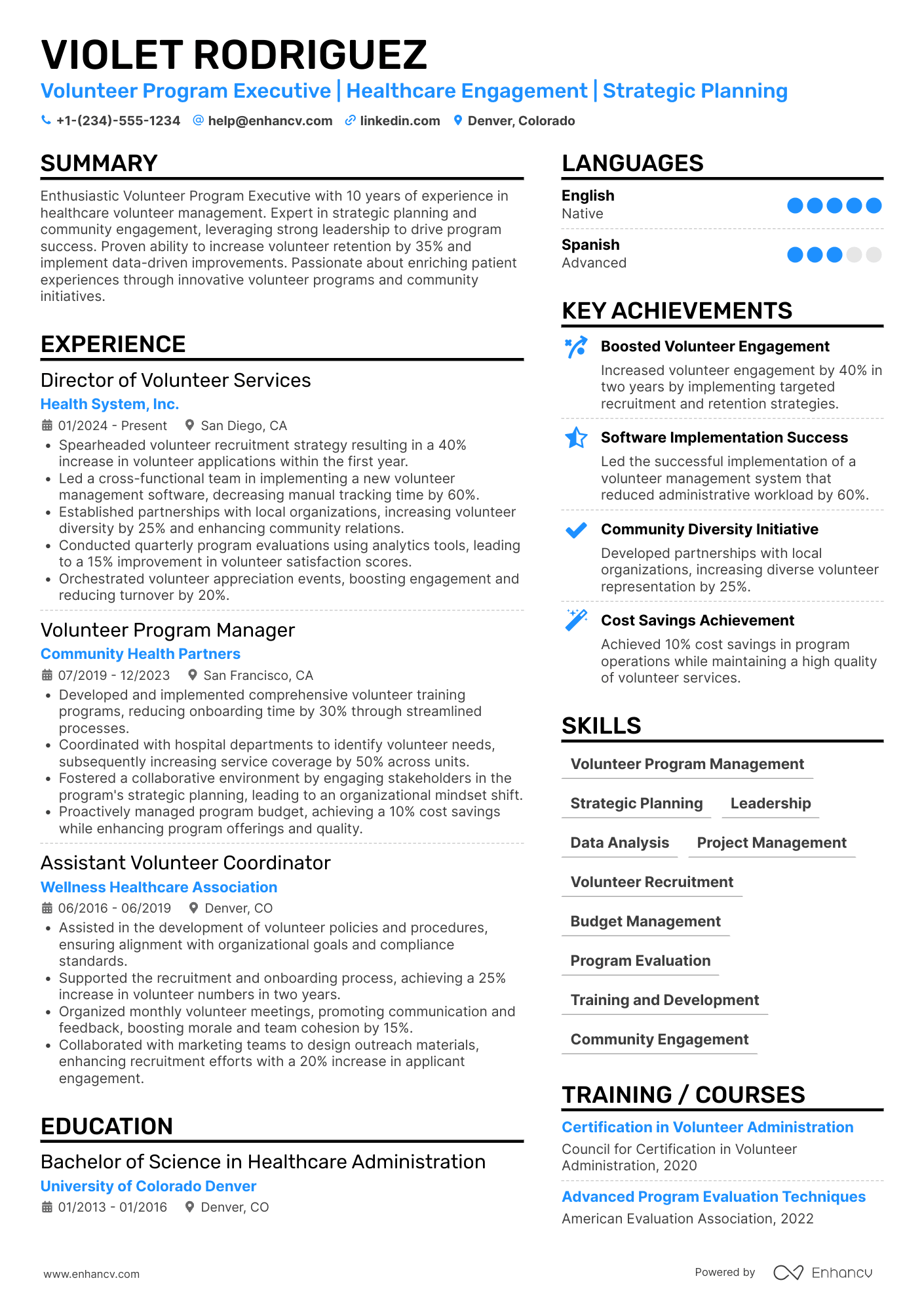
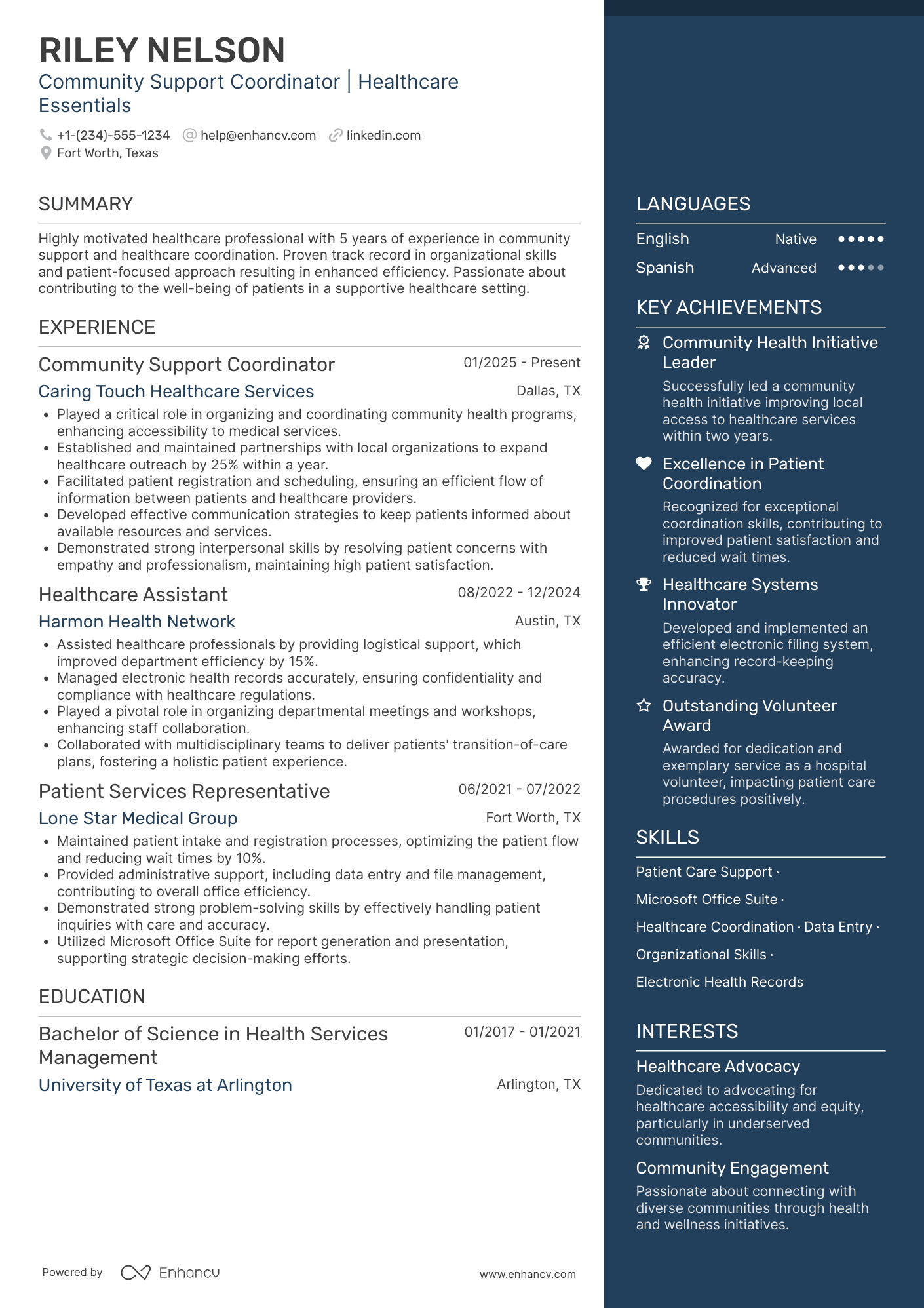
Hospital volunteer resumes fail when they read like generic duty lists and bury patient-facing impact. A hospital volunteer resume must earn attention in quick recruiter scans and pass ATS screening amid heavy competition.
A strong resume shows what changed because you helped. Knowing how to make your resume stand out is essential—highlight reduced wait times, supported fifty patients per shift, improved satisfaction scores, maintained zero privacy incidents, sped up transport turnaround, and trained new volunteers to follow infection control.

Key takeaways
- Quantify volunteer contributions with patient counts, hours served, and turnaround time improvements.
- Tailor each resume to the job posting's exact terminology, tools, and compliance requirements.
- Use a hybrid format when switching careers to lead with transferable skills.
- Show what changed because of your work, not just duties you performed.
- Place certifications like CPR, BLS, and HIPAA training near the top for clinical relevance.
- Pair action verbs with measurable results in every experience bullet point.
- Use Enhancv to turn vague volunteer duties into specific, recruiter-ready resume bullets.
How to format a hospital volunteer resume
Recruiters reviewing hospital volunteer resumes prioritize compassion-driven service, patient interaction skills, and reliability in clinical or administrative settings. Choosing the right resume format ensures these qualities—along with any relevant training or certifications—are immediately visible during a quick scan.

I have significant experience in this role—which format should I use?
Use a reverse-chronological format to present your volunteer history in a clear, time-ordered sequence that highlights growing responsibility. Do:
- Lead with your most recent volunteer placement, emphasizing scope such as department, patient population served, and hours contributed weekly.
- Include role-specific skills and domains like patient intake assistance, EMR (electronic medical records) navigation, surgical waiting room support, or discharge coordination.
- Quantify your contributions with measurable outcomes wherever possible, such as hours logged, patients assisted, or process improvements.
I'm junior or switching into this role—what format works best?
A hybrid format works best because it lets you feature transferable skills at the top while still showing any hands-on experience in a timeline. Do:
- Place a dedicated skills section near the top of your resume, highlighting competencies like HIPAA awareness, patient confidentiality, CPR/First Aid certification, and bedside manner.
- Include relevant coursework, community service projects, or shadowing experiences that demonstrate familiarity with hospital environments—even if they weren't formal volunteer roles.
- Connect each action to a clear result, showing recruiters you understand the impact of your contributions on patients and staff.
When does a functional resume make sense?
In specific situations, a functional format can work for a hospital volunteer resume if structured carefully:
- You're transitioning from an unrelated field and have no prior healthcare or volunteer experience but hold relevant certifications such as CPR, First Aid, or health sciences coursework.
- You have a significant gap in your resume and need to foreground transferable soft skills like empathy, communication, and teamwork.
- You're a recent high school or college student with limited work history but meaningful community service or caregiving experience.
- A functional format is acceptable when you're making a career change into healthcare volunteering, have no prior clinical exposure, or are addressing resume gaps—but even then, tie every listed skill to a specific project, service activity, or measurable outcome.
Once you've established a clean, readable format, the next step is deciding which sections to include so each one reinforces your qualifications.
What sections should go on a hospital volunteer resume
Recruiters expect a clean, standard resume that shows you can support patient care and hospital operations safely and reliably. Understanding which resume sections to include is key to maximum clarity:
- Header
- Summary
- Experience
- Skills
- Projects
- Education
- Certifications
- Optional sections: Volunteer work, Leadership, Languages
Your experience bullets should emphasize measurable impact, patient-facing scope, service outcomes, and reliability in high-volume, privacy-sensitive environments.
Is your resume good enough?
Drop your resume here or choose a file. PDF & DOCX only. Max 2MB file size.
Once you’ve organized your resume with the right core sections, the next step is writing your hospital volunteer experience in a way that fits that structure and shows your impact.
How to write your hospital volunteer resume experience
The experience section of your hospital volunteer resume should highlight the work you've actually delivered—patient support initiatives, care coordination tasks, and measurable contributions to hospital operations. Hiring managers prioritize demonstrated impact over descriptive task lists, so focus on what changed because of your involvement rather than simply listing duties you performed. Building a targeted resume that reflects the specific role's priorities will strengthen every bullet you write.
Each entry should include:
- Job title
- Company and location (or remote)
- Dates of employment (month and year)
Three to five concise bullet points showing what you owned, how you executed, and what outcomes you delivered:
- Ownership scope: the patient populations, hospital units, volunteer programs, administrative workflows, or support services you were directly accountable for during your time in the role.
- Execution approach: the caregiving protocols, patient intake systems, electronic health record platforms, infection control procedures, or communication methods you used to carry out your responsibilities and guide your decisions.
- Value improved: changes to patient comfort, wait times, departmental efficiency, resource accessibility, care quality, or safety compliance that resulted from your contributions as a hospital volunteer.
- Collaboration context: how you coordinated with nurses, physicians, social workers, administrative staff, other volunteers, or patients' families to support seamless hospital operations and compassionate care delivery.
- Impact delivered: outcomes framed through tangible results—such as the scale of patients served, improvements to unit workflows, or contributions to hospital-wide initiatives—rather than a simple recounting of daily activities.
Experience bullet formula
A hospital volunteer experience example
✅ Right example - modern, quantified, specific.
Hospital Volunteer, Patient Transport & Concierge
St. Mary’s Medical Center | Austin, TX
2023–Present
Nonprofit, three-hundred-bed acute care hospital serving a high-volume emergency department and multiple inpatient units.
- Coordinated patient transports using Epic (electronic health record), Vocera, and unit whiteboards, reducing average pickup-to-drop-off time by 18% (twenty-one to seventeen minutes) across two med-surg floors.
- Streamlined emergency department discharge flow by preparing mobility equipment in advance (wheelchairs, walkers, oxygen tanks) and updating status in Epic, cutting room turnaround time by 12% during peak evening hours.
- Verified patient identifiers and destination orders using two-identifier checks and barcode scanning workflows, contributing to zero transport-related safety events across 160+ monthly transports.
- Partnered with charge nurses, unit clerks, and security to manage high-priority moves (radiology, telemetry, isolation), improving on-time arrivals to imaging appointments by 15% week over week.
- Logged lost-and-found, wayfinding requests, and patient feedback in ServiceNow, helping patient experience staff resolve issues 25% faster and increasing same-day closure rate from 62% to 78%.
Now that you've seen how a strong hospital volunteer experience entry looks in practice, let's break down how to tailor each element to match the specific role you're applying for.
How to tailor your hospital volunteer resume experience
Recruiters evaluate hospital volunteer resumes through both human review and applicant tracking systems, so tailoring your resume to the job description increases your chances of advancing. Tailoring means reshaping how you present real duties and accomplishments to reflect the specific language and priorities in the listing.
Ways to tailor your hospital volunteer experience:
- Match patient care tools or health information systems named in the posting.
- Use the exact terminology for safety protocols or infection control standards.
- Mirror patient satisfaction scores or service quality criteria mentioned.
- Include relevant clinical department or specialty area experience.
- Emphasize HIPAA compliance or patient confidentiality practices if referenced.
- Highlight interdisciplinary team collaboration or rounding workflows described.
- Reflect patient accessibility or mobility assistance duties when listed.
- Incorporate discharge support or patient education frameworks the role requires.
Tailoring means aligning your actual achievements with stated job requirements, not forcing keywords where they don't belong.
Resume tailoring examples for hospital volunteer
| Job description excerpt | Untailored | Tailored |
|---|---|---|
| Assist nursing staff with patient transport, meal delivery, and comfort rounding on medical-surgical units. | Helped patients and staff with various tasks around the hospital. | Supported nursing staff on a 30-bed medical-surgical unit by transporting patients to diagnostic appointments, delivering meals, and completing hourly comfort rounds to address pain, positioning, and personal needs. |
| Greet and direct visitors at the main entrance, answer questions using the hospital's Epic-based directory system, and maintain a calm, reassuring presence in high-traffic areas. | Worked at the front desk and talked to visitors who came in. | Welcomed and directed 100+ daily visitors at the main entrance, used the hospital's Epic-based directory system to locate patients and departments, and de-escalated concerns to maintain a calm environment during peak-traffic hours. |
| Provide companionship to pediatric patients, facilitate age-appropriate activities approved by Child Life specialists, and document patient interactions in the volunteer activity log. | Spent time with kids in the hospital and helped keep them entertained. | Provided one-on-one companionship to pediatric patients ages 3–12, facilitated art and play activities approved by Child Life specialists, and documented each interaction in the volunteer activity log to support continuity of care. |
Once you’ve aligned your volunteer experience with the hospital’s needs and the role’s priorities, the next step is to quantify your achievements so hiring teams can see your impact at a glance.
How to quantify your hospital volunteer achievements
Quantifying shows how your support improved patient experience and kept operations moving. Using numbers on your resume to highlight volume handled, turnaround time, accuracy, satisfaction, and risk reduction in patient-facing, administrative, or transport tasks makes your contributions concrete.
Quantifying examples for hospital volunteer
| Metric | Example |
|---|---|
| Volume handled | "Checked in an average of forty-five visitors per shift and issued badges using the hospital's visitor management kiosk, keeping lobby lines under five minutes." |
| Turnaround time | "Delivered lab specimens and patient charts across three units, averaging twelve minutes per run and cutting STAT delivery delays by twenty percent." |
| Accuracy | "Entered patient menu selections and allergy notes for thirty to forty patients daily, maintaining ninety-nine percent accuracy based on diet office audits." |
| Patient satisfaction | "Rounded in the waiting area twice per hour, provided updates and comfort items, and helped raise post-visit satisfaction from 4.3 to 4.6 out of five." |
| Risk reduction | "Restocked isolation carts and posted contact-precaution signage for two wards, completing weekly checks with zero missed items for eight straight weeks." |
Turn vague job duties into measurable, recruiter-ready resume bullets in seconds with Enhancv's Bullet Point Generator.
Once you've crafted strong bullet points for your experience section, you'll want to apply the same level of precision to highlighting your hard and soft skills.
How to list your hard and soft skills on a hospital volunteer resume
Your skills section shows you can support patient flow and staff needs safely, and recruiters and an ATS (applicant tracking system) scan this section to match your fit quickly; aim for a hard-skill foundation with role-specific soft skills that reflect real hospital work. hospital volunteer roles require a blend of:
- Product strategy and discovery skills
- Data, analytics, and experimentation skills
- Delivery, execution, and go-to-market discipline
- Soft skills
Your skills section should be:
- Scannable (bullet-style grouping).
- Relevant to the job post.
- Backed by proof in experience bullets.
- Updated with current tools.
Place your skills section:
- Above experience if you're junior or switching careers.
- Below experience if you're mid/senior with strong achievements.

Hard skills
- HIPAA compliance
- Infection control, hand hygiene
- Personal protective equipment use
- Patient transport safety, wheelchair handling
- Patient check-in, registration support
- Electronic health record navigation
- Wayfinding, unit routing protocols
- Vital signs intake support
- Meal delivery, diet order awareness
- Inventory stocking, supply chain support
- Environmental services coordination
- Incident reporting documentation
Soft skills
- Follow clinical instructions precisely
- Communicate clearly with patients
- Escalate concerns to nursing staff
- De-escalate anxious visitors
- Maintain confidentiality in conversations
- Prioritize tasks during peak hours
- Coordinate handoffs across units
- Ask clarifying questions fast
- Stay calm in emergencies
- Document updates consistently
- Respect cultural and language needs
- Manage time across assignments
How to show your hospital volunteer skills in context
Skills shouldn't live only in a bulleted list on your resume. Explore examples of resume skills shown in context to see how top candidates weave competencies into real accomplishments.
They should be demonstrated in:
- Your summary (high-level professional identity)
- Your experience (proof through outcomes)
Here's how that looks in practice.
Summary example
Dedicated hospital volunteer with eight years of patient-facing experience in emergency and oncology departments. Skilled in EMR documentation, triage support, and compassionate communication. Helped reduce patient intake processing time by 20% through streamlined registration workflows.
- Reflects senior-level experience clearly
- Names relevant tools and methods
- Includes a measurable outcome
- Highlights essential soft skills
Experience example
Senior Hospital Volunteer
Mercy General Medical Center | Sacramento, CA
June 2017–April 2025
- Coordinated volunteer shift schedules using VolunteerHub, reducing coverage gaps by 35% across three departments.
- Partnered with nursing staff to implement a patient comfort rounding protocol, improving satisfaction scores by 18%.
- Trained 40+ new volunteers on EMR basics and HIPAA compliance, cutting onboarding time from two weeks to eight days.
- Every bullet includes measurable proof.
- Skills appear naturally through outcomes.
Once you’ve anchored your hospital volunteer contributions in real tasks and outcomes, the next step is structuring a hospital volunteer resume with no experience so those details still read as credible and relevant.
How do I write a hospital volunteer resume with no experience
Even without full-time experience, you can demonstrate readiness through:
- High school health science coursework
- Caregiving for family member
- Community clinic volunteer hours
- Blood drive check-in support
- CPR and First Aid certification
- Patient transport shadowing program
- School-based health club leadership
- HIPAA training certificate
If you're building a resume without work experience, focus on:
- Patient-facing tasks with specifics
- Compliance training and documentation
- Scheduling, check-in, and data entry
- Measurable outcomes and reliability
Resume format tip for entry-level hospital volunteer
Use a hybrid resume format because it highlights relevant skills and training while still showing recent activities and commitment. Do:
- Add a summary with availability and unit preferences.
- List certifications, training, and dates.
- Turn school and volunteer work into results.
- Match keywords from the hospital volunteer posting.
- Include shift hours and total hours.
- Supported blood drive check-in using paper intake forms and Excel tracking; processed sixty donors in one day with zero missing consent forms.
Now that you've built the foundation of your resume around transferable skills and relevant qualities, it's time to highlight your education—a section that carries extra weight when you don't have formal experience to lean on.
How to list your education on a hospital volunteer resume
Your education section helps hiring teams confirm you have foundational knowledge in health, safety, or patient care relevant to the hospital volunteer role.
Include:
- Degree name
- Institution
- Location
- Graduation year
- Relevant coursework (for juniors or entry-level candidates)
- Honors & GPA (if 3.5 or higher)
Skip month and day details—list the graduation year only.
Here's a strong education entry tailored for a hospital volunteer resume.
Example education entry
Bachelor of Science in Health Sciences
University of Florida, Gainesville, FL
Graduated 2023
GPA: 3.7/4.0
- Relevant coursework: Introduction to Public Health, Medical Terminology, Human Anatomy, and Patient Communication
- Honors: Dean's List, 2021–2023
How to list your certifications on a hospital volunteer resume
Certifications show your commitment to learning, your comfort with hospital tools, and your fit for patient-centered work as a hospital volunteer.
Include:
- Certificate name
- Issuing organization
- Year
- Optional: credential ID or URL
- Place certifications below education when your education is recent and your certifications are older or only loosely related to hospital volunteer duties.
- Place certifications above education when they are recent, required, or directly relevant to hospital volunteer tasks, such as safety, patient support, or compliance.
Best certifications for your hospital volunteer resume
- Basic Life Support (BLS)
- CPR and AED Certification
- First Aid Certification
- HIPAA Compliance Training Certificate
- Bloodborne Pathogens Training Certificate
- Infection Control Training Certificate
- Stop the Bleed Training Certificate
Once you’ve highlighted the training and credentials that support your role, focus on your hospital volunteer resume summary to quickly tie those qualifications to the value you’ll bring.
How to write your hospital volunteer resume summary
Your resume summary is the first thing a recruiter reads, so it sets the tone for everything that follows. A strong opening signals you're a reliable, compassionate volunteer ready to contribute from day one.
Keep it to three to four lines, with:
- Your title and total months or years of volunteer experience.
- The healthcare setting or department where you volunteered.
- Key skills such as patient intake, EMR data entry, or supply restocking.
- One or two measurable contributions, like hours served or patients assisted weekly.
- Interpersonal strengths tied to real results, such as communication that improved patient satisfaction scores.

PRO TIP
At the entry level, focus on relevant skills, specific tasks you handled, and any early impact you can quantify. Avoid vague phrases like "passionate team player" or "eager to make a difference." Instead, name the exact duties you performed and the results they produced.
Example summary for a hospital volunteer
Dedicated hospital volunteer with 10 months of experience supporting nursing staff at a 200-bed community hospital. Assisted 30+ patients weekly with intake paperwork and mobility, helping reduce front-desk wait times by 15%.
Optimize your resume summary and objective for ATS
Drop your resume here or choose a file.
PDF & DOCX only. Max 2MB file size.
Now that your summary is ready to make a strong first impression, make sure your header presents your contact details clearly so recruiters can actually reach you.
What to include in a hospital volunteer resume header
A well-structured resume header lists your key contact and identity details, helping hospital volunteer applications stand out for visibility, credibility, and recruiter screening.
Essential resume header elements
- Full name
- Tailored job title and headline
- Location
- Phone number
- Professional email
- GitHub link
- Portfolio link
A LinkedIn link helps recruiters verify experience quickly and supports screening.
Don't include a photo on a hospital volunteer resume unless the role is explicitly front-facing or appearance-dependent.
Keep the header to two lines, use one name format across documents, and match your job title to the hospital volunteer posting.
Example
Hospital volunteer resume header
Jordan Taylor
Hospital volunteer | Patient support and visitor assistance
Chicago, IL
(312) 555-01XX
jordan.taylor@enhancv.com github.com/jordantaylor jordantaylor.com linkedin.com/in/jordantaylor
Once your contact details and role focus are clear at the top, add optional sections to highlight additional qualifications that support your hospital volunteer application.
Additional sections for hospital volunteer resumes
Adding extra sections helps you stand out when multiple hospital volunteer candidates share similar qualifications and experience levels.
Choose sections that highlight skills, interests, or credentials directly relevant to patient care and healthcare environments:
- Languages
- Certifications (CPR, First Aid, HIPAA)
- Hobbies and interests
- Professional affiliations
- Publications
- Awards and honors
- Community involvement
Once you've strengthened your resume with these complementary sections, pair it with a cover letter to give your application even more impact.
Do hospital volunteer resumes need a cover letter
A cover letter isn't required for most hospital volunteer roles, but it helps when roles are competitive or coordinators expect one. If you're unfamiliar with the format, learn what a cover letter is and how it complements your resume. It can make a difference when your resume doesn't clearly show fit or relevant experience.
Use a cover letter to add context your hospital volunteer resume can't show:
- Explain your fit for the specific hospital volunteer role, unit, or patient population, and connect it to your availability and constraints.
- Highlight one or two relevant projects or outcomes, such as improving check-in flow, supporting patient transport, or coordinating supplies with fewer errors.
- Show you understand the hospital's users and context, including patients, families, nurses, and privacy expectations like HIPAA (Health Insurance Portability and Accountability Act).
- Address career transitions or non-obvious experience by translating past work into hospital volunteer skills, like de-escalation, documentation, or teamwork under pressure.
Drop your resume here or choose a file.
PDF & DOCX only. Max 2MB file size.
Even if you choose to include a cover letter to add context to your application, using AI to improve your hospital volunteer resume helps you strengthen the resume itself and align it with the role’s requirements.
Using AI to improve your hospital volunteer resume
AI can sharpen your resume's clarity, structure, and impact. It helps you find stronger words and tighter phrasing. If you're wondering which AI is best for writing resumes, the key is using it as an editing partner, not a ghostwriter. But overuse kills authenticity. Once your content feels clear and role-aligned, step away from AI.
Here are 10 practical prompts to strengthen specific sections of your hospital volunteer resume:
- Strengthen summary statement. "Rewrite my hospital volunteer resume summary to highlight patient-facing skills and compassionate care in under three sentences."
- Quantify experience bullets. "Add measurable outcomes to these hospital volunteer experience bullets using realistic numbers for patients assisted or hours served."
- Tighten skills section. "Review my hospital volunteer skills section and remove vague entries, keeping only relevant clinical support and interpersonal skills."
- Improve action verbs. "Replace weak verbs in my hospital volunteer experience bullets with strong, specific action verbs suited to healthcare settings."
- Align with job posting. "Compare my hospital volunteer resume experience section to this job description and suggest keyword improvements for alignment."
- Refine project descriptions. "Rewrite my hospital volunteer project descriptions to clearly state my role, actions taken, and tangible results achieved."
- Clarify education relevance. "Edit my education section to emphasize coursework and training directly relevant to my hospital volunteer responsibilities."
- Highlight certifications clearly. "Reorganize my hospital volunteer certifications section so the most healthcare-relevant credentials appear first with clear formatting."
- Remove redundant phrasing. "Identify and cut repetitive language across my hospital volunteer resume without losing important details or context."
- Focus bullet impact. "Shorten each hospital volunteer experience bullet to one line, leading with an action verb and ending with a clear result."
Stop using AI once your resume sounds accurate, specific, and aligned with real experience. AI should never invent experience or inflate claims—if it didn't happen, it doesn't belong here.
Conclusion
A strong hospital volunteer resume stays focused, measurable, and easy to scan. It highlights outcomes, such as hours served, patients assisted, or supplies stocked. It also shows role-specific skills, including patient support, infection control, and clear communication.
Use a clean structure with clear headings, consistent formatting, and targeted bullet points. This approach helps hiring teams review quickly and compare candidates. With these elements in place, your hospital volunteer resume shows you’re ready for today’s roles and near-future needs.
Hospital Volunteer resume examples
By Experience
By Role