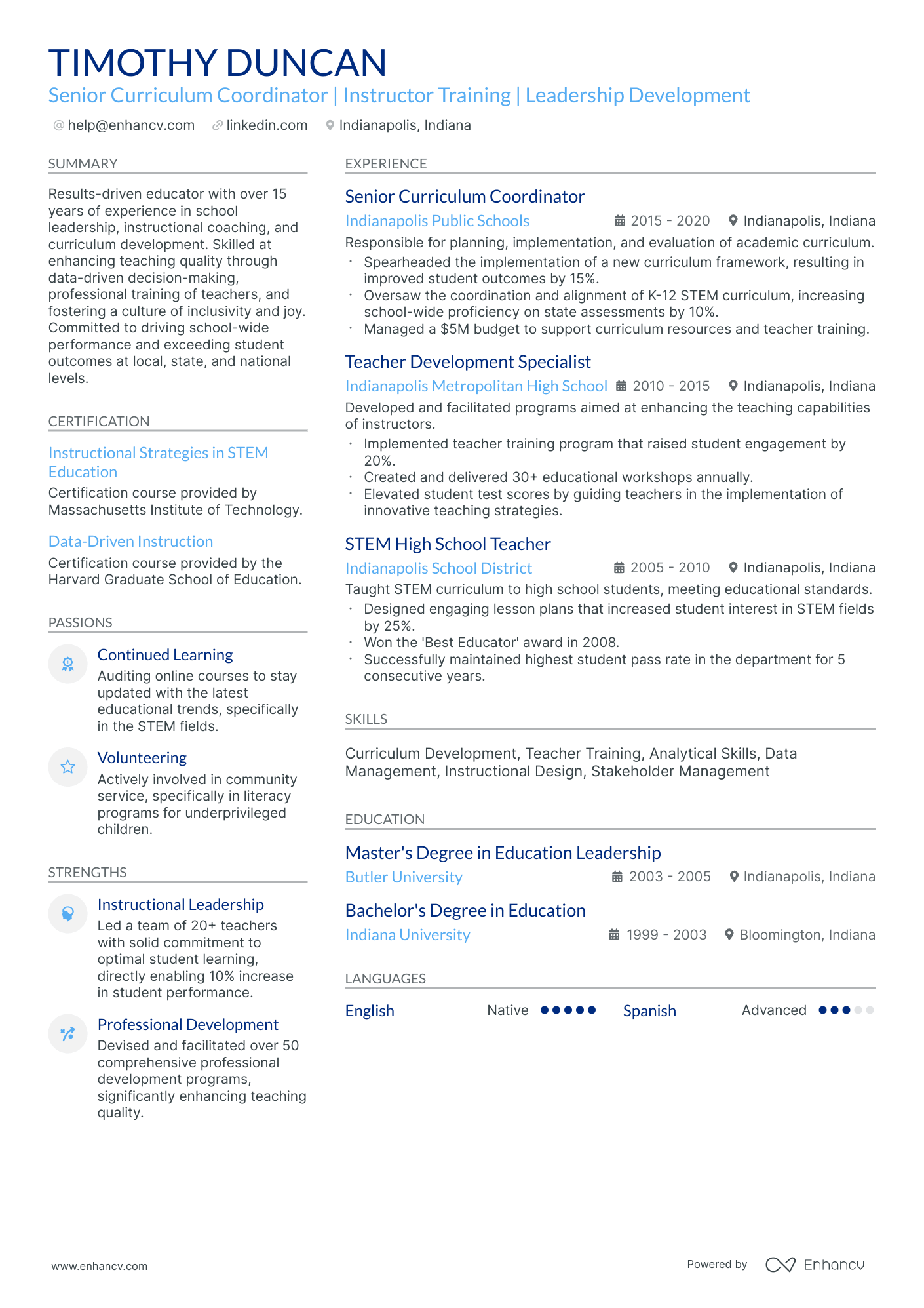
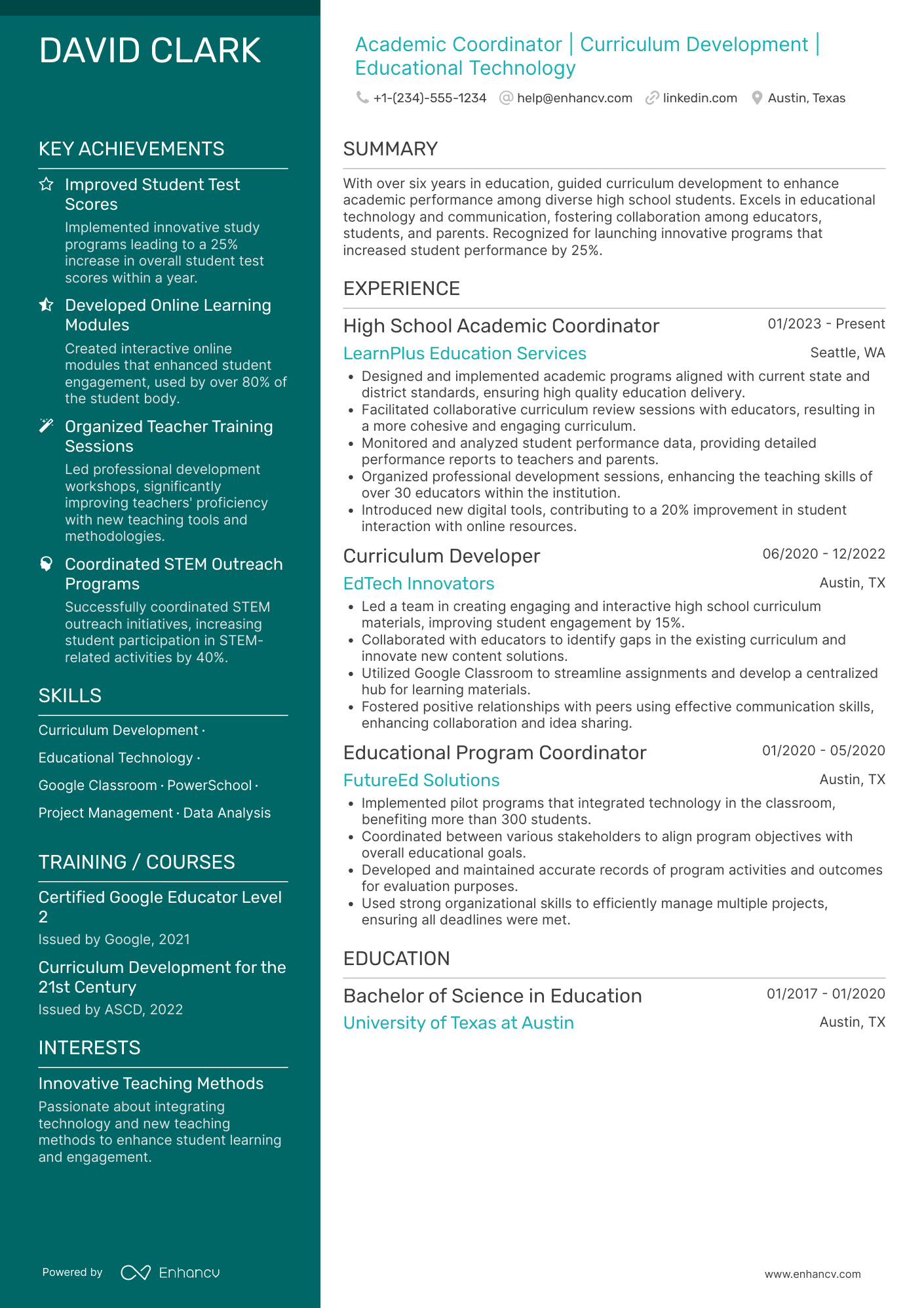
Many high school academic resume drafts fail because they read like class schedules, not evidence of results. That hurts when an ATS (applicant tracking system) filters keywords and recruiters scan in seconds in a crowded applicant pool.
A strong resume shows what you improved, delivered, or earned. Learning how to make your resume stand out starts with highlighting grade gains, competition placements, scholarship awards, tutoring impact, funds raised, hours led, event turnout, error reduction, and measurable project outcomes.

Key takeaways
- Quantify every achievement with grades, percentages, or volume so recruiters see proof, not claims.
- Use reverse-chronological format to lead with your most recent academic accomplishments.
- Tailor each resume to the specific opportunity by mirroring the posting's exact language.
- Place skills above experience when you lack formal work history.
- Tie every listed skill to a specific project, course, or measurable outcome.
- Write a three-to-four-line summary featuring your strongest credential and one concrete result.
- Use Enhancv's Bullet Point Generator to turn vague duties into measurable, recruiter-ready bullets.
How to format a high school academic resume
Recruiters reviewing high school academic resumes prioritize relevant coursework, GPA, extracurricular involvement, and any demonstrated initiative through projects, volunteering, or part-time work. A clean, well-organized resume format ensures these signals aren't buried, especially when applicants have limited professional experience to draw from.

I have significant experience in this role—which format should I use?
Use a reverse-chronological format to place your most recent and relevant academic achievements, activities, and work experience at the top of each section. Do:
- Lead with your education section, including GPA, honors, AP/IB courses, and any leadership roles within school organizations.
- List relevant skills such as research methods, lab techniques, public speaking, foreign languages, or software proficiency (Google Suite, Microsoft Office, coding languages).
- Quantify contributions wherever possible—participation rates, funds raised, event attendance, or academic performance metrics.
I'm junior or switching into this role—what format works best?
A hybrid format works well if you have limited formal experience but can highlight transferable skills from coursework, personal projects, or volunteer work alongside a brief experience section. Do:
- Place a skills or highlights section near the top of your resume to immediately surface strengths like communication, teamwork, time management, or technical abilities.
- Include class projects, independent research, volunteer initiatives, or informal work (tutoring, babysitting, freelance design) as legitimate experience entries.
- Connect every listed activity to a clear action and a tangible outcome so recruiters see what you contributed, not just where you showed up.
When does a functional resume make sense?
A functional format is rarely ideal for high school academic resumes because it removes the timeline that helps recruiters understand your growth, but it can work in a few specific situations:
- You're applying for your first-ever role and have zero formal work or volunteer experience to list chronologically.
- You have a nontraditional background—such as homeschooling, extended travel, or health-related gaps—where a skills-first structure tells a clearer story.
- You're pivoting into an academic program or opportunity that values specific competencies (art portfolio reviews, coding bootcamps) over employment history.
- A functional format is acceptable when you genuinely lack any sequential activities to present, but even then, tie every skill to a specific project, class assignment, or outcome so your resume doesn't read as a list of unsupported claims.
Once you've established a clean, readable format, the next step is deciding which sections to include so each one earns its place on the page.
What sections should go on a high school academic resume
Recruiters expect a high school academic resume to highlight your academic performance, relevant involvement, and evidence you can deliver results. Knowing which resume sections to include ensures you present a complete and compelling picture.
Use this structure for maximum clarity:
- Header
- Summary
- Experience
- Skills
- Projects
- Education
- Certifications
- Optional sections: Awards, Leadership, Volunteering
Your experience bullets should emphasize measurable impact, clear outcomes, and the scope of what you accomplished.
Is your resume good enough?
Drop your resume here or choose a file. PDF & DOCX only. Max 2MB file size.
Now that you’ve outlined the key categories to include, the next step is to write your high school academic resume experience so each entry supports those categories with clear, relevant details.
How to write your high school academic resume experience
The experience section of your high school academic resume should demonstrate work you've completed, tools or methods you've applied, and measurable outcomes you've achieved—whether through coursework, school organizations, volunteer roles, or part-time jobs. Hiring managers and admissions reviewers prioritize demonstrated impact over descriptive task lists, so focus on what you delivered rather than what you were assigned. Building a targeted resume means every entry connects directly to the opportunity you're pursuing.
Each entry should include:
- Job title
- Company and location (or remote)
- Dates of employment (month and year)
Three to five concise bullet points showing what you owned, how you executed, and what outcomes you delivered:
- Ownership scope: the projects, events, committees, student organizations, or academic initiatives you were directly accountable for as a high school academic.
- Execution approach: the research methods, software tools, laboratory techniques, presentation formats, or organizational frameworks you used to plan work and reach conclusions.
- Value improved: the changes you drove in academic performance, event participation, program accessibility, process efficiency, or resource quality within your school or community setting.
- Collaboration context: how you coordinated with teachers, administrators, fellow students, community partners, or external organizations to accomplish shared goals tied to your role.
- Impact delivered: the outcomes you produced expressed through tangible results, reach, or contribution to your school or organization rather than a summary of daily activities.
Experience bullet formula
A high school academic experience example
✅ Right example - modern, quantified, specific.
Student Research Assistant (Data Science)
Ridgeview High School Research Lab | Austin, TX
2024–Present
Student-led research team analyzing school climate and academic outcomes to support campus improvement initiatives.
- Designed and deployed a Google Forms survey (twenty-five questions) and standardized collection protocols; gathered 612 responses in nine days and increased completion rate by twenty-eight percent through clearer prompts and QR code distribution.
- Cleaned and validated data in Google Sheets and Python (pandas), reducing missing-field errors from fourteen percent to three percent and cutting analysis time by four hours per reporting cycle.
- Built a Tableau dashboard with filters for grade level, course load, and program participation; enabled administrators to identify two high-risk trends and prioritize three interventions within one week.
- Presented findings and recommendations to the principal, counselors, and a district data coach using a structured slide deck; secured approval for a pilot study and established monthly reporting adopted by five department leads.
- Coordinated weekly check-ins with a faculty advisor and two student analysts in Trello; delivered three milestones on schedule and improved peer review turnaround time by thirty-five percent.
Now that you've seen how academic experience looks on a resume, let's walk through how to tailor each detail to match the specific opportunity you're targeting.
How to tailor your high school academic resume experience
Recruiters evaluate your high school academic resume through both human review and applicant tracking systems. Tailoring your resume to the job description increases your chances of passing both screening stages.
Ways to tailor your high school academic experience:
- Match specific software or learning platforms named in the posting.
- Mirror the exact terminology used for teaching or tutoring methods.
- Highlight relevant GPA or academic performance metrics the role prioritizes.
- Include subject-area expertise that aligns with the posted requirements.
- Emphasize curriculum standards or assessment frameworks the position references.
- Reference collaboration with students or faculty when teamwork is specified.
- Incorporate classroom management or organizational skills the listing mentions.
- Align your experience with any accessibility or inclusion goals stated.
Tailoring means aligning your real accomplishments with what the role requires, not forcing disconnected keywords into your experience.
Resume tailoring examples for high school academic
| Job description excerpt | Untailored | Tailored |
|---|---|---|
| "Seeking a tutor to lead AP Biology study sessions, help students prepare for the AP exam, and track progress using Khan Academy reports" | Helped students with science subjects after school. | Led weekly AP Biology study sessions for groups of eight students, using Khan Academy progress reports to identify weak areas and adjust review topics before the AP exam. |
| "Looking for a student library assistant to manage book returns, update the catalog in Destiny, and assist peers with research using EBSCO databases" | Organized books and helped out in the library. | Processed 40+ daily book returns, updated catalog records in Destiny, and guided peers through EBSCO database searches to locate sources for research assignments. |
| "Seeking a peer mentor for the freshman transition program to facilitate small-group workshops on study skills, time management, and goal-setting using SMART framework" | Mentored younger students and helped them with schoolwork. | Facilitated biweekly small-group workshops for 12 freshmen, teaching study techniques, time management strategies, and goal-setting through the SMART framework as part of the freshman transition program. |
Once you’ve aligned your academic experience with the role’s requirements, the next step is to quantify your high school academic achievements so recruiters can quickly see your impact.
How to quantify your high school academic achievements
Numbers turn "worked hard" into proof of results, showing performance, quality, and delivery. Focus on grades and rank, test-score gains, workload volume, turnaround time, and measurable outcomes from research or projects. Quantifying your achievements makes every bullet point more convincing to recruiters and admissions reviewers.
Quantifying examples for high school academic
| Metric | Example |
|---|---|
| GPA and rank | "Raised GPA from 3.6 to 3.9 and finished top 10% of a class of 420 by improving study plan and retake strategy." |
| Test-score gain | "Improved SAT Math from 620 to 720 in eight weeks using Khan Academy and timed practice sets, boosting accuracy on algebra questions." |
| Course rigor | "Completed seven Advanced Placement courses and earned five scores of 4+ while maintaining a 3.8+ GPA across junior and senior year." |
| Workload volume | "Produced 12 lab reports and three formal research write-ups per semester in Honors Chemistry, meeting every deadline with zero late submissions." |
| Delivery speed | "Cut essay drafting time from six days to three by using outlines and Grammarly, while keeping teacher rubric scores at 90%+." |
Turn vague job duties into measurable, recruiter-ready resume bullets in seconds with Enhancv's Bullet Point Generator.
Once you've crafted strong bullet points for your experience, you'll want to apply that same precision to presenting your hard and soft skills on your resume.
How to list your hard and soft skills on a high school academic resume
Your skills section shows how you perform in academics and extracurriculars, helps recruiters and an ATS (applicant tracking system) match you to requirements fast, and typically works best as a balanced mix of hard skills and soft skills. high school academic roles require a blend of:
- Product strategy and discovery skills.
- Data, analytics, and experimentation skills.
- Delivery, execution, and go-to-market discipline.
- Soft skills.
Your skills section should be:
- Scannable (bullet-style grouping).
- Relevant to the job post.
- Backed by proof in experience bullets.
- Updated with current tools.
Place your skills section:
- Above experience if you're junior or switching careers.
- Below experience if you're mid/senior with strong achievements.

Hard skills
- Google Workspace, Microsoft Office
- Google Sheets formulas, pivot tables
- Excel charts, conditional formatting
- Research databases, Google Scholar
- MLA and APA formatting
- Academic writing and editing
- Algebra, geometry, statistics
- Laboratory safety procedures
- Data collection and analysis
- Presentation design, slide decks
- Citation management (Zotero)
Soft skills
- Translate requirements into tasks
- Prioritize deadlines and workload
- Ask clear, targeted questions
- Summarize findings for audiences
- Collaborate on group deliverables
- Give and apply feedback fast
- Own mistakes and correct them
- Manage time across commitments
- Follow instructions with precision
- Stay focused during long projects
How to show your high school academic skills in context
Skills shouldn't live only in a bulleted list on your resume. Explore examples of resume skills to see how top candidates weave abilities into every section.
They should be demonstrated in:
- Your summary (high-level professional identity)
- Your experience (proof through outcomes)
Here's how strong high school academic resumes put skills to work.
Summary example
Veteran high school biology teacher with 14 years of experience integrating inquiry-based labs and data-driven instruction. Raised AP Biology pass rates by 22% using CollegeBoard analytics, differentiated scaffolding, and cross-departmental STEM collaboration.
- Establishes senior-level classroom experience
- Names role-relevant tools and methods
- Leads with a measurable student outcome
- Highlights collaboration as a soft skill
Experience example
Senior Biology Teacher
Ridgeview High School | Tucson, AZ
August 2016–June 2024
- Redesigned AP Biology curriculum using backward design and CollegeBoard item-analysis data, improving exam pass rates by 22% over three years.
- Partnered with the math department to co-develop interdisciplinary STEM units, increasing student enrollment in advanced science electives by 15%.
- Mentored four early-career teachers through structured peer observations and weekly feedback cycles, raising department-wide student satisfaction scores by 10%.
- Every bullet contains measurable proof
- Skills surface naturally through outcomes
Once you’ve tied your coursework and achievements to real outcomes, the next step is to structure them into a high school academic resume with no experience so they carry the same weight on the page.
How do I write a high school academic resume with no experience
Even without full-time experience, you can demonstrate readiness through academic work and extracurriculars. If you're building a resume without work experience, focus on these areas:
- Class research papers and presentations
- Lab reports and experiments
- Academic competitions and awards
- Leadership in student organizations
- Tutoring or peer mentoring
- School newspaper or yearbook work
- Capstone, independent, or honors projects
- Relevant coursework with final projects
Focus on:
- Quantified results and outcomes
- Tools used: Excel, Google Workspace
- Role, scope, and deliverables
- Relevant coursework tied to roles
Resume format tip for entry-level high school academic
Use a skills-based resume format because it highlights coursework, projects, and tools when work history is limited. Do:
- Start with a summary listing target roles.
- Lead with skills, then projects and coursework.
- Add numbers to show impact and scope.
- List tools used in each project bullet.
- Keep bullets to one line.
- Built an Excel grade tracker for five classes, using formulas and charts to cut weekly study planning time by 30 percent.
Now that you've got a framework for building your resume from scratch, let's focus on one of its most critical sections—your education.
How to list your education on a high school academic resume
Your education section lets hiring teams confirm you have the foundational knowledge a high school academic role demands. It validates your subject expertise and academic preparation quickly.
Include:
- Degree name
- Institution
- Location
- Graduation year
- Relevant coursework (for juniors or entry-level candidates)
- Honors & GPA (if 3.5 or higher)
Skip month and day details—list the graduation year only.
Here's a strong education entry tailored for a high school academic resume:
Example education entry
Bachelor of Arts in Secondary Education — English Language Arts
University of Wisconsin–Madison, Madison, WI
Graduated 2021
GPA: 3.8/4.0
- Relevant Coursework: Adolescent Development, Curriculum Design, Instructional Methods for Diverse Learners, Educational Assessment
- Honors: Magna Cum Laude, Dean's List (six semesters)
How to list your certifications on a high school academic resume
Certifications on a resume show a high school academic's commitment to learning, comfort with real tools, and awareness of industry expectations, even before college or full-time work.
Include:
- Certificate name
- Issuing organization
- Year
- Optional: credential ID or URL
- Place certifications below Education when they are older, less relevant, or secondary to your coursework as a high school academic.
- Place certifications above Education when they are recent and directly support the role, scholarship, or program you are targeting as a high school academic.
Best certifications for your high school academic resume
- Microsoft Office Specialist (MOS)
- Adobe Certified Professional
- CompTIA IT Fundamentals (ITF+)
- Google Analytics Certification
- Google Ads Search Certification
- Autodesk Certified User (AutoCAD)
- First Aid, CPR, and AED Certification (American Red Cross)
Once you’ve positioned your certifications where they’re easy to scan and verify, you can write your high school academic resume summary to quickly highlight those credentials in the context of your overall academic strengths.
How to write your high school academic resume summary
Your resume summary is the first thing a recruiter reads. A sharp, focused opening sets the tone and earns a closer look at the rest of your resume.
Keep it to three to four lines, with:
- Your current title or role and relevant experience level.
- The academic domain or subject area you focus on.
- Core tools, technologies, or instructional skills you bring.
- One or two measurable achievements that show your impact.
- Soft skills tied to real classroom or school outcomes.

PRO TIP
At the early-career level, prioritize specific skills, relevant coursework or certifications, and any measurable contributions you've made. Avoid vague descriptors like "passionate" or "hardworking." Instead, show what you did and what resulted from it.
Example summary for a high school academic
High school educator with two years of experience teaching AP Biology. Skilled in data-driven instruction and Google Classroom. Raised average student exam scores by 18% through targeted review sessions and differentiated lesson planning.
Optimize your resume summary and objective for ATS
Drop your resume here or choose a file.
PDF & DOCX only. Max 2MB file size.
Now that your summary captures your academic strengths, make sure the header above it presents your contact details correctly so recruiters can actually reach you.
What to include in a high school academic resume header
A resume header lists your key contact details and role focus, helping a high school academic stay visible, credible, and easy to screen fast.
Essential resume header elements
- Full name
- Tailored job title and headline
- Location
- Phone number
- Professional email
- GitHub link
- Portfolio link
A LinkedIn link helps recruiters verify experience quickly and supports screening.
Do not include a photo on a high school academic resume unless the role is explicitly front-facing or appearance-dependent.
Keep your header on one or two lines, match it to your application name, and use consistent formatting across every document.
Example
High school academic resume header
Jordan Lee
High School Academic | AP Student and STEM Club Leader
Austin, TX
(512) 555-01XX | jordan.lee@enhancv.com github.com/jordanlee yourwebsite.com linkedin.com/in/jordanlee
Once your contact details and identifying information are set at the top, you can strengthen the rest of your resume by adding relevant optional sections that support your academic profile.
Additional sections for high school academic resumes
Extra sections help a high school academic stand out when core credentials alone don't capture the full picture of their qualifications. For example, listing language skills on your resume can set you apart in multilingual school environments or international programs.
- Languages
- Honors and awards
- Extracurricular activities
- Volunteer experience
- Publications and research projects
- Certifications and test scores
- Hobbies and interests
Once you've rounded out your resume with the right supporting sections, it's worth knowing whether a cover letter should accompany it.
Do high school academic resumes need a cover letter
A cover letter isn't always required for a high school academic, but it helps when roles are competitive or when reviewers expect one. If you're unsure where to start, understanding what a cover letter is and how it complements your resume can clarify when to include one. It can make a difference when your resume needs context or when you're targeting a specific team.
Use a cover letter to add details your resume can't show:
- Explain fit for the role or team by connecting your strengths to the program's goals and day-to-day work.
- Highlight one or two relevant projects or outcomes, and state your role, the result, and what you learned.
- Show you understand the product, users, or business context by referencing a real feature, audience, or constraint.
- Address career transitions or non-obvious experience by explaining why it matters and how it transfers to the role.
Drop your resume here or choose a file.
PDF & DOCX only. Max 2MB file size.
Even when you include a cover letter to add context, using AI to improve your high school academic resume helps you strengthen the resume itself and tailor it more effectively.
Using AI to improve your high school academic resume
AI can sharpen your resume's clarity, structure, and impact. It helps tighten language and highlight achievements you might overlook. If you're curious about which AI is best for writing resumes, the answer depends on the level of control and customization you need. But overuse strips authenticity fast. Once your content reads clearly and fits your goals, step away from AI.
Here are 10 practical prompts to strengthen specific sections of your resume:
- Strengthen your summary. "Rewrite this high school academic resume summary to highlight my strongest academic achievements in two concise sentences."
- Quantify your impact. "Add measurable results to these high school academic resume experience bullets using numbers, percentages, or concrete outcomes."
- Sharpen activity descriptions. "Rewrite these extracurricular activity bullets on my high school academic resume to emphasize leadership roles and tangible contributions."
- Tailor your skills. "Review this high school academic resume skills section and remove vague entries. Replace them with specific, demonstrable abilities."
- Improve project descriptions. "Rewrite the projects section of my high school academic resume to clearly state each project's purpose, my role, and the outcome."
- Tighten education details. "Edit the education section of my high school academic resume to highlight relevant coursework, honors, and GPA concisely."
- Clarify certification entries. "Reformat the certifications on my high school academic resume so each entry lists the credential, issuing organization, and date earned."
- Eliminate filler words. "Remove unnecessary adjectives and filler phrases from every bullet point on my high school academic resume."
- Align with opportunities. "Compare my high school academic resume against this program description and suggest specific edits to improve relevance."
- Fix inconsistent formatting. "Standardize verb tense, punctuation, and bullet structure across all sections of my high school academic resume."
Stop using AI once your resume sounds accurate, specific, and aligned with real experience. AI should never invent experience or inflate claims—if it didn't happen, it doesn't belong here.
Conclusion
A strong resume for a high school academic highlights measurable outcomes, role-specific skills, and a clear structure. It uses consistent headings, clean formatting, and focused bullets. It shows what you did, how well you did it, and what you learned.
This approach signals readiness for today’s and near-future hiring market. Employers can quickly see your academic strengths, reliability, and fit for the role. With a clear, results-driven resume, you make it easy to choose you.