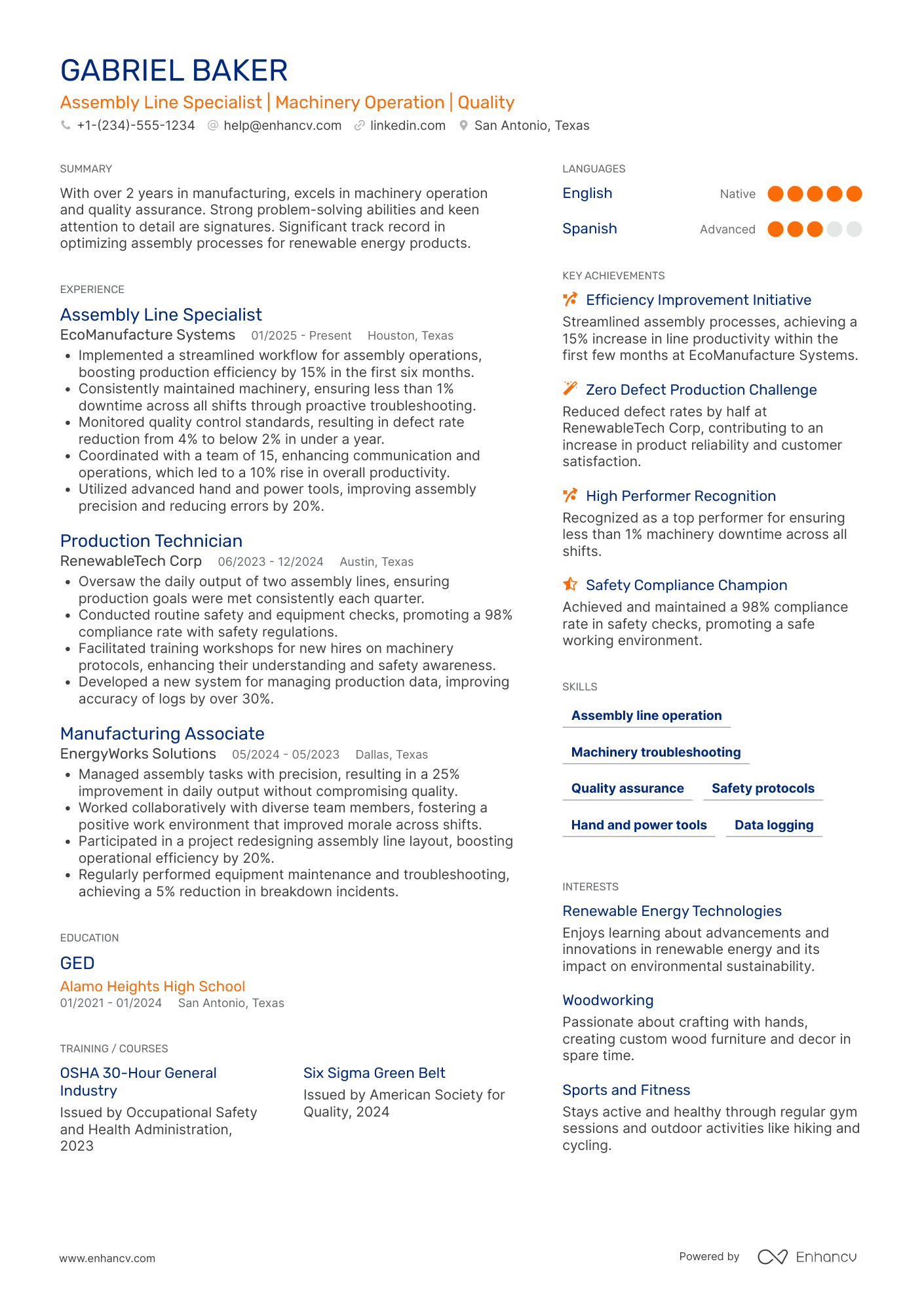
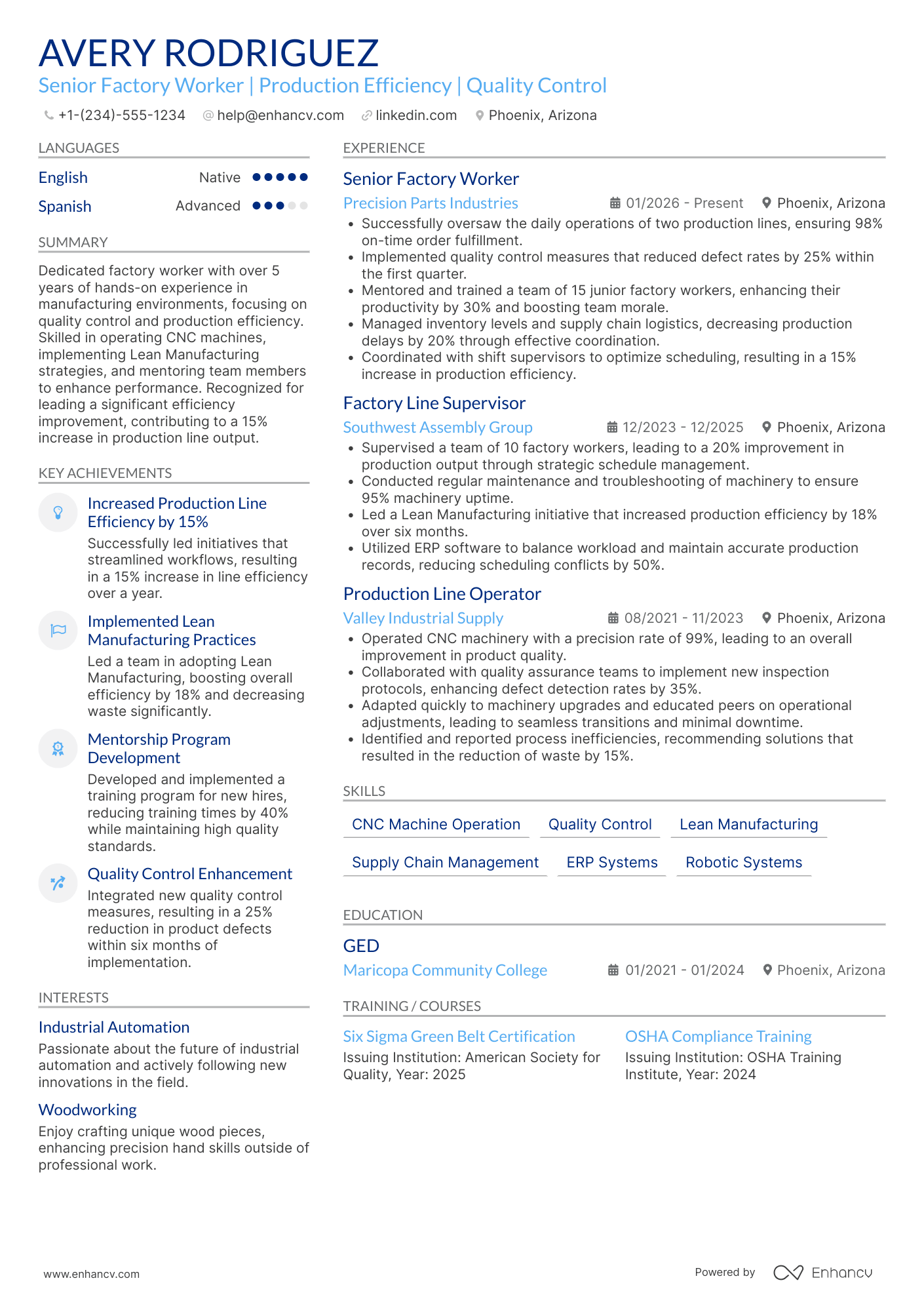
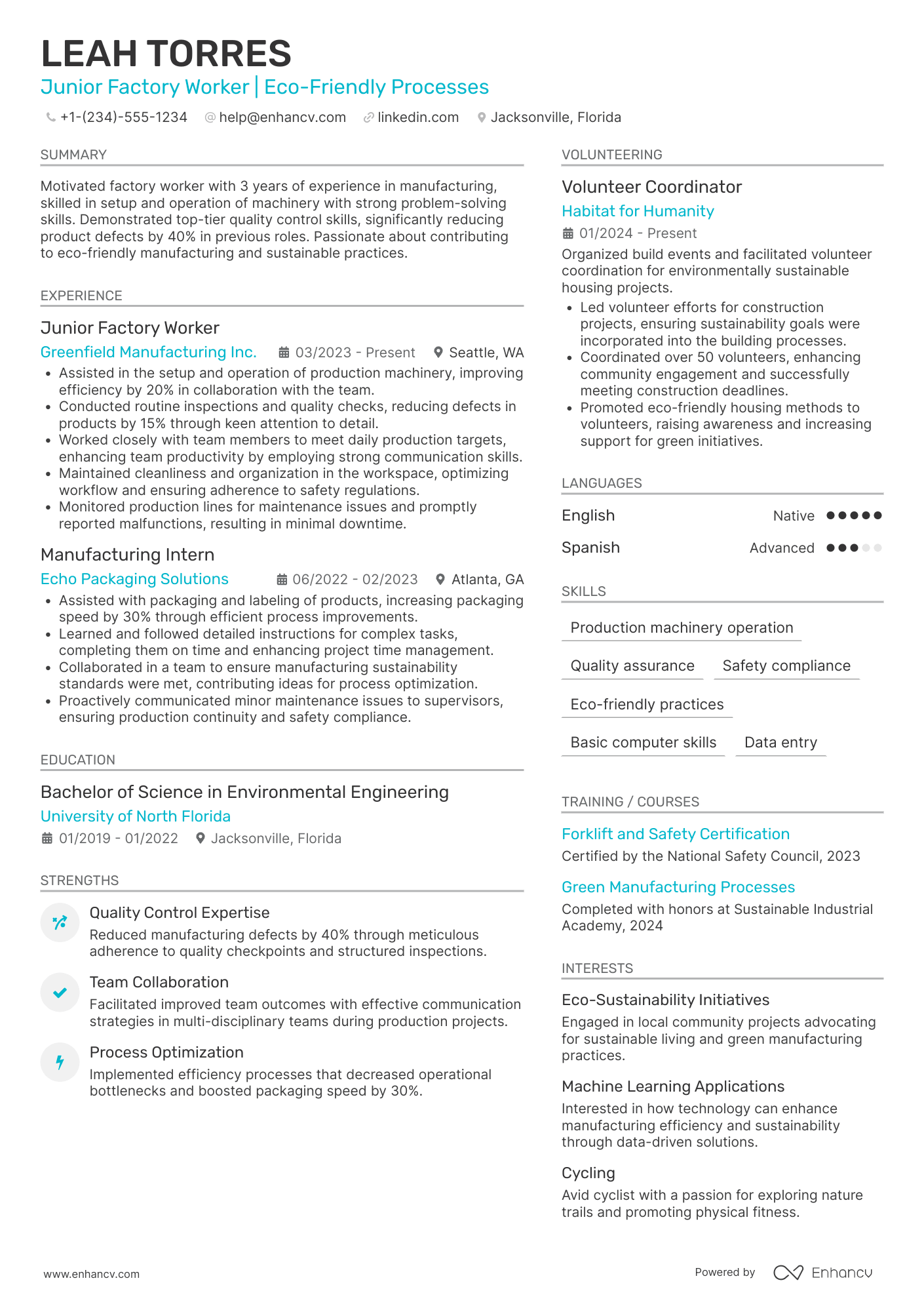
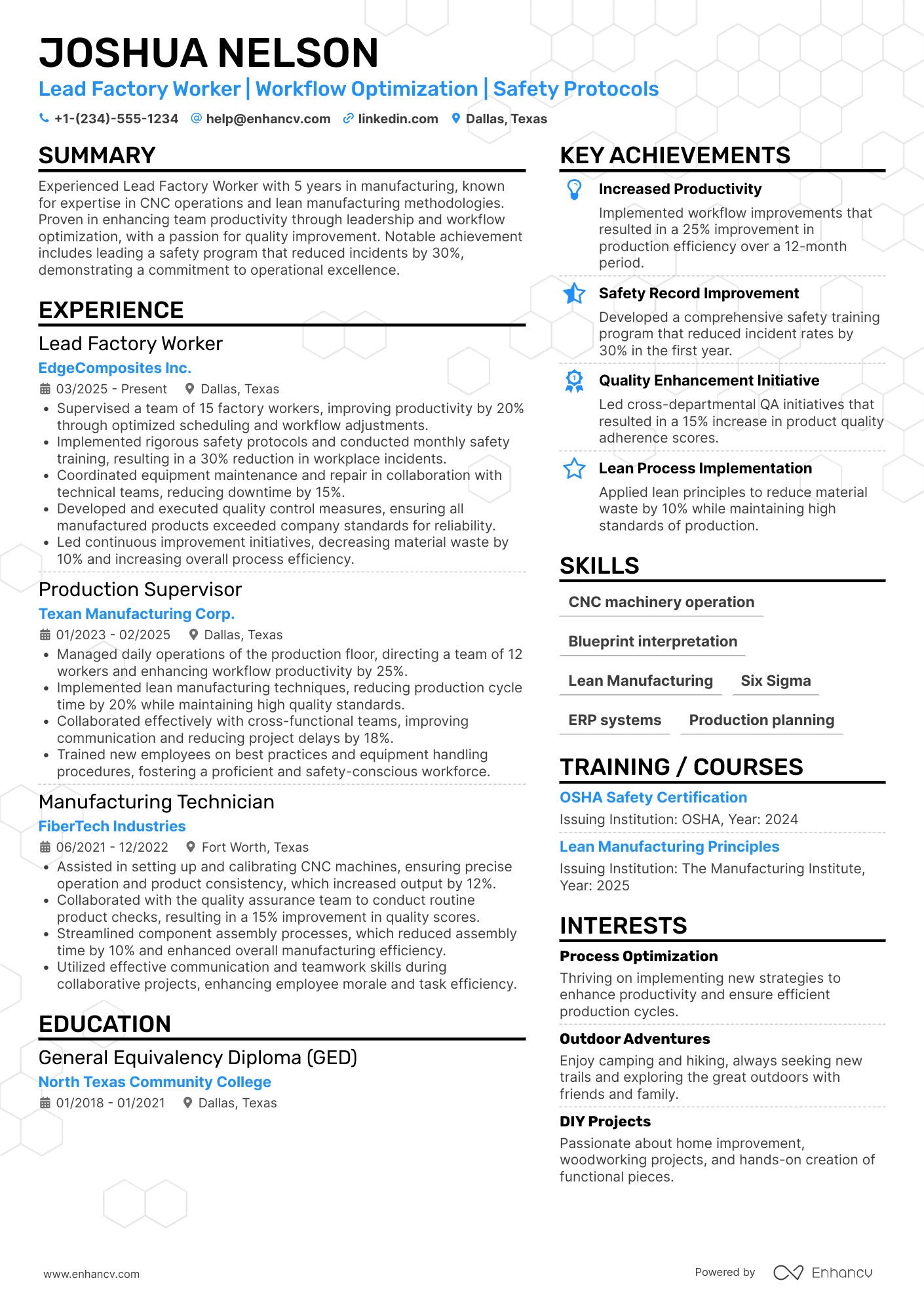
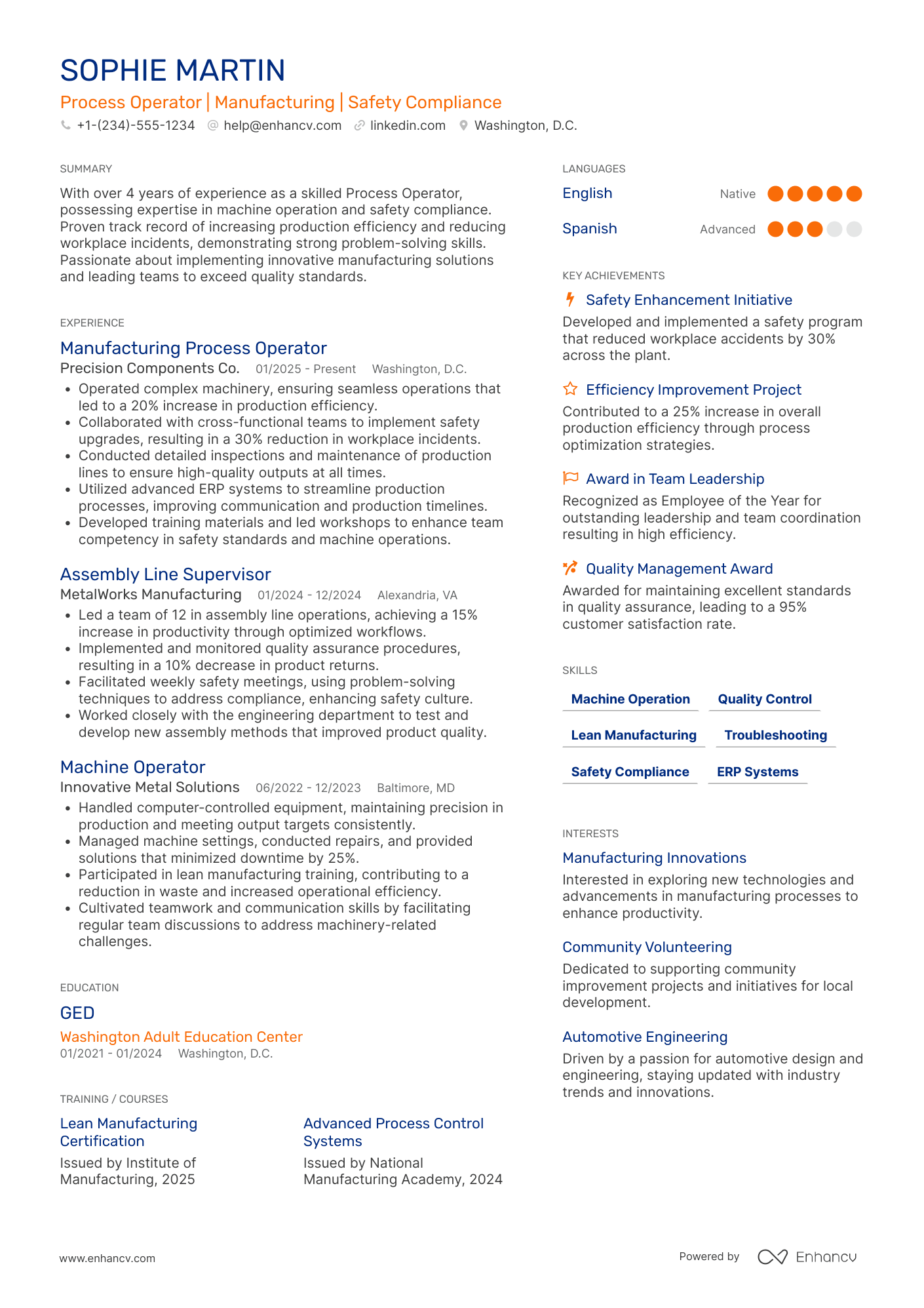
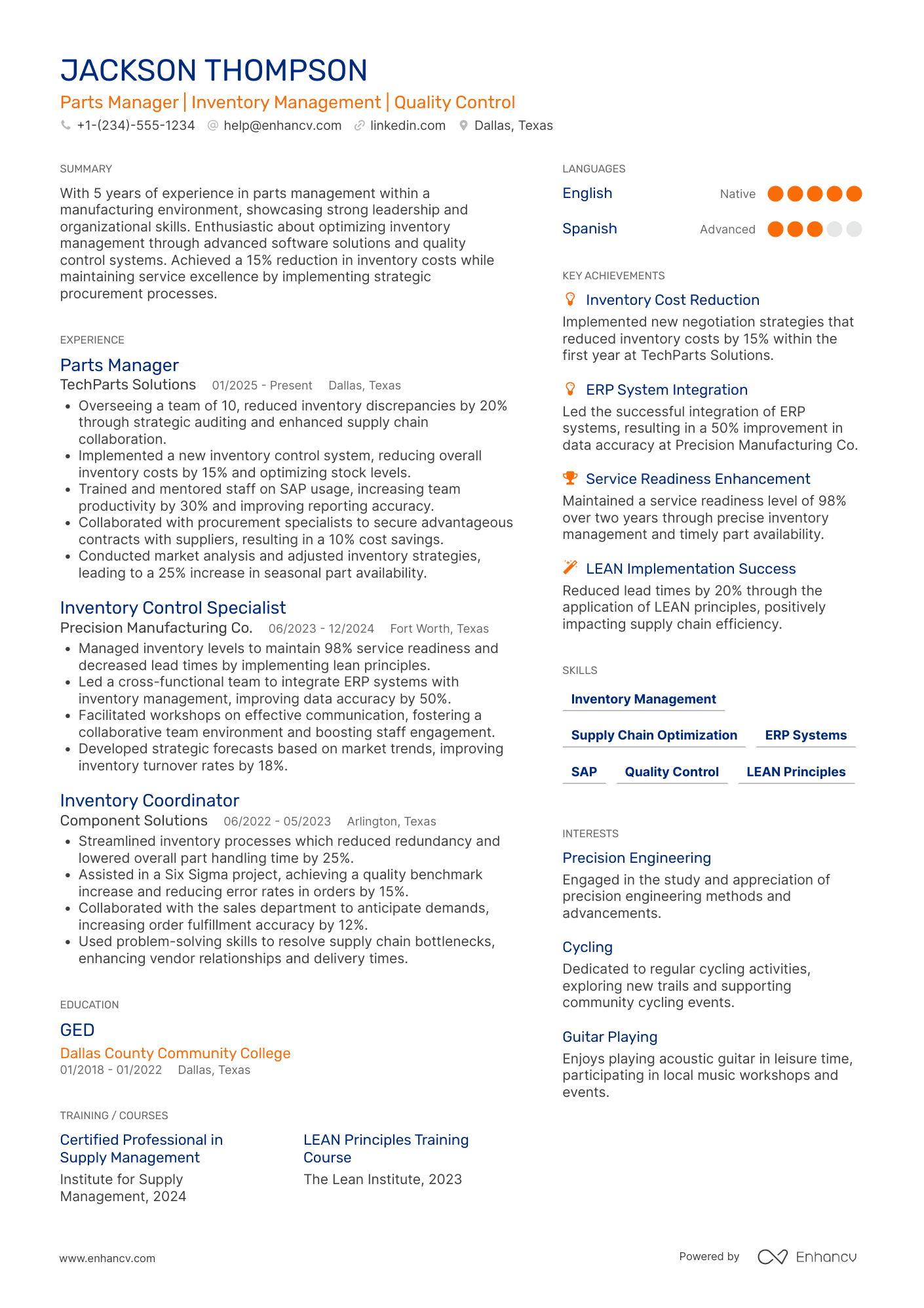
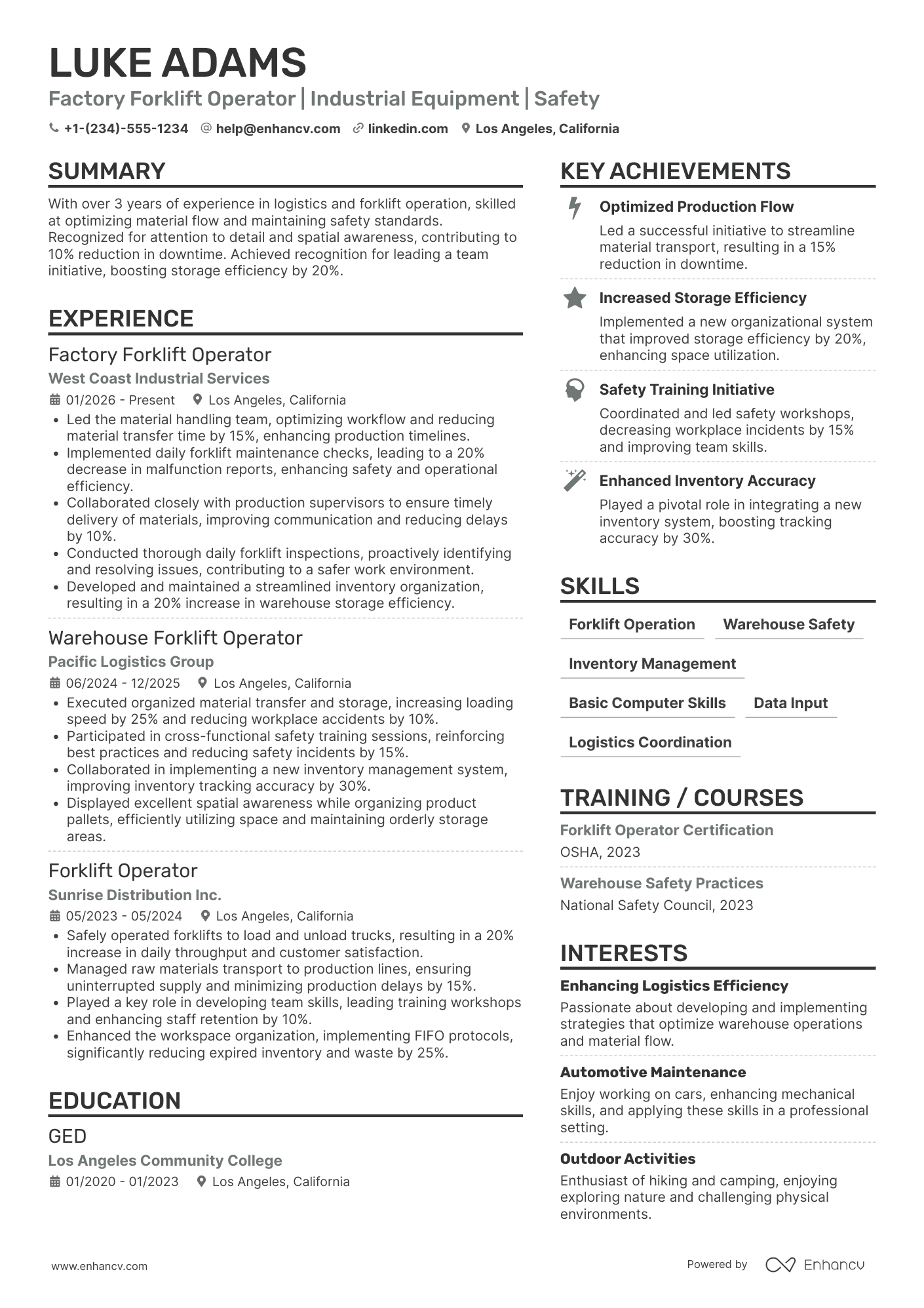
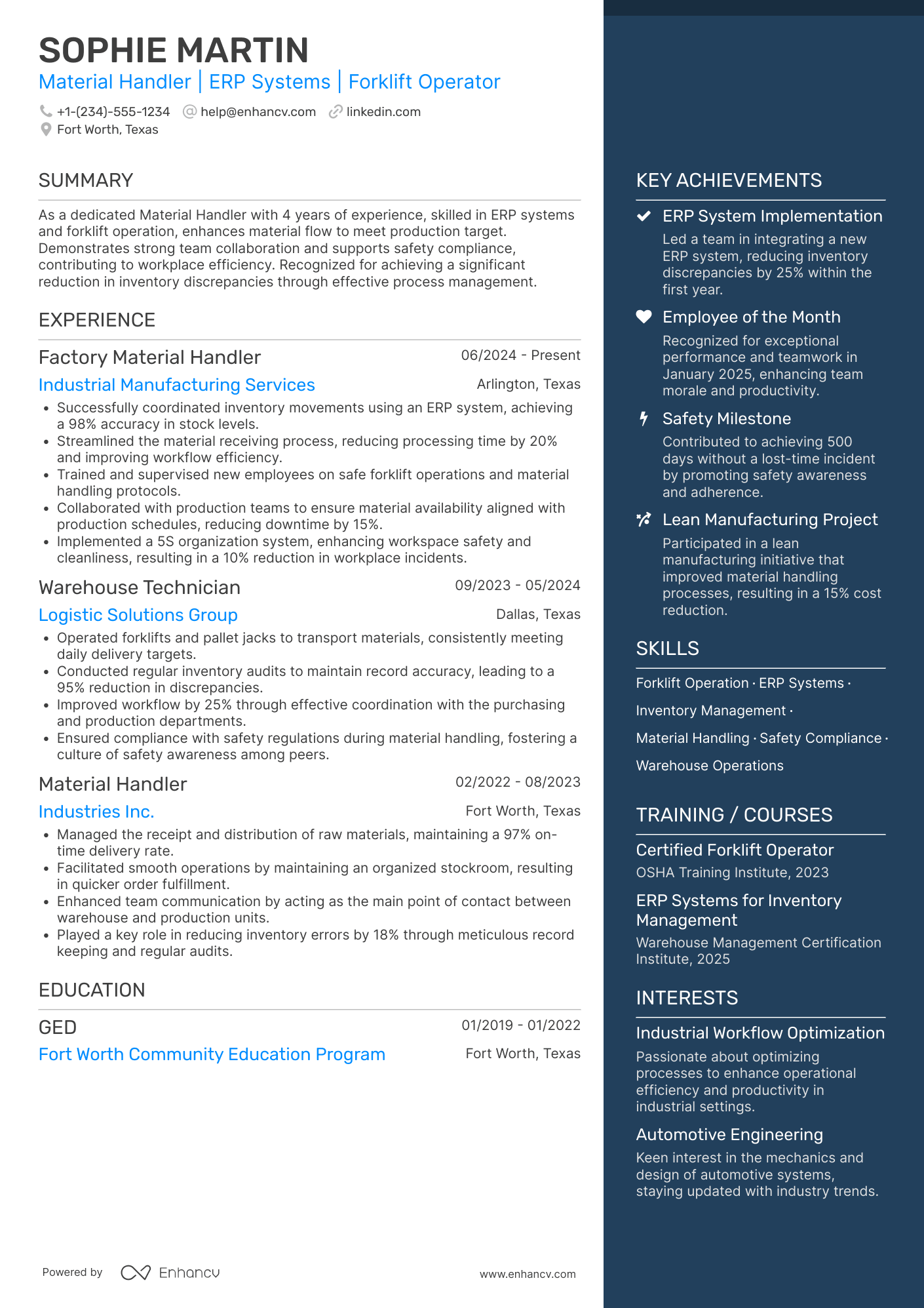
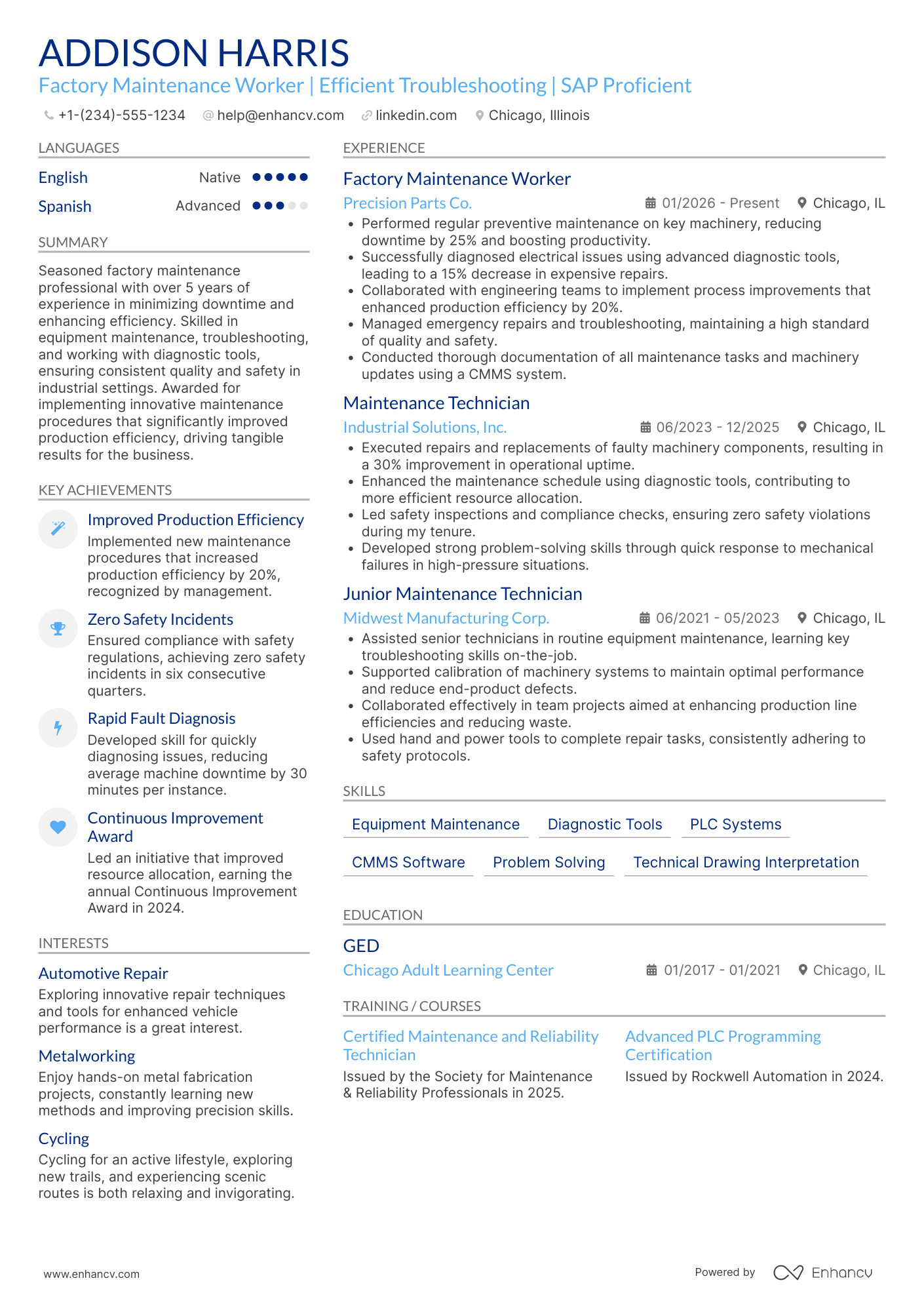
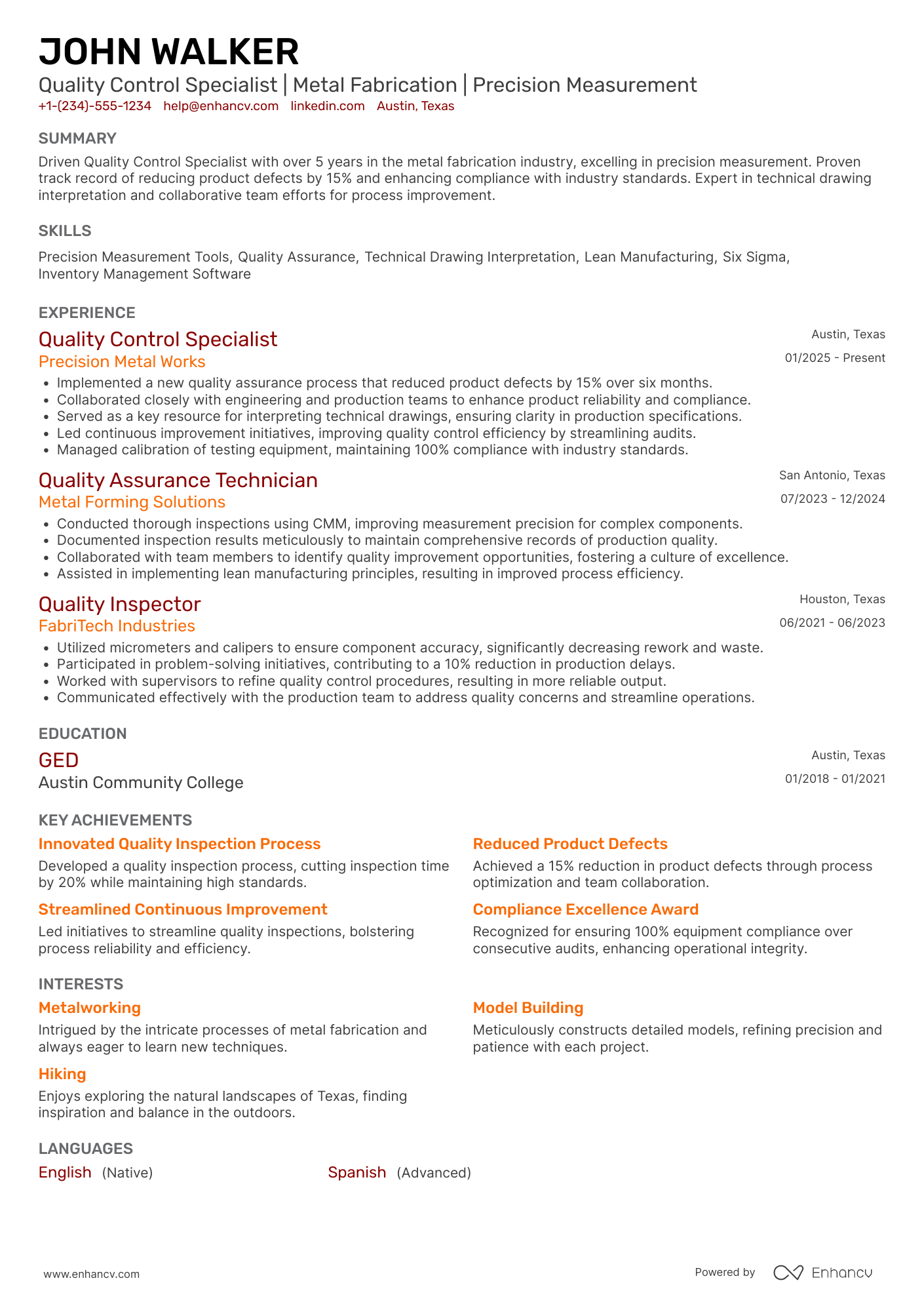
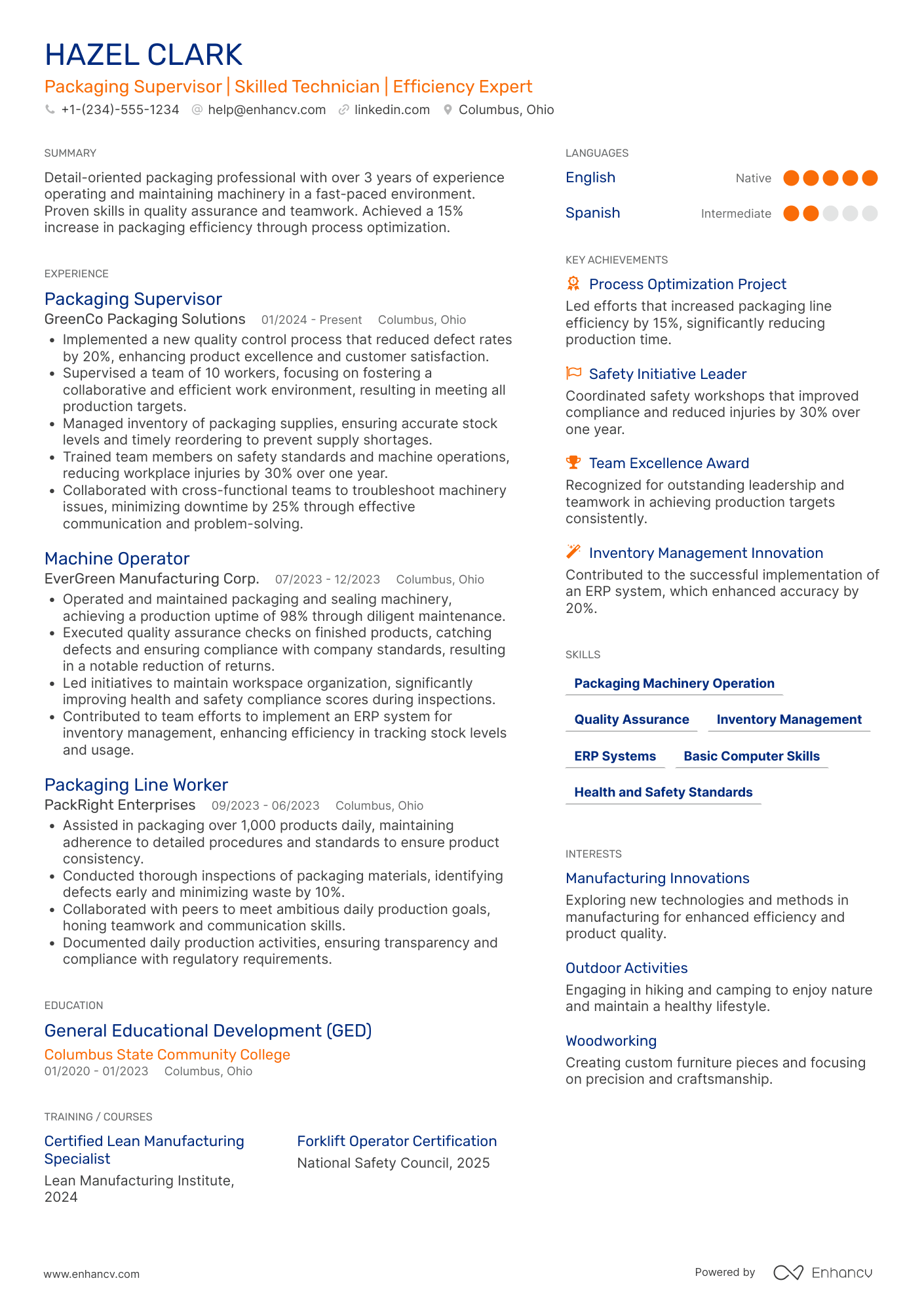
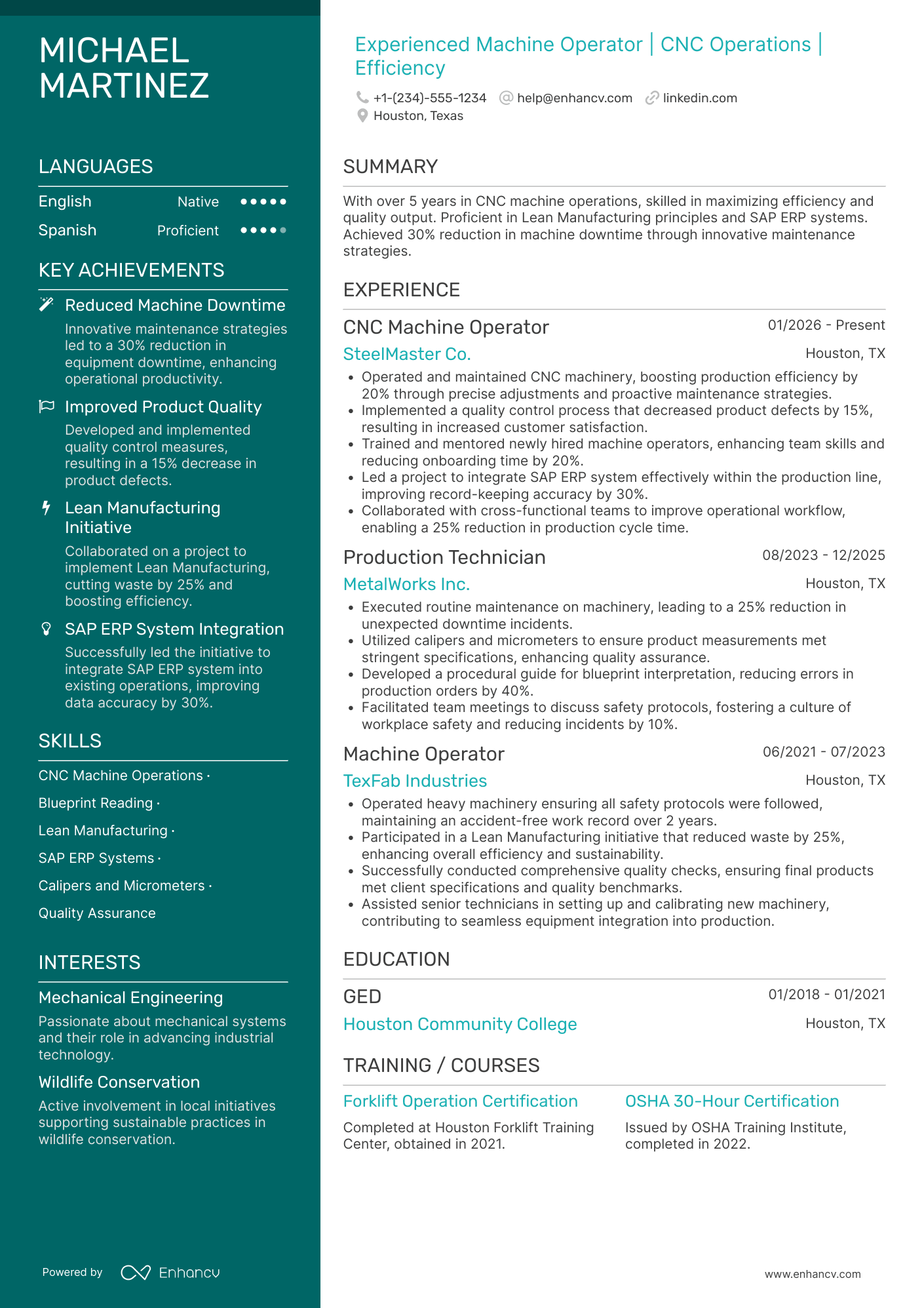
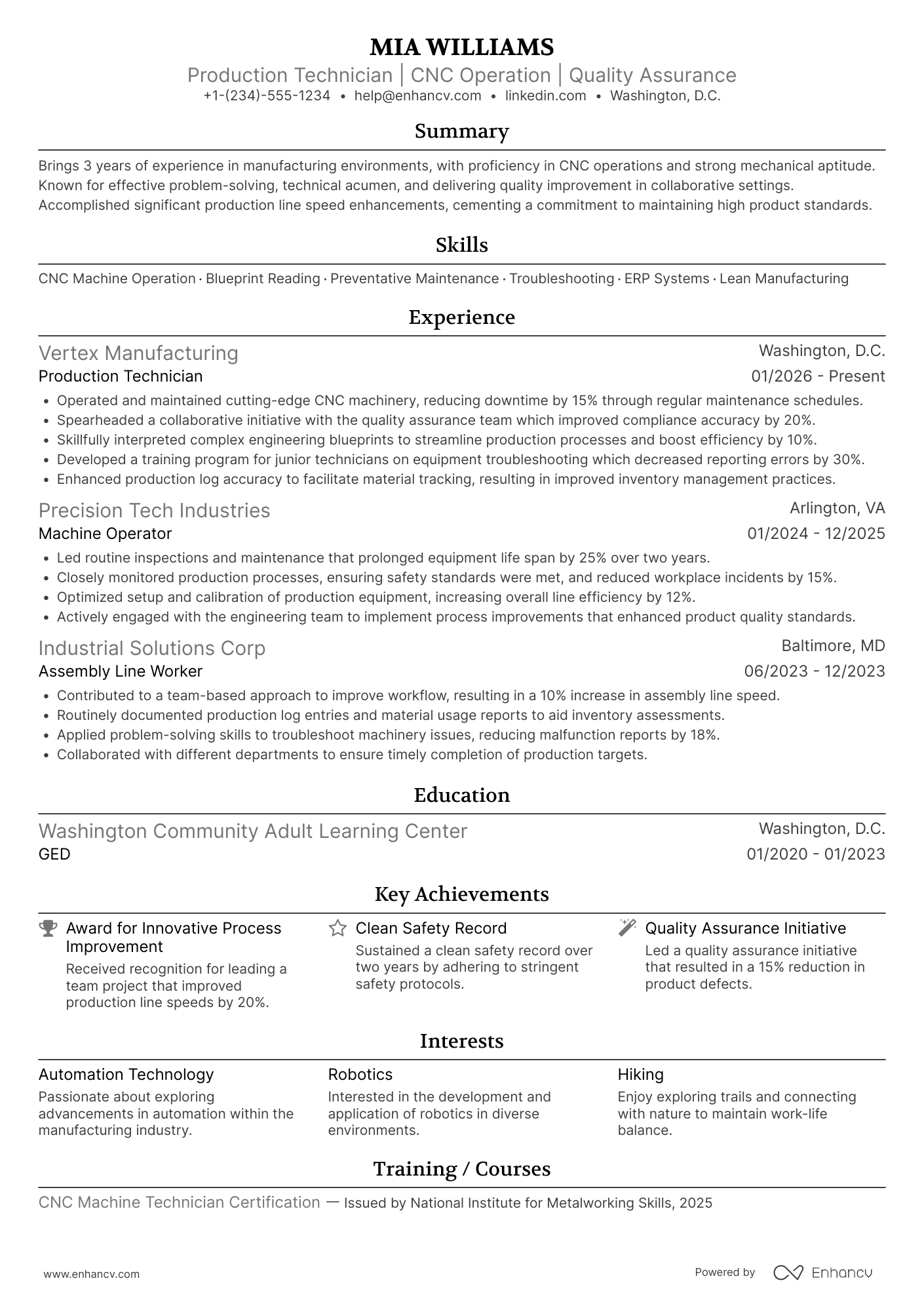
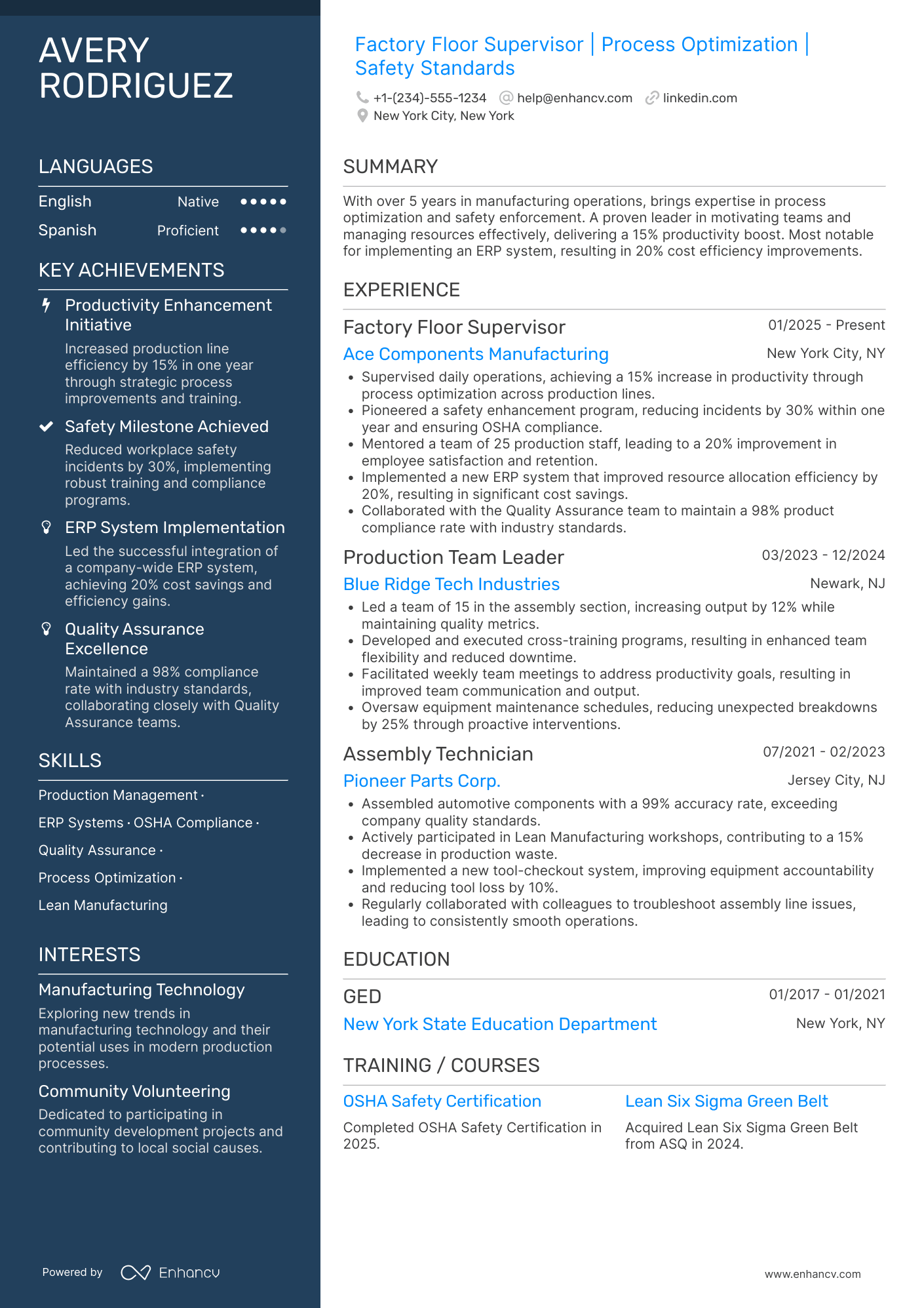
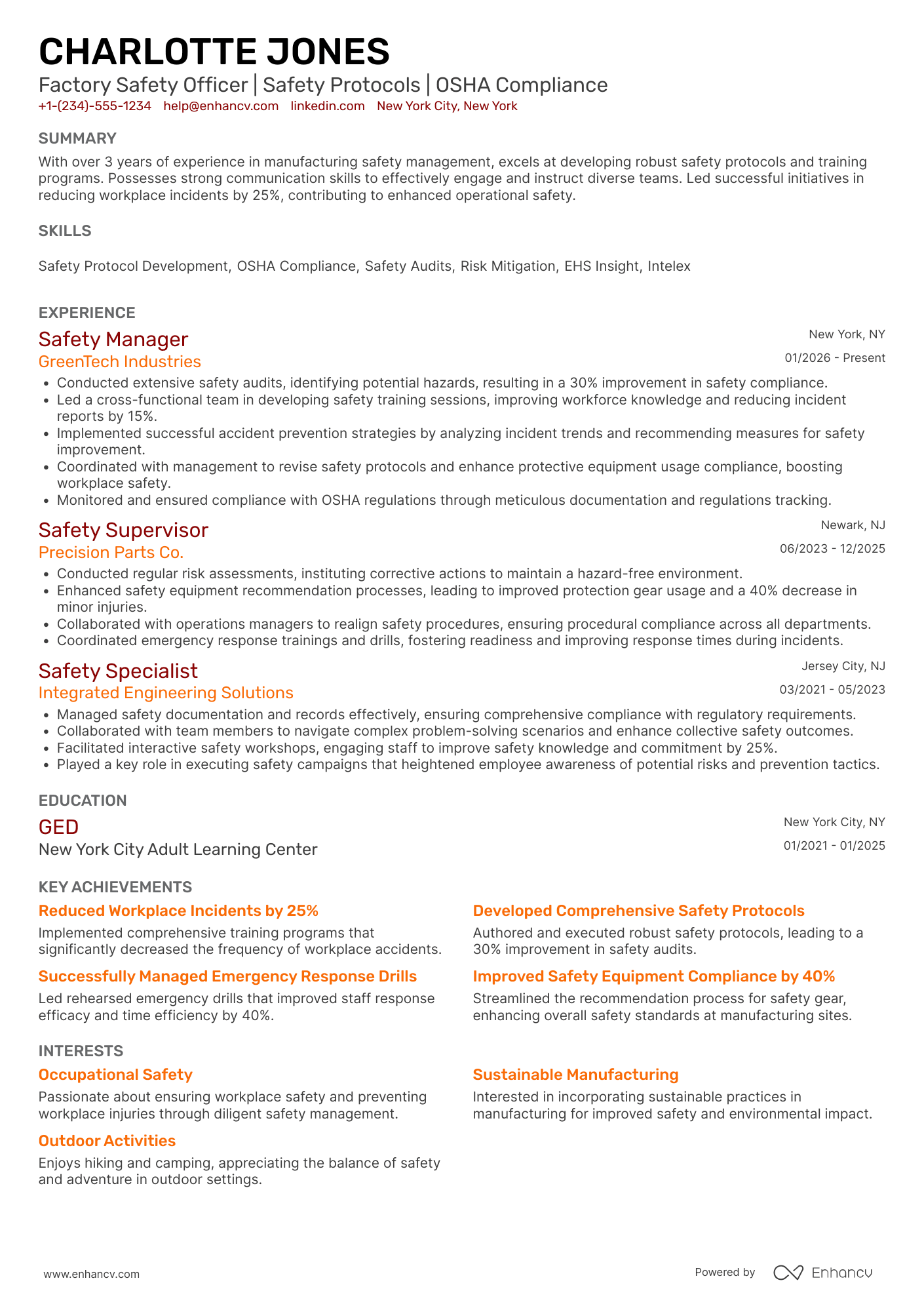
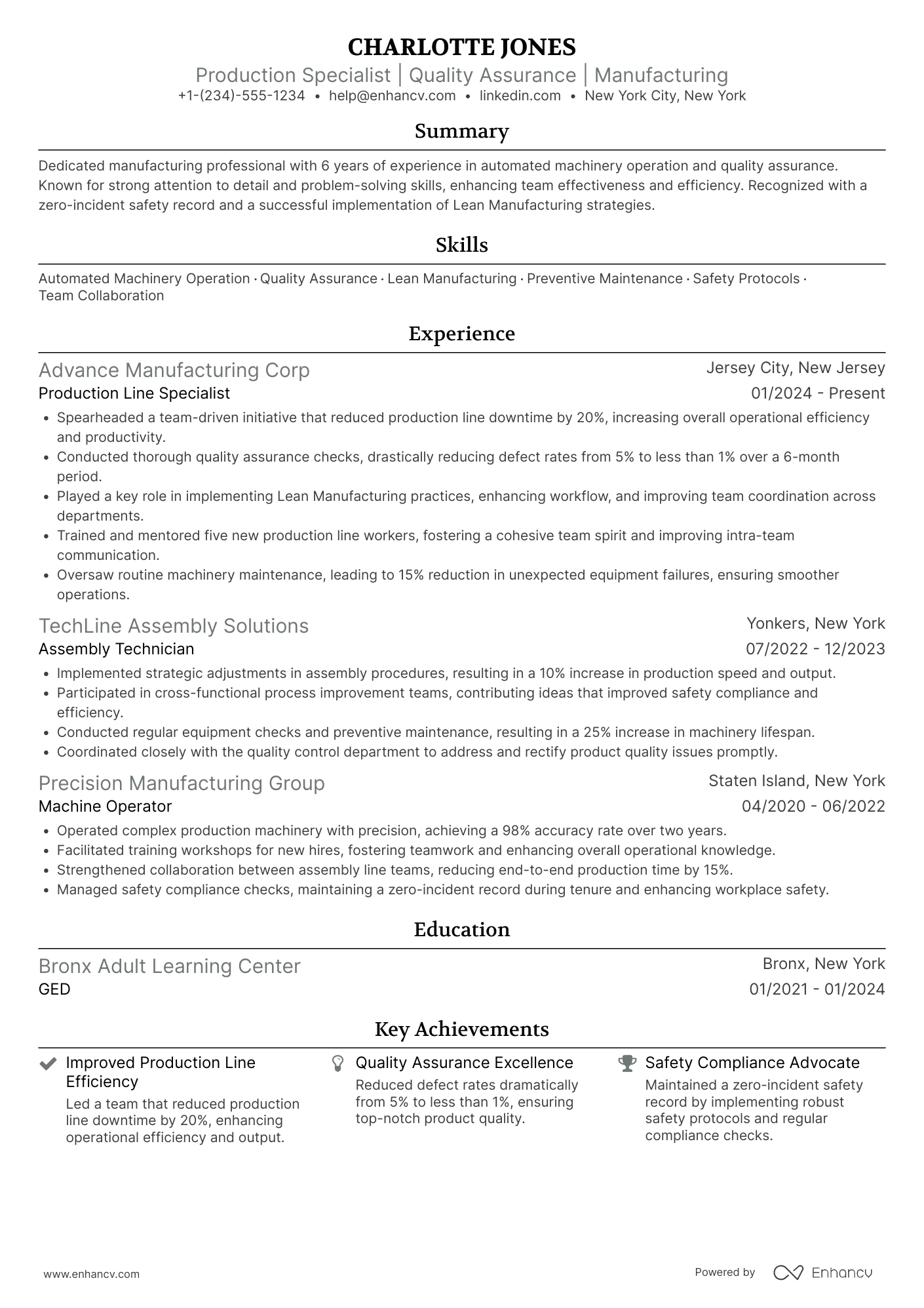
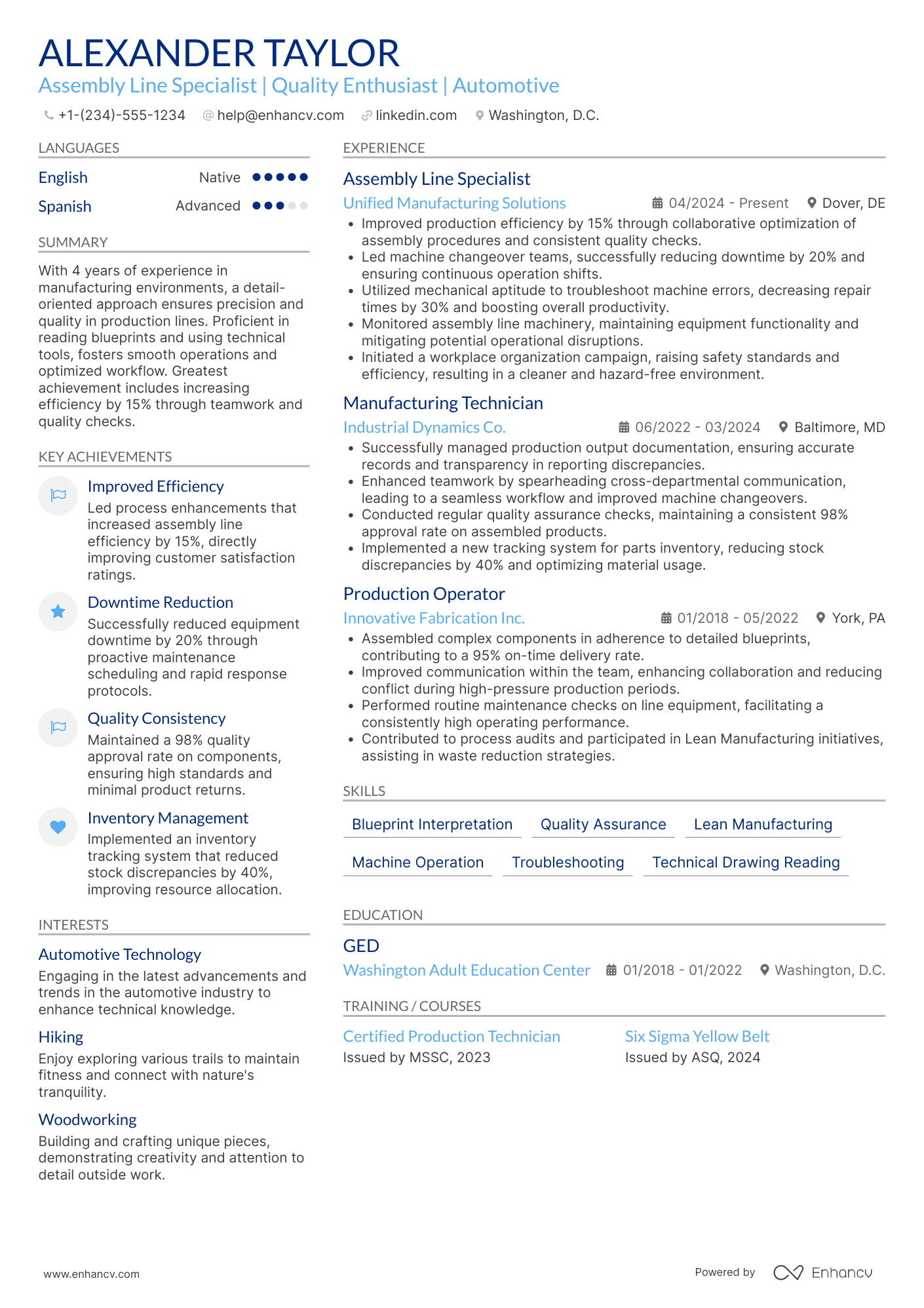
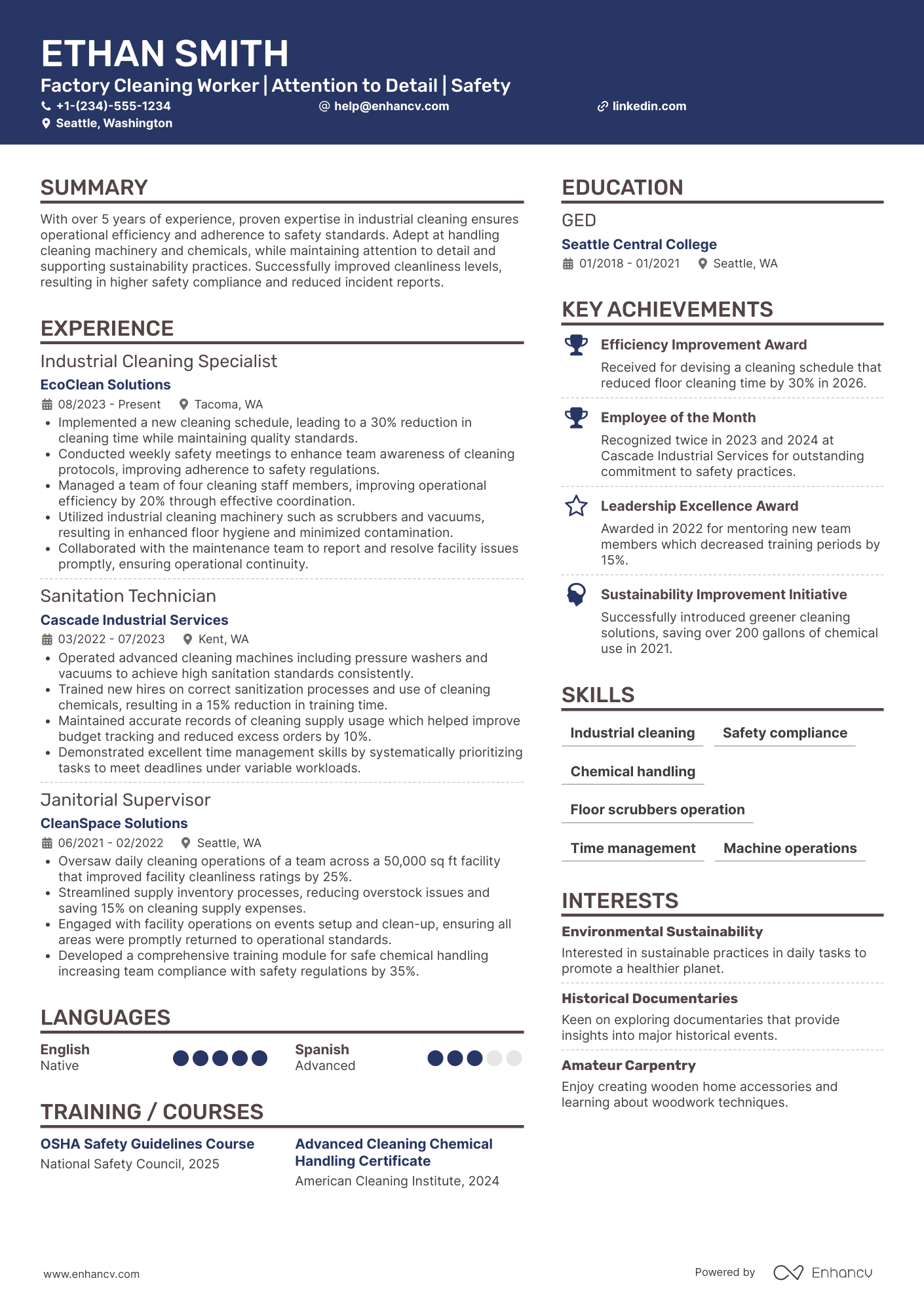
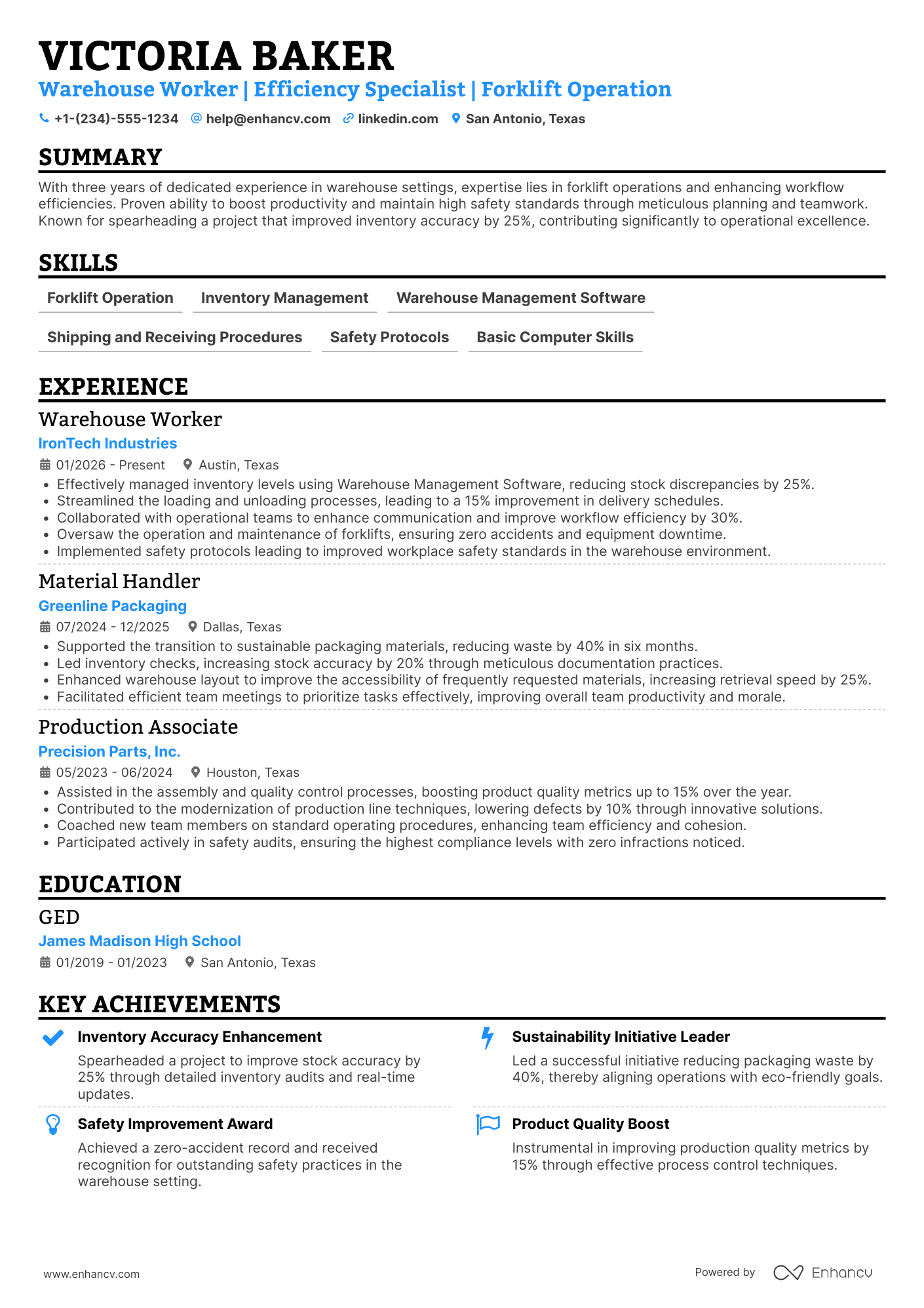
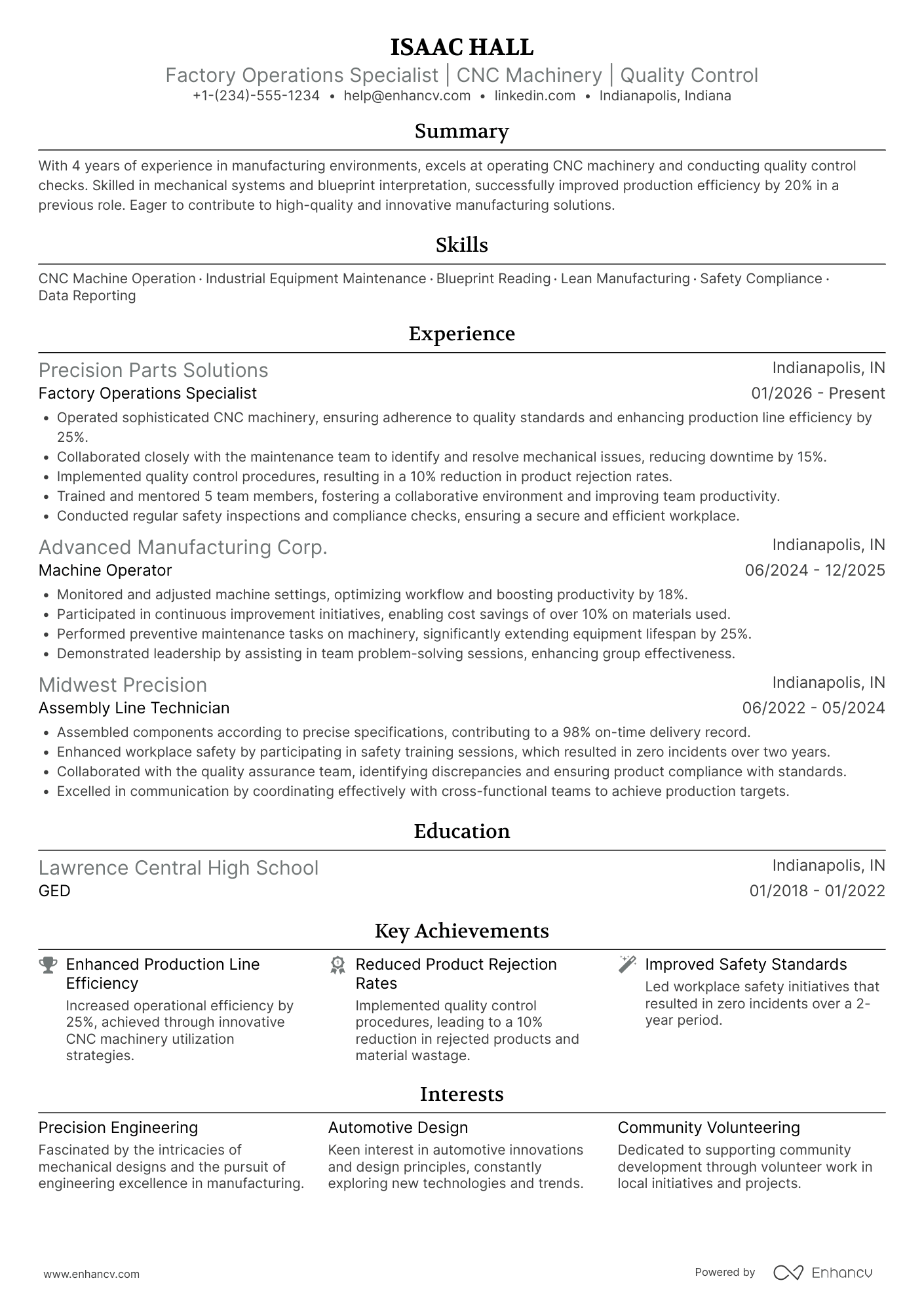
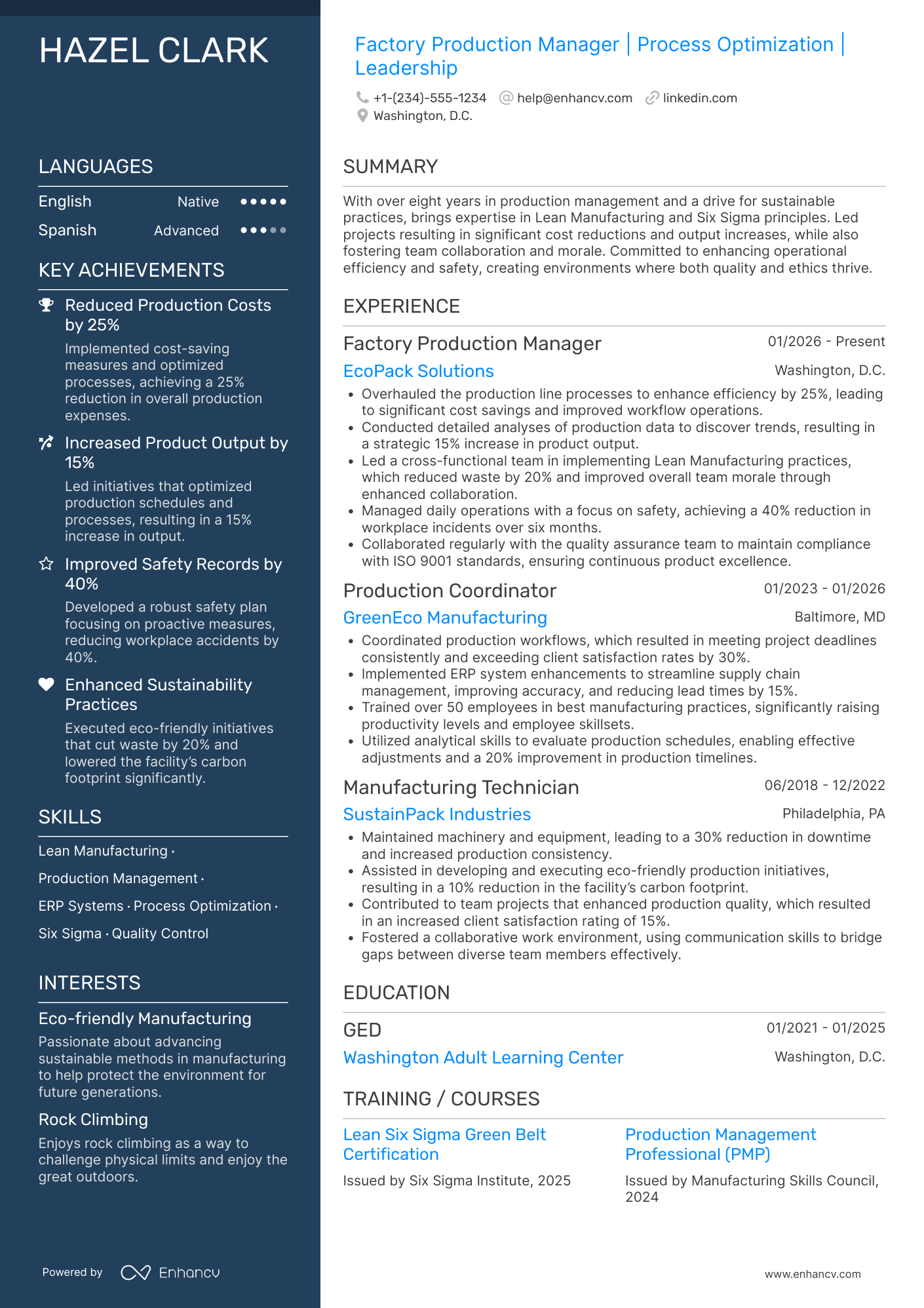
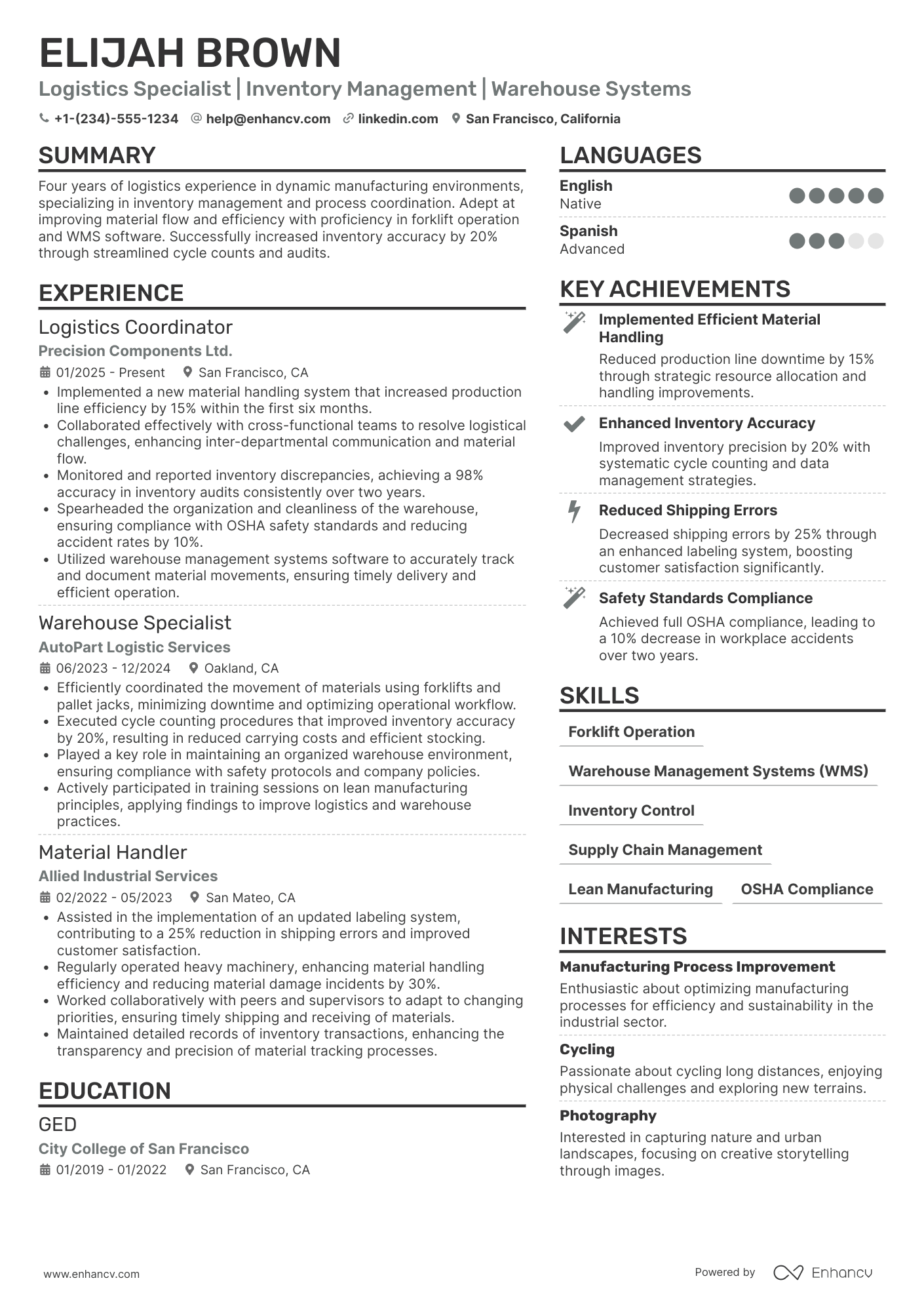
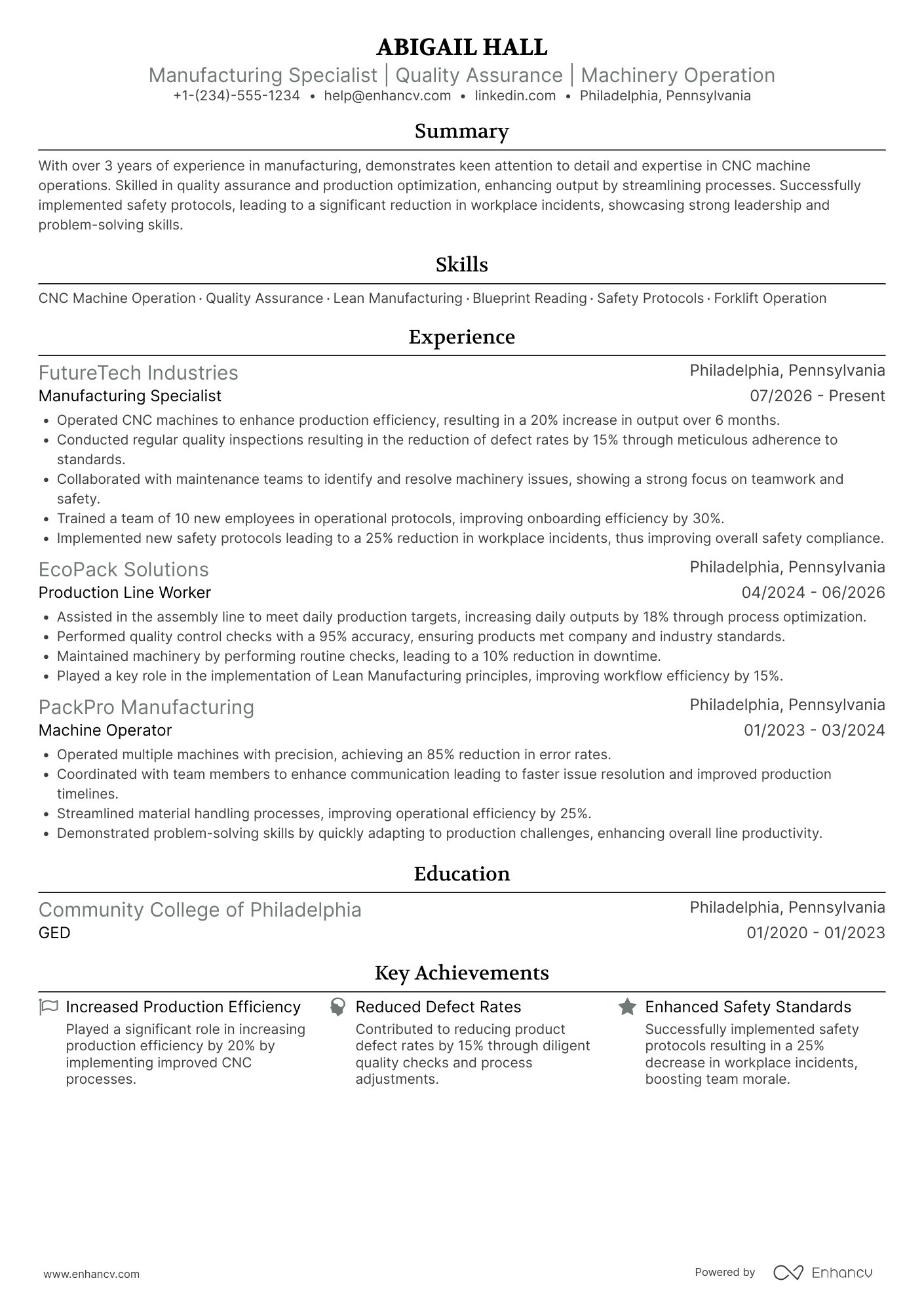
Many factory worker resume drafts fail because they read like task lists and bury measurable results. That hurts when an ATS filters keywords and recruiters scan fast in a crowded applicant pool.
If the plant or staffing agency also asks for a short cover letter, our factory worker cover letter examples show how to frame the same output and safety wins for a supervisor who skims before reading bullets.
A strong resume shows how you improved output, safety, and quality, not just what you did. Understanding how to make your resume stand out starts with highlighting units per hour, scrap reduction, on-time orders shipped, defect rates, downtime avoided, and near-miss incidents prevented.

Key takeaways
- Quantify achievements with metrics like units per hour, scrap rates, and downtime reduction.
- Use reverse-chronological format for experienced candidates and hybrid format for career changers.
- Tailor every resume to each job posting's specific machinery, standards, and terminology.
- Demonstrate skills through measurable outcomes in your experience section, not just a list.
- Place certifications like OSHA 10 and forklift operation where recruiters expect them.
- Write a three-to-four-line summary that leads with your title, experience, and a key result.
- Use Enhancv to turn vague duties into focused, recruiter-ready bullet points faster.
How to format a factory worker resume
Recruiters hiring factory workers prioritize reliability, hands-on production skills, and a clear record of safe, efficient work. A clean resume format ensures these signals—machinery experience, output metrics, and safety compliance—aren't buried under clutter or lost to applicant tracking systems.

I have significant experience as a factory worker—which format should I use?
Use a reverse-chronological format to put your strongest and most recent production experience front and center. Do:
- Lead with your current or most recent role, emphasizing the scope of your responsibilities (line ownership, shift coverage, equipment operated).
- Highlight specific machinery, tools, and production domains you've worked in, such as CNC operation, forklift certification, injection molding, or quality inspection protocols.
- Quantify your contributions with measurable outcomes tied to output, efficiency, or safety.
I'm junior or switching into a factory worker role—what format works best?
A hybrid format works best because it lets you lead with relevant skills and certifications while still showing a timeline of any work experience you have. Do:
- Place a skills section near the top of your resume featuring production-relevant abilities like machine operation, safety compliance, inventory handling, or lean manufacturing basics.
- Include hands-on projects, vocational training, warehouse roles, or volunteer work that demonstrates physical reliability and the ability to follow standard operating procedures.
- Connect each skill or experience to a concrete action and a clear result, even if the result is small in scale.
Why not use a functional resume?
A functional resume strips away the timeline of your work history, making it harder for hiring managers to verify your hands-on production experience and gauge your reliability in a factory setting.
- Career change into factory work: You have no direct production experience but hold relevant certifications (such as OSHA 10, forklift license, or lean manufacturing training) and can tie transferable skills from physical or operational roles to factory-floor tasks.
- Limited work history: You're a recent vocational school graduate or re-entering the workforce and need to foreground technical training and lab or shop projects over a thin employment section.
- Resume gaps: Extended time away from work due to personal circumstances, where a skills-first layout helps redirect focus to current capabilities and certifications.
Once you've locked in the right format, the next step is deciding which sections to include so each one works together to present a complete picture of your qualifications.
What sections should go on a factory worker resume
Recruiters expect you to present safety-focused, production-driven qualifications in an easy-to-scan format. Knowing what to put on a resume for factory roles is essential for maximum clarity. Use this structure:
- Header
- Summary
- Experience
- Skills
- Projects
- Education
- Certifications
- Optional sections: Awards, Volunteering, Languages
Strong experience bullets should emphasize safety performance, throughput, quality metrics, equipment proficiency, and measurable results across shifts, lines, or facilities.
Is your resume good enough?
Drop your resume here or choose a file. PDF & DOCX only. Max 2MB file size.
Once you’ve organized your resume with the right structure and information, you can focus on writing your factory worker experience section so hiring managers see your impact quickly.
How to write your factory worker resume experience
The experience section is where you prove you can do the job—not just describe it. Highlight the work you shipped, the tools and methods you used on the production floor, and the measurable outcomes you delivered, because hiring managers prioritize demonstrated impact over descriptive task lists. Building a targeted resume ensures your experience section speaks directly to the role you're pursuing.
Each entry should include:
- Job title
- Company and location (or remote)
- Dates of employment (month and year)
Three to five concise bullet points showing what you owned, how you executed, and what outcomes you delivered:
- Ownership scope: the production lines, machinery stations, assembly processes, or material handling areas you were directly accountable for as a factory worker.
- Execution approach: the equipment, safety protocols, quality control procedures, or manufacturing techniques you applied to complete production tasks and maintain operational standards.
- Value improved: the changes you drove in production quality, output efficiency, defect reduction, workplace safety, or equipment uptime within your factory environment.
- Collaboration context: how you coordinated with shift supervisors, maintenance teams, quality inspectors, warehouse staff, or supply chain partners to keep production on schedule and within specification.
- Impact delivered: the tangible results your work produced—expressed through production gains, waste reduction, safety improvements, or throughput increases rather than a list of daily duties.
Experience bullet formula
A factory worker experience example
✅ Right example - modern, quantified, specific.
CNC Machine Operator
RidgeLine Components | Dayton, OH
2021–Present
High-volume automotive supplier producing precision aluminum and steel parts across three shifts.
- Operated three-axis and five-axis CNC mills (Haas VF series) and lathes, holding ±0.001-inch tolerances and increasing average throughput by 18% by optimizing tool offsets and changeover sequencing.
- Set up jobs using micrometers, calipers, and height gauges, cutting first-pass scrap from 4.6% to 2.1% by tightening in-process inspection and documenting adjustments in the quality management system (QMS).
- Performed preventive maintenance and tool management in CMMS (computerized maintenance management system), reducing unplanned downtime by 22% and extending average tool life by 15% through standardized lubrication and insert-change intervals.
- Executed root cause analysis (Five Whys) with quality engineers and maintenance technicians, resolving recurring burr defects and improving customer acceptance rate from 97.8% to 99.3% over two quarters.
- Trained six new operators on lockout/tagout, safe material handling, and standard work, improving shift adherence to safety audits by 30% and reducing recordable incidents to zero for twelve months.
Now that you've seen how a strong experience section comes together, let's look at how to adjust those details to match a specific job posting.
How to tailor your factory worker resume experience
Recruiters evaluate factory worker resumes through both human review and applicant tracking systems, so your experience needs to align closely with each job posting. Tailoring your resume to the job description ensures the specific skills, tools, and qualifications you list match what the employer is actively seeking.
Ways to tailor your factory worker experience:
- Match specific machinery or equipment named in the job description.
- Use the exact terminology for production processes or standards listed.
- Mirror quality metrics or output targets the employer references.
- Include relevant industry experience such as food processing or automotive.
- Emphasize safety compliance and OSHA protocols when the posting requires them.
- Highlight lean manufacturing or Six Sigma methods if mentioned.
- Reference team-based assembly line workflows described in the listing.
- Align your experience with reliability or attendance standards noted.
Tailoring means connecting your real accomplishments to the job requirements, not forcing keywords into your resume where they don't belong.
Resume tailoring examples for factory worker
| Job description excerpt | Untailored | Tailored |
|---|---|---|
| Operate and monitor CNC machines and hydraulic presses to manufacture metal components per blueprint specifications | Operated various machines in a factory setting to produce parts. | Operated CNC machines and hydraulic presses to manufacture metal components, reading blueprint specifications to maintain dimensional accuracy across 500+ units per shift. |
| Perform quality inspections using calipers and micrometers, documenting results per ISO 9001 standards | Checked products for quality and reported any issues to supervisors. | Conducted quality inspections using calipers and micrometers on finished parts, documenting all measurement results in compliance with ISO 9001 standards and reducing defect rates by 12%. |
| Follow OSHA safety protocols while operating forklifts to transport raw materials between warehouse and production floor | Moved materials around the facility and followed safety rules. | Operated sit-down forklifts to transport raw materials between the warehouse and production floor, strictly adhering to OSHA safety protocols and maintaining zero incidents over 18 months. |
Once you’ve aligned your experience with the role’s priorities, the next step is to quantify your factory worker achievements to show the measurable impact of that work.
How to quantify your factory worker achievements
Quantifying your achievements proves you improved output, quality, safety, and on-time delivery. Focus on units per hour, scrap rates, downtime, safety incidents, and order accuracy across a shift, line, or month.
Quantifying examples for factory worker
| Metric | Example |
|---|---|
| Throughput | "Increased line output from 420 to 510 units per shift by optimizing changeover steps and staging materials." |
| Quality | "Cut scrap rate from 3.2% to 1.7% by tightening first-piece checks using calipers and go/no-go gauges." |
| Safety | "Maintained zero recordable incidents for twelve months by leading weekly lockout/tagout checks and correcting hazards within twenty-four hours." |
| Downtime | "Reduced unplanned downtime by 18% by logging jams in a downtime tracker and coordinating preventive maintenance on conveyors." |
| Delivery accuracy | "Improved pick-and-pack accuracy from 97.5% to 99.2% across 1,200 orders per week using barcode scanning and double-check bins." |
Turn vague job duties into measurable, recruiter-ready resume bullets in seconds with Enhancv's Bullet Point Generator.
Once you've crafted strong bullet points for your experience section, the next step is ensuring your skills section effectively showcases the hard and soft skills that factory employers prioritize most.
How to list your hard and soft skills on a factory worker resume
Your skills section shows you can meet production, quality, and safety targets, and recruiters and ATS scan it to match your fit fast; aim for a hard-skill-heavy mix with a smaller set of job-specific soft skills. factory worker roles require a blend of:
- Product strategy and discovery skills
- Data, analytics, and experimentation skills
- Delivery, execution, and go-to-market discipline
- Soft skills
Your skills section should be:
- Scannable (bullet-style grouping).
- Relevant to the job post.
- Backed by proof in experience bullets.
- Updated with current tools.
Place your skills section:
- Above experience if you're junior or switching careers.
- Below experience if you're mid/senior with strong achievements.

Hard skills
Listing hard skills relevant to factory work demonstrates your technical readiness:
- OSHA safety compliance
- Lockout/tagout (LOTO)
- PPE and hazard controls
- GMP and sanitation SOPs
- 5S workplace organization
- Lean manufacturing basics
- Kaizen continuous improvement
- Standard work adherence
- Quality inspections, calipers, micrometers
- Defect tracking and scrap reporting
- Barcode scanning, inventory systems
- Forklift, pallet jack operation
Soft skills
Pairing those with the right soft skills rounds out your profile:
- Follow SOPs under pressure
- Communicate shift handoffs clearly
- Coordinate with line leads
- Escalate safety and quality issues
- Maintain steady production pace
- Prioritize tasks by downtime impact
- Document work with accuracy
- Adapt to changeovers quickly
- Take ownership of station readiness
- Respond to feedback and coaching
- Support cross-training on the line
- Resolve minor line stoppages fast
How to show your factory worker skills in context
Skills shouldn't live only in a bulleted list on your resume. Explore resume skills examples to see how factory workers present abilities effectively.
They should be demonstrated in:
- Your summary (high-level professional identity)
- Your experience (proof through outcomes)
Here's what this looks like in practice.
Summary example
Quality-driven factory worker with 12 years in automotive parts manufacturing. Skilled in CNC operation, lean manufacturing, and SPC methods. Reduced line defects by 34% while mentoring junior operators across three production shifts.
- Reflects senior-level experience clearly
- Names role-relevant tools and methods
- Includes a measurable production outcome
- Highlights mentoring as a soft skill
Experience example
Senior Production Operator
Midwest Precision Components | Toledo, OH
March 2018–Present
- Operated and calibrated CNC lathes and hydraulic presses, increasing output accuracy by 21% over two years.
- Collaborated with quality engineers to implement statistical process control, cutting scrap rates by 15%.
- Trained 10 new hires on lockout/tagout procedures, achieving zero safety incidents for 18 consecutive months.
- Every bullet includes measurable proof.
- Skills appear naturally through real outcomes.
Once you’ve tied your strengths to real tasks and outcomes, the next step is learning how to build a factory worker resume with no experience that still presents those strengths clearly.
How do I write a factory worker resume with no experience
Even without full-time experience, you can demonstrate readiness through hands-on activities. If you're writing a resume without work experience, focus on transferable projects and training:
- School shop class projects
- Vocational training lab work
- Warehouse volunteering shifts
- Assembly line simulation exercises
- Equipment cleaning and upkeep
- Safety training certificates
- Quality checks in class labs
- Personal repair and build projects
Focus on:
- Safety training and incident-free work
- Measurable output and accuracy
- Tool, machine, and material handling
- Shift availability and schedule reliability
Resume format tip for entry-level factory worker
Use a hybrid resume format because it highlights skills and training first, while still showing projects and hands-on work in a clear timeline. Do:
- Put safety training near the top.
- List tools and equipment you used.
- Add numbers for output and accuracy.
- Use action verbs for each bullet.
- Match keywords from the job posting.
- Completed school shop class assembly project using torque wrench, calipers, and a drill press, producing 25 parts with 96% pass rate on measurements.
Even without direct experience, your education section can demonstrate relevant knowledge and training that strengthens your candidacy—here's how to present it effectively.
How to list your education on a factory worker resume
Your education section helps hiring teams confirm you have foundational knowledge. It validates skills in safety protocols, mechanical reasoning, and technical areas relevant to the factory worker role.
Include:
- Degree name
- Institution
- Location
- Graduation year
- Relevant coursework (for juniors or entry-level candidates)
- Honors & GPA (if 3.5 or higher)
Skip month and day details—list the graduation year only.
Here's a strong education entry tailored for a factory worker resume.
Example education entry
Associate of Applied Science in Industrial Technology
Lakeshore Technical College, Cleveland, WI
Graduated: 2021
GPA: 3.7/4.0
- Relevant Coursework: Manufacturing Processes, Workplace Safety Compliance, Quality Control Fundamentals, Industrial Equipment Operations
- Honors: Dean's List, Fall 2020 and Spring 2021
How to list your certifications on a factory worker resume
Certifications on your resume show your commitment to learning, prove tool proficiency, and highlight industry relevance as a factory worker. They also help employers trust your safety awareness and ability to follow standards. Include:
- Certificate name
- Issuing organization
- Year
- Optional: credential ID or URL
- List certifications below education when they're older, less relevant, or mainly confirm basic readiness for a factory worker role.
- List certifications above education when they're recent, highly relevant, or required for the specific factory worker job posting.
Best certifications for your factory worker resume
- OSHA 10-Hour General Industry
- OSHA 30-Hour General Industry
- Forklift Operator Certification
- CPR and First Aid Certification
- Hazardous Waste Operations and Emergency Response (HAZWOPER)
- Lean Six Sigma Yellow Belt
- Lockout/Tagout (LOTO) Safety Training
Once you’ve placed your credentials where hiring managers can spot them, use your factory worker resume summary to reinforce those qualifications upfront and show how they support the role.
How to write your factory worker resume summary
Your resume summary is the first thing a recruiter reads. A strong one instantly signals you're qualified and ready to contribute on the factory floor.
Keep it to three to four lines, with:
- Your title and total years of hands-on factory experience.
- The industry or production environment you know best.
- Core skills like machine operation, assembly, quality control, or forklift certification.
- One or two measurable wins, such as output increases or defect reductions.
- Soft skills tied to real results, like teamwork that improved shift efficiency.

PRO TIP
At the entry or early-career level, emphasize relevant skills, certifications, and any measurable contributions from past roles. Avoid vague phrases like "hard worker" or "passionate team player." Instead, show what you did and what changed because of it.
Example summary for a factory worker
Assembly line operator with two years in automotive parts manufacturing. Skilled in CNC machine operation and quality inspection. Reduced line defects by 15% through improved material handling procedures.
Optimize your resume summary and objective for ATS
Drop your resume here or choose a file.
PDF & DOCX only. Max 2MB file size.
Now that your summary is crafted to highlight your strongest qualifications, make sure the header above it presents your contact details correctly so hiring managers can actually reach you.
What to include in a factory worker resume header
A resume header is the contact and identity block at the top, and it boosts visibility, credibility, and recruiter screening for a factory worker.
Essential resume header elements
- Full name
- Tailored job title and headline
- Location
- Phone number
- Professional email
- GitHub link
- Portfolio link
A LinkedIn link helps recruiters verify experience quickly and supports screening.
Don't include a photo on a factory worker resume unless the role is explicitly front-facing or appearance-dependent.
Keep the header on one to two lines, match your job title to the posting, and use a professional email you check daily.
Example
Factory worker resume header
Jordan Taylor
Factory worker | Assembly, packaging, and forklift operations
Columbus, OH
(614) 555-12XX
your.name@enhancv.com github.com/yourname yourwebsite.com linkedin.com/in/yourname
Once your contact details and role identifiers are in place at the top of your resume, add the additional sections next to round out your qualifications and support the information that follows.
Additional sections for factory worker resumes
Adding extra sections helps you stand out when your work experience and skills alone don't capture your full value as a factory worker. For example, listing language skills can be a strong differentiator in multilingual factory environments.
- Languages
- Certifications and licenses
- Hobbies and interests
- Volunteer experience
- Awards and recognitions
- Professional affiliations
- Physical fitness and endurance training
Once you've rounded out your resume with the right supplementary sections, it's worth pairing it with a cover letter to make an even stronger impression.
Do factory worker resumes need a cover letter
A cover letter isn't required for most factory worker roles. If you're unsure what a cover letter is and when it adds value, it helps when the role is competitive, the employer expects one, or your resume needs context. It can make a difference when hiring managers compare candidates with similar experience.
Use a cover letter to add details your factory worker resume can't show:
- Explain role or team fit by matching your shift, line experience, and safety habits to the plant's needs.
- Highlight one or two relevant projects or outcomes, such as reducing scrap, improving changeovers, or hitting quality targets.
- Show understanding of the product, users, or business context by noting how your work supports on-time delivery and customer requirements.
- Address career transitions or non-obvious experience by connecting past roles to factory worker skills, such as inspection, packing, or machine operation.
Drop your resume here or choose a file.
PDF & DOCX only. Max 2MB file size.
Even when you decide a separate letter won’t add value for the role, using AI to improve your factory worker resume helps you strengthen the application you’ll submit.
Using AI to improve your factory worker resume
AI can sharpen your resume's clarity, structure, and impact. It helps you find stronger words and tighter phrasing. But overuse kills authenticity. Once your content feels clear and role-aligned, step away from the tool. If you're wondering which AI is best for writing resumes, the key is choosing one that enhances rather than replaces your own voice.
Here are 10 practical prompts you can copy and paste to strengthen each section of your factory worker resume:
- Strengthen summary — "Rewrite this factory worker resume summary to highlight hands-on production skills and reliability in under four sentences."
- Quantify experience — "Add measurable results to these factory worker experience bullets using production output, error rates, or efficiency gains."
- Tighten bullet points — "Shorten each factory worker experience bullet to one concise line starting with a strong action verb."
- Align with posting — "Compare this factory worker resume to the job description and flag missing keywords or misaligned skills."
- Improve skills section — "Reorganize this factory worker skills list by grouping technical, safety, and equipment-related abilities separately."
- Clarify certifications — "Reformat this factory worker certifications section so each entry includes the credential name, issuer, and date earned."
- Refine education details — "Edit this factory worker education section to emphasize coursework or training relevant to manufacturing environments."
- Showcase project work — "Rewrite this factory worker project description to emphasize process improvements, team contributions, and measurable outcomes."
- Remove filler language — "Identify and remove vague or redundant phrases from this factory worker resume without changing the core meaning."
- Fix inconsistent formatting — "Standardize verb tense, punctuation, and structure across all bullet points in this factory worker resume."
Stop using AI once your resume sounds accurate, specific, and aligned with real experience. AI should never invent experience or inflate claims—if it didn't happen, it doesn't belong here.
Conclusion
A strong factory worker resume shows measurable outcomes, role-specific skills, and a clear structure. Lead with results like units per hour, scrap reduction, safety record, and on-time output. Support them with skills in machine operation, quality checks, and warehouse processes.
Keep each section clean and easy to scan, with consistent titles and bullet points. This format helps hiring teams compare candidates fast and supports today’s and near-future hiring market. With clear results and focused skills, you’ll look job-ready.