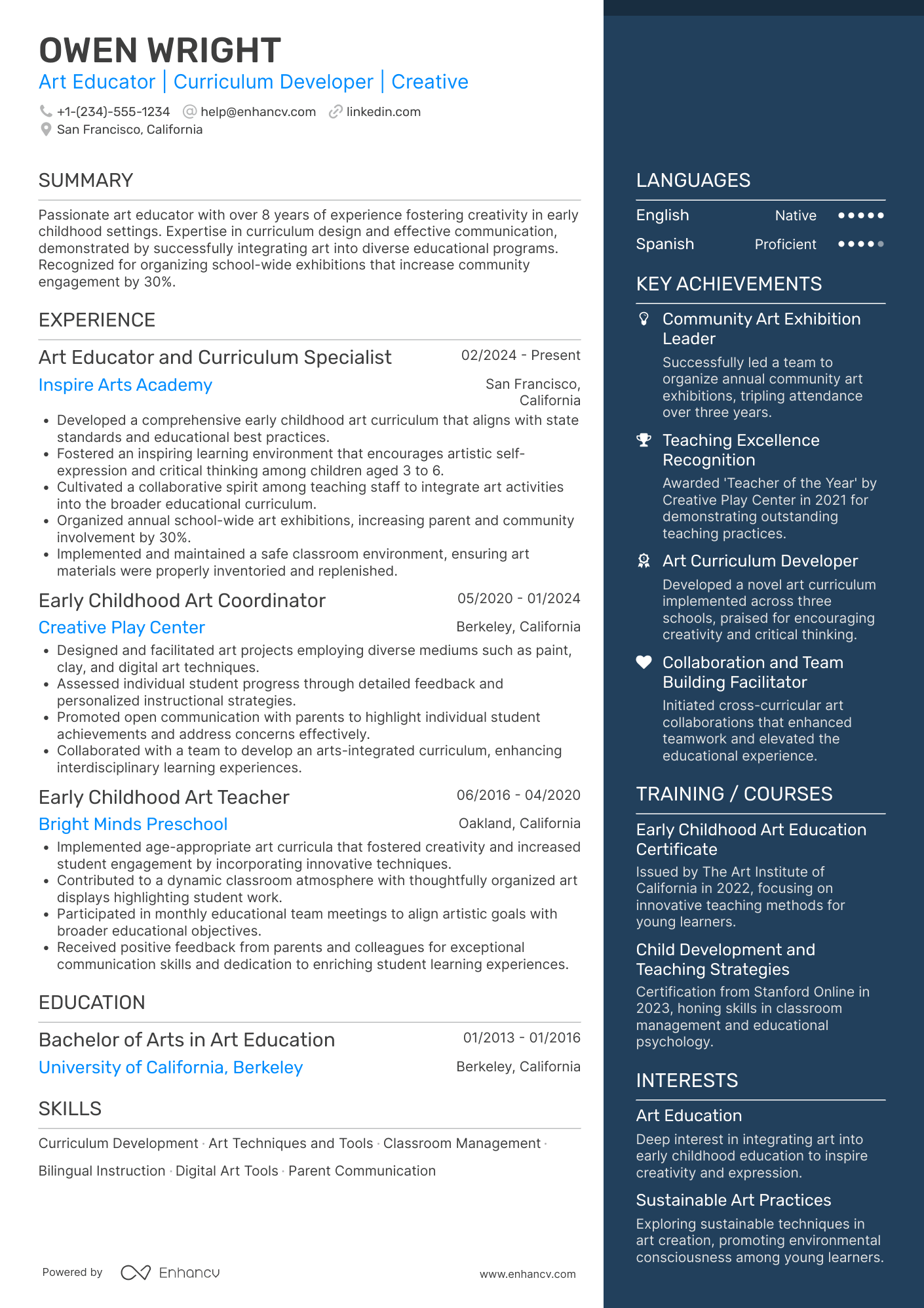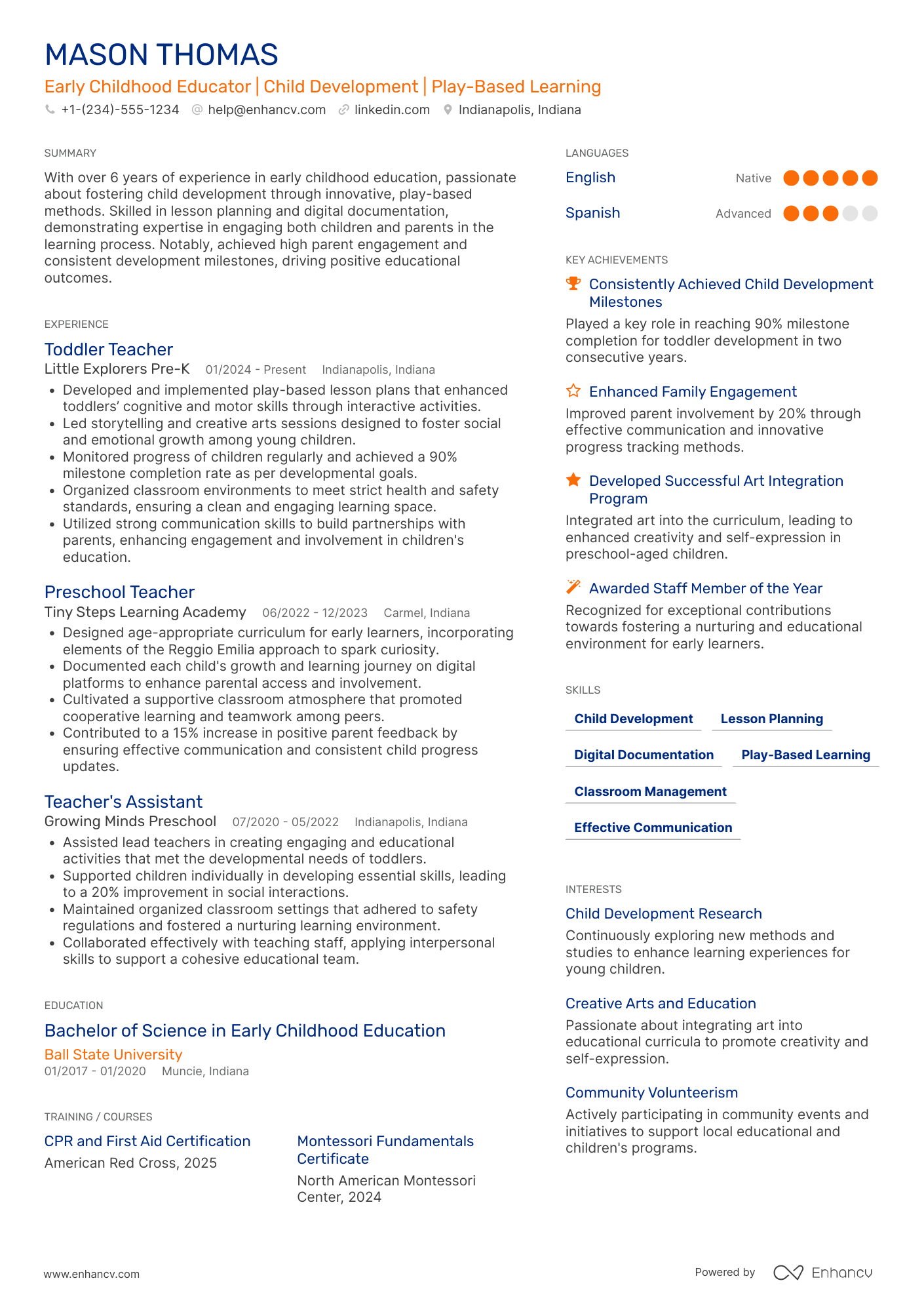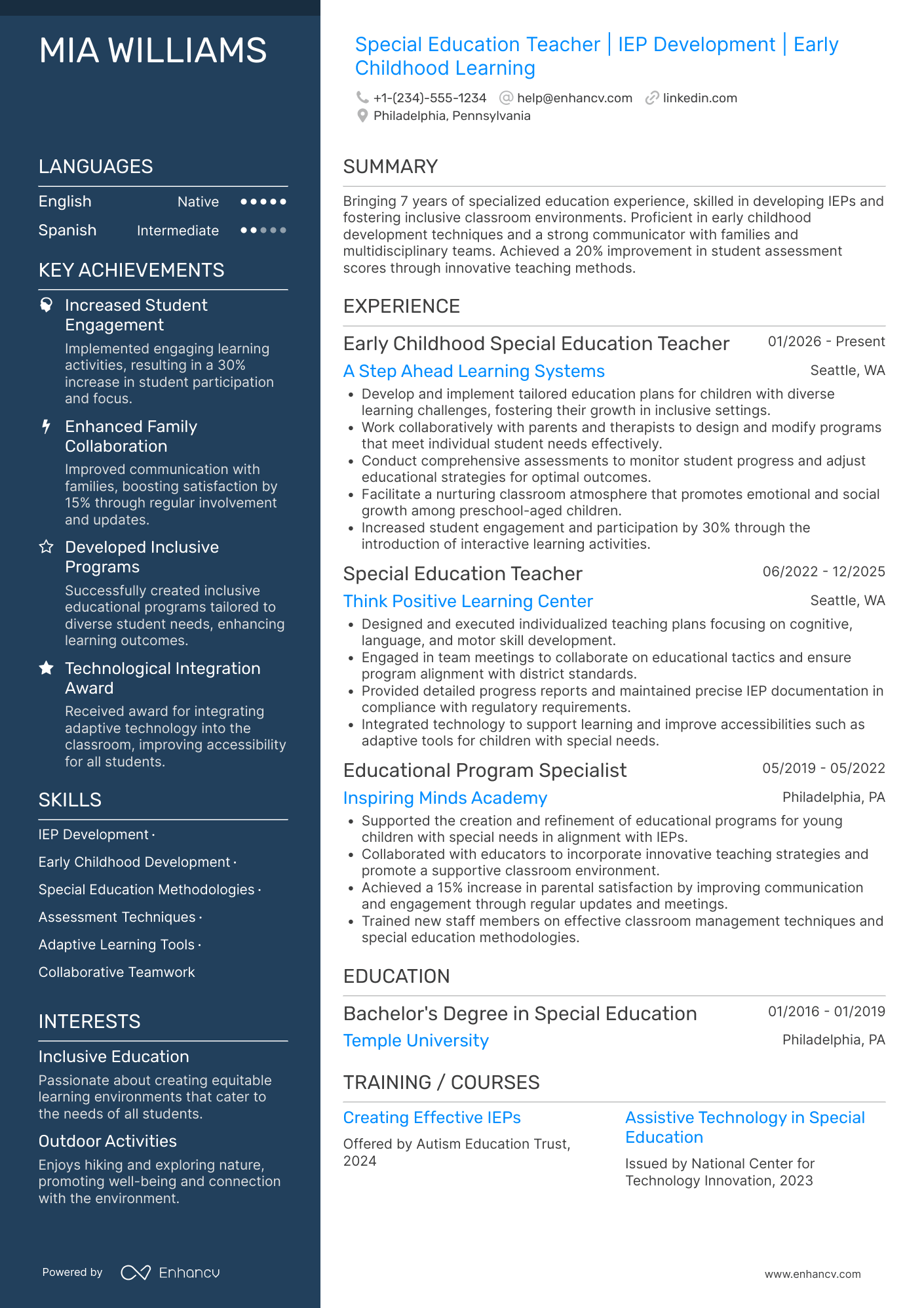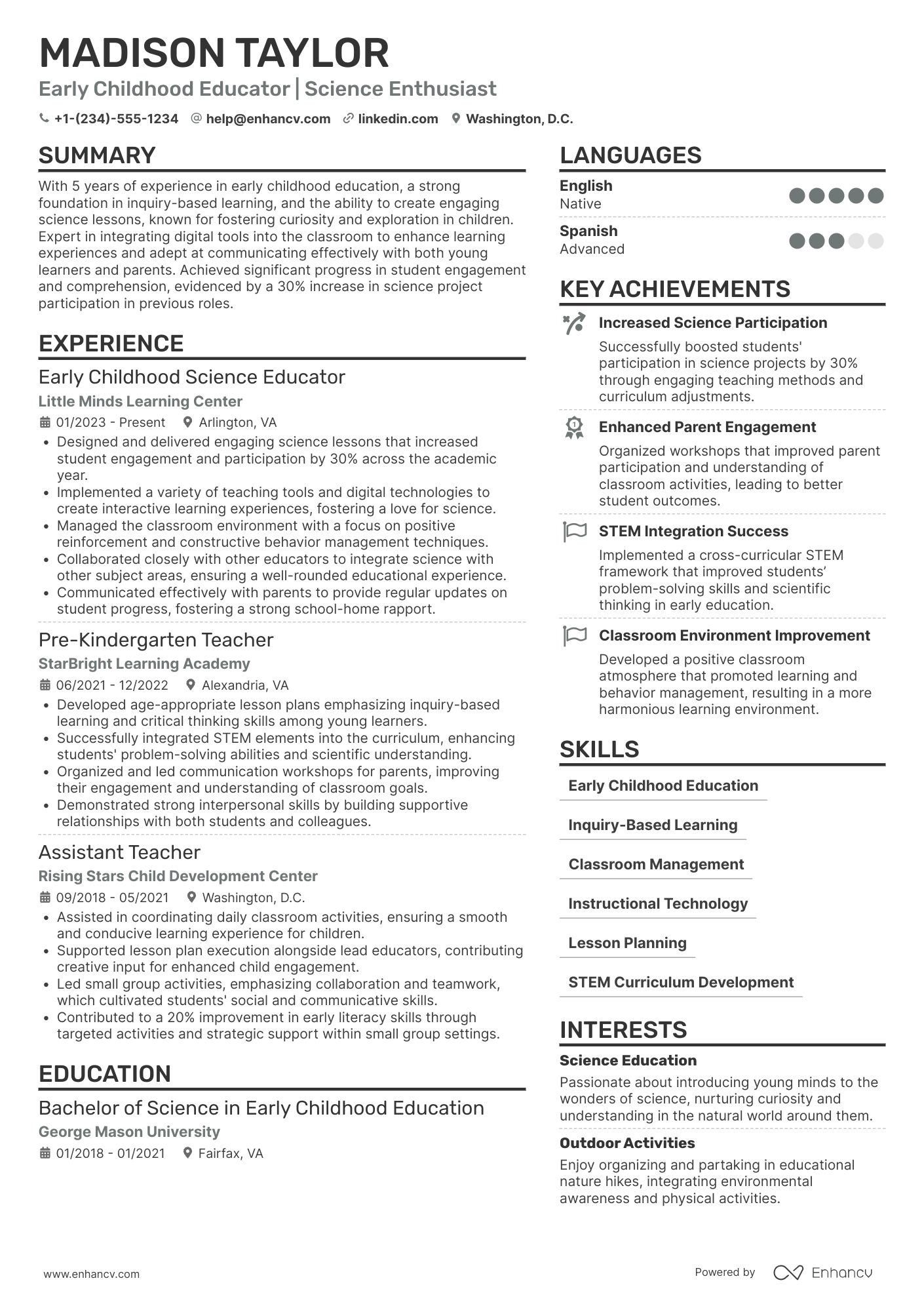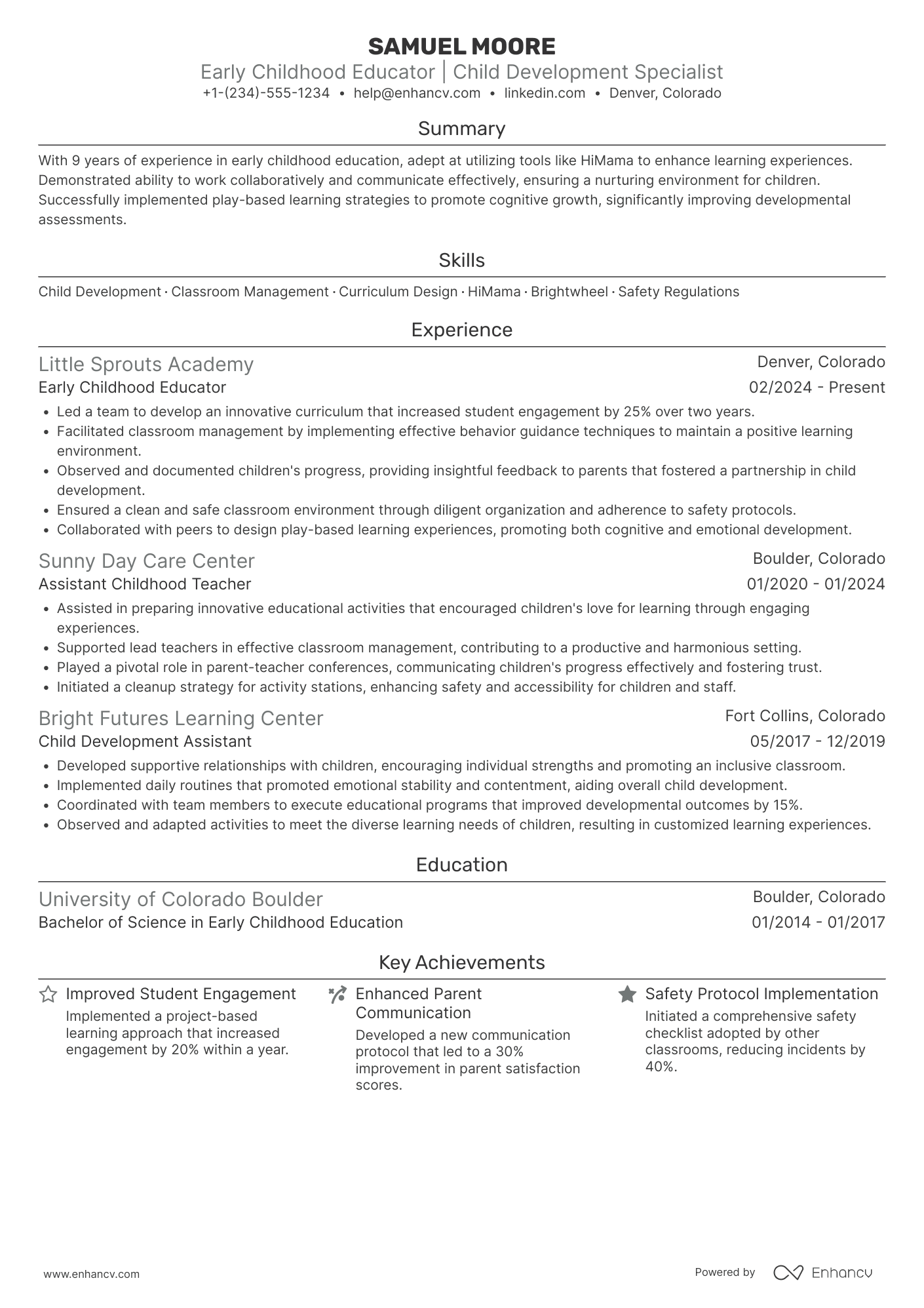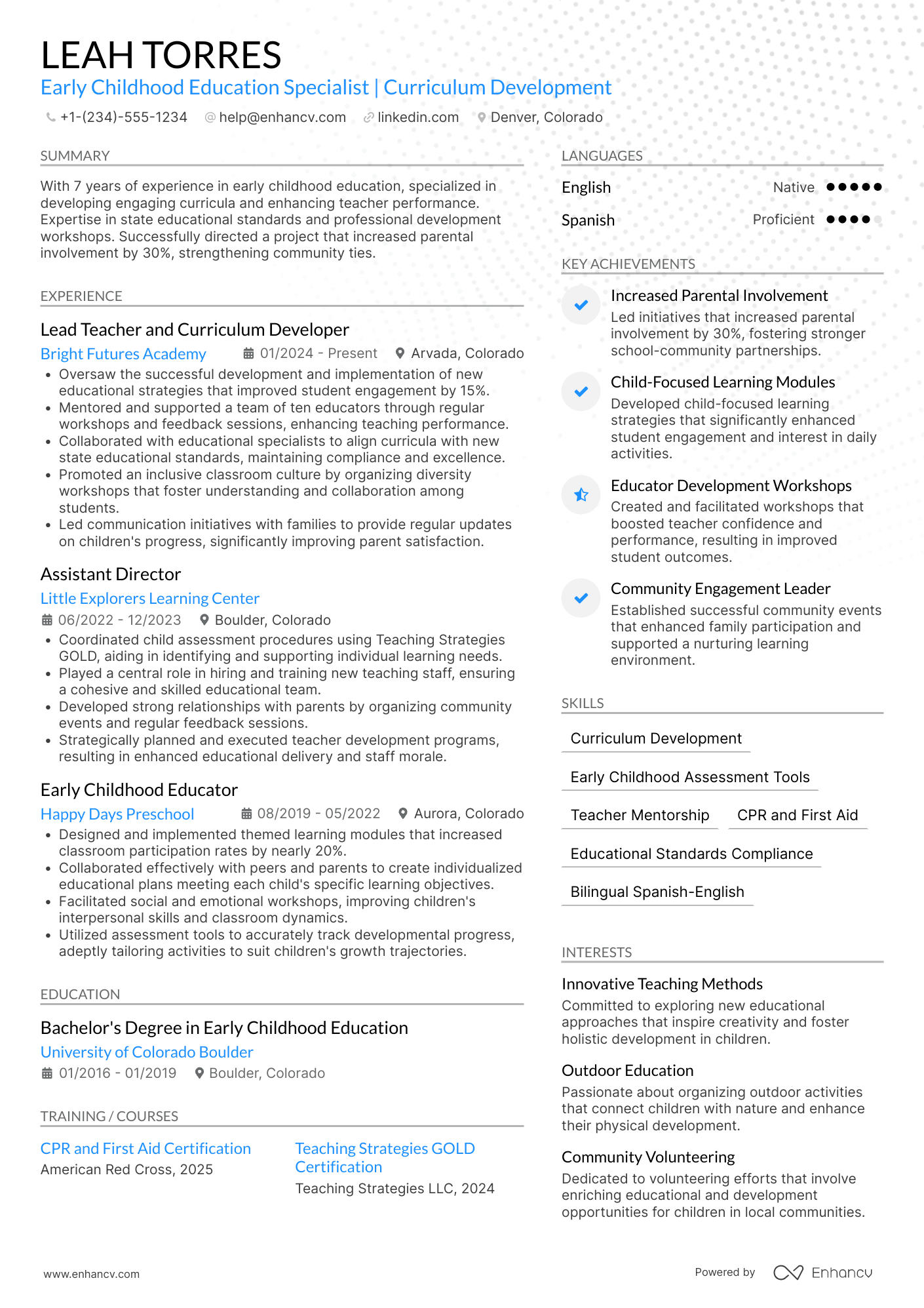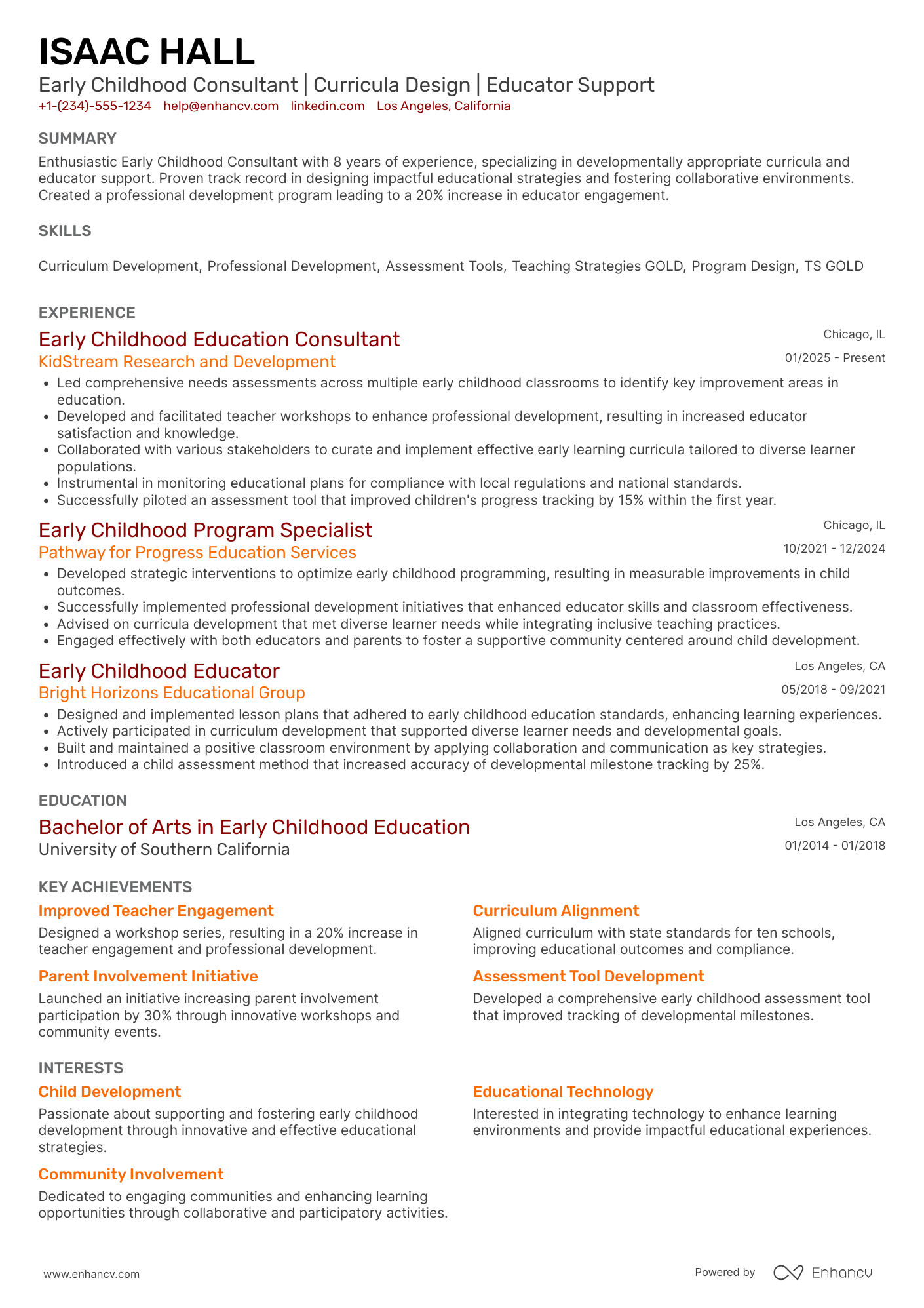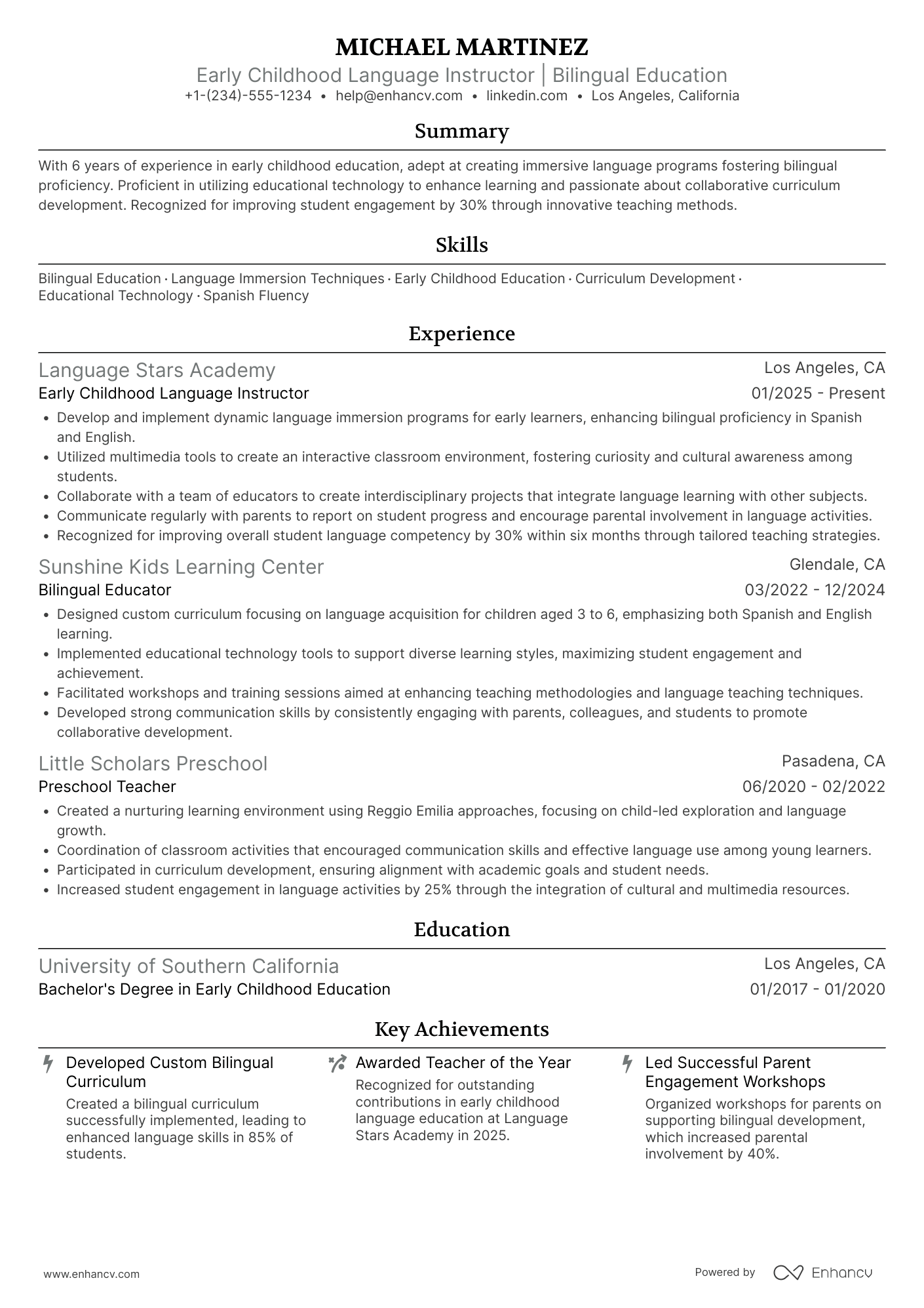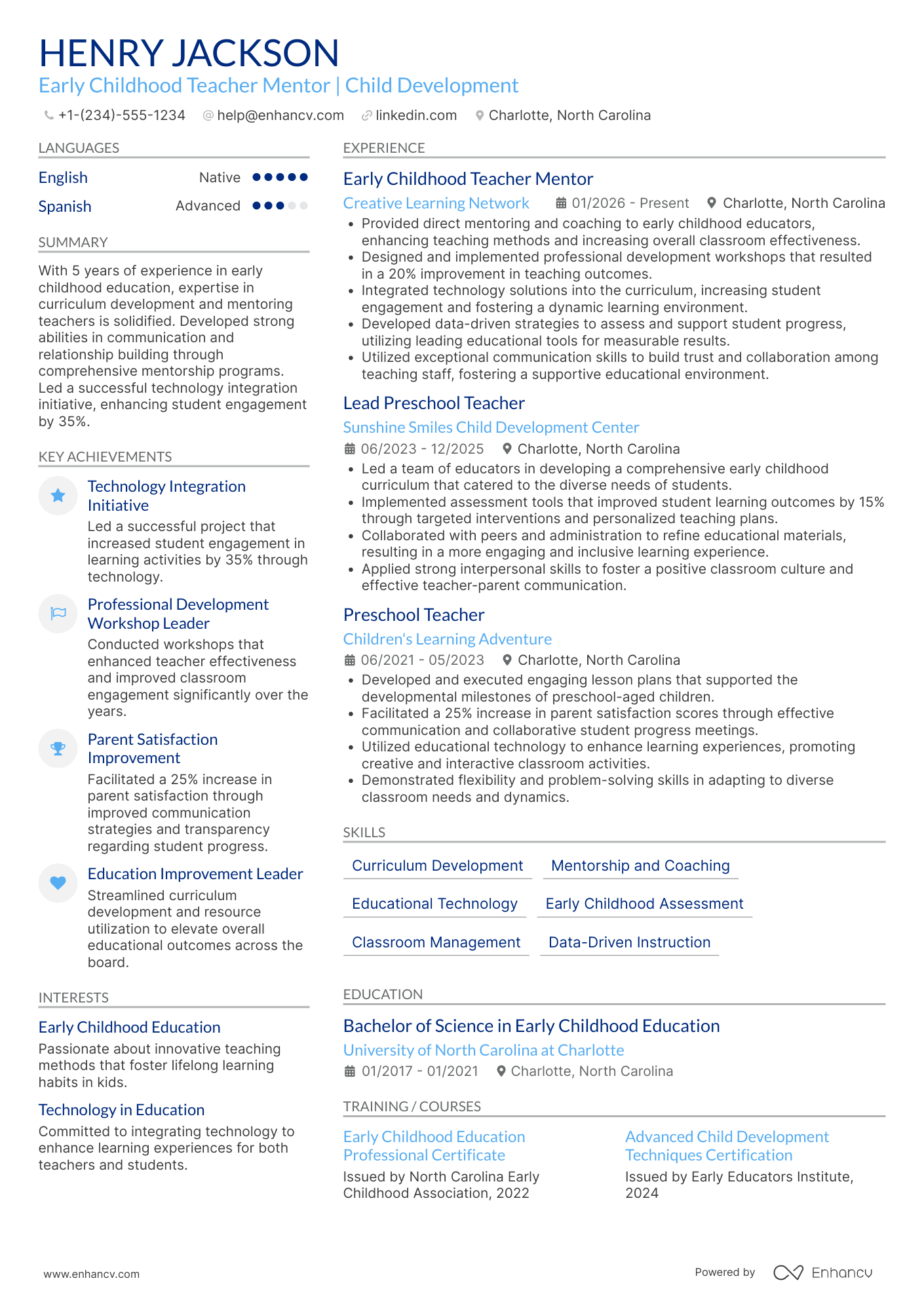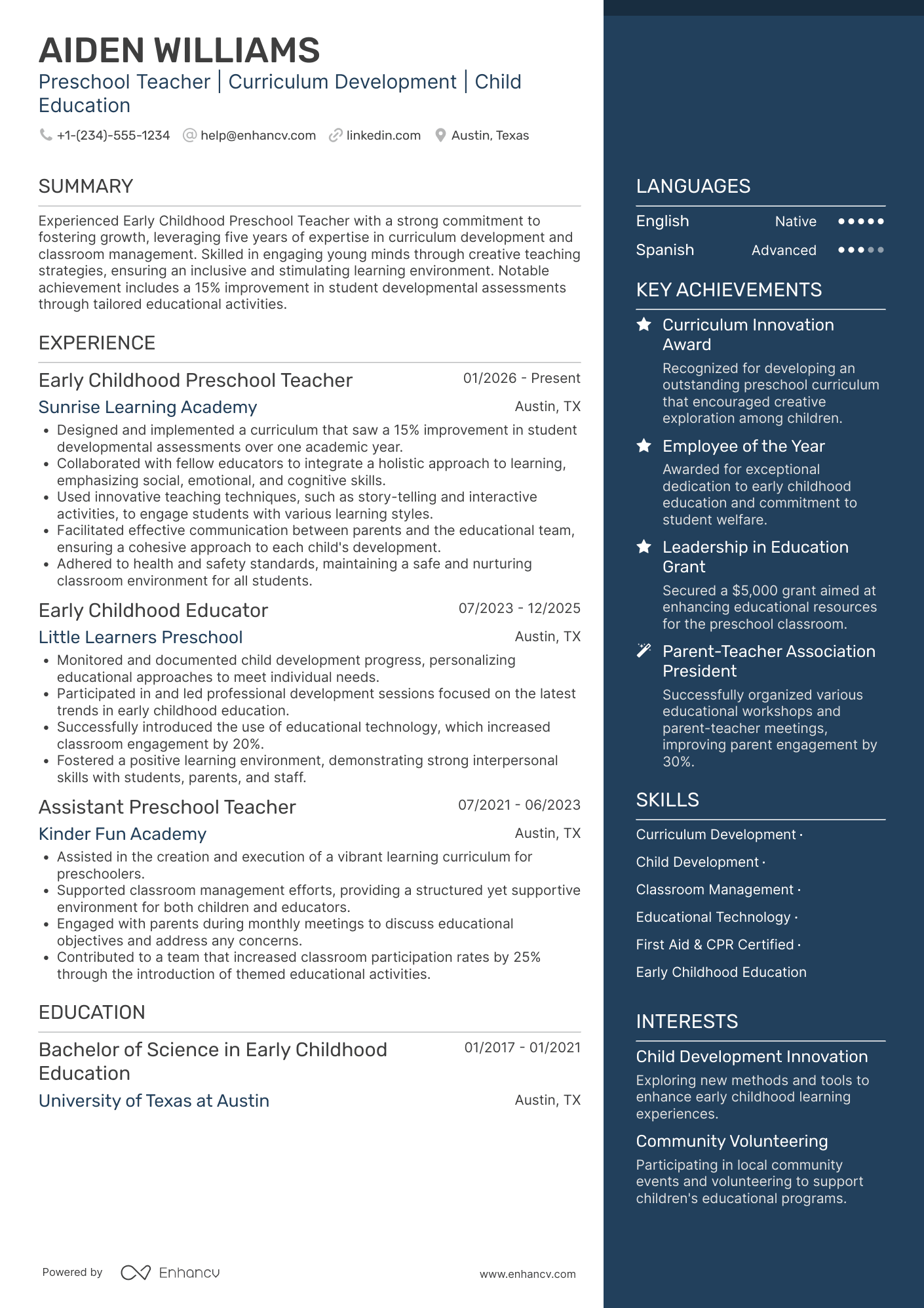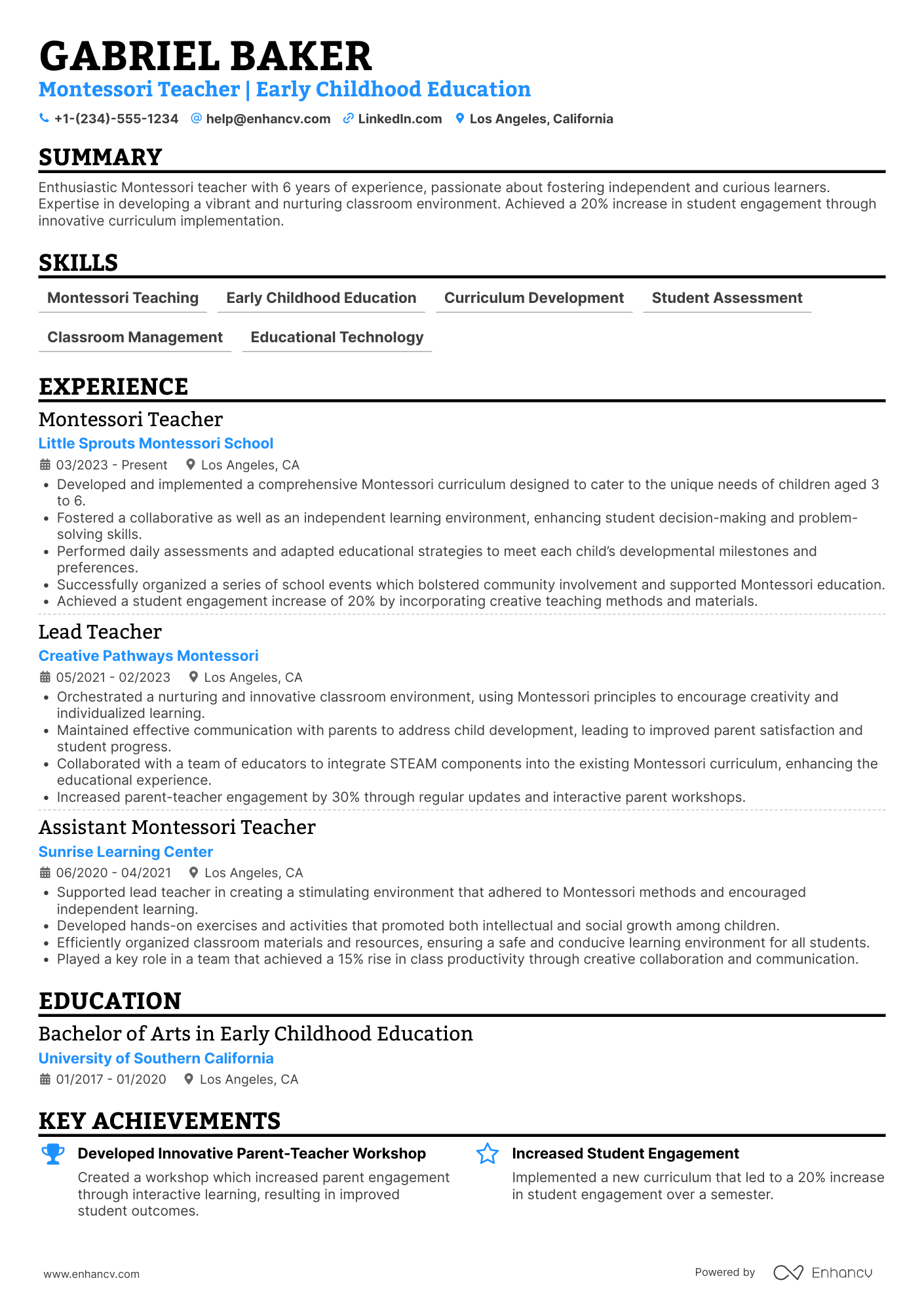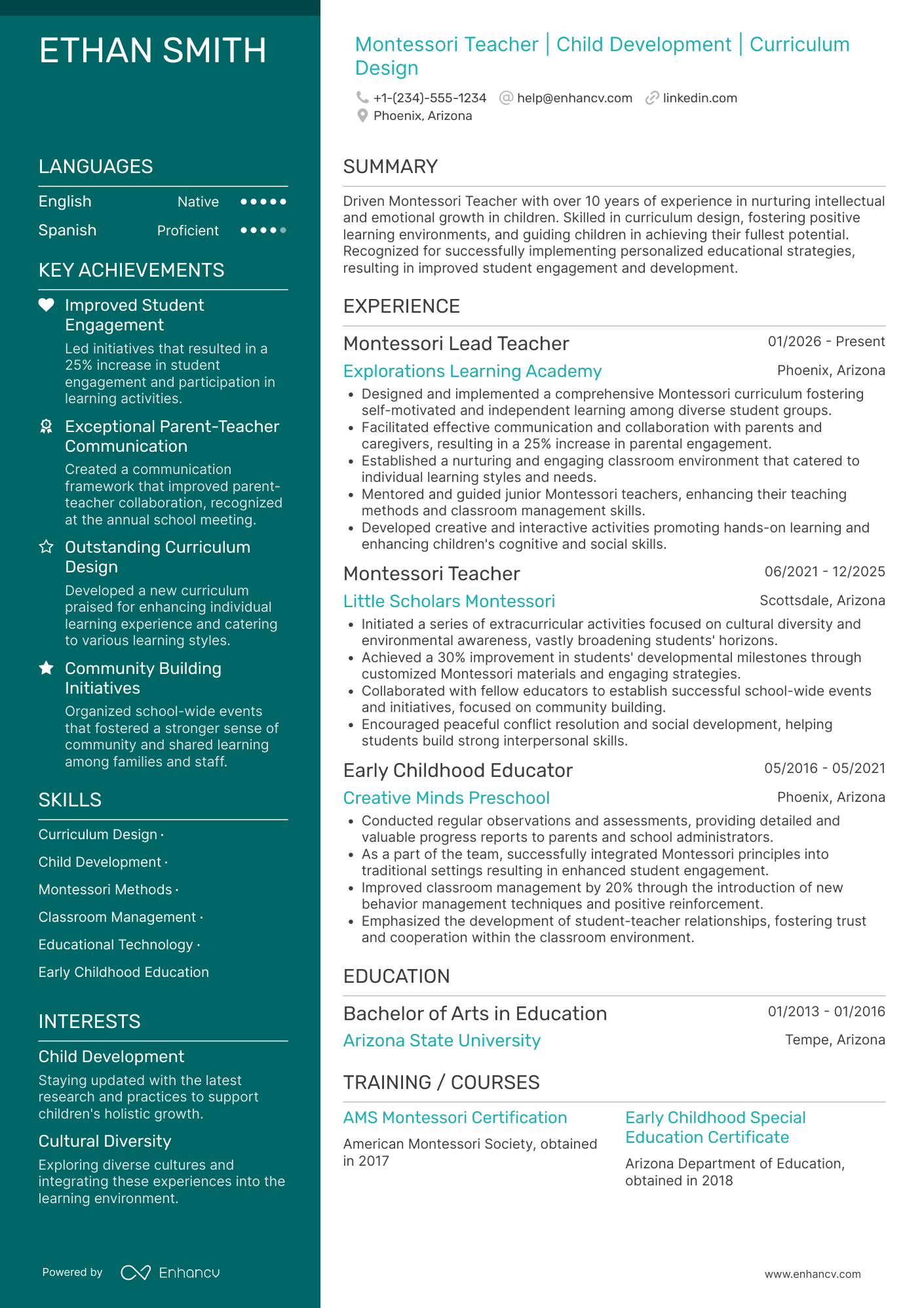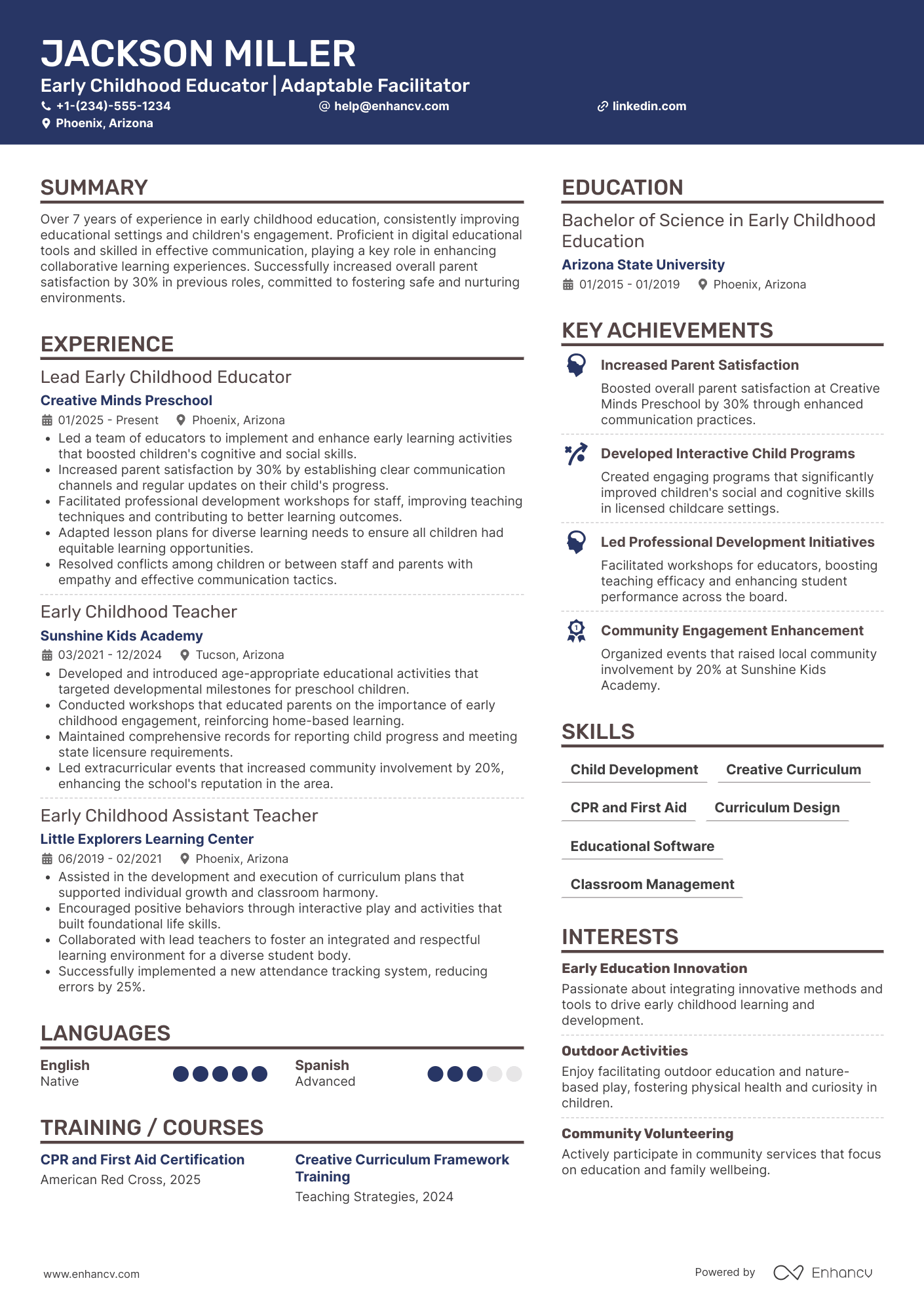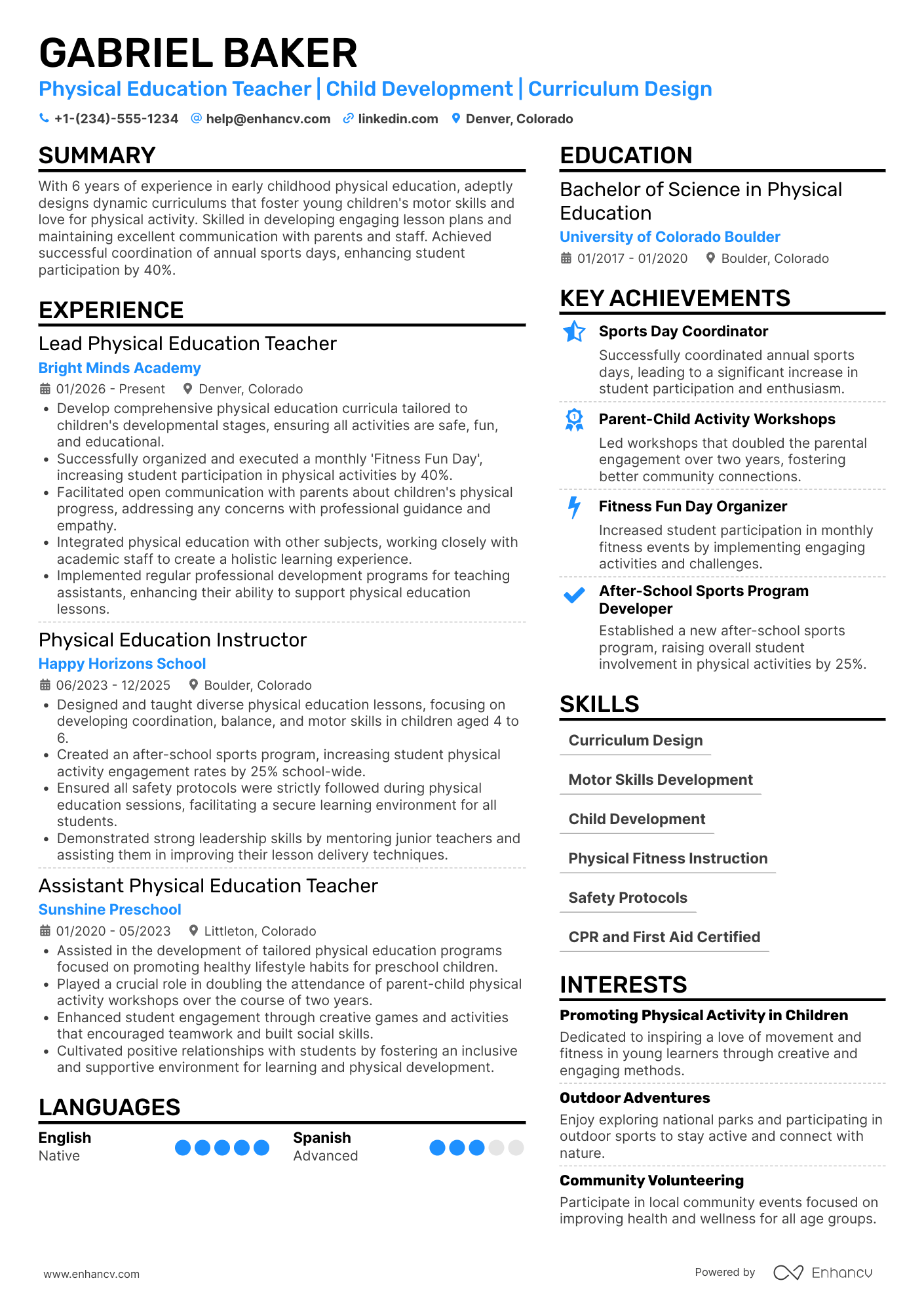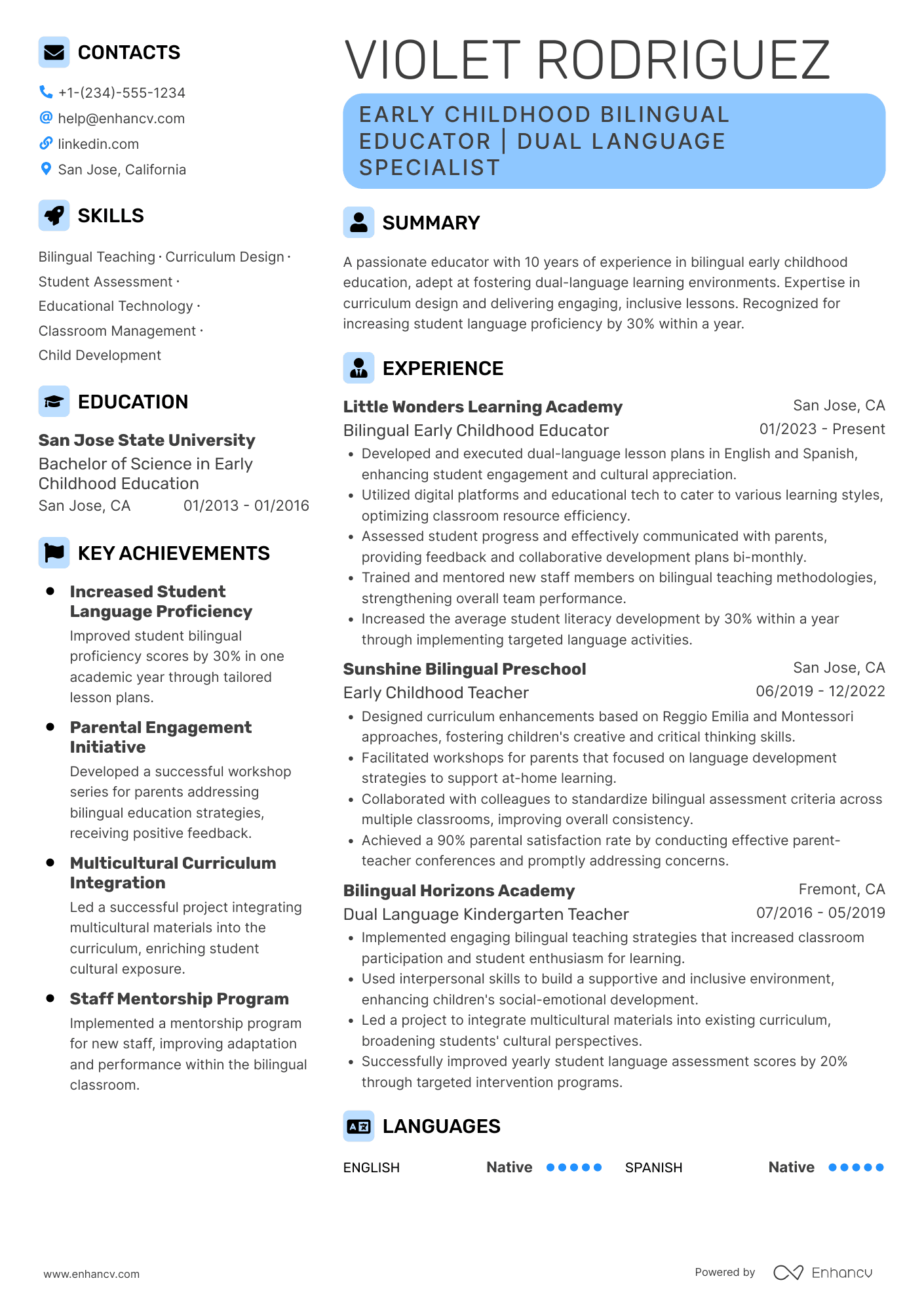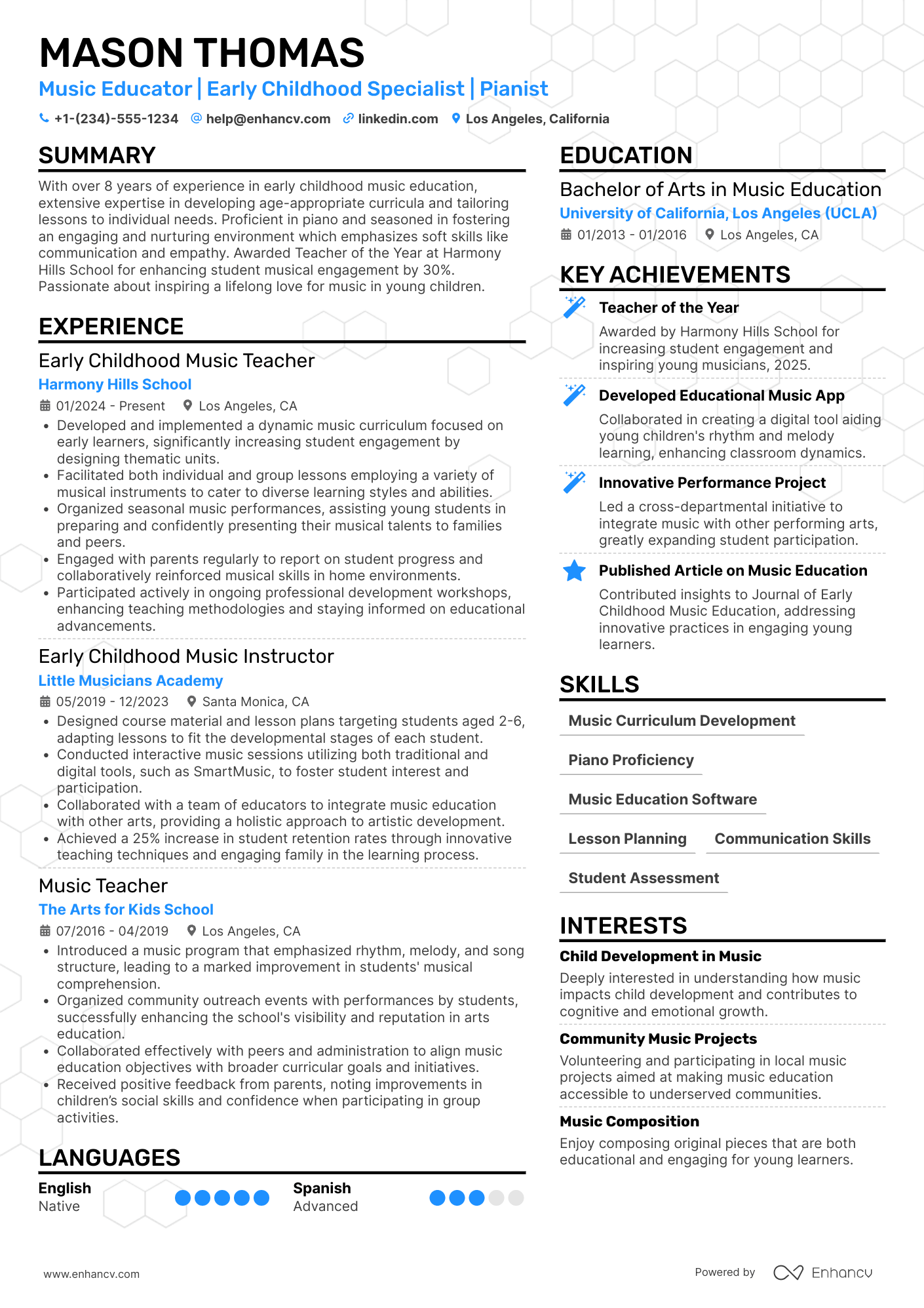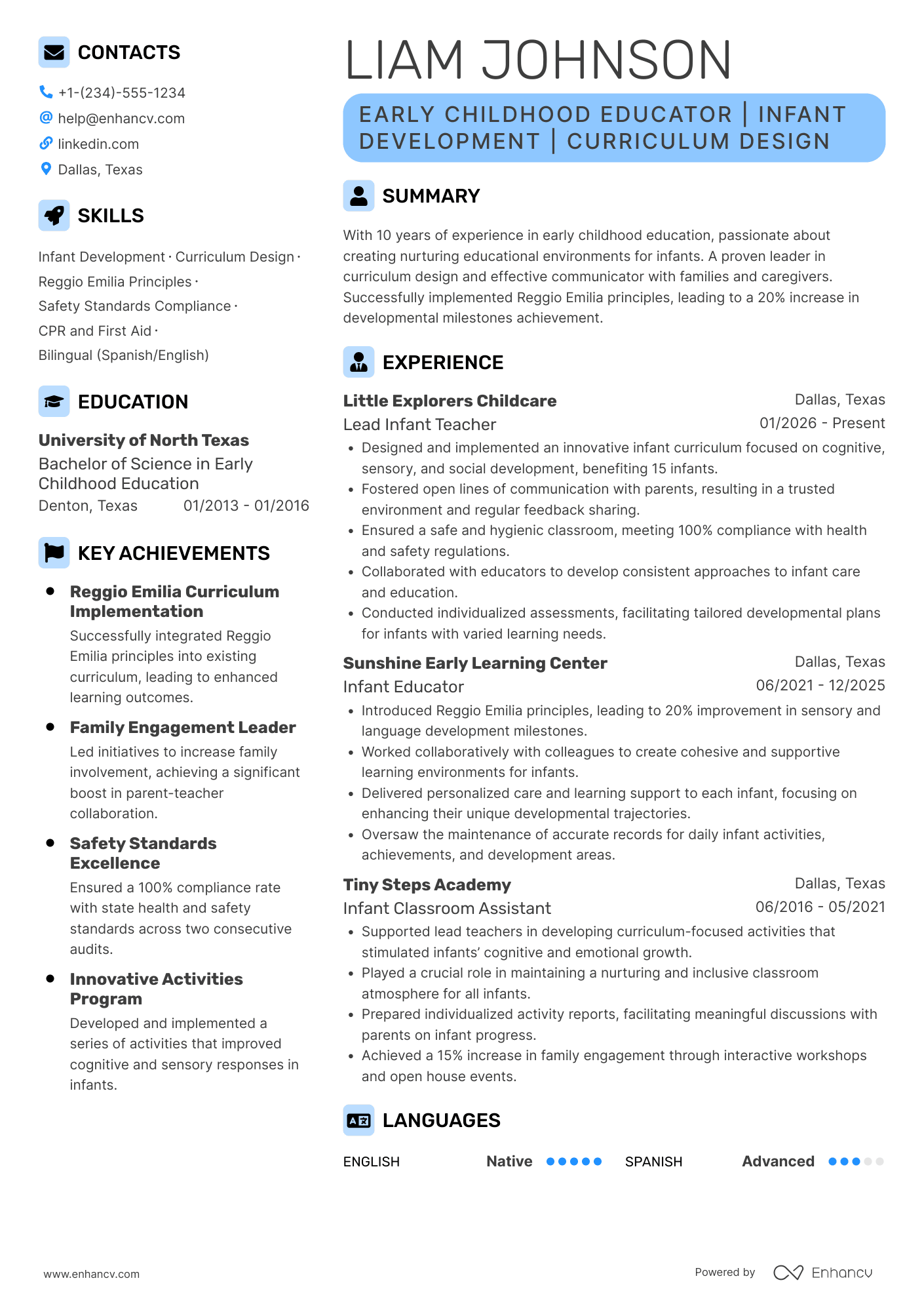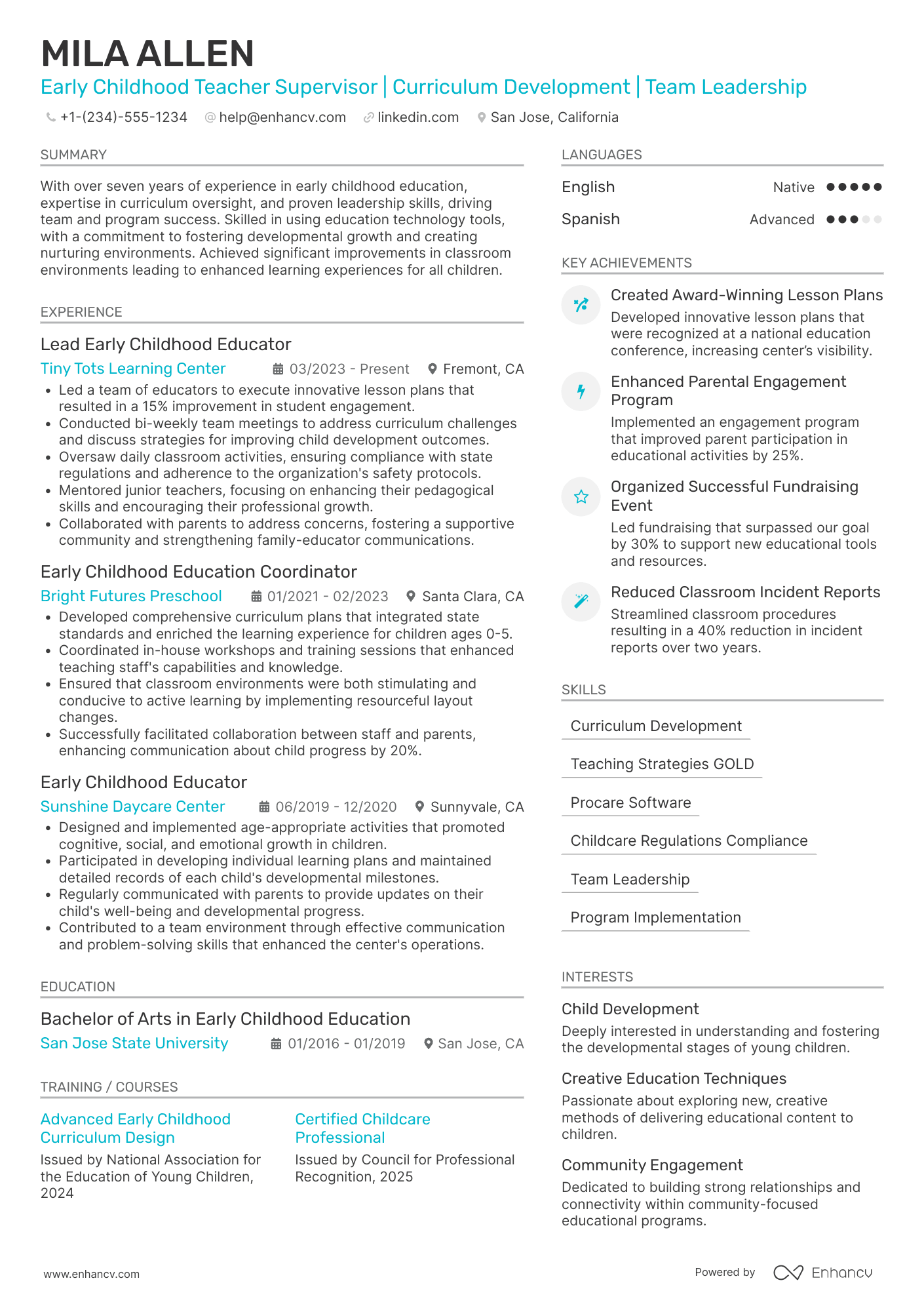
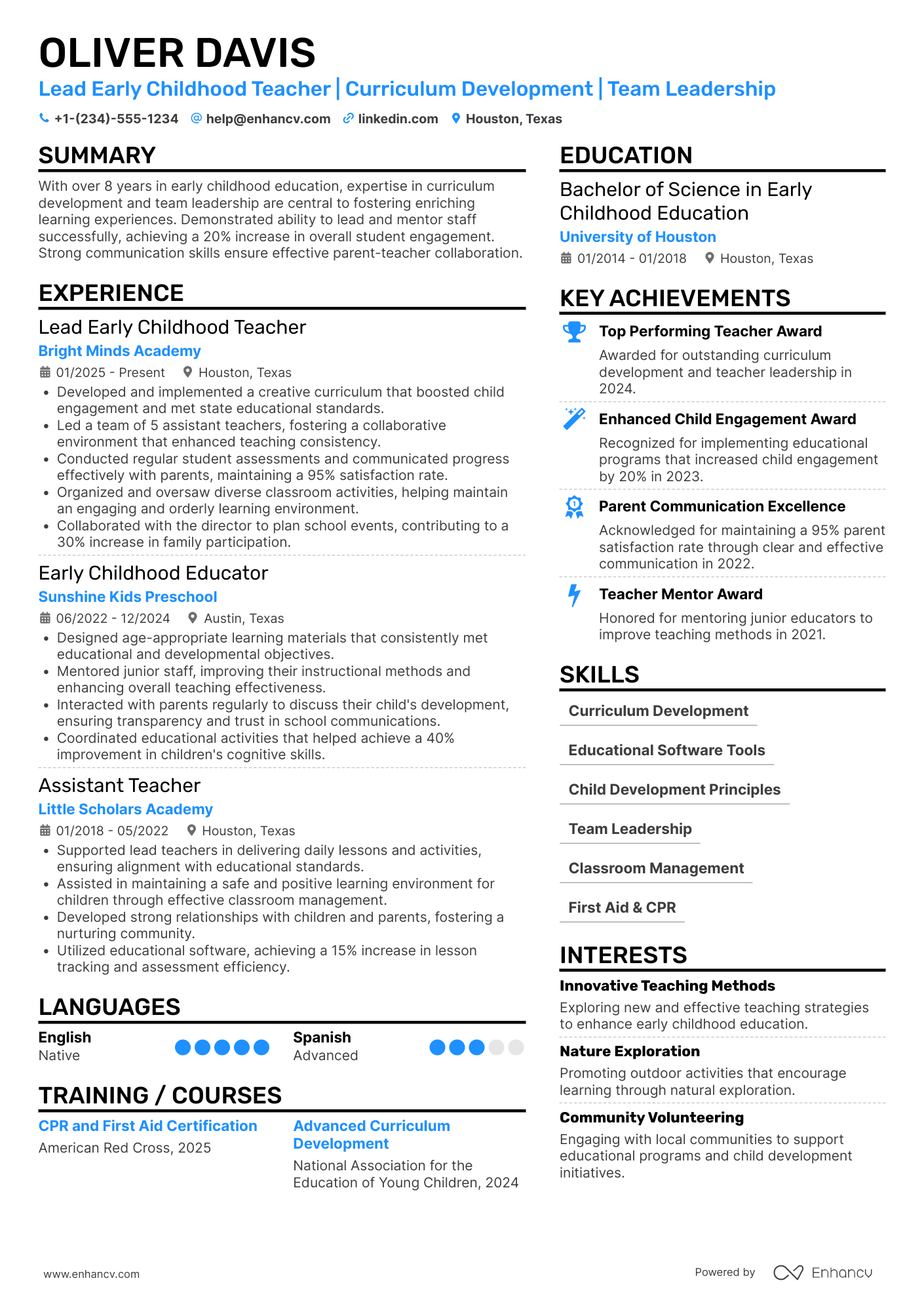
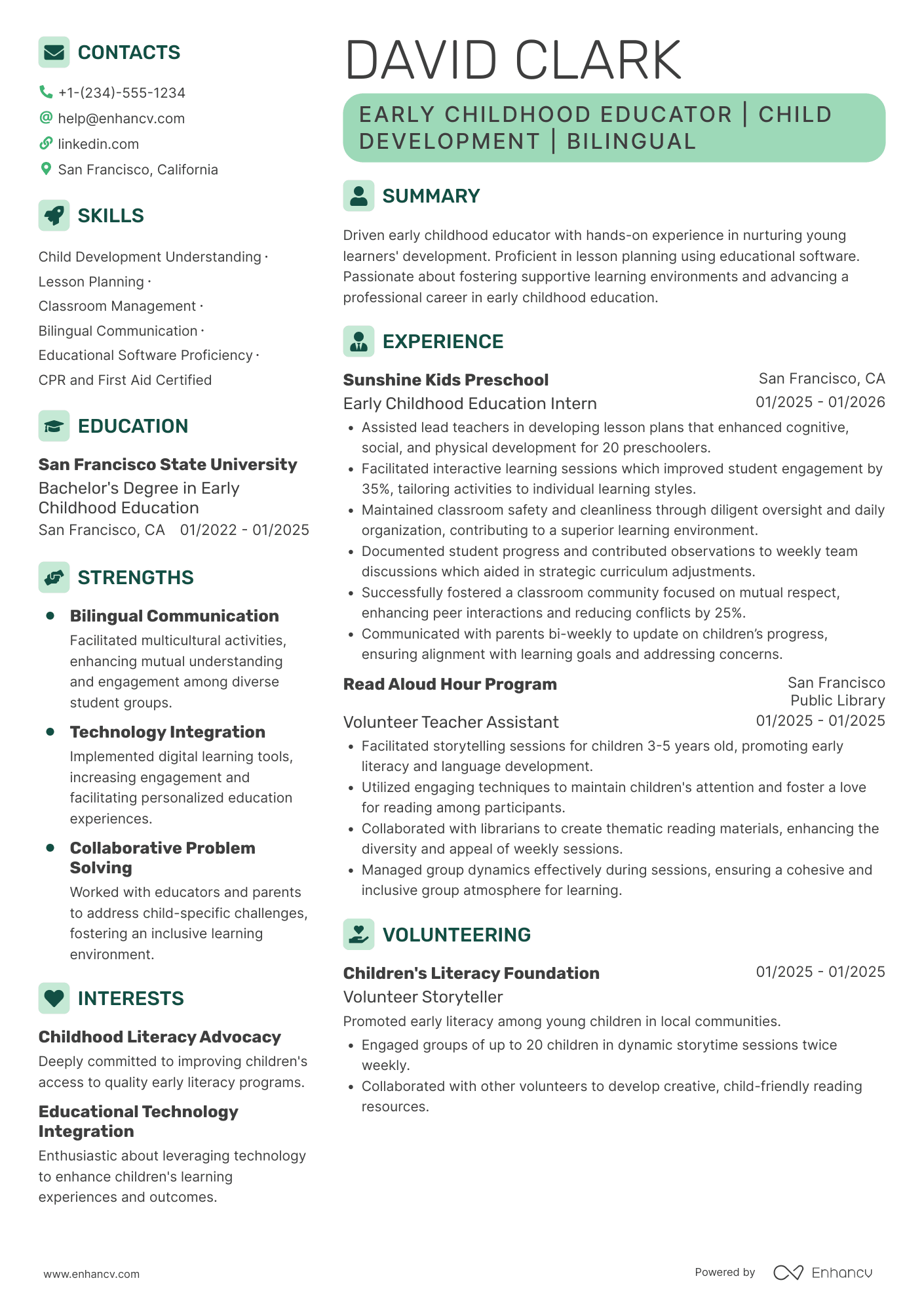
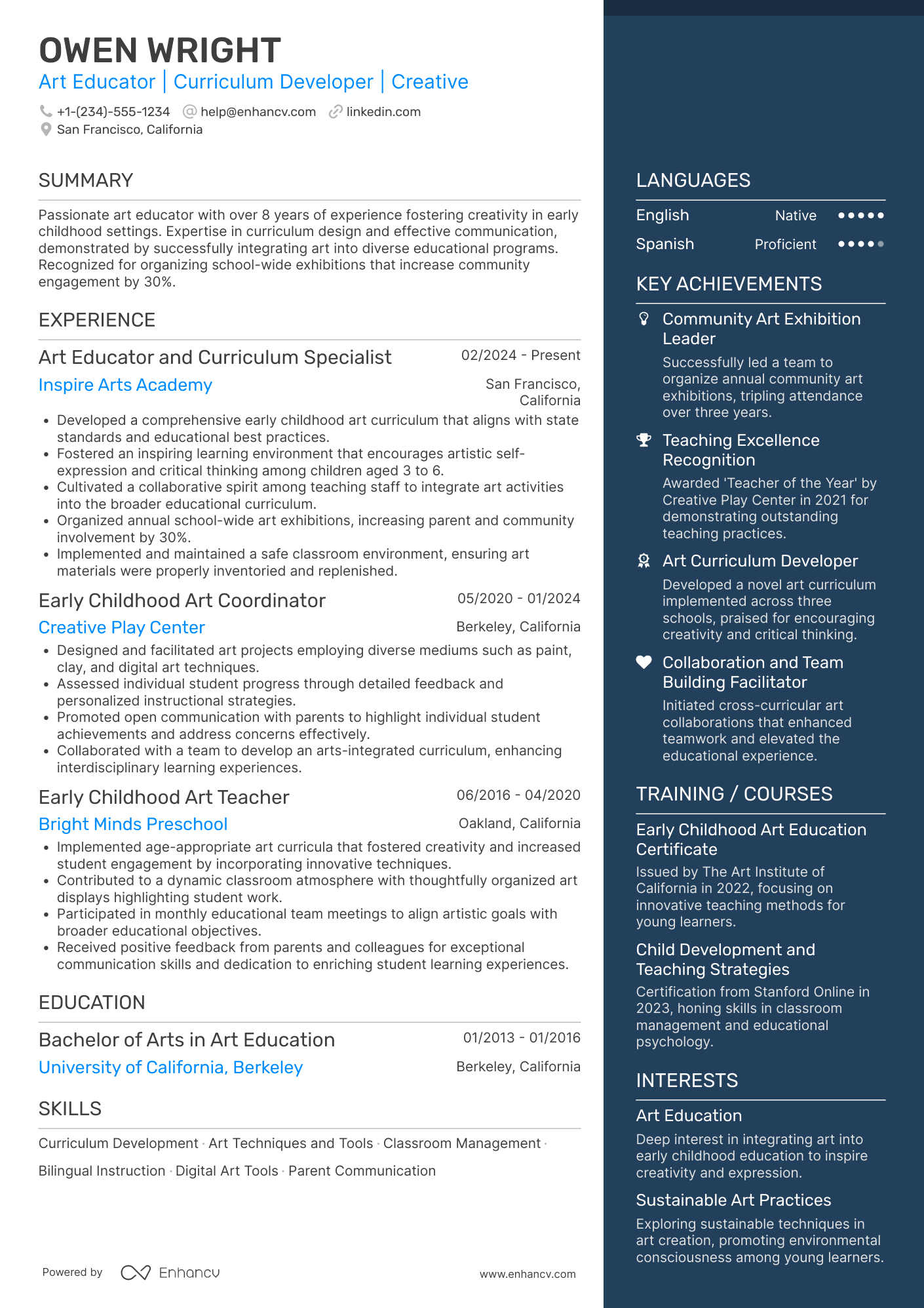
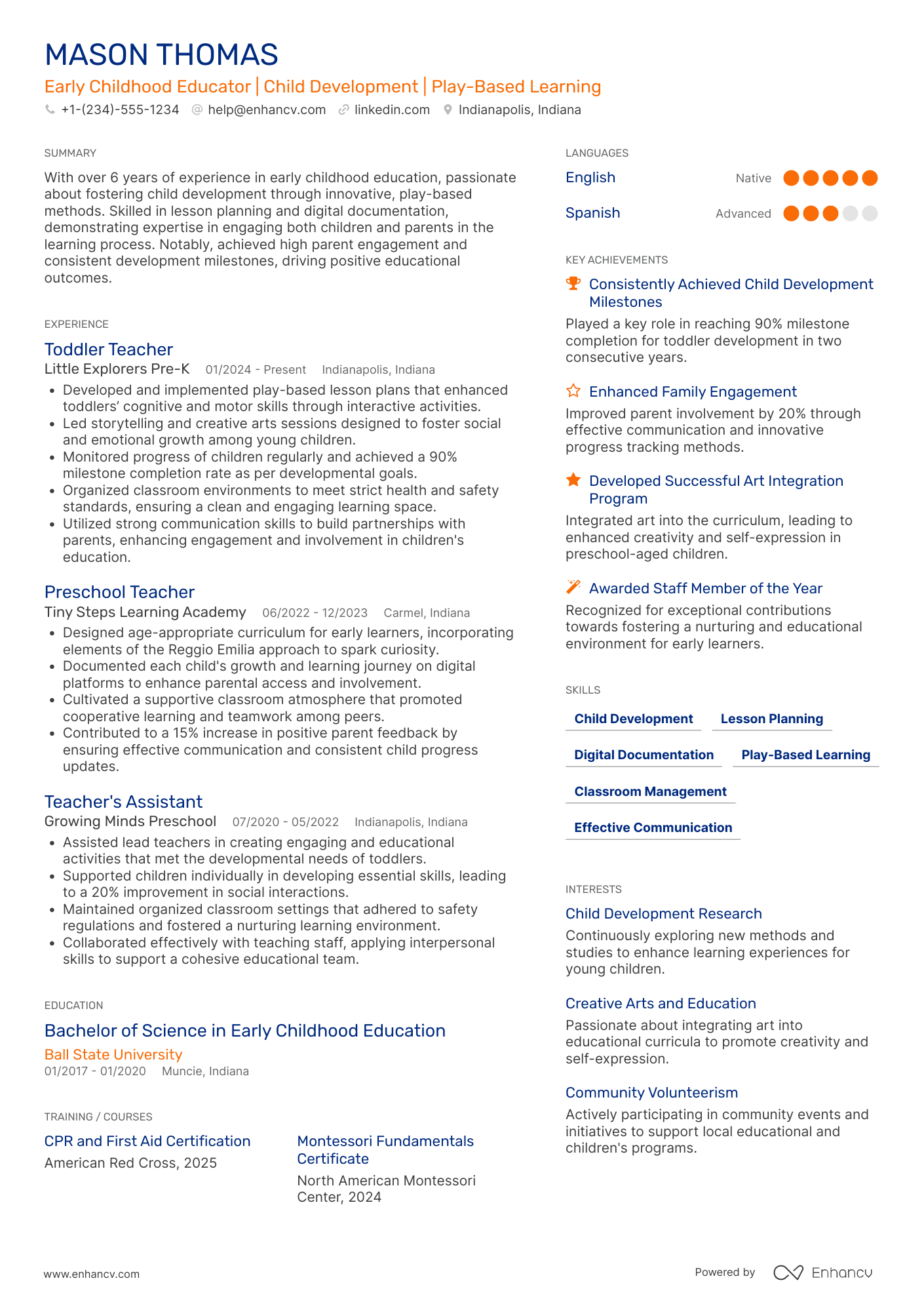
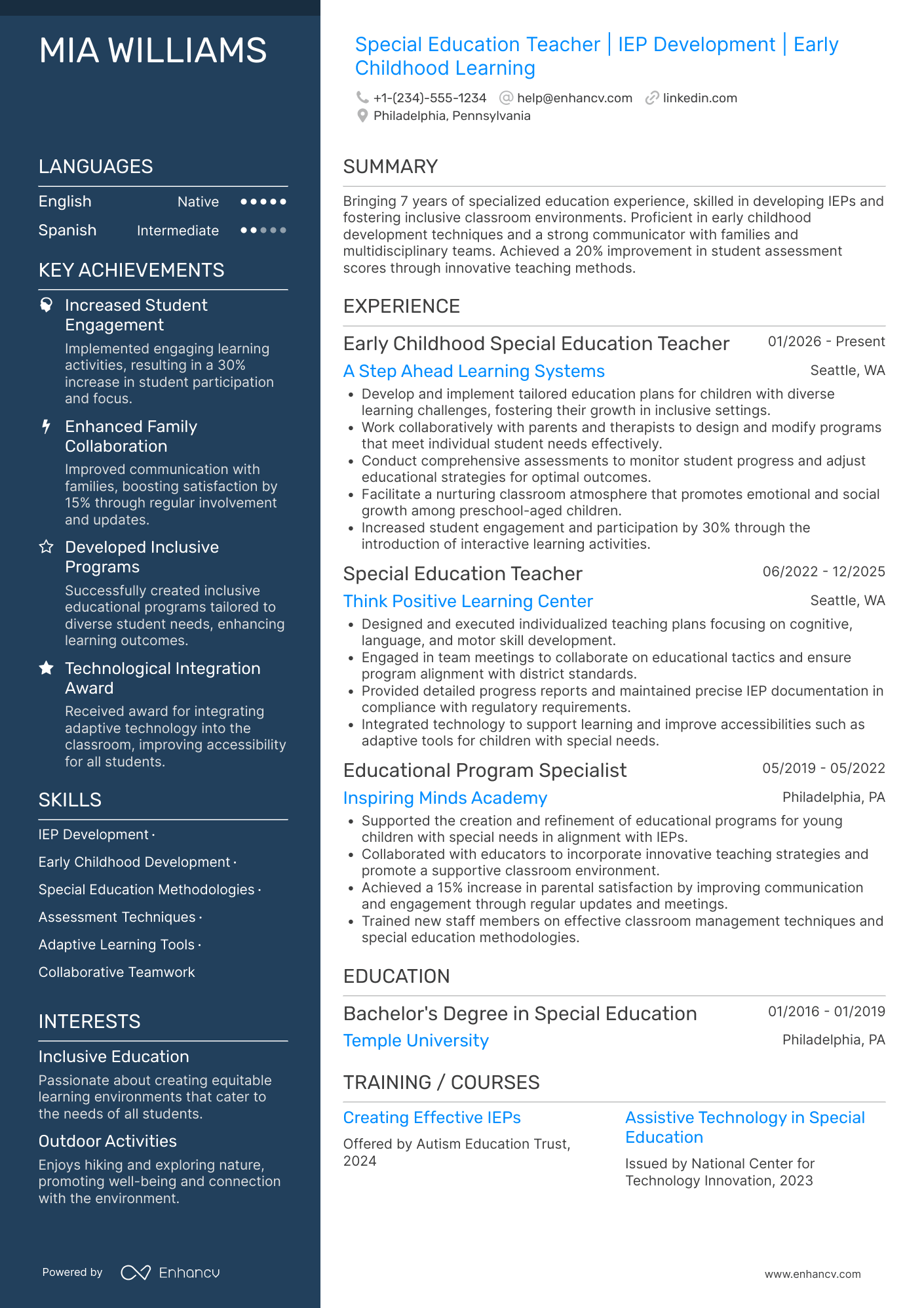
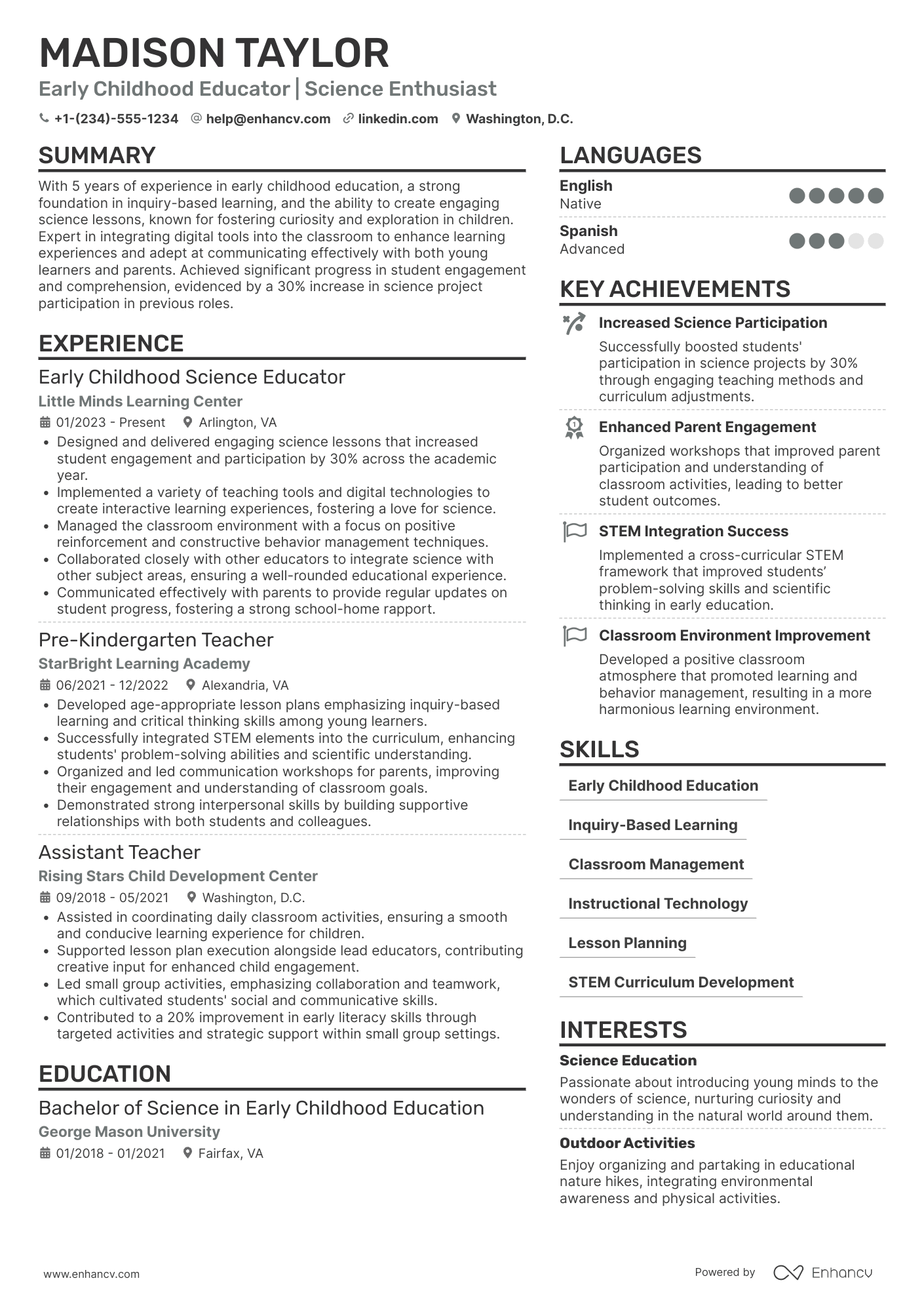
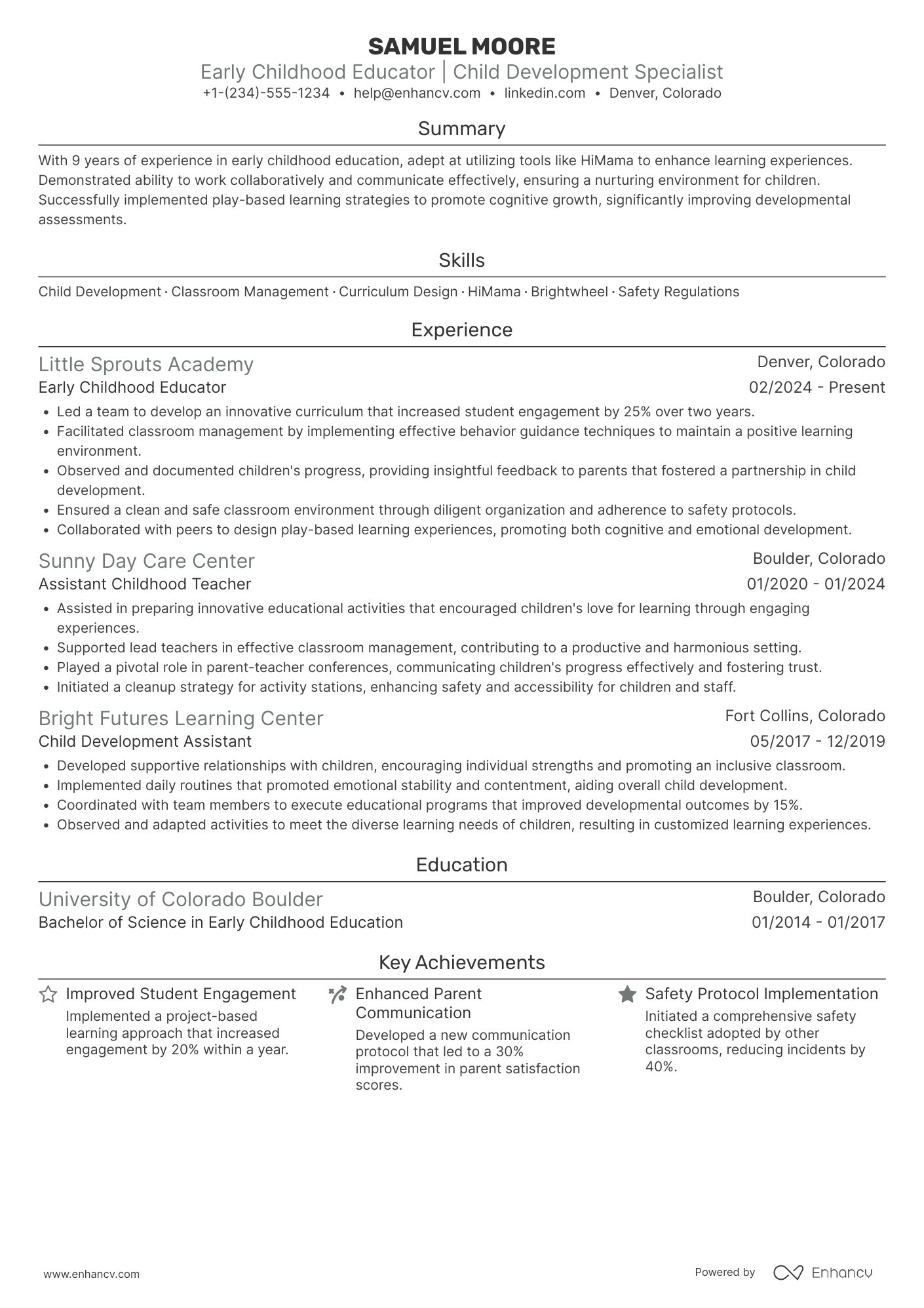
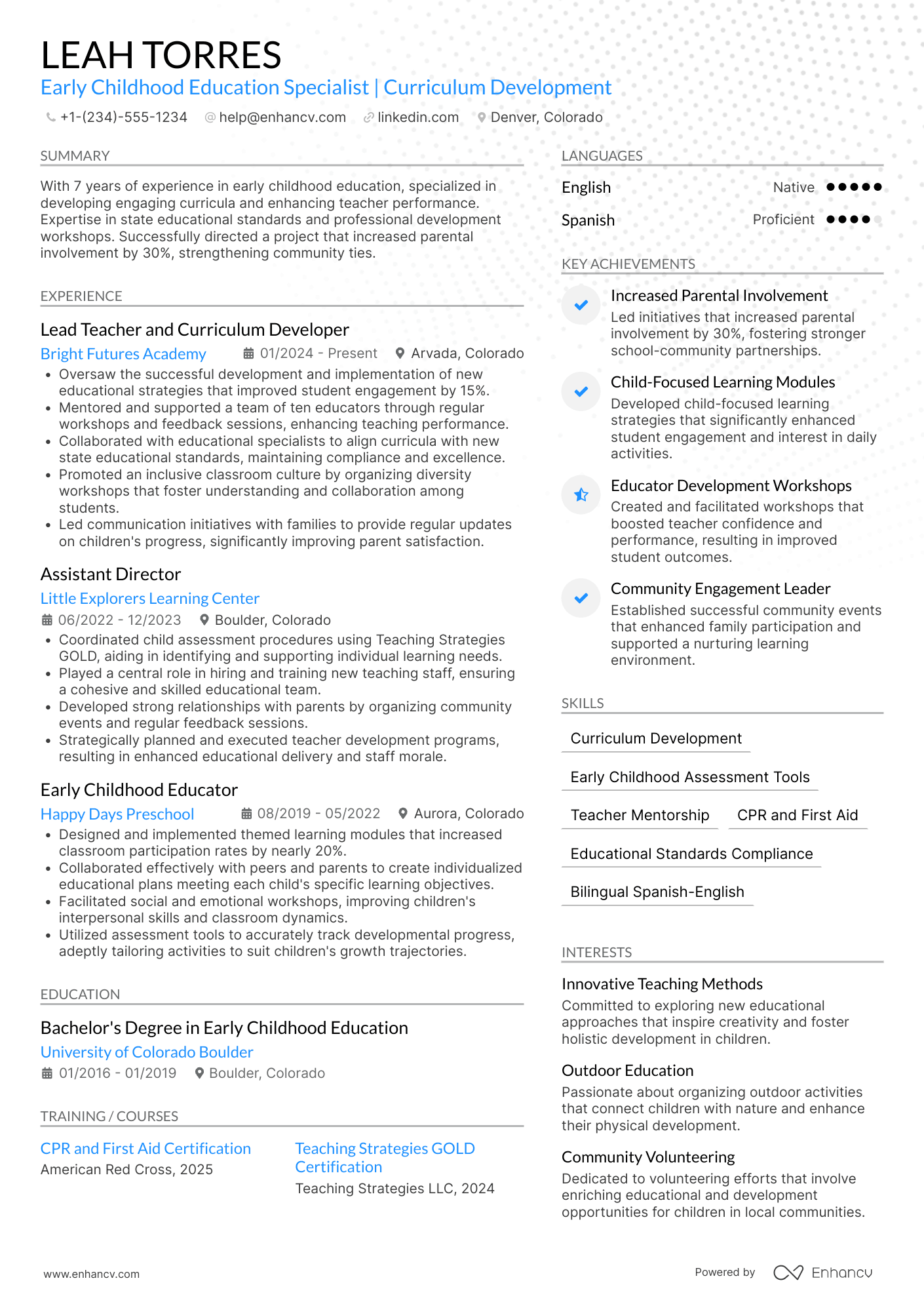
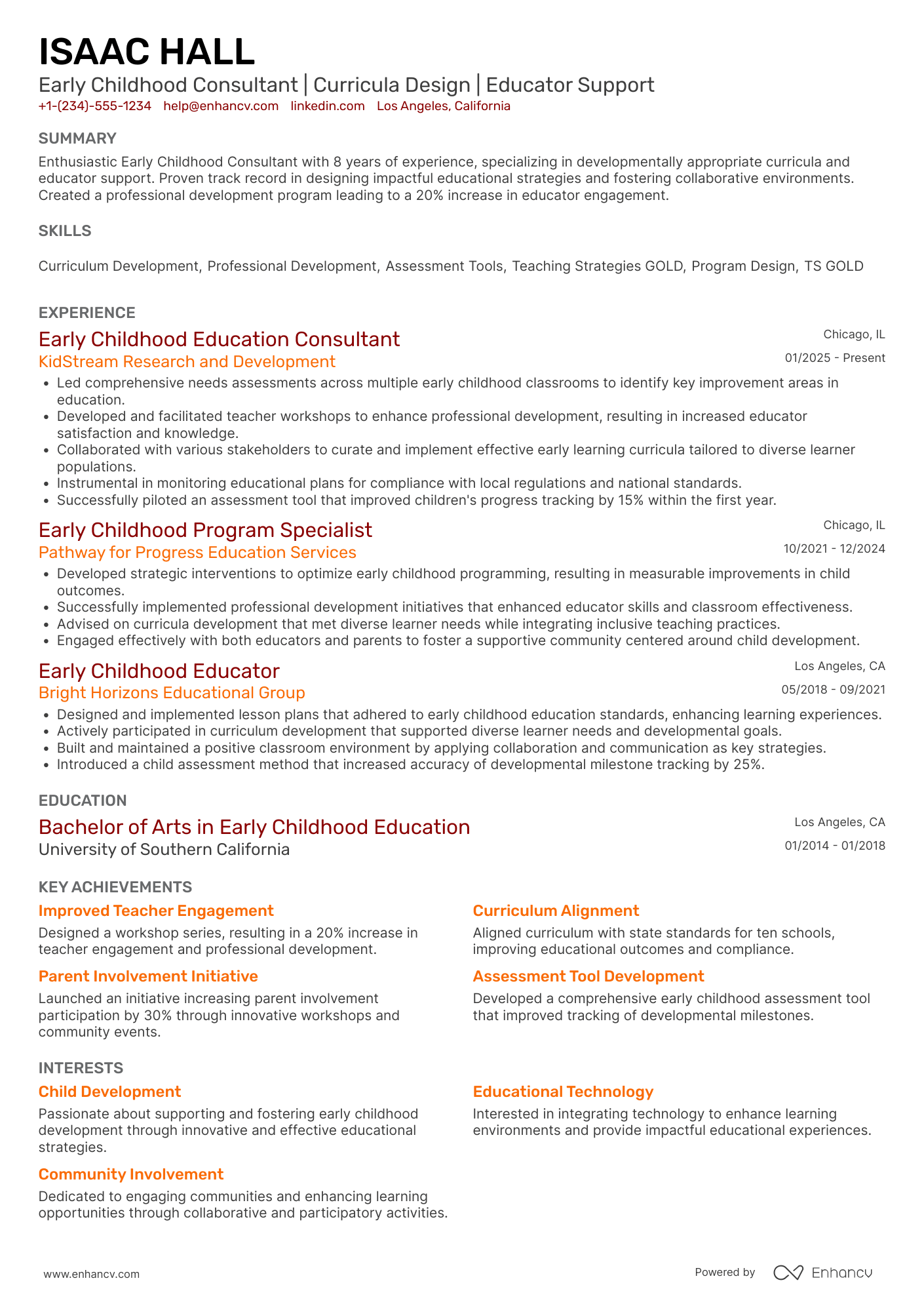
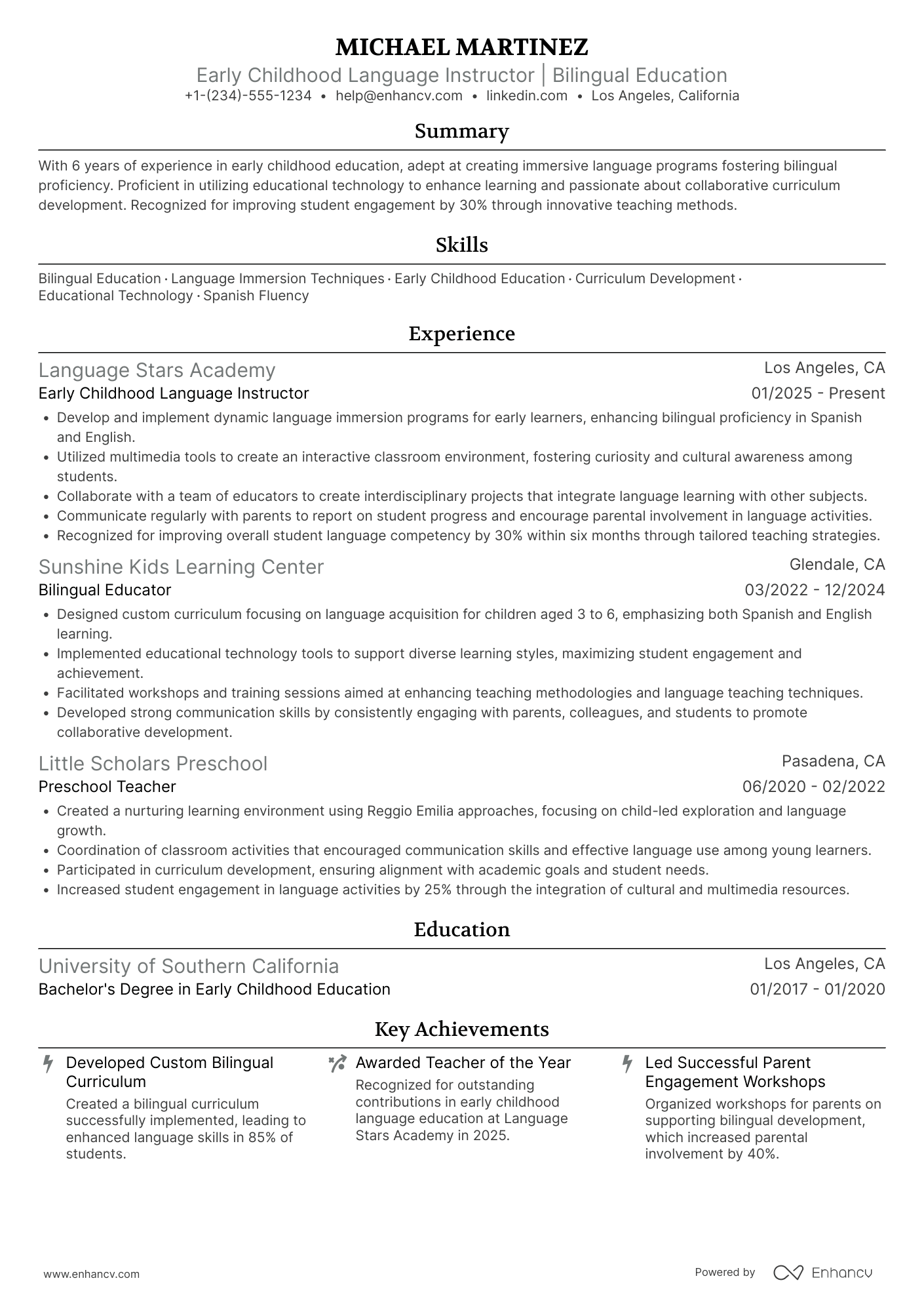
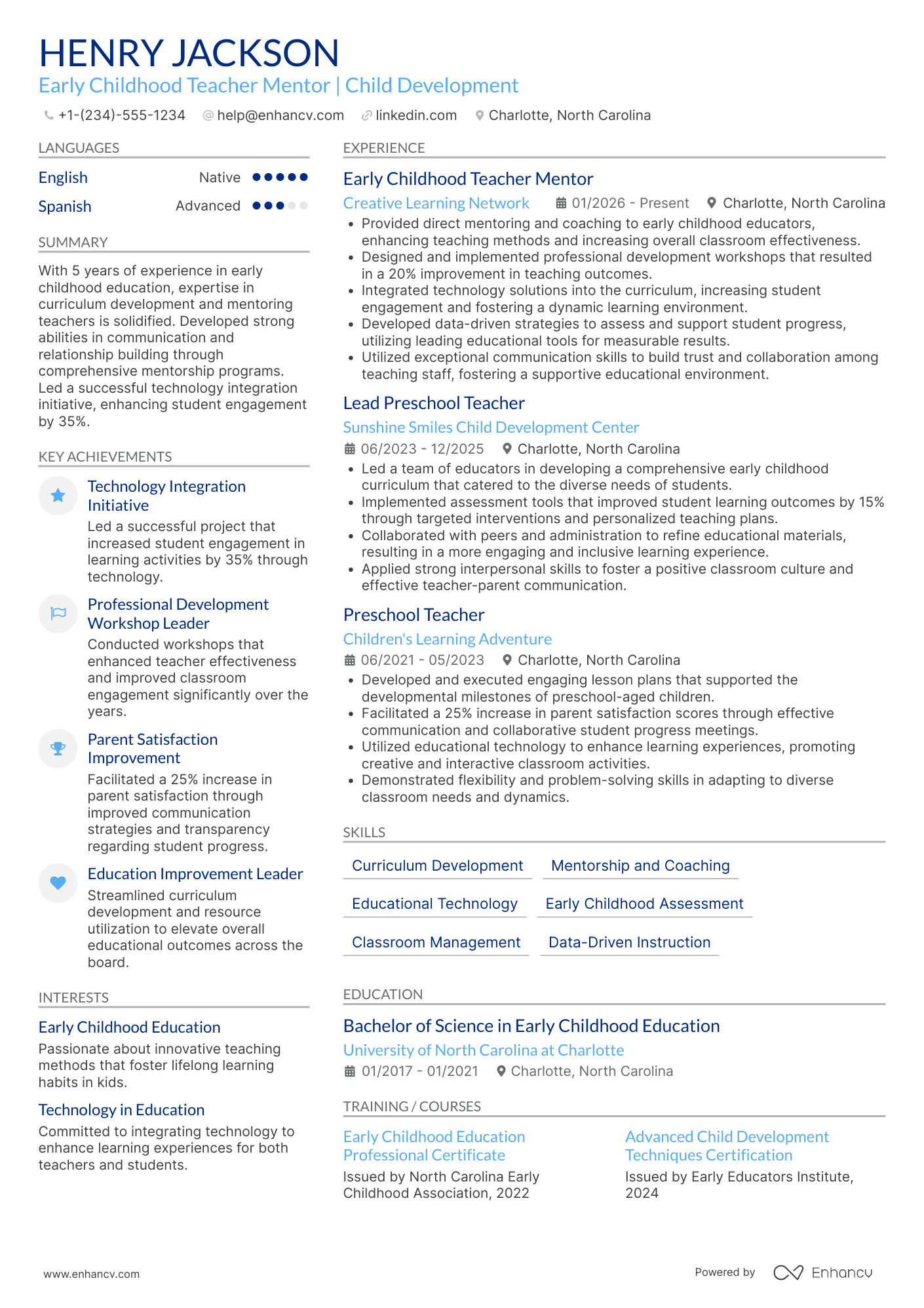
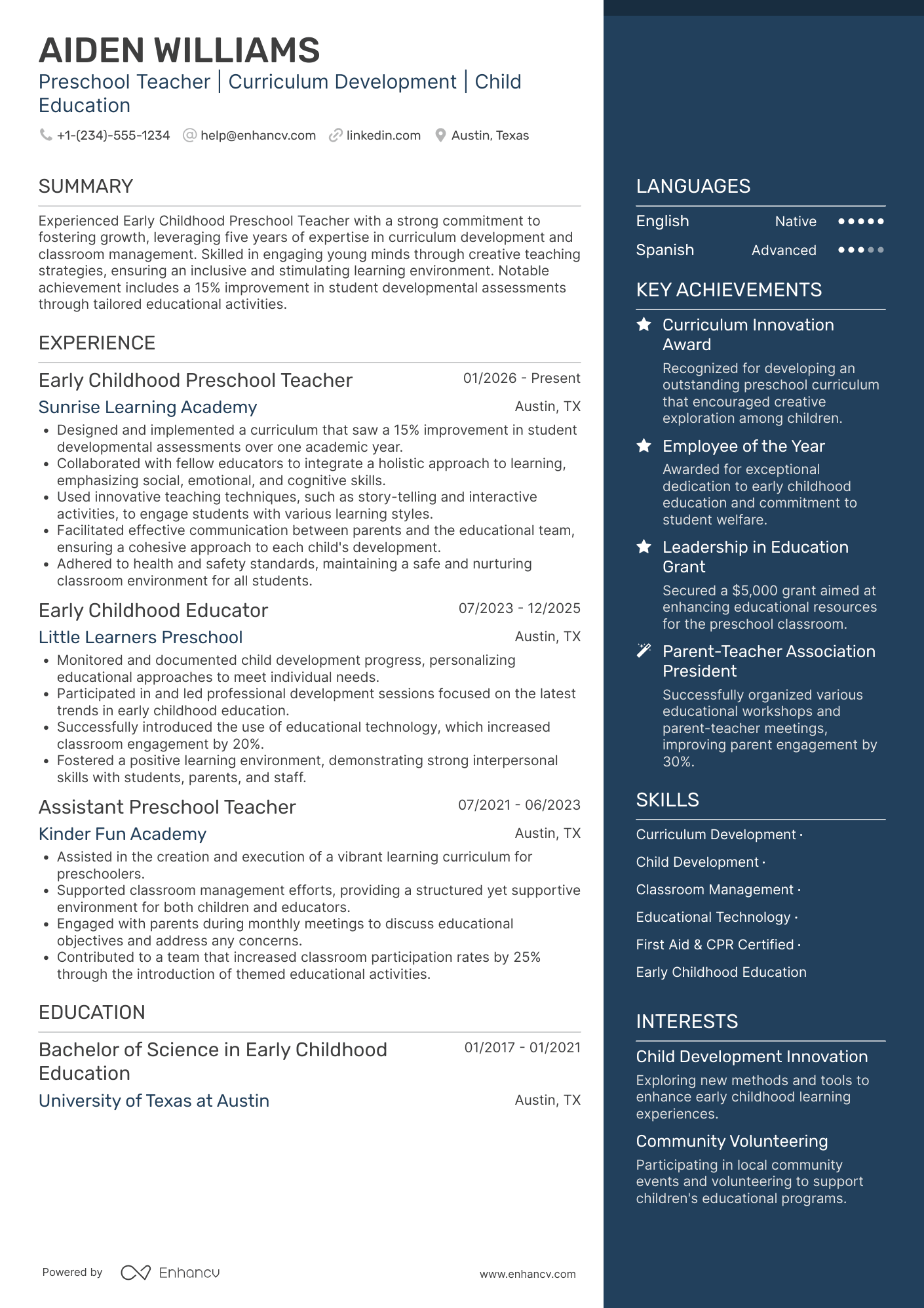
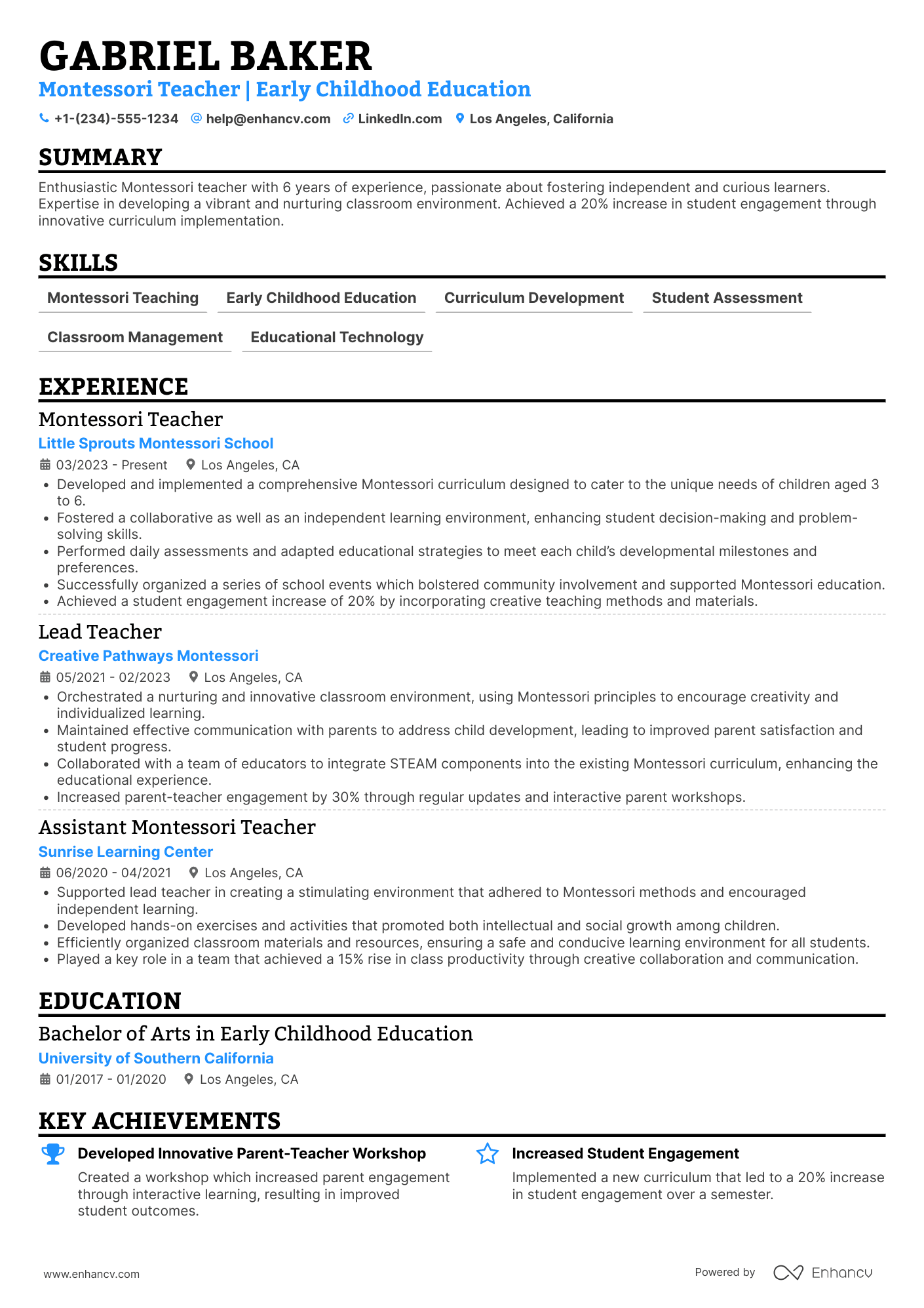
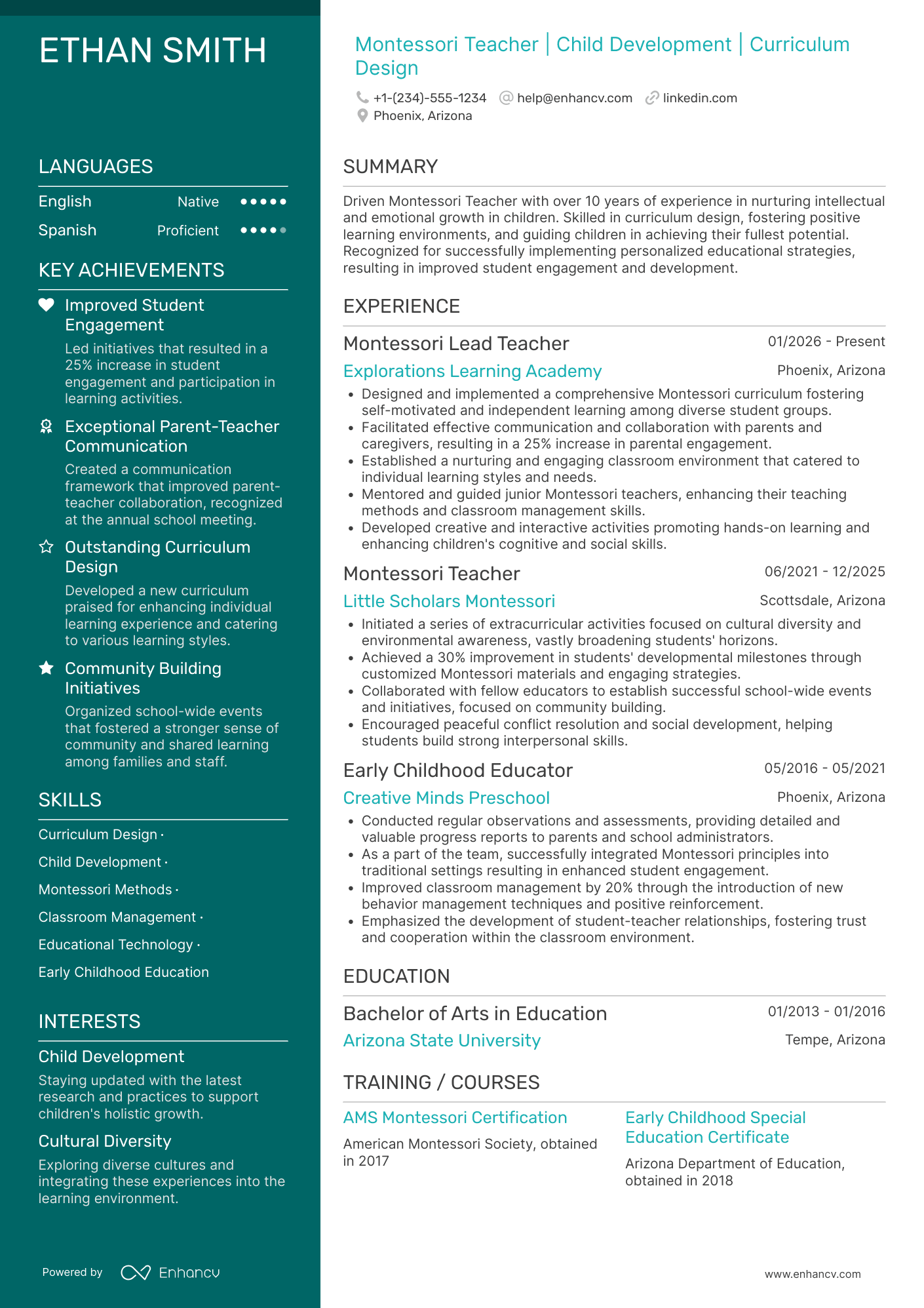
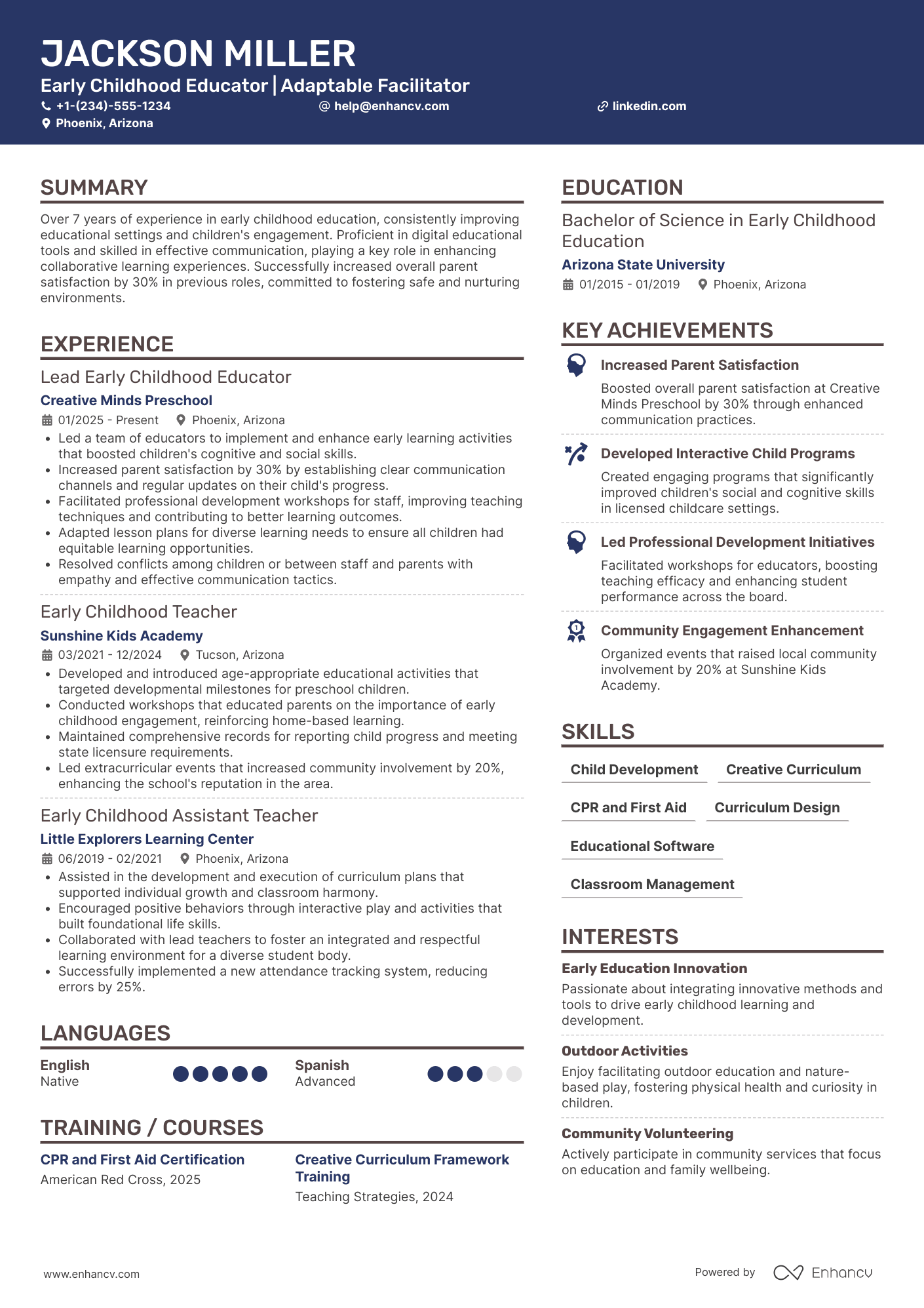
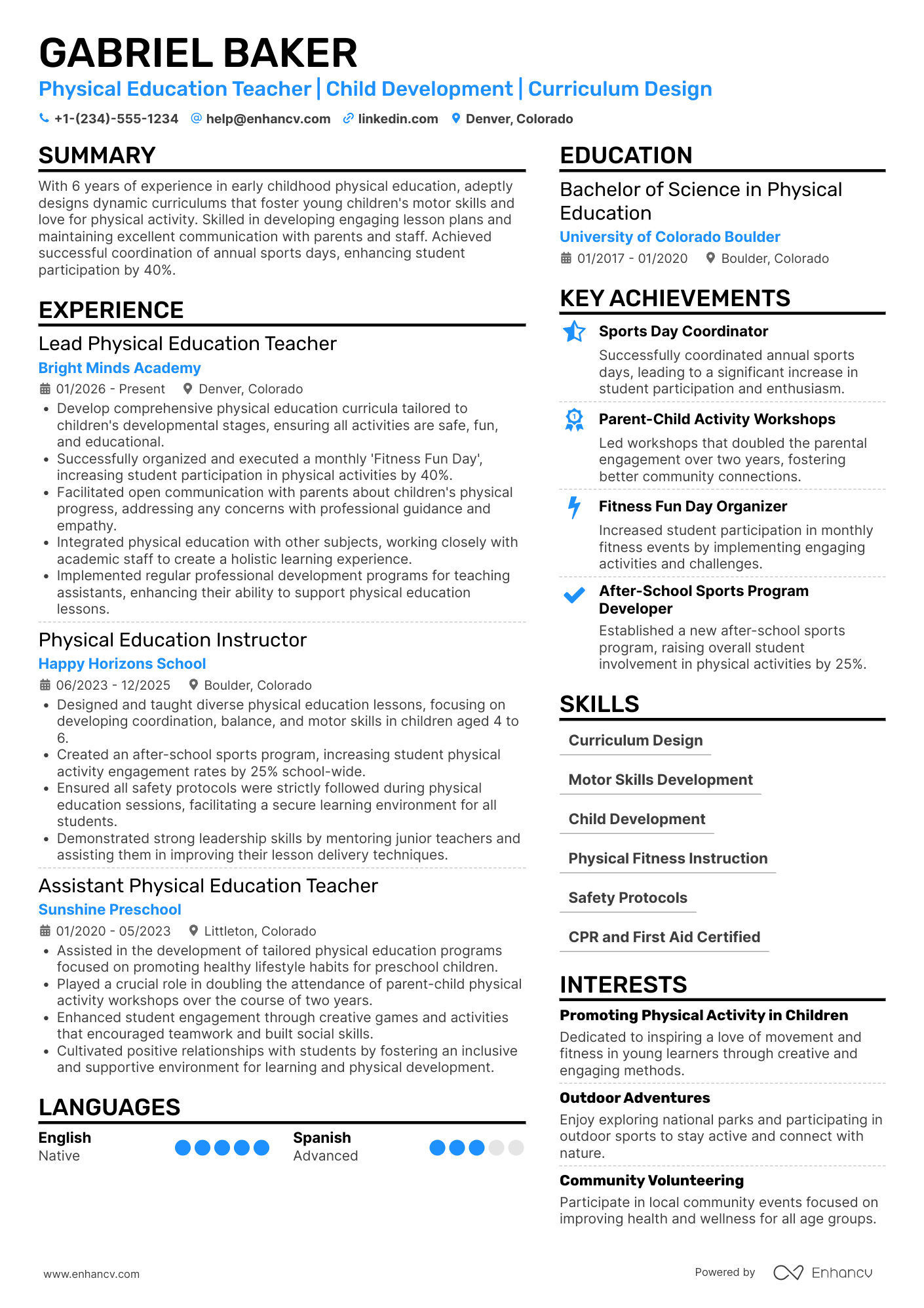
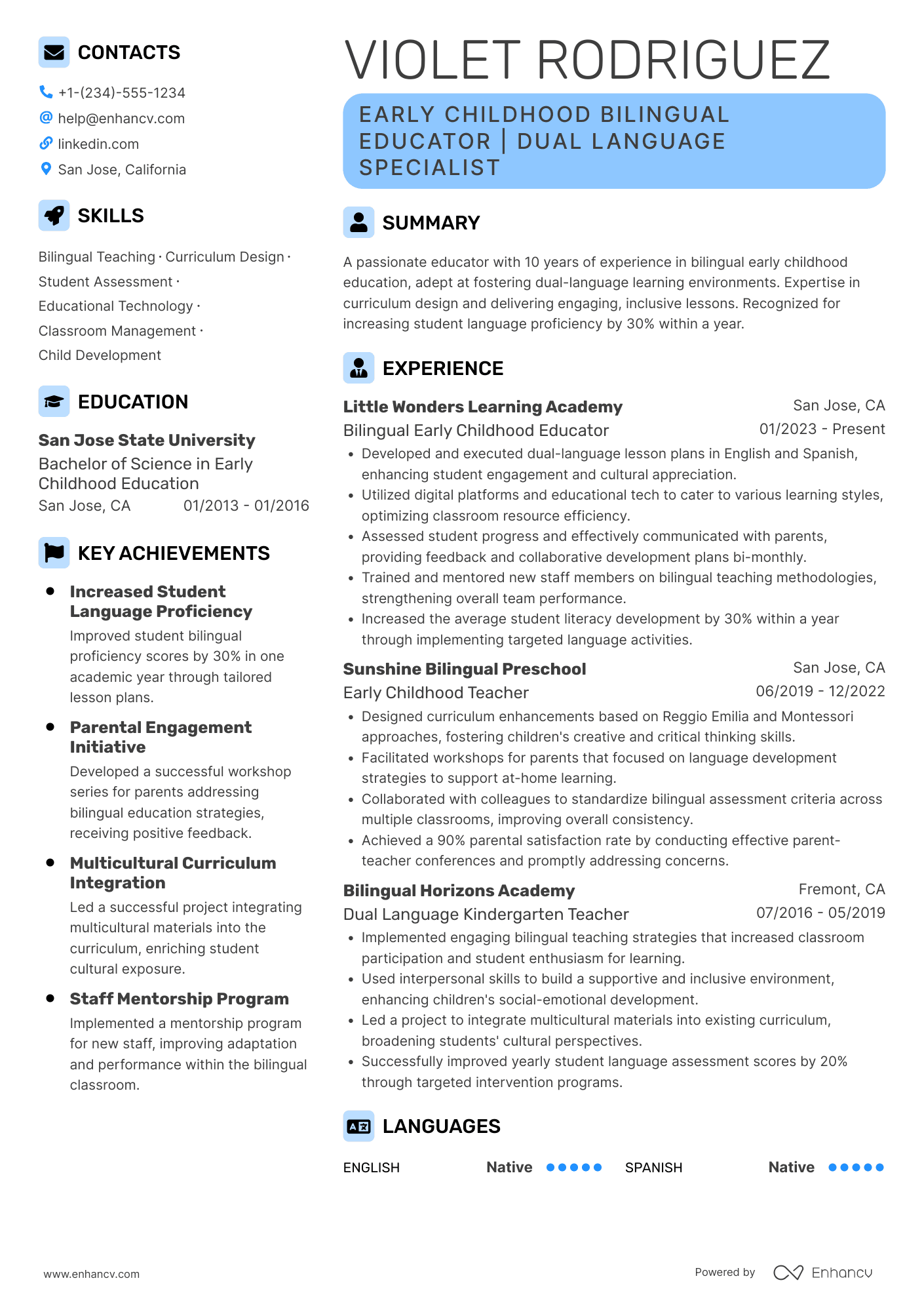
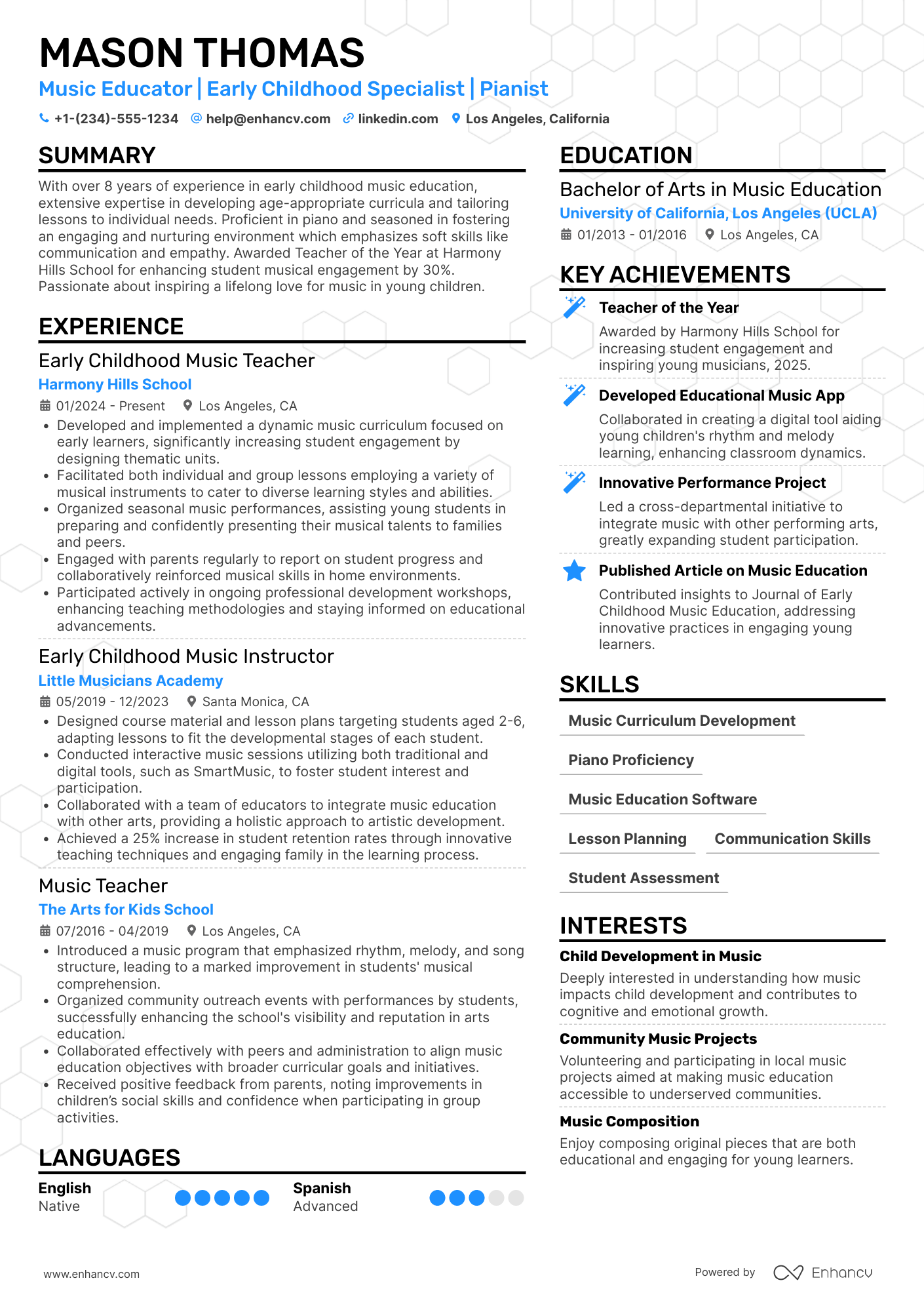
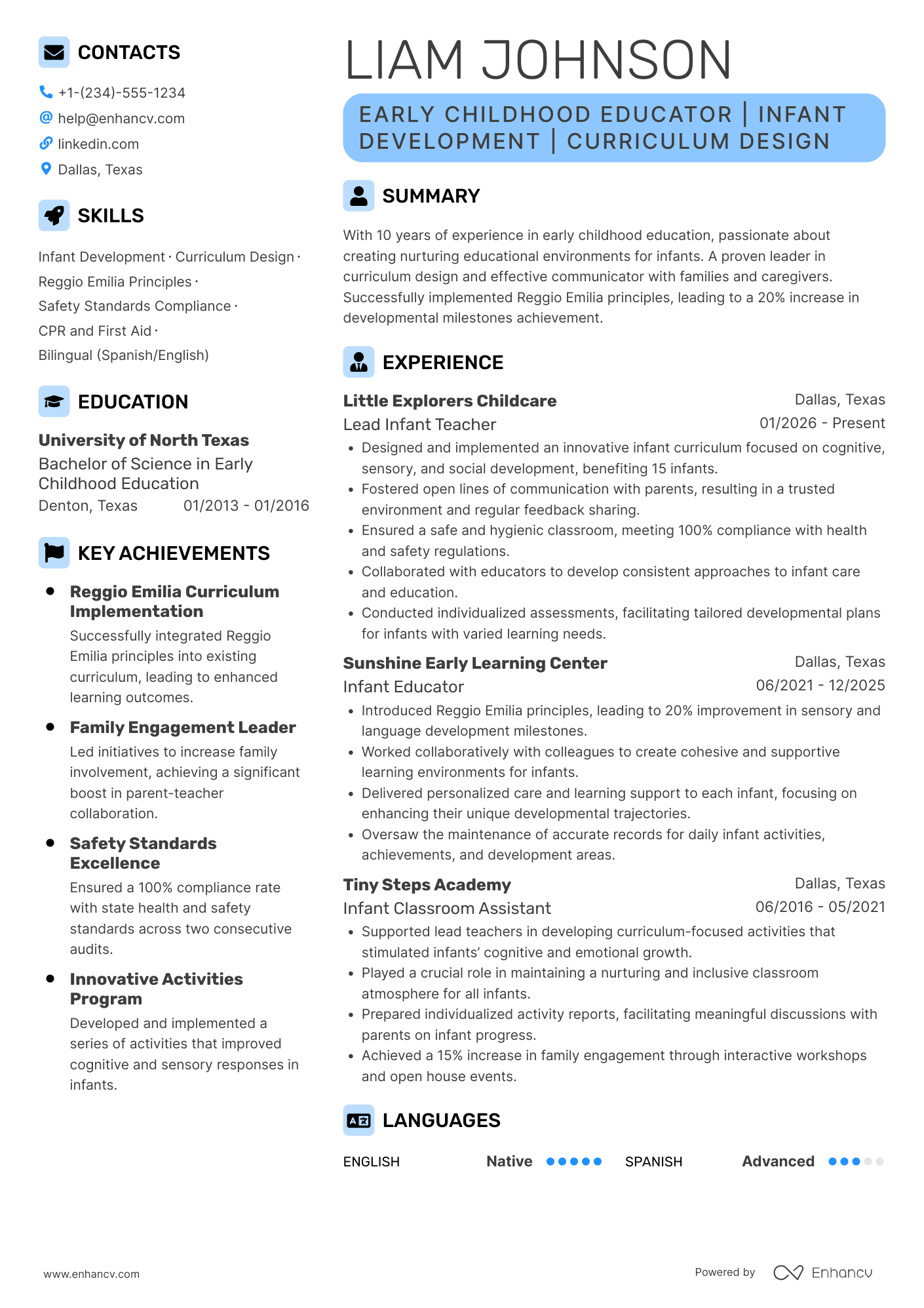
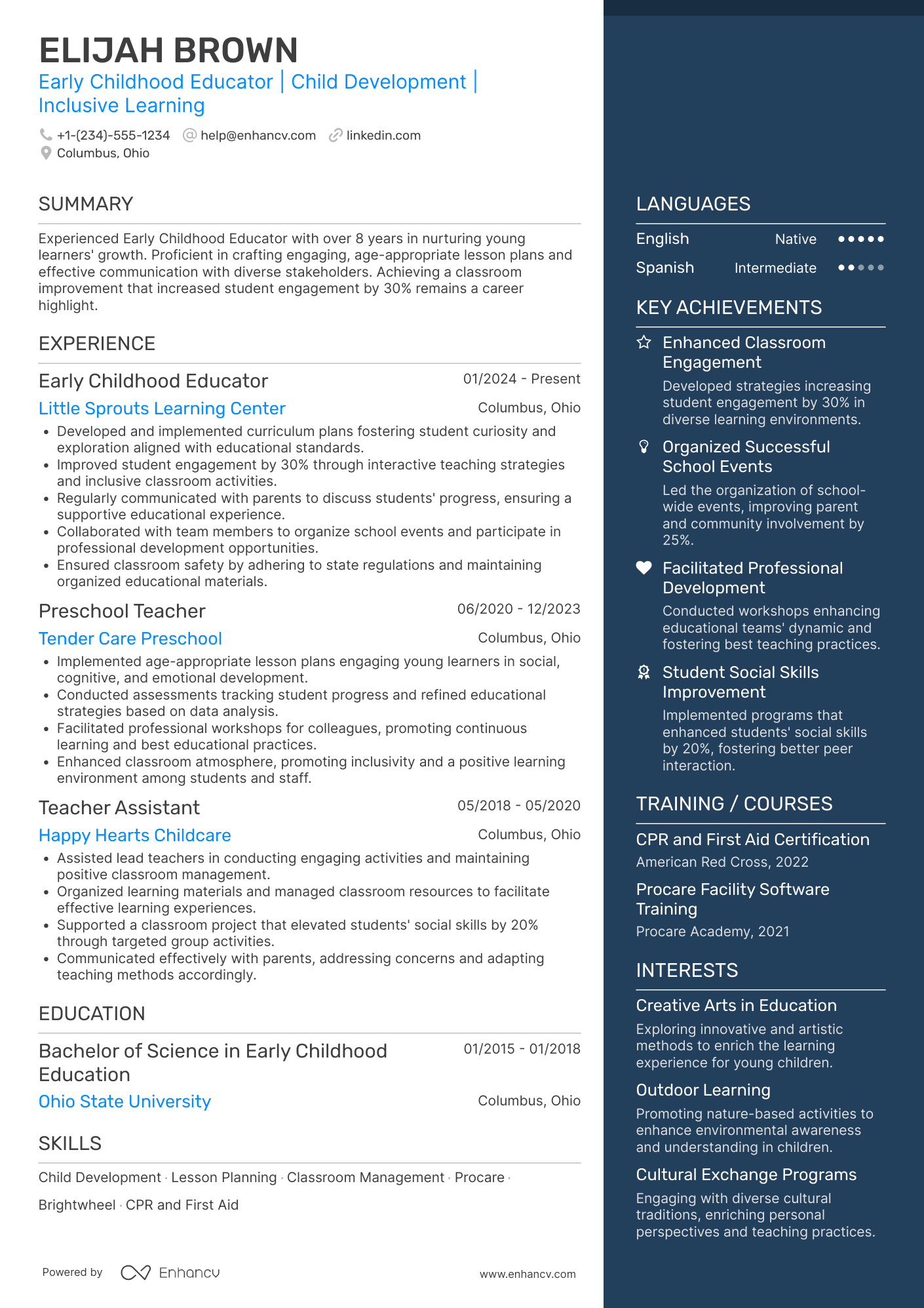
Early childhood teacher resume submissions often fail because they list duties without evidence of child outcomes or family impact. That gets missed by ATS screening and skimmed in seconds by recruiters in a crowded applicant pool.
A strong resume shows what changed because of your work. Knowing how to make your resume stand out means you should highlight gains in kindergarten readiness, higher assessment scores, fewer behavior incidents, improved attendance, stronger family engagement rates, successful Individualized Education Program support, and smoother classroom transitions.

Key takeaways
- Quantify classroom outcomes like readiness scores and behavior reductions instead of listing duties.
- Use reverse-chronological format for experienced teachers and hybrid format for career changers.
- Tailor every experience bullet to mirror the job posting's frameworks, tools, and age groups.
- Place certifications like CDA or CPR prominently—they often influence early childhood hiring decisions.
- Tie each listed skill to a measurable result in your experience or summary section.
- Write a three- to four-line summary stating your title, setting, and strongest outcome.
- Use Enhancv to turn vague responsibilities into specific, recruiter-ready resume bullets faster.
Job market snapshot for early childhood teachers
We analyzed 79 recent early childhood teacher job ads across major US job boards. These numbers help you understand regional hotspots, industry demand, role specialization trends at a glance.
What level of experience employers are looking for early childhood teachers
| Years of Experience | Percentage found in job ads |
|---|---|
| 1–2 years | 7.6% (6) |
| 10+ years | 5.1% (4) |
| Not specified | 87.3% (69) |
Early childhood teacher ads by area of specialization (industry)
| Industry (Area) | Percentage found in job ads |
|---|---|
| Education | 54.4% (43) |
| Finance & Banking | 34.2% (27) |
Top companies hiring early childhood teachers
| Company | Percentage found in job ads |
|---|---|
| Bright Horizons Family Solutions | 22.8% (18) |
Role overview stats
These tables show the most common responsibilities and employment types for early childhood teacher roles. Use them to align your resume with what employers expect and to understand how the role is structured across the market.
Day-to-day activities and top responsibilities for a early childhood teacher
| Responsibility | Percentage found in job ads |
|---|---|
| Iep | 5.1% (4) |
| Instructional strategies | 5.1% (4) |
| Classroom management | 3.8% (3) |
| Cpr | 3.8% (3) |
| Special education | 3.8% (3) |
| Technology | 3.8% (3) |
| Aed | 2.5% (2) |
| Assessment | 2.5% (2) |
| Cda | 2.5% (2) |
| Child growth and development | 2.5% (2) |
| Common core state standards | 2.5% (2) |
| Communication | 2.5% (2) |
How to format a early childhood teacher resume
Recruiters hiring early childhood teachers prioritize classroom management skills, developmentally appropriate teaching practices, and evidence of positive student outcomes. Choosing the right resume format ensures these signals surface quickly during both human review and applicant tracking system (ATS) scans.

I have significant experience as an early childhood teacher—which format should I use?
Use a reverse-chronological format to present your teaching career in a clear, progression-driven timeline that highlights growing classroom responsibility. Do:
- Lead with your most recent role and emphasize scope—grade levels taught, class sizes managed, and any mentorship or curriculum leadership responsibilities.
- Feature role-specific tools and domains prominently, including early literacy programs, individualized education program (IEP) collaboration, assessment platforms like Teaching Strategies GOLD, and state early learning standards.
- Quantify student outcomes and program impact wherever possible, tying your contributions to measurable gains in readiness, behavior, or family engagement.
I'm junior or switching into early childhood education—what format works best?
A hybrid format works best because it lets you lead with relevant skills and certifications while still providing a concise work history that shows practical application. Do:
- Place a dedicated skills section near the top of your resume featuring competencies like child development milestones, positive behavior intervention, creative lesson planning, and parent communication.
- Include student teaching placements, practicums, volunteer tutoring, or childcare experience as transitional experience entries with clear descriptions of your classroom contributions.
- Connect every action to an outcome—even in non-traditional roles—so recruiters can see your ability to drive learning results.
Why not use a functional resume?
A functional format strips away the timeline of your teaching experience, making it difficult for hiring managers to verify where and when you applied your classroom skills—something school administrators weigh heavily during screening. A functional resume may be acceptable if you're transitioning from a related caregiving or youth services role and have limited formal classroom history, but you should still tie every listed skill to a specific project, practicum, or measurable outcome.
Now that you've established a clean, readable layout, it's time to fill it with the right sections that highlight your qualifications as an early childhood teacher.
What sections should go on a early childhood teacher resume
Recruiters expect to see clear evidence you can create safe, developmentally appropriate learning experiences and communicate effectively with children and families. Understanding what to put on a resume helps you use this structure for maximum clarity:
- Header
- Summary
- Experience
- Skills
- Projects
- Education
- Certifications
- Optional sections: Awards, Volunteering, Languages
Strong experience bullets should emphasize measurable child progress, classroom outcomes, family engagement results, and the scope of students, routines, and programs you supported.
Is your resume good enough?
Drop your resume here or choose a file. PDF & DOCX only. Max 2MB file size.
Now that you’ve organized the key parts of your resume, the next step is writing your early childhood teacher resume experience so your responsibilities and results fit that structure.
How to write your early childhood teacher resume experience
Your experience section should highlight the teaching strategies, classroom environments, and developmental programs you've delivered—along with the measurable outcomes they produced. Hiring managers prioritize demonstrated impact on children's growth, family engagement, and curriculum goals over descriptive task lists. Building a targeted resume ensures each bullet speaks directly to the role you're applying for.
Each entry should include:
- Job title
- Company and location (or remote)
- Dates of employment (month and year)
Three to five concise bullet points showing what you owned, how you executed, and what outcomes you delivered:
- Ownership scope: the classrooms, age groups, curriculum areas, or developmental programs you were directly accountable for as an early childhood teacher.
- Execution approach: the instructional frameworks, assessment tools, classroom management techniques, or play-based learning methods you used to guide daily instruction and developmental planning.
- Value improved: changes to learning readiness, behavioral outcomes, developmental milestones, classroom accessibility, or program quality tied to your teaching practice.
- Collaboration context: how you partnered with parents, special education staff, administrators, therapists, or community organizations to support whole-child development.
- Impact delivered: outcomes expressed through improvements in school readiness, family satisfaction, program retention, or alignment with state early learning standards rather than a list of daily responsibilities.
Experience bullet formula
A early childhood teacher experience example
✅ Right example - modern, quantified, specific.
Early childhood teacher
Bright Horizons Learning Center | Austin, TX
2021–Present
NAEYC-aligned early learning center serving 120 children ages two to five across eight classrooms.
- Designed and delivered play-based, standards-aligned literacy and numeracy instruction using Teaching Strategies GOLD and Canva; increased kindergarten readiness scores by 18% across two assessment cycles.
- Implemented positive behavior supports and Conscious Discipline routines with visual schedules and ClassDojo updates; reduced classroom incident reports by 32% and improved transition time by ten minutes per day.
- Built and tracked individualized learning plans and interventions in Brightwheel, partnering with speech-language pathologists and occupational therapists; improved goal attainment by 25% for twelve children on active support plans.
- Led weekly family communication and conferences using Brightwheel messaging, bilingual handouts, and translation support; raised family engagement participation from 64% to 87% and improved satisfaction survey results by 0.6 points (five-point scale).
- Coordinated with the center director and a four-teacher team to strengthen health, safety, and licensing compliance using digital checklists and incident logs; achieved zero critical findings across two state inspections.
Now that you've seen how a strong experience section comes together, let's look at how to adjust yours to match a specific job posting.
How to tailor your early childhood teacher resume experience
Recruiters evaluate your early childhood teacher resume through both applicant tracking systems and manual review. Tailoring your resume to the job description ensures your qualifications stand out in both rounds.
Ways to tailor your early childhood teacher experience:
- Match curriculum frameworks like Creative Curriculum or HighScope from the posting.
- Use the exact developmental screening tools the job description names.
- Mirror language for classroom management approaches the employer prefers.
- Reflect specific age groups or grade levels stated in the listing.
- Highlight family engagement strategies when the posting emphasizes parent communication.
- Include state licensing standards or NAEYC accreditation criteria mentioned in requirements.
- Reference IEP collaboration or inclusive practices if the role requires them.
- Align assessment methods with progress monitoring systems the employer uses.
Tailoring means connecting your real accomplishments to what the employer asks for, not forcing unrelated keywords into your experience.
Resume tailoring examples for early childhood teacher
| Job description excerpt | Untailored | Tailored |
|---|---|---|
| "Implement play-based learning aligned with the Creative Curriculum framework for children ages 3–5, supporting developmental milestones across cognitive, social-emotional, and physical domains." | Planned and led daily classroom activities for young children. | Designed and facilitated play-based learning experiences using the Creative Curriculum framework for 18 children ages 3–5, tracking progress across cognitive, social-emotional, and physical developmental milestones through weekly observational assessments. |
| "Conduct developmental screenings using ASQ-3 and maintain accurate documentation in Teaching Strategies GOLD to inform individualized learning plans." | Completed assessments and kept records of student progress. | Administered ASQ-3 developmental screenings for a classroom of 20 children each quarter and documented ongoing observations in Teaching Strategies GOLD to build individualized learning plans addressing identified skill gaps. |
| "Partner with families and multidisciplinary teams, including speech-language pathologists and occupational therapists, to support children with IEPs in an inclusive classroom setting." | Communicated with parents and worked with other staff members as needed. | Collaborated with families, speech-language pathologists, and occupational therapists to implement IEP accommodations for six children in an inclusive classroom, contributing to measurable gains in language and fine motor goals during annual reviews. |
Once you’ve aligned your experience with the role’s needs, quantify your early childhood teacher achievements to show the measurable impact of that work.
How to quantify your early childhood teacher achievements
Numbers on your resume prove your classroom impact beyond duties by showing growth, safety, and consistency. Track student progress, family satisfaction, compliance, incident reduction, and volume handled using assessment data, attendance logs, and communication records.
Quantifying examples for early childhood teacher
| Metric | Example |
|---|---|
| Learning progress | "Raised average letter-sound mastery from 45% to 78% in 12 weeks using Teaching Strategies GOLD checklists and small-group phonics stations." |
| Family satisfaction | "Improved parent satisfaction from 4.2 to 4.7 out of 5 across two quarters by launching weekly photo updates and same-day responses in Brightwheel." |
| Safety incidents | "Reduced playground incident reports from eight to three per month by adding a rotating supervision map and reteaching three safety routines." |
| Compliance accuracy | "Maintained 100% on-time immunization and allergy documentation for 18 children for nine months using a monthly audit checklist and locked medication log." |
| Volume handled | "Completed 54 individualized observation notes per month for three classrooms while keeping lesson plans submitted two days before each weekly cycle." |
Turn vague job duties into measurable, recruiter-ready resume bullets in seconds with Enhancv's Bullet Point Generator.
Once you've crafted strong bullet points highlighting your experience, the next step is ensuring your resume also effectively showcases the specific hard and soft skills that early childhood education employers prioritize.
How to list your hard and soft skills on a early childhood teacher resume
Your skills section shows you can run a safe, developmentally appropriate classroom, and recruiters and ATS scan this section to match your qualifications to the job post; aim for a slightly heavier mix of hard skills with targeted soft skills. early childhood teacher roles require a blend of:
- Product strategy and discovery skills.
- Data, analytics, and experimentation skills.
- Delivery, execution, and go-to-market discipline.
- Soft skills.
Your skills section should be:
- Scannable (bullet-style grouping).
- Relevant to the job post.
- Backed by proof in experience bullets.
- Updated with current tools.
Place your skills section:
- Above experience if you're junior or switching careers.
- Below experience if you're mid/senior with strong achievements.

Hard skills
- Classroom management systems
- Lesson planning, unit planning
- Developmentally appropriate practice
- Early literacy instruction
- Early numeracy instruction
- Social-emotional learning instruction
- Individualized Education Programs (IEPs)
- Behavior intervention plans
- Child observation, assessment
- Parent-teacher conference documentation
- Child safety, mandated reporting
- Learning management systems, Seesaw, ClassDojo
Soft skills
- Communicate with families clearly
- Set routines and expectations
- De-escalate challenging behavior
- Collaborate with special education staff
- Coordinate with teaching assistants
- Adapt instruction in real time
- Give specific, timely feedback
- Document concerns objectively
- Prioritize child safety decisions
- Lead calm transitions between activities
- Resolve conflicts between children
- Manage time across daily centers
How to show your early childhood teacher skills in context
Skills shouldn't live only in a bulleted list on your resume. Explore examples of resume skills to see how other professionals present theirs effectively.
They should be demonstrated in:
- Your summary (high-level professional identity)
- Your experience (proof through outcomes)
Here's what both look like in practice.
Summary example
Early childhood educator with 12 years of experience designing play-based curricula using Creative Curriculum and GOLD assessment tools. Boosted kindergarten readiness scores by 30% across three classrooms while mentoring junior teaching staff.
- Reflects senior-level experience clearly
- Names industry-standard tools
- Includes a measurable student outcome
- Highlights mentorship soft skills
Experience example
Lead Preschool Teacher
Bright Horizons | Austin, TX
June 2018–March 2024
- Implemented a STEAM-integrated curriculum using Teaching Strategies GOLD, raising developmental benchmark achievement by 25% across 45 students.
- Partnered with speech therapists and parents to create individualized learning plans, improving communication milestones for 80% of flagged learners.
- Trained four assistant teachers on positive behavior guidance techniques, reducing classroom behavioral incidents by 40% within one semester.
- Every bullet includes measurable proof.
- Skills emerge naturally through outcomes.
Once you’ve tied your teaching strengths to real classroom examples, the next step is to apply that approach to writing an early childhood teacher resume with no experience so your skills still come through clearly.
How do I write a early childhood teacher resume with no experience
Even without full-time experience, you can demonstrate readiness through practicum work, volunteer hours, and relevant coursework. Our guide on writing a resume without work experience walks you through the full approach. Start by highlighting:
- Student teaching classroom placements
- Childcare center volunteer shifts
- Preschool practicum lesson plans
- CPR and first aid certification
- Child development coursework projects
- After-school program support roles
- Family engagement event coordination
- Classroom observation reflection logs
Focus on:
- Age-appropriate lesson planning samples
- Safety, hygiene, and supervision training
- Behavior tracking and documentation
- Parent communication and reporting
Resume format tip for entry-level early childhood teacher
Use a functional resume format because it highlights teaching skills, coursework, and practicum work when you lack paid early childhood teacher experience. Do:
- Lead with a skills summary tied to evidence.
- Add a projects section for practicum work.
- Quantify results using counts, dates, and rates.
- List relevant tools like ClassDojo.
- Include certifications with completion dates.
- Delivered five-day preschool practicum lesson plan using centers, read-alouds, and ClassDojo updates, improving on-task behavior from 60% to 80% in two weeks.
Once you've shaped your resume around transferable skills and relevant coursework, the next step is presenting your education effectively—often the strongest section for candidates entering the field.
How to list your education on a early childhood teacher resume
Your education section helps hiring teams confirm you have the foundational knowledge needed for an early childhood teacher role. It validates your training in child development and pedagogy.
Include:
- Degree name
- Institution
- Location
- Graduation year
- Relevant coursework (for juniors or entry-level candidates)
- Honors & GPA (if 3.5 or higher)
Avoid listing specific months or days—use the graduation year only to keep things clean.
Here's a strong education entry tailored for an early childhood teacher resume:
Example education entry
Bachelor of Science in Early Childhood Education
University of North Carolina at Charlotte, Charlotte, NC
Graduated 2021
GPA: 3.7/4.0
- Relevant Coursework: Child Development Theory, Literacy Instruction for Young Learners, Inclusive Classroom Strategies, Play-Based Learning Methods
- Honors: Magna Cum Laude, Dean's List (six semesters)
How to list your certifications on a early childhood teacher resume
Certifications on your resume show an early childhood teacher's commitment to learning, proficiency with classroom tools, and alignment with current standards in child development and safety.
Include:
- Certificate name
- Issuing organization
- Year
- Optional: credential ID or URL
- List certifications below education when your degree is recent and your certifications support it without adding stronger, role-specific value.
- List certifications above education when they are recent, highly relevant, or required, and they help you qualify faster than your education alone.
Best certifications for your early childhood teacher resume
- Child Development Associate (CDA)
- Pediatric First Aid and Cardiopulmonary Resuscitation (CPR)
- Mandated Reporter Training
- Child Abuse Prevention Training
- Positive Behavior Support Certification
- Teaching English to Speakers of Other Languages (TESOL) Certificate
- Autism Certificate Program
Once you’ve presented your credentials in a clear, easy-to-scan format, use the resume summary to highlight their relevance upfront and set the tone for the rest of your early childhood teacher resume.
How to write your early childhood teacher resume summary
Your resume summary is the first thing a recruiter reads. A strong one instantly signals you're qualified, passionate, and ready to support young learners.
Keep it to three to four lines, with:
- Your title and total years of classroom experience.
- The age group or setting, such as preschool or Head Start.
- Core skills like lesson planning, developmental assessments, or behavior guidance.
- One or two measurable results, such as improved readiness scores or parent satisfaction rates.
- Soft skills tied to outcomes, like communication that increased family engagement.

PRO TIP
At this level, emphasize relevant skills, certifications, and any early impact you've made in the classroom. Highlight specific age groups and teaching methods you've used. Avoid vague phrases like "passionate educator" or "team player" without context. Show what you did and what changed because of it.
Example summary for a early childhood teacher
Early childhood teacher with three years of experience in preschool classrooms. Skilled in play-based curriculum design and developmental screening. Boosted kindergarten readiness scores by 18% through targeted literacy interventions.
Optimize your resume summary and objective for ATS
Drop your resume here or choose a file.
PDF & DOCX only. Max 2MB file size.
Now that your summary captures your teaching strengths at a glance, make sure your header provides the essential contact details recruiters need to reach you.
What to include in a early childhood teacher resume header
A well-structured resume header lists your key contact details and role, boosting visibility, credibility, and fast recruiter screening for a early childhood teacher.
Essential resume header elements
- Full name
- Tailored job title and headline
- Location
- Phone number
- Professional email
- GitHub link
- Portfolio link
Including a LinkedIn link helps recruiters verify your experience quickly and supports screening.
Do not include photos on a early childhood teacher resume unless the role is explicitly front-facing or appearance-dependent.
Keep your header to two lines, match the job posting's title, and use a professional email to avoid screening issues.
Example
Early childhood teacher resume header
Jordan Lee
Early childhood teacher | Preschool classroom lead
Austin, TX
(512) 555-12XX
your.name@enhancv.com
github.com/yourname
yourwebsite.com
linkedin.com/in/yourname
Once your contact details and key identifiers are clear and easy to find, you can strengthen the rest of your application by adding relevant additional sections to your early childhood teacher resume.
Additional sections for early childhood teacher resumes
When your core qualifications match other applicants, additional sections can highlight unique strengths that set you apart as an early childhood teacher. For example, listing language skills on your resume can be especially valuable in multilingual classroom settings.
- Languages
- Volunteer experience
- Professional affiliations and memberships
- Certifications and training
- Awards and recognitions
- Hobbies and interests
- Conference presentations or workshops
Once you've rounded out your resume with sections that showcase the full scope of your qualifications, the next step is pairing it with a strong cover letter to make an even greater impact.
Do early childhood teacher resumes need a cover letter
An early childhood teacher cover letter usually isn't required, but it often helps in competitive roles or programs with strict hiring expectations. If you're unsure what a cover letter is or when to include one, it can make a difference when the job asks for one, or when your resume needs context.
Use a cover letter to add value in these situations:
- Explain role and team fit: Connect your approach to the center's curriculum, classroom routines, and collaboration style with co-teachers and families.
- Highlight one or two outcomes: Share a specific project, such as improving behavior supports or boosting literacy readiness, and include a clear result.
- Show understanding of the setting: Reference the program's age group, family needs, and priorities, such as inclusion, safety, or developmental screening.
- Address transitions or gaps: Clarify career changes, short tenures, or non-obvious experience, and link them to early childhood teacher responsibilities.
Drop your resume here or choose a file.
PDF & DOCX only. Max 2MB file size.
Whether you include a cover letter depends on the role and application requirements—next, we’ll cover how artificial intelligence can help you strengthen your early childhood teacher resume when you tailor it for each submission.
Using AI to improve your early childhood teacher resume
AI can sharpen your resume's clarity, structure, and impact. It helps refine language and highlight measurable results. But overuse strips authenticity. If you're wondering which AI is best for writing resumes, start with tools that let you stay in control of your content. Once your content feels clear and role-aligned, step away from AI entirely.
Here are 10 practical prompts to strengthen specific sections of your early childhood teacher resume:
Strengthen your summary
Quantify experience bullets
Align skills precisely
Clarify certification details
Tighten action verbs
Improve education section
Refine project descriptions
Remove filler language
Tailor to job postings
Polish overall consistency
Conclusion
A strong early childhood teacher resume highlights measurable outcomes, role-specific skills, and a clear structure. Use specific results, show what you did, and keep formatting consistent so hiring teams can scan it fast.
This approach shows you’re ready for today’s hiring market and near-future needs. It proves you can support child development, partner with families, and run a safe, engaging classroom.
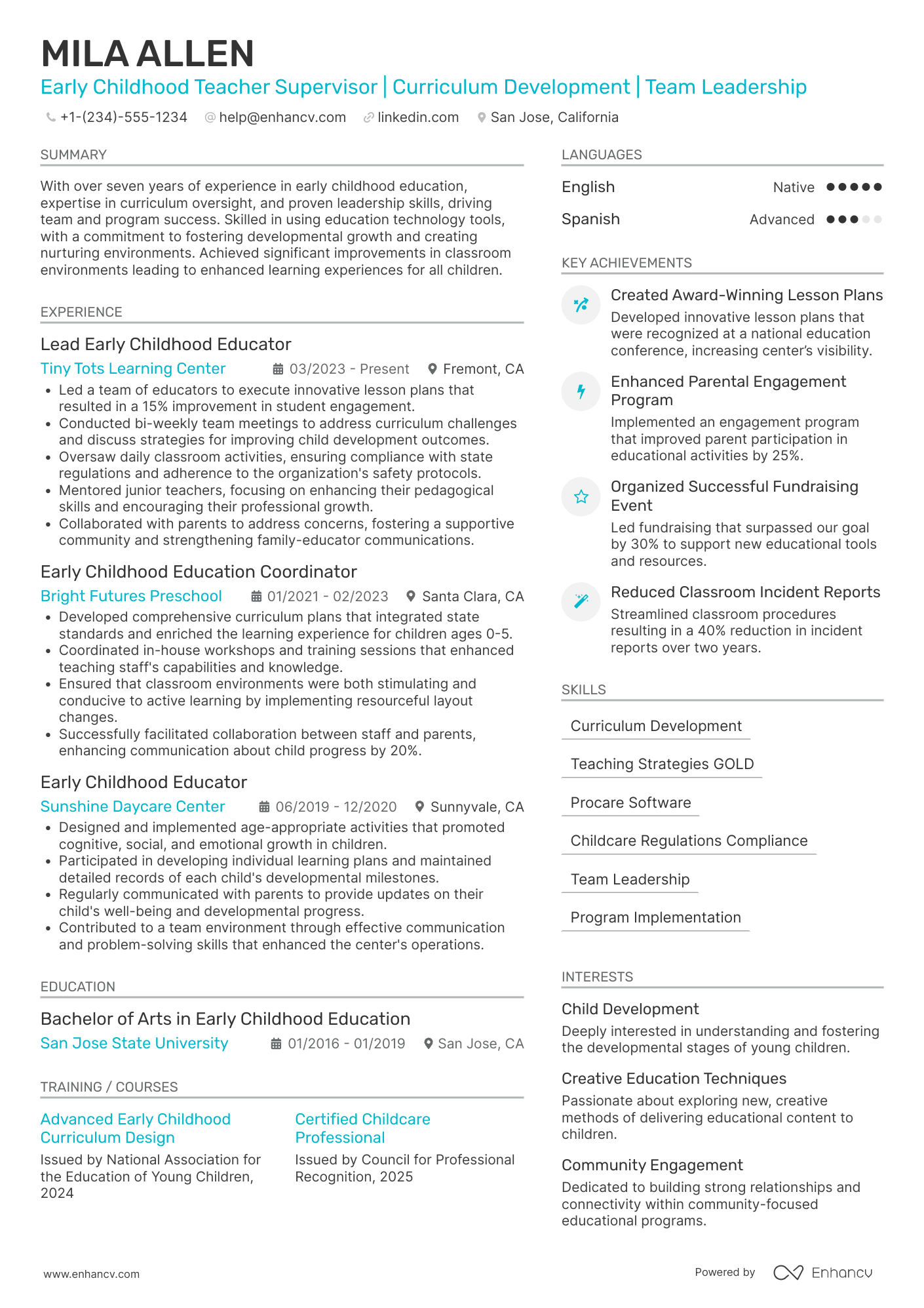
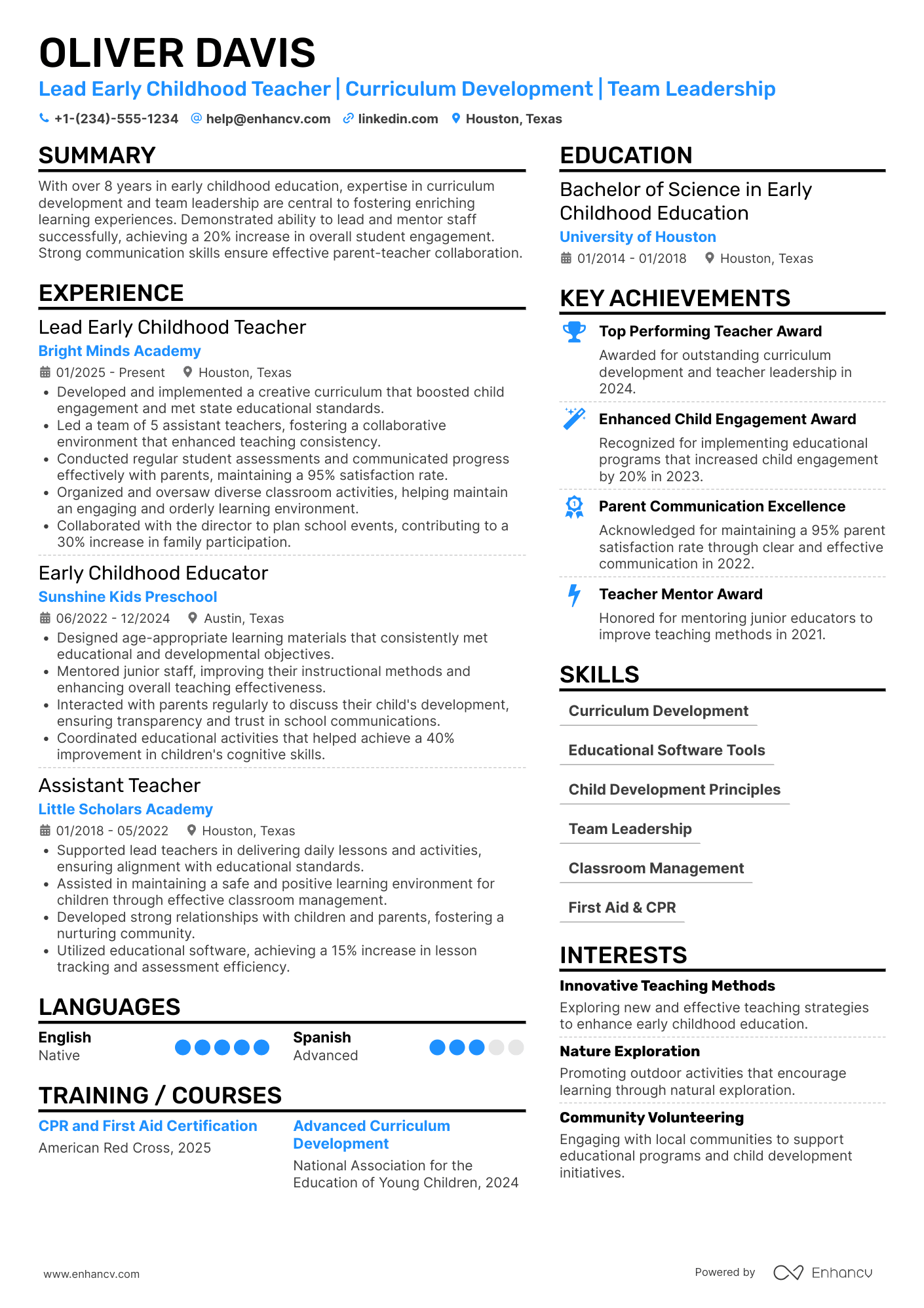
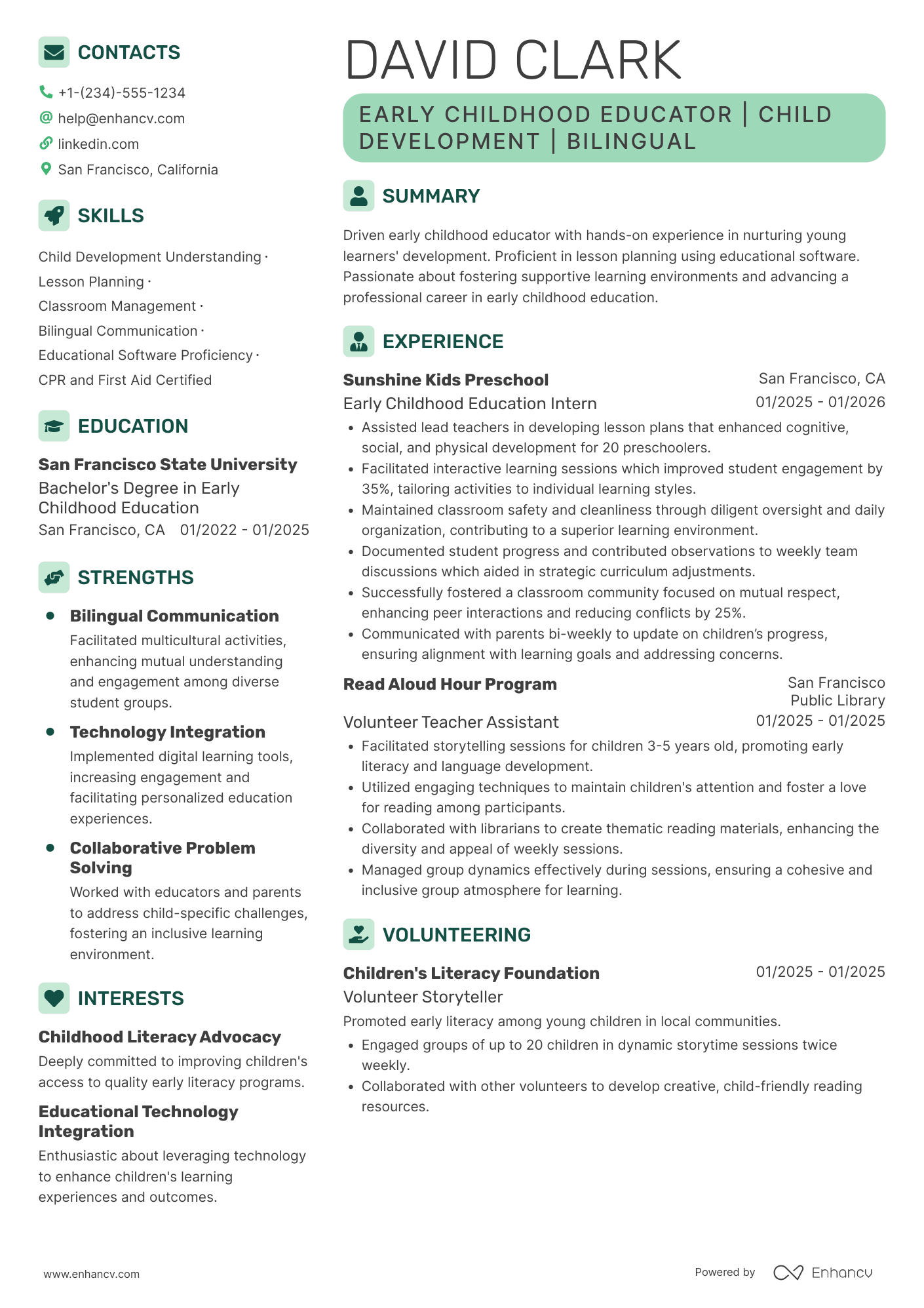
Early Childhood Teacher resume examples
By Experience
By Role