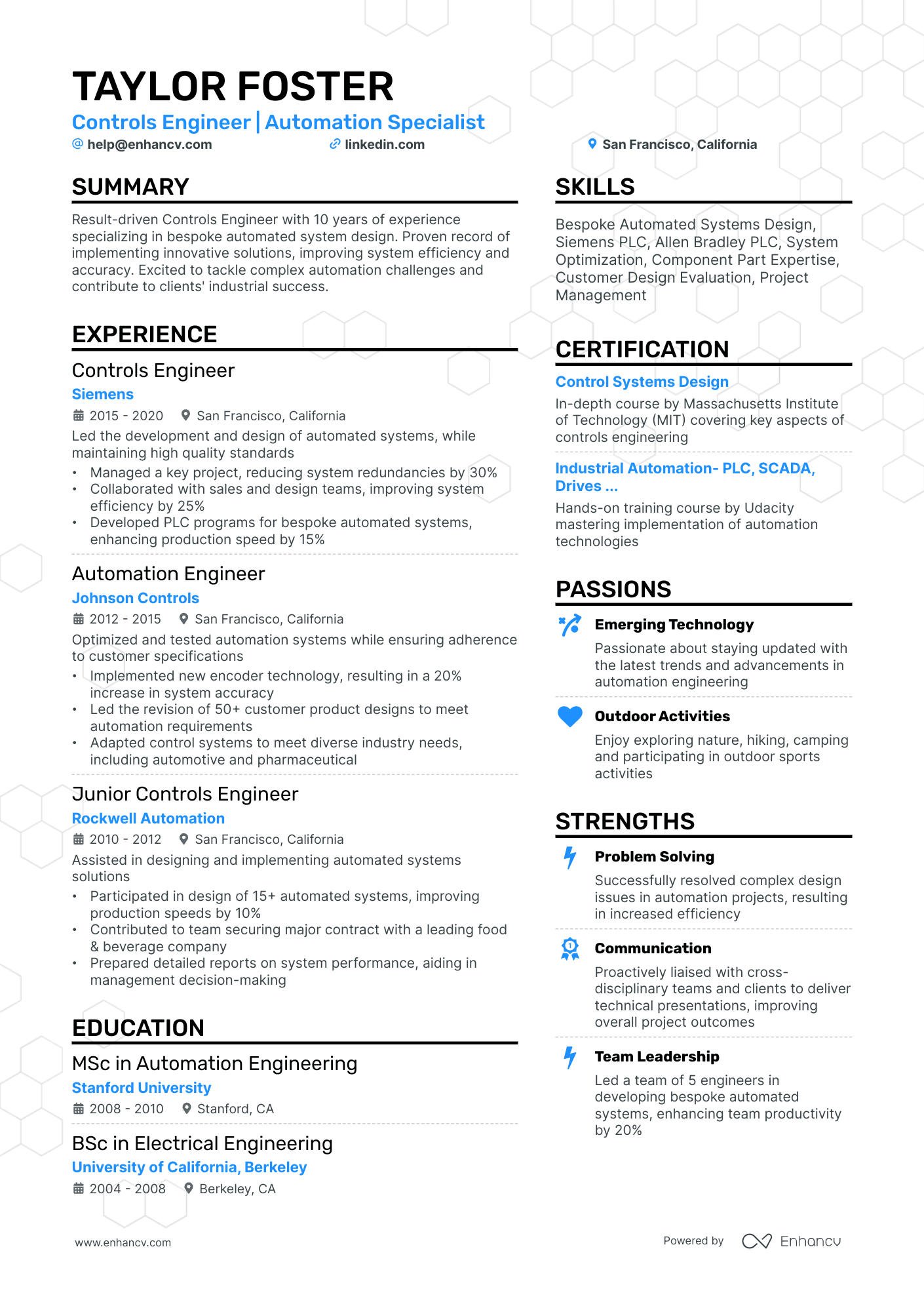
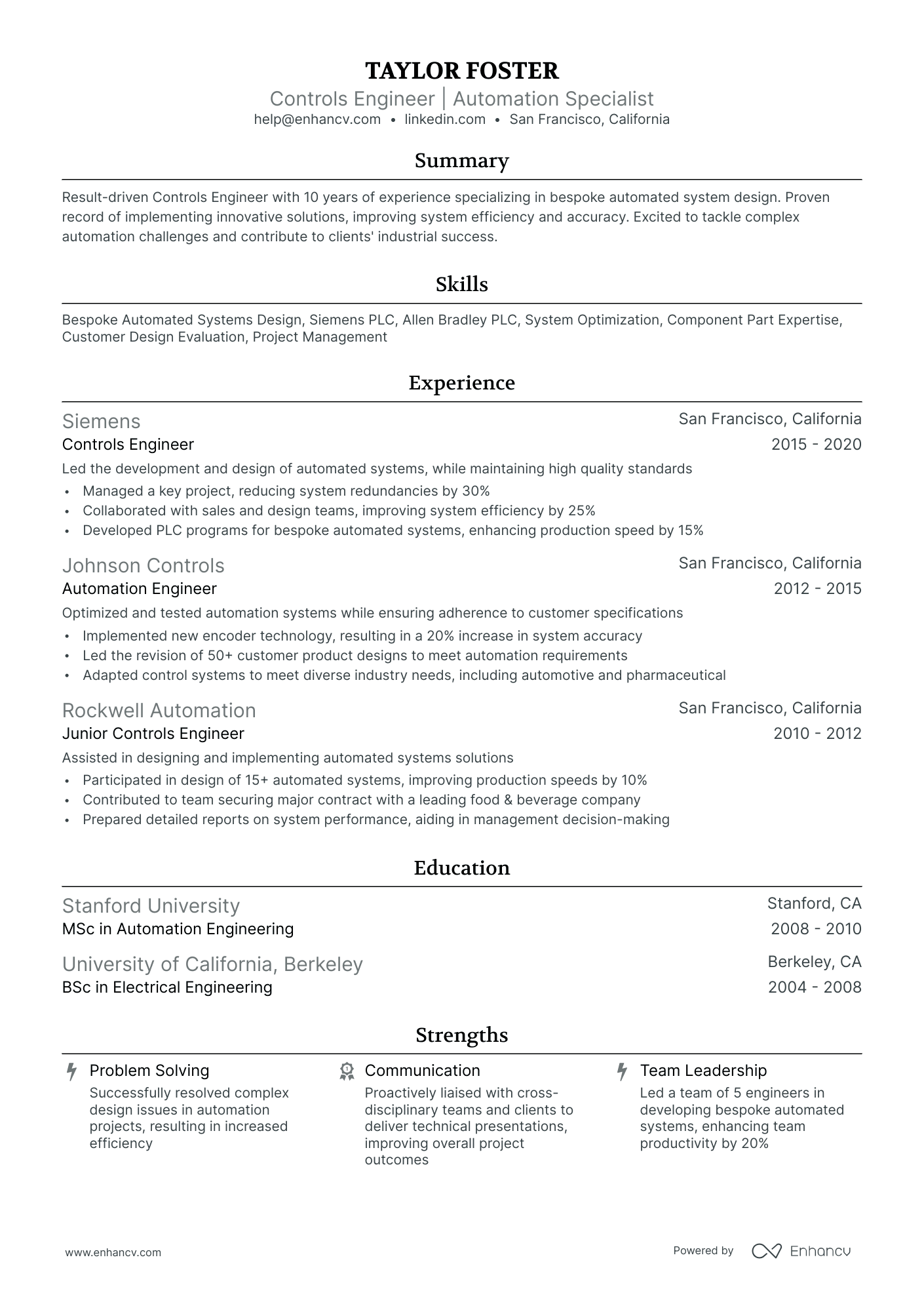
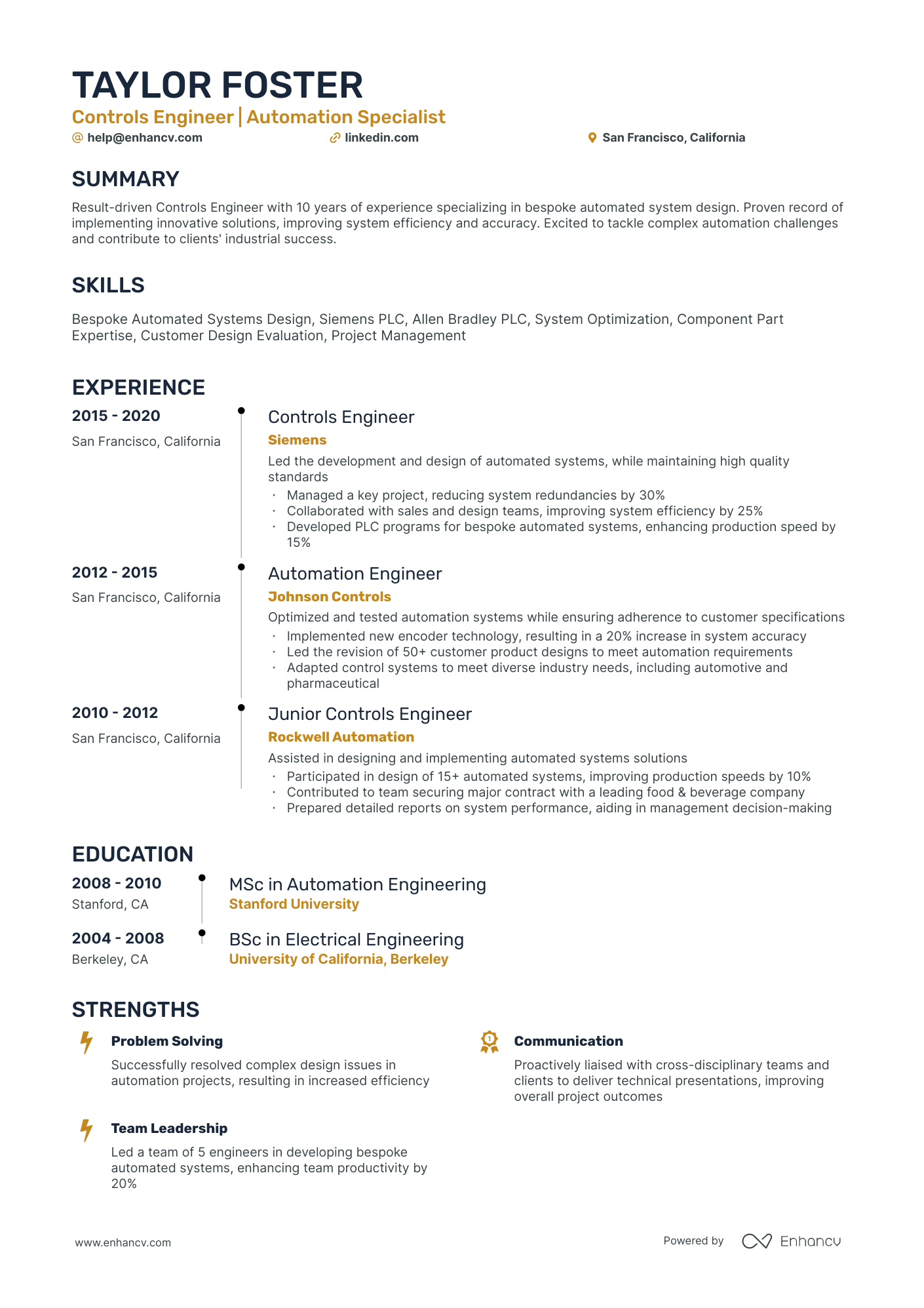
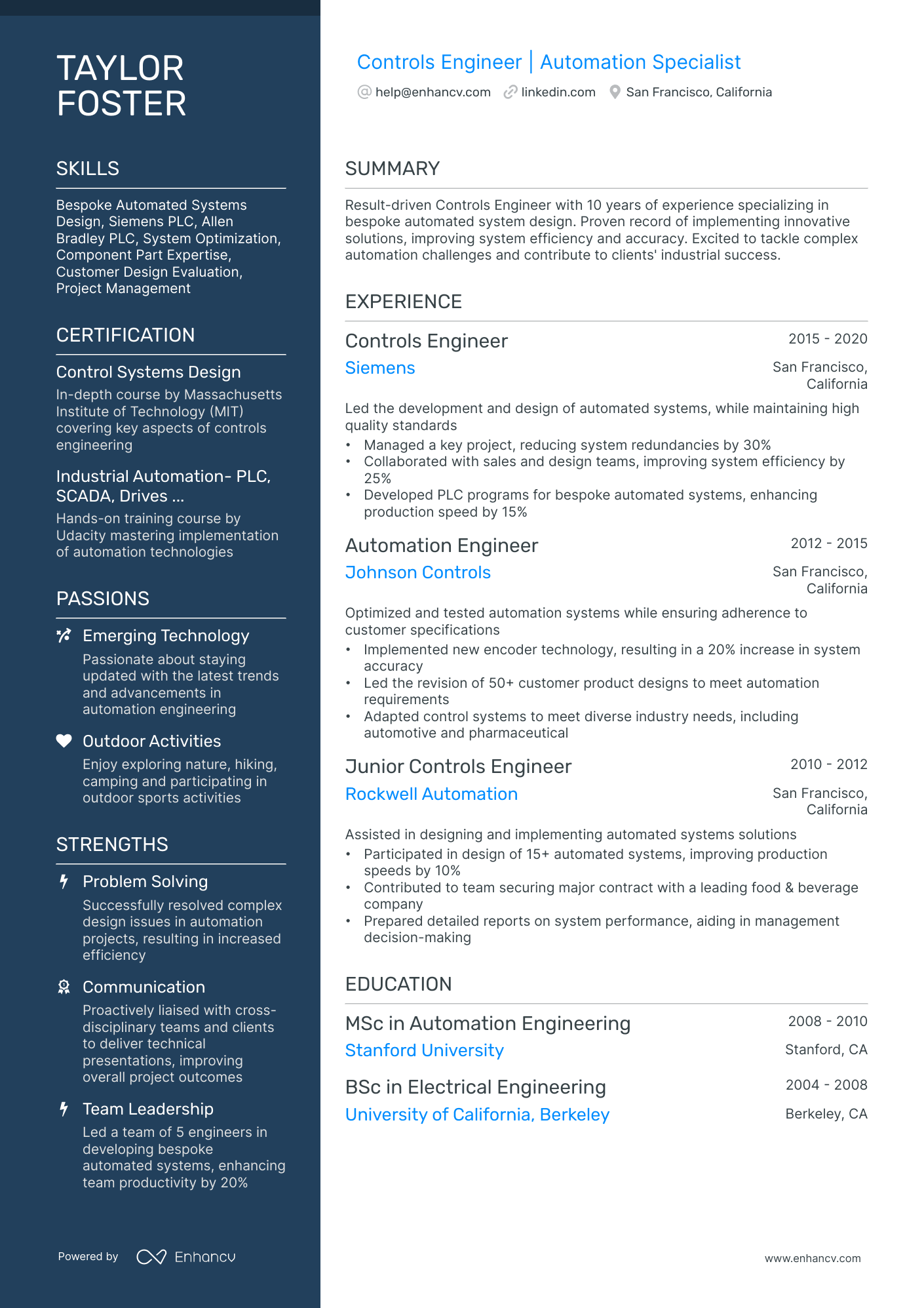
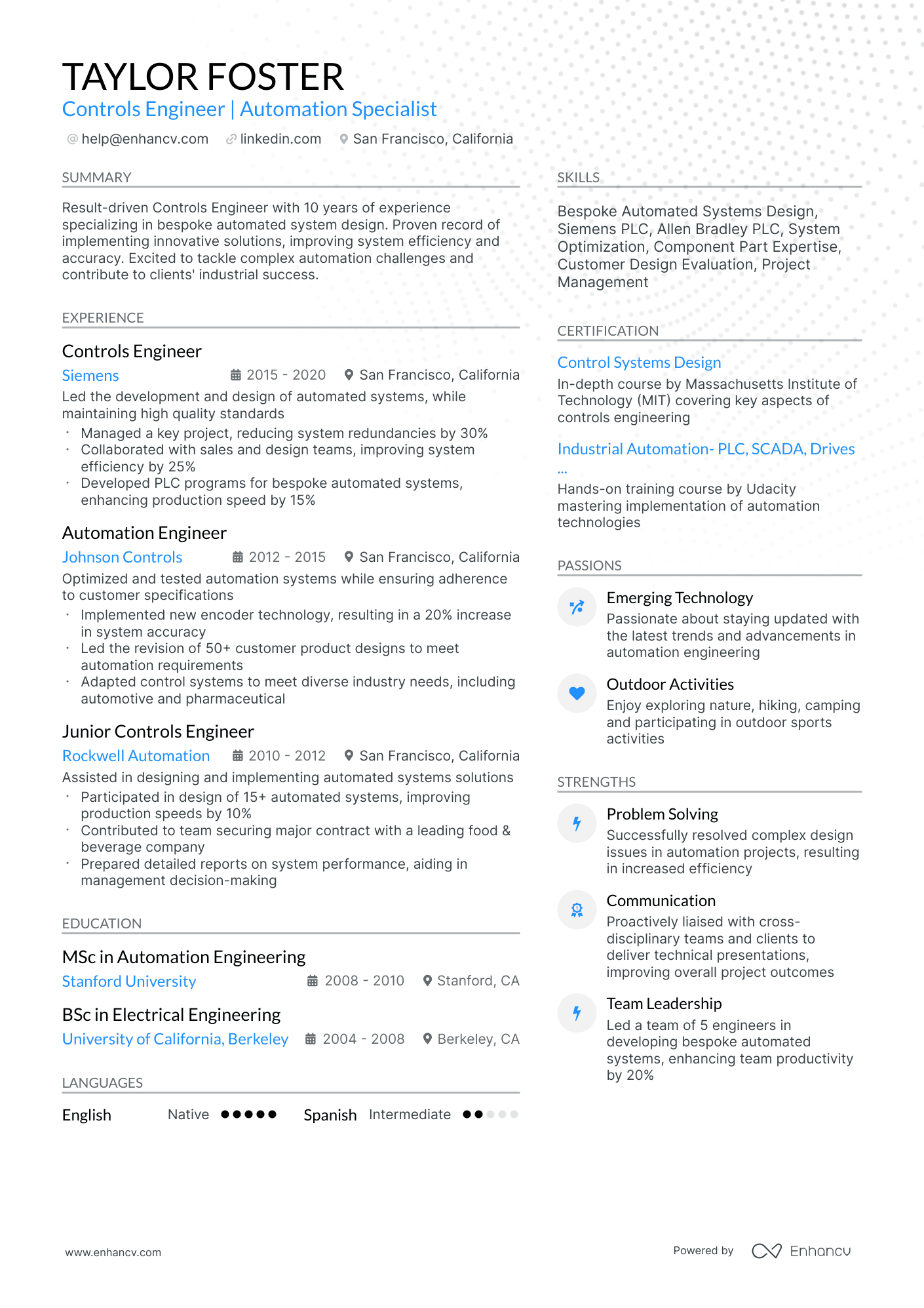
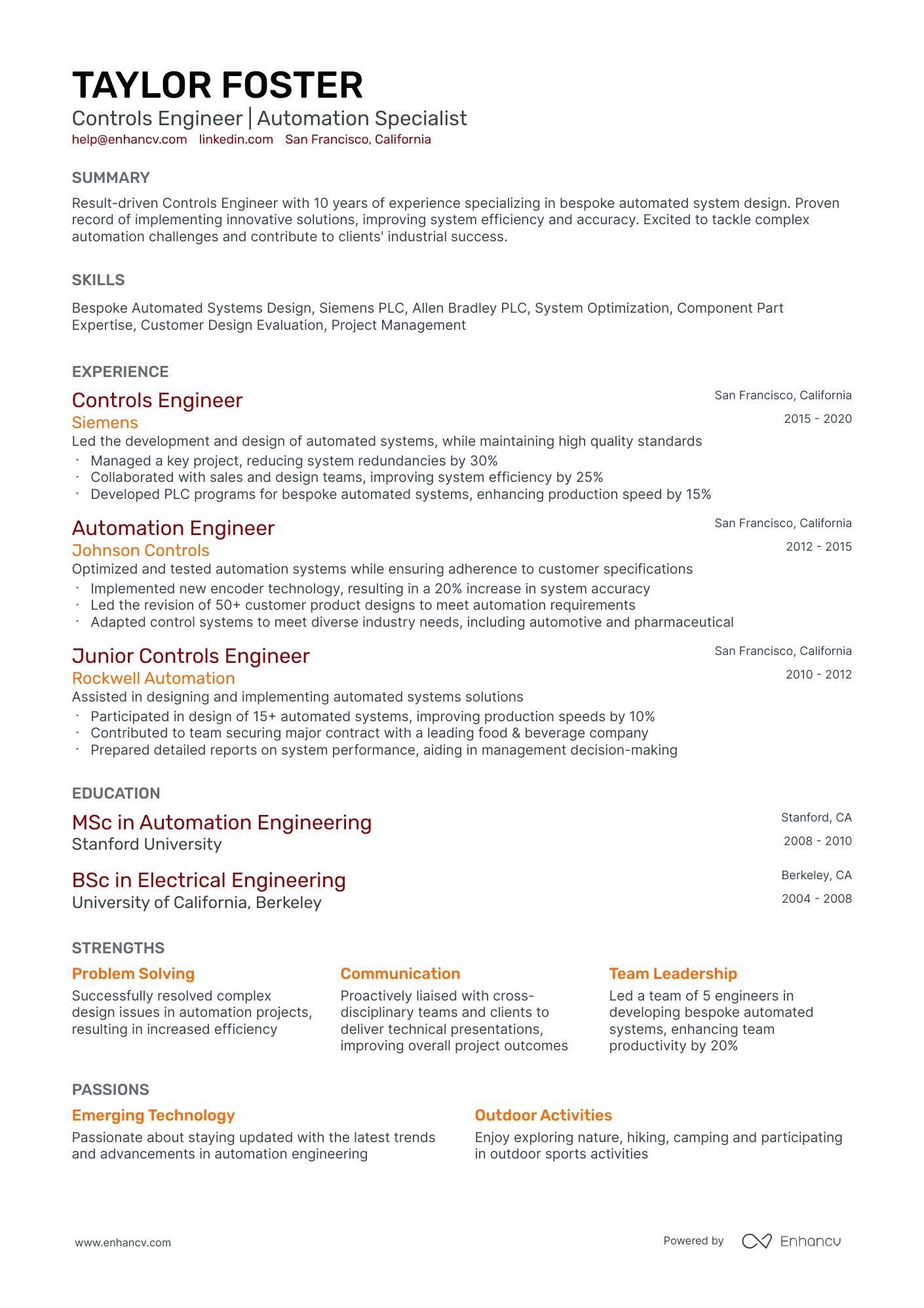
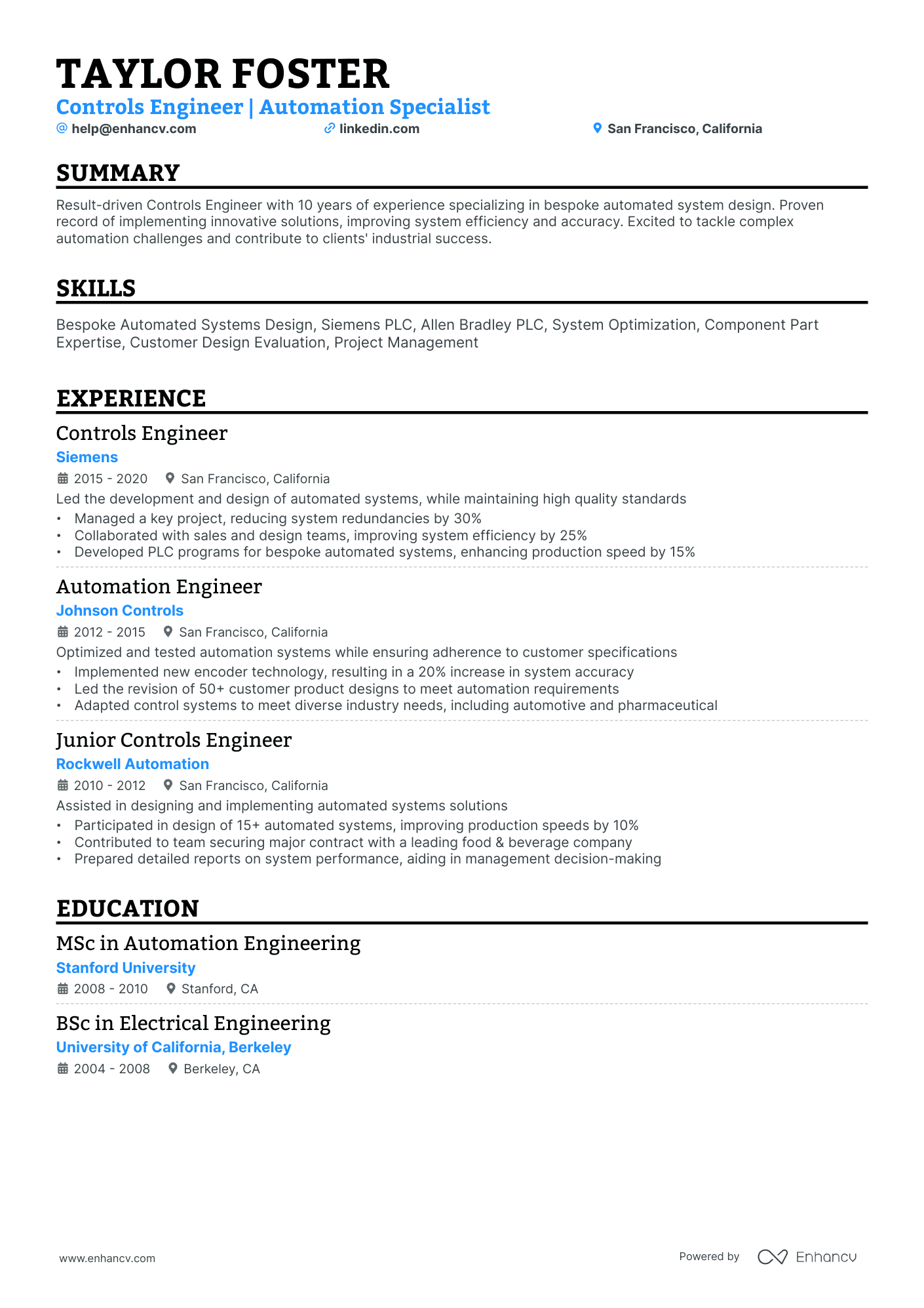
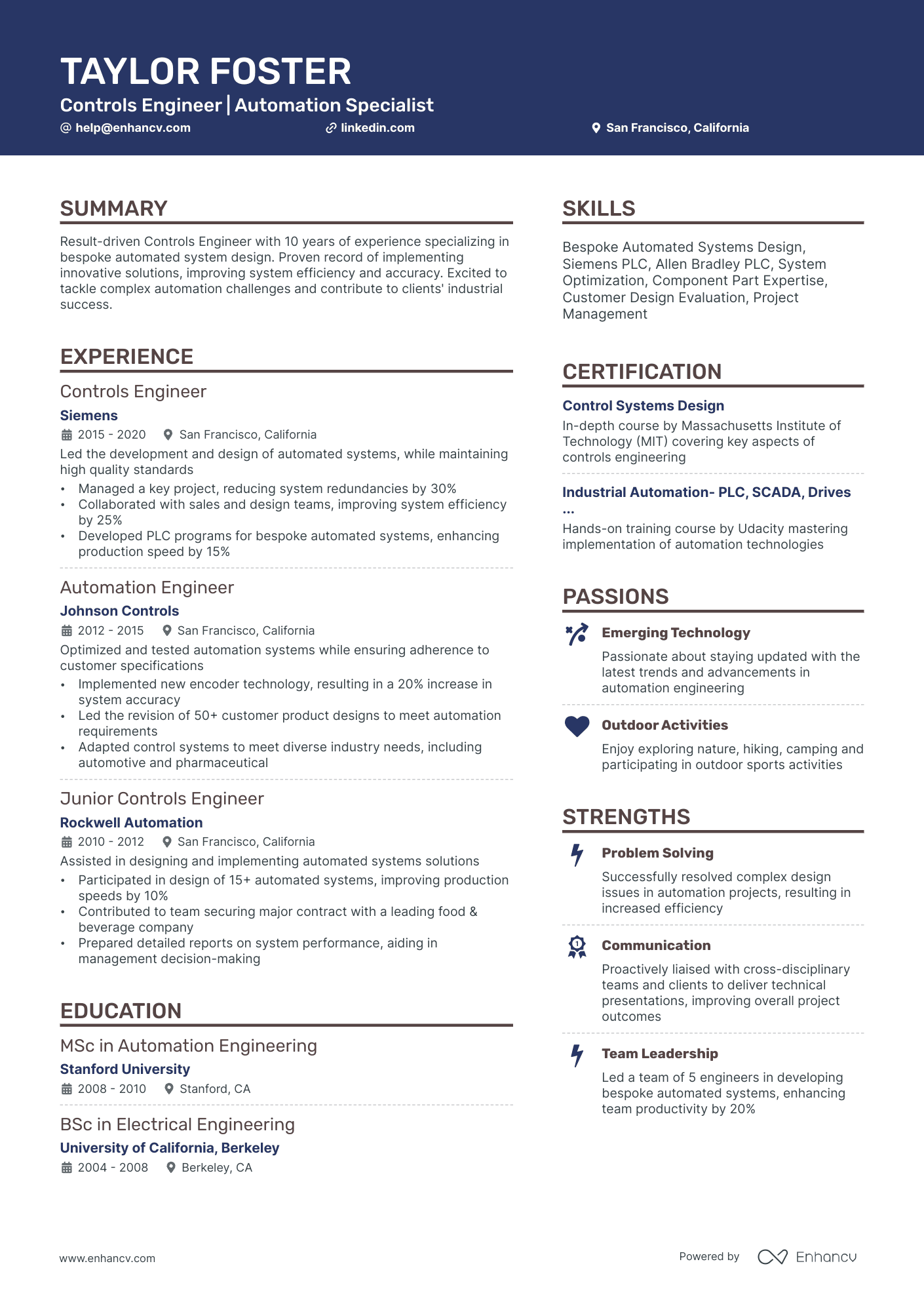
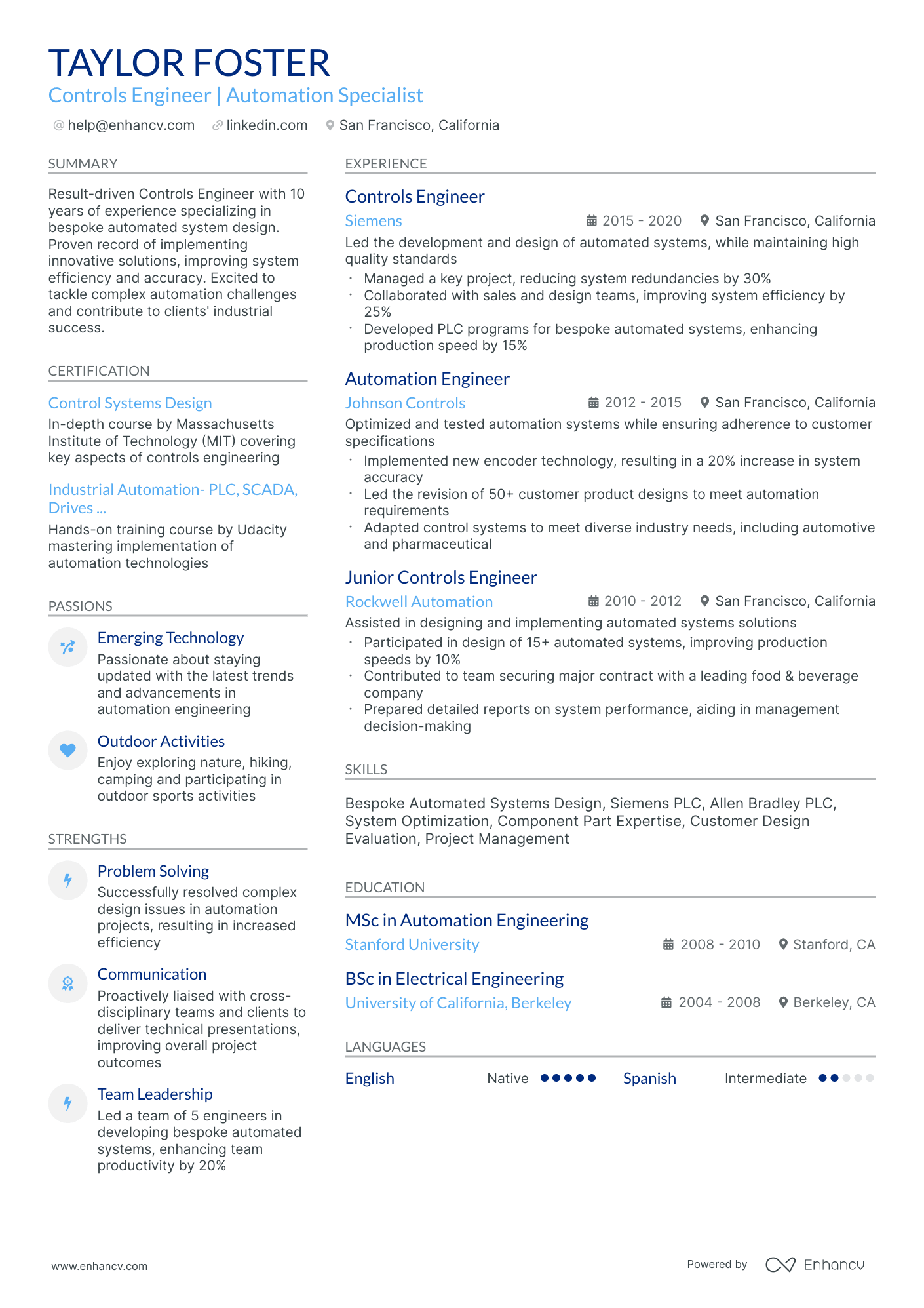
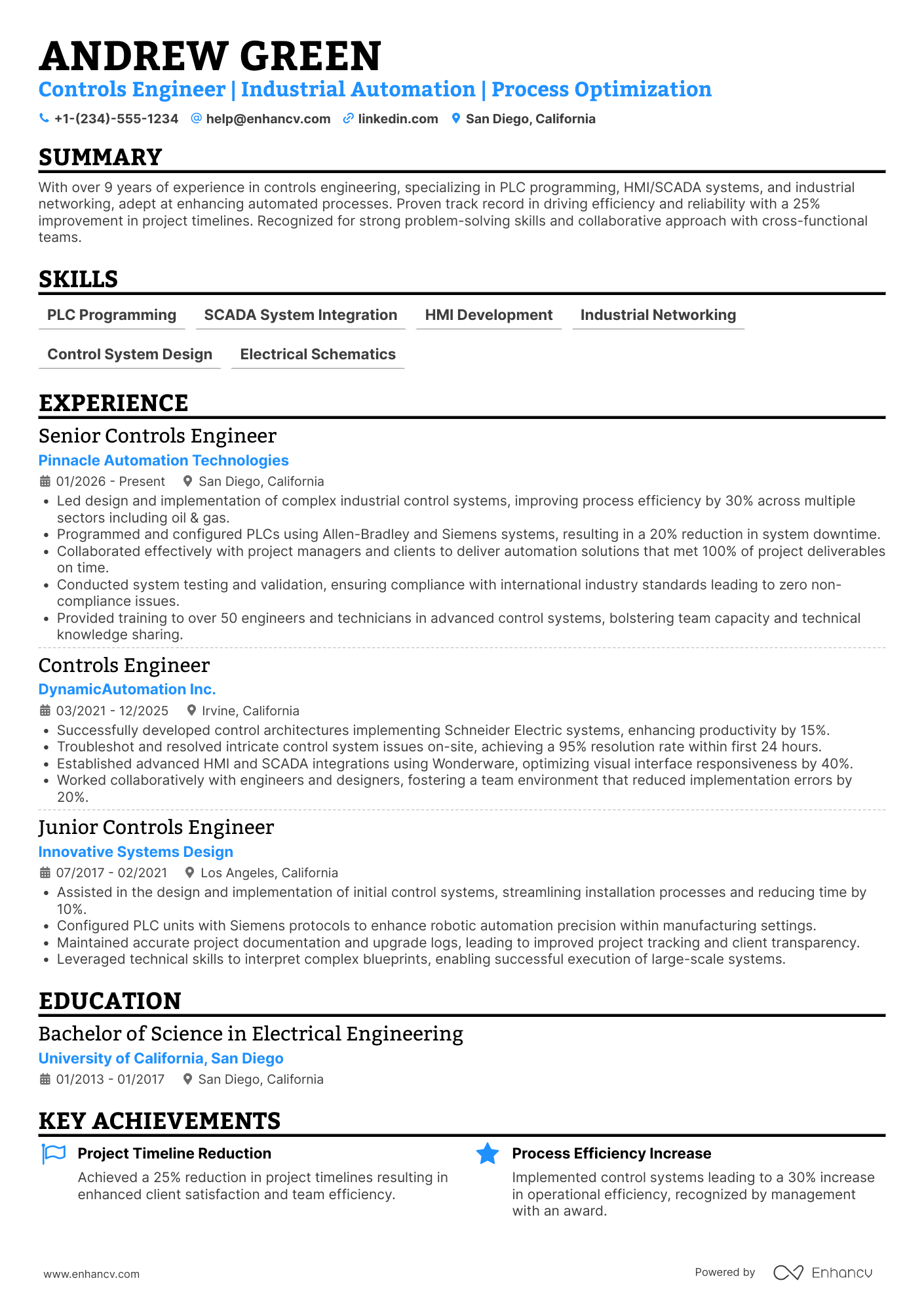
Many controls engineer resumes fail because they list PLC brands and tasks but don't show measurable plant impact. In today's hiring process, a controls engineer resume must pass ATS screening and earn attention in a fast recruiter scan. If you're unsure where to begin, understanding how to write a resume that highlights impact over duties is the essential first step.
A strong resume shows outcomes first, so you prove value quickly. Highlight uptime gains, cycle-time reductions, scrap decreases, successful commissioning across multiple lines, safety and quality improvements, on-time startup delivery, and support load reduced through better diagnostics.

Key takeaways
- Lead every experience bullet with a measurable outcome like uptime, cycle time, or scrap reduction.
- Use reverse-chronological format for senior roles to show clear career progression.
- Tailor your resume to each job posting by mirroring its exact platforms, protocols, and KPIs.
- Place skills above experience if you're junior, and below experience if you're senior.
- Anchor every listed skill to a specific project, system, or quantifiable result.
- Include a Projects section near the top when professional controls experience is limited.
- Use Enhancv to turn vague task descriptions into concise, metric-driven resume bullets.
Job market snapshot for controls engineers
We analyzed 1,435 recent controls engineer job ads across major US job boards. These numbers help you understand experience requirements, employer expectations, top companies hiring at a glance.
What level of experience employers are looking for controls engineers
| Years of Experience | Percentage found in job ads |
|---|---|
| 1–2 years | 7.6% (109) |
| 3–4 years | 12.3% (177) |
| 5–6 years | 15.1% (217) |
| 7–8 years | 5.3% (76) |
| 9–10 years | 3.2% (46) |
| 10+ years | 6.6% (94) |
| Not specified | 51.6% (741) |
Controls engineer ads by area of specialization (industry)
| Industry (Area) | Percentage found in job ads |
|---|---|
| Finance & Banking | 59.7% (856) |
| Manufacturing | 18.5% (265) |
| Healthcare | 12.7% (182) |
| Education | 2.2% (31) |
| Energy | 1.9% (27) |
| Retail & E-commerce | 1.9% (27) |
| Government | 1.3% (18) |
| Real Estate & Construction | 1.0% (15) |
Top companies hiring controls engineers
| Company | Percentage found in job ads |
|---|---|
| Actalent | 18.3% (263) |
| Dematic Corp. | 4.2% (60) |
| Barry-Wehmiller | 3.9% (56) |
| Tesla | 3.6% (52) |
| KION Group | 3.5% (50) |
| M.C. Dean, Inc. | 2.8% (40) |
| Sargent & Lundy, L.L.C. | 2.2% (32) |
| Eaton Corporation | 2.0% (29) |
| General Motors | 1.7% (25) |
| Blue Origin | 1.5% (21) |
Role overview stats
These tables show the most common responsibilities and employment types for controls engineer roles. Use them to align your resume with what employers expect and to understand how the role is structured across the market.
Day-to-day activities and top responsibilities for a controls engineer
| Responsibility | Percentage found in job ads |
|---|---|
| Plc | 40.1% (575) |
| Hmi | 26.1% (375) |
| Scada | 24.7% (355) |
| Autocad | 16.2% (232) |
| Siemens | 15.3% (220) |
| Plc programming | 14.8% (213) |
| Python | 11.1% (159) |
| Ignition | 9.8% (140) |
| Allen bradley | 9.0% (129) |
| Vfd | 8.9% (127) |
| Allen-bradley | 8.6% (124) |
| Modbus | 8.4% (121) |
Type of employment (remote vs on-site vs hybrid)
| Employment type | Percentage found in job ads |
|---|---|
| On-site | 79.8% (1145) |
| Hybrid | 13.4% (192) |
| Remote | 6.8% (98) |
How to format a controls engineer resume
Recruiters evaluating controls engineer resumes prioritize hands-on technical depth—PLC programming platforms, SCADA/HMI development, industrial networking protocols—alongside evidence of successful commissioning, system integration, and process optimization. A clean, well-structured format ensures these signals surface immediately during both automated parsing and the initial human scan. Choosing the right resume format is critical for making your technical depth visible at a glance.

I have significant experience in this role—which format should I use?
Use a reverse-chronological format to present your controls engineering career in a clear, progression-driven timeline. Do:
- Lead each role entry with your scope of ownership: number of systems managed, facility scale, or capital budget of automation projects you delivered.
- List role-specific platforms and domains—Allen-Bradley, Siemens TIA Portal, DCS migration, VFD integration, industrial Ethernet architecture—within the context of each position rather than in a standalone skills block.
- Quantify outcomes tied to uptime improvement, cycle time reduction, commissioning timelines, or cost savings.
I'm junior or switching into this role—what format works best?
A hybrid format works best, letting you lead with a focused technical skills section while still showing relevant work or project history in chronological order. Do:
- Place core competencies—ladder logic, structured text, P&ID interpretation, loop tuning—near the top so applicant tracking systems and recruiters see them immediately.
- Include capstone projects, co-op rotations, or personal automation builds that demonstrate real controls work, even outside traditional employment.
- Connect every skill to a concrete action and a measurable or observable result.
Why hybrid and functional resumes don't work for senior roles
Hybrid formats push your career timeline below a skills summary, obscuring the progression from individual contributor to system-level owner and diluting the leadership context hiring managers need to see. Functional formats are worse—they strip accountability from specific roles entirely, making it impossible for reviewers to evaluate the scope, scale, and business impact of your decisions at each stage. Avoid both formats if you have five or more years of progressive controls engineering experience with clear project ownership and team or facility-level responsibility.
- Edge-case exception: A functional format may be acceptable if you're a seasoned controls professional re-entering the workforce after an extended gap or transitioning from a closely related discipline (e.g., electrical design to controls integration), but only if every listed skill is anchored to a specific project, system, or measurable outcome rather than presented as an unsubstantiated keyword list.
Once you've established a clean, readable format, the next step is deciding which sections to include so each one reinforces your qualifications.
What sections should go on a controls engineer resume
Recruiters expect a controls engineer resume to show clear automation ownership, PLC and HMI expertise, and measurable project results. Knowing which resume sections to include ensures you don't leave out anything hiring managers look for. Use this structure for maximum clarity:
- Header
- Summary
- Experience
- Skills
- Projects
- Education
- Certifications
- Optional sections: Awards, Publications, Leadership
Strong experience bullets should emphasize delivered uptime, cycle time, quality, safety, commissioning scope, and quantified outcomes tied to specific systems and sites.
Is your resume good enough?
Drop your resume here or choose a file. PDF & DOCX only. Max 2MB file size.
Once you’ve organized your resume with the right building blocks, the next step is writing your controls engineer experience section so each role supports that structure with clear, job-relevant detail.
How to write your controls engineer resume experience
The experience section is where you prove you've shipped real control systems, applied role-relevant tools like PLCs, SCADA, or HMI platforms, and delivered measurable outcomes such as reduced downtime, improved throughput, or tighter process tolerances. Hiring managers prioritize demonstrated impact over descriptive task lists, so every line should connect your work to a tangible result.
Each entry should include:
- Job title
- Company and location (or remote)
- Dates of employment (month and year)
Three to five concise bullet points showing what you owned, how you executed, and what outcomes you delivered:
- Ownership scope: the control systems, automation platforms, production lines, or equipment programs you were directly accountable for, including the scale of machinery, facilities, or processes under your responsibility.
- Execution approach: the programming languages, hardware platforms, communication protocols, or engineering methods—such as ladder logic, structured text, PID tuning, or loop optimization—you used to design, troubleshoot, and deliver control solutions.
- Value improved: the specific gains you drove in system reliability, cycle time, process accuracy, safety compliance, energy efficiency, or defect reduction tied to your controls engineering work.
- Collaboration context: how you partnered with mechanical engineers, electrical teams, operations staff, integrators, or equipment vendors to scope requirements, validate designs, or commission automated systems.
- Impact delivered: the end results of your work expressed through production uptime, cost savings, regulatory audit outcomes, or successful system go-lives rather than a summary of daily tasks.
Experience bullet formula
A controls engineer experience example
✅ Right example - modern, quantified, specific.
Controls Engineer
Apex Packaging Systems | Milwaukee, WI
2021–Present
Designed and supported PLC-controlled packaging lines for a high-volume food and beverage manufacturer running three shifts across two plants.
- Led migration of eight lines from legacy PLC-5 to Rockwell ControlLogix using Studio 5000, reducing unplanned downtime by 18% and cutting changeover time by 12 minutes per run.
- Programmed and tuned VFD and servo motion (Kinetix, PowerFlex) with coordinated motion profiles, improving throughput by 9% and lowering scrap by 1.6% through tighter registration control.
- Built a standardized HMI library in FactoryTalk View ME with alarm rationalization and ISA-18.2 naming, decreasing nuisance alarms by 42% and speeding operator fault recovery by 25%.
- Integrated vision inspection and barcode traceability (Cognex, EtherNet/IP) into SCADA reporting, increasing first-pass yield from 96.8% to 98.4% and enabling lot-level genealogy for 100% of shipped cases.
- Partnered with mechanical engineering, maintenance, and operations to execute FAT and SAT protocols and root-cause analysis (5 Whys, fishbone), reducing mean time to repair from 38 to 27 minutes.
Now that you've seen what a strong experience section looks like, let's break down how to customize yours for each specific job posting.
How to tailor your controls engineer resume experience
Recruiters evaluate your controls engineer resume through both human review and applicant tracking systems (ATS). Tailoring your resume to the job description ensures your qualifications connect directly with what hiring managers prioritize.
Ways to tailor your controls engineer experience:
- Match PLC platforms and programming languages named in the job description.
- Mirror the exact automation protocols and communication standards listed.
- Use the same terminology for control system methodologies and processes.
- Reflect specific KPIs like uptime targets or cycle time reductions mentioned.
- Include relevant industry experience such as automotive or pharmaceutical manufacturing.
- Highlight compliance with safety standards like NFPA 79 or UL 508A.
- Emphasize HMI/SCADA development work if the posting references operator interfaces.
- Reference cross-functional collaboration with mechanical or electrical engineering teams.
Tailoring means aligning your real accomplishments with the role's stated requirements, not forcing keywords where they don't belong.
Resume tailoring examples for controls engineer
| Job description excerpt | Untailored | Tailored |
|---|---|---|
| Design and program Allen-Bradley PLCs using RSLogix 5000 for automated packaging lines; troubleshoot and reduce unplanned downtime across three shifts. | Programmed PLCs and supported manufacturing operations. | Programmed Allen-Bradley PLCs in RSLogix 5000 for six automated packaging lines, reducing unplanned downtime by 22% across a three-shift operation. |
| Develop and maintain HMI applications in FactoryTalk View SE; collaborate with process engineers to integrate SCADA systems for real-time batch monitoring. | Created HMI screens and worked with other engineers on system improvements. | Developed 15+ HMI applications in FactoryTalk View SE and integrated SCADA systems with process engineering to enable real-time batch monitoring across four production areas. |
| Commission variable frequency drives (VFDs) and servo systems for CNC machining cells; define control architecture using AutoCAD Electrical and EPLAN. | Helped with drive commissioning and created electrical drawings. | Commissioned VFDs and servo systems for 12 CNC machining cells, designing the full control architecture in AutoCAD Electrical and EPLAN—cutting commissioning time by 30%. |
Once your experience aligns with the role’s requirements, the next step is to quantify your controls engineer achievements so hiring managers can quickly see your impact.
How to quantify your controls engineer achievements
Quantifying your achievements proves you improved machines, not just code. Focus on cycle time, uptime, scrap, safety risk, energy use, and delivery speed—plus the scope, tools, and production volume you supported.
Quantifying examples for controls engineer
| Metric | Example |
|---|---|
| Cycle time | "Reduced packaging line cycle time by 12% by tuning Allen-Bradley ControlLogix PID loops and optimizing conveyor VFD setpoints across three stations." |
| Uptime | "Increased OEE availability from 91% to 96% by adding PLC heartbeat monitoring and SCADA alarms in Ignition for twenty-four critical sensors." |
| Scrap rate | "Cut scrap from 3.8% to 2.1% by implementing vision inspection interlocks and refining servo motion profiles on a six-axis pick-and-place cell." |
| Safety risk | "Reduced near-miss incidents by 40% by validating safety PLC logic, updating light curtain zoning, and completing ISO 13849 performance level calculations." |
| Delivery speed | "Commissioned two automated test stands two weeks early by standardizing IO checklists, reusing function blocks, and simulating sequences in FactoryTalk Logix Echo." |
Turn vague job duties into measurable, recruiter-ready resume bullets in seconds with Enhancv's Bullet Point Generator.
Once you've crafted strong bullet points to showcase your experience, the next step is ensuring your resume also highlights the right hard and soft skills employers expect from a controls engineer.
How to list your hard and soft skills on a controls engineer resume
Your skills section shows you can design, program, and troubleshoot automation systems, and recruiters and an ATS (applicant tracking system) scan this section for role keywords, tool matches, and fit—aim for a mix heavy on hard skills with targeted soft skills.
controls engineer roles require a blend of:
- Product strategy and discovery skills.
- Data, analytics, and experimentation skills.
- Delivery, execution, and go-to-market discipline.
- Soft skills.
Your skills section should be:
- Scannable (bullet-style grouping).
- Relevant to the job post.
- Backed by proof in experience bullets.
- Updated with current tools.
Place your skills section:
- Above experience if you're junior or switching careers.
- Below experience if you're mid/senior with strong achievements.

Hard skills
- PLC programming: Allen-Bradley, Siemens
- Ladder logic, structured text
- HMI development: FactoryTalk View, WinCC
- SCADA systems: Ignition, Wonderware
- Motion control, servo tuning
- Industrial networking: EtherNet/IP, PROFINET
- VFD configuration, motor control
- Instrumentation: 4–20 mA, RTD, thermocouples
- Control panel design, AutoCAD Electrical
- Safety circuits, safety PLCs
- Commissioning, loop checks, I/O validation
- Root cause troubleshooting, fault diagnostics
Soft skills
- Translate process needs into control logic
- Lead commissioning and startup plans
- Communicate issues in clear test reports
- Coordinate with mechanical and electrical teams
- Align with production on downtime windows
- Prioritize fixes by safety and impact
- Own problems through to verified closure
- Challenge requirements with data and risk
- Train operators and maintenance on changes
- Document standards and enforce version control
- Manage vendors and integrator deliverables
- Stay calm during line-down escalations
How to show your controls engineer skills in context
Skills shouldn't live only in a bulleted list on your resume. Explore resume skills examples to see how top candidates weave competencies into every section.
They should be demonstrated in:
- Your summary (high-level professional identity)
- Your experience (proof through outcomes)
Here's what strong, contextual skill placement looks like in practice.
Summary example
Senior controls engineer with 12 years in automotive manufacturing. Skilled in PLC programming, SCADA integration, and HMI design using Allen-Bradley and Siemens platforms. Led automation upgrades that reduced unplanned downtime by 34% across three production facilities.
- Reflects senior-level expertise clearly
- Names specific platforms and tools
- Includes a measurable performance outcome
- Implies leadership and cross-site coordination
Experience example
Senior Controls Engineer
Meridian Automation Systems | Detroit, MI
June 2018–Present
- Programmed and commissioned 15 Allen-Bradley PLCs for robotic welding cells, cutting integration time by 22% through standardized code libraries.
- Partnered with mechanical and process engineering teams to redesign SCADA dashboards, improving operator response time to faults by 40%.
- Developed preventive maintenance logic within HMI systems using FactoryTalk, reducing unplanned equipment stops by 28% year over year.
- Every bullet includes a measurable outcome.
- Skills appear naturally within real accomplishments.
Once you’ve tied your technical strengths to real projects and outcomes, the next step is to apply the same approach to a controls engineer resume when you have no experience, so your potential still reads clearly.
How do I write a controls engineer resume with no experience
Even without full-time experience, you can demonstrate readiness through projects and academic work. Our guide on writing a resume without work experience walks you through exactly how to do this effectively. Consider including:
- Senior design automation capstone project
- PLC and HMI lab coursework
- Controls-focused internship or co-op
- Robotics team controls programming
- Manufacturing equipment troubleshooting volunteer
- SCADA dashboard personal project
- UL 508A panel wiring practicum
- GitHub portfolio of PLC code
Focus on:
- PLC platforms and ladder logic
- HMI, SCADA, and alarm strategy
- Electrical schematics and panel layout
- Commissioning tests and documented results
Resume format tip for entry-level controls engineer
Use a reverse-chronological resume with a Projects section near the top, because it highlights hands-on controls engineer work when job history is limited. Do:
- Lead with Projects, then Education.
- Name PLC, HMI, and SCADA tools.
- Quantify cycle time, uptime, or defects.
- Include schematics, I O, and safety.
- Link to a GitHub code sample.
- Built an Allen-Bradley PLC ladder program and FactoryTalk View HMI for a conveyor simulator, cutting jam recovery time by 30% using alarm states and interlocks.
Even without professional experience, your education section can serve as the foundation of your controls engineer resume—here's how to present it effectively.
How to list your education on a controls engineer resume
Your education section helps hiring teams confirm you have the foundational engineering knowledge a controls engineer needs. It validates your technical training and academic background quickly.
Include:
- Degree name
- Institution
- Location
- Graduation year
- Relevant coursework (for juniors or entry-level candidates)
- Honors & GPA (if 3.5 or higher)
Skip month and day details—list the graduation year only.
Here's a strong education entry tailored for a controls engineer resume.
Example education entry
Bachelor of Science in Electrical Engineering
University of Michigan, Ann Arbor, MI
Graduated 2021
GPA: 3.7/4.0
- Relevant coursework: Control Systems Design, PLC Programming, Industrial Automation, Signal Processing, Embedded Systems
- Honors: Magna Cum Laude, Dean's List (six semesters)
How to list your certifications on a controls engineer resume
Certifications show a controls engineer's commitment to learning, confirm tool proficiency, and signal industry relevance across automation, safety, and industrial networks.
Include:
- Certificate name
- Issuing organization
- Year
- Optional: credential ID or URL
- Place certifications below education when your degree is recent and the certifications support it without adding stronger proof of job readiness.
- Place certifications above education when they are recent, highly relevant, or required for your target controls engineer role.
Best certifications for your controls engineer resume
- ISA Certified Control Systems Technician (CCST)
- Siemens Certified Programmer (SIMATIC S7)
- Rockwell Automation Control Systems Certification
- TÜV Rheinland Functional Safety Engineer (FS Eng)
- Certified Automation Professional (CAP)
- CompTIA Network+
- OSHA 30-Hour General Industry
Once you’ve positioned your credentials where recruiters can spot them, move on to your controls engineer resume summary to tie those qualifications to the value you bring.
How to write your controls engineer resume summary
Your resume summary is the first thing a recruiter reads. A strong one instantly signals you have the right skills and experience for a controls engineer role.
Keep it to three to four lines, with:
- Your title and relevant years of hands-on controls engineering experience.
- The industry or domain you've worked in, such as manufacturing, automotive, or process control.
- Core tools and technologies like PLC programming, SCADA systems, HMI design, or ladder logic.
- One or two measurable achievements, such as reduced downtime or improved cycle times.
- Soft skills tied to real outcomes, like cross-functional collaboration that accelerated commissioning timelines.

PRO TIP
At this level, focus on specific technical skills, relevant tools, and early wins that prove you can contribute from day one. Avoid vague statements like "passionate problem-solver" or "motivated self-starter." Instead, name the PLCs you've programmed, the systems you've configured, and the results you've delivered—even from internships or co-op rotations.
Example summary for a controls engineer
Controls engineer with two years of experience programming Allen-Bradley PLCs in automotive manufacturing. Designed HMI interfaces and reduced machine changeover time by 18% through optimized ladder logic sequences.
Optimize your resume summary and objective for ATS
Drop your resume here or choose a file.
PDF & DOCX only. Max 2MB file size.
Now that your summary captures your strongest qualifications, make sure the header presenting your contact details is equally polished and error-free.
What to include in a controls engineer resume header
A resume header lists your key identity and contact details, helping controls engineers boost visibility, build credibility, and pass recruiter screening fast.
Essential resume header elements
- Full name
- Tailored job title and headline
- Location
- Phone number
- Professional email
- GitHub link
- Portfolio link
A LinkedIn link helps recruiters verify your experience quickly and supports screening.
Don't include a photo on a controls engineer resume unless the role is explicitly front-facing or appearance-dependent.
Match your header title and headline to the job posting keywords, and keep links clean, working, and consistent across profiles.
Controls engineer resume header
Jordan Lee
Controls Engineer | PLC and SCADA Integration | Industrial Automation
Austin, TX
(512) 555-12XX
jordan.lee@enhancv.com
github.com/jordanlee
jordanleeautomation.com
linkedin.com/in/jordanlee
Once your contact details and role identifiers are set at the top, add additional sections to highlight qualifications that don’t fit in the main experience and skills areas.
Additional sections for controls engineer resumes
When your core qualifications match other applicants, well-chosen additional sections can set you apart and reinforce your technical credibility.
Consider adding these sections to strengthen your controls engineer resume:
- Certifications and licenses
- Technical publications and conference papers
- Professional affiliations (ISA, IEEE, NSPE)
- Languages
- Patents
- Hobbies and interests
Once you've strengthened your resume with well-chosen additional sections, the next step is pairing it with a cover letter that adds even more context to your application.
Do controls engineer resumes need a cover letter
A cover letter isn't required for a controls engineer, but it helps in competitive roles or teams with strict hiring expectations. If you're unsure where to start, learn what a cover letter is and how it complements your resume. It can make a difference when your resume needs context, or when several candidates have similar technical skills.
Use a cover letter to add details your resume can't show:
- Explain role and team fit by mapping your experience to the plant, product line, or automation stack in the job description.
- Highlight one or two relevant projects with outcomes, such as reduced downtime, faster cycle times, improved safety, or cleaner commissioning handoffs.
- Show understanding of the product, users, or business context by referencing who relies on the system and what constraints drive design choices.
- Address career transitions or non-obvious experience by connecting past work to controls engineer responsibilities, tools, and on-call expectations.
Drop your resume here or choose a file.
PDF & DOCX only. Max 2MB file size.
Once you’ve decided how to handle a cover letter for your controls engineer application, the next step is using AI to improve your controls engineer resume so it aligns more closely with the role.
Using AI to improve your controls engineer resume
AI can sharpen your resume's clarity, structure, and impact. It helps refine bullet points, tighten language, and highlight measurable results. But overuse creates generic, hollow content. Once your resume reads clearly and aligns with your target role, step away from AI. If you're wondering which AI is best for writing resumes, start with tools designed specifically for job applications.
Here are 10 practical prompts you can copy, paste, and customize right away:
- Strengthen your summary: "Rewrite my controls engineer resume summary to highlight my core technical strengths and years of relevant experience in under four sentences."
- Quantify accomplishments: "Add specific metrics and measurable outcomes to these controls engineer experience bullets without changing the original scope of work."
- Align with job postings: "Compare my controls engineer resume experience section to this job description and suggest edits that improve keyword alignment."
- Sharpen skills formatting: "Organize my controls engineer skills section into clear categories such as PLC platforms, programming languages, and communication protocols."
- Improve project descriptions: "Rewrite this controls engineer project summary to emphasize the technical challenge, my specific contribution, and the measurable result."
- Tighten bullet points: "Shorten each controls engineer experience bullet to one concise line starting with a strong action verb."
- Clarify certifications: "Reformat my controls engineer certifications section so each entry includes the credential name, issuing body, and year earned."
- Refine education details: "Edit my controls engineer education section to highlight relevant coursework, capstone projects, and academic honors only."
- Remove filler language: "Identify and remove vague or generic phrases from my controls engineer resume that don't communicate specific skills or results."
- Tailor for industry: "Adjust the tone and terminology of my controls engineer resume to better fit the automotive manufacturing industry."
Stop using AI once your resume sounds accurate, specific, and aligned with real experience. AI should never invent experience or inflate claims—if it didn't happen, it doesn't belong here.
Conclusion
A strong controls engineer resume proves impact with measurable outcomes, shows role-specific skills, and follows a clear structure. Use metrics for uptime, cycle time, scrap reduction, commissioning speed, and safety incidents. Match your experience to the job requirements.
Keep your controls engineer resume easy to scan, with clean sections and consistent formatting. This approach shows readiness for today’s hiring market and near-future needs. It helps hiring teams trust your judgment and move you forward faster.