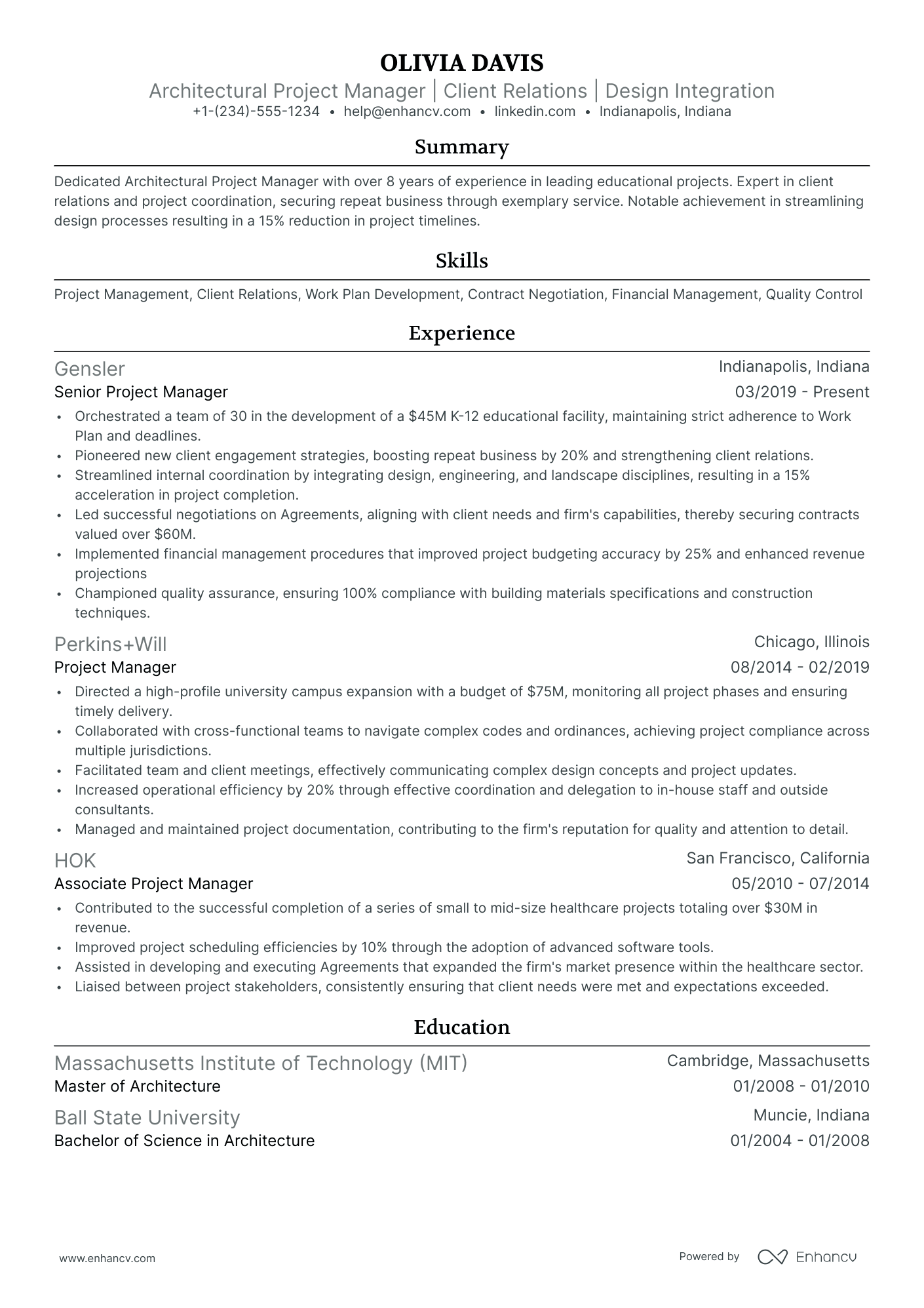
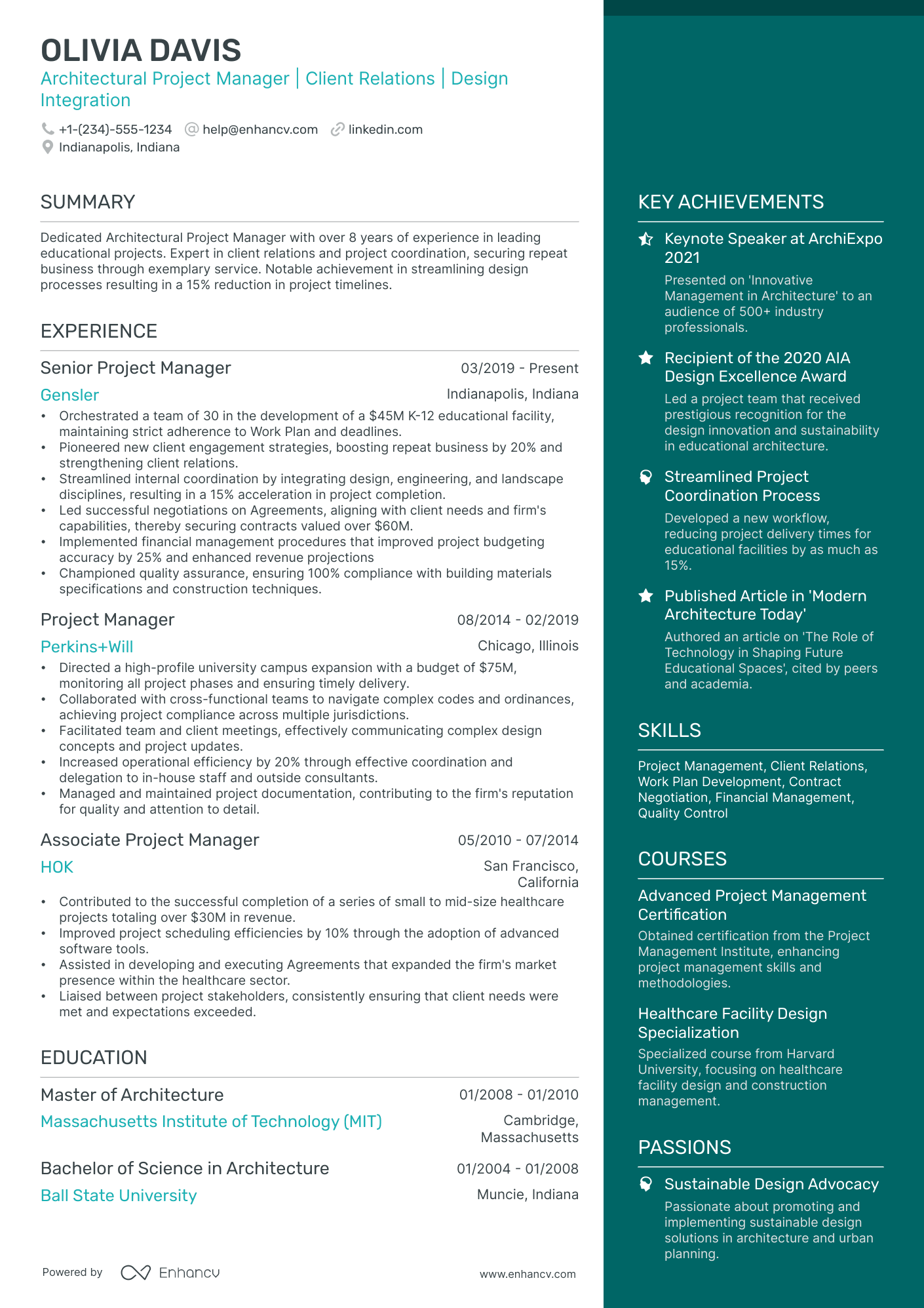
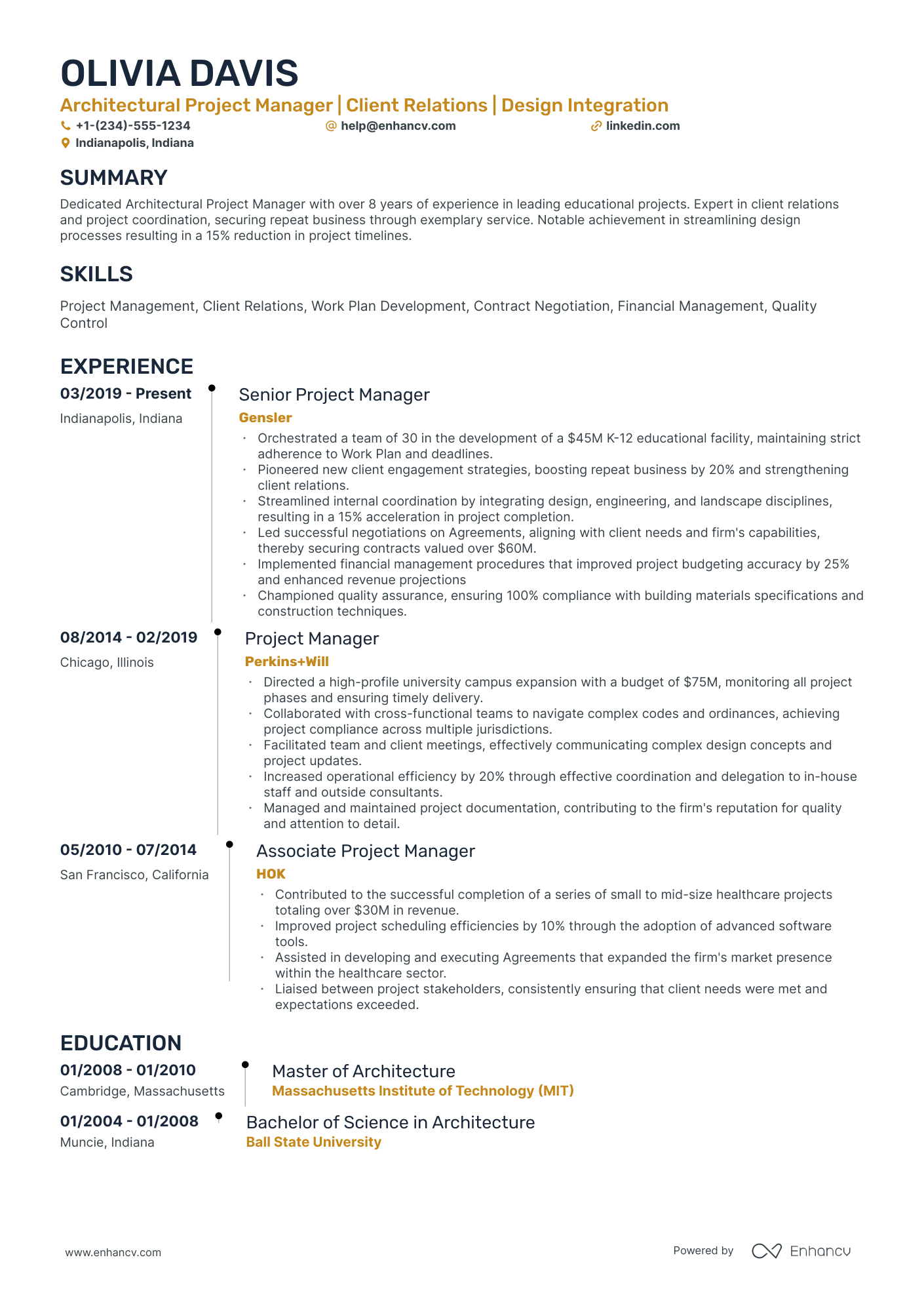
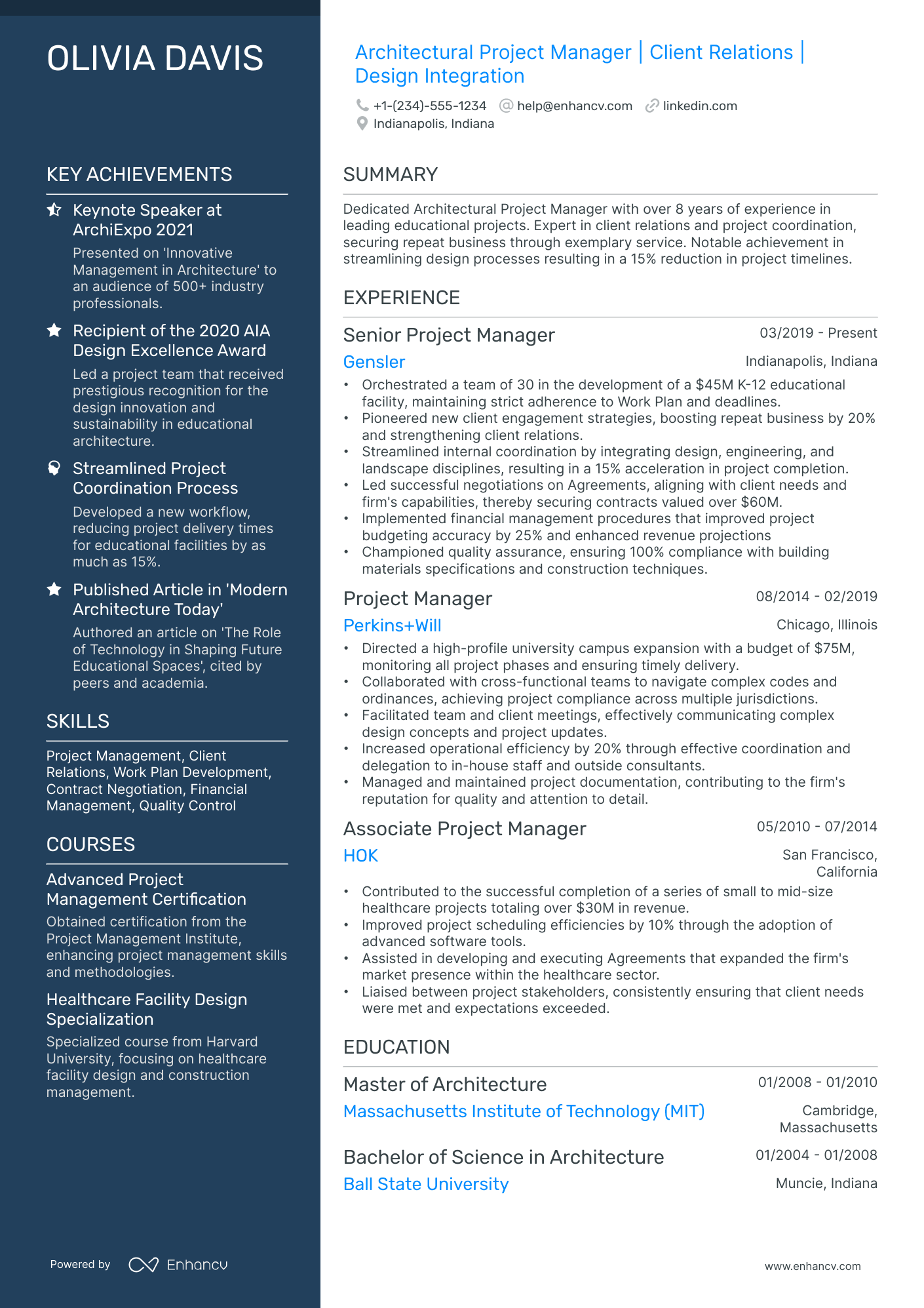
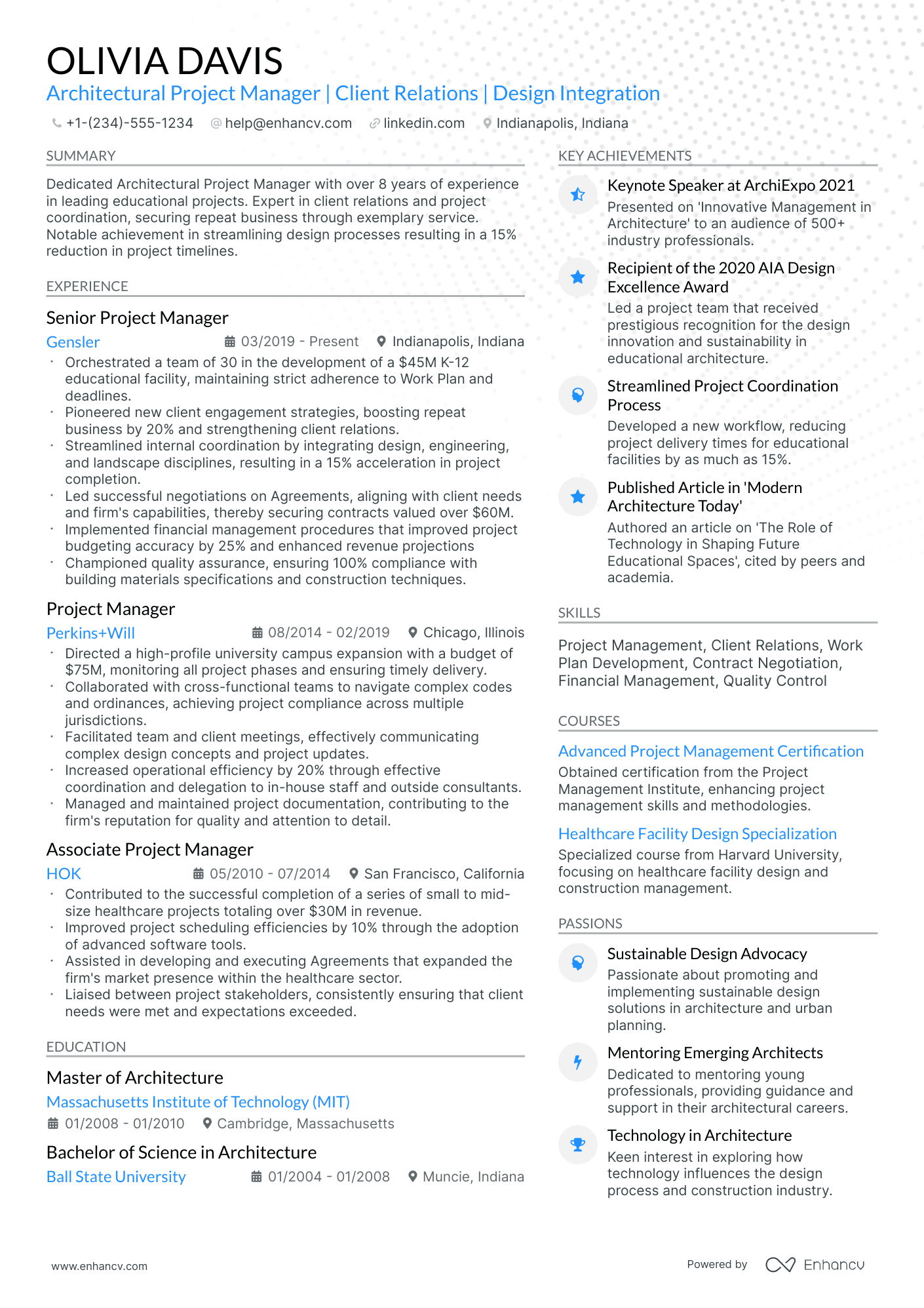
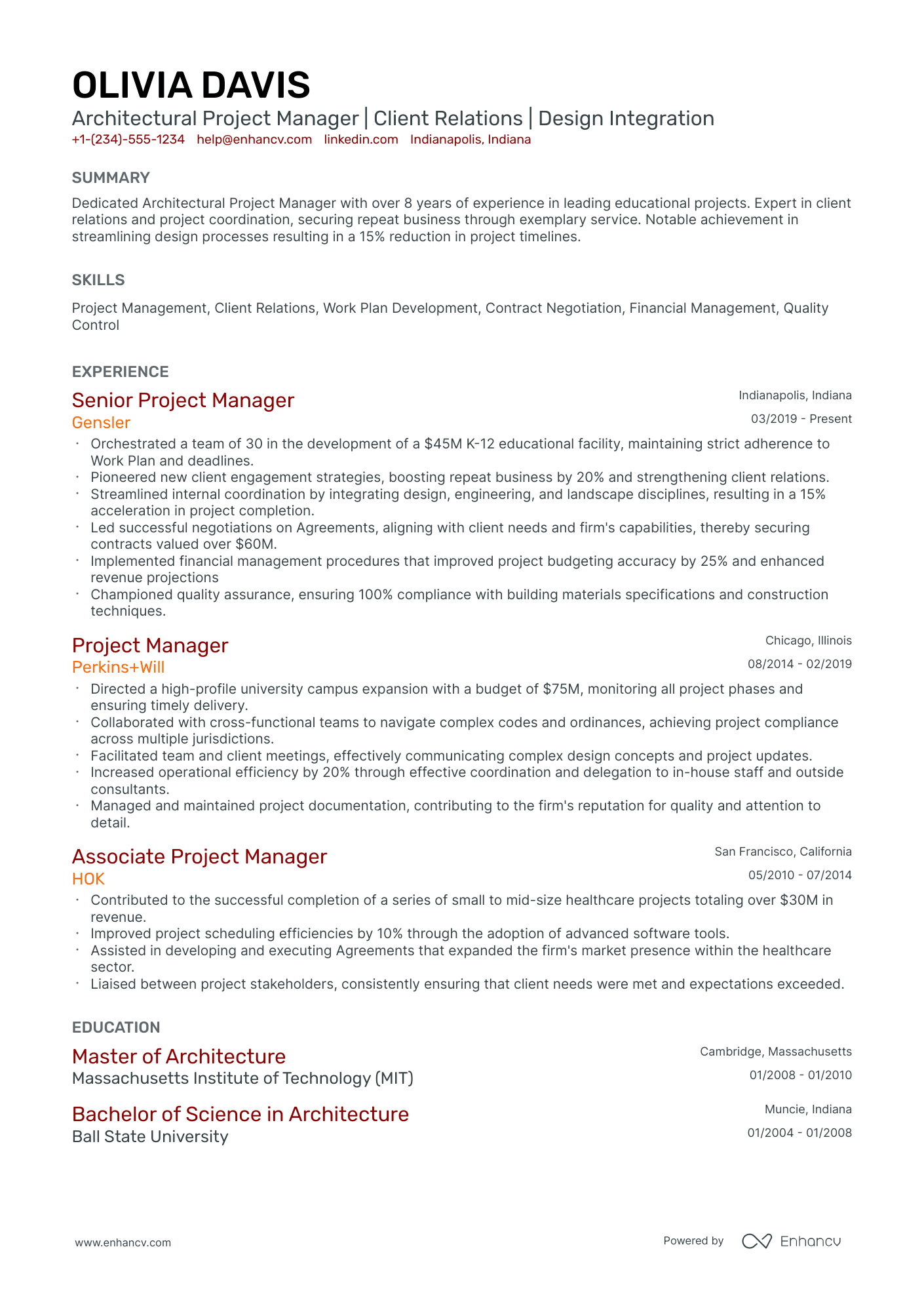
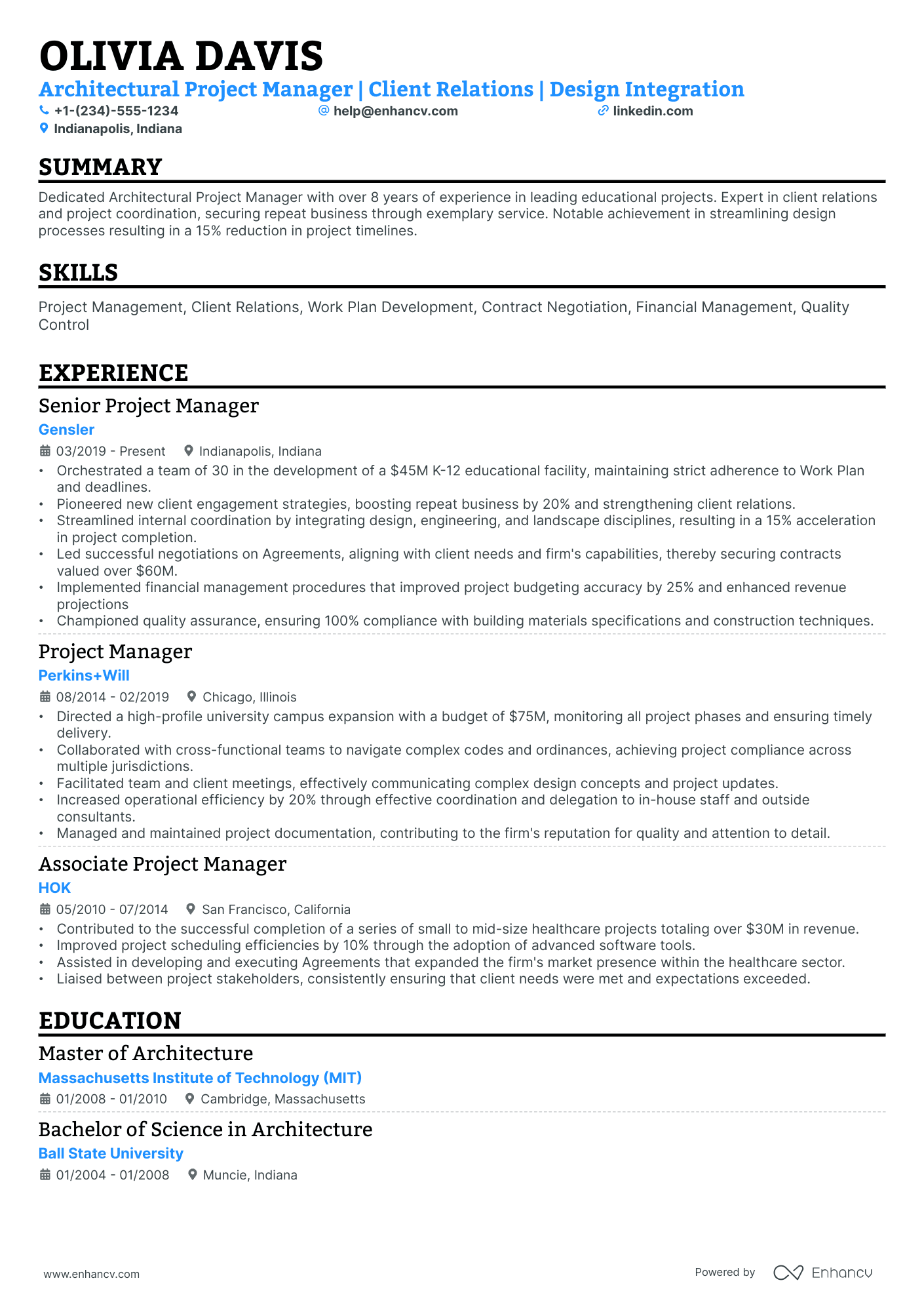
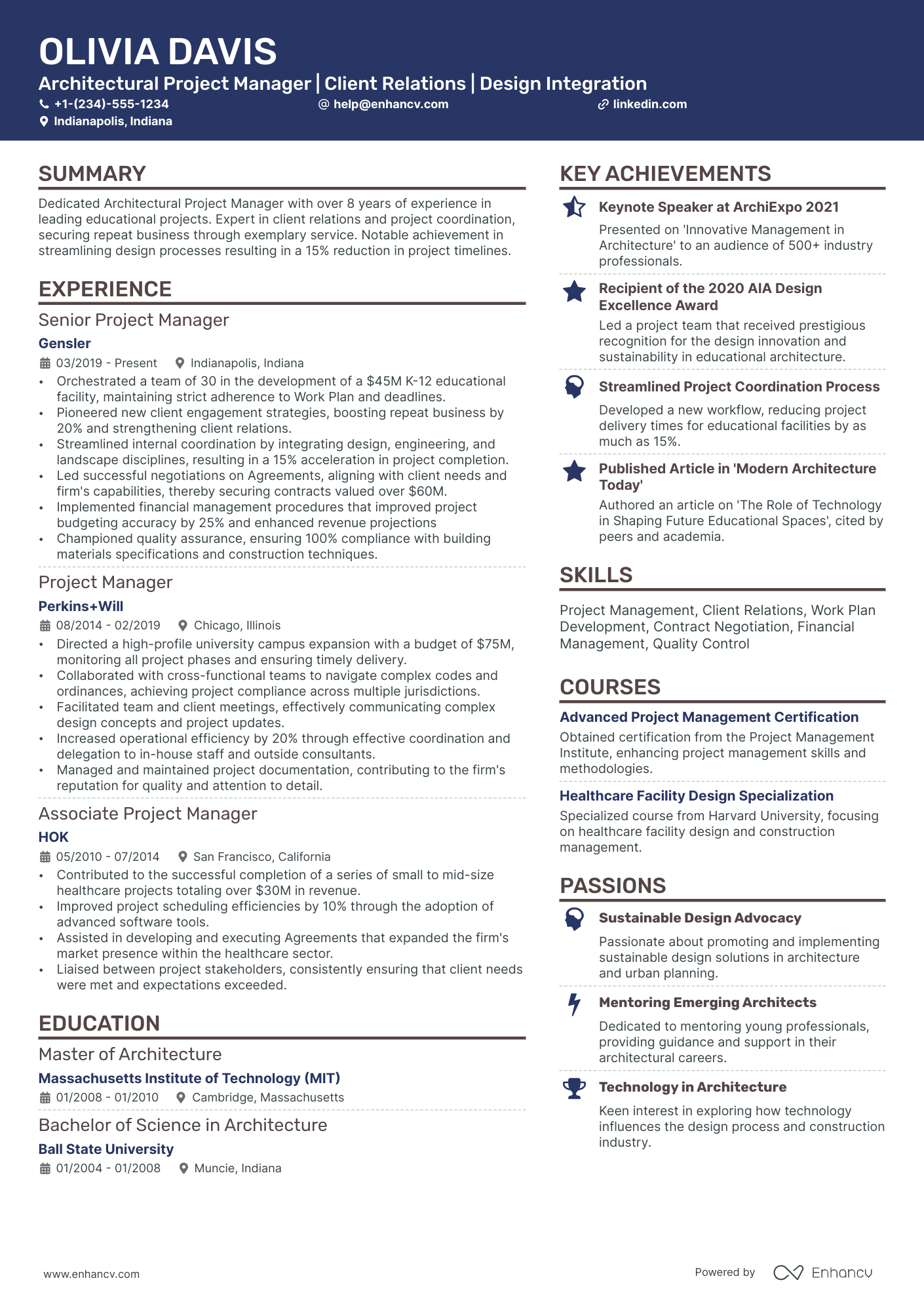
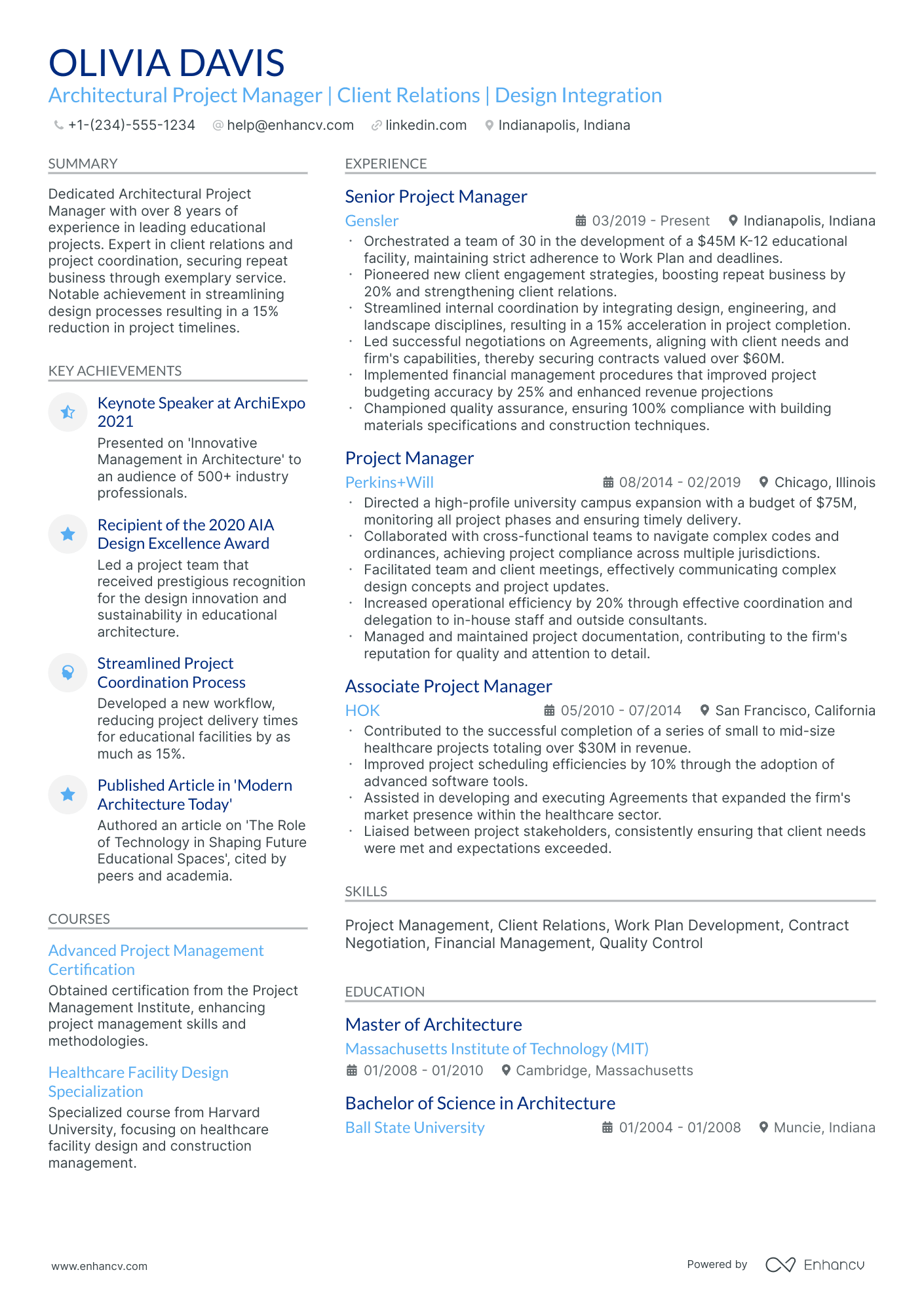
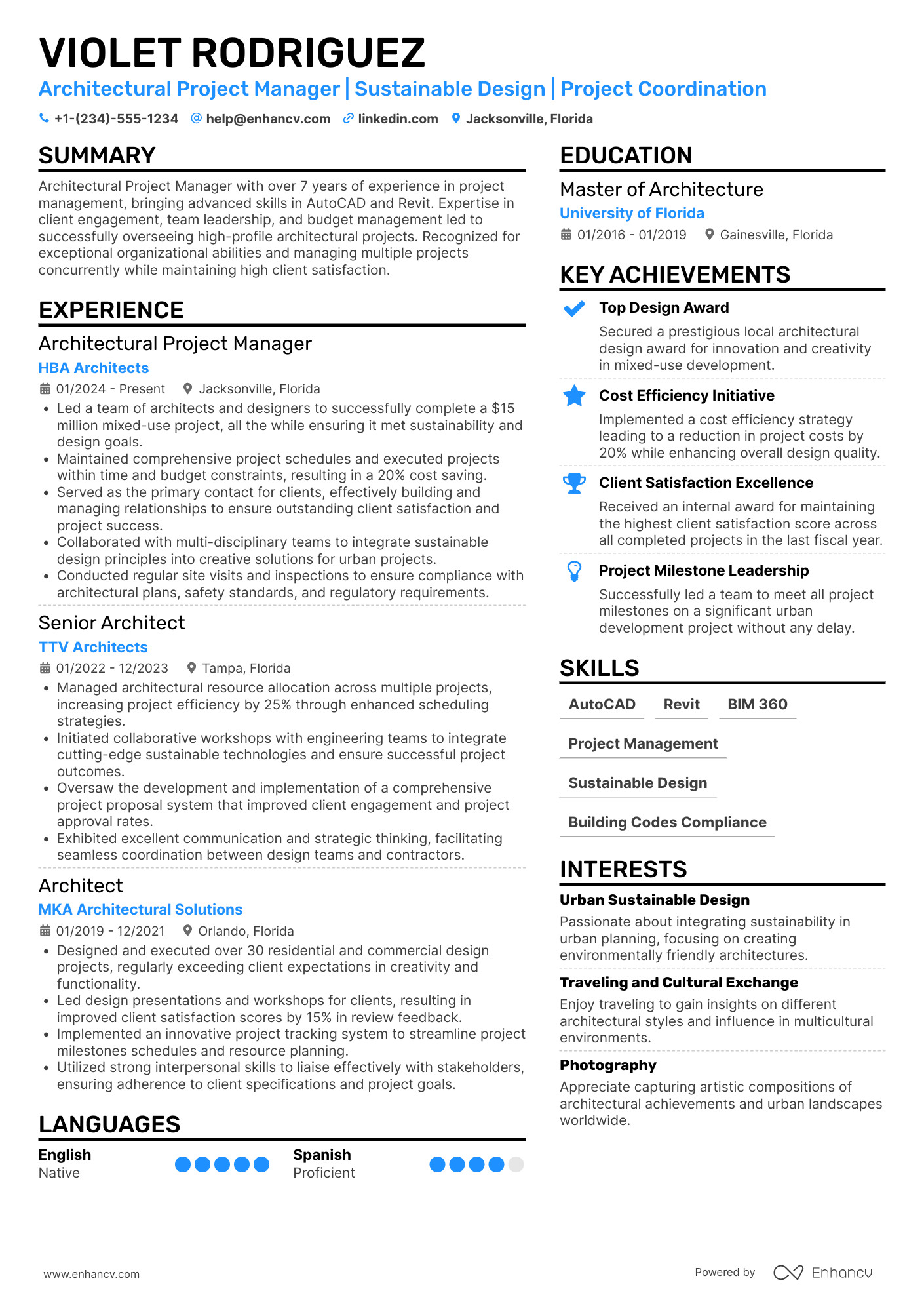
Many architectural project manager resume submissions fail because they read like task logs and bury delivery outcomes. That hurts in today's architectural project manager resume screens, where applicant tracking system filters and fast recruiter scans reward clear, quantified impact.
A strong resume shows what you delivered, not just what you used. Understanding how to make your resume stand out means highlighting budget and schedule control, change-order reductions, fewer requests for information, on-time permits, smoother closeout, improved quality, and measurable stakeholder satisfaction across project scope.

Key takeaways
- Lead each bullet with measurable outcomes—budgets, schedules, and change-order reductions—not task descriptions.
- Use reverse-chronological format to show progressive ownership of larger, more complex projects.
- Tailor every resume to the job posting by mirroring its tools, terminology, and compliance requirements.
- Quantify achievements with specific metrics like cost savings, RFI reductions, and schedule compression.
- Demonstrate skills in context within your summary and experience, not only in a standalone list.
- Anchor entry-level resumes to capstone projects, internship deliverables, and quantified coordination outcomes.
- Use Enhancv's tools to tighten language and strengthen bullet points without inflating your actual experience.
Job market snapshot for architectural project managers
We analyzed 63 recent architectural project manager job ads across major US job boards. These numbers help you understand skills in demand, experience requirements, industry demand at a glance.
What level of experience employers are looking for architectural project managers
| Years of Experience | Percentage found in job ads |
|---|---|
| 1–2 years | 4.8% (3) |
| 3–4 years | 1.6% (1) |
| 5–6 years | 25.4% (16) |
| 7–8 years | 12.7% (8) |
| 9–10 years | 12.7% (8) |
| 10+ years | 15.9% (10) |
| Not specified | 39.7% (25) |
Architectural project manager ads by area of specialization (industry)
| Industry (Area) | Percentage found in job ads |
|---|---|
| Finance & Banking | 68.3% (43) |
Top companies hiring architectural project managers
| Company | Percentage found in job ads |
|---|---|
| Actalent | 42.9% (27) |
Role overview stats
These tables show the most common responsibilities and employment types for architectural project manager roles. Use them to align your resume with what employers expect and to understand how the role is structured across the market.
Day-to-day activities and top responsibilities for a architectural project manager
| Responsibility | Percentage found in job ads |
|---|---|
| Revit | 47.6% (30) |
| Autocad | 42.9% (27) |
| Project management | 39.7% (25) |
| Architecture | 27.0% (17) |
| Bluebeam | 27.0% (17) |
| Microsoft office | 25.4% (16) |
| Adobe creative suite | 20.6% (13) |
| Sketchup | 20.6% (13) |
| Construction administration | 19.0% (12) |
| Construction documentation | 11.1% (7) |
| Ada | 9.5% (6) |
| Design | 9.5% (6) |
Type of employment (remote vs on-site vs hybrid)
| Employment type | Percentage found in job ads |
|---|---|
| On-site | 68.3% (43) |
| Hybrid | 22.2% (14) |
| Remote | 9.5% (6) |
How to format a architectural project manager resume
Recruiters evaluating architectural project manager candidates prioritize evidence of project delivery leadership, budget and schedule accountability, cross-functional team coordination, and progressive responsibility across increasingly complex building programs. Choosing the right resume format matters—burying key signals beneath skills lists or non-linear layouts makes it harder for both hiring managers and applicant tracking systems to assess your qualifications.

I have significant experience in this role—which format should I use?
Use a reverse-chronological format to present your architectural project management career in a clear, linear progression that highlights growing scope and accountability. Do:
- Lead each role entry with your scope of ownership—project value, team size, number of concurrent programs, and client relationship responsibilities.
- Feature role-specific proficiencies such as Revit, Procore, Bluebeam, contract administration (AIA documents), code compliance, and entitlement processes within the context of each position.
- Quantify outcomes tied to business impact: cost savings, schedule compression, change order reduction, and client retention.
Why hybrid and functional resumes don't work for senior roles
Hybrid and functional formats fragment your career timeline, obscuring the leadership progression and expanding project scope that hiring managers need to evaluate for senior architectural project management roles. These layouts dilute the accountability narrative—decision ownership, stakeholder management, and delivery track record lose their context when separated from specific positions and timelines. Avoid hybrid and functional formats entirely if you have five or more years of progressive architectural project management experience, as they will raise more questions than they answer.
- A functional resume may be acceptable only if you're transitioning into architectural project management from a closely related discipline (such as construction management or architecture with no formal PM title) and have limited direct PM role history—but even then, every skill must be anchored to a specific project, deliverable, and measurable outcome.
Once you've established a clean, professional format, the next step is deciding which sections to include so each one reinforces your qualifications.
What sections should go on a architectural project manager resume
Recruiters expect you to present a clear record of delivering complex architectural projects on time, on budget, and to spec. Knowing what to put on a resume for this role is essential to making the right impression.
Use this structure for maximum clarity:
- Header
- Summary
- Experience
- Skills
- Projects
- Education
- Certifications
- Optional sections: Awards, Publications, Languages
Your experience bullets should emphasize measurable project outcomes, budget and schedule ownership, stakeholder coordination, and the scope and complexity of the work you delivered.
Is your resume good enough?
Drop your resume here or choose a file. PDF & DOCX only. Max 2MB file size.
Once you’ve organized your resume with the right structure, focus next on writing your architectural project manager experience section so each role supports that layout with clear, relevant detail.
How to write your architectural project manager resume experience
The experience section is where you prove you can move architectural projects from concept through completion—on time, within budget, and at the quality standard clients and stakeholders expect. Hiring managers prioritize demonstrated impact over descriptive task lists, so focus on shipped deliverables, the project management and design coordination tools you used, and measurable outcomes tied to scope, schedule, cost, or quality.
Each entry should include:
- Job title
- Company and location (or remote)
- Dates of employment (month and year)
Three to five concise bullet points showing what you owned, how you executed, and what outcomes you delivered:
- Ownership scope: the architectural projects, building programs, client portfolios, consultant teams, or construction phases you were directly accountable for managing from initiation through closeout.
- Execution approach: the scheduling platforms, BIM coordination tools, contract delivery methods, cost-tracking systems, or stakeholder management frameworks you relied on to drive decisions and keep projects on track.
- Value improved: the changes you created in project timelines, budget accuracy, drawing quality, code compliance, constructability, risk mitigation, or resource allocation across your architectural programs.
- Collaboration context: how you coordinated with architects, engineers, interior designers, general contractors, permitting agencies, ownership groups, or other external consultants to align scope and resolve conflicts.
- Impact delivered: the tangible results your management produced—expressed through completed project milestones, portfolio scale, client retention, regulatory approvals, or business outcomes rather than routine activities.
Experience bullet formula
A architectural project manager experience example
✅ Right example - modern, quantified, specific.
Architectural Project Manager
Horizon Civic Studio | Austin, TX
2021–2025
Full-service architecture firm delivering municipal and higher education projects valued at $10M–$120M.
- Directed end-to-end delivery of a $68M, 210,000-square-foot public library—managed scope, budget, and schedule in Procore and Microsoft Project—achieving substantial completion six weeks early and closing $1.9M in change orders at 0.8% of contract value.
- Led BIM coordination in Autodesk Revit and Navisworks with structural, mechanical, electrical, and plumbing consultants—ran weekly clash detection and issue logs—cutting field conflicts by 35% and reducing requests for information by 22% across three project phases.
- Negotiated consultant and contractor workflows using AIA contract documents and a formal risk register—facilitated owner, architect, and contractor design reviews—lowering contingency draw by 18% while maintaining design intent and code compliance.
- Implemented a standardized submittal and closeout process in Procore—aligned architects, engineers, and commissioning agents—reducing submittal cycle time by 27% and improving first-pass approval rates from 62% to 81%.
- Coordinated permitting and authority having jurisdiction reviews—tracked comments and resubmittals in Bluebeam Revu—cutting permit turnaround by 19 days and avoiding $250K in schedule-related general conditions.
Now that you've seen how strong experience entries look in practice, let's focus on customizing yours to match the specific role you're targeting.
How to tailor your architectural project manager resume experience
Recruiters evaluate your resume through both applicant tracking systems and manual review, so tailoring your resume to the job description is essential. Tailoring ensures the skills, tools, and accomplishments you highlight directly reflect what the hiring team prioritizes.
Ways to tailor your architectural project manager experience:
- Match project management software like Revit Procore or Bluebeam from the posting.
- Mirror the exact terminology used for design phases or deliverables.
- Reflect specific building codes zoning standards or compliance requirements mentioned.
- Highlight LEED certification or sustainability experience when the role requires it.
- Emphasize consultant coordination or cross-discipline collaboration models referenced.
- Align your budgeting and scheduling language with stated KPIs or benchmarks.
- Include relevant sector experience such as healthcare civic or commercial projects.
- Reference quality assurance or constructability review processes the posting names.
Tailoring means connecting your actual achievements to the language and priorities in the job description, not forcing in keywords where they don't belong.
Resume tailoring examples for architectural project manager
| Job description excerpt | Untailored | Tailored |
|---|---|---|
| Manage full project lifecycle for mixed-use developments using Revit and Procore, ensuring compliance with local zoning codes and ADA standards. | Managed various architecture projects from start to finish. | Directed full lifecycle delivery of three mixed-use developments (50,000–120,000 sq. ft.) using Revit and Procore, ensuring compliance with municipal zoning codes and ADA accessibility standards across all project phases. |
| Coordinate with structural, MEP, and civil engineering consultants to resolve design conflicts and maintain project schedules within a $10M–$50M budget range. | Worked with different teams to keep projects on track and within budget. | Coordinated with structural, MEP, and civil engineering consultants to resolve 40+ design conflicts per project, maintaining schedules and controlling budgets ranging from $12M to $48M with zero cost overruns on last four deliveries. |
| Lead schematic design and design development phases for healthcare facilities, presenting to client stakeholders and incorporating FGI Guidelines compliance into documentation. | Led design phases and presented updates to clients on building projects. | Led schematic design and design development for a 200-bed acute care facility, presenting milestone reviews to hospital board stakeholders and integrating FGI Guidelines compliance into all construction documentation packages. |
Once you’ve aligned your experience with the role’s priorities, quantifying your achievements shows the measurable impact behind those responsibilities.
How to quantify your architectural project manager achievements
Quantified results prove you delivered predictable schedules, controlled costs, and reduced risk. Learning how to present numbers on your resume effectively lets you focus on on-time milestones, budget variance, change orders, RFIs, safety incidents, and client satisfaction across projects, teams, and consultants.
Quantifying examples for architectural project manager
| Metric | Example |
|---|---|
| Schedule delivery | "Recovered a six-week delay by re-baselining in Primavera P6, holding weekly pull-planning sessions, and delivering permit set two days early." |
| Cost control | "Cut construction administration hours by 18% by standardizing submittal logs in Newforma and tightening review cycles from ten days to six." |
| Quality and rework | "Reduced change orders from 4.2% to 2.6% of contract value by running BIM clash detection in Autodesk Revit and closing 320 issues pre-IFC." |
| Risk and compliance | "Passed three authority reviews with zero major comments by tracking code items in Bluebeam and maintaining a 100% inspection-ready checklist." |
| Stakeholder turnaround | "Decreased client decision time from fourteen days to seven by using a weekly decision register and resolving 90% of RFIs within five business days." |
Turn vague job duties into measurable, recruiter-ready resume bullets in seconds with Enhancv's Bullet Point Generator.
Once you've crafted strong bullet points for your experience section, the next step is ensuring your resume also highlights the right hard and soft skills that architectural project manager roles demand.
How to list your hard and soft skills on a architectural project manager resume
Your skills section shows you can lead design and delivery, and recruiters and ATS scan it for role-matched keywords; aim for a balanced mix of hard skills like building systems and software, plus soft skills like stakeholder alignment and risk control. architectural project manager roles require a blend of:
- Product strategy and discovery skills.
- Data, analytics, and experimentation skills.
- Delivery, execution, and go-to-market discipline.
- Soft skills.
Your skills section should be:
- Scannable (bullet-style grouping).
- Relevant to the job post.
- Backed by proof in experience bullets.
- Updated with current tools.
Place your skills section:
- Above experience if you're junior or switching careers.
- Below experience if you're mid/senior with strong achievements.

Hard skills
- Revit, AutoCAD, Navisworks
- BIM execution planning
- Bluebeam Revu markups
- Construction documentation sets
- RFI, submittal workflows
- Change orders, scope control
- Cost estimating, value engineering
- Schedule management, CPM
- Building codes, ADA compliance
- Building envelope detailing
- MEP coordination, clash detection
- Contract administration, AIA forms
Soft skills
- Align stakeholders on scope
- Run design coordination meetings
- Translate client needs to requirements
- Negotiate fees and change requests
- Manage consultants and vendors
- Escalate risks with clear options
- Resolve conflicts across disciplines
- Communicate decisions and tradeoffs
- Maintain accountability to milestones
- Document agreements and actions
- Prioritize issues under deadlines
- Lead quality reviews and closeout
How to show your architectural project manager skills in context
Skills shouldn't live only in a bulleted list on your resume. Browse examples of resume skills presented effectively to see how they can be woven throughout your document.
They should be demonstrated in:
- Your summary (high-level professional identity)
- Your experience (proof through outcomes)
Here's what strong, skill-rich entries look like in practice.
Summary example
Senior architectural project manager with 12 years leading complex mixed-use and healthcare projects. Skilled in Procore, BIM coordination, and stakeholder management. Delivered $180M in projects on time, consistently reducing budgets by 9% through value engineering.
- Reflects senior-level career scope
- Names industry-relevant tools directly
- Quantifies impact with clear metrics
- Highlights leadership and collaboration
Experience example
Senior Architectural Project Manager
Holden Pierce Associates | Denver, CO
March 2019–Present
- Managed a $74M mixed-use development using Procore and Revit, completing the project 6 weeks ahead of schedule through cross-discipline coordination.
- Led a team of 14 architects, engineers, and consultants, reducing RFI turnaround time by 35% with structured BIM collaboration workflows.
- Negotiated contractor scopes alongside ownership groups, cutting change order costs by 18% across three concurrent healthcare facility projects.
- Every bullet contains measurable proof
- Skills appear naturally within achievements
Once you’ve demonstrated your architectural project manager abilities through specific project outcomes and responsibilities, the next step is to apply that approach to structuring an architectural project manager resume when you have no experience.
How do I write a architectural project manager resume with no experience
Even without full-time experience, you can demonstrate readiness through building a resume without work experience that leverages:
- Capstone construction document set leadership
- Studio project schedules and budgets
- Owner meetings and decision logs
- Consultant coordination and clash reviews
- Permitting research and submittal tracking
- Internship RFIs and submittals support
- Site visits with punch lists
- Volunteer facilities renovation planning
Focus on:
- Schedule ownership with clear milestones
- Budget tracking with documented updates
- Drawing coordination across disciplines
- Permitting, RFIs, and submittals
Resume format tip for entry-level architectural project manager
Use a hybrid resume format that leads with projects and skills, then lists experience. It highlights relevant project management work when your job history is limited. Do:
- Lead with a "Projects" section.
- Add tools: Revit, Bluebeam, Procore.
- Quantify scope: sheets, dollars, dates.
- Use project manager keywords: RFIs, submittals.
- List deliverables: logs, schedules, meeting notes.
- Led capstone CD set coordination in Revit, tracked twenty RFIs and submittals in Procore, and cut coordination issues by thirty percent before final review.
When you're building your resume without direct experience, your education section becomes one of the strongest tools for demonstrating relevant qualifications—here's how to present it effectively.
How to list your education on a architectural project manager resume
Your education section helps hiring teams confirm you have the foundational knowledge needed for an architectural project manager role. It validates technical training and design expertise quickly.
Include:
- Degree name
- Institution
- Location
- Graduation year
- Relevant coursework (for juniors or entry-level candidates)
- Honors & GPA (if 3.5 or higher)
Avoid listing specific months or days for graduation. Use the year only to keep things clean.
Here's a strong education entry tailored for an architectural project manager resume.
Example education entry
Bachelor of Architecture (B.Arch)
University of Southern California, Los Angeles, CA
Graduated 2019
GPA: 3.7/4.0
- Relevant Coursework: Construction Project Management, Building Information Modeling, Sustainable Design Systems, Contract Administration
- Honors: Dean's List, Magna Cum Laude
How to list your certifications on a architectural project manager resume
Certifications on a resume show an architectural project manager's commitment to learning, proficiency with project tools, and alignment with industry standards and regulations.
Include:
- Certificate name
- Issuing organization
- Year
- Optional: credential ID or URL
- Place certifications below education when they're older, less relevant, or supplemental to your core architectural project manager qualifications.
- Place certifications above education when they're recent, highly relevant, or required for the architectural project manager roles you target.
Best certifications for your architectural project manager resume
- Project Management Professional (PMP)
- Associate Constructor (AC)
- Certified Construction Manager (CCM)
- LEED Accredited Professional (LEED AP)
- Autodesk Certified Professional: Revit for Architectural Design
- WELL Accredited Professional (WELL AP)
- OSHA 30-Hour Construction Safety and Health
Once you’ve positioned your credentials where they’re easy to verify, move to your architectural project manager resume summary to connect those qualifications to the value you deliver.
How to write your architectural project manager resume summary
Your resume summary is the first thing a recruiter reads. A strong one instantly signals you have the experience and leadership to manage complex architectural projects.
Keep it to three to four lines, with:
- Your title and total years of experience in architectural project management.
- The types of projects you've managed, such as commercial, institutional, or mixed-use developments.
- Core tools and skills like Revit, AutoCAD, Procore, budgeting, and contract administration.
- One or two measurable achievements, such as projects delivered under budget or ahead of schedule.
- Soft skills tied to real outcomes, like stakeholder coordination that reduced approval timelines.

PRO TIP
At this level, lead with project scope, team leadership, and business outcomes rather than listing technical skills alone. Highlight ownership of budgets, timelines, and client relationships. Avoid vague phrases like "passionate leader" or "results-driven professional." Instead, anchor every claim to a specific number or outcome.
Example summary for a architectural project manager
Architectural project manager with 10+ years leading commercial and mixed-use projects valued up to $85M. Directed cross-functional teams of 25, consistently delivering projects 12% under budget through proactive risk management and stakeholder alignment.
Optimize your resume summary and objective for ATS
Drop your resume here or choose a file.
PDF & DOCX only. Max 2MB file size.
Now that your summary is ready to showcase your value, make sure the header above it presents your contact details correctly so recruiters can actually reach you.
What to include in a architectural project manager resume header
A resume header is the top section with your identity and contact details, and it boosts visibility, credibility, and recruiter screening for a architectural project manager.
Essential resume header elements
- Full name
- Tailored job title and headline
- Location
- Phone number
- Professional email
- GitHub link
- Portfolio link
A LinkedIn link lets recruiters verify roles, dates, and recommendations fast, which supports screening.
Do not include a photo on a architectural project manager resume unless the role is explicitly front-facing or appearance-dependent.
Keep your header on one to two lines, lead with "architectural project manager," and match your headline to the job posting's wording.
Example
Architectural project manager resume header
Jordan Lee
Architectural Project Manager | Commercial Interiors & Tenant Improvements
Austin, TX
(512) 555-01XX your.name@enhancv.com github.com/yourname yourwebsite.com linkedin.com/in/yourname
Once your contact details and role information are clear and easy to scan, add targeted additional sections to reinforce your fit and credibility.
Additional sections for architectural project manager resumes
When your core qualifications match other candidates, additional sections help you stand out with role-specific credibility and depth.
- Languages
- Professional affiliations (AIA, USGBC, PMI)
- Publications and conference presentations
- Volunteer design and community projects
- Continuing education and specialized training
- Awards and design competition recognitions
Once you've strengthened your resume with relevant extra sections, the next step is pairing it with a cover letter to give hiring managers the full picture of your qualifications.
Do architectural project manager resumes need a cover letter
A cover letter isn't required for an architectural project manager, but it helps in competitive searches or when hiring teams expect one. If you're unsure what a cover letter is or how it complements your resume, it can make a difference when your resume needs context or when your fit isn't obvious.
Use a cover letter to add context your resume can't:
- Explain role or team fit by matching your delivery style to the firm's workflow, stakeholders, and project types.
- Highlight one or two relevant projects or outcomes, including scope, schedule impact, budget control, and key coordination wins.
- Show understanding of the product, users, or business context, such as tenant needs, permitting risk, or owner priorities.
- Address career transitions or non-obvious experience by connecting past roles to architectural project manager responsibilities and results.
Drop your resume here or choose a file.
PDF & DOCX only. Max 2MB file size.
Even if you choose to include a cover letter to add context, using AI to improve your architectural project manager resume helps you strengthen the document that hiring teams review first.
Using AI to improve your architectural project manager resume
AI can sharpen your resume's clarity, structure, and impact. It helps tighten language and highlight results. But overuse strips authenticity. If you're wondering which AI is best for writing resumes, the key is using it as a refinement tool, not a replacement. Once your content feels clear and role-aligned, step away from AI.
Here are 10 practical prompts to strengthen specific sections of your architectural project manager resume:
- Sharpen your summary. "Rewrite my resume summary to highlight my core strengths as an architectural project manager in under four sentences."
- Quantify project results. "Add measurable outcomes to these experience bullets for an architectural project manager, focusing on budgets, timelines, and team sizes."
- Strengthen action verbs. "Replace weak or passive verbs in my architectural project manager experience section with strong, industry-specific action verbs."
- Align with job posting. "Compare my resume to this job description and suggest edits so my architectural project manager experience better matches the listed requirements."
- Refine skills section. "Reorganize my skills section to prioritize the most relevant technical and leadership skills for an architectural project manager role."
- Tighten project descriptions. "Condense these project descriptions into concise, results-driven bullets appropriate for an architectural project manager resume."
- Improve certifications section. "Reformat my certifications section to emphasize credentials most valued for an architectural project manager, like PMP or LEED."
- Clarify education details. "Edit my education section to highlight coursework and achievements directly relevant to an architectural project manager career path."
- Remove filler language. "Identify and remove vague or redundant phrases throughout my architectural project manager resume without losing important details."
- Tailor scope descriptions. "Rewrite these bullet points to clearly communicate the scale and complexity of projects I managed as an architectural project manager."
Stop using AI once your resume sounds accurate, specific, and aligned with real experience. AI should never invent experience or inflate claims—if it didn't happen, it doesn't belong here.
Conclusion
A strong architectural project manager resume shows measurable outcomes, role-specific skills, and a clear structure. It highlights budgets managed, schedules met, risks reduced, and quality improved. It also reflects leadership, stakeholder communication, and coordination across design, consultants, and contractors.
Keep your architectural project manager resume easy to scan and consistent from top to bottom. Use focused project highlights, clean formatting, and precise language. This approach shows readiness for today’s hiring market and supports strong consideration for near-future roles.