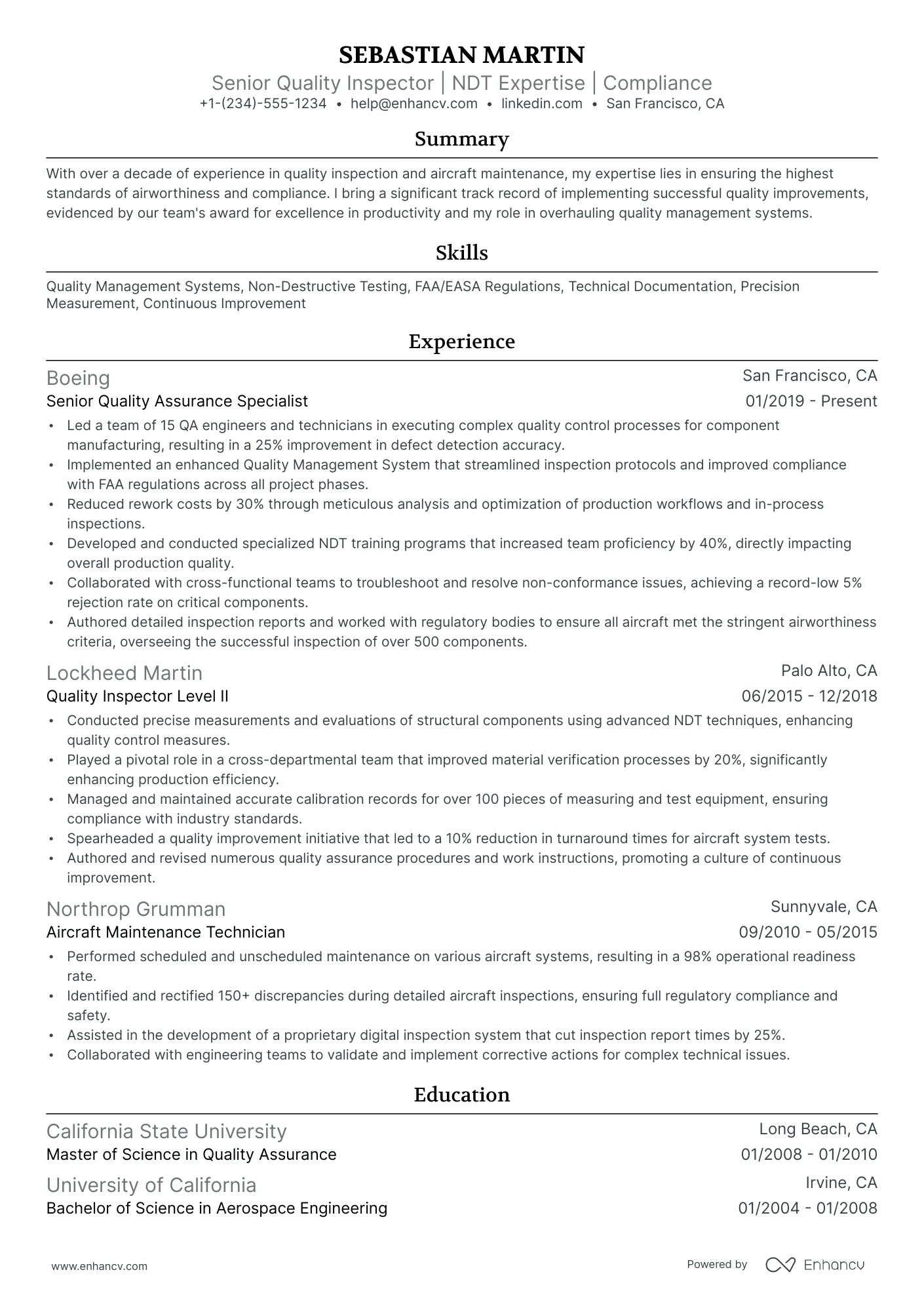
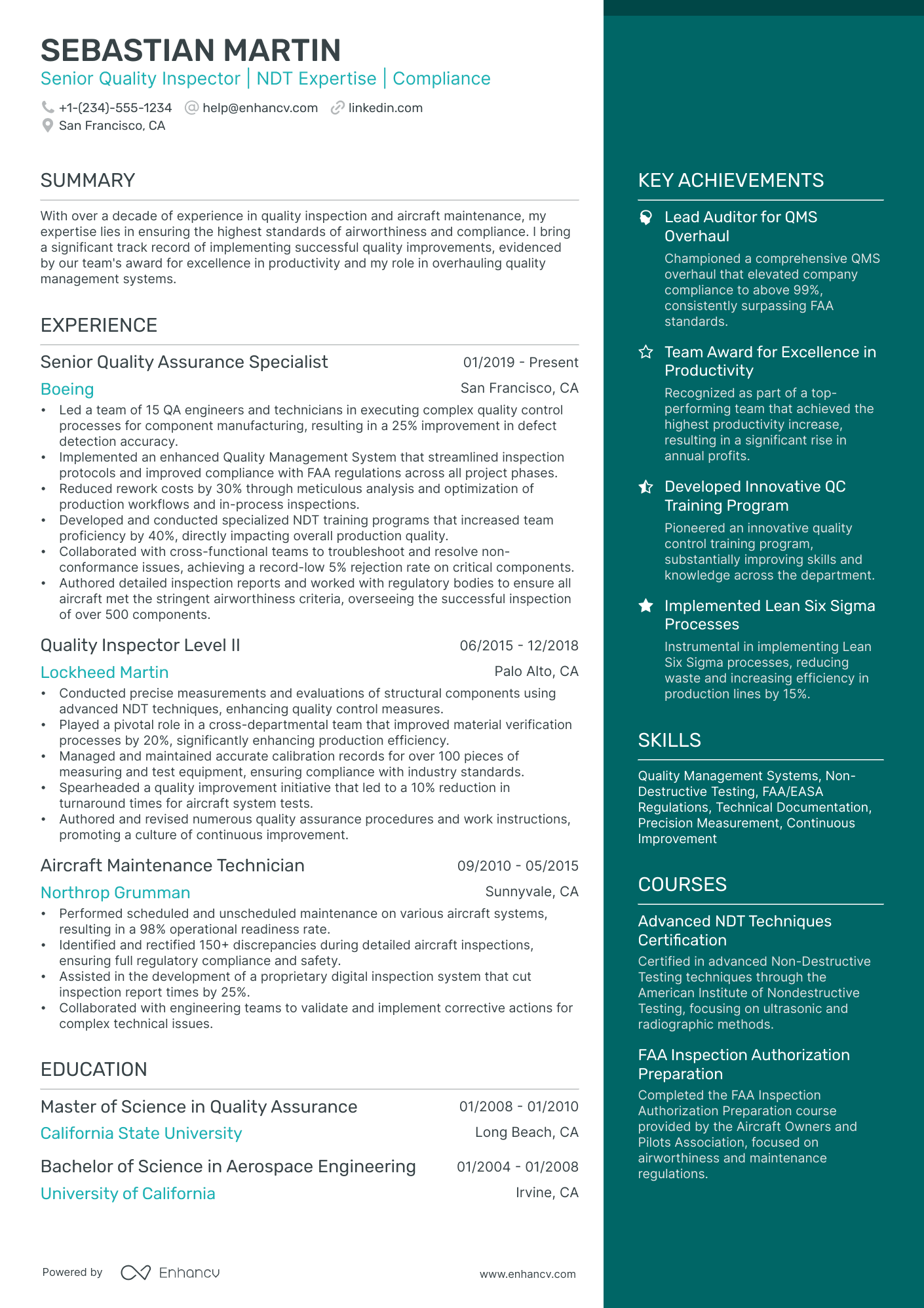
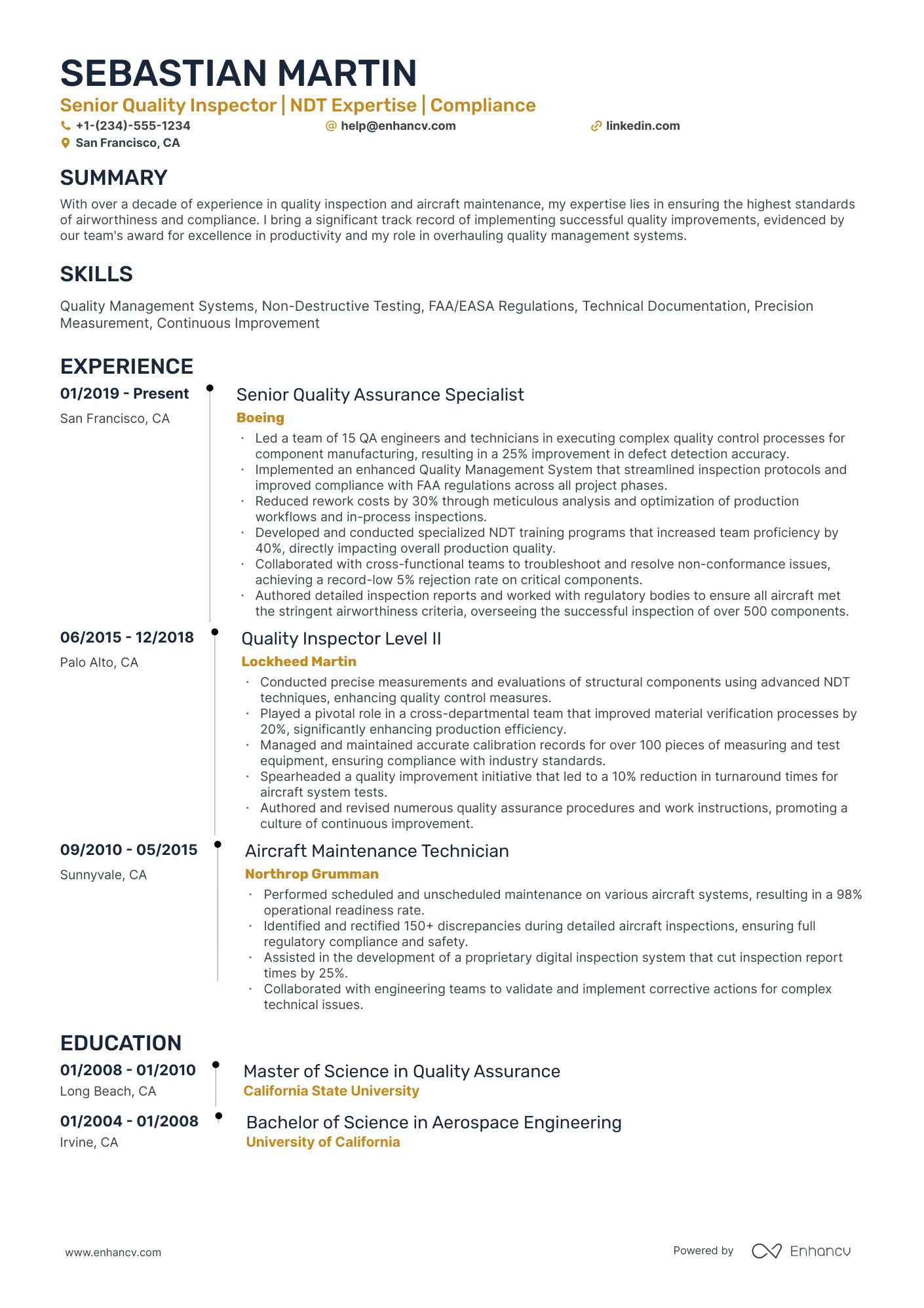
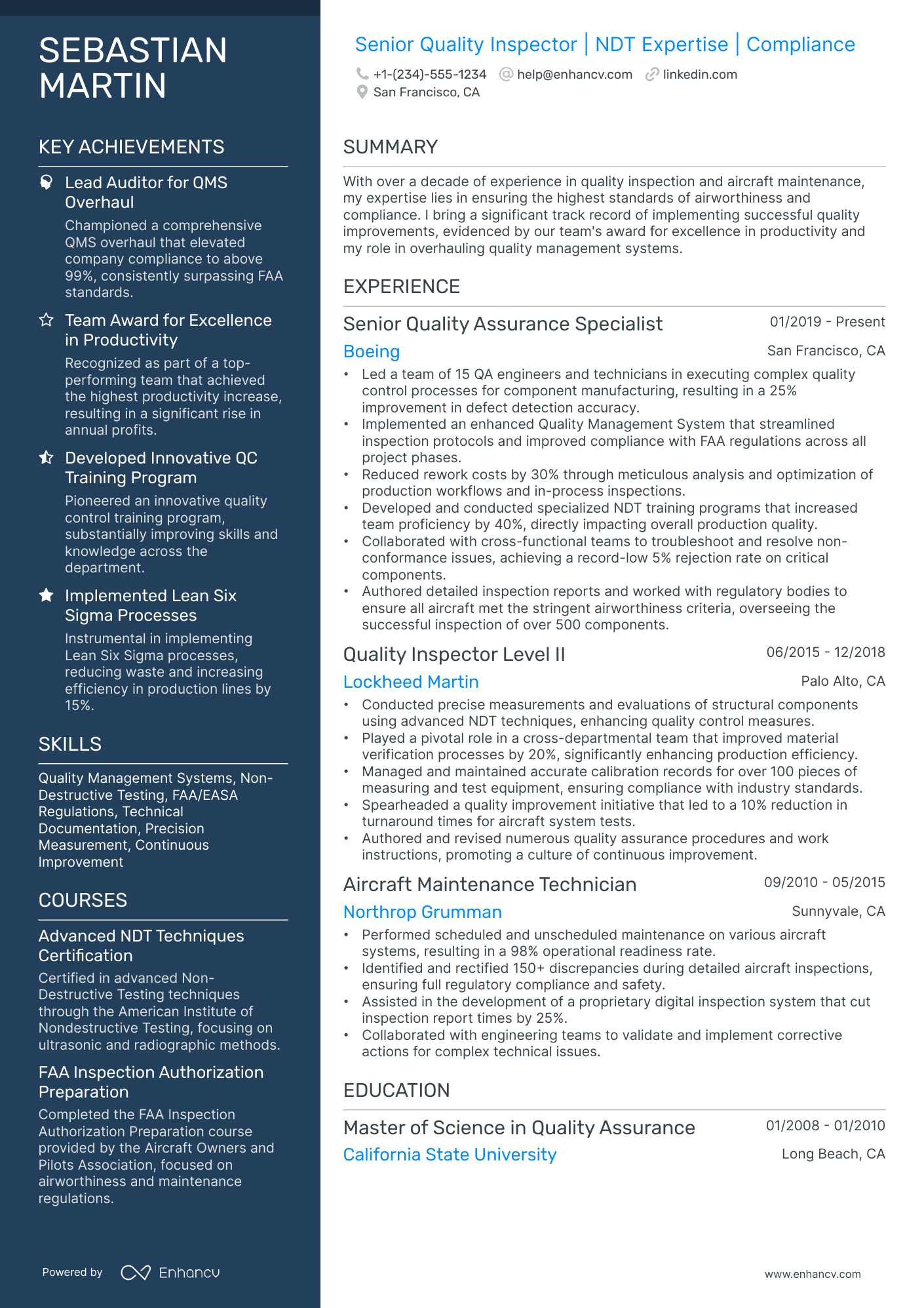
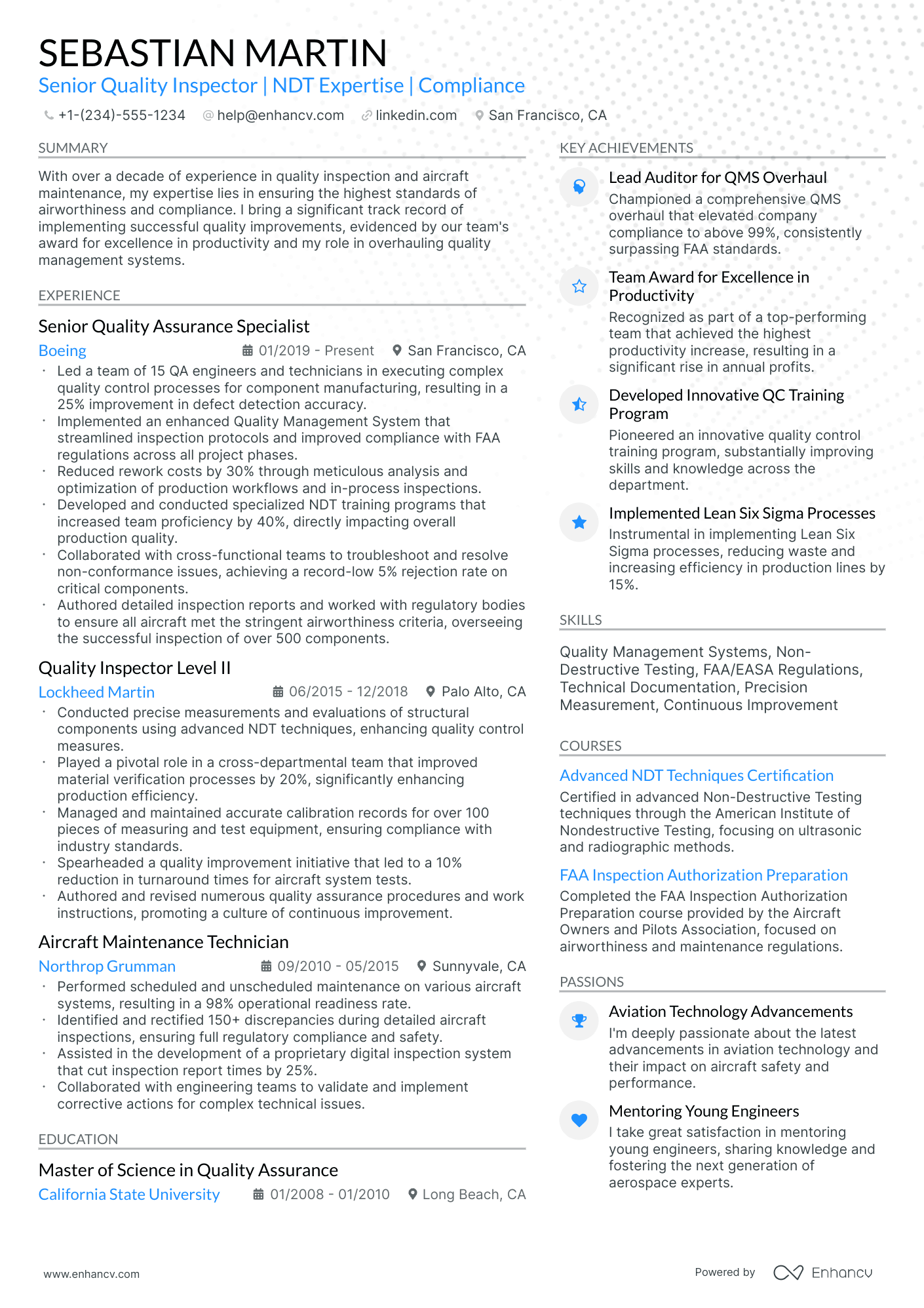
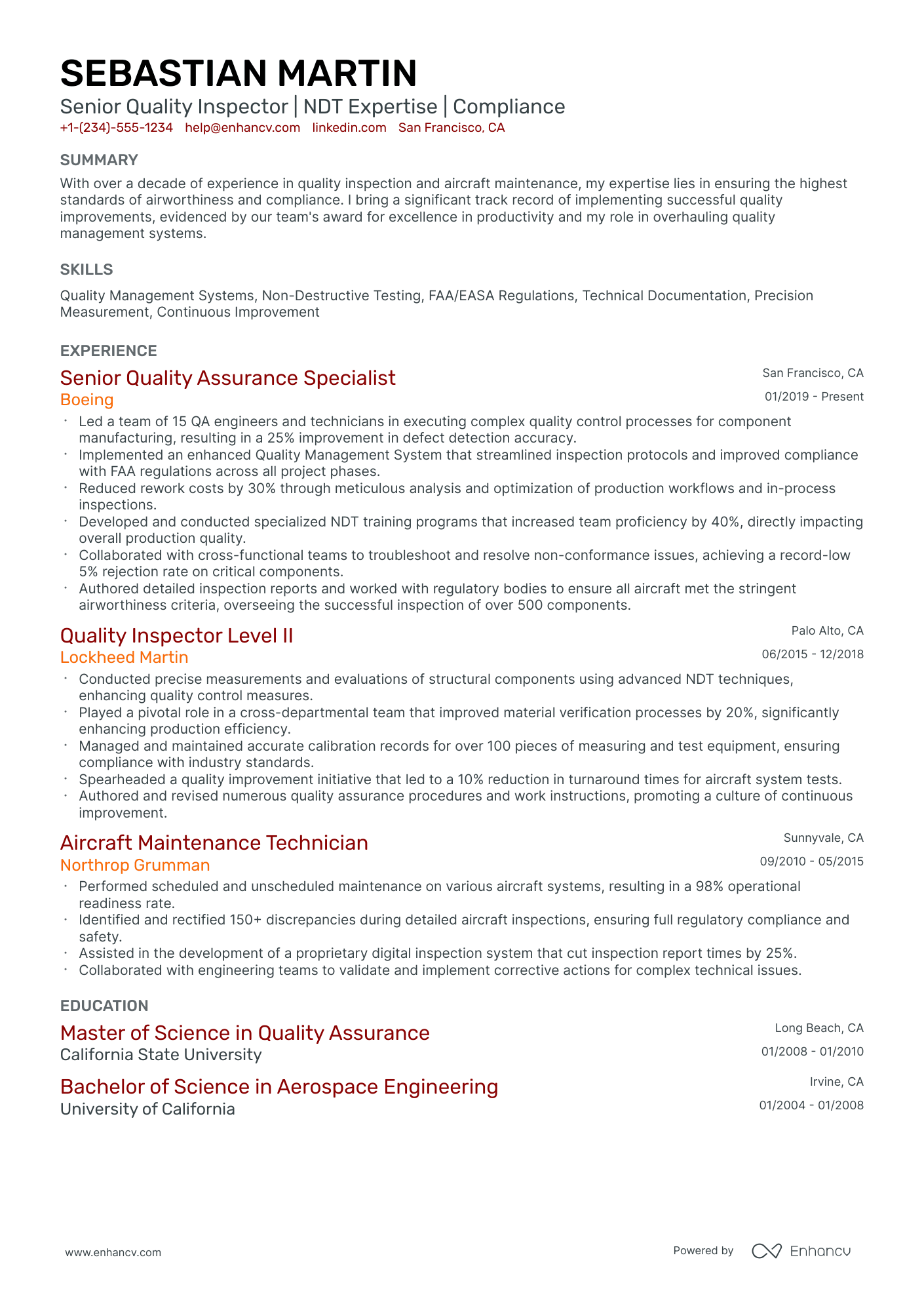
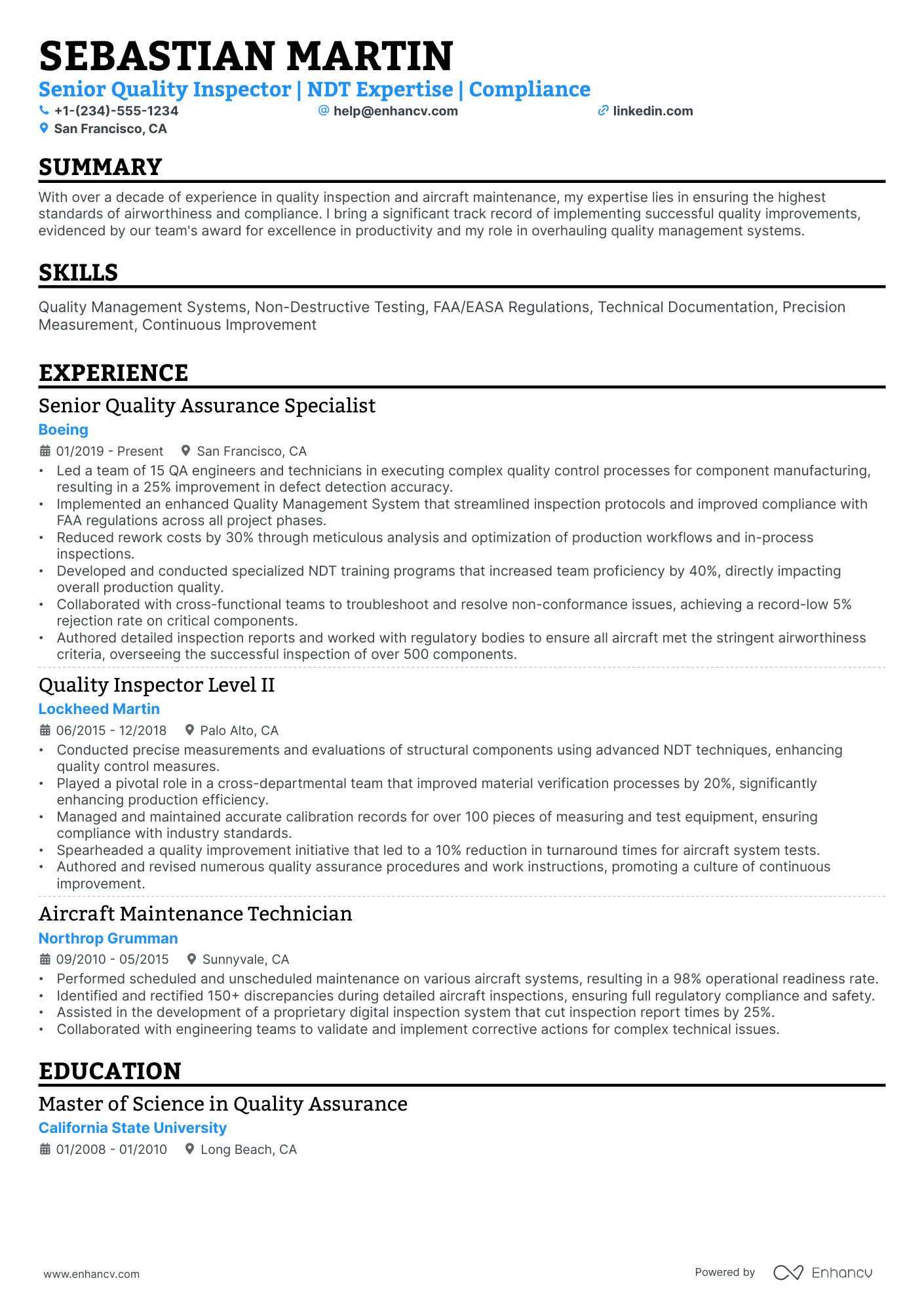
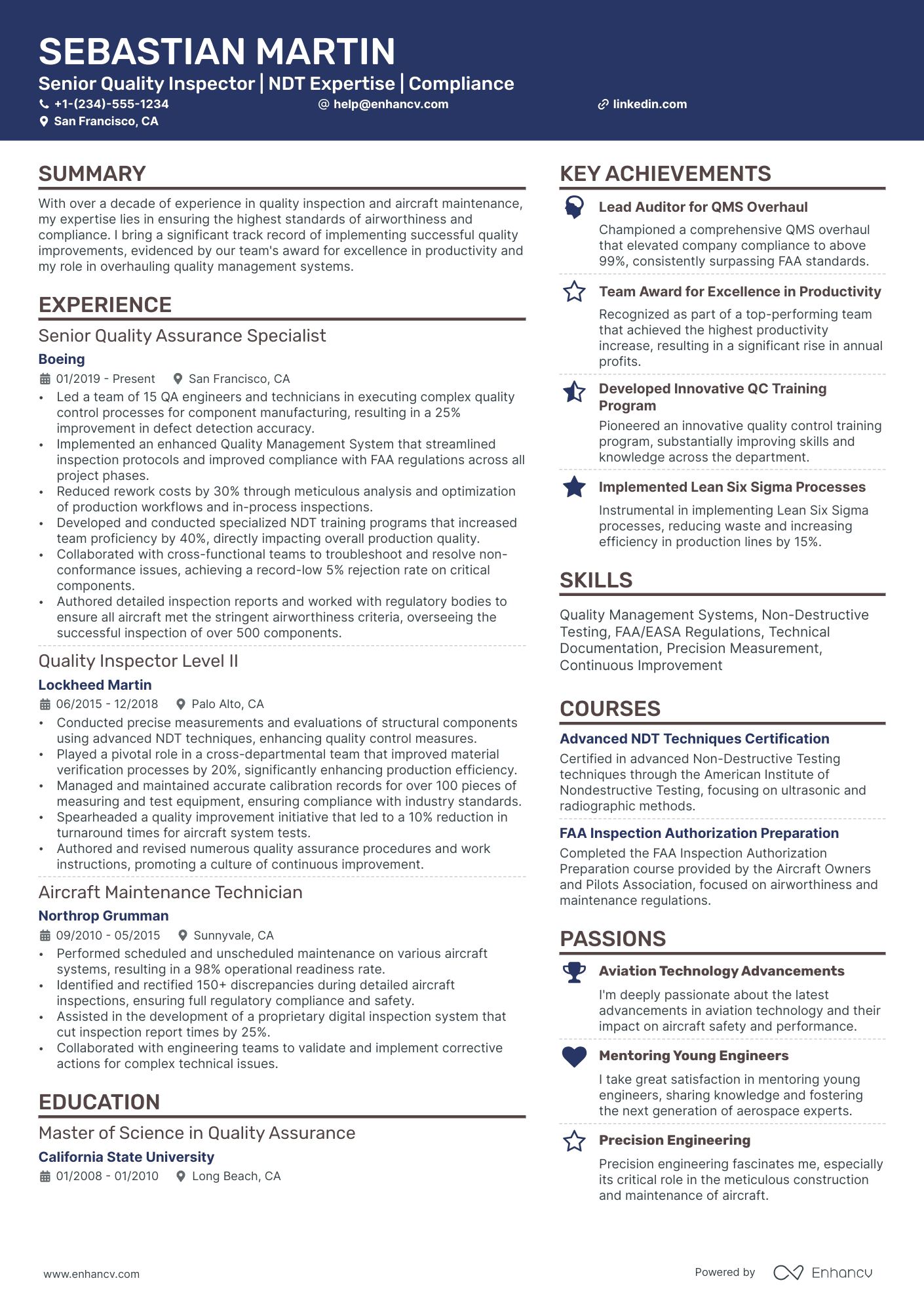
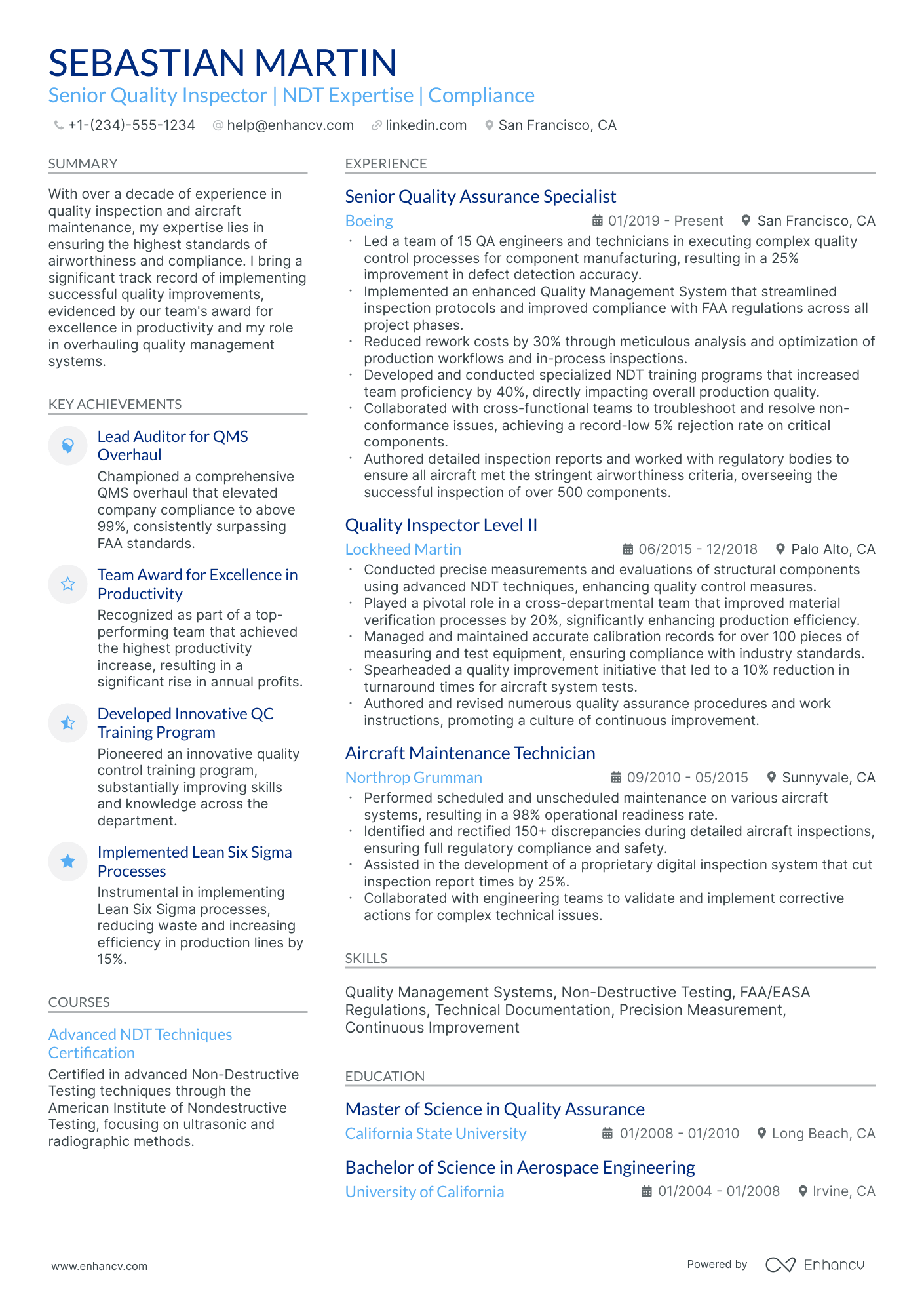
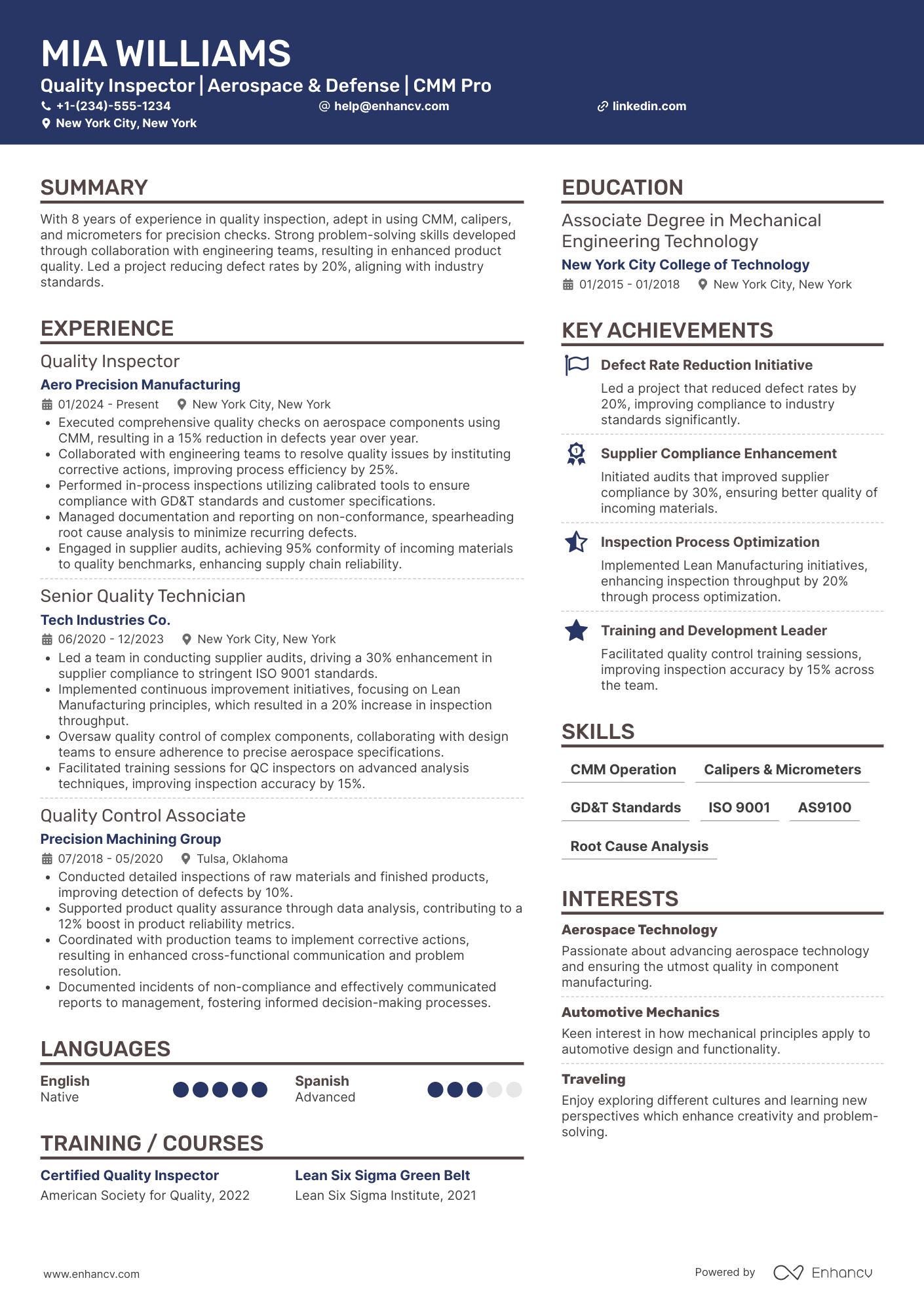
Most quality inspector resume drafts fail because they list checks and tools but don't prove defect prevention, traceability, or audit readiness. That hurts when an ATS (applicant tracking system) filters fast and recruiters scan in seconds.
A strong resume shows what changed because of your work. Knowing how to make your resume stand out means highlighting reduced defect rates, improved first-pass yield, faster release cycles, fewer customer returns, cleaner audit results, and tighter supplier quality. Quantify lots inspected, nonconformances closed, and cost of poor quality avoided.

Key takeaways
- Quantify defect rates, scrap savings, and audit results to prove inspection impact.
- Use reverse-chronological format for experienced inspectors and hybrid format for career switchers.
- Tailor every experience bullet to mirror the job posting's tools, standards, and KPIs.
- Lead each bullet with ownership scope, execution method, and a measurable outcome.
- Place certifications like ASQ CQI above education when they match the target role.
- Write a three- to four-line summary featuring your industry, core tools, and top metric.
- Use Enhancv to turn vague inspection duties into focused, recruiter-ready resume bullets.
Job market snapshot for quality inspectors
We analyzed 567 recent quality inspector job ads across major US job boards. These numbers help you understand top companies hiring, skills in demand, role specialization trends at a glance.
What level of experience employers are looking for quality inspectors
| Years of Experience | Percentage found in job ads |
|---|---|
| 1–2 years | 16.9% (96) |
| 3–4 years | 11.3% (64) |
| 5–6 years | 2.6% (15) |
| 7–8 years | 0.4% (2) |
| 9–10 years | 0.2% (1) |
| 10+ years | 5.8% (33) |
| Not specified | 61.4% (348) |
Quality inspector ads by area of specialization (industry)
| Industry (Area) | Percentage found in job ads |
|---|---|
| Finance & Banking | 47.4% (269) |
| Manufacturing | 21.9% (124) |
| Healthcare | 21.7% (123) |
| Retail & E-commerce | 4.2% (24) |
| Government | 2.5% (14) |
Top companies hiring quality inspectors
| Company | Percentage found in job ads |
|---|---|
| TRIGO Group | 4.1% (23) |
| Jabil Inc. | 3.9% (22) |
| Stratosphere Quality | 2.8% (16) |
| Leidos Holdings Inc. | 2.1% (12) |
| Boeing | 1.9% (11) |
| Eaton Corporation | 1.9% (11) |
| State of North Carolina | 1.9% (11) |
Role overview stats
These tables show the most common responsibilities and employment types for quality inspector roles. Use them to align your resume with what employers expect and to understand how the role is structured across the market.
Day-to-day activities and top responsibilities for a quality inspector
| Responsibility | Percentage found in job ads |
|---|---|
| Calipers | 25.7% (146) |
| Micrometers | 20.6% (117) |
| Microsoft office | 16.6% (94) |
| Inspection | 16.2% (92) |
| Blueprints | 15.0% (85) |
| Excel | 12.7% (72) |
| Quality control | 11.6% (66) |
| Gd&t | 11.5% (65) |
| Quality inspection | 11.5% (65) |
| Quality assurance | 11.3% (64) |
| Cmm | 10.8% (61) |
| As9100 | 10.6% (60) |
How to format a quality inspector resume
Recruiters evaluating quality inspector resumes prioritize hands-on inspection experience, familiarity with industry standards (ISO, GMP, ASME), and measurable contributions to defect reduction or process improvement. A clean, well-structured format ensures these signals surface quickly during both automated screening and manual review. Choosing the right resume format is the first step toward passing both filters.

I have significant experience in this role—which format should I use?
Use a reverse-chronological format to showcase your progression through increasingly complex inspection environments and quality systems. Do:
- Lead with your most recent role and emphasize the scope of your responsibilities—number of product lines inspected, team size, or facility coverage.
- Highlight proficiency with role-specific tools and standards such as CMMs, calipers, SPC software, ISO 9001 audits, and first article inspection protocols.
- Quantify outcomes that demonstrate business impact, including defect rate reductions, cost savings from rejected-lot prevention, or improvements in audit pass rates.
- Conducted dimensional and visual inspections across three production lines, reducing customer-reported defects by 34% over 12 months through implementation of standardized SPC charting.
I'm junior or switching into this role—what format works best?
A hybrid format works well because it lets you lead with relevant skills and certifications while still providing a concise work history that shows context. Do:
- Place a skills section near the top featuring inspection methodologies, measurement tools (micrometers, bore gauges, optical comparators), and any relevant certifications like CQI or Six Sigma Yellow Belt.
- Include projects, internships, or cross-functional experience that involved quality checks, compliance documentation, or root cause analysis—even if performed in a different role.
- Connect every listed skill or project to a concrete action and a clear result so recruiters can assess your readiness.
- SPC analysis (skill) → monitored control charts for a capstone manufacturing project and flagged process drift (action) → helped the team reduce simulated scrap rate by 18% (result).
Why not use a functional resume?
A functional format strips away the timeline and context that recruiters need to verify where, when, and how you applied your inspection skills, making it harder for them to trust your qualifications. A functional resume may be acceptable if you're entering quality inspection from an adjacent field (such as manufacturing operations or lab testing), have limited formal work history, or are addressing a significant resume gap—but only if every listed skill is tied directly to a specific project, training exercise, or measurable outcome.
Once you've established a clean, professional layout, the next step is deciding which sections to include and how to arrange them for maximum impact.
What sections should go on a quality inspector resume
What sections should go on a quality inspector resume?
Recruiters expect to see clear proof you can inspect to spec, document findings, and prevent defects from reaching customers. Understanding which resume sections to include ensures you cover every expectation. Use this structure for maximum clarity:
- Header
- Summary
- Experience
- Skills
- Projects
- Education
- Certifications
- Optional sections: Awards, Leadership, Languages
Your experience bullets should emphasize measurable defect reduction, audit pass rates, throughput improvements, and the scope of parts, processes, and standards you owned.
Is your resume good enough?
Drop your resume here or choose a file. PDF & DOCX only. Max 2MB file size.
Now that you’ve organized your resume with the right components, the next step is to write your quality inspector experience section so it supports each part with clear, relevant proof.
How to write your quality inspector resume experience
The experience section is where you prove you've shipped real work—inspections completed, defects caught, standards enforced, and measurable improvements to product quality or compliance. Hiring managers prioritize demonstrated impact over descriptive task lists, so every line should connect a quality inspector's tools, methods, and decisions to outcomes that mattered. Building a targeted resume means each bullet reflects the specific demands of the role you're pursuing.
Each entry should include:
- Job title
- Company and location (or remote)
- Dates of employment (month and year)
Three to five concise bullet points showing what you owned, how you executed, and what outcomes you delivered:
- Ownership scope: the product lines, production stages, inspection programs, or facility areas you were directly accountable for as a quality inspector.
- Execution approach: the inspection tools, testing equipment, statistical methods, regulatory frameworks, or quality management systems you used to evaluate conformance and drive decisions.
- Value improved: the specific changes you brought to defect rates, product reliability, process efficiency, regulatory compliance, or risk reduction within your inspection responsibilities.
- Collaboration context: how you worked alongside production teams, engineering, suppliers, auditors, or regulatory bodies to resolve nonconformances and maintain quality standards.
- Impact delivered: the tangible results your inspection work produced—expressed through scope of influence, scale of operations affected, or direct business outcomes rather than routine activity descriptions.
Experience bullet formula
A quality inspector experience example
✅ Right example - modern, quantified, specific.
Quality Inspector
AeroFab Components | Wichita, KS
2022–Present
Federal Aviation Administration-regulated manufacturer producing machined aluminum and titanium assemblies for commercial aerospace.
- Executed first article inspection using Coordinate Measuring Machine (CMM) and PC-DMIS, cutting dimensional nonconformances from 3.1% to 1.2% across 180+ part numbers.
- Built control plans and Statistical Process Control (SPC) charts in Minitab for five critical characteristics, improving CpK from 1.05 to 1.38 and reducing scrap costs by $92K annually.
- Led root cause analysis using 8D, 5 Whys, and fishbone diagrams with manufacturing engineers and operators, closing 26 corrective actions and lowering repeat defects by 41%.
- Standardized calibration and gauge management in GAGEtrak and ISO 9001-compliant logs, achieving 100% on-time calibrations and preventing three potential line stoppages per quarter.
- Audited supplier lots against AS9102 and internal sampling plans using digital check sheets in SAP Quality Management, improving incoming acceptance rate by 12% and cutting inspection cycle time by 18%.
Now that you've seen how a strong experience section comes together, let's look at how to adjust those details to match the specific job you're applying for.
How to tailor your quality inspector resume experience
Recruiters evaluate your quality inspector resume through applicant tracking systems and manual review, screening for alignment with specific job requirements. Tailoring your resume to the job description ensures your qualifications stand out in both stages.
Ways to tailor your quality inspector experience:
- Match inspection tools and measurement instruments listed in the posting.
- Use the exact quality standards referenced like ISO or AS9100.
- Mirror the specific KPIs or performance metrics the employer prioritizes.
- Include industry experience relevant to the sector such as automotive or aerospace.
- Highlight compliance and regulatory knowledge when the role requires it.
- Reflect the same terminology for inspection methodologies or testing procedures.
- Emphasize cross-functional collaboration if the posting references team-based workflows.
- Reference statistical process control or root cause analysis frameworks when mentioned.
Tailoring means aligning your real accomplishments with the employer's stated priorities, not forcing unrelated keywords into your experience.
Resume tailoring examples for quality inspector
| Job description excerpt | Untailored | Tailored |
|---|---|---|
| Perform incoming, in-process, and final inspections using calipers, micrometers, and CMM equipment per AS9100 standards. | Inspected parts and products for quality issues. | Conducted incoming, in-process, and final inspections using calipers, micrometers, and CMM equipment, maintaining 99.6% compliance with AS9100 standards across 12,000+ aerospace components annually. |
| Monitor production line output, document non-conformances in SAP, and initiate corrective actions using 8D methodology. | Tracked quality problems and helped fix them. | Monitored daily production output for three high-volume lines, documented non-conformances in SAP, and led 8D corrective actions that reduced repeat defects by 34% over six months. |
| Conduct root cause analysis on customer complaints and collaborate with engineering to update inspection plans and control charts. | Worked with other teams to improve quality processes. | Performed root cause analysis on 50+ customer complaints per quarter, partnering with engineering to revise inspection plans and update SPC control charts, cutting complaint recurrence by 28%. |
Once you’ve aligned your experience with the specific inspection duties and standards in the job posting, the next step is to quantify your quality inspector achievements so employers can see the impact of your work.
How to quantify your quality inspector achievements
Quantifying your achievements proves you improved quality, reduced risk, and sped up release. Focus on defect rates, first-pass yield, audit results, inspection throughput, scrap and rework costs, and customer returns.
Quantifying examples for quality inspector
| Metric | Example |
|---|---|
| Defect reduction | "Cut defect escape rate from 1.8% to 0.6% in eight weeks by tightening sampling plans and updating checklists in Minitab." |
| Inspection throughput | "Increased inspection throughput from 120 to 165 units per shift by reorganizing workstations and standardizing gauge setup steps." |
| Audit compliance | "Passed three ISO 9001 internal audits with zero major nonconformities by closing twenty-two corrective actions in the quality management system." |
| Scrap cost savings | "Reduced scrap costs by $48,000 per quarter by identifying top two failure modes and partnering with production on rework limits and controls." |
| Customer returns | "Lowered customer return rate from 0.9% to 0.4% by adding final inspection criteria and verifying torque specs with calibrated digital wrenches." |
Turn vague job duties into measurable, recruiter-ready resume bullets in seconds with Enhancv's Bullet Point Generator.
Once you've crafted strong bullet points to showcase your experience, the next step is ensuring your resume highlights the right hard and soft skills employers expect from a quality inspector.
How to list your hard and soft skills on a quality inspector resume
Your skills section shows you can spot defects, verify compliance, and document results—recruiters and ATS scan this section for keyword matches, then validate them in your experience; aim for a hard-skill-heavy mix with job-specific soft skills. Quality inspector roles require a blend of:
- Product strategy and discovery skills.
- Data, analytics, and experimentation skills.
- Delivery, execution, and go-to-market discipline.
- Soft skills.
Your skills section should be:
- Scannable (bullet-style grouping).
- Relevant to the job post.
- Backed by proof in experience bullets.
- Updated with current tools.
Place your skills section:
- Above experience if you're junior or switching careers.
- Below experience if you're mid/senior with strong achievements.

Hard skills
Listing hard skills that match the job posting is critical for passing ATS filters and proving technical readiness.
- ISO 9001 compliance
- AS9100, IATF 16949
- GD&T, blueprint reading
- First article inspection (FAI)
- SPC, control charts
- CMM inspection programming
- Calipers, micrometers, height gauges
- Gage R&R studies
- NCRs, CAPA workflows
- 8D, root cause analysis
- PPAP, APQP
- Minitab, Excel
Soft skills
Pairing technical expertise with the right soft skills shows employers you can communicate findings and collaborate across teams.
- Escalate quality risks fast
- Write clear inspection reports
- Challenge nonconforming output
- Align with production priorities
- Coordinate with engineering changes
- Communicate defects with evidence
- Maintain audit-ready documentation
- Hold the line on standards
- Manage shift handoffs cleanly
- Resolve supplier quality issues
- Make pass/fail decisions promptly
- Follow up on corrective actions
How to show your quality inspector skills in context
Skills shouldn't live only in a bulleted list on your resume. Explore examples of resume skills shown in context to see how top candidates integrate them throughout their documents.
They should be demonstrated in:
- Your summary (high-level professional identity)
- Your experience (proof through outcomes)
Here's what strong, skills-rich entries look like in practice.
Summary example
Detail-oriented quality inspector with 10+ years in automotive manufacturing. Skilled in root cause analysis, CMM programming, and ISO 9001 audits. Reduced defect rates by 34% through improved SPC methods and cross-functional corrective action initiatives.
- Reflects senior-level experience clearly
- Names industry-specific tools and standards
- Quantifies impact with a strong metric
- Highlights collaboration as a soft skill
Experience example
Senior Quality Inspector
Meridian Components Inc. | Toledo, OH
March 2018–Present
- Implemented SPC monitoring across six production lines, reducing nonconforming parts by 27% within one year.
- Partnered with engineering and procurement teams to redesign incoming inspection protocols using Keyence CMM equipment.
- Led ISO 9001:2015 internal audits quarterly, achieving zero major findings across four consecutive certification cycles.
- Every bullet includes measurable proof
- Skills surface naturally through real outcomes
Once you’ve tied your inspection strengths to real tasks and outcomes, the next step is to apply that approach to a quality inspector resume when you have no experience.
How do I write a quality inspector resume with no experience
Even without full-time experience, you can demonstrate readiness through:
- ISO 9001 internal audit participation
- SPC charting for process checks
- Caliper and micrometer measurements
- First article inspection practice
- Incoming material inspection volunteering
- Nonconformance log and rework tracking
- Gauge repeatability and reproducibility study
- Lean Six Sigma coursework project
If you're building a resume without work experience, focus on:
- Measurement tools and calibration basics
- Inspection records and traceability
- Defect identification and reporting
- Standards awareness, like ISO 9001
Resume format tip for entry-level quality inspector
Use a skills-based resume format because it highlights inspection tools, methods, and documented projects before limited work history. Do:
- Put inspection tools in Skills.
- Add a Projects section near top.
- Quantify results with rates and counts.
- List standards, like ISO 9001.
- Include relevant coursework and labs.
- Completed first article inspection on 30 parts using calipers and micrometers, documented three nonconformances, and reduced rework rate by 15% in the next run.
Even without hands-on experience, your educational background can demonstrate the foundational knowledge employers look for—so let's cover how to present it effectively on your resume.
How to list your education on a quality inspector resume
Your education section helps hiring teams confirm you have the foundational knowledge needed for the role. It validates technical training and academic background relevant to quality inspector positions.
Include:
- Degree name
- Institution
- Location
- Graduation year
- Relevant coursework (for juniors or entry-level candidates)
- Honors & GPA (if 3.5 or higher)
Skip month and day details—list the graduation year only.
Here's a strong education entry tailored to the quality inspector role.
Example education entry
Bachelor of Science in Manufacturing Engineering Technology
Purdue University, West Lafayette, IN
Graduated 2021
GPA: 3.7/4.0
- Relevant coursework: Statistical Process Control, Materials Science, Quality Systems Management, and Industrial Metrology.
- Honors: Dean's List, magna cum laude.
How to list your certifications on a quality inspector resume
Certifications on a resume show a quality inspector's commitment to learning, hands-on tool proficiency, and alignment with current industry standards and customer requirements.
Include:
- Certificate name
- Issuing organization
- Year
- Optional: credential ID or URL
- Place certifications below education when your degree is recent and your certifications are older or less relevant to your target quality inspector role.
- Place certifications above education when they are recent, highly relevant, or required for the quality inspector job you want.
Best certifications for your quality inspector resume
- ASQ Certified Quality Inspector (CQI)
- ASQ Certified Quality Technician (CQT)
- ASQ Certified Quality Improvement Associate (CQIA)
- ISO 9001:2015 Internal Auditor Certification
- IATF 16949 Internal Auditor Certification
- IPC-A-610 Certified IPC Specialist (CIS)
- Six Sigma Green Belt Certification
Once you’ve shown your qualifications through the credentials you’ve earned, the next step is to write your quality inspector resume summary so employers see your value at a glance.
How to write your quality inspector resume summary
Your resume summary is the first thing a recruiter reads. A strong one instantly signals you have the skills and attention to detail this role demands.
Keep it to three to four lines, with:
- Your title and total years of quality inspection experience.
- The industry or product type you know best, such as automotive, aerospace, or electronics.
- Core tools and skills like CMM operation, GD&T interpretation, or ISO 9001 auditing.
- One or two measurable wins, such as defect reduction rates or audit pass percentages.
- Soft skills tied to real outcomes, like cross-team communication that shortened inspection cycles.

PRO TIP
At this level, focus on specific skills, tools, and early results that prove you can contribute right away. Highlight certifications, inspection methods you've used, and any measurable impact. Avoid vague phrases like "passionate quality professional" or "detail-oriented team player." Recruiters want evidence, not self-assessment.
Example summary for a quality inspector
Quality inspector with three years of experience in automotive parts manufacturing. Skilled in CMM programming, GD&T, and ISO 9001 compliance. Reduced product defect rates by 18% through improved incoming material inspection procedures.
Optimize your resume summary and objective for ATS
Drop your resume here or choose a file.
PDF & DOCX only. Max 2MB file size.
Now that your summary captures your top qualifications at a glance, let's make sure your header presents your contact details just as clearly so recruiters can reach you without any friction.
What to include in a quality inspector resume header
A well-crafted resume header lists your key contact and professional details, helping a quality inspector stand out, build credibility, and pass recruiter screening fast.
Essential resume header elements
- Full name
- Tailored job title and headline
- Location
- Phone number
- Professional email
- GitHub link
- Portfolio link
A LinkedIn link helps recruiters verify your experience quickly and supports screening.
Don't include a photo on a quality inspector resume unless the role is explicitly front-facing or appearance-dependent.
Use a clear job title that matches the posting and keep all links short, accurate, and easy to scan.
Quality inspector resume header
Jordan Taylor
Quality Inspector | ISO 9001, GD&T, and SPC
Columbus, OH
(614) 555-12XX
jordan.taylor@enhancv.com
github.com/jordantaylor
jordantaylor.com
linkedin.com/in/jordantaylor
Once your resume header clearly identifies you and your qualifications, you can strengthen the rest of your application with additional sections that add relevant context.
Additional sections for quality inspector resumes
Extra resume sections help you stand out when your core qualifications match other candidates competing for the same quality inspector role.
Consider adding these sections if they strengthen your credibility. For example, listing language skills can be a differentiator for inspectors working with international suppliers or global manufacturing teams.
- Languages
- Certifications and licenses
- Professional affiliations
- Volunteer experience
- Publications
- Hobbies and interests
- Continuing education and training
Once you've rounded out your resume with the right supplementary sections, it's worth turning your attention to the document that often accompanies it—your cover letter.
Do quality inspector resumes need a cover letter
A cover letter isn't required for a quality inspector, but it helps in competitive roles or when hiring teams expect one. It can make a difference when your resume needs context or when the job is highly regulated. If you're unfamiliar with the format, start by understanding what a cover letter is and how it complements your resume.
Use a cover letter to add value in these situations:
- Explain role or team fit: Match your inspection scope to their lines, shifts, standards, and cross-functional partners.
- Highlight one or two relevant projects or outcomes: Share a specific defect reduction, audit pass, or scrap decrease, and how you measured it.
- Show understanding of the product, users, or business context: Connect inspection priorities to safety, reliability, customer complaints, or warranty costs.
- Address career transitions or non-obvious experience: Translate adjacent work into inspection skills, such as documentation control, calibration, or root cause analysis.
Drop your resume here or choose a file.
PDF & DOCX only. Max 2MB file size.
Once you’ve decided whether to include a cover letter based on the role and employer expectations, you can use AI to refine your quality inspector resume faster and more consistently.
Using AI to improve your quality inspector resume
AI can sharpen your resume's clarity, structure, and impact. It helps tighten language and highlight measurable results. But overuse dulls authenticity. Once your content is clear and role-aligned, step away from AI. For practical guidance, explore these ChatGPT resume writing prompts tailored to different resume sections.
Here are 10 practical prompts to strengthen specific sections of your quality inspector resume:
- Sharpen your summary: "Rewrite my quality inspector resume summary to highlight my top three strengths and years of experience in under four sentences."
- Quantify inspection results: "Add measurable outcomes to these quality inspector experience bullets, focusing on defect rates, audit scores, and compliance improvements."
- Tighten bullet structure: "Rewrite these quality inspector job bullets using strong action verbs and concise, results-driven language under 15 words each."
- Align skills strategically: "Compare this quality inspector job description to my skills section and suggest missing technical or industry-specific skills to add."
- Strengthen certification details: "Reformat my quality inspector certifications section to clearly list credential names, issuing bodies, and dates earned."
- Refine project descriptions: "Rewrite this quality inspector project description to emphasize my specific role, methods used, and measurable project outcomes."
- Improve education relevance: "Tailor my education section to highlight coursework and training directly relevant to a quality inspector role."
- Eliminate weak language: "Identify and replace vague or passive phrases in my quality inspector resume with specific, confident, active alternatives."
- Target industry keywords: "Extract the top 10 keywords from this quality inspector job posting and suggest where to place them naturally."
- Customize for ATS: "Restructure my quality inspector resume so applicant tracking systems can easily parse sections, job titles, and key qualifications."
Stop using AI once your resume sounds accurate, specific, and aligned with real experience. AI should never invent experience or inflate claims—if it didn't happen, it doesn't belong here.
Conclusion
A strong quality inspector resume shows measurable outcomes, role-specific skills, and a clear structure that’s easy to scan. It connects your work to results like fewer defects, higher yield, faster inspections, and stronger compliance.
Keep every section focused on what you did, how you did it, and what changed because of it. With clear metrics, relevant skills, and clean formatting, your quality inspector resume will match today’s hiring needs and stay competitive.