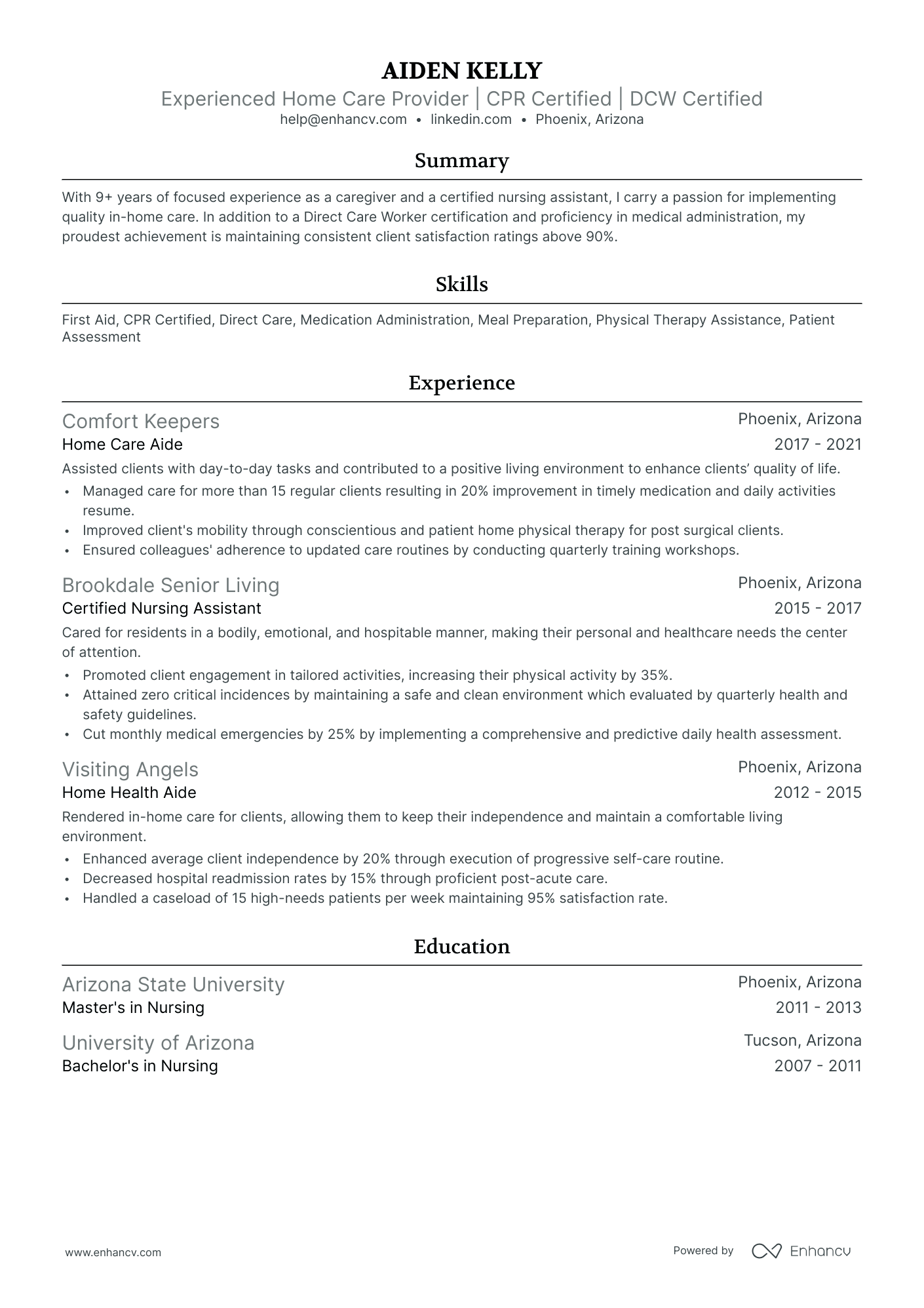
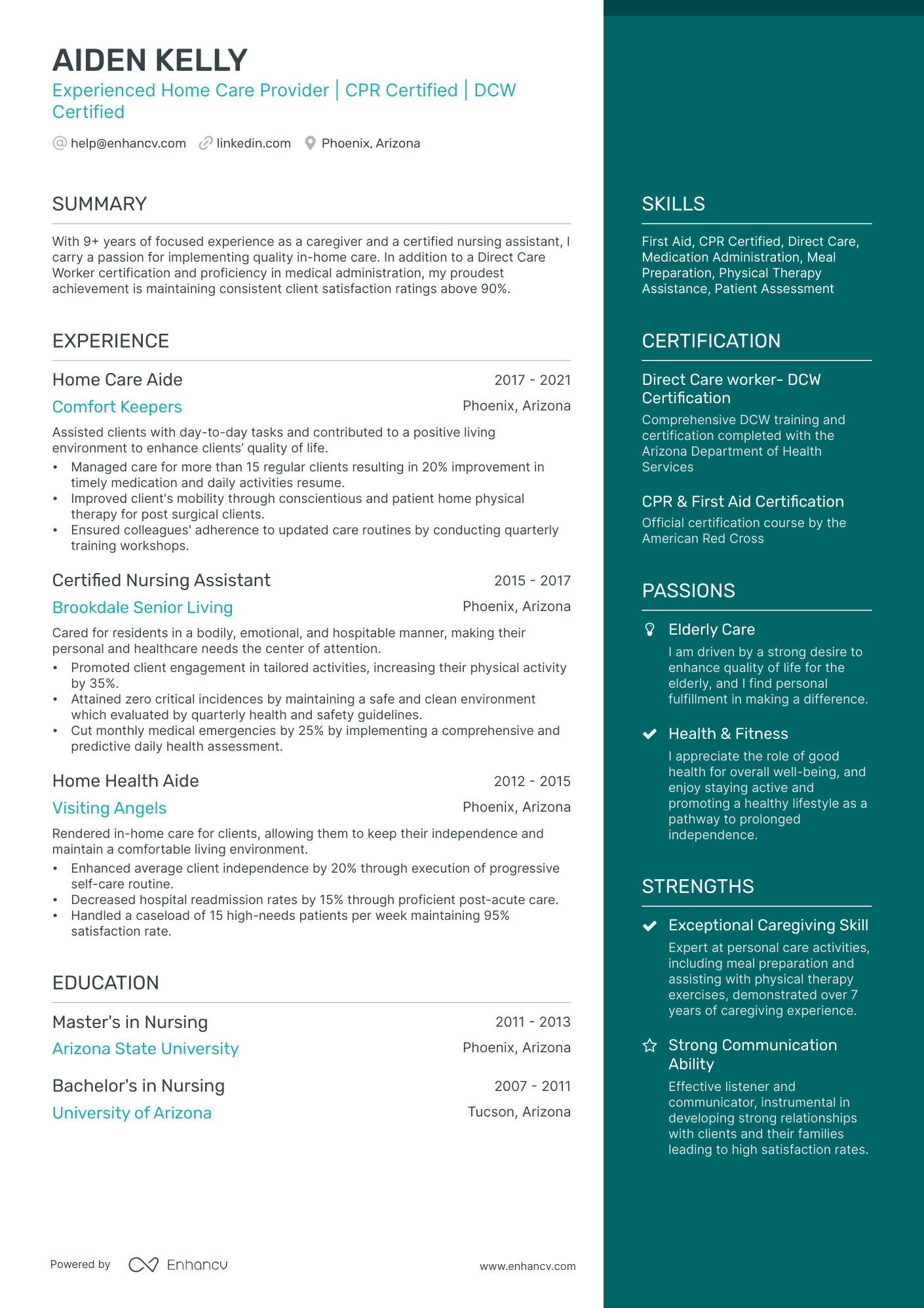
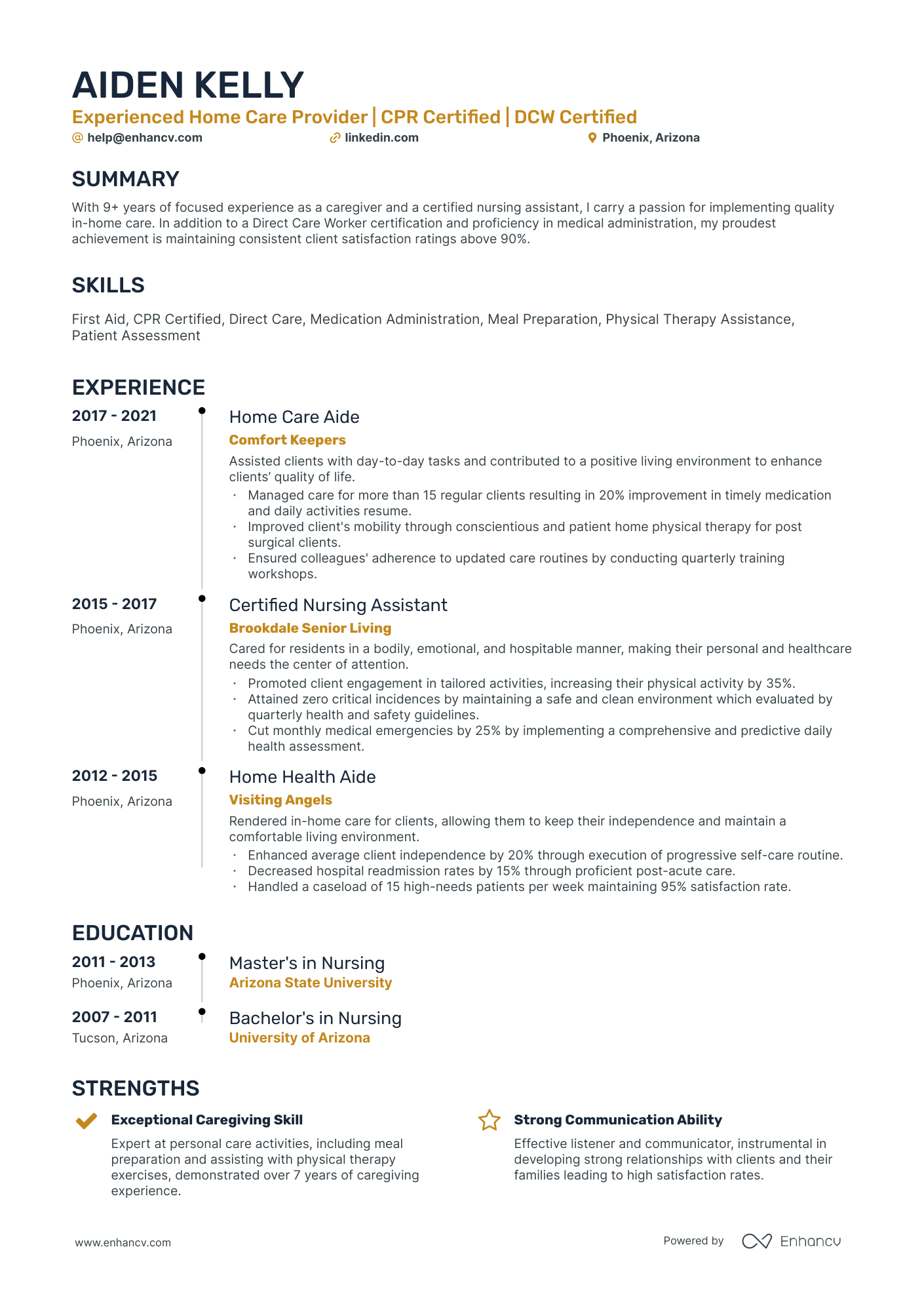
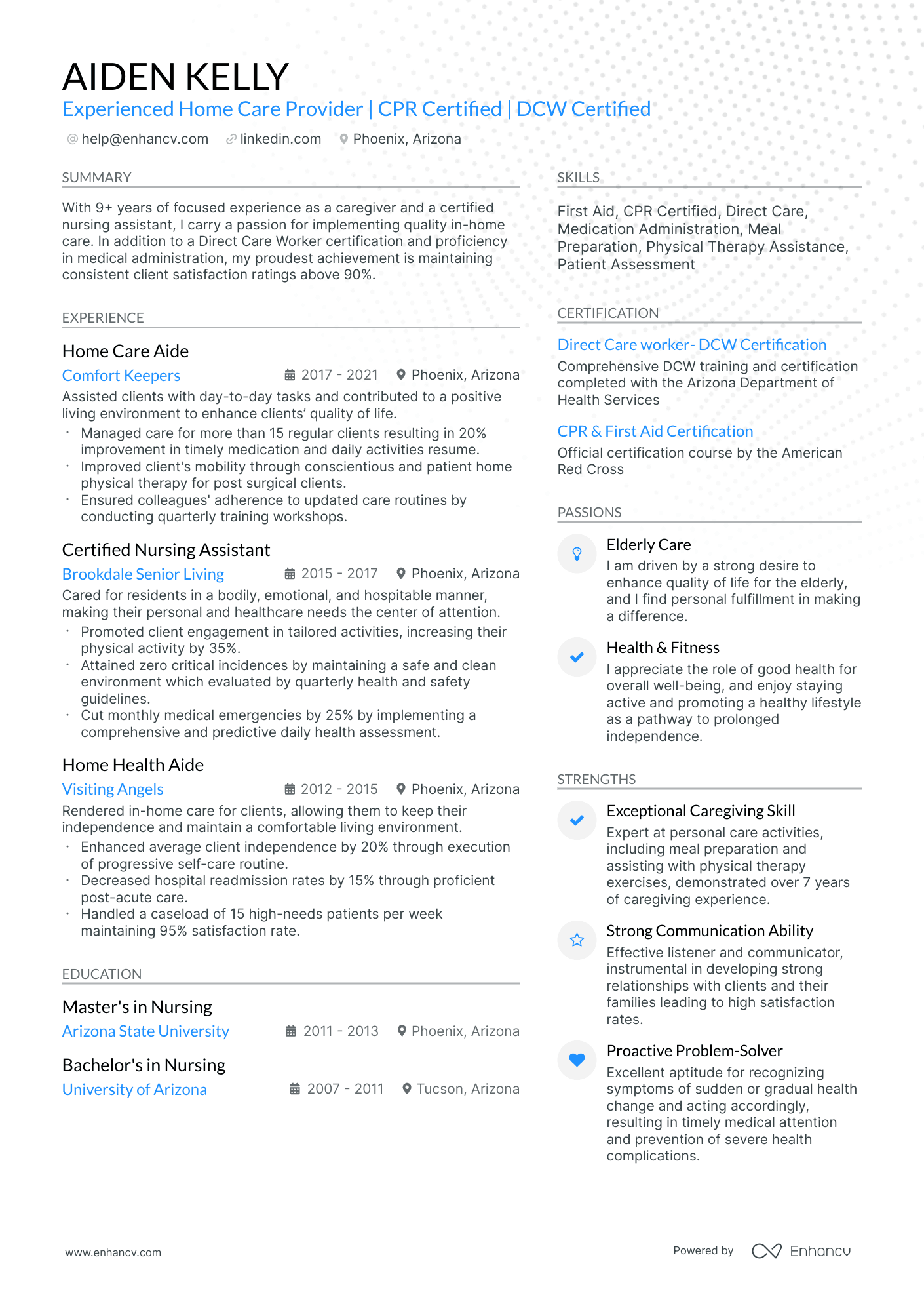
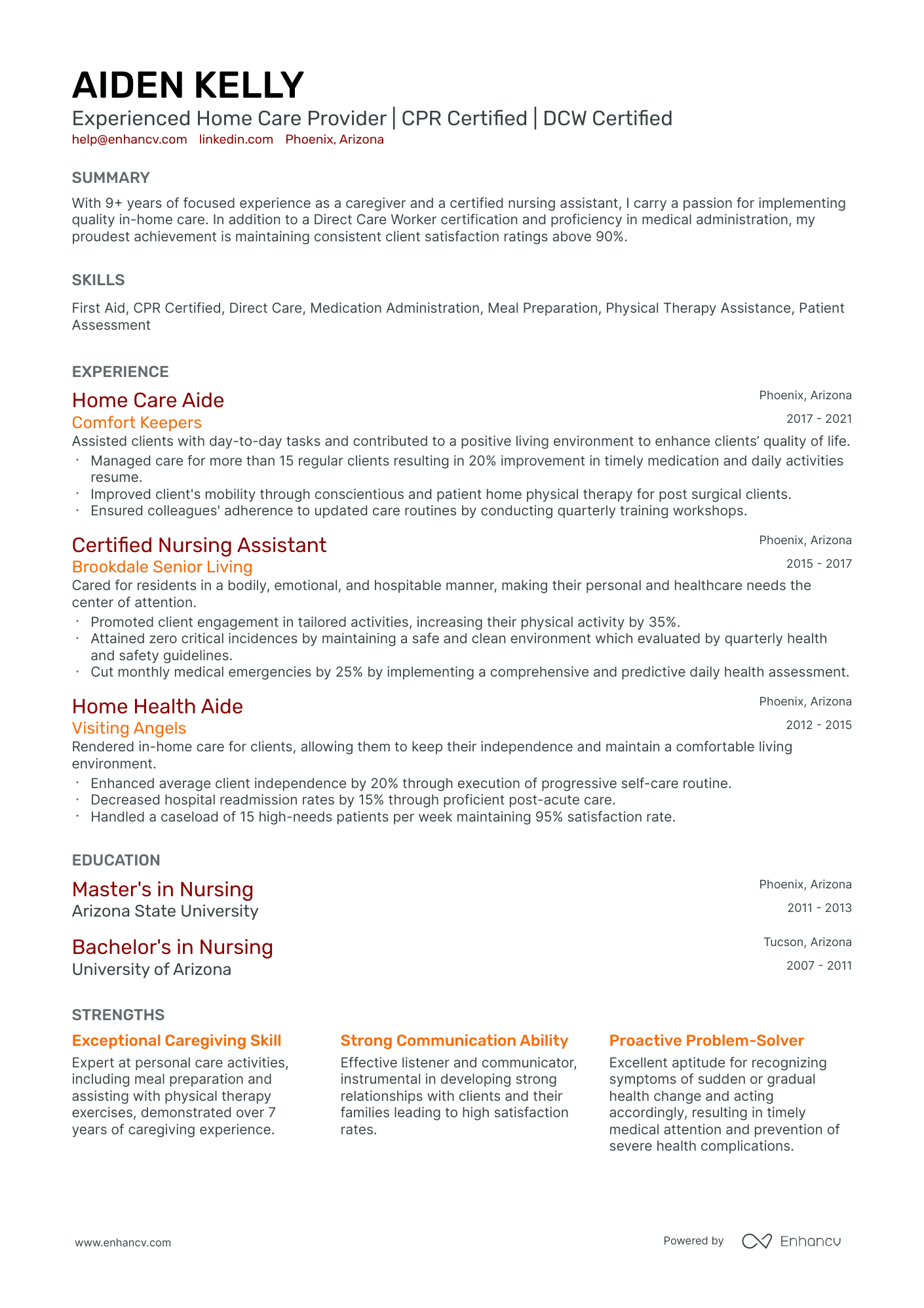
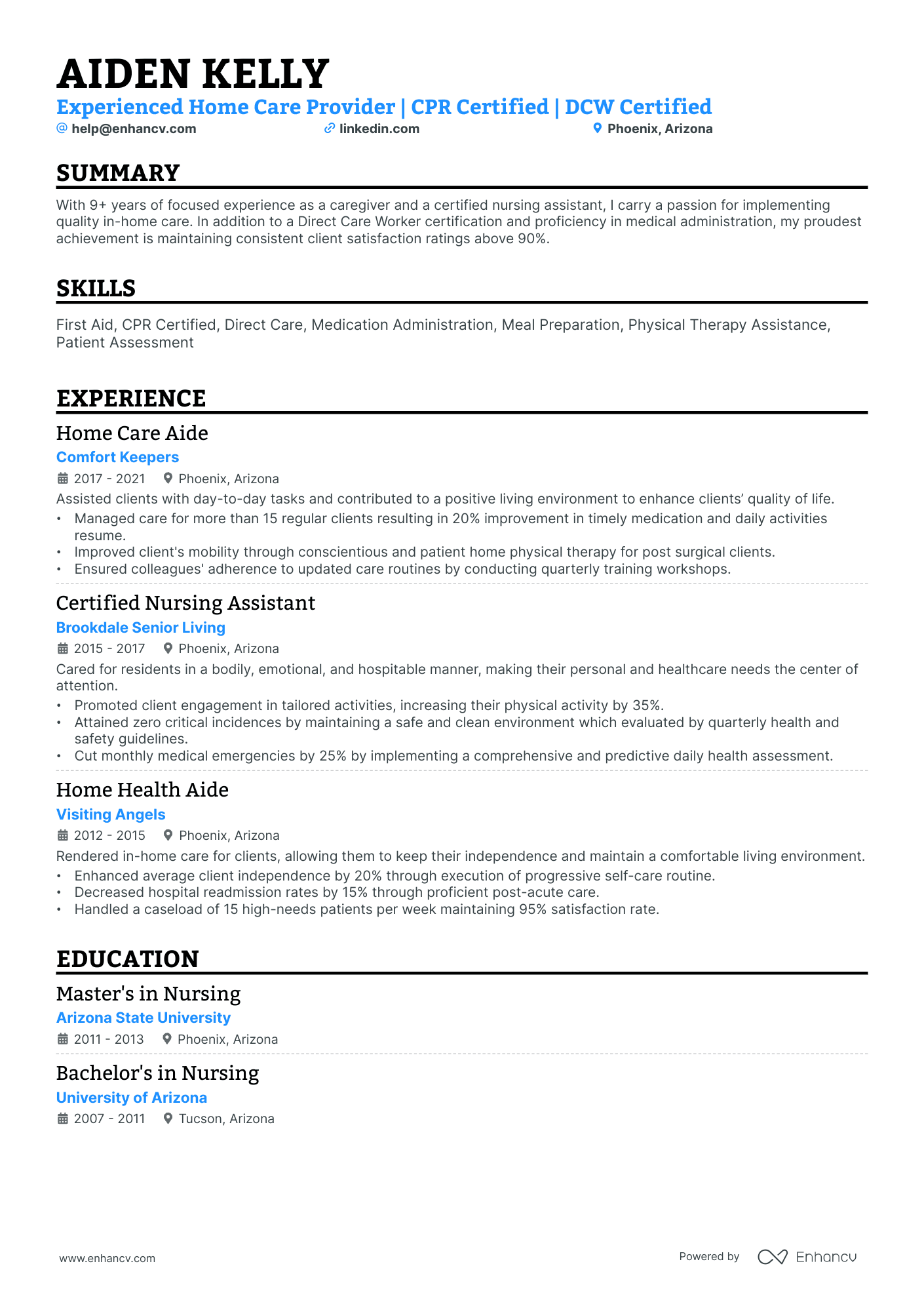
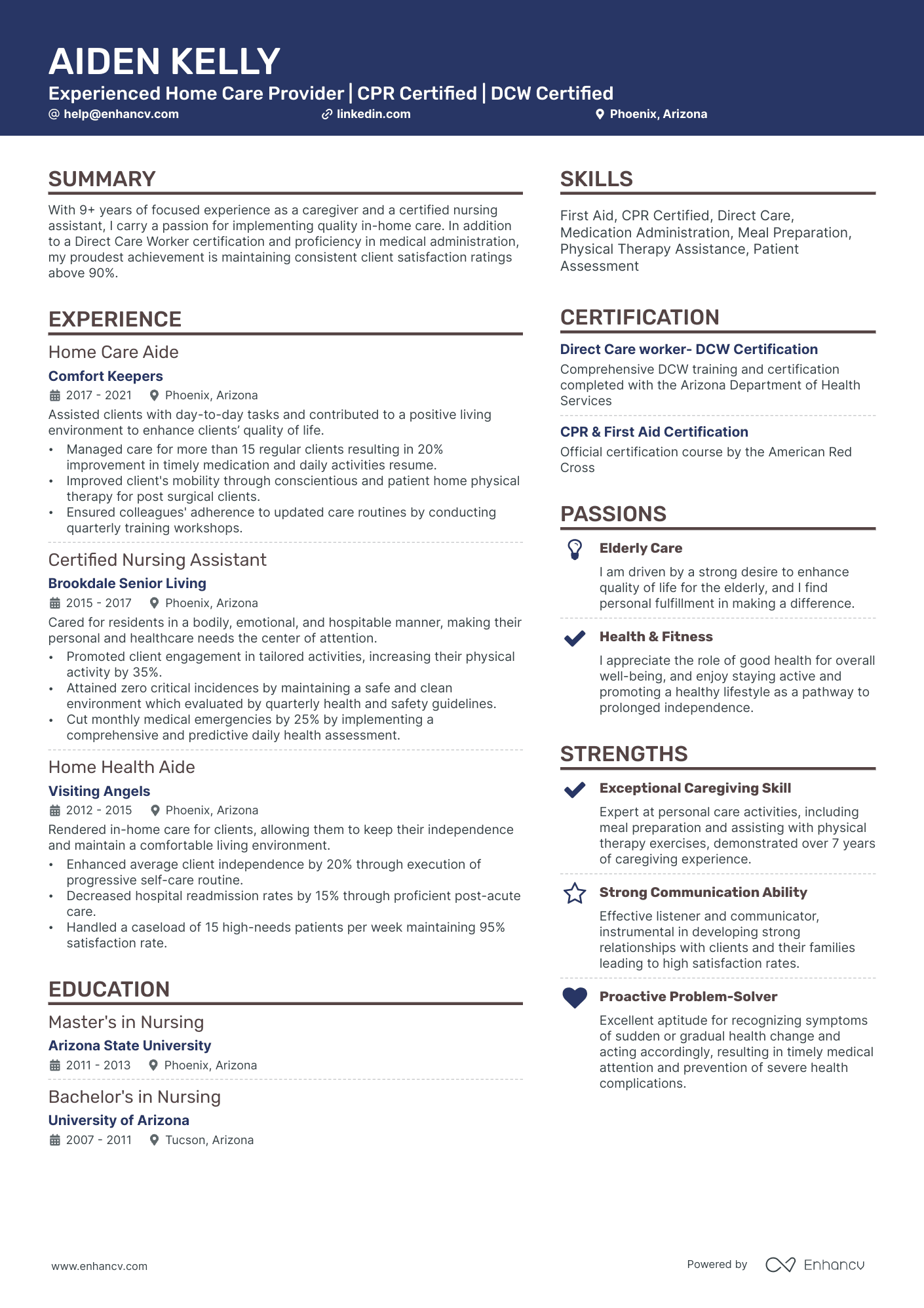
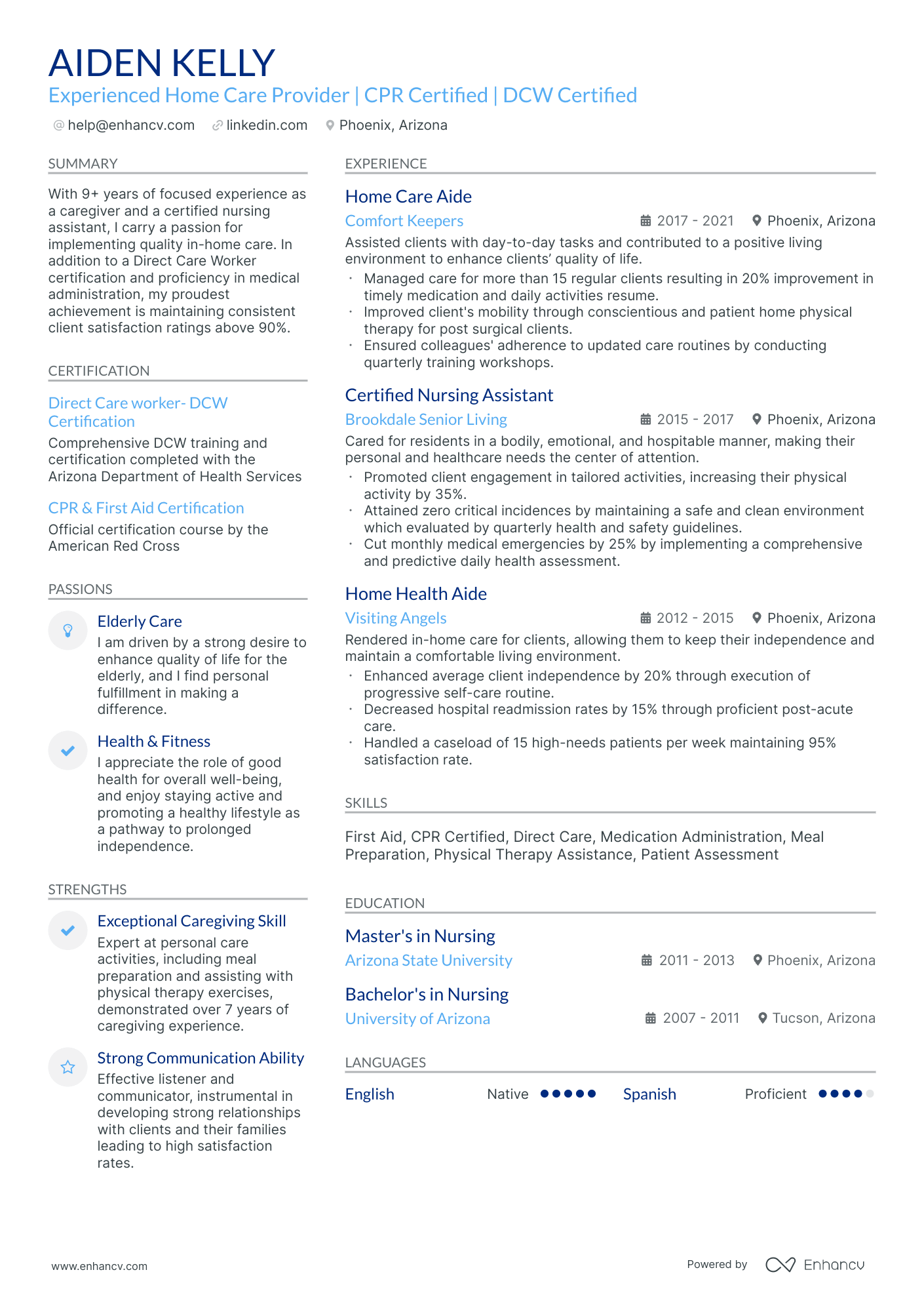
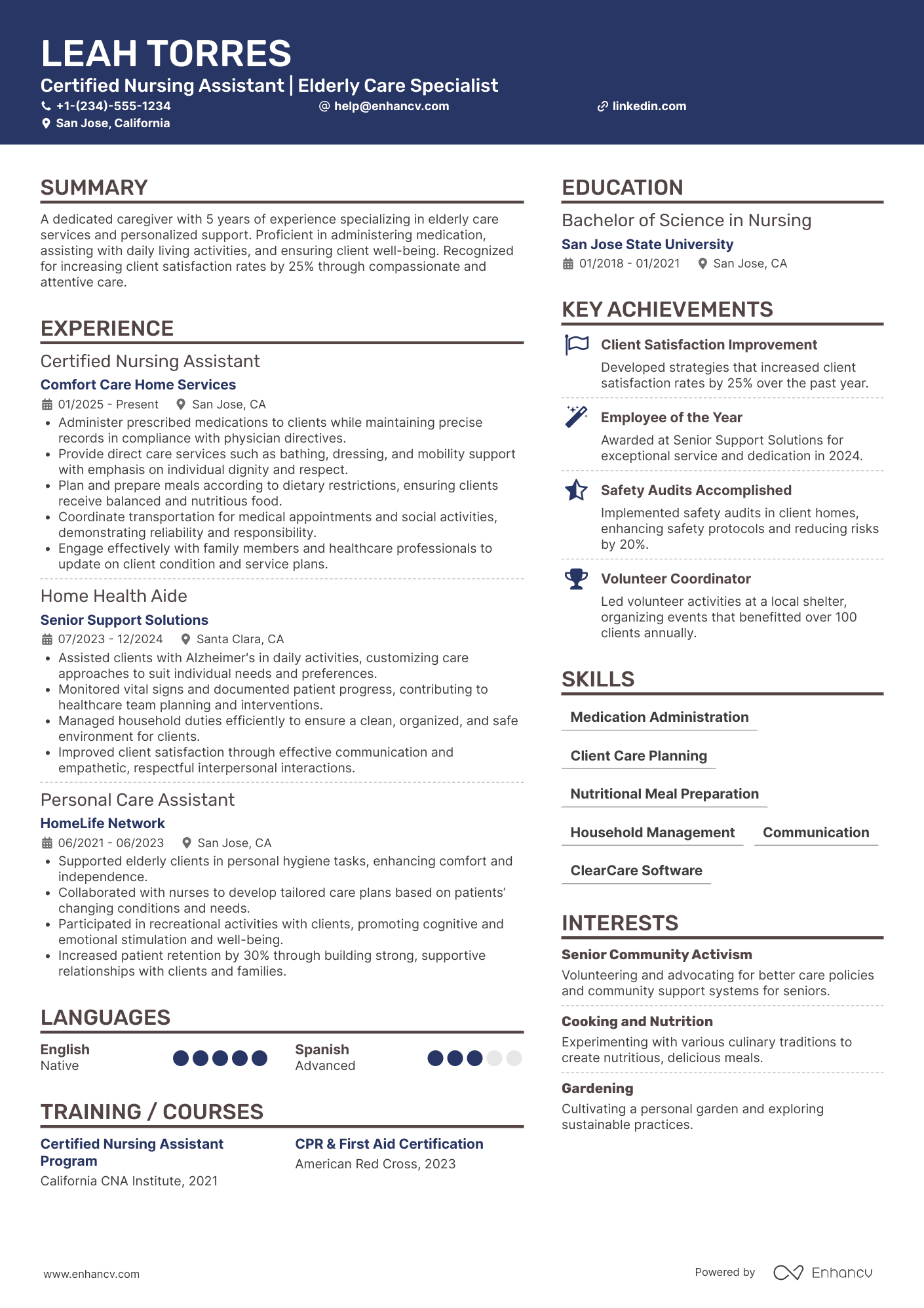
Most elderly caregiver resume drafts fail because they list duties without proving safety, reliability, or results. That makes them easy for an ATS to filter out and for recruiters to skip during fast scans in a crowded field.
A strong resume shows what you improved and how you supported clients and families. Knowing how to make your resume stand out is essential—highlight fall reductions, medication adherence rates, on-time shift coverage, caseload size, successful mobility gains, fewer hospital readmissions, and higher family satisfaction.

Key takeaways
- Quantify caregiving outcomes like fall reductions and medication adherence rates instead of listing duties.
- Use reverse-chronological format if you have consistent, relevant elderly care experience.
- Choose a hybrid format when switching careers to lead with transferable caregiving skills.
- Tailor every experience bullet to mirror the job posting's terminology and care requirements.
- Tie each listed skill to a specific action and measurable result in your experience section.
- Place certifications like CNA, CPR, and HHA where recruiters can spot them immediately.
- Use Enhancv's tools to turn vague task descriptions into concise, recruiter-ready resume bullets.
How to format a elderly caregiver resume
Recruiters hiring elderly caregivers prioritize hands-on care skills, reliability, and a consistent work history that demonstrates trust and compassion with vulnerable populations. Choosing the right resume format ensures these signals—continuity of employment, relevant certifications, and measurable caregiving outcomes—are immediately visible during a quick scan or an applicant tracking system (ATS) parse.

I have significant experience in this role—which format should I use?
Use a reverse-chronological format to put your deepest and most recent caregiving experience front and center. Do:
- Lead each role entry with scope details: number of clients served, types of conditions managed (dementia, mobility impairment, post-surgical recovery), and whether you worked independently or supervised other aides.
- Highlight role-specific certifications and skills—CPR/First Aid, medication administration, electronic health records, mobility-assist equipment, and condition-specific training such as Alzheimer's care.
- Quantify outcomes and impact wherever possible, including client retention, fall-reduction rates, or family satisfaction scores.
I'm junior or switching into this role—what format works best?
A hybrid format works best because it lets you lead with transferable caregiving skills while still showing a concise work history that proves follow-through. Do:
- Place a dedicated skills section near the top of your resume featuring patient care competencies, relevant certifications (CNA, HHA, CPR), and soft skills like patience, communication, and empathy.
- Include volunteer work, clinical rotations, practicum hours, or family caregiving experience as legitimate entries in a projects or experience section.
- Connect every listed skill to a specific action and a tangible result so recruiters see real-world application rather than abstract claims.
Why not use a functional resume?
A functional format strips away the timeline and context that hiring managers rely on to verify consistent, trustworthy caregiving—qualities that are non-negotiable when someone's safety depends on the person hired.
- Career changers with healthcare-adjacent experience: You held a role in nursing support, home health administration, or disability services and want to reframe that background toward direct elderly care.
- Gaps due to personal caregiving responsibilities: You spent time as an unpaid family caregiver and need to foreground the skills you developed during that period.
- A functional format may be acceptable if you have no formal caregiving employment history at all—but even then, every listed skill must be tied to a specific project, volunteer role, or caregiving outcome to carry weight with hiring managers.
With your format established, it's time to fill it with the right sections that showcase your caregiving qualifications.
What sections should go on a elderly caregiver resume
Recruiters expect a clean, complete resume that proves you can deliver safe, reliable, compassionate care for older adults. Understanding which resume sections to include helps you organize your qualifications for maximum clarity.
Use this structure for maximum clarity:
- Header
- Summary
- Experience
- Skills
- Projects
- Education
- Certifications
- Optional sections: Volunteering, Languages, Awards
Your experience bullets should emphasize measurable outcomes, patient scope and acuity, safety and compliance, and concrete improvements in comfort, mobility, and daily living independence.
Is your resume good enough?
Drop your resume here or choose a file. PDF & DOCX only. Max 2MB file size.
With your resume’s key components in place, the next step is to show your impact by writing a strong elderly caregiver experience section.
How to write your elderly caregiver resume experience
Your experience section should showcase the care you've delivered, the methods and tools you've used, and the measurable outcomes you've achieved for elderly clients and their families. Hiring managers prioritize demonstrated impact—improved patient well-being, safer home environments, and reliable daily support—over descriptive task lists. Building a targeted resume ensures each entry speaks directly to the role you're pursuing.
Each entry should include:
- Job title
- Company and location (or remote)
- Dates of employment (month and year)
Three to five concise bullet points showing what you owned, how you executed, and what outcomes you delivered:
- Ownership scope: the elderly clients, care plans, daily routines, medication schedules, or household environments you were directly accountable for managing and maintaining.
- Execution approach: the caregiving techniques, mobility assistance methods, health monitoring tools, documentation systems, or personal care protocols you used to deliver consistent, high-quality support to elderly individuals.
- Value improved: changes to client safety, comfort, health stability, daily functioning, nutritional intake, or fall-prevention measures that resulted from your direct involvement in elderly care.
- Collaboration context: how you coordinated with families, physicians, nurses, therapists, social workers, or home health agencies to ensure comprehensive and aligned care for elderly clients.
- Impact delivered: outcomes expressed through improvements in client well-being, family satisfaction, care plan adherence, or continuity of independent living rather than a simple list of tasks performed.
Experience bullet formula
A elderly caregiver experience example
✅ Right example - modern, quantified, specific.
Elderly Caregiver
Silver Oak Home Care | Phoenix, AZ
2022–Present
Provided in-home care for older adults with mobility limitations, dementia, and post-hospital recovery across a high-volume private-duty caseload.
- Coordinated medication administration for five clients using eMAR (electronic medication administration record) checklists and pharmacy refill tracking, reducing missed doses by 90% over six months.
- Implemented fall-prevention plans using gait belts, transfer boards, non-slip placement audits, and timed toileting schedules, cutting fall incidents from four per quarter to one per quarter.
- Documented daily vitals, pain scores, and activities of daily living in CareSmartz360, improving care-plan adherence by 25% and accelerating nurse case reviews from forty-eight hours to twenty-four hours.
- Partnered with registered nurses, physical therapists, and family stakeholders to run weekly care conferences, closing 100% of open care tasks within seven days and reducing avoidable urgent-care visits by 30%.
- Streamlined meal prep and diabetic-friendly nutrition planning with MyFitnessPal logs and hydration reminders, improving weekly blood glucose stability by 15% and reducing unplanned weight loss to zero across two high-risk clients.
Now that you've seen what a strong experience section looks like, let's break down how to tailor each element to match the specific elderly caregiver role you're applying for.
How to tailor your elderly caregiver resume experience
Recruiters evaluate your elderly caregiver resume through both human review and applicant tracking systems. Tailoring your resume to the job description increases your chances of passing both screenings.
Ways to tailor your elderly caregiver experience:
- Match specific care techniques or mobility equipment listed in the posting.
- Mirror the exact terminology used for daily living assistance tasks.
- Reflect patient-to-caregiver ratios or caseload sizes mentioned in the role.
- Include relevant experience with dementia or Alzheimer's care when requested.
- Emphasize compliance with HIPAA or state eldercare regulations if referenced.
- Highlight familiarity with electronic health record systems the employer uses.
- Align your experience with care plan frameworks or assessment tools specified.
- Reference collaboration with nursing staff or family members as described.
Tailoring means aligning your real accomplishments with what the employer needs rather than forcing disconnected keywords into your experience section.
Resume tailoring examples for elderly caregiver
| Job description excerpt | Untailored | Tailored |
|---|---|---|
| "Assist elderly clients with ADLs including bathing, grooming, toileting, and mobility transfers using Hoyer lift equipment." | Helped elderly patients with daily personal care tasks as needed. | Assisted 8–10 elderly clients daily with ADLs—bathing, grooming, toileting, and safe mobility transfers using Hoyer lift equipment—while maintaining zero transfer-related injuries over 14 months. |
| "Monitor and document vital signs, blood glucose levels, and medication schedules using ClearCare home care software." | Kept track of patient health information and gave medications on time. | Monitored vital signs, blood glucose levels, and medication schedules for 6 elderly clients, logging all readings accurately in ClearCare home care software and flagging 12 critical deviations to nursing staff within the first quarter. |
| "Provide compassionate dementia care using person-centered techniques, redirect agitated behaviors, and engage clients in structured cognitive stimulation activities." | Cared for older adults with memory problems and kept them comfortable. | Delivered person-centered dementia care for 4 clients with mid-to-late-stage Alzheimer's, redirecting agitated behaviors through validation therapy and leading daily cognitive stimulation activities that improved client engagement scores by 30% over six months. |
Once you’ve aligned your experience with the role’s priorities, the next step is to quantify your elderly caregiver achievements so employers can see the impact behind those responsibilities.
How to quantify your elderly caregiver achievements
Quantifying your achievements shows families and employers the results behind your care. Track safety, health routines, time saved, satisfaction, and workload handled—numbers like incident reductions, adherence rates, response times, and client feedback.
Quantifying examples for elderly caregiver
| Metric | Example |
|---|---|
| Safety incidents | "Reduced fall incidents from three per quarter to zero by implementing hourly rounding, grab-bar checks, and non-slip footwear routines." |
| Medication adherence | "Maintained 98% on-time medication administration for a client on eight daily meds using a pill organizer and phone reminders." |
| Care efficiency | "Cut morning routine time by 20 minutes per day by standardizing bathing, dressing, and meal-prep steps while preserving comfort and dignity." |
| Client satisfaction | "Earned 4.9 out of 5 average family satisfaction across six months through weekly updates, shared care notes, and consistent routines." |
| Workload volume | "Provided 40 hours per week of in-home care, supporting two clients and completing 12 appointments per month with transport and documentation." |
Turn vague job duties into measurable, recruiter-ready resume bullets in seconds with Enhancv's Bullet Point Generator.
With strong, well-crafted bullet points in place, the next step is making sure your skills section highlights the right mix of hard and soft skills that elderly caregiving demands.
How to list your hard and soft skills on a elderly caregiver resume
Your skills section shows you can deliver safe, consistent care, and recruiters and an ATS (applicant tracking system) scan this section to match you to the job post—aim for more hard skills than soft skills, with both tailored to the role. elderly caregiver roles require a blend of:
- Product strategy and discovery skills.
- Data, analytics, and experimentation skills.
- Delivery, execution, and go-to-market discipline.
- Soft skills.
Your skills section should be:
- Scannable (bullet-style grouping).
- Relevant to the job post.
- Backed by proof in experience bullets.
- Updated with current tools.
Place your skills section:
- Above experience if you're junior or switching careers.
- Below experience if you're mid/senior with strong achievements.

Hard skills
- Activities of daily living support
- Safe patient transfer techniques
- Gait belt, Hoyer lift use
- Vital signs monitoring
- Medication reminders and logs
- Dementia and Alzheimer's care
- Fall prevention protocols
- Infection control, hand hygiene
- Wound care, dressing changes
- Nutrition support, meal prep
- Blood glucose monitoring
- Electronic visit verification systems
Soft skills
- De-escalate agitation and anxiety
- Communicate changes to nurses
- Document care clearly and on time
- Set boundaries with families
- Follow care plans consistently
- Prioritize tasks under time pressure
- Adapt routines to client needs
- Coordinate with multidisciplinary teams
- Handle confidential information appropriately
- Respond calmly in emergencies
- Provide respectful, dignity-first care
- Ask clarifying questions early
How to show your elderly caregiver skills in context
Skills shouldn't live only in a bulleted list on your resume. Explore examples of resume skills shown in context to see how effective this approach can be.
They should be demonstrated in:
- Your summary (high-level professional identity)
- Your experience (proof through outcomes)
Here's what that looks like in practice.
Summary example
Compassionate elderly caregiver with 10+ years supporting dementia and palliative care patients. Skilled in ADL assistance, fall prevention, and care plan coordination. Reduced hospital readmissions by 30% through proactive health monitoring and family communication.
- Reflects senior-level experience clearly
- Names role-specific care methods
- Includes a measurable patient outcome
- Highlights empathy and communication skills
Experience example
Senior Elderly Caregiver
Harmony Home Care Services | Portland, OR
March 2018–Present
- Managed daily care plans for 12+ dementia patients, cutting fall incidents by 40% using evidence-based prevention protocols.
- Collaborated with nurses and family members to coordinate medication schedules, improving adherence rates by 25%.
- Documented patient progress in CareSmartz360, streamlining shift handoffs and reducing communication errors by 35%.
- Every bullet contains measurable proof
- Skills appear naturally within achievements
Once you’ve demonstrated your caregiving abilities through specific, real-world examples, the next step is to translate them into a resume even if you don’t have formal experience.
How do I write a elderly caregiver resume with no experience
Even without full-time experience, you can demonstrate readiness through:
- Family elder care support
- Volunteer work at senior center
- Home health aide training hours
- First aid and CPR certification
- Medication reminder tracking practice
- Meal prep for dietary needs
- Mobility assistance for relatives
- Dementia care workshop participation
If you're building a resume without work experience, focus on:
- Safety training and certifications
- Hygiene, transfers, and mobility tasks
- Documentation, schedules, and checklists
- Reliable availability and shift coverage
Resume format tip for entry-level elderly caregiver
Use a combination resume format to highlight caregiving skills and training first, then list any related experience substitutes to prove readiness. Do:
- Add a "Caregiving Skills" section with task keywords.
- List training, certifications, and dates clearly.
- Describe experience substitutes with measurable details.
- Use action verbs tied to caregiver tasks.
- Include availability, location, and transportation.
- Provided family elder care support, using a gait belt and transfer checklist to complete two daily safe transfers for eight weeks, with zero falls.
Once you've structured your resume around transferable skills and relevant strengths, presenting your education effectively becomes the next step in building credibility with hiring managers.
How to list your education on a elderly caregiver resume
Your education section helps hiring teams confirm you have foundational knowledge in health, aging, and patient care relevant to the elderly caregiver role.
Include:
- Degree name
- Institution
- Location
- Graduation year
- Relevant coursework (for juniors or entry-level candidates)
- Honors & GPA (if 3.5 or higher)
Skip month and day details—list the graduation year only.
Here's a strong education entry tailored to an elderly caregiver resume:
Example education entry
Associate of Applied Science in Health Science
Brookdale Community College, Lincroft, NJ
Graduated: 2021
GPA: 3.7/4.0
- Relevant coursework: Gerontology, Nutrition for Aging Adults, Personal Care Fundamentals, and Health Communication
- Honors: Dean's List, 2020–2021
How to list your certifications on a elderly caregiver resume
Certifications on your resume show your commitment to learning, your comfort with care tools, and your knowledge of current standards for an elderly caregiver.
Include:
- Certificate name
- Issuing organization
- Year
- Optional: credential ID or URL
- Put certifications below education when your education is recent and directly related to elderly caregiver work.
- Put certifications above education when they are recent, highly relevant, or required for the elderly caregiver role.
Best certifications for your elderly caregiver resume
CPR and First Aid Certification Basic Life Support (BLS) Certified Nursing Assistant (CNA) Home Health Aide (HHA) Alzheimer's Association essentiALZ Certification Dementia Care Specialist Certification Medication Administration Certification
Once you’ve positioned your credentials where recruiters can spot them quickly, use your elderly caregiver resume summary to reinforce those qualifications upfront and connect them to the role.
How to write your elderly caregiver resume summary
Your resume summary is the first thing a recruiter reads. A strong opening pitched to an elderly caregiver role can set you apart in seconds.
Keep it to three to four lines, with:
- Your title and total years of hands-on caregiving experience.
- The care setting you know best, such as in-home, assisted living, or hospice.
- Core skills like medication management, mobility assistance, or dementia care.
- One or two measurable achievements, such as reduced fall incidents or improved patient satisfaction scores.
- Soft skills tied to real outcomes, like empathy that strengthened family trust or communication that improved care plan adherence.

PRO TIP
At the entry level, focus on relevant certifications, specific caregiving skills, and any early wins from clinical rotations or volunteer work. Avoid vague phrases like "passionate and hardworking" or "seeking to grow." Instead, name the exact tools and techniques you've used and tie them to a concrete result, even a small one.
Example summary for a elderly caregiver
Certified elderly caregiver with two years of in-home experience supporting clients with Alzheimer's. Skilled in medication tracking, daily living assistance, and fall prevention. Reduced patient incident reports by 30% through consistent mobility routines.
Optimize your resume summary and objective for ATS
Drop your resume here or choose a file.
PDF & DOCX only. Max 2MB file size.
With your summary crafted to highlight your caregiving strengths, it's time to ensure your resume header presents the essential contact details hiring managers need to reach you.
What to include in a elderly caregiver resume header
A resume header lists your key contact details and role focus, helping elderly caregiver applications stand out in screening, look credible, and stay easy to find.
Essential resume header elements
- Full name
- Tailored job title and headline
- Location
- Phone number
- Professional email
- GitHub link
- Portfolio link
A LinkedIn link helps recruiters confirm your work history fast and supports quick screening.
Do not include photos on a elderly caregiver resume unless the role is explicitly front-facing or appearance-dependent.
Match your header job title to the posting and keep every detail consistent across your resume and online profiles.
Elderly caregiver resume header
Jordan Taylor
Elderly caregiver | Dementia care, mobility support, and medication reminders
Phoenix, AZ
(602) 555-01XX
jordan.taylor@enhancv.com
github.com/jordantaylor
jordantaylorcare.com
linkedin.com/in/jordantaylor
Once your contact details and role focus are clear at the top, add targeted additional sections to reinforce your qualifications and support the rest of your resume.
Additional sections for elderly caregiver resumes
Adding extra sections helps an elderly caregiver stand out by showcasing specialized skills, personal qualities, and credentials beyond standard experience. For example, listing language skills on your resume can be especially valuable when caring for elderly clients from diverse backgrounds.
- Languages
- Certifications and training
- Volunteer experience
- Hobbies and interests
- Professional affiliations
- First aid and safety training
- References
Once you've strengthened your resume with relevant additional sections, pairing it with a well-crafted cover letter can further set your application apart.
Do elderly caregiver resumes need a cover letter
An elderly caregiver resume doesn't always need a cover letter. It helps when the role is competitive or the employer expects one. If you're unsure about the basics, learn what a cover letter is and when it can make a difference—especially when your resume doesn't fully show fit, reliability, or relevant caregiving context.
Use a cover letter to add details your resume can't:
- Explain role and team fit by naming the care setting, shift needs, and collaboration style with family members and clinical staff.
- Highlight one or two outcomes, like reducing falls, improving medication adherence, or building a routine that increased mobility or appetite.
- Show understanding of the employer's users and context, such as dementia care, post-surgery support, or hospice needs, and how you adapt care plans.
- Address career transitions or non-obvious experience by connecting transferable skills, training, and supervised hours to elderly caregiver responsibilities.
Drop your resume here or choose a file.
PDF & DOCX only. Max 2MB file size.
Even if you include a cover letter to add context beyond your resume, AI can help you strengthen the resume itself by improving clarity, structure, and relevance.
Using AI to improve your elderly caregiver resume
AI can sharpen your elderly caregiver resume's clarity, structure, and impact. It helps tighten language and highlight results. But overuse strips authenticity. Once your content reads clearly and fits the role, step away from AI. If you're curious about where to start, explore ChatGPT resume writing prompts designed to improve specific resume sections.
Here are 10 practical prompts to strengthen specific sections of your elderly caregiver resume:
Strengthen your summary
Quantify care results
Tailor to job posts
Sharpen action verbs
Refine skills section
Highlight certifications
Improve education details
Clarify care specialties
Tighten bullet length
Align project descriptions
Conclusion
A strong elderly caregiver resume highlights measurable outcomes, role-specific skills, and a clear structure. Use numbers to show impact, and focus on safe mobility support, personal care, medication reminders, and calm communication.
Keep sections easy to scan, with consistent dates, concise bullets, and relevant keywords. This shows you can meet today’s expectations and adapt to near-future needs across home care and senior living roles.