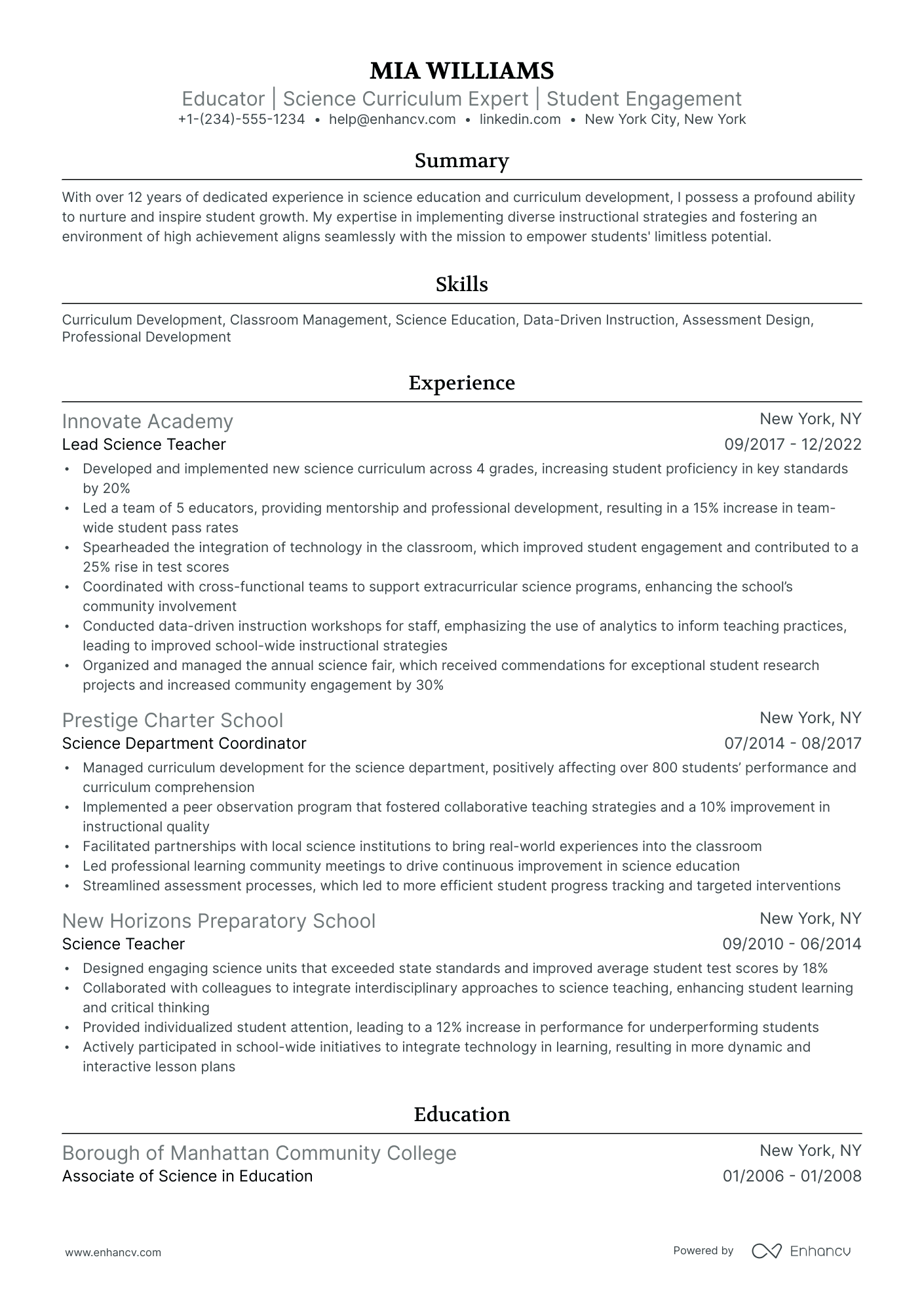
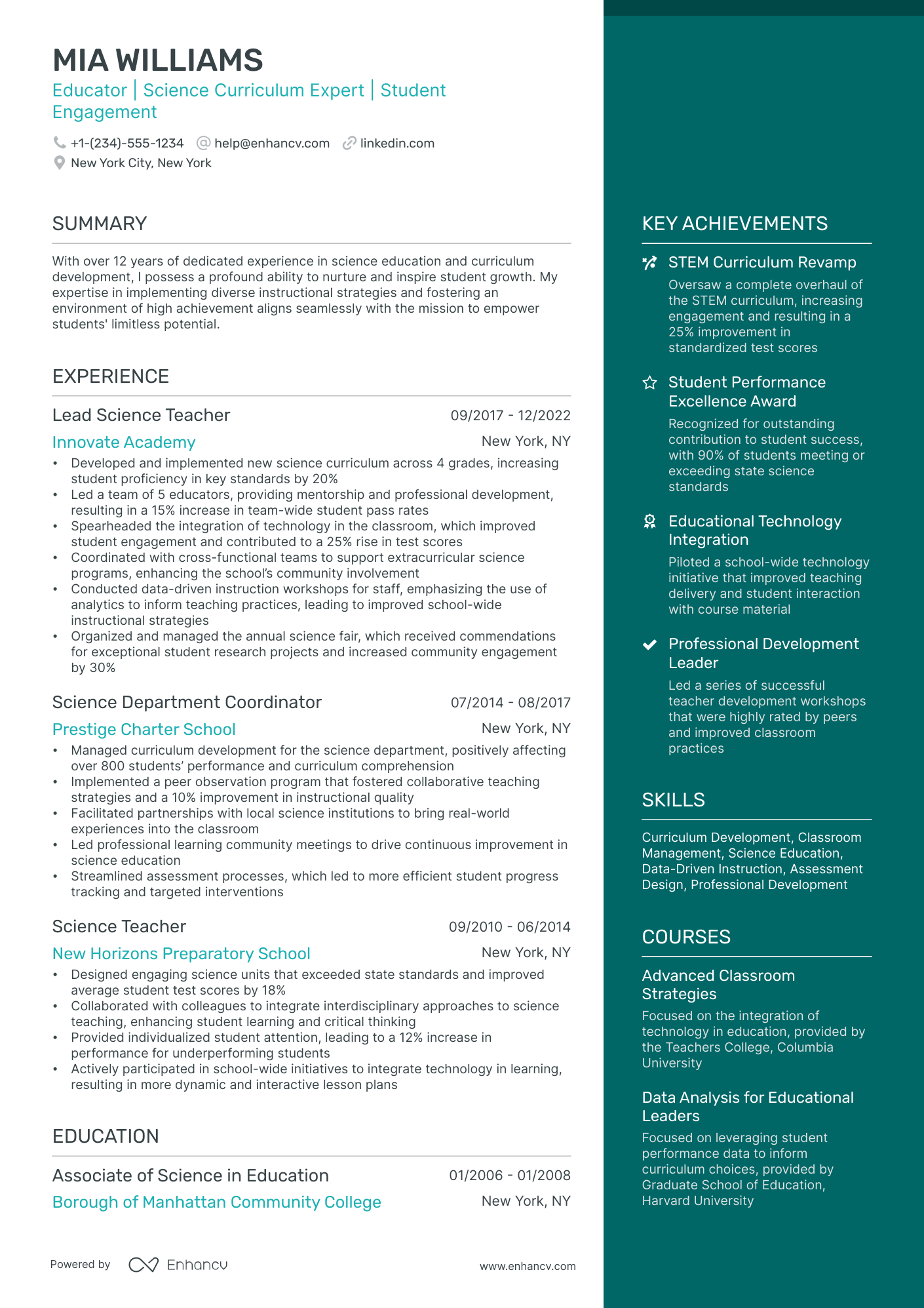
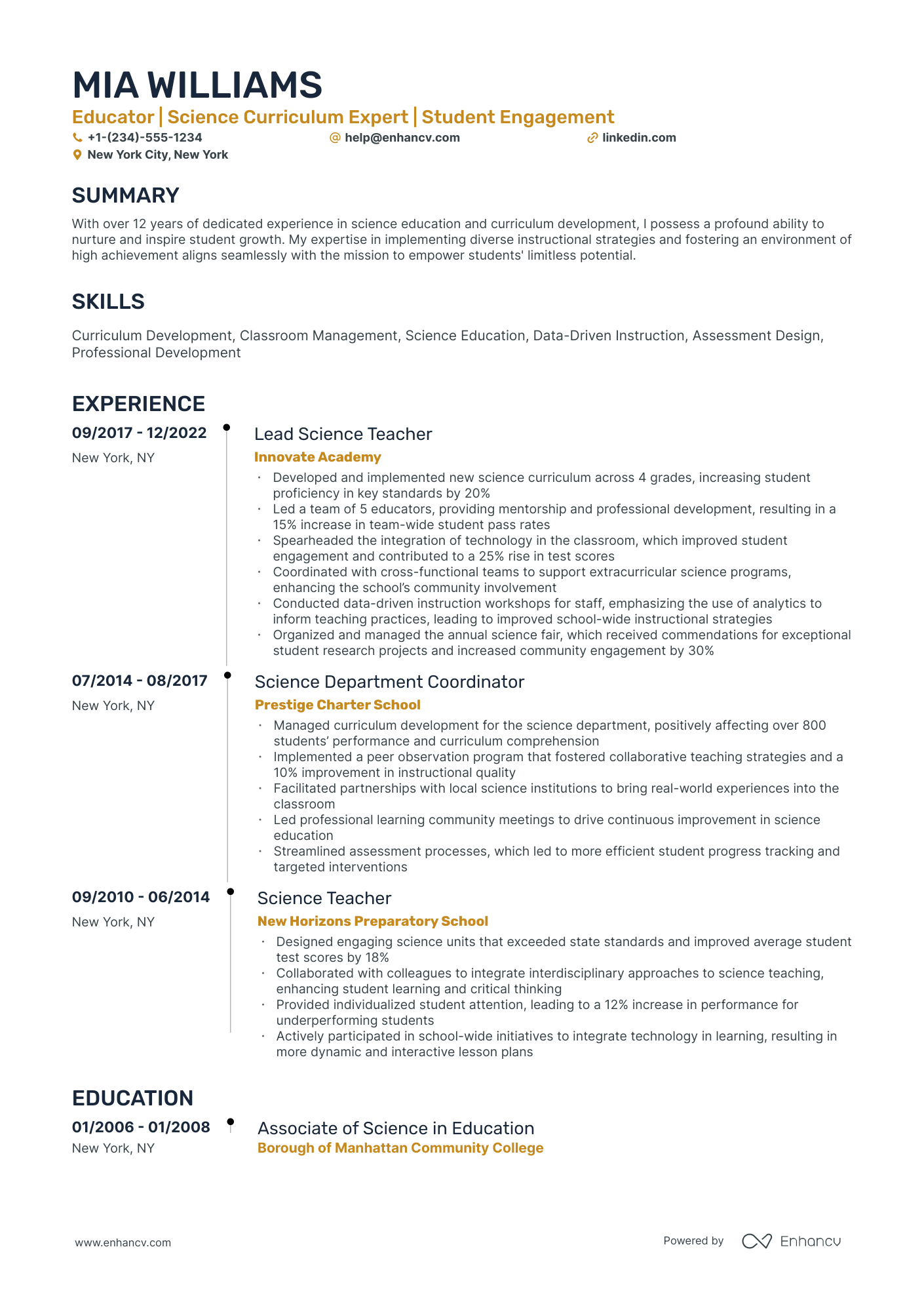
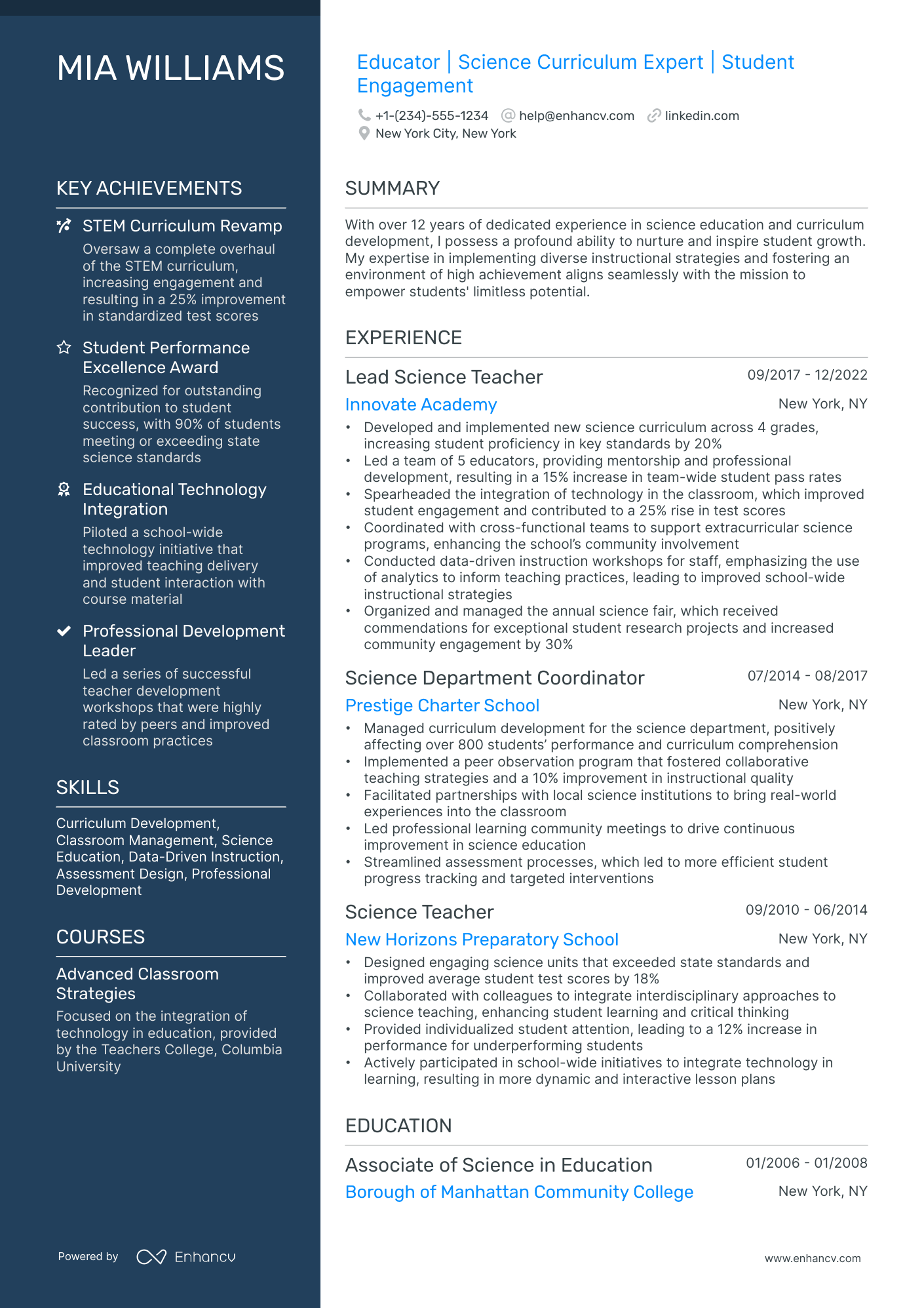
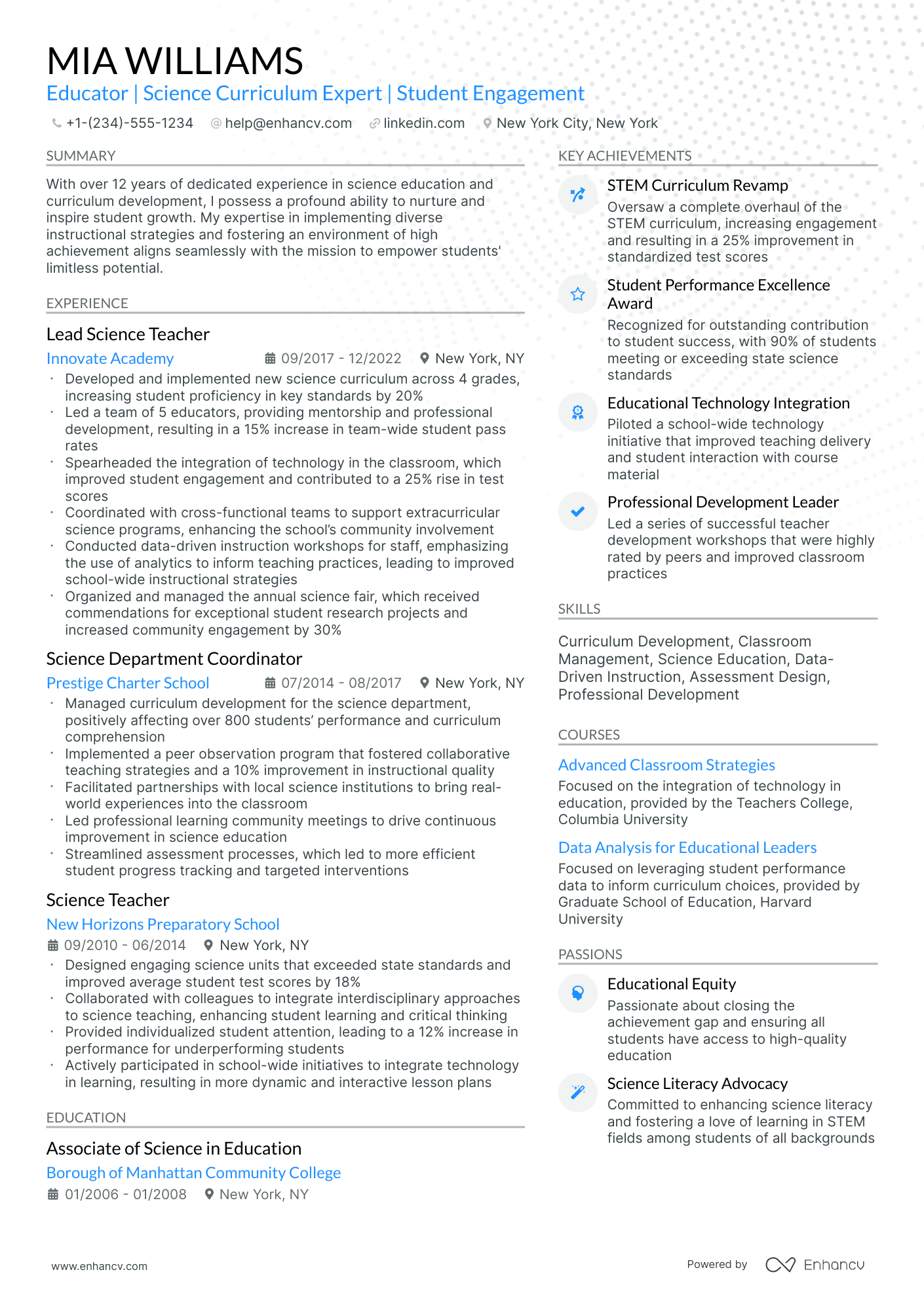
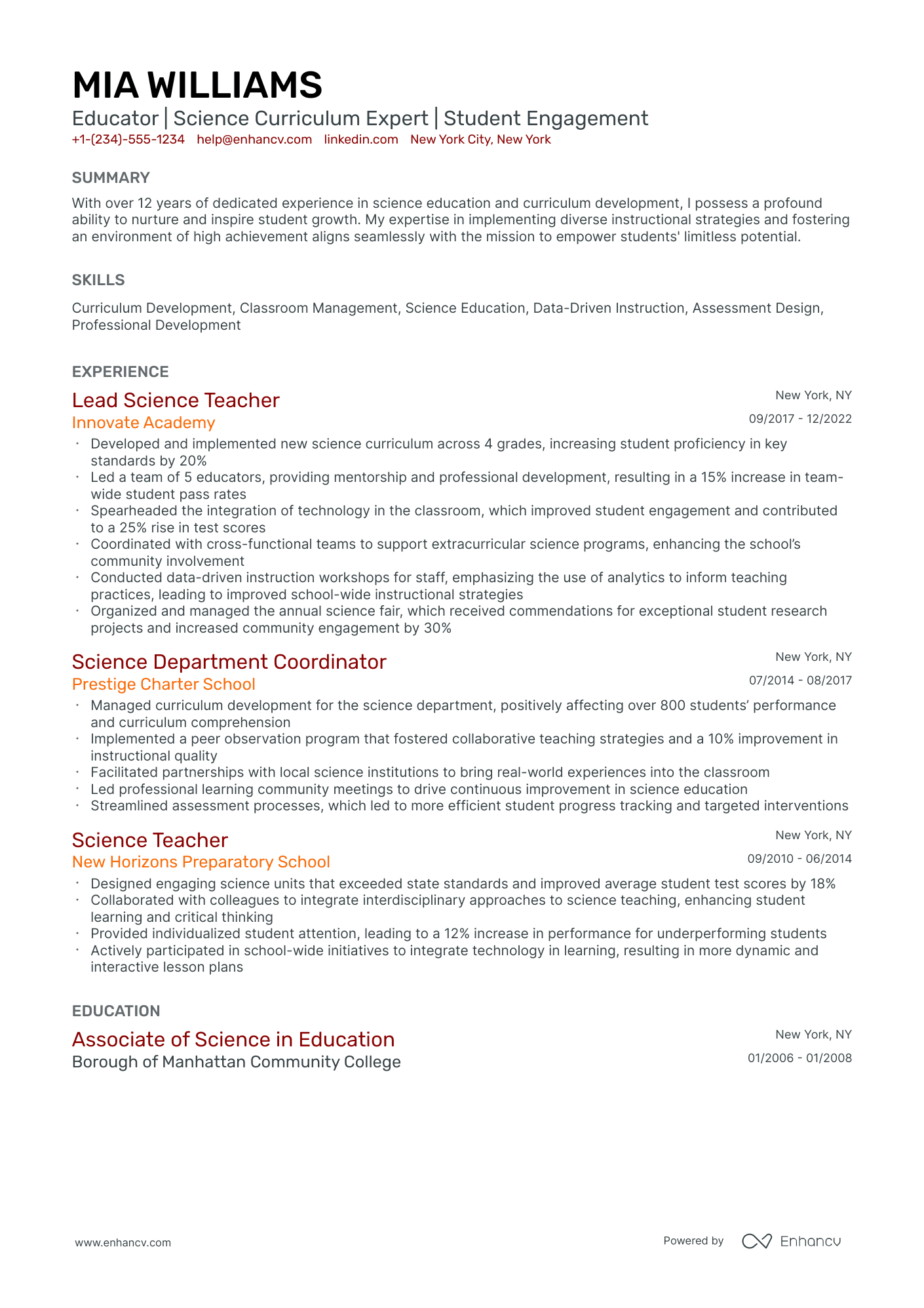
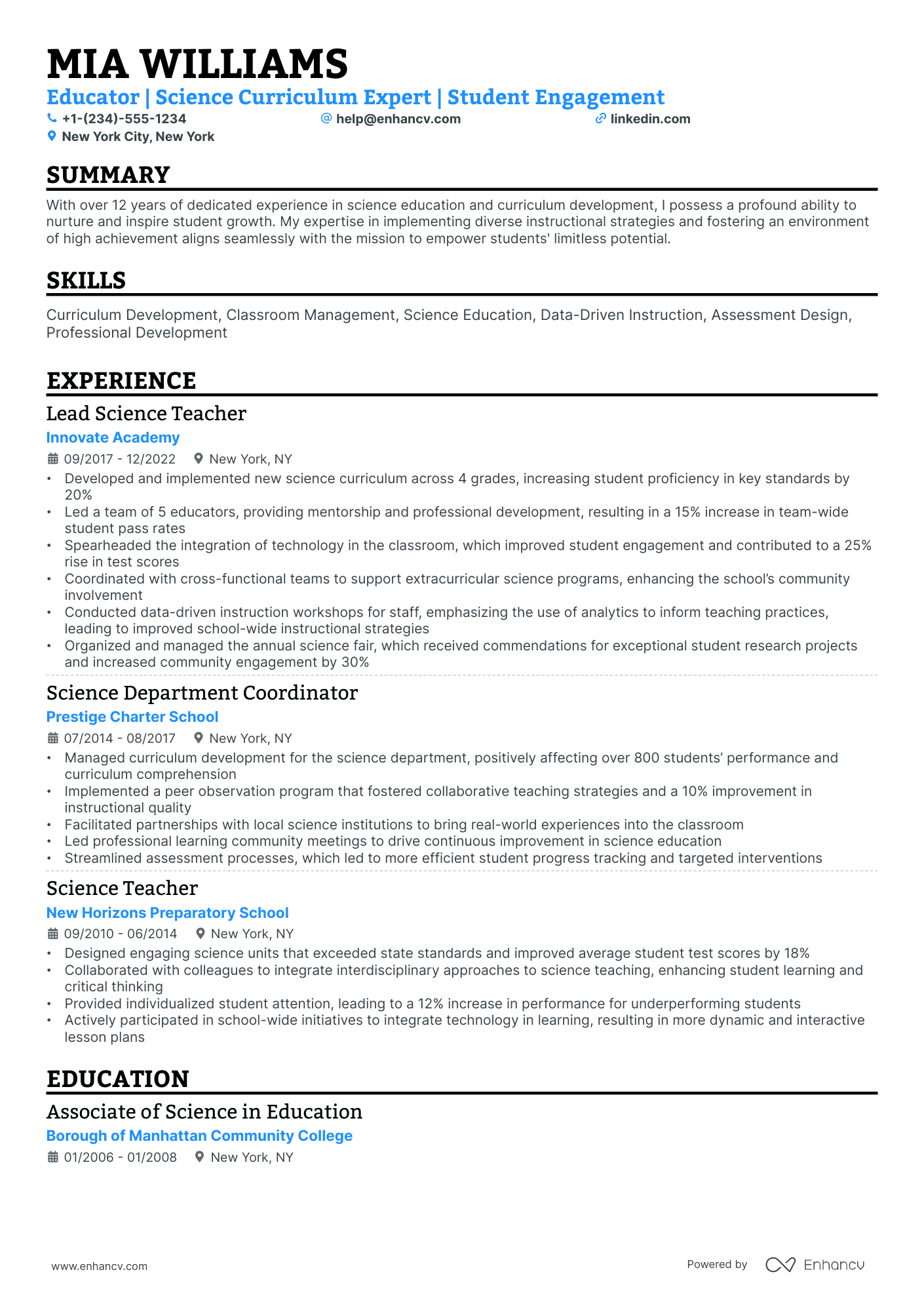
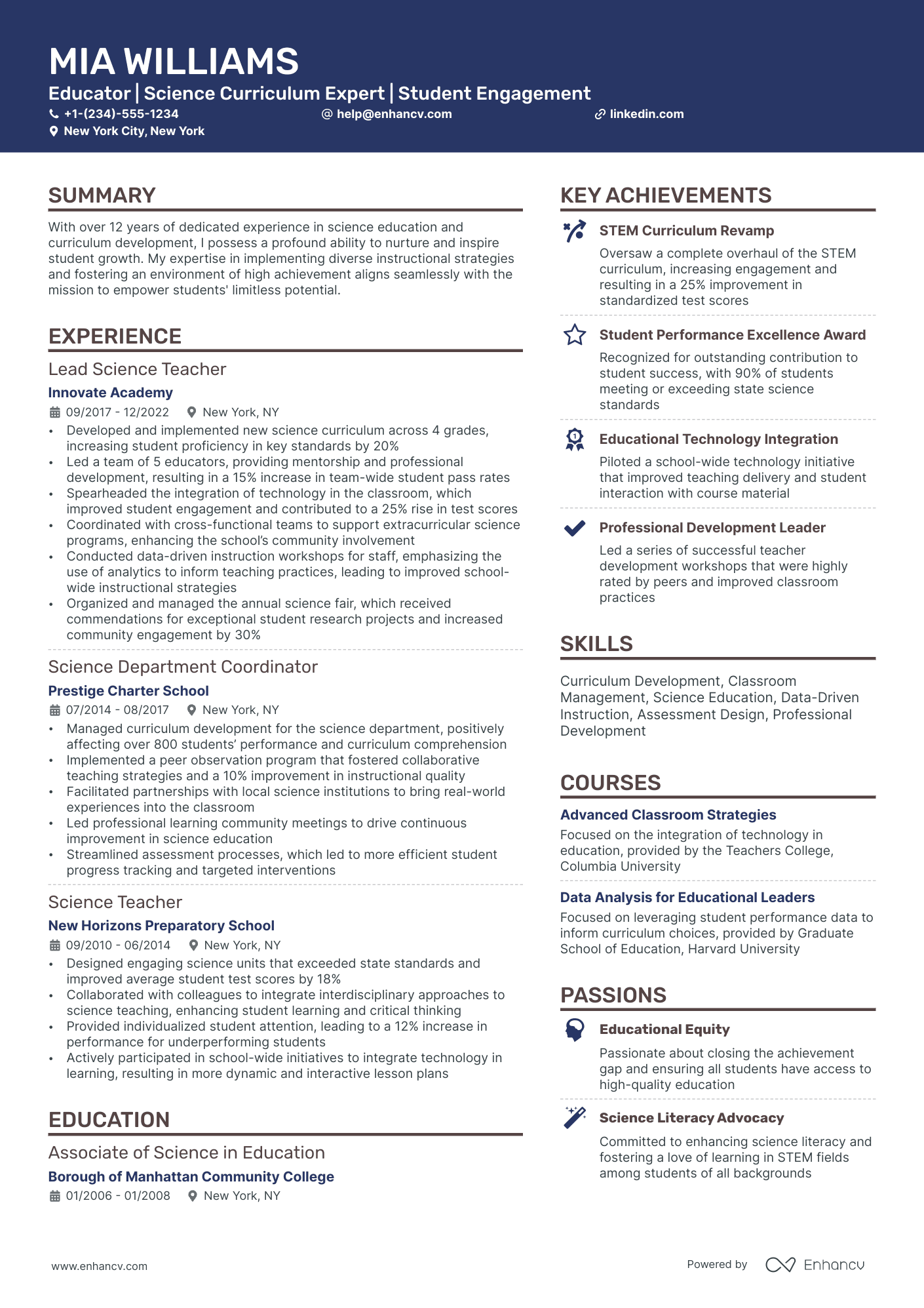
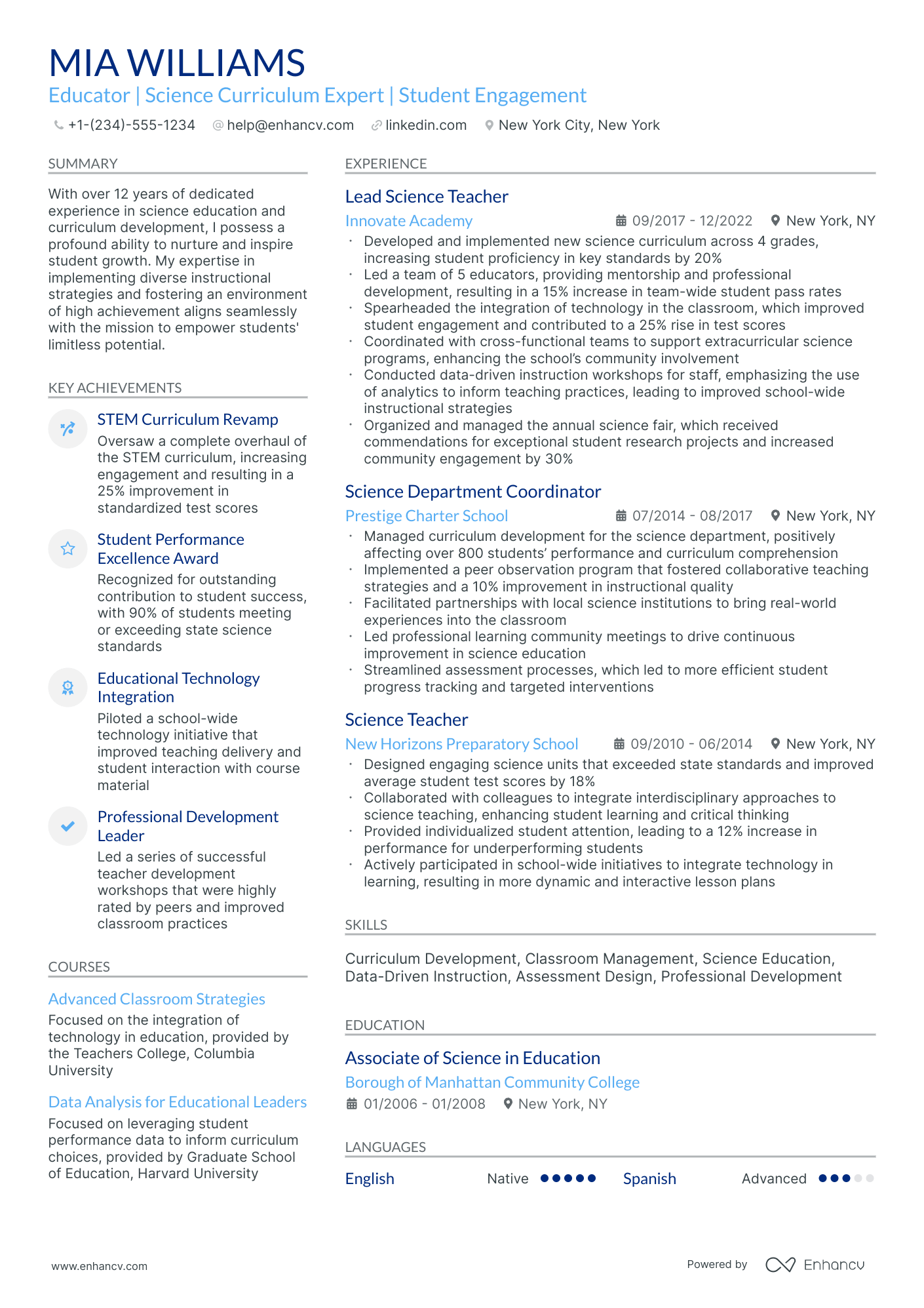
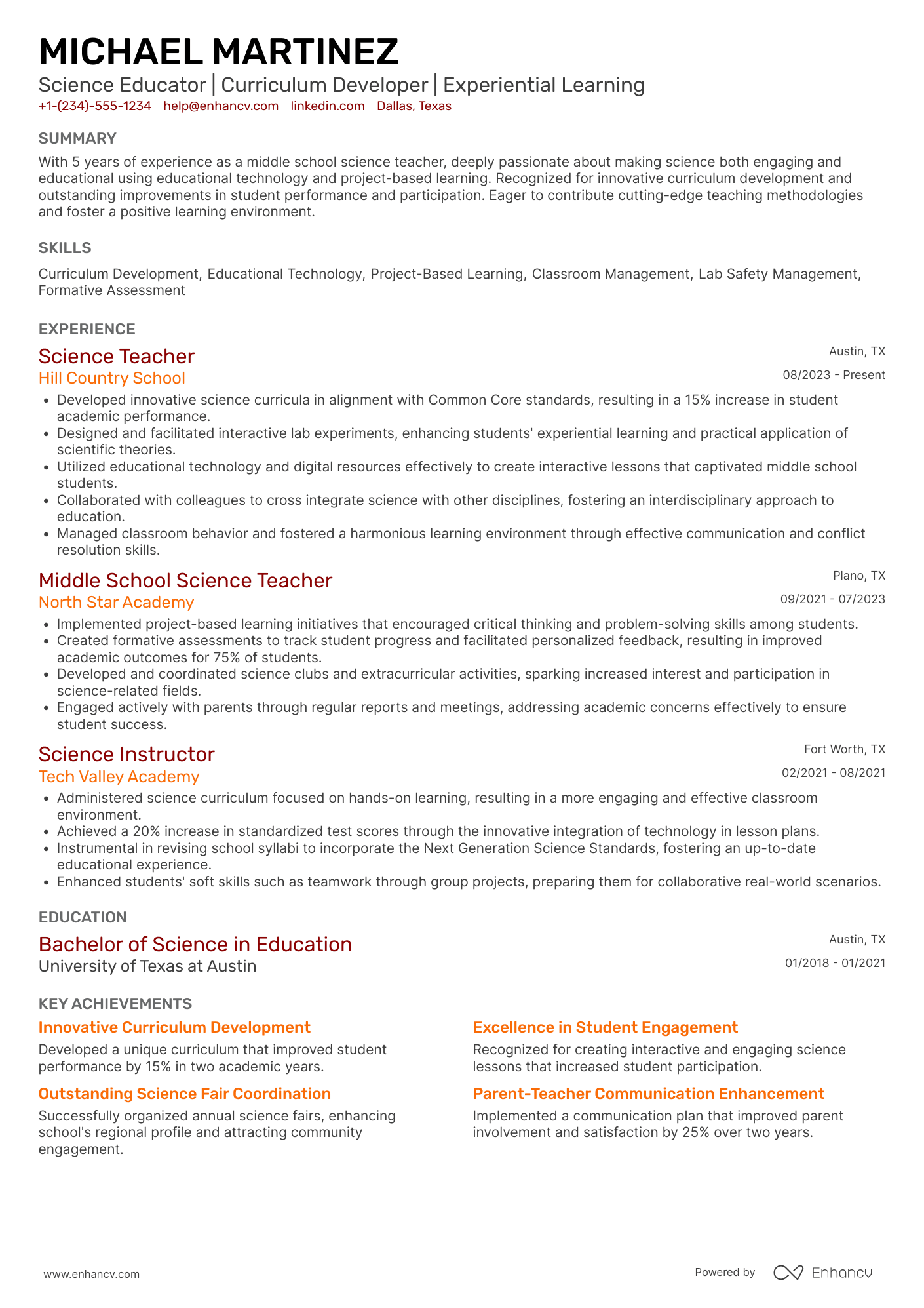
Many science teacher resume submissions fail because they read like lesson-plan checklists. That buries measurable impact, so your science teacher resume gets filtered by ATS keywords and dismissed in fast recruiter scans.
A strong resume shows what improved because of you, not every tool you used. Knowing how to make your resume stand out means highlighting higher assessment growth, stronger lab safety compliance, improved attendance, wider course load, successful curriculum rollout, and better exam pass rates. Quantify class sizes, sections taught, and gains over time.

Key takeaways
- Quantify student outcomes like test score gains and pass rates in every experience bullet.
- Use reverse-chronological format for experienced teachers and hybrid format for career changers.
- Tailor each resume to mirror the job posting's standards, tools, and grade levels.
- Demonstrate skills through measurable achievements in your summary and experience sections.
- Maintain zero-incident lab safety records and document your safety protocols on your resume.
- Use AI tools like Enhancv to sharpen bullet points, but stop before content loses authenticity.
- Add certifications directly after education to confirm subject endorsements and classroom readiness.
Job market snapshot for science teachers
We analyzed 469 recent science teacher job ads across major US job boards. These numbers help you understand skills in demand, salary landscape, industry demand at a glance.
What level of experience employers are looking for science teachers
| Years of Experience | Percentage found in job ads |
|---|---|
| 1–2 years | 3.6% (17) |
| 3–4 years | 0.4% (2) |
| 9–10 years | 0.4% (2) |
| 10+ years | 1.1% (5) |
| Not specified | 94.2% (442) |
Science teacher ads by area of specialization (industry)
| Industry (Area) | Percentage found in job ads |
|---|---|
| Education | 69.7% (327) |
| Finance & Banking | 21.1% (99) |
| Healthcare | 7.5% (35) |
Top companies hiring science teachers
| Company | Percentage found in job ads |
|---|---|
| Illinois Association Of School | 3.2% (15) |
| Summit Public Schools | 3.0% (14) |
| Indiana Public Schools | 2.8% (13) |
| Ohio Department of Education | 2.8% (13) |
| Arizona Department of Education | 2.6% (12) |
| Educate Kansas | 2.6% (12) |
| Kentucky Department of Education | 2.6% (12) |
| Basis Texas Charter Schools | 2.3% (11) |
| Basis.ed | 2.3% (11) |
| Public School of North Carolina | 2.1% (10) |
Role overview stats
These tables show the most common responsibilities and employment types for science teacher roles. Use them to align your resume with what employers expect and to understand how the role is structured across the market.
Day-to-day activities and top responsibilities for a science teacher
| Responsibility | Percentage found in job ads |
|---|---|
| Lesson planning | 10.4% (49) |
| Classroom management | 7.2% (34) |
| Curriculum development | 6.0% (28) |
| Student assessment | 5.8% (27) |
| Data analysis | 5.1% (24) |
| Microsoft office suite | 4.3% (20) |
| Technology | 3.4% (16) |
| Communication | 3.2% (15) |
| Biology | 2.8% (13) |
| Chemistry | 2.8% (13) |
| Google suite | 2.6% (12) |
| Microsoft office | 2.6% (12) |
How to format a science teacher resume
Recruiters hiring science teachers prioritize classroom experience, subject-matter expertise, and evidence of student outcomes—such as improved test scores or successful lab program development. A clear, well-organized resume format ensures these signals surface quickly during both human review and applicant tracking system (ATS) screening.

I have significant experience in this role—which format should I use?
Use a reverse-chronological format to highlight your teaching trajectory, growing responsibilities, and sustained classroom impact. Do:
- Lead with your most recent teaching position and emphasize scope: grade levels taught, class sizes, number of course preps, and any department or curriculum leadership roles.
- Feature subject-specific expertise prominently—AP or IB science courses, lab safety certifications, NGSS alignment, learning management systems (such as Google Classroom or Canvas), and any instructional technology tools you use regularly.
- Quantify outcomes wherever possible, including standardized test pass rates, student growth percentages, grant funding secured, or extracurricular program results.
I'm junior or switching into this role—what format works best?
A hybrid format works best, allowing you to lead with relevant skills and certifications while still showing your experience timeline. Do:
- Place a skills section near the top that highlights your subject-area knowledge (chemistry, physics, biology), lab management competencies, classroom technology proficiency, and any relevant certifications like a state teaching license or STEM endorsement.
- Include student teaching practicums, tutoring roles, research assistantships, volunteer science outreach, or informal education work (such as museum or camp programs) as transitional experience entries.
- Connect every listed action to a result—even in non-traditional roles—so recruiters can see how your skills translate to classroom effectiveness.
Why not use a functional resume?
A functional resume removes the timeline context that principals and hiring committees rely on to verify teaching experience, certifications, and professional growth—weakening your candidacy even if your skills are strong.
- A functional format may be acceptable if you're transitioning from a non-teaching STEM career (such as lab research or science communication) or returning to education after an extended gap, but only if you tie every listed skill to specific projects, student outcomes, or measurable results.
Once you've established a clean, readable format, the next step is deciding which sections to include so each one serves a clear purpose on your resume.
What sections should go on a science teacher resume
Recruiters expect to see clear evidence you can drive student learning, manage a safe lab environment, and deliver standards-aligned instruction. Understanding what to put on a resume helps you prioritize the right content.
Use this structure for maximum clarity:
- Header
- Summary
- Experience
- Skills
- Projects
- Education
- Certifications
- Optional sections: Awards, Publications, Research
Strong experience bullets should emphasize measurable student outcomes, instructional scope, lab safety results, and curriculum impact.
Is your resume good enough?
Drop your resume here or choose a file. PDF & DOCX only. Max 2MB file size.
With your resume’s essential components in place, the next step is to write your science teacher experience section so hiring teams can quickly see your impact in the classroom.
How to write your science teacher resume experience
The experience section is where you prove you've delivered meaningful educational outcomes—not just held a position. Hiring managers prioritize demonstrated impact through instructional methods, classroom tools, and measurable student achievement over generic task lists. Building a targeted resume ensures every bullet speaks directly to the role's expectations.
Each entry should include:
- Job title
- Company and location (or remote)
- Dates of employment (month and year)
Three to five concise bullet points showing what you owned, how you executed, and what outcomes you delivered:
- Ownership scope: the courses, grade levels, lab programs, curriculum areas, or student populations you were directly accountable for as a science teacher.
- Execution approach: the instructional strategies, lab technologies, assessment frameworks, learning management systems, or pedagogical methods you used to plan lessons, evaluate progress, and drive student understanding.
- Value improved: changes to student performance, comprehension rates, lab safety standards, curriculum rigor, accessibility for diverse learners, or classroom engagement tied to your teaching practice.
- Collaboration context: how you worked with fellow educators, department heads, administrators, parents, special education staff, or community partners to strengthen science programming and student support.
- Impact delivered: outcomes expressed through student growth, program expansion, grant funding secured, retention improvements, or standardized assessment results rather than routine teaching duties.
Experience bullet formula
A science teacher experience example
✅ Right example - modern, quantified, specific.
Science Teacher (Biology & Chemistry)
Ridgeview Public High School | Austin, TX
2021–Present
Four-year public high school serving 1,800 students with a focus on college and career readiness.
- Designed and delivered standards-aligned Biology and Chemistry units using Canvas (learning management system), Nearpod, and lab-based inquiry, increasing average unit assessment scores by 12% across six sections.
- Built a data-driven intervention cycle using Eduphoria, Google Sheets, and item analysis, cutting D/F rates from 18% to 11% and improving on-time assignment completion by 22%.
- Implemented NGSS-aligned lab protocols and safety systems (chemical inventory, Safety Data Sheets, and digital lab checklists), reducing lab incidents to zero over three semesters and cutting setup time by 25%.
- Collaborated with special education case managers, English as a second language teachers, and counselors to deliver accommodations and language supports, raising pass rates for targeted students by 15% year over year.
- Led a cross-department curriculum refresh with the science team and assistant principal, piloting common formative assessments and rubric calibration that improved scoring consistency by 30% and reduced regrade requests by 40%.
Now that you've seen what a strong experience section looks like in practice, let's break down how to adapt yours to match the specific job you're applying for.
How to tailor your science teacher resume experience
Recruiters evaluate your science teacher resume through both human review and applicant tracking systems, scanning for alignment with the posted role. Tailoring your resume to the job description increases your chances of passing both filters.
Ways to tailor your science teacher experience:
- Match the specific lab equipment or software named in the posting.
- Use the exact curriculum standards referenced like NGSS or state frameworks.
- Mirror the grade levels and science disciplines the role requires.
- Highlight inquiry-based or project-based learning if the listing mentions them.
- Include safety compliance and lab management experience when specified.
- Emphasize collaboration with interdisciplinary teams or co-teaching models referenced.
- Reflect student assessment methods or data-driven instruction the school prioritizes.
- Reference relevant tools like Google Classroom or learning management systems listed.
Tailoring means aligning your real accomplishments with what the role demands, not forcing disconnected keywords into your experience bullets.
Resume tailoring examples for science teacher
| Job description excerpt | Untailored | Tailored |
|---|---|---|
| Develop and deliver Next Generation Science Standards (NGSS)-aligned curriculum for grades 9–12, incorporating inquiry-based labs and cross-cutting concepts. | Taught science classes to high school students and created lesson plans. | Designed and delivered NGSS-aligned biology and chemistry curriculum for grades 9–12, integrating 30+ inquiry-based labs per semester that reinforced cross-cutting concepts such as cause and effect, systems, and energy transfer. |
| Use Vernier probeware and data-analysis software to guide students through controlled experiments in biology and environmental science. | Helped students with lab experiments and technology in the classroom. | Guided 120+ students annually through controlled experiments in biology and environmental science using Vernier probeware and Logger Pro data-analysis software, improving lab report accuracy scores by 18% year over year. |
| Differentiate instruction for diverse learners, including English Language Learners (ELL) and students with IEPs, to meet district inclusion goals. | Worked with students of different ability levels and adapted teaching when needed. | Differentiated science instruction across three ability tiers for classes of up to 34 students, implementing visual scaffolding and bilingual glossaries for ELL students and co-developing modified assessments with special education staff to meet all IEP benchmarks. |
Once you’ve aligned your classroom experience with the role’s priorities, the next step is to quantify your science teacher achievements so hiring teams can quickly see the impact behind each example.
How to quantify your science teacher achievements
Quantifying your achievements shows how your instruction changes outcomes, not just activities. Focus on learning growth, lab safety, assessment quality, engagement, and delivery speed across classes, units, and lab cycles.
Quantifying examples for science teacher
| Metric | Example |
|---|---|
| Student growth | "Raised average unit test scores from 71% to 83% in one semester using CER rubrics, weekly retrieval quizzes, and targeted reteach groups." |
| Lab safety | "Completed 28 wet labs with zero recordable incidents by enforcing PPE checklists, chemical inventory logs, and a pre-lab safety quiz requirement." |
| Assessment turnaround | "Returned lab reports within three school days for 120 students by using Google Classroom rubrics, comment banks, and a weekly grading schedule." |
| Engagement | "Improved lab participation from 78% to 92% by adding roles, timed checkpoints, and PhET simulations for pre-lab practice." |
| Standards mastery | "Increased NGSS proficiency from 46% to 62% on district benchmarks by aligning lessons to performance expectations and spiraling vocabulary weekly." |
Turn vague job duties into measurable, recruiter-ready resume bullets in seconds with Enhancv's Bullet Point Generator.
With your experience clearly articulated in strong bullet points, the next step is ensuring your skills section effectively showcases the hard and soft skills that reinforce your qualifications.
How to list your hard and soft skills on a science teacher resume
Your skills section shows you can deliver safe, standards-aligned instruction and measurable student growth, and recruiters and an ATS (applicant tracking system) scan them to confirm fit fast; aim for a balanced mix of hard skills and job-specific soft skills. science teacher roles require a blend of:
- Product strategy and discovery skills.
- Data, analytics, and experimentation skills.
- Delivery, execution, and go-to-market discipline.
- Soft skills.
Your skills section should be:
- Scannable (bullet-style grouping).
- Relevant to the job post.
- Backed by proof in experience bullets.
- Updated with current tools.
Place your skills section:
- Above experience if you're junior or switching careers.
- Below experience if you're mid/senior with strong achievements.

Hard skills
- Next Generation Science Standards alignment
- Curriculum mapping, unit planning
- Laboratory safety, chemical hygiene plan
- Lab equipment setup, maintenance
- Inquiry-based, phenomena-based instruction
- Data collection, graphing, analysis
- Formative assessment, exit tickets
- Differentiation, accommodations, modifications
- Individualized Education Program compliance
- Learning management systems: Google Classroom, Canvas
- Student information systems: PowerSchool, Infinite Campus
- Digital lab tools: Vernier, PhET
Soft skills
- Explain complex concepts clearly
- Facilitate evidence-based discussions
- Give actionable student feedback
- Manage lab routines and transitions
- De-escalate conflict and redirect behavior
- Collaborate with special education staff
- Communicate progress to families
- Align expectations with department teams
- Prioritize instructional time and prep
- Adjust lessons based on data
- Document incidents and follow protocols
- Lead student groups safely in labs
How to show your science teacher skills in context
Skills shouldn't live only in a bulleted list on your resume. Explore resume skills examples to see how top candidates weave competencies throughout their documents.
They should be demonstrated in:
- Your summary (high-level professional identity)
- Your experience (proof through outcomes)
Here's what that looks like in practice.
Summary example
Senior science teacher with 12 years of experience designing inquiry-based biology and chemistry curricula. Skilled in NGSS alignment, Vernier probeware, and differentiated instruction. Boosted district science proficiency scores by 18% over three years through data-driven intervention strategies.
- Reflects senior-level experience clearly
- Names specific tools and frameworks
- Includes a concrete, measurable outcome
- Highlights collaboration and adaptability
Experience example
Senior Science Teacher
Westfield Academy | Portland, OR
August 2017–June 2024
- Redesigned the 9–12 biology curriculum using NGSS standards and backward design, raising AP Biology pass rates by 22% in two years.
- Partnered with the math department to integrate cross-curricular data analysis labs, improving student scientific reasoning scores by 15%.
- Implemented Vernier probeware and PhET simulations across four course levels, increasing student engagement survey results by 30%.
- Every bullet contains measurable proof
- Skills appear naturally within achievements
Once you’ve tied your teaching strengths to real classroom outcomes, the next step is learning how to build a science teacher resume with no experience, so you can showcase those same strengths through coursework, student teaching, and relevant projects.
How do I write a science teacher resume with no experience
Even without full-time experience, you can demonstrate readiness through:
- Student teaching classroom rotations
- Substitute teaching in science classes
- Tutoring biology, chemistry, or physics
- Leading lab safety demonstrations
- Designing standards-aligned lesson plans
- Running after-school STEM clubs
- Coaching science fair projects
Our guide on writing a resume without work experience offers additional strategies for showcasing your qualifications.
Focus on:
- Standards-aligned lesson and unit plans
- Lab safety and classroom procedures
- Data-driven assessment and grading
- Technology used for instruction
Resume format tip for entry-level science teacher
Use a combination resume format to highlight projects, teaching practice, and coursework before work history, since experience comes from training and school-based work. Do:
- Start with a targeted summary and certification status.
- Add a "Teaching Experience" section for student teaching.
- Include lesson plans, labs, and assessments with metrics.
- List tools like Google Classroom and PhET.
- Tailor keywords to each job posting.
- Designed standards-aligned lesson plans and PhET labs for an eighth-grade unit, increasing average quiz scores from 72% to 84% across four weeks.
Now that you've mapped out a strategy for building your resume without classroom experience, let's focus on your education section—often the strongest asset entry-level candidates can leverage.
How to list your education on a science teacher resume
Your education section lets hiring teams confirm you hold the foundational knowledge a science teacher needs. It validates your subject expertise and teaching preparation quickly.
Include:
- Degree name
- Institution
- Location
- Graduation year
- Relevant coursework (for juniors or entry-level candidates)
- Honors & GPA (if 3.5 or higher)
Skip month and day details—list the graduation year only.
Here's a strong education entry tailored for a science teacher resume:
Example education entry
Bachelor of Science in Biology Education
University of Wisconsin–Madison, Madison, WI
Graduated 2021
GPA: 3.7/4.0
- Relevant Coursework: Genetics, Organic Chemistry, Environmental Science, Science Teaching Methods, Classroom Assessment Strategies
- Honors: Magna Cum Laude, Dean's List (six consecutive semesters)
How to list your certifications on a science teacher resume
Certifications on your resume show a science teacher's commitment to learning, proficiency with lab and classroom tools, and alignment with current standards and scientific practice.
Include:
- Certificate name
- Issuing organization
- Year
- Optional: credential ID or URL
- Place certifications below education when they are older, broadly relevant, or secondary to your degree and teaching license.
- Place certifications above education when they are recent, highly relevant to the role, or required for the science teacher position.
Best certifications for your science teacher resume
- State Teaching License in Science (Secondary)
- National Board Certification (Adolescence and Young Adulthood Science)
- OSHA Laboratory Safety Certificate
- Google Certified Educator Level 1
- College Board AP Biology Professional Learning Certificate
- College Board AP Chemistry Professional Learning Certificate
- Red Cross Adult and Pediatric First Aid/CPR/AED
Once you’ve presented your credentials so hiring teams can quickly verify your qualifications, use that foundation to write your science teacher resume summary that highlights your fit upfront.
How to write your science teacher resume summary
Your resume summary is the first thing a recruiter reads. A strong one immediately signals you're a qualified science teacher worth interviewing.
Keep it to three to four lines, with:
- Your title and total years of classroom teaching experience.
- The grade levels, subjects, or curriculum frameworks you've taught.
- Core skills like lab safety, differentiated instruction, or NGSS alignment.
- One or two measurable achievements, such as improved test scores or pass rates.
- Soft skills tied to real outcomes, like collaboration that boosted department initiatives.

PRO TIP
At the early-career level, focus on relevant coursework, certifications, and specific skills you've applied in student teaching or your first roles. Highlight measurable contributions, even small ones. Avoid vague phrases like "passionate educator" or "lifelong learner." Show what you did, not what you hope to become.
Example summary for a science teacher
Certified science teacher with two years of experience teaching biology and chemistry to grades 9–12. Raised state assessment pass rates by 18% through inquiry-based labs and differentiated instruction.
Optimize your resume summary and objective for ATS
Drop your resume here or choose a file.
PDF & DOCX only. Max 2MB file size.
Now that you've crafted a summary that highlights your teaching strengths, make sure the header above it presents your contact details correctly so hiring managers can easily reach you.
What to include in a science teacher resume header
A resume header lists your key identification and contact details, helping a science teacher stand out in searches, build credibility, and pass recruiter screening.
Essential resume header elements
- Full name
- Tailored job title and headline
- Location
- Phone number
- Professional email
- GitHub link
- Portfolio link
Including a LinkedIn link helps recruiters verify experience quickly and supports screening.
Don't include a photo on a science teacher resume unless the role is explicitly front-facing or appearance-dependent.
Keep your header aligned with the posting by matching the science teacher title and adding links that show labs, lessons, and student outcomes.
Example
Science teacher resume header
Jordan M. Rivera
Science Teacher | Biology and Chemistry | NGSS-Aligned Instruction
Austin, TX
(512) 555-01XX
jordan.rivera@enhancv.com github.com/jordanrivera riveralabs.com linkedin.com/in/jordanrivera
Once your contact details and role information are clear at the top, add additional sections to highlight supporting qualifications that strengthen your fit for the science teacher role.
Additional sections for science teacher resumes
Beyond core qualifications, additional sections help you stand out by showcasing unique strengths directly relevant to science education.
- Languages
- Publications and research
- Professional affiliations (e.g., NSTA membership)
- Lab certifications and safety training
- Science fair judging or mentorship
- Hobbies and interests related to STEM
- Conference presentations
Once you've strengthened your resume with relevant extra sections, pair it with a cover letter to give hiring managers the full picture of your qualifications.
Do science teacher resumes need a cover letter
A cover letter isn't required for every science teacher role, but it often helps. If you're unsure what a cover letter is or when to use one, it makes the biggest difference in competitive openings or districts that expect one. Skip it only when the posting says not to include one.
Use a cover letter to add value in these situations:
- Explain fit with the grade level, course load, and team: Align your lab routines, safety practices, and collaboration style with their department needs.
- Highlight one or two outcomes: Describe a lab redesign, assessment change, or intervention that improved student performance, engagement, or safety.
- Show you understand their context: Reference their curriculum, student population, scheduling limits, and lab resources, and explain how you'll teach effectively within them.
- Address transitions or non-obvious experience: Connect industry, research, tutoring, or cross-subject teaching to the science teacher role with clear, relevant examples.
Drop your resume here or choose a file.
PDF & DOCX only. Max 2MB file size.
Once you decide whether to include a cover letter based on the role and application requirements, you can use AI tools to strengthen your science teacher resume so it communicates your fit clearly and consistently.
Using AI to improve your science teacher resume
AI can sharpen your resume's clarity, structure, and impact. It helps reframe experience into compelling, results-driven language. But overuse kills authenticity. Once your content sounds clear and role-aligned, step away from AI. For practical prompts and strategies, explore our guide on ChatGPT resume writing.
Here are 10 practical prompts to strengthen specific sections of your science teacher resume:
- Strengthen your summary. "Rewrite my science teacher resume summary to highlight classroom impact, subject expertise, and student outcomes in three concise sentences."
- Quantify experience bullets. "Add measurable results to these science teacher experience bullets, focusing on student performance gains, retention rates, or engagement metrics."
- Align skills to postings. "Compare my science teacher skills section against this job posting and suggest missing keywords that match my actual qualifications."
- Sharpen lab descriptions. "Rewrite this science teacher resume bullet about laboratory instruction to emphasize safety protocols, hands-on learning, and student skill development."
- Improve curriculum entries. "Make this science teacher experience bullet about curriculum design more specific by referencing standards alignment and learning objectives."
- Refine certification details. "Reorganize my science teacher certifications section so the most relevant credentials appear first, formatted consistently with issuing bodies and dates."
- Clarify project impact. "Rewrite this science teacher project description to clearly show my role, the student population served, and the measurable outcome achieved."
- Tighten education entries. "Edit my science teacher education section to highlight relevant coursework, honors, and specializations without unnecessary filler words."
- Upgrade action verbs. "Replace weak or repetitive verbs in my science teacher experience bullets with precise action verbs that convey leadership and instructional impact."
- Cut redundant content. "Identify and remove any redundant or vague phrases across my entire science teacher resume while preserving meaning and specificity."
Stop using AI once your resume sounds accurate, specific, and aligned with real experience.
AI should never invent experience or inflate claims. If it didn't happen, it doesn't belong here.
Conclusion
A strong science teacher resume shows measurable outcomes, role-specific skills, and a clear structure. It highlights student growth, lab safety, and data-driven instruction. It stays easy to scan with consistent headings, focused bullets, and clean formatting.
This approach signals you’re ready for today’s hiring market and the next hiring cycle. It helps hiring teams see your impact fast and trust your classroom and lab leadership. Keep it specific, organized, and results-focused.