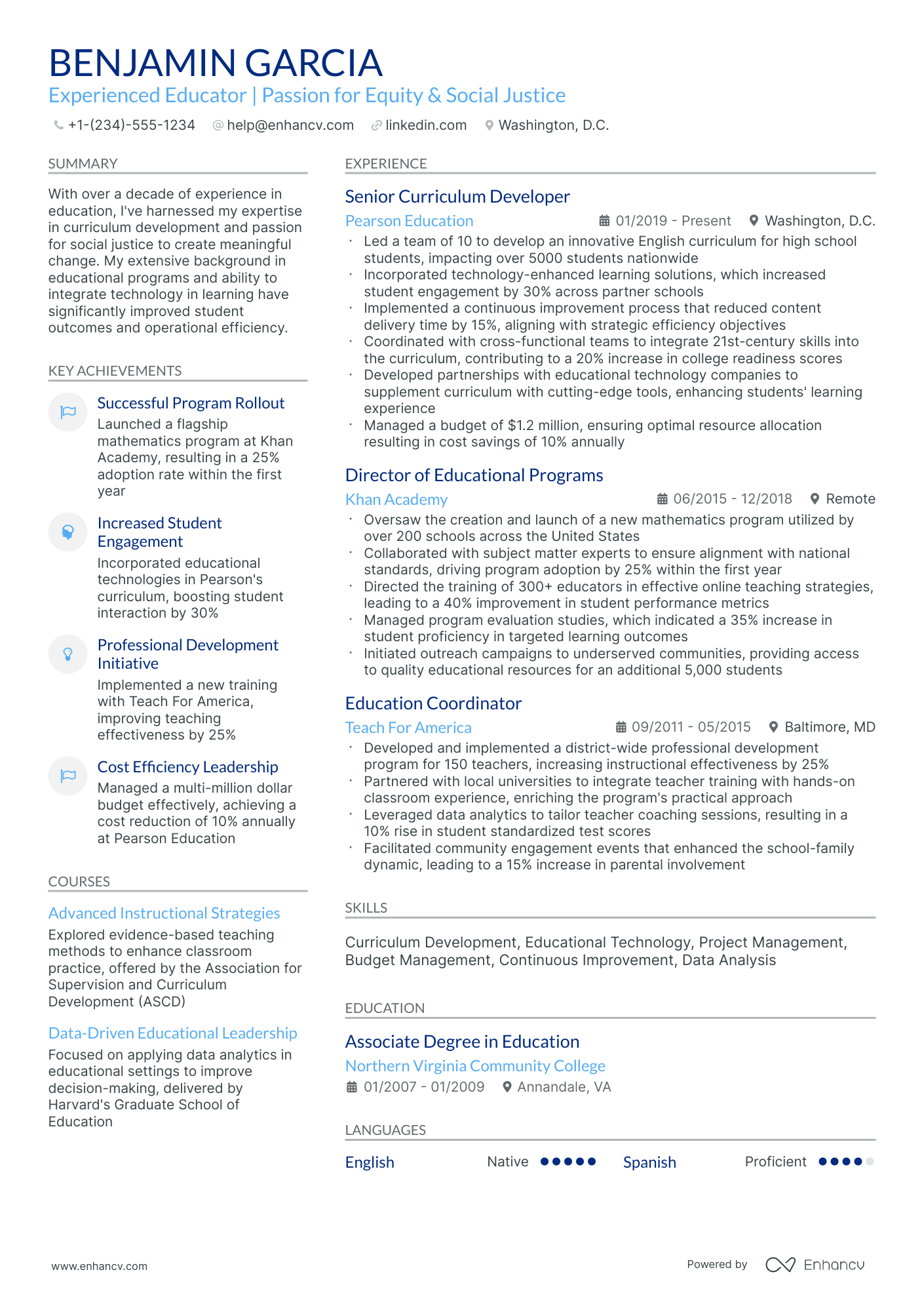
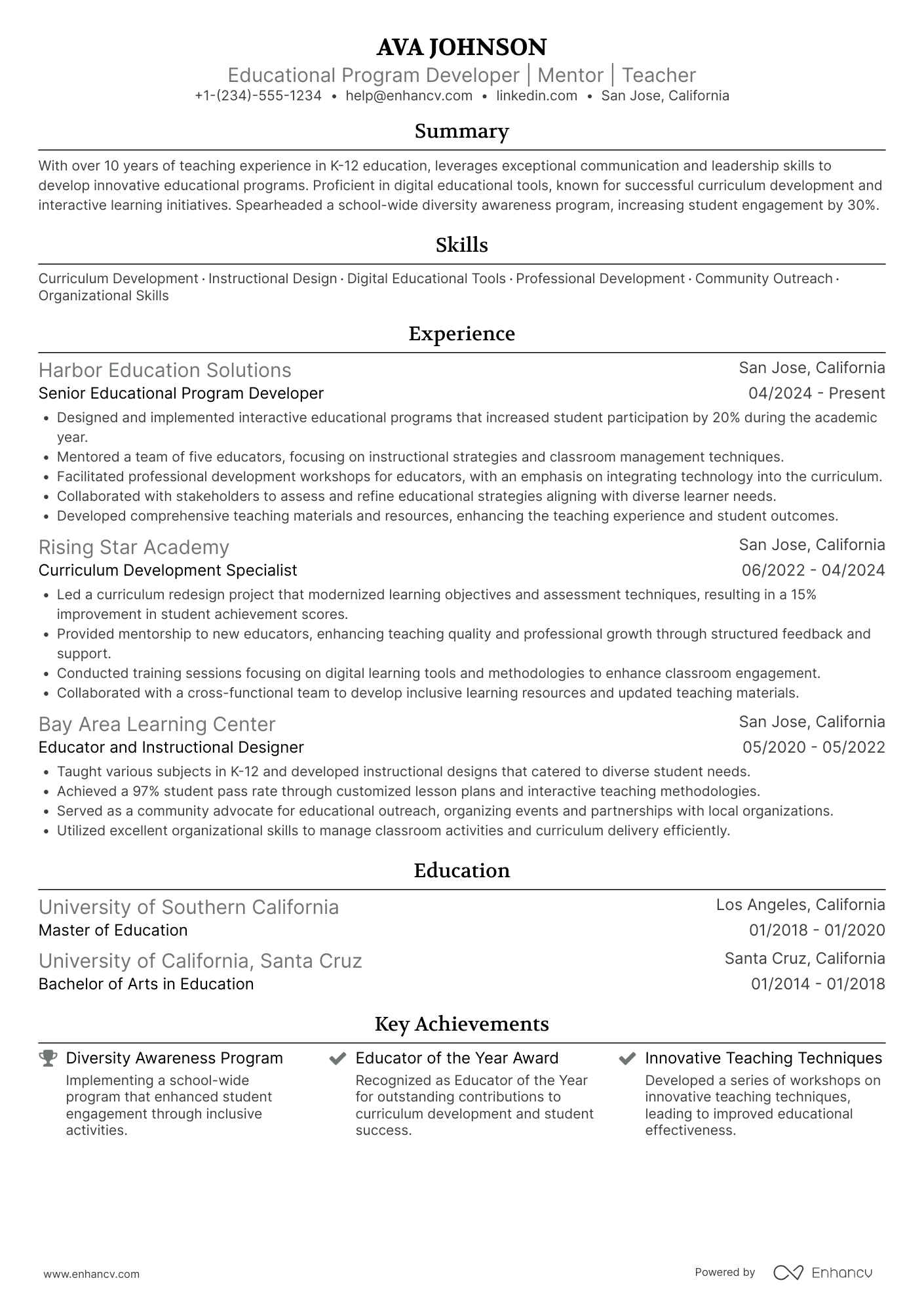
A retired teacher resume often fails because it reads like a job description and buries recent impact under dated duties. That costs you in ATS screening and quick recruiter scans, where crowded applicant pools reward clear, current value.
Building the cover letter to send with it? Our retired teacher cover letter guide covers the narrative half — turning decades of classroom wins and your reason for returning into a story a district hiring lead actually wants to read.
A strong resume shows what you improved, not what you used. Knowing how to make your resume stand out means you should highlight student growth data, higher pass rates, improved attendance, reduced behavior incidents, curriculum delivered across grades, and measurable gains for multilingual learners.

Key takeaways
- Quantify student outcomes like pass rates, growth percentiles, and attendance improvements in every experience bullet.
- Choose a reverse-chronological format for deep experience or a hybrid format for career pivots.
- Tailor each resume to the job posting by mirroring its exact terminology and listed tools.
- Place certifications above education when they're recent and directly relevant to the target role.
- Lead your summary with measurable achievements and leadership scope, not vague phrases like "passionate educator."
- Demonstrate skills through outcome-driven experience bullets, not just a standalone skills list.
- Use Enhancv's Bullet Point Generator to turn routine teaching duties into recruiter-ready, results-focused statements.
How to format a retired teacher resume
Recruiters reviewing a retired teacher's resume look for transferable skills—classroom management, curriculum development, mentoring, and communication—alongside any post-retirement volunteer work, tutoring, or consulting that signals continued engagement. Because retired teachers often carry decades of experience yet may be pivoting into new roles, the right resume format determines whether those strengths surface quickly or get buried under outdated job listings.

I have significant experience in this role—which format should I use?
Use a reverse-chronological format to showcase the full arc of your teaching career, highlighting promotions, expanded responsibilities, and lasting impact. Do:
- Lead with your most recent or most relevant teaching positions, emphasizing scope: grade levels taught, department leadership, committee roles, and student population size.
- Feature role-specific expertise such as curriculum design, IEP development, standardized test preparation, classroom technology platforms (Google Classroom, Canvas, SMART Board integration), and subject-matter specializations.
- Quantify outcomes wherever possible—improved pass rates, student growth percentiles, grant funding secured, or mentorship program results.
I'm junior or switching into this role—what format works best?
A hybrid format works best because it lets you lead with transferable skills while still providing a concise work history that gives recruiters context. Do:
- Place a skills section near the top that highlights competencies relevant to your target role—communication, organization, data analysis, training, or conflict resolution—so recruiters see your value immediately.
- Include projects, volunteer tutoring, substitute teaching, community education workshops, or any transitional experience that demonstrates classroom-adjacent abilities.
- Connect every listed skill to a specific action and a measurable or observable result so hiring managers understand your real-world impact.
Why not use a functional resume?
A functional resume strips away the timeline of your experience, making it difficult for recruiters to verify when and where you applied your teaching skills—which raises red flags rather than building confidence in your candidacy.
- Career change with no direct teaching history: You're transitioning from an unrelated field and have only informal teaching experience, such as corporate training workshops or volunteer tutoring.
- Extended career gap after retirement: You've been out of the workforce for several years and want to foreground recently updated skills or certifications over a long employment gap.
- Limited formal work history: You're re-entering the workforce with primarily volunteer, freelance, or part-time instructional roles that don't fill a traditional timeline.
- A functional resume may be acceptable if you're a retired professional from a non-education field pivoting into teaching-adjacent work with no formal classroom roles—but even then, tie every listed skill to a specific project, volunteer engagement, or measurable outcome to maintain credibility.
Once you've established a clean, readable format, the next step is deciding which sections to include and how to arrange them to highlight your most relevant experience.
What sections should go on a retired teacher resume
Recruiters expect to see clear, recent, and role-aligned proof of your classroom impact and transferable expertise. Understanding which resume sections to include ensures you present your qualifications in the most effective order.
Use this structure for maximum clarity:
- Header
- Summary
- Experience
- Skills
- Projects (include only if appropriate for this role or seniority)
- Education
- Certifications (only if relevant to the role)
- Optional sections: Awards, Leadership, Volunteering
Your experience bullets should emphasize measurable student outcomes, scope of responsibility, and results you delivered across instruction, student support, and school-wide initiatives.
Is your resume good enough?
Drop your resume here or choose a file. PDF & DOCX only. Max 2MB file size.
With your resume’s key components in place, the next step is to write your retired teacher resume experience section so those details translate into clear, relevant impact for employers.
How to write your retired teacher resume experience
Your work experience section should highlight the work you delivered throughout your teaching career—the curricula you built, the instructional methods you employed, and the measurable student or program outcomes you achieved. Hiring managers prioritize demonstrated impact over descriptive task lists, so frame each role around what changed because of your contributions.
Each entry should include:
- Job title
- Company and location (or remote)
- Dates of employment (month and year)
Three to five concise bullet points showing what you owned, how you executed, and what outcomes you delivered:
- Ownership scope: the classrooms, grade levels, subject areas, departments, or student populations you were directly accountable for as a retired teacher returning to the workforce or pivoting into a new role.
- Execution approach: the instructional strategies, assessment frameworks, classroom technologies, curriculum design methods, or intervention programs you used to drive student achievement and inform your decisions.
- Value improved: changes to student performance, graduation readiness, learning accessibility, program quality, classroom engagement, or operational efficiency that resulted from your teaching practice.
- Collaboration context: how you partnered with administrators, fellow educators, parents, counselors, special education teams, or community organizations to support student outcomes and institutional goals.
- Impact delivered: outcomes expressed through program-level results, student progress at scale, or institutional improvements rather than routine duties—connecting your teaching legacy to the value you bring in your next chapter.
Experience bullet formula
A retired teacher experience example
✅ Right example - modern, quantified, specific.
High School English Teacher
Ridgeview Public Schools | Austin, TX
2003–2024
Large, diverse public high school serving 2,100 students with a campuswide focus on college and career readiness.
- Designed and delivered standards-aligned curriculum in Google Classroom and Canvas (learning management system), increasing on-time assignment completion from 72% to 89% across five sections (one hundred fifty students) in one semester.
- Implemented data-driven interventions using NWEA MAP and Excel dashboards, raising average reading growth from 1.1 to 1.6 grade levels and reducing failing rates by 28% year over year.
- Built inclusive lesson materials and accommodations with individualized education program documentation in PowerSchool, improving individualized education program goal attainment from 64% to 81% while coordinating weekly with special education case managers and counselors.
- Streamlined grading and feedback with Google Forms, rubric-based comments, and Turnitin, cutting turnaround time from seven days to three days and increasing revision submission rates by 22%.
- Led a cross-department literacy initiative with administrators and department chairs, standardizing common assessments and moderation protocols that improved inter-rater consistency by 35% and increased state exam pass rates by nine points.
Now that you've seen how a retired teacher's experience section comes together, let's break down how to tailor each element to match the specific role you're targeting.
How to tailor your retired teacher resume experience
Recruiters evaluate your retired teacher resume through both human review and applicant tracking systems. Tailoring your resume to the job description increases your chances of passing both screenings.
Ways to tailor your retired teacher experience:
- Match instructional technologies and learning platforms named in the posting.
- Mirror the exact terminology used for curriculum standards or frameworks.
- Highlight student performance outcomes that reflect the listed success criteria.
- Include grade levels or subject expertise that align with stated requirements.
- Emphasize classroom management strategies or behavioral intervention models referenced.
- Reflect collaboration structures like co-teaching or professional learning communities.
- Incorporate assessment tools or data analysis methods specified in the description.
- Address compliance with IEP accommodations or accessibility standards when mentioned.
Tailoring means aligning your real classroom achievements with stated job requirements, not forcing disconnected keywords into your experience bullets.
Resume tailoring examples for retired teacher
| Job description excerpt | Untailored | Tailored |
|---|---|---|
| "Seeking a curriculum consultant to redesign K–5 literacy programs using structured literacy frameworks aligned with the Science of Reading." | Helped develop reading curriculum for elementary students. | Redesigned K–5 literacy curriculum for 12 classrooms using Orton-Gillingham and other structured literacy frameworks, increasing grade-level reading proficiency by 18% over two academic years. |
| "Looking for an after-school program coordinator to manage tutoring schedules, track student progress in PowerSchool, and communicate outcomes to parents and administrators." | Coordinated after-school activities and worked with students who needed extra help. | Managed after-school tutoring for 45+ students across three grade levels, tracked attendance and academic progress in PowerSchool, and delivered monthly outcome reports to parents and building administrators. |
| "Hiring a substitute teacher trainer to lead onboarding sessions covering classroom management techniques, district safety protocols, and differentiated instruction strategies." | Trained new staff and helped them adjust to the school environment. | Led full-day onboarding sessions for groups of 20+ substitute teachers, covering de-escalation-based classroom management, district emergency and safety protocols, and differentiated instruction strategies for inclusive classrooms. |
Once you’ve aligned your teaching background with the role’s priorities, the next step is to quantify your retired teacher achievements so hiring managers can see the impact behind that fit.
How to quantify your retired teacher achievements
Quantifying your achievements shows how you improved learning, efficiency, and compliance. Focus on student growth, assessment accuracy, classroom management, family engagement, and program delivery volume.
Quantifying examples for retired teacher
| Metric | Example |
|---|---|
| Student growth | "Raised reading proficiency from 58% to 76% in one school year for twenty-eight third graders using DIBELS progress monitoring and small-group instruction." |
| Assessment accuracy | "Cut grading errors by 40% by using Google Forms rubrics and double-check workflows, reducing parent regrade requests from ten per quarter to six." |
| Family engagement | "Increased parent conference attendance from 45% to 70% by scheduling via SignUpGenius and offering two time blocks, reaching 120 families." |
| Classroom safety | "Reduced office referrals from eighteen to seven per semester by implementing PBIS routines and weekly behavior check-ins for a class of thirty-two." |
| Program delivery | "Delivered 160 hours of after-school tutoring across two semesters, supporting fifty students and improving average math unit scores by eight points." |
Turn vague job duties into measurable, recruiter-ready resume bullets in seconds with Enhancv's Bullet Point Generator.
With strong bullet points in place, the next step is ensuring your skills section highlights the right mix of hard and soft skills for the roles you're targeting.
How to list your hard and soft skills on a retired teacher resume
Your skills section shows how you deliver instruction and results, and recruiters and an ATS (applicant tracking system) scan them to match keywords fast—aim for a balanced mix of hard skills, plus role-specific soft skills tied to outcomes. retired teacher roles require a blend of:
- Product strategy and discovery skills
- Data, analytics, and experimentation skills
- Delivery, execution, and go-to-market discipline
- Soft skills
Your skills section should be:
- Scannable (bullet-style grouping).
- Relevant to the job post.
- Backed by proof in experience bullets.
- Updated with current tools.
Place your skills section:
- Above experience if you're junior or switching careers.
- Below experience if you're mid/senior with strong achievements.

Hard skills
- Curriculum mapping, scope and sequence
- Lesson planning, unit design
- Differentiated instruction, IEP alignment
- Classroom management systems
- Formative and summative assessment design
- Standards alignment, Common Core
- Learning management systems: Google Classroom, Canvas
- Student information systems: PowerSchool, Infinite Campus
- Google Workspace: Docs, Sheets, Slides
- Microsoft Office: Word, Excel, PowerPoint
- Data tracking: gradebooks, dashboards
- Parent communication platforms: Remind, ClassDojo
Soft skills
- Translate standards into clear goals
- Explain complex ideas simply
- Facilitate group discussions
- Build rapport with families
- Collaborate with grade-level teams
- Align stakeholders on student plans
- De-escalate classroom conflict
- Set boundaries and expectations
- Prioritize workload under deadlines
- Document decisions and follow through
- Give actionable feedback fast
- Adapt instruction in real time
How to show your retired teacher skills in context
Skills shouldn't live only in a bulleted list on your resume. Explore resume skills examples to see how educators present their abilities effectively.
They should be demonstrated in:
- Your summary (high-level professional identity)
- Your experience (proof through outcomes)
Here's how that looks in practice for a retired teacher.
Summary example
Veteran K–8 educator with 30 years of experience designing differentiated curricula and mentoring new teachers. Skilled in IEP development, classroom technology integration, and formative assessment. Improved district-wide reading proficiency scores by 18% through data-driven literacy initiatives.
- Reflects senior-level experience clearly
- Names specific tools and methods
- Includes a measurable student outcome
- Highlights mentorship and leadership
Experience example
Lead Language Arts Teacher
Maplewood Unified School District | Maplewood, NJ
August 1993–June 2023
- Raised 7th-grade reading comprehension scores by 22% using formative assessments and targeted small-group instruction tracked in PowerSchool.
- Collaborated with special education staff to develop 40+ individualized education programs annually, improving student goal attainment by 15%.
- Mentored 12 early-career teachers over five years, contributing to a 95% new-hire retention rate across the department.
- Every bullet contains measurable proof.
- Skills appear naturally within achievements.
Once you’ve tied your classroom strengths to relevant accomplishments and outcomes, you can apply that same approach to structuring a retired teacher resume when you don’t have direct experience in the target role.
How do I write a retired teacher resume with no experience
Even without full-time experience, you can demonstrate readiness through the strategies outlined in our guide on building a resume without work experience:
- Classroom volunteer teaching support
- Substitute teaching assignments
- Tutoring students in core subjects
- Curriculum design for community programs
- Online course creation and delivery
- School committee and PTA leadership
- Education conference presentations and workshops
- Learning management system course builds
Focus on:
- Measurable outcomes from teaching projects
- Transferable tools and documentation
- Industry relevant training and certifications
- Clear scope, timelines, and deliverables
Resume format tip for entry-level retired teacher
Use a combination resume format because it highlights transferable skills and projects first, while still showing a clear work history timeline. Do:
- Lead with a summary and target role.
- Add a projects section with metrics.
- List tools used for each project.
- Translate education tasks into business terms.
- Include recent training with dates.
- Built and delivered a six-week online tutoring program in Google Classroom; improved average quiz scores by 18 percent across twelve students using weekly assessments.
Even without formal classroom experience, your educational background can demonstrate the foundation and credibility needed for a teaching career—making it essential to present it effectively.
How to list your education on a retired teacher resume
Your education section helps hiring teams confirm you hold the foundational knowledge and credentials required. It validates your qualifications and teaching expertise as a retired teacher.
Include:
- Degree name
- Institution
- Location
- Graduation year
- Relevant coursework (for juniors or entry-level candidates)
- Honors & GPA (if 3.5 or higher)
Avoid listing month or day details—use the graduation year only.
Here's a strong education entry tailored to a retired teacher:
Example education entry
Master of Education in Curriculum and Instruction
University of Virginia, Charlottesville, VA
Graduated: 1988
GPA: 3.8/4.0
- Relevant Coursework: Differentiated Instruction, Educational Psychology, Literacy Development, and Classroom Assessment Strategies
- Honors: Graduated Summa Cum Laude, Phi Kappa Phi Honor Society
How to list your certifications on a retired teacher resume
Certifications show a retired teacher stays committed to learning, uses modern tools with confidence, and remains relevant to today's education standards and practices.
Include:
- Certificate name
- Issuing organization
- Year
- Optional: credential ID or URL
- Place certifications below education when they're older, less relevant, or mainly confirm long-held qualifications.
- Place certifications above education when they're recent, highly relevant, or highlight in-demand skills like technology, literacy, or special education.
Best certifications for your retired teacher resume
- National Board Certification
- Google Certified Educator Level 1
- Google Certified Educator Level 2
- Microsoft Certified Educator
- TESOL Certificate
- Certified Reading Specialist
- Child Development Associate Credential
Once you’ve positioned your credentials where hiring teams can spot them quickly, shift to your retired teacher resume summary to tie those qualifications to the value you’ll bring.
How to write your retired teacher resume summary
Your resume summary is the first thing a recruiter reads. A strong opening frames your decades of classroom experience as a direct asset for whatever role you're pursuing next.
Keep it to three to four lines, with:
- Your professional title and total years of teaching experience.
- The education level, subject area, or program type you specialized in.
- Core skills such as curriculum design, student assessment, or instructional technology.
- One or two measurable achievements, like improved test scores or program completion rates.
- Soft skills tied to real outcomes, such as mentoring that raised student retention by a specific percentage.

PRO TIP
As a retired teacher, lead with outcomes and leadership scope rather than daily duties. Highlight how you shaped programs, mentored colleagues, or drove measurable student growth across your career. Avoid vague phrases like "passionate educator" or "lifelong learner." Replace them with concrete results and the specific expertise you bring.
Example summary for a retired teacher
Veteran educator with 28 years in secondary science education. Redesigned district-wide biology curriculum, raising AP pass rates by 34%. Skilled in data-driven instruction, faculty mentorship, and cross-departmental program leadership.
Optimize your resume summary and objective for ATS
Drop your resume here or choose a file.
PDF & DOCX only. Max 2MB file size.
Now that your summary captures the essence of your teaching career, make sure the header framing it presents your contact details correctly so recruiters can reach you without hesitation.
What to include in a retired teacher resume header
A well-crafted resume header lists your key identifiers and contact details, helping a retired teacher boost visibility, credibility, and pass recruiter screening fast.
Essential resume header elements
- Full name
- Tailored job title and headline
- Location
- Phone number
- Professional email
- GitHub link
- Portfolio link
A LinkedIn link helps recruiters verify experience quickly and supports screening.
Don't include photos on a retired teacher resume unless the role is explicitly front-facing or appearance-dependent.
Keep the header to two lines, match the job posting keywords in your headline, and use the same name across every profile.
Example
Retired teacher resume header
Jordan M. Taylor
Retired teacher | Curriculum writer and instructional coach
Austin, TX
(512) 555-01XX your.name@enhancv.com github.com/yourname yourwebsite.com linkedin.com/in/yourname
Once your top-of-page contact details and professional identity are clear, you can strengthen your application with additional sections that add relevant context to your experience.
Additional sections for retired teacher resumes
Adding extra sections helps a retired teacher stand out by showcasing depth beyond standard qualifications and classroom experience. For example, listing language skills can highlight your ability to connect with diverse student populations and communities.
- Languages
- Volunteer experience
- Publications and curriculum contributions
- Professional affiliations and memberships
- Hobbies and interests
- Continuing education and workshops
- Awards and recognitions
Once you've rounded out your resume with the right supplementary sections, it's worth pairing it with a cover letter to strengthen your overall application.
Do retired teacher resumes need a cover letter
A cover letter isn't required for a retired teacher, but it often helps. If you're wondering what a cover letter is and when it matters most, it's especially useful in competitive roles or when hiring managers expect one. It can also make a difference when your resume needs context or a clear fit story.
Use these guidelines to decide when to include one:
- Explain role and team fit: Connect your teaching strengths to the job's daily work, pace, and collaboration style.
- Highlight one or two relevant projects or outcomes: Choose results that match the role, and include measurable impact when possible.
- Show understanding of the product, users, or business context: Reference what the organization does and how your experience supports its customers or students.
- Address career transitions or non-obvious experience: Clarify gaps, part-time work, consulting, or volunteer roles, and link them to the target role.
Drop your resume here or choose a file.
PDF & DOCX only. Max 2MB file size.
Once you’ve decided whether to include a cover letter to add context and strengthen your application, you can use AI to improve your retired teacher resume by refining how your experience and skills come across.
Using AI to improve your retired teacher resume
AI can sharpen your wording, tighten structure, and highlight measurable impact. It's a useful editing partner for retired teacher resumes. But overuse strips away authenticity. Once your content reads clearly and fits the role, step away from AI. If you're exploring this approach, our guide on ChatGPT resume writing prompts offers practical starting points.
Here are 10 practical prompts to strengthen specific sections of your retired teacher resume:
- Strengthen your summary: "Rewrite this retired teacher resume summary to emphasize leadership, mentorship, and measurable student outcomes in under four sentences."
- Quantify experience bullets: "Add specific metrics—like percentages, class sizes, or test score improvements—to these retired teacher experience bullet points."
- Align skills with roles: "Review this retired teacher skills section and remove irrelevant entries. Suggest replacements that match this specific job description."
- Clarify volunteer work: "Rewrite these retired teacher volunteer descriptions to highlight transferable skills like training, coordination, and community engagement."
- Modernize education details: "Update this retired teacher education section to emphasize relevant coursework, honors, or specializations for a non-teaching role."
- Tighten certification language: "Simplify this retired teacher certifications section. Remove expired credentials and clarify which remain active and relevant."
- Improve action verbs: "Replace weak or repetitive verbs in these retired teacher experience bullets with stronger, more precise action words."
- Refine project descriptions: "Rewrite these retired teacher project entries to focus on outcomes, collaboration, and skills that transfer outside education."
- Remove redundancy: "Identify and eliminate repeated ideas across this retired teacher resume without losing important details or accomplishments."
- Tailor for a new industry: "Adjust this retired teacher resume summary and experience section to better target a role in corporate training."
Stop using AI once your resume sounds accurate, specific, and aligned with real experience. AI should never invent experience or inflate claims—if it didn't happen, it doesn't belong here.
Conclusion
A strong retired teacher resume highlights measurable outcomes, role-specific skills, and a clear structure. It shows results in student growth, classroom management, and collaboration, supported by concrete numbers and concise examples.
Keep your retired teacher resume easy to scan and consistent from top to bottom. This approach matches today’s and near-future hiring market, and it shows you can deliver results in modern classrooms and support roles.