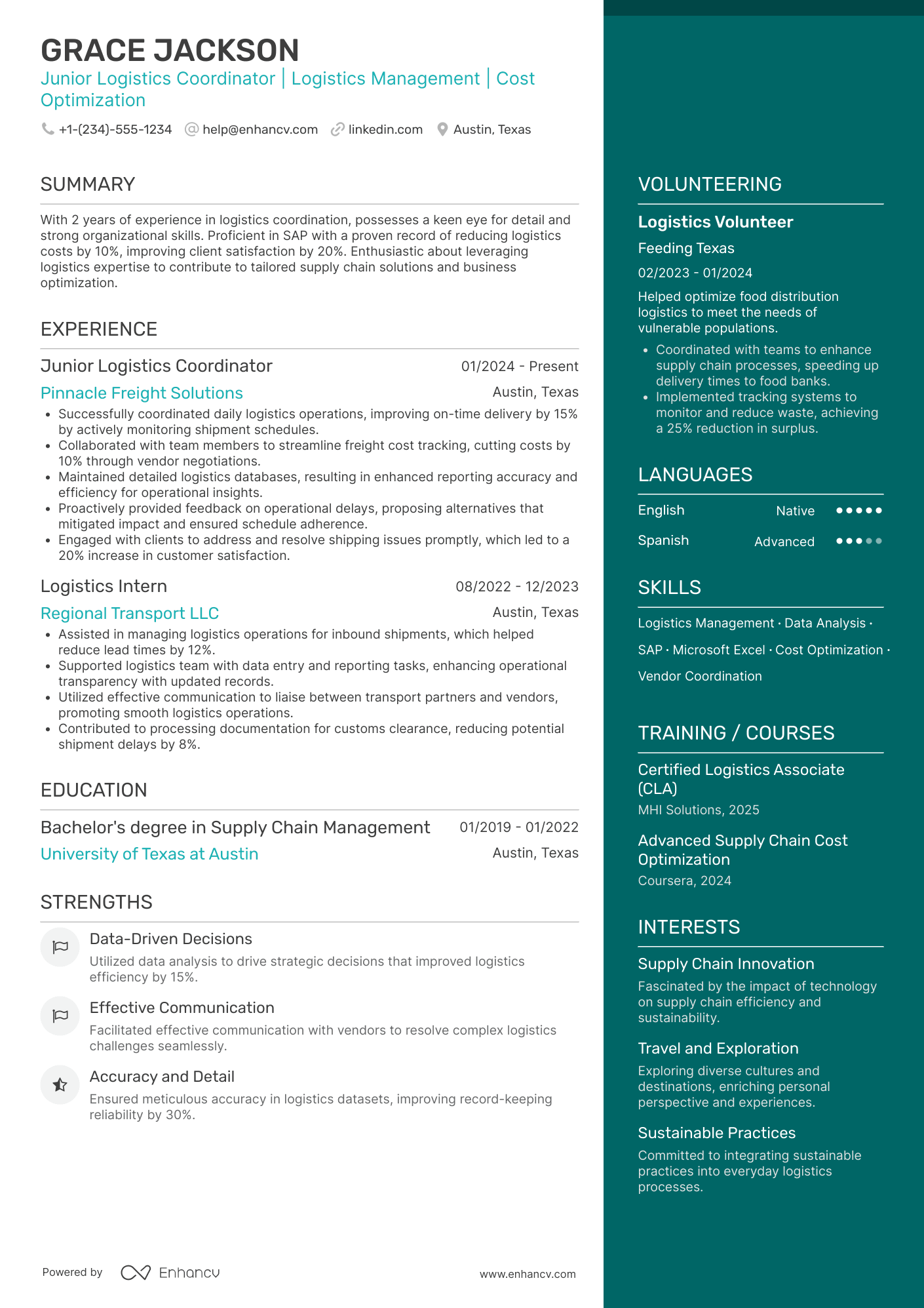
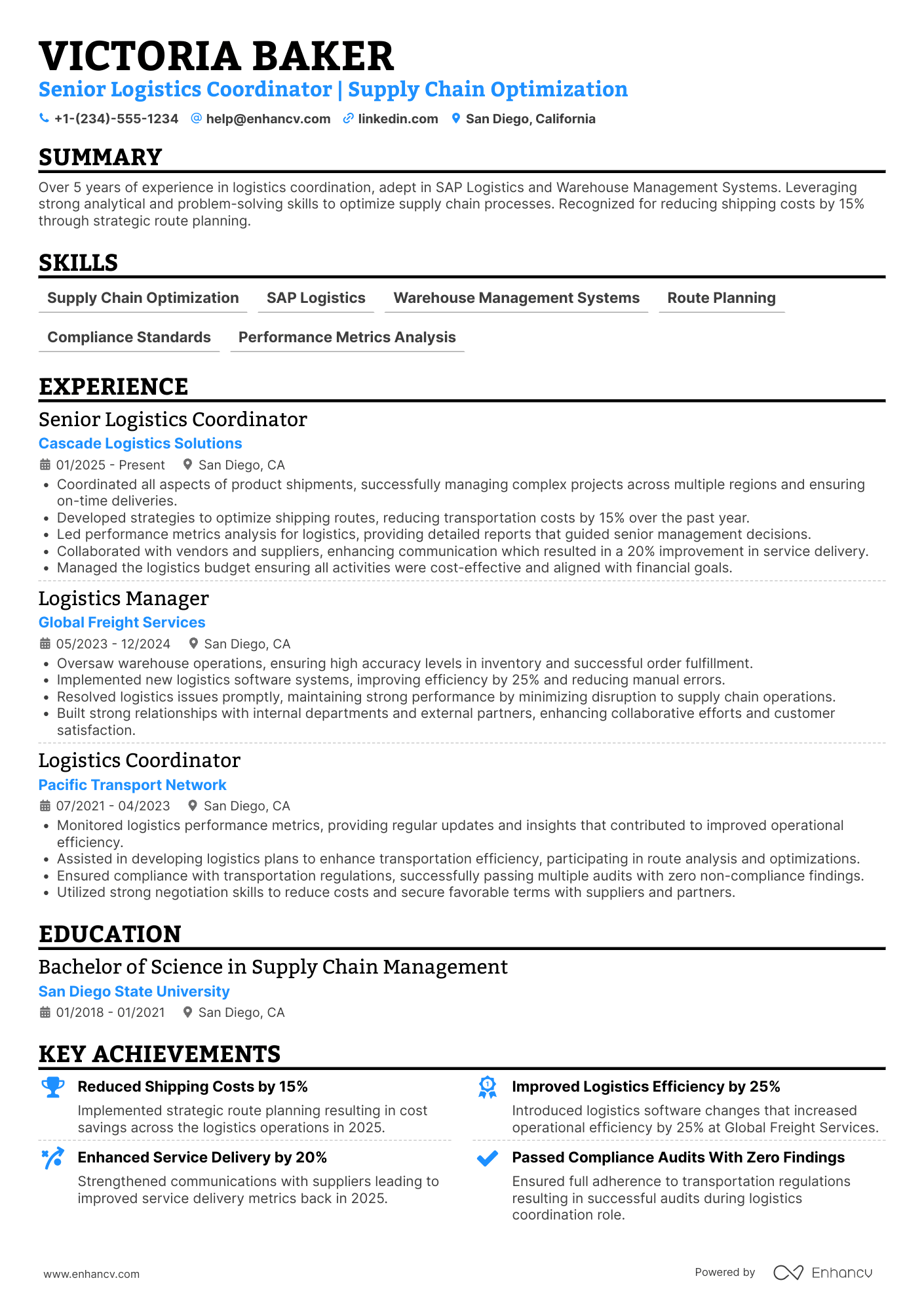
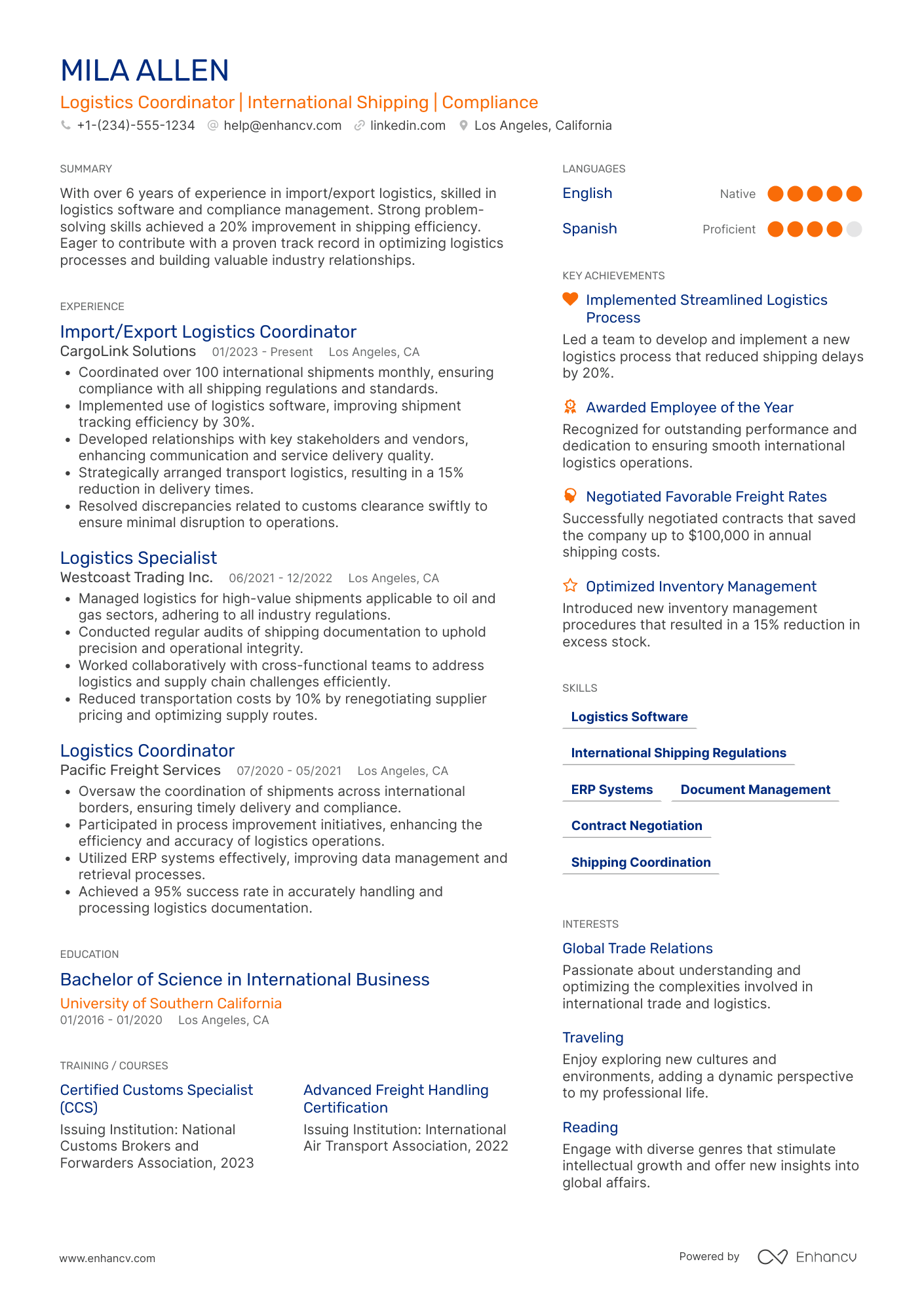
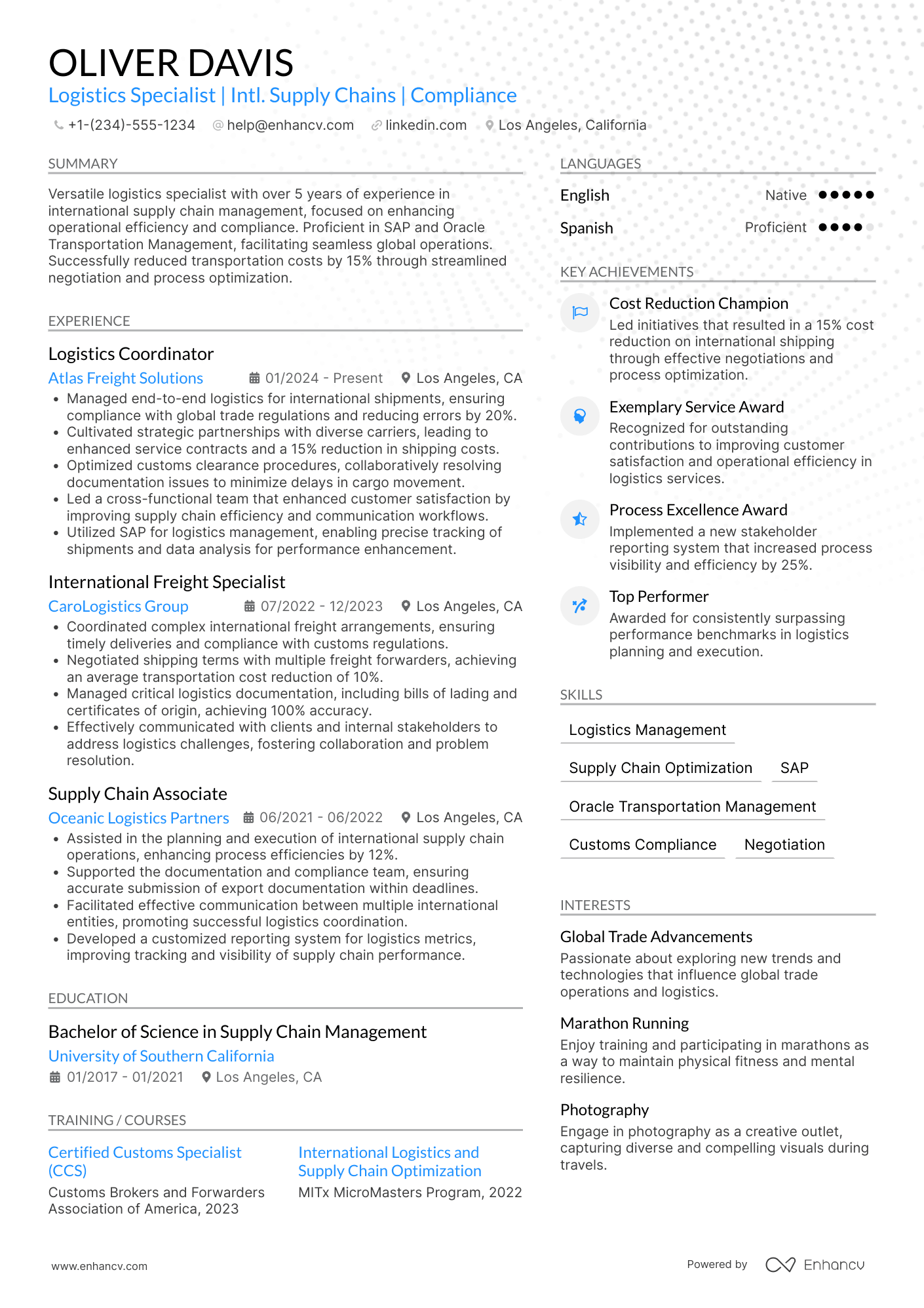
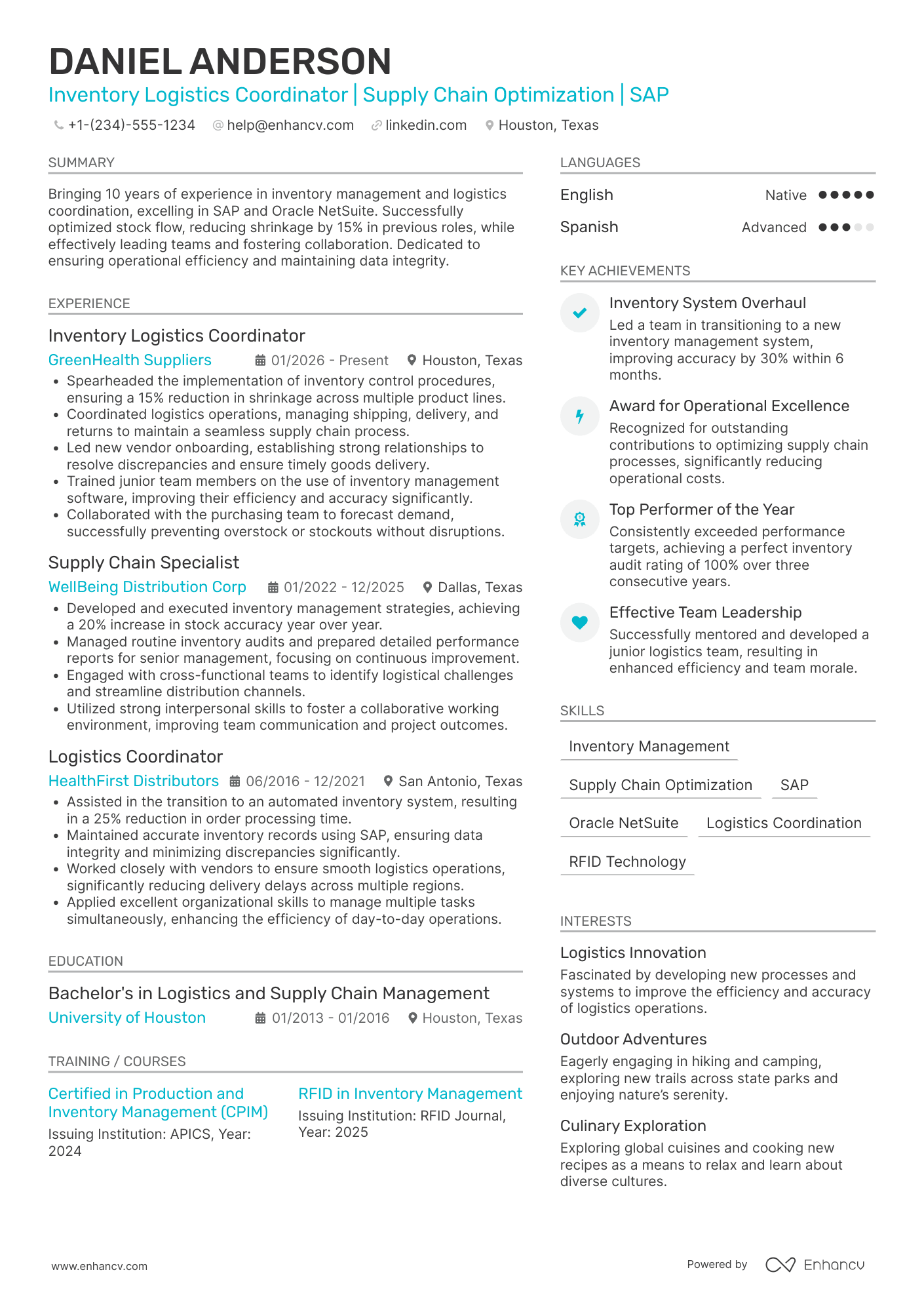
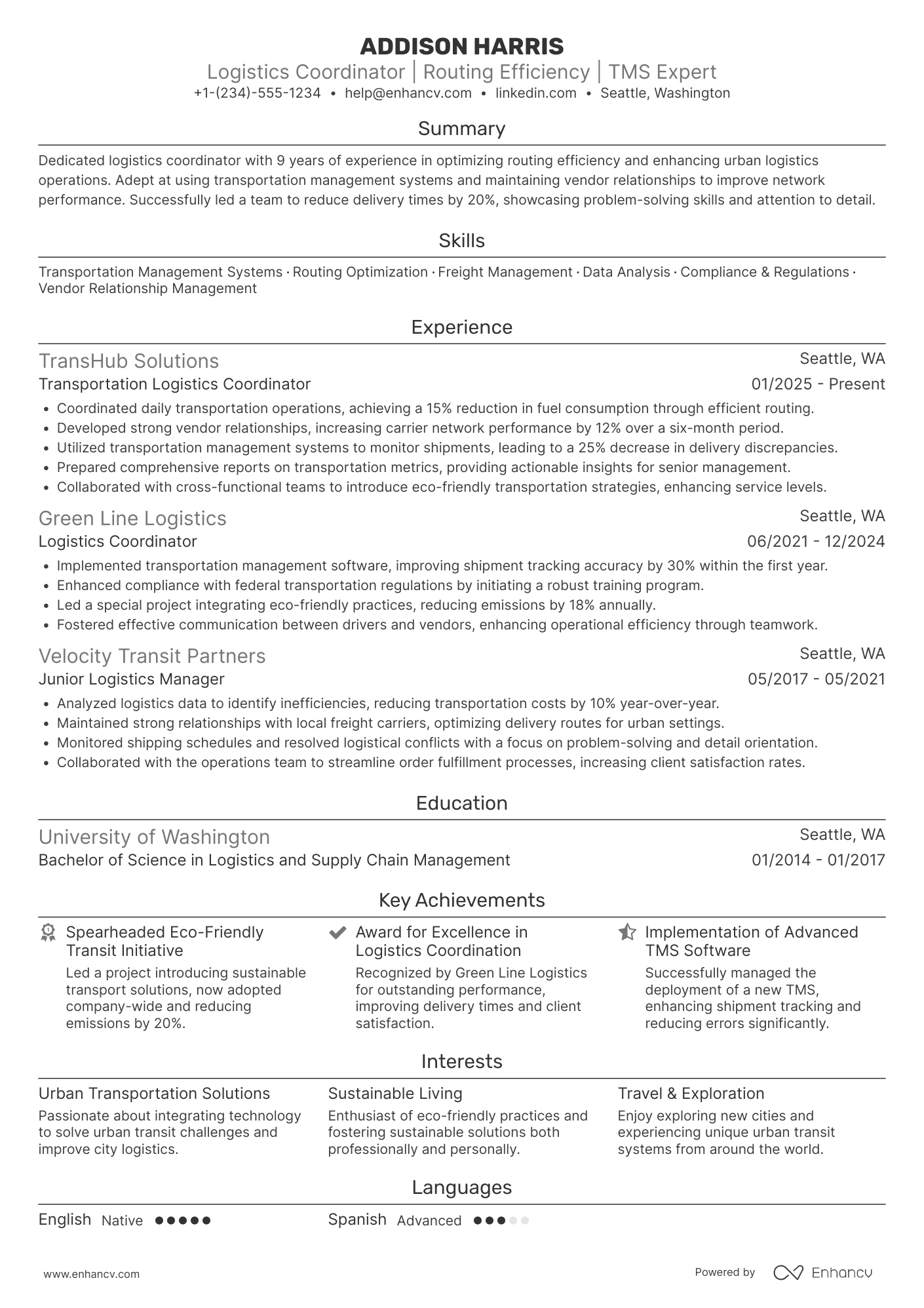
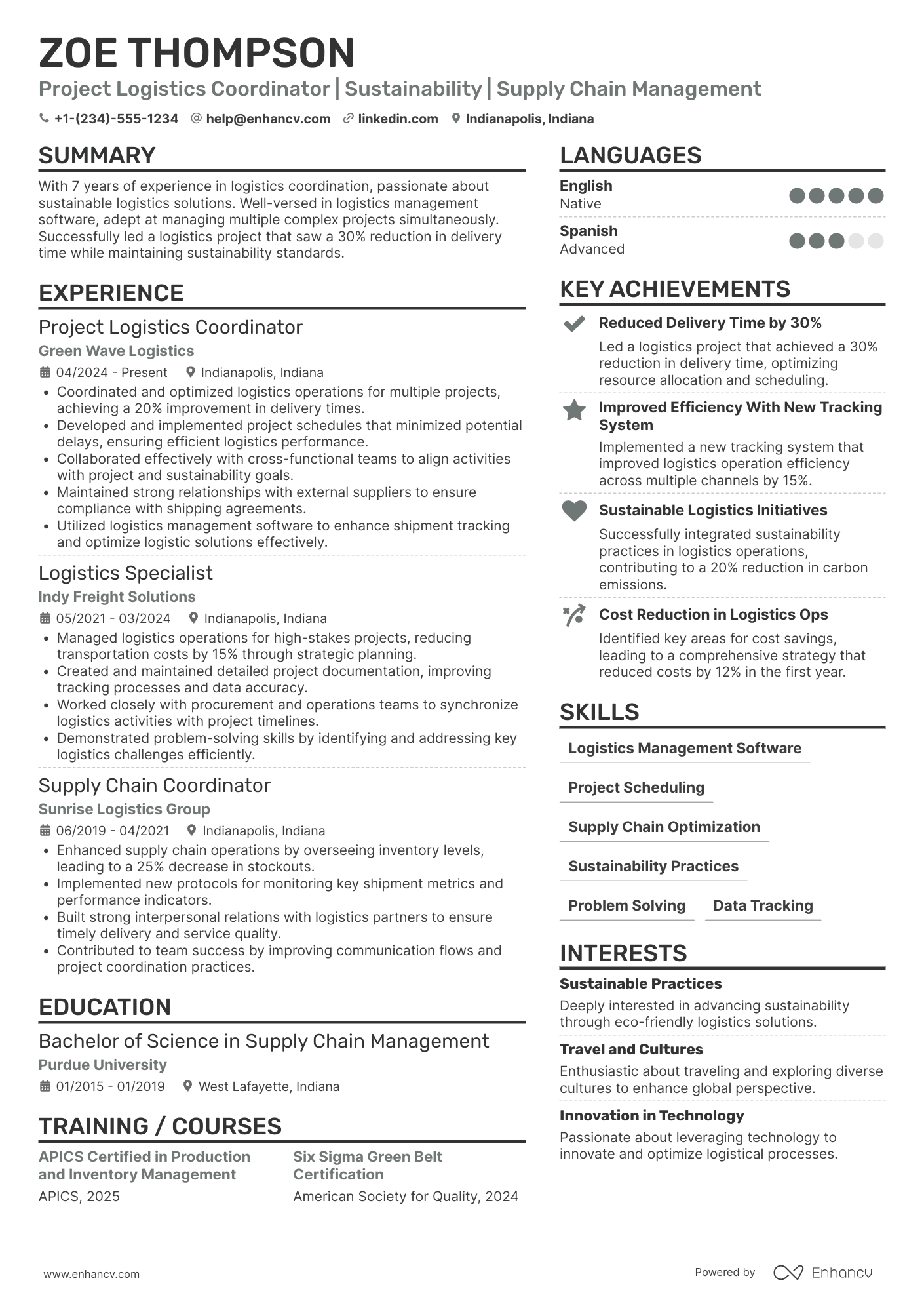
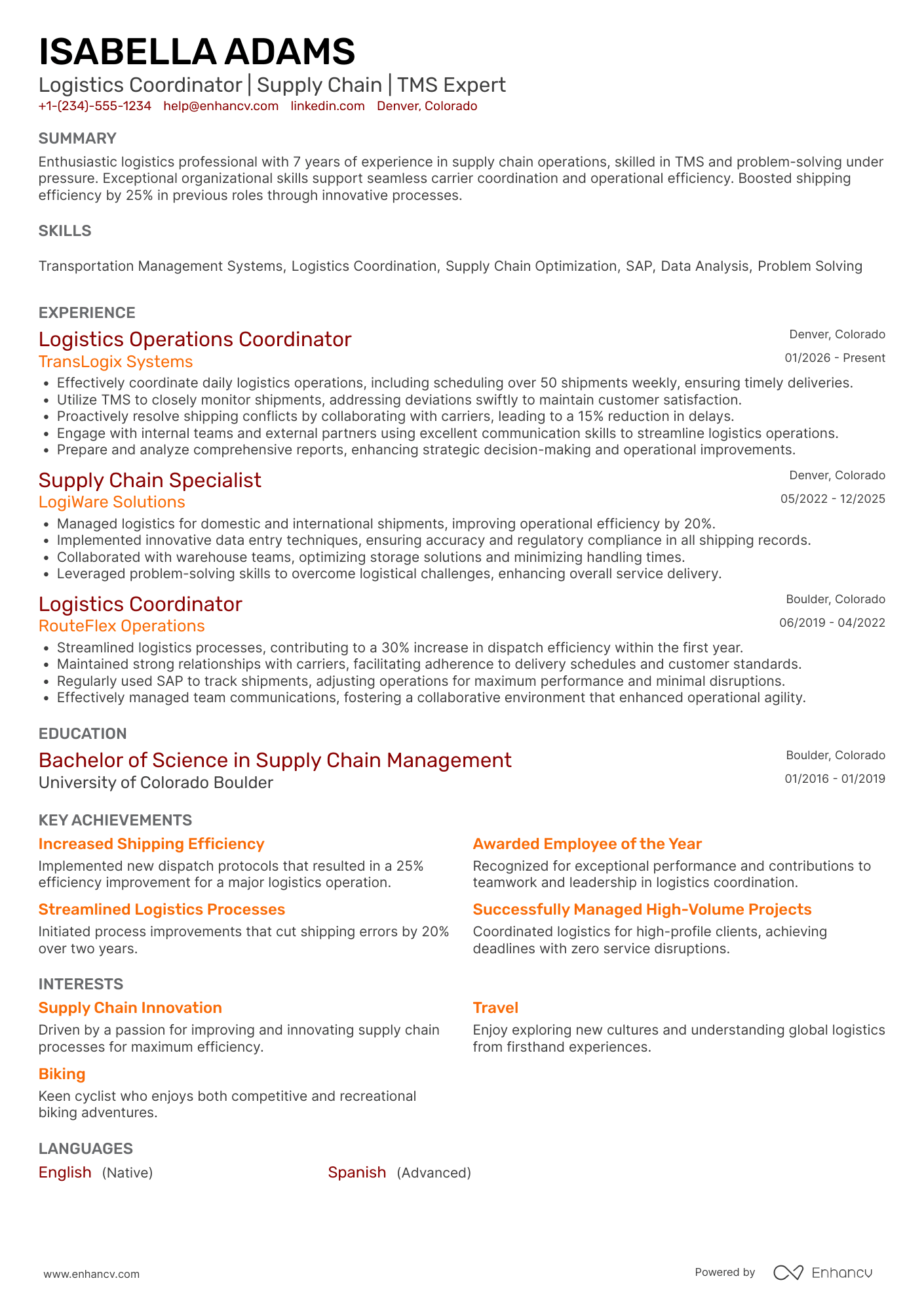
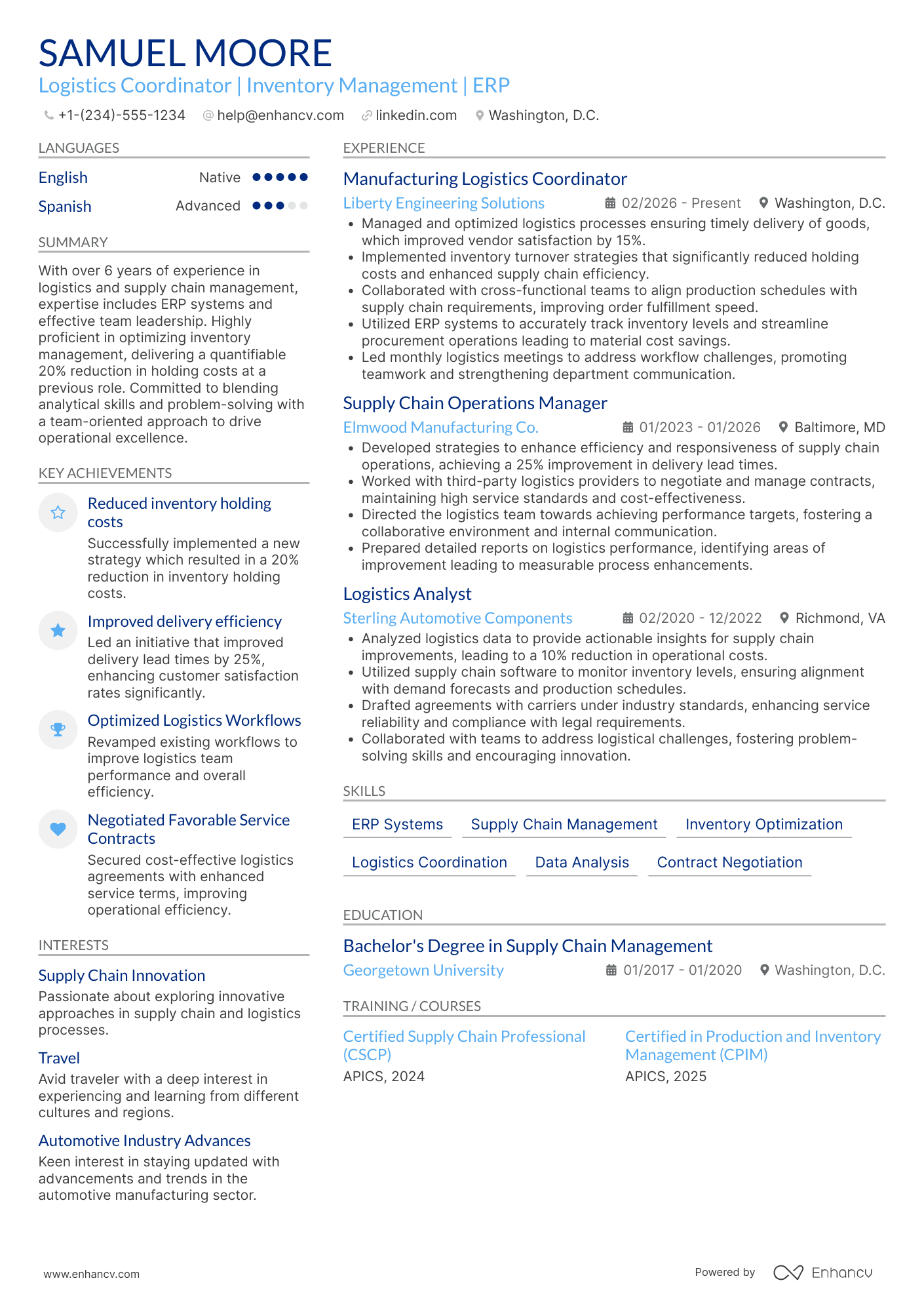
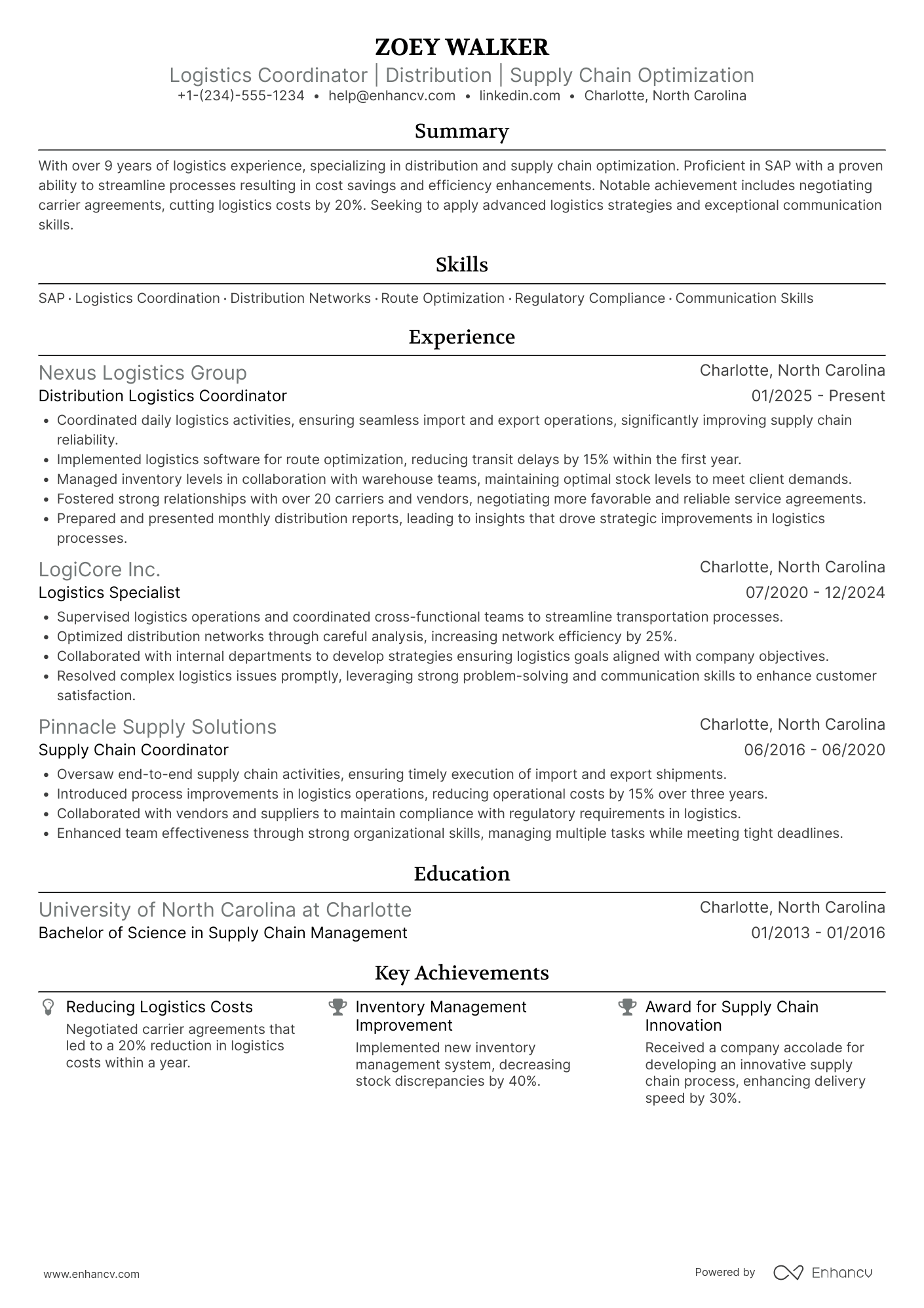
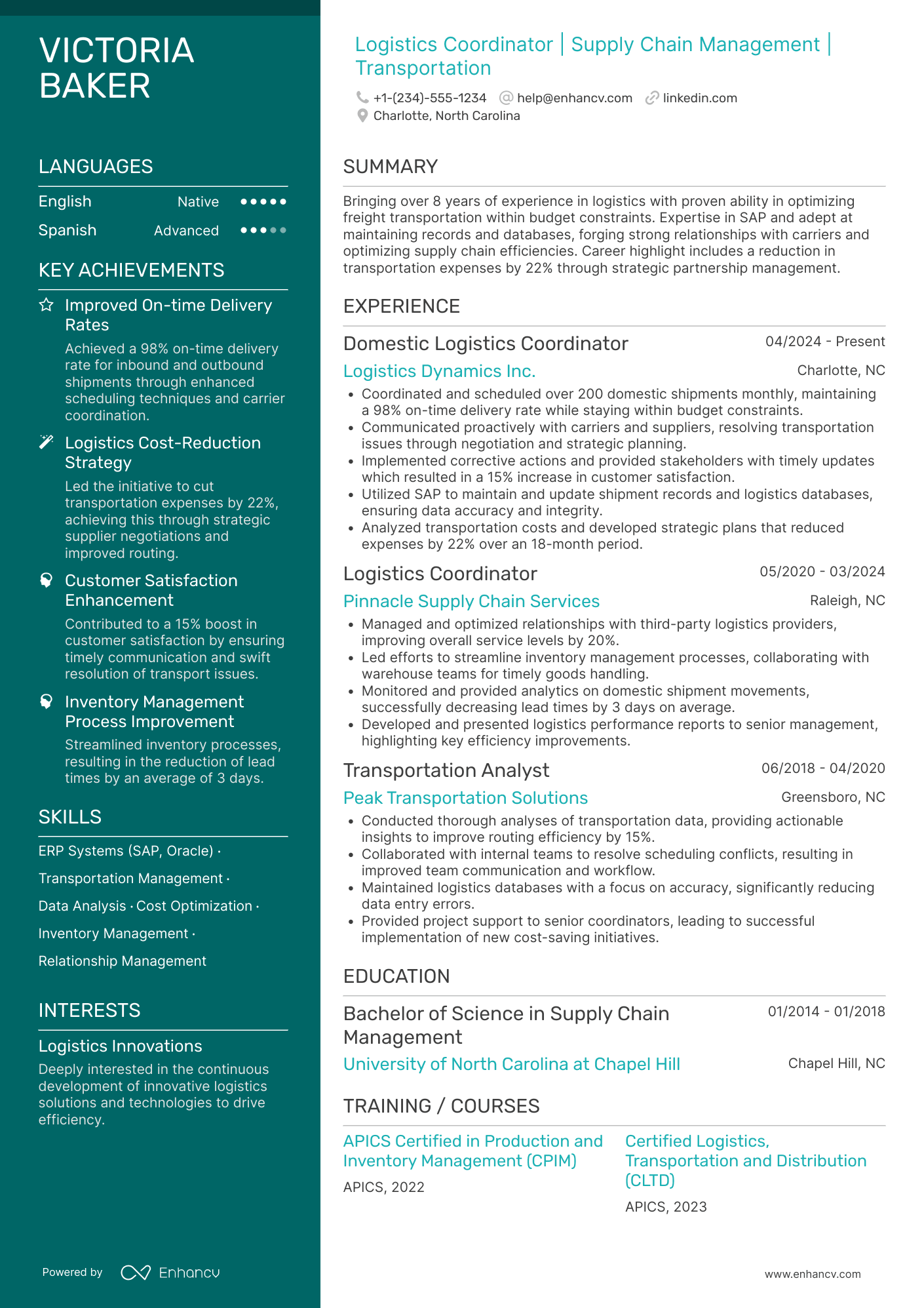
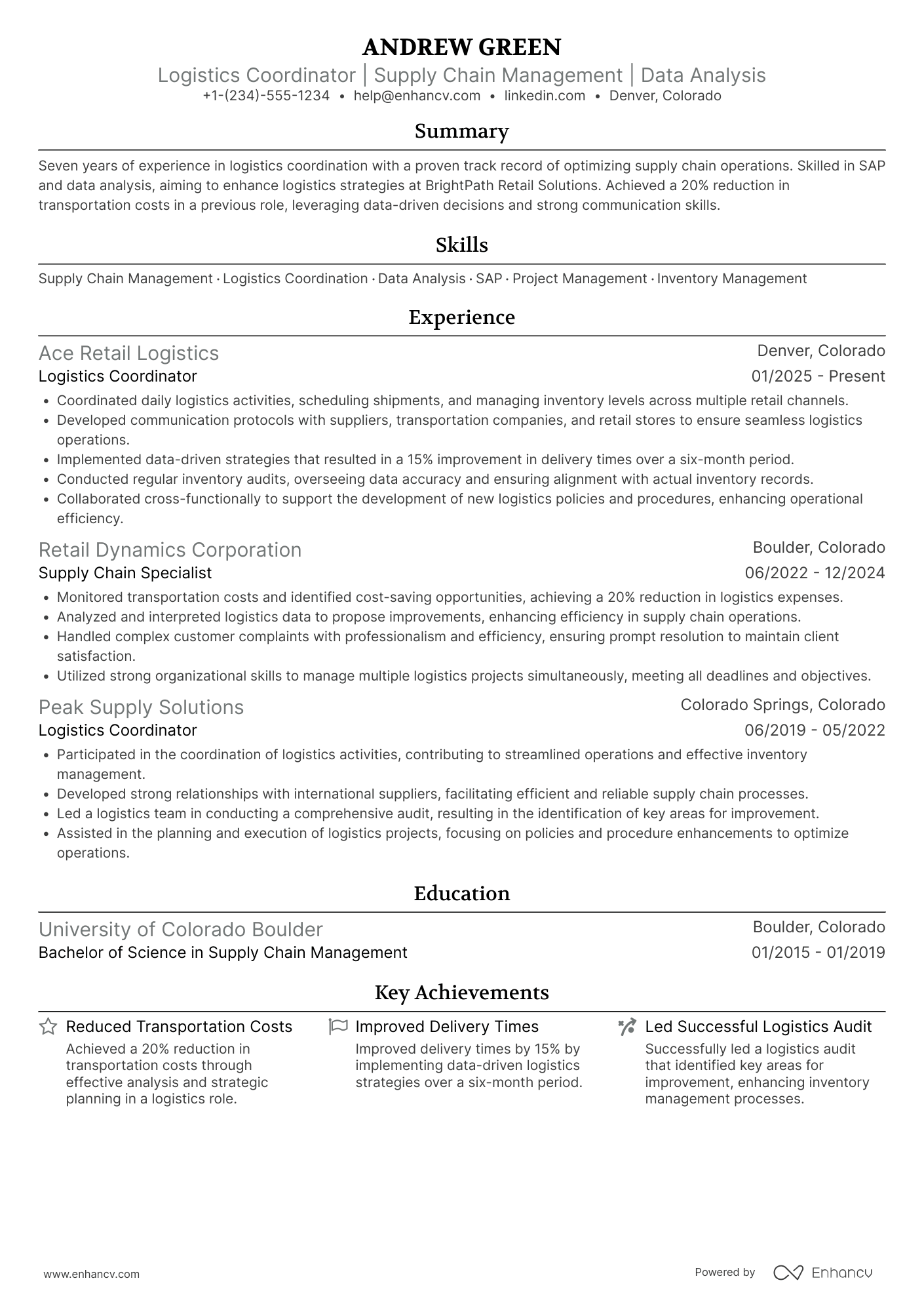
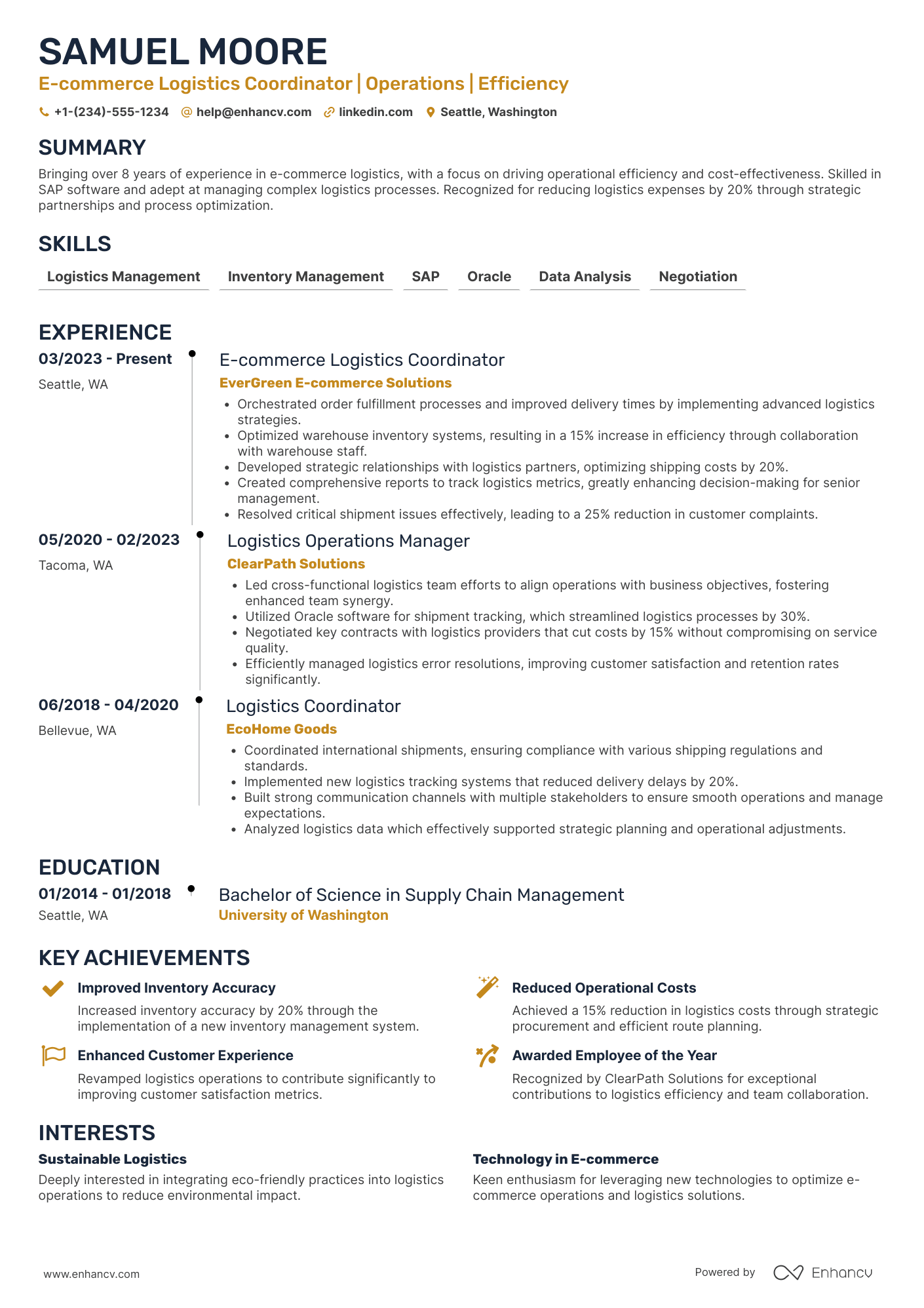
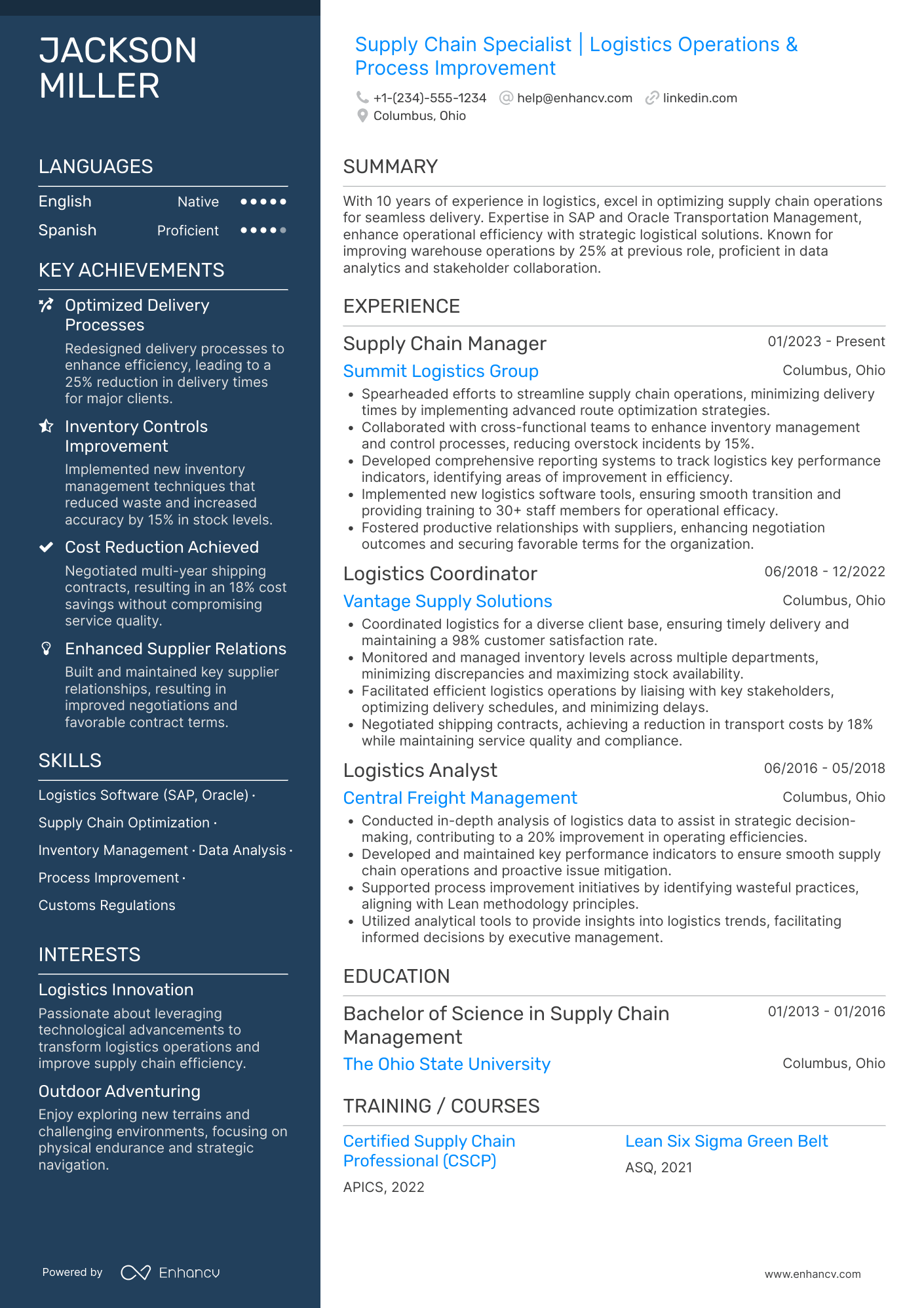
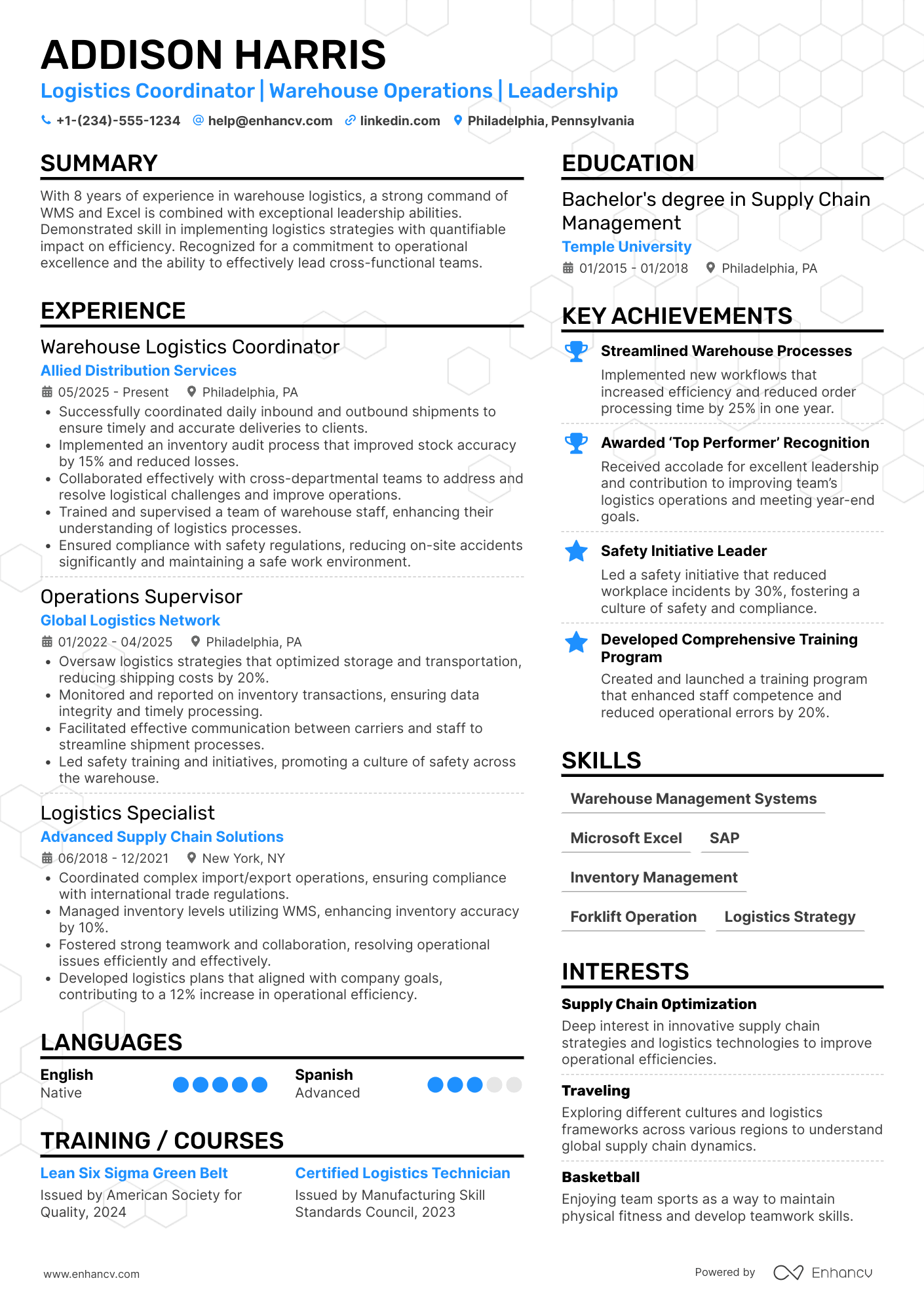
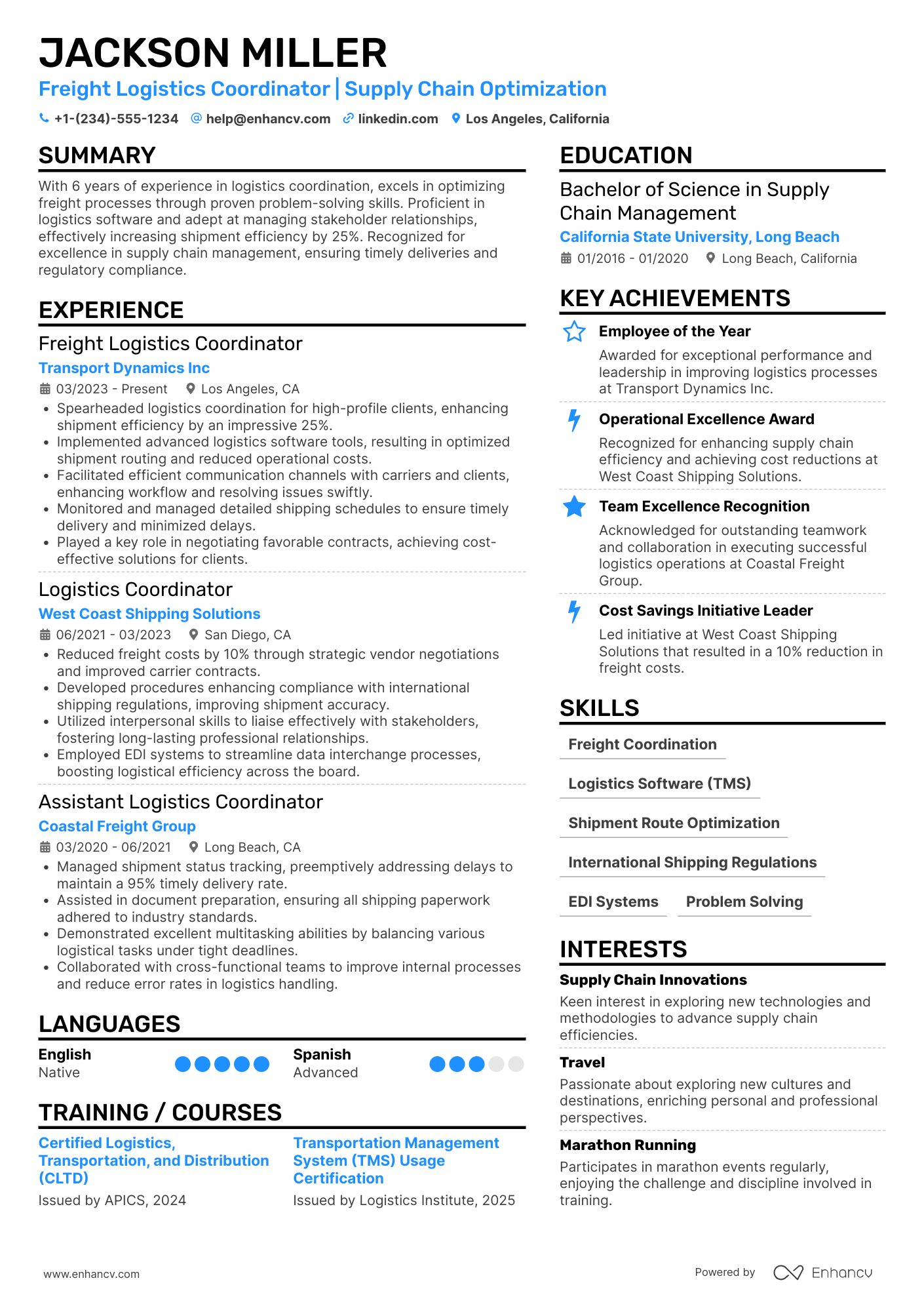
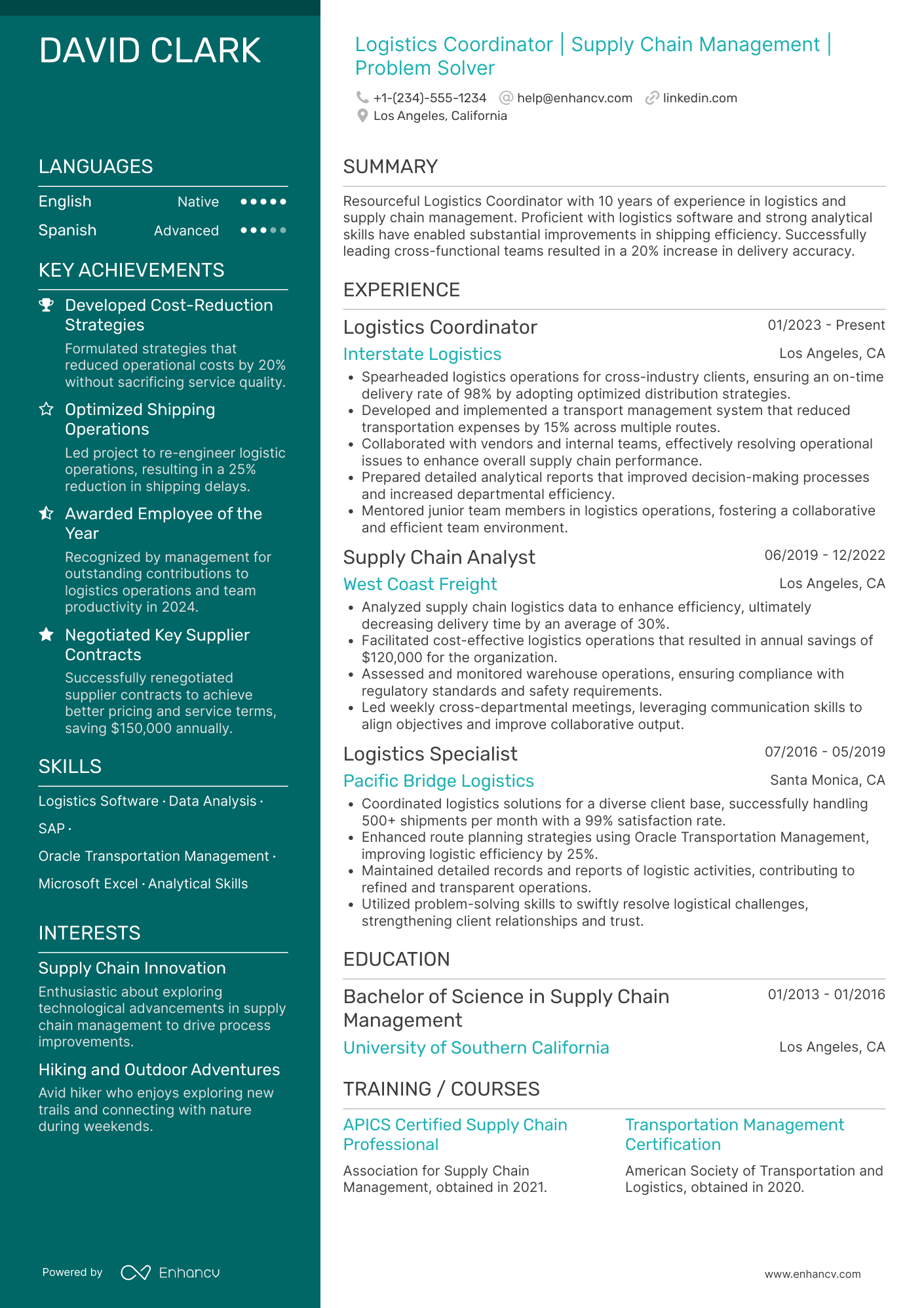
Most logistics coordinator resume submissions fail because they don't translate daily coordination into measurable service levels and cost control. That gap gets you filtered by ATS screening and missed in rapid recruiter scans in a crowded market.
A tight resume earns the interview; the operations lead reading next still wants context on how you handle exceptions, which is what our logistics coordinator cover letter examples show you how to convey before the call.
A strong resume shows the business results you drive, not just the systems you use. Knowing how to make your resume stand out means highlighting on-time delivery gains, fewer expedite shipments, lower freight spend, cleaner inventory counts, reduced dock-to-stock time, and fewer claims or chargebacks.

Key takeaways
- Quantify logistics achievements with metrics like on-time delivery rates, freight savings, and error reductions.
- Use reverse-chronological format for experienced coordinators and hybrid format for career changers.
- Tailor every resume to mirror the job posting's tools, KPIs, and terminology.
- Demonstrate skills through outcome-driven experience bullets, not isolated keyword lists.
- Place certifications above education when they're recent or required for the target role.
- Write a cover letter when it adds context about team fit or non-obvious experience.
- Use Enhancv to turn routine logistics duties into measurable, recruiter-ready resume bullets.
Job market snapshot for logistics coordinators
We analyzed 330 recent logistics coordinator job ads across major US job boards. These numbers help you understand top companies hiring, regional hotspots, role specialization trends at a glance.
What level of experience employers are looking for logistics coordinators
| Years of Experience | Percentage found in job ads |
|---|---|
| 1–2 years | 22.1% (73) |
| 3–4 years | 11.2% (37) |
| 5–6 years | 4.8% (16) |
| 7–8 years | 0.3% (1) |
| 10+ years | 1.8% (6) |
| Not specified | 59.4% (196) |
Logistics coordinator ads by area of specialization (industry)
| Industry (Area) | Percentage found in job ads |
|---|---|
| Finance & Banking | 41.2% (136) |
| Healthcare | 20.6% (68) |
| Education | 15.2% (50) |
| Manufacturing | 9.1% (30) |
| Government | 3.9% (13) |
| Retail & E-commerce | 3.6% (12) |
Top companies hiring logistics coordinators
| Company | Percentage found in job ads |
|---|---|
| CR England, Inc. | 7.3% (24) |
| DSV Road Transport | 4.5% (15) |
| NFI Industries | 3.6% (12) |
Role overview stats
These tables show the most common responsibilities and employment types for logistics coordinator roles. Use them to align your resume with what employers expect and to understand how the role is structured across the market.
Day-to-day activities and top responsibilities for a logistics coordinator
| Responsibility | Percentage found in job ads |
|---|---|
| Excel | 30.0% (99) |
| Microsoft office | 29.7% (98) |
| Logistics | 13.0% (43) |
| Ms office | 12.4% (41) |
| Word | 12.4% (41) |
| Sap | 11.8% (39) |
| Microsoft excel | 9.4% (31) |
| Erp | 8.8% (29) |
| Inventory management | 8.5% (28) |
| Data entry | 7.9% (26) |
| Microsoft word | 7.3% (24) |
| Forklift | 6.4% (21) |
How to format a logistics coordinator resume
Recruiters evaluating logistics coordinator resumes prioritize operational efficiency, supply chain knowledge, and the ability to manage shipments, vendors, and inventory systems under tight deadlines. A clean, well-structured resume format ensures these signals surface quickly during both ATS parsing and the initial six-to-ten-second recruiter scan.

I have significant experience in this role—which format should I use?
Use a reverse-chronological format to lead with your most recent and relevant logistics coordination experience. Do:
- Highlight the scope and ownership of your coordination responsibilities, including the volume of shipments, number of vendor relationships, or size of the warehouse operations you managed.
- Feature role-specific tools and domains—such as TMS (transportation management system) platforms, ERP software like SAP or Oracle, freight classification, customs documentation, and inventory management systems.
- Quantify outcomes tied to cost savings, on-time delivery rates, error reduction, or process improvements you directly influenced.
I'm junior or switching into this role—what format works best?
A hybrid format works best because it lets you lead with transferable logistics skills while still providing a concise work history that shows professional context. Do:
- Place a skills section near the top of your resume featuring supply chain terminology, software proficiency, and relevant certifications such as APICS or OSHA training.
- Include projects, internships, or transitional experience that demonstrate coordination ability—such as managing inventory counts, scheduling deliveries, or streamlining a warehouse process.
- Connect every action to a clear result so recruiters see the practical impact of your skills, not just a list of duties.
Why not use a functional resume?
A functional format strips away the timeline and context recruiters need to evaluate how your logistics skills were applied in real operational settings, making it harder to verify your coordination experience and weakening your candidacy.
- A functional resume may be acceptable if you're entering logistics coordination from an adjacent field (such as retail operations or warehouse labor), have limited formal work history, or are addressing a significant resume gap—but only if every listed skill is tied to a specific project, task, or measurable outcome rather than presented in isolation.
Once your layout and formatting choices are in place, the next step is deciding which sections to include so each one works within that structure.
What sections should go on a logistics coordinator resume
Recruiters expect to see clear proof you can coordinate shipments, carriers, and inventory while keeping costs, timelines, and service levels on track. Understanding what to put on a resume for this role is essential for meeting those expectations.
Use this structure for maximum clarity:
- Header
- Summary
- Experience
- Skills
- Projects
- Education
- Certifications
- Optional sections: Awards, Languages, Volunteering
Strong experience bullets should emphasize measurable impact, on-time delivery performance, cost savings, issue resolution, and the shipment volume, lanes, and stakeholders you supported.
Is your resume good enough?
Drop your resume here or choose a file. PDF & DOCX only. Max 2MB file size.
Once you’ve organized your resume with the right components, the next step is to write your logistics coordinator experience section so each role supports and strengthens that structure.
How to write your logistics coordinator resume experience
The experience section is where you prove you can move goods, manage supply chain workflows, and deliver measurable results using role-relevant tools and methods. Hiring managers prioritize demonstrated impact—shipments delivered on time, costs reduced, processes streamlined—over descriptive task lists that simply restate a job description.
Each entry should include:
- Job title
- Company and location (or remote)
- Dates of employment (month and year)
Three to five concise bullet points showing what you owned, how you executed, and what outcomes you delivered:
- Ownership scope: the shipments, freight lanes, warehouse operations, carrier relationships, or inventory categories you were directly accountable for as a logistics coordinator.
- Execution approach: the transportation management systems, enterprise resource planning platforms, routing software, demand forecasting methods, or compliance frameworks you used to plan, track, and optimize logistics operations.
- Value improved: the changes you drove in delivery performance, freight cost efficiency, order accuracy, warehouse throughput, carrier reliability, or supply chain risk reduction.
- Collaboration context: how you coordinated with procurement teams, warehouse staff, third-party carriers, customs brokers, sales departments, or vendor partners to keep goods flowing and resolve disruptions.
- Impact delivered: the outcomes you produced expressed through shipment volume, cost savings, on-time delivery improvements, lead time reductions, or service-level gains rather than routine activity descriptions.
Experience bullet formula
A logistics coordinator experience example
✅ Right example - modern, quantified, specific.
Logistics Coordinator
BlueRiver Home Goods | Columbus, OH
2022–Present
Coordinated inbound and outbound freight for a multi-warehouse ecommerce operation shipping 2,500–3,500 orders per day.
- Optimized carrier mix and routing in a transportation management system (TMS) using lane-cost analysis, cutting freight spend by 11% and improving on-time delivery from 92% to 97% in six months.
- Implemented barcode scanning and advanced shipping notices in NetSuite and a warehouse management system (WMS), reducing mis-shipments by 38% and chargebacks by $120K annually.
- Built Power BI dashboards from enterprise resource planning (ERP) and TMS data to track dwell time, tender rejections, and accessorials, saving eight hours per week in manual reporting for operations and finance.
- Negotiated service-level agreements with three regional carriers and standardized dock appointment scheduling, decreasing average detention from 1.6 hours to 0.9 hours and improving trailer turn time by 24%.
- Led weekly cross-functional reviews with warehouse leads, customer support, and key accounts to resolve exceptions, cutting open shipment escalations by 33% and improving customer satisfaction score by 0.4 points.
Now that you've seen how a strong experience section looks in practice, let's break down how to customize yours for each specific job posting.
How to tailor your logistics coordinator resume experience
Recruiters evaluate logistics coordinator resumes through both human review and applicant tracking systems, so tailoring your resume to the job description increases your chances of advancing. Tailoring means adjusting how you present your background to reflect the specific language and priorities each employer highlights.
Ways to tailor your logistics coordinator experience:
- Match warehouse management or TMS platforms named in the posting.
- Mirror the exact shipping and freight terminology the employer uses.
- Reflect KPIs like on-time delivery or order accuracy rates.
- Highlight experience with relevant compliance or customs regulations.
- Include industry-specific logistics knowledge such as cold chain or hazmat.
- Emphasize cross-functional coordination with procurement or operations teams.
- Reference inventory control methods or demand planning frameworks mentioned.
- Align your experience with cited carrier management or vendor workflows.
Tailoring means framing your real accomplishments to match what the employer values rather than forcing keywords where they don't belong.
Resume tailoring examples for logistics coordinator
| Job description excerpt | Untailored | Tailored |
|---|---|---|
| "Coordinate inbound and outbound shipments using SAP TM, ensuring on-time delivery across 12 regional distribution centers." | Helped manage shipping and receiving operations for the company. | Coordinated 150+ weekly inbound and outbound shipments across 12 regional distribution centers using SAP TM, maintaining a 97.3% on-time delivery rate. |
| "Monitor carrier performance metrics, resolve freight discrepancies, and negotiate rate agreements with third-party logistics providers." | Worked with vendors and tracked logistics performance. | Tracked carrier KPIs for eight 3PL providers, resolved an average of 40 freight discrepancies per month, and renegotiated rate agreements that reduced annual transportation costs by $180K. |
| "Manage inventory replenishment cycles in coordination with warehouse teams, using demand forecasting data to prevent stockouts and overstock conditions." | Assisted with inventory tasks and communicated with warehouse staff. | Led weekly inventory replenishment cycles for 3,200 SKUs by translating demand forecasting data into reorder schedules, cutting stockouts by 34% and reducing overstock carrying costs by 18% within one fiscal year. |
Once you’ve aligned your experience with the role’s priorities, the next step is to quantify your logistics coordinator achievements to show the impact of that work.
How to quantify your logistics coordinator achievements
Quantifying your achievements proves you improved speed, accuracy, cost, and reliability. Focus on shipment volume, on-time delivery, freight spend, documentation errors, and compliance outcomes across carriers, warehouses, and systems.
Quantifying examples for logistics coordinator
| Metric | Example |
|---|---|
| On-time delivery | "Improved on-time delivery from 92% to 97% in six months by tightening carrier cutoffs, using TMS alerts, and standardizing dock schedules." |
| Cost savings | "Reduced monthly freight spend by $18,000 by consolidating LTL shipments, renegotiating accessorial fees, and auditing invoices in SAP." |
| Cycle time | "Cut order-to-ship cycle time from 36 hours to 22 hours by revising pick waves and coordinating labor plans with the warehouse supervisor." |
| Documentation accuracy | "Lowered bill of lading and customs document error rate from 3.1% to 0.8% by adding checklists and validation in Excel templates." |
| Compliance risk | "Passed three consecutive DOT and hazmat audits with zero findings by maintaining training logs, SDS files, and incident reports in SharePoint." |
Turn vague job duties into measurable, recruiter-ready resume bullets in seconds with Enhancv's Bullet Point Generator.
Once you've crafted strong bullet points that highlight your achievements, the next step is ensuring your resume also showcases the right mix of hard and soft skills employers expect from a logistics coordinator.
How to list your hard and soft skills on a logistics coordinator resume
Your skills section shows how you manage freight, inventory, and carriers day to day, and recruiters and an ATS (applicant tracking system) scan this section to confirm job-fit keywords—aim for a balanced mix of role-specific hard skills and execution-focused soft skills. logistics coordinator roles require a blend of:
- Product strategy and discovery skills.
- Data, analytics, and experimentation skills.
- Delivery, execution, and go-to-market discipline.
- Soft skills.
Your skills section should be:
- Scannable (bullet-style grouping).
- Relevant to the job post.
- Backed by proof in experience bullets.
- Updated with current tools.
Place your skills section:
- Above experience if you're junior or switching careers.
- Below experience if you're mid/senior with strong achievements.

Hard skills
- Transportation management systems
- Warehouse management systems
- Enterprise resource planning systems
- Freight quoting and rate negotiation
- Carrier onboarding and compliance
- Bills of lading, packing lists
- Customs documentation, incoterms
- Shipment tracking and exception management
- Inventory reconciliation and cycle counts
- Route planning and load optimization
- Microsoft Excel, pivot tables, VLOOKUP
- KPI reporting, on-time delivery
Soft skills
- Prioritize shipments under deadlines
- Coordinate across sales and warehouse
- Communicate delays and recovery plans
- Escalate issues with clear context
- Negotiate service levels with carriers
- Document processes and handoffs
- Maintain high-detail order accuracy
- Resolve exceptions with urgency
- Manage multiple shipments in parallel
- Collaborate with procurement and finance
- Follow up until closure and confirmation
- Make risk-based tradeoffs quickly
How to show your logistics coordinator skills in context
Skills shouldn't live only in a dedicated skills list. Explore resume skills examples to see how logistics coordinators present their abilities effectively.
They should be demonstrated in:
- Your summary (high-level professional identity)
- Your experience (proof through outcomes)
Here's what strong, skill-rich entries look like in practice.
Summary example
Logistics coordinator with eight years in cold-chain pharmaceutical distribution. Skilled in SAP TM, carrier negotiation, and cross-functional scheduling. Reduced average shipment delays by 32% while managing 200+ weekly outbound loads across regional fulfillment centers.
- Reflects senior-level experience clearly
- Names industry-specific tools immediately
- Quantifies a meaningful operational outcome
- Signals collaboration and leadership ability
Experience example
Logistics Coordinator
Redline Distribution Group | Charlotte, NC
June 2019–March 2024
- Coordinated with warehouse and procurement teams using Oracle TMS to consolidate shipments, cutting freight costs by 18% annually.
- Redesigned carrier evaluation scorecards with the operations manager, improving on-time delivery rates from 87% to 96%.
- Streamlined customs documentation workflows for cross-border shipments, reducing border clearance delays by an average of 1.4 days.
- Every bullet contains measurable proof
- Skills surface naturally through real outcomes
Once you’ve demonstrated your logistics coordinator strengths through specific, results-focused examples, the next step is applying that same approach to a logistics coordinator resume with no experience by highlighting transferable achievements.
How do I write a logistics coordinator resume with no experience
Even without full-time experience, you can demonstrate readiness through:
- Warehouse picking, packing, and staging
- Retail inventory counts and cycle audits
- Shipping labels and carrier pickups
- Student supply chain capstone project
- Volunteer donation sorting and routing
- ERP data entry for orders
- Excel shipment tracker and dashboards
- Customer order status updates
If you're building a resume without work experience, focus on:
- Order accuracy and error rates
- Inventory control and reconciliation results
- Carrier coordination and on-time pickup
- System skills: Excel, ERP
Resume format tip for entry-level logistics coordinator
Use a combination resume format because it highlights logistics coordinator skills and projects first, while still showing steady work history and reliability. Do:
- Add a Skills section with Excel, ERP, and shipping documentation.
- Write bullets with numbers: orders, units, error rate, and turnaround time.
- Include projects that show order flow, inventory tracking, and carrier coordination.
- List tools used in each bullet: Excel, barcode scanners, or ERP.
- Match keywords from the logistics coordinator job posting.
- Built an Excel shipment tracker with status flags and daily pickup schedule, cutting missed pickups from four per week to one over six weeks.
Even without direct experience, your education section can demonstrate the foundational knowledge and relevant coursework that qualify you for a logistics coordinator role.
How to list your education on a logistics coordinator resume
Your education section helps hiring teams confirm you have the foundational knowledge needed. It validates your understanding of supply chain principles, business operations, and analytical skills relevant to the logistics coordinator role.
Include:
- Degree name
- Institution
- Location
- Graduation year
- Relevant coursework (for juniors or entry-level candidates)
- Honors & GPA (if 3.5 or higher)
Skip month and day details—list the graduation year only.
Here's a strong education entry tailored for a logistics coordinator resume.
Example education entry
Bachelor of Science in Supply Chain Management
Penn State University, University Park, PA
Graduated 2021
GPA: 3.7/4.0
- Relevant Coursework: Warehouse Operations, Transportation Management, Inventory Control, and Business Analytics
- Honors: Dean's List, Magna Cum Laude
How to list your certifications on a logistics coordinator resume
Certifications on a resume show a logistics coordinator's commitment to learning, proficiency with key tools, and relevance to industry standards, which helps employers trust your readiness for complex shipments.
Include:
- Certificate name
- Issuing organization
- Year
- Optional: credential ID or URL
- Put certifications below education when they're older, less relevant, or you want your degree to lead the section order.
- Put certifications above education when they're recent, highly relevant, or required for your target logistics coordinator role.
Best certifications for your logistics coordinator resume
Certified in Logistics, Transportation and Distribution (CLTD) Certified Supply Chain Professional (CSCP) Certified Professional in Supply Management (CPSM) International Air Transport Association (IATA) Dangerous Goods Regulations (DGR) FIATA Diploma in Freight Forwarding Customs Broker License
Once your credentials are clearly documented to reinforce your qualifications, you can use them to shape a focused logistics coordinator resume summary that highlights your value upfront.
How to write your logistics coordinator resume summary
Your resume summary is the first thing a recruiter reads. A strong one immediately connects your coordination skills and logistics experience to what the role demands.
Keep it to three to four lines, with:
- Your title and one to three years of relevant logistics experience.
- The domain you've worked in, such as warehousing, freight, or supply chain distribution.
- Core tools and skills like inventory management systems, ERP software, or shipment tracking platforms.
- One or two measurable wins, such as reducing shipping delays or cutting costs by a specific percentage.
- Soft skills tied to real outcomes, like cross-team communication that improved on-time delivery rates.

PRO TIP
At this level, emphasize specific tools you've used and tangible results from your daily coordination work. Recruiters want proof you can execute reliably. Avoid vague phrases like "passionate team player" or "motivated self-starter." Replace them with concrete skills and measurable contributions.
Example summary for a logistics coordinator
Logistics coordinator with two years of experience managing shipment scheduling and inventory tracking using SAP. Reduced order processing errors by 18% through improved vendor communication workflows.
Optimize your resume summary and objective for ATS
Drop your resume here or choose a file.
PDF & DOCX only. Max 2MB file size.
Now that your summary is ready to spotlight your qualifications, make sure the header above it presents your contact details correctly so recruiters can actually reach you.
What to include in a logistics coordinator resume header
A resume header is the top block with your key contact details, and it boosts visibility, credibility, and recruiter screening for a logistics coordinator.
Essential resume header elements
- Full name
- Tailored job title and headline
- Location
- Phone number
- Professional email
- GitHub link
- Portfolio link
A LinkedIn link helps recruiters verify experience fast and supports screening across roles, dates, and recommendations.
Do not include photos on a logistics coordinator resume unless the role is explicitly front-facing or appearance-dependent.
Match your header job title to the posting and mirror key logistics coordinator keywords to pass recruiter screening.
Example
Logistics coordinator resume header
Jordan Lee
Logistics coordinator | Inbound and outbound scheduling, carrier coordination, and inventory tracking
Chicago, IL
(312) 555-01XX
your.name@enhancv.com
github.com/yourname
yourwebsite.com
linkedin.com/in/yourname
Once your contact details and role information are clearly presented at the top, you can strengthen your application with additional sections that add relevant context and support your qualifications.
Additional sections for logistics coordinator resumes
When your core qualifications match other applicants, well-chosen additional sections can set your logistics coordinator resume apart with role-specific credibility. For example, listing language skills on your resume can be a strong differentiator for roles involving international shipping or cross-border coordination.
- Languages
- Certifications
- Professional affiliations
- Volunteer experience
- Publications
- Hobbies and interests
- Awards and honors
Once you've strengthened your resume with these supplementary sections, the next step is pairing it with a well-crafted cover letter to make your application even more competitive.
Do logistics coordinator resumes need a cover letter
A cover letter isn't required for a logistics coordinator, but it helps in competitive roles or when employers expect one. If you're unsure what a cover letter is or when to use one, it can make a difference when your resume needs context, or when you're targeting a specific team or operation.
Use a cover letter when it adds clear, role-specific value:
- Explain team fit by matching your experience to their shipping volume, carrier mix, warehouse setup, and service-level targets.
- Highlight one or two outcomes, such as reducing late shipments, improving on-time delivery, cutting freight costs, or speeding up order processing.
- Show you understand their product and customers by referencing delivery constraints, packaging needs, returns flow, or seasonal demand patterns.
- Address transitions or non-obvious experience by connecting prior roles to scheduling, vendor coordination, documentation, and issue resolution.
Drop your resume here or choose a file.
PDF & DOCX only. Max 2MB file size.
Once you’ve decided whether to include a cover letter, the next step is using AI to improve your logistics coordinator resume so it aligns with the role and highlights your strengths efficiently.
Using AI to improve your logistics coordinator resume
AI can sharpen your resume's clarity, structure, and overall impact. It helps refine bullet points, tighten language, and highlight measurable results. But overuse dulls authenticity. Once your content reads clearly and aligns with the role, step away from AI. If you're wondering which AI is best for writing resumes, the key is choosing tools that enhance your real experience rather than replace it.
Here are 10 practical prompts you can copy and paste to strengthen specific sections of your logistics coordinator resume:
Strengthen your summary
Quantify experience bullets
Tighten action verbs
Align skills section
Clarify project descriptions
Refine education entries
Improve certification relevance
Remove redundant phrasing
Tailor for specific postings
Enhance warehouse operations bullets
Conclusion
A strong logistics coordinator resume shows measurable outcomes, role-specific skills, and a clear structure. Highlight on-time delivery rates, cost savings, inventory accuracy, and process improvements. Use precise language, consistent formatting, and easy-to-scan sections.
Keep your logistics coordinator resume focused on what hiring teams need now and next. Show you can coordinate carriers, track shipments, resolve exceptions, and work across teams. When results and structure align, your resume signals readiness.