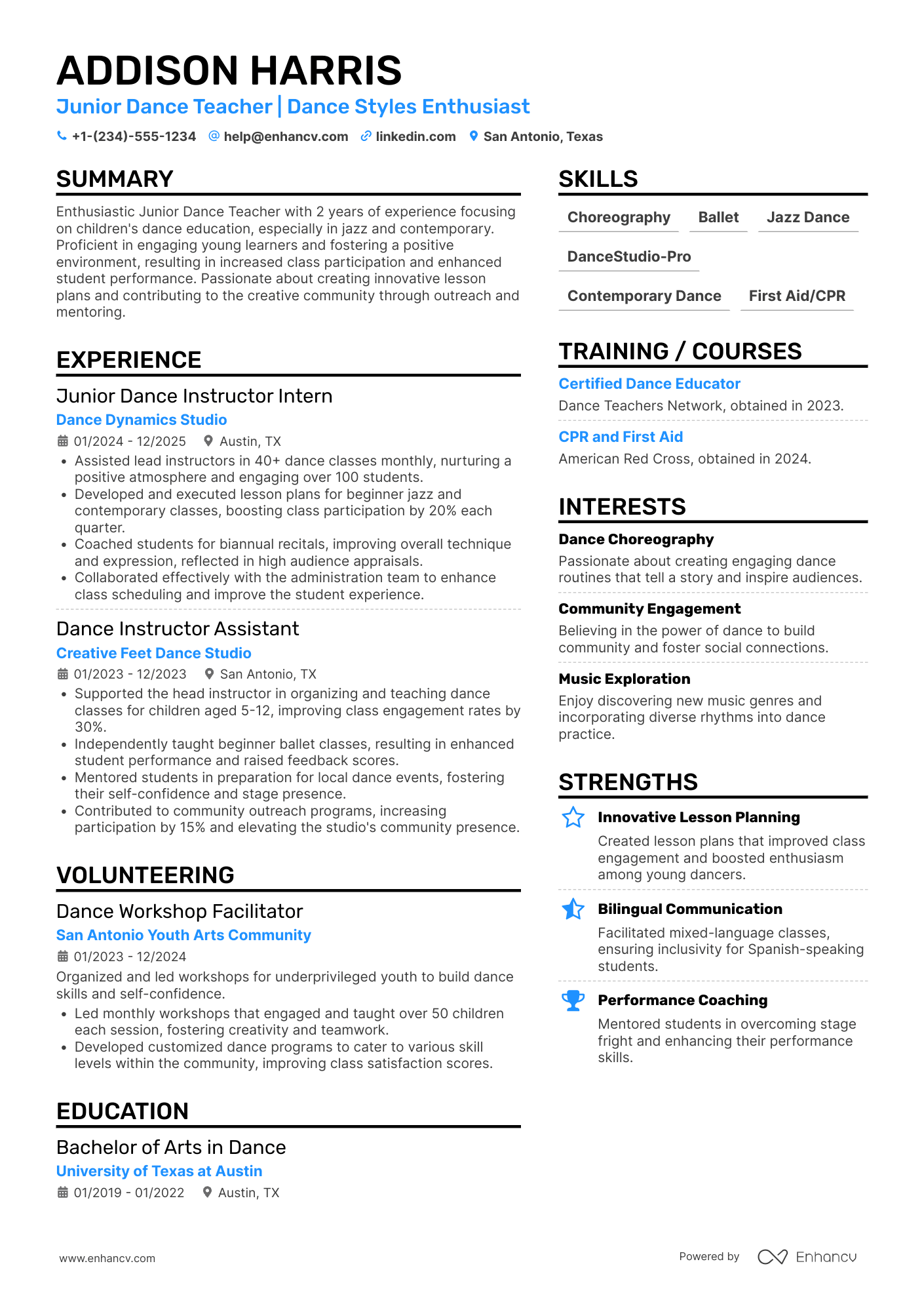
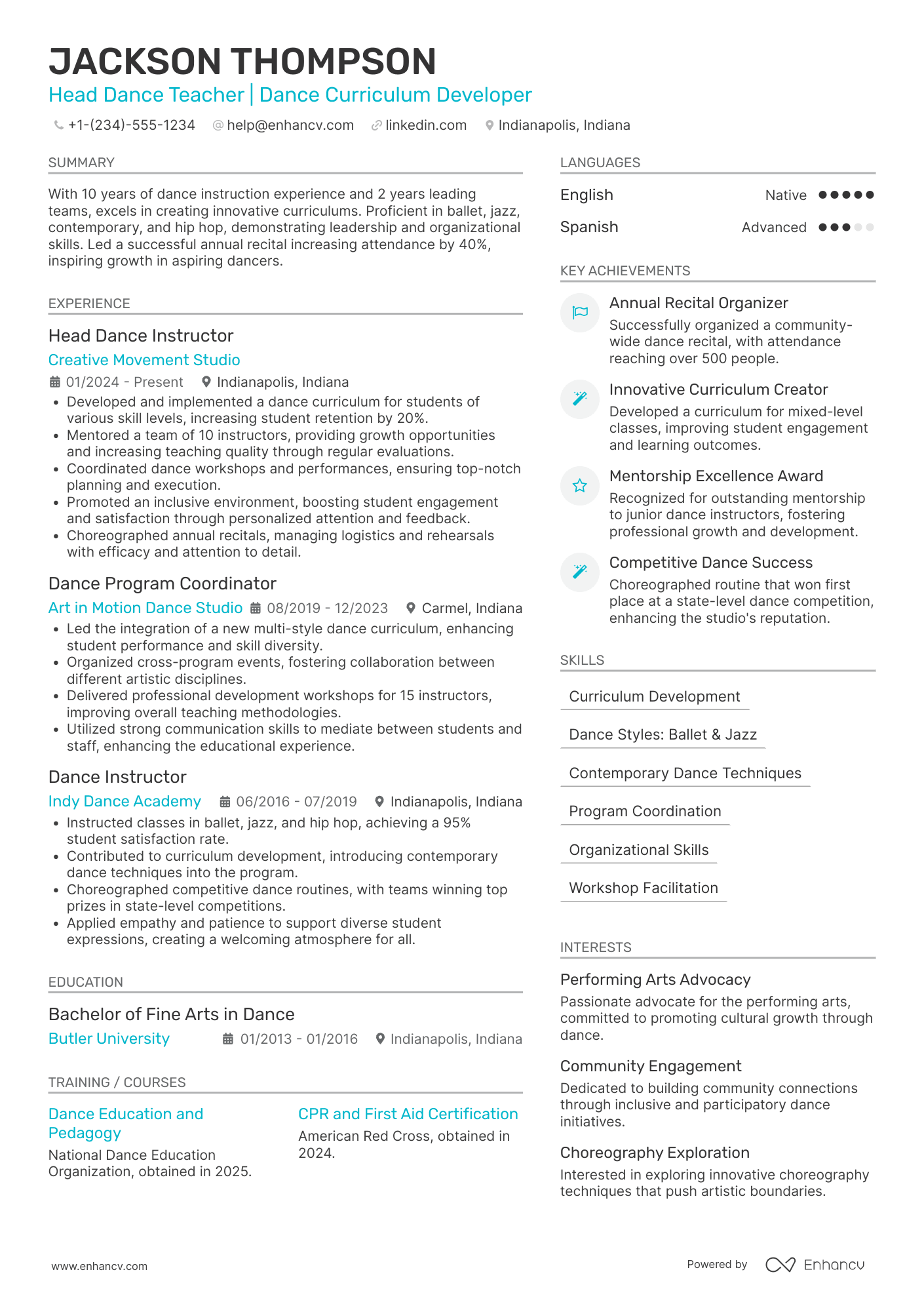
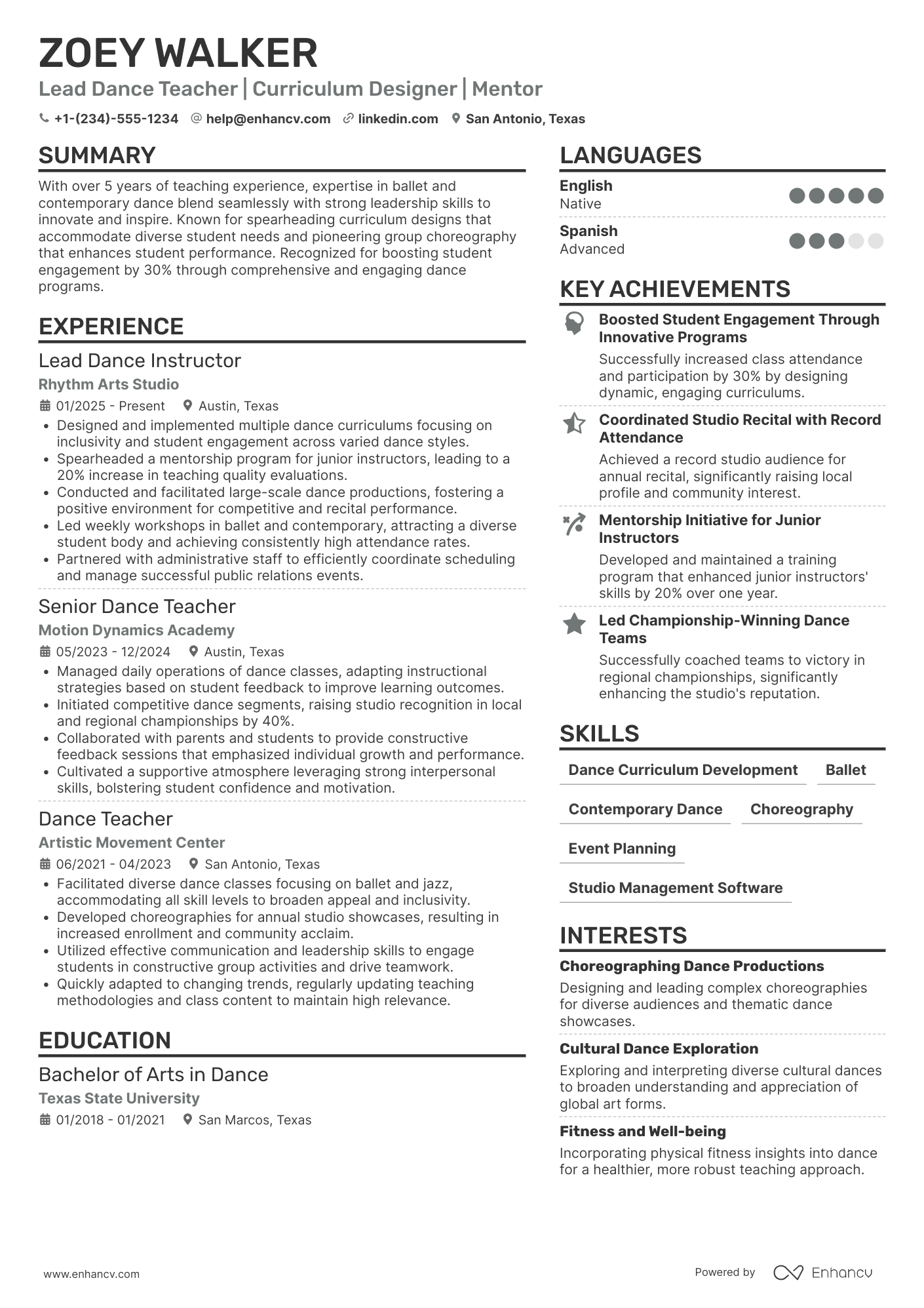
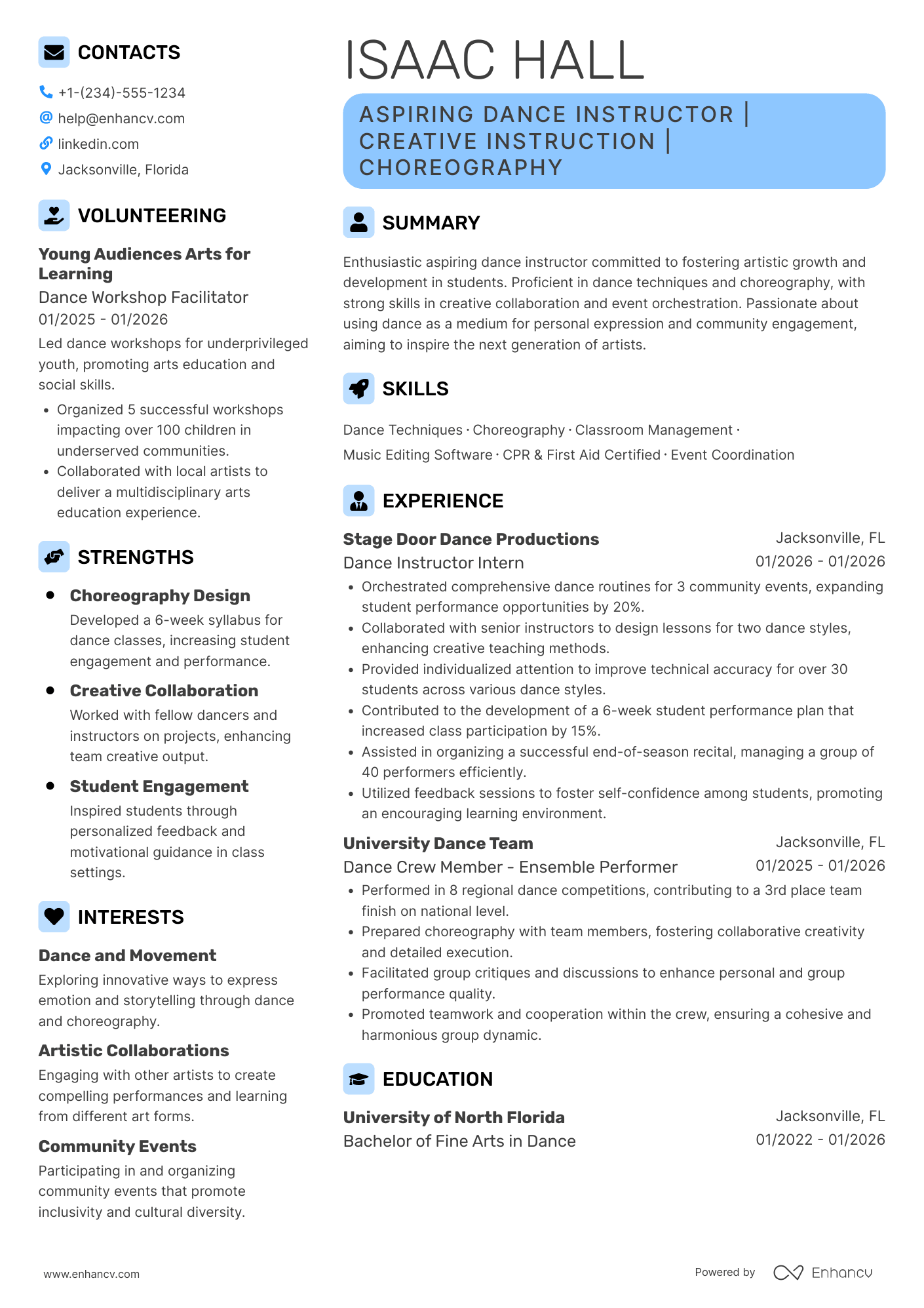
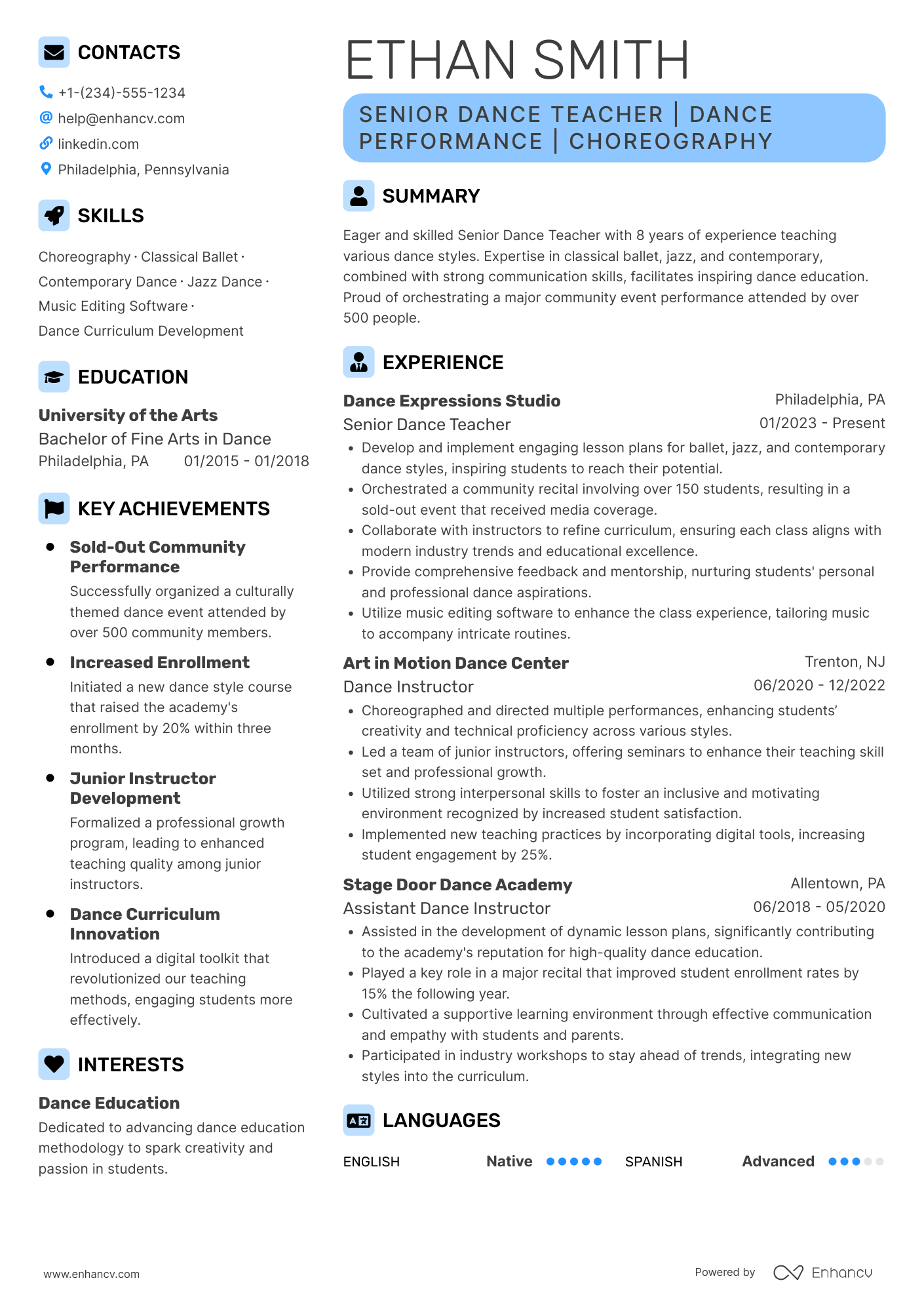
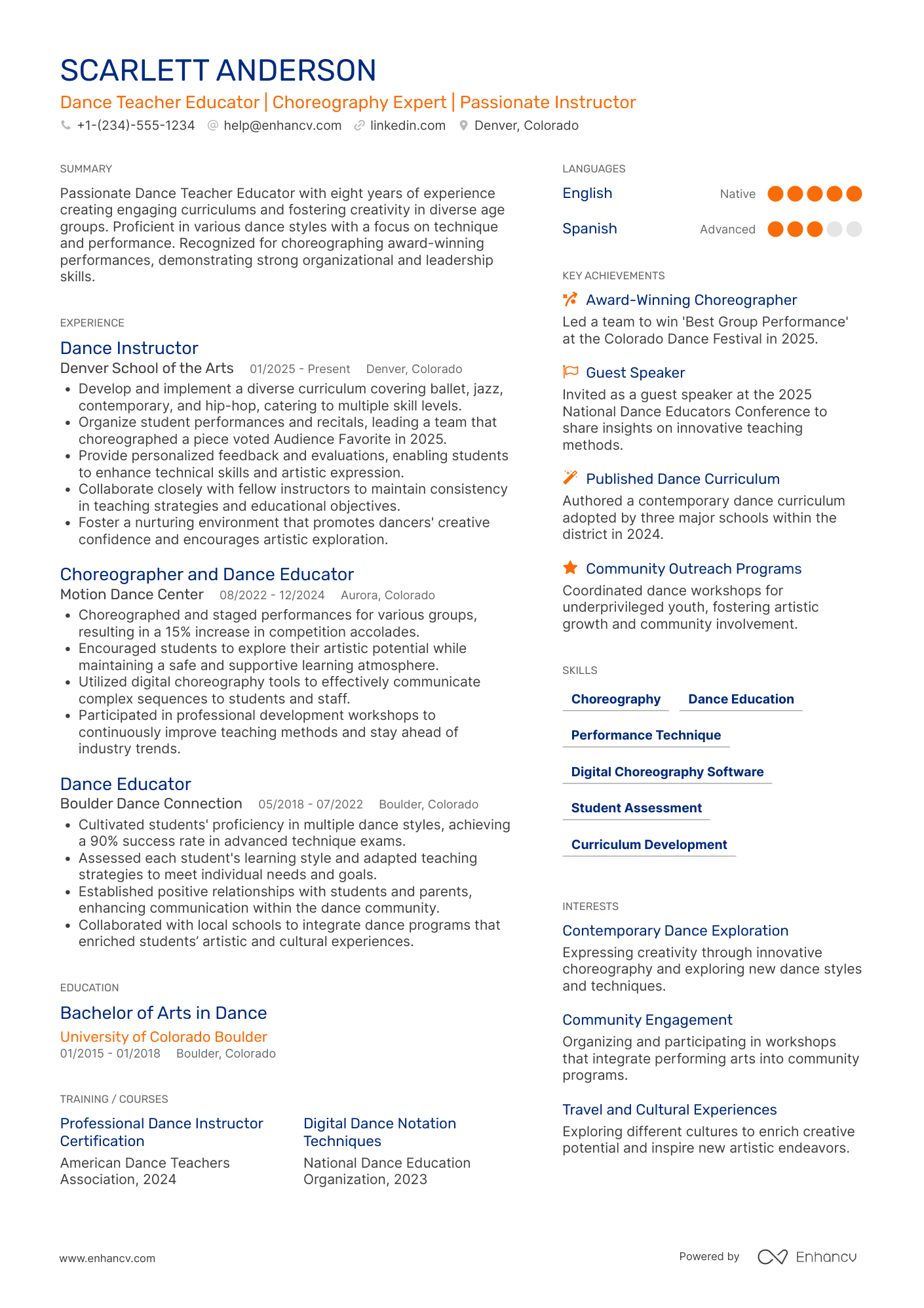
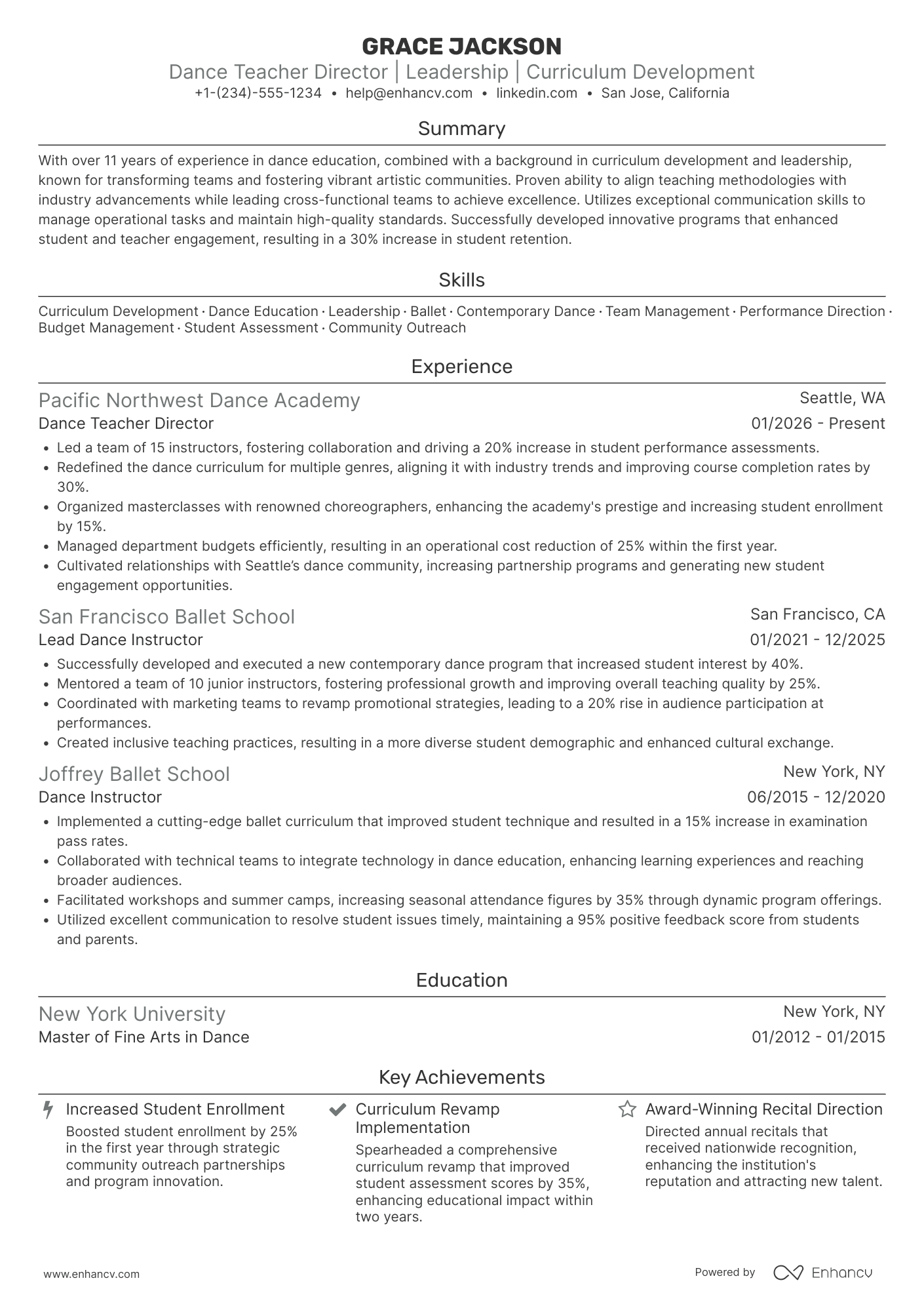
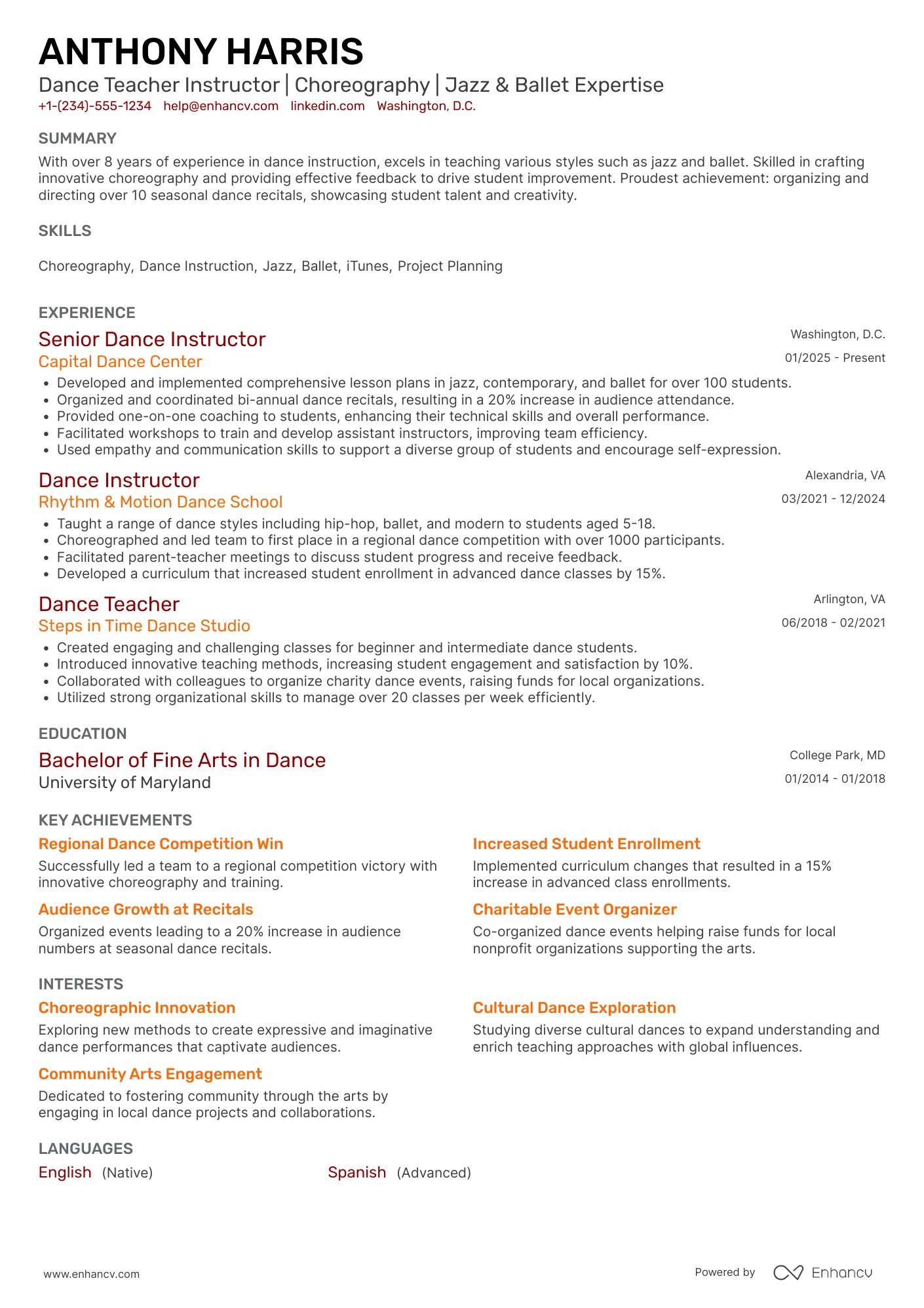
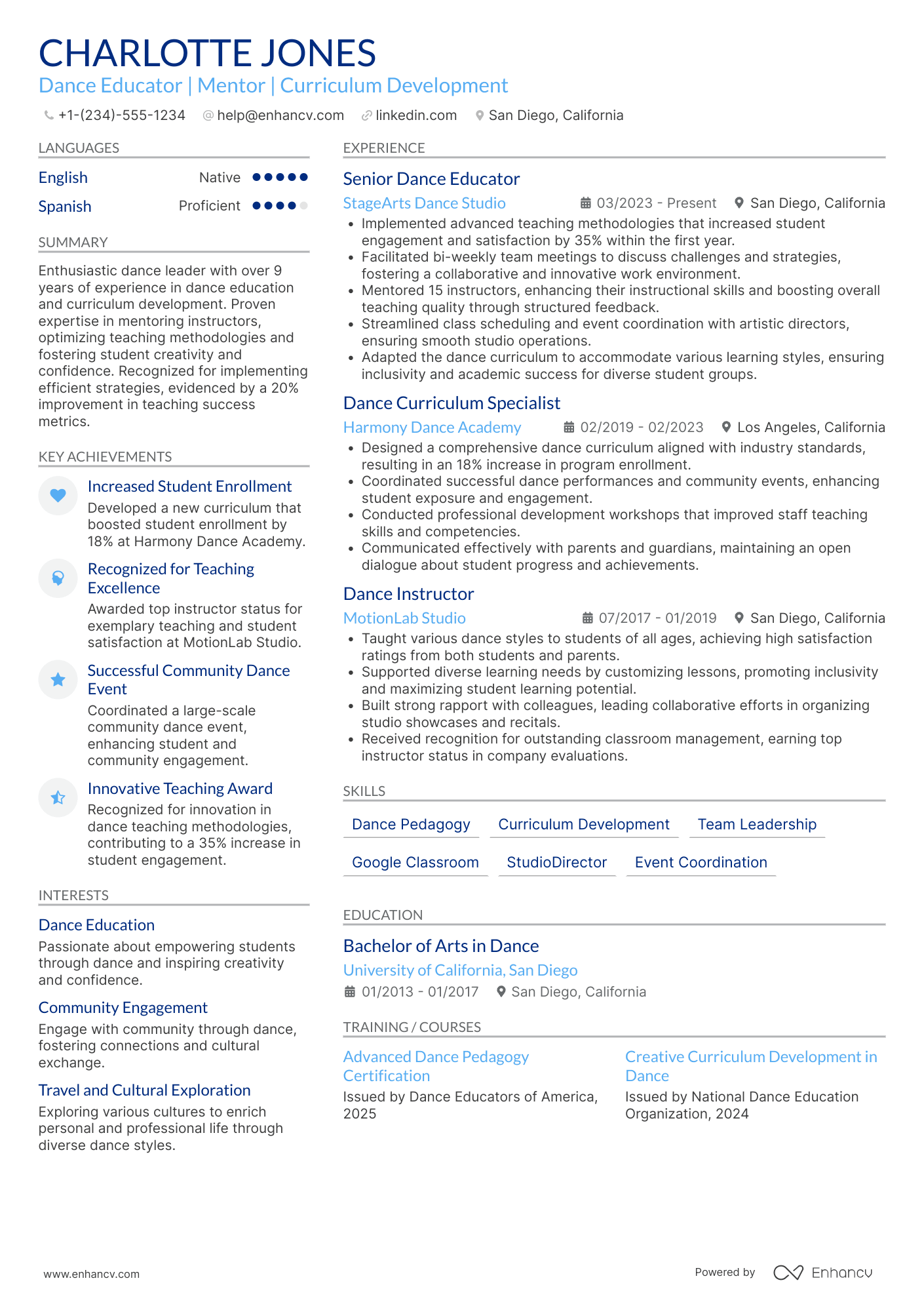
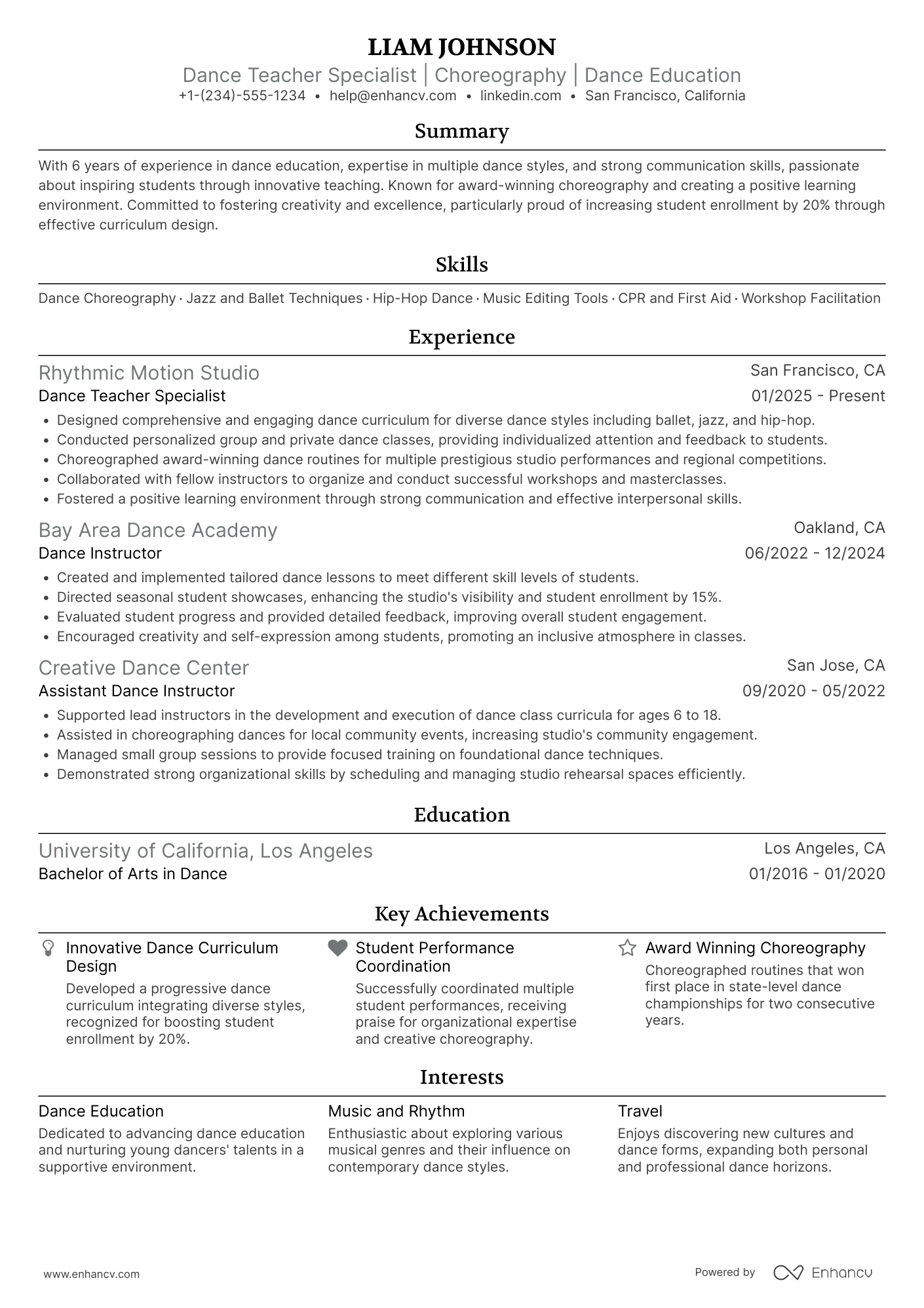
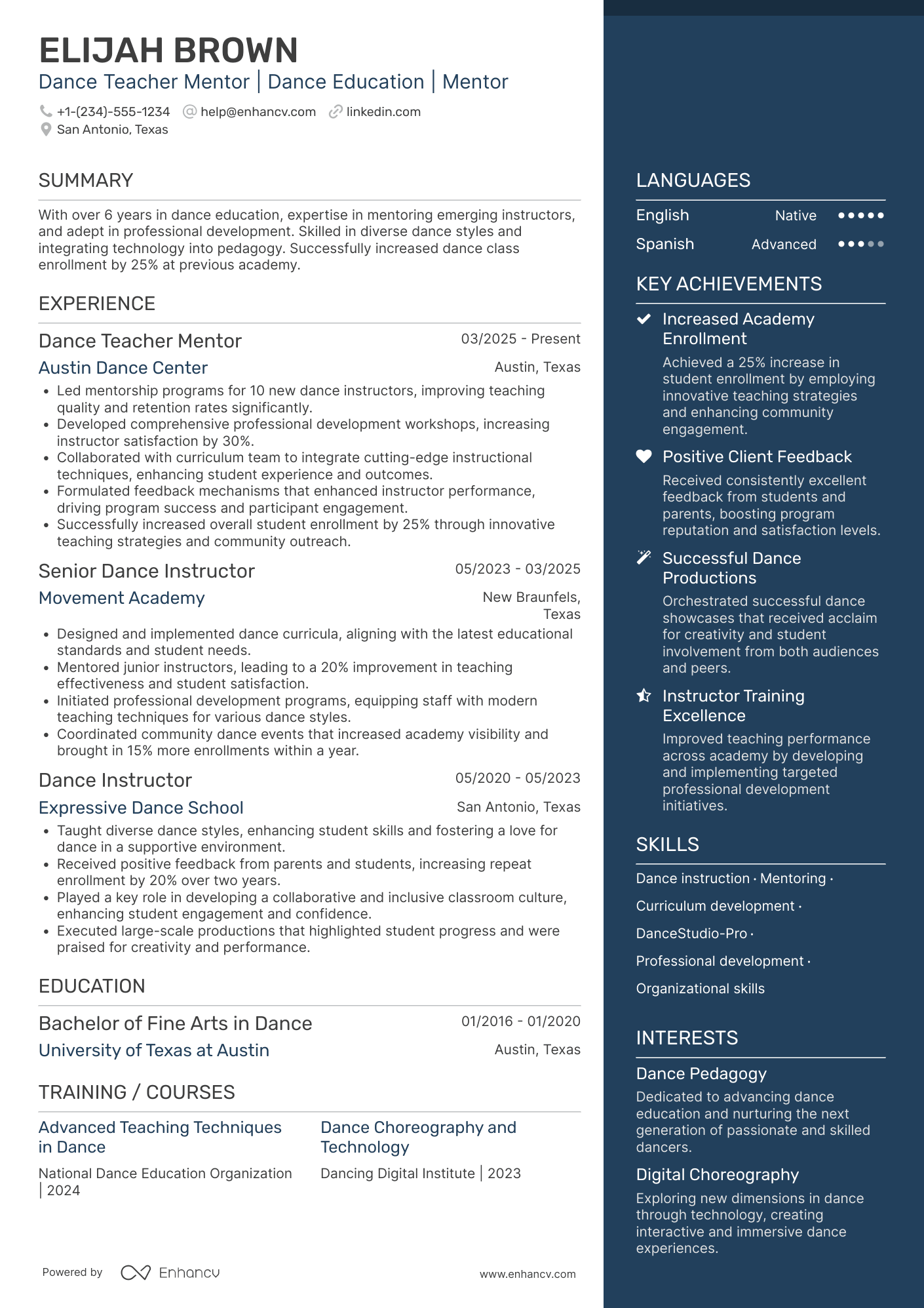
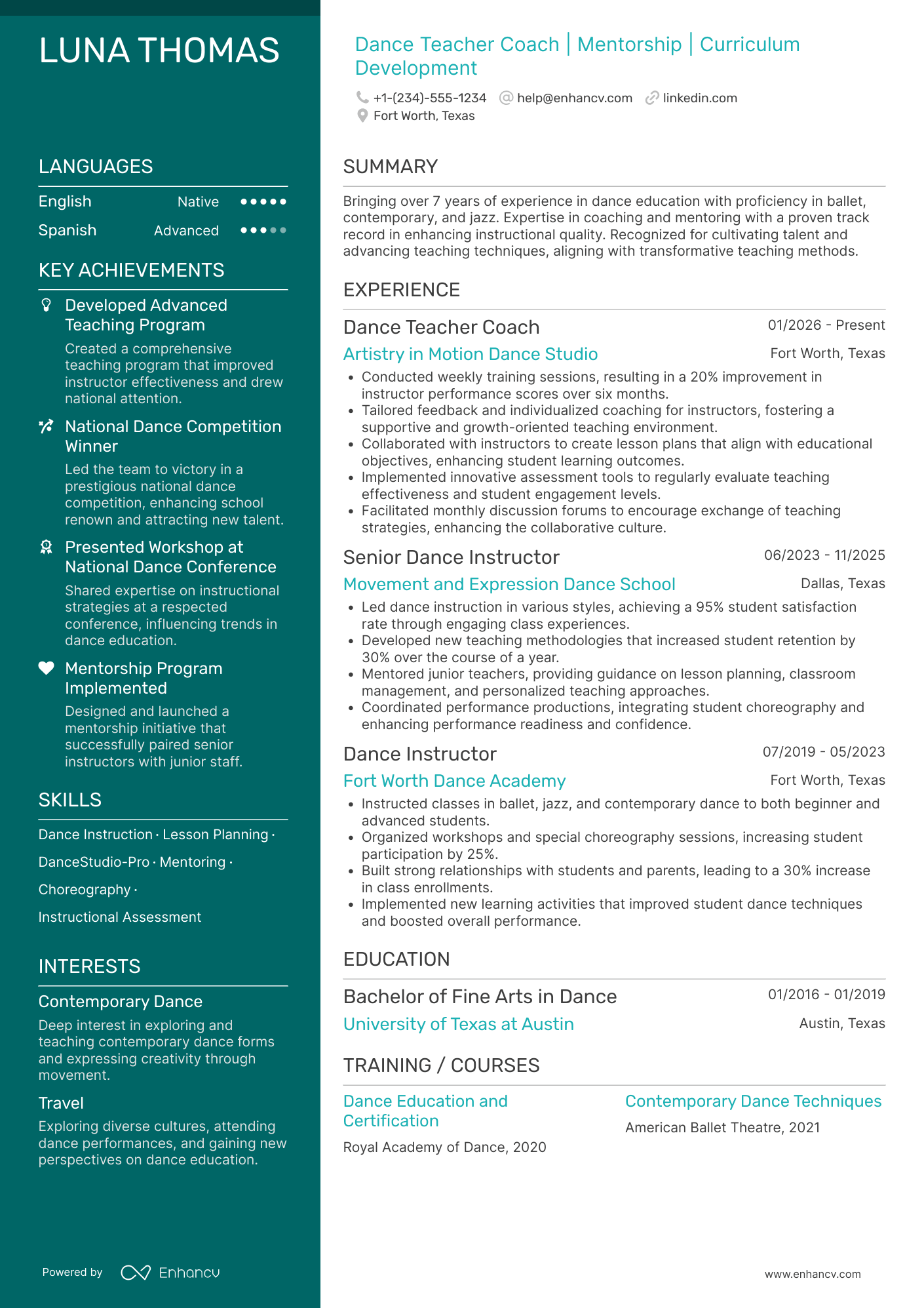
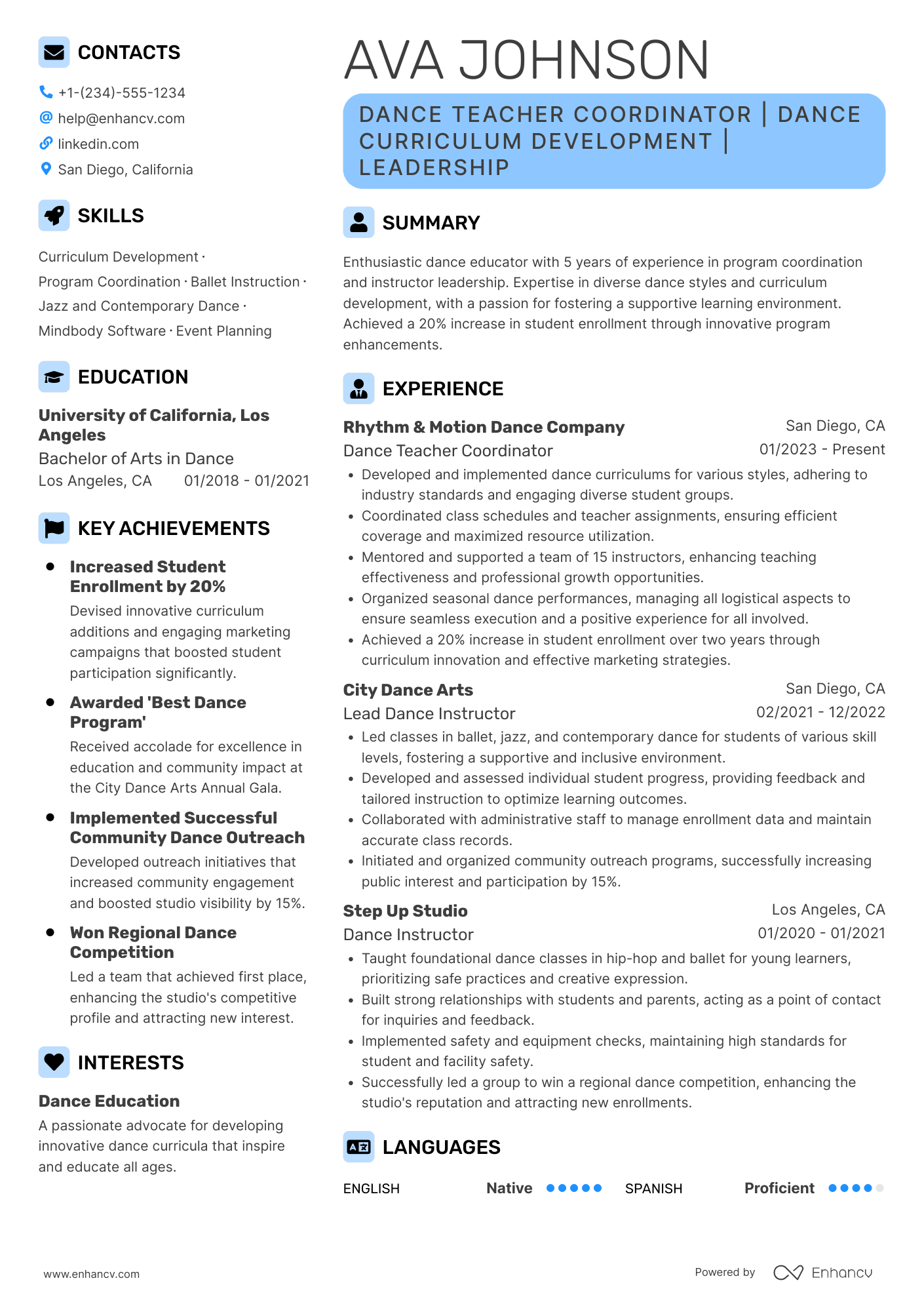
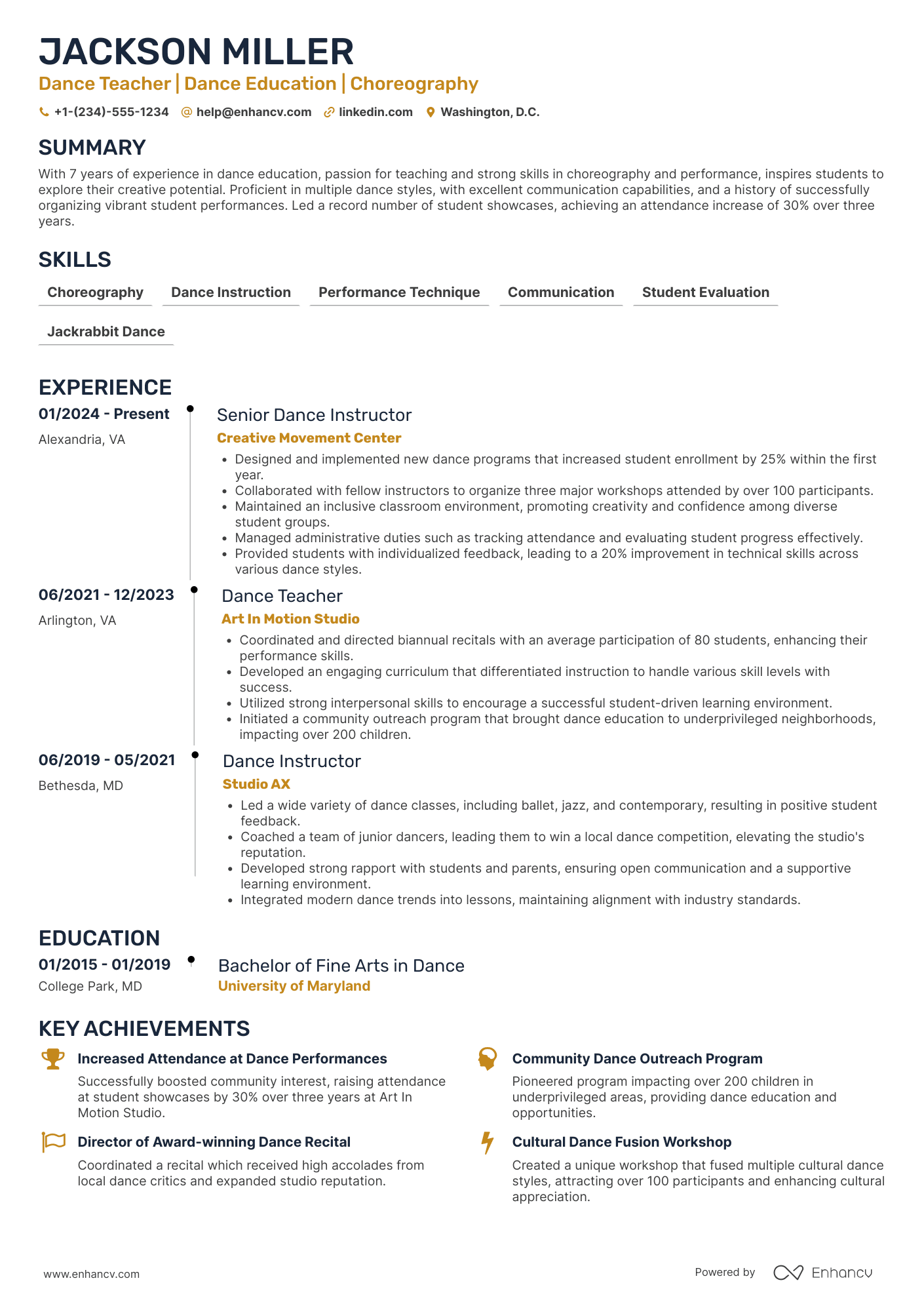
Many applications fail because the dance teacher resume reads like a class schedule, not evidence of student progress. That hurts in today's hiring flow, where applicant tracking system screening and fast recruiter scans filter out generic, duty-heavy summaries.
A strong resume shows what you improved and how you delivered it. Knowing how to make your resume stand out starts with highlighting retention gains, recital readiness timelines, competition placements, class sizes managed, measurable technique improvements, behavior and safety outcomes, and parent satisfaction scores. Show results across age groups and levels.

Key takeaways
- Quantify student outcomes like retention rates, recital results, and enrollment growth in every experience bullet.
- Use reverse-chronological format with teaching history; switch to hybrid only if you're entering the field.
- Tailor each resume to the job posting by mirroring its dance styles, age groups, and terminology.
- Place skills above experience when junior, and below experience when you have strong achievements.
- Demonstrate skills inside your summary and experience bullets—not only in a standalone list.
- List certifications with full credential names, issuing organizations, and years earned.
- Use Enhancv's tools to turn vague teaching duties into measurable, recruiter-ready resume bullets.
How to format a dance teacher resume
Recruiters hiring dance teachers prioritize teaching methodology, genre versatility, student development outcomes, and the ability to manage studio or program operations. A clean, well-structured resume format ensures these signals surface quickly during both human review and applicant tracking system (ATS) scans.

I have significant experience as a dance teacher—which format should I use?
Use a reverse-chronological format to showcase your teaching history, growing responsibilities, and measurable impact across studios or programs. Do:
- Lead with your most recent role and highlight scope—class sizes, age groups, genres taught, and any program or curriculum ownership.
- Feature role-specific skills such as choreography, injury prevention techniques, performance preparation, and learning management platforms like Jackrabbit Dance or DanceBiz.
- Quantify outcomes tied to student progress, retention, recital success, or program growth.
I'm junior or switching into a dance teacher role—what format works best?
A hybrid format works best, allowing you to lead with relevant skills and training while still providing a chronological work history that gives recruiters context. Do:
- Place a skills section near the top featuring genres (ballet, jazz, hip-hop, modern), certifications (ACE, NASM, Progressing Ballet Technique), and any teaching tools or studio management software you've used.
- Include projects and transitional experience such as assistant teaching roles, choreography for community performances, student teaching practicums, or workshop facilitation.
- Connect every action to a clear result so recruiters see your capacity for impact, not just participation.
Why not use a functional resume?
A functional resume strips away the timeline and teaching context that help recruiters evaluate your growth, consistency, and classroom management track record—making it harder to trust your qualifications for a role built on progressive skill development and student relationships. A functional format may make sense in a narrow set of circumstances:
- You're transitioning from professional dance performance into teaching and lack formal teaching titles but have extensive mentoring, workshop, or choreography experience.
- You have gaps in your work history due to injury recovery, touring, or caregiving but continued developing relevant skills through freelance instruction or certification programs.
- Edge-case use: A functional format is acceptable only if you're making a full career change into dance education—for example, moving from a corporate fitness role or professional performance career—and you anchor every listed skill to specific projects, workshops, or measurable student outcomes rather than presenting skills in isolation.
Now that you've established a clean, readable layout, it's time to fill each part of your resume with the right content.
What sections should go on a dance teacher resume
Recruiters expect a clean, role-focused resume that proves you can teach, choreograph, and improve student performance. Understanding which resume sections to include helps you organize your qualifications for maximum clarity.
Use this structure:
- Header
- Summary
- Experience
- Skills
- Projects
- Education
- Certifications
- Optional sections: Awards, Leadership, Languages
Your experience bullets should emphasize student outcomes, class sizes and levels taught, choreography results, retention gains, and measurable contributions to recitals, competitions, and studio growth.
Is your resume good enough?
Drop your resume here or choose a file. PDF & DOCX only. Max 2MB file size.
Once you’ve organized your resume with the right structure and supporting sections, you can focus on writing the experience section in a way that fits that format and clearly shows your impact.
How to write your dance teacher resume experience
The experience section of your dance teacher resume should highlight the classes you've led, the teaching methods you've applied, and the measurable progress your students have achieved. Hiring managers prioritize demonstrated impact—such as student retention, performance outcomes, and program growth—over descriptive task lists that simply catalog daily duties. Building a targeted resume ensures every bullet connects directly to what the role requires.
Each entry should include:
- Job title
- Company and location (or remote)
- Dates of employment (month and year)
Three to five concise bullet points showing what you owned, how you executed, and what outcomes you delivered:
- Ownership scope: the dance programs, class levels, age groups, curricula, or studio operations you were directly accountable for as a dance teacher.
- Execution approach: the teaching techniques, choreographic frameworks, assessment tools, or rehearsal methods you used to plan instruction, evaluate student progress, and deliver polished performances.
- Value improved: changes to student skill development, class retention, injury prevention, recital quality, or program accessibility that resulted from your work as a dance teacher.
- Collaboration context: how you coordinated with studio owners, fellow instructors, accompanists, costume designers, parents, or school administrators to support student growth and event production.
- Impact delivered: outcomes expressed through student advancement, enrollment growth, competition results, audience reach, or community engagement rather than a simple list of classes taught.
Experience bullet formula
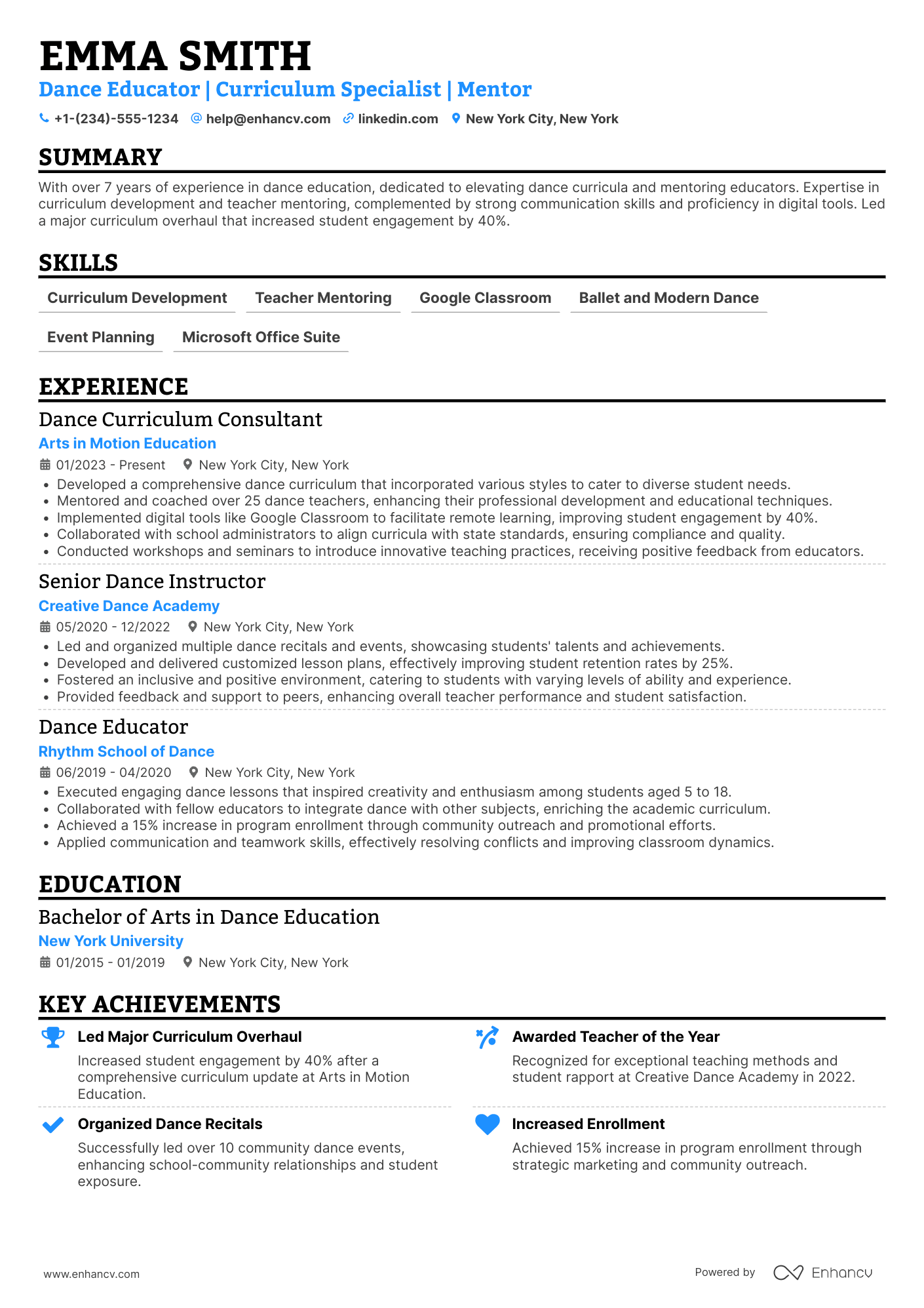
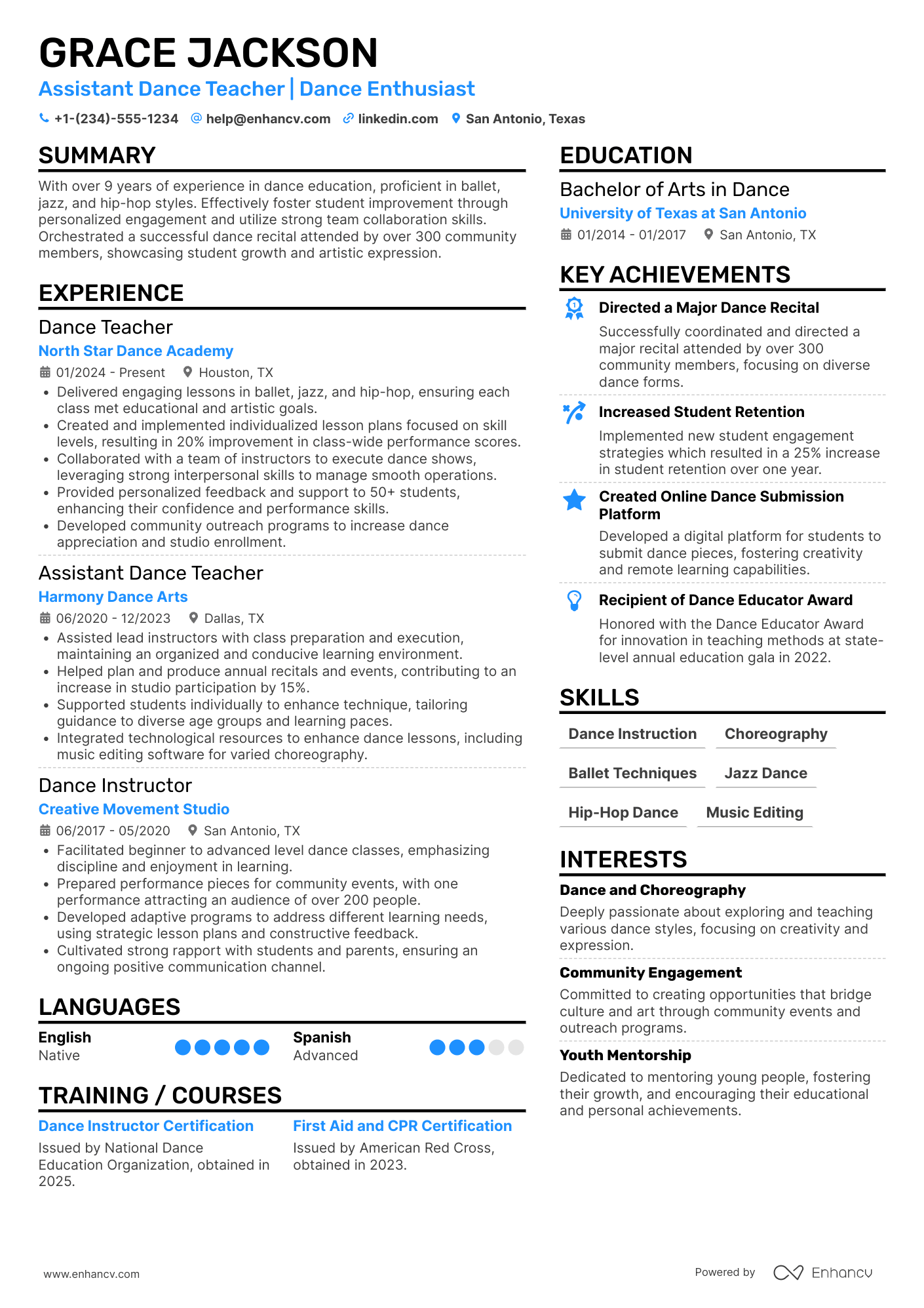
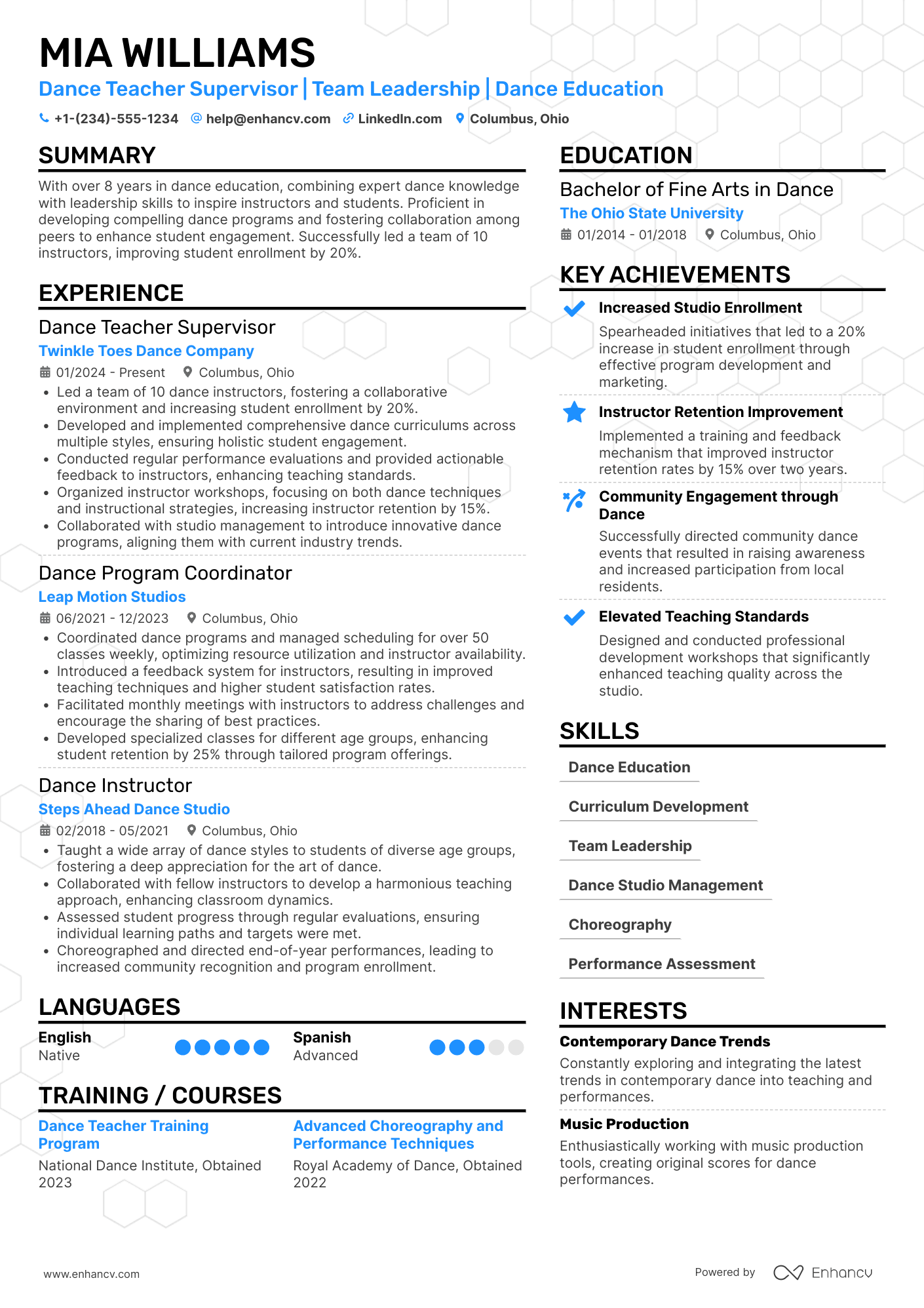
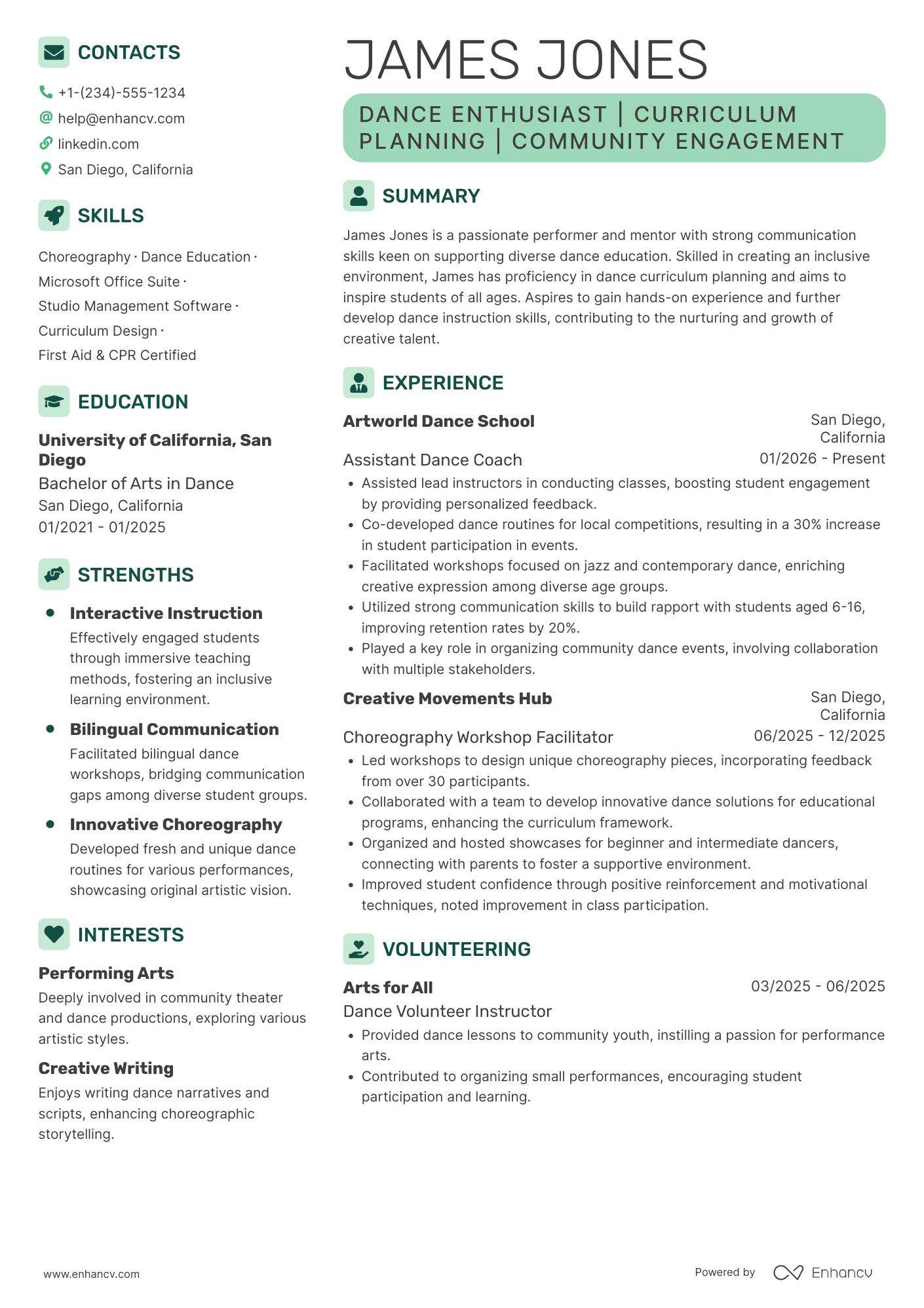
A dance teacher experience example
✅ Right example - modern, quantified, specific.
Dance Teacher (Contemporary & Ballet)
Pulse Studio | Austin, TX
2021–Present
Boutique studio serving 250+ active students with performance, competition, and recreational programs.
- Designed and delivered level-based contemporary and ballet curriculum using Google Workspace lesson plans and music editing in Audacity, improving student technique assessment scores by 22% across two semesters.
- Implemented video feedback workflows with Coach’s Eye and Google Drive folders, cutting correction turnaround time from five days to forty-eight hours and increasing class retention by 14%.
- Choreographed eight group pieces and two solos using countsheets in Notion and rehearsal tracking in Airtable, earning three top-three placements and boosting showcase ticket revenue by 18%.
- Coordinated scheduling, attendance, and billing in Mindbody, reducing no-shows by 11% through automated reminders and tightening waitlist fill time from three days to one day.
- Partnered with studio owner, costume vendors, and parents to manage production timelines and safety protocols, completing four showcases with zero reportable injuries and 95% on-time costume delivery.
Now that you've seen how a strong experience section looks in practice, let's break down how to customize yours for each specific job posting.
How to tailor your dance teacher resume experience
Recruiters evaluate your dance teacher resume through both human review and applicant tracking systems. Tailoring your resume to the job description ensures your qualifications align with what hiring committees prioritize.
Ways to tailor your dance teacher experience:
- Match the specific dance styles and techniques listed in the posting.
- Use the same terminology for curriculum frameworks or teaching methodologies.
- Mirror student performance benchmarks or assessment criteria the school references.
- Include experience with age groups or skill levels specified in the role.
- Highlight choreography or recital production work if the posting mentions it.
- Emphasize injury prevention and student safety practices when listed as priorities.
- Reference collaboration with arts departments or interdisciplinary teaching teams.
- Align your experience with adaptive or inclusive teaching approaches if noted.
Tailoring means connecting your real accomplishments to the role's stated requirements rather than forcing unrelated keywords into your experience section.
Resume tailoring examples for dance teacher
| Job description excerpt | Untailored | Tailored |
|---|---|---|
| Teach ballet, jazz, and contemporary to students ages 5–18 using the RAD syllabus, preparing them for annual graded examinations. | Taught various dance styles to students of different ages. | Taught ballet, jazz, and contemporary to 60+ students ages 5–18 following the RAD syllabus, achieving a 95% pass rate on annual graded examinations. |
| Choreograph original pieces for the school's spring showcase and coordinate rehearsal schedules across three studio spaces. | Helped with school performances and scheduling. | Choreographed four original pieces for the annual spring showcase and coordinated rehearsal schedules across three studio spaces for 80 student performers. |
| Lead warm-ups grounded in Bartenieff Fundamentals, monitor students for injury risk, and adapt combinations for dancers with physical limitations. | Led warm-ups and helped students stay safe during class. | Led warm-ups rooted in Bartenieff Fundamentals, screened students for injury risk each session, and modified combinations for six dancers with physical limitations—resulting in zero class-related injuries over two semesters. |
Once you’ve aligned your background with the role’s priorities, support those choices by quantifying your dance teacher achievements to show their impact.
How to quantify your dance teacher achievements
Quantifying your achievements shows how your teaching changed outcomes, not just effort. Track enrollment growth, student retention, recital readiness, satisfaction scores, and safety or injury reductions across classes, teams, and seasons.
Quantifying examples for dance teacher
| Metric | Example |
|---|---|
| Enrollment growth | "Grew weekly studio enrollment from twenty-four to thirty-six students in one eight-week session by adding a beginner hip-hop track and referral cards." |
| Retention rate | "Improved term-to-term retention from seventy percent to eighty-six percent across three teen classes by introducing level checklists and monthly progress emails." |
| Performance readiness | "Delivered a twelve-minute recital piece with forty-two dancers, hitting ninety-five percent choreography accuracy by week six using video review and counts sheets." |
| Satisfaction score | "Raised parent satisfaction to 4.8 out of five across thirty-two survey responses by standardizing weekly updates and offering two open rehearsal days." |
| Safety incidents | "Cut minor injury reports from six to two per quarter by adding ten-minute warmups, enforcing footwear rules, and logging incidents in Google Sheets." |
Turn vague job duties into measurable, recruiter-ready resume bullets in seconds with Enhancv's Bullet Point Generator.
With your experience clearly articulated in strong bullet points, the next step is ensuring your skills section effectively showcases the right mix of hard and soft skills employers expect from a dance teacher.
How to list your hard and soft skills on a dance teacher resume
Your skills section shows how you run safe, effective classes, and recruiters and an ATS (applicant tracking system) scan this section to confirm role fit fast; aim for a balanced mix of teachable hard skills and job-relevant soft skills. Dance teacher roles require a blend of:
- Product strategy and discovery skills.
- Data, analytics, and experimentation skills.
- Delivery, execution, and go-to-market discipline.
- Soft skills.
Your skills section should be:
- Scannable (bullet-style grouping).
- Relevant to the job post.
- Backed by proof in experience bullets.
- Updated with current tools.
Place your skills section:
- Above experience if you're junior or switching careers.
- Below experience if you're mid/senior with strong achievements.

Hard skills
- Ballet, pointe fundamentals
- Jazz, contemporary technique
- Hip-hop foundations
- Tap technique, rhythm drills
- Choreography, staging, formations
- Lesson planning, syllabus design
- Class management, progressions
- Injury prevention, safe spotting
- Music editing, cue sheets
- Video analysis, rehearsal playback
- Recital production, tech rehearsals
- Attendance and billing software
Soft skills
- Give clear, actionable corrections
- Adapt instruction by skill level
- Set expectations and enforce boundaries
- Run rehearsals on schedule
- Coach performance under pressure
- Communicate with parents and guardians
- Coordinate with studio owners and staff
- Manage conflict in class quickly
- Track goals and follow up
- Provide consistent, fair feedback
- Lead warm, focused class energy
- Own recital outcomes end-to-end
How to show your dance teacher skills in context
Skills shouldn't live only in a bulleted list on your resume. Explore common resume skills to ensure you're covering the competencies recruiters expect.
They should be demonstrated in:
- Your summary (high-level professional identity)
- Your experience (proof through outcomes)
Here's what that looks like in practice.
Summary example
Senior dance teacher with 12 years of experience in ballet and contemporary technique. Skilled in Laban Movement Analysis, curriculum design, and student mentorship. Built a youth program that boosted enrollment by 35% across three semesters.
- Reflects senior-level expertise clearly.
- Names specific methods and frameworks.
- Includes a measurable enrollment outcome.
- Highlights mentorship as a soft skill.
Experience example
Senior Dance Teacher
Brooklyn Arts Conservatory | Brooklyn, NY
June 2018–Present
- Redesigned the contemporary dance curriculum using Laban Movement Analysis, improving student technique scores by 22% over two years.
- Collaborated with music faculty and costume designers to produce four annual showcases averaging 400 attendees each.
- Mentored 15 pre-professional students through individualized training plans, with 80% earning admission to competitive BFA programs.
- Every bullet contains measurable proof.
- Skills appear naturally within achievements.
Once you’ve demonstrated your teaching strengths through concrete examples and outcomes, the next step is learning how to build a dance teacher resume with no experience by translating those same strengths into entry-level resume sections.
How do I write a dance teacher resume with no experience
Even without full-time experience, you can demonstrate readiness. Writing a resume without work experience is possible through:
- Student teaching in dance classes
- Leading warm-ups for teams
- Assisting studio recital rehearsals
- Choreographing school performance pieces
- Volunteering at community dance programs
- Coaching private beginner sessions
- Completing certified training workshops
- Teaching peer-led technique clinics
Focus on:
- Technique-specific teaching methods used
- Lesson plans with clear objectives
- Choreography samples and performance outcomes
- Safety practices and class management
Resume format tip for entry-level dance teacher
Use a skills-based resume format because it highlights teaching methods, choreography, and training when your work history is limited. Do:
- Lead with teaching methods and styles.
- Add a projects section with outcomes.
- List certifications, workshops, and dates.
- Include choreography links or a reel.
- Tailor keywords to each posting.
- Choreographed a three-minute jazz routine for a school showcase, taught weekly rehearsals using counts and video feedback, and improved timing accuracy by 20% on final run-throughs.
Even without formal work history, your education section can demonstrate the training and qualifications that make you a strong candidate.
How to list your education on a dance teacher resume
Your education section helps hiring teams confirm you have the foundational training and academic background needed. It validates your qualifications and readiness to teach dance effectively.
Include:
- Degree name
- Institution
- Location
- Graduation year
- Relevant coursework (for juniors or entry-level candidates)
- Honors & GPA (if 3.5 or higher)
Avoid listing specific months or days—use the graduation year only.
Here's a strong education entry tailored for a dance teacher resume.
Example education entry
Bachelor of Fine Arts in Dance
University of the Arts, Philadelphia, PA
Graduated 2021
GPA: 3.7/4.0
- Relevant Coursework: Dance Pedagogy, Choreographic Methods, Kinesiology for Dancers, Child Development in the Arts
- Honors: Magna Cum Laude, Dean's List (all semesters)
How to list your certifications on a dance teacher resume
Certifications on your resume show a dance teacher's commitment to learning, proficiency with teaching tools, and connection to current industry standards. They also signal credibility to studios, schools, and parents.
Include:
- Certificate name
- Issuing organization
- Year
- Optional: credential ID or URL
- Place certifications below education when your degree is recent and directly relevant, and your certifications mainly support or extend that foundation.
- Place certifications above education when they are recent, highly relevant to the role, or your education is older or outside dance instruction.
Best certifications for your dance teacher resume
- American Ballet Theatre National Training Curriculum Certification
- Progressing Ballet Technique (PBT) Certified Instructor
- Royal Academy of Dance Registered Teacher Status
- Dance Educators of America Certified Dance Teacher
- Yoga Alliance Registered Yoga Teacher (RYT-200)
- National Council on Strength and Fitness (NCSF) Certified Personal Trainer
- American Red Cross Adult and Pediatric First Aid/CPR/AED
Once you’ve positioned your credentials where hiring managers can find them quickly, use your dance teacher resume summary to highlight those qualifications upfront and connect them to the role.
How to write your dance teacher resume summary
Your resume summary is the first thing a recruiter reads. A strong opening immediately signals you're qualified and passionate about teaching dance.
Keep it to three to four lines, with:
- Your title and total years of dance teaching experience.
- The dance styles, age groups, or studio settings you specialize in.
- Core skills like choreography, lesson planning, or student assessment.
- One or two measurable achievements, such as student retention rates or performance outcomes.
- Interpersonal strengths tied to real results, like communication that improved class enrollment.

PRO TIP
At the dance teacher level, focus on specific skills, relevant training, and early classroom impact. Highlight the styles you teach and any measurable student progress. Avoid vague phrases like "passionate individual" or "hard worker"—show results instead.
Example summary for a dance teacher
Dance teacher with three years of experience leading ballet and contemporary classes for students ages 5–18. Increased annual student retention by 30% through structured curriculum design and individualized feedback.
Optimize your resume summary and objective for ATS
Drop your resume here or choose a file.
PDF & DOCX only. Max 2MB file size.
Now that your summary captures your teaching strengths, make sure your header presents the essential contact details recruiters need to reach you.
What to include in a dance teacher resume header
A resume header is the top section with your key details, and it boosts visibility, credibility, and fast recruiter screening for a dance teacher.
Essential resume header elements
- Full name
- Tailored job title and headline
- Location
- Phone number
- Professional email
- GitHub link
- Portfolio link
A LinkedIn link helps recruiters verify experience quickly and supports screening.
Do not include photos on a dance teacher resume unless the role is explicitly front-facing or appearance-dependent.
Match your header title to the posting and keep formatting consistent so your details scan cleanly in an applicant tracking system.
Example
Dance teacher resume header
Jordan Rivera
Dance Teacher | Ballet and Contemporary Instruction
Chicago, IL
(312) 555-12XX
jordan.rivera@enhancv.com
github.com/jordanrivera
jordanrivera.com
linkedin.com/in/jordanrivera
Once your contact details and role-specific identifiers are in place, the next step is to add additional sections that strengthen your dance teacher resume and support the information at the top.
Additional sections for dance teacher resumes
Extra resume sections help you stand out when your core qualifications match other candidates, showcasing unique strengths that speak to your teaching style. For example, listing language skills on your resume can highlight your ability to connect with diverse student populations.
- Languages
- Performance and choreography credits
- Certifications and training workshops
- Professional affiliations and memberships
- Awards and competition achievements
- Hobbies and interests
Once you've rounded out your resume with these supplementary sections, it's time to pair it with a strong cover letter to complete your application.
Do dance teacher resumes need a cover letter
A cover letter isn't required for a dance teacher, but it helps in competitive roles or studios with strict hiring expectations. If you're unsure what a cover letter is and when it adds value, it can make a difference when your resume needs context or when the job asks for one.
Use a cover letter to add value in these situations:
- Explain role and team fit by matching your teaching style to the studio's age groups, genres, class size, and performance schedule.
- Highlight one or two relevant projects or outcomes, such as recital planning, retention gains, competition results, or measurable student progress.
- Show understanding of the studio's product and users by referencing their programs, student goals, parent expectations, and business priorities like safety and enrollment.
- Address career transitions or non-obvious experience by connecting related work to dance teacher skills, including coaching, childcare, or fitness instruction.
Drop your resume here or choose a file.
PDF & DOCX only. Max 2MB file size.
Once you’ve decided whether to include a cover letter based on the role and application requirements, you can use AI to strengthen your dance teacher resume faster and with more consistency.
Using AI to improve your dance teacher resume
AI can sharpen your resume's clarity, structure, and impact. It helps refine language and highlight relevant achievements. But overuse strips away authenticity. Once your content feels clear and aligned with the role, step back. If you're wondering which AI is best for writing resumes, focus on tools that enhance rather than replace your voice.
Here are 10 practical prompts you can copy and paste to strengthen specific sections of your resume:
- Strengthen your summary: "Rewrite my dance teacher resume summary to highlight my teaching philosophy, top skills, and years of experience in under four sentences."
- Quantify achievements: "Add measurable results to these dance teacher experience bullets, such as student numbers, retention rates, or performance outcomes."
- Tailor to a posting: "Compare my dance teacher resume to this job description and suggest edits to better align my experience bullets with their requirements."
- Refine skills section: "Organize my dance teacher skills into technical and interpersonal categories, removing any that aren't relevant to studio or school settings."
- Improve action verbs: "Replace weak or repetitive verbs in my dance teacher experience section with strong, specific alternatives that convey leadership and instruction."
- Tighten education details: "Edit my dance teacher education section to emphasize coursework, honors, or training directly relevant to dance instruction roles."
- Showcase certifications: "Rewrite my dance teacher certifications section to clearly state each credential's full name, issuing body, and relevance to teaching."
- Clarify project descriptions: "Rewrite my dance teacher project entries to specify my role, the student population served, and the outcome of each project."
- Remove filler language: "Identify and remove vague or unnecessary words from my dance teacher resume without changing the meaning of each bullet."
- Check consistency: "Review my dance teacher resume for inconsistent formatting, tense shifts, or misaligned dates across all sections and flag each issue."
Stop using AI once your resume sounds accurate, specific, and true to your real experience. AI should never invent experience or inflate claims—if it didn't happen, it doesn't belong here.
Conclusion
A strong dance teacher resume shows results, role-specific skills, and a clean structure. Use measurable outcomes to prove impact, like student progress, class retention, competition results, and program growth. Keep sections clear, consistent, and easy to scan.
This approach shows you’re ready for today’s hiring market and the next hiring cycle. It helps employers see your teaching style, safety focus, choreography strengths, and communication skills fast. With clear proof and structure, your dance teacher resume stands out.