A strong teacher cover letter can be the difference between landing an interview and getting overlooked. But it’s not about repeating your resume—it’s about showing how your experience translates into impact in the classroom.
Hiring committees aren’t just scanning for qualifications. They’re looking for clear evidence that you understand their school’s goals and can contribute to them.
In this guide, we’ll walk through how to write a cover letter that complements your resume, what to include, and what to leave out—so your application tells a clear, compelling story.

Key takeaways
- A strong teacher cover letter answers four key questions: Are you certified, do you have classroom experience, can you show results, and do you understand the school’s goals.
- Your opening paragraph should immediately signal your certification, subject, and teaching approach as a practice—not a generic statement.
- Instead of repeating your resume, use the cover letter to explain one specific achievement and the impact it had on student outcomes.
- Quantifying results (test scores, retention, participation) makes your application more credible and easier to evaluate.
- Clear structure and formatting help hiring committees quickly scan your letter and find the most important information.
- Addressing the principal by name and tailoring your letter to the school shows intent and sets you apart from generic applications.
- Keep your letter concise and focused—one page, three to four paragraphs, with every sentence adding value.
Teacher cover letter example
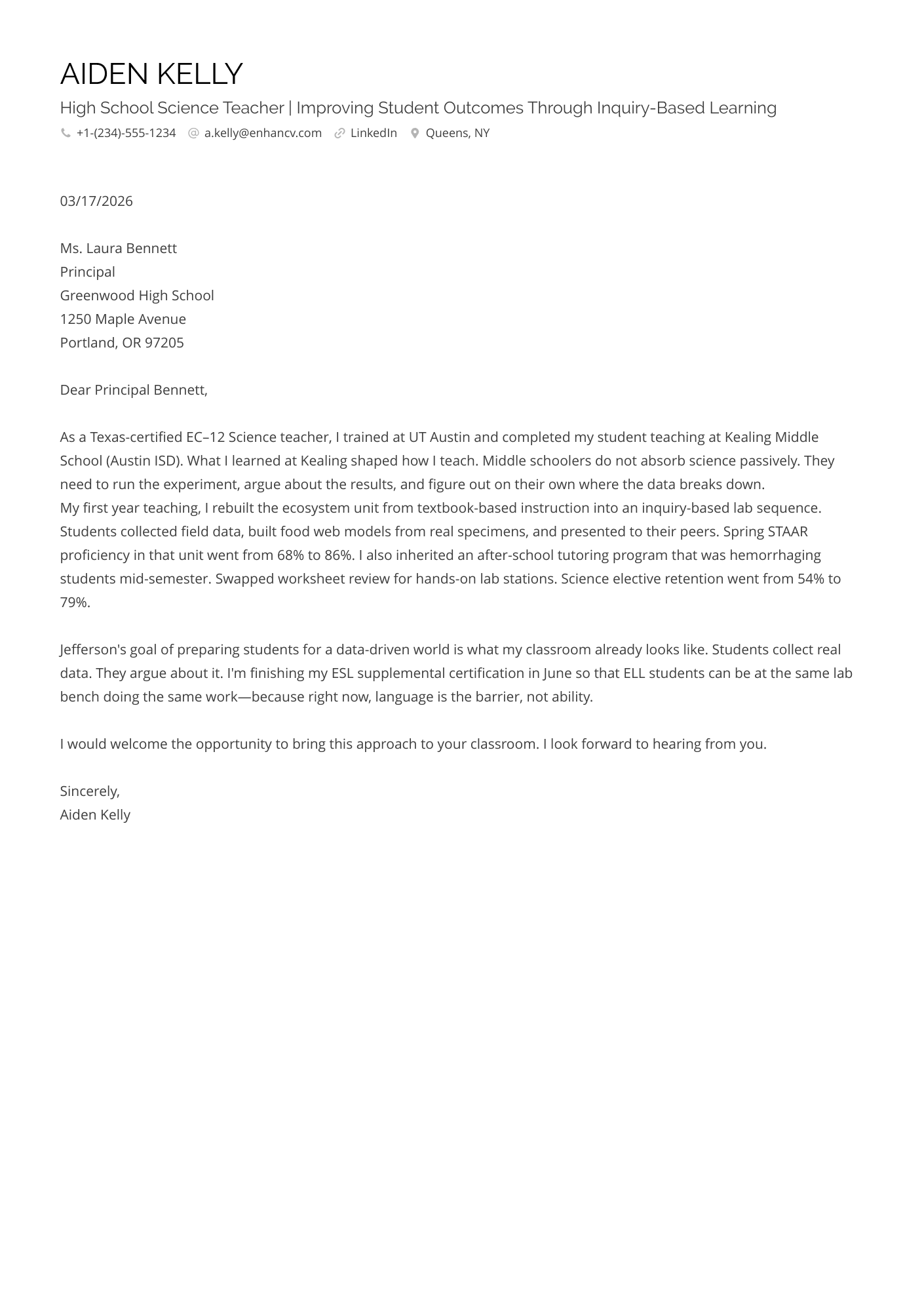
Use this teacher cover letter sample as a basis for your own. Copy and paste it and replace it with your own information, or use our Cover Letter Builder to create one in minutes.
Aiden Kelly
Queens, NY
+1-(234)-555-1234
a.kelly@enhancv.com
Principal
Greenwood High School
1250 Maple Avenue
Portland, OR 97205


The cover letter above was crafted by one of our in-house Certified Professional Résumé Writers with a science teacher in mind, so let’s break down how it strategically incorporates key points:
- If you decide to open with your credentials, such as your education and certifications, immediately leverage them to show how they helped you achieve results.
- Provide traceable details. In the above example, the teaching internship is supported by a school district (Austin ISD) and a real school (Kealing Middle School).
- The achievements are causal, meaning a specific change produced a specific number (STAAR proficiency 68% → 86%; Elective retention 54% → 79%). There are no claims without evidence.
- Signal growth indirectly. Instead of saying “I’m passionate about…” state how you’re growing. In our example, the applicant focuses on their ESL certification. If you teach ELL students, see our bilingual teacher resume examples.
What your teacher cover letter needs to cover
A good teacher cover letter answers four questions a principal asks themselves:
- Are you certified to teach in this state?
- Do you have real classroom experience?
- Can you produce results for students?
- Do you understand what this school is trying to do?
Everything else—fonts, margins, salutations—is secondary to that. If you manage to answer those questions, then your letter is doing its job.
Still, formatting is important, so look at our next section to see how to polish it. Alternatively, just use our app—we’ll take care of organizing your document while you focus solely on content.
Drop your resume here or choose a file.
PDF & DOCX only. Max 2MB file size.
How to format your cover letter
Just like a well-organized lesson plan keeps a classroom running smoothly, a clear and professional format makes your cover letter easier to read.
Hiring committees often skim applications before reading them in full. A clean layout helps them quickly spot key information—and keeps them engaged.
Contact information
Even if your resume includes your contact details, your cover letter should repeat them for consistency and quick reference. A small typo here can mean a missed opportunity.
Ideally, match your cover letter header to your resume’s.
Here’s how to format this section:
- Place your full name at the top
- Include your phone number and professional email address
- Add your location (city and state)
- Include the date below your contact details
- Add the hiring manager’s name, title, and school name and address (if available)
Font, spacing, and margins
Your formatting should reflect the same clarity and structure you bring to the classroom. Keep it simple and easy to read. Stick to one page and three-four paragraphs in length.
- Use a clean, professional font like Rubik or Chivo (size 10–12) and match your font with your resume for consistency
- Keep single spacing throughout the letter
- Use one-inch margins on all sides
- Align your text to the left for a polished, standard look

PRO TIP
Although cover letters are usually read by people, not ATS systems, it’s best to submit your letter as a PDF to preserve formatting.
Sections to include in a teacher cover letter
Once your formatting is set, the next step is organizing your content. A strong teacher cover letter follows a simple structure, with each section serving a clear purpose.
- Header: Include your name, phone, email and city. Ideally, use a cover letter template that has a matching header design as your resume. This will make your application feel like a cohesive brand. In your headline, include your teaching certificate, especially if your state uses a specific designation. For example, in Texas, an “EC-12 Science” tells a principal your certifications in a single line. In New York, “Initial Certificate - Biology 7-12” does the same.
- Salutation: Address the principal by name. It’s likely on the school’s website and it takes two minutes. “Dear Principal Bennett” reads much better than “Dear Hiring Manager”.
- Opening paragraph: Mention your certificate, your subject and grade level, and one sentence that says why this school specifically.
- Body paragraph: Describe at least one achievement in detail. Think of a way to quantify it, if possible.
- Closing: Clearly ask for an interview and how to reach you. No more than two sentences.
What principals actually look for
These are the qualities that decide teacher hires. Ideally, you should address at least three in your cover letter:
- State-specific teaching certifications: They should be mentioned explicitly—but not just repeated. Principals will see them on your resume, but since they’re often required, surface them clearly and connect them to what you’re qualified to teach.
- Classroom management skills: Describe a structure or approach. “My students run the lab before I explain the result” says more than “strong classroom management skills”.
- Subject matter expertise: Mention your subject expertise—but don’t just list it. Use it to show how your background shapes your teaching approach and the value you bring to the classroom.
- Measurable student outcome: Include measurable outcomes, but go beyond listing them. While your resume highlights results, your cover letter should explain what drove them and why they matter. If you don’t have the numbers yourself, try to quantify them as close to the truth as possible.
- Adaptability: explain how you adjust for different learners in the same room. Explain specific strategies, not “differentiated instruction”.
- Educational technology: name platforms and tools you actually use and how you use them.
- Professional development in progress: an ESL endorsement, a content-area certification, a grad course. Including something current shows you’re advancing and developing your teaching skills, not coasting.
How to address your teacher cover letter
Look up the principal’s name on the school website. Usually you’ll find the whole administrative staff listed there. This applies for the district directory as well. If you’re applying to a large school district like Austin ISD or NYC DOE, the school’s own site usually has the information.
If all these fail and you can’t find a name, а simple salutation along the lines of “Dear [School Name] Hiring Committee” works too. Skip “Dear Sir or Madam” or “To Whom It May Concern” because they’re outdated.
Salutations you can use
- Dear Principal [Last Name],
- Dear [School Name] Hiring Committee,
- Dear [Department Head Title] [Last Name],
- Dear Superintendent [Last Name],
- Dear [School Name] Selection Committee,
- Dear Director [Last Name],
How to open your teacher cover letter
The opening of your cover letter has one goal—hook the principal / hiring committee and keep them reading. A weak opening starts with “I am writing to express my interest in the teaching position….” They already know that. And they’ve read openings like these hundreds of times.
A strong introduction sentence does three things in the first paragraph: names your certificate and subject, your experience level, and signals your teaching philosophy as a practice, not a value.
Look at Aiden Kelly’s letter (the example we have above):
As a Texas-certified EC–12 Science teacher, I trained at UT Austin and completed my student teaching at Kealing Middle School (Austin ISD).
In a single sentence, you have the credentials and experience. You don’t need much detail here since they’re already neatly outlined in your resume. Then:
What I learned at Kealing shaped how I teach. Middle schoolers do not absorb science passively. They need to run the experiment, argue about the results, and figure out on their own where the data breaks down.
That’s your teaching philosophy. Instead of “I believe in student-centered learning,” you should describe how you put this into practice.
How to write the body of your teacher cover letter
The body should describe at least one achievement in detail. You don’t need to list all of your job duties—your cover letter is not a summary of your resume. Focus the body of your cover letter on one thing you excelled at, changed, or a problem you solved, and what happened after.
Follow this structure:
- What the problem was: a struggling unit, a failing program, a proficiency gap
- How you approached it: describe the specific intervention
- The result: ideally, use numbers. As a teacher, if you can’t quantify your results, explain them concisely.
Looking at our example cover letter above:
My first year teaching, I rebuilt the ecosystem unit from textbook-based instruction into an inquiry-based lab sequence. Students collected field data, built food web models from real specimens, presented to their peers. Spring STAAR proficiency in that unit went from 68% to 86%.
Note that the paragraph doesn’t use tired structures like “innovative teaching methods,” “student-centered approach,” or “passion for education.” It just explains what happened in an informative way.
How to find a number if you don’t think you have one
Unlike tech jobs, as a teacher you rarely have KPIs to easily reference. So, if you need to reference numbers to quantify your impact, test score data is the easiest. If you have it, use it. If you don’t:
- Elective retention — calculate the percentage of students who stay enrolled vs. drop your course.
- Assignment completion — before and after a curriculum change.
- Grade distribution — average grade or pass rate before and after an intervention
- Tutoring attendance — how many students showed up voluntarily vs when attendance was tracked.
- AP or advanced-track enrollment — if more students moved into higher-level courses after your class.
One real number beats five bullet points about your skills.
How to close your teacher cover letter
The closing paragraph of your cover letter has two tasks. Ask for an interview and tell them how to reach you. It doesn’t need to restate your qualifications or thank the reader at length.
A simple “I would welcome the opportunity to bring this approach to your classroom. I look forward to hearing from you” works beautifully. It shows you’re proactive and gives the hiring manager the info that they need.
What doesn’t work is
Thank you so much for taking the time to review my application. I would be honored to discuss how my passion for education aligns with your school's mission. I look forward to hearing from you at your earliest convenience.
The reason why it doesn’t work is that it buries the ask in hedging language. Plus, it makes you look insecure. “I’d like to come in and talk” is direct. It assumes a next step rather than asking for one.
PRO TIP
You can also close with something concrete, like your willingness to provide a teaching demonstration, a reference from your current principal, or a specific date you’re available. Aim to move the conversation forward.
Frequently asked questions about teacher cover letters
Let’s address some common concerns regarding cover letters.
Writing a teacher cover letter with no experience
If you’re just finishing student teaching or entering education from another career, lead with what you do have: your student teaching placement with the school and district named, your state certification status, your licensure exam score, your GPA in your content area.
If you tutored, describe a student's improvement. If you ran a class as a substitute, describe how it went, or see our substitute teacher resume for more context on what experience to lead with.
The goal is to give the principal something concrete to evaluate, not a list of traits you claim to have.

For student teachers
Your placement is your experience, so name it fully. The school, the district, the grade level, and the subject. “Completed student teaching at Kealing Middle School, Austin ISD, 7-th grade science” is a real credential. Treat it like one and use it. When you're ready to write your resume too, see our student teacher resume examples.
Also, name your state certification status and your licensure exam score, especially if it’s strong. In Texas, a TExES score of 274/300 on science 7-12 tells a principal that you know the content. Most states have an equivalent, so name the exam and your score.
If your content-area GPA is strong, make sure to mention it. A 3.8 in Biology Education is evidence of subject mastery, and it can help support your claims.
Then you want to find one specific and concrete result from your placement. A lesson that landed, a student who improved, a classroom routine you built, and it worked. Don’t just write “dedicated and hardworking”.
How to write a cover letter as a career changer
Lead with your transferable skills and evidence. A lab manager who trained new staff has classroom management experience. A corporate trainer who designed curriculum has lesson planning experience. The important thing is to make the connection explicit, because neither the principal nor the hiring committee will do that for you.
If you’re mid-certification, say so. Having “currently completing New York State Initial Certificate requirements, NYSTICE Biology 7-12 passed” on your cover letter tells the hiring committee that you’re on a real path and not just exploring an idea.
What should a teacher cover letter include?
At minimum you should list your state teaching certificate, your subject and grade level, at least one quantified classroom achievement, and a reason you’re applying to this school specifically.
Remember — a cover letter that has your licensure exam result and a real student outcome will outperform a longer letter that has neither.
Use our free Cover Letter Generator to create a tailored cover letter from your resume and the job you’re applying for.
How long should a teacher's cover letter be?
One page and three to four paragraphs. The hiring committee will read dozens of applications, and long letters usually get skimmed. If you can’t say what you want to say in four paragraphs, then review, edit, and cut the weakest parts.
What makes a teacher's cover letter stand out?
Specificity! Name the principal, cite a real outcome (ideally quantify with a number), and make a clear ask.
Remove fluff and generic language. Everyone is “passionate about education” but this doesn’t make you stand out. You should focus on concrete results from your classroom.
Final thoughts
A strong teacher cover letter doesn’t try to say everything—it focuses on what matters. If a principal can quickly see that you’re certified, have real classroom experience, can produce results, and understand their school, your letter is doing its job.
Keep it specific, structured, and focus on impact over buzzwords. That’s what makes you stand out.
If you want to skip the formatting and structure entirely, Enhancv’s Cover Letter Builder takes care of it for you—so you can focus on writing a letter that actually gets interviews—not just reads well.
Teacher cover letter examples
By Role