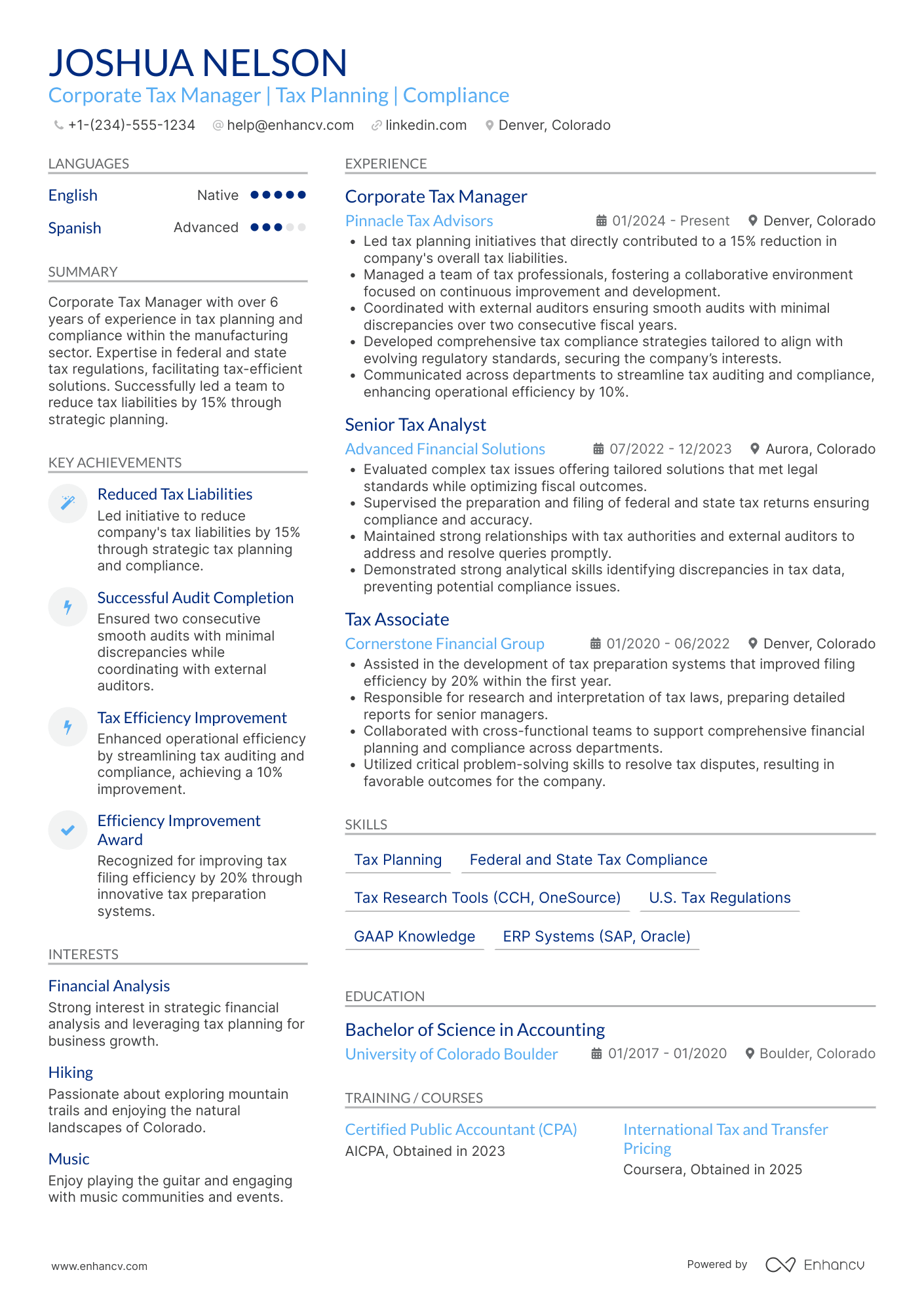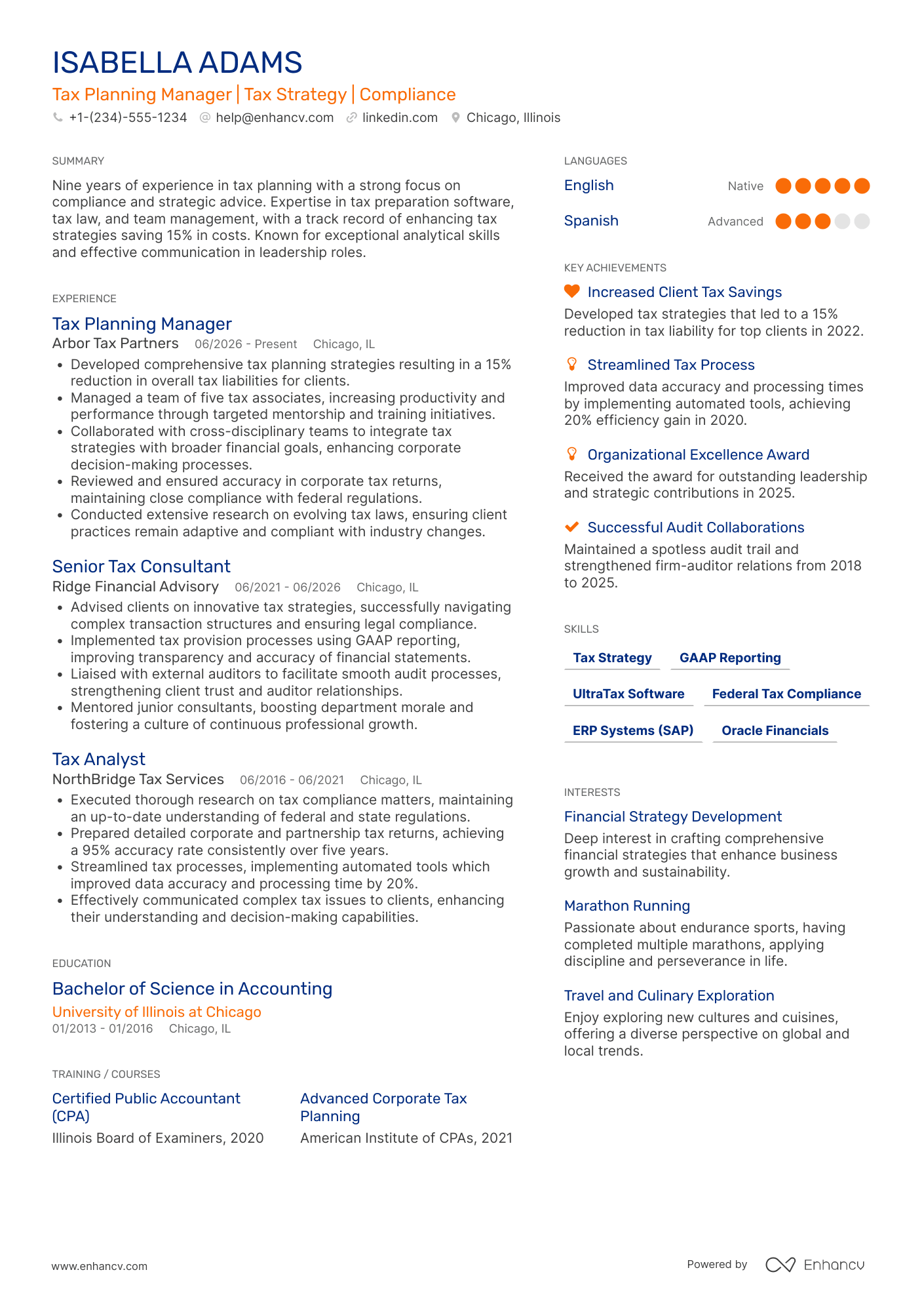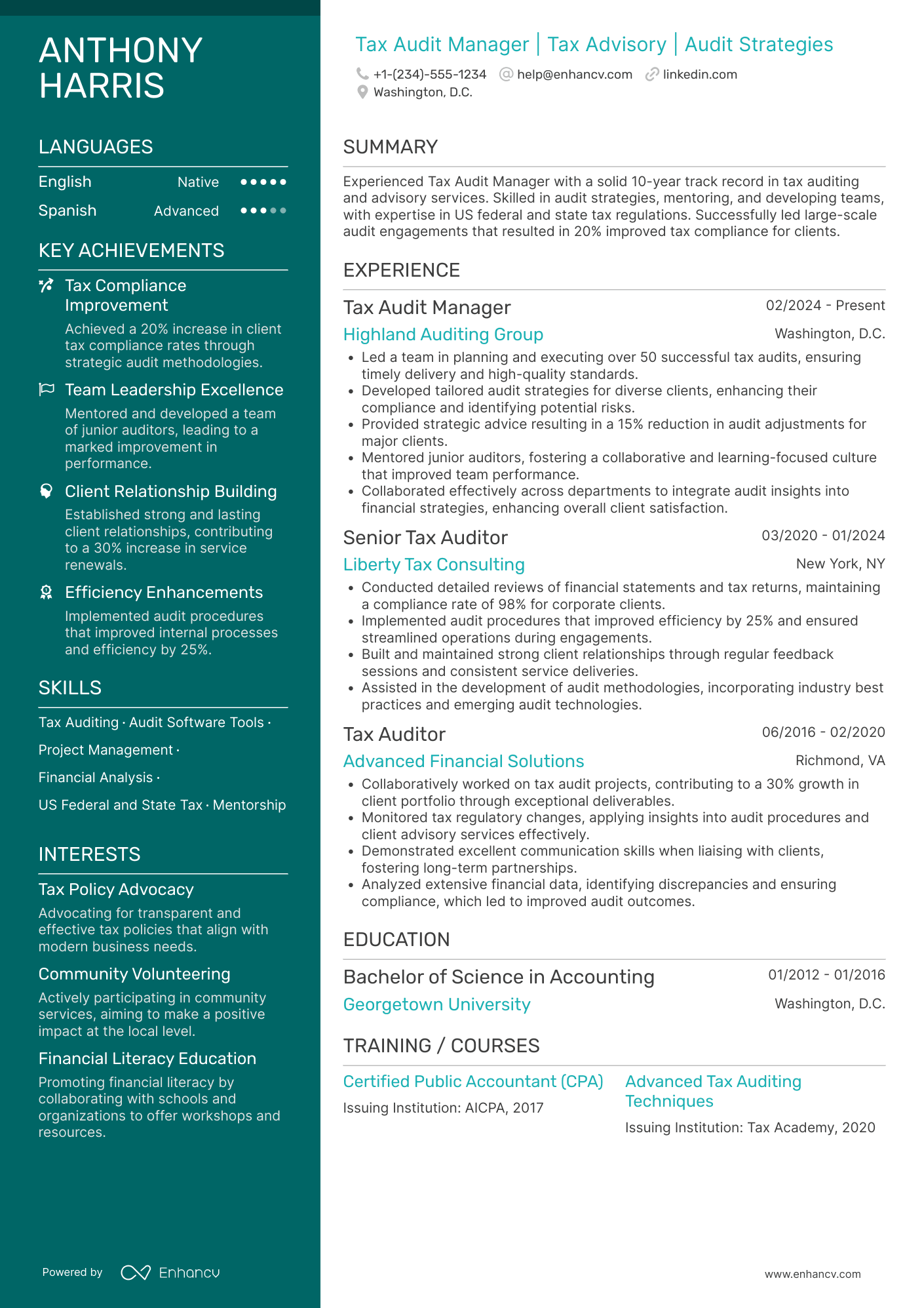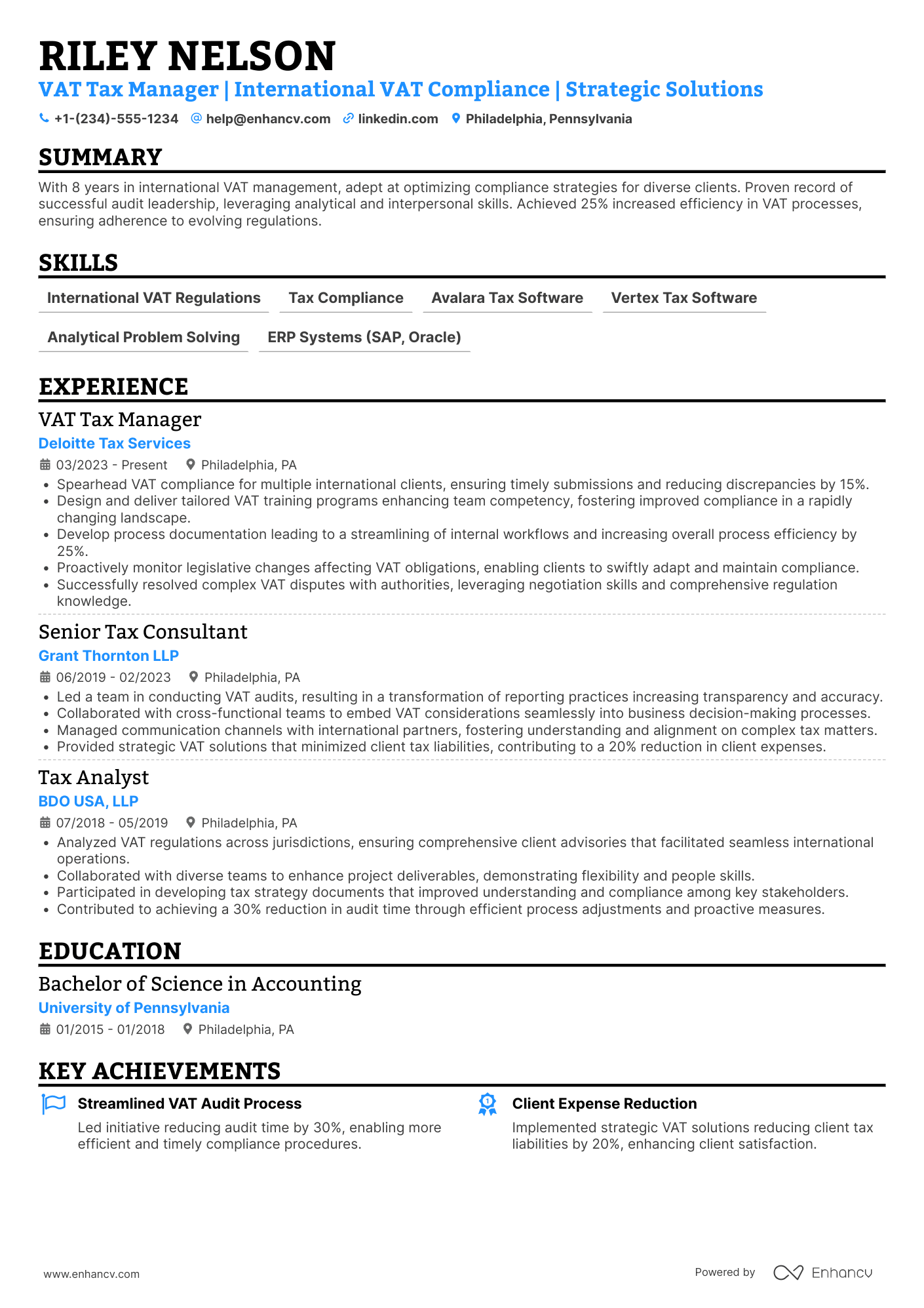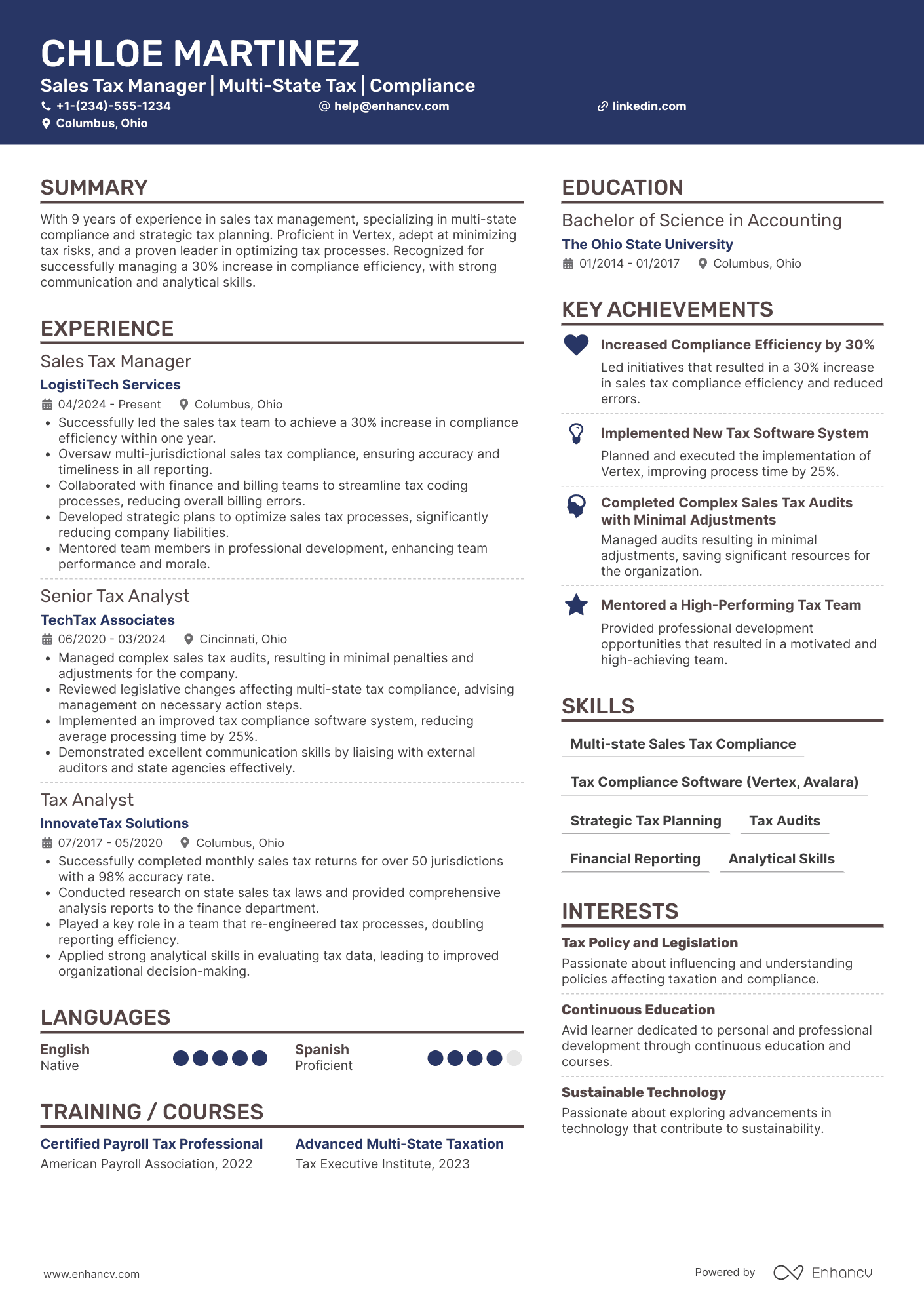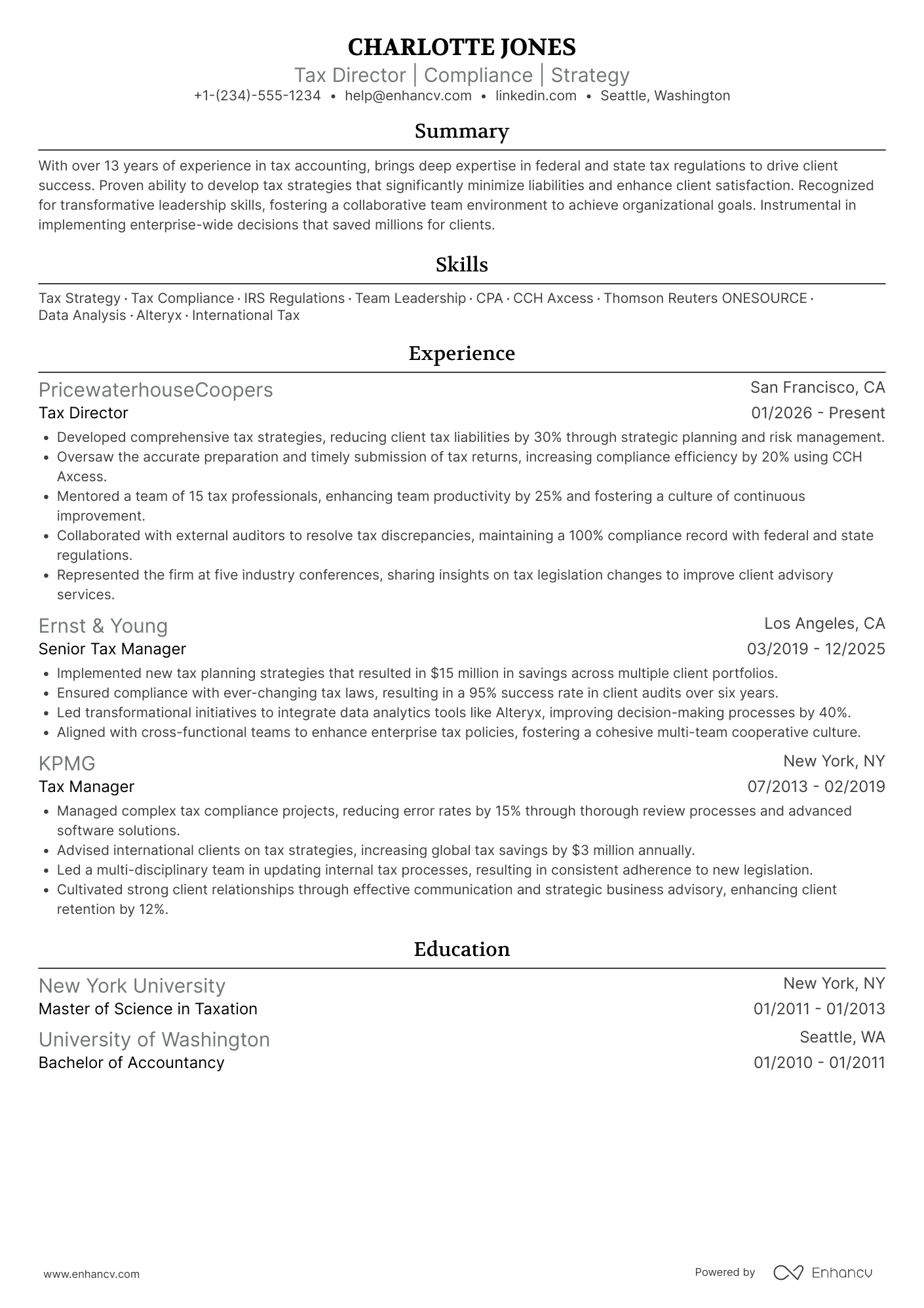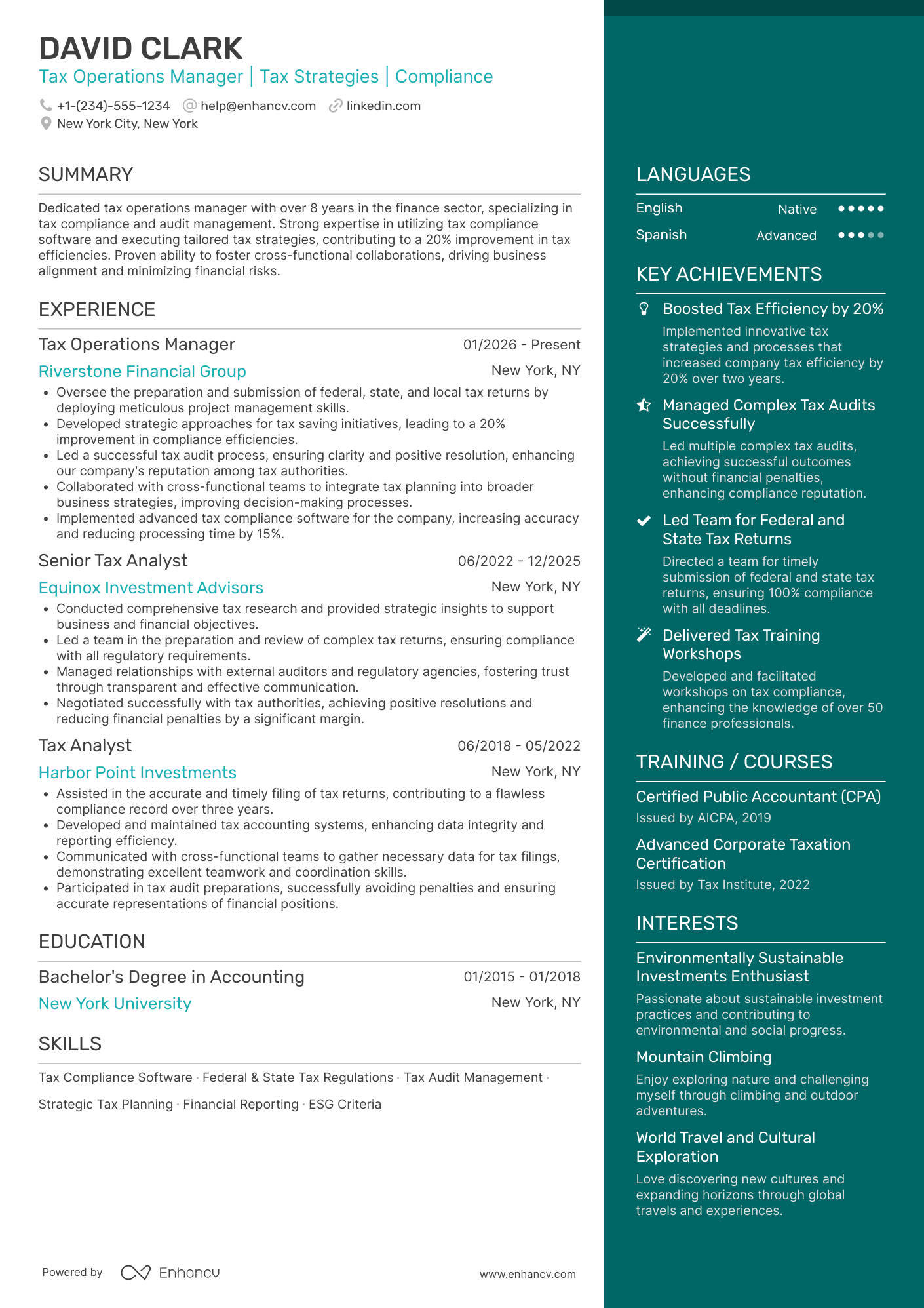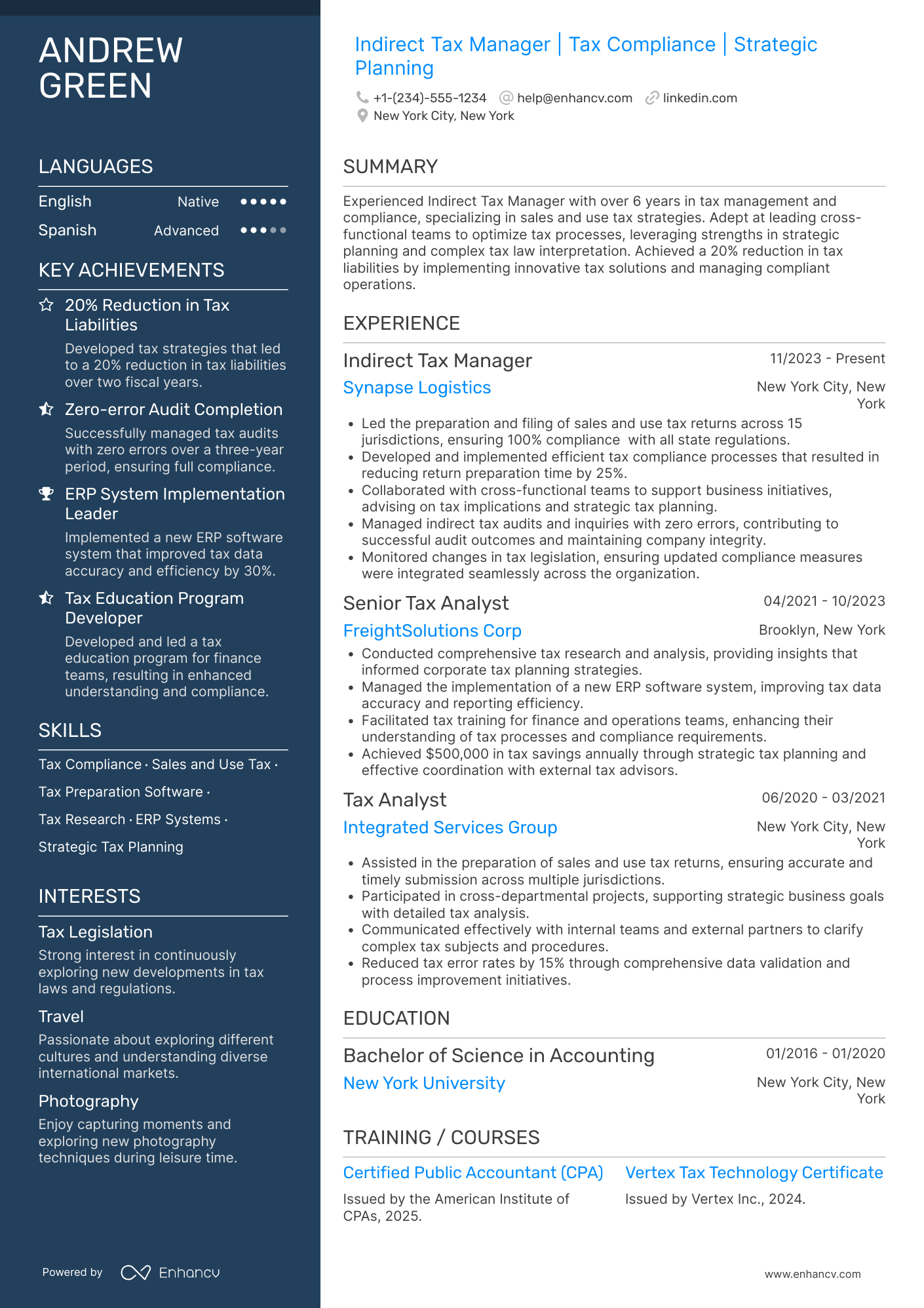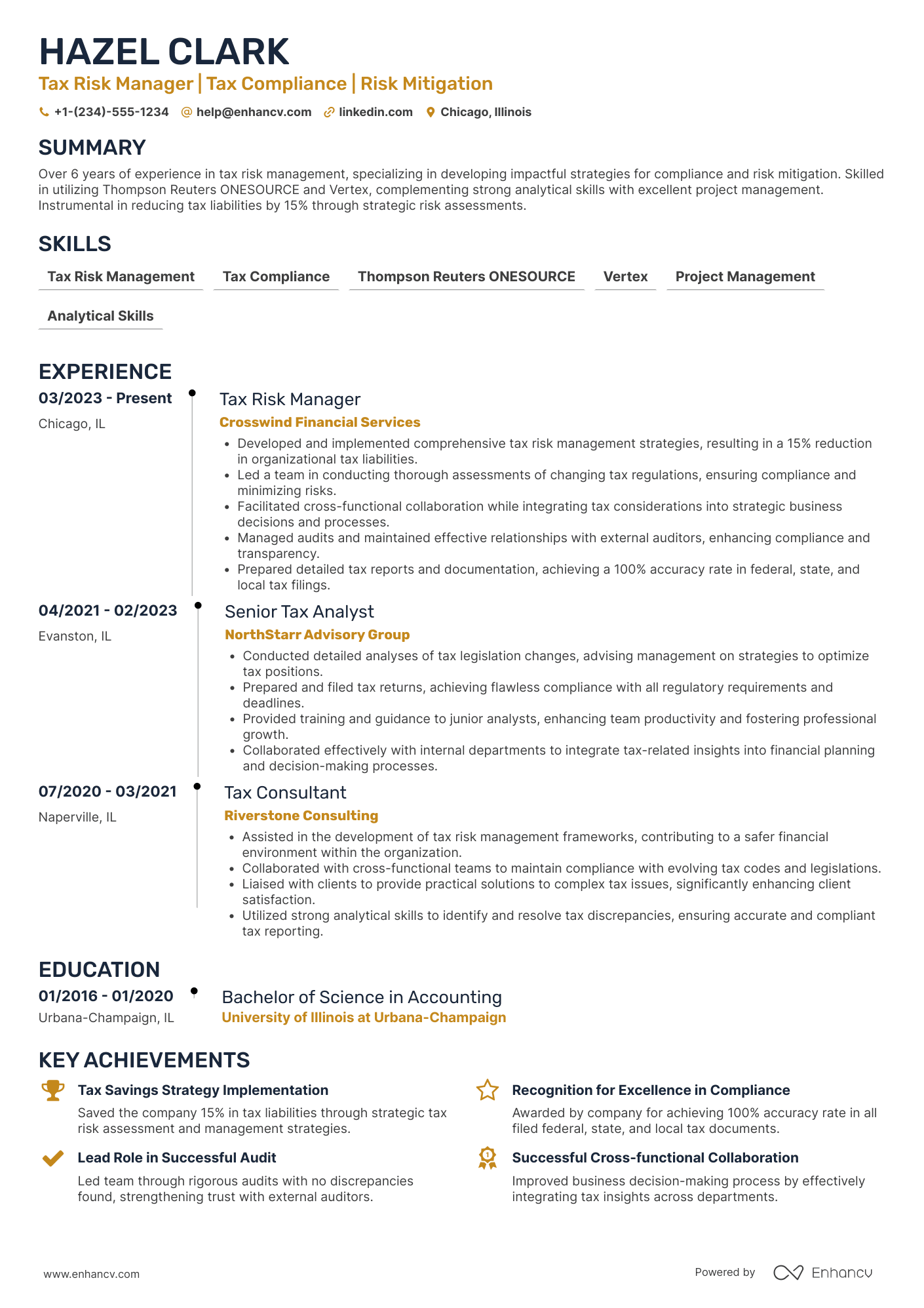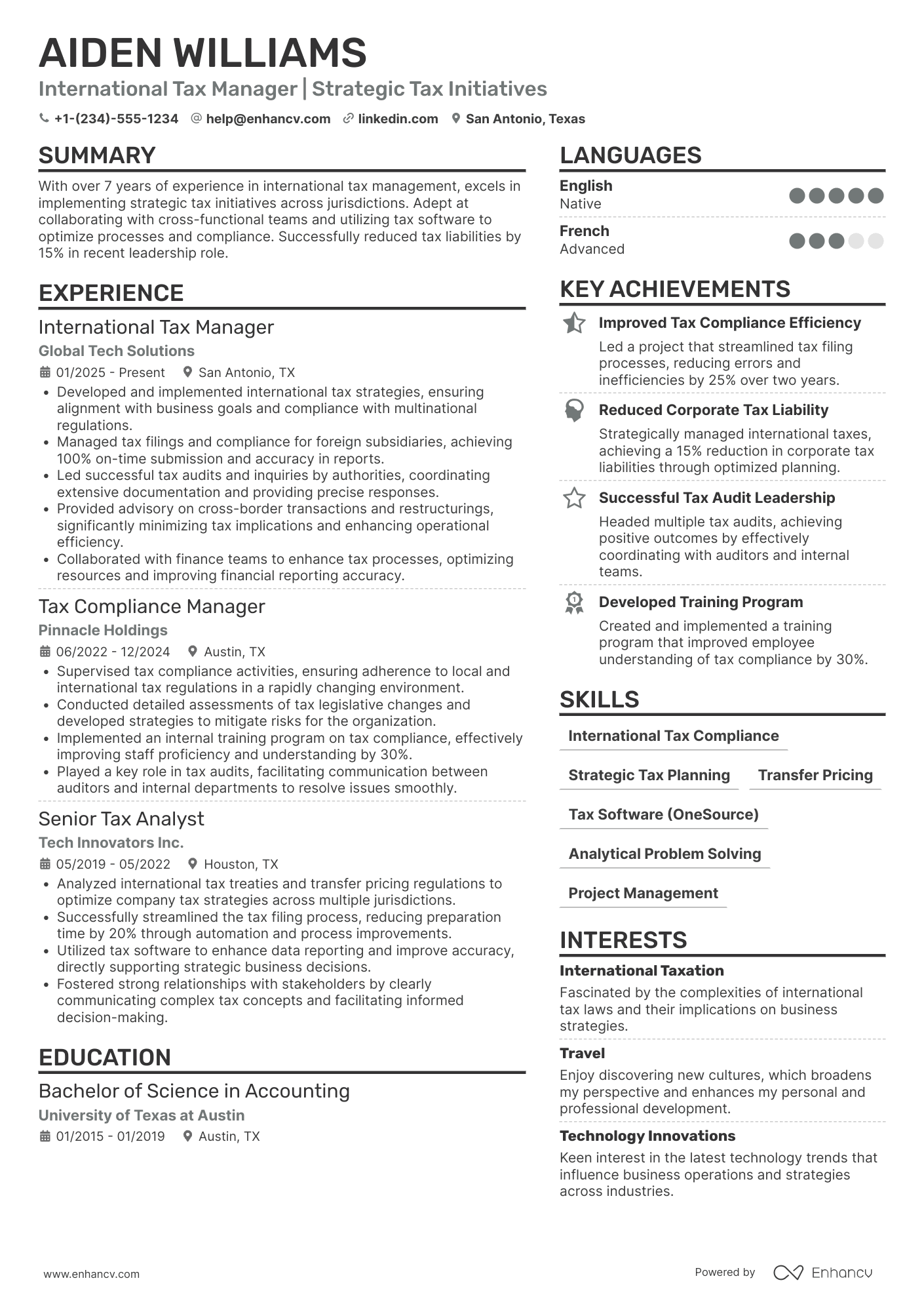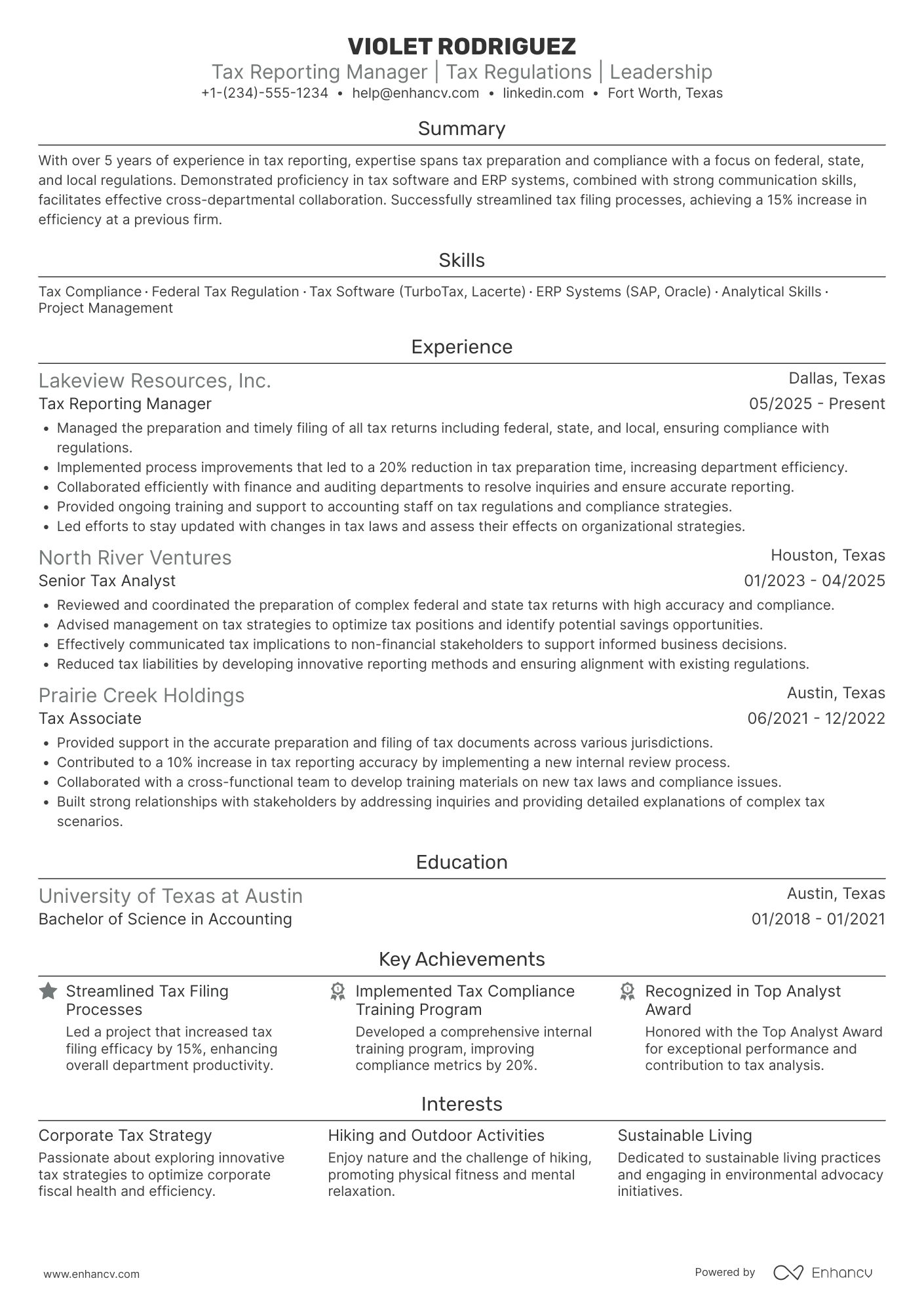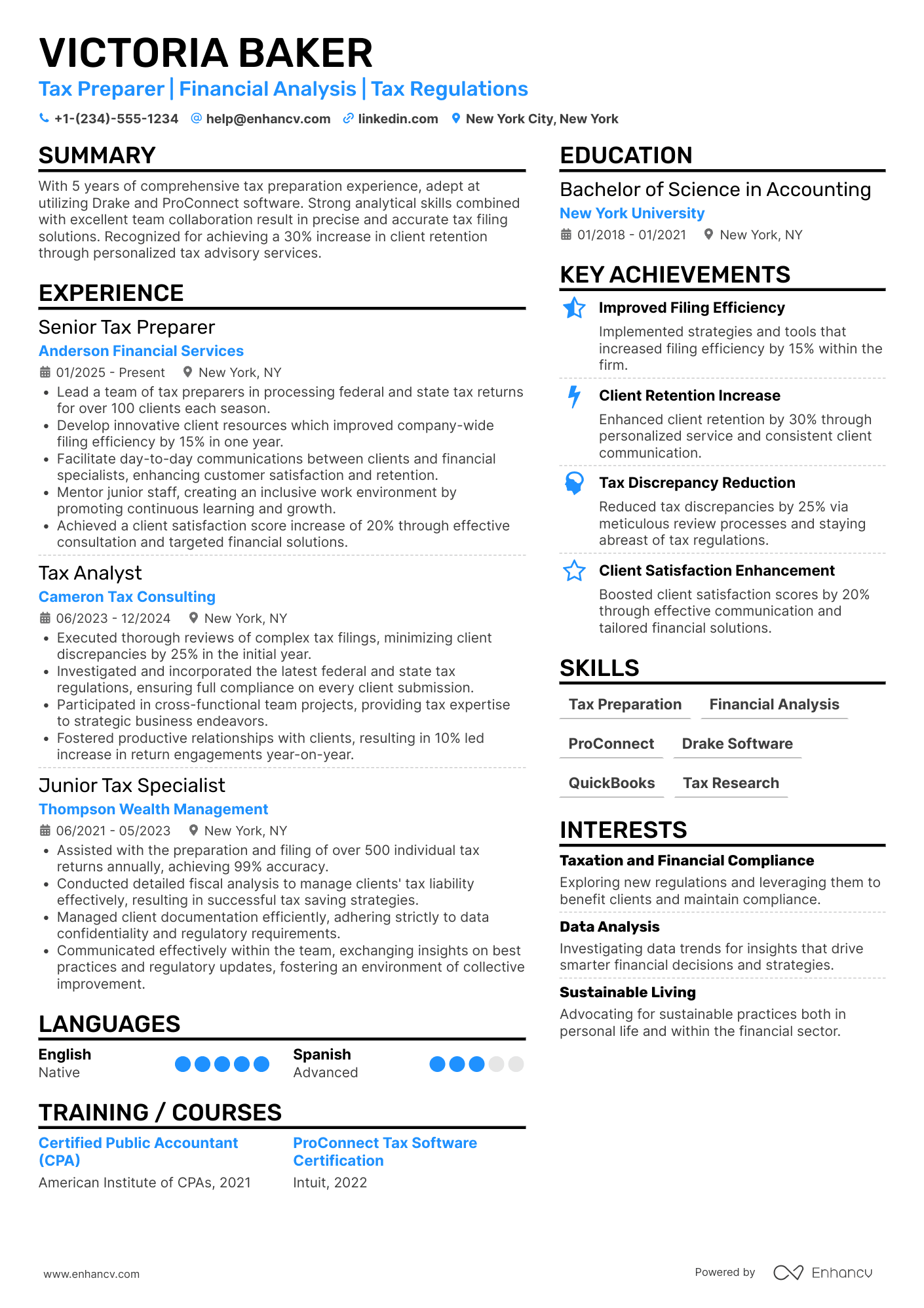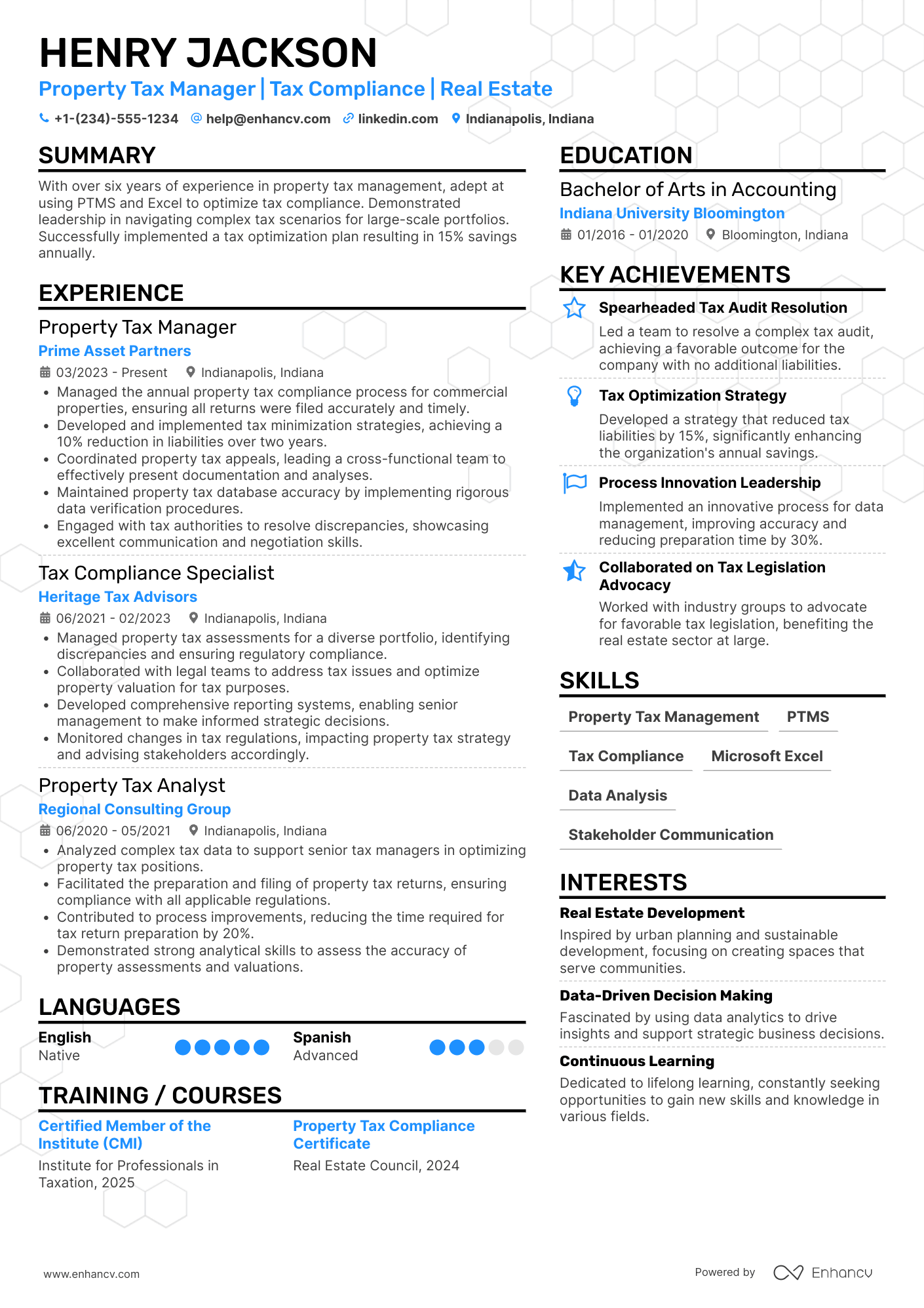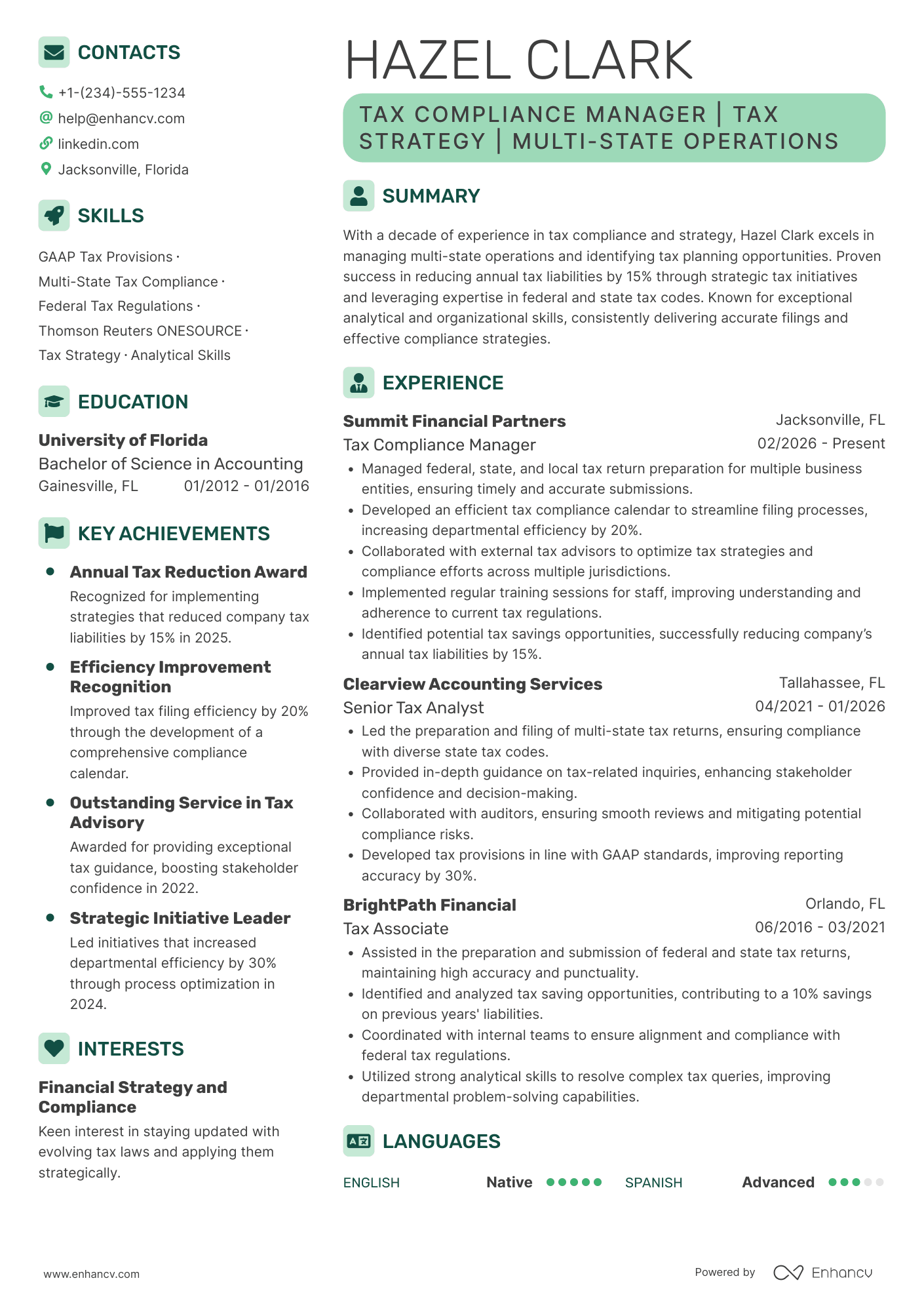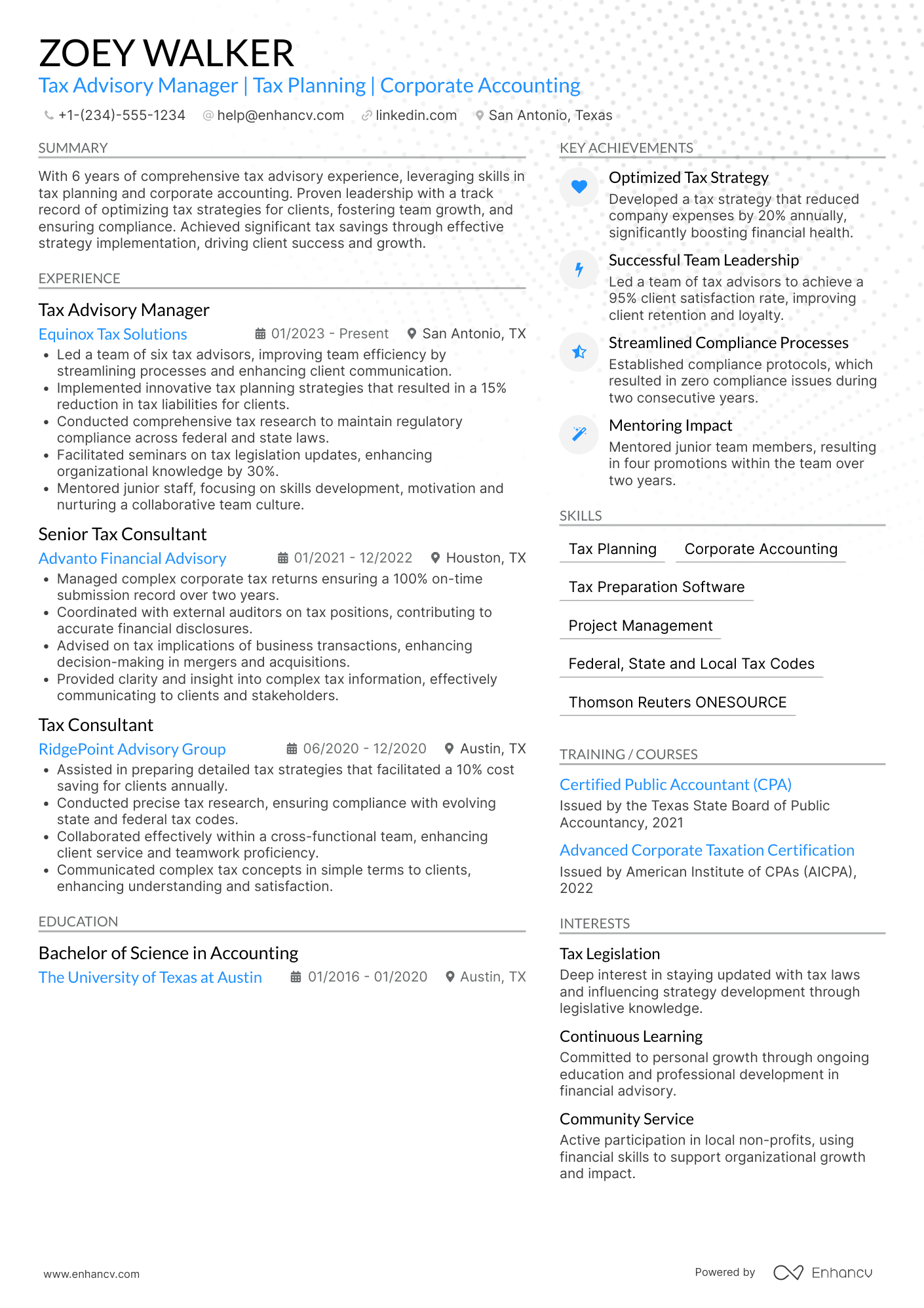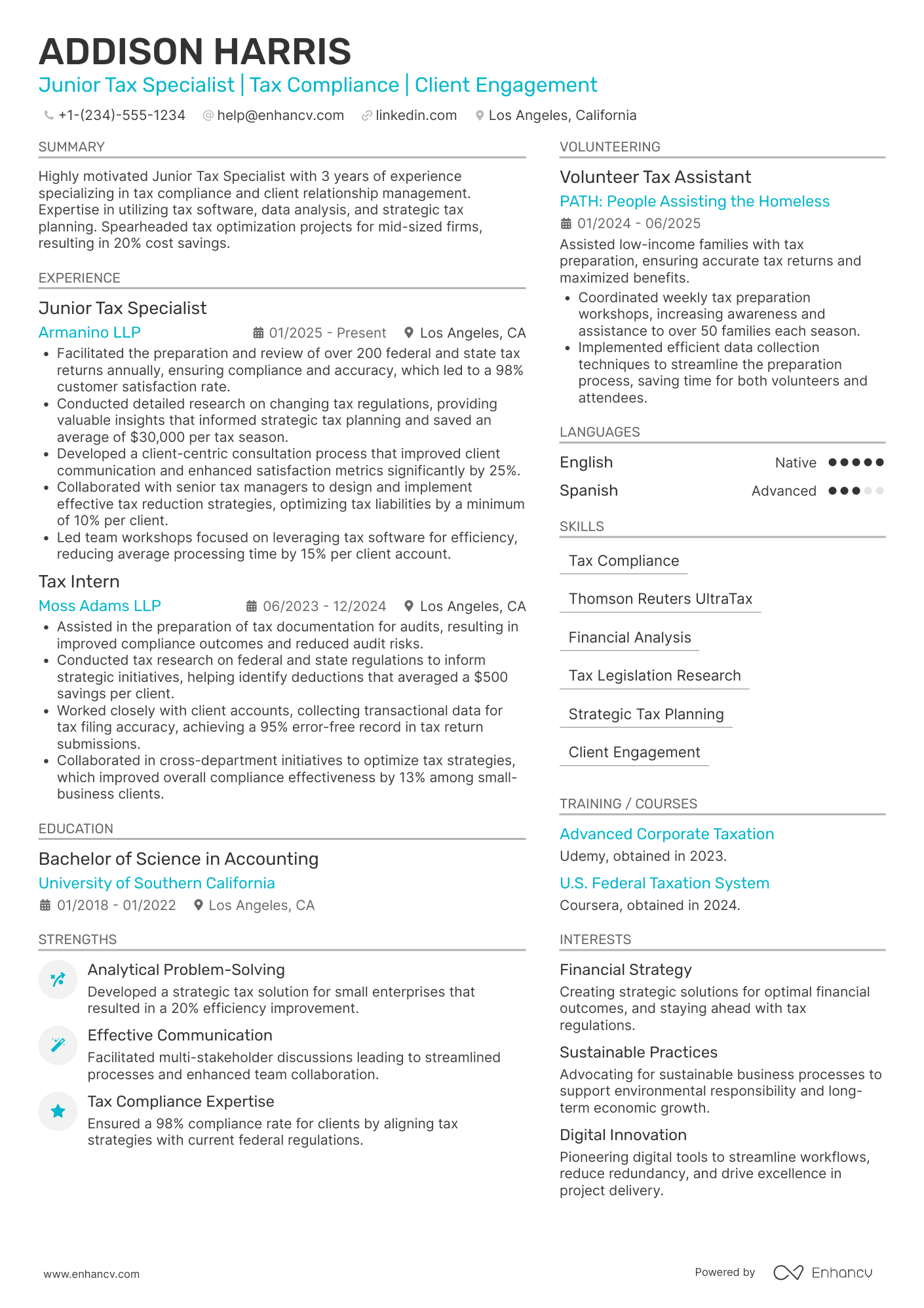
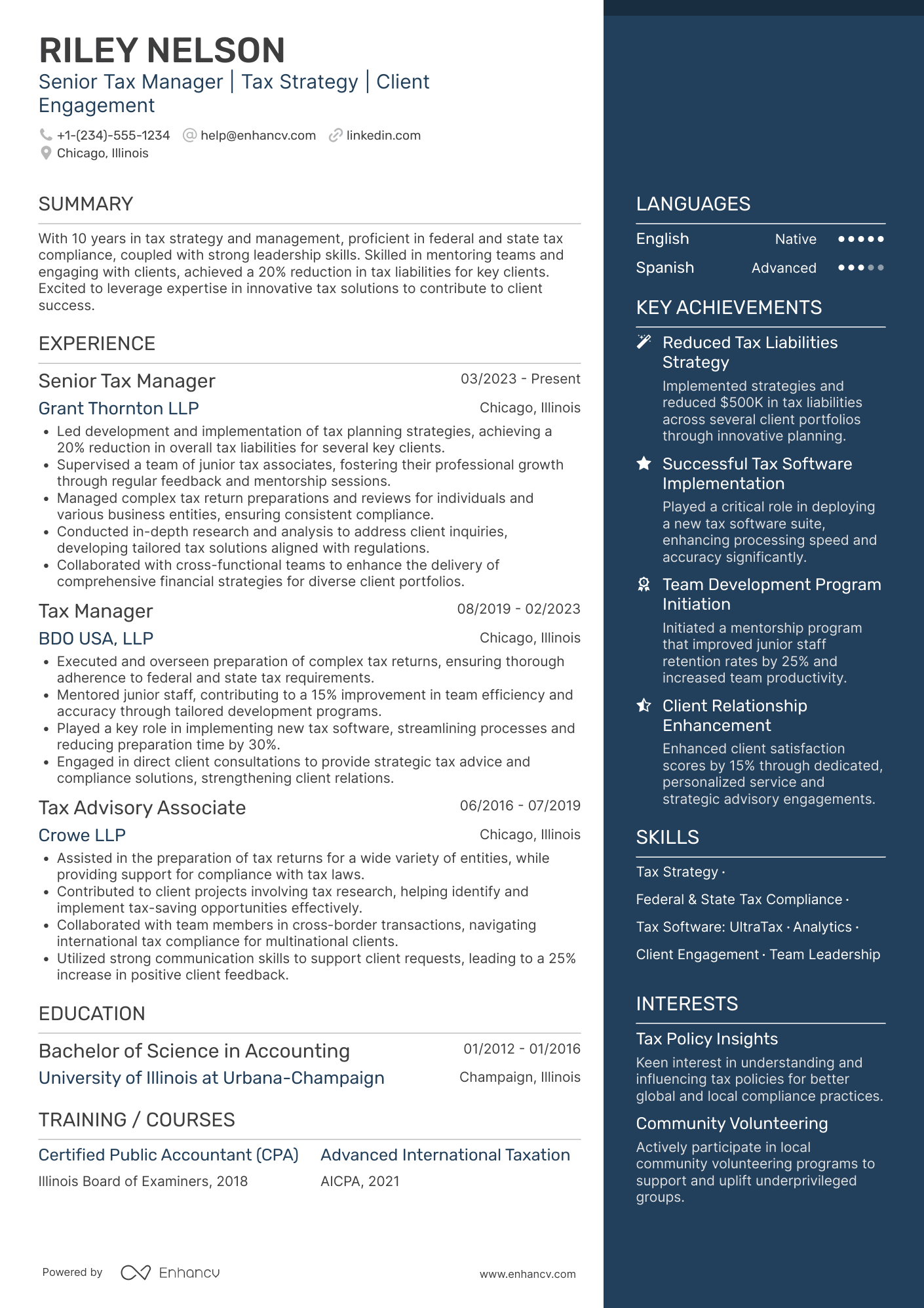
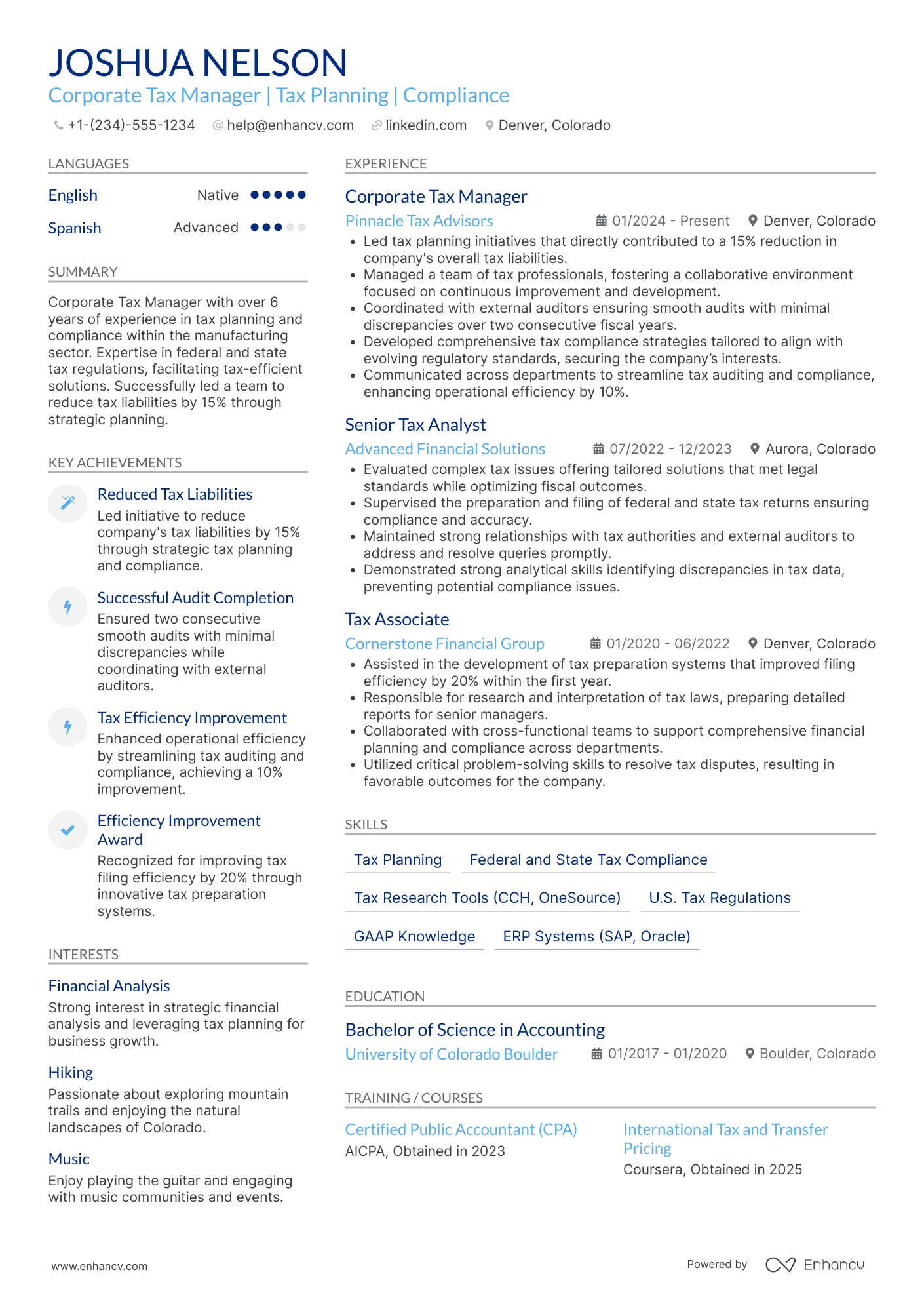
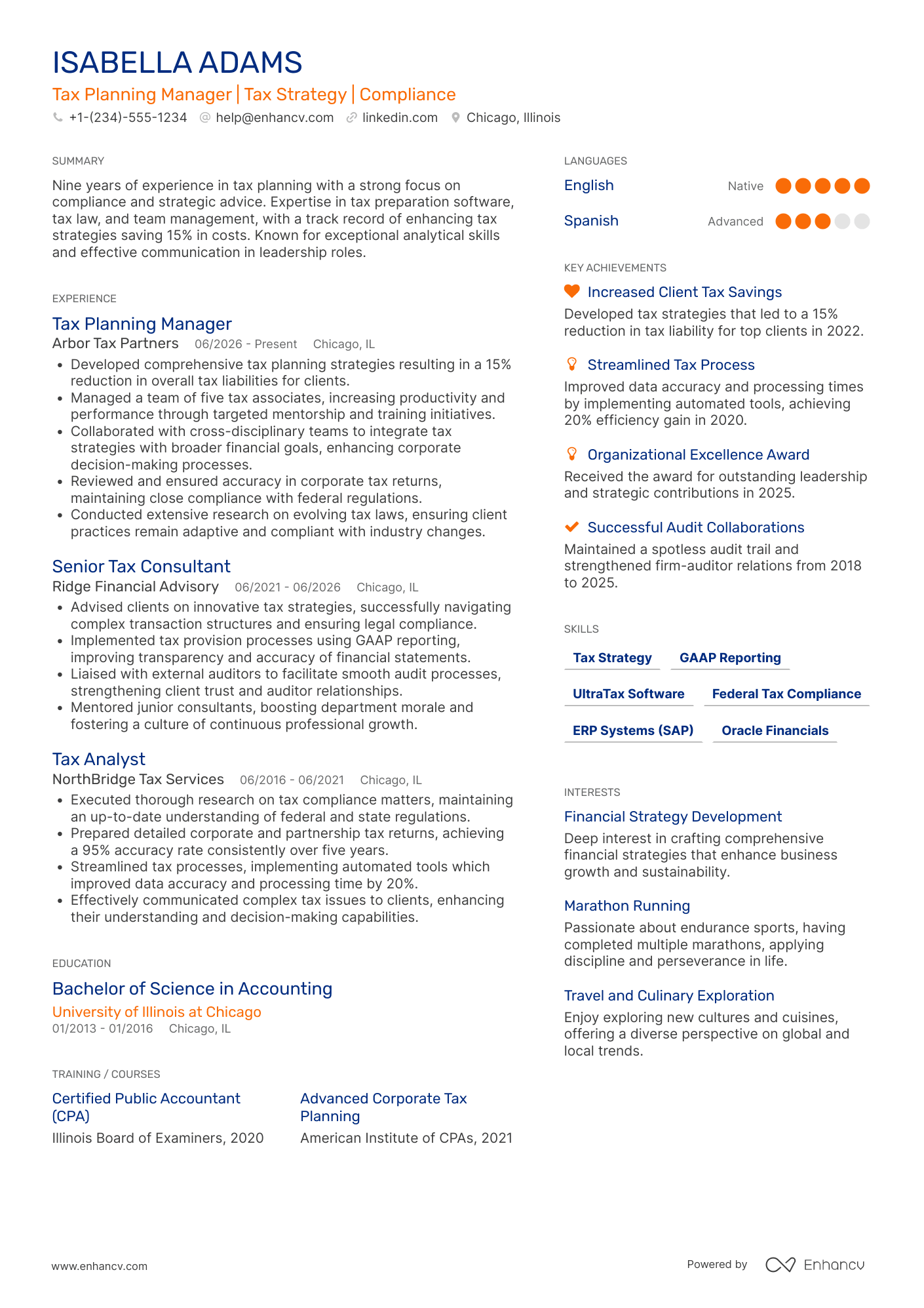
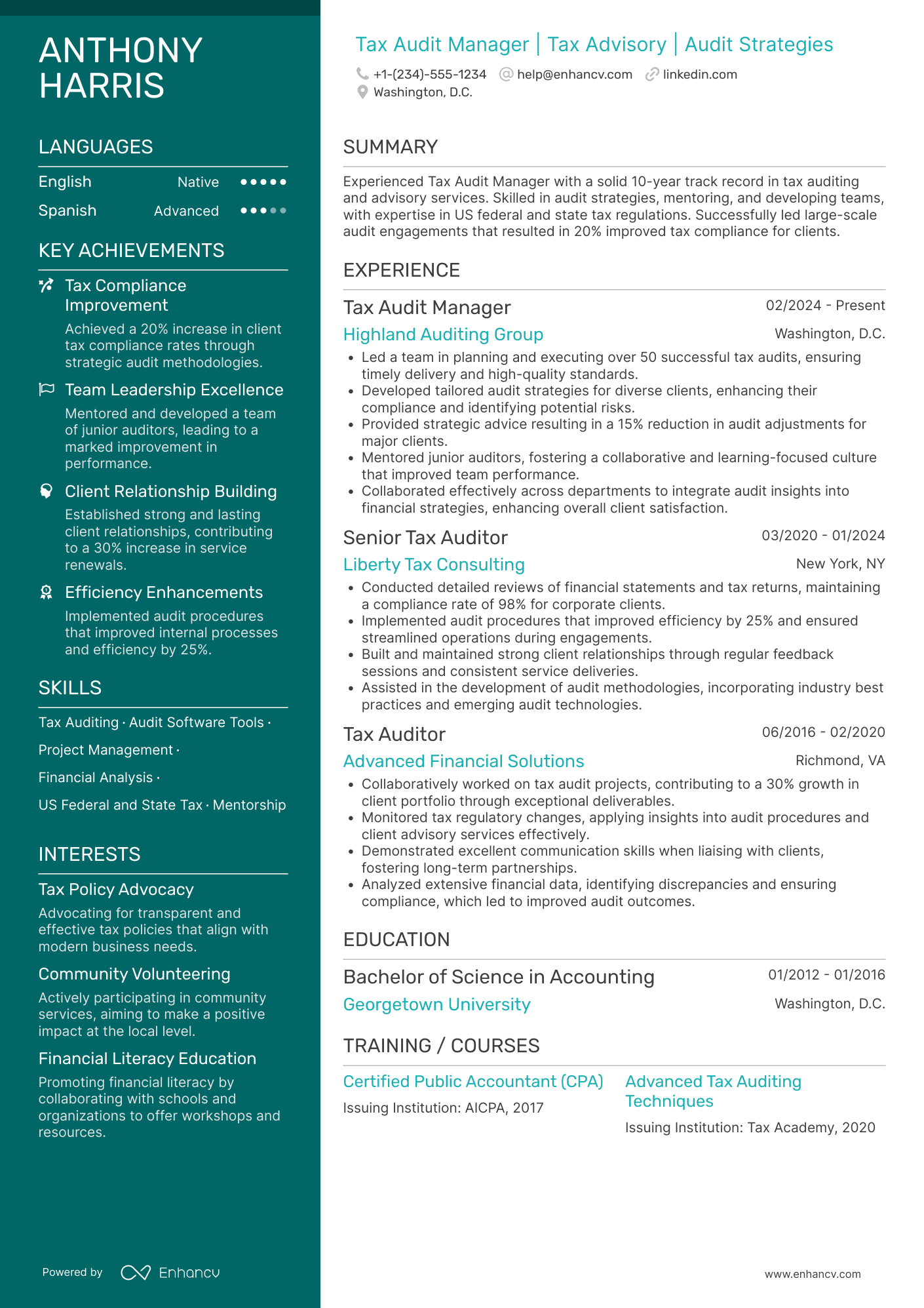
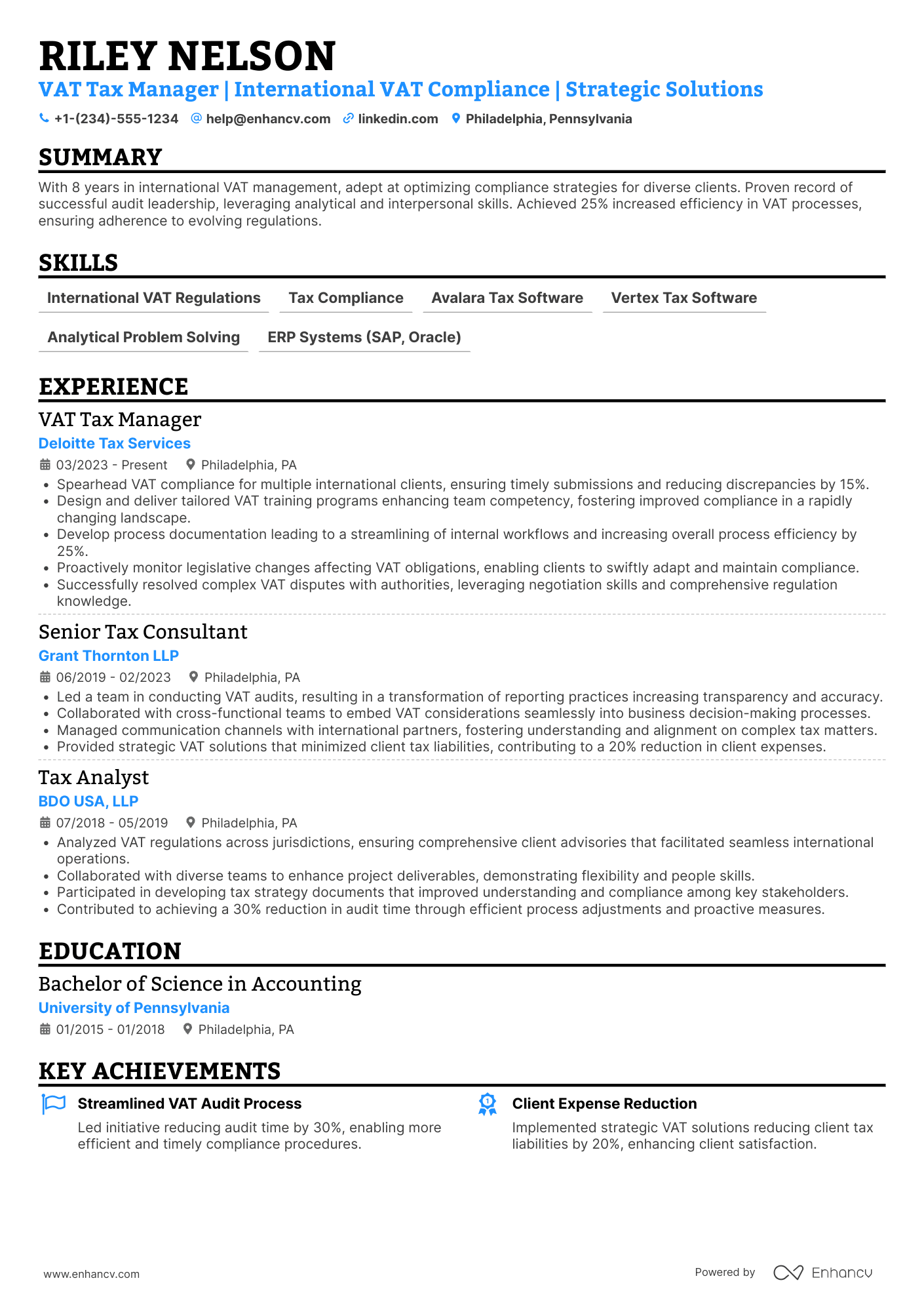
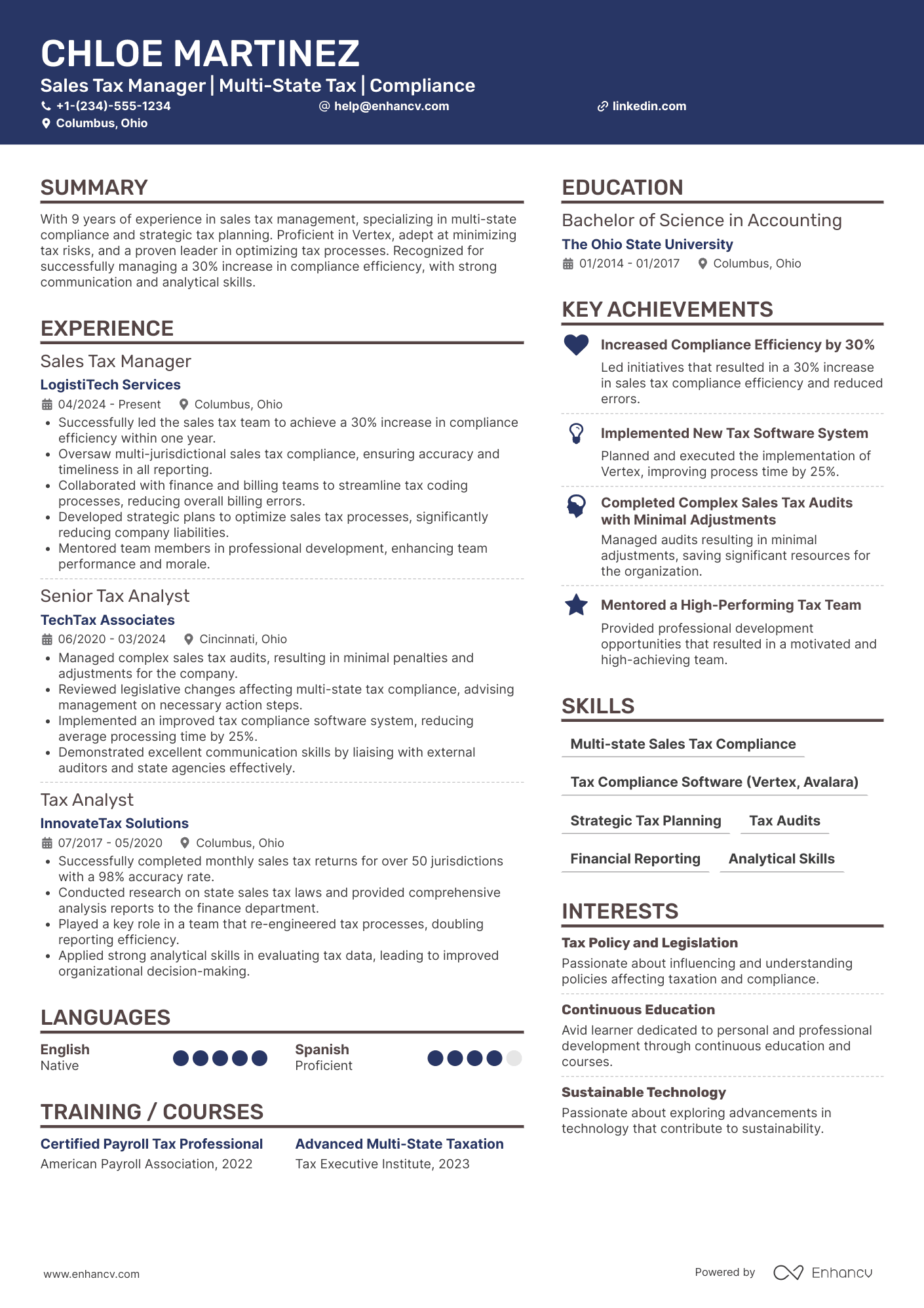
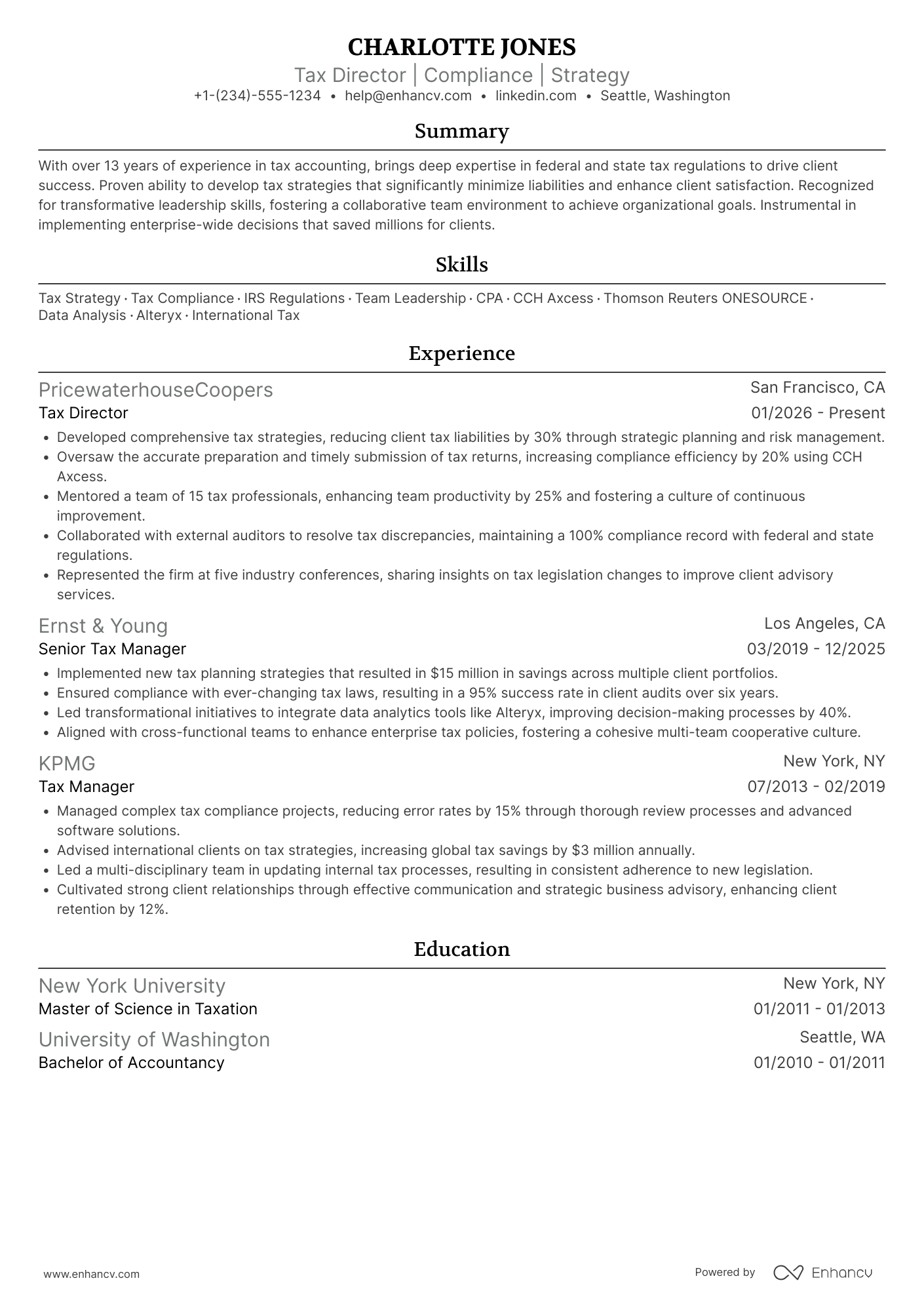
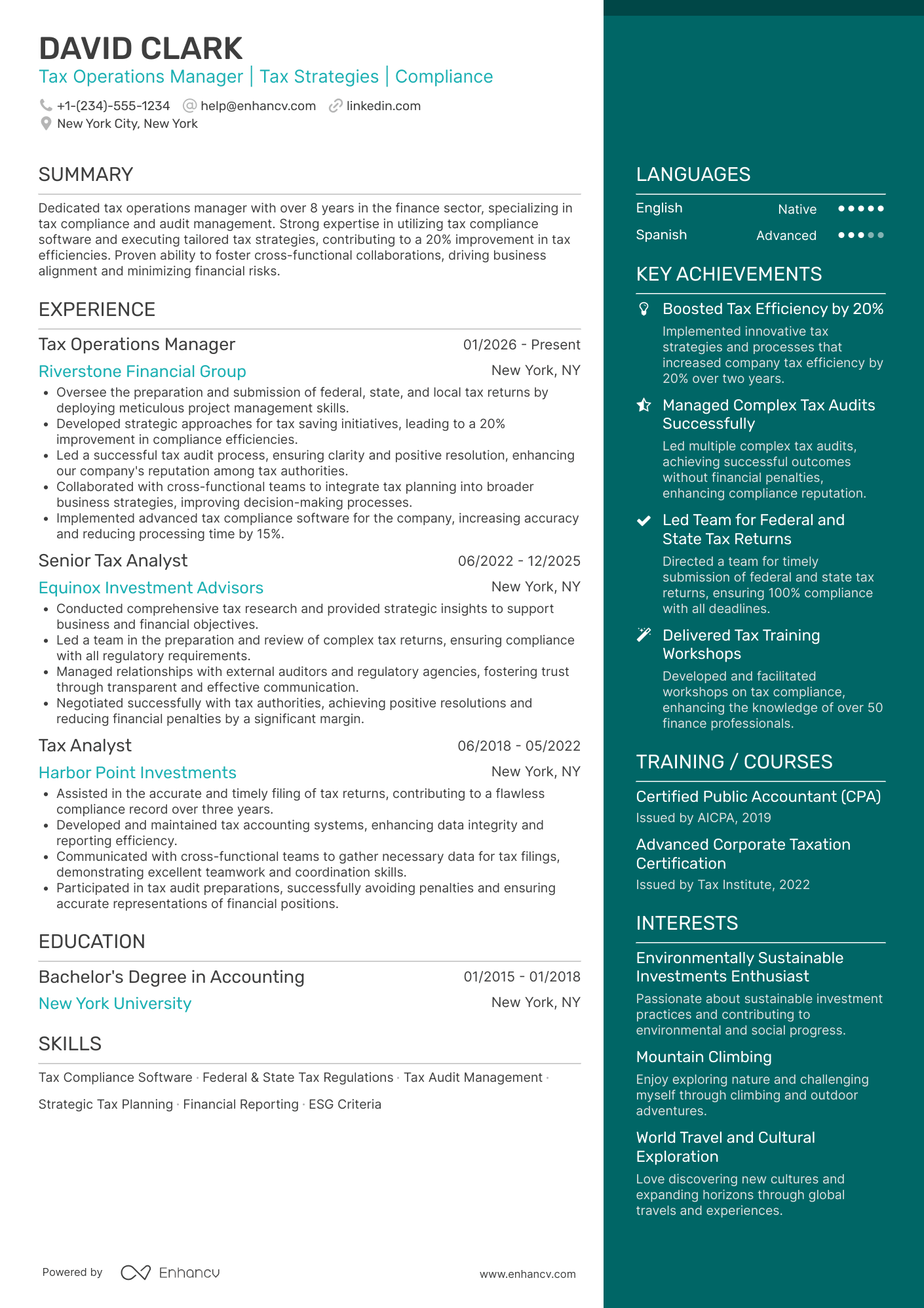
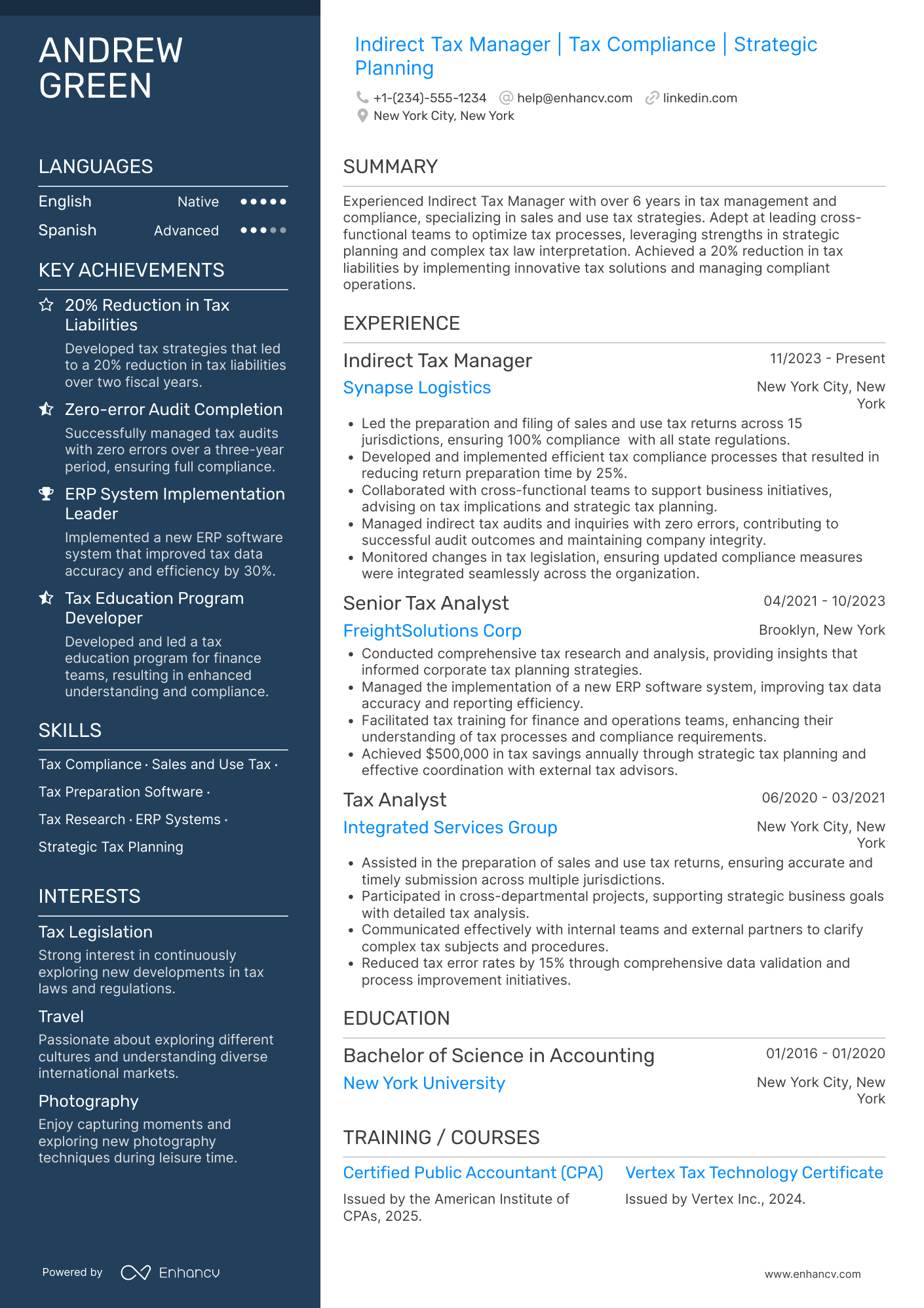
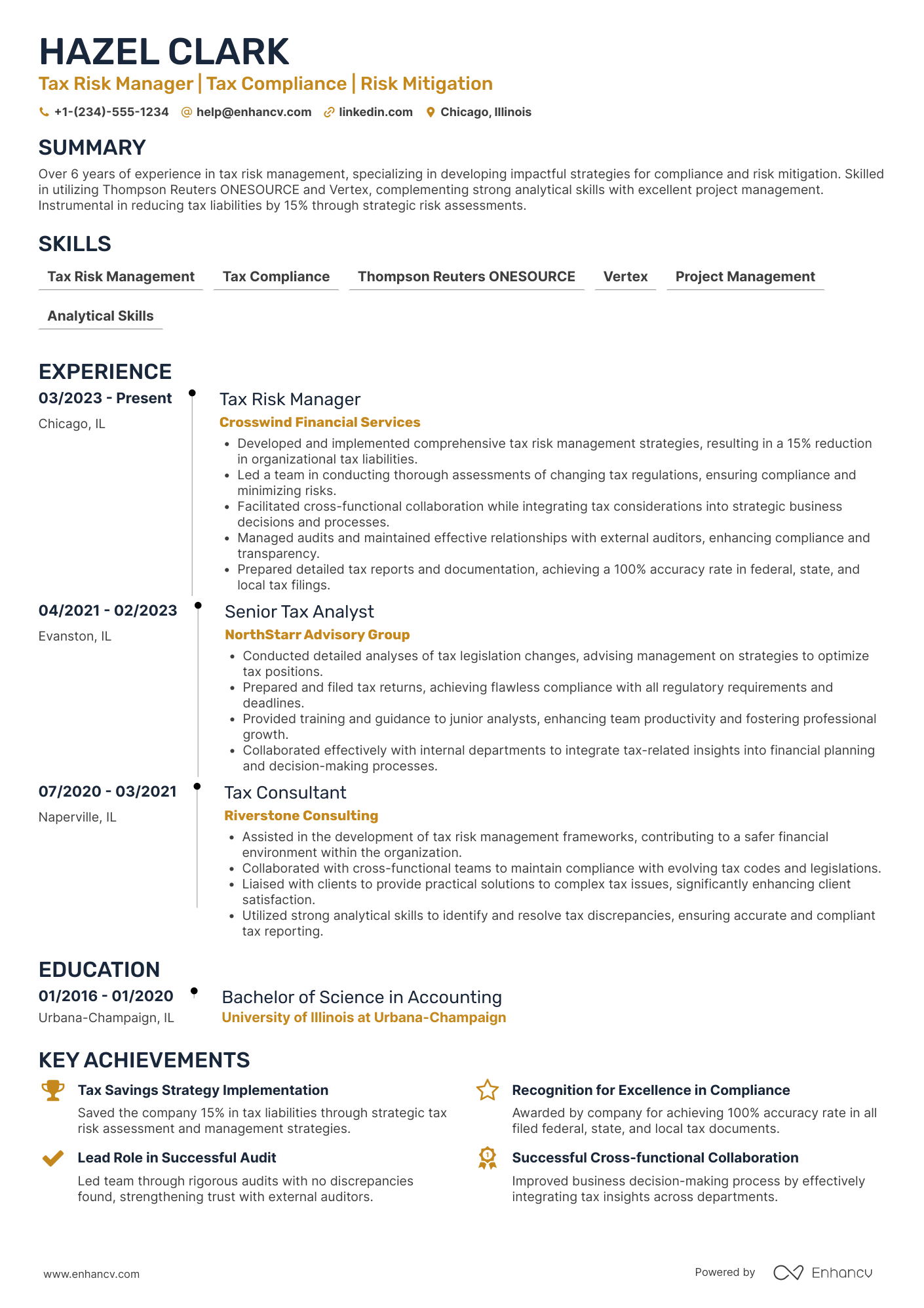
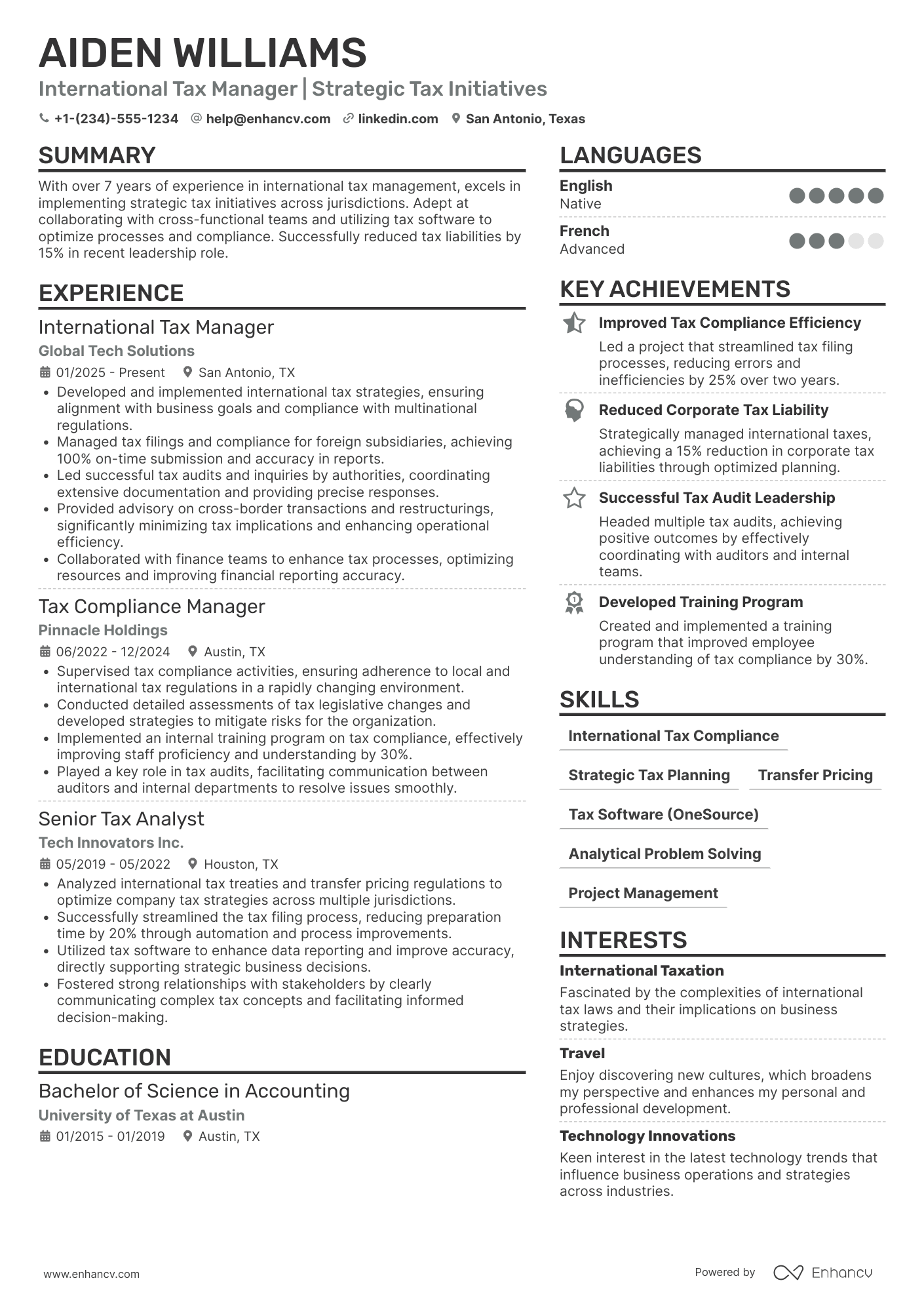
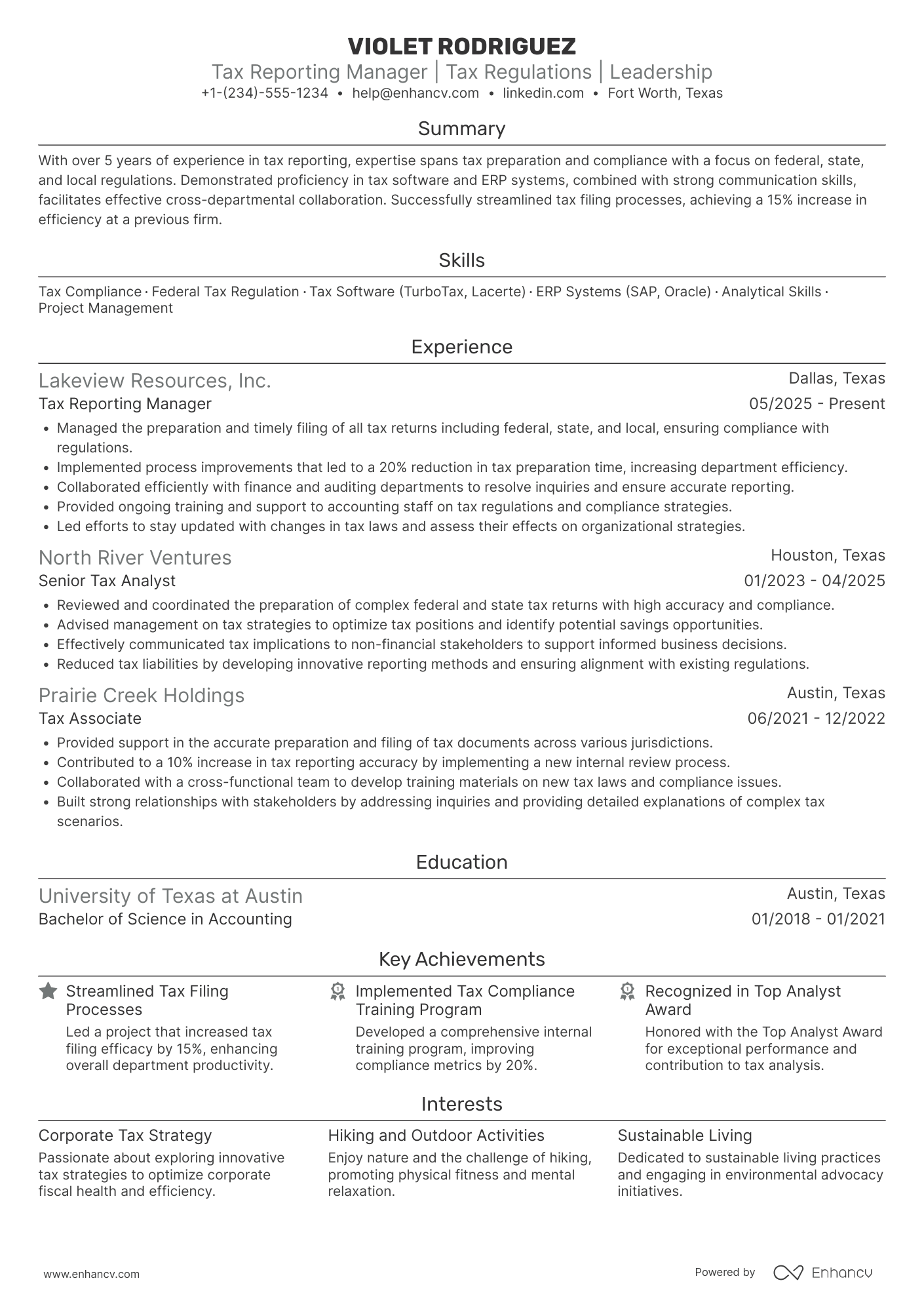
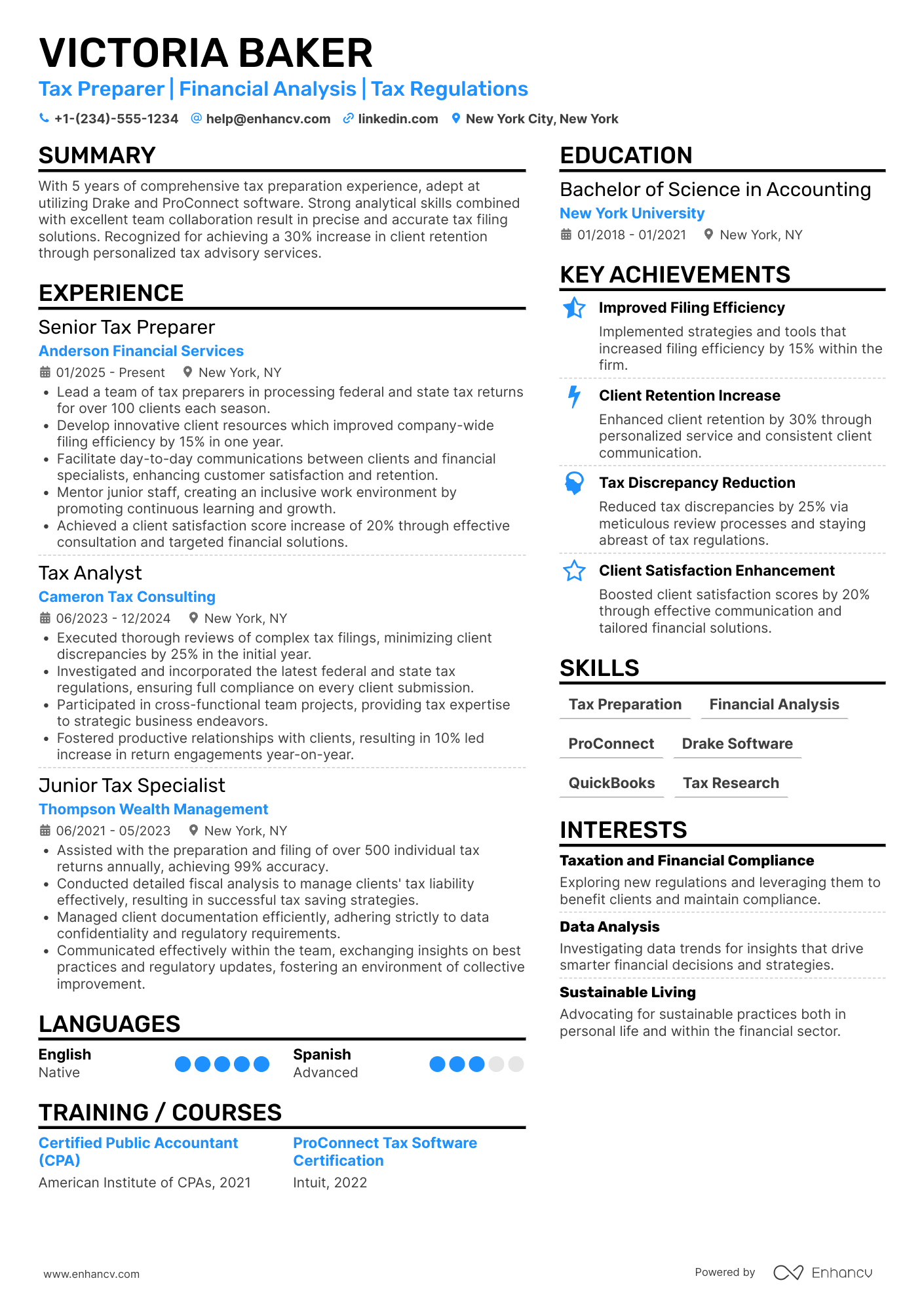
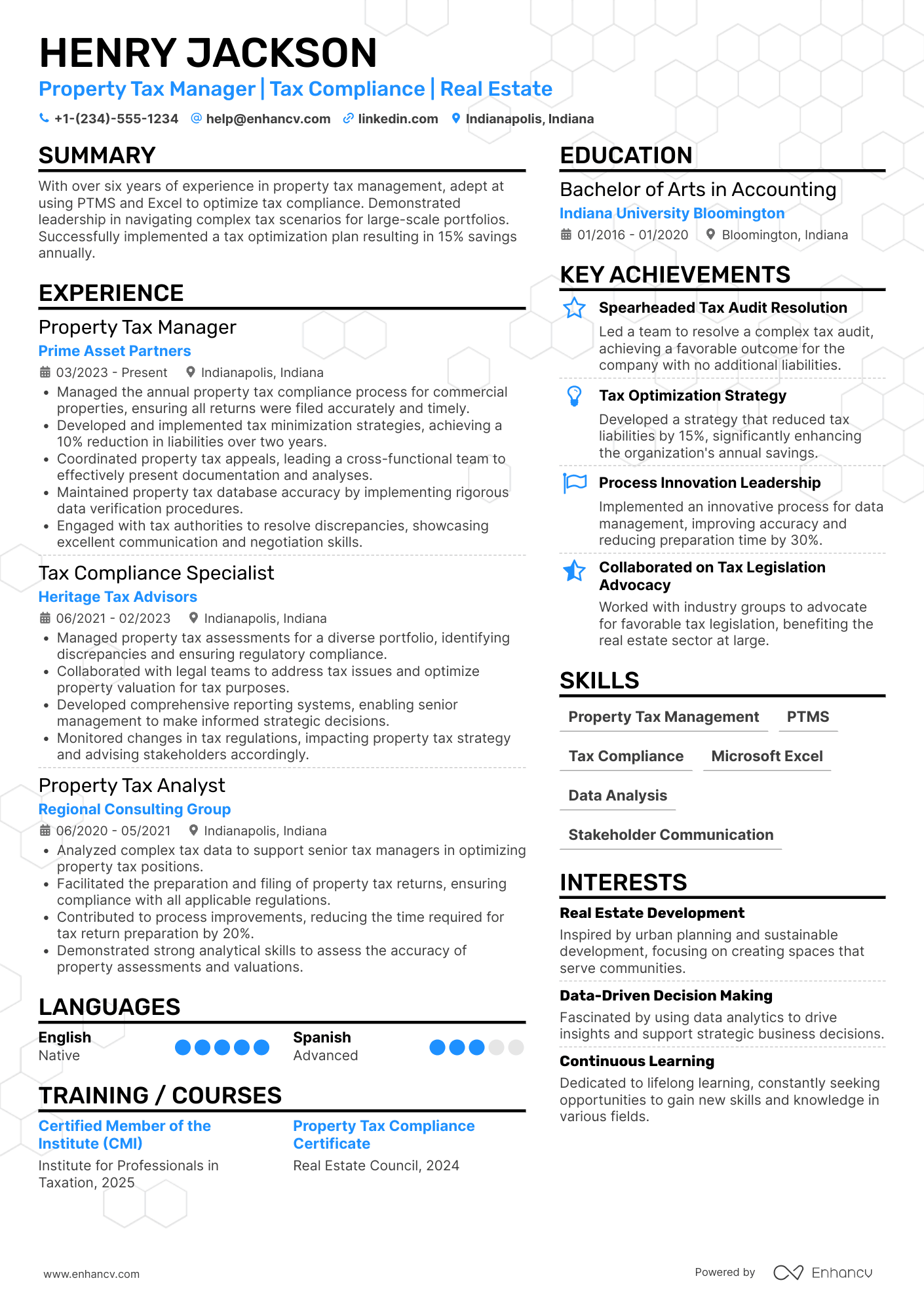
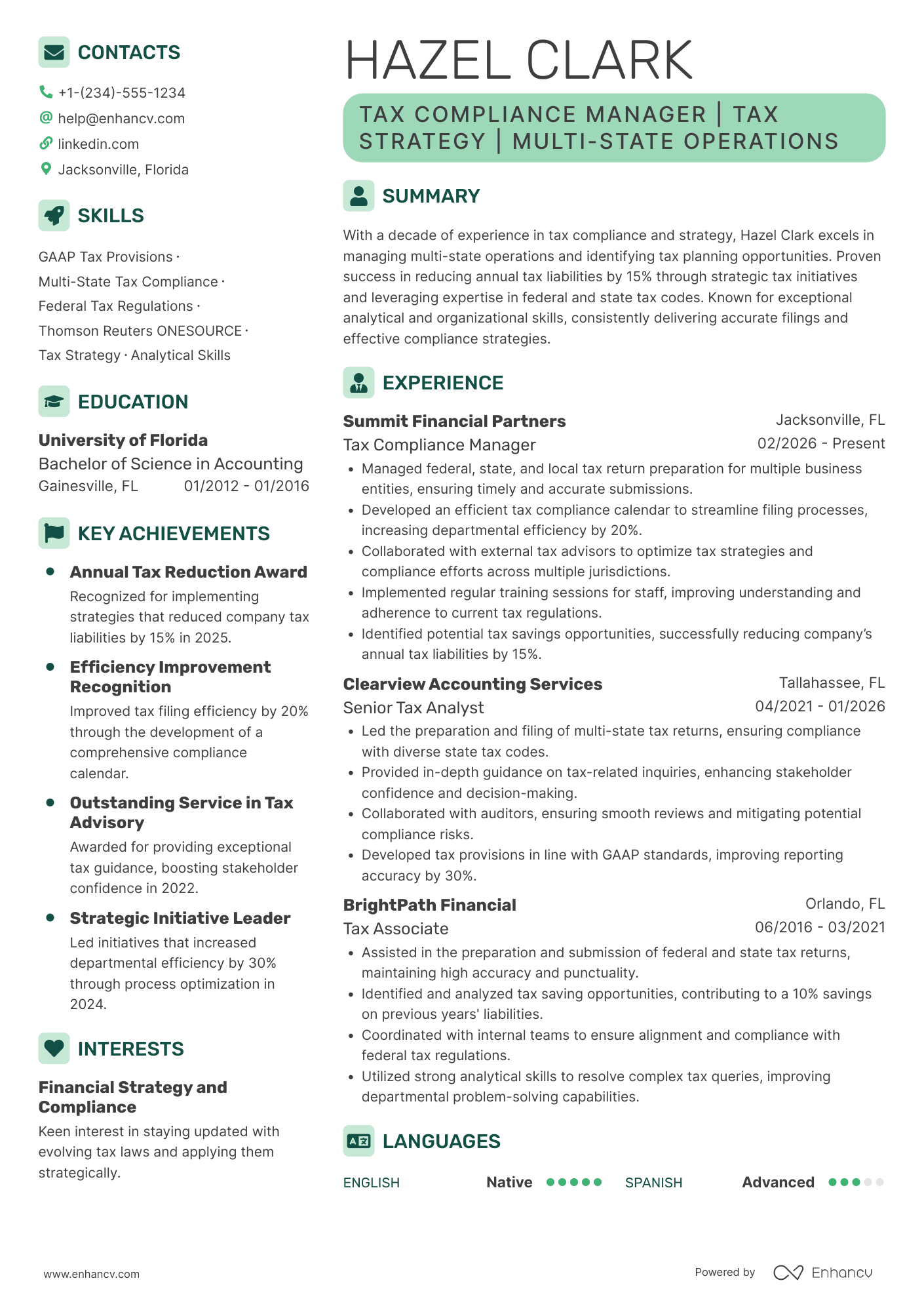
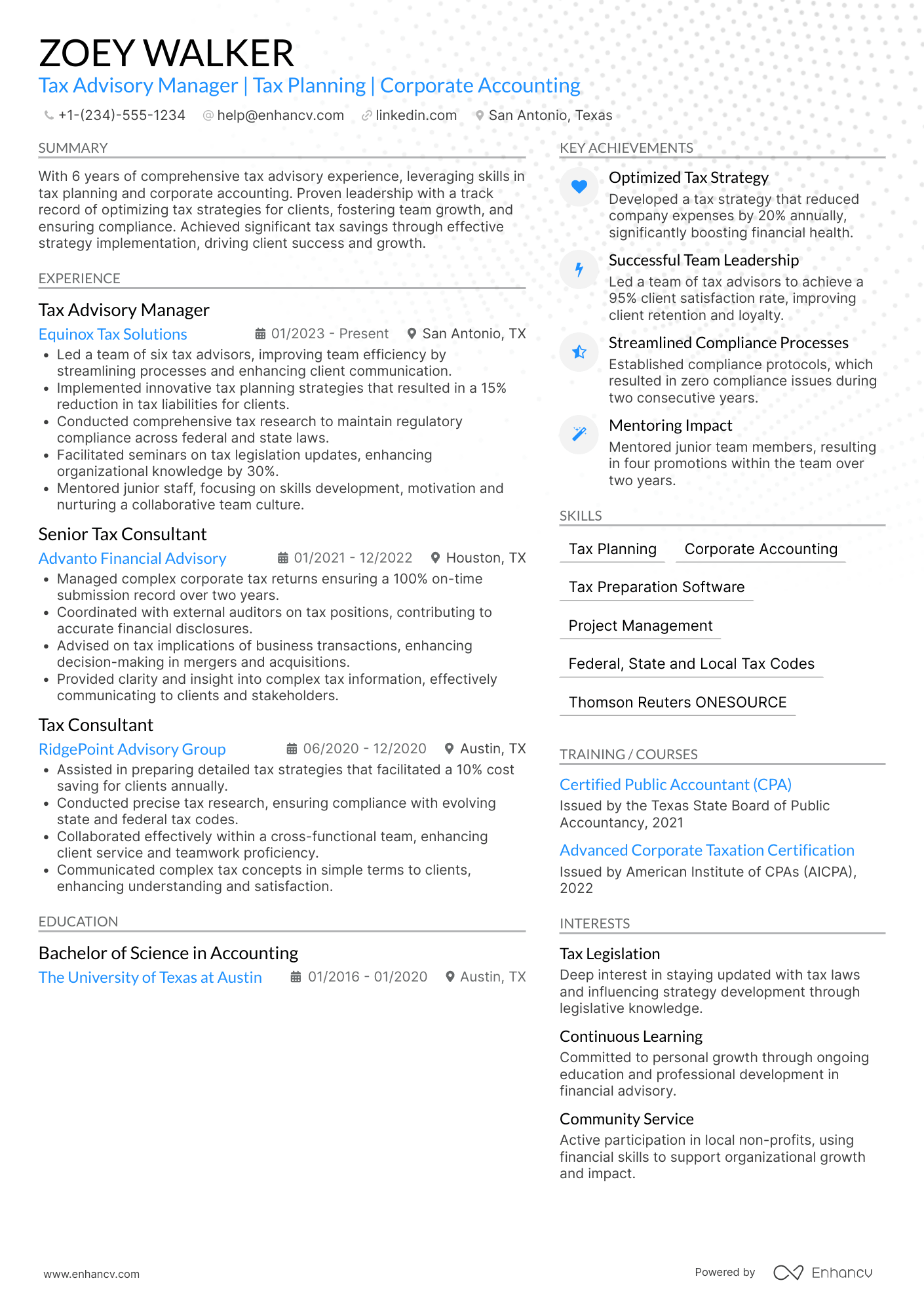
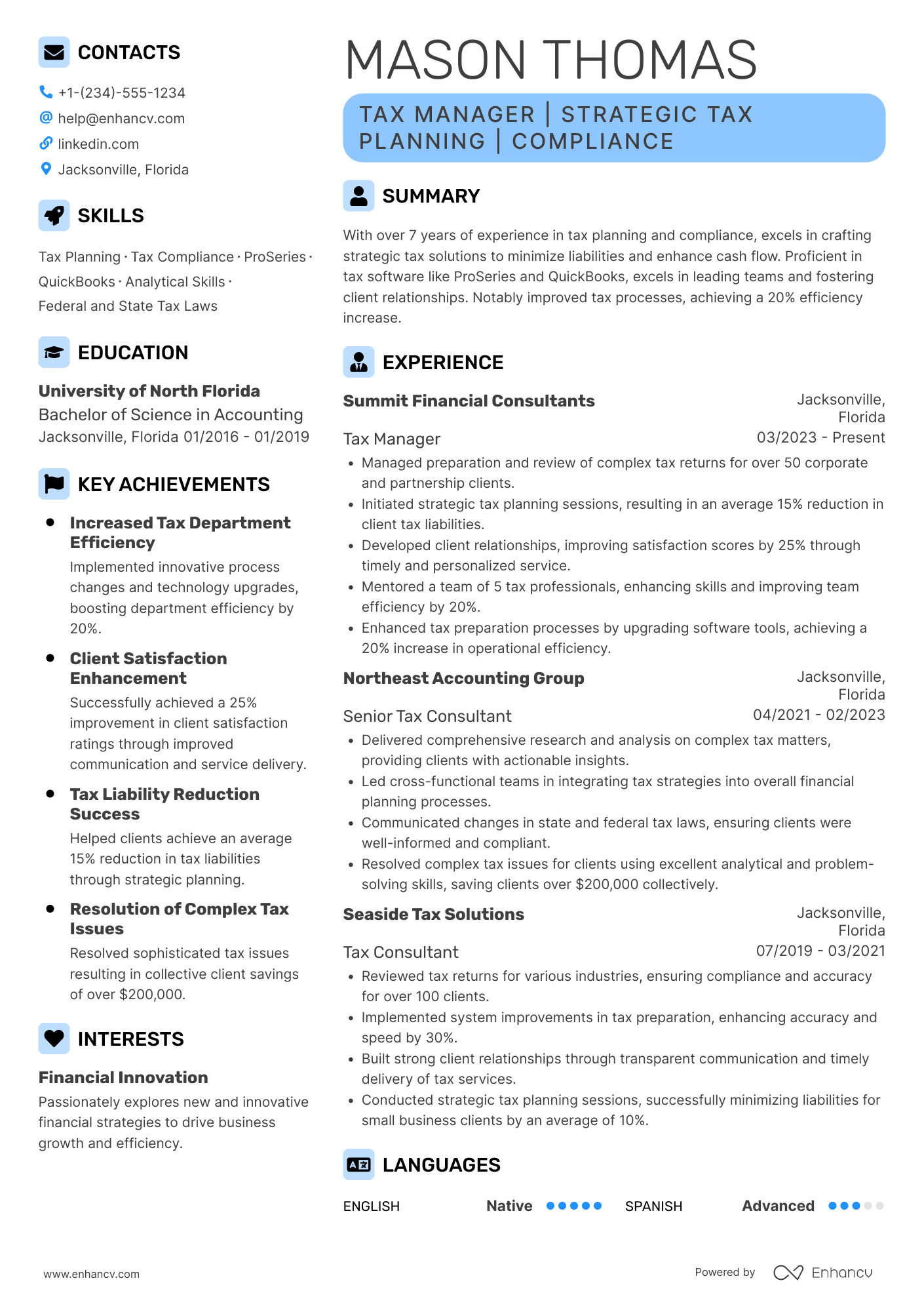
Many tax manager resume drafts fail because they bury impact under task lists and dense tax software details. That format gets filtered by ATS screening and missed in rapid recruiter scans, especially when competition is high.
A strong resume shows what you delivered and why it mattered. Knowing how to make your resume stand out starts with highlighting audit adjustments reduced, effective tax rate movement, filing accuracy, close timelines, dollars saved, jurisdictions managed, and risk exposure lowered. Quantify scope, deadlines met, and controls strengthened.

Key takeaways
- Quantify tax savings, audit outcomes, close timelines, and filing accuracy in every experience bullet.
- Use reverse-chronological format if you have two or more years of direct tax management experience.
- Mirror the job posting's exact software, frameworks, and compliance terminology throughout your resume.
- Demonstrate skills in your summary and experience sections, not just in a standalone skills list.
- Lead each role entry with scope: entities managed, jurisdictions covered, team size, and revenue exposure.
- List CPA, EA, or other certifications near your education to strengthen credibility at a glance.
- Use Enhancv to turn routine tax tasks into measurable, recruiter-ready resume bullets faster.
Job market snapshot for tax managers
We analyzed 917 recent tax manager job ads across major US job boards. These numbers help you understand experience requirements, skills in demand, industry demand at a glance.
What level of experience employers are looking for tax managers
| Years of Experience | Percentage found in job ads |
|---|---|
| 1–2 years | 6.5% (60) |
| 3–4 years | 27.0% (248) |
| 5–6 years | 18.4% (169) |
| 7–8 years | 5.0% (46) |
| 9–10 years | 1.4% (13) |
| 10+ years | 1.4% (13) |
| Not specified | 41.5% (381) |
Tax manager ads by area of specialization (industry)
| Industry (Area) | Percentage found in job ads |
|---|---|
| Finance & Banking | 92.0% (844) |
| Education | 4.0% (37) |
| Professional Services | 1.2% (11) |
Top companies hiring tax managers
| Company | Percentage found in job ads |
|---|---|
| PwC | 29.3% (269) |
| Aprio | 6.9% (63) |
| Deloitte | 6.7% (61) |
| RSM | 6.1% (56) |
| KPMG | 5.7% (52) |
| Baker Tilly Virchow Krause, LLP | 4.9% (45) |
| Elliot Davis | 2.7% (25) |
| Wipfli LLP | 2.5% (23) |
| Armanino McKenna Certified Public Accountants & Consultants | 2.3% (21) |
| Ernst & Young LLP | 2.1% (19) |
Role overview stats
These tables show the most common responsibilities and employment types for tax manager roles. Use them to align your resume with what employers expect and to understand how the role is structured across the market.
Day-to-day activities and top responsibilities for a tax manager
| Responsibility | Percentage found in job ads |
|---|---|
| Accounting | 36.2% (332) |
| Tax compliance | 30.1% (276) |
| Tax | 25.2% (231) |
| Project management | 21.5% (197) |
| Tax planning | 19.6% (180) |
| Technology | 19.5% (179) |
| Finance | 13.8% (127) |
| Client relationship management | 12.1% (111) |
| Coaching | 10.9% (100) |
| Us entities | 10.8% (99) |
| Excel | 9.5% (87) |
| Tax software | 8.7% (80) |
Type of employment (remote vs on-site vs hybrid)
| Employment type | Percentage found in job ads |
|---|---|
| On-site | 59.1% (542) |
| Hybrid | 38.6% (354) |
| Remote | 2.3% (21) |
How to format a tax manager resume
Recruiters evaluating tax manager candidates prioritize progressive leadership in tax operations, technical depth across compliance and planning domains, and measurable business impact such as reduced liabilities or improved audit outcomes. Choosing the right resume format ensures these signals surface immediately rather than getting buried beneath formatting that obscures your career trajectory.

I have significant experience in this role—which format should I use?
Use a reverse-chronological format—it's the strongest choice for experienced tax managers because it foregrounds your career progression and expanding scope of responsibility. Do:
- Lead each role entry with the scope of your oversight: team size, entity count, jurisdictional reach, and budget or tax exposure managed.
- Highlight technical command of role-specific domains such as ASC 740 provisions, multistate and international compliance, transfer pricing, R&D credits, and platforms like OneSource, Vertex, or Alteryx.
- Quantify outcomes tied to decisions you owned—savings generated, penalties avoided, audit cycle reductions, or process improvements that scaled.
I'm junior or switching into this role—what format works best?
A hybrid format works best because it lets you lead with relevant tax skills and technical proficiencies while still showing a clear work history timeline. Do:
- Place a dedicated skills section near the top featuring compliance areas, tax software, and analytical tools directly relevant to tax management responsibilities.
- Highlight transitional experience—tax analyst projects, busy-season engagements, or cross-functional work with controllers and auditors—that demonstrates readiness for a management-level role.
- Connect every listed skill or project to a concrete action and a measurable or observable result.
Why not use a functional resume?
A functional resume strips away the timeline and context that hiring managers rely on to assess a tax manager's growing authority over compliance cycles, team leadership, and strategic planning decisions. A functional format may be worth considering only in narrow situations:
- You're transitioning from public accounting or a tax advisory role into your first industry tax manager position and need to reframe client-facing work as operational leadership.
- You have a gap of one year or more in your work history but continued to maintain CPA licensure, completed relevant continuing education, or handled tax projects in a consulting or freelance capacity.
With your format established, the next step is filling it with the right sections to present your qualifications effectively.
What sections should go on a tax manager resume
Recruiters expect a tax manager resume to show progressive responsibility, technical tax expertise, and measurable business impact. Understanding which resume sections to include ensures maximum clarity.
Use this structure:
- Header
- Summary
- Experience
- Skills
- Projects
- Education
- Certifications
- Optional sections: Awards, Publications, Languages
Strong experience bullets should emphasize tax savings, risk reduction, audit outcomes, compliance accuracy, process improvements, and the scope of entities, jurisdictions, and teams you supported.
Is your resume good enough?
Drop your resume here or choose a file. PDF & DOCX only. Max 2MB file size.
With your resume’s key components in place, the next step is to detail your tax manager experience so each section supports a clear, results-focused narrative.
How to write your tax manager resume experience
The experience section is where you prove you've delivered real results as a tax manager—through the compliance frameworks you've managed, the tax planning strategies you've executed, and the measurable savings or efficiencies you've driven. Hiring managers prioritize demonstrated impact over descriptive task lists, so every bullet should connect your work to an outcome the business cared about.
Each entry should include:
- Job title
- Company and location (or remote)
- Dates of employment (month and year)
Three to five concise bullet points showing what you owned, how you executed, and what outcomes you delivered:
- Ownership scope: the tax functions, filing jurisdictions, entity structures, or teams you were directly accountable for as a tax manager.
- Execution approach: the tax software, research platforms, regulatory frameworks, or analytical methods you used to guide decisions and deliver compliant, optimized work.
- Value improved: changes to tax liability accuracy, audit readiness, compliance timelines, reporting efficiency, or risk exposure that resulted from your efforts.
- Collaboration context: how you partnered with controllers, external auditors, legal counsel, finance leadership, or revenue teams to align tax strategy with broader business objectives.
- Impact delivered: outcomes expressed through reduced exposure, faster close cycles, successful audit resolutions, or strategic savings rather than routine activities.
Experience bullet formula
A tax manager experience example
✅ Right example - modern, quantified, specific.
Tax Manager
NorthBridge Manufacturing | Chicago, IL
2021–Present
Multi-entity manufacturer with $650M annual revenue operating across twelve states and three international subsidiaries.
- Led ASC 740 income tax provision and quarterly close in OneSource Tax Provision and SAP, cutting close cycle from nine to six business days and reducing true-up variance by 18%.
- Directed federal and state compliance for eight entities using OneSource Income Tax and Alteryx workflows, improving on-time filing from 92% to 100% and eliminating $240K in late-payment and penalty exposure.
- Implemented transfer pricing documentation and intercompany chargeback controls with Finance and Legal, lowering audit adjustments by 35% and supporting $18M in cross-border transactions.
- Built an audit-ready sales and use tax governance program in Avalara and Excel Power Query with Operations and IT, reducing exemption certificate gaps by 60% and preventing $410K in assessed tax.
- Partnered with FP&A and external advisors to model R&D and domestic production incentives, securing $1.3M in credits and improving effective tax rate by 0.7 points.
Now that you've seen how a strong experience section comes together, let's look at how to adjust yours to match the specific role you're targeting.
How to tailor your tax manager resume experience
Recruiters evaluate your tax manager resume through both human review and applicant tracking systems (ATS), so tailoring your resume to the job description is essential. Aligning your language and accomplishments with the specific role increases your chances of passing both screenings.
Ways to tailor your tax manager experience:
- Mirror the exact tax software and ERP platforms listed in the posting.
- Match terminology for compliance frameworks and regulatory standards referenced.
- Reflect the specific tax types like federal state or international mentioned.
- Highlight industry experience that aligns with the company's sector.
- Use the same language for reporting cycles and filing deadlines described.
- Emphasize team leadership or cross-functional collaboration if the role requires it.
- Include audit coordination experience when the posting references audit readiness.
- Align your results with the KPIs or performance measures they prioritize.
Tailoring means connecting your real accomplishments to the job requirements, not forcing keywords where they don't belong.
Resume tailoring examples for tax manager
| Job description excerpt | Untailored | Tailored |
|---|---|---|
| Manage federal and multi-state corporate tax compliance for entities with $500M+ in annual revenue using OneSource Tax Provision | Handled tax compliance tasks and prepared returns for the company. | Managed federal and multi-state corporate tax compliance for 12 entities generating over $500M in annual revenue, leveraging Thomson Reuters OneSource Tax Provision to streamline quarterly and annual filings. |
| Lead ASC 740 income tax provision process, including coordination with external auditors and preparation of deferred tax calculations | Assisted with tax provisions and worked with auditors during year-end close. | Led the end-to-end ASC 740 income tax provision process, preparing deferred tax asset and liability calculations and coordinating directly with Big Four external auditors to resolve provision-related inquiries within a two-week review cycle. |
| Identify and implement tax planning strategies to reduce effective tax rate, including R&D tax credit studies and fixed asset cost segregation analyses | Helped find ways to reduce the company's tax burden. | Identified and executed tax planning strategies—including R&D tax credit studies and cost segregation analyses on $80M in fixed assets—that reduced the consolidated effective tax rate by 3.2 percentage points over two fiscal years. |
Once you’ve aligned your experience with the role’s priorities, quantify your achievements to show the measurable impact of that work.
How to quantify your tax manager achievements
Quantifying your achievements proves business impact beyond compliance. For tax managers, focus on close cycle time, filing accuracy, audit outcomes, cash savings, and risk reduction across entities, jurisdictions, and systems.
Quantifying examples for tax manager
| Metric | Example |
|---|---|
| Close cycle time | "Cut the tax provision close from 10 to seven business days by standardizing workpapers in Excel and Alteryx and tightening reviewer checkpoints." |
| Filing accuracy | "Reduced amended returns by 40% year over year by implementing a return-to-provision tie-out and validation rules in the applicant tracking system (applicant tracking system)." |
| Compliance volume | "Managed 120+ federal, state, and local filings annually across eight entities, maintaining a 99% on-time filing rate using OneSource and a shared calendar." |
| Audit risk | "Resolved an Internal Revenue Service audit with zero adjustments on $85M in intercompany charges by strengthening transfer pricing documentation and reconciliation support." |
| Cash tax savings | "Identified $650K in state tax credits and apportionment savings by reworking nexus analysis and modeling scenarios in Excel with external advisors." |
Turn your everyday tasks into measurable, recruiter-ready resume bullets in seconds with Enhancv's Bullet Point Generator.
Once you've crafted strong bullet points to showcase your experience, you'll want to pair them with a well-organized skills section that highlights both your hard and soft skills.
How to list your hard and soft skills on a tax manager resume
Your skills section shows you can deliver compliant, accurate filings and manage risk—recruiters scan them to confirm fit, and ATS software matches them to job keywords—so aim for a balanced mix of hard skills like tax expertise and role-specific soft skills. tax manager roles require a blend of:
- Product strategy and discovery skills.
- Data, analytics, and experimentation skills.
- Delivery, execution, and go-to-market discipline.
- Soft skills.
Your skills section should be:
- Scannable (bullet-style grouping).
- Relevant to the job post.
- Backed by proof in experience bullets.
- Updated with current tools.
Place your skills section:
- Above experience if you're junior or switching careers.
- Below experience if you're mid/senior with strong achievements.

Hard skills
- Federal and state income tax
- ASC 740 tax provision
- Tax return review and sign-off
- Partnership and S corporation tax
- Corporate income tax compliance
- Sales and use tax
- International tax basics, GILTI, FDII
- Transfer pricing documentation
- Tax research, IRC, Treasury regs
- Tax planning and structuring
- Workpapers, trial balance tie-out
- Alteryx, Excel, Power Query
Soft skills
- Lead multi-entity close timelines
- Translate tax impact to finance
- Manage reviewer and preparer workflows
- Resolve notices with tax authorities
- Prioritize high-risk issues fast
- Coach staff through review notes
- Align with audit and legal teams
- Drive process improvements in compliance
- Document positions and assumptions clearly
- Push back with data and standards
- Communicate deadlines and dependencies
- Own deliverables end-to-end
How to show your tax manager skills in context
Skills shouldn't live only in a dedicated skills list. Explore examples of resume skills to see how they can be woven throughout your application.
They should be demonstrated in:
- Your summary (high-level professional identity)
- Your experience (proof through outcomes)
Here's how that looks in practice.
Summary example
Senior tax manager with 12 years in corporate tax compliance and provision across manufacturing. Skilled in ASC 740, OneSource, and cross-functional leadership. Reduced effective tax rate by 3.2% through strategic planning and process automation.
- Signals senior-level depth immediately
- Names industry-specific tools and standards
- Leads with a measurable tax outcome
- Highlights cross-functional leadership ability
Experience example
Senior Tax Manager
Alcott Industrial Group | Chicago, IL
March 2019–Present
- Directed quarterly ASC 740 provisions using OneSource, cutting close timelines by 30% and eliminating two recurring audit findings.
- Partnered with FP&A and legal teams to restructure intercompany transactions, generating $1.8M in annual tax savings.
- Implemented automated state apportionment workflows in Alteryx, reducing manual data entry errors by 65% across six entities.
- Every bullet includes a measurable outcome.
- Skills surface naturally through real accomplishments.
Once you’ve demonstrated your tax manager strengths through relevant examples, the next step is applying that approach to a tax manager resume when you lack direct experience.
How do I write a tax manager resume with no experience
Even without full-time experience, you can demonstrate readiness. Writing a resume without work experience is possible through:
- Volunteer tax clinic return preparation
- Advanced tax coursework capstone project
- Tax research memos using CCH
- Internship supporting tax provision workpapers
- VITA site leadership and review
- IRS Enrolled Agent exam progress
- University tax case competition results
- Pro bono small business filings
Focus on:
- Tax compliance scope and volume
- Research quality with citations
- Tools: Excel, CCH, Thomson Reuters
- Review-ready workpapers and controls
Resume format tip for entry-level tax manager
Use a hybrid resume format because it highlights tax manager skills and projects first, while still showing internships, volunteer work, and education. Do:
- Lead with a "Tax Projects" section.
- Quantify returns, entities, and hours.
- Name tools used in each bullet.
- Add research citations and conclusions.
- Include review steps and checklists.
- Led VITA site return reviews in Excel, standardized a QA checklist, and reduced filing errors by 18% across 120 individual returns.
Even without direct experience, your education section can carry significant weight on a tax manager resume—here's how to present it effectively.
How to list your education on a tax manager resume
Your education section helps hiring teams confirm you have the foundational accounting and tax knowledge a tax manager needs. It validates your academic background quickly and efficiently.
Include:
- Degree name
- Institution
- Location
- Graduation year
- Relevant coursework (for juniors or entry-level candidates)
- Honors & GPA (if 3.5 or higher)
Skip month and day details—list the graduation year only.
Here's a strong education entry tailored to a tax manager resume:
Example education entry
Master of Science in Taxation
Georgetown University, Washington, D.C.
Graduated 2018
GPA: 3.8/4.0
- Relevant Coursework: Corporate Tax Strategy, Federal Income Taxation, Partnership Taxation, Tax Research and Practice
- Honors: Dean's List, Beta Alpha Psi National Honor Society
How to list your certifications on a tax manager resume
Certifications on your resume show a tax manager's commitment to learning, proficiency with current tools, and alignment with industry standards, which strengthens credibility with employers and clients.
Include:
- Certificate name
- Issuing organization
- Year
- Optional: credential ID or URL
- List certifications below education when your degree is recent and directly relevant, and your certifications mainly support your core qualifications.
- List certifications above education when they are recent, highly relevant to tax manager work, or required for the roles you target.
Best certifications for your tax manager resume
Certified Public Accountant (CPA) Enrolled Agent (EA) Chartered Global Management Accountant (CGMA) Certified Management Accountant (CMA) Certified Internal Auditor (CIA) Accredited Tax Advisor (ATA) Certified Fraud Examiner (CFE)
Once you’ve positioned your credentials where hiring teams can spot them quickly, shift to writing your tax manager resume summary to reinforce those qualifications upfront.
How to write your tax manager resume summary
Your resume summary is the first thing a recruiter reads, so it needs to earn their attention fast. A strong tax manager summary signals your expertise, leadership, and measurable impact in seconds.
Keep it to three to four lines, with:
- Your title and total years of experience in tax or accounting.
- Domain focus, such as corporate tax, multistate compliance, or international tax.
- Core tools and skills like tax provision software, ASC 740, or ERP systems.
- One or two quantified achievements, such as savings delivered or audit outcomes.
- Soft skills tied to real outcomes, like cross-functional collaboration or mentoring staff.

PRO TIP
At the manager level, emphasize ownership of tax processes, team leadership, and measurable results you drove. Highlight scope—how many entities, jurisdictions, or direct reports you managed. Avoid vague descriptors like "detail-oriented" or "passionate." Skip motivation statements. Let concrete outcomes speak for your value.
Example summary for a tax manager
Tax manager with eight years of experience leading corporate tax compliance across 12 states. Reduced effective tax rate by 3.2% through strategic credits and deductions using OneSource and SAP.
Optimize your resume summary and objective for ATS
Drop your resume here or choose a file.
PDF & DOCX only. Max 2MB file size.
Now that your summary communicates your value as a tax professional, make sure your header presents the essential contact and identification details hiring managers need to reach you.
What to include in a tax manager resume header
A resume header is the top section with your key identifiers, and it boosts visibility, credibility, and recruiter screening for a tax manager role.
Essential resume header elements
- Full name
- Tailored job title and headline
- Location
- Phone number
- Professional email
- GitHub link
- Portfolio link
A LinkedIn link helps recruiters verify experience quickly and supports screening.
Don't include a photo on a tax manager resume unless the role is explicitly front-facing or appearance-dependent.
Match your header job title to the posting and keep your contact details consistent across your resume, LinkedIn, and applications.
Example
Tax manager resume header
Jordan Taylor
Tax manager — Corporate Tax Compliance and Provision (ASC 740)
Chicago, IL
(312) 555-78XX
your.name@enhancv.com
github.com/yourname
yourwebsite.com
linkedin.com/in/yourname
Once your contact details and key identifiers are set at the top, you can strengthen the rest of your application by adding additional sections that support your qualifications.
Additional sections for tax manager resumes
When your core qualifications match other candidates, additional sections can set you apart and reinforce your credibility as a tax manager.
- Languages
- Professional affiliations (e.g., AICPA, Tax Executives Institute)
- Publications and tax research
- Continuing professional education
- Industry speaking engagements
- Volunteer tax preparation (e.g., VITA program)
Once you've rounded out your resume with the right supplementary sections, it's worth turning your attention to the document that accompanies it—your cover letter.
Do tax manager resumes need a cover letter
A cover letter isn't required for a tax manager, but it helps in competitive searches and at firms that expect one. Understanding what a cover letter is and how to use it effectively can make a difference when several candidates have similar technical backgrounds.
Use your cover letter to add context your tax manager resume can't show:
- Explain team fit by naming the tax manager scope you've handled, such as federal, state and local, international, or provision work.
- Highlight one or two outcomes, such as closing a filing gap, reducing audit exposure, or improving provision timelines with a clear metric.
- Show business context by referencing the company's revenue model, entity structure, or growth plans, and how that affects tax risk and planning.
- Address transitions or non-obvious experience, such as moving from public accounting to industry, or shifting from compliance into planning or provision.
Drop your resume here or choose a file.
PDF & DOCX only. Max 2MB file size.
Even if you decide a cover letter adds value for your tax manager application, using AI to improve your tax manager resume is the next step to strengthen the document hiring teams review first.
Using AI to improve your tax manager resume
AI can sharpen your resume's clarity, structure, and impact. It helps refine language and highlight results. But overuse strips authenticity. Once your content is clear and role-aligned, step away from AI. If you're exploring this approach, learn more about which AI is best for writing resumes to choose the right tool.
Here are 10 practical prompts to strengthen specific sections of your tax manager resume:
Strengthen your summary
Quantify experience bullets
Align skills with job posting
Tighten wordy bullets
Improve action verbs
Refine certification descriptions
Clarify project contributions
Tailor education details
Remove filler language
Check consistency throughout
Conclusion
A strong tax manager resume shows measurable outcomes, role-specific skills, and a clear structure. Use metrics that prove impact on compliance accuracy, audit results, close timelines, and tax savings. Keep sections scannable, and align your experience with the job posting.
This approach signals readiness for today’s hiring market and near-future needs. It shows you can lead filings, manage risk, partner across teams, and improve processes. With focused results and clean formatting, your tax manager resume becomes easy to trust.
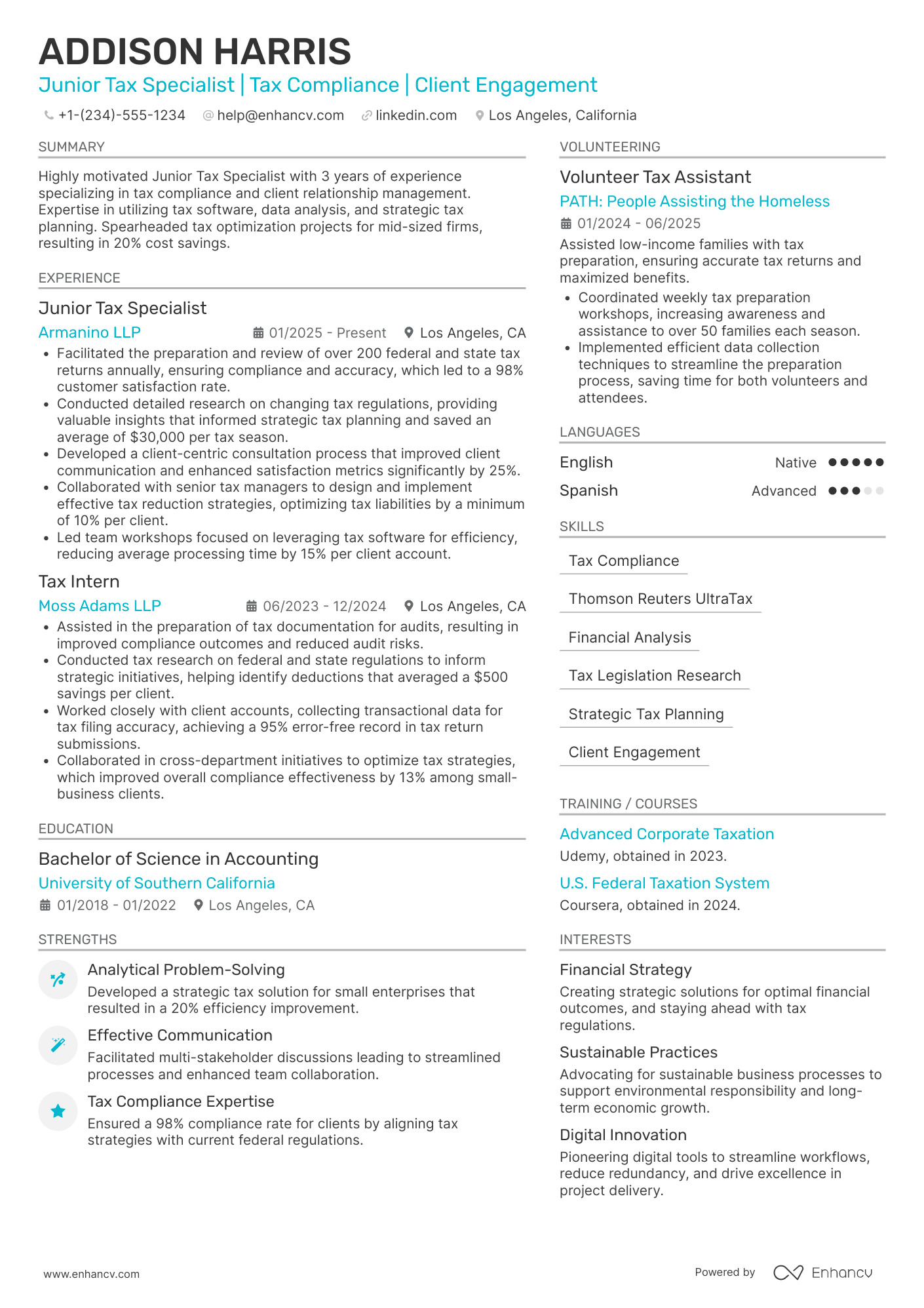
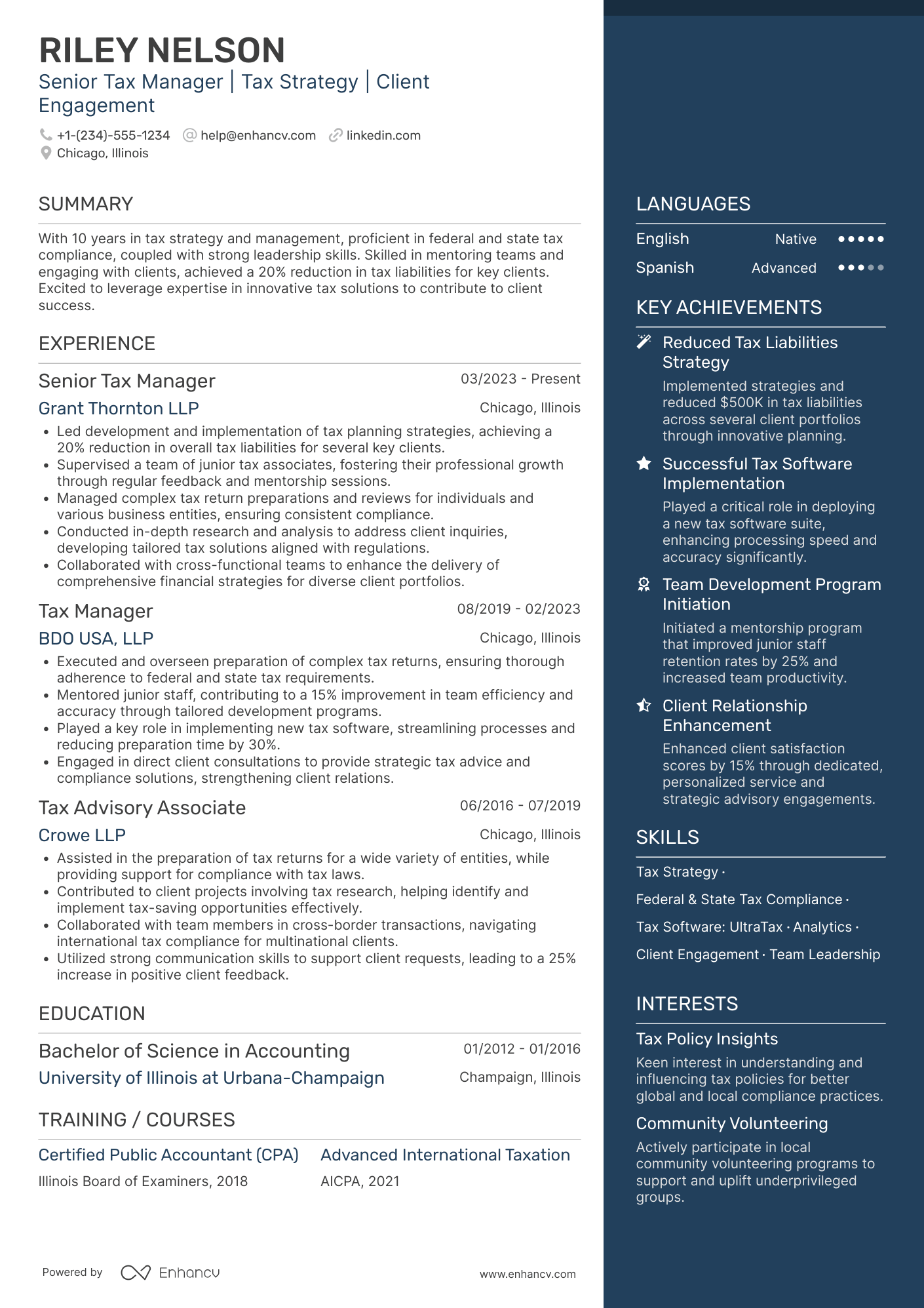
Tax Manager resume examples
By Experience
By Role