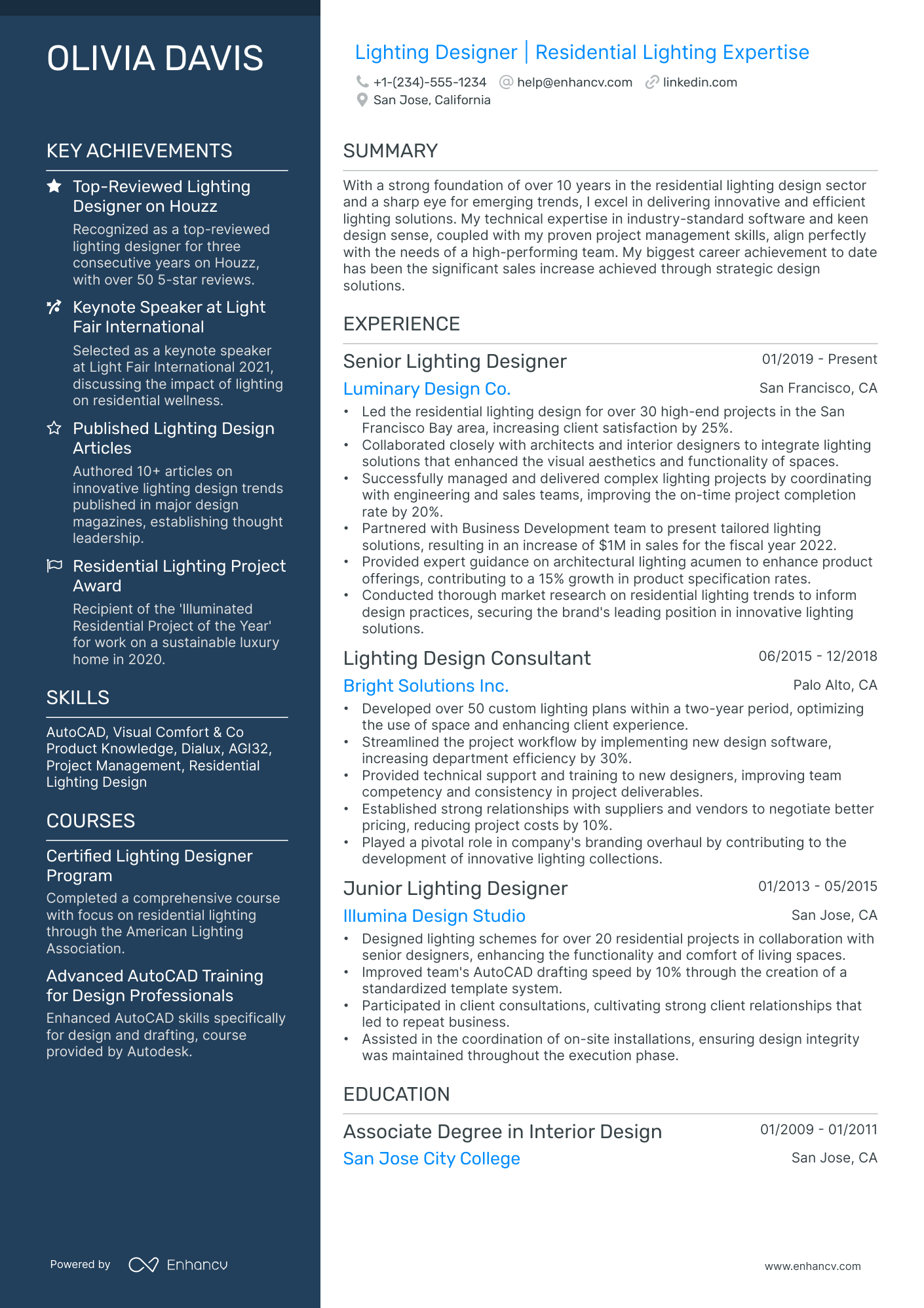
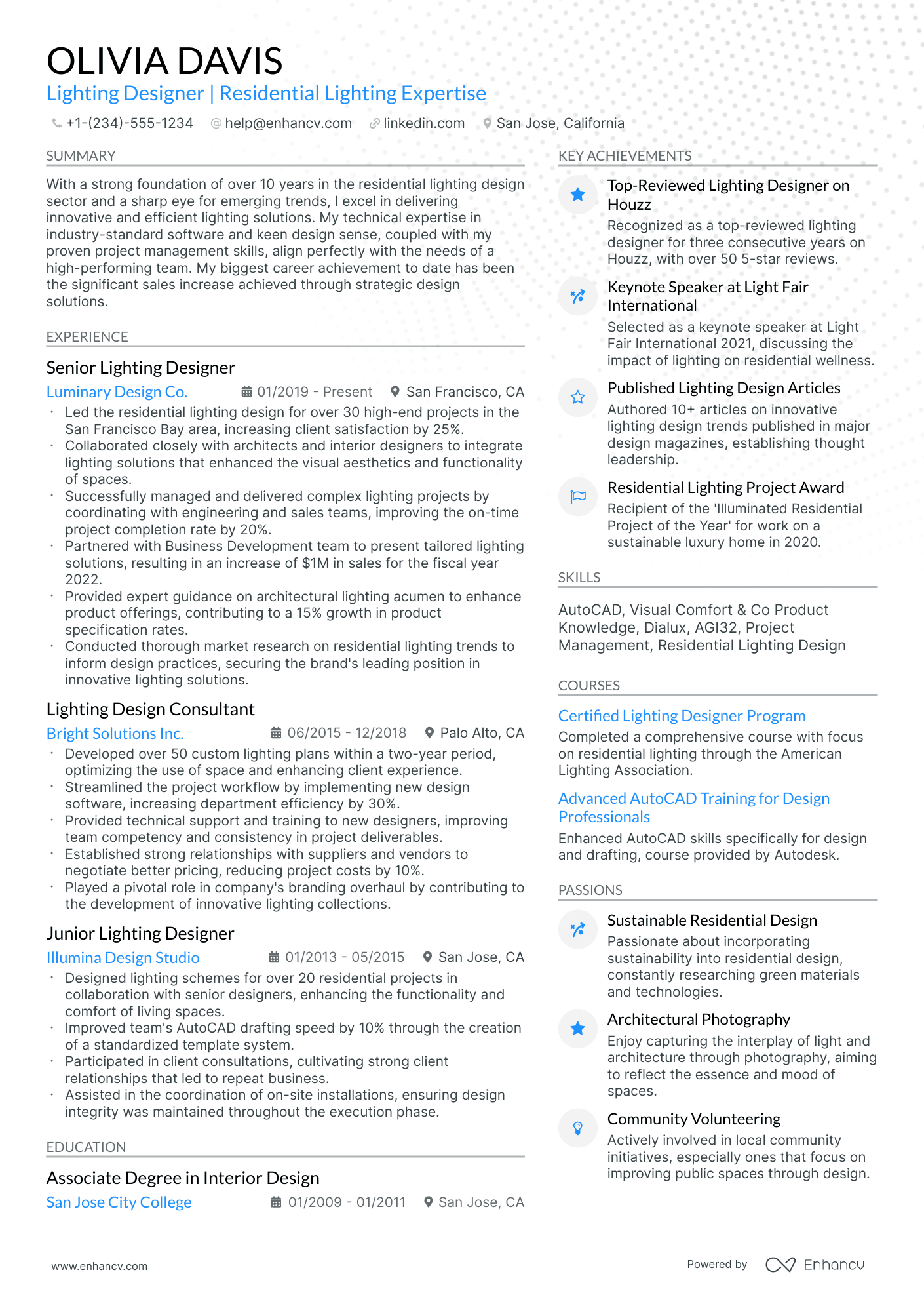
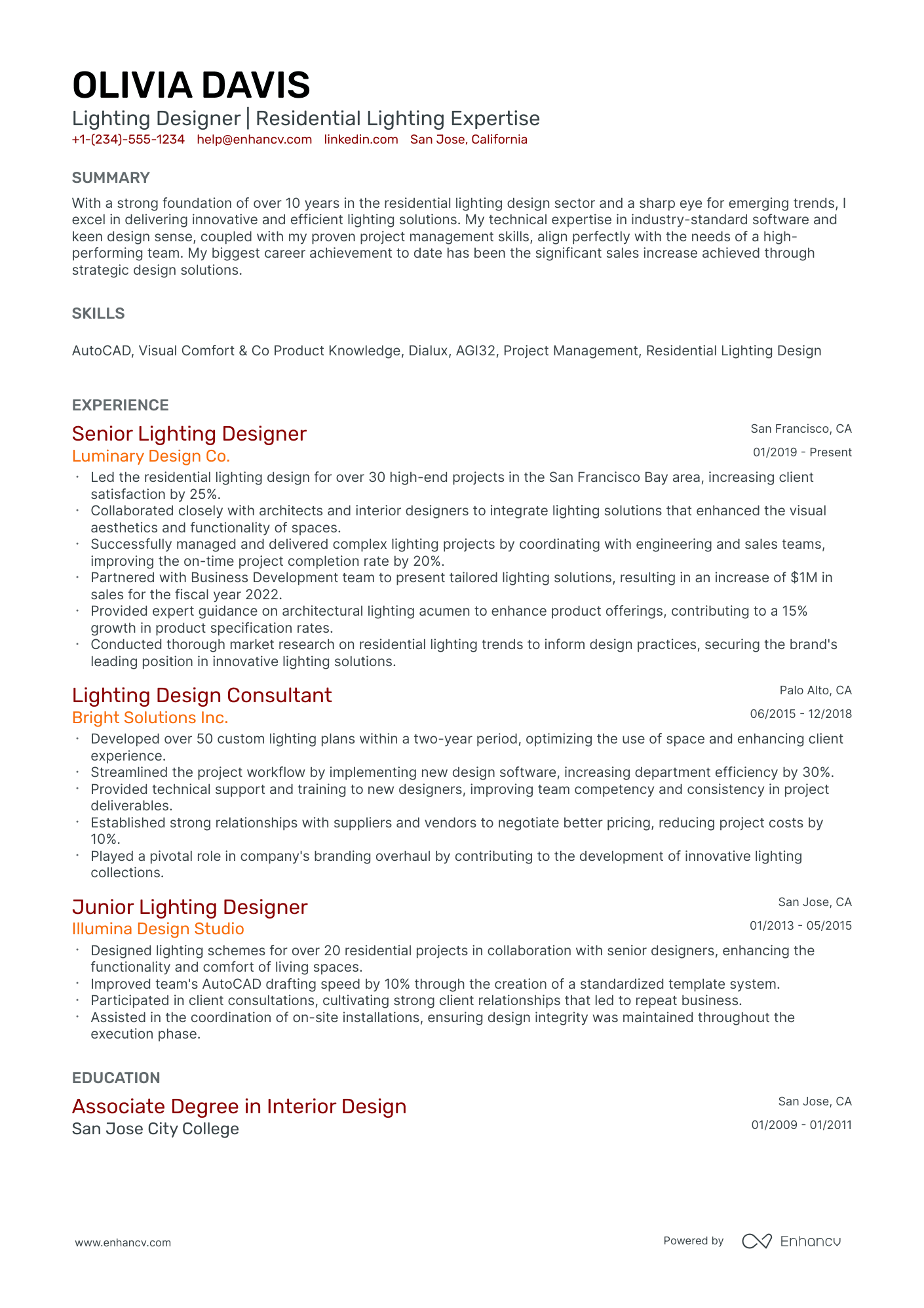
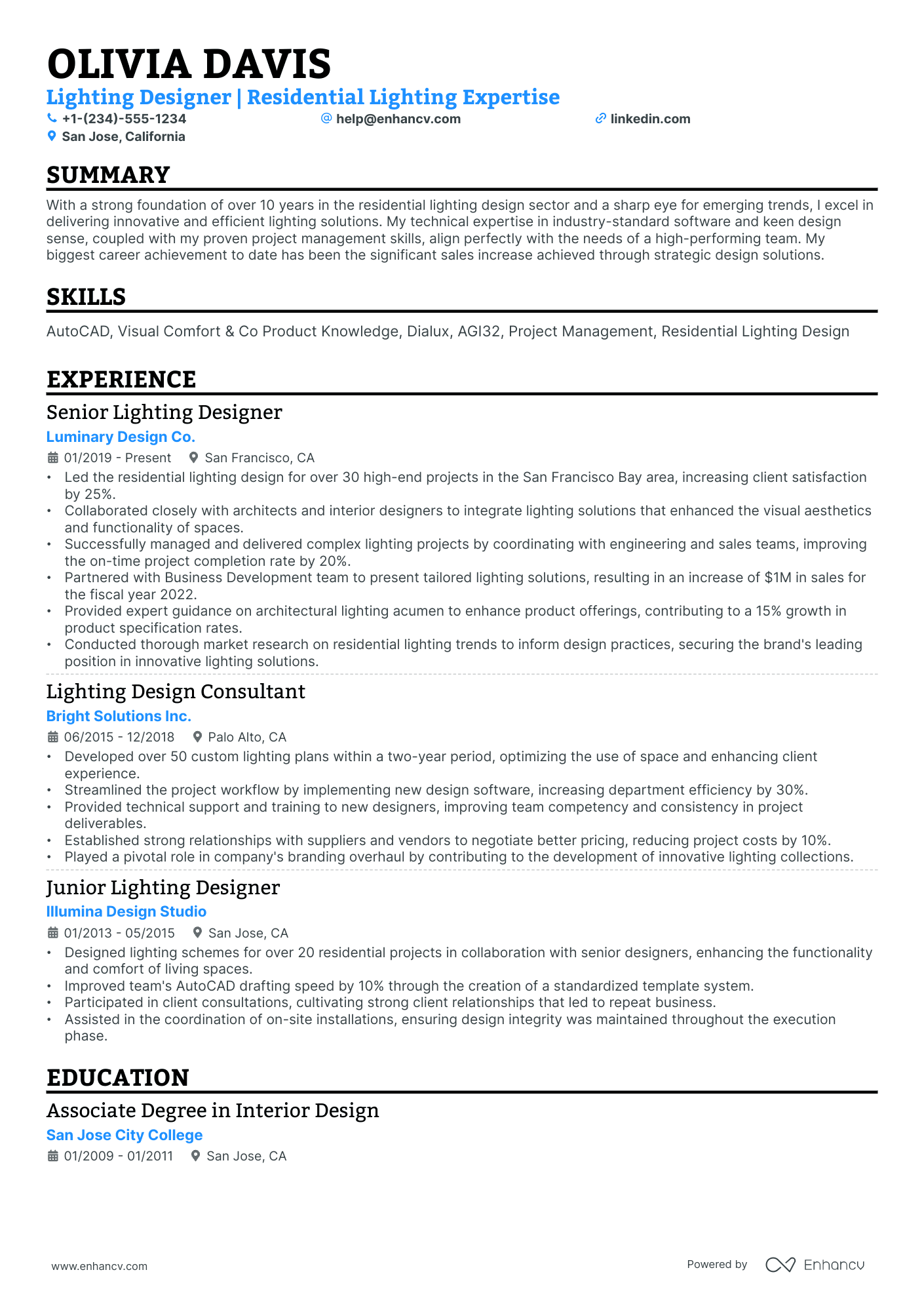
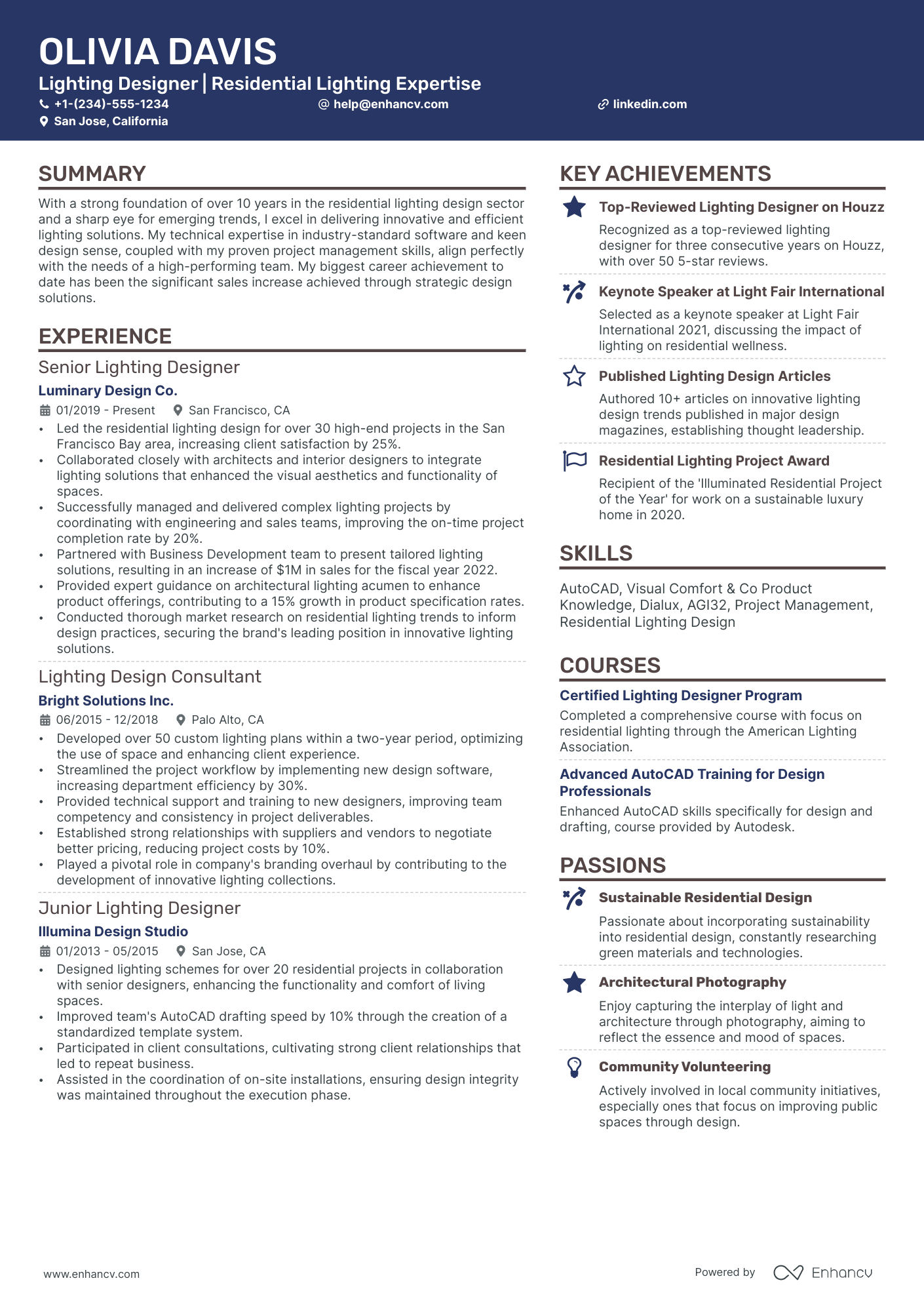
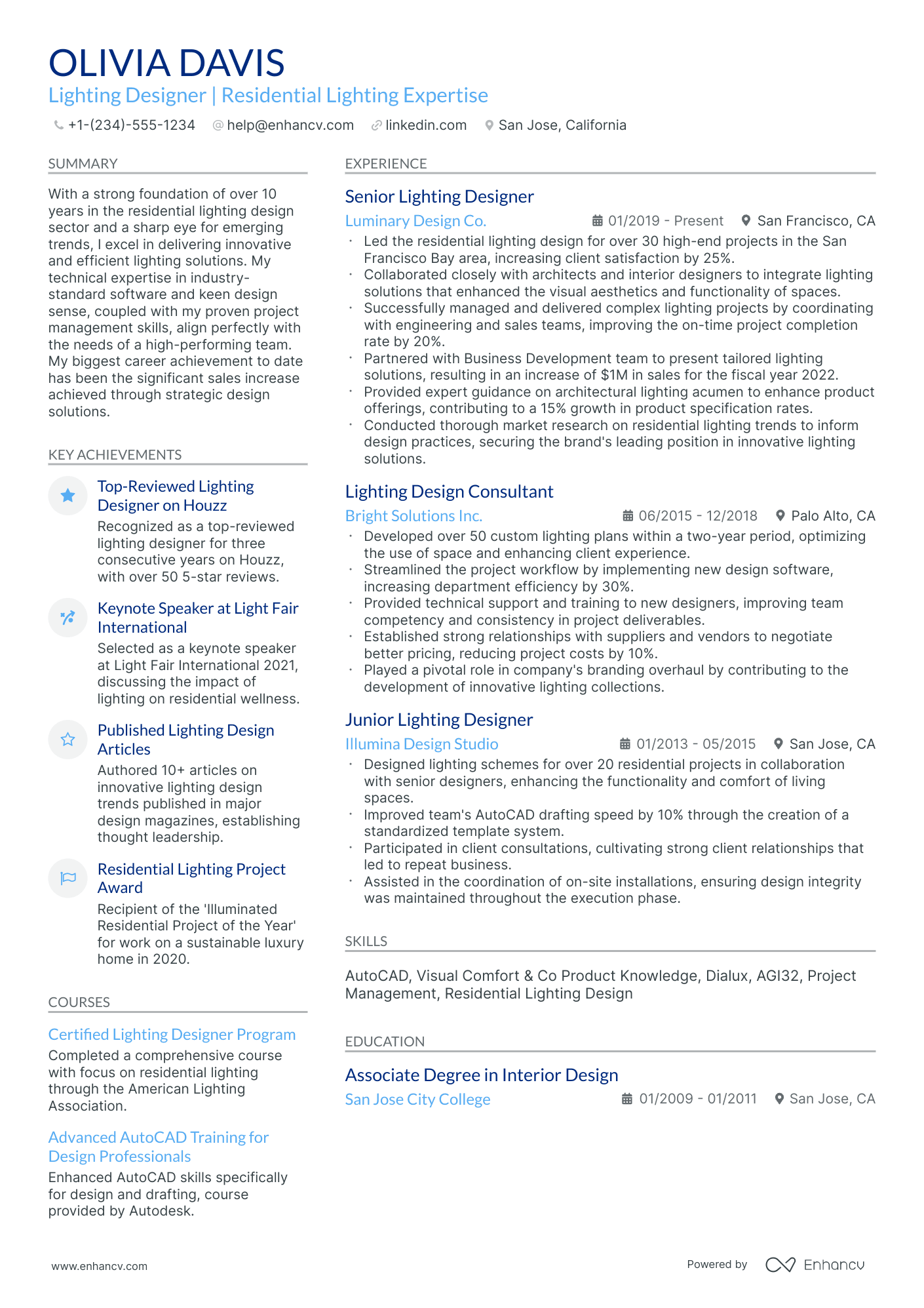
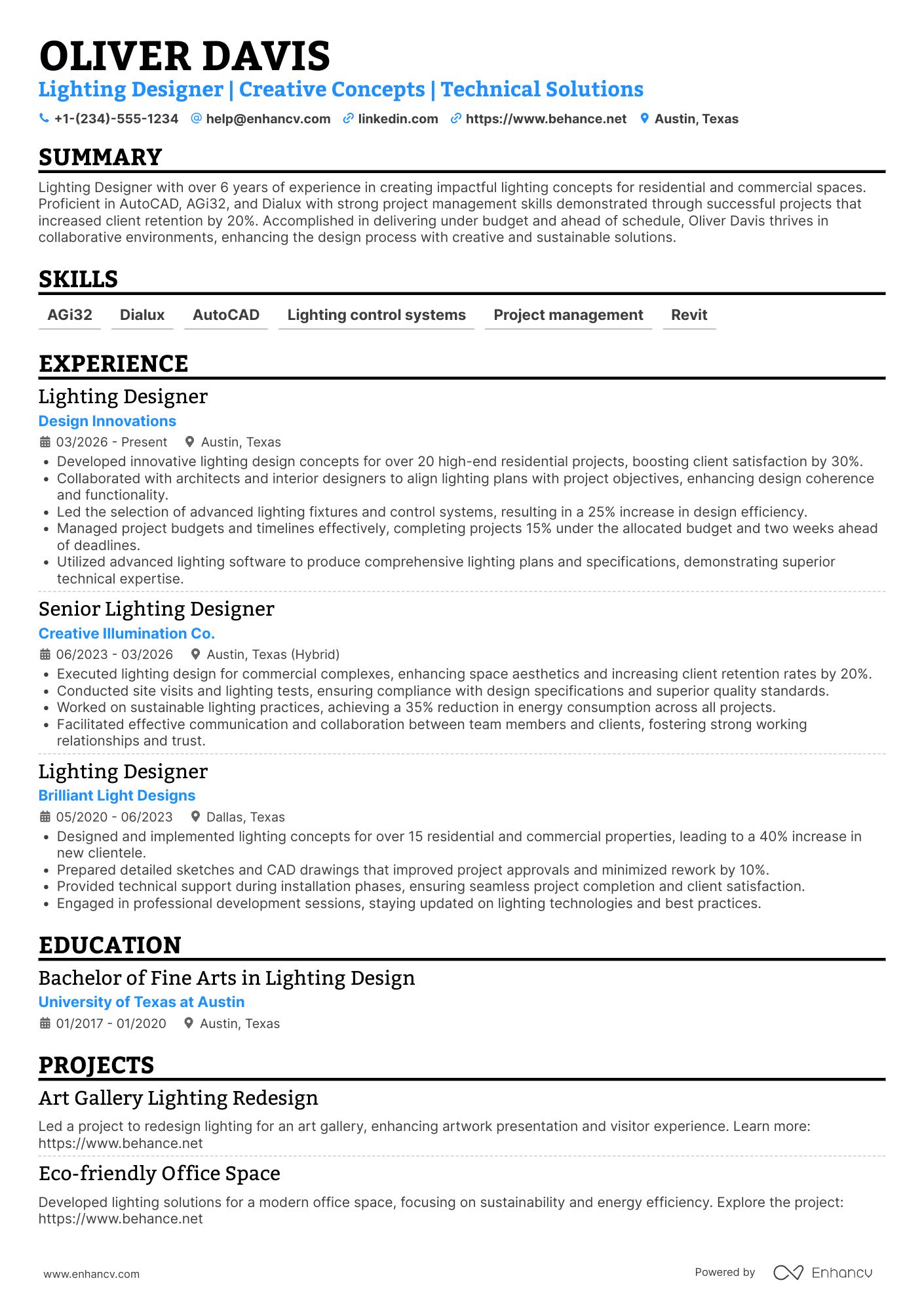
Many lighting designer resume drafts fail because they read like gear lists and cue sheets, not proof of production impact. That hurts in ATS screening and quick recruiter scans, where competition is high and context disappears.
A strong resume shows what you delivered and why it mattered. Knowing how to make your resume stand out starts with highlighting on-time tech, fewer cue errors, consistent looks across venues, audience sightline improvements, budget savings, and safer load-ins. Quantify rig size, show count, and turnaround time.

Key takeaways
- Quantify lighting achievements with metrics like energy savings, cue counts, and budget performance.
- Use reverse-chronological format for experienced designers and hybrid format for career changers.
- Tailor every experience bullet to mirror the job posting's tools, standards, and venue types.
- Anchor each listed skill to a specific project, outcome, or production context.
- Lead your summary with years of experience, domain focus, and one measurable result.
- Include a cover letter when your resume needs context about transitions or standout projects.
- Use Enhancv's tools to tighten bullet points and align your resume with role-specific requirements.
How to format a lighting designer resume
Recruiters reviewing lighting designer resumes prioritize a strong portfolio of completed projects, proficiency with industry-standard tools like AutoCAD, Vectorworks, and AGi32, and evidence of creative problem-solving balanced with technical precision. The right resume format ensures these signals—your project scope, design versatility, and measurable results—are immediately visible rather than buried beneath an unclear structure.

I have significant experience in this role—which format should I use?
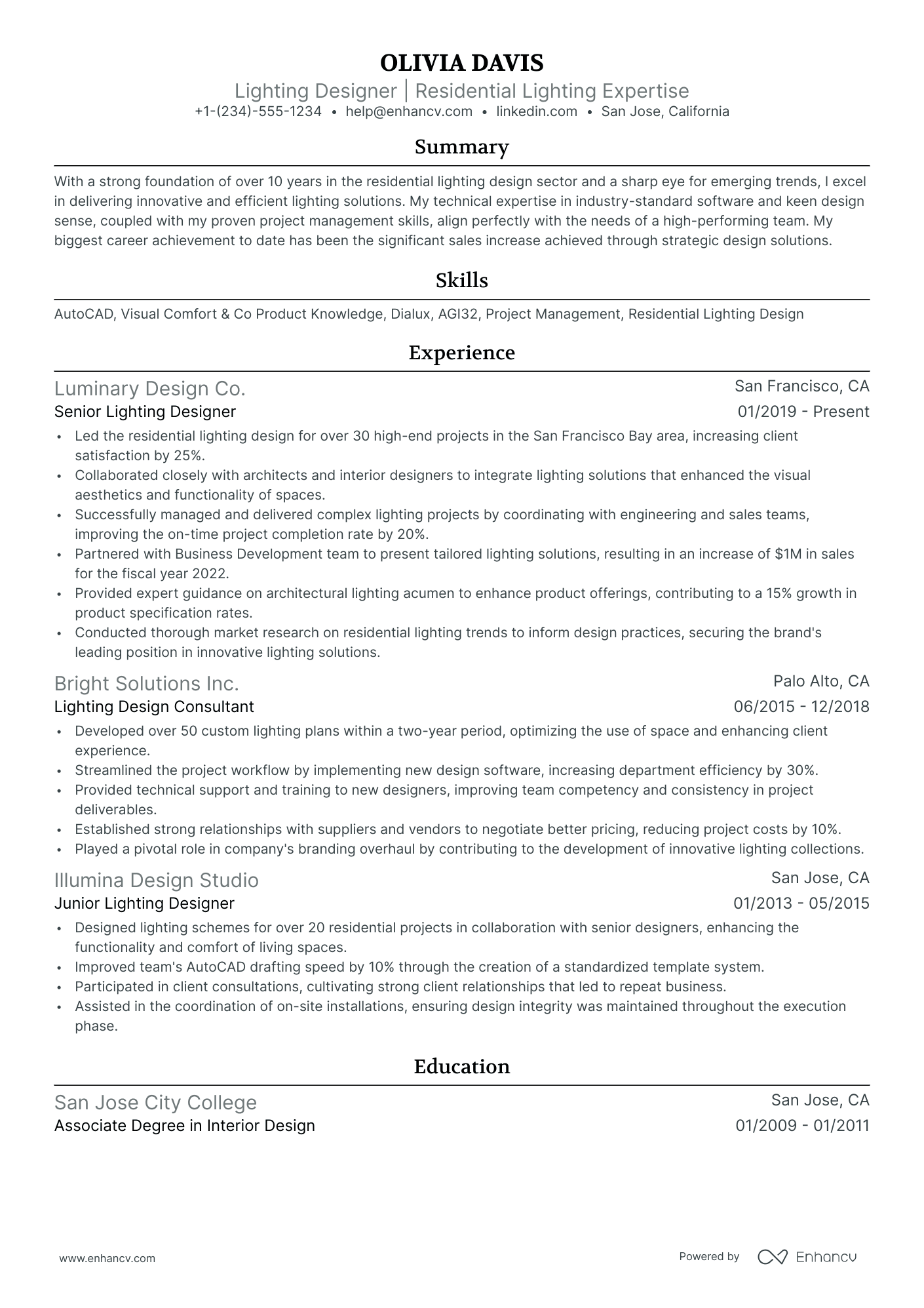
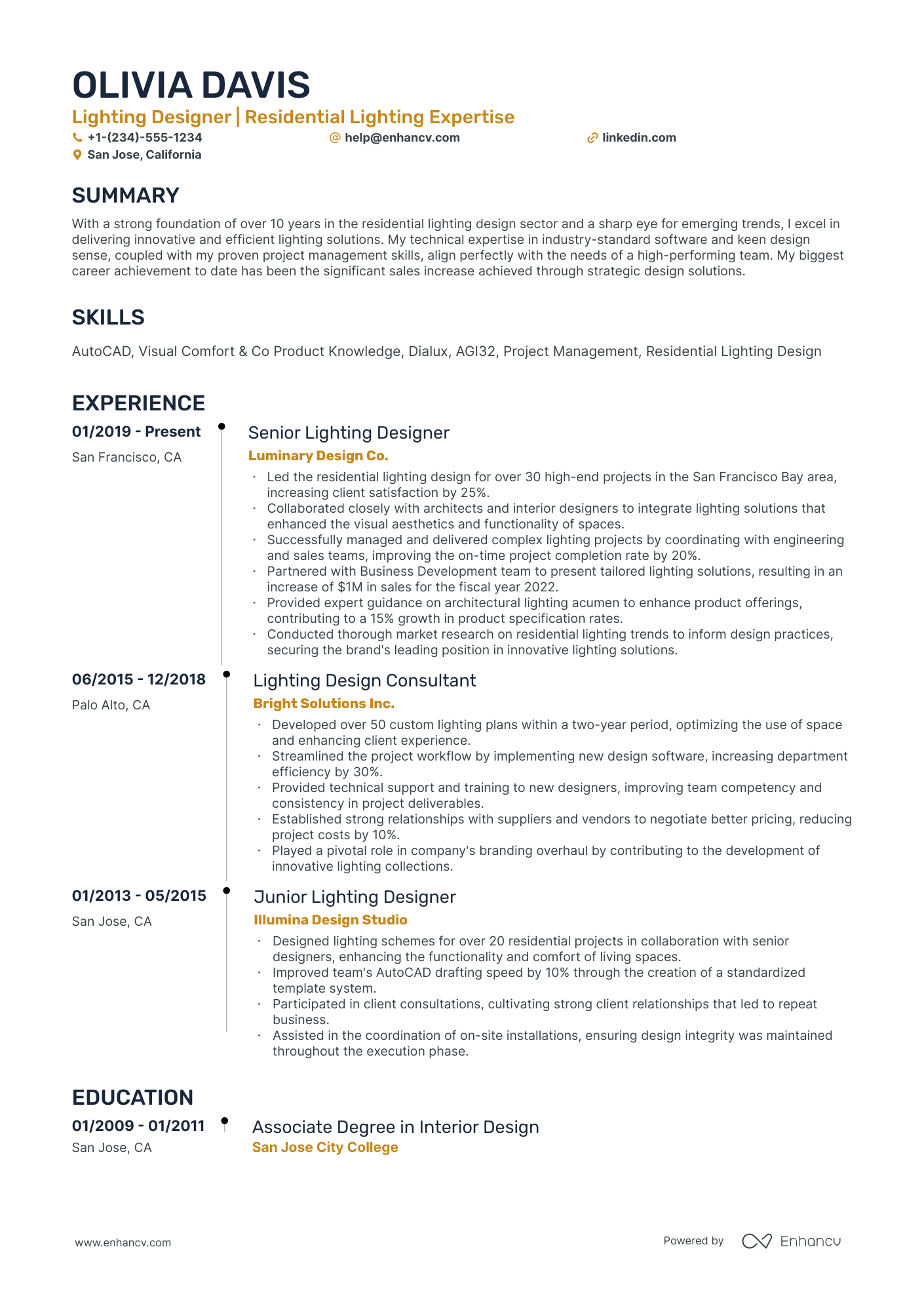
Use a reverse-chronological format to present your lighting design career as a clear progression of increasingly complex projects and responsibilities. Do:
- Lead with your most recent role and emphasize the scope of each project—venue type, budget scale, team size, and client relationship ownership.
- Highlight proficiency in role-specific tools and domains such as Vectorworks Spotlight, DALI controls, Revit lighting analysis, energy code compliance, and architectural or theatrical lighting specializations.
- Quantify outcomes wherever possible, including energy savings, project budgets delivered on target, award recognition, or client satisfaction metrics.
I'm junior or switching into this role—what format works best?
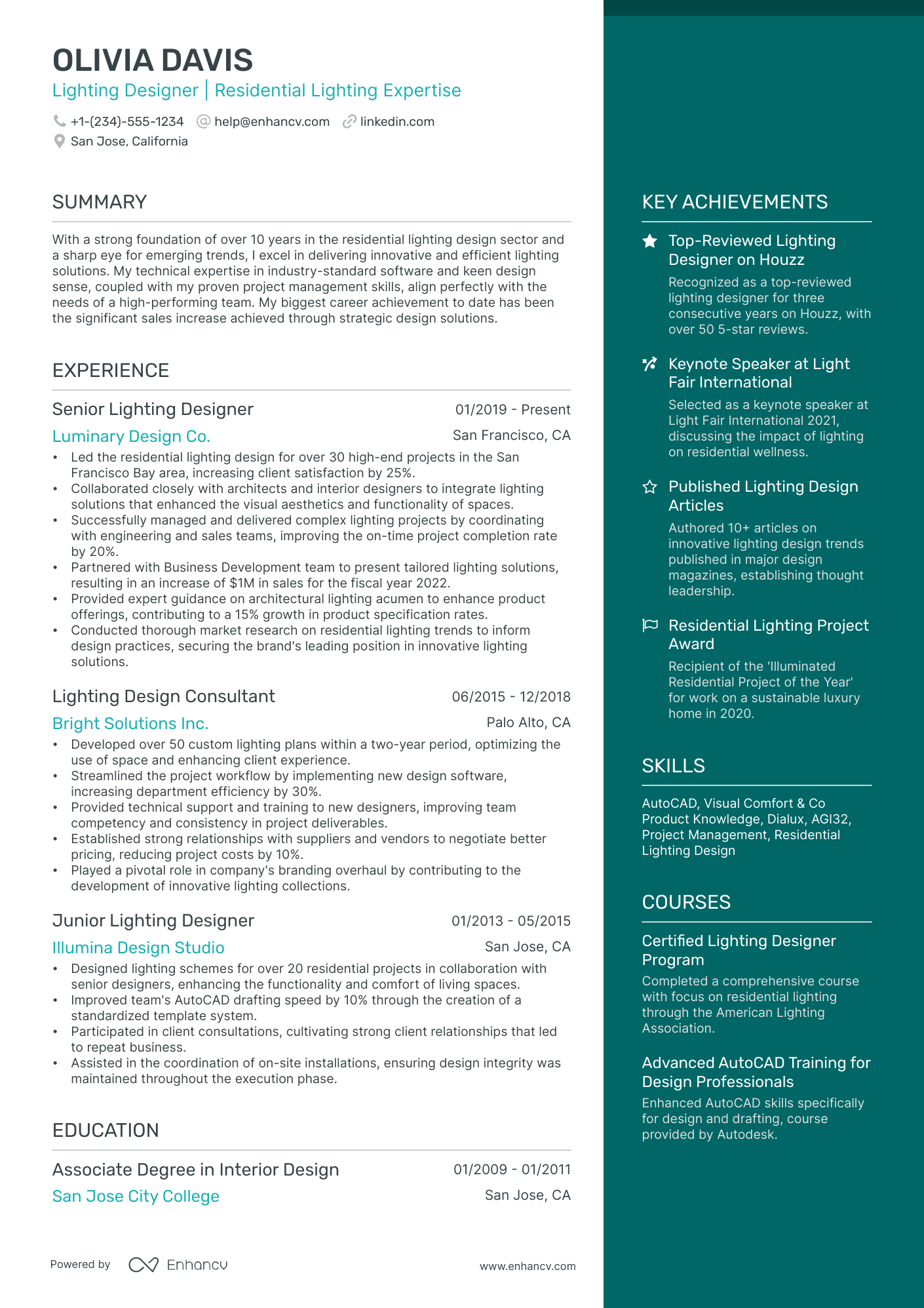
A hybrid format works best, letting you lead with a focused skills section while still showing your work or project history in chronological order. Do:
- Place a skills section near the top that groups technical competencies (lighting calculation software, fixture selection, photometric analysis) alongside design fundamentals (color theory, spatial composition, circuiting).
- Feature academic projects, freelance work, volunteer installations, or theatrical productions as substantive experience entries with clear descriptions of your design contributions.
- Connect every action to an outcome so recruiters see the impact of your work, not just a task list.
Why not use a functional resume?
A functional format strips away the project-by-project context that hiring managers rely on to evaluate a lighting designer's growth, design range, and ability to deliver results within real constraints.
- A functional resume may be acceptable if you're transitioning from a related field like electrical engineering, architecture, or theater production, have limited professional lighting design history, or are re-entering the workforce after a gap—but only if every listed skill is anchored to a specific project, coursework, or measurable outcome rather than presented as a standalone claim.
Now that you've established a clean, readable layout, it's time to fill it with the right sections that showcase your qualifications effectively.
What sections should go on a lighting designer resume
Recruiters expect a clean, role-focused resume that proves you can design, program, and deliver lighting that meets creative and technical requirements. Understanding which resume sections to include ensures your application covers every angle hiring managers evaluate.
Use this structure for maximum clarity:
- Header
- Summary
- Experience
- Skills
- Projects
- Education
- Certifications
- Optional sections: Awards, Publications, Volunteering
Strong experience bullets should emphasize measurable results, production scope, technical complexity, and delivery outcomes across venues, teams, and timelines.
Is your resume good enough?
Drop your resume here or choose a file. PDF & DOCX only. Max 2MB file size.
Once you’ve organized your resume with the right components, the next step is to write your lighting designer experience section so it supports each part with clear, job-relevant proof.
How to write your lighting designer resume experience
The experience section of your lighting designer resume should spotlight shipped productions, installed systems, and completed designs—anchored in the tools, methods, and technologies you used to bring each project to life. Hiring managers prioritize demonstrated impact over descriptive task lists, so every line should prove you delivered measurable results rather than simply listing duties. Building a targeted resume means each entry aligns directly with the role you're pursuing.
Each entry should include:
- Job title
- Company and location (or remote)
- Dates of employment (month and year)
Three to five concise bullet points showing what you owned, how you executed, and what outcomes you delivered:
- Ownership scope: the productions, venues, architectural projects, touring rigs, or permanent installations you were directly accountable for as a lighting designer.
- Execution approach: the design software, control consoles, visualization platforms, fixture technologies, or drafting methods you used to develop and deliver lighting solutions.
- Value improved: changes to visual quality, energy efficiency, code compliance, audience experience, safety, or operational reliability that resulted from your design decisions.
- Collaboration context: how you coordinated with directors, set designers, architects, electricians, producers, or clients to align lighting concepts with broader creative and technical goals.
- Impact delivered: outcomes expressed through production scale, venue capacity, client retention, budget performance, sustainability benchmarks, or audience and stakeholder reception rather than activity alone.
Experience bullet formula
A lighting designer experience example
✅ Right example - modern, quantified, specific.
Lighting Designer
LumenWorks Studio | Austin, TX
2021–Present
Designed architectural lighting for commercial, hospitality, and civic projects across the Southwest, from concept through construction administration.
- Led lighting concepts and photometric analysis in AGi32 and DIALux evo for thirty-two projects, cutting lighting power density by an average of eighteen percent while meeting IES recommendations and Title 24 requirements.
- Produced coordinated lighting plans, reflected ceiling plans, and fixture schedules in Revit and AutoCAD, reducing request for information volume by twenty-six percent through tighter clash-free documentation with mechanical, electrical, and architectural teams.
- Specified luminaires, drivers, and control sequences using nLight and Lutron Vive, improving commissioning pass rates from eighty-two percent to ninety-six percent and reducing on-site tuning time by twelve hours per project.
- Built mockups and aiming studies with manufacturers and contractors, resolving glare and uniformity issues before install and lowering punch-list lighting items by thirty-one percent across five flagship openings.
- Partnered with project managers, electrical engineers, and owners to value-engineer alternates and negotiate lead times, protecting an average of four percent of project budgets and avoiding schedule slips on eight fast-track jobs.
Now that you've seen how a strong experience section comes together, let's look at how to adjust those details to match a specific job posting.
How to tailor your lighting designer resume experience
Recruiters evaluate your lighting designer resume through both applicant tracking systems and manual review. Tailoring your resume to the job description ensures your qualifications stand out in both rounds.
Ways to tailor your lighting designer experience:
- Match specific lighting software and control systems named in the posting.
- Use the same terminology for design standards or building codes referenced.
- Mirror energy efficiency or sustainability metrics the employer prioritizes.
- Include venue types or industry sectors listed in the job description.
- Emphasize compliance with accessibility or safety regulations when mentioned.
- Highlight collaboration with architects or engineers if the role requires it.
- Reflect fixture specification workflows or documentation methods they reference.
- Align your photometric analysis experience with their stated technical requirements.
Tailoring means aligning your real accomplishments with what the employer asks for, not forcing keywords where they don't belong.
Resume tailoring examples for lighting designer
| Job description excerpt | Untailored | Tailored |
|---|---|---|
| Seeking a lighting designer proficient in Vectorworks and WYSIWYG to create detailed lighting plots for mid-scale theatrical productions, collaborating closely with directors and scenic designers. | Created lighting designs for various productions using industry-standard software. | Drafted lighting plots in Vectorworks and rendered previsualization scenes in WYSIWYG for 12 mid-scale theatrical productions, coordinating directly with directors and scenic designers to align cue sequences with staging concepts. |
| The ideal candidate will program and operate ETC Eos-family consoles for live concert tours, managing fixture libraries of 300+ intelligent lights across multi-city runs. | Operated lighting consoles and managed equipment for live events. | Programmed ETC Eos Ti consoles for a 28-city concert tour, building and maintaining fixture libraries for 350+ moving lights while executing real-time cue adjustments during performances. |
| Responsible for specifying energy-efficient LED fixture packages for commercial architectural installations, ensuring designs meet LEED daylighting credit requirements and client budgets under $150K. | Selected fixtures for commercial projects and stayed within budget guidelines. | Specified LED fixture packages for seven commercial architectural installations, achieving LEED daylighting credit compliance on each project while keeping material costs 8% below the $150K budget ceiling. |
Once you’ve aligned your experience with the role’s requirements, quantify your lighting designer achievements to show the measurable impact of that work.
How to quantify your lighting designer achievements
Quantifying your achievements shows how your lighting choices improved show quality, reliability, speed, and budget. Track cue volume, programming time, power and rental costs, focus accuracy, and incident-free performances across venues, rigs, and production schedules.
Quantifying examples for lighting designer
| Metric | Example |
|---|---|
| Programming speed | "Programmed 185 cues in ETC Eos over three days, cutting tech rehearsal by two hours while meeting the director's notes on every scene." |
| Show reliability | "Delivered 24 performances with zero lighting-related holds by adding pre-show console checks and backup show files on two USB drives." |
| Budget savings | "Reduced rental spend by 12% ($3,600) by reusing house fixtures, swapping to LED units, and trimming unnecessary cable runs." |
| Power efficiency | "Lowered peak draw by 18% by converting front wash to LED and balancing dimmer loads, avoiding a generator upgrade at an outdoor venue." |
| Focus accuracy | "Cut refocus notes from 30 to eight per night by labeling positions, using a focus chart, and verifying shutter cuts during the first focus call." |
Turn vague job duties into measurable, recruiter-ready resume bullets in seconds with Enhancv's Bullet Point Generator.
Once you've crafted strong bullet points that highlight your accomplishments, the next step is ensuring your resume also showcases the right mix of hard and soft skills that lighting design employers are looking for.
How to list your hard and soft skills on a lighting designer resume
Your skills section shows you can design, program, and run safe, repeatable lighting for live or filmed productions, and recruiters and ATS scan this section to match you to the rig, console, and workflow in the job post—aim for a hard-skill-heavy mix.
lighting designer roles require a blend of:
- Product strategy and discovery skills.
- Data, analytics, and experimentation skills.
- Delivery, execution, and go-to-market discipline.
- Soft skills.
Your skills section should be:
- Scannable (bullet-style grouping).
- Relevant to the job post.
- Backed by proof in experience bullets.
- Updated with current tools.
Place your skills section:
- Above experience if you're junior or switching careers.
- Below experience if you're mid/senior with strong achievements.

Hard skills
Listing relevant hard skills helps recruiters quickly verify your technical qualifications:
- ETC Eos family consoles
- grandMA2, grandMA3
- Hog 4 OS consoles
- DMX512, RDM, sACN, Art-Net
- Moving light programming
- Cueing, timecode, MIDI, OSC
- Vectorworks Spotlight drafting
- Lightwright paperwork management
- Photometrics and plot calculations
- Power distribution, load balancing
- Rigging coordination and focus calls
- Troubleshooting dimmers and networks
Soft skills
Complementing your technical expertise with strong soft skills signals you can collaborate effectively under production pressure:
- Translate director intent into cues
- Run efficient focus sessions
- Coordinate with scenic and sound
- Communicate changes under pressure
- Prioritize fixes during tech
- Document updates and revisions
- Make fast, safe show calls
- Manage time in rehearsals
- Align expectations with production
- Mentor programmers and electricians
- Resolve conflicts on headset
- Own preproduction through strike
How to show your lighting designer skills in context
Skills shouldn't live only in a bulleted list on your resume. Explore how other professionals present their resume skills for inspiration on contextual placement.
They should be demonstrated in:
- Your summary (high-level professional identity)
- Your experience (proof through outcomes)
Here's what that looks like in practice.
Summary example
Senior lighting designer with 12 years in commercial and theatrical environments. Proficient in Vectorworks, WYSIWYG, and sustainable design methods. Led a 30-venue retrofit project that cut energy costs by 38% while elevating audience experience.
- Reflects senior-level expertise clearly
- Names industry-standard design tools
- Includes a strong measurable outcome
- Signals collaboration and creative leadership
Experience example
Senior Lighting Designer
Lumencraft Studios | Chicago, IL
March 2018–Present
- Designed lighting systems for 45+ commercial installations using Vectorworks and DMX programming, reducing client energy usage by an average of 27%.
- Collaborated with architects and interior designers to integrate adaptive lighting into LEED-certified buildings, contributing to three Platinum certifications.
- Developed standardized rendering workflows in WYSIWYG that shortened the design review cycle by 40%, improving cross-team turnaround times.
- Every bullet includes measurable proof
- Skills appear naturally within achievements
Once you’ve demonstrated your lighting design strengths through relevant examples, the next step is to translate that approach into a lighting designer resume when you don’t have formal experience.
How do I write a lighting designer resume with no experience
Even without full-time experience, you can demonstrate readiness through academic work and side projects. Writing a resume without work experience is entirely possible when you focus on transferable skills and tangible outputs:
- Student theater lighting plots
- Volunteer event lighting support
- Freelance small venue gigs
- Lighting console training labs
- Previs and visualization renders
- Shadowing a lighting designer
- Portfolio of cue sheets
Focus on:
- Console proficiency with show files
- Drafted plots and paperwork samples
- Safety compliance and power planning
- Quantified results from live events
Resume format tip for entry-level lighting designer
Use a combination resume format because it highlights technical skills and projects first, while still showing related experience like labs and volunteer shows. Do:
- Lead with a Skills section listing consoles, software, and protocols you've used.
- Add a Projects section with plots, cue sheets, and show files.
- Include a tools line: Vectorworks Spotlight, Lightwright, grandMA3, ETC Eos.
- Quantify scope: fixtures, universes, cue count, load-in time.
- Link a portfolio with plots, renders, and paperwork.
- Built an ETC Eos cue stack for a student theater show, programming forty-two cues and cutting scene transitions by twenty percent after rehearsals.
Even without professional experience, your education section can demonstrate relevant training and knowledge that makes you a strong candidate.
How to list your education on a lighting designer resume
Your education section helps hiring teams confirm you have foundational training in lighting design, electrical theory, and visual storytelling. It validates the technical knowledge behind your creative work.
Include:
- Degree name
- Institution
- Location
- Graduation year
- Relevant coursework (for juniors or entry-level candidates)
- Honors & GPA (if 3.5 or higher)
Skip month and day details—list the graduation year only.
Here's a strong education entry tailored for a lighting designer resume:
Example education entry
Bachelor of Fine Arts in Lighting Design
Carnegie Mellon University, Pittsburgh, PA
Graduated 2021
GPA: 3.7/4.0
- Relevant Coursework: Architectural Lighting, Stage Electrics, Lighting Control Systems, Color Theory, and CAD for Entertainment Design
- Honors: Dean's List (six semesters), Outstanding Achievement in Lighting Design Award
How to list your certifications on a lighting designer resume
Certifications on a resume show a lighting designer's commitment to learning, proficiency with tools, and awareness of current industry standards. They also help employers trust your technical skills and on-set readiness.
Include:
- Certificate name
- Issuing organization
- Year
- Optional: credential ID or URL
- List certifications below education when your degree is recent, and your certifications are older or only loosely related to lighting designer work.
- List certifications above education when they're recent, highly relevant, or required for the lighting designer roles you target.
Best certifications for your lighting designer resume
- Entertainment Technician Certification Program (ETCP) Certified Entertainment Electrician
- Entertainment Technician Certification Program (ETCP) Certified Entertainment Rigger—Theatre
- OSHA 10-Hour General Industry
- OSHA 30-Hour General Industry
- Dante Certification Program (Level 1)
- Vectorworks Certified Professional (VCP)
- MA University (grandMA2 and grandMA3 training certification)
Once you’ve positioned your credentials where hiring managers can spot them quickly, use your lighting designer resume summary to reinforce their value upfront and set the tone for the rest of your resume.
How to write your lighting designer resume summary
Your resume summary is the first thing a recruiter reads. A strong one instantly connects your skills and experience to the lighting designer role.
Keep it to three to four lines, with:
- Your title and total years of lighting design experience.
- Domain focus, such as theatrical, architectural, concert, or film lighting.
- Core tools and skills like AutoCAD, Vectorworks, Lightwright, or ETC consoles.
- One or two measurable achievements that show your impact.
- Soft skills tied to real outcomes, like collaboration that improved production timelines.

PRO TIP
At this level, emphasize relevant technical skills, specific tools you've used, and any early contributions with measurable results. Avoid vague phrases like "passionate designer" or "hard worker." Recruiters want to see what you've done, not how you describe yourself.
Example summary for a lighting designer
Lighting designer with three years of experience in theatrical and event production. Proficient in Vectorworks and ETC Ion. Reduced setup time by 20% across 15 productions through streamlined light plots.
Optimize your resume summary and objective for ATS
Drop your resume here or choose a file.
PDF & DOCX only. Max 2MB file size.
Now that your summary captures your lighting design expertise at a glance, make sure your header presents the essential contact and professional details recruiters need to reach you.
What to include in a lighting designer resume header
A resume header lists your key identifiers and contact details, helping a lighting designer stand out, build credibility, and pass recruiter screening fast.
Essential resume header elements
- Full name
- Tailored job title and headline
- Location
- Phone number
- Professional email
- GitHub link
- Portfolio link
A LinkedIn link helps recruiters verify your experience quickly and supports screening.
Don't include a photo on a lighting designer resume unless the role is explicitly front-facing or appearance-dependent.
Keep your header on one or two lines, match the job title to the posting, and use links that open directly to your work.
Example
Lighting designer resume header
Jordan Rivera
Lighting Designer | Live Events and Theatrical Lighting
Austin, TX
(512) 555-12XX
jordan.rivera@enhancv.com
github.com/jordanrivera
jordanrivera.com
linkedin.com/in/jordanrivera
Once your contact details and role focus are clear at the top, you can strengthen the rest of your application with additional sections that add relevant context to your lighting designer resume.
Additional sections for lighting designer resumes
When your core qualifications match other candidates, additional sections can set you apart and reinforce your credibility as a lighting designer. For example, listing language skills on your resume can be particularly valuable if you work on international productions or with multilingual crews.
- Languages
- Certifications and licenses
- Professional affiliations and memberships
- Awards and honors
- Publications and presentations
- Notable productions or projects
- Hobbies and interests
Once you've rounded out your resume with sections that highlight your full range of qualifications, the next step is pairing it with a strong cover letter to make an even greater impact.
Do lighting designer resumes need a cover letter
A cover letter isn't required for a lighting designer, but it often helps in competitive searches or when hiring teams expect one. If you're unsure about the basics, understanding what a cover letter is and how it complements your resume can clarify when to include one. It can make a difference when your resume needs context, or when you want to show strong fit fast.
Use a cover letter to add context your portfolio and resume can't:
- Explain role and team fit by matching your strengths to the role's lighting designer priorities and the team's workflow.
- Highlight one or two relevant projects, including your constraints, decisions, and measurable outcomes like reduced setup time or improved consistency.
- Show you understand the product, users, or business context by referencing the venue, audience needs, budget limits, and safety requirements.
- Address career transitions or non-obvious experience by connecting past work to lighting designer responsibilities and tools.
Drop your resume here or choose a file.
PDF & DOCX only. Max 2MB file size.
Even if you decide to include a cover letter to add context beyond your resume, AI tools can help you strengthen your lighting designer resume faster and more accurately.
Using AI to improve your lighting designer resume
AI can sharpen your resume's clarity, structure, and impact. It helps tighten language and highlight relevant achievements. But overuse strips authenticity. Once your content reads clearly and aligns with lighting designer roles, step away from AI. If you're wondering which AI is best for writing resumes, focus on tools that refine rather than fabricate your content.
Here are 10 practical prompts you can copy and paste to strengthen specific sections of your resume:
- Tighten your summary: "Rewrite my lighting designer resume summary to be concise, specific, and focused on my strongest qualifications in three sentences or fewer."
- Quantify achievements: "Add measurable results to these lighting designer experience bullets, using metrics like energy savings, project budgets, or venue capacity."
- Strengthen action verbs: "Replace weak or passive verbs in my lighting designer experience section with strong, industry-specific action verbs."
- Align skills: "Compare my lighting designer skills section against this job description and suggest missing technical or software skills I should add."
- Refine project descriptions: "Edit my lighting designer project entries to clearly state my role, the design challenge, and the outcome for each project."
- Improve relevance: "Remove or condense experience bullets on my lighting designer resume that don't directly relate to this specific job posting."
- Clarify certifications: "Rewrite my lighting designer certifications section so each entry clearly states the credential, issuing body, and year earned."
- Enhance education entries: "Improve my lighting designer education section to highlight relevant coursework, thesis work, or studio projects in lighting design."
- Cut filler language: "Identify and remove vague or filler phrases from my lighting designer resume that add no specific meaning or value."
- Check consistency: "Review my entire lighting designer resume for inconsistent formatting, tense shifts, and punctuation errors across all sections."
Stop using AI once your resume sounds accurate, specific, and aligned with real experience. AI should never invent experience or inflate claims—if it didn't happen, it doesn't belong here.
Conclusion
A strong lighting designer resume shows impact with numbers, highlights role-specific skills, and stays easy to scan. Use measurable outcomes, clear project details, and precise tools and systems. Keep sections consistent, with a focused summary, skills, experience, and education.
Hiring teams want lighting designers who can deliver reliable results across live, film, and installation work. A clean structure and proof of outcomes show you can meet current expectations and adapt to near-future needs. Keep it direct, specific, and ready to submit.