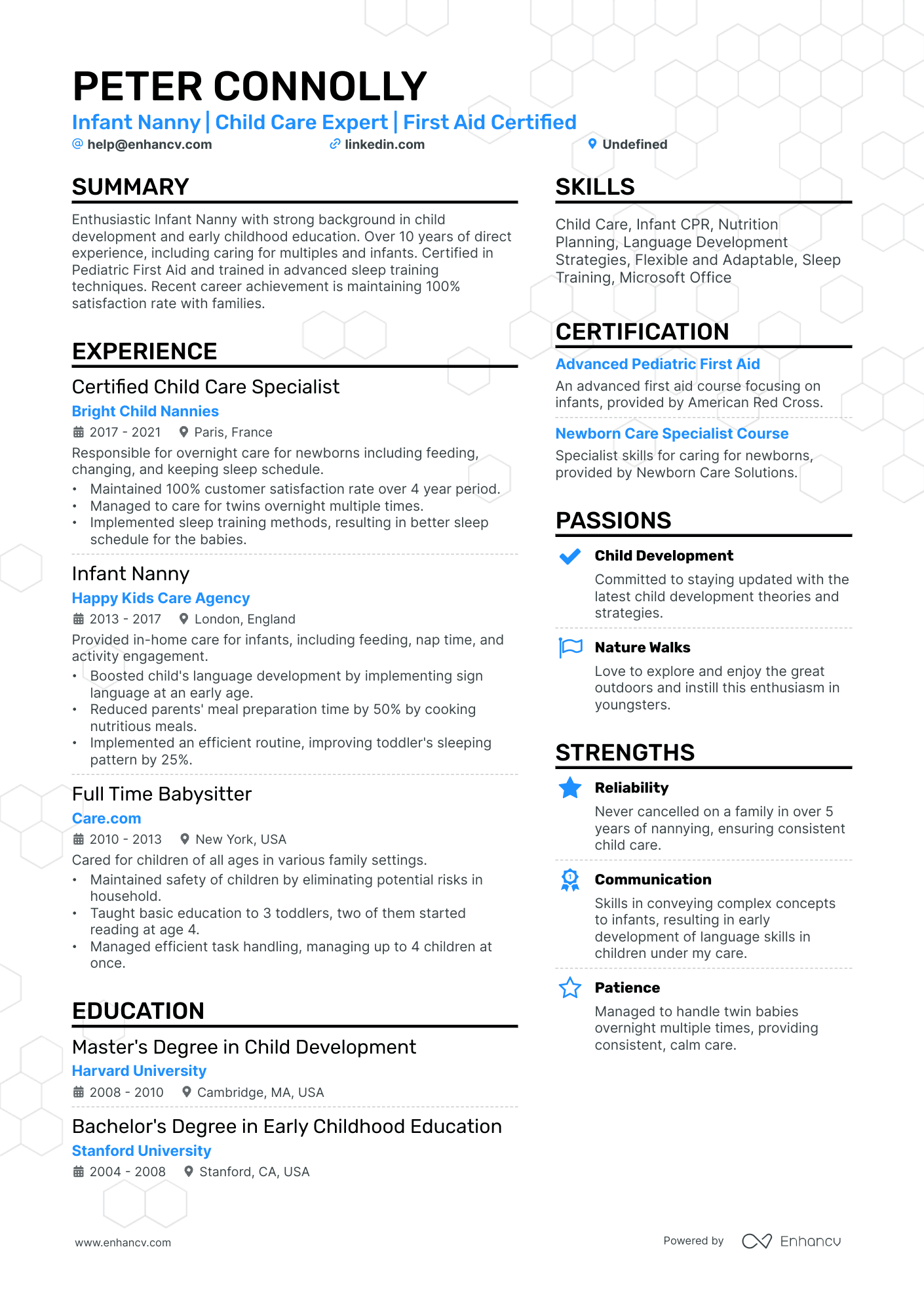
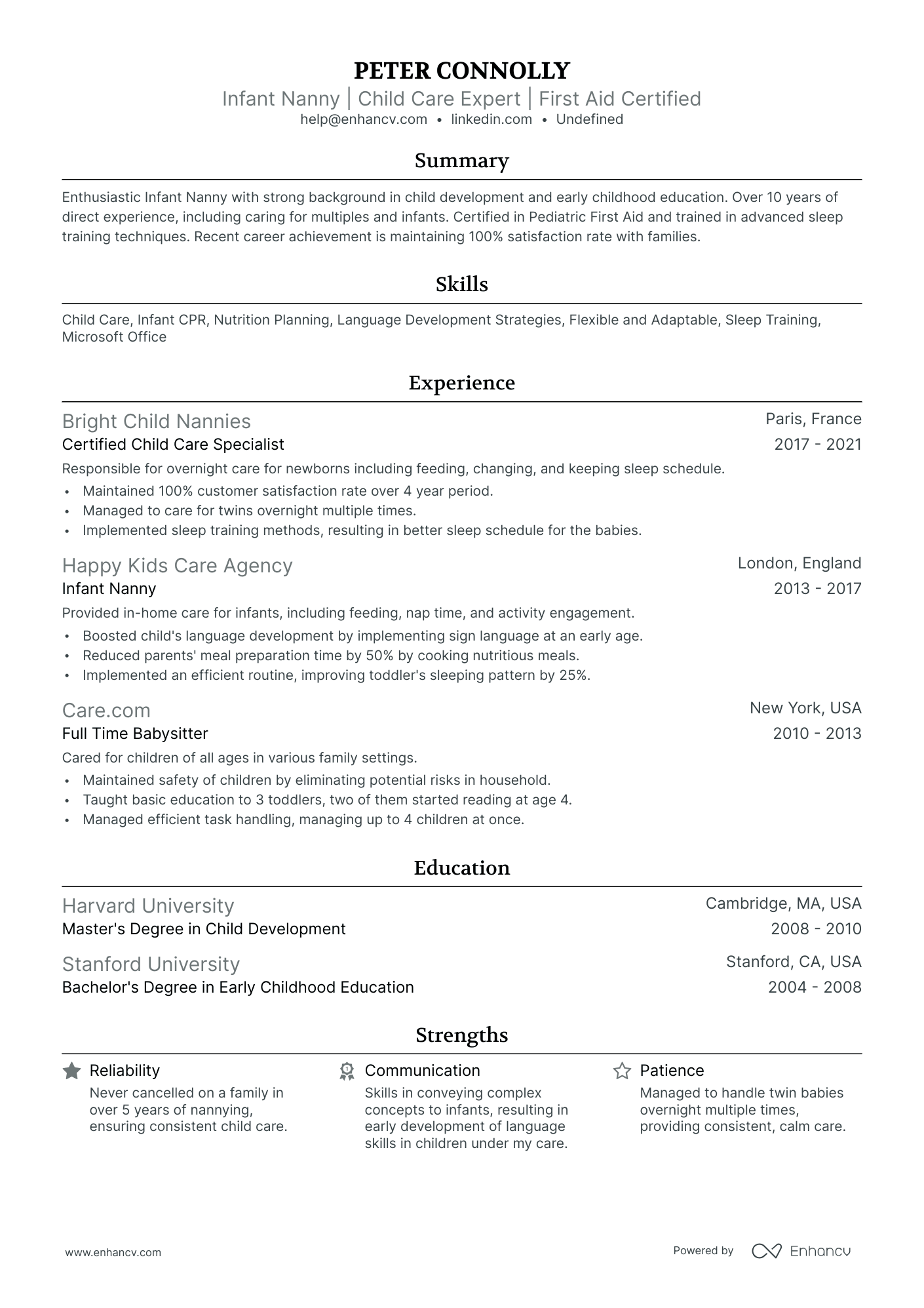
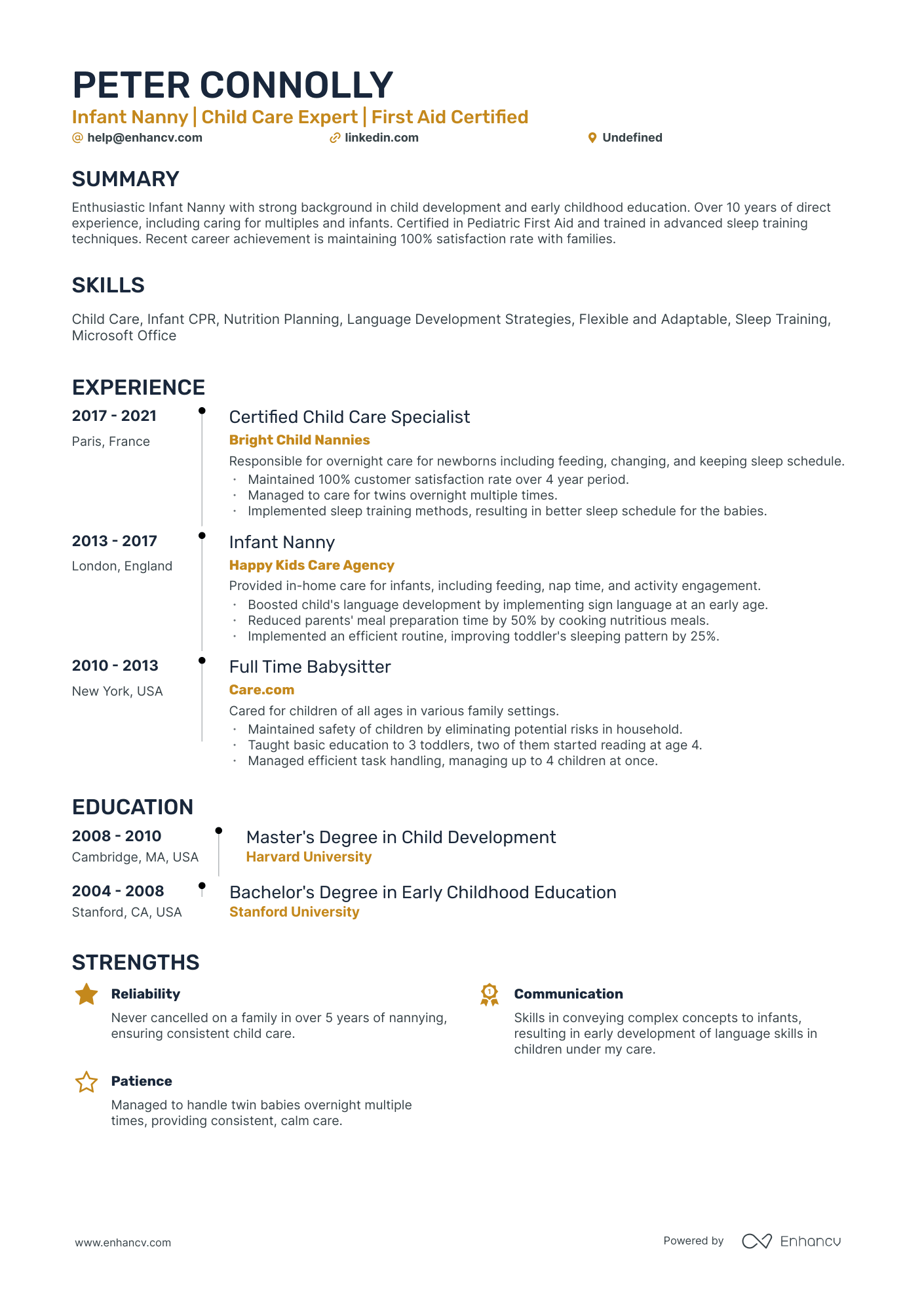
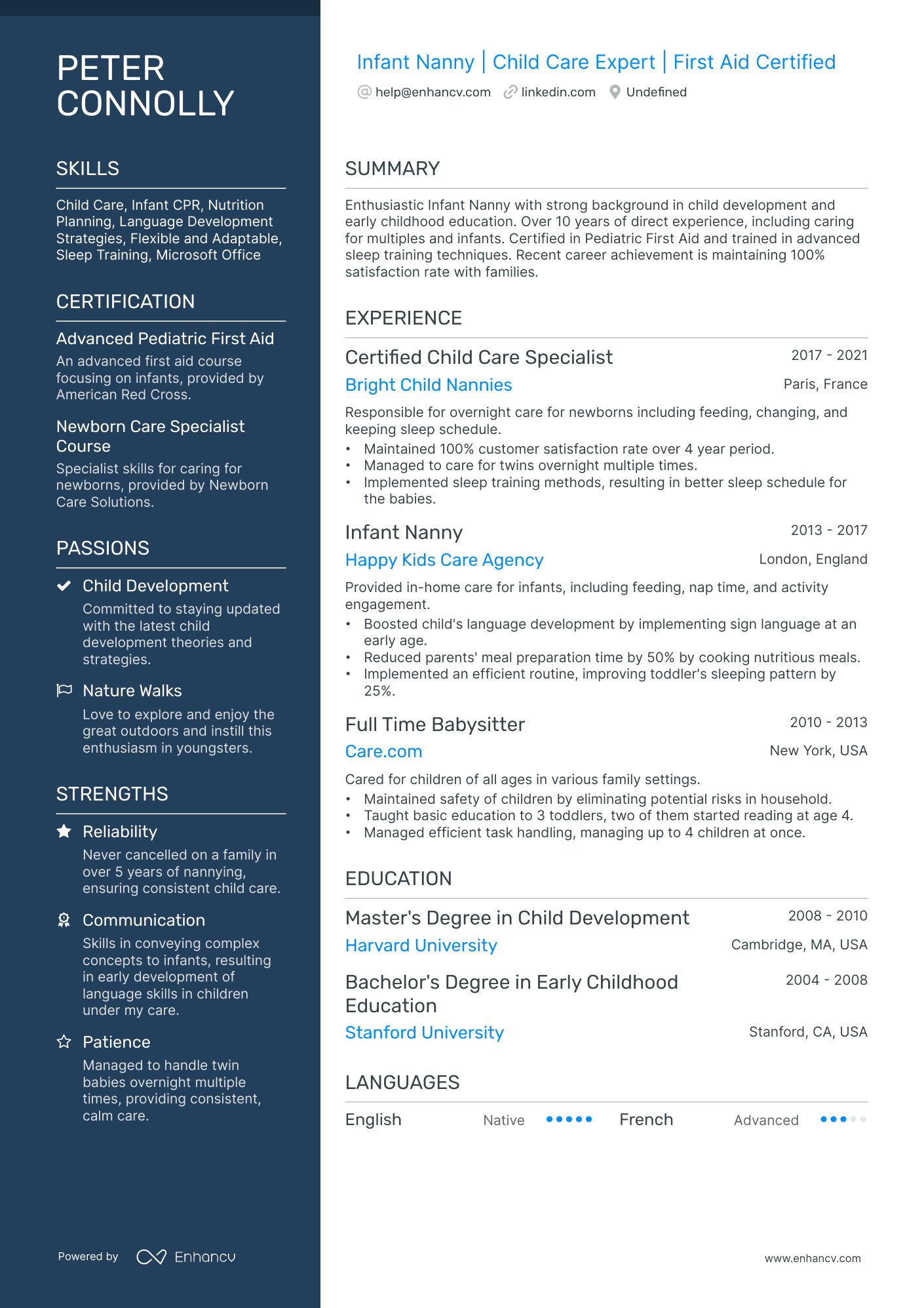
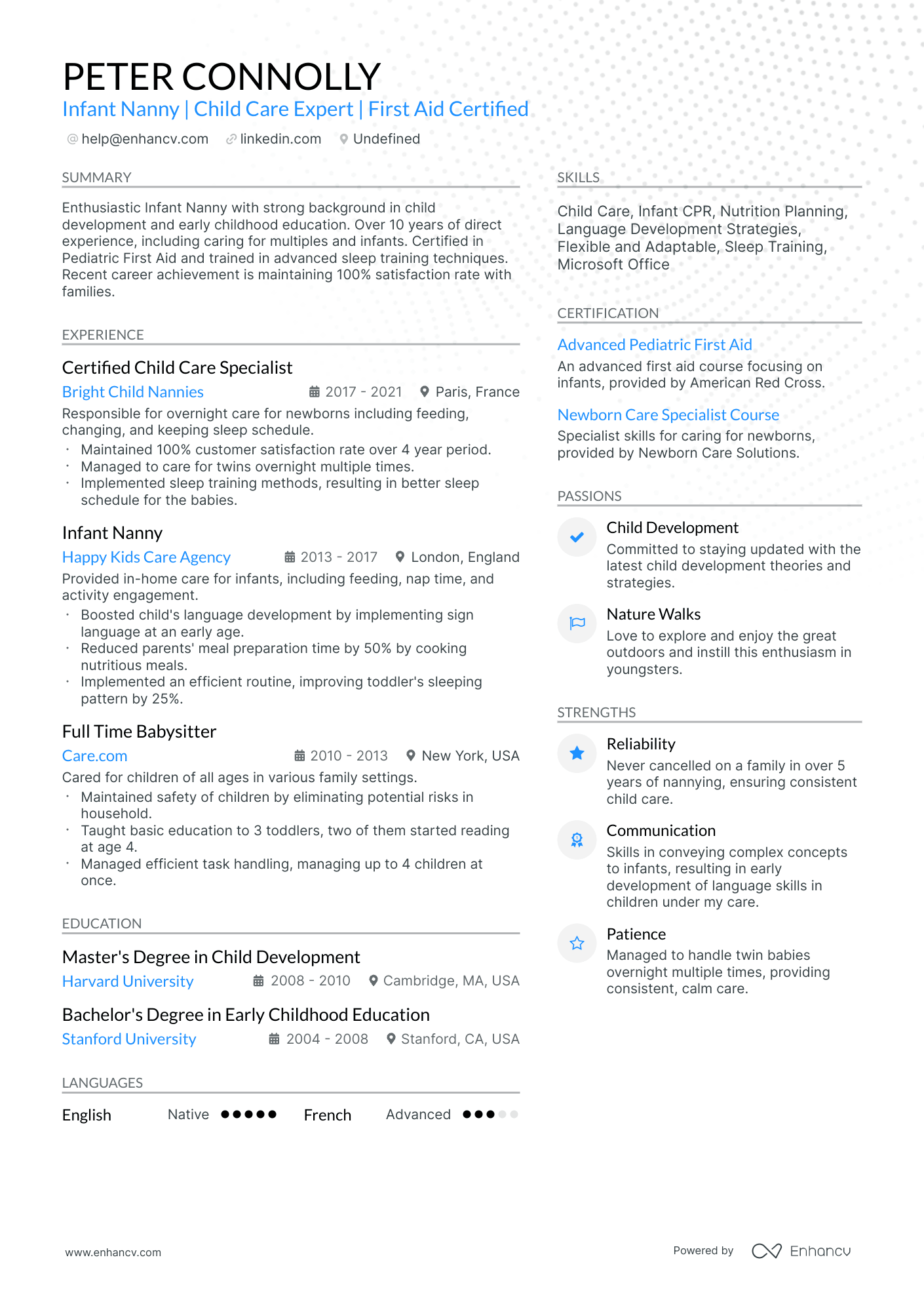
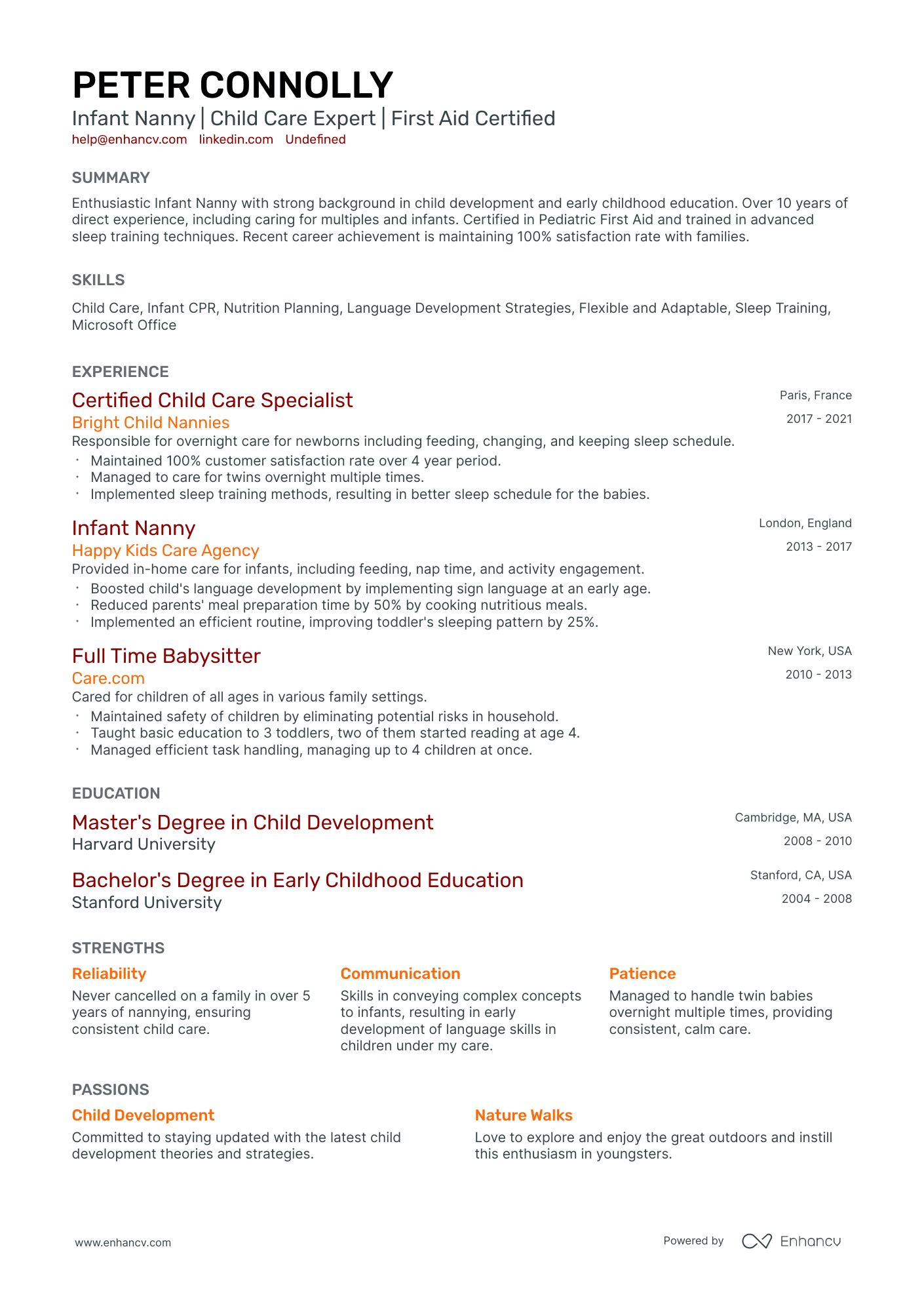
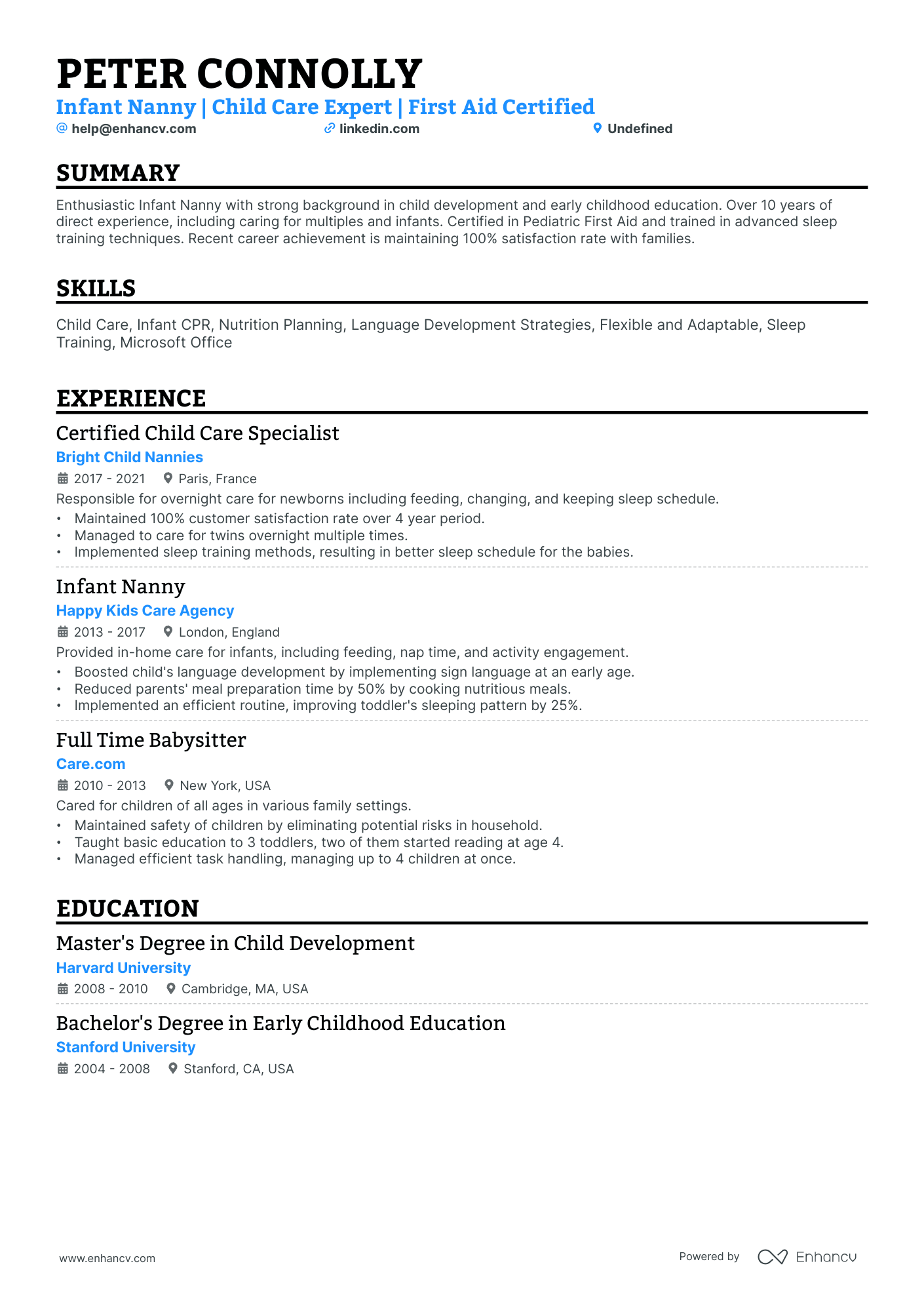
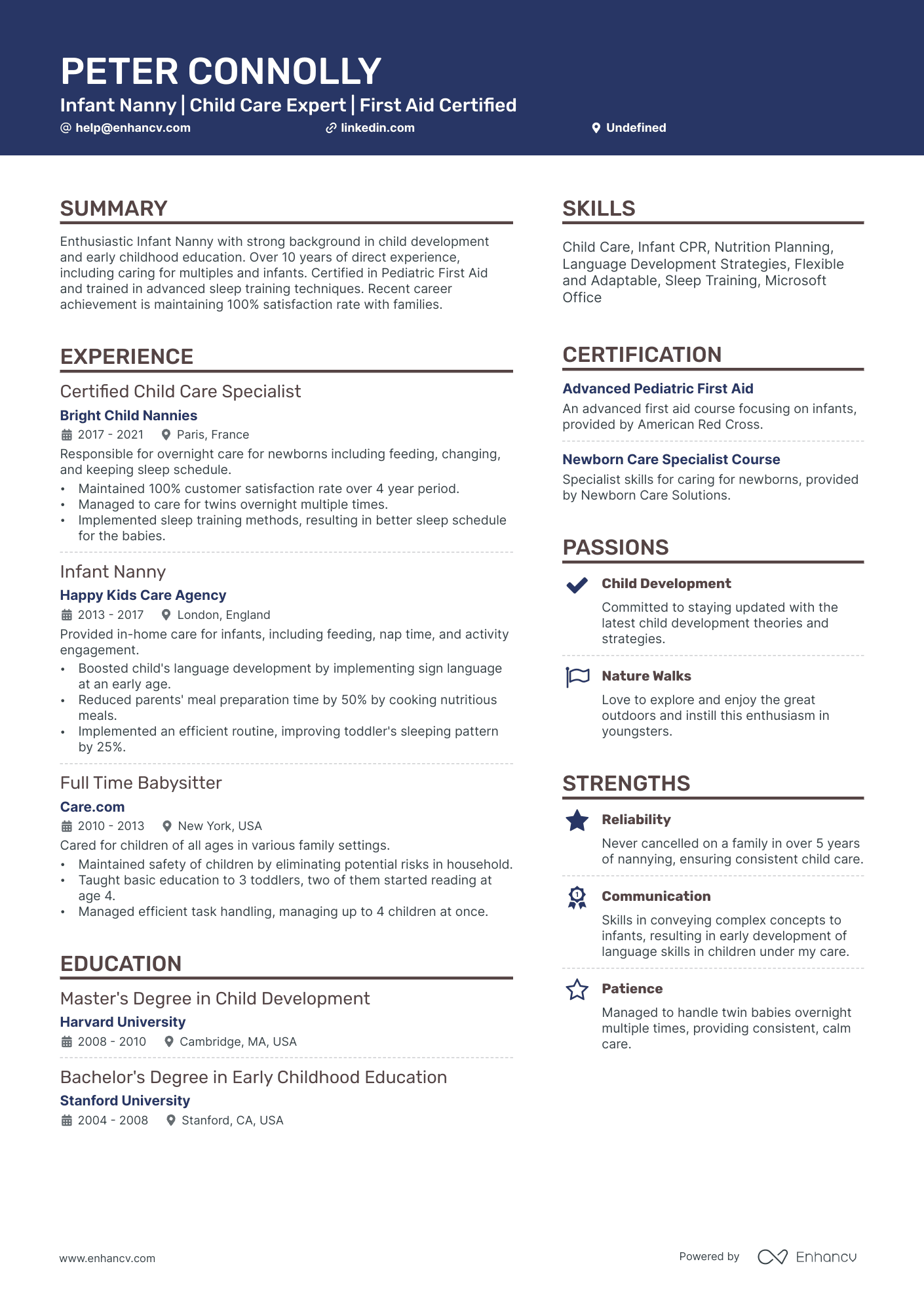
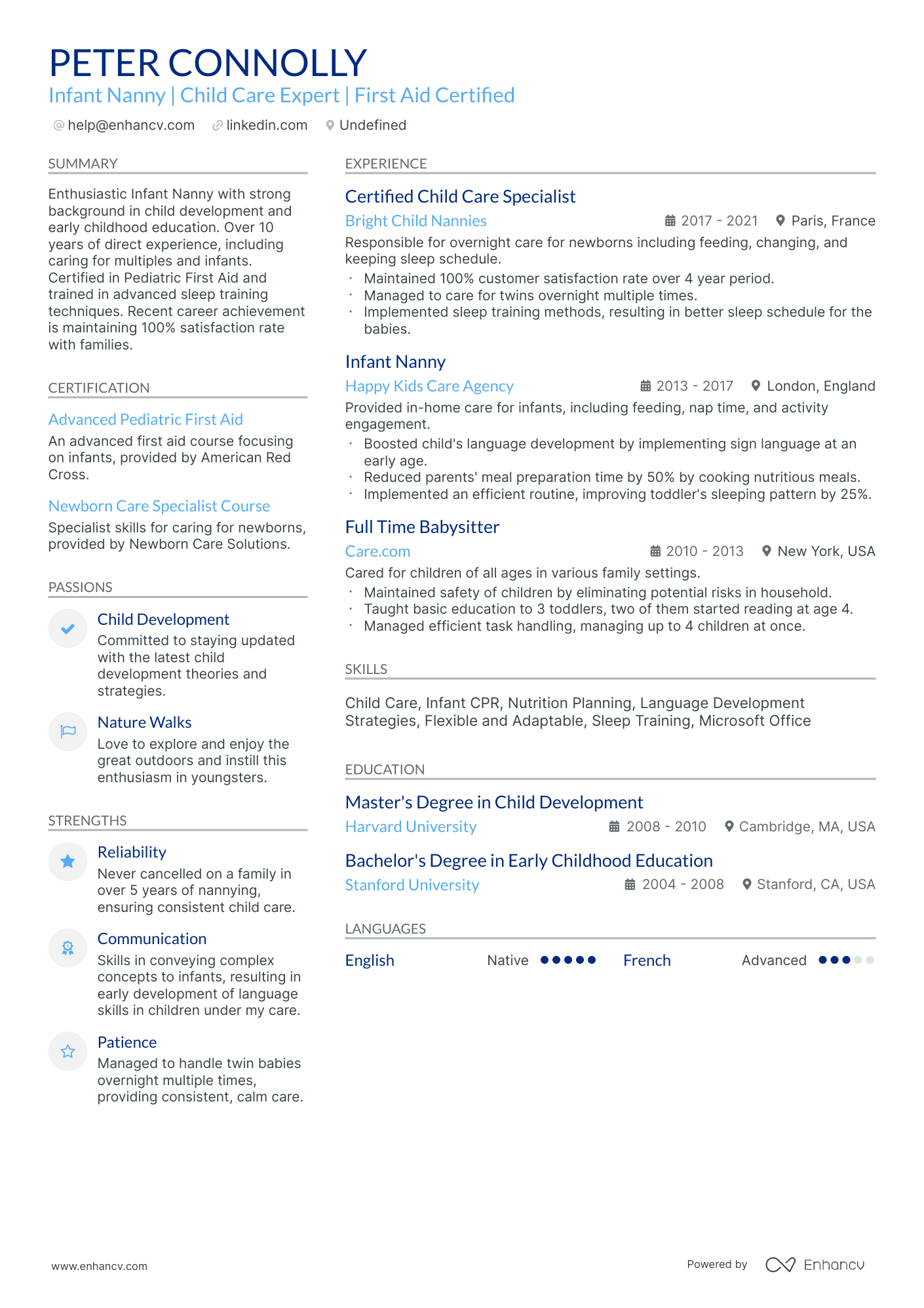
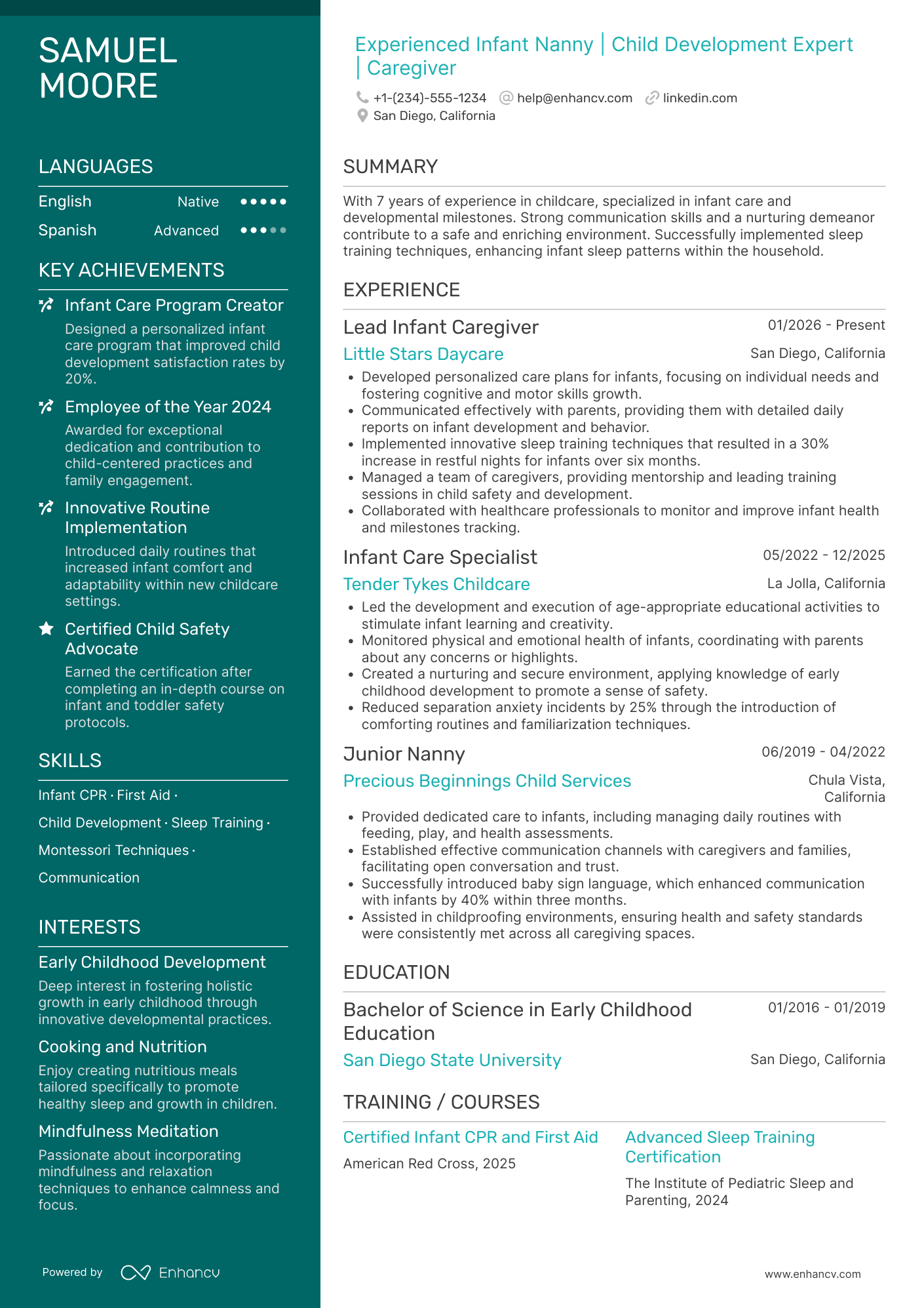
An infant nanny resume often fails because it reads like a duty list and buries safety credentials, infant milestones, and measurable trust signals. That matters when applicant tracking systems filter keywords and recruiters scan fast in a crowded caregiver market.
A strong resume shows outcomes you delivered, not just tasks you handled. Knowing how to make your resume stand out is essential in this competitive field. You should highlight infant ages supported, weekly hours, safe sleep compliance, feeding and nap routines stabilized, milestone progress tracked, incidents prevented, parent satisfaction, and long-term placements.

Key takeaways
- Quantify infant care outcomes like sleep improvements and feeding consistency instead of listing duties.
- Use reverse-chronological format if experienced and hybrid format if entering infant care.
- Tailor every experience bullet to match the family's stated caregiving needs and tools.
- Place certifications like infant CPR and newborn care specialist credentials prominently on your resume.
- Pair hard skills with measurable proof in your experience section, not just a skills list.
- Write a three- to four-line summary featuring your care setting, infant ages, and top results.
- Use Enhancv's Bullet Point Generator to turn vague duties into specific, recruiter-ready achievements.
How to format a infant nanny resume
Recruiters hiring infant nannies prioritize hands-on childcare experience, infant-specific certifications (CPR, newborn care), and a demonstrated ability to maintain safe, nurturing routines. A clean, well-organized resume format ensures these qualifications surface quickly during both manual review and applicant tracking system (ATS) screening.

I have significant experience in this role—which format should I use?
Use a reverse-chronological format to showcase your depth of infant care experience and growing responsibility across placements. Do:
- Lead with your most recent position, highlighting the number of infants in your care, ages served, and the scope of your daily responsibilities (feeding schedules, sleep training, developmental milestones).
- Feature infant-specific skills and certifications prominently—newborn care specialist (NCS) credentials, infant CPR/first aid, breastmilk handling, and developmental activity planning.
- Quantify outcomes wherever possible, including duration of placements, infant age ranges, and measurable improvements in routines or developmental benchmarks.
I'm junior or switching into this role—what format works best?
A hybrid format works best, letting you lead with relevant infant care skills while supporting them with any caregiving, volunteer, or professional experience you do have. Do:
- Place a skills section near the top of your resume featuring infant-focused competencies like safe sleep practices, bottle and breastmilk preparation, diapering, and soothing techniques.
- Include babysitting, volunteer nursery work, nannying for older children, or practicum hours from early childhood education programs as transitional experience.
- Connect every skill to a specific action and result so hiring families can see practical application, not just a list of keywords.
Why not use a functional resume?
A functional format hides the timeline and context of your caregiving experience, making it difficult for families and agencies to verify how recently and consistently you've worked with infants.
- Career changers with transferable caregiving skills: If you're transitioning from pediatric nursing, postpartum doula work, or early childhood education, a functional format can group relevant infant care competencies while you build direct nanny experience.
- Limited formal work history: New graduates of nanny training programs or NCS courses who have practicum or clinical hours but few paid placements can use a functional layout to foreground certified skills.
Once your resume's layout and structure are in place, the next step is filling it with the right sections to showcase your qualifications effectively.
What sections should go on a infant nanny resume
Recruiters expect a clean, complete resume that proves you can keep infants safe, supported, and on consistent routines. Understanding which resume sections to include is key to building that proof.
Use this structure for maximum clarity:
- Header
- Summary
- Experience
- Skills
- Projects
- Education
- Certifications
- Optional sections: Volunteering, Languages, Awards
Strong experience bullets should highlight infant ages cared for, number of children, schedule coverage, safety practices, routine improvements, and measurable outcomes for feeding, sleep, development, and parent satisfaction.
Is your resume good enough?
Drop your resume here or choose a file. PDF & DOCX only. Max 2MB file size.
Now that you’ve organized the key resume components, the next step is to write your infant nanny experience section so those details translate into clear, relevant qualifications.
How to write your infant nanny resume experience
Your experience section is the core of your infant nanny resume, where you demonstrate the caregiving methods, developmental tools, and safety practices you've applied in real household settings. Hiring managers prioritize demonstrated impact on infant well-being, developmental milestones, and family satisfaction over generic task lists. Writing a targeted resume that speaks directly to each family's needs will set you apart from candidates who submit the same generic application everywhere.
Each entry should include:
- Job title
- Company and location (or remote)
- Dates of employment (month and year)
Three to five concise bullet points showing what you owned, how you executed, and what outcomes you delivered:
- Ownership scope: the number and age range of infants in your care, the daily routines you managed independently, and the full spectrum of responsibilities you held—from feeding and sleep scheduling to household safety and developmental programming.
- Execution approach: the caregiving frameworks, infant development methodologies, soothing techniques, feeding protocols, sleep training systems, or health monitoring tools you relied on to make daily decisions and deliver consistent, high-quality care.
- Value improved: the changes you drove in infant sleep quality, feeding consistency, developmental milestone progression, household safety standards, or the overall reliability and structure of daily care routines.
- Collaboration context: how you partnered with parents, pediatricians, lactation consultants, fellow household staff, or early childhood specialists to align on care plans, address emerging health concerns, and maintain seamless communication about each infant's progress.
- Impact delivered: the tangible results you produced—expressed through developmental outcomes, family retention, improved infant routines, or strengthened parental confidence—rather than a simple list of duties you performed each day.
Experience bullet formula
A infant nanny experience example
✅ Right example - modern, quantified, specific.
Infant Nanny
The Rivera Family | Austin, TX
2023–Present
Private household supporting first-time parents with full-time infant care in a sleep-training-focused environment.
- Implemented an age-appropriate sleep plan using Huckleberry and daily wake-window tracking, increasing independent crib naps from one to three per day within six weeks and reducing night wakings by 60%.
- Streamlined feeding and pumping workflows with a shared Google Sheets log and timed bottle-prep system, cutting missed-feed incidents to zero and saving parents forty-five minutes per day on handoffs.
- Maintained accurate health and safety records in Baby Connect, logging one hundred percent of feeds, diapers, medications, and temperature checks, supporting two pediatric visits with complete data and no documentation gaps.
- Coordinated weekly care updates with parents and the pediatrician, aligning on reflux management and paced-bottle-feeding techniques, which reduced spit-up episodes by 35% over four weeks.
- Enforced sanitation and risk-reduction protocols using CDC-aligned checklists for bottle sterilization, toy rotation, and surface disinfection, preventing illness-related absences for five consecutive months.
Now that you've seen how strong experience entries look in practice, let's break down how to customize yours based on the specific infant nanny role you're targeting.
How to tailor your infant nanny resume experience
Recruiters evaluate your infant nanny resume through both human review and applicant tracking systems. Tailoring your resume to the job description ensures your qualifications stand out in both screening methods.
Ways to tailor your infant nanny experience:
- Match specific caregiving philosophies or sleep training methods listed in the posting.
- Mirror the exact developmental milestone tracking tools the family requires.
- Reflect infant CPR and first aid certification terms used in the description.
- Include experience with feeding approaches like breastmilk handling or formula preparation.
- Highlight sensory play or age-appropriate enrichment activities the role prioritizes.
- Use the same language for daily logging or parent communication platforms referenced.
- Emphasize newborn or multiples experience when the posting specifies infant age ranges.
- Reference household safety protocols or childproofing standards the family outlines.
Tailoring means aligning your real caregiving achievements with the family's stated needs rather than forcing unrelated keywords into your experience.
Resume tailoring examples for infant nanny
| Job description excerpt | Untailored | Tailored |
|---|---|---|
| "Provide daily care for twins under 12 months, including feeding schedules aligned with pediatrician-recommended guidelines and tracking developmental milestones using the ASQ-3 screening tool." | Cared for young children and helped with daily feeding routines. | Managed concurrent feeding schedules for infant twins following pediatrician-recommended guidelines, administered ASQ-3 developmental screenings monthly, and flagged two early motor-skill delays that led to timely intervention referrals. |
| "Implement safe sleep practices per AAP guidelines, maintain a sanitized environment using hospital-grade protocols, and log all naps, feedings, and diaper changes in the Huckleberry app for parent review." | Ensured babies slept safely and kept the nursery clean throughout the day. | Enforced AAP safe-sleep standards—including supine positioning and bare-crib setup—for three infants across two families, maintained hospital-grade sanitization protocols in all nursery areas, and logged every nap, feeding, and diaper change in Huckleberry with 100% daily completion for parent transparency. |
| "Support sensory and language development through age-appropriate activities based on the RIE (Resources for Infant Educarers) philosophy, and collaborate weekly with parents to adjust care plans as the infant grows." | Played with the baby and did activities to help with learning and development. | Designed weekly sensory-play rotations—textured bins, high-contrast cards, and musical exploration—rooted in the RIE philosophy of uninterrupted infant-led play, then collaborated with parents during standing Friday check-ins to adjust care plans around emerging motor and language milestones. |
Once you’ve aligned your experience with the family’s needs, back it up with measurable results by quantifying your infant nanny achievements.
How to quantify your infant nanny achievements
Quantifying your work proves trust, safety, and consistency. Knowing how to use numbers on your resume effectively is crucial—focus on schedule reliability, sleep and feeding routines, safety incident prevention, caregiver communication cadence, and on-time delivery of daily care tasks.
Quantifying examples for infant nanny
| Metric | Example |
|---|---|
| Routine consistency | "Implemented a feeding and nap schedule that improved average nap duration from 35 to 70 minutes within three weeks, using a shared Huckleberry log." |
| Safety risk reduction | "Maintained zero safety incidents across 480 caregiving hours by completing daily safe-sleep checks and using a checklist for bottle prep and sanitizing." |
| Parent communication | "Sent two daily updates and one weekly summary, reducing parent check-in texts from eight per day to two while keeping response time under 15 minutes." |
| Efficiency | "Cut diaper-change and cleanup cycle time by 25% by organizing supplies into a grab-and-go caddy and pre-staging wipes, diapers, and cream." |
| Care volume handled | "Provided full-time care for one infant for 45 hours per week, including six bottle feeds per day and three developmental play sessions per day." |
Turn vague job duties into measurable, recruiter-ready resume bullets in seconds with Enhancv's Bullet Point Generator.
Once you've crafted strong bullet points for your experience section, it's equally important to highlight the specific hard and soft skills that qualify you for infant nanny roles.
How to list your hard and soft skills on a infant nanny resume
Your skills section shows you can keep infants safe, healthy, and on schedule, and recruiters and an ATS (applicant tracking system) scan this section for role keywords—aim for a balance of mostly hard skills with a smaller set of job-specific soft skills. infant nanny roles require a blend of:
- Product strategy and discovery skills.
- Data, analytics, and experimentation skills.
- Delivery, execution, and go-to-market discipline.
- Soft skills.
Your skills section should be:
- Scannable (bullet-style grouping).
- Relevant to the job post.
- Backed by proof in experience bullets.
- Updated with current tools.
Place your skills section:
- Above experience if you're junior or switching careers.
- Below experience if you're mid/senior with strong achievements.

Hard skills
- Infant CPR and first aid
- Safe sleep, SIDS prevention
- Bottle prep, sterilization
- Breast milk handling, storage
- Formula mixing, feeding logs
- Diapering, rash prevention
- Solid foods, allergy protocols
- Infant developmental milestones
- Tummy time, motor development
- Sleep training routines
- Baby-led weaning (BLW)
- Household sanitation, disinfecting
Soft skills
- Calm, safety-first judgment
- Clear parent handoffs
- Proactive schedule management
- Consistent routine enforcement
- Fast escalation of concerns
- Detailed daily updates
- Boundary setting with families
- Adapt plans to cues
- De-escalate infant distress
- Discreet, confidentiality-minded
- Coordinate with pediatric guidance
- Reliable follow-through on plans
How to show your infant nanny skills in context
Skills shouldn't live only in a bulleted list on your resume. Explore our resume skills resource to see how top candidates present their competencies effectively.
They should be demonstrated in:
- Your summary (high-level professional identity)
- Your experience (proof through outcomes)
Here's how that looks in practice for an infant nanny.
Summary example
Dedicated infant nanny with 10 years of experience supporting newborns through developmental milestones using RIE methodology and sleep training techniques. Reduced night wakings by 60% for families with multiples while fostering secure attachment and consistent routines.
- Reflects senior-level experience clearly
- Names specific caregiving methodologies
- Includes a measurable sleep outcome
- Highlights empathy and consistency
Experience example
Lead Infant Nanny
The Bridges Family | Austin, TX
March 2019–August 2024
- Implemented Montessori-based sensory activities for twin infants, accelerating fine motor milestones by three months ahead of pediatrician benchmarks.
- Collaborated with a lactation consultant and pediatric nutritionist to design a feeding schedule that improved weight gain consistency by 25%.
- Tracked developmental progress using the BabySparks app, providing weekly reports that helped parents stay informed and engaged.
- Every bullet contains measurable proof.
- Skills appear naturally through outcomes.
Once you’ve shown your infant care capabilities through specific examples and outcomes, the next step is learning how to write an infant nanny resume with no experience so you can translate those strengths into credible resume content.
How do I write a infant nanny resume with no experience
Even without full-time experience, you can demonstrate readiness through:
- Babysitting infants for neighbors
- Sibling infant care responsibilities
- Newborn care training course completion
- Pediatric first aid certification
- Volunteer nursery caregiving shifts
- Infant feeding and bottle prep
- Diapering and safe sleep routines
- Babysitting references from families
Our guide on writing a resume without work experience offers detailed strategies for building a compelling application from scratch.
Focus on:
- Infant safety training and certifications
- Documented infant care hours logged
- Age-specific routines and milestones
- Reliable scheduling and availability history
Resume format tip for entry-level infant nanny
Use a combination resume format to highlight certifications and infant nanny skills first, then list related caregiving experience to prove readiness. Do:
- Add infant ages and total hours.
- List safety credentials with dates.
- Describe routines: feeding, sleep, diapers.
- Include references with permission.
- Use action verbs and metrics.
- Provided infant nanny care for a four-month-old for forty hours, following safe sleep and bottle-prep routines, and maintained a zero-incident safety record.
Even without formal work history, your educational background can demonstrate relevant knowledge and training—here's how to present it effectively.
How to list your education on a infant nanny resume
Your education section helps hiring teams confirm you have foundational knowledge in child development, safety, and caregiving. It validates your readiness for the infant nanny role.
Include:
- Degree name
- Institution
- Location
- Graduation year
- Relevant coursework (for juniors or entry-level candidates)
- Honors & GPA (if 3.5 or higher)
Omit month and day details—list the graduation year only.
Here's a strong education entry tailored for an infant nanny resume.
Example education entry
Associate of Applied Science in Early Childhood Development
Brookdale Community College, Lincroft, NJ
Graduated 2021
GPA: 3.7/4.0
- Relevant Coursework: Infant and Toddler Care, Child Nutrition, Developmental Psychology, Pediatric First Aid
- Honors: Dean's List, 2020–2021
How to list your certifications on a infant nanny resume
Certifications show your commitment to learning, confidence with infant care tools, and knowledge of current safety standards that matter to families hiring an infant nanny.
Include:
- Certificate name
- Issuing organization
- Year
- Optional: credential ID or URL
- List certifications below education when your degree or coursework is recent and directly supports infant nanny work.
- List certifications above education when they are recent, highly relevant, or required for infant nanny roles you target.
Best certifications for your infant nanny resume
- Infant and Child CPR and First Aid Certification
- Pediatric First Aid Certification
- Newborn Care Specialist Certification
- Certified Professional Nanny (CPN)
- Safe Sleep Training Certificate
- Infant Feeding and Lactation Support Certificate
- Child Passenger Safety Technician (CPST) Certification
Once you’ve highlighted your key credentials and training, shift to your infant nanny resume summary to quickly show how those qualifications translate into the care you provide.
How to write your infant nanny resume summary
Your resume summary is the first thing a recruiter reads, so it needs to immediately signal your fit. A strong opening builds trust and earns a closer look at the rest of your resume.
Keep it to three to four lines, with:
- Your title and total years of hands-on infant care experience.
- The type of care setting, such as private household, newborn, or multiples.
- Core skills like sleep training, developmental milestones tracking, and infant CPR certification.
- One or two measurable achievements, such as infants served or routines successfully implemented.
- Soft skills tied to real outcomes, like communication with parents or calm problem-solving under pressure.

PRO TIP
At the entry or junior level, emphasize specific caregiving skills, relevant certifications, and any early wins from past roles. Highlight your reliability and adaptability with concrete examples. Avoid vague phrases like "passionate caregiver" or "loving and dedicated." Recruiters want evidence, not enthusiasm statements.
Example summary for a infant nanny
Certified infant nanny with three years of experience caring for newborns and twins in private households. Established sleep and feeding schedules that improved nap consistency by 40% across four families.
Optimize your resume summary and objective for ATS
Drop your resume here or choose a file.
PDF & DOCX only. Max 2MB file size.
Now that your summary captures your caregiving strengths at a glance, make sure your header presents the essential contact details hiring families need to reach you.
What to include in a infant nanny resume header
A resume header is the top section with your key contact details, and it boosts visibility, credibility, and recruiter screening for a infant nanny role.
Essential resume header elements
- Full name
- Tailored job title and headline
- Location
- Phone number
- Professional email
- GitHub link
- Portfolio link
A LinkedIn link helps recruiters confirm your work history fast and supports quick screening.
Don't include a photo on a infant nanny resume unless the role is explicitly front-facing or appearance-dependent.
Use the same name and contact details across your resume and online profiles to prevent delays during background and reference checks.
Example
Infant nanny resume header
Jordan Taylor
Infant nanny | Newborn care, sleep routines, and safe feeding support
Austin, TX
(512) 555-01XX
jordan.taylor@enhancv.com
github.com/jordantaylor yourwebsite.com linkedin.com/in/jordantaylor
Once your contact details and role focus are clear at the top, you can strengthen your application by adding additional sections that highlight relevant qualifications and fit for an infant nanny role.
Additional sections for infant nanny resumes
When competing for trusted infant nanny positions, extra resume sections can highlight specialized training, personal strengths, and caregiving depth that set you apart. For example, listing language skills can be a strong differentiator when families seek bilingual caregivers.
- Languages
- Certifications and training
- Hobbies and interests
- Volunteer experience
- Professional affiliations
- References
Beyond strengthening your resume with targeted sections, pairing it with a well-crafted cover letter can further set your application apart.
Do infant nanny resumes need a cover letter
An infant nanny cover letter isn't required, but it helps in competitive searches or when families expect a personal note. If you're unsure where to start, learning what a cover letter is and how it complements your resume can clarify when one is worth writing. It can make a difference when your resume needs context, or when you're applying through an agency.
Use these tips to decide when to include one and what to say:
- Explain fit with the family's schedule, parenting style, and household routines, and confirm comfort with overnights, travel, or shared care if needed.
- Highlight one or two outcomes, like improving sleep routines, supporting feeding plans, or tracking milestones with daily logs and caregiver handoffs.
- Show you understand the family's needs, like infant development goals, safety expectations, and communication preferences with parents and pediatric guidance.
- Address career transitions or non-obvious experience, like moving from daycare to private care, returning after a gap, or translating nursing skills to in-home routines.
Drop your resume here or choose a file.
PDF & DOCX only. Max 2MB file size.
Even if you include a cover letter to add context to your infant nanny application, using AI to improve your infant nanny resume is the next step because it helps sharpen your wording and highlight the same qualifications more effectively.
Using AI to improve your infant nanny resume
AI can sharpen your resume's clarity, structure, and overall impact. It helps you find stronger words and tighter phrasing. But overuse can strip away your authentic voice. Once your content feels clear and role-aligned, step away from AI. If you're wondering which AI is best for writing resumes, the answer depends on what you need most—whether that's rewriting bullets, tailoring to a job posting, or checking formatting.
Here are 10 practical prompts to strengthen specific sections of your infant nanny resume:
Strengthen your summary
Quantify experience bullets
Tighten job descriptions
Align skills section
Improve action verbs
Refine certifications section
Tailor to postings
Clarify education entries
Highlight special projects
Cut unnecessary filler
Conclusion
A strong infant nanny resume shows measurable outcomes, role-specific skills, and a clear structure. Highlight infant care results, safety practices, feeding and sleep routines, and calm communication with parents.
Keep sections easy to scan, and align your experience with today’s hiring needs. A focused infant nanny resume helps employers see reliability, professionalism, and readiness for the roles they need now.