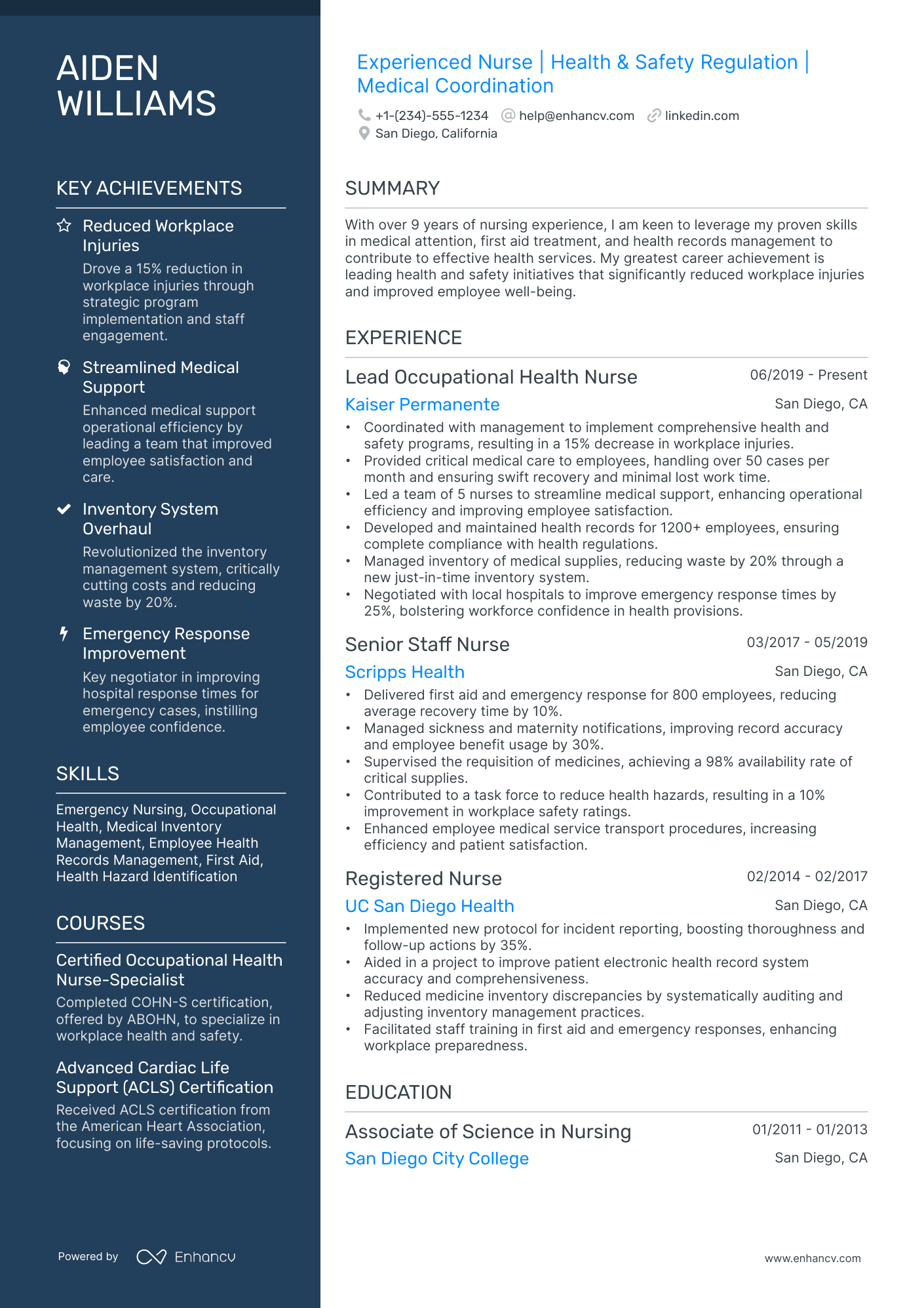
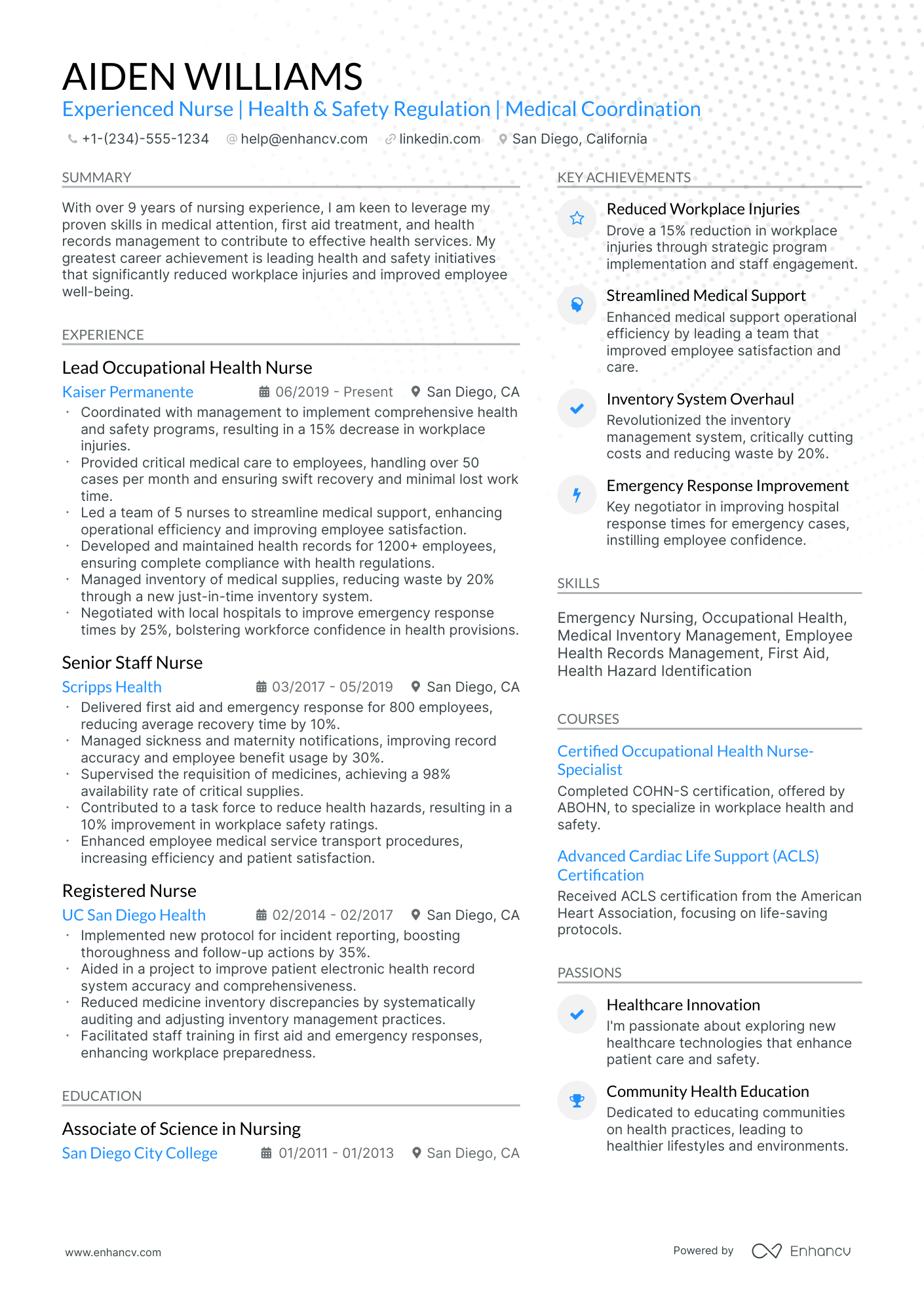
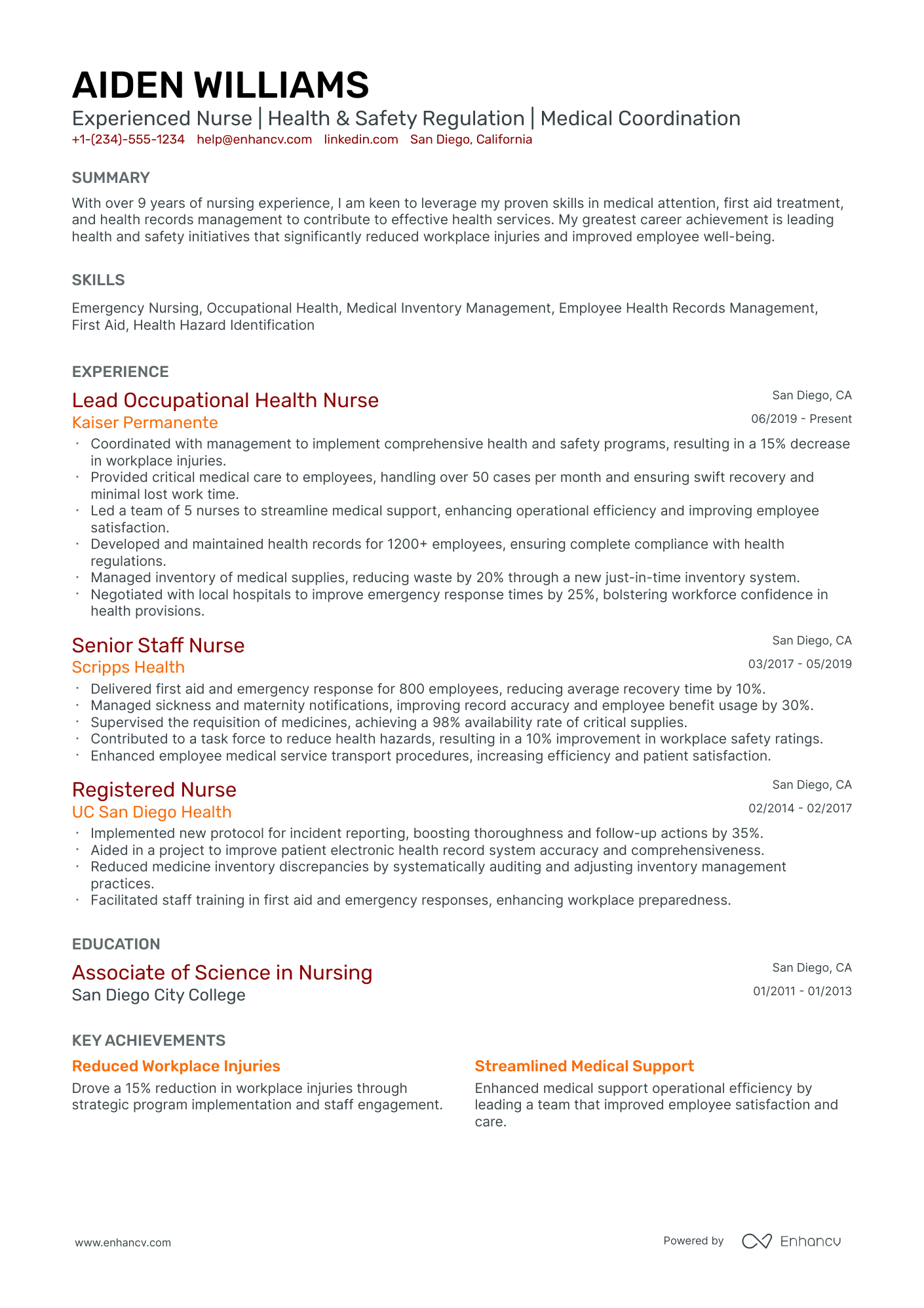
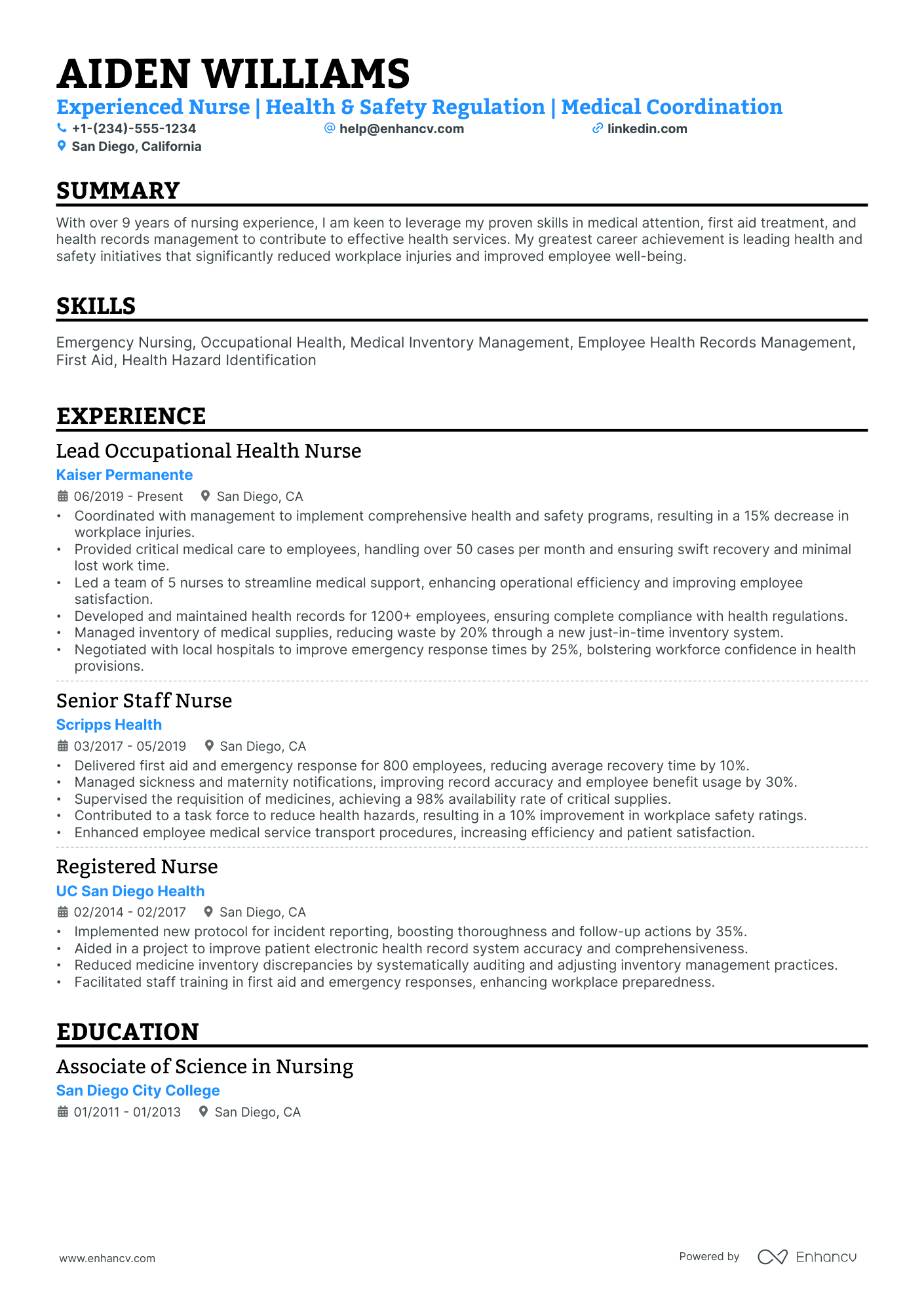
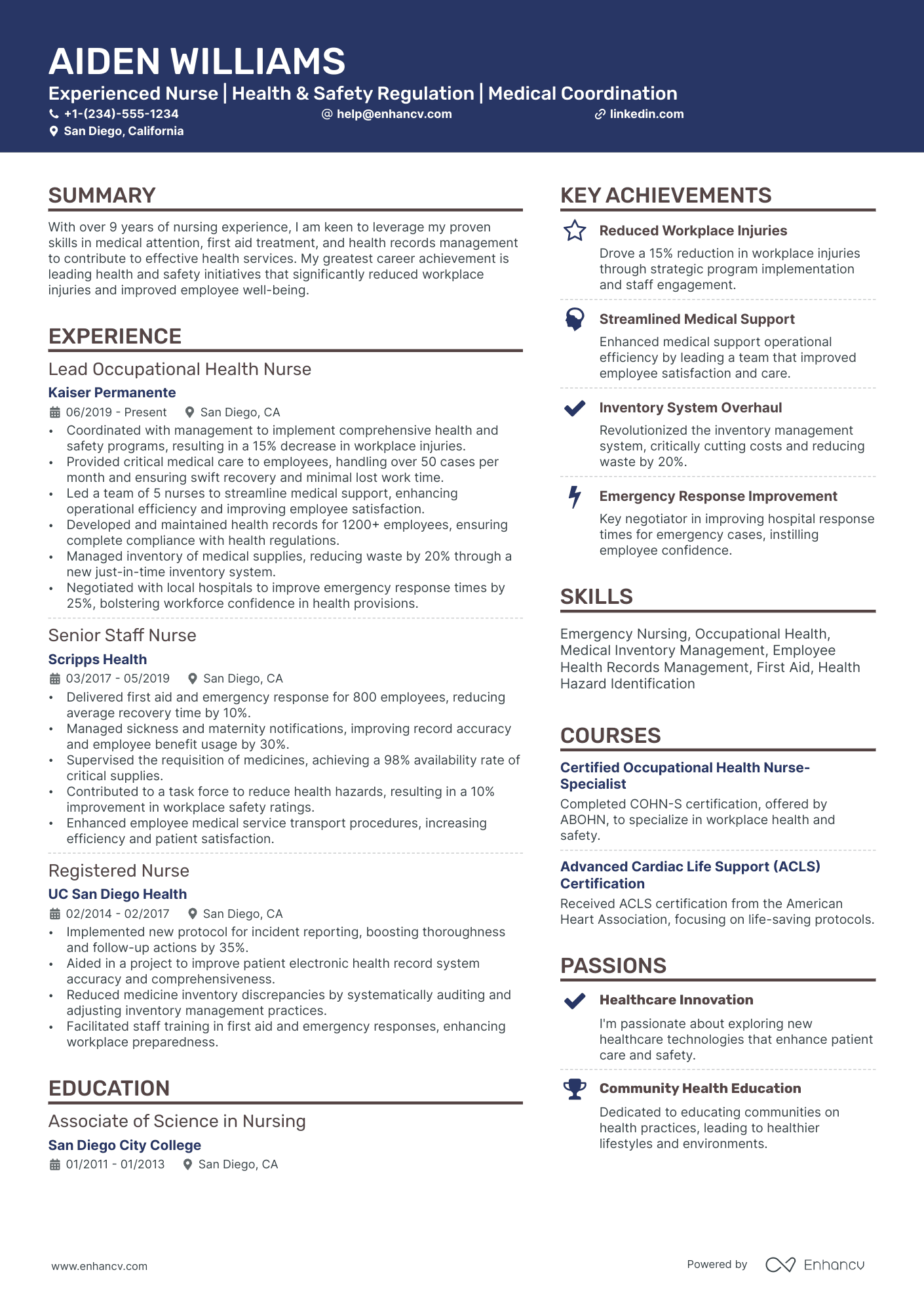
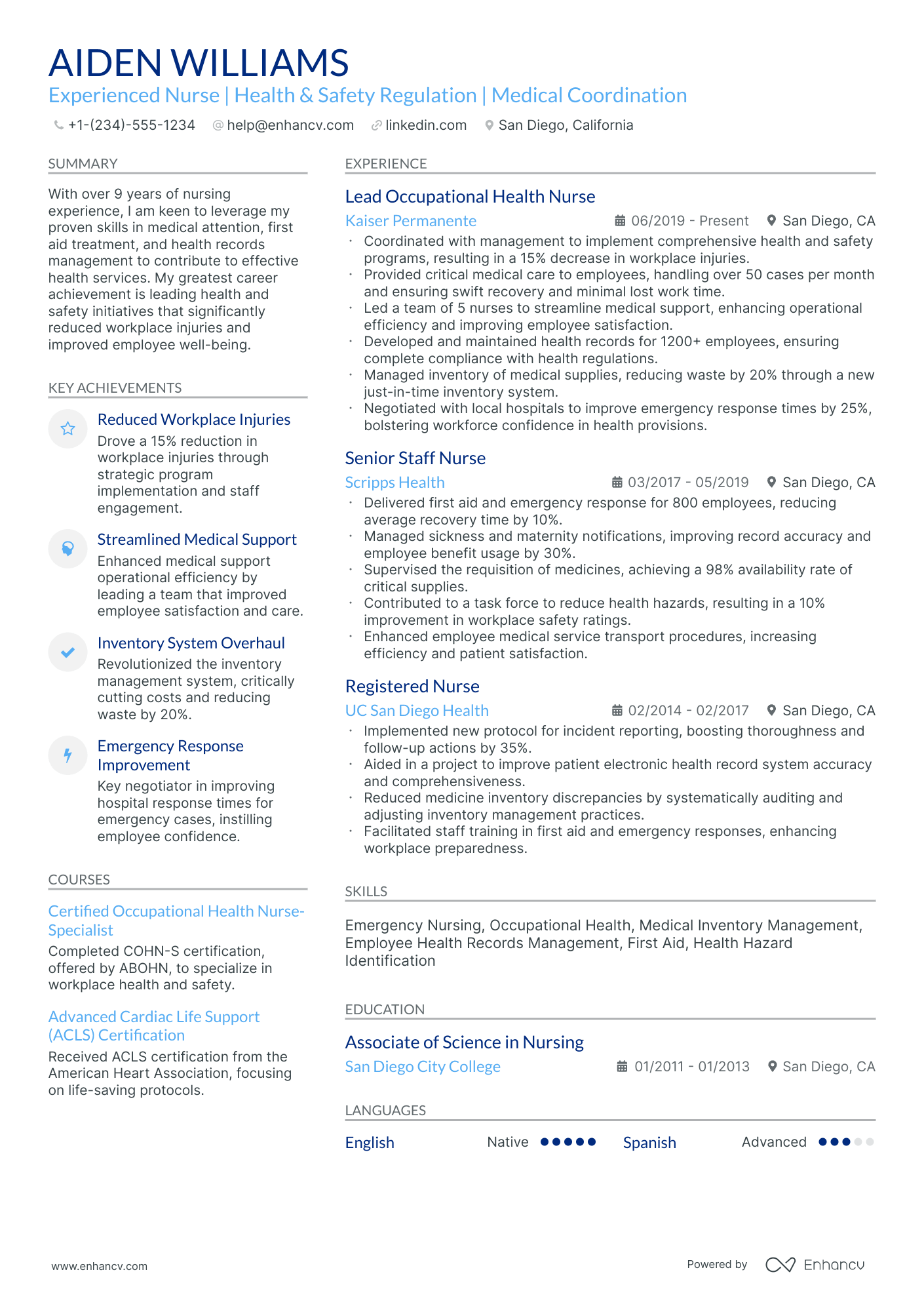
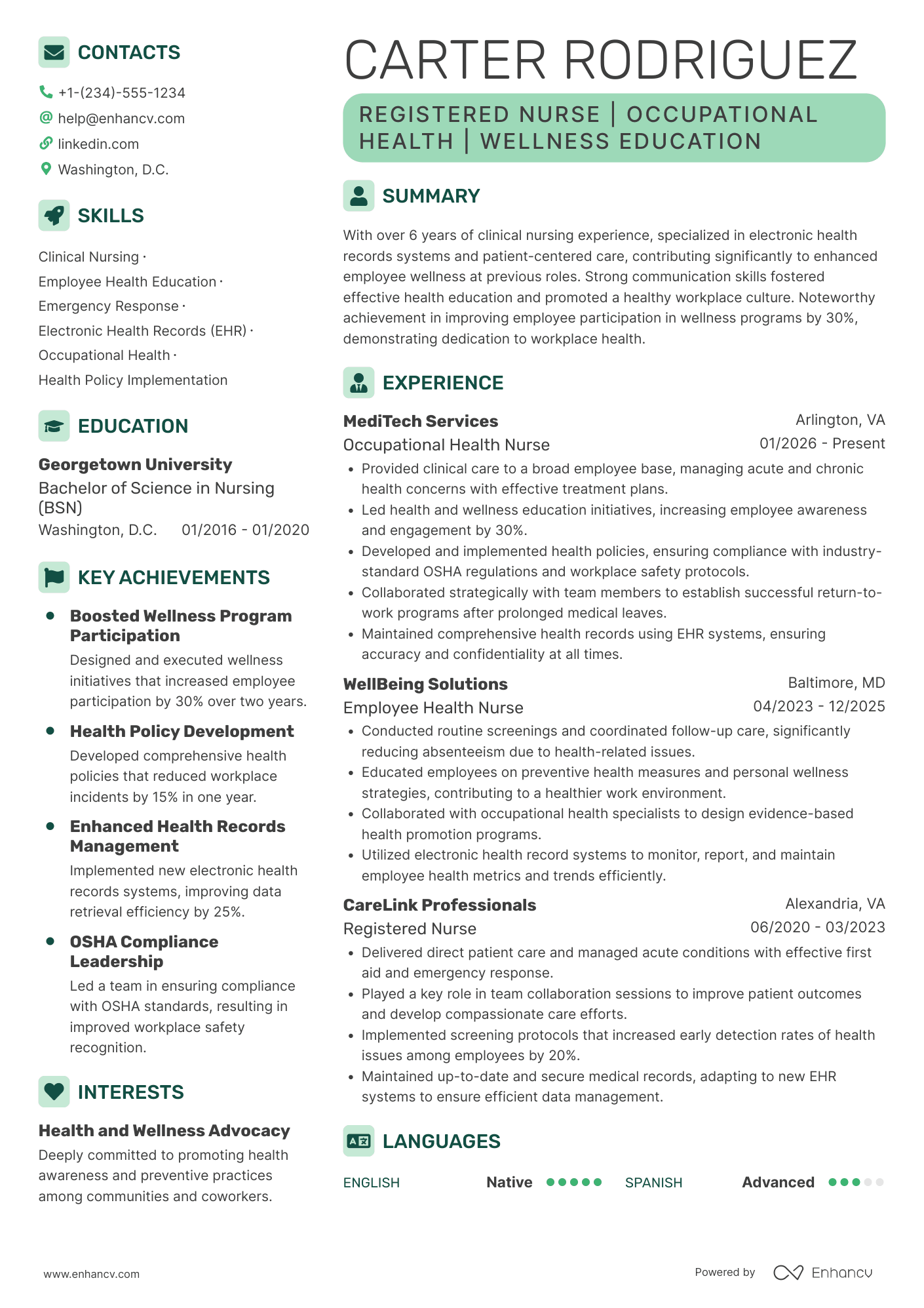
Most company nurse resume drafts fail because they read like task logs and hide clinical outcomes, compliance impact, and onsite risk reduction. That hurts when an ATS filters fast and recruiters scan in seconds in a crowded applicant pool.
A strong resume shows what changed because of your work. Understanding how to make your resume stand out starts with highlighting injury rate reductions, faster return-to-work timelines, audit-ready documentation, vaccination or wellness program uptake, and fewer recordable incidents across multiple sites. Quantify caseload, response times, and cost avoidance.

Key takeaways
- Quantify outcomes like injury reductions, response times, and cost savings in every experience bullet.
- Use reverse-chronological format for experienced nurses and hybrid format for career changers.
- Tailor resume language to mirror each job posting's exact tools, standards, and KPIs.
- Place certifications above education when they're recent and directly relevant to occupational health.
- Demonstrate skills through measurable results in your summary and experience, not just a list.
- Use AI to sharpen phrasing and spot gaps, but stop before it invents or inflates claims.
- Enhancv can help turn vague duties into focused, recruiter-ready bullets faster.
How to format a company nurse resume
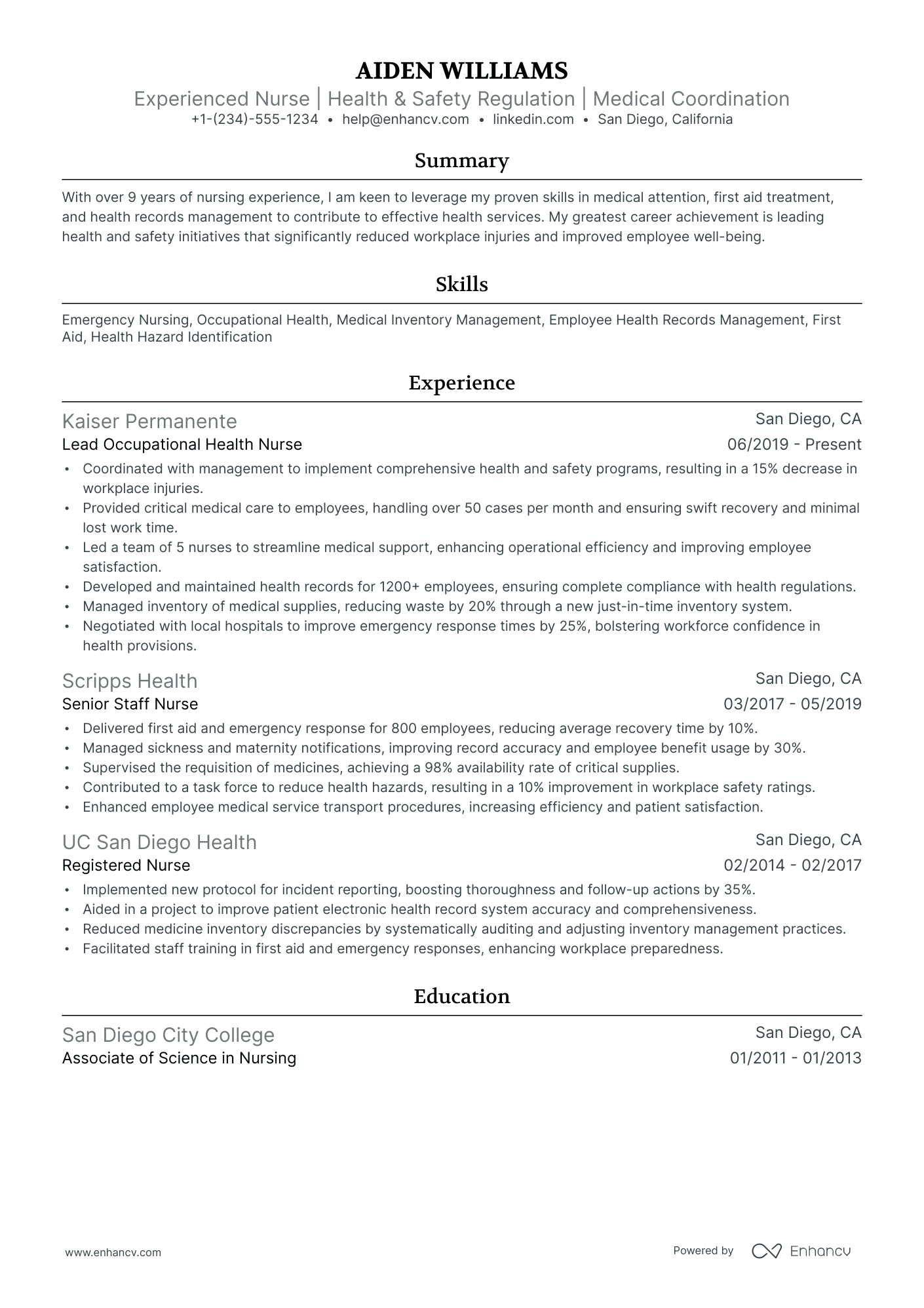
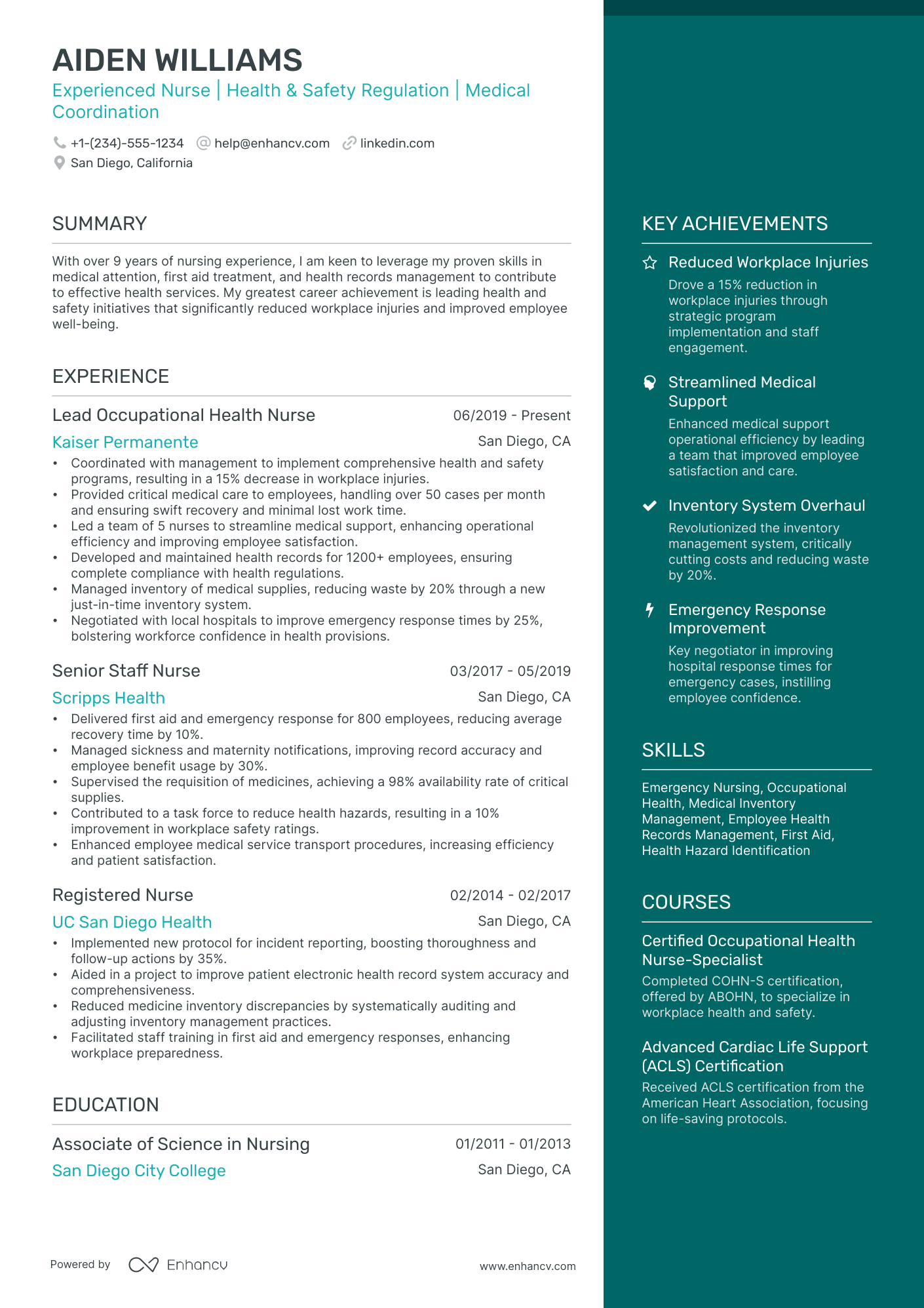
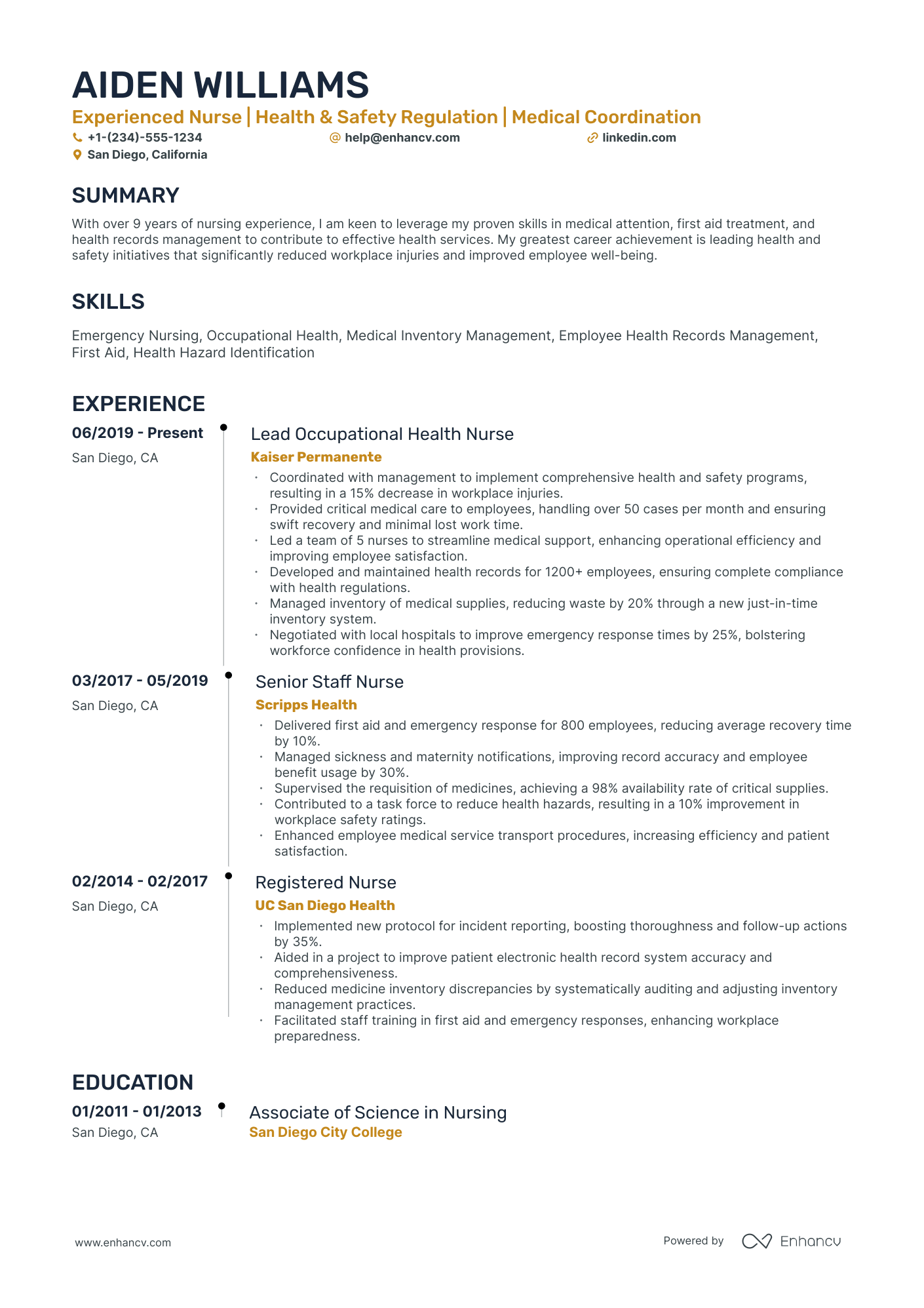
Recruiters evaluating company nurse resumes prioritize clinical competency, workplace health program management, and compliance with occupational health regulations. A clean, well-structured resume format ensures these signals surface quickly during both human review and applicant tracking system (ATS) scans.

I have significant experience in this role—which format should I use?
Use a reverse-chronological format to showcase your progression through increasingly complex occupational health responsibilities. Do:
- Lead with your most recent role and emphasize scope: number of employees served, sites managed, and programs you owned.
- Highlight role-specific tools and domains such as OSHA recordkeeping, electronic health records (EHR) systems, workers' compensation case management, and workplace injury surveillance.
- Quantify outcomes tied to cost savings, injury rate reductions, or compliance improvements.
I'm junior or switching into this role—what format works best?
A hybrid format works best, letting you lead with relevant clinical and occupational health skills while supporting them with your work history. Do:
- Place a dedicated skills section near the top featuring competencies like health screenings, first aid/CPR, OSHA compliance, and employee wellness programming.
- Include clinical rotations, occupational health practicums, volunteer work, or transitional experience that demonstrates workplace health exposure.
- Connect every listed skill to a concrete action and a measurable or observable result.
Why not use a functional resume?
A functional format strips away the timeline and context that hiring managers need to verify where and when you applied your clinical and occupational health skills, weakening your credibility even at the entry or mid-career level.
- Career changers from bedside nursing: You have transferable clinical assessment and triage skills but no direct occupational health titles yet.
- New graduates with practicum-only experience: Your work history is thin, but you completed employer-based clinical rotations or capstone projects in workplace health.
- Professionals with resume gaps: Extended absences due to personal circumstances, but you maintained certifications or completed continuing education during the gap.
Once you've established a clean, readable format, the next step is deciding which sections to include so each one earns its place on the page.
What sections should go on a company nurse resume
What sections should go on a company nurse resume?
Recruiters expect to see a clear snapshot of your occupational health expertise, clinical scope, and on-site impact. Knowing what to put on a resume helps you prioritize the sections that matter most.
Use this structure for maximum clarity:
- Header
- Summary
- Experience
- Skills
- Projects
- Education
- Certifications
- Optional sections: Awards, Leadership, Volunteering
Strong experience bullets should emphasize measurable outcomes, workforce coverage, compliance results, case volumes, and improvements you delivered in safety, injury management, and wellness.
Is your resume good enough?
Drop your resume here or choose a file. PDF & DOCX only. Max 2MB file size.
Once you’ve organized the essential resume components, the next step is to write your company nurse resume experience so it aligns with those elements and supports them with clear, role-specific evidence.
How to write your company nurse resume experience
The experience section of your company nurse resume should highlight the clinical work you've delivered, the occupational health tools and methods you've applied, and the measurable outcomes you've achieved for employees and employers alike. Hiring managers prioritize demonstrated impact—reduced incident rates, improved compliance, faster return-to-work timelines—over descriptive task lists that simply recount daily duties. Building a targeted resume ensures every bullet speaks directly to the role you're pursuing.
Each entry should include:
- Job title
- Company and location (or remote)
- Dates of employment (month and year)
Three to five concise bullet points showing what you owned, how you executed, and what outcomes you delivered:
- Ownership scope: the employee health programs, occupational health caseloads, clinic operations, wellness initiatives, or workforce populations you were directly accountable for as a company nurse.
- Execution approach: the clinical assessment protocols, electronic health record systems, triage frameworks, regulatory standards, or health screening methods you used to guide decisions and deliver care.
- Value improved: changes to workplace injury rates, employee health outcomes, regulatory compliance levels, return-to-work timelines, or risk reduction efforts tied to your occupational nursing practice.
- Collaboration context: how you partnered with human resources, safety officers, management teams, insurance carriers, or external healthcare providers to coordinate employee care and enforce workplace health policies.
- Impact delivered: outcomes expressed through improvements in workforce wellness, reductions in occupational health incidents, strengthened OSHA compliance, or cost savings for the organization rather than a list of tasks performed.
Experience bullet formula
A company nurse experience example
✅ Right example - modern, quantified, specific.
Company Nurse (Occupational Health)
Riverton Manufacturing | Columbus, OH
2022–Present
Eight-hundred-employee automotive parts plant operating three shifts with a focus on injury prevention and rapid return-to-work.
- Implemented an electronic health record (EHR) workflow in Cority, standardizing OSHA 300/301 documentation and reducing record completion time by 32% while improving audit readiness to 98% on internal spot checks.
- Led a respiratory protection program using NIOSH protocols, spirometry, and quantitative fit testing (TSI PortaCount), increasing on-time annual clearances from 74% to 96% and cutting respirator-related incidents by 41%.
- Coordinated transitional duty plans with HR, safety, and line supervisors, using job demand analyses and functional capacity data to reduce lost-time case rate by 18% and shorten average return-to-work by six days.
- Built a shift-based triage and follow-up model in Microsoft Teams and Outlook, improving first-response time for workplace injuries from twenty minutes to eight minutes and reducing offsite clinic referrals by 27%.
- Partnered with the safety manager and plant leadership to deliver targeted ergonomics interventions, tracking leading indicators in Power BI and lowering repetitive strain injury claims by 22% year over year.
Now that you've seen how a strong experience section comes together, let's look at how to adjust yours to match the specific job posting you're targeting.
How to tailor your company nurse resume experience
Recruiters evaluate company nurse resumes through both human review and applicant tracking systems, so your experience section needs to reflect the specific language and priorities in each job posting. Tailoring your resume to the job description means aligning what you've already done with what the employer is actively seeking.
Ways to tailor your company nurse experience:
- Match the exact health screening tools and systems listed in the posting.
- Mirror the workplace safety standards or compliance frameworks referenced.
- Use the same terminology for occupational health protocols and procedures.
- Reflect specific KPIs like injury reduction or response time goals mentioned.
- Highlight experience in the industry sector the employer operates within.
- Emphasize emergency response workflows or triage models they describe.
- Include relevant employee wellness program coordination if the role requires it.
- Reference OSHA recordkeeping or regulatory documentation practices they prioritize.
Tailoring your experience means presenting real accomplishments in the employer's own language, not forcing keywords where they don't belong.
Resume tailoring examples for company nurse
| Job description excerpt | Untailored | Tailored |
|---|---|---|
| Conduct pre-employment physicals, drug screenings, and health assessments using OSHA recordkeeping standards for a manufacturing facility with 500+ employees. | Performed various health screenings for employees. | Conducted over 200 pre-employment physicals and drug screenings annually for a 500-employee manufacturing site, maintaining full compliance with OSHA recordkeeping and reporting standards. |
| Manage workplace injury triage, administer first aid, and coordinate return-to-work programs in collaboration with HR and workers' compensation carriers. | Helped injured employees and provided basic medical care. | Triaged 30+ workplace injuries per quarter, administered first aid on-site, and partnered with HR and workers' compensation carriers to design return-to-work plans that reduced lost workdays by 18%. |
| Develop and deliver health promotion programs—including blood pressure monitoring, diabetes management, and flu vaccination clinics—tracked through the company's Epic Occupational Health module. | Educated employees on general wellness topics. | Launched quarterly blood pressure monitoring, diabetes management workshops, and flu vaccination clinics for 600 employees, logging all encounters and outcomes in the Epic Occupational Health module to track participation and health trends. |
Once you’ve aligned your experience with the role’s needs, the next step is to quantify your company nurse achievements so employers can see the impact behind those responsibilities.
How to quantify your company nurse achievements
Quantifying your achievements shows how you protect employee health and reduce business risk. Track visit volume, response time, compliance rates, return-to-work outcomes, and incident trends to prove impact.
Quantifying examples for company nurse
| Metric | Example |
|---|---|
| Visit volume | "Handled 35–45 employee clinic visits weekly using Epic, maintaining same-day triage for walk-ins across a 600-employee site." |
| Response time | "Reduced first-aid response time from 12 minutes to six by revising call-tree routing and staging trauma kits in three high-risk areas." |
| Compliance rate | "Improved OSHA recordkeeping accuracy to 98% by standardizing incident intake forms and auditing logs biweekly with HR." |
| Risk reduction | "Cut recordable injuries 22% in six months by leading monthly safety huddles and coaching supervisors on early symptom reporting." |
| Return-to-work | "Decreased average restricted-duty days from nine to six by coordinating modified assignments with managers and tracking cases in a shared dashboard." |
Turn vague job duties into measurable, recruiter-ready resume bullets in seconds with Enhancv's Bullet Point Generator.
With your bullet points clearly articulating your nursing accomplishments, the next step is ensuring your resume also highlights the right mix of hard and soft skills that hiring managers expect.
How to list your hard and soft skills on a company nurse resume
Your skills section shows you can deliver safe, compliant workplace care, and recruiters and an ATS (applicant tracking system) scan this section to match role keywords fast—aim for a hard skills-heavy mix, supported by role-specific soft skills. company nurse roles require a blend of:
- Product strategy and discovery skills.
- Data, analytics, and experimentation skills.
- Delivery, execution, and go-to-market discipline.
- Soft skills.
Your skills section should be:
- Scannable (bullet-style grouping).
- Relevant to the job post.
- Backed by proof in experience bullets.
- Updated with current tools.
Place your skills section:
- Above experience if you're junior or switching careers.
- Below experience if you're mid/senior with strong achievements.

Hard skills
- Occupational health nursing
- OSHA recordkeeping, 300/301/300A
- Workers' compensation case management
- Return-to-work coordination
- FMLA, ADA compliance support
- Triage protocols, symptom assessment
- First aid, CPR, AED
- Immunization administration
- Phlebotomy, specimen collection
- EHR documentation, Epic, Cerner
- Drug and alcohol testing programs
- Infection prevention and control
Soft skills
- Communicate clinical decisions clearly
- De-escalate high-stress situations
- Educate employees on care plans
- Coordinate with HR and safety teams
- Protect confidentiality under pressure
- Prioritize competing urgent needs
- Document objectively and consistently
- Escalate appropriately to providers
- Drive follow-up to closure
- Build trust with frontline staff
- Advocate for safe work practices
- Navigate sensitive employee relations
How to show your company nurse skills in context
Skills shouldn't live only in a bulleted list on your resume. Explore resume skills examples to see how other professionals integrate competencies throughout their documents.
They should be demonstrated in:
- Your summary (high-level professional identity)
- Your experience (proof through outcomes)
Here's what strong, skill-integrated writing looks like in practice.
Summary example
Senior company nurse with 12 years in manufacturing health services. Skilled in OSHA compliance, triage protocols, and Epic documentation. Reduced workplace injury recurrence by 34% through proactive ergonomic assessments and employee wellness coaching.
- Reflects senior-level expertise clearly
- Names role-relevant tools and frameworks
- Leads with a measurable outcome
- Highlights communication and coaching ability
Experience example
Senior Occupational Health Nurse
Ridgeline Manufacturing Co. | Akron, OH
March 2018–Present
- Implemented a digital triage system using Epic, cutting average assessment time by 22% across three production facilities.
- Partnered with HR and safety teams to redesign return-to-work protocols, improving employee retention post-injury by 18%.
- Led monthly wellness screenings for 600+ employees, identifying early hypertension cases and reducing emergency referrals by 29%.
- Every bullet includes measurable proof
- Skills surface naturally through outcomes
Once you’ve demonstrated your nursing strengths through specific, job-relevant examples, the next step is to apply that same approach to building a company nurse resume when you don’t have formal experience.
How do I write a company nurse resume with no experience
Even without full-time experience, you can demonstrate readiness through clinical training and volunteer work. Our guide on writing a resume without work experience covers the full approach. Here are entry points specific to company nursing:
- Occupational health clinical rotation hours
- On-campus health clinic volunteering
- First aid and CPR instruction
- Immunization clinic support shifts
- Health screening event staffing
- HIPAA and OSHA training certificates
- EHR documentation practice labs
- Case study care plan portfolios
Focus on:
- Occupational health and triage examples
- Documentation accuracy using EHR
- Compliance: HIPAA and OSHA training
- Vaccination, screening, and testing exposure
Resume format tip for entry-level company nurse
Use a functional resume format because it highlights clinical competencies, compliance training, and projects when your work history is limited. Do:
- Lead with a skills summary tied to occupational health tasks.
- Add clinical rotations with hours, settings, and duties.
- List certifications and compliance training with dates.
- Include projects with tools, metrics, and outcomes.
- Use job keywords from the posting.
- Supported an immunization clinic using EHR documentation and vaccine cold-chain logs, processing 120 employee records with zero charting errors during a four-hour shift.
Even without hands-on experience, your educational background can demonstrate the clinical knowledge and training that qualify you for the role—so presenting it effectively is essential.
How to list your education on a company nurse resume
Your education section lets hiring teams confirm you hold the clinical training and credentials a company nurse needs. It validates your foundational nursing knowledge quickly.
Include:
- Degree name
- Institution
- Location
- Graduation year
- Relevant coursework (for juniors or entry-level candidates)
- Honors & GPA (if 3.5 or higher)
Skip month and day details—list the graduation year only.
Here's a strong education entry tailored to the company nurse role.
Example education entry
Bachelor of Science in Nursing
University of Michigan, Ann Arbor, MI
Graduated 2021
GPA: 3.7/4.0
- Relevant Coursework: Occupational Health Nursing, Community Health, Epidemiology, Health Promotion & Disease Prevention
- Honors: Magna Cum Laude, Sigma Theta Tau International Honor Society
How to list your certifications on a company nurse resume
Certifications on your resume show your commitment to learning, proficiency with clinical tools, and current industry knowledge as a company nurse. They also help employers confirm you meet workplace health, safety, and compliance expectations.
Include:
- Certificate name
- Issuing organization
- Year
- Optional: credential ID or URL
- Place certifications below education when they are older, less role-specific, or mainly reinforce your base nursing credentials.
- Place certifications above education when they are recent, highly relevant to company nurse work, or required for occupational health responsibilities.
Best certifications for your company nurse resume
- Basic Life Support (BLS)
- Advanced Cardiovascular Life Support (ACLS)
- Certified Occupational Health Nurse (COHN)
- Certified Occupational Health Nurse–Specialist (COHN-S)
- Certified Case Manager (CCM)
- Certified Emergency Nurse (CEN)
- DOT Urine Specimen Collector Certification
Once you’ve presented your nursing credentials and licenses clearly, shift to your company nurse resume summary to show how those qualifications translate into value for the role.
How to write your company nurse resume summary
Your resume summary is the first thing a recruiter reads. A strong one instantly signals you're qualified for a company nurse role.
Keep it to three to four lines, with:
- Your title and years of hands-on nursing experience.
- The industry or setting you've worked in, such as corporate or occupational health.
- Core skills like health assessments, OSHA compliance, and electronic health records.
- One or two measurable achievements, such as reduced workplace injuries or improved screening rates.
- Soft skills tied to real outcomes, like communication that boosted employee participation in wellness programs.

PRO TIP
At this level, focus on clinical skills, relevant certifications, and early wins that show initiative. Avoid vague phrases like "passionate team player" or "dedicated professional." Replace them with specific contributions and measurable results.
Example summary for a company nurse
Company nurse with three years of experience in corporate occupational health. Reduced workplace injury rates by 22% through proactive screening programs. Skilled in OSHA compliance, triage, and employee wellness coordination.
Optimize your resume summary and objective for ATS
Drop your resume here or choose a file.
PDF & DOCX only. Max 2MB file size.
Now that your summary effectively showcases your clinical expertise and value, make sure the header presenting your contact details is equally polished and professional.
What to include in a company nurse resume header
A resume header is the top section with your key identifiers, and it boosts visibility, credibility, and recruiter screening for a company nurse.
Essential resume header elements
- Full name
- Tailored job title and headline
- Location
- Phone number
- Professional email
- GitHub link
- Portfolio link
A LinkedIn link lets recruiters verify your experience quickly and supports screening.
Don't include a photo on a company nurse resume unless the role is explicitly front-facing or appearance-dependent.
Use a clear job title that matches the posting, and keep all contact details consistent with your application profiles.
Company nurse resume header
Jordan Taylor
Company Nurse | Occupational Health and Workplace Safety
Austin, TX
(512) 555-01XX
your.name@enhancv.com
github.com/yourname
yourwebsite.com
linkedin.com/in/yourname
Once your contact details and key credentials are easy to find at the top, you can strengthen the rest of your application with additional sections that add relevant context.
Additional sections for company nurse resumes
Adding extra sections helps you stand out when your core qualifications match other applicants. They showcase unique strengths relevant to workplace health settings. For example, listing volunteering on your resume can highlight community health involvement and hands-on clinical initiative.
- Languages
- Certifications and licenses
- Professional affiliations
- Volunteer experience
- Publications
- Continuing education
- Awards and recognitions
Once you've rounded out your resume with the right supplementary sections, it's worth turning your attention to the cover letter—a separate document that can reinforce and contextualize everything your resume presents.
Do company nurse resumes need a cover letter
A cover letter isn't required for a company nurse, but it helps when the role is competitive or the employer expects one. If you're unsure where to start, understanding what a cover letter is and how it complements your resume can clarify when to include one. It can make a difference when your resume needs context, or when you want to show clear fit.
Use a cover letter to add details your resume can't:
- Explain role and team fit by connecting your clinical strengths to onsite workflows, safety priorities, and cross-functional partners.
- Highlight one or two relevant projects or outcomes, such as reducing incident rates, improving triage response times, or increasing follow-up compliance.
- Show understanding of the business context by referencing the workforce, shift patterns, common risks, and how health programs support productivity and retention.
- Address career transitions or non-obvious experience by mapping past work to company nurse duties, scope, and reporting relationships.
Drop your resume here or choose a file.
PDF & DOCX only. Max 2MB file size.
Even if you choose to apply without a cover letter, the next step is to use AI to improve your company nurse resume so it communicates your qualifications clearly and efficiently.
Using AI to improve your company nurse resume
AI can sharpen your resume's clarity, structure, and impact. It helps you find stronger phrasing and highlight measurable results. But overuse strips authenticity. Once your content feels clear and role-aligned, step away from AI. If you're wondering which AI is best for writing resumes, start with tools designed specifically for resume optimization.
Here are 10 practical prompts to strengthen specific sections of your company nurse resume:
- Sharpen your summary: "Rewrite my company nurse resume summary to highlight my top clinical skills and workplace health achievements in three concise sentences."
- Quantify experience bullets: "Add measurable outcomes to these company nurse experience bullets, focusing on injury reduction rates, response times, or employee health improvements."
- Align skills section: "Review this skills list and remove any entries irrelevant to a company nurse role. Suggest missing occupational health competencies."
- Strengthen action verbs: "Replace weak verbs in my company nurse experience section with precise, clinical action verbs that show direct impact."
- Tighten certification details: "Reformat my company nurse certifications section for consistency, listing credential name, issuing body, and expiration date."
- Refine education entries: "Edit my education section to emphasize coursework and clinical rotations most relevant to a company nurse position."
- Improve project descriptions: "Rewrite this workplace wellness project description to show my company nurse contributions and specific health outcomes achieved."
- Remove filler language: "Identify and remove vague or redundant phrases from my company nurse resume without losing important clinical details."
- Tailor to job posting: "Compare my company nurse resume against this job description. Highlight gaps and suggest targeted edits for each section."
- Fix inconsistent formatting: "Standardize bullet structure, tense, and punctuation across all sections of my company nurse resume."
Stop using AI once your resume sounds accurate, specific, and aligned with real experience. AI should never invent experience or inflate claims—if it didn't happen, it doesn't belong here.
Conclusion
A strong company nurse resume shows measurable outcomes, role-specific skills, and a clear structure. Highlight results like reduced incidents, faster return-to-work timelines, and improved compliance rates. Keep sections easy to scan, with focused bullets and consistent formatting.
This approach shows you’re ready for today’s hiring market and the next hiring cycle. It proves you can deliver safe care, manage cases, and support workplace health programs with confidence. Keep it direct, accurate, and results-driven.