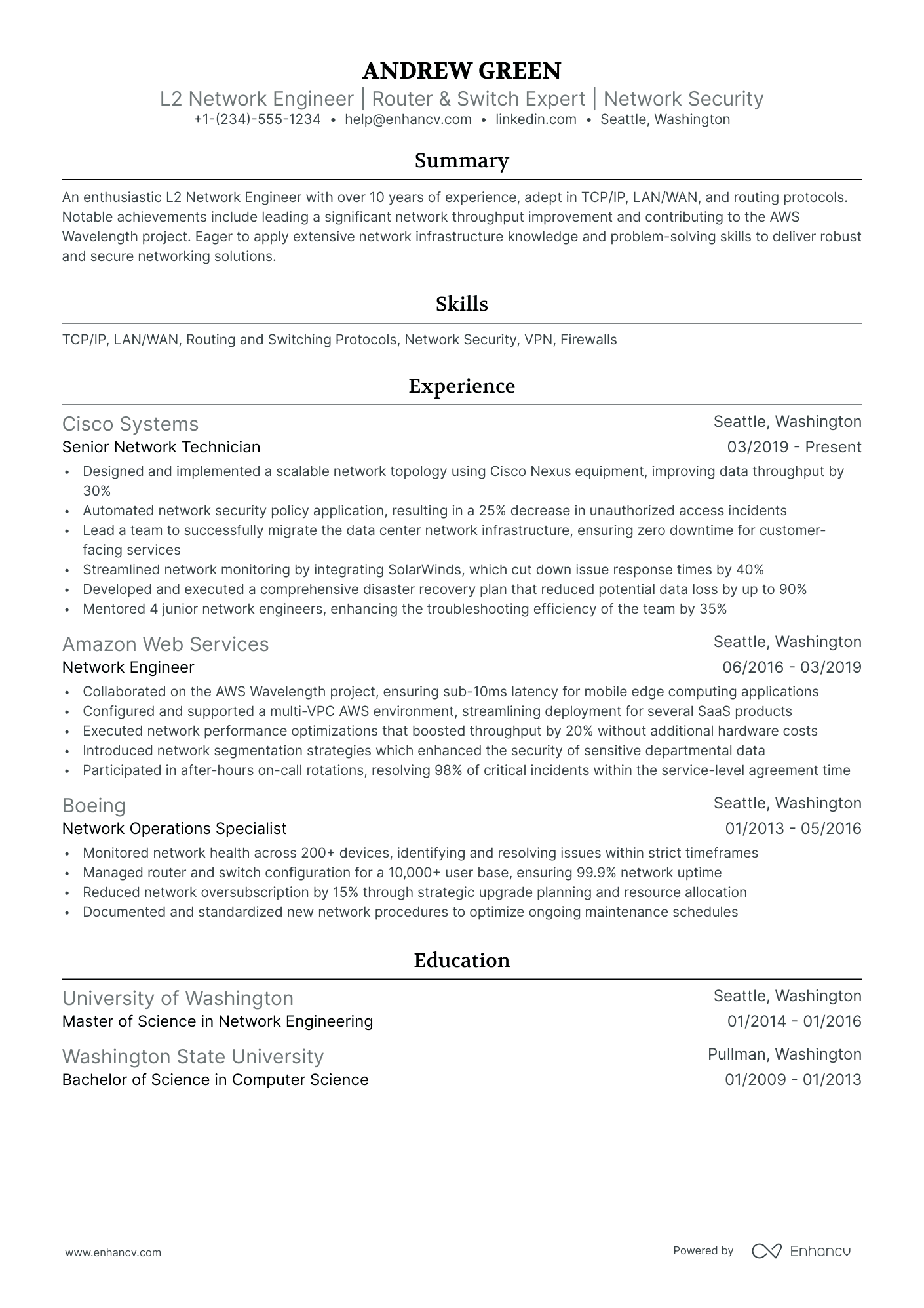
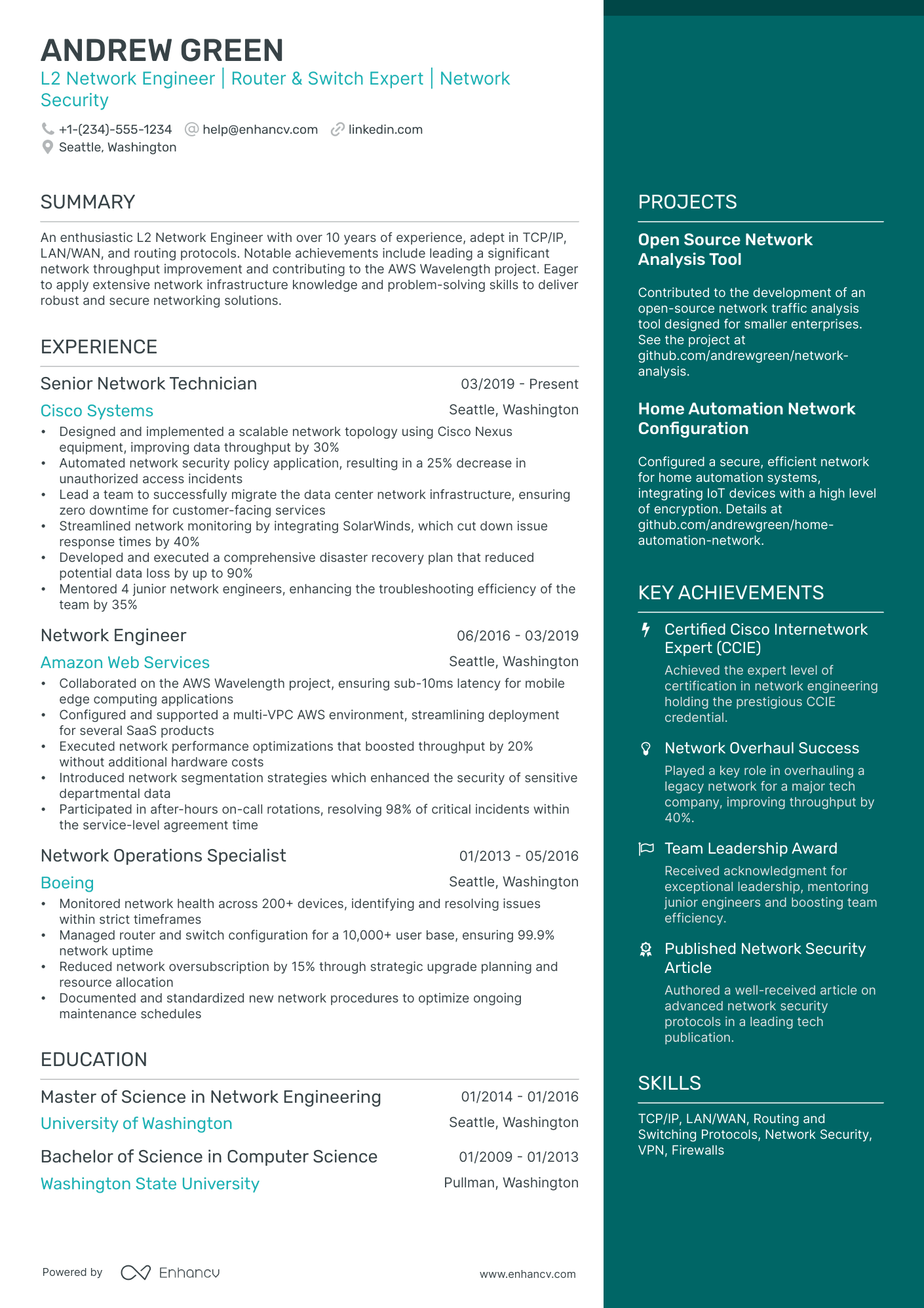
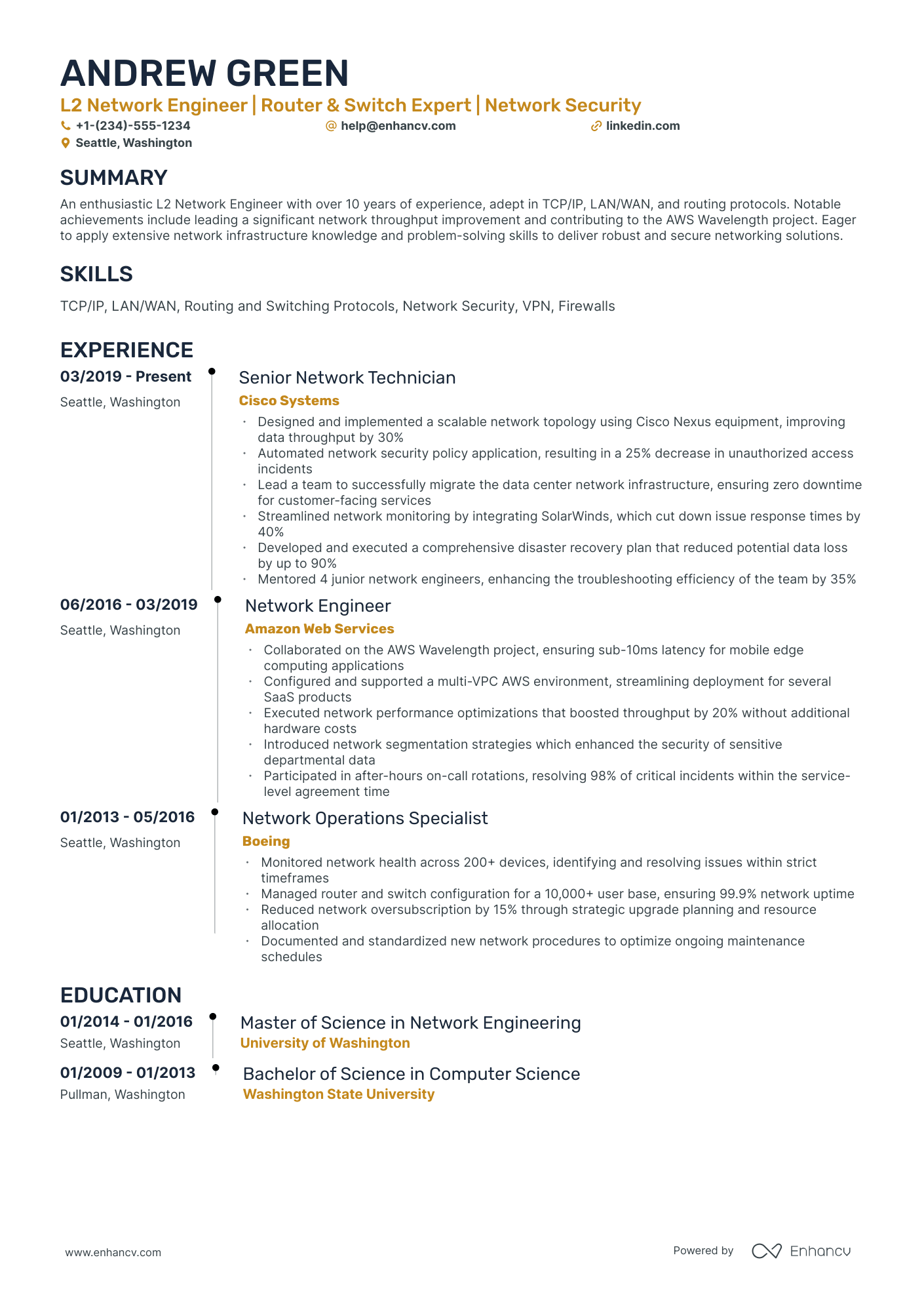
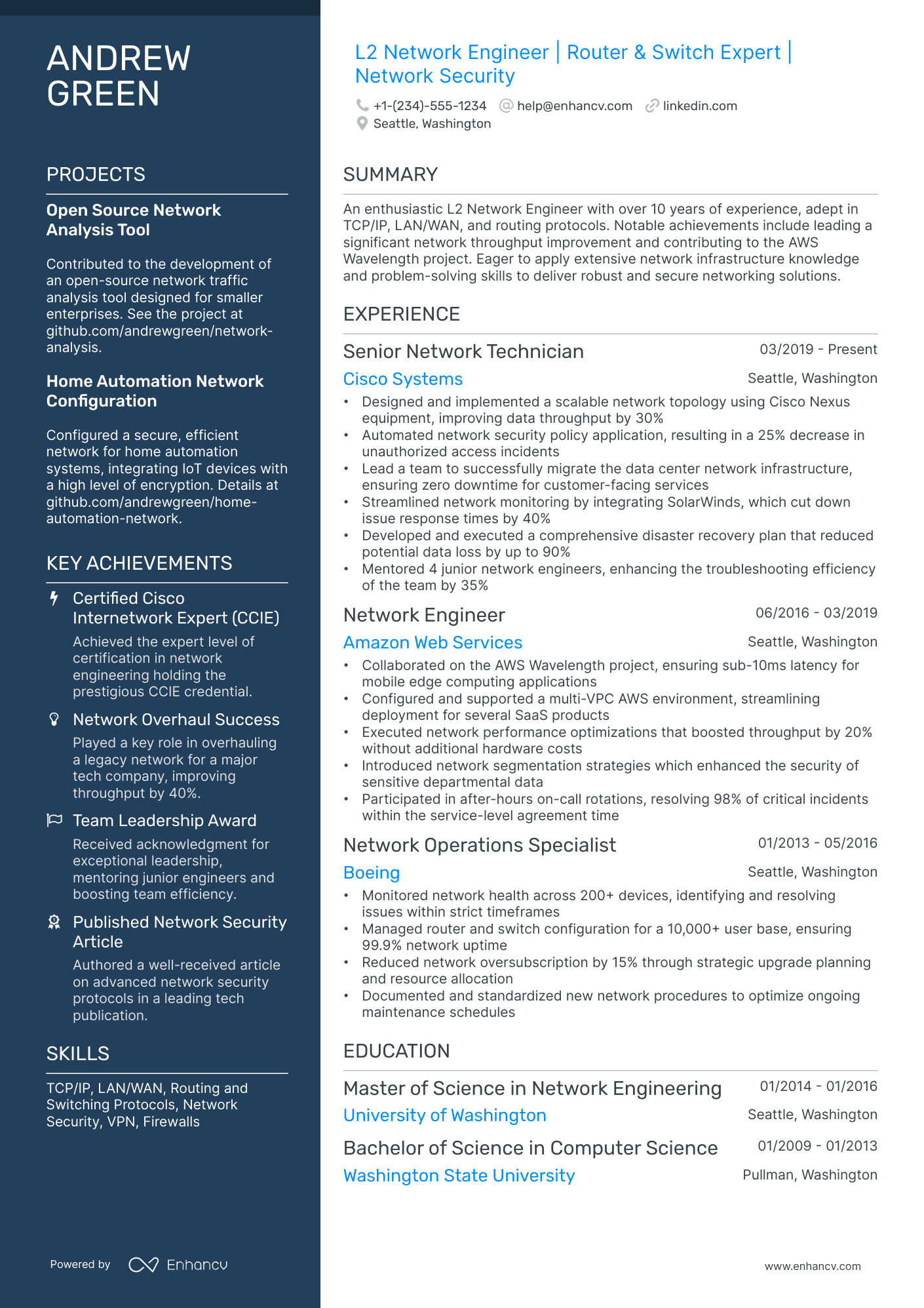
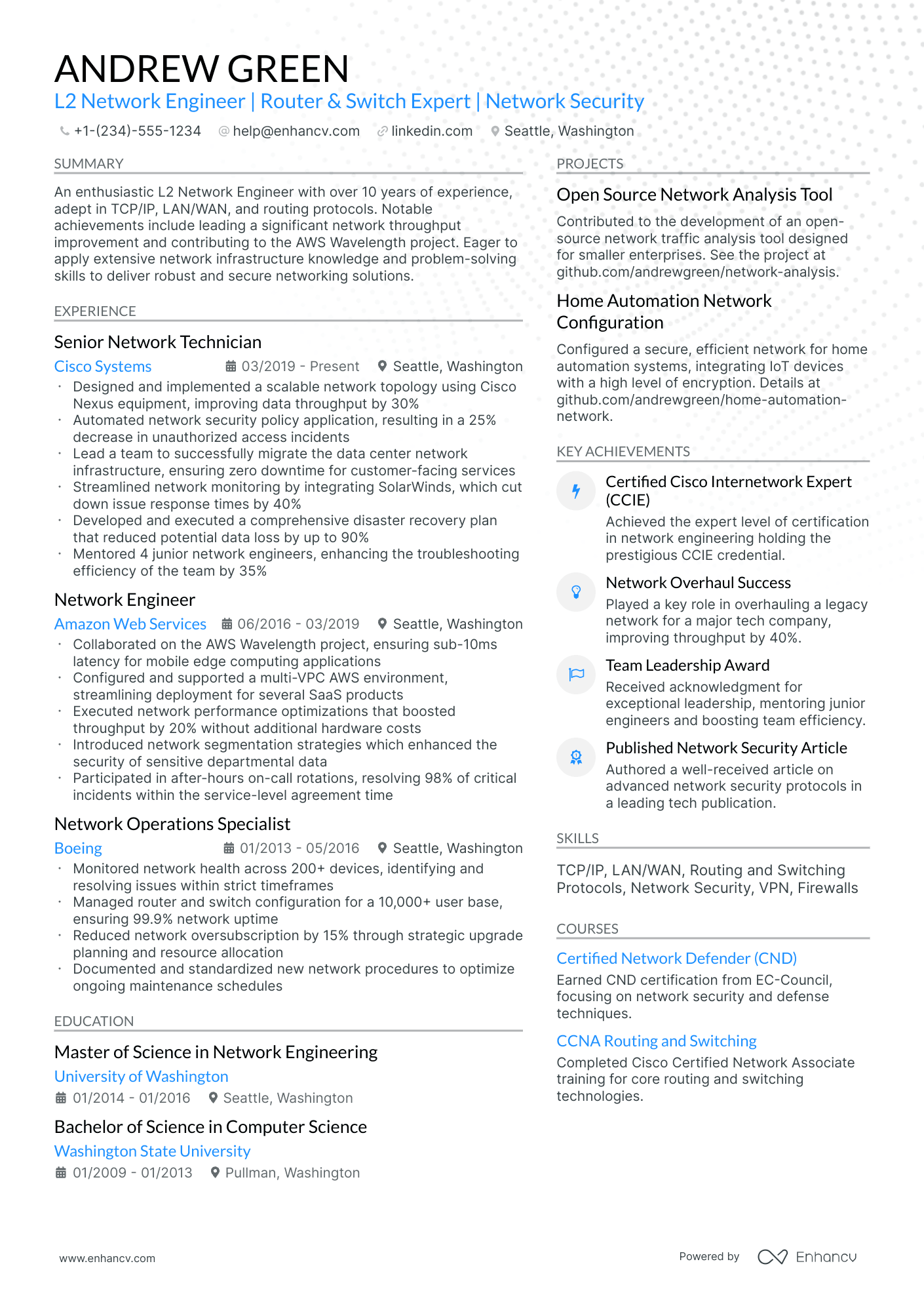
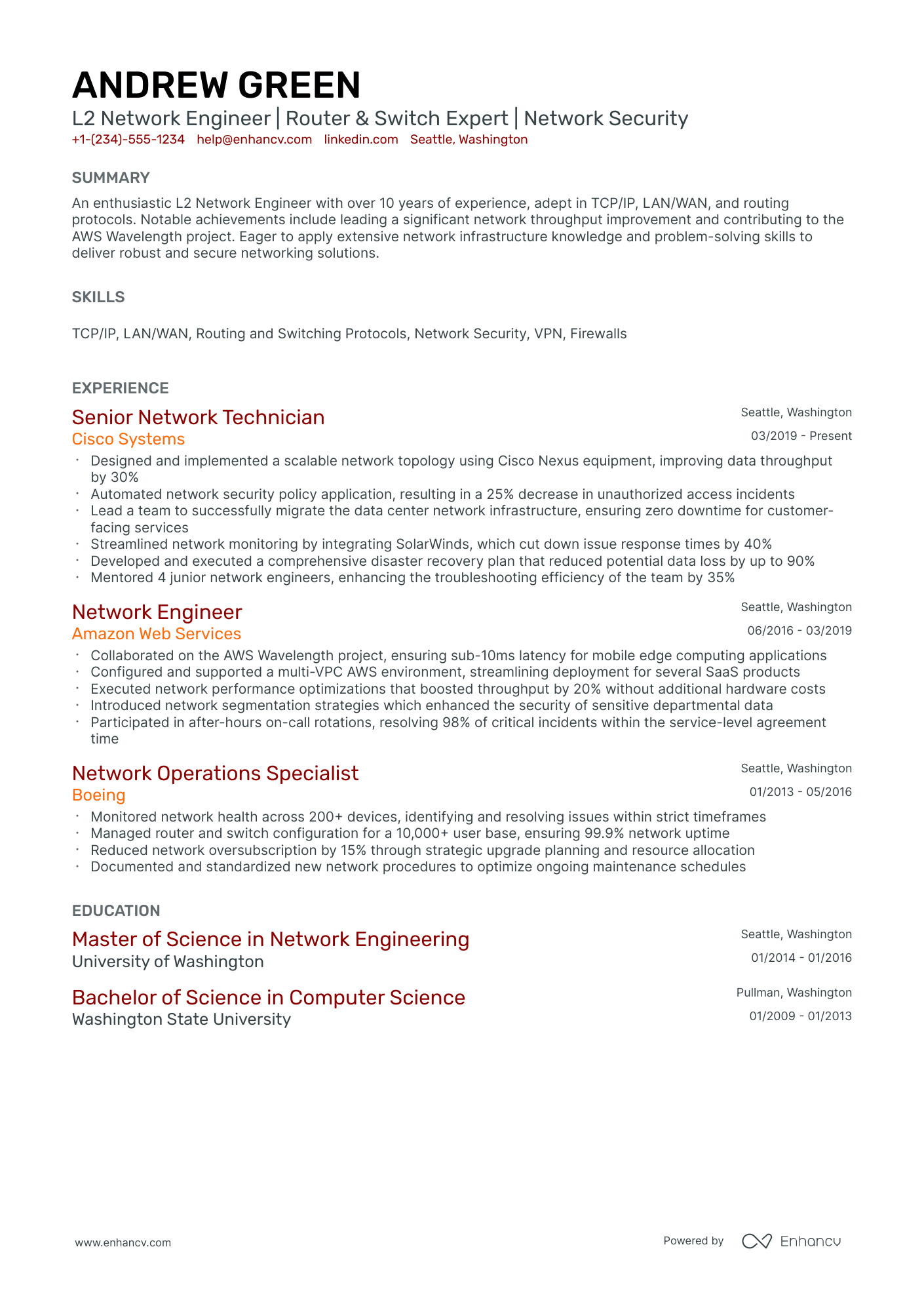
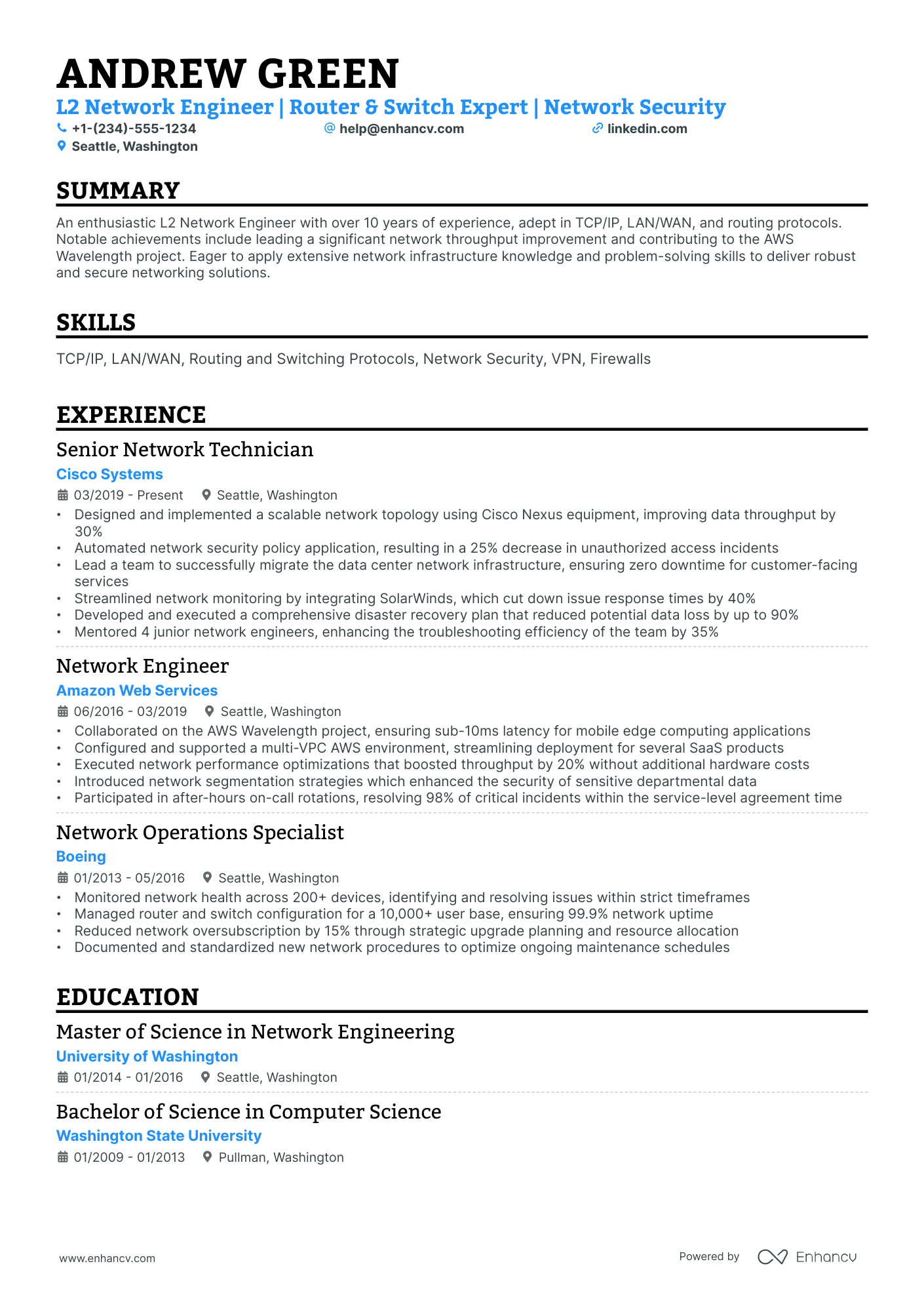
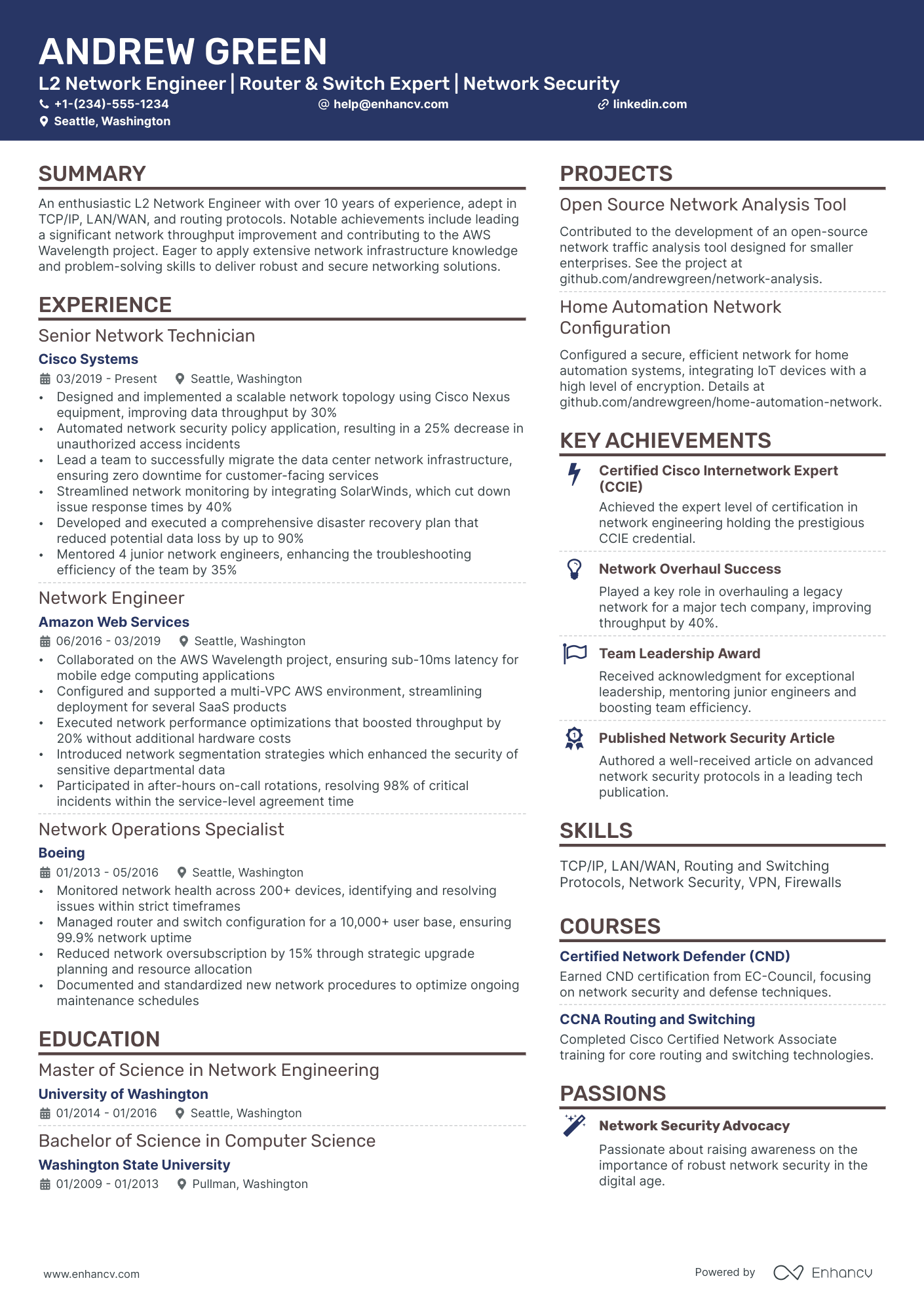
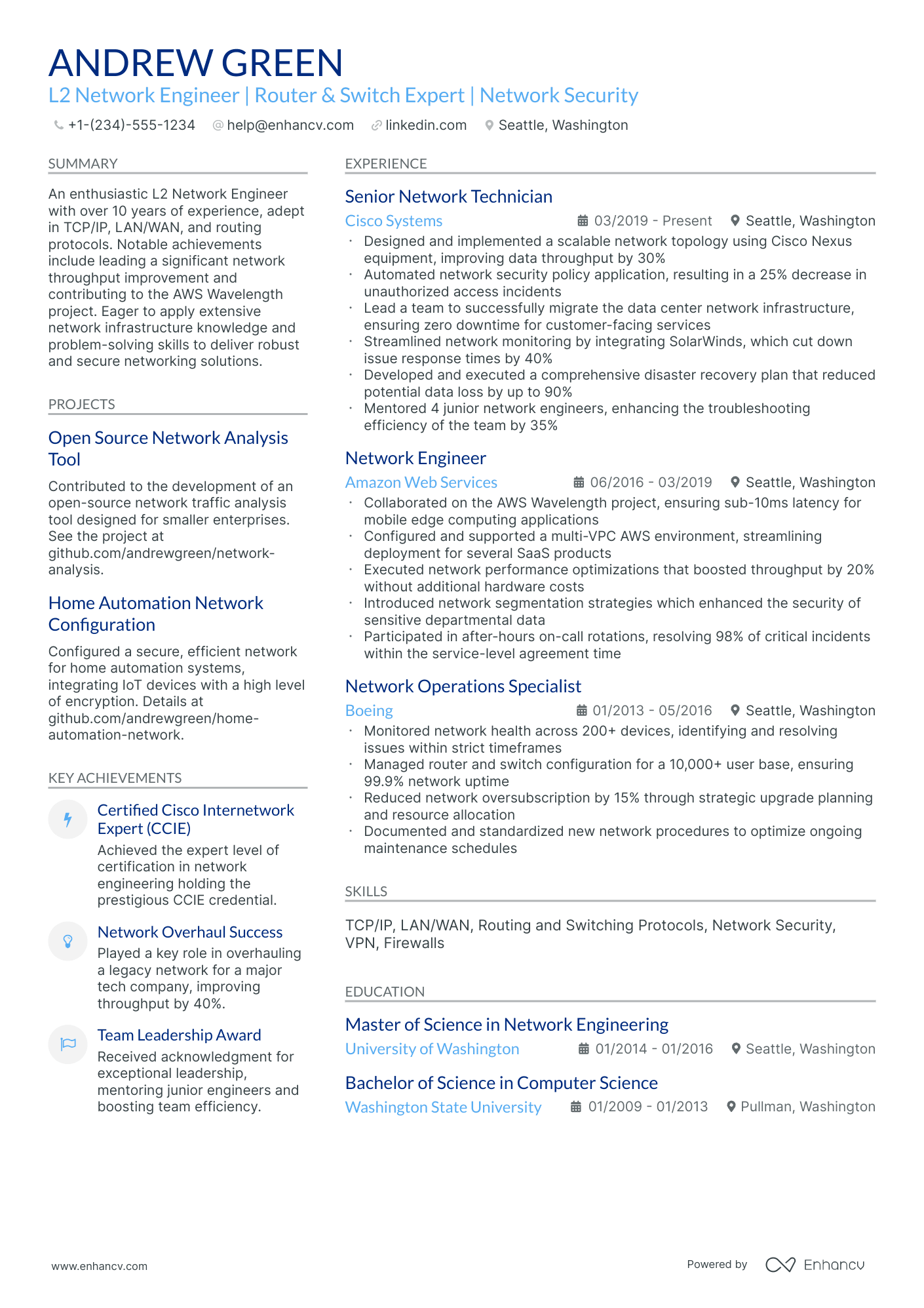
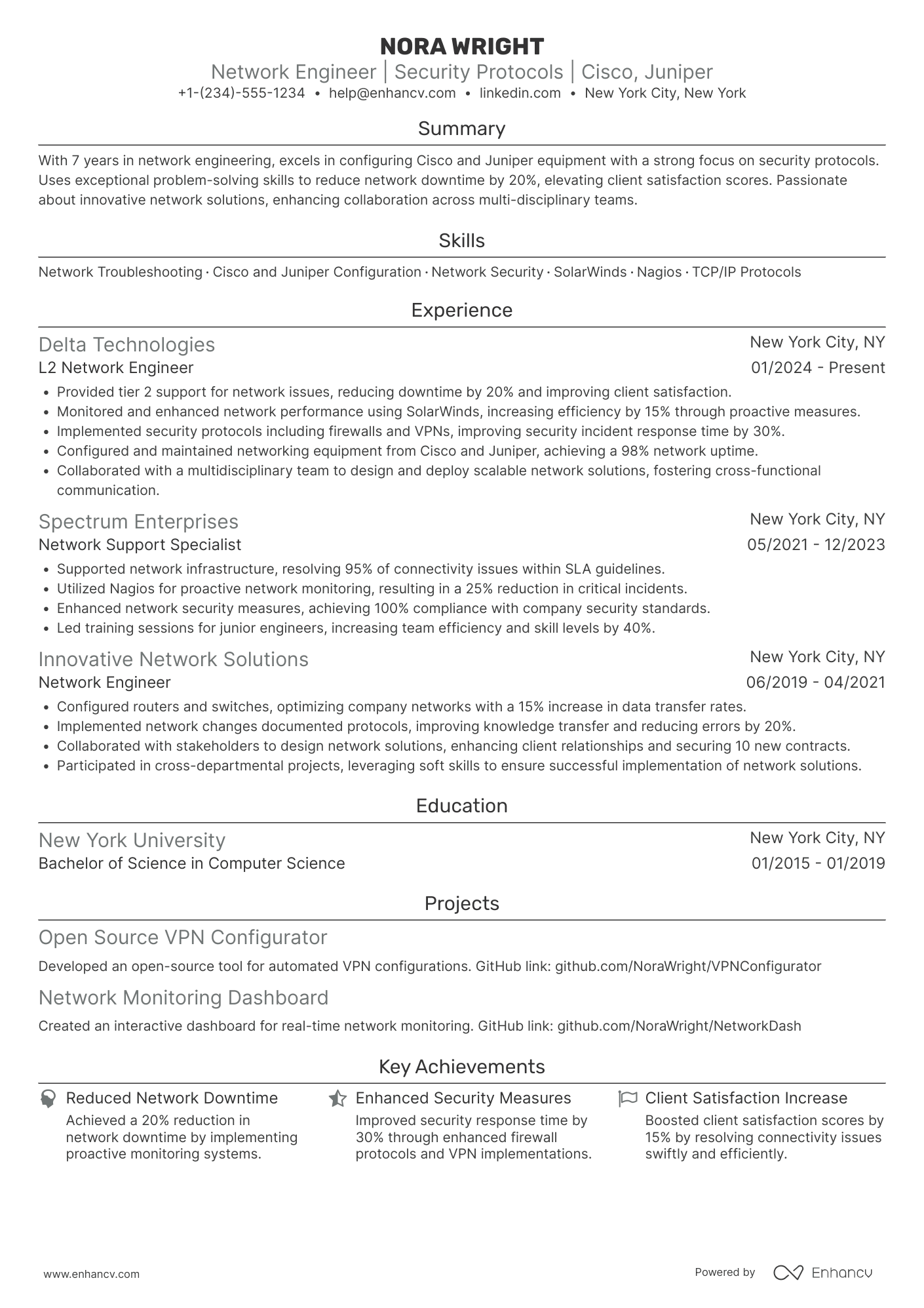
Most L2 network engineer resume submissions fail because they read like tool inventories and ticket logs, not proof of incident ownership and service stability. In today's ATS screening and rapid recruiter scans, that hides your impact in a crowded applicant pool.
A strong resume shows what improved because of your work. Knowing how to make your resume stand out means highlighting reduced mean time to resolution, fewer repeat incidents, higher uptime, cleaner change success rates, faster site bring-ups, and better user experience. Quantify scope with locations supported, devices managed, and escalations resolved.

Key takeaways
- Quantify every experience bullet with metrics like uptime, MTTR, or incident volume reduction.
- Tailor resume keywords to each job posting's specific tools, protocols, and platforms.
- Use reverse-chronological format if you have continuous L2 network engineering experience.
- Place a skills section above experience when switching careers or entering the field.
- Pair each listed skill with a concrete action and measurable result from your work.
- Position certifications like CCNA or CCNP prominently when they match the target role.
- Build polished, results-driven bullets faster using Enhancv's resume tools.
How to format a L2 network engineer resume
Recruiters hiring L2 network engineers prioritize hands-on troubleshooting depth, familiarity with routing/switching protocols, and the ability to resolve escalated issues efficiently under pressure. A clean, well-structured resume format ensures these technical competencies and operational contributions surface quickly during both ATS parsing and manual review.

I have significant experience in this role—which format should I use?
Use a reverse-chronological format to present your growing technical responsibilities and incident resolution track record in a clear, linear timeline. Do:
- Lead each role entry with your operational scope—network size, number of sites supported, and escalation tier ownership.
- Highlight proficiency in role-specific tools and domains such as Cisco IOS, Juniper, OSPF/BGP configuration, VLAN segmentation, Wireshark, SolarWinds, and ITIL-based ticketing workflows.
- Quantify outcomes tied to uptime improvements, mean time to resolution (MTTR) reductions, or successful migration and upgrade projects.
I'm junior or switching into this role—what format works best?
A hybrid format works best, allowing you to feature relevant networking skills and certifications prominently while still presenting any hands-on experience in chronological order. Do:
- Place a dedicated skills section near the top of your resume covering protocols (STP, VLANs, OSPF), tools (Wireshark, PuTTY, packet tracer), and certifications (CCNA, CompTIA Network+).
- Include lab projects, home lab environments, internships, or helpdesk roles where you performed network troubleshooting or configuration tasks.
- Connect every listed skill to a specific action and a measurable or observable result.
Why not use a functional resume?
A functional format strips away the timeline context recruiters need to evaluate how your networking skills were applied in real operational environments, making it harder to verify your troubleshooting progression and hands-on experience depth.
- Career changers from helpdesk or systems administration roles who have networking project experience but no formal L2 engineer title yet.
- Candidates with resume gaps who completed relevant certifications (CCNA, JNCIA) or lab-based training during time away from employment.
- Recent graduates with strong academic networking projects but minimal professional experience.
With your resume's structure and layout established, the next step is determining which sections to include to best showcase your qualifications.
What sections should go on a L2 network engineer resume
Recruiters expect you to present clear proof you can troubleshoot, operate, and improve enterprise networks at the L2 level. Understanding what to put on a resume for this role is critical to passing both ATS screens and hiring manager reviews.
Use this structure for maximum clarity:
- Header
- Summary
- Experience
- Skills
- Projects
- Education
- Certifications
- Optional sections: Awards, Volunteering, Languages
Strong experience bullets should emphasize measurable impact, incident outcomes, uptime improvements, ticket volume and closure rates, and the size and complexity of the environments you supported.
Is your resume good enough?
Drop your resume here or choose a file. PDF & DOCX only. Max 2MB file size.
Now that you’ve organized your resume with the right categories and supporting details, the next step is to write your L2 network engineer experience section so it clearly shows impact within that structure.
How to write your L2 network engineer resume experience
Your experience section should spotlight the network infrastructure you've built, maintained, or improved—along with the tools, protocols, and methodologies you used to deliver measurable results. Hiring managers prioritize demonstrated impact over descriptive task lists, so every bullet should connect your hands-on work to a concrete outcome. Writing a targeted resume ensures each entry aligns with the specific L2 network engineer role you're pursuing.
Each entry should include:
- Job title
- Company and location (or remote)
- Dates of employment (month and year)
Three to five concise bullet points showing what you owned, how you executed, and what outcomes you delivered:
- Ownership scope: the network segments, switching and routing infrastructure, VLAN environments, or escalation queues you were directly accountable for as an L2 network engineer.
- Execution approach: the diagnostic tools, monitoring platforms, routing and switching protocols, ticketing systems, or troubleshooting frameworks you applied to identify root causes and restore service.
- Value improved: the changes you drove in network uptime, latency, mean time to resolution, packet loss, or security posture across the environments you supported.
- Collaboration context: how you coordinated with L1 support teams, L3 engineers, security analysts, vendors, or infrastructure architects to resolve incidents and implement network changes.
- Impact delivered: the outcomes your work produced—expressed through improvements in network reliability, reduction in recurring incidents, faster escalation resolution, or successful completion of infrastructure projects—rather than a list of daily tasks.
Experience bullet formula
A L2 network engineer experience example
✅ Right example - modern, quantified, specific.
L2 Network Engineer
NorthBridge Health Systems | Remote
2022–Present
Supported a multi-site healthcare network serving two hundred clinics and three regional data centers with strict uptime and compliance requirements.
- Resolved an average of thirty-five L2 incidents per week in ServiceNow by triaging with Wireshark, SolarWinds, and NetFlow, cutting mean time to resolution by twenty-eight percent.
- Optimized Cisco IOS and Juniper Junos switching and routing—VLANs, OSPF, HSRP, and spanning tree protocol—reducing peak-hour latency by eighteen percent across twenty-five sites.
- Automated access switch port provisioning and standard configuration checks using Ansible and Python, saving six hours per week and reducing configuration drift by forty percent.
- Led root cause analyses for two recurring packet loss issues by correlating syslog, Simple Network Management Protocol (SNMP) telemetry, and firewall logs, eliminating repeat incidents and improving monthly availability from 99.85 percent to 99.95 percent.
- Coordinated maintenance windows with security, infrastructure, and clinical application teams to deploy firewall rule updates and Quality of Service (QoS) policies, reducing voice-over-internet protocol (VoIP) jitter by twenty-two percent with zero unplanned downtime.
Now that you've seen how a strong experience section comes together, let's look at how to adapt yours to match a specific job posting.
How to tailor your L2 network engineer resume experience
Recruiters evaluate your L2 network engineer resume through both human review and applicant tracking systems (ATS). Tailoring your resume to the job description ensures your qualifications align directly with what hiring managers prioritize.
Ways to tailor your L2 network engineer experience:
- Match the specific routing and switching platforms listed in the posting.
- Mirror the exact network monitoring tools the employer references.
- Use the same terminology for escalation and incident management workflows.
- Highlight ITIL or ticketing system experience when the role requires it.
- Emphasize uptime and SLA performance criteria the job description mentions.
- Include VLAN segmentation or subnetting methods relevant to the environment.
- Reference firewall and network security protocols the posting specifies.
- Align your troubleshooting scope with the infrastructure scale they describe.
Tailoring means framing your real accomplishments around each job's specific requirements, not forcing disconnected keywords into your experience.
Resume tailoring examples for L2 network engineer
| Job description excerpt | Untailored | Tailored |
|---|---|---|
| "Troubleshoot and resolve L2/L3 network issues across LAN, WAN, and MPLS environments using Cisco IOS and Juniper Junos" | Resolved network issues and maintained infrastructure uptime. | Diagnosed and resolved L2/L3 incidents across LAN, WAN, and MPLS networks using Cisco IOS and Juniper Junos, reducing mean time to resolution by 35% over 12 months. |
| "Monitor network performance with SolarWinds and Nagios, escalate critical alerts, and maintain 99.9% uptime SLA for enterprise clients" | Monitored systems and responded to outages as needed. | Monitored network health for 200+ enterprise client nodes using SolarWinds and Nagios, triaging critical alerts within SLA thresholds and contributing to 99.95% uptime across all managed circuits. |
| "Configure and manage VLANs, spanning tree protocols, and EtherChannel on Cisco Catalyst switches in a multi-site data center environment" | Configured switches and supported data center operations. | Configured and maintained VLANs, STP, and EtherChannel across 60+ Cisco Catalyst switches spanning three data center sites, eliminating broadcast storms and improving inter-site failover consistency. |
Once your experience aligns with the role’s priorities, quantify your achievements to show the measurable impact of that work.
How to quantify your L2 network engineer achievements
Quantifying your achievements proves you improved uptime, speed, and stability, not just "handled tickets." Focus on outage minutes, incident volume, mean time to resolve, packet loss, change success, and security risk reduced.
Quantifying examples for L2 network engineer
| Metric | Example |
|---|---|
| Reliability | "Cut unplanned outage time by 38% (from 210 to 130 minutes monthly) by tuning Spanning Tree Protocol, fixing duplex mismatches, and standardizing switch configs." |
| Incident speed | "Reduced mean time to resolve Sev 2 network tickets from 95 to 55 minutes by improving runbooks and using SolarWinds and Wireshark for faster isolation." |
| Change quality | "Improved change success rate from 92% to 98% across 120 monthly switchport and VLAN changes by adding pre-check scripts and rollback steps." |
| Throughput | "Increased WAN throughput by 22% for three branch sites by optimizing Quality of Service policies and validating traffic classes with NetFlow reports." |
| Security risk | "Closed 60 high-risk switch findings in two weeks by disabling unused ports, enforcing port security, and correcting Simple Network Management Protocol settings across 85 access switches." |
Turn vague job duties into measurable, recruiter-ready resume bullets in seconds with Enhancv's Bullet Point Generator.
Once you've crafted strong bullet points that highlight your achievements, the next step is ensuring your resume also presents the right mix of hard and soft skills that L2 network engineer roles demand.
How to list your hard and soft skills on a L2 network engineer resume
A strong skills section shows recruiters and an ATS (applicant tracking system) you can troubleshoot, escalate, and stabilize networks fast, and it should balance hard skills like routing and monitoring with soft skills like clear incident communication and cross-team coordination. L2 network engineer roles require a blend of:
- Product strategy and discovery skills.
- Data, analytics, and experimentation skills.
- Delivery, execution, and go-to-market discipline.
- Soft skills.
Your skills section should be:
- Scannable (bullet-style grouping).
- Relevant to the job post.
- Backed by proof in experience bullets.
- Updated with current tools.
Place your skills section:
- Above experience if you're junior or switching careers.
- Below experience if you're mid/senior with strong achievements.

Hard skills
- TCP/IP, OSI model
- VLANs, trunking, STP
- OSPF, BGP basics
- Access control lists, NAT
- VPN troubleshooting: IPsec, SSL
- Wireshark packet analysis
- Cisco IOS, Juniper Junos
- SNMP, Syslog, NetFlow
- SolarWinds, PRTG, Nagios
- ServiceNow incident management
- DNS, DHCP troubleshooting
- High availability: HSRP, VRRP
Soft skills
- Triage incidents by impact
- Write clear escalation notes
- Communicate during outages
- Coordinate with NOC and L3
- Ask targeted troubleshooting questions
- Document fixes and runbooks
- Manage handoffs across shifts
- Prioritize multiple tickets fast
- Own issues through closure
- Explain risk to stakeholders
- Follow change control rigor
- Validate fixes before closing
How to show your L2 network engineer skills in context
Skills shouldn't live only in a bulleted list on your resume. Explore resume skills examples to see how top candidates weave technical abilities into real accomplishments.
They should be demonstrated in:
- Your summary (high-level professional identity)
- Your experience (proof through outcomes)
Here's what strong, skill-rich entries look like in practice.
Summary example
Senior L2 network engineer with eight years of experience in enterprise telecommunications. Skilled in OSPF/BGP routing, Cisco IOS troubleshooting, and SolarWinds monitoring. Reduced mean time to resolution by 35% through proactive incident triage and cross-team escalation workflows.
- Reflects senior-level experience clearly
- Names industry-standard tools and protocols
- Quantifies a key operational metric
- Highlights collaboration as a soft skill
Experience example
Senior L2 Network Engineer
Meridian Telecom Solutions | Dallas, TX
March 2019–Present
- Diagnosed and resolved 200+ monthly network incidents using Wireshark and SolarWinds, cutting average downtime by 28% year over year.
- Collaborated with L3 engineers and security teams to redesign VLAN segmentation, improving internal traffic efficiency by 40%.
- Standardized OSPF routing configurations across 15 branch sites, reducing misrouted traffic complaints by 60% within six months.
- Every bullet includes a measurable outcome.
- Skills appear naturally within real achievements.
Once you’ve tied your Layer Two network engineering abilities to real tasks and outcomes, the next step is translating that approach into a resume format that works even when you don’t have formal experience.
How do I write a L2 network engineer resume with no experience
Even without full-time experience, you can demonstrate readiness through labs, projects, and simulations. If you're building a resume without work experience, focus on hands-on proof of your networking capabilities:
- Home lab VLAN and trunk setup
- Packet Tracer topology builds
- Wireshark capture and analysis labs
- Ticket-based troubleshooting simulations
- GitHub network diagrams and configs
- CCNA-aligned labs and notes
- Campus network volunteer support
Focus on:
- VLANs, trunking, STP configuration
- Troubleshooting with Wireshark evidence
- Clear configs, diagrams, documentation
- Ticket metrics and resolution results
Resume format tip for entry-level L2 network engineer
Use a skills-based resume format because it highlights labs, projects, and tools when you lack full-time L2 network engineer experience. Do:
- Put a "Projects" section above work history.
- List Cisco IOS commands you used.
- Quantify results: uptime, latency, errors.
- Add links to GitHub configs.
- Match keywords to the job post.
- Built a home lab with VLANs, trunking, and STP on Cisco Packet Tracer, cutting broadcast traffic by 30% and documenting configs in GitHub.
Even without professional experience, your education section can demonstrate the technical foundation employers look for in an L2 network engineer.
How to list your education on a L2 network engineer resume
Your education section helps hiring teams confirm you have the foundational networking and systems knowledge required for a L2 network engineer role.
Include:
- Degree name
- Institution
- Location
- Graduation year
- Relevant coursework (for juniors or entry-level candidates)
- Honors & GPA (if 3.5 or higher)
Skip month and day details—list the graduation year only.
Here's a strong education entry tailored for a L2 network engineer:
Example education entry
Bachelor of Science in Network Engineering
George Mason University, Fairfax, VA
Graduated 2021
GPA: 3.7/4.0
- Relevant Coursework: TCP/IP Protocols, Network Security, Routing & Switching, LAN/WAN Architecture, Network Troubleshooting
- Honors: Magna Cum Laude, Dean's List (six semesters)
How to list your certifications on a L2 network engineer resume
Certifications on your resume show a L2 network engineer's commitment to learning, hands-on tool proficiency, and alignment with current industry standards, especially for switching, routing, wireless, and troubleshooting.
Include:
- Certificate name
- Issuing organization
- Year
- Optional: credential ID or URL
- Place certifications below education when your degree is recent and directly relevant, and your certifications are older or less aligned with L2 network engineer work.
- Place certifications above education when they are recent, in-demand, and closely match the L2 network engineer role you're targeting.
Best certifications for your L2 network engineer resume
Cisco Certified Network Associate (CCNA) Cisco Certified Network Professional Enterprise (CCNP Enterprise) Juniper Networks Certified Associate (JNCIA-Junos) Aruba Certified Switching Associate (ACSA) CompTIA Network+ Fortinet NSE 4 FortiGate Operator
Once your credentials are positioned to support your technical expertise, focus on your L2 network engineer resume summary to present that value upfront.
How to write your L2 network engineer resume summary
Your resume summary is the first thing a recruiter reads. A strong one instantly signals you have the right skills and experience for an L2 network engineer role.
Keep it to three to four lines, with:
- Your title and total years of hands-on networking experience.
- The domain you work in, such as enterprise LAN/WAN, data center, or managed services.
- Core tools and technologies like Cisco IOS, Juniper, OSPF, BGP, or SNMP monitoring platforms.
- One or two measurable achievements, such as uptime improvements or ticket resolution metrics.
- Soft skills tied to real outcomes, like cross-team collaboration that reduced escalation rates.

PRO TIP
At this level, focus on technical depth, troubleshooting ability, and measurable contributions. Highlight specific protocols, platforms, and results from your daily work. Avoid vague phrases like "passionate team player" or "motivated self-starter." Recruiters want proof you can resolve L2/L3 issues independently and efficiently.
Example summary for a L2 network engineer
L2 network engineer with three years of experience supporting enterprise LAN/WAN environments. Skilled in Cisco IOS, OSPF, and SolarWinds monitoring. Reduced average ticket resolution time by 30% through improved escalation workflows.
Optimize your resume summary and objective for ATS
Drop your resume here or choose a file.
PDF & DOCX only. Max 2MB file size.
With your summary crafted to highlight your core qualifications, it's time to ensure your resume header presents the essential contact and identification details that make it easy for hiring managers to reach you.
What to include in a L2 network engineer resume header
A resume header lists your key contact and professional details, helping L2 network engineer recruiters spot you fast, trust your profile, and screen you accurately.
Essential resume header elements
- Full name
- Tailored job title and headline
- Location
- Phone number
- Professional email
- GitHub link
- Portfolio link
Including a LinkedIn link helps recruiters confirm your roles and dates quickly, which speeds up screening.
Don't include a photo on a L2 network engineer resume unless the role is explicitly front-facing or appearance-dependent.
Keep your header on one or two lines, use a title that matches the job posting, and confirm every link opens to the right page.
L2 network engineer resume header
Jordan Rivera
L2 network engineer | Network Operations, Routing and Switching, Incident Response
Austin, TX
(512) 555-01XX | jordan.rivera@enhancv.com | github.com/yourname | yourwebsite.com | linkedin.com/in/yourname
Once your contact details and role identifiers are clear at the top, add relevant additional sections to strengthen your L2 network engineer resume with supporting context.
Additional sections for L2 network engineer resumes
Adding extra sections helps you stand out when your core qualifications closely match other L2 network engineer candidates.
- Certifications (CCNA, CCNP, CompTIA Network+, JNCIA)
- Languages
- Professional affiliations (Cisco Learning Network, NANOG)
- Volunteer experience in IT support or network infrastructure
- Technical publications or blog contributions
- Hobbies and interests related to technology or problem-solving
Once you've rounded out your resume with relevant additional sections, the next step is making sure you pair it with an equally strong cover letter.
Do L2 network engineer resumes need a cover letter
A cover letter isn't required for an L2 network engineer, but it helps in competitive roles or teams with strict hiring expectations. If you're unsure what a cover letter is or how it complements your resume, it can make a difference when your resume needs context, or when the role demands close cross-team work.
Use a cover letter to add context your resume can't:
- Explain role and team fit by matching your troubleshooting scope to their stack, on-call model, and change process.
- Highlight one or two relevant projects or outcomes, such as reducing incident volume, improving mean time to resolution, or stabilizing a site rollout.
- Show you understand the product, users, or business context by tying network reliability to customer impact, service levels, or revenue-critical systems.
- Address career transitions or non-obvious experience by connecting adjacent work, certifications, or lab projects to L2 network engineer responsibilities.
Drop your resume here or choose a file.
PDF & DOCX only. Max 2MB file size.
Even if you decide a cover letter adds value for your application, the next step is using AI to strengthen your L2 network engineer resume so it carries the clearest, most role-aligned impact on its own.
Using AI to improve your L2 network engineer resume
AI can sharpen your resume's clarity, structure, and impact. It helps you tighten language and highlight relevant accomplishments. But overuse strips authenticity. Once your content is clear and role-aligned, step away from AI. If you're wondering which AI is best for writing resumes, the answer depends on the level of customization and control you need.
Here are 10 practical prompts to strengthen specific sections of your L2 network engineer resume:
Strengthen your summary
Quantify experience bullets
Sharpen technical skills
Improve action verbs
Tailor to a job posting
Clarify project contributions
Refine certifications placement
Tighten education details
Eliminate filler language
Check role alignment
Conclusion
A strong L2 network engineer resume proves impact with measurable outcomes, like reduced ticket time, higher uptime, and fewer repeat incidents. It highlights role-specific skills in switching, VLANs, STP, troubleshooting, and documentation, supported by clear metrics.
Keep a clean structure with a focused summary, skills that match the role, and experience written in results-first bullets. This format shows you can deliver now and adapt to today’s and near-future hiring market.