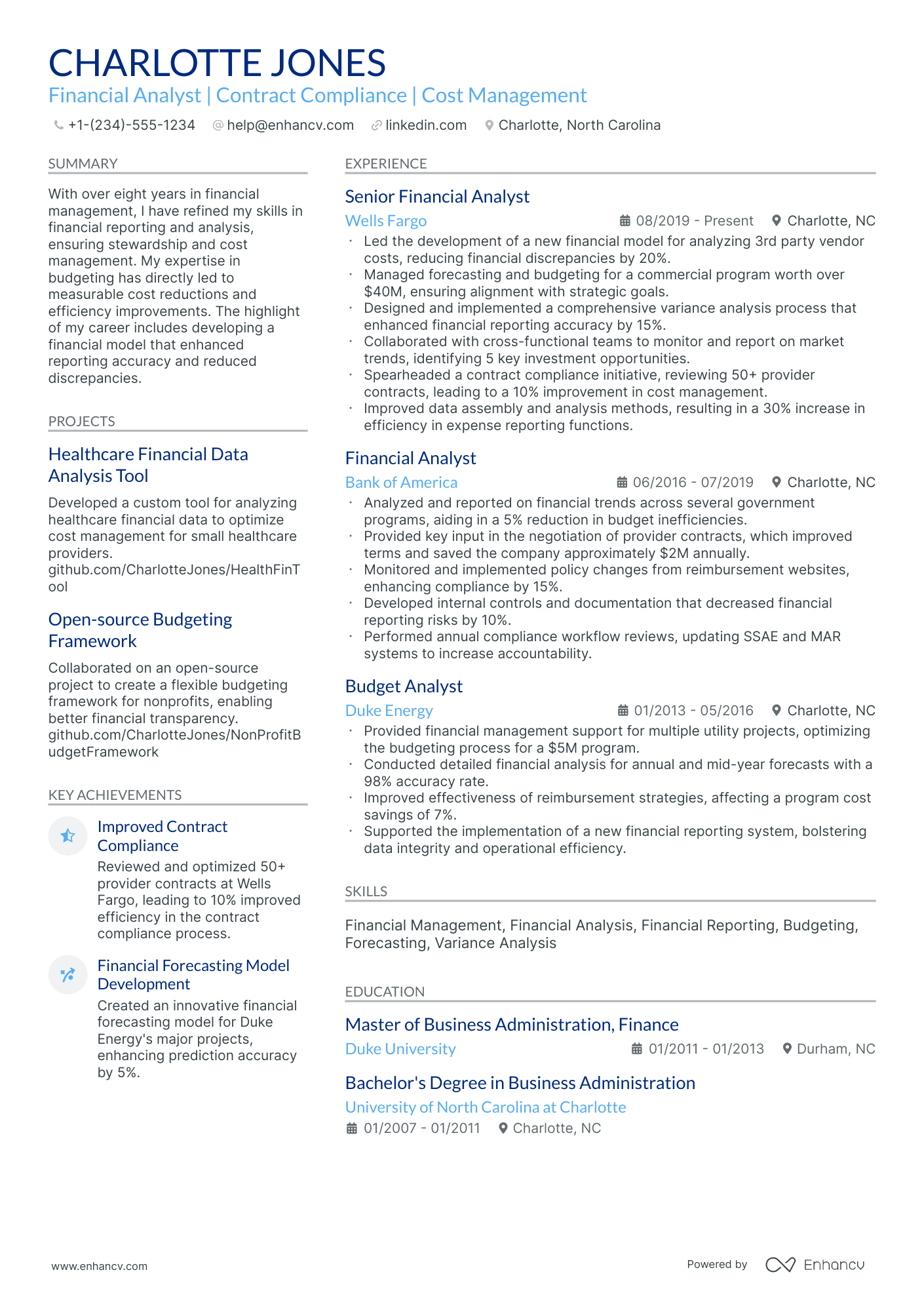
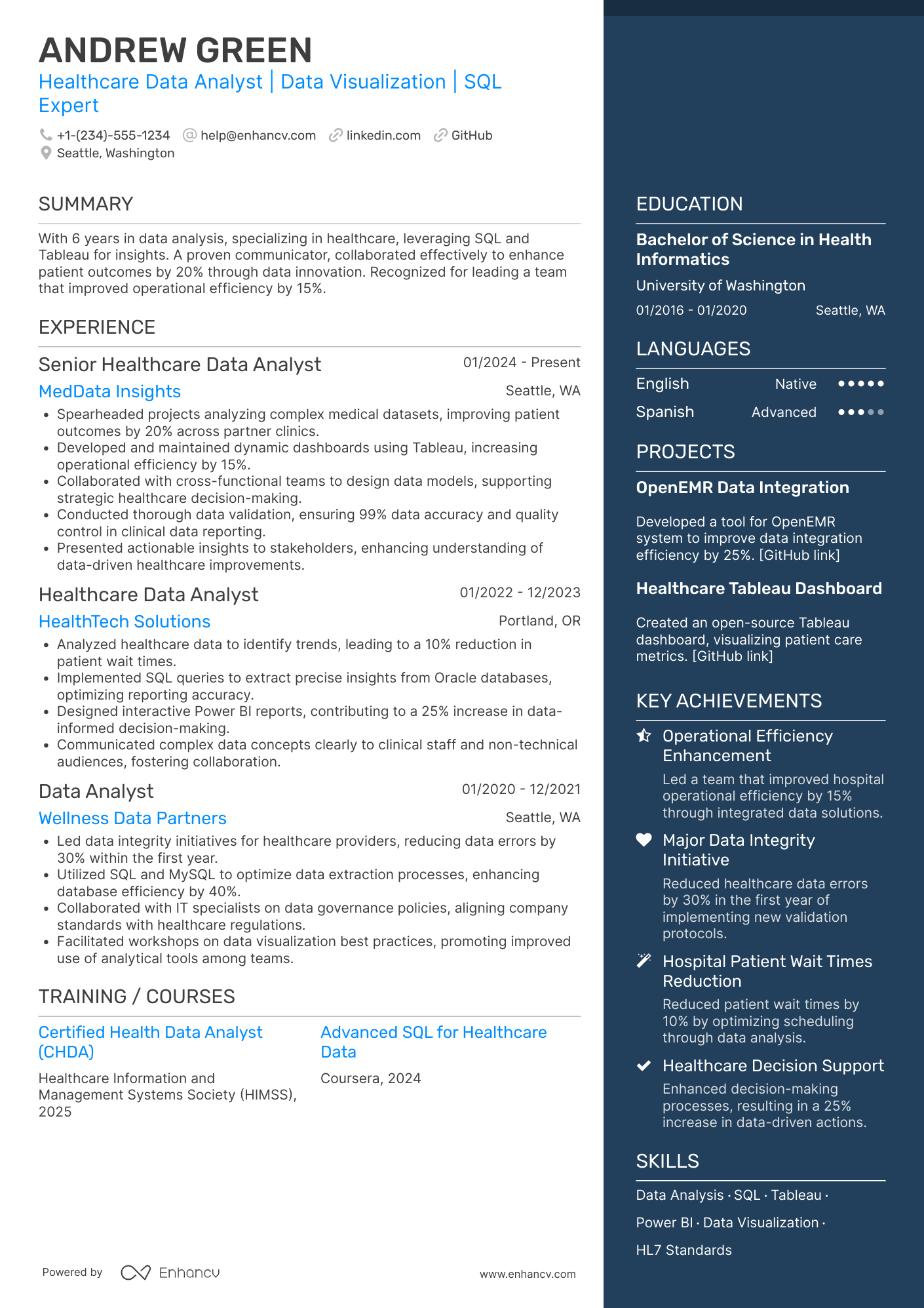
Many healthcare data analyst resumes fail because they list tools and tasks without linking them to measurable outcomes or clinical and financial decisions. That weak signal gets filtered by ATS screening and lost in rapid recruiter scans in a crowded market.
This guide shows you how to write a resume that emphasizes impact: reduced readmission risk, improved claims denial rates, faster reporting cycles, higher data quality, cleaner patient matching, or better dashboard adoption. You'll quantify scope, stakeholders, delivery timelines, and how your insights changed decisions.

Key takeaways
- Link every resume bullet to a measurable clinical, financial, or operational outcome.
- Use reverse-chronological format for experienced analysts and hybrid format for career changers.
- Tailor experience bullets to mirror each job posting's exact tools, metrics, and terminology.
- Quantify data quality improvements, reporting speed gains, cost savings, and dashboard adoption rates.
- Demonstrate skills in context through your summary and experience, not just a standalone list.
- Lead with projects and certifications when you lack full-time healthcare data analyst experience.
- Use Enhancv to turn vague job duties into specific, recruiter-ready resume bullets faster.
How to format a healthcare data analyst resume
Recruiters evaluating healthcare data analyst candidates prioritize technical proficiency in tools like SQL, Python, and Tableau alongside domain knowledge of clinical data standards such as HL7, FHIR, and ICD-10 coding. A clean, well-structured resume format ensures these signals—plus relevant project work and quantified outcomes—surface quickly during both ATS parsing and the initial human scan. Choosing the right resume layout is equally important for making your qualifications easy to find at a glance.

I have significant experience in this role—which format should I use?
Use a reverse-chronological format to present your deepest and most relevant healthcare data experience first. Do:
- Lead each role entry with the scope of your work—datasets managed, departments supported, patient populations covered, or cross-functional teams you collaborated with.
- Highlight proficiency in role-specific tools and domains: SQL, Python, R, SAS, Epic/Cerner EHR systems, claims data, clinical quality measures, and regulatory reporting frameworks like HEDIS or CMS guidelines.
- Quantify outcomes tied to business or clinical impact, such as cost reductions, reporting efficiency gains, readmission rate improvements, or accuracy increases in predictive models.
I'm junior or switching into this role—what format works best?
Use a hybrid format that leads with a focused skills section, then supports it with chronological experience or project entries. Do:
- Place a technical skills section near the top of your resume, grouping competencies by category—programming languages, visualization tools, healthcare data standards, and statistical methods.
- Feature academic projects, capstone work, internships, or freelance analyses that involved healthcare datasets, even if they weren't performed in a formal healthcare setting.
- Connect every listed skill to a specific action and a measurable or observable result so recruiters see applied capability, not just keyword lists.
Why not use a functional resume?
A functional format strips away the timeline and context that recruiters need to evaluate how your healthcare data skills were applied, in what setting, and with what level of responsibility—making it harder for both ATS software and hiring managers to assess your candidacy.
- Edge-case exception: A functional format may be acceptable if you're making a career change from a non-analytics healthcare role (such as clinical or administrative work) or have a significant resume gap, but only if every listed skill is anchored to a specific project, dataset, or measurable outcome rather than presented as a standalone keyword.
Once your format establishes a clean, scannable structure, the next step is deciding which sections to include and how to organize them for maximum impact.
What sections should go on a healthcare data analyst resume
Recruiters expect to see clear evidence you can turn healthcare data into accurate insights that improve clinical, operational, or financial outcomes. Knowing what to put on a resume for this role is critical to getting past both ATS filters and human reviewers. Use this structure for maximum clarity:
- Header
- Summary
- Experience
- Skills
- Projects
- Education
- Certifications
- Optional sections: Awards, Publications, Research
Strong experience bullets should emphasize measurable impact, outcomes, scope, and results across healthcare datasets, stakeholders, and reporting or analytics deliverables.
Is your resume good enough?
Drop your resume here or choose a file. PDF & DOCX only. Max 2MB file size.
Now that you’ve organized your resume with the right core components, focus on how to write your healthcare data analyst resume experience so each role clearly supports the qualifications those components highlight.
How to write your healthcare data analyst resume experience
Your experience section should demonstrate the analytical work you've shipped—dashboards deployed, reporting pipelines built, clinical or operational insights delivered—using the tools and methods healthcare organizations rely on. Hiring managers prioritize demonstrated impact over descriptive task lists, so every bullet should connect what you did to a measurable outcome that mattered to patients, providers, or the business. Building a targeted resume that aligns each bullet with the specific role you're applying for makes this connection even stronger.
Each entry should include:
- Job title
- Company and location (or remote)
- Dates of employment (month and year)
Three to five concise bullet points showing what you owned, how you executed, and what outcomes you delivered:
- Ownership scope: the datasets, reporting systems, analytics platforms, patient populations, or clinical and operational domains you were directly accountable for as a healthcare data analyst.
- Execution approach: the tools, query languages, statistical methods, visualization platforms, or data governance frameworks you used to extract insights and inform decisions across healthcare settings.
- Value improved: the changes you drove in data accuracy, reporting turnaround, clinical quality measures, cost containment, regulatory compliance, or population health outcomes relevant to healthcare analytics.
- Collaboration context: how you partnered with clinicians, health information teams, IT departments, compliance officers, payers, or executive leadership to translate data into actionable healthcare decisions.
- Impact delivered: the outcomes your analysis produced—expressed through improvements in care delivery, operational performance, financial results, or organizational decision-making rather than a list of tasks you performed.
Experience bullet formula
A healthcare data analyst experience example
✅ Right example - modern, quantified, specific.
Healthcare Data Analyst
Riverside Health System | Richmond, VA
2022–Present
Integrated delivery network supporting five hospitals and fifty outpatient clinics across Virginia.
- Built automated claims and encounter pipelines in SQL and Python using dbt (data build tool) and Airflow, cutting monthly close from nine days to four and improving refresh reliability to 99.5%.
- Developed Tableau and Power BI dashboards for readmissions, length of stay, and emergency department throughput, enabling service line leaders to reduce thirty-day readmissions by 8% across two facilities.
- Implemented data quality rules and reconciliation checks in Great Expectations and Snowflake, reducing duplicate patient records by 22% and lowering downstream chart review hours by 180 per month.
- Partnered with clinical informatics, nursing leadership, and data engineers to map Epic Clarity and HL7 feeds to a standardized data model, improving measure completeness for HEDIS reporting from 91% to 98%.
- Ran A/B tests and regression analyses on appointment reminder workflows, increasing kept-visit rate by 6% and generating $420K in annualized net revenue for ambulatory clinics.
Now that you've seen how a strong experience section comes together, let's look at how to adjust yours to match a specific job posting.
How to tailor your healthcare data analyst resume experience
Recruiters evaluate your healthcare data analyst resume through both human review and applicant tracking systems (ATS). Tailoring your resume to the job description increases your chances of passing both screenings.
Ways to tailor your healthcare data analyst experience:
- Match analytics tools and platforms named in the job description.
- Mirror the exact terminology used for healthcare data standards.
- Reflect specific KPIs or performance metrics the posting prioritizes.
- Highlight HIPAA compliance and data governance experience when required.
- Include EHR or claims data systems you have worked with.
- Align your process language with their stated reporting methodologies.
- Emphasize cross-functional collaboration with clinical or operations teams referenced.
- Reference population health or quality improvement frameworks the role mentions.
Tailoring means aligning your real accomplishments with the language and priorities of each job posting, not forcing in keywords where they don't belong.
Resume tailoring examples for healthcare data analyst
| Job description excerpt | Untailored | Tailored |
|---|---|---|
| "Analyze claims data using SQL and Tableau to identify trends in patient readmission rates across service lines." | Analyzed data and created reports for stakeholders. | Queried claims data in SQL and built Tableau dashboards tracking 30-day readmission rates across five service lines, helping reduce readmissions by 12% over two quarters. |
| "Collaborate with clinical teams to develop predictive models for patient no-show rates using Python and electronic health record (EHR) data." | Worked with teams to build models and support decision-making. | Partnered with clinical operations to develop a Python-based logistic regression model using Epic EHR data, predicting patient no-show rates with 84% accuracy and informing scheduling adjustments for three outpatient clinics. |
| "Ensure compliance with HIPAA regulations while managing large datasets in support of population health management initiatives." | Managed datasets and followed company data policies. | Maintained HIPAA-compliant data pipelines supporting population health analyses for 250,000+ attributed lives, conducting regular access audits and de-identification protocols before delivering datasets to care management teams. |
Once you’ve aligned your experience with the role’s priorities, quantify your healthcare data analyst achievements to show the measurable impact behind that fit.
How to quantify your healthcare data analyst achievements
Quantifying your achievements proves clinical and operational impact. Focus on data quality, reporting speed, cost savings, compliance risk reduction, and adoption of dashboards or datasets across care, billing, and quality teams.
Quantifying examples for healthcare data analyst
| Metric | Example |
|---|---|
| Data quality | "Reduced duplicate patient records by 18% by tuning SQL matching logic and adding Great Expectations checks across 2.3M rows." |
| Reporting speed | "Cut monthly quality measure reporting from 3 days to 6 hours by automating ETL in Python and scheduling in Airflow." |
| Cost savings | "Saved $120K annually by consolidating three vendor extracts into one Snowflake pipeline and reducing compute usage by 28%." |
| Compliance risk | "Improved HIPAA access compliance by auditing 100% of Tableau dashboards, removing PHI from 14 views, and enforcing row-level security." |
| Stakeholder adoption | "Increased dashboard adoption from 45 to 120 weekly users by redesigning KPI definitions with clinicians and adding drill-downs for readmissions." |
Turn vague job duties into measurable, recruiter-ready resume bullets in seconds with Enhancv's Bullet Point Generator.
Once you've crafted strong bullet points for your experience section, you'll want to apply that same precision to presenting your hard and soft skills effectively.
How to list your hard and soft skills on a healthcare data analyst resume
Your skills section shows you can turn clinical, claims, and operational data into compliant insights, and recruiters and ATS scan this section for role keywords—aim for a skills mix weighted toward hard skills, supported by targeted soft skills. healthcare data analyst roles require a blend of:
- Product strategy and discovery skills.
- Data, analytics, and experimentation skills.
- Delivery, execution, and go-to-market discipline.
- Soft skills.
Your skills section should be:
- Scannable (bullet-style grouping).
- Relevant to the job post.
- Backed by proof in experience bullets.
- Updated with current tools.
Place your skills section:
- Above experience if you're junior or switching careers.
- Below experience if you're mid/senior with strong achievements.

Hard skills
- SQL (PostgreSQL, SQL Server)
- Python, pandas, NumPy
- Tableau, Power BI
- Excel, Power Query
- dbt, Airflow
- Snowflake, BigQuery
- HL7, FHIR
- ICD-10, CPT, LOINC
- Claims and EHR data modeling
- HIPAA compliance reporting
- Cohort, outcomes analysis
- Data quality checks, validation
Soft skills
- Translate clinical needs into metrics
- Clarify requirements with stakeholders
- Present insights to nontechnical teams
- Write crisp data definitions
- Challenge assumptions with evidence
- Prioritize work by impact and risk
- Drive alignment across clinical and operations
- Manage expectations and timelines
- Document decisions and data lineage
- Escalate data issues early
- Partner with engineering on fixes
- Protect patient privacy in workflows
How to show your healthcare data analyst skills in context
Skills shouldn't live only in a bulleted list on your resume. Explore curated resume skills examples to see how top candidates present their competencies effectively.
They should be demonstrated in:
- Your summary (high-level professional identity)
- Your experience (proof through outcomes)
Here's what that looks like in practice.
Summary example
Senior healthcare data analyst with eight years in payer analytics. Skilled in SQL, Tableau, and predictive modeling to reduce claim denials. Led a cross-functional initiative that cut reporting turnaround by 35% and saved $1.2M annually.
- Reflects senior-level experience clearly
- Names specific, role-relevant tools
- Leads with a measurable outcome
- Signals cross-functional collaboration skills
Experience example
Senior Healthcare Data Analyst
Meridian Health Partners | Remote
June 2019–Present
- Built a Tableau dashboard tracking readmission trends, helping clinical teams reduce 30-day readmissions by 18% across five facilities.
- Partnered with actuarial and compliance teams to automate claims validation using SQL and Python, cutting processing errors by 27%.
- Designed a predictive risk-scoring model in collaboration with nursing leadership, improving early intervention rates by 22% within one year.
- Every bullet includes measurable proof
- Skills surface naturally through outcomes
Once you’ve tied your healthcare data analyst strengths to real outcomes and workflows, the next step is learning how to write a healthcare data analyst resume with no experience so you can present that evidence clearly without relying on prior job titles.
How do I write a healthcare data analyst resume with no experience
Even without full-time experience, you can demonstrate readiness through projects, coursework, and certifications. Learn more about building a compelling resume without work experience to position yourself effectively as an entry-level candidate.
- Healthcare analytics capstone project
- Clinical data internship or practicum
- HIPAA compliance training certificate
- SQL and Tableau portfolio dashboards
- EHR dataset case study write-up
- Public health research assistant role
- Data cleaning volunteer project
- Relevant coursework with deliverables
Focus on:
- SQL queries and data validation
- Healthcare metrics and coding basics
- Dashboarding with Tableau or Power BI
- HIPAA-safe data handling examples
Resume format tip for entry-level healthcare data analyst
Use a hybrid resume format because it spotlights projects and skills first, while still showing consistent education and any related roles. Do:
- Put projects above work history.
- Add a tools line: SQL, Tableau.
- Quantify results with clear metrics.
- Describe datasets, sources, and constraints.
- Include healthcare terms: EHR, HIPAA.
- Built a Tableau dashboard from de-identified EHR data using SQL cleaning and validation, reducing missing lab values from 12% to 3% across 5,000 records.
Once you've positioned your transferable skills and relevant projects to compensate for limited work history, the next step is showcasing your education—often your strongest asset as an entry-level candidate.
How to list your education on a healthcare data analyst resume
Your education section helps hiring teams confirm you have the foundational knowledge needed. It validates your training in analytics, statistics, or health informatics relevant to the healthcare data analyst role.
Include:
- Degree name
- Institution
- Location
- Graduation year
- Relevant coursework (for juniors or entry-level candidates)
- Honors & GPA (if 3.5 or higher)
Skip month and day details—list the graduation year only.
Here's a strong education entry tailored for a healthcare data analyst:
Example education entry
Bachelor of Science in Health Informatics
University of Michigan, Ann Arbor, MI
Graduated 2021
GPA: 3.7/4.0
- Relevant Coursework: Biostatistics, Healthcare Database Management, Epidemiology, Applied Regression Analysis, Clinical Data Systems
- Honors: Dean's List (six consecutive semesters), Magna Cum Laude
How to list your certifications on a healthcare data analyst resume
Certifications on your resume show a healthcare data analyst's commitment to learning, proficiency with key tools, and alignment with healthcare standards, data privacy, and analytics practices.
Include:
- Certificate name
- Issuing organization
- Year
- Optional: credential ID or URL
- Place certifications below education when they're older, less relevant, or you already have strong healthcare data analyst experience and recent roles.
- Place certifications above education when they're recent, highly relevant, or they fill a skills gap for a healthcare data analyst role.
Best certifications for your healthcare data analyst resume
- Certified Health Data Analyst (CHDA)
- Certified Professional in Healthcare Information and Management Systems (CPHIMS)
- Certified Associate in Healthcare Information and Management Systems (CAHIMS)
- Certified in Healthcare Privacy and Security (CHPS)
- SAS Certified Specialist: Base Programming Using SAS 9.4
- Microsoft Certified: Power BI Data Analyst Associate
- Tableau Certified Data Analyst
Once you’ve positioned your credentials where recruiters can quickly verify them, shift to writing your healthcare data analyst resume summary to tie those qualifications to the value you deliver.
How to write your healthcare data analyst resume summary
Your resume summary is the first thing a recruiter reads. A strong one immediately signals you have the right skills and experience for a healthcare data analyst role.
Keep it to three to four lines, with:
- Your title and relevant years of experience in data analysis.
- Healthcare domain expertise, such as clinical operations, payer analytics, or population health.
- Core tools like SQL, Tableau, Python, SAS, or electronic health record platforms.
- One or two measurable achievements, such as cost reductions or reporting improvements.
- Soft skills tied to real outcomes, like cross-team collaboration that shortened project timelines.

PRO TIP
At this level, emphasize technical skills, relevant tools, and early measurable contributions. Show recruiters you can apply your analytics training to real healthcare problems. Avoid vague phrases like "passionate team player" or "quick learner." Replace them with specific results.
Example summary for a healthcare data analyst
Healthcare data analyst with two years of experience in clinical reporting using SQL and Tableau. Built automated dashboards that reduced monthly reporting time by 35% across three hospital departments.
Optimize your resume summary and objective for ATS
Drop your resume here or choose a file.
PDF & DOCX only. Max 2MB file size.
Now that your summary captures your professional value, make sure the header above it presents your contact details correctly so recruiters can reach you.
What to include in a healthcare data analyst resume header
A resume header lists your key identifiers and contact details, helping your healthcare data analyst application stay visible, credible, and easy to screen quickly.
Essential resume header elements
- Full name
- Tailored job title and headline
- Location
- Phone number
- Professional email
- GitHub link
- Portfolio link
A LinkedIn link helps recruiters verify experience quickly and supports screening.
Do not include a photo on a healthcare data analyst resume unless the role is explicitly front-facing or appearance-dependent.
Keep your header scannable by using one line per detail, consistent formatting, and keywords that match the healthcare data analyst job posting.
Example
Healthcare data analyst resume header
Jordan Patel
Healthcare Data Analyst | Claims, EHR, and Quality Reporting
Chicago, IL
(312) 555-01XX
jordan.patel@enhancv.com
github.com/jordanpatel
jordanpateldata.com
linkedin.com/in/jordanpatel
Once your contact details and role-specific identifiers are in place at the top, you can strengthen the rest of your application with additional sections that add relevant context and support your qualifications.
Additional sections for healthcare data analyst resumes
When your core qualifications match other applicants, additional sections help you stand out by showcasing role-specific credibility and depth.
- Languages
- Publications
- Professional affiliations
- Certifications and continuing education
- Volunteer experience in healthcare settings
- Conference presentations
Once you've rounded out your resume with the right supplementary sections, the next step is pairing it with a strong cover letter to make your application even more competitive.
Do healthcare data analyst resumes need a cover letter
A cover letter isn't required for a healthcare data analyst, but it helps in competitive searches or when employers expect one. If you're unsure where to start, understanding what a cover letter is and how it complements your resume can clarify when it's worth writing one. It can make a difference when your resume needs context, your experience isn't a direct match, or the role involves cross-functional work.
Use a cover letter to add context your resume can't show:
- Explain role and team fit: Connect your workflow to how the healthcare data analyst role supports clinicians, operations, finance, or quality teams.
- Highlight one or two relevant projects or outcomes: Name the metric, timeframe, and impact, and clarify your specific contribution and tools used.
- Show understanding of the product, users, or business context: Reference the data's end users and decisions, such as care pathways, utilization, or revenue cycle.
- Address career transitions or non-obvious experience: Translate adjacent work into healthcare data analyst skills, and explain any gaps or changes in one sentence.
Drop your resume here or choose a file.
PDF & DOCX only. Max 2MB file size.
Even when you decide a cover letter won’t add value, you can use AI to strengthen your healthcare data analyst resume and make your qualifications clearer and more targeted.
Using AI to improve your healthcare data analyst resume
AI can sharpen your resume's clarity, structure, and impact. It helps tighten language and highlight relevant achievements. But overuse strips authenticity. Once your content is clear and role-aligned, step away from AI. For a deeper look at available options, explore which AI is best for writing resumes before choosing your tool.
Here are 10 practical prompts to strengthen specific sections of your healthcare data analyst resume:
- Strengthen your summary. "Rewrite this resume summary for a healthcare data analyst to emphasize clinical data expertise and measurable outcomes in under four sentences."
- Quantify experience bullets. "Add specific metrics and results to these experience bullet points for a healthcare data analyst role, using percentages or volume where possible."
- Align skills to job posts. "Compare this healthcare data analyst job description to my skills section and suggest missing keywords I should add."
- Tighten wordy bullets. "Shorten each of these healthcare data analyst experience bullets to one concise line without losing key accomplishments or context."
- Improve project descriptions. "Rewrite this project section to clearly show the business impact of my healthcare data analyst work on patient outcomes or operational efficiency."
- Refine certification relevance. "Reorganize my certifications section to prioritize credentials most relevant to a healthcare data analyst position in a hospital setting."
- Clarify technical proficiencies. "Group and reformat my technical skills for a healthcare data analyst resume, separating tools, languages, and platforms into clear categories."
- Tailor education details. "Highlight coursework and academic projects in my education section that directly support a healthcare data analyst career path."
- Remove filler language. "Identify and remove vague or redundant phrases across this healthcare data analyst resume, replacing them with specific, action-driven language."
- Match industry terminology. "Review this healthcare data analyst resume for inconsistent or outdated terminology and suggest corrections aligned with current industry standards."
Stop using AI once your resume sounds accurate, specific, and aligned with real experience. AI should never invent experience or inflate claims—if it didn't happen, it doesn't belong here.
Conclusion
A strong healthcare data analyst resume proves impact with measurable outcomes, role-specific skills, and a clear structure. It shows how you improved data quality, reporting speed, cost control, or care outcomes. It highlights SQL, dashboards, data validation, and compliance work.
Keep your healthcare data analyst resume easy to scan and consistent. Use focused sections, concise bullets, and results that connect to healthcare priorities. This approach shows you can support today’s hiring needs and adapt to near-future expectations.