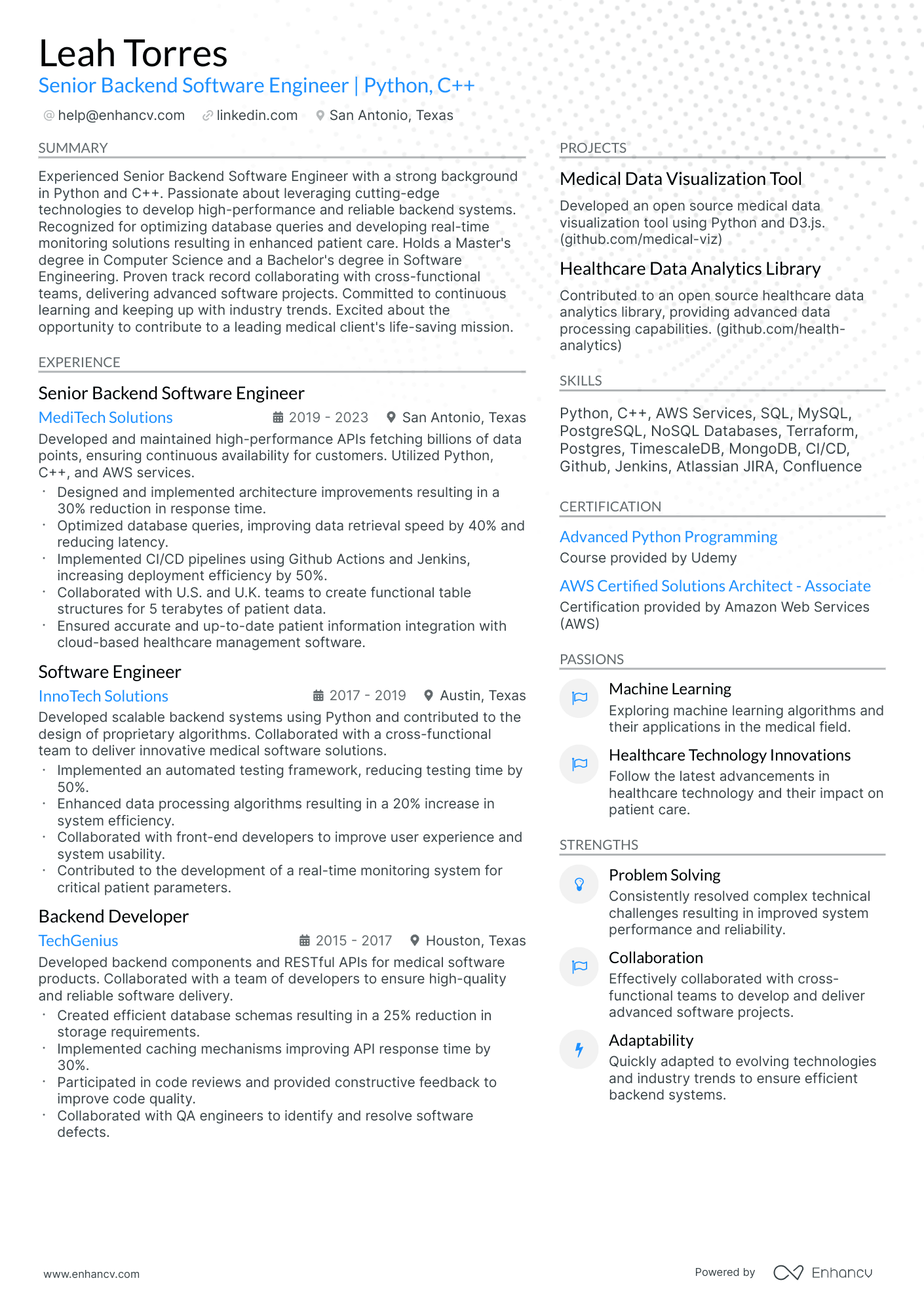
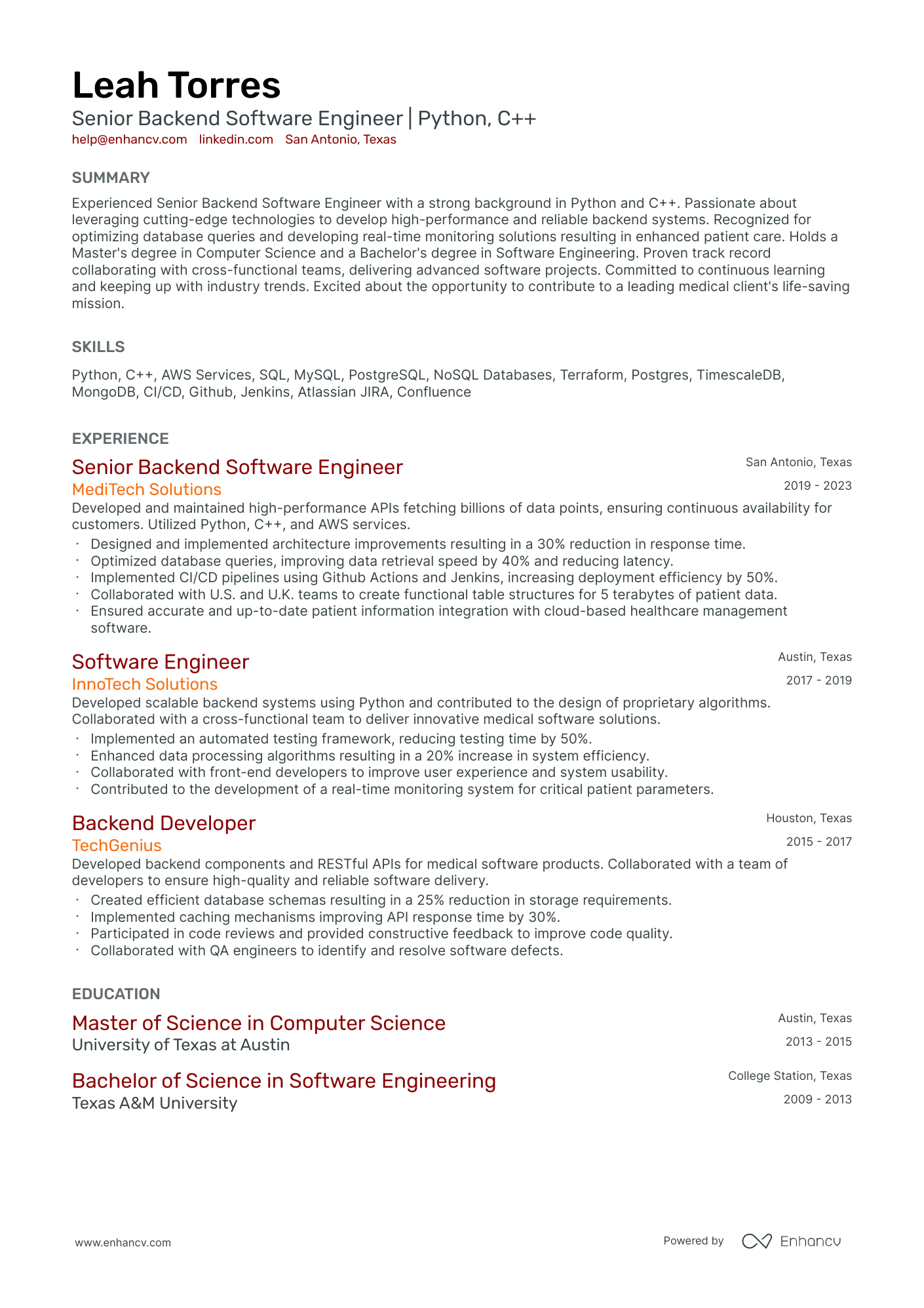
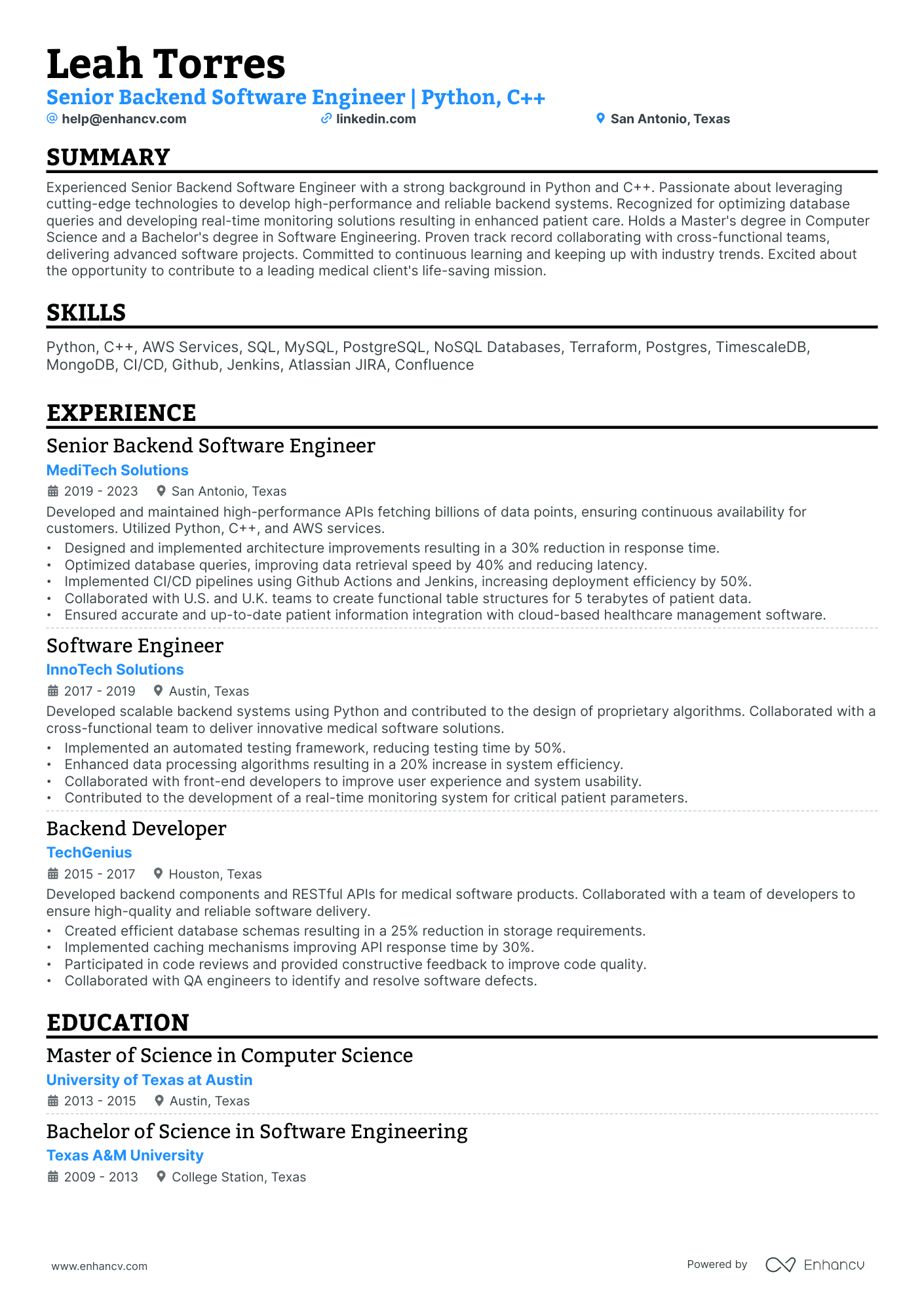
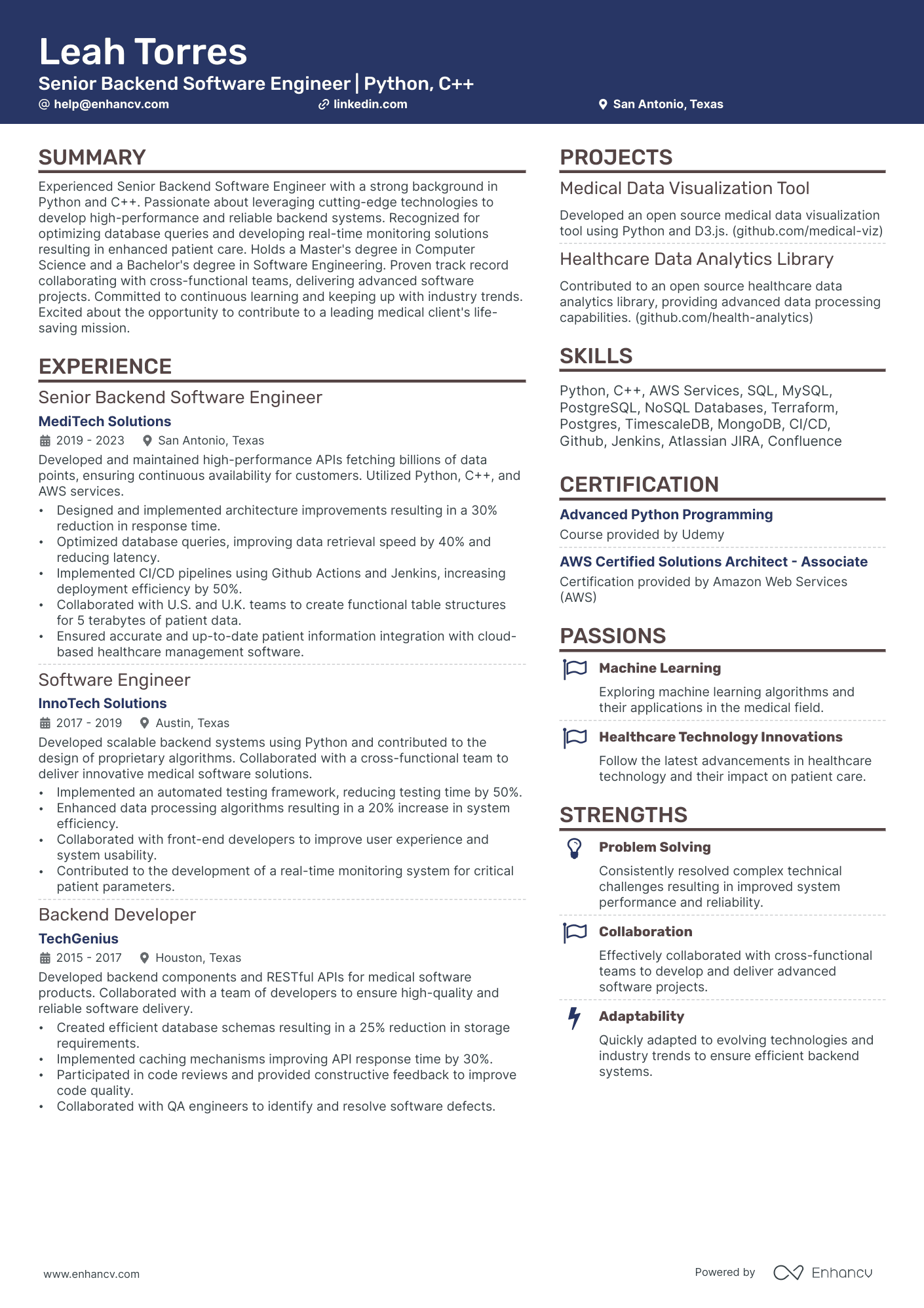
Most lead engineer resume submissions fail because they read like task logs, not leadership narratives. That costs you in ATS screening and fast recruiter scans, where impact signals must surface in seconds.
A strong resume shows how you led outcomes, not just what you used. You should highlight delivery acceleration, uptime gains, defect reduction, cost savings, and measurable performance improvements. Include scope like team size, services owned, release cadence, and business results tied to revenue or retention.

Key takeaways
- Use reverse-chronological format to showcase a clear arc of growing technical leadership.
- Quantify every achievement with metrics like uptime, latency, cost savings, or deployment speed.
- Tailor experience bullets to mirror the exact tools, KPIs, and terminology in each job posting.
- Pair hard skills with soft skills demonstrated through real outcomes, not isolated keyword lists.
- Anchor your summary in ownership scope, team size, and one or two measurable results.
- Without direct experience, lead with projects that show system design, delivery, and production-grade tooling.
- Use Enhancv to turn everyday responsibilities into measurable, recruiter-ready resume bullets faster.
Job market snapshot for lead engineers
We analyzed 605 recent lead engineer job ads across major US job boards. These numbers help you understand employment type trends, skills in demand, top companies hiring at a glance.
What level of experience employers are looking for lead engineers
| Years of Experience | Percentage found in job ads |
|---|---|
| 1–2 years | 4.8% (29) |
| 3–4 years | 6.9% (42) |
| 5–6 years | 13.2% (80) |
| 7–8 years | 20.3% (123) |
| 9–10 years | 3.5% (21) |
| 10+ years | 15.5% (94) |
| Not specified | 37.9% (229) |
Lead engineer ads by area of specialization (industry)
| Industry (Area) | Percentage found in job ads |
|---|---|
| Finance & Banking | 53.4% (323) |
| Education | 15.5% (94) |
| Healthcare | 11.6% (70) |
| Manufacturing | 10.2% (62) |
| Energy | 3.0% (18) |
Top companies hiring lead engineers
| Company | Percentage found in job ads |
|---|---|
| Deloitte | 18.0% (109) |
| GE Vernova | 9.9% (60) |
| KPMG | 6.1% (37) |
| GE Aerospace | 4.0% (24) |
| Eversource | 3.5% (21) |
| ZP Group | 3.0% (18) |
| Iberdrola | 2.8% (17) |
| Duke Energy Corporation | 2.0% (12) |
| Celestica | 1.8% (11) |
| JLL | 1.8% (11) |
Role overview stats
These tables show the most common responsibilities and employment types for lead engineer roles. Use them to align your resume with what employers expect and to understand how the role is structured across the market.
Day-to-day activities and top responsibilities for a lead engineer
| Responsibility | Percentage found in job ads |
|---|---|
| Python | 27.9% (169) |
| Agile | 19.5% (118) |
| Genai | 18.5% (112) |
| Aws | 16.2% (98) |
| Ai | 14.0% (85) |
| Sql | 13.9% (84) |
| C# | 13.1% (79) |
| Ml | 12.9% (78) |
| Node.js | 12.9% (78) |
| Java | 12.7% (77) |
| Sap | 10.7% (65) |
| Activity diagrams | 10.2% (62) |
Type of employment (remote vs on-site vs hybrid)
| Employment type | Percentage found in job ads |
|---|---|
| On-site | 71.6% (433) |
| Hybrid | 17.9% (108) |
| Remote | 10.6% (64) |
How to format a lead engineer resume
Recruiters evaluating lead engineer candidates prioritize evidence of technical leadership scope, cross-functional decision ownership, and measurable engineering outcomes delivered across teams or product lines. A reverse-chronological format makes these signals immediately visible by presenting a clear arc of increasing responsibility, which is exactly what hiring managers scan for in the first 10–15 seconds.

I have significant experience in this role—which format should I use?
Use a reverse-chronological format—it's the strongest choice for a lead engineer resume because it foregrounds your leadership trajectory and growing technical accountability. Do:
- Lead each role entry with your scope of ownership: team size, system domains, and the engineering functions you directed.
- Highlight proficiency in role-specific areas such as architecture design, CI/CD pipeline strategy, code review governance, and cross-team technical planning.
- Quantify business impact through metrics like system uptime improvements, deployment frequency gains, incident reduction rates, or revenue-affecting delivery milestones.
Why hybrid and functional resumes don't work for senior roles
Hybrid formats fragment your leadership narrative by pulling key skills into a separate section, which obscures the progression from individual contributor to technical leader and dilutes the context around your decision ownership. Functional formats are even more problematic—they strip away timeline and accountability entirely, making it impossible for recruiters to assess the scope, scale, and organizational impact of your engineering leadership at each stage. Avoid hybrid and functional formats entirely when your career history demonstrates a clear upward trajectory in engineering leadership, as these formats will work against you in both recruiter screening and ATS parsing.
- Edge-case exception: A functional format may be acceptable only if you're transitioning into a lead engineer role from an adjacent discipline (such as moving from a principal architect or engineering program manager track) and have limited direct "lead engineer" titles—but even then, every skill listed must be anchored to specific projects, team outcomes, and measurable results rather than presented in isolation.
Now that you've established a clean, readable layout, it's time to fill it with the right sections that highlight your leadership and technical expertise.
What sections should go on a lead engineer resume
Recruiters expect you to present leadership, technical depth, and measurable delivery in a clean, easy-to-scan resume.
Use this structure for maximum clarity:
- Header
- Summary
- Experience
- Skills
- Projects
- Education
- Certifications
- Optional sections: Open-source work, Publications, Awards
Your experience bullets should emphasize impact, outcomes, scope, and results—especially how you led technical decisions, improved reliability or performance, and delivered cross-team initiatives.
Is your resume good enough?
Drop your resume here or choose a file. PDF & DOCX only. Max 2MB file size.
Once you’ve organized your resume with the right components, the next step is to write your lead engineer experience section so each role reinforces those elements with clear, role-specific impact.
How to write your lead engineer resume experience
The experience section is where you prove you've shipped real work—products launched, systems scaled, and teams guided through complex technical decisions using the tools and methods that define lead engineering. Hiring managers prioritize demonstrated impact over descriptive task lists, so every line should connect what you owned to a measurable outcome.
Each entry should include:
- Job title
- Company and location (or remote)
- Dates of employment (month and year)
Three to five concise bullet points showing what you owned, how you executed, and what outcomes you delivered:
- Ownership scope: the systems, platforms, services, or engineering teams you were directly accountable for as a lead engineer.
- Execution approach: the architectures, frameworks, languages, or engineering practices you applied to drive technical direction and deliver working software.
- Value improved: the specific gains in system performance, code quality, deployment reliability, uptime, or technical debt reduction your leadership produced.
- Collaboration context: how you partnered with product managers, designers, stakeholders, or other engineering teams to align technical execution with business priorities.
- Impact delivered: the outcomes your work created—expressed through scale reached, velocity gained, or business results achieved rather than tasks performed.
Experience bullet formula
A lead engineer experience example
✅ Right example - modern, quantified, specific.
Lead Software Engineer
AtlasPay | Austin, TX (Remote)
2022–Present
Built and scaled a B2B payments platform processing high-volume transactions for mid-market SaaS and marketplace customers.
- Led a six-engineer squad to migrate a Python and Django monolith to modular services on Kubernetes using gRPC and Terraform, cutting deployment time from forty-five minutes to eight minutes and improving change failure rate by 32%.
- Architected an event-driven ledger with Kafka, PostgreSQL, and Redis, increasing throughput from 900 to 2,600 transactions per second and reducing reconciliation defects by 41% through idempotency, schema validation, and contract tests.
- Drove performance and reliability work across services with OpenTelemetry, Prometheus, and Grafana, improving p95 API latency by 38% and raising uptime from 99.85% to 99.96% by tuning queries, adding caching, and enforcing service-level objectives.
- Partnered with product managers, designers, and compliance to deliver step-up authentication and audit trails using OAuth, role-based access control, and immutable logs, reducing fraud losses by 18% and passing two external audits with zero critical findings.
- Established engineering standards with GitHub Actions, trunk-based development, and automated security scanning (Snyk), increasing test coverage from 52% to 78% and cutting escaped defects by 27% quarter over quarter.
Now that you've seen how a strong experience section comes together, let's look at how to adjust yours based on the specific job posting you're targeting.
How to tailor your lead engineer resume experience
Recruiters evaluate lead engineer resumes through both human review and applicant tracking systems, so aligning your experience with the job posting is essential. Tailoring ensures your strongest qualifications surface immediately during both screening methods.
Ways to tailor your lead engineer experience:
- Match the specific tools and technologies listed in the job description.
- Mirror the exact terminology used for development methodologies or standards.
- Reflect the KPIs or success criteria the employer highlights.
- Include domain or industry experience when the posting requests it.
- Emphasize reliability or security practices if the role requires them.
- Highlight the collaboration models or cross-functional workflows referenced.
- Align your quality assurance or compliance experience with stated expectations.
- Reference the architectural patterns or system design approaches they prioritize.
Tailoring means framing your real accomplishments around what the employer values—not forcing unrelated keywords into your experience.
Resume tailoring examples for lead engineer
| Job description excerpt | Untailored | Tailored |
|---|---|---|
| "Lead the migration of legacy monolithic services to a microservices architecture on AWS, ensuring 99.9% uptime during transition." | Led various infrastructure projects and improved system performance. | Led the migration of 12 monolithic services to a microservices architecture on AWS using ECS and Terraform, maintaining 99.95% uptime across a six-month phased rollout. |
| "Own the technical roadmap for our real-time data pipeline, mentor a team of 8 engineers, and drive adoption of Kafka and Apache Flink for stream processing." | Managed a team of engineers and worked on data-related projects. | Owned the technical roadmap for a real-time data pipeline processing 2M+ events per second, mentored eight engineers, and led the adoption of Kafka and Apache Flink—reducing end-to-end latency by 40%. |
| "Partner with product and security teams to architect a zero-trust networking model and implement CI/CD best practices across 30+ repositories." | Collaborated with cross-functional teams and helped improve deployment processes. | Partnered with product and security teams to architect and deploy a zero-trust networking model, then standardized CI/CD pipelines with GitHub Actions across 34 repositories—cutting average deployment time from 45 minutes to under 10. |
Once you’ve aligned your experience with the role’s priorities, quantify your lead engineer achievements to show the impact behind that alignment.
How to quantify your lead engineer achievements
Quantifying your work proves you shipped measurable outcomes, not just code. Focus on performance, reliability, quality, delivery speed, cost, and security—then tie improvements to real baselines, production scope, and business impact.
Quantifying examples for lead engineer
| Metric | Example |
|---|---|
| Performance | "Cut API p95 latency from 480 ms to 210 ms by adding Redis caching and query tuning in PostgreSQL across three services." |
| Reliability | "Improved uptime from 99.7% to 99.95% by adding SLOs, alerts in Datadog, and runbooks for eight on-call engineers." |
| Quality | "Reduced production defects by 32% by enforcing code owners, raising unit test coverage from 58% to 81%, and adding contract tests." |
| Delivery speed | "Shortened lead time from merge to deploy from two days to four hours by standardizing CI/CD in GitHub Actions and adding canary releases." |
| Security risk | "Cut high-severity vulnerabilities from 24 to five in six weeks by adding Snyk scanning, patch SLAs, and dependency pinning." |
Turn your everyday tasks into measurable, recruiter-ready resume bullets in seconds with Enhancv's Bullet Point Generator.
With strong, results-driven bullet points in place, the next step is ensuring your skills section highlights the right mix of hard and soft skills for a lead engineer role.
How to list your hard and soft skills on a lead engineer resume
Skills show how you lead technical delivery and influence architecture decisions, and recruiters and applicant tracking systems scan this section to match role keywords, so aim for a balanced mix of hard skills and execution-focused soft skills. lead engineer roles require a blend of:
- Product strategy and discovery skills.
- Data, analytics, and experimentation skills.
- Delivery, execution, and go-to-market discipline.
- Soft skills.
Your skills section should be:
- Scannable (bullet-style grouping).
- Relevant to the job post.
- Backed by proof in experience bullets.
- Updated with current tools.
Place your skills section:
- Above experience if you're junior or switching careers.
- Below experience if you're mid/senior with strong achievements.

Hard skills
- System design, architecture reviews
- Distributed systems, microservices
- Cloud: AWS, Azure, Google Cloud
- Kubernetes, Docker, Helm
- Infrastructure as code: Terraform
- Continuous integration, continuous delivery pipelines
- Observability: OpenTelemetry, Prometheus, Grafana
- API design: REST, GraphQL
- Databases: PostgreSQL, MySQL, Redis
- Messaging: Kafka, RabbitMQ
- Security: threat modeling, OAuth 2.0
- Performance profiling, load testing
Soft skills
- Lead technical decision-making
- Align stakeholders on tradeoffs
- Drive execution through ambiguity
- Mentor engineers through code reviews
- Delegate ownership and unblock teams
- Run effective incident retrospectives
- Communicate architecture to nontechnical partners
- Negotiate scope, timeline, and quality
- Facilitate cross-team technical alignment
- Hold a high engineering bar
- Prioritize reliability and maintainability
- Give direct, actionable feedback
How to show your lead engineer skills in context
Skills shouldn't live only in a dedicated skills list.
They should be demonstrated in:
- Your summary (high-level professional identity)
- Your experience (proof through outcomes)
Here's what that looks like in practice.
Summary example
Lead engineer with 12 years in cloud infrastructure, skilled in Kubernetes, Terraform, and CI/CD pipeline design. Led a 15-member platform team that cut deployment failures by 40% while mentoring junior engineers across three product squads.
- Signals senior-level experience immediately
- Names specific, role-relevant tools
- Leads with a measurable outcome
- Highlights mentorship as a soft skill
Experience example
Lead Engineer
Axton Systems | Remote
March 2019–Present
- Architected a microservices migration using Kubernetes and Go, reducing system latency by 35% across four production environments.
- Partnered with product and QA teams to implement automated testing via Jenkins, cutting release cycle time from ten days to three.
- Mentored eight engineers through structured code reviews and pair programming, increasing team pull request throughput by 50%.
- Every bullet includes measurable proof
- Skills appear naturally through real outcomes
Once you’ve framed your leadership and technical impact through concrete examples, the next step is translating that approach into a lead engineer resume when you lack direct experience in the role.
How do I write a lead engineer resume with no experience
Even without full-time experience, you can demonstrate readiness through:
- Capstone technical leadership project
- Open-source maintainer contributions
- Hackathon team lead builds
- Freelance client delivery engagements
- Internship engineering ownership scope
- Technical mentoring or tutoring sessions
- Student engineering club leadership role
- Personal product shipped to users
Focus on:
- Clear ownership of delivered outcomes
- System design and tradeoffs
- Production-grade tooling and testing
- Metrics: performance, cost, reliability
Resume format tip for entry-level lead engineer
Use a combination resume format to spotlight projects, technical leadership, and skills above limited work history. It proves lead engineer readiness through evidence and results. Do:
- Lead with a projects section.
- Use action verbs plus metrics.
- List tools used per project.
- Show scope, ownership, and impact.
- Add links to code and demos.
- Led a capstone team to ship a Dockerized Node.js API on AWS with GitHub Actions, cutting build time 35% and reaching 99.9% uptime in demos.
Even without direct experience, your education section can demonstrate the technical foundation and knowledge that qualify you for a lead engineer role.
How to list your education on a lead engineer resume
Your education section helps hiring teams confirm you have the technical foundation a lead engineer role demands. It validates core engineering knowledge quickly and efficiently.
Include:
- Degree name
- Institution
- Location
- Graduation year
- Relevant coursework (for juniors or entry-level candidates)
- Honors & GPA (if 3.5 or higher)
Skip month and day details—list the graduation year only.
Here's a strong education entry tailored for a lead engineer resume.
Example education entry
Bachelor of Science in Computer Science
Georgia Institute of Technology, Atlanta, GA
Graduated: 2014
GPA: 3.7/4.0
- Relevant coursework: Distributed Systems, Software Architecture, Advanced Algorithms, Operating Systems
- Honors: Magna Cum Laude, Dean's List (all semesters)
How to list your certifications on a lead engineer resume
Certifications show a lead engineer’s commitment to continuous learning, proficiency with modern tools, and alignment with current industry standards. They also add credibility when you lead technical decisions and mentor others. Include:
- Certificate name
- Issuing organization
- Year
- Optional: credential ID or URL
- Place certifications below education if they are older, broadly relevant, or less important than your degree for the role.
- Place certifications above education if they are recent, role-critical, or directly match the job’s core tools and responsibilities.
Best certifications for your lead engineer resume
- AWS Certified Solutions Architect—Professional
- Microsoft Certified: Azure Solutions Architect Expert
- Google Professional Cloud Architect
- Certified Kubernetes Administrator (CKA)
- Cisco Certified Network Professional (CCNP)
- Certified ScrumMaster (CSM)
- PMI Agile Certified Practitioner (PMI-ACP)
Once you’ve positioned your credentials where recruiters can find them quickly, shift to your lead engineer resume summary to connect those qualifications to your top strengths and impact.
How to write your lead engineer resume summary
Your resume summary is the first thing a recruiter reads, so it must prove your value fast. For a lead engineer role, it should signal technical authority, team leadership, and measurable impact.
Keep it to three to four lines, with:
- Your title and total years of engineering experience.
- The domain, industry, or product type you've worked in.
- Core technologies, architectures, or methodologies you command.
- One or two quantified achievements that show business or team-level outcomes.
- Soft skills tied to real results, such as mentoring that reduced onboarding time.

PRO TIP
At the lead level, emphasize ownership of technical direction, cross-team coordination, and outcomes you drove. Highlight decisions that shaped architecture, improved delivery speed, or grew team capability. Avoid generic phrases like "passionate problem-solver" or "motivated team player." Every claim should connect to a measurable result.
Example summary for a lead engineer
Lead engineer with 9 years of experience building distributed systems in fintech. Guided a team of 12 engineers, cutting deployment cycles by 40%. Drove architecture decisions that improved platform reliability to 99.95% uptime.
Optimize your resume summary and objective for ATS
Drop your resume here or choose a file.
PDF & DOCX only. Max 2MB file size.
Now that your summary captures your leadership strengths and technical expertise, make sure your header presents the essential contact details recruiters need to reach you.
What to include in a lead engineer resume header
A resume header is the top section with your identity and contact details, and it boosts visibility, credibility, and recruiter screening for a lead engineer.
Essential resume header elements
- Full name
- Tailored job title and headline
- Location
- Phone number
- Professional email
- GitHub link
- Portfolio link
A LinkedIn link helps recruiters verify experience quickly and supports screening.
Don’t include a photo on a lead engineer resume unless the role is explicitly front-facing or appearance-dependent.
Keep the header to one or two lines, match your lead engineer title to the posting, and use links that open cleanly and load fast.
Lead engineer resume header
Jordan Patel
Lead engineer | Backend systems and team leadership
Austin, TX
(512) 555-01XX | jordan.patel@enhancv.com | github.com/jordanpatel | jordanpatel.dev | linkedin.com/in/jordanpatel
Once your header clearly identifies who you are and how to reach you, add optional sections to provide supporting details that strengthen your lead engineer resume.
Additional sections for lead engineer resumes
Beyond core experience and skills, additional sections can strengthen your lead engineer resume by showcasing unique qualifications that set you apart.
Consider adding these sections when they're directly relevant to the role:
- Languages
- Publications and technical papers
- Patents
- Open source contributions
- Professional affiliations and engineering societies
- Conference talks and presentations
- Hobbies and interests
Once you've rounded out your resume with the right supplementary sections, it's worth turning your attention to the cover letter—a separate document that can reinforce and contextualize everything your resume presents.
Do lead engineer resumes need a cover letter
A cover letter isn’t required for a lead engineer, but it helps in competitive searches or when hiring managers expect one. It can make a difference when your resume can’t show context, leadership scope, or clear fit.
Use a cover letter to add targeted context:
- Explain role and team fit: Match your leadership style to the team’s stage, constraints, and delivery model.
- Highlight one or two relevant projects or outcomes: Name the problem, your approach, and the measurable result.
- Show product, user, or business understanding: Connect technical decisions to customer impact, reliability, revenue, or risk.
- Address career transitions or non-obvious experience: Clarify why the shift makes sense and how your skills transfer to a lead engineer role.
Drop your resume here or choose a file.
PDF & DOCX only. Max 2MB file size.
If you decide your application needs more than a resume alone, the next step is using AI to improve your lead engineer resume so it communicates your value with maximum clarity and impact.
Using AI to improve your lead engineer resume
AI can sharpen your resume's clarity, structure, and impact. It's great for tightening language and highlighting measurable results. But overuse can strip away your authentic voice. Once your content feels clear and role-aligned, step away from AI.
Here are 10 practical prompts to strengthen specific sections of your lead engineer resume:
- Strengthen your summary. "Rewrite my lead engineer resume summary to emphasize technical leadership, team size, and measurable business outcomes in three sentences or fewer."
- Quantify experience bullets. "Revise these lead engineer experience bullets to include specific metrics like performance gains, cost savings, or deployment frequency."
- Sharpen technical skills. "Reorganize my lead engineer skills section by grouping tools, languages, and frameworks by relevance to modern engineering leadership roles."
- Improve project descriptions. "Rewrite this lead engineer project description to clearly state my role, the technical challenge, the approach taken, and the measurable result."
- Tighten action verbs. "Replace weak or passive verbs in my lead engineer experience section with strong, specific action verbs that convey ownership and leadership."
- Align with job postings. "Compare my lead engineer resume bullets against this job description and suggest edits that better reflect the listed responsibilities and qualifications."
- Refine education details. "Suggest how to present my education section for a lead engineer resume, highlighting relevant coursework, honors, or research contributions."
- Clarify certification value. "Rewrite my certifications section so each entry clearly connects to a lead engineer's day-to-day responsibilities or career advancement."
- Remove filler language. "Identify and remove vague or redundant phrases from my lead engineer resume without losing any meaningful technical or leadership detail."
- Tailor the narrative. "Restructure my lead engineer resume so each section builds a cohesive story of progressive technical leadership and growing scope of impact."
Stop using AI once your resume sounds accurate, specific, and aligned with real experience. AI should never invent experience or inflate claims—if it didn't happen, it doesn't belong here.
Conclusion
A strong lead engineer resume proves impact with measurable outcomes, highlights role-specific skills, and stays easy to scan. Use a clear structure that connects scope, decisions, and results to the work you led.
Hiring teams need lead engineers who can deliver now and adapt fast as tools and expectations change. A focused resume with strong metrics, relevant skills, and clean formatting shows you’re ready for today’s market.