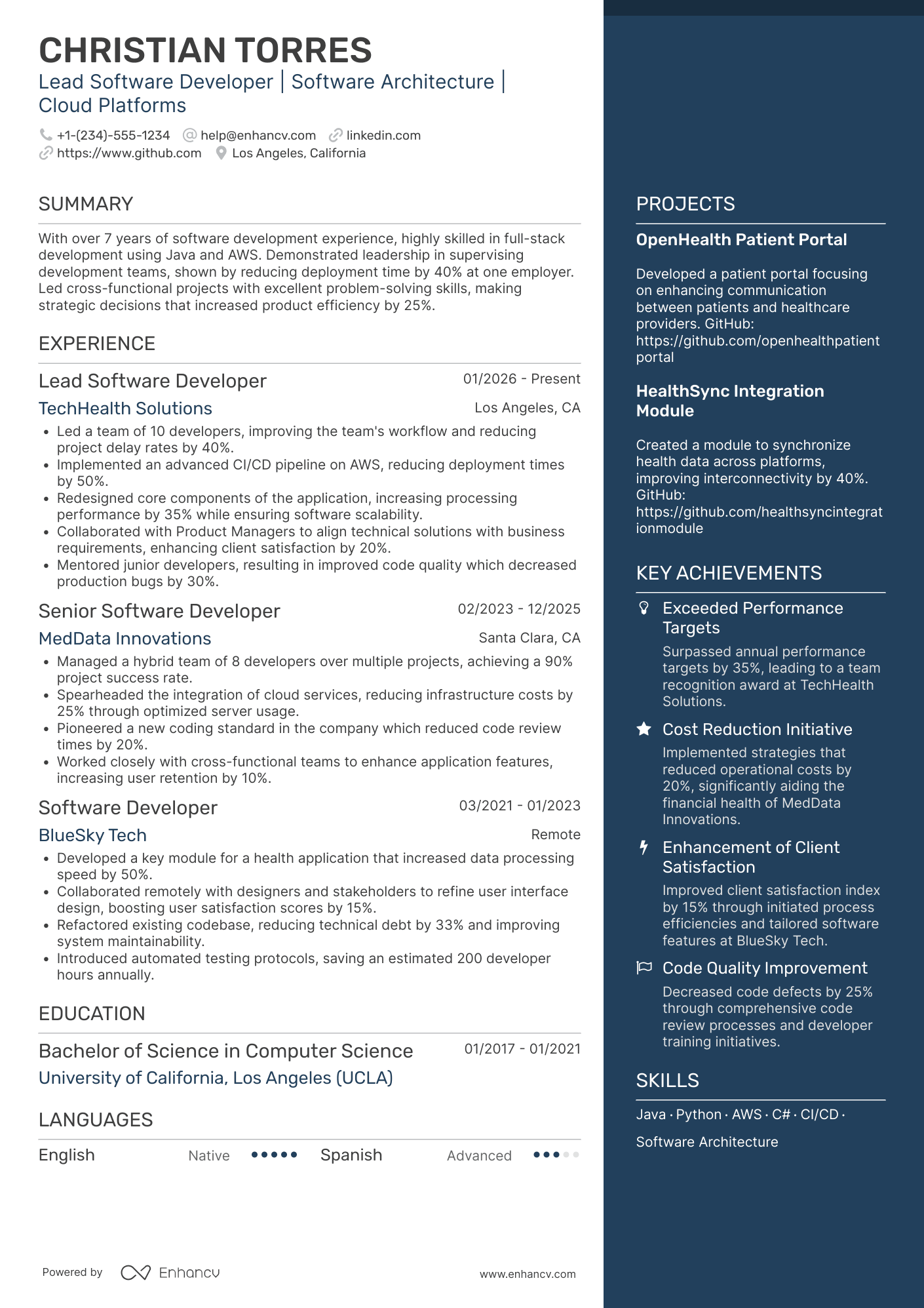
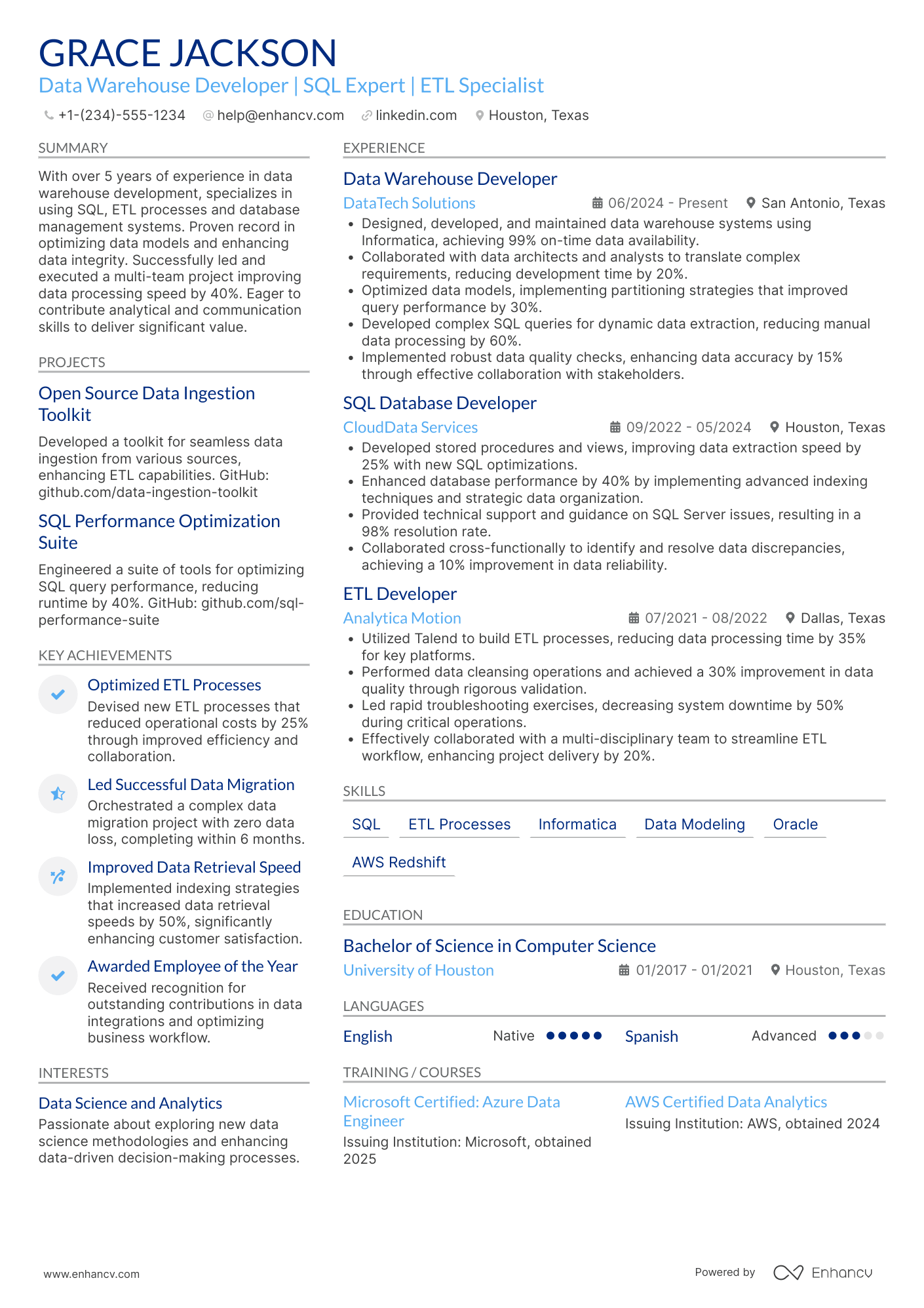
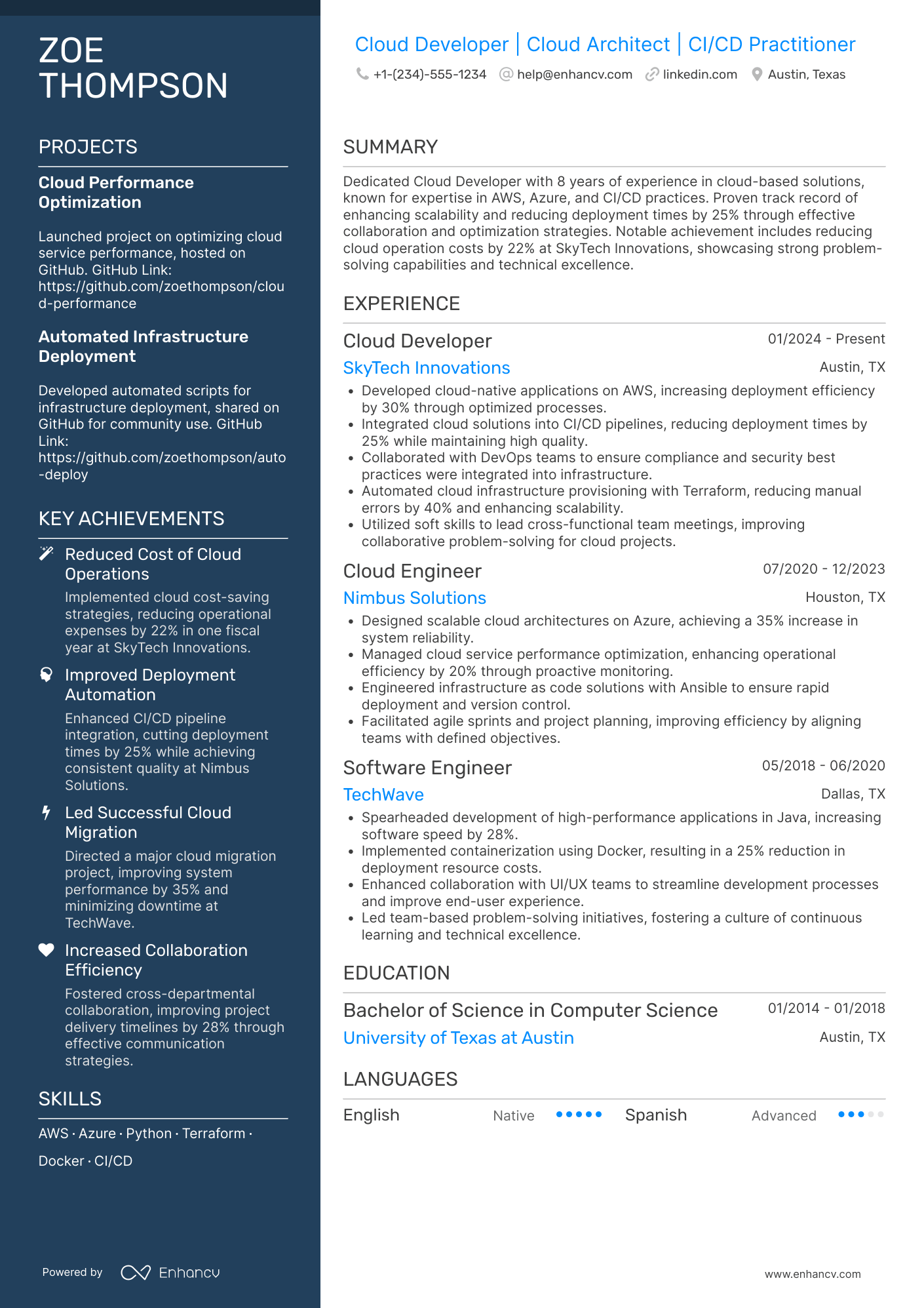
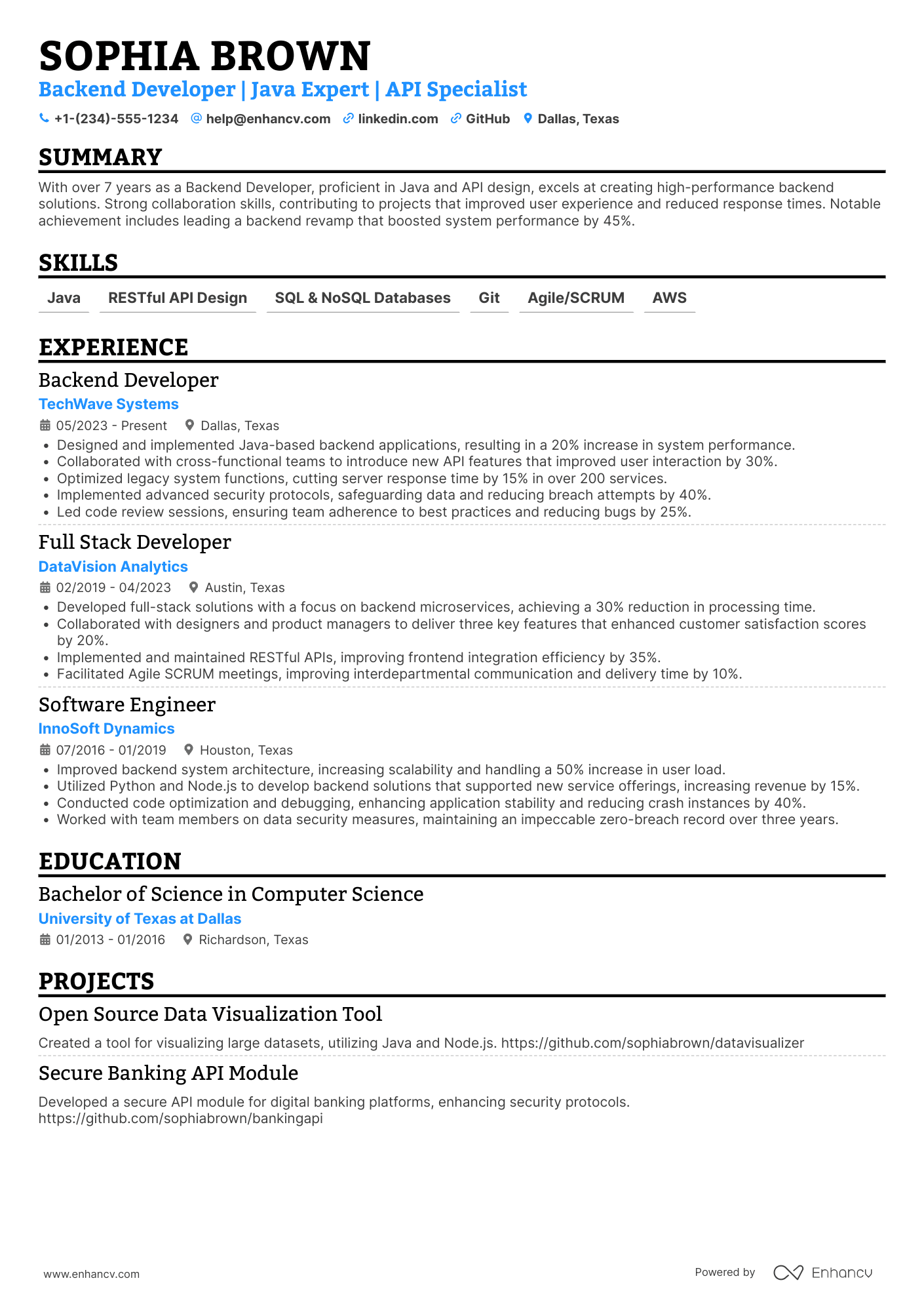
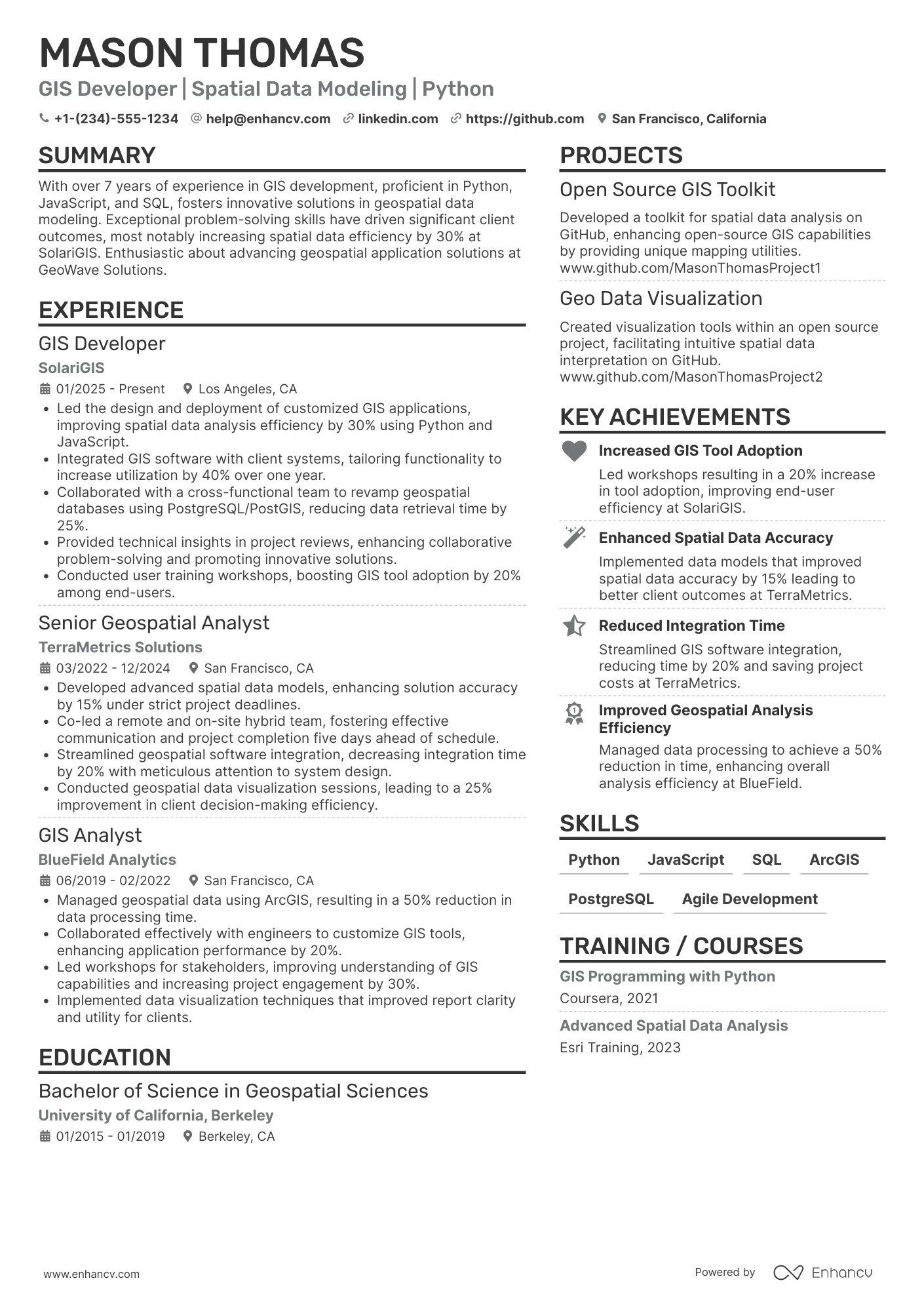
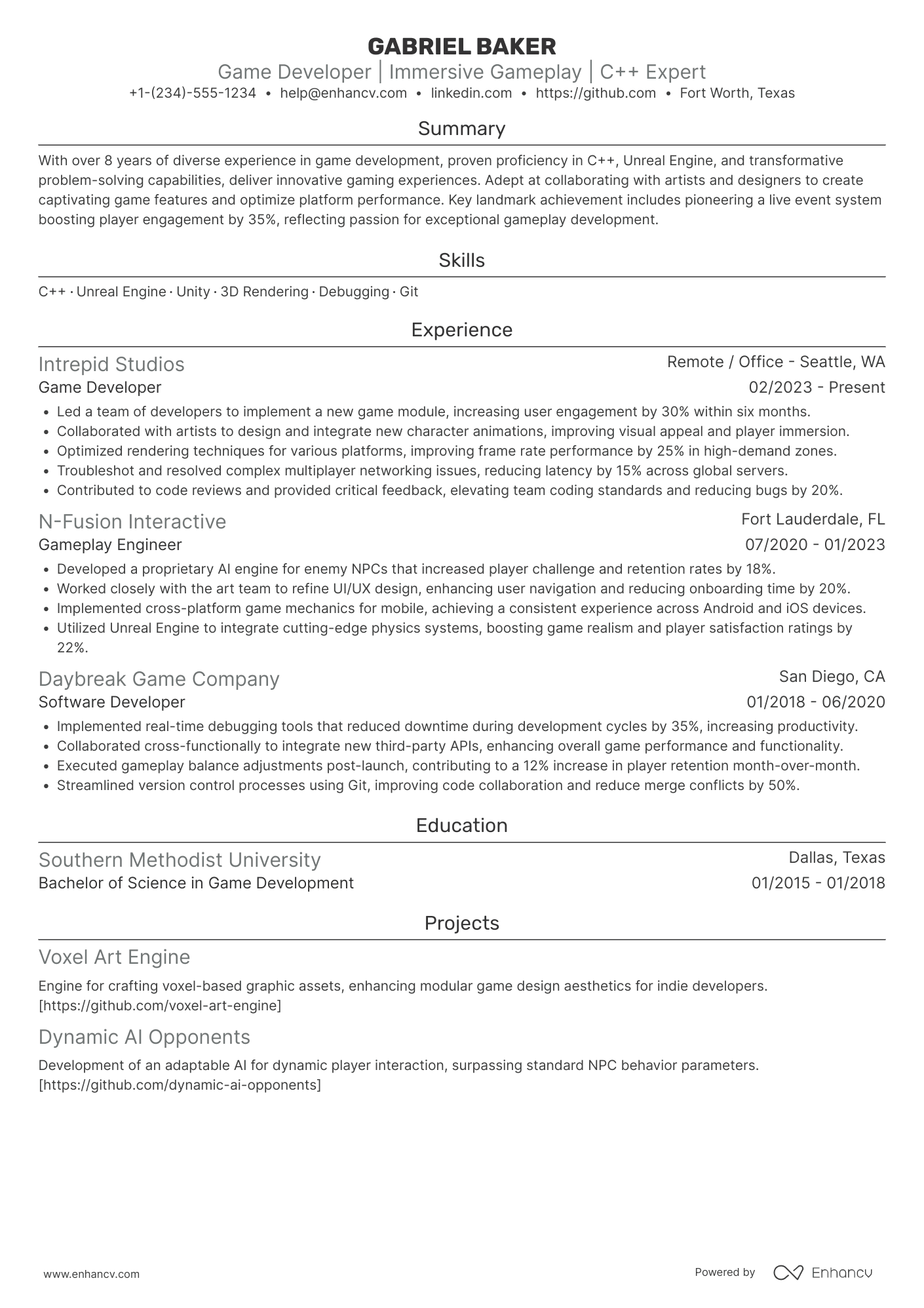
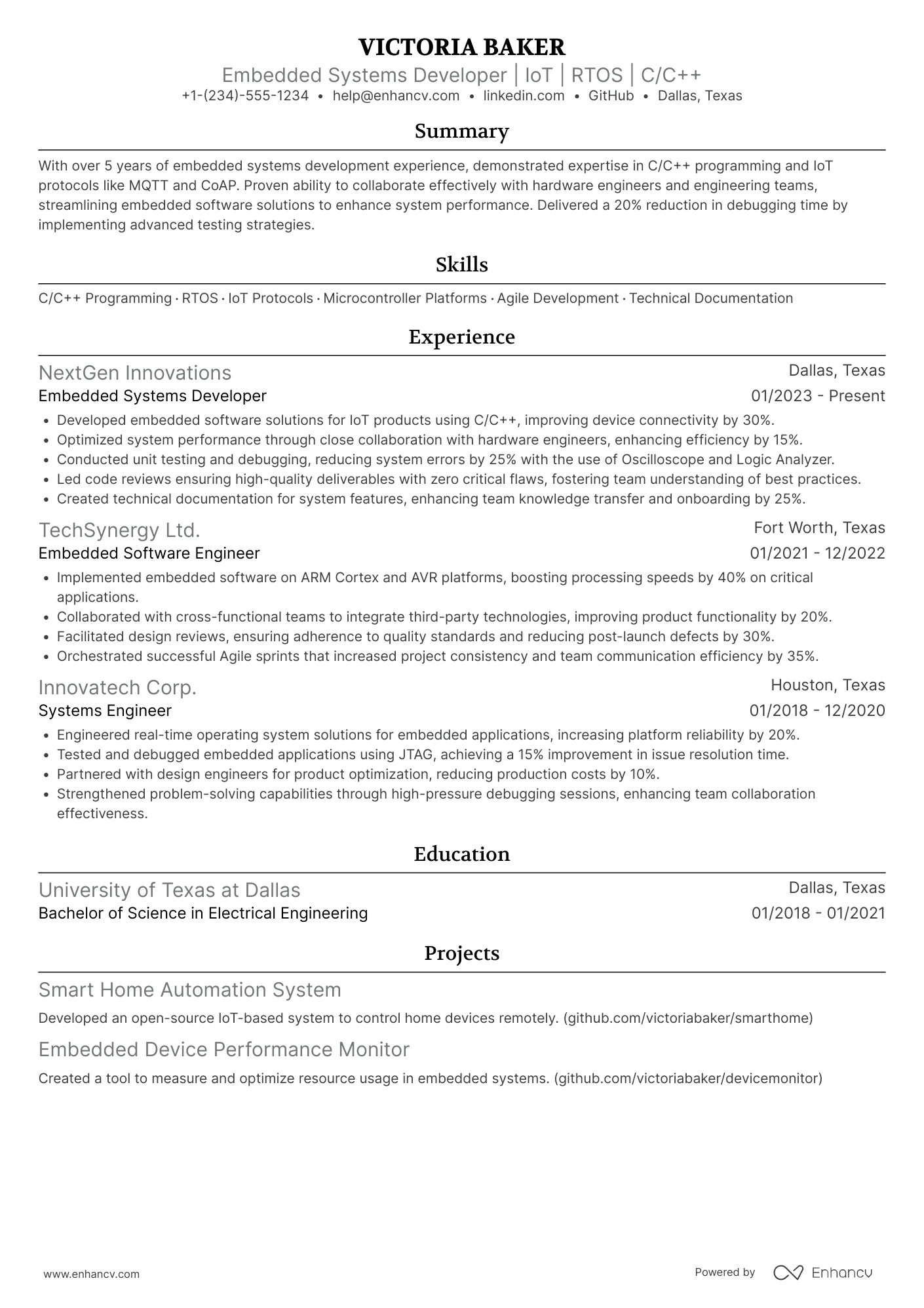
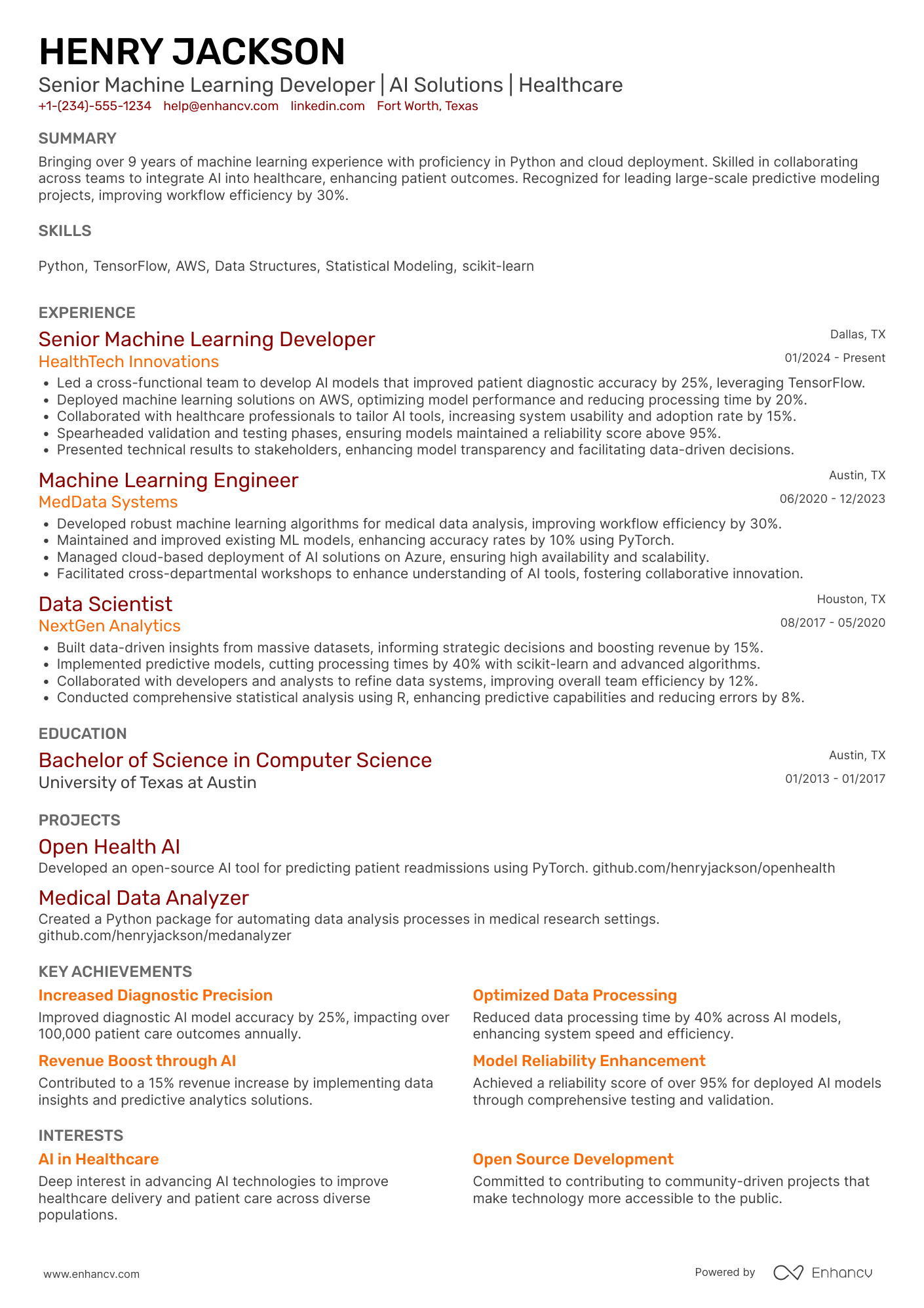
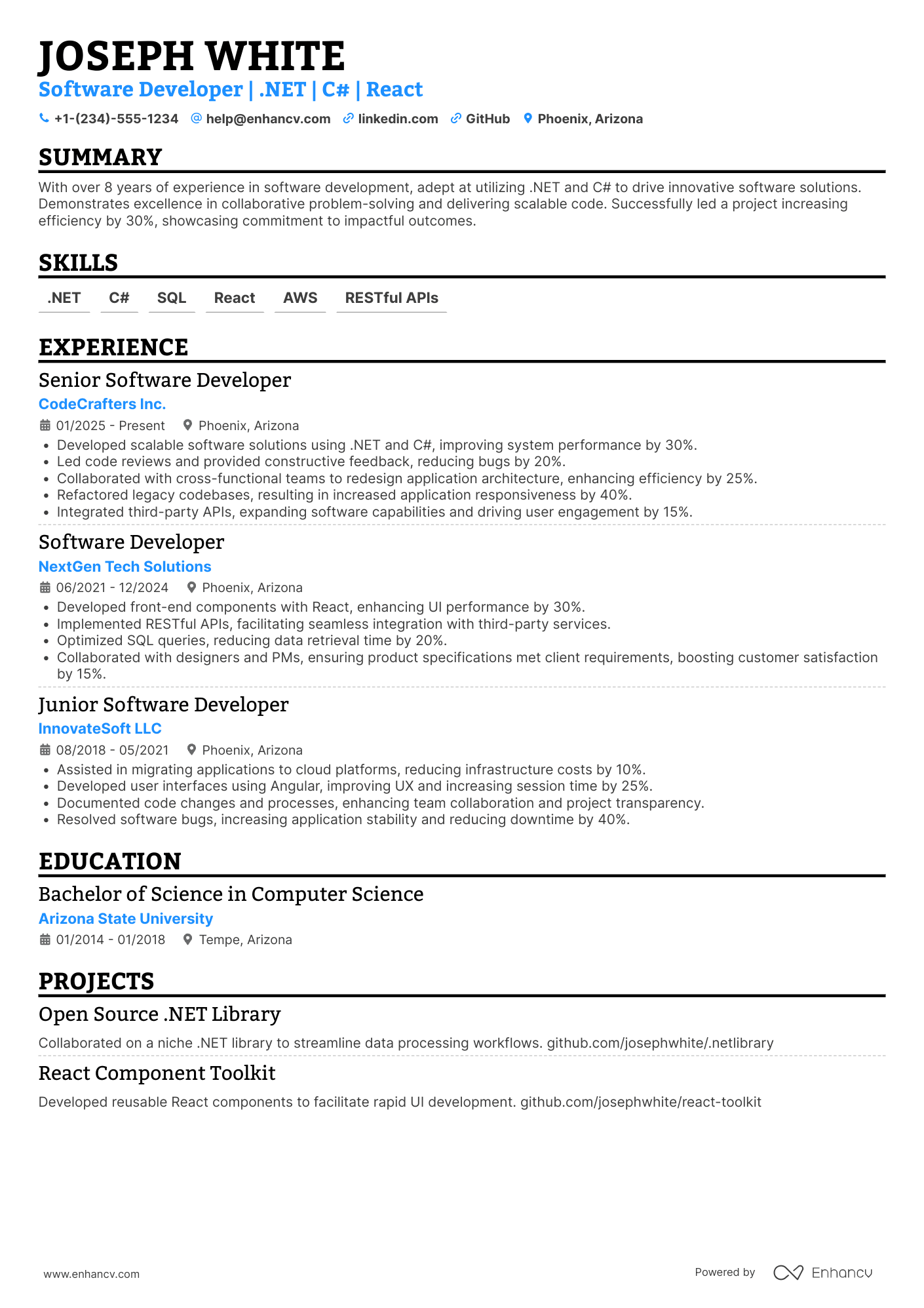
Many developer resume submissions fail because they read like a tool inventory and task log, not evidence of impact. In today's hiring funnel, that format loses to ATS screening, fast recruiter scans, and intense competition for limited interview slots.
A strong resume shows what changed because of your work, with proof you can defend. Knowing how to make your resume stand out means you should highlight shipped features, measurable performance gains, reduced cloud spend, faster release cycles, fewer production incidents, and improved conversion or retention.

Key takeaways
- Quantify your developer achievements with metrics like latency, uptime, cost savings, and deployment speed.
- Tailor every resume to the job posting by mirroring its languages, frameworks, and terminology.
- Lead experience bullets with ownership scope, execution details, and measurable outcomes—not task lists.
- Use reverse-chronological format for experienced developers and hybrid format for career changers.
- Anchor every listed skill to a specific project, contribution, or result somewhere on your resume.
- Showcase shipped projects with live links and Git history when you lack full-time experience.
- Use Enhancv to turn everyday developer tasks into measurable, recruiter-ready resume bullets quickly.
Job market snapshot for developers
We analyzed 28,720 recent developer job ads across major US job boards. These numbers help you understand career growth patterns, regional hotspots, employment type trends at a glance.
What level of experience employers are looking for developers
| Years of Experience | Percentage found in job ads |
|---|---|
| 1–2 years | 9.5% (2725) |
| 3–4 years | 11.7% (3363) |
| 5–6 years | 13.3% (3807) |
| 7–8 years | 5.5% (1581) |
| 9–10 years | 4.8% (1367) |
| 10+ years | 6.9% (1984) |
| Not specified | 52.6% (15096) |
Developer ads by area of specialization (industry)
| Industry (Area) | Percentage found in job ads |
|---|---|
| Finance & Banking | 55.0% (15803) |
| Healthcare | 20.5% (5893) |
| Education | 10.0% (2883) |
| Manufacturing | 4.1% (1187) |
| Government | 2.6% (744) |
| Retail & E-commerce | 2.4% (687) |
| Real Estate & Construction | 1.4% (396) |
| Professional Services | 1.1% (326) |
| Energy | 0.8% (237) |
| Media & Entertainment | 0.7% (206) |
Top companies hiring developers
| Company | Percentage found in job ads |
|---|---|
| Accenture | 2.9% (829) |
| Deloitte | 2.1% (595) |
| CVS Health | 1.5% (434) |
| Amazon.com, Inc. | 1.5% (421) |
| Oracle | 1.4% (401) |
| Old Dominion Freight Line Inc | 0.9% (265) |
| PwC | 0.8% (236) |
| Assa Abloy | 0.8% (221) |
| Infosys LTD | 0.8% (216) |
| Akkodis | 0.7% (213) |
Role overview stats
These tables show the most common responsibilities and employment types for developer roles. Use them to align your resume with what employers expect and to understand how the role is structured across the market.
Day-to-day activities and top responsibilities for a developer
| Responsibility | Percentage found in job ads |
|---|---|
| Java | 13.7% (3946) |
| Python | 13.7% (3933) |
| Agile | 12.4% (3551) |
| Sql | 12.2% (3513) |
| Javascript | 11.3% (3255) |
| Ci/cd | 9.8% (2818) |
| Aws | 9.5% (2739) |
| Git | 8.6% (2456) |
| Salesforce | 8.4% (2411) |
| Crm | 7.9% (2264) |
| Excel | 7.3% (2098) |
| Project management | 7.1% (2038) |
Type of employment (remote vs on-site vs hybrid)
| Employment type | Percentage found in job ads |
|---|---|
| On-site | 66.7% (19148) |
| Hybrid | 19.6% (5618) |
| Remote | 13.8% (3954) |
How to format a developer resume
Recruiters evaluating developer resumes prioritize technical skill depth, project complexity, and measurable contributions to product or system outcomes. The right resume format ensures these signals surface quickly during both automated screening and the brief manual review most resumes receive.

I have significant experience in this role—which format should I use?
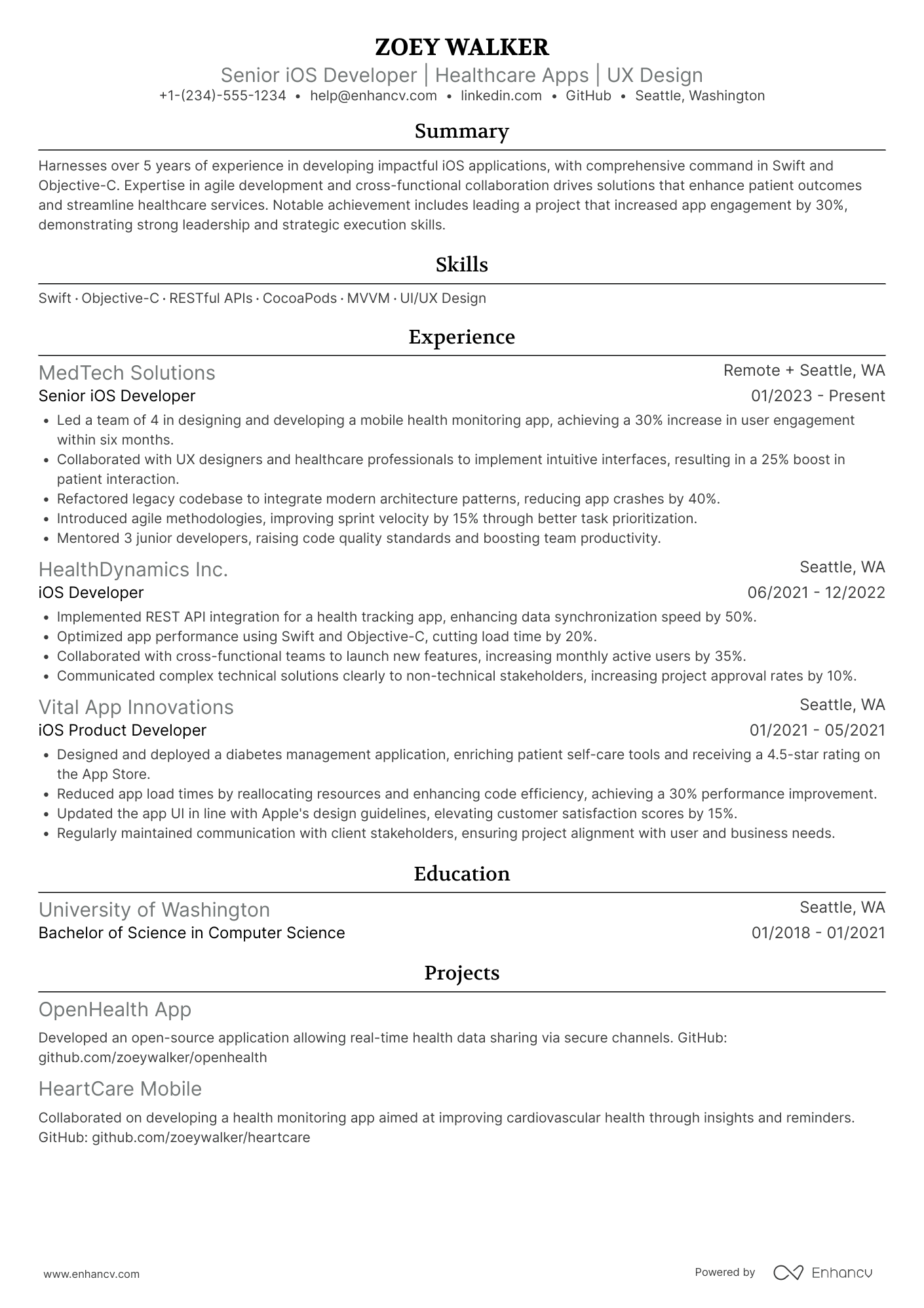
Use a reverse-chronological format to present your development experience in a clear, linear timeline that highlights growing technical ownership. Do:
- Lead each role entry with the scope of your responsibilities—team size, codebase scale, systems owned, or user base served.
- Highlight proficiency in role-specific languages, frameworks, and tools (e.g., Python, React, AWS, CI/CD pipelines, Docker, PostgreSQL) within the context of each position.
- Quantify outcomes tied to your work, such as performance improvements, uptime gains, deployment frequency, or cost reductions.
I'm junior or switching into this role—what format works best?
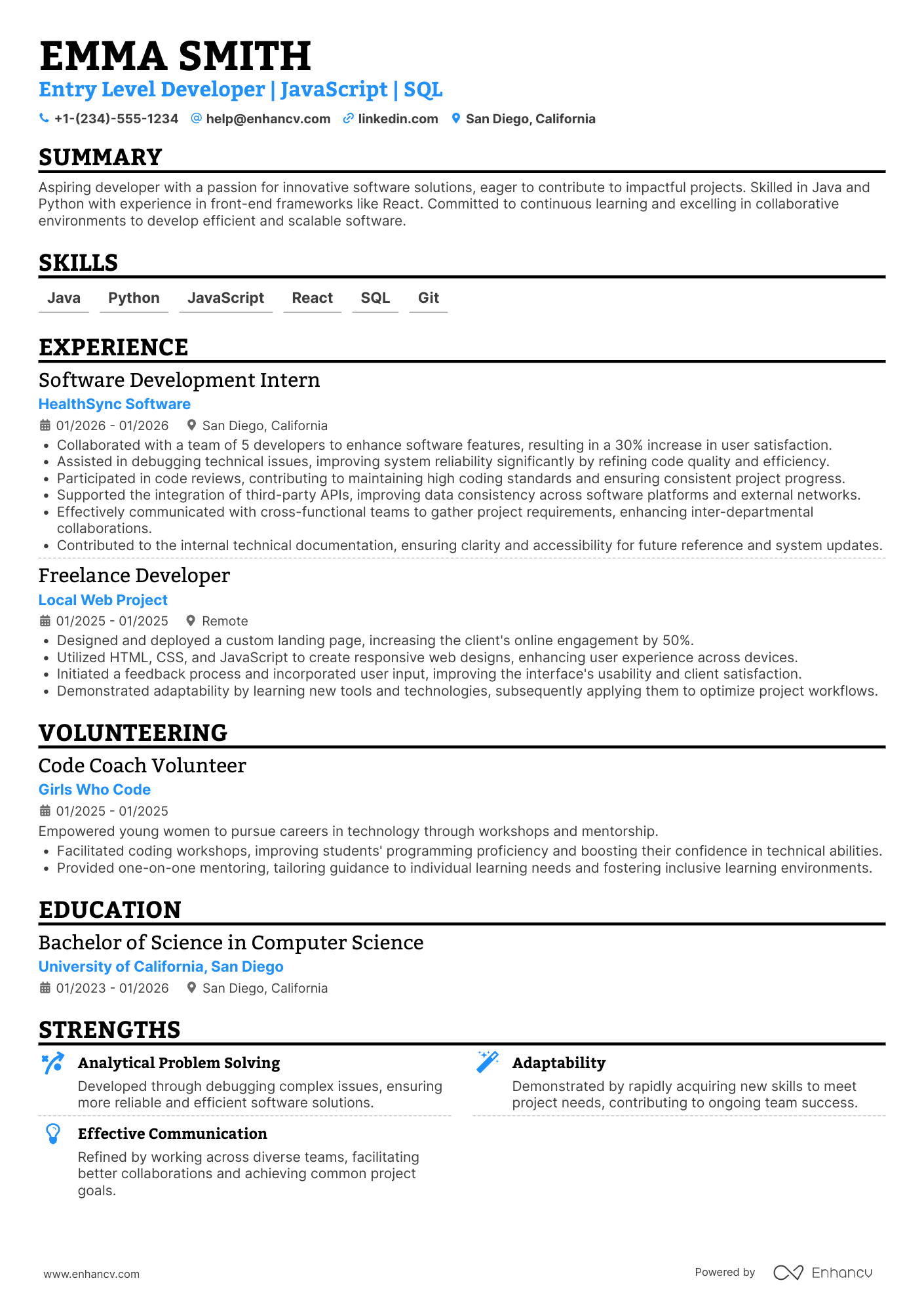
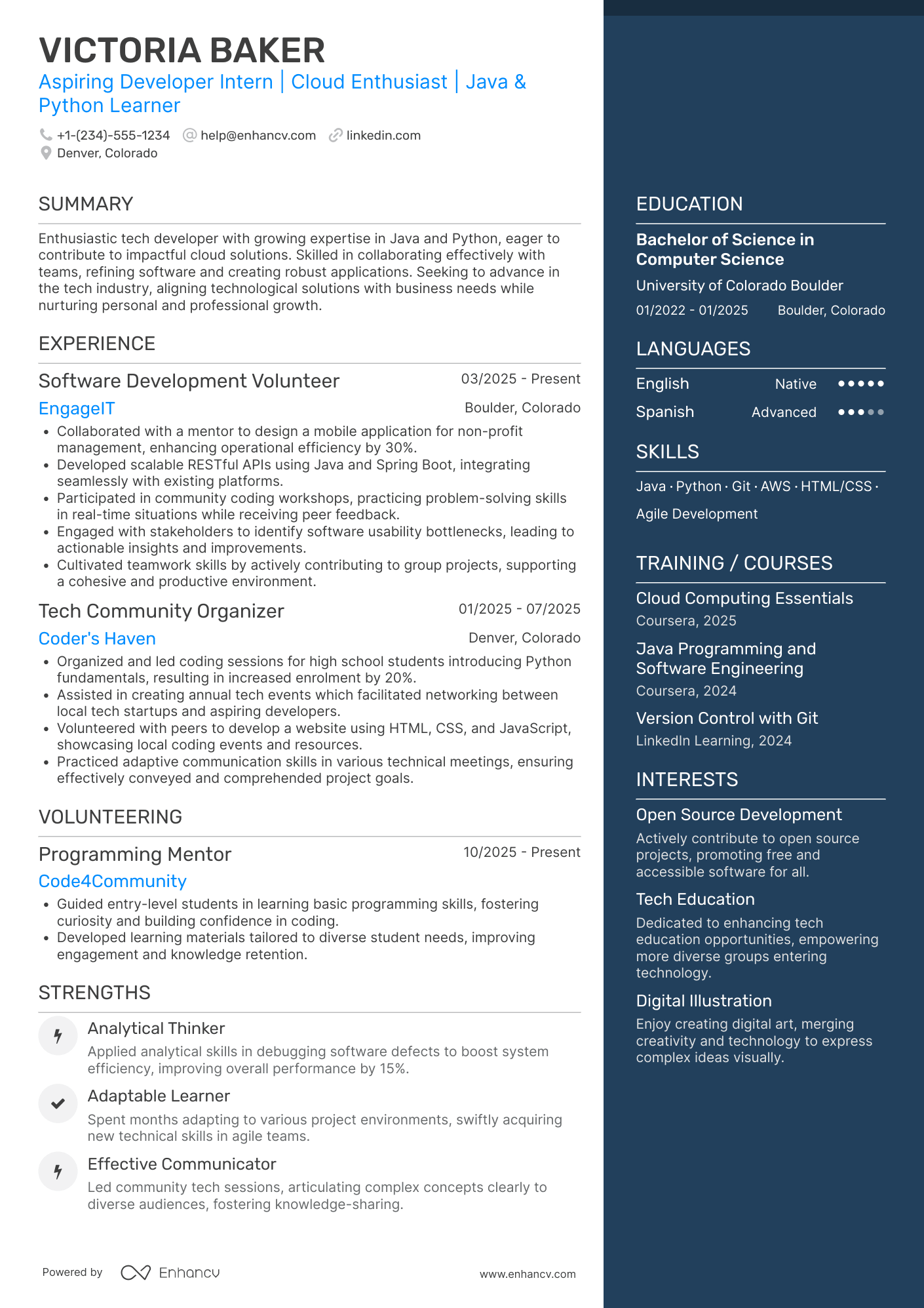
Use a hybrid format that leads with a focused technical skills section, then supports it with project experience or relevant work history in reverse-chronological order. Do:
- Place core languages, frameworks, and developer tools in a dedicated skills section near the top of the resume so they're immediately visible to applicant tracking systems and recruiters.
- Feature personal projects, open-source contributions, bootcamp capstones, or freelance work as structured experience entries with clear descriptions of your role and the technologies used.
- Connect every listed skill or project to a specific action and a tangible result, even if the result is small-scale.
Why not use a functional resume?
A functional resume strips away project context and timeline, making it difficult for recruiters to verify where, when, and how you applied your technical skills—which is exactly what hiring managers need to assess.
- Career changers: You have transferable technical skills (e.g., scripting, data analysis, automation) from a non-developer role and need to reframe them toward software development.
- Bootcamp graduates or self-taught developers: You lack traditional employment history in development but have completed substantial projects or contributions that demonstrate applied skill.
- Resume gaps: You're re-entering the workforce after a break and want to foreground current, relevant capabilities over an inconsistent timeline.
Once you've established a clean, readable format, the next step is deciding which sections to include and how to organize them for maximum impact.
What sections should go on a developer resume
Recruiters expect you to present your technical value fast, with the most relevant information easy to find. Understanding which resume sections to include and how to order them is critical for developer resumes.
Use this structure for maximum clarity:
- Header
- Summary
- Experience
- Skills
- Projects
- Education
- Certifications
- Optional sections: Open-source work, Awards, Languages
Strong experience bullets should emphasize measurable impact, shipped outcomes, technical scope, and the results your work produced.
Is your resume good enough?
Drop your resume here or choose a file. PDF & DOCX only. Max 2MB file size.
Now that you’ve outlined the key components of your developer resume, the next step is to write your experience section so it supports each part with clear, relevant proof.
How to write your developer resume experience
The experience section is where you prove you can ship working software—not just write code. Hiring managers prioritize demonstrated impact, such as features delivered, systems improved, and problems solved using role-relevant tools, over descriptive task lists that read like job descriptions.
Each entry should include:
- Job title
- Company and location (or remote)
- Dates of employment (month and year)
Three to five concise bullet points showing what you owned, how you executed, and what outcomes you delivered:
- Ownership scope: the applications, services, codebases, platforms, or infrastructure you were directly accountable for as a developer.
- Execution approach: the languages, frameworks, libraries, development methodologies, or architectural patterns you applied to build and deliver software.
- Value improved: the changes you drove in code quality, application performance, system reliability, deployment speed, or technical debt reduction tied to your developer work.
- Collaboration context: how you worked with product managers, designers, QA engineers, DevOps teams, or external stakeholders to ship features and resolve technical challenges.
- Impact delivered: the outcomes your development work produced, expressed through scale of users served, release cadence improvements, downtime reductions, or direct business results rather than a list of tasks completed.
Experience bullet formula
A developer experience example
✅ Right example - modern, quantified, specific.
Senior Software Engineer (Backend)
BrightLedger | Remote
2022–Present
Built and scaled a multi-tenant financial reporting platform serving two million monthly active users across small and mid-sized businesses.
- Architected and shipped event-driven microservices in Go and Kafka, cutting monthly close report generation from forty-five minutes to nine minutes and reducing compute costs by twenty-two percent.
- Optimized PostgreSQL queries and Redis caching for high-traffic endpoints, improving p95 API latency from 680 ms to 210 ms and increasing throughput by 1.8x under peak load.
- Implemented end-to-end observability with OpenTelemetry, Prometheus, Grafana, and structured logging, reducing mean time to recovery from fifty minutes to fourteen minutes through faster incident triage with on-call engineers.
- Hardened authentication and authorization using OAuth two point zero (OAuth 2.0), JSON Web Tokens, and role-based access control, eliminating a critical access control gap and passing two external security audits with zero high-severity findings.
- Partnered with product managers and designers to deliver a self-serve exports workflow in React and TypeScript, increasing feature adoption by nineteen percent and reducing support tickets related to exports by thirty-one percent.
Now that you've seen how a well-structured experience section looks in practice, let's break down how to tailor each element to match the specific role you're targeting.
How to tailor your developer resume experience
Recruiters evaluate your developer resume through both human review and applicant tracking systems (ATS), so tailoring your resume to the job description is essential. Tailoring ensures your most relevant work stands out in both screening methods.
Ways to tailor your developer experience:
- Match programming languages and frameworks listed in the job description.
- Mirror the exact terminology used for development methodologies or standards.
- Reflect the metrics or performance benchmarks the posting emphasizes.
- Include domain experience when the role targets a specific industry.
- Highlight security or accessibility practices if the posting references them.
- Emphasize collaboration models or workflows the team actually uses.
- Reference CI/CD tools or infrastructure platforms named in the listing.
- Align your testing or quality assurance approach with stated expectations.
Tailoring means aligning your real accomplishments with what the role requires, not forcing keywords where they don't belong.
Resume tailoring examples for developer
| Job description excerpt | Untailored | Tailored |
|---|---|---|
| "Build and maintain RESTful APIs using Node.js and Express, with PostgreSQL for data persistence. Must write unit and integration tests using Jest." | Developed backend services and worked with databases to support application features. | Built and maintained 12 RESTful APIs using Node.js and Express with PostgreSQL, achieving 95% test coverage through unit and integration tests written in Jest. |
| "Collaborate with cross-functional teams to migrate legacy monolith to microservices architecture on AWS using Docker and Kubernetes." | Helped move old systems to newer technology and worked with other teams on infrastructure projects. | Partnered with product and DevOps teams to decompose a legacy monolith into 8 microservices deployed on AWS using Docker and Kubernetes, reducing deployment time by 40%. |
| "Develop and optimize React front-end components, implement state management with Redux, and ensure WCAG 2.1 AA accessibility compliance." | Created front-end components and made sure the website worked well for all users. | Developed and optimized 30+ React components with Redux state management, remediating accessibility gaps to meet WCAG 2.1 AA standards across 4 customer-facing applications. |
Once you’ve aligned your experience with the role’s priorities, the next step is to quantify your developer achievements so hiring teams can see the impact behind that fit.
How to quantify your developer achievements
Quantifying your achievements proves business impact beyond code. Focus on performance, reliability, quality, delivery speed, and cost—metrics tied to user experience, incident reduction, and faster releases.
Quantifying examples for developer
| Metric | Example |
|---|---|
| Performance | "Reduced API p95 latency from 420 ms to 180 ms by adding Redis caching and query indexes in PostgreSQL." |
| Reliability | "Cut production incidents from twelve to four per quarter by adding SLO alerts in Datadog and improving runbooks." |
| Code quality | "Lowered test flakiness from eight percent to one percent by stabilizing mocks and parallelizing Jest suites in GitHub Actions." |
| Delivery speed | "Shortened lead time from five days to two days by introducing trunk-based development and automated releases with Argo CD." |
| Cost efficiency | "Reduced AWS spend by $18,000 per month by right-sizing EC2, switching to Graviton, and tuning autoscaling policies." |
Turn your everyday tasks into measurable, recruiter-ready resume bullets in seconds with Enhancv's Bullet Point Generator.
Once you've crafted strong, impact-driven bullet points, the next step is ensuring your resume also highlights the right mix of hard and soft skills that hiring managers look for in developers.
How to list your hard and soft skills on a developer resume
Your skills section shows how you build, ship, and maintain software, and recruiters and ATS scan it to match keywords to the job post, so aim for a balanced mix of role-specific hard skills and execution-focused soft skills.
developer roles require a blend of:
- Product strategy and discovery skills.
- Data, analytics, and experimentation skills.
- Delivery, execution, and go-to-market discipline.
- Soft skills.
Your skills section should be:
- Scannable (bullet-style grouping).
- Relevant to the job post.
- Backed by proof in experience bullets.
- Updated with current tools.
Place your skills section:
- Above experience if you're junior or switching careers.
- Below experience if you're mid/senior with strong achievements.

Hard skills
- Java, Kotlin, Spring Boot
- TypeScript, Node.js, React
- REST APIs, GraphQL
- SQL, PostgreSQL, Redis
- AWS, Docker, Kubernetes
- CI/CD, GitHub Actions
- Microservices, event-driven architecture
- Kafka, RabbitMQ
- Observability: OpenTelemetry, Prometheus, Grafana
- Automated testing: Jest, JUnit
- Infrastructure as code: Terraform
Soft skills
- Translate requirements into technical plans
- Write clear technical documentation
- Communicate tradeoffs and risks early
- Review code with actionable feedback
- Collaborate with product and design partners
- Break down work into shippable increments
- Own production issues through resolution
- Prioritize reliability and maintainability
- Use data to guide decisions
- Align stakeholders on scope and timelines
How to show your developer skills in context
Skills shouldn't live only in a bulleted list on your resume. Explore resume skills examples to see how developers present their technical abilities effectively.
They should be demonstrated in:
- Your summary (high-level professional identity)
- Your experience (proof through outcomes)
Here's what that looks like in practice.
Summary example
Senior full-stack developer with eight years of experience building scalable fintech platforms using React, Node.js, and AWS. Led a microservices migration that cut API response times by 40%, improving reliability for 200K+ daily users.
- Signals senior-level expertise immediately
- Names specific, role-relevant tools
- Leads with a measurable performance outcome
- Shows ownership and cross-team leadership
Experience example
Senior Full-Stack Developer
Ledgerpoint Technologies | Remote
March 2020–Present
- Architected a React and Node.js microservices platform that reduced deployment cycles by 35%, collaborating with DevOps and product teams.
- Optimized PostgreSQL queries and implemented Redis caching, cutting average API latency from 320ms to 190ms across core endpoints.
- Mentored four junior developers through code reviews and pair programming, increasing team pull request throughput by 20%.
- Every bullet includes a measurable outcome.
- Skills appear naturally through real accomplishments.
Once you’ve framed your technical strengths through real work and project examples, the next step is applying that approach to a developer resume when you have no experience, so you can present relevant skills with the same clarity.
How do I write a developer resume with no experience
Even without full-time experience, you can demonstrate readiness through shipped projects and technical contributions. Our guide on writing a resume without work experience covers this in detail. Here are strong options to include:
- Capstone projects with production deployment
- Open-source pull requests and reviews
- Freelance developer gigs for clients
- Hackathon builds with documented demos
- Technical internships or apprenticeships
- Personal apps with active users
- Coursework projects with Git history
- Bug fixes for community projects
Focus on:
- Shipped code with live links
- Git workflow and code reviews
- Tests, tooling, and documentation
- Relevant stack and problem scope
Resume format tip for entry-level developer
Use a reverse-chronological resume with a Projects section near the top, since it highlights shipped work and measurable outcomes fast. Do:
- Lead with projects, then education.
- Add GitHub and live demo links.
- Start bullets with strong verbs.
- Quantify impact with metrics.
- Match keywords to the job.
- Built and deployed a React and Node.js budget app to Vercel, added Jest tests, and cut page load time by 35 percent based on Lighthouse.
Even without professional experience, your education section can demonstrate the technical foundation and relevant coursework that make you a strong candidate.
How to list your education on a developer resume
Your education section helps hiring teams confirm you have the foundational knowledge needed. It validates your technical training, problem-solving skills, and readiness for developer responsibilities.
Include:
- Degree name
- Institution
- Location
- Graduation year
- Relevant coursework (for juniors or entry-level candidates)
- Honors & GPA (if 3.5 or higher)
Skip month and day details—list the graduation year only.
Here's a strong education entry tailored for a developer resume.
Example education entry
Bachelor of Science in Computer Science
Georgia Institute of Technology, Atlanta, GA
Graduated 2022
GPA: 3.7/4.0
- Relevant Coursework: Data Structures, Algorithms, Operating Systems, Software Engineering, Database Systems
- Honors: Dean's List (six semesters), Magna Cum Laude
How to list your certifications on a developer resume
Certifications show a developer's commitment to learning, proficiency with key tools, and alignment with current industry needs, especially when paired with recent projects and measurable outcomes.
Include:
- Certificate name
- Issuing organization
- Year
- Optional: credential ID or URL
- Place certifications below education when your degree is recent and directly relevant to your developer role.
- Place certifications above education when they are recent, highly relevant, or required for the developer job.
Best certifications for your developer resume
- AWS Certified Developer – Associate
- Microsoft Certified: Azure Developer Associate
- Google Professional Cloud Developer
- Certified Kubernetes Application Developer (CKAD)
- HashiCorp Certified: Terraform Associate
- Oracle Certified Professional, Java SE Developer
Once you’ve placed your certifications where they support your skills and stay easy to scan, you can write your developer resume summary to highlight those qualifications upfront and set the context for the rest of your resume.
How to write your developer resume summary
Your resume summary is the first thing a recruiter reads. A strong one instantly connects your skills and experience to the role. Keep it to three to four lines, with:
- Your title and years of hands-on development experience.
- The domain, industry, or product type you've worked in most.
- Core programming languages, frameworks, and tools you use daily.
- One or two achievements backed by numbers or measurable outcomes.
- Soft skills demonstrated through real project results, not vague claims.

PRO TIP
At the junior level, focus on relevant technical skills, tools you've used in real projects, and any early impact you've delivered. Highlight clarity and specificity over breadth. Avoid generic phrases like "passionate developer" or "fast learner." Replace them with concrete details about what you built, improved, or shipped.
Example summary for a developer
Front-end developer with two years of experience building React applications for e-commerce platforms. Improved page load speed by 34% through component optimization. Proficient in TypeScript, Next.js, and REST API integration.
Optimize your resume summary and objective for ATS
Drop your resume here or choose a file.
PDF & DOCX only. Max 2MB file size.
Now that your summary captures your value at a glance, make sure the header above it presents your contact details and professional identity just as effectively.
What to include in a developer resume header
A resume header is the top section with your key identity and contact details, helping recruiters spot you fast, trust your profile, and screen you accurately.
Essential resume header elements
- Full name
- Tailored job title and headline
- Location
- Phone number
- Professional email
- GitHub link
- Portfolio link
A LinkedIn link helps recruiters verify experience quickly and supports screening.
Do not include photos on a developer resume unless the role is explicitly front-facing or appearance-dependent.
Keep your header to two lines, use consistent formatting, and match your job title to the role's wording.
Example
Developer resume header
Jordan Lee
Full-stack developer | React, Node.js, PostgreSQL
Austin, TX
(512) 555-01XX | your.name@enhancv.com | github.com/yourname | yourwebsite.com | linkedin.com/in/yourname
Once your header establishes who you are and how to reach you, you can strengthen the rest of your resume with additional sections that support those details.
Additional sections for developer resumes
Extra sections help you stand out when your core experience doesn't fully capture your technical depth or community involvement.
- Open source contributions
- Technical publications and blog posts
- Hackathon awards and coding competitions
- Languages
- Professional development and developer conferences
- Hobbies and interests
- Technical community involvement and meetups
Once you've rounded out your resume with the right supplementary sections, it's worth considering whether a well-crafted cover letter can further strengthen your application.
Do developer resumes need a cover letter
A cover letter isn't required for most developer roles, but it helps when hiring teams expect one or the role is competitive. If you're unsure about the basics, learn what a cover letter is and when it adds value. It can make a difference when your resume needs context, or when you want to show clear fit.
Use a cover letter to add context your resume can't:
- Explain role or team fit: Connect your strengths to the team's stack, workflow, and priorities, and name the problems you can help solve.
- Highlight one or two relevant projects or outcomes: Pick two results, quantify impact, and link the work to the role's core responsibilities.
- Show understanding of the product, users, or business context: Reference the company's product, target users, and tradeoffs, and describe how you'd contribute.
- Address career transitions or non-obvious experience: Explain the shift, map prior work to the role, and give one proof point that reduces risk.
Drop your resume here or choose a file.
PDF & DOCX only. Max 2MB file size.
Once you’ve decided whether to include a cover letter based on the role and employer expectations, the next step is using AI to improve your developer resume so your qualifications come through clearly and consistently.
Using AI to improve your developer resume
AI can sharpen your resume's clarity, structure, and impact. It helps tighten language and highlight results. But overuse strips authenticity fast. Once your content reads clearly and fits the role, step away from AI. For specific prompt ideas, check out our guide on ChatGPT resume writing prompts.
Here are 10 practical prompts you can copy and paste to strengthen specific sections of your developer resume:
- Strengthen your summary. "Rewrite this developer resume summary to highlight core technical skills and years of experience in two concise sentences."
- Quantify your impact. "Add measurable outcomes to these developer experience bullets using metrics like performance gains, uptime, or deployment frequency."
- Tighten bullet phrasing. "Shorten each developer experience bullet to one line, starting with a strong action verb and removing filler words."
- Align skills strategically. "Reorder this developer skills section to prioritize technologies mentioned in the following job description."
- Clarify project descriptions. "Rewrite this developer project section to clearly state the problem solved, technologies used, and measurable result delivered."
- Remove redundant language. "Identify and remove repeated or vague phrases across this developer resume without changing the factual content."
- Tailor to role. "Adjust this developer resume's experience section to better match the requirements listed in this specific job posting."
- Improve education relevance. "Rewrite this developer education section to emphasize coursework, projects, or research directly relevant to backend engineering roles."
- Highlight certifications clearly. "Format this developer certifications section to list each credential with its issuing body, date earned, and relevance to the target role."
- Fix inconsistent formatting. "Standardize tense, punctuation, and structure across all bullet points in this developer resume's experience section."
Stop using AI once your resume sounds accurate, specific, and aligned with real experience. AI should never invent experience or inflate claims—if it didn't happen, it doesn't belong here.
Conclusion
A strong developer resume shows measurable outcomes, role-specific skills, and a clear structure that’s easy to scan. It highlights impact with numbers, names the tools you used, and connects your work to results.
When your resume stays focused and consistent, you look ready for today’s hiring market and the next shift in expectations. You make it simple for recruiters and hiring managers to see fit, value, and momentum.