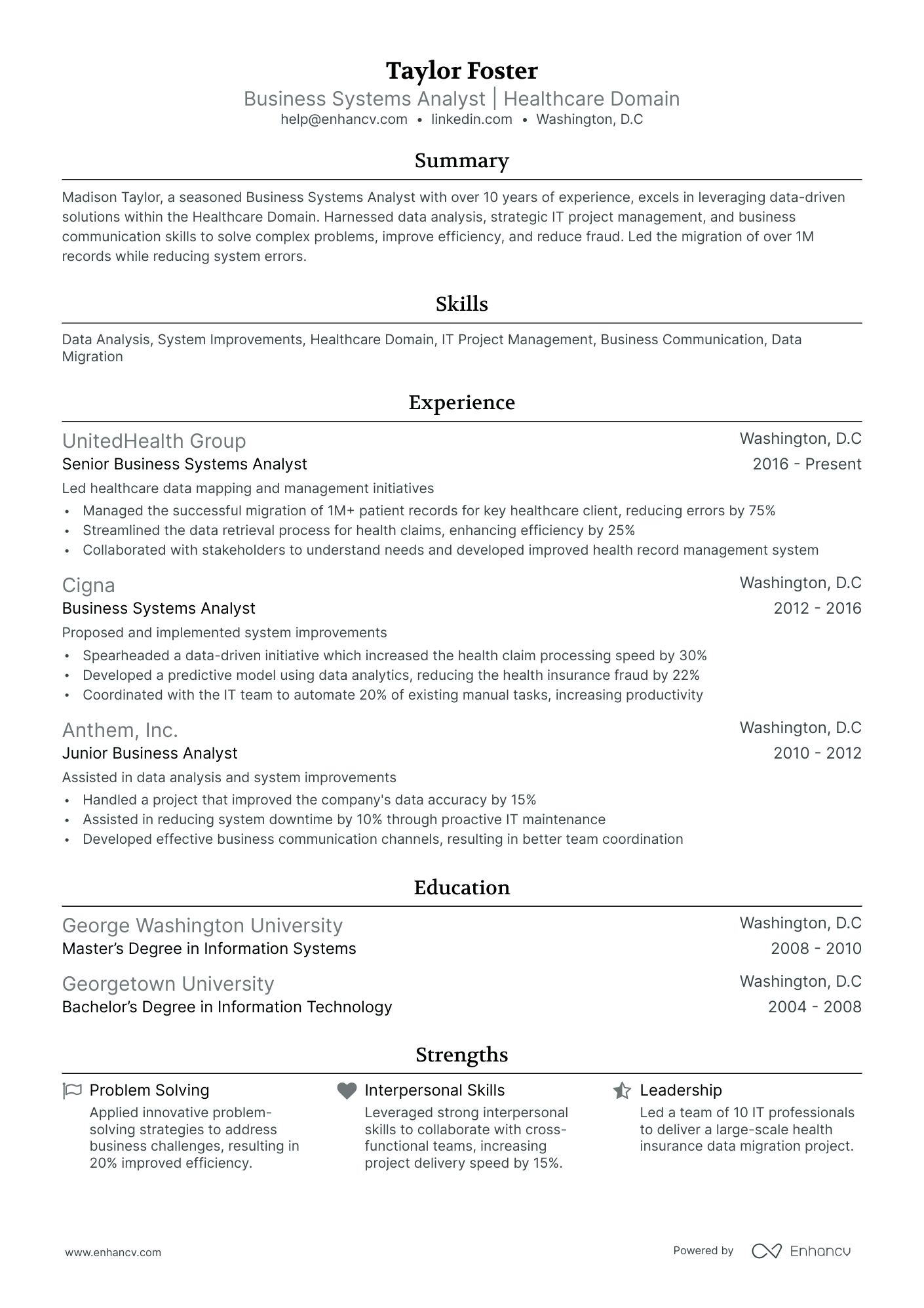
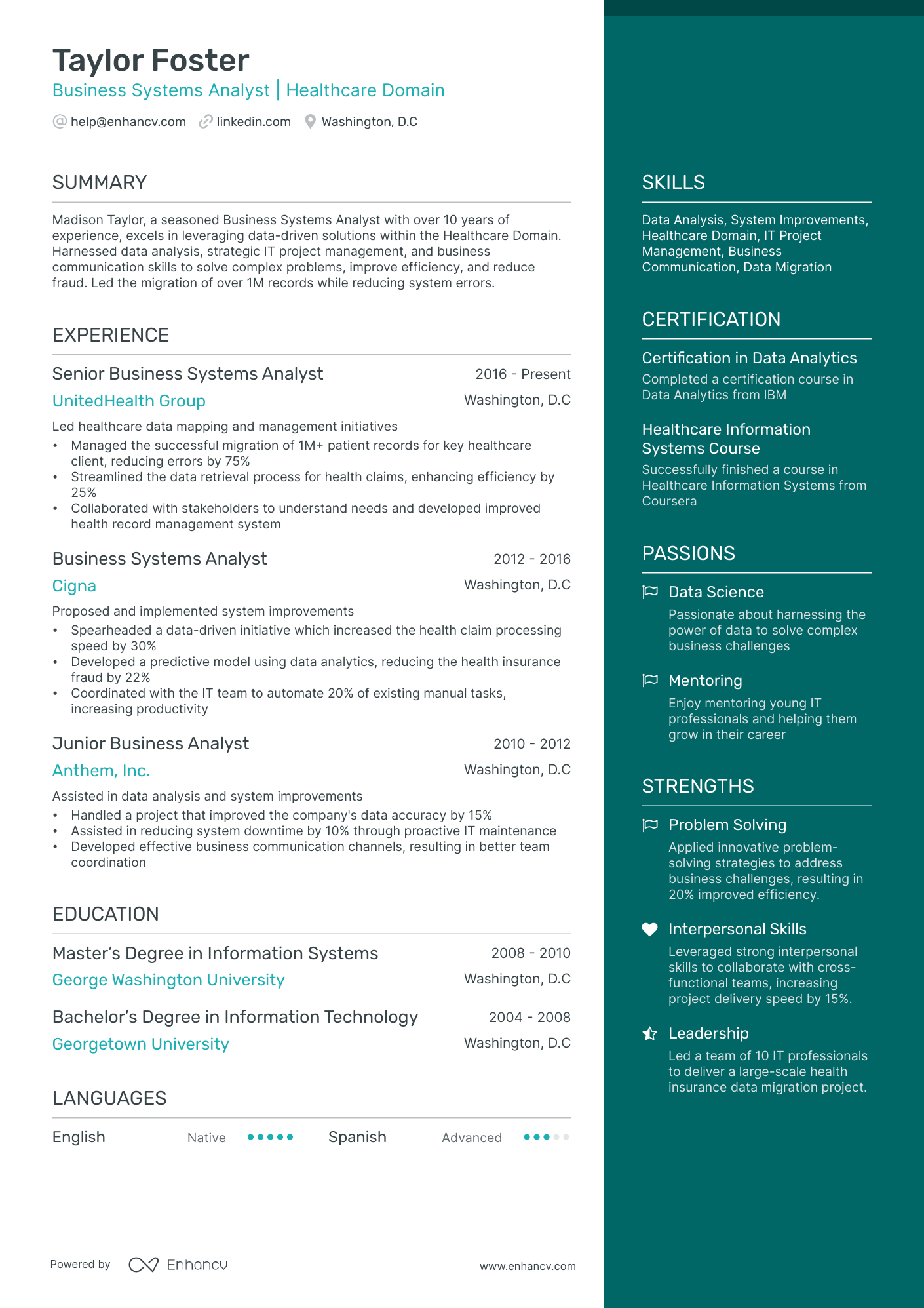
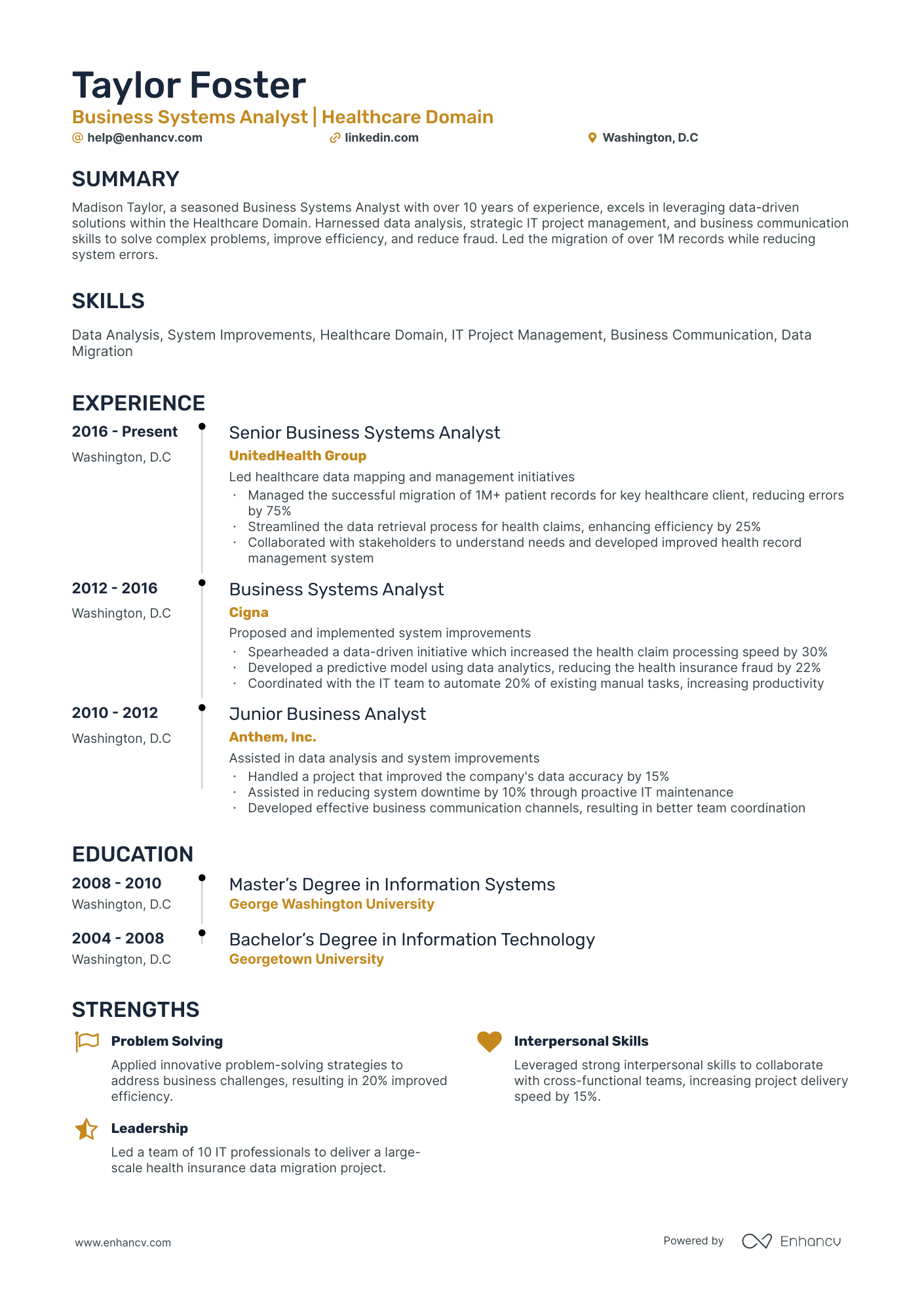
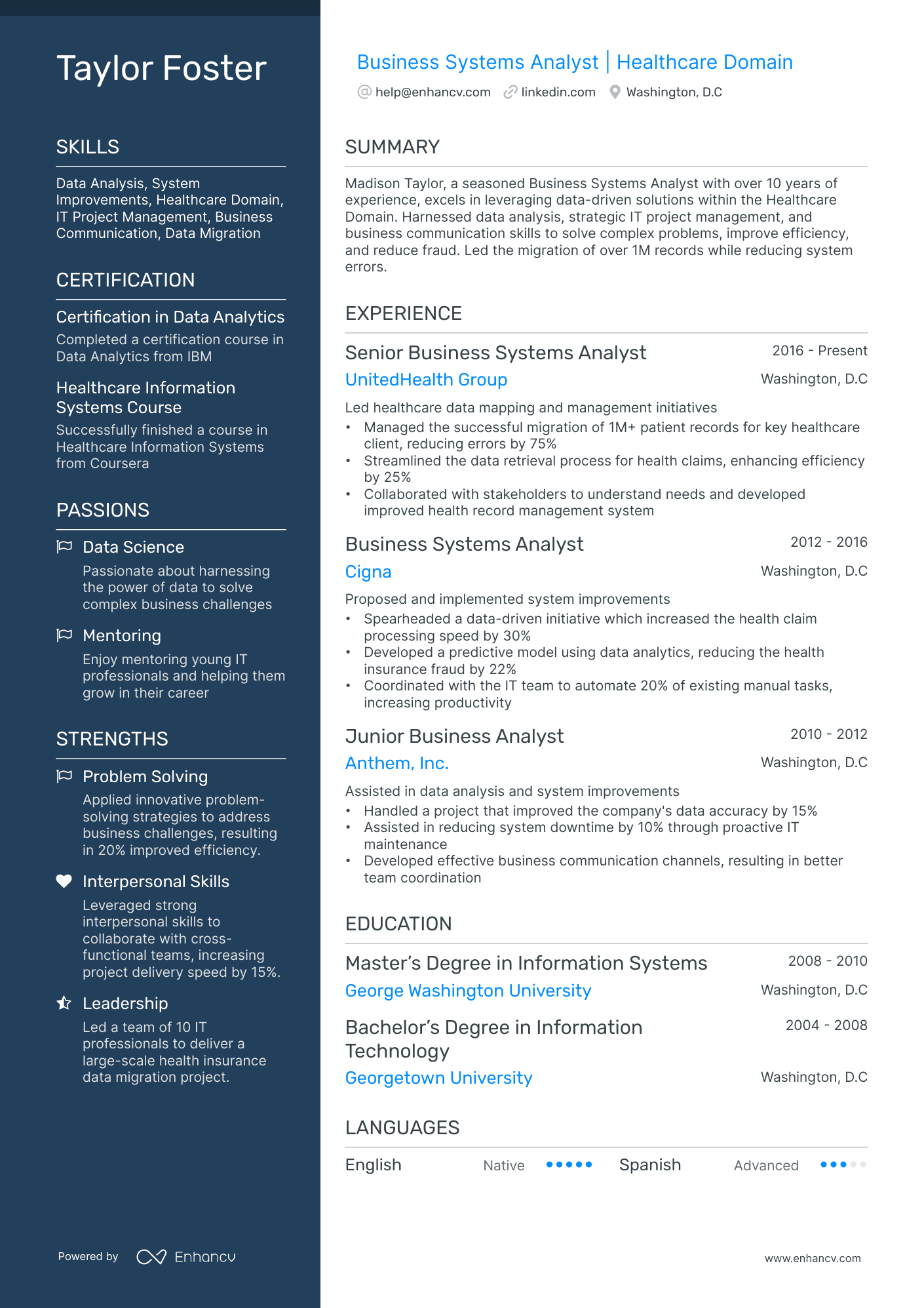
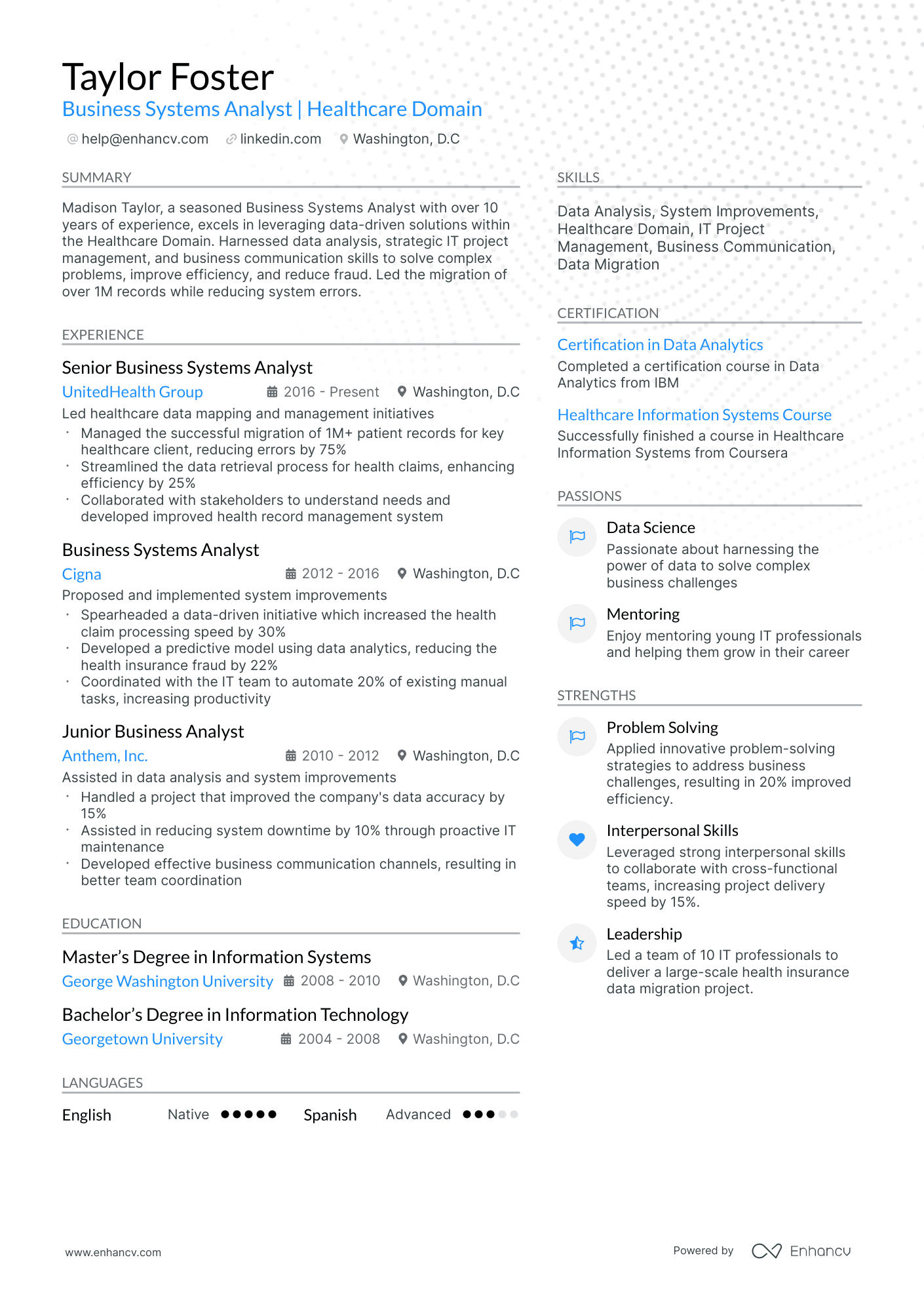
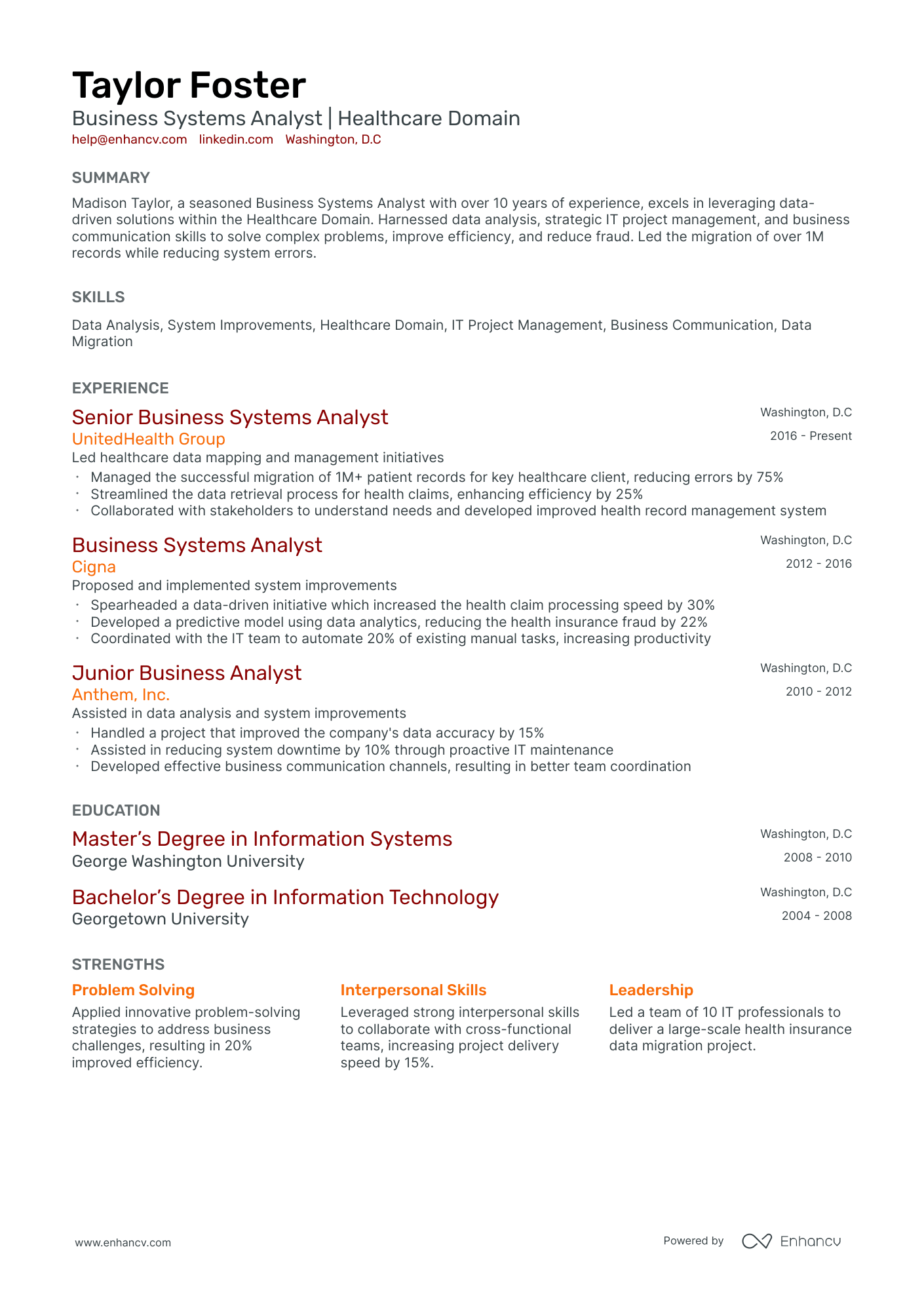
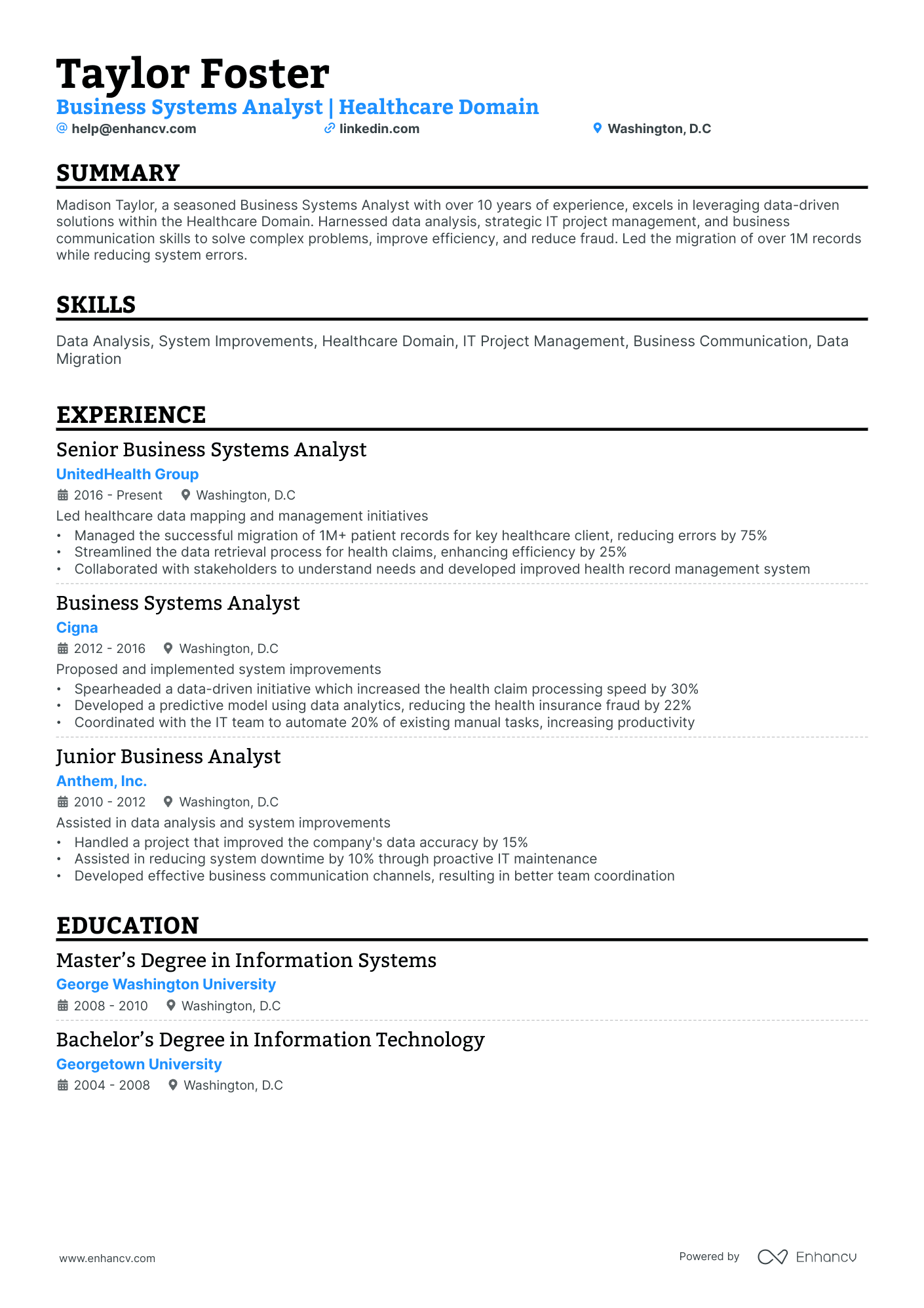
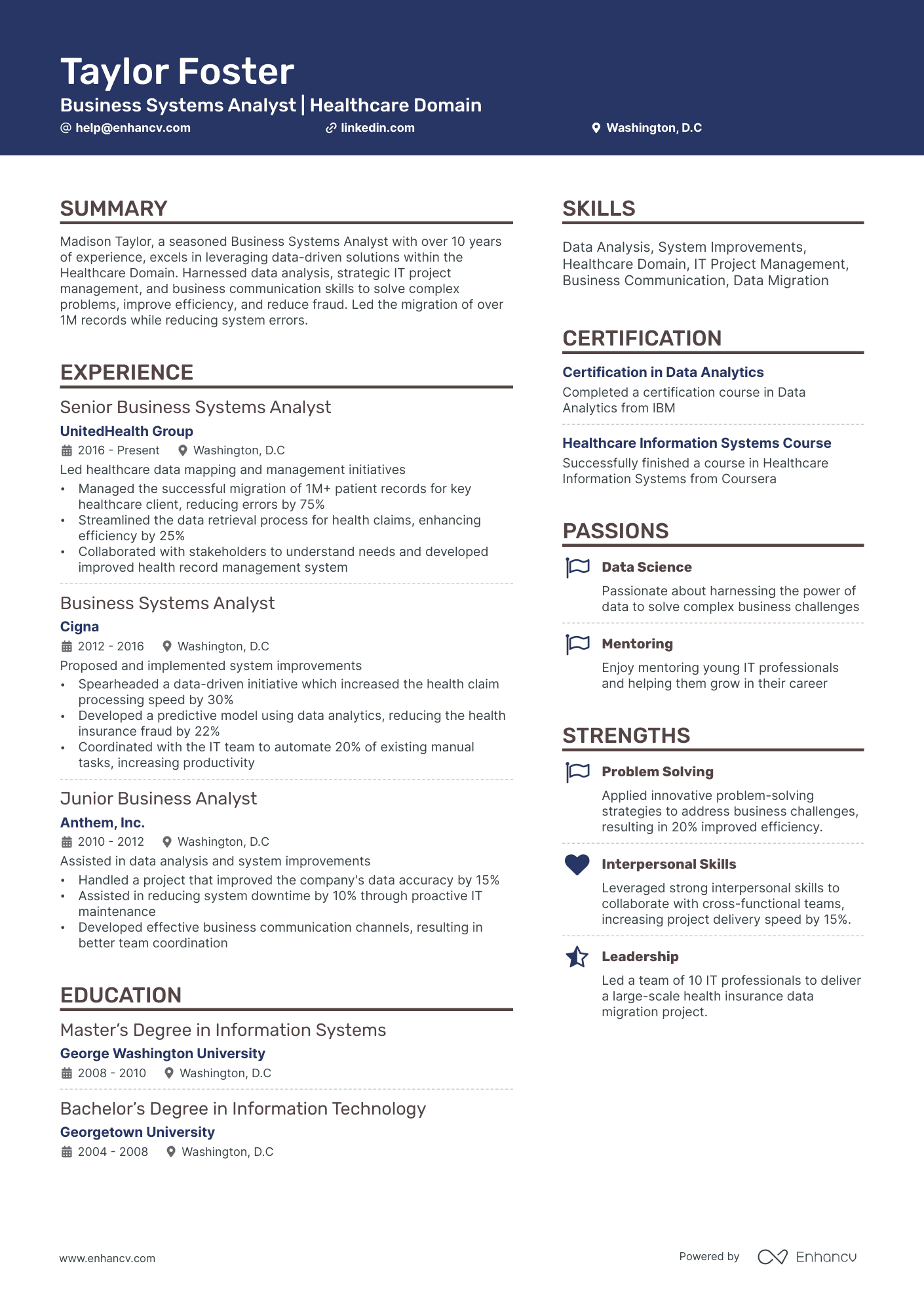
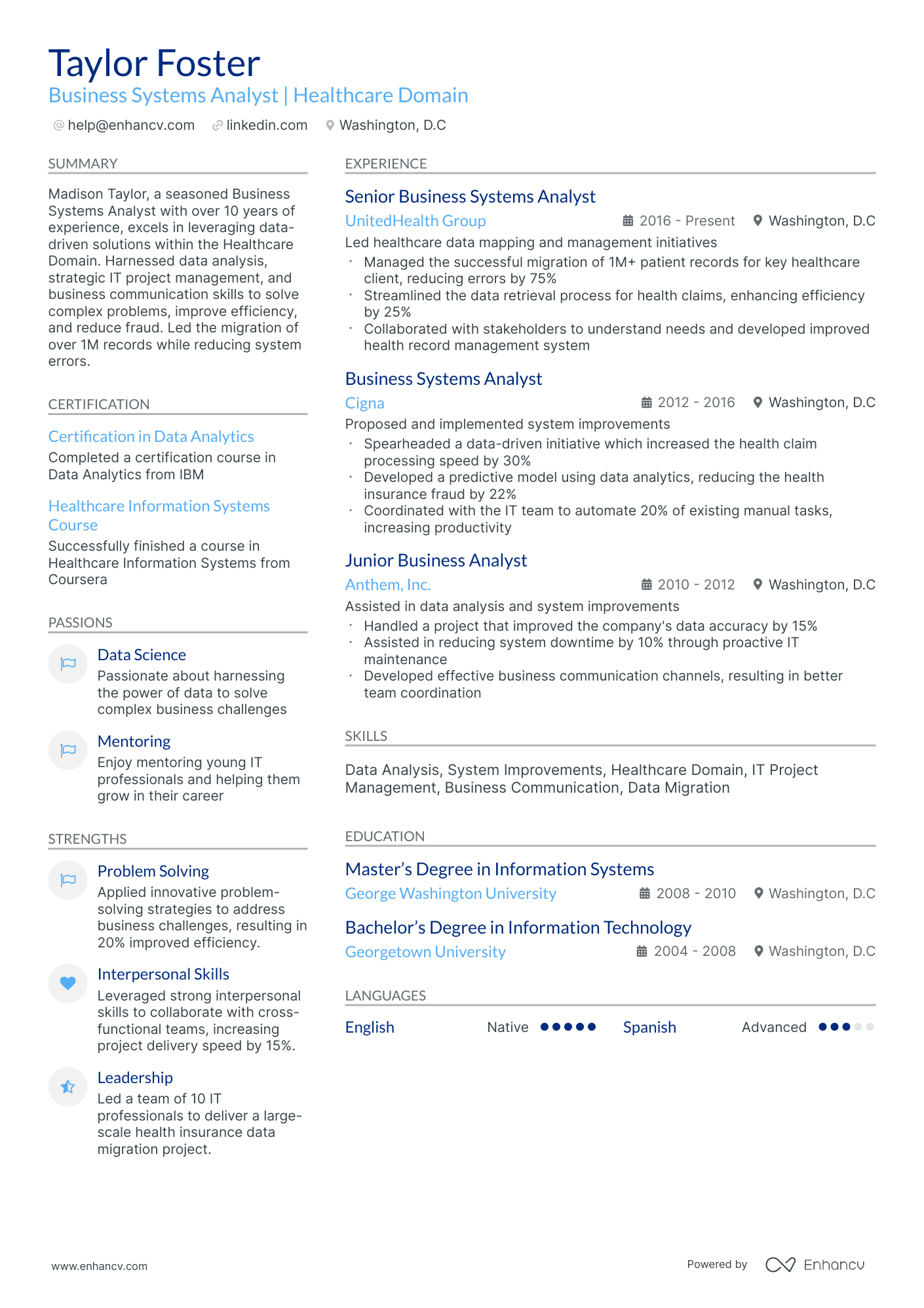
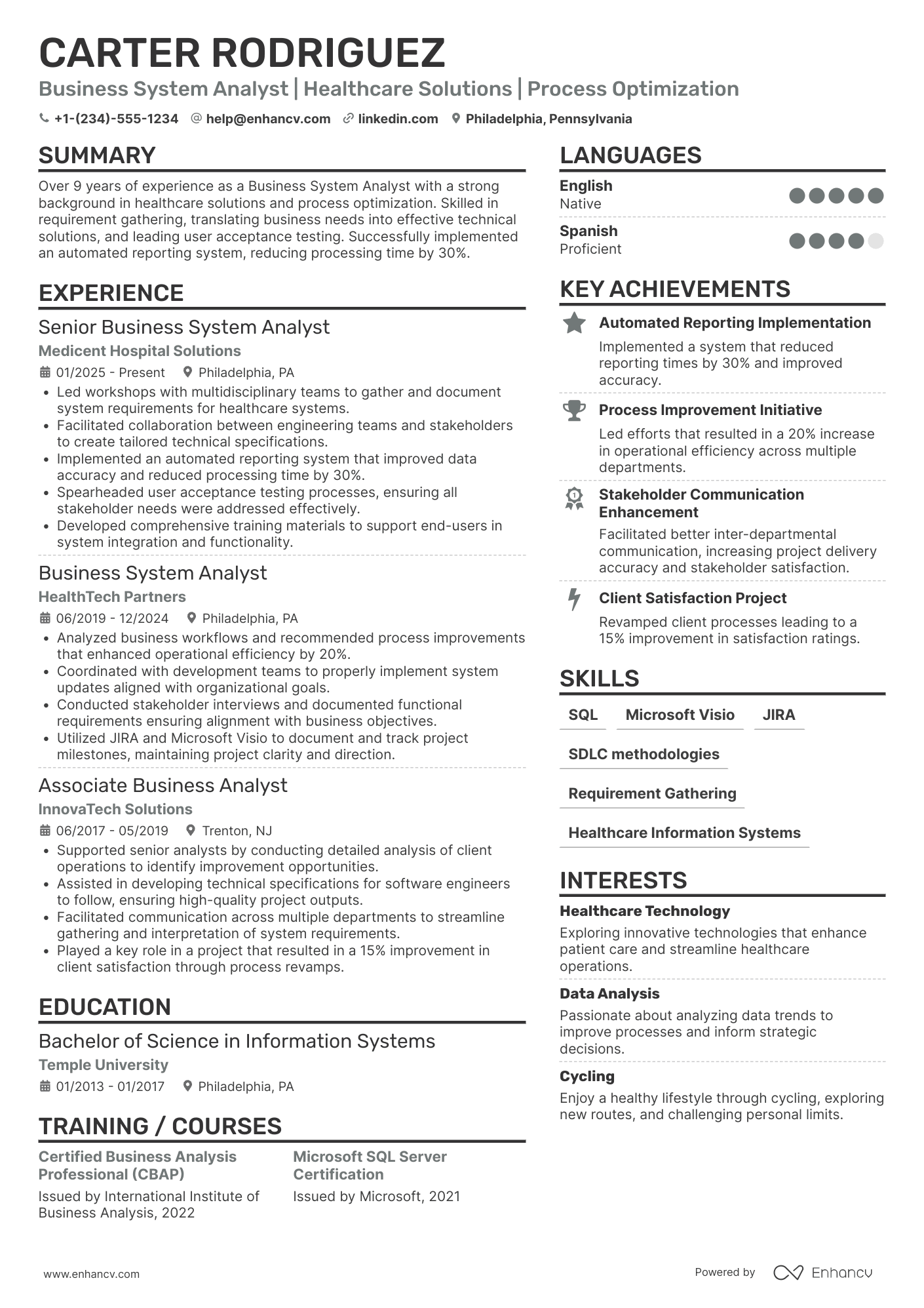
Most business system analyst resume submissions fail because they describe tasks and tools instead of decisions, impact, and ownership. That hurts in ATS screening and fast recruiter scans, where crowded pipelines reward clear outcomes and relevant keywords. If you're unsure where to begin, understanding how to write a resume that prioritizes impact over duties is the essential first step.
A strong resume shows how you improved processes and delivered measurable results. You should highlight cycle time reductions, fewer defects after release, higher adoption, clearer requirements, smoother integrations, on-time delivery across multiple teams, and quantified cost savings.

Key takeaways
- Quantify achievements with metrics like cycle time, cost savings, and adoption rates.
- Use reverse-chronological format if you have direct business system analyst experience.
- Choose a hybrid format when switching careers or entering the field.
- Tailor every experience bullet to mirror the job posting's tools and terminology.
- Show skills in context through your summary and experience, not just a skills list.
- Place certifications above education when they're recent and role-relevant.
- Use Enhancv's Bullet Point Generator to turn routine tasks into results-driven statements.
How to format a business system analyst" All words in this title are regular English words, so no capitalization changes are needed. business system analyst resume
Recruiters hiring for a business system analyst role prioritize candidates who demonstrate clear analytical problem-solving, stakeholder communication, and the ability to bridge business needs with technical solutions. A well-chosen resume format ensures these signals—along with relevant tools, methodologies, and measurable project outcomes—are immediately visible during both ATS parsing and human review.

I have significant experience in this role—which format should I use?
Use a reverse-chronological format to present your deepest and most relevant business system analyst experience first. Do:
- Lead each role entry with your scope of ownership: the systems you managed, the business units you supported, and the stakeholders you collaborated with.
- Highlight tools and domains central to the role, such as SQL, JIRA, business process modeling, requirements gathering frameworks, and ERP or CRM platforms.
- Quantify outcomes tied to efficiency gains, cost savings, system adoption rates, or project delivery timelines.
I'm junior or switching into this role—what format works best?
A hybrid format works best, letting you lead with a focused skills section while still showing relevant experience in chronological order. Do:
- Place a skills section near the top that highlights core competencies like requirements elicitation, data analysis, process mapping, and specific tools such as Visio, SQL, or Tableau.
- Include academic projects, internships, or cross-functional work that demonstrates systems thinking or business analysis, even if the job title didn't match.
- Connect every listed skill or project to a concrete action and a measurable or observable result.
Why not use a functional resume?
A functional format strips away the timeline and context recruiters need to evaluate how you applied your analytical and technical skills in real working environments, which weakens your candidacy for business system analyst roles.
- Career changers with no direct analyst experience: If your previous roles involved process improvement, data work, or cross-functional coordination, a functional format can group these transferable skills—but each skill must still be tied to a specific project, tool, or outcome rather than listed in isolation.
- Candidates with significant resume gaps: A functional layout can redirect focus to relevant certifications (such as CBAP or PMI-PBA) and freelance or volunteer analysis work completed during gaps.
- Recent graduates with limited work history: Grouping coursework projects, capstone analyses, and technical skills under competency headers can compensate for a thin experience section.
With your resume's structure and layout in place, the next step is identifying the specific sections that'll present your qualifications most effectively.
What sections should go on a business system analyst" All words in this title are regular English words, so no capitalization changes are needed. business system analyst resume
Recruiters expect to see a clear summary of your business analysis focus, systems expertise, and measurable results across cross-functional initiatives. Knowing exactly what to put on a resume helps you prioritize the sections that matter most for this role.
Use this structure for maximum clarity:
- Header
- Summary
- Experience
- Skills
- Projects
- Education
- Certifications
- Optional sections: Awards, Publications, Languages
Strong experience bullets should emphasize business impact, delivery outcomes, stakeholder scope, and measurable results tied to requirements, process improvements, and system changes.
Is your resume good enough?
Drop your resume here or choose a file. PDF & DOCX only. Max 2MB file size.
Now that you know which sections belong on a business system analyst resume, the next step is learning how to write your business system analyst resume experience so each section clearly communicates your impact.
How to write your business system analyst" All words in this title are regular English words, so no capitalization changes are needed. business system analyst resume experience
Your work experience section is where you prove you can bridge business needs and technical systems to drive real organizational results. Hiring managers prioritize demonstrated impact—shipped deliverables, role-relevant tools and methods, and measurable outcomes—over descriptive task lists.
Each entry should include:
- Job title
- Company and location (or remote)
- Dates of employment (month and year)
Three to five concise bullet points showing what you owned, how you executed, and what outcomes you delivered:
- Ownership scope: the specific business processes, enterprise systems, platforms, or cross-departmental initiatives you were directly accountable for as a business system analyst.
- Execution approach: the requirements-gathering techniques, modeling frameworks, system configuration tools, or analysis methods you used to evaluate needs, define solutions, and deliver work.
- Value improved: the changes you drove in system performance, process efficiency, data accuracy, compliance posture, or operational reliability that are directly relevant to business system analysis.
- Collaboration context: how you partnered with stakeholders such as developers, project managers, end users, vendors, or executive sponsors to translate business requirements into technical specifications and implemented solutions.
- Impact delivered: the outcomes you produced expressed through business results—whether that's reduced processing time, improved system adoption, fewer escalations, or successful go-lives—rather than a list of activities you performed.
Experience bullet formula
A business system analyst" All words in this title are regular English words, so no capitalization changes are needed. business system analyst experience example
✅ Right example - modern, quantified, specific.
business system analyst
Northbridge Health | Remote
2022–Present
Supported a multi-state healthcare provider serving 1.2M members, optimizing core business systems across claims, enrollment, and customer service.
- Led end-to-end requirements discovery for a Salesforce Service Cloud case workflow redesign, cutting average handle time by 18% and improving first-contact resolution by 11%.
- Built and maintained Jira epics, user stories, and acceptance criteria, enabling two-week sprint delivery with a 27% drop in scope change requests after sprint start.
- Mapped as-is and to-be processes in Microsoft Visio and facilitated stakeholder workshops across operations, compliance, and engineering, reducing handoff errors by 32% in claims intake.
- Defined data validation rules and reconciliation checks in SQL and Excel for enrollment feeds, lowering monthly eligibility defects from 2.6% to 1.1% and preventing an estimated $420K in downstream rework.
- Partnered with product managers, designers, and QA to implement UAT in Azure DevOps with traceability to business outcomes, shortening release sign-off cycles by nine days on average.
Now that you've seen what a strong experience section looks like in practice, let's focus on how to customize it for each specific role you're targeting.
How to tailor your business system analyst" All words in this title are regular English words, so no capitalization changes are needed. business system analyst resume experience
Recruiters evaluate your business system analyst resume through a combination of human review and applicant tracking systems (ATS). Tailoring your resume to the job description increases your chances of passing both screenings.
Ways to tailor your business system analyst experience:
- Mirror the exact tools and platforms listed in the job description.
- Match the methodology names like Agile or Waterfall from the posting.
- Reflect the specific KPIs or success criteria the employer prioritizes.
- Include domain experience relevant to the industry they operate in.
- Highlight compliance or regulatory standards the role requires.
- Use the same terminology for business processes they reference.
- Emphasize cross-functional collaboration models described in the listing.
- Align your workflow documentation practices with their stated frameworks.
Tailoring means connecting your real accomplishments to the job's specific requirements—not forcing keywords where they don't belong.
Resume tailoring examples for business system analyst" All words in this title are regular English words, so no capitalization changes are needed. business system analyst
| Job description excerpt | Untailored | Tailored |
|---|
Once your business system analyst resume experience matches the role’s needs, quantify your business system analyst achievements to show the impact of your work clearly.
How to quantify your business system analyst" All words in this title are regular English words, so no capitalization changes are needed. business system analyst achievements
Quantifying your achievements proves business impact beyond tasks. Focus on cycle time, defect leakage, system performance, adoption, cost savings, and risk reduction across releases, integrations, and process changes.
Quantifying examples for business system analyst" All words in this title are regular English words, so no capitalization changes are needed. business system analyst
| Metric | Example |
|---|---|
| Delivery speed | "Cut requirements-to-UAT cycle time from twelve to eight weeks by standardizing user stories in Jira and refining backlog grooming." |
| Defect reduction | "Reduced post-release defects by thirty-five percent by adding acceptance criteria, traceability matrices, and QA test coverage reviews for three integrations." |
| Performance | "Improved API response time from nine hundred milliseconds to four hundred milliseconds by optimizing data mappings and tuning queries with the engineering team." |
| Cost savings | "Saved $180,000 annually by consolidating two reporting tools into Power BI and retiring legacy licenses across five departments." |
| Adoption rate | "Increased new workflow adoption from fifty-five percent to eighty-five percent within sixty days through role-based training and in-app guidance." |
Turn your everyday tasks into measurable, recruiter-ready resume bullets in seconds with Enhancv's Bullet Point Generator.
Once you've crafted strong, results-driven bullet points, the next step is making sure your skills section reinforces those same strengths with the right mix of hard and soft skills.
How to list your hard and soft skills on a business system analyst" All words in this title are regular English words, so no capitalization changes are needed. business system analyst resume
Your skills section shows you can translate business needs into system requirements and measurable outcomes, and recruiters and ATS scan this section to confirm role fit fast; aim for a balanced mix of technical hard skills and execution-focused soft skills.
business system analyst roles require a blend of:
- Product strategy and discovery skills
- Data, analytics, and experimentation skills
- Delivery, execution, and go-to-market discipline
- Soft skills
Your skills section should be:
- Scannable (bullet-style grouping).
- Relevant to the job post.
- Backed by proof in experience bullets.
- Updated with current tools.
Place your skills section:
- Above experience if you're junior or switching careers.
- Below experience if you're mid/senior with strong achievements.

Hard skills
- Requirements elicitation, workshops
- User stories, acceptance criteria
- Business process modeling, BPMN
- Use case modeling, UML
- Data mapping, entity-relationship diagrams
- SQL querying, data validation
- API analysis, REST, JSON
- Systems integration, middleware basics
- Jira, Confluence
- Visio, Lucidchart
- UAT planning, test case design
- Agile delivery, Scrum ceremonies
Soft skills
- Stakeholder alignment and buy-in
- Clear requirements communication
- Scope control and prioritization
- Trade-off decision-making
- Cross-functional facilitation
- Structured problem solving
- Risk and dependency management
- Ownership through delivery
- Conflict resolution with partners
- Executive-ready status updates
- Attention to edge cases
- Change management support
How to show your business system analyst" All words in this title are regular English words, so no capitalization changes are needed. business system analyst skills in context
Skills shouldn't live only in a dedicated skills list. Explore resume skills examples to see how top candidates weave competencies throughout their resumes.
They should be demonstrated in:
- Your summary (high-level professional identity)
- Your experience (proof through outcomes)
Here's how that looks in practice.
Summary example
Senior business system analyst with 10 years in healthcare IT, specializing in requirements gathering, SQL-based data validation, and cross-functional stakeholder alignment. Led EHR integration initiatives that reduced claim processing errors by 34%.
Why it works:
- Reflects senior-level expertise immediately
- Names specific tools and methods
- Leads with a measurable outcome
- Signals stakeholder collaboration skills
Experience example
Business System Analyst
Meridian Health Solutions | Remote
June 2019–March 2024
- Mapped 120+ business requirements in Jira for a claims platform migration, cutting project delivery time by 18%.
- Partnered with engineering and compliance teams to design UAT scripts, resolving 95% of defects before launch.
- Built Tableau dashboards tracking KPI trends, helping leadership reduce operational costs by $280K annually.
Why it works:
- Every bullet includes measurable proof
- Skills surface naturally through outcomes
Now that you know how to show your business system analyst skills in context, you can use the same approach to write a business system analyst resume with no experience because it highlights impact without relying on past job titles.
How do I write a business system analyst" All words in this title are regular English words, so no capitalization changes are needed. business system analyst resume with no experience
Even without full-time experience, you can demonstrate readiness through transferable projects and relevant coursework. Our guide on writing a resume without work experience walks you through the exact strategies that work for entry-level candidates.
- Capstone business process improvement project
- Internship requirements gathering and documentation
- Volunteer system rollout support
- Coursework in systems analysis methods
- Case study with stakeholder interviews
- Personal project dashboard and reporting
- Hackathon workflow automation prototype
- User acceptance testing for class app
Focus on:
- Requirements artifacts and traceability
- Process maps and gap analysis
- Data analysis with documented outputs
- Tools: Jira, SQL, Excel
Resume format tip for entry-level business system analyst
Use a skills-based resume format because it highlights relevant projects, coursework, and tools when you lack full-time business system analyst experience. Do:
- Lead with a "Projects" section.
- List tools and methods per project.
- Quantify outcomes with clear metrics.
- Add links to deliverables when possible.
- Mirror keywords from job postings.
- Built a business system analyst requirements package in Jira using user stories and acceptance criteria, reducing rework by 20% in a capstone workflow automation project.
Even without direct experience, your academic background can carry significant weight—here's how to present your education effectively on your business system analyst resume.
How to list your education on a business system analyst" All words in this title are regular English words, so no capitalization changes are needed. business system analyst resume
Your education section helps hiring teams confirm you have the foundational knowledge a business system analyst needs. It signals relevant training in areas like systems thinking, data analysis, and business process design.
Include:
- Degree name
- Institution
- Location
- Graduation year
- Relevant coursework (for juniors or entry-level candidates)
- Honors & GPA (if 3.5 or higher)
Skip month and day details—list the graduation year only.
Here's a strong education entry for a business system analyst resume:
Example education entry
Bachelor of Science in Management Information Systems
Georgetown University, Washington, D.C.
Graduated 2021
GPA: 3.7/4.0
- Relevant coursework: Systems Analysis & Design, Business Process Modeling, Database Management, Requirements Engineering
- Honors: Dean's List (six semesters), Beta Gamma Sigma Honor Society
How to list your certifications on a business system analyst" All words in this title are regular English words, so no capitalization changes are needed. business system analyst resume
Certifications on your resume show your commitment to learning, confirm tool proficiency, and signal industry relevance for a business system analyst resume. Include:
- Certificate name
- Issuing organization
- Year
- Optional: credential ID or URL
- Place certifications below education when they are older, less relevant, or secondary to your degree for the role.
- Place certifications above education when they are recent, highly relevant, or required for the business system analyst job.
Best certifications for your business system analyst" All words in this title are regular English words, so no capitalization changes are needed. business system analyst resume
- Certified Business Analysis Professional (CBAP)
- Certification of Capability in Business Analysis (CCBA)
- PMI Professional in Business Analysis (PMI-PBA)
- Agile Analysis Certification (IIBA-AAC)
- Professional Scrum Product Owner (PSPO I)
- ITIL 4 Foundation
- Microsoft Certified: Power BI Data Analyst Associate
With your certifications clearly listed to validate your qualifications, the next step is to write your business system analyst resume summary to quickly highlight that value for hiring managers.
How to write your business system analyst" All words in this title are regular English words, so no capitalization changes are needed. business system analyst resume summary
Your resume summary is the first thing a recruiter reads. A strong one immediately signals you're qualified and worth a closer look.
Keep it to three to four lines, with:
- Your title and total years of experience in business systems analysis.
- The domain or industry you've worked in, such as finance, healthcare, or supply chain.
- Core tools and skills like SQL, JIRA, requirements gathering, or process mapping.
- One or two quantified achievements that show measurable impact.
- Soft skills tied to real outcomes, such as stakeholder communication that reduced project delays.

PRO TIP
At the mid-level, emphasize hands-on skills, specific tools, and concrete project contributions. Highlight how your analysis improved a process, saved time, or reduced costs. Avoid vague phrases like "passionate problem solver" or "detail-oriented team player." Ground every claim in something you actually did and can measure.
Example summary for a business system analyst" All words in this title are regular English words, so no capitalization changes are needed. business system analyst
Business system analyst with four years of experience in financial services. Skilled in SQL, Visio, and UAT coordination. Streamlined a loan processing workflow, cutting cycle time by 22% across three departments.
Optimize your resume summary and objective for ATS
Drop your resume here or choose a file.
PDF & DOCX only. Max 2MB file size.
With a strong summary in place, you'll want to make sure your header presents the essential contact and professional details that recruiters look for first.
What to include in a business system analyst" All words in this title are regular English words, so no capitalization changes are needed. business system analyst resume header
Your resume header is the top section of your resume that lists your identity and contact details, helping recruiters quickly confirm fit and reach you.
It matters for a business system analyst because it boosts visibility in recruiter screening, signals credibility, and prevents missed callbacks due to unclear contact information.
Essential resume header elements
- Full name
- Tailored job title and headline
- Location
- Phone number
- Professional email
- GitHub link
- Portfolio link
Including a LinkedIn link helps recruiters verify experience quickly and supports screening.
Do not include photos on a business system analyst resume unless the role is explicitly front-facing or appearance-dependent.
Use a tailored job title that matches the posting and keep every link clickable, current, and consistent with the name on your resume.
Business system analyst" All words in this title are regular English words, so no capitalization changes are needed. business system analyst resume header
Jordan Lee
Business system analyst | Requirements, process mapping, and stakeholder management
Austin, TX
(512) 555-01XX
your.name@enhancv.com
github.com/yourname
yourwebsite.com
linkedin.com/in/yourname
Once you’ve covered the essentials in your business system analyst resume header, add relevant additional sections to reinforce those core details and strengthen your overall business system analyst resume.
Additional sections for business system analyst" All words in this title are regular English words, so no capitalization changes are needed. business system analyst resumes
Adding extra sections to your resume makes sense when they highlight specialized expertise or credibility that your core sections don't fully capture.
The right additions can set you apart from other business system analyst candidates and reinforce your qualifications. For example, listing language skills on your resume can be a strong differentiator when supporting global stakeholders or multi-region system rollouts.
Choose sections that directly support how hiring managers evaluate a business system analyst:
- Languages
- Certifications
- Professional affiliations
- Publications
- Technical tools and platforms
- Hobbies and interests
- Volunteer experience
Beyond strengthening your resume with well-chosen additional sections, pairing it with a tailored cover letter can further set your business system analyst application apart.
Do business system analyst" All words in this title are regular English words, so no capitalization changes are needed. business system analyst resumes need a cover letter
A cover letter isn't required for every business system analyst role, but it helps in competitive postings and teams with strict hiring expectations. If you're wondering what a cover letter is and when it adds value, use one when you need to clarify fit, show business impact, or connect your experience to the role.
Use a cover letter when you want to add context your resume can't:
- Explain role or team fit by linking your domain experience to the team's product, stakeholders, and delivery process.
- Highlight one or two relevant projects or outcomes, including scope, tools, and measurable results that match the job description.
- Show understanding of the product, users, and business context by naming key workflows, risks, and success metrics you'd prioritize.
- Address career transitions or non-obvious experience by explaining how past roles built analysis, documentation, and stakeholder management skills.
Drop your resume here or choose a file.
PDF & DOCX only. Max 2MB file size.
Once you understand what a business system analyst does, the next step is using AI to improve your business system analyst resume so your cover letter supports it and strengthens your application.
Using AI to improve your business system analyst" All words in this title are regular English words, so no capitalization changes are needed. business system analyst resume
AI can sharpen your resume's clarity, structure, and impact. It's useful for tightening language and aligning content with role expectations. But don't overdo it—once your resume reads clearly and fits the role, step away. Overuse strips authenticity fast. To get started, explore these ChatGPT resume writing prompts designed to improve specific sections of your resume.
Here are practical prompts you can copy and paste to strengthen specific sections of your resume:
- Strengthen your summary: "Rewrite my business system analyst resume summary to highlight my core competencies, years of experience, and the value I bring to cross-functional teams."
- Quantify experience bullets: "Add measurable outcomes to these business system analyst experience bullets, focusing on efficiency gains, cost savings, or stakeholder impact."
- Align skills to the role: "Review this job description and identify which technical and soft skills I should emphasize on my business system analyst resume."
- Tighten wordy bullets: "Shorten each of these business system analyst resume bullets to one concise line without losing key details or accomplishments."
- Improve project descriptions: "Rewrite this project section to clearly show my role, methods, and results as a business system analyst on each initiative."
- Refine action verbs: "Replace weak or repetitive verbs in my business system analyst resume with strong, specific action verbs suited to systems analysis work."
- Tailor to a posting: "Compare my business system analyst resume against this job posting and suggest targeted edits to improve alignment."
- Clarify certifications section: "Reorganize and rewrite my certifications section to highlight credentials most relevant to a business system analyst role."
- Enhance education details: "Suggest ways to present my education section so it supports my candidacy as a business system analyst more effectively."
- Remove filler language: "Identify and remove vague or filler phrases across my entire business system analyst resume, keeping only specific, meaningful content."
Stop using AI once your resume sounds accurate, specific, and aligned with real experience. AI should never invent experience or inflate claims—if it didn't happen, it doesn't belong here.
Conclusion
A strong business system analyst resume shows measurable outcomes, role-specific skills, and a clear structure. Use concise bullets to highlight process improvements, cost savings, cycle time reductions, and higher adoption rates tied to your work.
Keep your business system analyst story easy to scan and easy to verify. Lead with impact, support it with metrics, and align your skills with current hiring needs for data-driven, cross-functional delivery.