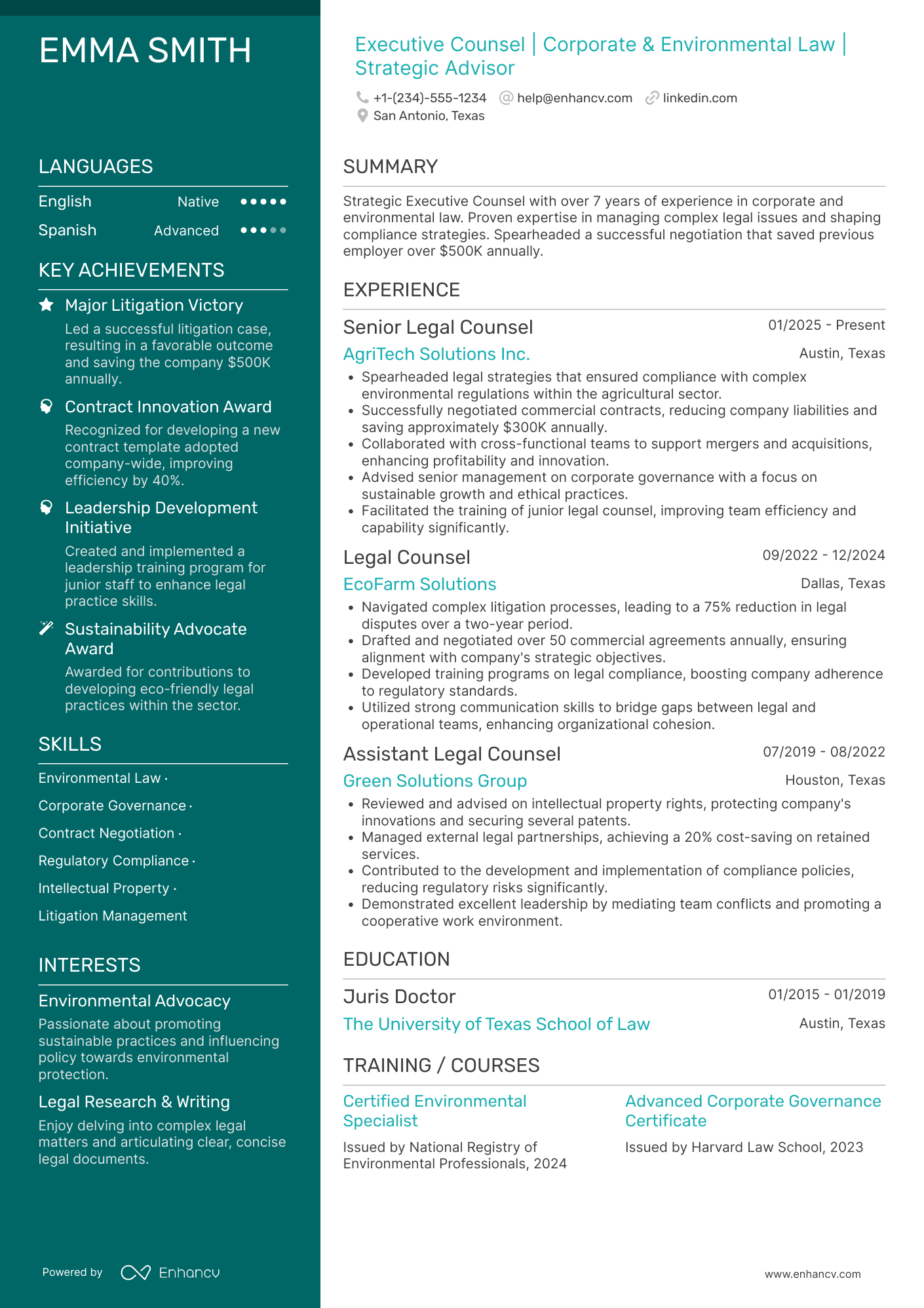
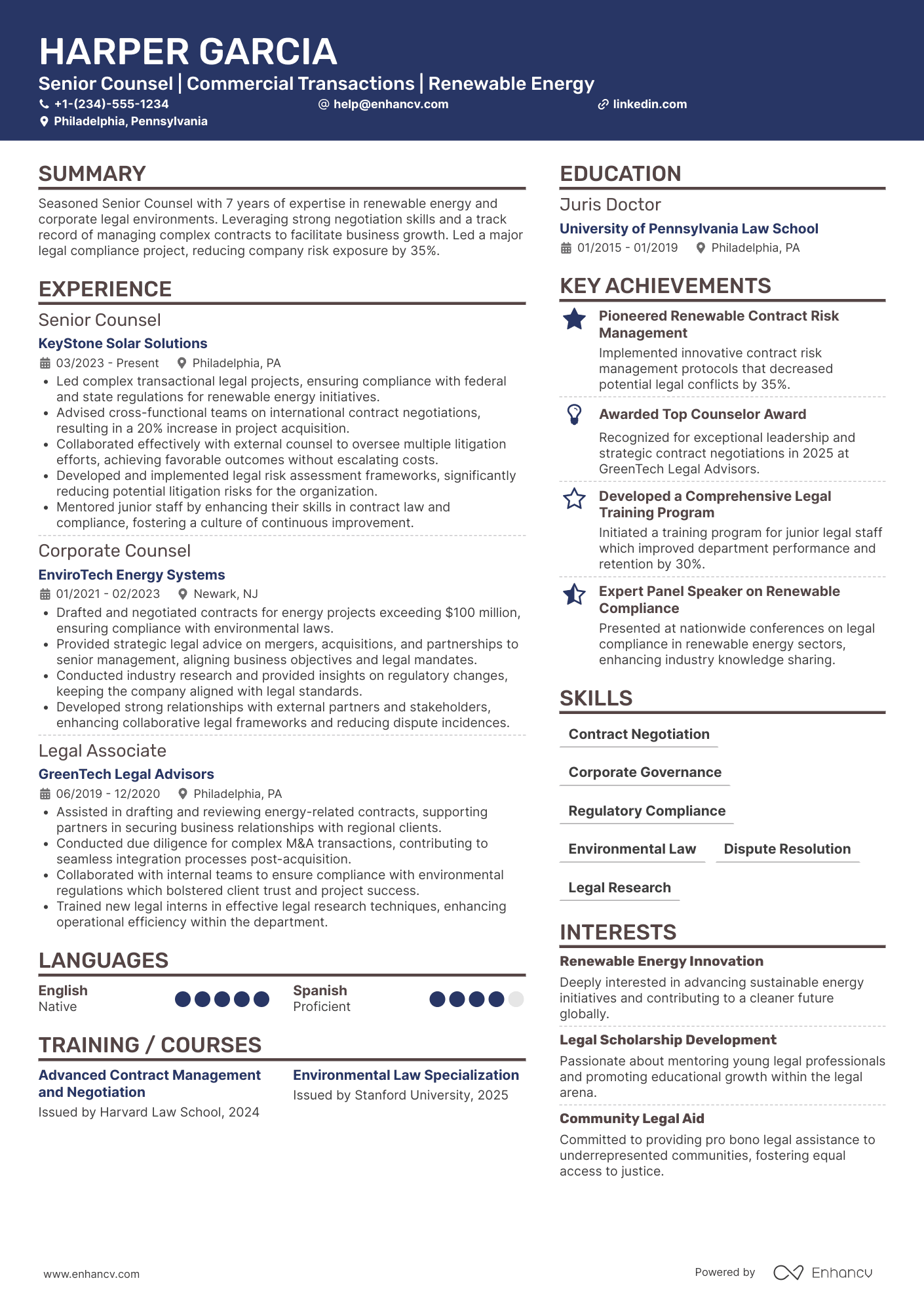
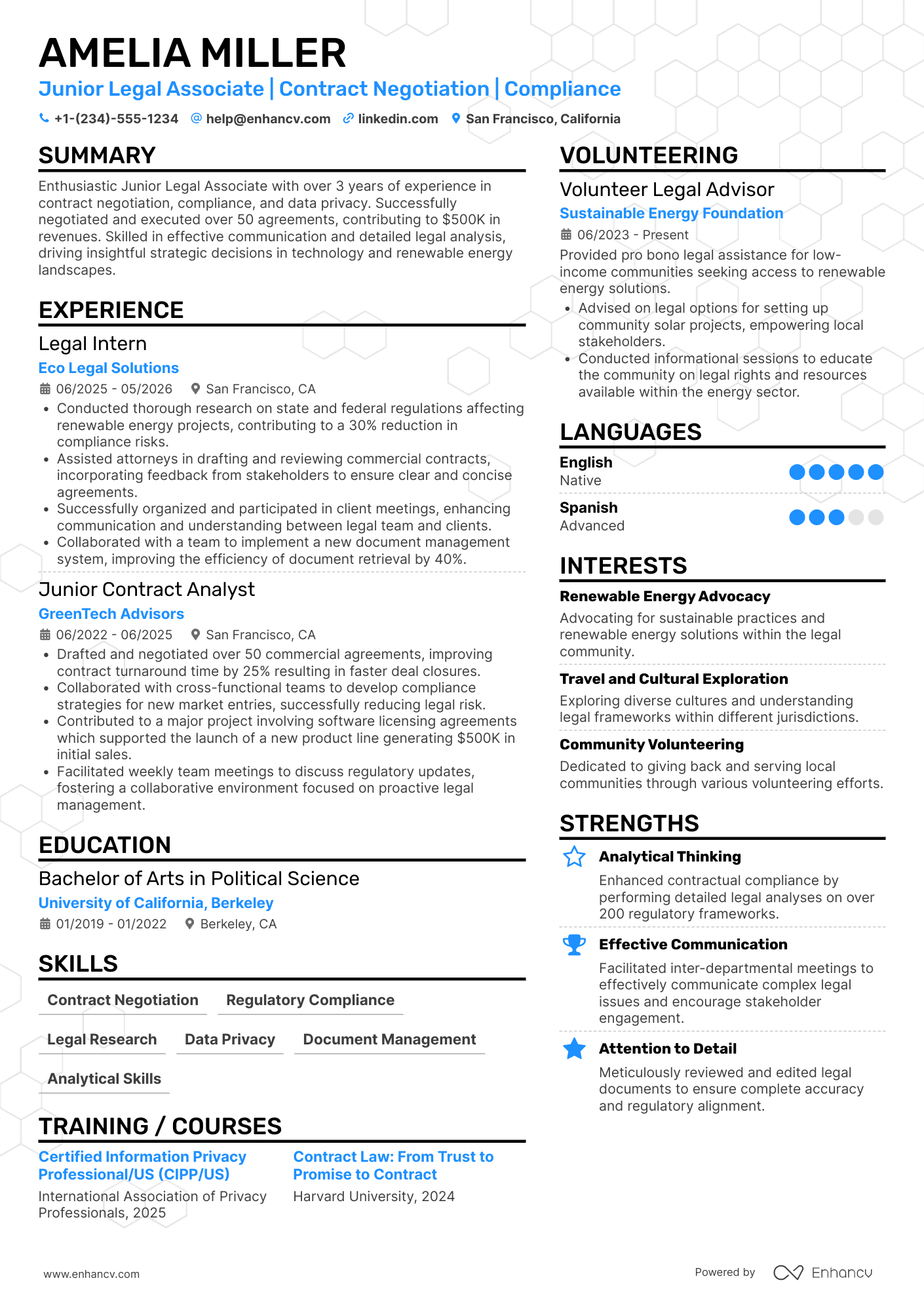
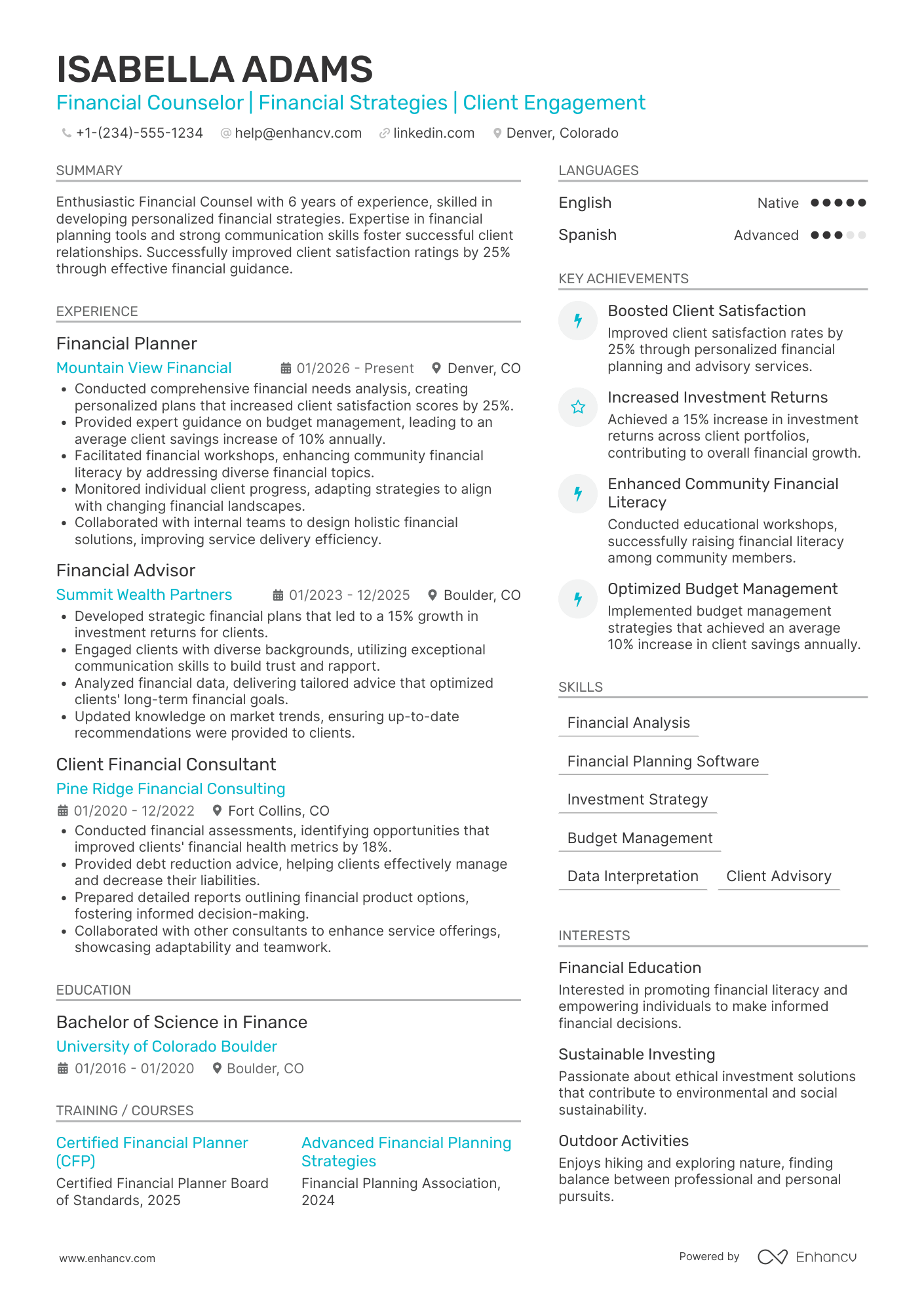
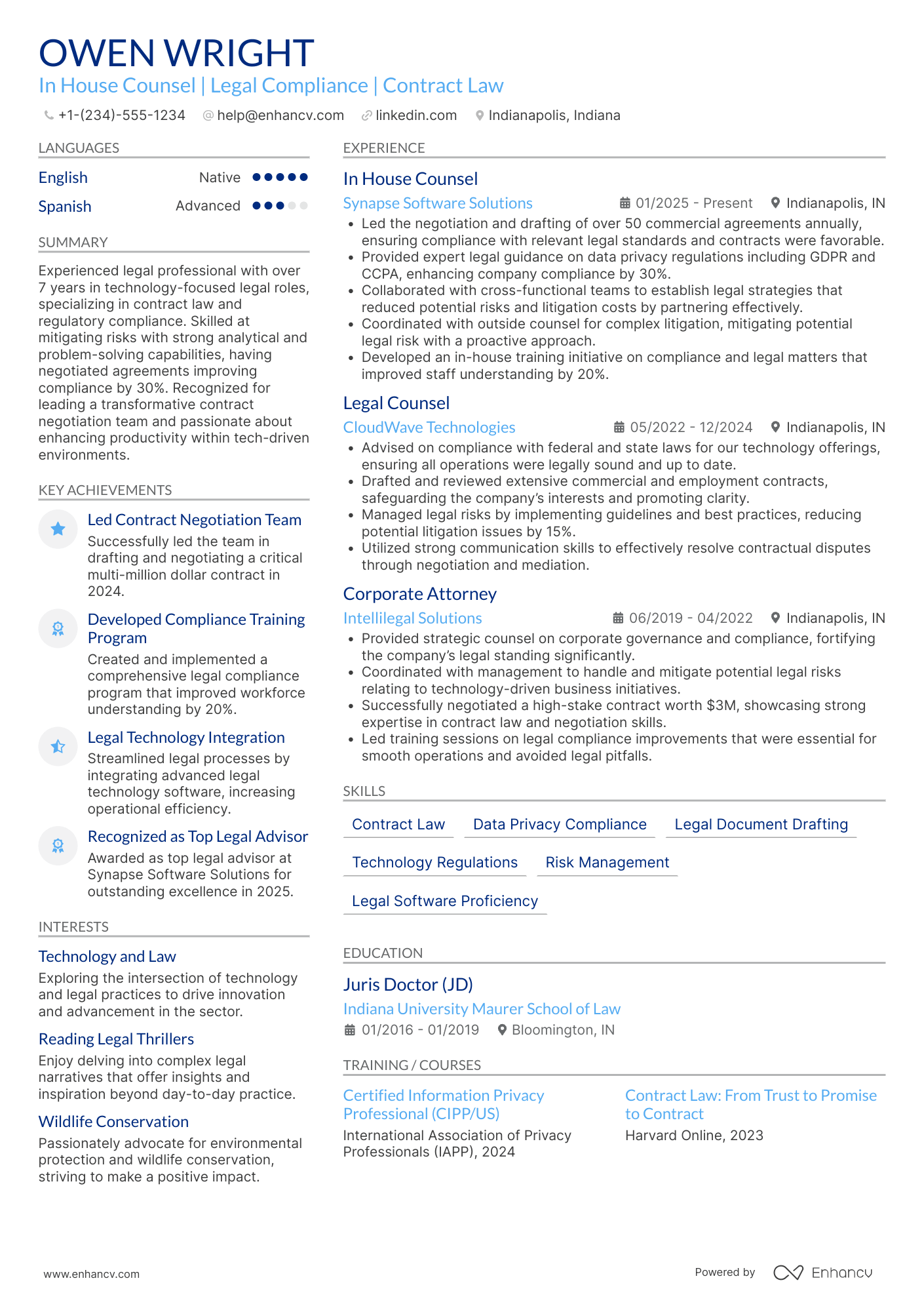
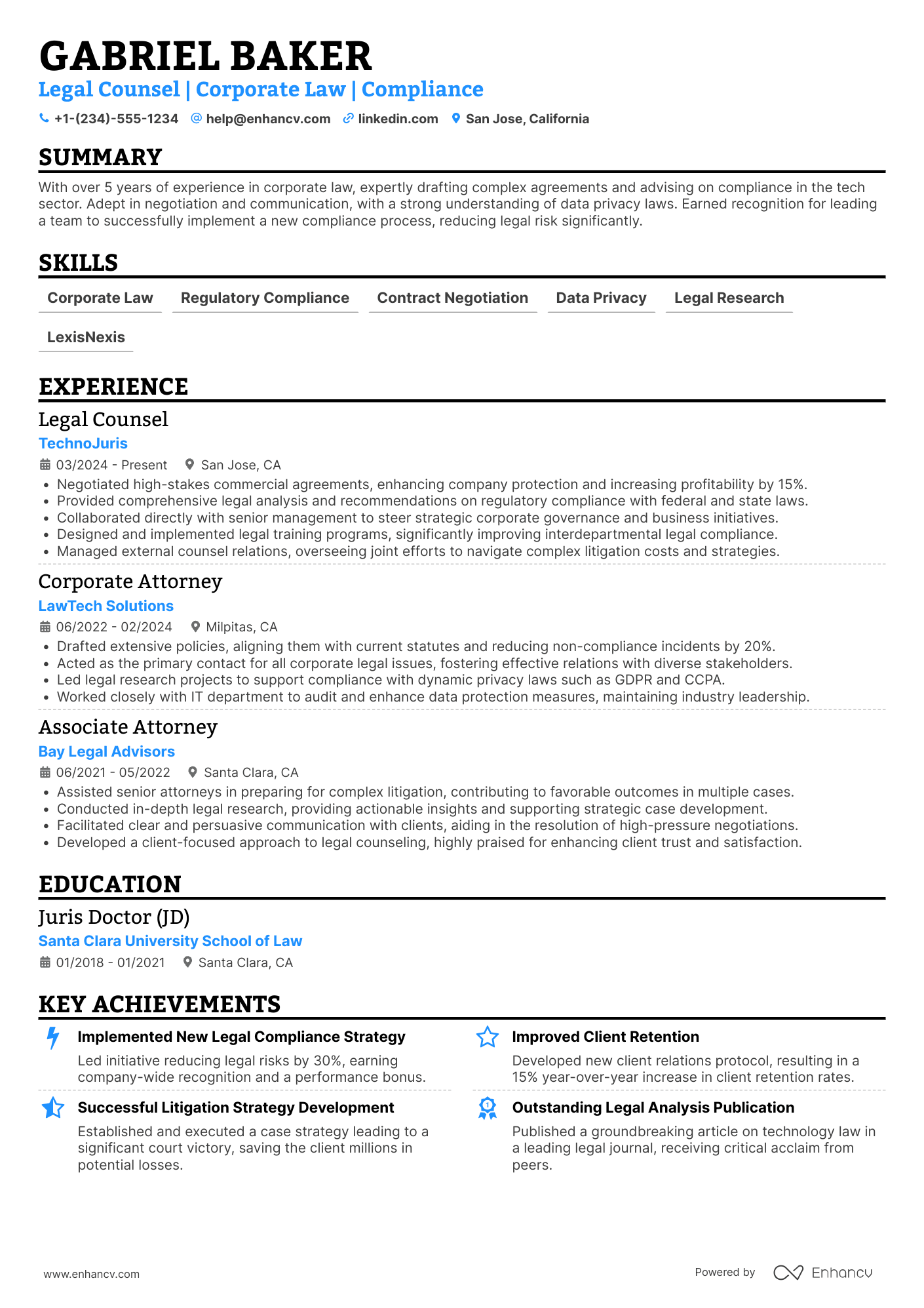
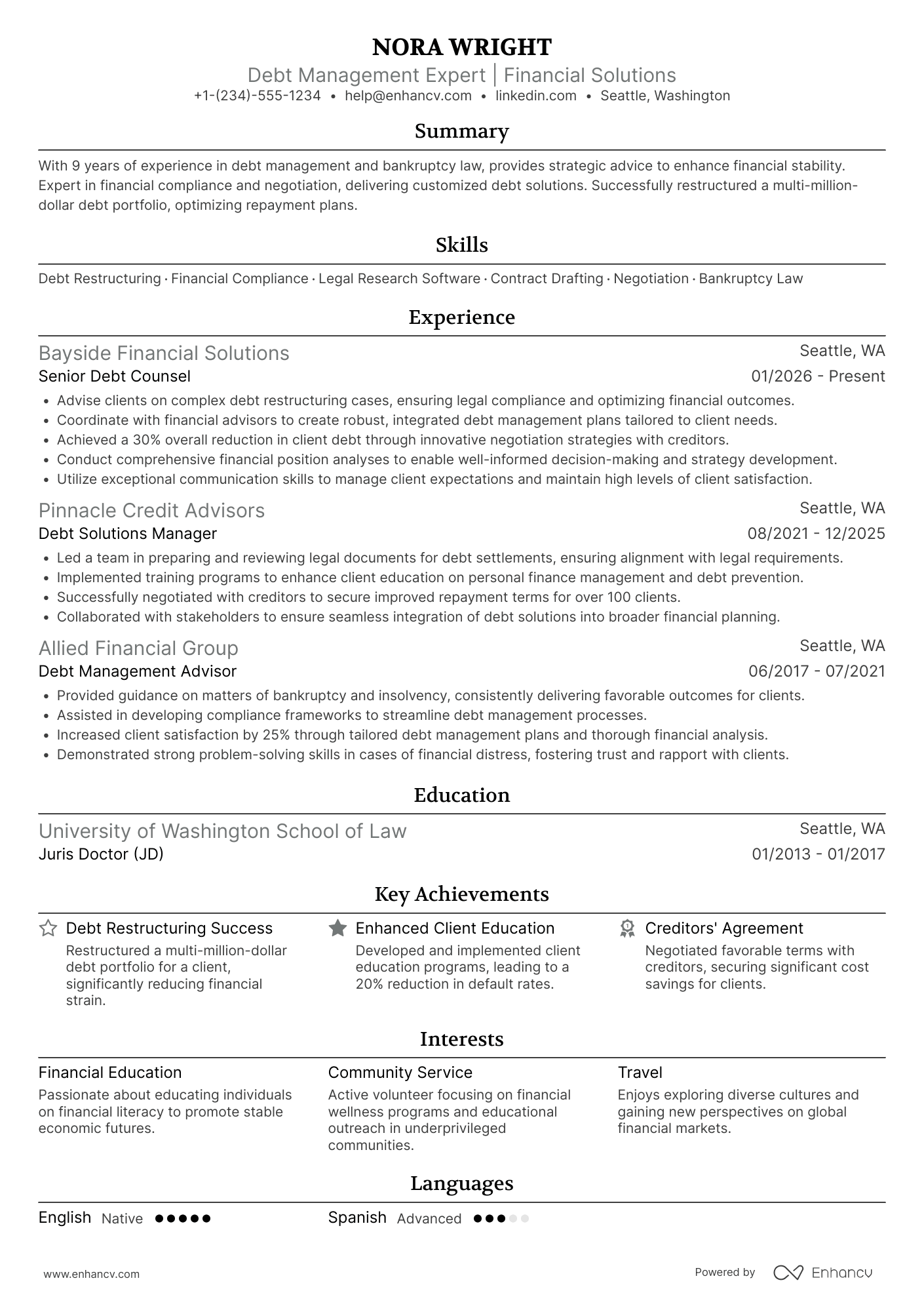
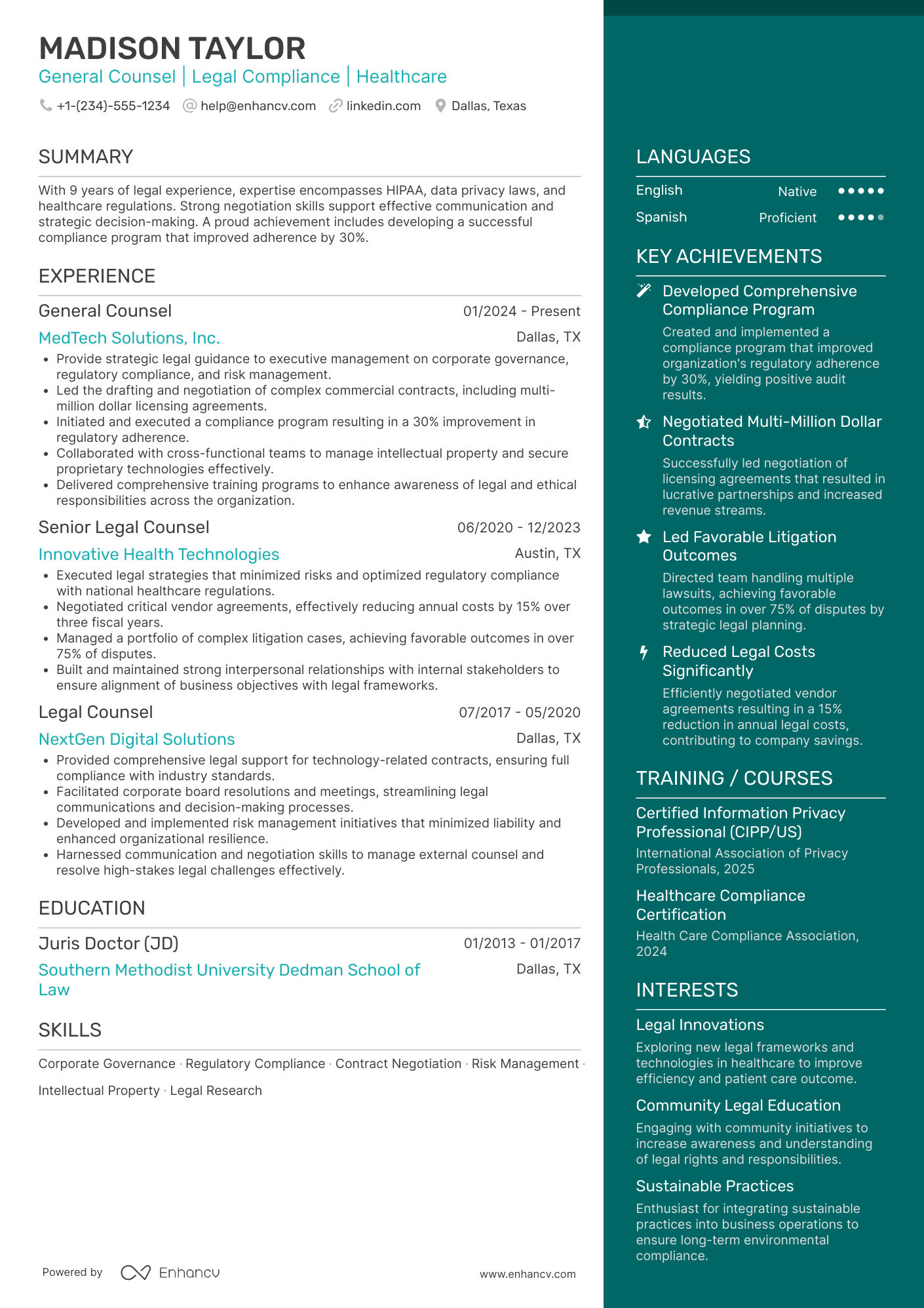
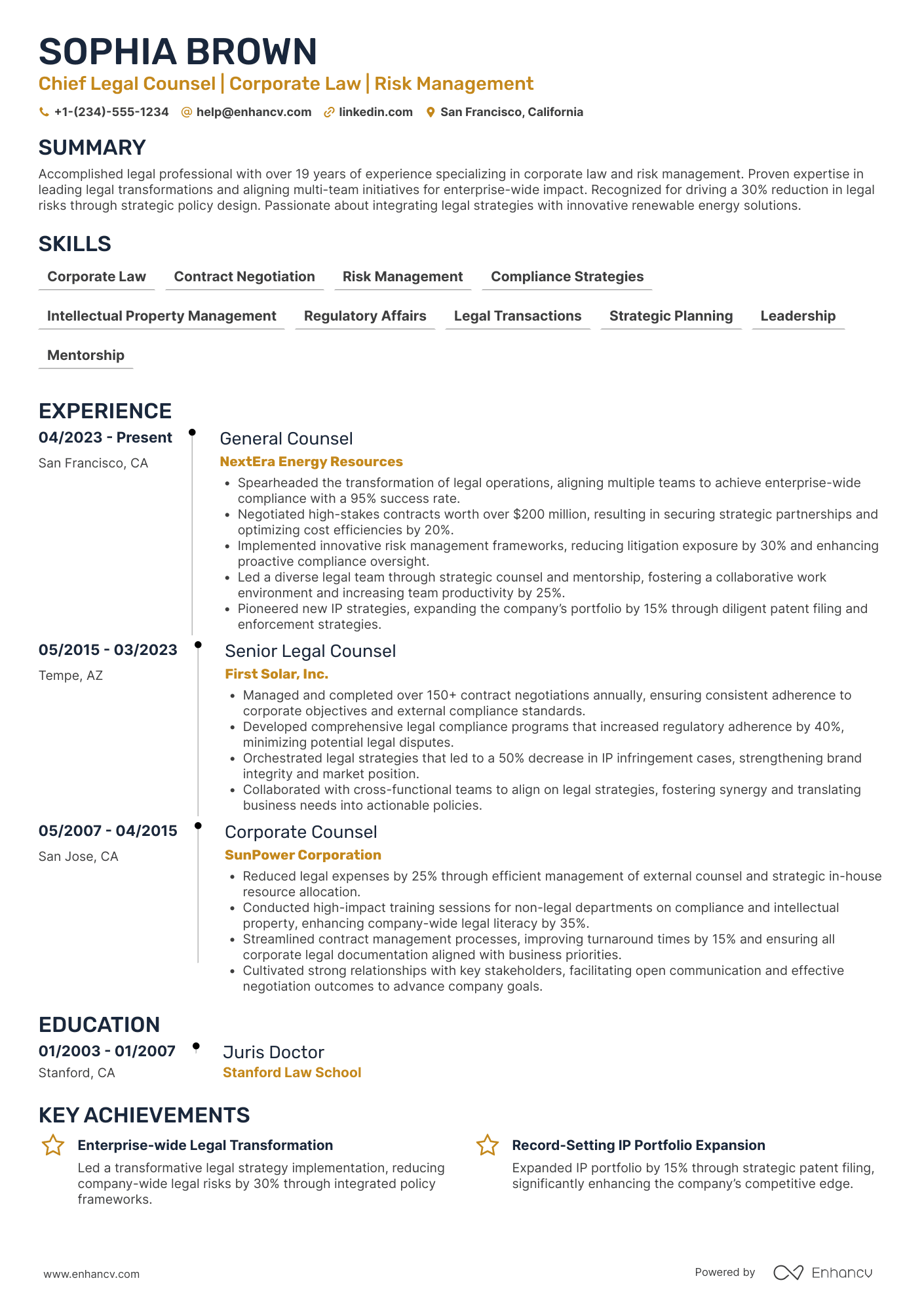
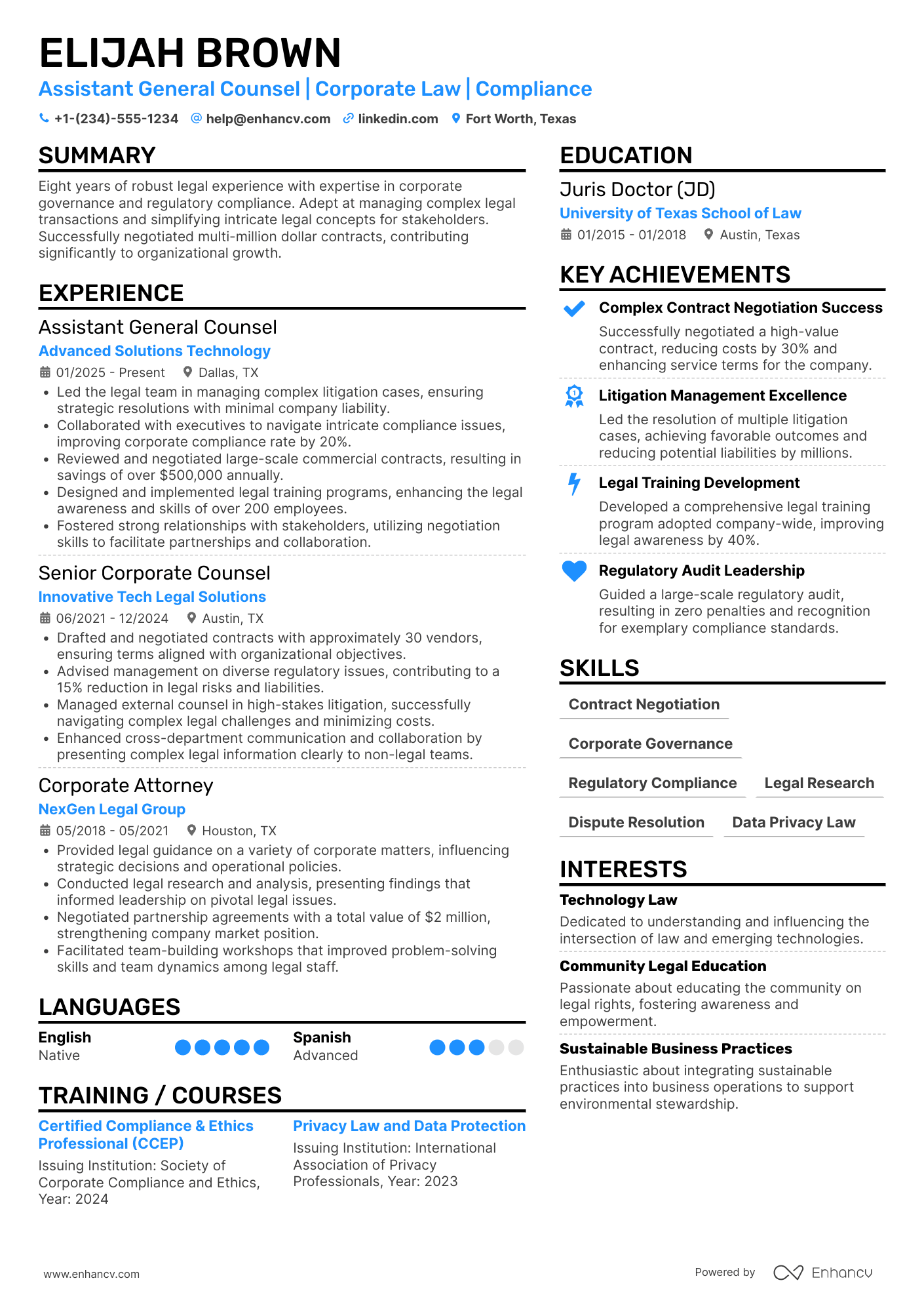
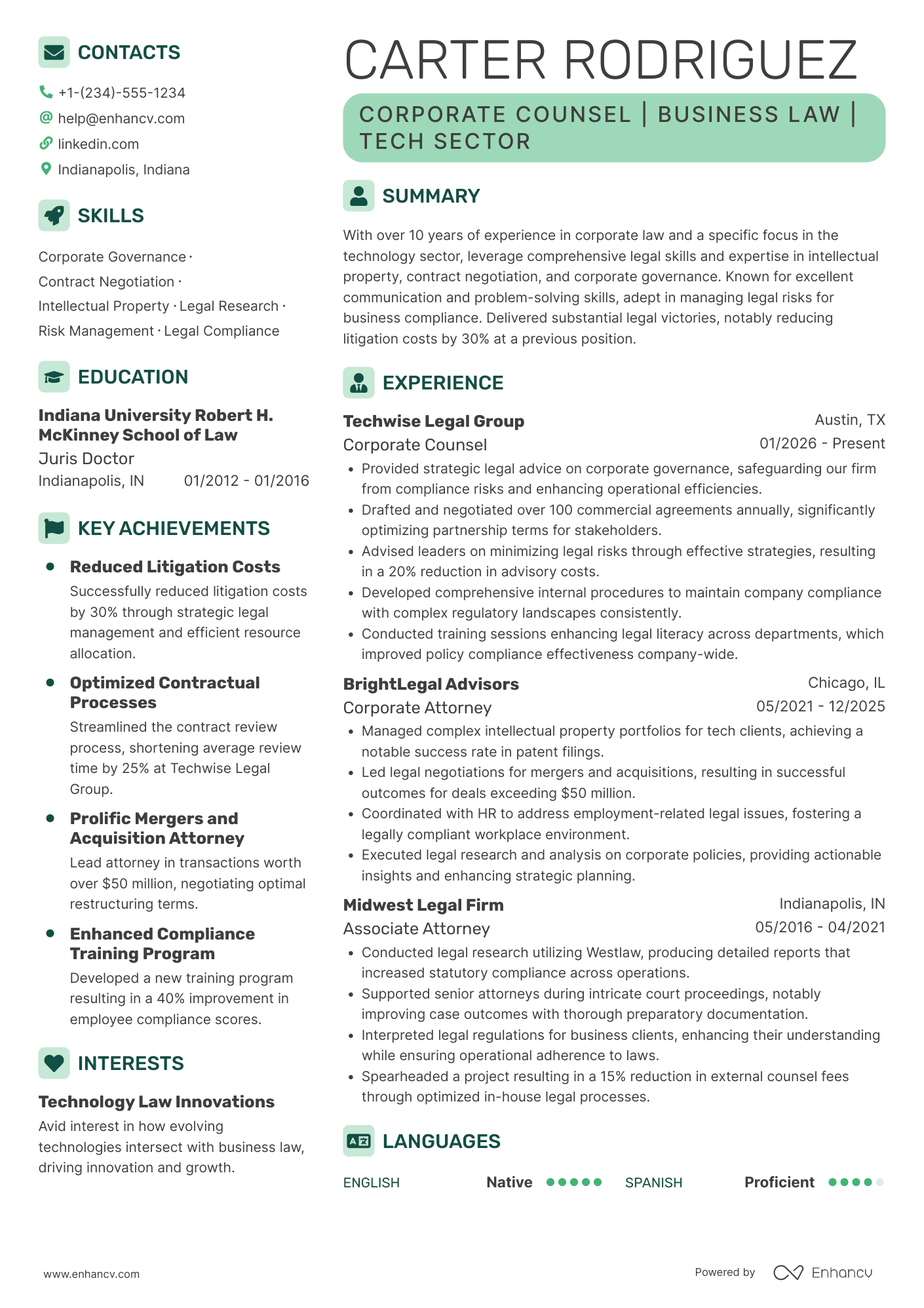
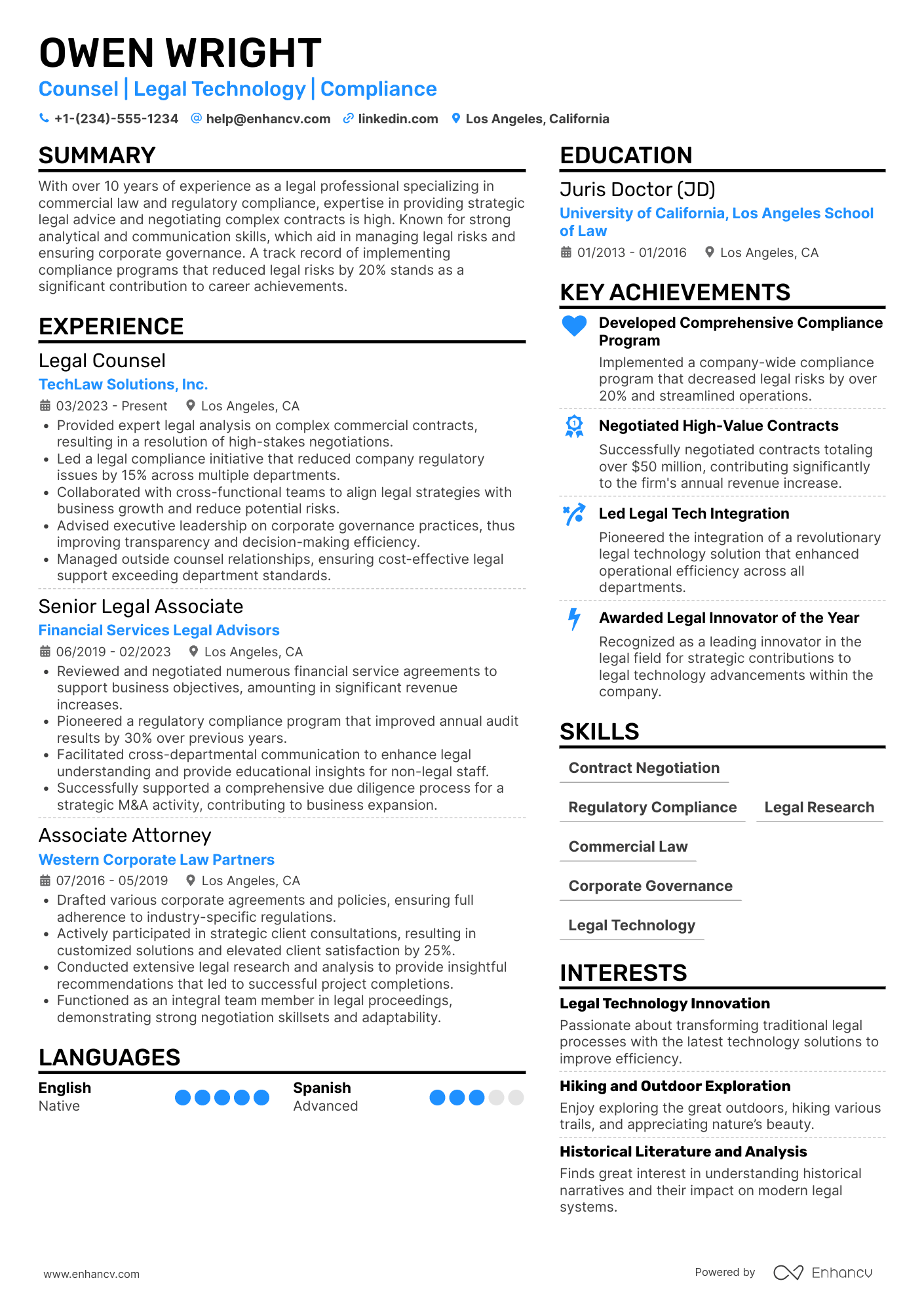
counsel resume
Many counsel resumes fail because they read like duty logs and bury risk judgment, deal value, and stakeholder influence. That matters when an ATS filters keywords and recruiters scan fast in a competitive market.
Once the resume reads as evidence, the framing around it matters — our counsel cover letter examples show how to position a single risk call or settlement so the GC or hiring partner sees judgment, not just deal volume.
A strong resume shows how you protected the business and enabled growth. Knowing how to write a resume that highlights outcomes like dollars saved in disputes, contract cycle time reduced, compliance gaps closed, matters managed across regions, and favorable settlements is essential for counsel professionals.

Key takeaways
- Quantify outcomes like dollars saved, cycle time reduced, and compliance gaps closed in every experience bullet.
- Use reverse-chronological format for senior counsel roles and hybrid format for career switchers.
- Tailor each resume to the job posting by mirroring its practice areas, frameworks, and terminology.
- Demonstrate skills through measurable results in your experience section, not just in a skills list.
- Lead your summary with years of experience, domain focus, and one or two concrete achievements.
- Use AI tools like Enhancv to sharpen language and align keywords, then stop before content loses authenticity.
- Add certifications, bar admissions, and pro bono work to strengthen credibility beyond core sections.
Job market snapshot for counsels
We analyzed 3,298 recent counsel job ads across major US job boards. These numbers help you understand experience requirements, top companies hiring, skills in demand at a glance.
What level of experience employers are looking for counsels
| Years of Experience | Percentage found in job ads |
|---|---|
| 1–2 years | 3.6% (120) |
| 3–4 years | 13.6% (447) |
| 5–6 years | 12.1% (399) |
| 7–8 years | 11.9% (393) |
| 9–10 years | 5.7% (187) |
| 10+ years | 7.7% (254) |
| Not specified | 50.6% (1668) |
Counsel ads by area of specialization (industry)
| Industry (Area) | Percentage found in job ads |
|---|---|
| Finance & Banking | 59.7% (1969) |
| Healthcare | 13.6% (449) |
| Education | 9.7% (321) |
| Government | 7.4% (244) |
| Manufacturing | 5.4% (178) |
| Retail & E-commerce | 1.3% (42) |
| Telecommunications | 1.0% (34) |
| Energy | 0.8% (28) |
| Media & Entertainment | 0.4% (12) |
Top companies hiring counsels
| Company | Percentage found in job ads |
|---|---|
| Deloitte | 4.9% (160) |
| Accenture | 2.7% (88) |
| State of Florida | 2.6% (86) |
| Wolters Kluwer | 1.8% (59) |
| S&P Global | 1.6% (54) |
| Liberty Mutual | 1.4% (47) |
| Google LLC | 1.4% (45) |
| Capital One | 1.1% (36) |
| The Travelers Companies | 1.0% (34) |
| T-Mobile | 0.9% (29) |
Role overview stats
These tables show the most common responsibilities and employment types for counsel roles. Use them to align your resume with what employers expect and to understand how the role is structured across the market.
Day-to-day activities and top responsibilities for a counsel
| Responsibility | Percentage found in job ads |
|---|---|
| Legal research | 14.3% (472) |
| Contract negotiation | 12.9% (425) |
| Negotiation | 10.2% (337) |
| Regulatory compliance | 9.3% (307) |
| Compliance | 9.0% (296) |
| Litigation | 8.6% (285) |
| Microsoft office | 8.1% (267) |
| Data privacy | 7.6% (251) |
| Intellectual property | 7.2% (237) |
| Contract drafting | 6.2% (203) |
| Microsoft excel | 6.0% (197) |
| Risk management | 5.6% (186) |
Type of employment (remote vs on-site vs hybrid)
| Employment type | Percentage found in job ads |
|---|---|
| On-site | 53.2% (1755) |
| Hybrid | 36.3% (1198) |
| Remote | 10.5% (345) |
How to format a counsel resume
Recruiters evaluating counsel candidates prioritize evidence of legal expertise, advisory judgment, and the ability to manage complex matters across practice areas or business units. Your resume format must make these signals immediately visible—placing career progression, substantive legal work, and measurable contributions front and center for both human reviewers and applicant tracking systems.

I have significant experience as a counsel—which format should I use?
Use a reverse-chronological format to showcase your depth of legal experience and progressive responsibility across roles. Do:
- Lead each role entry with your scope of advisory responsibility, practice areas covered, and reporting structure (e.g., direct report to general counsel, partnership with C-suite stakeholders).
- Highlight domain-specific proficiencies such as contract negotiation, regulatory compliance, litigation management, M&A due diligence, or specialized tools like Westlaw, Relativity, or contract lifecycle management platforms.
- Quantify outcomes wherever possible—dollars saved through settlement strategy, contract volume managed, reduction in outside counsel spend, or compliance program improvements tied to measurable risk reduction.
I'm junior or switching into a counsel role—what format works best?
A hybrid format works best, allowing you to lead with a targeted skills section while still providing a clear, chronological employment history. Do:
- Place a concise skills section near the top of your resume featuring core legal competencies—such as legal research, contract drafting, regulatory analysis, or litigation support—aligned to the job description.
- Include relevant projects, internships, clerkships, or pro bono work that demonstrate counsel-adjacent experience, even if gained outside a formal counsel title.
- Connect every listed skill or experience to a concrete action and a clear result so recruiters can assess your readiness for the role.
Why not use a functional resume?
A functional format strips away the chronological context that hiring managers need to evaluate how your legal skills developed and where you applied them, making it harder to demonstrate readiness for a counsel role.
- A functional resume may be acceptable if you're transitioning from a paralegal, compliance, or policy role into a counsel position, or if you have significant resume gaps—but only if every listed skill is tied directly to a specific project, matter, or outcome rather than presented as a standalone claim.
Once your format establishes a clean, readable structure, the next step is filling it with the right sections to showcase your qualifications effectively.
What sections should go on a counsel resume
Recruiters expect a counsel resume to show clear legal scope, business partnership, and measurable results across matters you own. Understanding which resume sections to include ensures you cover every area hiring teams evaluate.
Use this structure for maximum clarity:
- Header
- Summary
- Experience
- Skills
- Projects
- Education
- Certifications
- Optional sections: Publications, Leadership, Languages
Your experience bullets should emphasize outcomes, risk reduction, deal or matter complexity, stakeholder scope, and the business impact of your advice.
Is your resume good enough?
Drop your resume here or choose a file. PDF & DOCX only. Max 2MB file size.
Now that you’ve identified the key components your counsel resume needs, the next step is to write your counsel resume experience section so those details translate into clear, role-relevant impact.
How to write your counsel resume experience
The experience section of your counsel resume should demonstrate the legal work you've delivered, the regulatory frameworks and advisory methods you've applied, and the measurable outcomes you've achieved for clients or organizations. Hiring managers prioritize demonstrated impact—risk mitigated, disputes resolved, compliance strengthened—over descriptive task lists that simply catalog daily responsibilities.
Each entry should include:
- Job title
- Company and location (or remote)
- Dates of employment (month and year)
Three to five concise bullet points showing what you owned, how you executed, and what outcomes you delivered:
- Ownership scope: the legal functions, practice areas, regulatory portfolios, contract pipelines, or business units you were directly accountable for as counsel.
- Execution approach: the legal research platforms, compliance frameworks, negotiation strategies, risk assessment methodologies, or case management tools you used to guide decisions and deliver sound legal work.
- Value improved: changes to regulatory compliance posture, litigation exposure, contract turnaround efficiency, policy clarity, or organizational risk tolerance that resulted from your counsel.
- Collaboration context: how you partnered with executive leadership, outside law firms, regulatory bodies, business development teams, or cross-functional departments to align legal strategy with organizational objectives.
- Impact delivered: outcomes expressed through resolved disputes, successful regulatory approvals, strengthened governance structures, or reduced legal exposure—framed as results and business impact rather than activity.
Experience bullet formula
A counsel experience example
✅ Right example - modern, quantified, specific.
Senior Product Counsel
NimbusPay | Austin, TX (Remote)
2021–Present
Series C payments platform serving 18,000 small businesses across the United States with card issuing, invoicing, and embedded finance products.
- Led end-to-end legal review for eight product launches across card issuing, invoicing, and application programming interface integrations, cutting time-to-market by 22% by standardizing Jira intake, playbooks, and approval workflows with product managers and engineering leads.
- Negotiated and redlined 120+ vendor and partner agreements (software as a service, data processing addendum, master services agreements) in Ironclad, reducing average contract cycle time from fourteen days to nine days and avoiding an estimated $750,000 in unfavorable liability exposure.
- Built and operationalized a privacy and data governance program aligned to General Data Protection Regulation and California Consumer Privacy Act requirements, implementing OneTrust assessments and data maps that lowered high-risk findings in quarterly audits by 35%.
- Partnered with security, compliance, and engineering to mature incident response and breach notification procedures, running three tabletop exercises and reducing mean time to legal sign-off for customer notices from forty-eight hours to sixteen hours.
- Advised executives and go-to-market leaders on marketing, consumer protection, and financial services regulatory risk, revising claims substantiation and disclosures that cut complaint rate by 18% and improved approval rates for paid campaigns by 12%.
Now that you've seen how a strong counsel experience section looks in practice, let's break down how to tailor yours to match the specific role you're targeting.
How to tailor your counsel resume experience
Recruiters evaluate counsel resumes through both human review and applicant tracking systems (ATS), so tailoring your resume to the job description is essential. Aligning your background with the specific role ensures your qualifications stand out in both screening methods.
Ways to tailor your counsel experience:
- Mirror the legal practice areas and specialties listed in the posting.
- Match regulatory frameworks or compliance standards the employer names.
- Use the same terminology for contract types or transaction structures referenced.
- Highlight experience with legal technologies or case management systems mentioned.
- Emphasize relevant industry knowledge when the role specifies a sector focus.
- Reflect collaboration models such as cross-functional or outside counsel coordination.
- Align risk assessment or dispute resolution methods with those the job describes.
- Include governance or policy development experience when the posting prioritizes it.
Tailoring means aligning your real accomplishments with each role's stated requirements, not forcing keywords where they don't belong.
Resume tailoring examples for counsel
| Job description excerpt | Untailored | Tailored |
|---|---|---|
| "Provide legal counsel on SEC reporting obligations, including Forms 10-K, 10-Q, and 8-K, and advise on Regulation FD compliance." | Advised leadership on various regulatory and compliance matters. | Counseled executive team on SEC reporting obligations across Forms 10-K, 10-Q, and 8-K filings, ensuring full Regulation FD compliance over 12 consecutive quarterly cycles with zero late filings. |
| "Draft, review, and negotiate complex commercial agreements, including SaaS licensing, data processing addendums, and vendor MSAs, in coordination with procurement and IT." | Reviewed and negotiated contracts for the company. | Drafted, reviewed, and negotiated 150+ commercial agreements annually—including SaaS licensing deals, data processing addendums, and vendor MSAs—partnering directly with procurement and IT to reduce contract cycle time by 30%. |
| "Support M&A transactions end-to-end, including due diligence, disclosure schedules, purchase agreement drafting, and post-closing integration planning." | Assisted with corporate transactions and related legal work. | Managed legal workstreams for four M&A transactions valued at a combined $220M, leading due diligence, drafting disclosure schedules and purchase agreements, and coordinating post-closing integration with cross-functional teams. |
Once you’ve aligned your experience with the role’s priorities, the next step is to quantify your counsel achievements so hiring teams can see the impact behind those choices.
How to quantify your counsel achievements
Quantifying your achievements proves business impact beyond advice. Focus on cycle time, risk reduction, compliance outcomes, deal value protected, and volume handled across contracts, policies, investigations, and stakeholder reviews.
Quantifying examples for counsel
| Metric | Example |
|---|---|
| Cycle time | "Cut contract turnaround from eight business days to three by standardizing clause playbooks and using DocuSign templates across fifty vendor agreements per quarter." |
| Risk reduction | "Reduced high-risk clause acceptance by 35% by implementing a redline checklist and escalation thresholds for indemnity, limitation of liability, and data processing terms." |
| Compliance accuracy | "Improved policy compliance accuracy from 92% to 98% after launching a quarterly audit tracker in Excel and training twenty managers on documentation standards." |
| Revenue protected | "Protected $1.8M in annual recurring revenue by resolving renewal disputes within two weeks and negotiating revised service credits for three enterprise customers." |
| Volume handled | "Managed 120 legal requests per month with a two-day median response time by triaging intake in Jira and publishing a self-serve FAQ for common issues." |
Turn vague job tasks into measurable, recruiter-ready resume bullets in seconds with Enhancv's Bullet Point Generator.
Once you've crafted strong bullet points for your experience section, you'll want to apply that same precision to presenting your hard and soft skills throughout your counsel resume.
How to list your hard and soft skills on a counsel resume
Your skills section matters for counsel because recruiters and applicant tracking systems scan them to confirm legal domain fit, risk coverage, and business enablement—aim for a balanced mix of hard skills (legal disciplines and tools) and soft skills (stakeholder and execution behaviors). counsel roles require a blend of:
- Product strategy and discovery skills.
- Data, analytics, and experimentation skills.
- Delivery, execution, and go-to-market discipline.
- Soft skills.
Your skills section should be:
- Scannable (bullet-style grouping).
- Relevant to the job post.
- Backed by proof in experience bullets.
- Updated with current tools.
Place your skills section:
- Above experience if you're junior or switching careers.
- Below experience if you're mid/senior with strong achievements.

Hard skills
- Contract drafting and negotiation
- Commercial agreements, procurement
- Privacy compliance (GDPR, CCPA)
- Data processing agreements
- Regulatory compliance programs
- Corporate governance, board support
- Employment law counseling
- Litigation management, eDiscovery
- Intellectual property licensing
- Legal research: Westlaw, LexisNexis
- Matter management systems
- Risk assessments and controls
Soft skills
- Translate legal risk into business options
- Drive alignment across stakeholders
- Lead cross-functional deal reviews
- Negotiate tradeoffs under deadlines
- Write clear, executive-ready guidance
- Ask incisive, scope-setting questions
- Prioritize high-impact legal work
- Escalate issues with recommendations
- Influence without formal authority
- Maintain confidentiality and discretion
- Manage outside counsel performance
- Document decisions and rationale
How to show your counsel skills in context
Skills shouldn't live only in a dedicated skills list. Explore resume skills examples to see how counsel professionals weave competencies throughout their resumes.
They should be demonstrated in:
- Your summary (high-level professional identity)
- Your experience (proof through outcomes)
Here's how that looks in practice.
Summary example
Corporate counsel with 12 years in healthcare regulatory compliance. Skilled in HIPAA frameworks, contract lifecycle management, and cross-functional negotiation. Reduced outside counsel spend by 35% while managing a 200+ contract portfolio annually.
- Signals senior-level depth immediately
- Names role-relevant tools and frameworks
- Leads with a measurable cost outcome
- Highlights negotiation as a soft skill
Experience example
Senior Corporate Counsel
Vantage Health Systems | Remote
March 2019–Present
- Negotiated 150+ vendor and SaaS agreements annually using ContractPodAi, cutting review cycle time by 40% through standardized playbooks.
- Partnered with compliance and product teams to build a HIPAA training program that reduced regulatory incidents by 28% in one year.
- Led three cross-border M&A due diligence efforts collaborating with outside firms, completing each ahead of projected timelines by an average of two weeks.
- Every bullet contains a measurable outcome.
- Skills surface naturally through real achievements.
Once you’ve tied your counseling strengths to real examples, the next step is learning how to write a counseling resume with no experience so you can present those examples effectively.
How do I write a counsel resume with no experience
Even without full-time experience, you can demonstrate readiness through:
- Law clinic client counseling cases
- Externship with in-house legal
- Pro bono intake and advice
- Contract review and redlining projects
- Legal research memos for faculty
- Moot court briefs and arguments
- Compliance policy drafting assignments
If you're building your first counsel application, our guide on writing a resume without work experience walks you through how to position these activities effectively.
Focus on:
- Practice-area relevant writing samples
- Contract and policy drafting outcomes
- Research depth with cited authorities
- Risk, compliance, and process exposure
Resume format tip for entry-level counsel
Use a combination resume format because it highlights legal projects and writing first while still listing roles, clinics, and externships clearly. Do:
- Add a Legal Projects section first.
- Quantify scope: contracts, pages, hours.
- List tools: Westlaw, LexisNexis, Microsoft Word.
- Link one writing sample portfolio.
- Tailor bullets to target practice.
- Drafted and redlined five vendor agreements using Microsoft Word track changes; reduced turnaround time by 20% by standardizing clause language and issue logs.
Even without direct experience, your educational background can serve as a strong foundation for your counsel resume, making how you present it especially important.
How to list your education on a counsel resume
Your education section helps hiring teams confirm you hold the legal credentials required for a counsel role. It validates foundational knowledge in law, compliance, and analytical reasoning.
Include:
- Degree name
- Institution
- Location
- Graduation year
- Relevant coursework (for juniors or entry-level candidates)
- Honors & GPA (if 3.5 or higher)
Skip month and day details—list the graduation year only.
Here's a strong education entry tailored for a counsel resume.
Example education entry
Juris Doctor
Georgetown University Law Center, Washington, D.C.
Graduated: 2019
GPA: 3.7/4.0
- Relevant Coursework: Corporate Governance, Securities Regulation, Mergers & Acquisitions, Legal Ethics, Contract Drafting
- Honors: Dean's List (six semesters), Order of the Coif
How to list your certifications on a counsel resume
Certifications show your commitment to learning, confirm tool proficiency, and signal industry relevance as a counsel, especially in regulated or specialized practice areas.
Include:
- Certificate name
- Issuing organization
- Year
- Optional: credential ID or URL
- Place certifications below education when they're older, less relevant, or mainly reinforce your core legal training.
- Place certifications above education when they're recent, highly relevant to the counsel role, or required for the work you target.
Best certifications for your counsel resume
- Certified Information Privacy Professional, United States (CIPP/US)
- Certified Information Privacy Manager (CIPM)
- Certified Compliance & Ethics Professional (CCEP)
- Certified Anti-Money Laundering Specialist (CAMS)
- Certified Information Systems Auditor (CISA)
- Project Management Professional (PMP)
- Chartered Financial Analyst (CFA)
Once you’ve placed your certifications where they’re easy to verify, use that credibility to shape a focused counsel resume summary that reinforces your fit upfront.
How to write your counsel resume summary
Your resume summary is the first thing a recruiter reads, so it needs to earn their attention fast. A strong opening frames you as a qualified counsel candidate before they scan the rest of the page.
Keep it to three to four lines, with:
- Your current title and total years of legal experience.
- The domain or industry you specialize in, such as corporate, regulatory, or commercial law.
- Core skills like contract negotiation, compliance frameworks, or M&A due diligence.
- One or two measurable achievements, such as cost savings, deal volume, or risk reduction.
- Soft skills tied to real outcomes, like cross-functional collaboration that accelerated deal closures.

PRO TIP
At a senior level, lead with outcomes and strategic ownership rather than listing responsibilities. Highlight the scope of your decisions—team size, deal value, or enterprise-wide initiatives you drove. Avoid generic phrases like "results-oriented professional" or "passionate legal mind." Recruiters want evidence of leadership and business impact, not motivation.
Example summary for a counsel
Senior counsel with 12 years in corporate and securities law. Led a five-person legal team through 30+ M&A transactions totaling $2.1B. Reduced outside counsel spend by 35% through strategic insourcing.
Optimize your resume summary and objective for ATS
Drop your resume here or choose a file.
PDF & DOCX only. Max 2MB file size.
Now that your summary captures your legal expertise and value, make sure the header framing it presents your contact details correctly so recruiters can reach you without friction.
What to include in a counsel resume header
A resume header lists your key contact details and role focus, helping counsel stand out, build credibility, and pass recruiter screening fast.
Essential resume header elements
- Full name
- Tailored job title and headline
- Location
- Phone number
- Professional email
- GitHub link
- Portfolio link
A LinkedIn link helps recruiters verify your experience quickly and supports screening.
Don't include a photo on a counsel resume unless the role is explicitly front-facing or appearance-dependent.
Match your header title to the counsel job posting and keep formatting consistent so recruiters can scan it in seconds.
Counsel resume header
Jordan M. Carter
Counsel | Commercial Contracts and Employment
Chicago, IL
(312) 555-01XX
your.name@enhancv.com
github.com/yourname
yourwebsite.com
linkedin.com/in/yourname
Once your header clearly identifies your role, credentials, and contact details, you can strengthen the rest of your application by adding targeted additional sections for counsel resumes.
Additional sections for counsel resumes
Beyond core sections, additional resume sections help you stand out by showcasing specialized expertise, leadership, and professional depth that hiring committees value.
- Languages
- Publications and legal scholarship
- Bar admissions and jurisdictions
- Professional affiliations and legal associations
- Pro bono work
- Speaking engagements and CLE presentations
- Honors and awards
Once you've rounded out your resume with these supplementary sections, it's equally important to pair it with a strong cover letter that reinforces your candidacy.
Do counsel resumes need a cover letter
A cover letter isn't required for a counsel, but it often helps. If you're unsure where to start, understanding what a cover letter is and how it complements your resume can clarify when one adds value. It matters most for competitive roles or teams that expect a writing sample. It can tip decisions when your resume needs context or your fit isn't obvious.
Use a cover letter to add value, not to repeat your resume:
- Explain why this counsel role and team fit your experience, and connect your strengths to their risk, product, or growth priorities.
- Highlight one or two projects with clear outcomes, such as reduced regulatory exposure, faster contracting, or improved launch readiness.
- Show you understand the product, users, and business model, and explain how you balance speed with compliance and practical guidance.
- Address transitions or non-obvious experience, and clarify how prior work maps to this counsel scope and stakeholder group.
Drop your resume here or choose a file.
PDF & DOCX only. Max 2MB file size.
Whether you include a cover letter or not, using AI to improve your counsel resume helps you strengthen and tailor the document you submit.
Using AI to improve your counsel resume
AI can sharpen your resume's clarity, structure, and overall impact. It helps refine language and highlight relevant achievements. But overuse strips authenticity. Once your content reads clearly and aligns with your target role, step away from AI. For specific guidance, explore ChatGPT resume writing prompts tailored to legal professionals.
Here are 10 practical prompts you can copy and paste to strengthen specific sections of your counsel resume:
- Strengthen your summary: "Rewrite my counsel resume summary to emphasize litigation expertise, regulatory knowledge, and measurable business outcomes in under four sentences."
- Quantify experience bullets: "Add specific metrics and measurable results to each experience bullet on my counsel resume without inventing any data."
- Tighten legal skills: "Review the skills section of my counsel resume and remove vague entries. Replace them with precise, role-relevant legal competencies."
- Improve action verbs: "Replace weak or repetitive verbs in my counsel resume experience section with strong, specific action verbs appropriate for legal professionals."
- Align with job descriptions: "Compare my counsel resume experience bullets against this job posting and suggest edits to improve keyword alignment."
- Clarify project contributions: "Rewrite the projects section of my counsel resume to clearly define my role, the legal challenge, and the outcome."
- Refine education details: "Edit the education section of my counsel resume to highlight relevant coursework, honors, and legal concentrations concisely."
- Showcase certifications: "Reorganize the certifications section of my counsel resume by relevance to corporate law and regulatory compliance roles."
- Eliminate redundancy: "Identify and remove redundant phrases across all sections of my counsel resume while preserving key legal accomplishments."
- Improve readability: "Simplify overly complex sentences throughout my counsel resume so each bullet is clear, direct, and under 20 words."
Stop using AI once your resume sounds accurate, specific, and aligned with real experience. AI should never invent experience or inflate claims—if it didn't happen, it doesn't belong here.
Conclusion
A strong counsel resume proves impact with measurable outcomes, highlights role-specific skills, and uses a clear, consistent structure. It makes your value easy to scan, easy to verify, and easy to match to the role.
This approach shows you’re ready for today’s hiring market and the changes ahead. With focused content and clean formatting, your counsel resume supports faster decisions and stronger interviews.