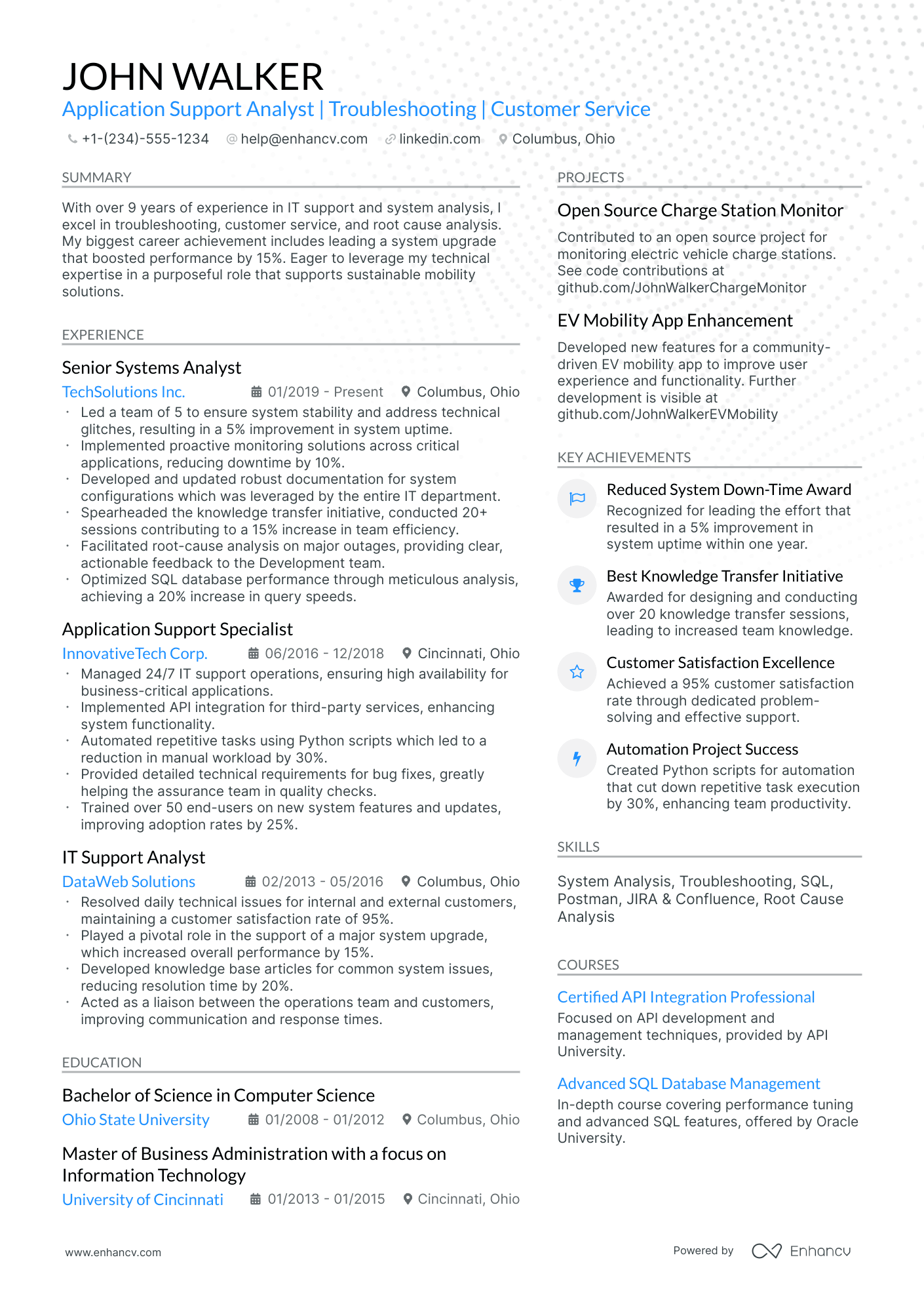
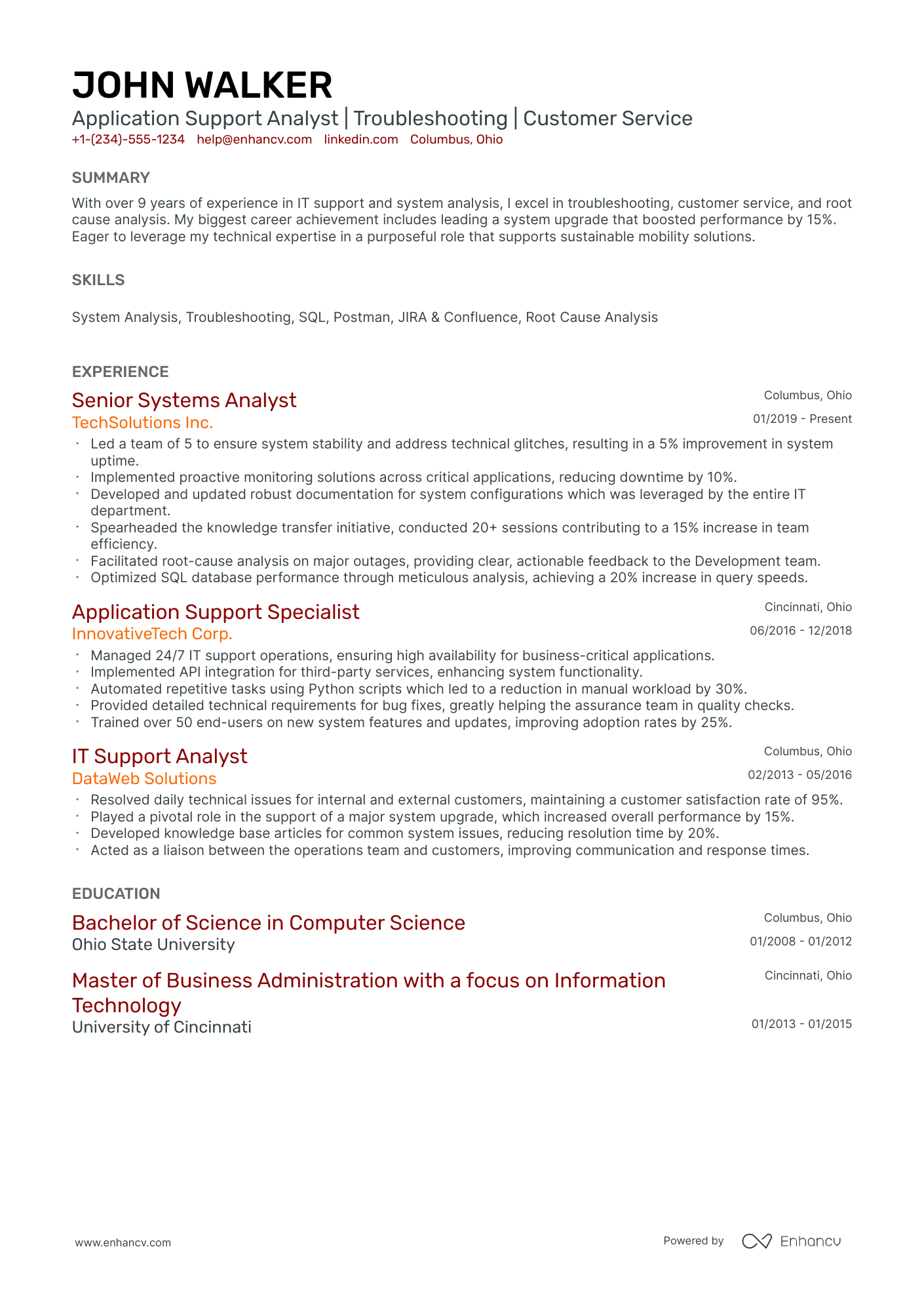
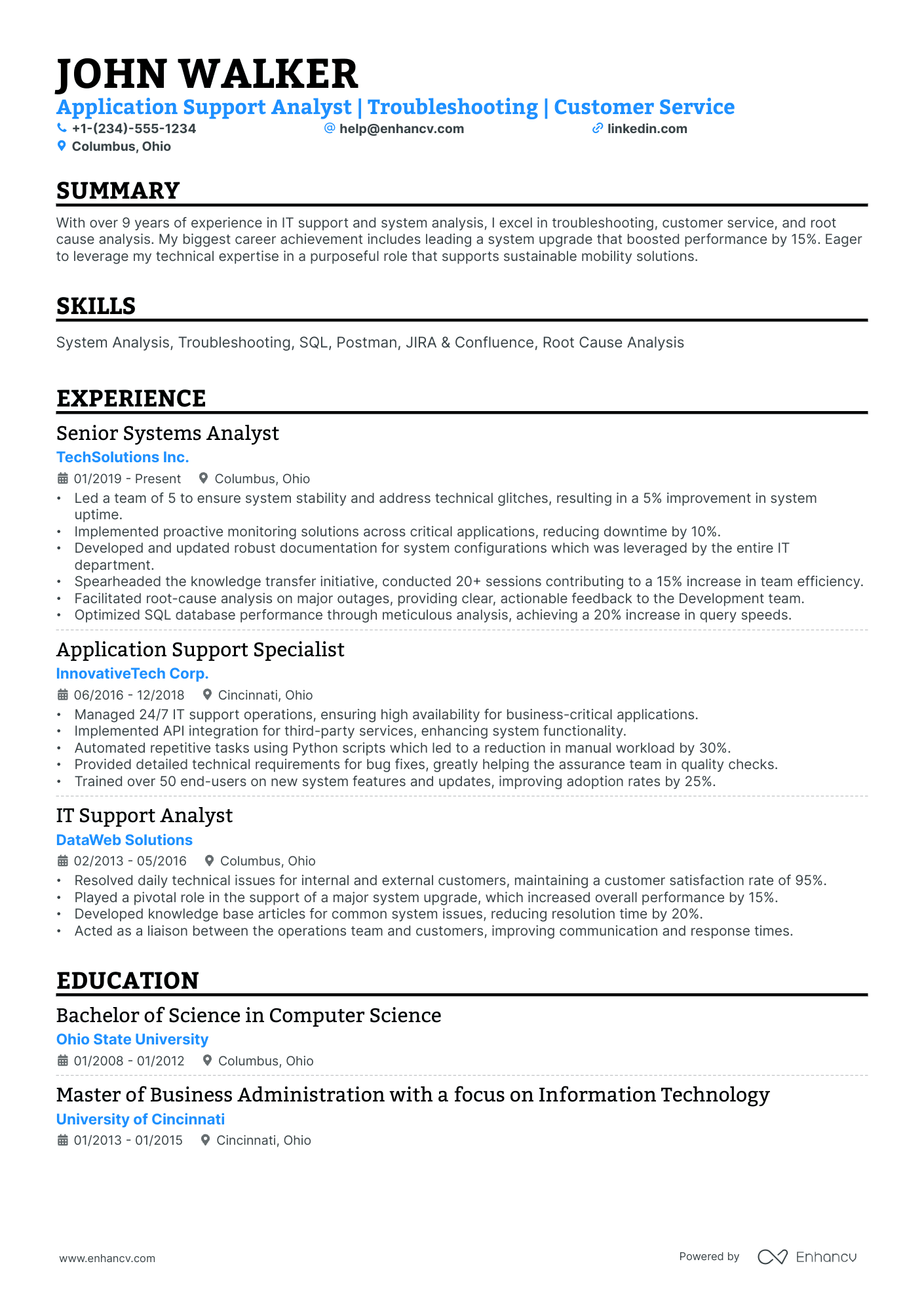
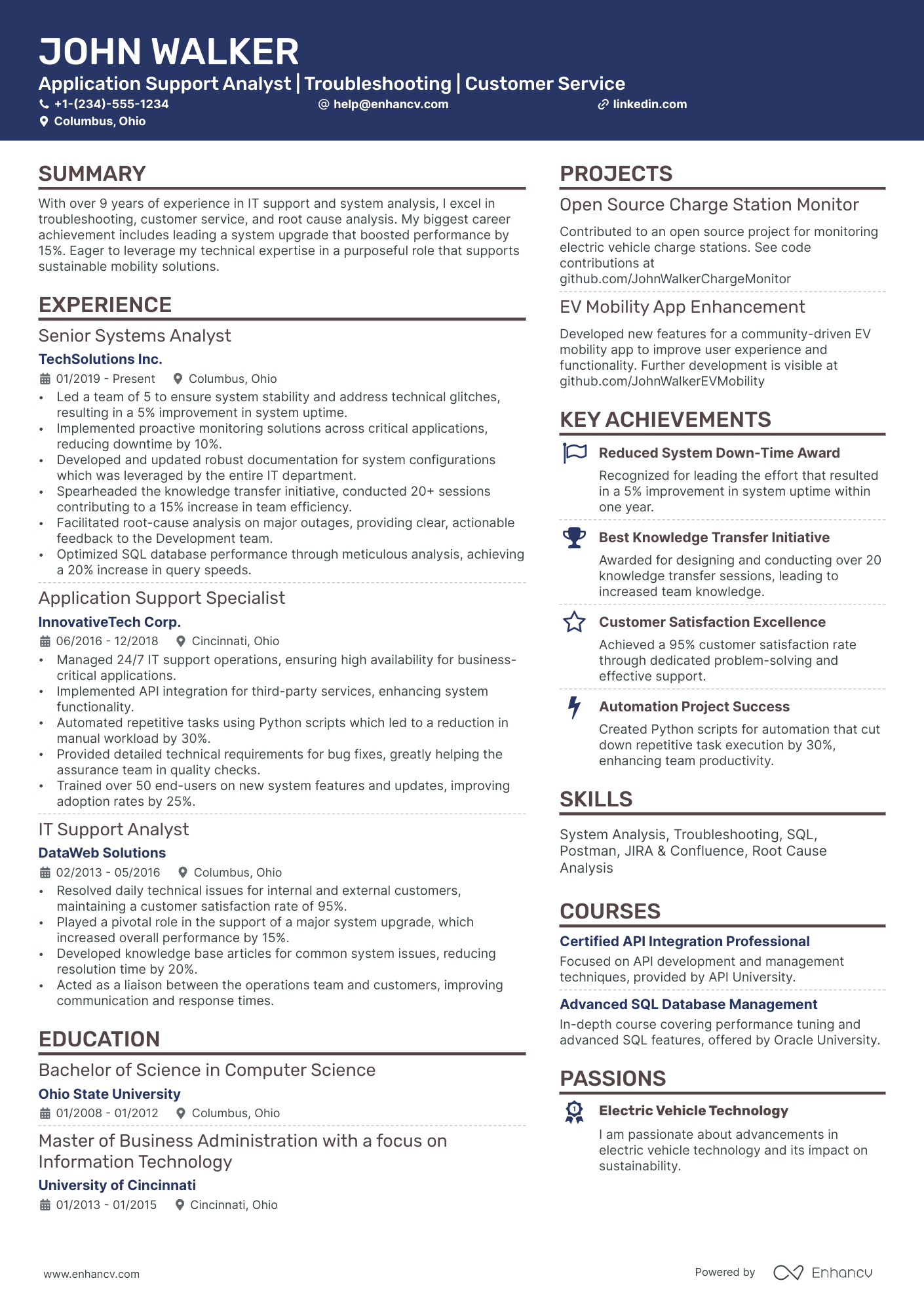
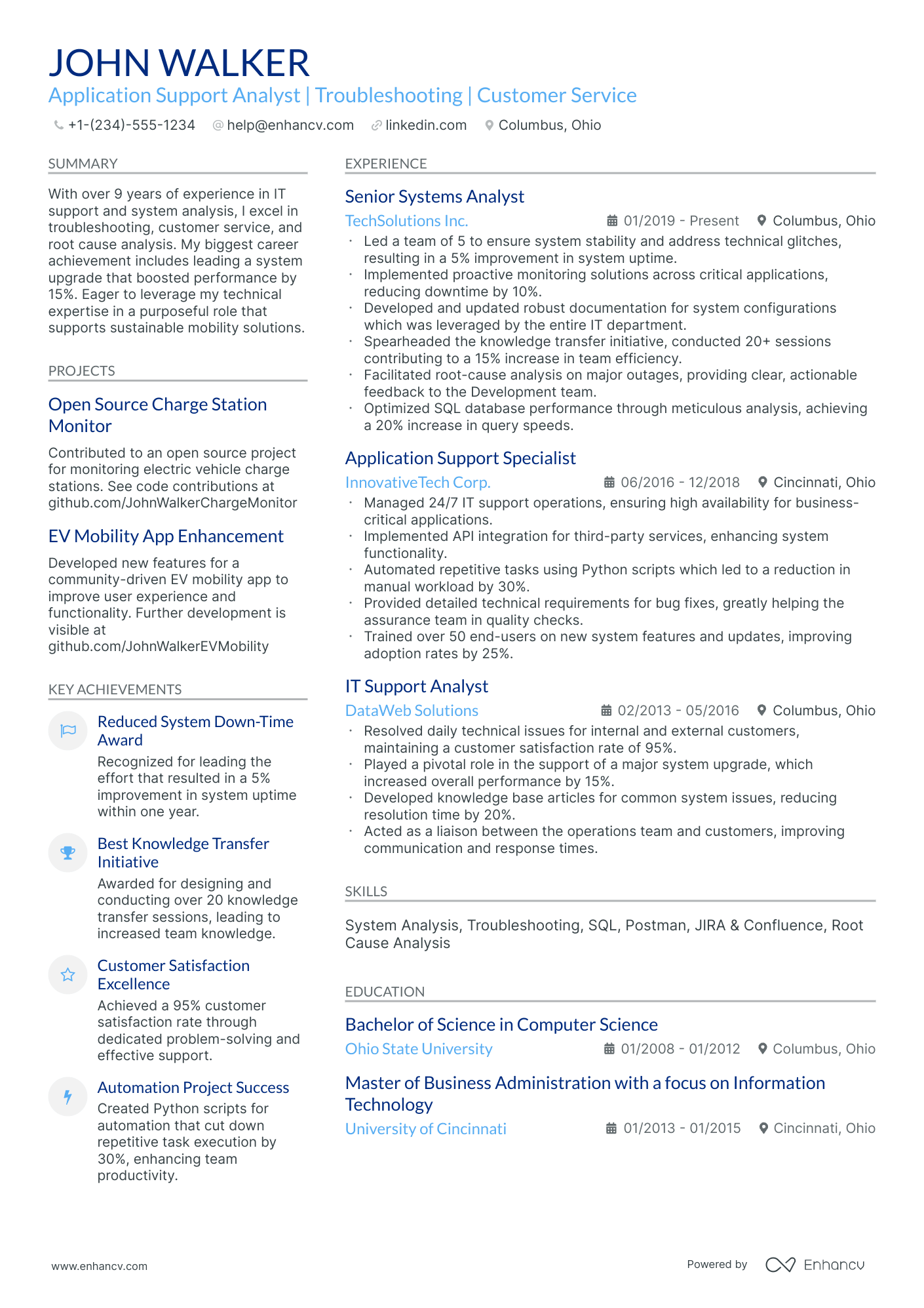
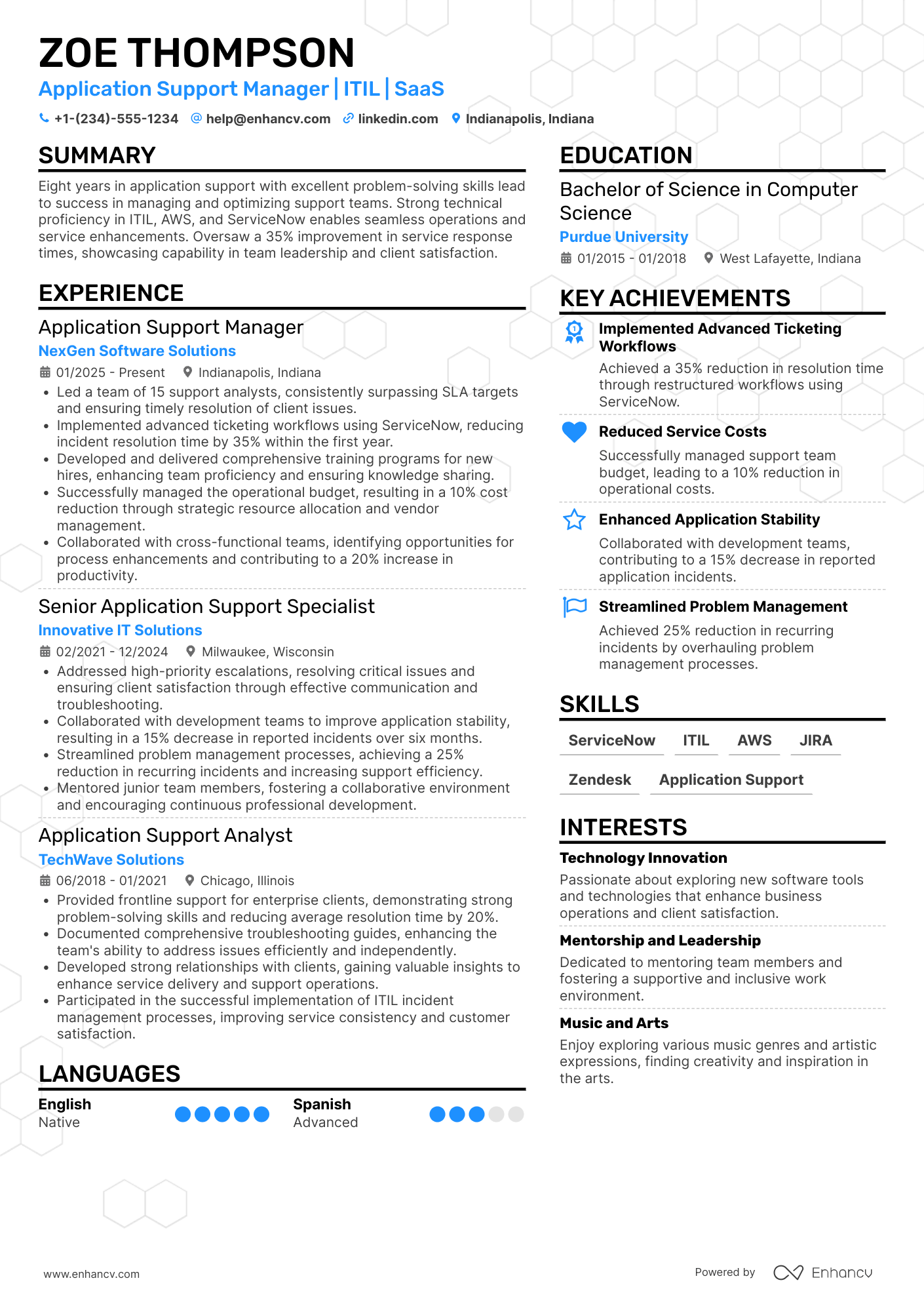
Many application support manager resume drafts fail because they read like ticket logs, not leadership summaries. That hides impact during ATS screening and fast recruiter scans, where competition is high and decision time is short.
A strong resume shows what changed because of your work. You should highlight uptime gains, incident volume reduction, faster mean time to resolution, fewer escalations, cleaner releases, improved service-level agreement performance, and higher user satisfaction across supported applications.

Key takeaways
- Quantify every experience bullet with metrics like resolution time, uptime, and SLA compliance rates.
- Use reverse-chronological format when you have direct application support management experience.
- Tailor resume language to mirror the exact tools, frameworks, and KPIs in each job posting.
- Demonstrate skills through measurable outcomes in your experience section, not just a skills list.
- Choose a hybrid format if you're transitioning into the role from an adjacent IT position.
- Pair ITIL, ServiceNow, or cloud certifications with your education to strengthen technical credibility.
- Use Enhancv to turn routine support duties into impact-driven, recruiter-ready resume bullets.
How to format a application support manager resume
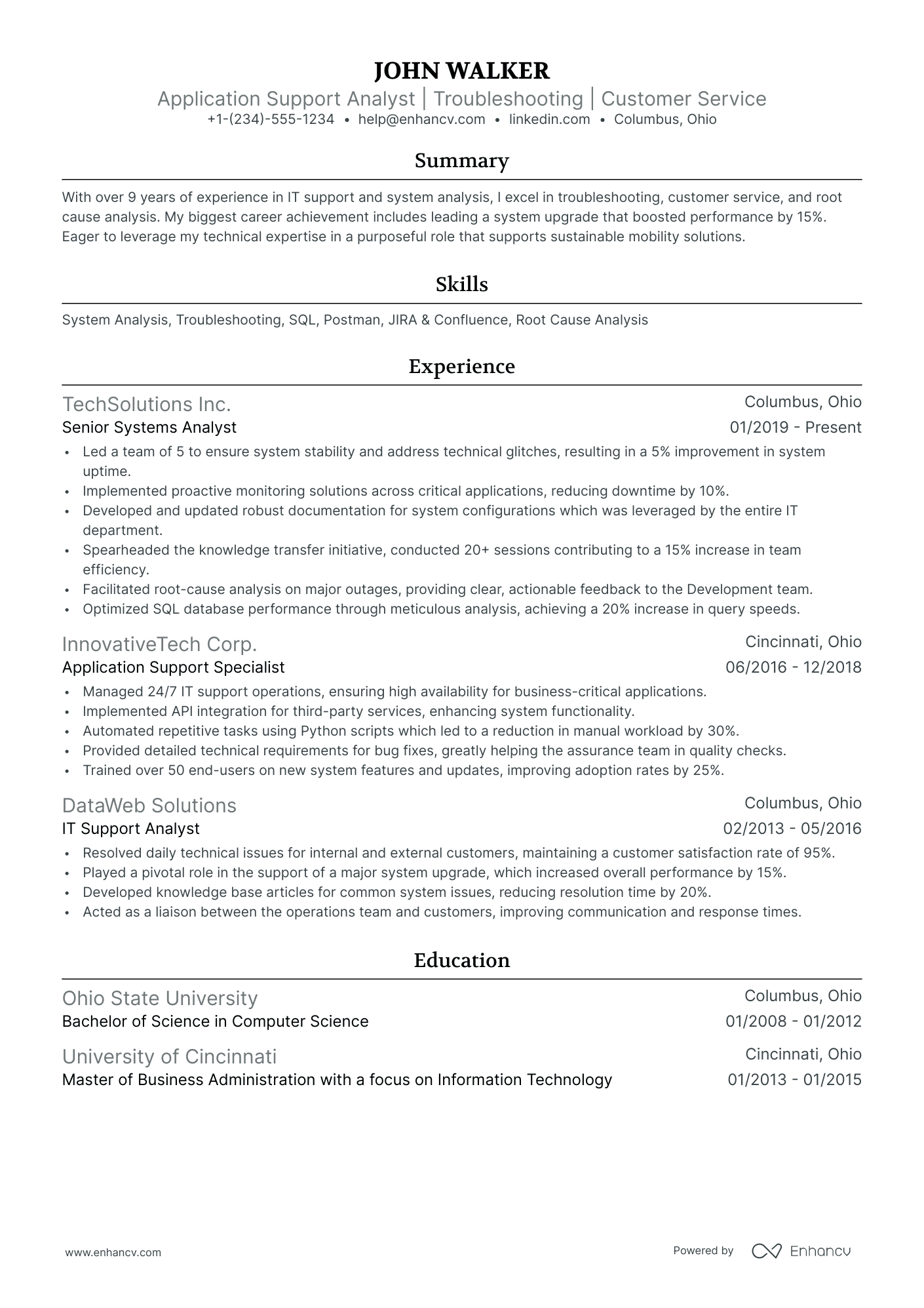
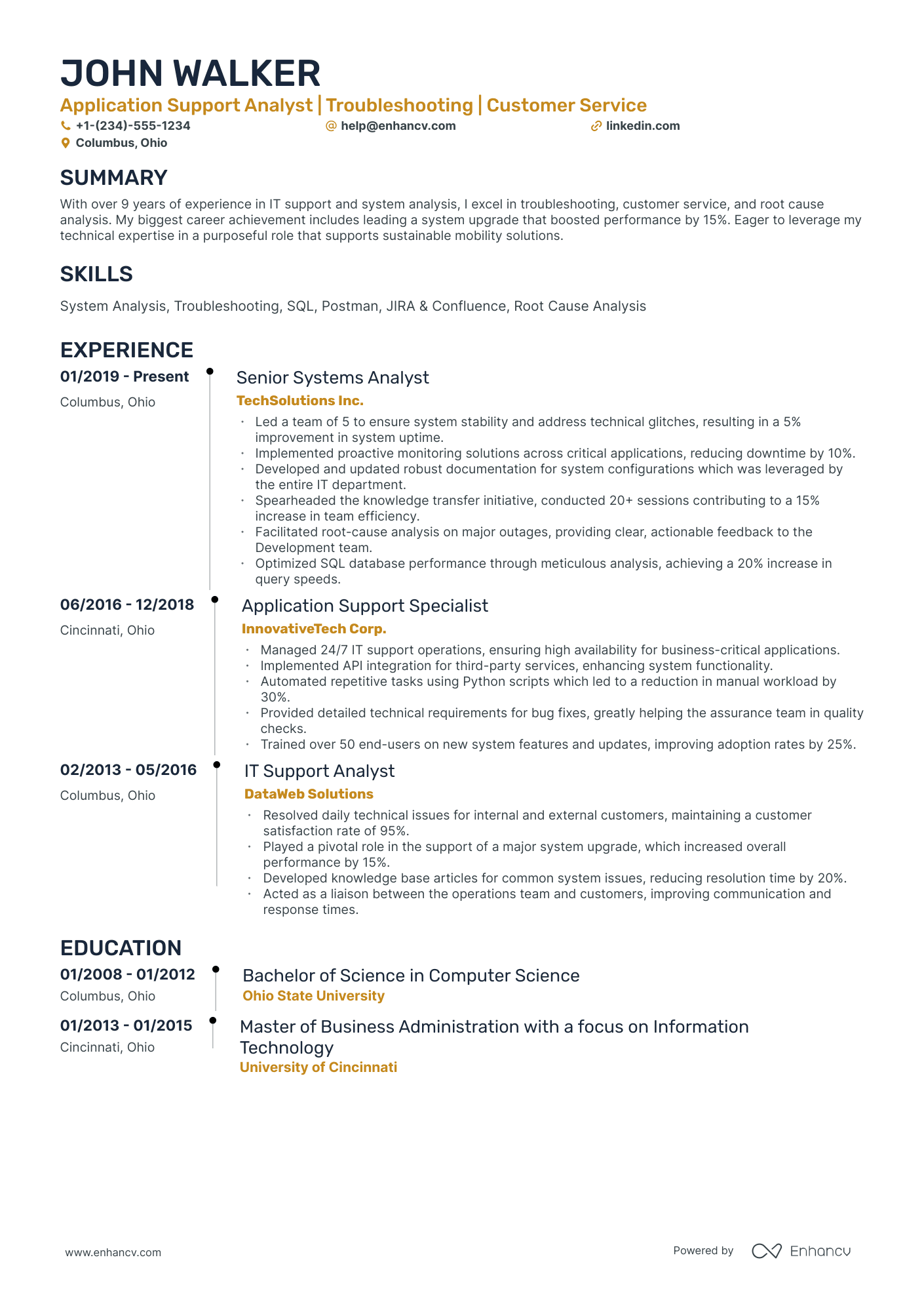
Recruiters evaluating application support manager candidates prioritize evidence of escalation management, cross-functional coordination, and system reliability ownership. A well-chosen resume format ensures these signals—particularly your progression from hands-on troubleshooting into team leadership and process optimization—are immediately visible to both hiring managers and applicant tracking systems.

I have significant experience in this role—which format should I use?
Use a reverse-chronological format to present a clear trajectory of increasing scope across application support operations. Do:
- Lead with your most recent role and emphasize span of ownership: team size managed, number of applications supported, and escalation tiers overseen.
- Highlight role-specific tools and domains such as ITIL frameworks, ITSM platforms (ServiceNow, Jira Service Management), monitoring tools (Splunk, Datadog), and SLA governance processes.
- Quantify business impact through metrics like ticket resolution time reductions, SLA compliance rates, system uptime improvements, and customer satisfaction scores.
I'm junior or switching into this role—what format works best?
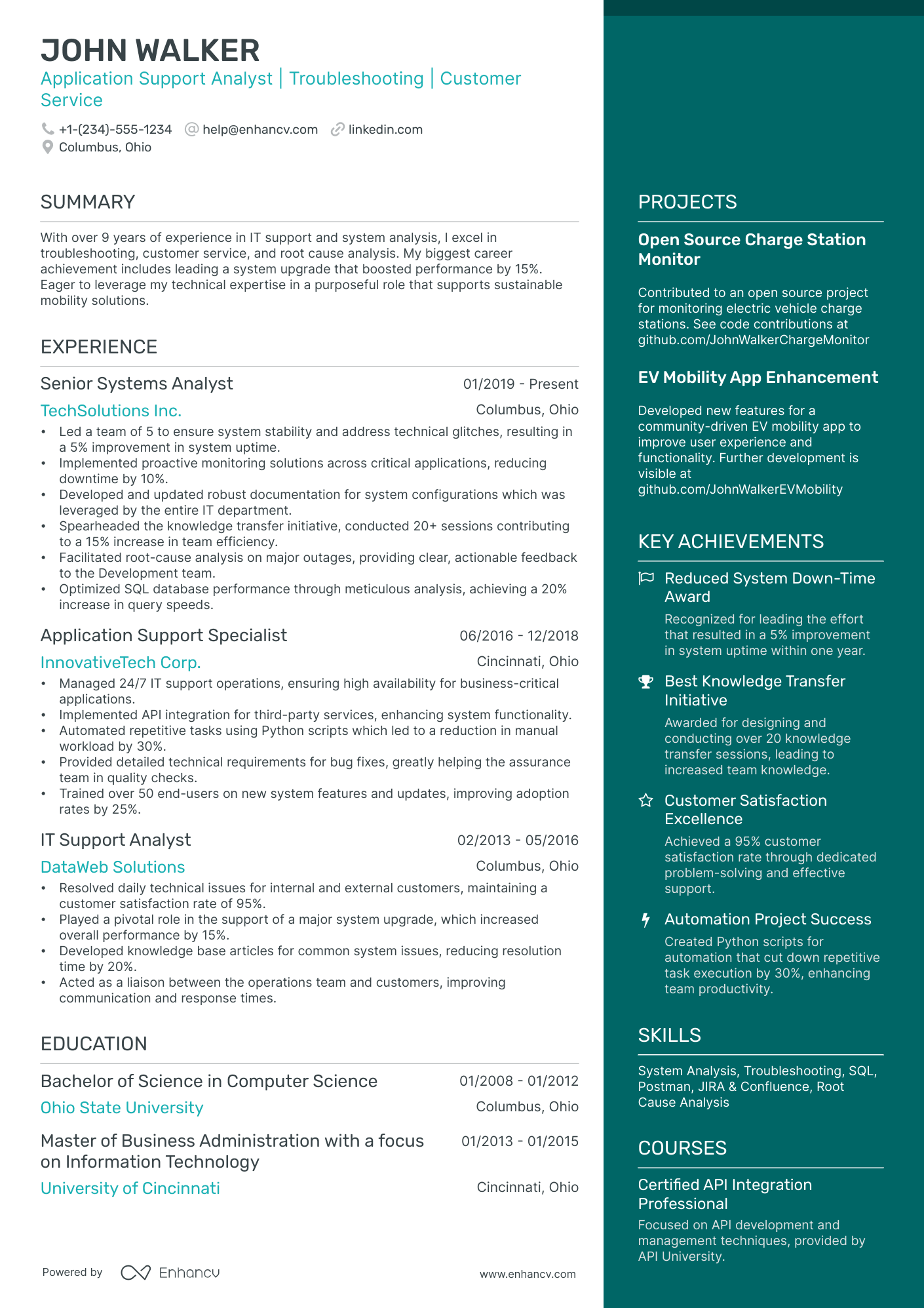
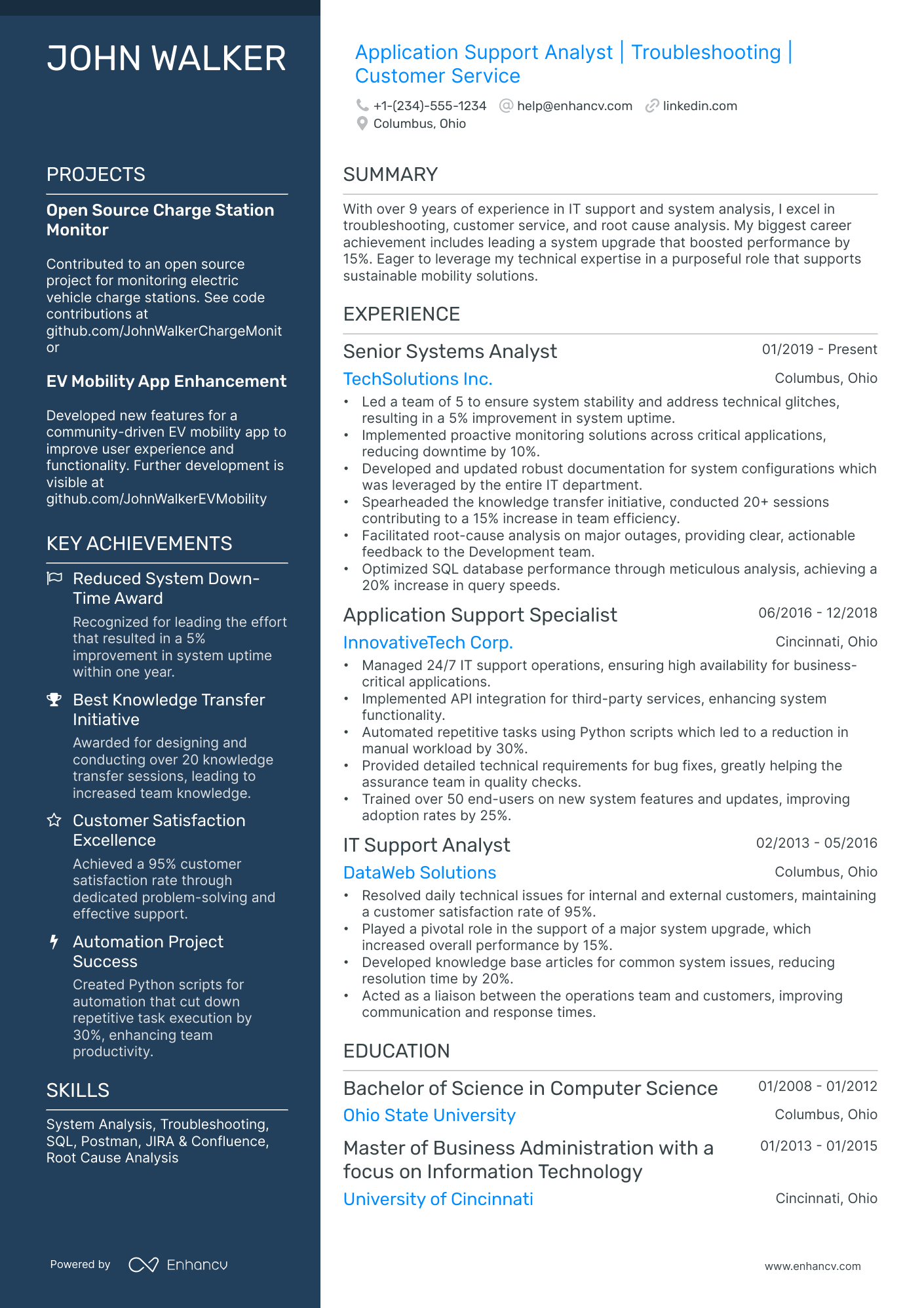
A hybrid format works best, allowing you to feature transferable skills prominently while still presenting your work history in chronological order. Do:
- Place a skills section near the top highlighting competencies like incident triage, ticketing system administration, root cause analysis, and stakeholder communication.
- Include projects or transitional experience such as help desk leadership, application testing, deployment support, or cross-team troubleshooting initiatives—even if they weren't formal application support roles.
- Connect every listed skill or project to a measurable outcome so recruiters can evaluate your readiness for the role.
Why not use a functional resume?
A functional format strips away the chronological context recruiters need to assess how your support management capabilities developed over time, making it harder to verify your readiness for coordination-heavy responsibilities.
- A functional resume may be acceptable if you're transitioning from a adjacent role (such as systems administration or QA) or re-entering the workforce after a gap, but only if every listed skill is tied directly to a specific project, tool, or measurable outcome rather than presented as a standalone claim.
Now that you've established a clean, readable layout, it's time to fill it with the right sections that highlight your qualifications as an application support manager.
What sections should go on a application support manager resume
Recruiters expect to quickly see how you keep business-critical applications stable, resolve incidents fast, and improve support operations.
Use this structure for maximum clarity:
- Header
- Summary
- Experience
- Skills
- Projects
- Education
- Certifications
- Optional sections: Awards, Leadership, Languages
Strong experience bullets should emphasize measurable impact, incident and problem outcomes, service levels, stakeholder scope, and reliability improvements.
Is your resume good enough?
Drop your resume here or choose a file. PDF & DOCX only. Max 2MB file size.
Once you’ve organized your resume with the right components in place, the next step is detailing your work history—here’s how to write your application support manager resume experience.
How to write your application support manager resume experience
Your experience section should highlight the support systems you've shipped, the tools and methods you've used to resolve complex application issues, and the measurable outcomes you've delivered for users and stakeholders. Hiring managers prioritize demonstrated impact—improved system uptime, faster ticket resolution, streamlined escalation workflows—over descriptive task lists.
Each entry should include:
- Job title
- Company and location (or remote)
- Dates of employment (month and year)
Three to five concise bullet points showing what you owned, how you executed, and what outcomes you delivered:
- Ownership scope: the applications, support queues, environments, service-level agreements, or teams you were directly accountable for as an application support manager.
- Execution approach: the incident management platforms, ticketing systems, monitoring tools, diagnostic frameworks, or escalation methodologies you used to triage issues and drive resolution.
- Value improved: changes to application uptime, mean time to resolution, support backlog volume, system reliability, or end-user satisfaction that resulted from your direct involvement.
- Collaboration context: how you partnered with development teams, infrastructure engineers, QA analysts, vendors, or business stakeholders to diagnose root causes and implement lasting fixes.
- Impact delivered: outcomes expressed through reduced downtime, improved service-level compliance, increased user adoption, or strengthened operational resilience rather than routine support activity.
Experience bullet formula
A application support manager experience example
✅ Right example - modern, quantified, specific.
Application Support Manager
NimbusPay | Remote
2021–Present
B2B payments platform supporting 1,200+ merchant clients and processing $3B+ in annual transaction volume.
- Led ITIL-based incident and problem management in ServiceNow, cutting Sev one and Sev two mean time to resolution by 32% and improving uptime from 99.85% to 99.95%.
- Implemented Datadog monitoring, synthetic checks, and PagerDuty on-call workflows, reducing alert noise by 41% and decreasing after-hours pages by 28% across eight services.
- Built root cause analysis and post-incident review standards with engineering and product managers, driving a 22% drop in repeat incidents and a 15% reduction in customer escalations.
- Partnered with database and platform engineers to tune PostgreSQL queries and Redis caching, improving peak checkout API latency by 24% and preventing an estimated $180K in monthly churn risk.
- Created a Zendesk knowledge base and internal runbooks in Confluence, raising first-contact resolution from 54% to 71% and saving 18 hours per week across the support team.
Now that you've seen what a strong experience section looks like in practice, let's break down how to customize yours for each specific job posting.
How to tailor your application support manager resume experience
Recruiters evaluate your application support manager resume through both human review and applicant tracking systems (ATS). Tailoring your experience section to align directly with the job posting increases your chances of passing both screenings.
Ways to tailor your application support manager experience:
- Match monitoring and ticketing tools named in the job description.
- Mirror the exact terminology used for ITIL or SLA processes.
- Reflect specific uptime or resolution time KPIs the posting prioritizes.
- Highlight experience with the application platforms or tech stack listed.
- Emphasize incident management and escalation workflows the role requires.
- Include relevant industry or domain expertise when the posting specifies it.
- Address compliance or security standards referenced in the job requirements.
- Align team leadership scope with the collaboration model described.
Tailoring means framing your real accomplishments in language that directly reflects the job requirements, not forcing in keywords where they don't belong.
Resume tailoring examples for application support manager
| Job description excerpt | Untailored | Tailored |
|---|---|---|
| Manage L2/L3 escalations for enterprise SaaS applications, ensuring resolution within SLA targets using ServiceNow and Jira Service Management | Helped resolve technical issues and worked with the support team to fix problems quickly. | Managed L2/L3 escalations for enterprise SaaS applications across 12 product lines, maintaining a 97% SLA compliance rate using ServiceNow and Jira Service Management to track, prioritize, and resolve incidents. |
| Lead a team of 8–10 application support analysts, conduct root cause analysis on recurring incidents, and drive process improvements using ITIL frameworks | Supervised a team and improved some internal processes to make things run more smoothly. | Led a team of nine application support analysts, conducting root cause analysis on recurring incidents that reduced ticket volume by 22% over six months through process improvements aligned with ITIL v4 frameworks. |
| Collaborate with development and QA teams to triage production defects in Oracle EBS and SQL-based reporting environments, providing after-hours on-call coverage | Worked with other departments to troubleshoot application issues and provided support when needed. | Partnered with development and QA teams to triage production defects in Oracle EBS and SQL-based reporting environments, resolving critical after-hours incidents within an average of 45 minutes during on-call rotations. |
Once you’ve aligned your experience with the role’s priorities, the next step is to quantify your application support manager achievements so hiring teams can see the impact of that work.
How to quantify your application support manager achievements
Quantifying your impact proves you keep systems stable and users productive. Focus on incident volume, service level agreement performance, mean time to resolution, defect escape rates, change success, uptime, cost, and security risk reduction.
Quantifying examples for application support manager
| Metric | Example |
|---|---|
| Reliability | "Improved payroll app uptime from 99.5% to 99.95% by adding synthetic monitoring in Datadog and tightening on-call runbooks for three regions." |
| Resolution speed | "Cut mean time to resolution from 4.2 hours to 1.6 hours by introducing ServiceNow routing rules and a tiered escalation model." |
| Quality | "Reduced incident reopen rate from 12% to 5% by enforcing root cause analysis templates and validating fixes with regression checklists in Jira." |
| Delivery speed | "Decreased standard access-request turnaround from two days to four hours by automating approvals and provisioning through Okta workflows." |
| Risk reduction | "Lowered high-severity change failures from eight to two per quarter by adding pre-deploy checks, rollback plans, and weekly change advisory board reviews." |
Turn vague job duties into measurable, recruiter-ready resume bullets in seconds with Enhancv's Bullet Point Generator.
Once you've crafted strong bullet points highlighting your achievements, the next step is ensuring your resume also effectively showcases the hard and soft skills that application support manager roles demand.
How to list your hard and soft skills on a application support manager resume
Skills show you can keep business-critical applications stable and users productive, and recruiters and ATS scan this section to confirm tool fit fast—aim for a mix weighted toward hard skills with a smaller set of role-specific soft skills. application support manager roles require a blend of:
- Product strategy and discovery skills.
- Data, analytics, and experimentation skills.
- Delivery, execution, and go-to-market discipline.
- Soft skills.
Your skills section should be:
- Scannable (bullet-style grouping).
- Relevant to the job post.
- Backed by proof in experience bullets.
- Updated with current tools.
Place your skills section:
- Above experience if you're junior or switching careers.
- Below experience if you're mid/senior with strong achievements.

Hard skills
- ITIL incident, problem, change management
- ServiceNow, Jira Service Management
- Service level agreements, service level objectives
- Root cause analysis, postmortems
- SQL, data validation, reconciliation
- Splunk, Datadog, New Relic
- Windows Server, Linux administration
- AWS, Azure monitoring
- API troubleshooting, Postman
- CI/CD support, Jenkins, GitHub Actions
- Knowledge base management, Confluence
Soft skills
- Triage and prioritize incidents
- Lead cross-functional war rooms
- Communicate impact and timelines
- Set clear escalation paths
- Translate technical issues for stakeholders
- Drive follow-ups to closure
- Balance risk, speed, and quality
- Coach analysts and on-call staff
- Resolve conflicts between teams
- Build trust with business partners
- Document decisions and outcomes
How to show your application support manager skills in context
Skills shouldn't live only in a dedicated skills list.
They should be demonstrated in:
- Your summary (high-level professional identity)
- Your experience (proof through outcomes)
Here's what strong, skill-rich content looks like in practice.
Summary example
Application support manager with 10+ years in healthcare IT, specializing in ITIL-driven incident management and ServiceNow optimization. Led cross-functional teams that reduced critical ticket resolution time by 35% while maintaining 99.9% system uptime across enterprise platforms.
- Signals senior-level depth immediately
- Names industry-relevant tools and frameworks
- Leads with a measurable outcome
- Highlights leadership and collaboration
Experience example
Application Support Manager
Vantage Health Systems | Remote
March 2019–Present
- Redesigned Jira Service Management workflows with development and QA teams, cutting average escalation time from 48 hours to 14 hours.
- Implemented proactive monitoring using Datadog and custom dashboards, reducing P1 incidents by 42% year over year.
- Mentored a team of eight support analysts through ITIL 4 certification, improving first-contact resolution rates by 27%.
- Every bullet includes measurable proof.
- Skills surface naturally through outcomes.
Once you’ve demonstrated your application support manager strengths through real examples, the next step is to apply that same approach to building an application support manager resume when you don’t have direct experience.
How do I write a application support manager resume with no experience
Even without full-time experience, you can demonstrate readiness through:
- IT service desk internships
- Ticket triage in student helpdesk
- ITIL Foundation certification projects
- Zendesk or ServiceNow sandbox work
- On-call support for campus systems
- Root cause analysis case studies
- Knowledge base articles you authored
- Incident postmortems for class projects
Focus on:
- Ticket metrics and SLA adherence
- Incident management and escalations
- Monitoring, alerting, and triage
- Documentation and knowledge base ownership
Resume format tip for entry-level application support manager
Use a skills-first resume format because it highlights tools, processes, and outcomes when your work history is limited. Do:
- Add a “Projects” section with metrics.
- List ServiceNow, Jira, and SQL.
- Map bullets to incident management steps.
- Quantify volume, time saved, and accuracy.
- Include certifications with completion dates.
- Built a ServiceNow incident workflow in a sandbox, cutting duplicate tickets by 25% and improving SLA compliance from 82% to 93% over four weeks.
Even without direct experience, your education section can demonstrate the foundational knowledge and technical skills that qualify you for an application support manager role.
How to list your education on a application support manager resume
Your education section helps hiring teams confirm you have the foundational knowledge needed for an application support manager role. It validates technical training and analytical skills quickly.
Include:
- Degree name
- Institution
- Location
- Graduation year
- Relevant coursework (for juniors or entry-level candidates)
- Honors & GPA (if 3.5 or higher)
Skip month and day details—list the graduation year only.
Here's a strong education entry tailored to an application support manager resume.
Example education entry
Bachelor of Science in Information Systems
George Mason University, Fairfax, VA
Graduated 2019
GPA: 3.7/4.0
- Relevant Coursework: Database Management, Systems Administration, IT Service Management, Software Quality Assurance
- Honors: Magna Cum Laude, Dean's List (six semesters)
How to list your certifications on a application support manager resume
Certifications show your commitment to learning, confirm tool proficiency, and signal industry relevance for an application support manager in fast-changing support environments. Include:
- Certificate name
- Issuing organization
- Year
- Optional: credential ID or URL
- Place certifications below education when they are older, less relevant, or you want your degree to lead the page.
- Place certifications above education when they are recent, highly relevant, or required for the application support manager role.
Best certifications for your application support manager resume
- ITIL 4 Foundation
- Microsoft Certified: Azure Administrator Associate
- AWS Certified SysOps Administrator – Associate
- CompTIA Security+
- Certified ScrumMaster (CSM)
- HDI Support Center Manager (HDI-SCM)
- Microsoft Certified: Windows Server Hybrid Administrator Associate
Once you’ve positioned your certifications to validate your technical and operational expertise, shift to your application support manager resume summary to frame those credentials within a clear, outcome-focused snapshot of your fit.
How to write your application support manager resume summary
Your resume summary is the first thing a recruiter reads. A strong one immediately signals you're qualified for the application support manager role.
Keep it to three to four lines, with:
- Your title and total years of experience in application support or IT service management.
- The domain or industry you've worked in, such as SaaS, financial services, or healthcare.
- Core tools and skills like ITIL, ServiceNow, Jira, SQL, or incident management frameworks.
- One or two measurable achievements, such as reduced resolution times or improved uptime.
- Soft skills tied to real outcomes, like cross-functional collaboration that streamlined escalation workflows.

PRO TIP
As a mid-level manager, emphasize team leadership, process improvements, and measurable service outcomes. Highlight how you've driven efficiency or reduced downtime across applications. Avoid vague phrases like "passionate problem-solver" or "results-driven professional." Recruiters want specifics, not motivational filler.
Example summary for a application support manager
Application support manager with six years of experience leading teams in SaaS environments. Reduced average ticket resolution time by 34% using ServiceNow and ITIL-based workflows while managing cross-functional escalations.
Optimize your resume summary and objective for ATS
Drop your resume here or choose a file.
PDF & DOCX only. Max 2MB file size.
Now that your summary is crafted to highlight your strongest qualifications, make sure the header above it presents your contact details clearly so recruiters can reach you without any friction.
What to include in a application support manager resume header
A resume header lists your key contact details and role fit, helping application support manager candidates gain visibility, build credibility, and pass recruiter screening faster.
Essential resume header elements
- Full name
- Tailored job title and headline
- Location
- Phone number
- Professional email
- GitHub link
- Portfolio link
A LinkedIn link helps recruiters verify your experience quickly and supports screening.
Do not include photos on a application support manager resume unless the role is explicitly front-facing or appearance-dependent.
Match your header job title to the posting and include a clear headline that reflects your application support manager scope and core systems.
Example
Application support manager resume header
Jordan Lee
Application Support Manager | Incident Management, ITIL, and Customer Escalations
Austin, TX
(512) 555-01XX
jordan.lee@enhancv.com
github.com/jordanlee
jordanlee.com
linkedin.com/in/jordanlee
Once your header clearly identifies you and your key contact details, add relevant additional sections to strengthen your application support manager resume with supporting information.
Additional sections for application support manager resumes
When your core qualifications align closely with other candidates, additional sections help you stand out with unique, role-relevant credibility.
- Languages
- Certifications (ITIL, CompTIA, Microsoft)
- Technical training and workshops
- Volunteer IT support experience
- Professional affiliations and memberships
- Awards and recognitions
- Publications or technical blog contributions
Once you've strengthened your resume with relevant additional sections, the next step is pairing it with a well-crafted cover letter to complete your application.
Do application support manager resumes need a cover letter
A cover letter is not required for an application support manager, but it often helps in competitive searches or when hiring teams expect one. It can make a difference when your resume needs context or when you’re targeting a specific product and user group.
Use a cover letter to add context your resume can’t:
- Explain role and team fit by connecting your support model, escalation approach, and stakeholder style to the team’s needs.
- Highlight one or two projects with measurable outcomes, such as reduced incident volume, faster resolution times, or improved service-level agreement performance.
- Show product and business understanding by referencing key users, workflows, integrations, and the operational impact of downtime.
- Address career transitions or non-obvious experience by mapping transferable skills to application support manager responsibilities and tools.
Drop your resume here or choose a file.
PDF & DOCX only. Max 2MB file size.
Even when you decide a cover letter won’t add value, using AI to improve your application support manager resume helps you strengthen and tailor your resume so it stands on its own.
Using AI to improve your application support manager resume
AI can sharpen your resume's clarity, structure, and impact. It helps you find stronger phrasing and tighten loose sections. But overuse can strip out your authentic voice. Once your content feels clear and aligned with the role, step away from AI.
Here are 10 practical prompts you can copy and paste to strengthen specific sections of your resume:
- Strengthen your summary: "Rewrite my resume summary to highlight my core value as an application support manager, focusing on technical leadership and user satisfaction in under four sentences."
- Quantify experience bullets: "Add measurable outcomes to each of my application support manager experience bullets, using metrics like ticket resolution time, uptime percentage, or user adoption rates."
- Tighten skills relevance: "Review my skills section and remove any entries not directly relevant to an application support manager role supporting enterprise software environments."
- Clarify technical projects: "Rewrite my projects section to clearly explain my specific contributions as an application support manager, including tools used, team size, and business outcomes."
- Improve action verbs: "Replace weak or repetitive verbs in my application support manager experience section with stronger, more precise action verbs that convey leadership and problem-solving."
- Align with job postings: "Compare my resume against this application support manager job description and identify gaps in keywords, responsibilities, or qualifications I should address."
- Refine education details: "Simplify my education section to emphasize coursework, honors, or projects most relevant to an application support manager career path."
- Spotlight certifications: "Reorder and briefly describe my certifications to show which ones matter most for an application support manager supporting cloud-based or enterprise applications."
- Remove filler language: "Identify and remove vague or filler phrases across my entire application support manager resume, replacing them with specific, concise statements."
- Fix inconsistent formatting: "Review my application support manager resume for inconsistent date formats, bullet styles, tense usage, and spacing, then suggest corrections."
Stop using AI once your resume sounds accurate, specific, and aligned with your real experience. AI should never invent experience or inflate claims—if it didn't happen, it doesn't belong here.
Conclusion
A strong application support manager resume shows measurable outcomes, role-specific skills, and a clear structure. Use metrics like reduced incidents, faster resolution times, higher uptime, and improved customer satisfaction to prove impact.
Keep sections easy to scan and aligned to today’s hiring market. Highlight incident management, root cause analysis, stakeholder communication, service level agreement ownership, and team leadership to show readiness for current and near-future needs.