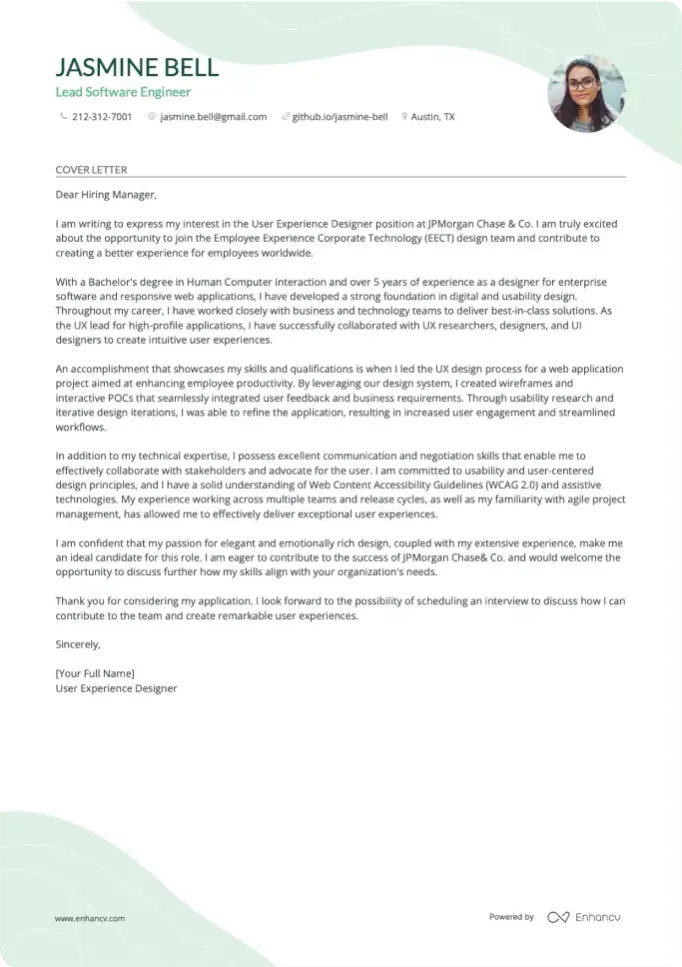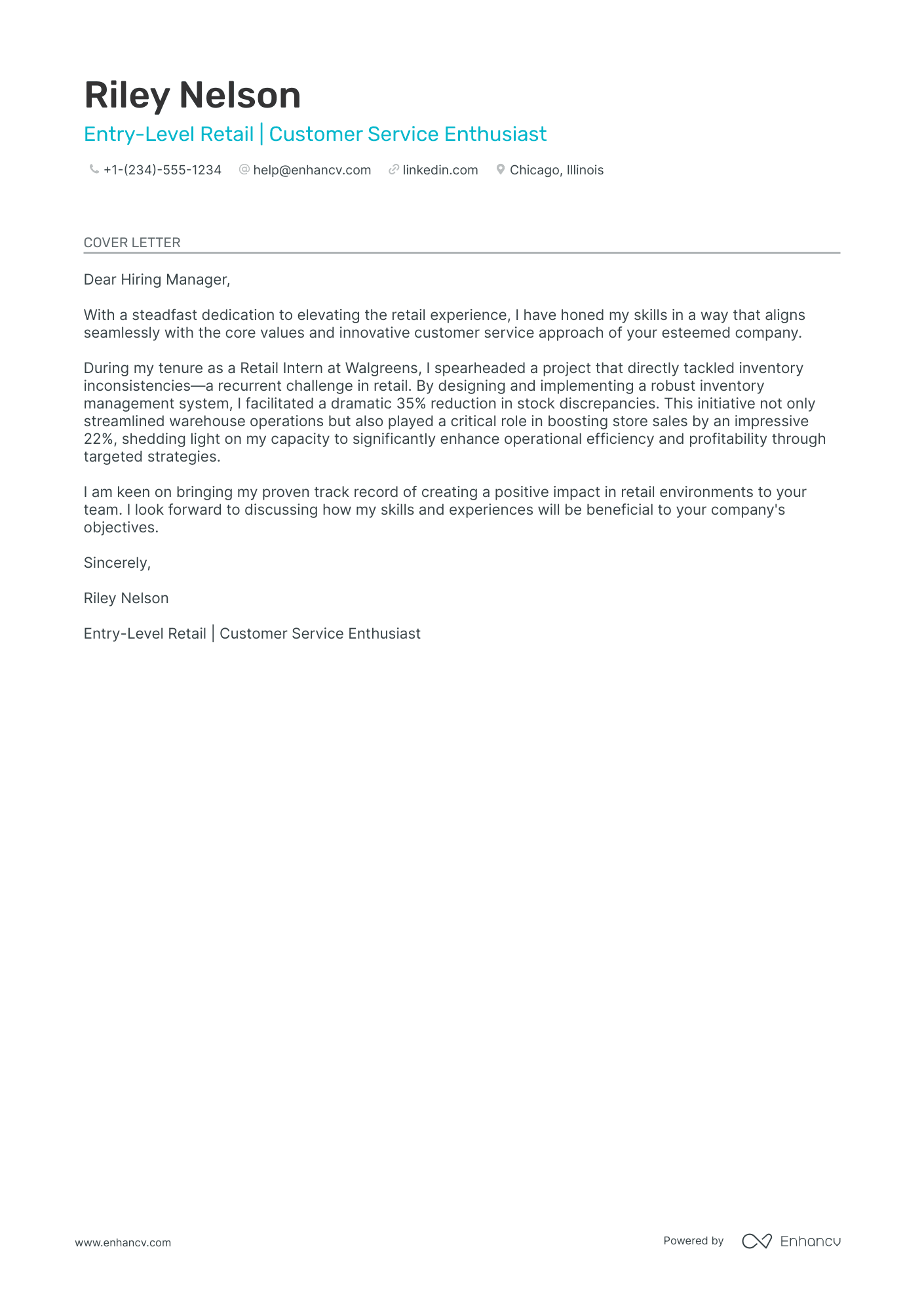
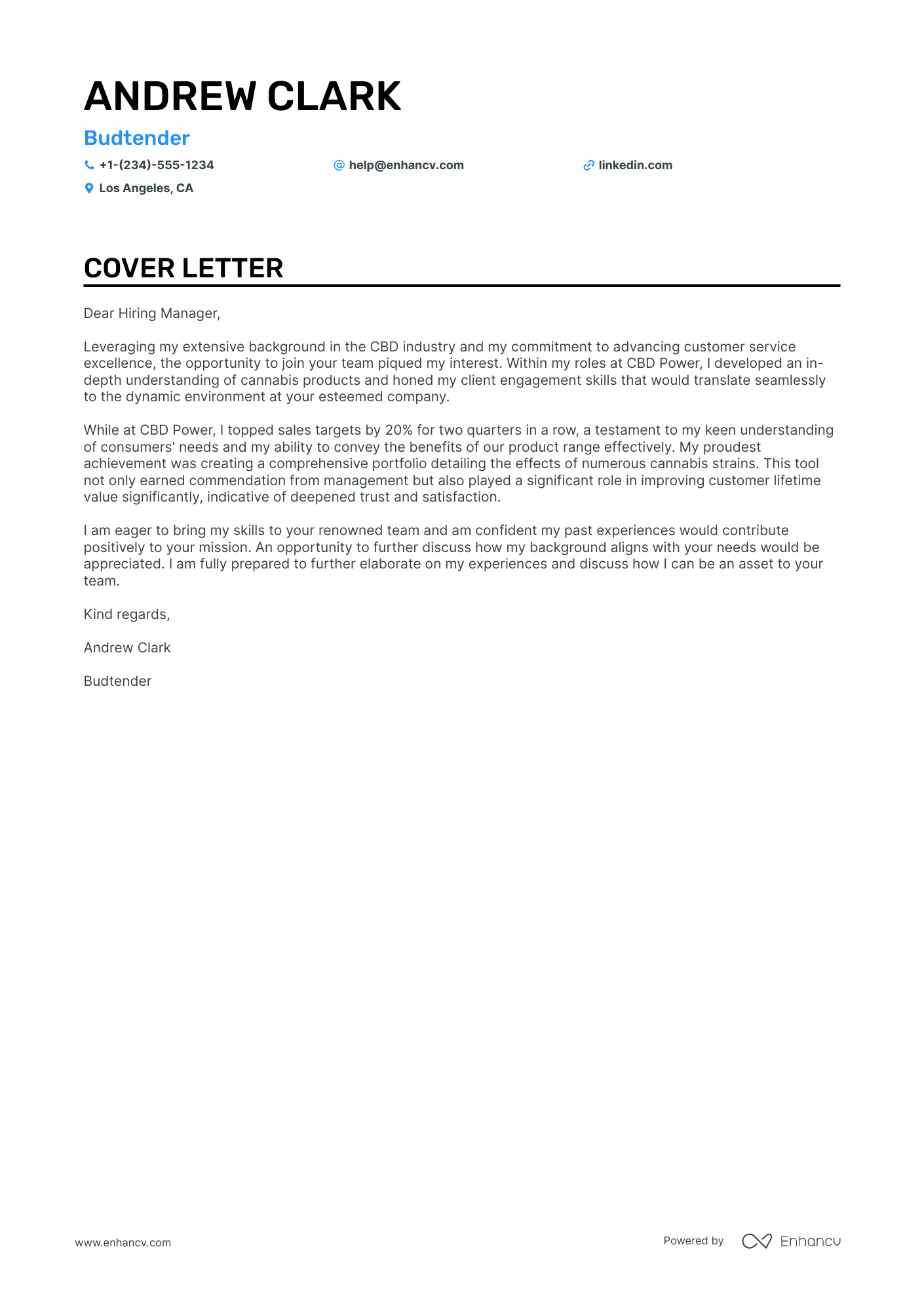
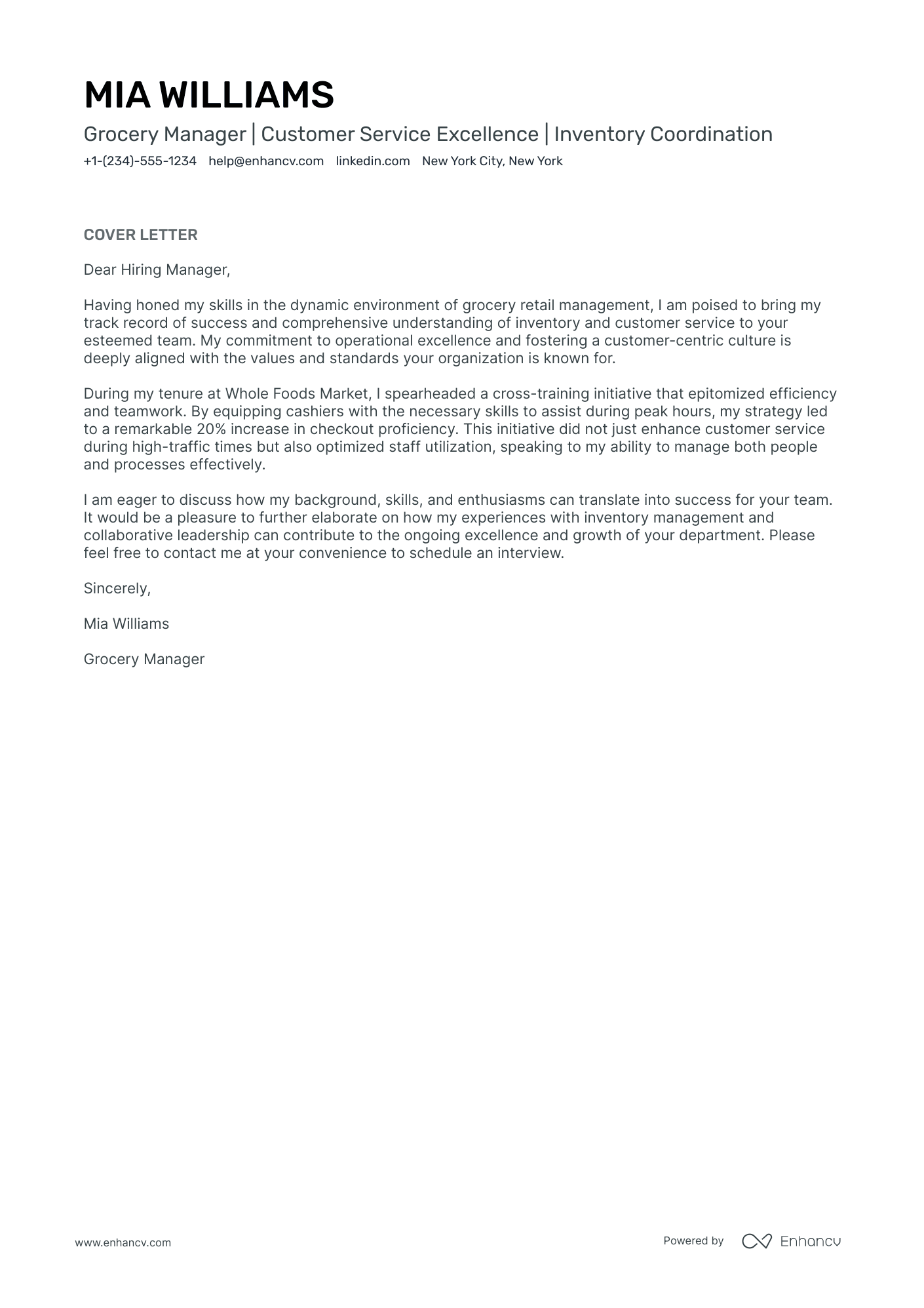
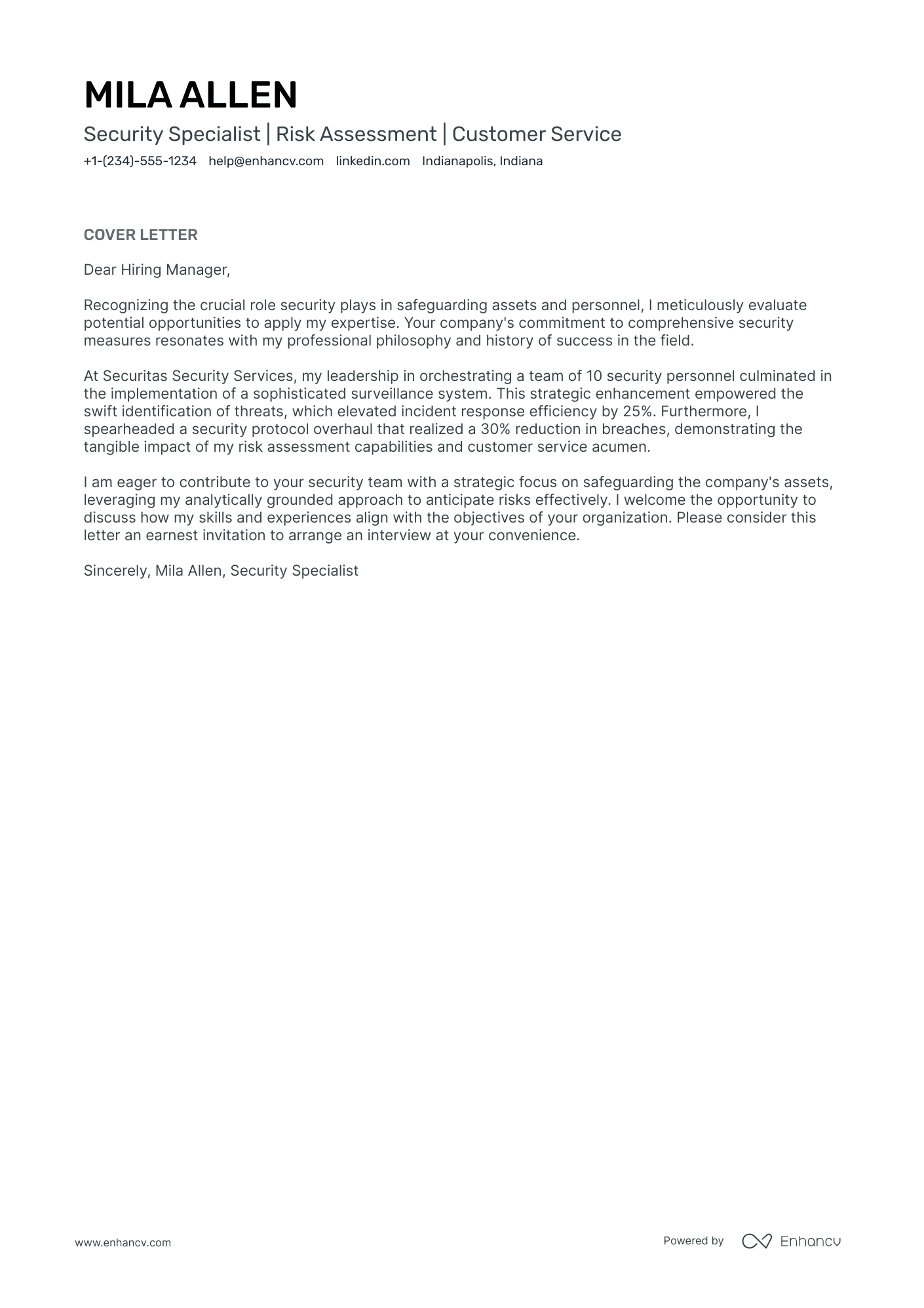
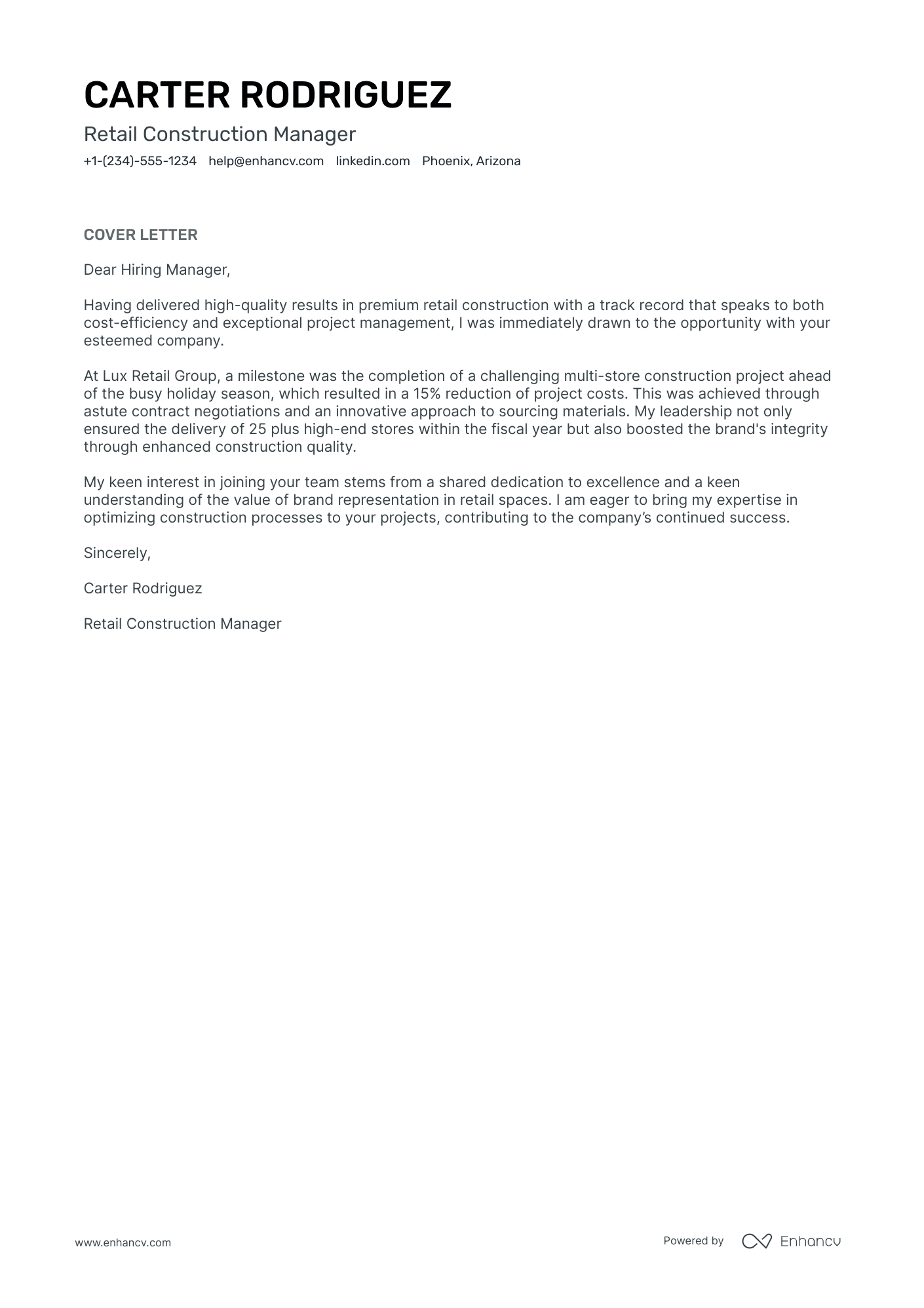
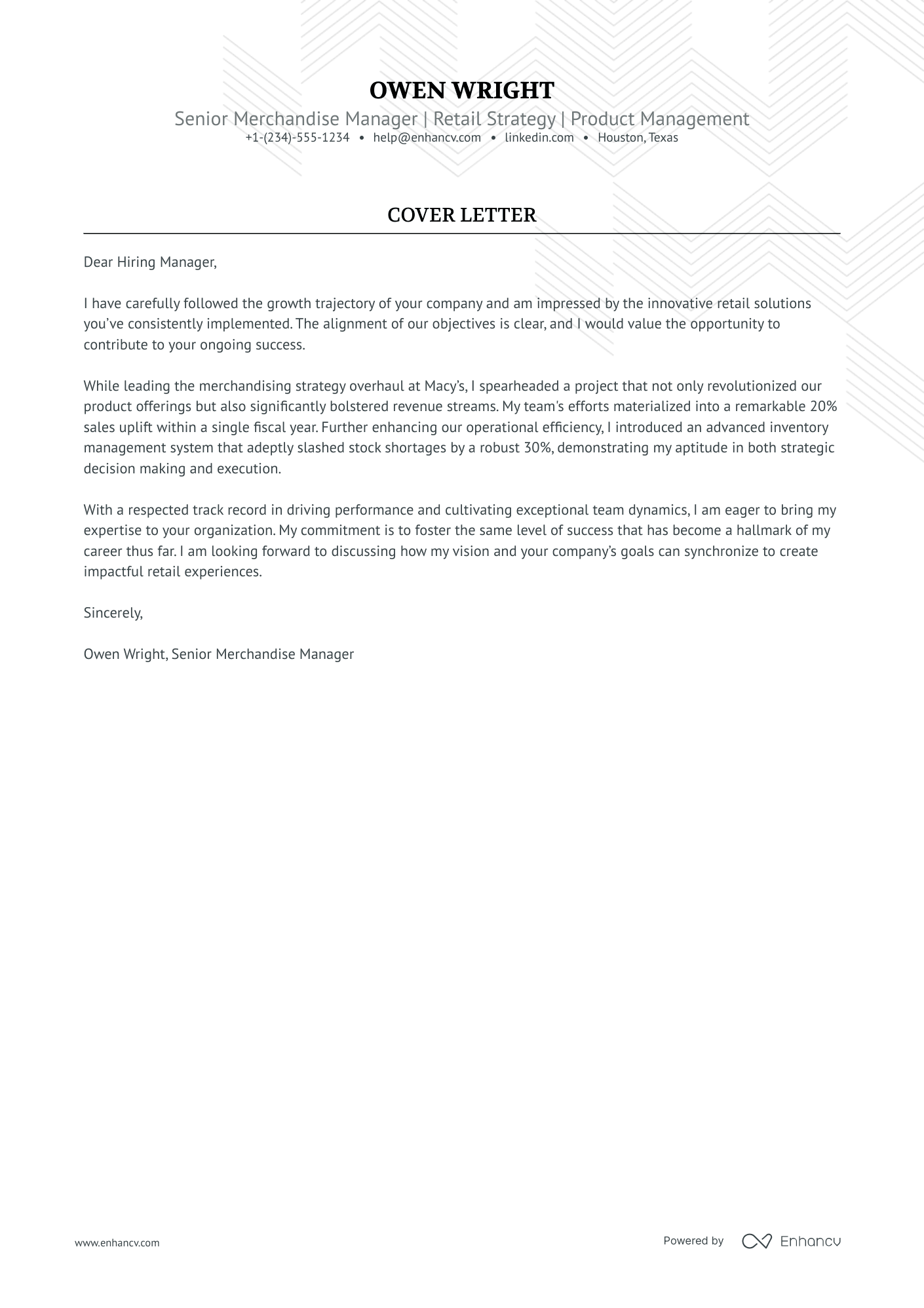
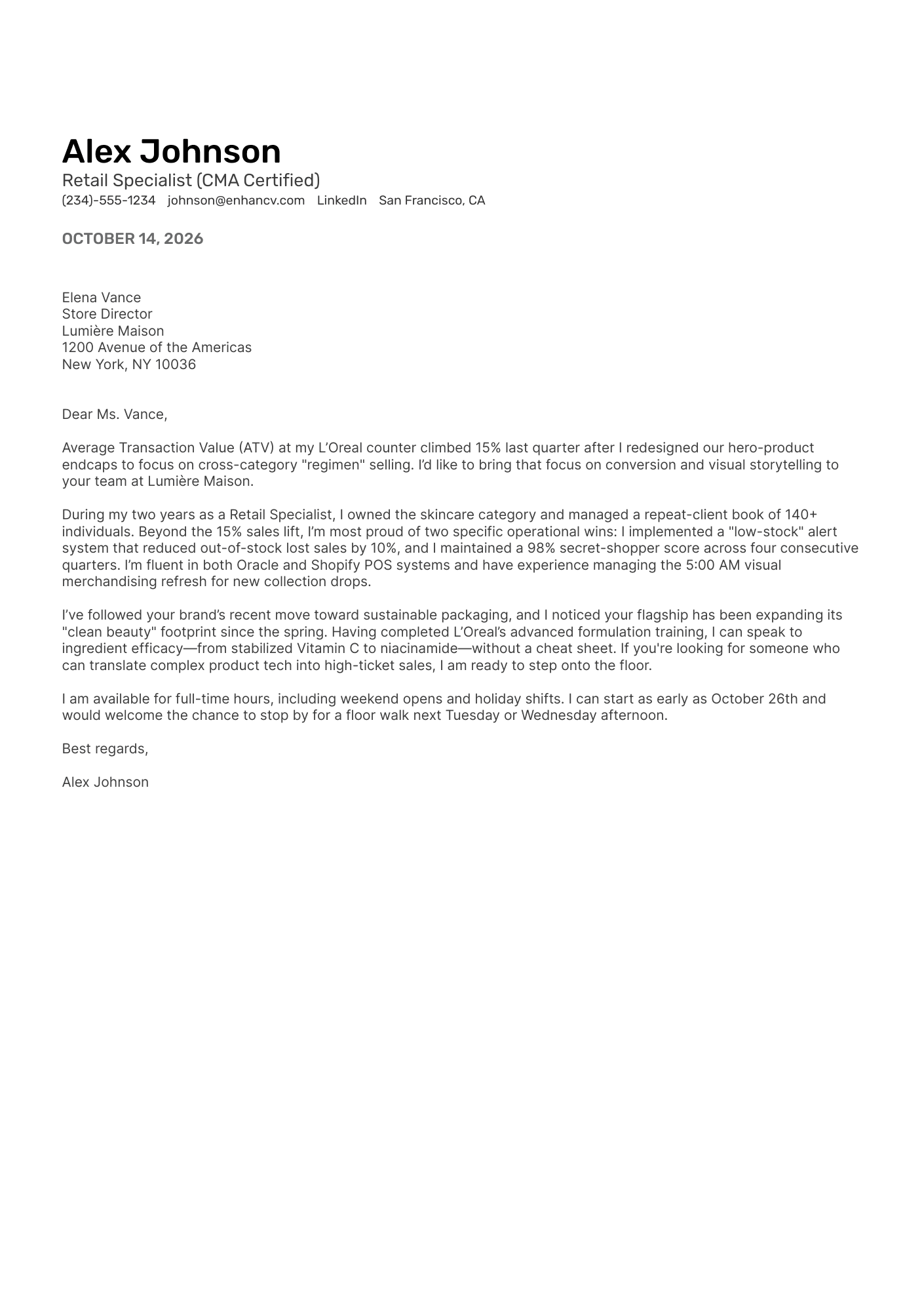
In the high-turnover world of retail, store managers are looking for a reliable closer. While AI-driven applications are rising, a personalized cover letter remains the fastest way to prove soft skills a resume can’t quantify.
The letter only sells half the story — district managers will check the resume right after for the sales-per-hour, shrink, and conversion numbers that prove the soft skills paid off, which our retail resume guide walks through.
A cover letter is the best way to explain why a candidate is the right fit for a specific brand. Whether you’re targeting luxury, big-box, or specialty shops, your letter must prove two things: you can drive sales and you are a pillar of reliability.

Key takeaways
- Lead with numbers, not narratives: Skip the generic greetings and open with a specific metric to grab attention in the first 10 seconds.
- Target your store type: Tailor your tone to the specific environment. Luxury requires polish and a "clienteling" focus, while Specialty requires deep technical product authority.
- Use tailored vocabulary: Pass the mental fit check by using industry-specific terms like attach rate, shrink, soft-goods, and POS fluency. This signals you understand the business and reduces your perceived training cost.
- Prioritize operations in the closing: End your letter by clearly stating your availability and offering a specific next step, such as an immediate start date.
- Bridge experience gaps with transferable data: If writing a no-experience cover letter, translate non-retail work into store priorities. Frame past volunteer or campus roles in terms of cash handling, customer volume, and 100% attendance reliability.
What makes a retail cover letter get read?
Store managers read in stolen minutes. A district manager reviews applicants between morning meetings and the lunch rush, which means she gets through maybe 15 letters in a sitting. The ones they remember have a number in the first sentence and a name on the address line. Everything else is filler.
If your letter mentions a metric—your UPT, your attach rate, the conversion you ran on a specific category, a shrink number—you'll outrank ~80% of the pile by paragraph two. The other 20% know to do the same thing.
How do luxury, big-box, and specialty stores read your letter differently?
| Store type | Key audience | What they’re reading for | High-value metrics & keywords |
|---|---|---|---|
| Luxury | Hiring manager/ floor lead | Polish & clienteling: Can you maintain high-stakes relationships and speak fluently about brand heritage/provenance? | Average Order Value (AOV), Repeat-customer book, brand training, "saved sales" |
| Big-box | Store manager | Reliability & throughput: Can you handle high-volume inventory and show up for the 6 AM truck without burning out? | Open availability, holiday history, cross-training (softlines/receiving), loss prevention |
| Specialty | Category manager | Expertise & enthusiasm: Do you actually use the gear? Can you provide deep technical advice without checking a manual? | Product-specific knowledge (e.g., belaying, specs), gear stories, category certifications |
The same letter, flipped between these three readers, lands as polished, dependable, or expert. Pick your reader before you write a single line.
What format should a retail cover letter follow?
A successful retail cover letter is built for speed and legibility. Use the following structural rules to ensure a store manager can scan your credentials in under 20 seconds:
- Stick to a strict one-page limit: Keep your word count between 250–350 words across three to four concise paragraphs.
- Format a professional header: Include your contact info, a date line, the recipient’s name, and the physical store address.
- Identify the specific hiring manager: Research the name via LinkedIn or a quick call to the front desk. Use oursalutation guide if the name is hidden.
- Mirror the brand’s visual register:Select a sans-serif font that fits the store's vibe—use a clean Rubik for luxury boutiques or an approachable Montserrat for big-box retailers.
- Optimize for white space: Set margins between 0.7"–1" and use single-spacing with a clear blank line between each paragraph.
- Finalize with a formal signature block: Sign off with a professional closing and your full name.

Retail cover letter body
Write three concise paragraphs:
- Opening paragraph: who you are, what you're applying for, and one concrete outcome.
- Middle paragraph (or two): two to three pieces of evidence that match the store type—metrics for big-box, brand fluency for luxury, product depth for specialty.
- Closing paragraph: schedule availability and one line about why this specific store. Sign-off, name.
Don't pad with a skills section inside the letter body. That's a retail resume’s job.
Below is an example of a strong retail cover letter.
Sample retail cover letter (specialty store associate)
Below is a full letter for a specialty retail applicant. Specialty is the spine that gets the most variation across the three store types, so it's the best base to adapt from. Swap the metrics and the brand language for luxury or big-box.
Marlowe Chen
Burlington, VT
802) 555-0148
mchen.retail@email.com


A few things this letter does on purpose. The opening leads with a service-revenue number, not an interest statement. The middle paragraph names the previous employer, gives two concrete pieces of evidence (the intake form, the attach rate), and includes a number that anchors them.
The third paragraph is what specialty stores for—proofroof of category fluency, with a line that gives the manager something to ask about on the floor walk.
The closing is short and operational. Schedule, start date, next step.
If you're adapting this for big-box, swap the climbing paragraph for cross-trained departments and forklift cert. For luxury, swap it for AOV, your client book, and brand-language fluency. The bones stay the same.
Write like a colleague, not a fan
In retail, especially specialty or luxury, "passion for the brand" is the baseline—it won’t get you hired. Marlowe’s letter works because the tone is professional, unceremonious, and data-backed.
- Adopt "floor voice": Use the vocabulary of the job (e.g., attach rate, intake form, soft-goods wall). It signals that you won't need a month of training to understand the business.
- Anchor passion in competence: Don't just say you love the products—show how you use them to help customers. For example, Marlowe mentions specific grades (5.10) and clinics, proving she can sell high-tech gear to serious enthusiasts.
- Keep the hook quantitative: Notice the first line is a revenue win, not a greeting. Retail managers are busy, so leading with a 41% climb ensures they read the second paragraph.
What are the most common mistakes on retail cover letters?
Avoid these six frequent traps to ensure your letter stays out of the trash pile:
- Leading with a generic opening: Phrases like "I am writing to apply" are invisible. Replace them with a specific sales metric, a store name, or a high-stakes moment—if you don't have a numeric hook, skip the intro and start with your core experience.
- Listing duties instead of outcomes: Phrases like "Operated the POS" or "Greeted customers" describe a job, not a candidate. Use evidence-based language: instead of "maintained cleanliness," say "optimized floor layout to improve foot traffic."
- Mismatching the brand register: A casual, exclamation-heavy letter that works for a big-box retailer reads as unserious at a luxury boutique. Match the store’s voice by reviewing their Instagram or Careers page before you draft.
- Fabricating experience: Retail hiring managers are experts at spot-checking. If you claim you managed a Black Friday opening, expect a technical question about truck unloads or floor staging that will immediately reveal the truth.
- Missing the ideal length: Keep your letter between 200 and 400 words. Anything longer gets skimmed and anything shorter looks like a lack of effort.
- Closing with passive filler: "I look forward to hearing from you" is a wasted line. Use a proactive closer that names your specific availability for a floor walk or your potential start date. See thecover letter ending guide for stronger alternatives.
Frequently asked questions about retail cover letters
Do I need a cover letter for a retail job?
If the application has a cover letter field, fill it. If it doesn't, attach one anyway. A 250-word letter takes a manager 40 seconds to read and tilts the decision your way more often than candidates expect.
Should I mention my availability in the cover letter?
Yes, in the closing paragraph. Store managers schedule first, evaluate second. If you can work weekends, evenings, the holiday block-out, or 4 AM truck shifts, say so plainly. Clarity can move you up the stack.
What if I have no retail experience?
If you’re writing a no-experience cover letter, your goal is to prove you are a low-risk hire. Store managers are looking for evidence of soft skills and reliability that suggest you can handle a shift without constant supervision.
- Lead with transferable evidence: Highlight roles that mirror retail’s pace, such as a high-volume barista shift, a campus bookstore position, or a volunteer role involving cash handling.
- Frame your work in retail terms: Translate your past actions into store priorities. Instead of "helped people," use terms like customer count, transaction volume, and scheduling reliability.
- Highlight availability and Attendance: In an entry-level role, being the person who never misses a shift is a major competitive advantage. Mention your 100% attendance record or your flexibility for holiday and weekend "clopening" shifts.
- Focus on technical aptitude: If you have used a POS system in any capacity, or even a smartphone-based inventory tool, name it. Being tech-literate reduces the store’s training costs.
Is it okay to use the same letter for multiple stores?
You can reuse the bones. Rewrite the opening line and the closing paragraph for each application. The middle stays mostly stable. If you're applying across luxury, big-box, and specialty, the letter needs three different versions, not one.
Conclusion
Retail hiring runs on speed. A store manager will decide on your letter in roughly 60 seconds. The floor walk usually happens within a week. The hire is often locked by end of that same week. The candidates who get those calls name a specific store and drop a real number. They tell the manager when they can start. Everything else is filler.
Drop your resume here or choose a file.
PDF & DOCX only. Max 2MB file size.
Build a retail cover letter that names your store, your number, and your next shift. Start with a free Enhancv template and customize it for the floor you actually want to work.