

Ashby is a modern, AI-native applicant tracking system used by a lot of high-growth tech companies. It reads your resume with AI against the criteria a role defines, shows recruiters your actual document, and leaves the decision to a person.
Most "beat the ATS" advice assumes a system that scans your resume line by line and scrambles anything that isn't plain. Ashby doesn't work that way, and it documents how its AI review actually runs. This guide explains how Ashby handles your resume, step by step, and what to do at each stage.

Key takeaways
- Ashby uses AI to read your full resume and check it against the criteria a role defines, marking each one as meets, does not meet, or undecided.
- The AI shows its evidence with citations and, by Ashby's own rule, never ranks you or makes the decision. A person always does.
- Recruiters see your resume as the actual document, so your layout and columns reach a human intact.
- Ashby redacts personal details from the resume it sends to its AI to reduce bias.
- Match the role's stated criteria with clear evidence, because that is what the AI looks for.
- Confirm your file is clean, selectable text with the Resume Checker before you apply.
What is Ashby?
Ashby is recruiting software built around AI and analytics. Companies use it to post jobs, collect applications, review candidates with AI assistance, run structured interviews, and track hiring data in one place.
You'll find it most often at technology companies and high-growth startups that want data-driven, consistent hiring. When you apply through an Ashby-hosted job post, your application lands in that company's Ashby account for its recruiters to work through.
For a wider view of how any applicant tracking system fits together, start with our guide to what an ATS is and how it works. The following looks specifically into Ashby.
How does Ashby handle your application?
Four stages, in order, each doing a different job.
1. You apply through an Ashby job post
You submit your resume and complete the application form, which may include a few questions. Ashby keeps your resume as the file you uploaded, so the recruiter later reads your actual document. That alone removes the parsing anxiety behind most ATS myths, and it means the way you format your resume reaches a person the way you designed it.
2. Ashby's AI reviews you against the role's criteria
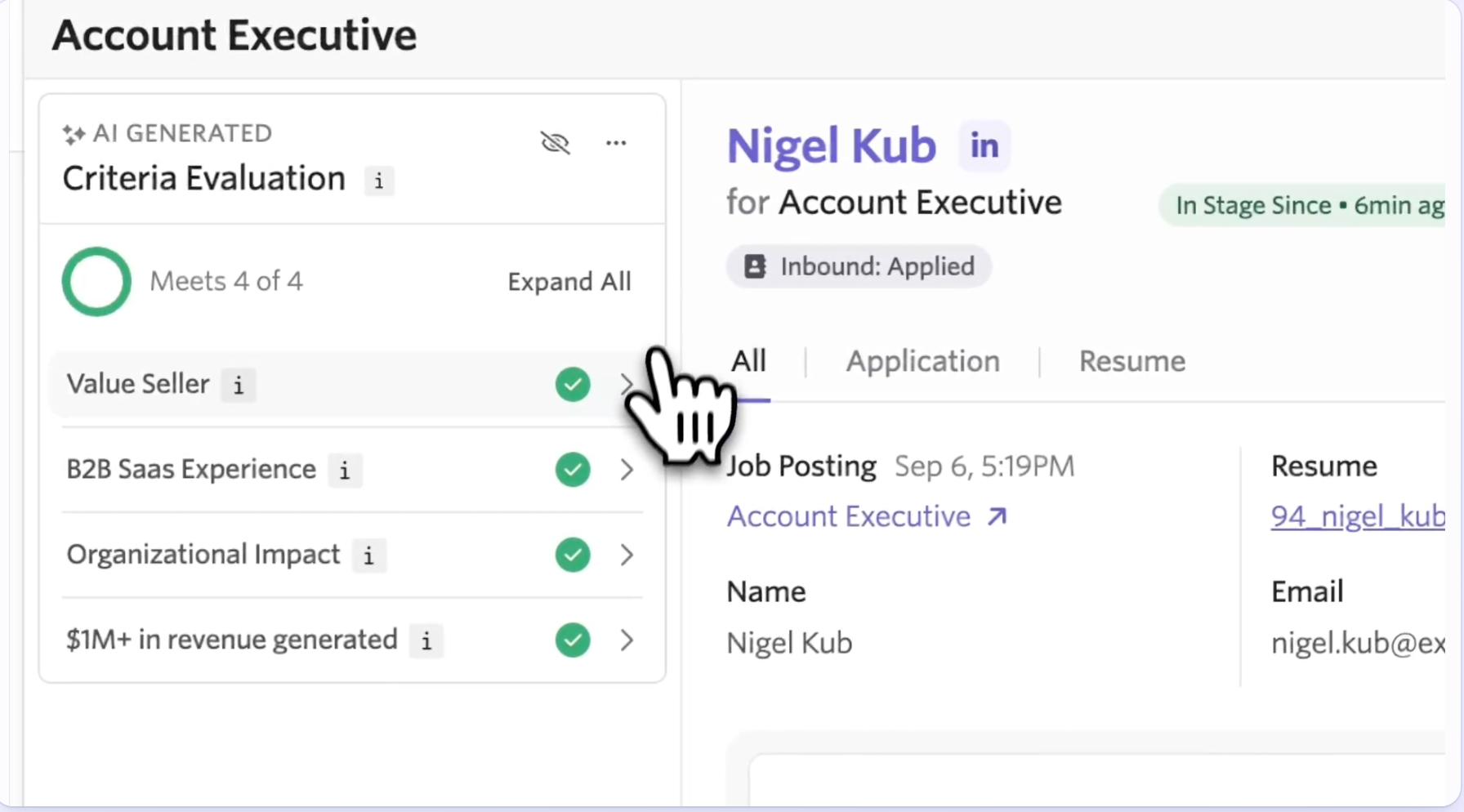
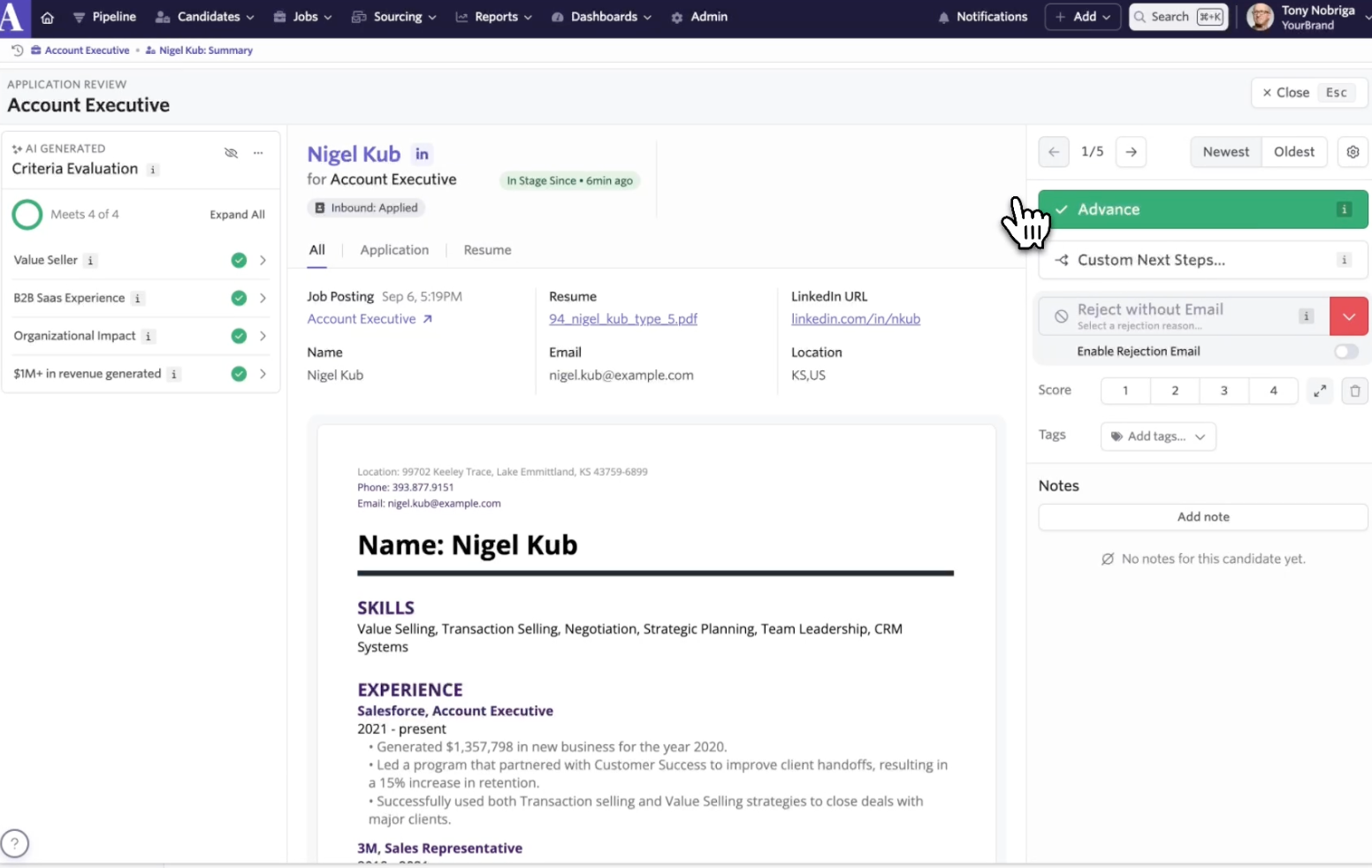
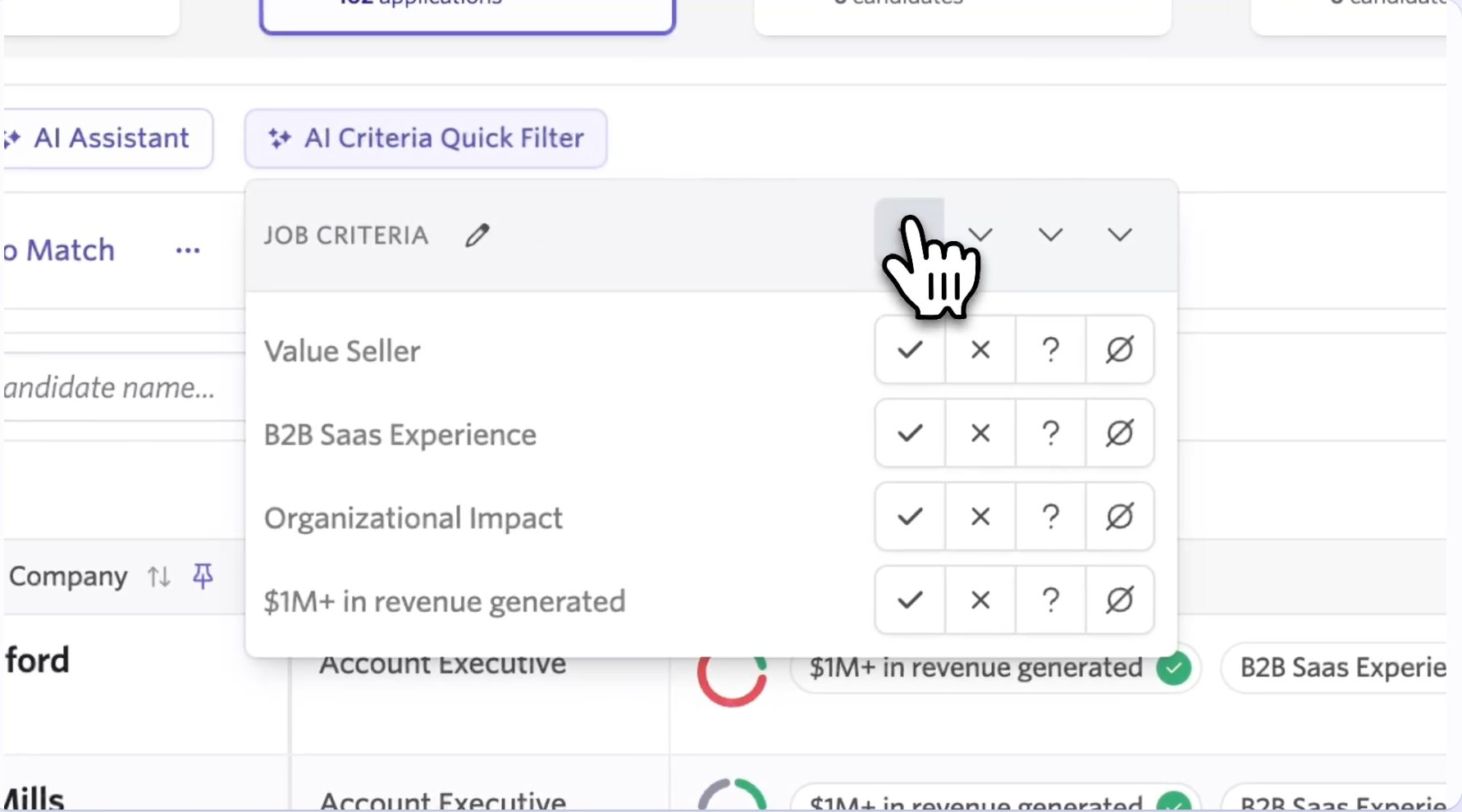
This is where Ashby differs from older systems. With AI-Assisted Application Review, the company defines the objective criteria for a role, and Ashby's AI reads each resume to find evidence of whether you meet or do not meet, or are undecided on each one. Ashby describes the criteria as must-haves, should-haves, and nice-to-haves.
Ashby says the AI reads resumes "the way a recruiter would": it interprets your work experience and infers relevance, rather than matching exact keywords. So the AI is looking for proof you meet the role's requirements, which comes from concrete resume action verbs and results, not a string of resume buzzwords.
3. A recruiter reads your actual resume and filters by fit
Recruiters see your resume rendered as the document you uploaded, and they can filter the whole applicant pool by the AI's criteria results. For every assessment, Ashby provides a citation that links to the exact evidence in your profile so a recruiter can verify it, flag it, or override it.
4. A person scores and decides
A recruiter advances you, rejects you with a reason, or scores your profile, and only then do you move through the pipeline. Ashby is explicit that its AI never ranks candidates or gives numerical ratings and that a human must always be involved in the decision. The score you might see is a reviewer's, not the machine's.
What's specific to Ashby: AI-assisted application review
Ashby's review model rests on a few principles it publishes openly.
The AI works from criteria, not keywords. Employers write each criterion as a specific, resume-verifiable requirement, and the AI reports where you meet it, which means the path forward is to match those criteria with real evidence.
The Ashby docs even coach recruiters to phrase criteria the way they'd brief a junior teammate, splitting compound requirements like "Python, TypeScript, and AWS" into separate checks.

How Ashby's AI evaluates you
Each role criterion + evidence found in your resume = meets / does not meet / undecided (with a citation)
No overall number. No ranking. Every result links to the line in your resume that supports it, and a recruiter can override any one of them.
Every AI result carries a citation. Ashby links each assessment to the specific line in your resume that supports it, so a recruiter sees the reasoning and can override it. Your personal details are also redacted from the resume Ashby sends to its AI models, a step Ashby takes to reduce bias.

Pro tip
Because the AI cites the exact line behind each result, vague phrasing costs you twice: it gives the AI nothing to point to and gives the recruiter nothing to verify. Name the skill and show the outcome in the same bullet, so a single line proves the criterion. This is the whole game behind quantifying your achievements.
Does Ashby auto-reject your resume?
Ashby does not auto-reject you, and it says so plainly: the AI never makes the decision. It surfaces evidence about which criteria you meet, and a recruiter chooses to advance or reject.
What actually screens qualified people out is the match to the role's stated criteria.

What the numbers say about ATS rejection
- 88% — executives who admit qualified candidates get screened out for missing exact job requirements (Harvard Business School and Accenture, 2,275 executives).
- 92% — recruiters (23 of 25 we interviewed) whose systems leave formatting alone.
- 98% vs. 95% — parse accuracy of two-column versus single-column resumes across the ATS parsers we tested.
The way to advance in Ashby is to meet the criteria on paper, with evidence the AI and the recruiter can both see. That comes down to a targeted resume that mirrors the role, not a design trick.
How do you make your resume work in Ashby?
Ashby rewards a clear, well-matched resume. If you're starting from scratch, our full guide on how to write a resume covers the build end to end. However, here's the short checklist for Ashby:
- Use real, selectable text. Both the AI and the recruiter read your document, so keep everything as text rather than an image.
- Match the role's criteria with evidence. Name the skill and show the result, since the AI looks for proof you meet each must-have, not for repeated resume keywords. Pull the language straight from finding keywords in the job description, and weight the hard skills on your resume that the posting actually names.
- Use clear, standard sections. Easy-to-follow resume sections help the AI and the reader find your evidence fast.
- Don't worry about columns or design. The recruiter sees your actual document and the AI reads the full text, so column count and reading order are not the variable here.
- Answer the application questions honestly. They're part of how the role's criteria get checked, since Ashby can evaluate whether specific application questions were answered.
For the full build, read our guide on how to create an ATS-friendly resume. For the columns question specifically, see whether two-column resumes are ATS-friendly.
Is your resume good enough?
Drop your resume here or choose a file. PDF & DOCX only. Max 2MB file size.
Myths about Ashby
Three claims come up in every thread about Ashby, and none of them survive contact with its own documentation.
"Ashby's AI auto-rejects me." Ashby's AI never ranks candidates or makes the decision. It marks which criteria you meet, with citations, and a person advances or rejects you.
"A two-column resume breaks in Ashby." The AI reads your full text and the recruiter sees your actual document, so column count is not the variable. Across the ATS parsers we tested, two-column resumes scored 98% versus 95% for single-column on parse accuracy, and Ashby's model removes that risk further by reading the whole document.
If you want the deeper build, here's when a two-page resume earns its space.
"I need a special resume just for Ashby." One clean, well-matched resume works across Ashby and every other system.
What Ashby manages behind the scenes
Reading resumes is one piece of a bigger tool. Ashby's own materials show the full set of jobs it runs for a hiring team:
- AI-Assisted Application Review that evaluates each applicant against the role's criteria.
- Sourcing and CRM that rediscover past applicants when a new role opens.
- Scheduling that coordinates interview logistics automatically.
- Analytics that track the hiring pipeline end to end.
- The Ashby Assistant that lets recruiters query and act on candidate data in plain language.
Your resume review is a small slice of a system built to run the whole hiring process. The gatekeeper image misses most of what Ashby is for.
Is Ashby's AI regulated?
More than most. Because AI-Assisted Application Review touches hiring decisions, Ashby has built compliance in rather than bolting it on.
Ashby partners with third-party auditor FairNow for bias audits, does not train AI models on candidate data, and handles applications in line with GDPR, NY Local Law 144, and SOC 2. It also tracks the EU AI Act, whose employment provisions phase in through 2026.
Candidates can be shown an automated-processing notice and given the option to opt out of AI review.
For you, that means two things. Your data isn't feeding a model, and if an employer enables the disclosure, you can decline AI review and still be considered by a person. Either way, the resume that wins is the one that matches the role.
Where does Ashby fit among other ATS?
Ashby belongs to a newer, AI-native generation of applicant tracking systems that read your full resume with AI rather than parsing it into rigid fields. Older systems like Greenhouse and Taleo extract your resume into structured fields, while Ashby evaluates it against defined criteria with AI. In both models, the software reads and surfaces, and a person decides.
So you don't need a different resume per system. Build one clear, well-matched file, tailor the content to each role, and it travels across all of them. If you want to check the result before you apply, run yours through a free ATS resume scanner first.
Frequently asked questions
The questions that come up every time someone spots an ashbyhq.com application link.
Does Ashby use AI to screen resumes?
Ashby uses AI to read each resume against the criteria a role defines and report which ones you meet, with a citation to the evidence. The AI assists the review, and a recruiter makes the call.
Does Ashby automatically reject candidates?
Ashby does not auto-reject. Its AI never ranks or decides, by Ashby's own rule, so a recruiter chooses to advance or reject after seeing the evidence.
Can Ashby read a two-column resume?
Yes. Ashby reads your full resume text and shows the recruiter your actual document, so a two-column layout reaches both intact. Keep the text real and selectable.
Does Ashby give my resume a score?
Ashby's AI does not give your resume a numerical rating. Any score you might hear about is a human reviewer's rating, not the machine's.
Can Ashby read a PDF?
Ashby reads a standard, text-based resume file without trouble, as long as the text is selectable rather than saved as an image. Whether you send a resume in PDF or Word, a text-based file is the safe choice.
What criteria does Ashby's AI check?
Whatever the employer defines for that role: the must-haves, should-haves, and nice-to-haves specific to the job. Mirror the requirements in the posting where they genuinely fit you, which is the heart of a tailored resume.
Does the AI see my personal information?
Ashby redacts personal identifiers from the resume it sends to its AI models, a step it takes to reduce bias in the evaluation.
Why did I get rejected from an Ashby job so fast?
A fast rejection usually means a recruiter judged you missed a must-have for the role, rather than a problem with your layout. It's worth learning how to respond to a rejection email and even how to ask why you didn't get the job, since that feedback sharpens your next application.
What if I don't have a resume, just a profile?
Ashby's AI can still evaluate your work experience and education section from your profile if no resume is attached, so complete every field rather than leaving gaps.
How do I know a company uses Ashby?
The application often runs on an ashbyhq.com or jobs.ashbyhq.com address. The fix is the same regardless: a clear, well-matched resume in selectable text.
The bottom line on Ashby
Ashby is about the most candidate-friendly setup you can apply through. It reads your whole resume the way a person would, shows the recruiter your real document, and tells you it won't let the AI make the call. So match the role's criteria with evidence, keep your file clean, and let the work speak. There's no layout trick to chase.
Ashby is an AI-assisted review tool, not a gatekeeper. Match the role's criteria, keep your text real, and you put yourself in front of the people who actually decide.
Author's Take
Make one that's truly you.