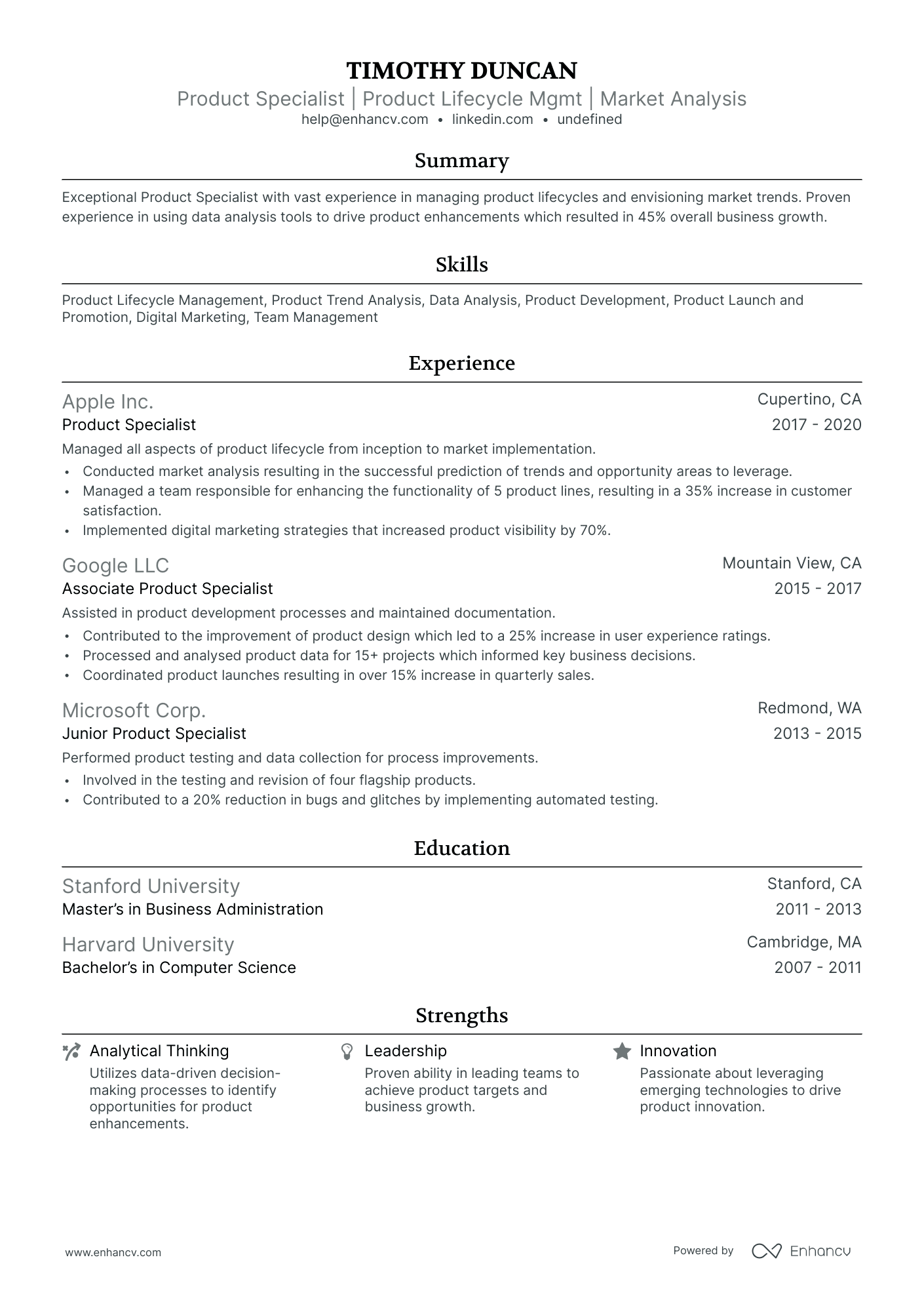
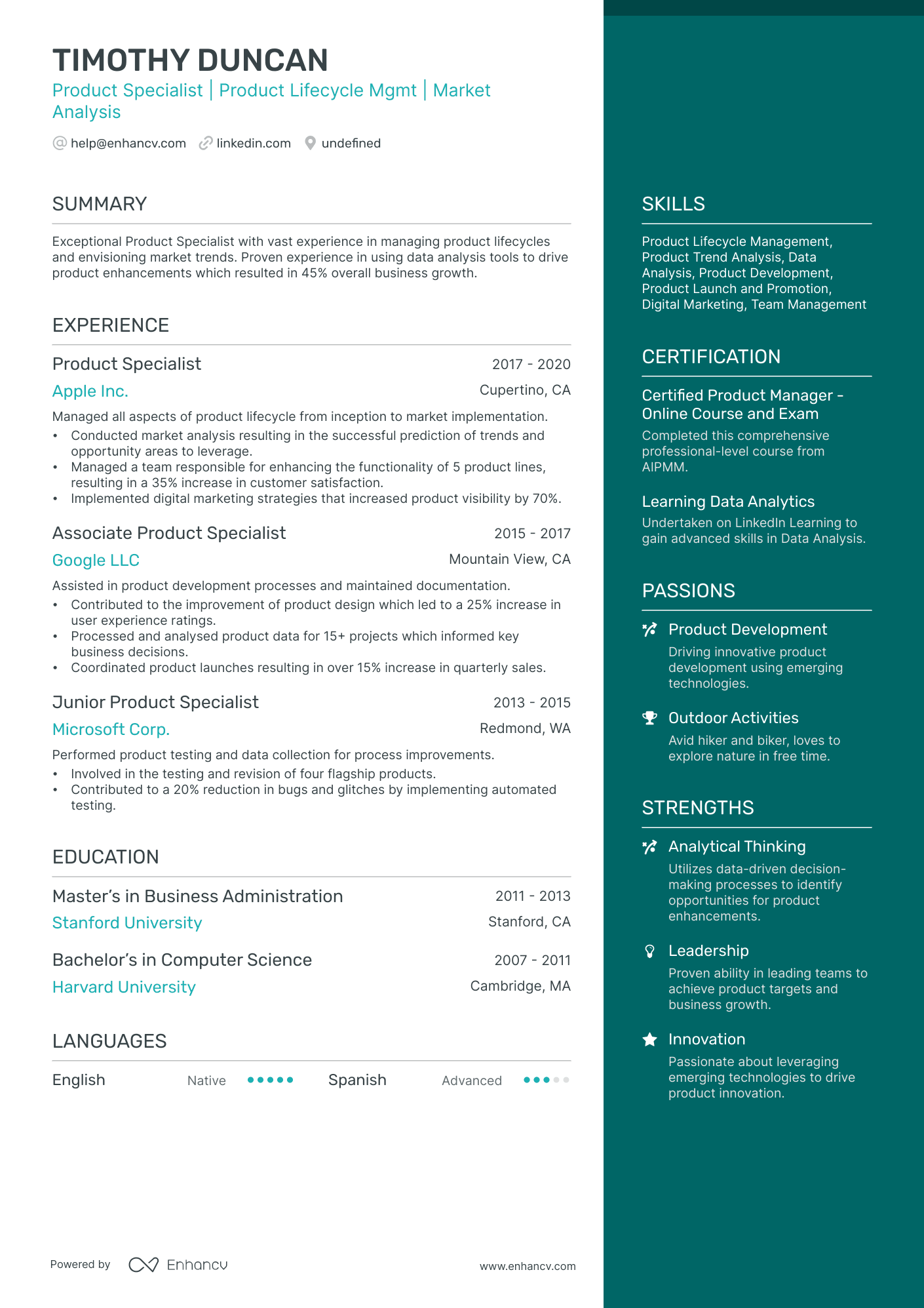
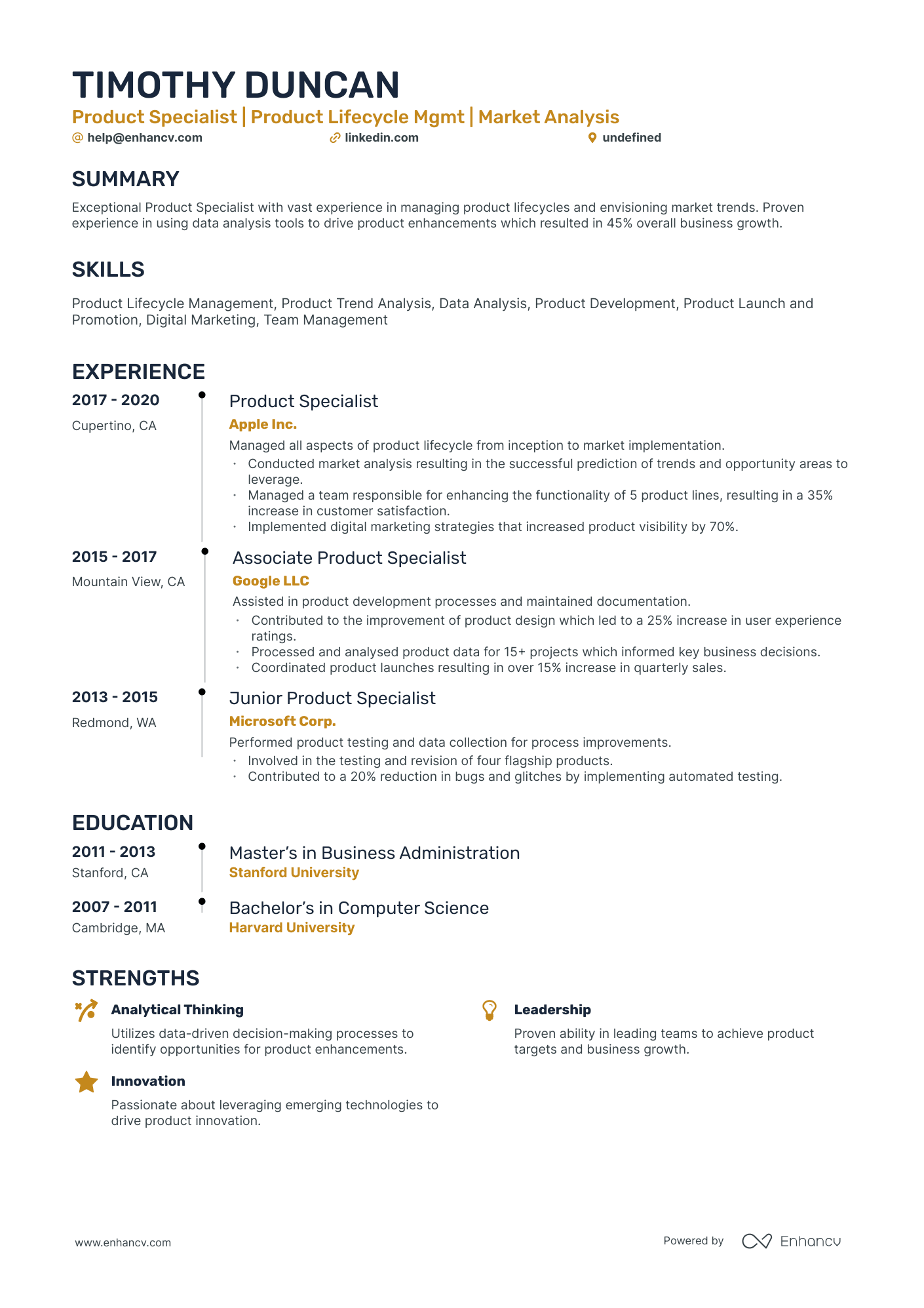
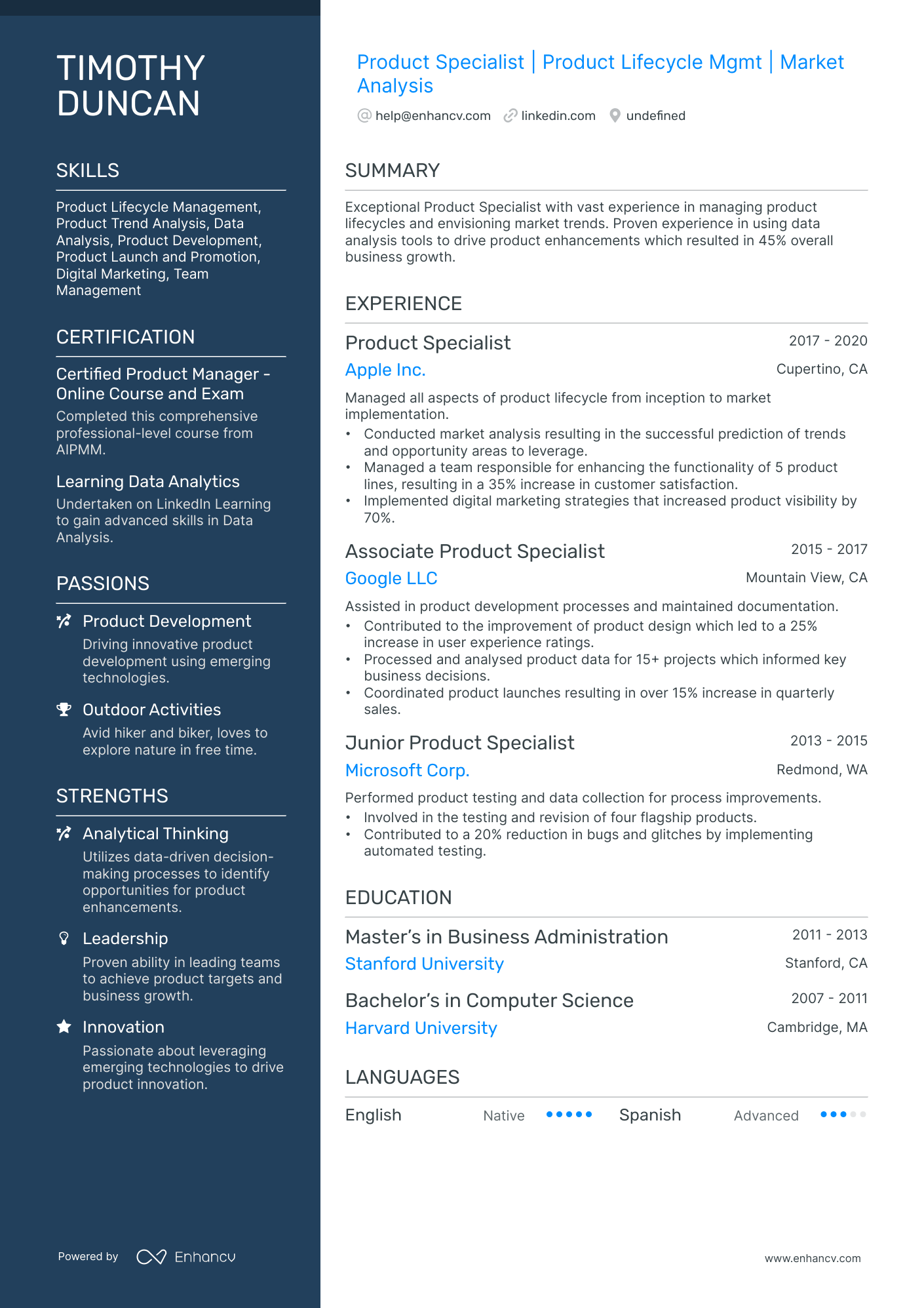
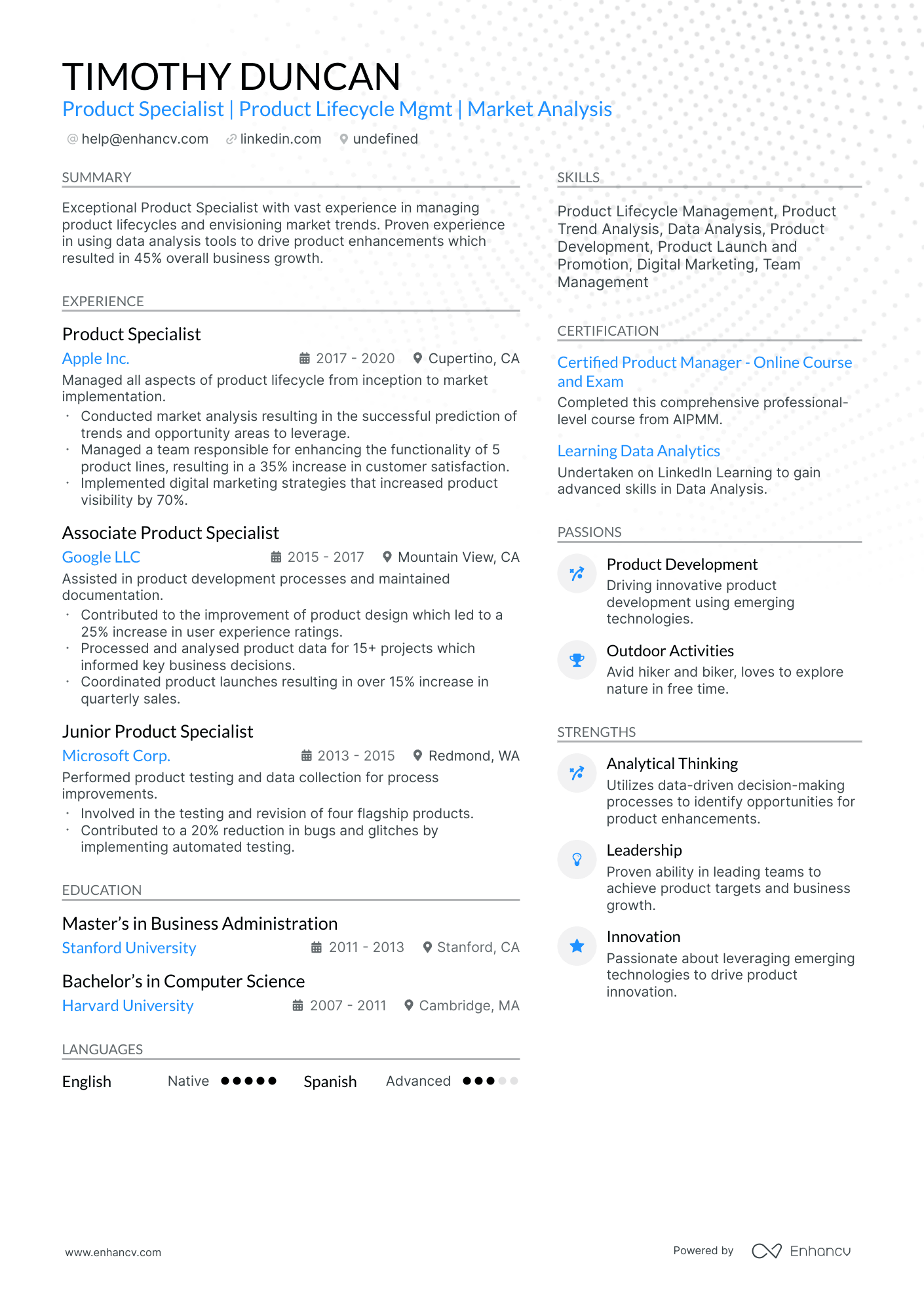
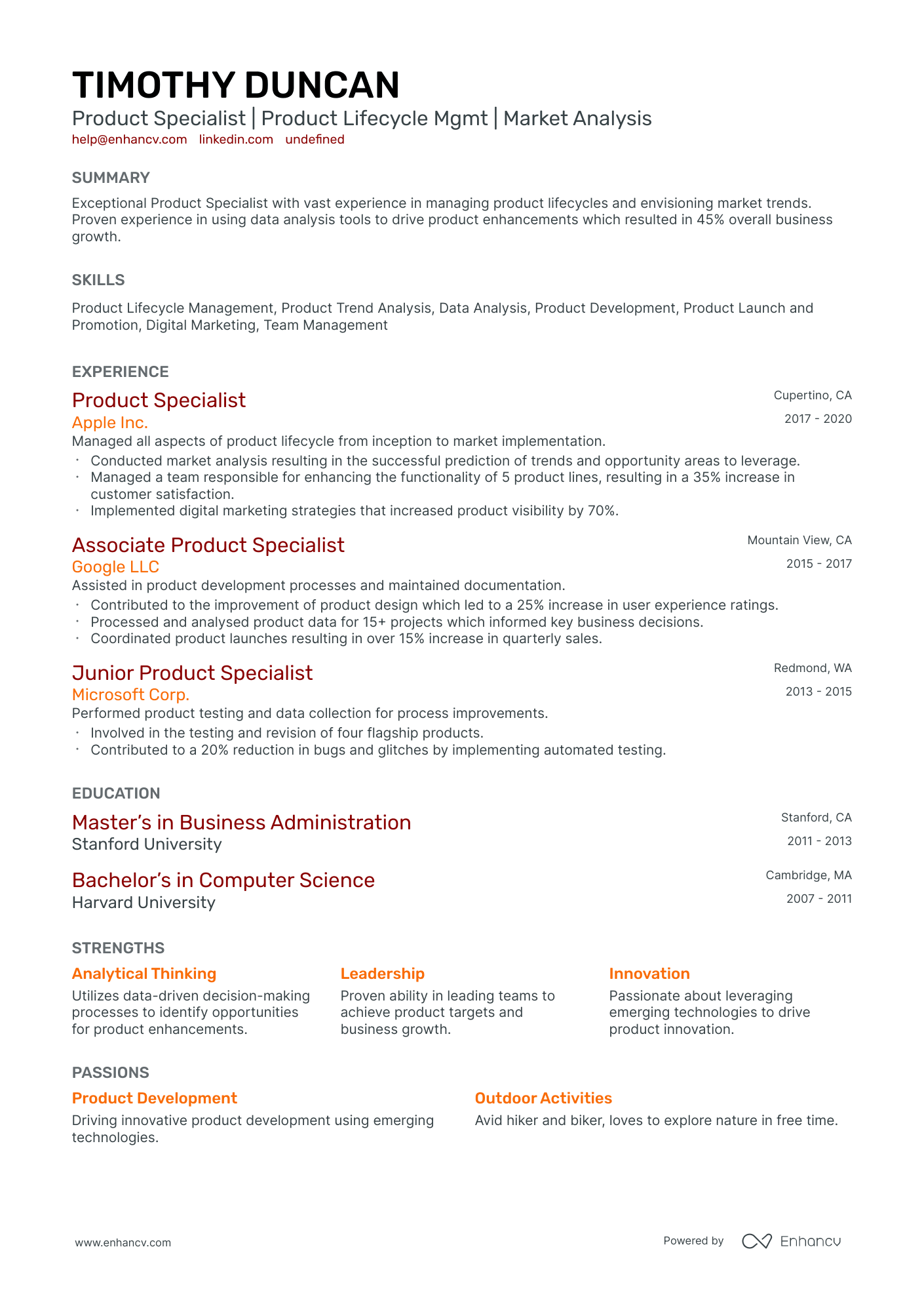
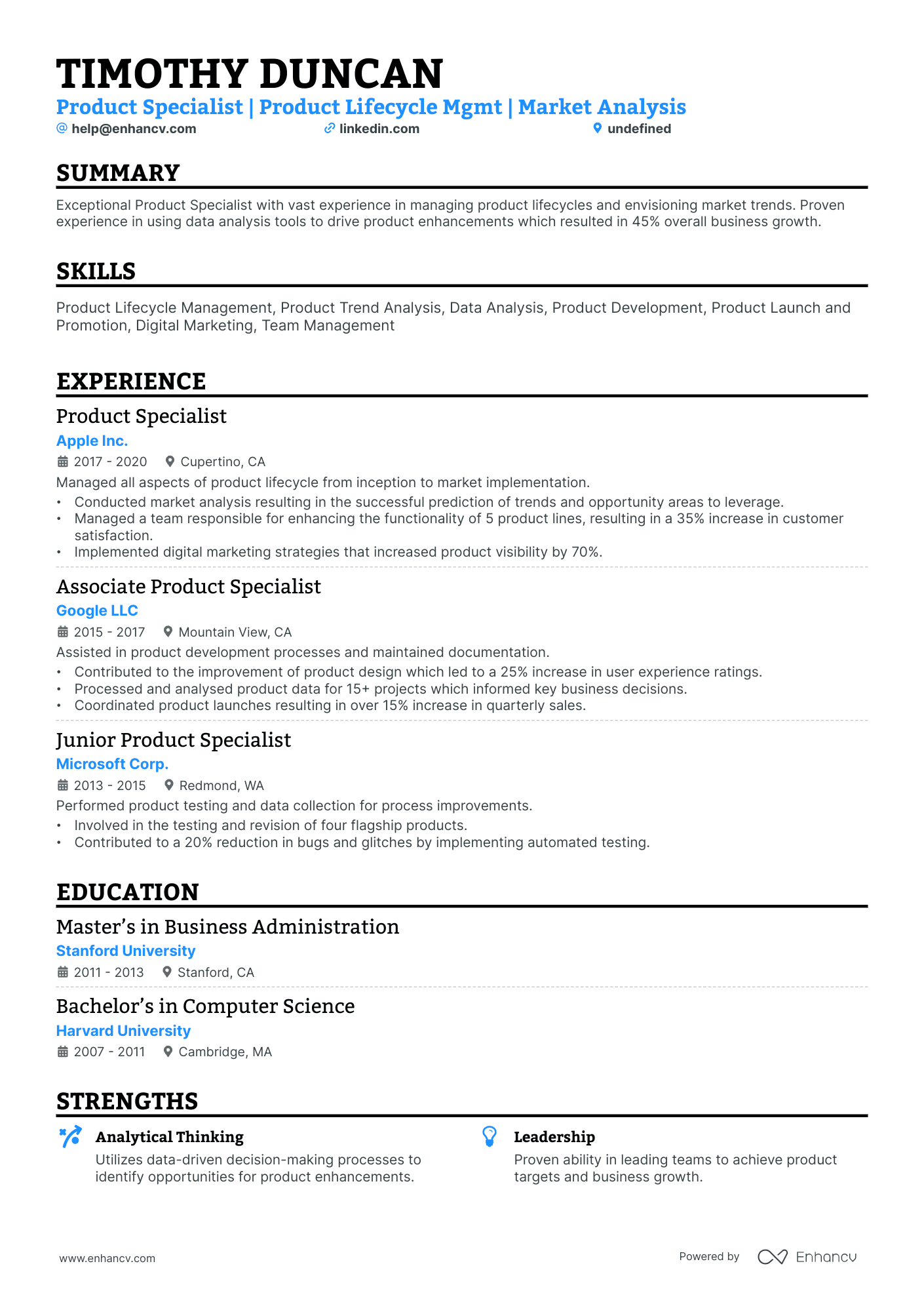
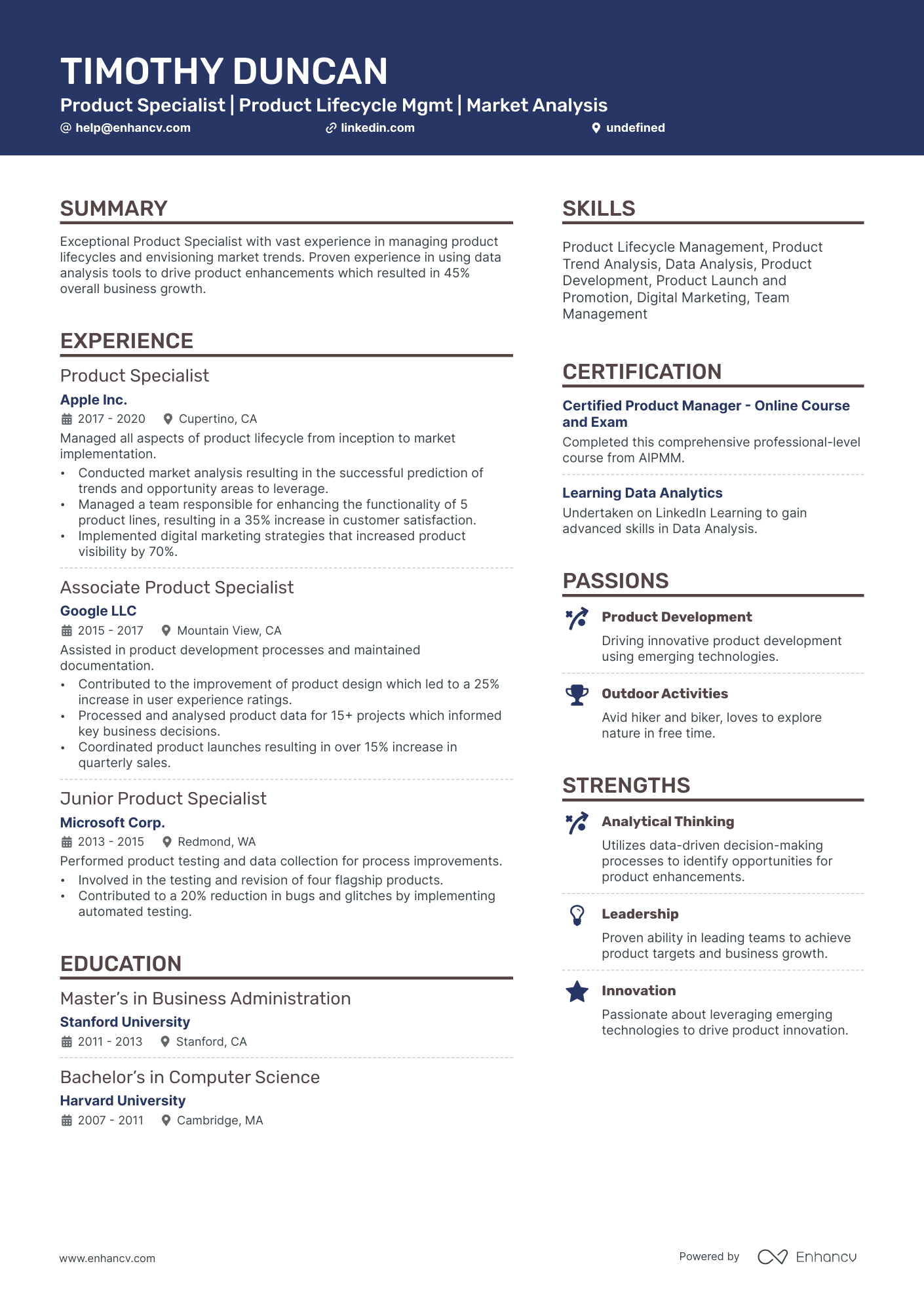
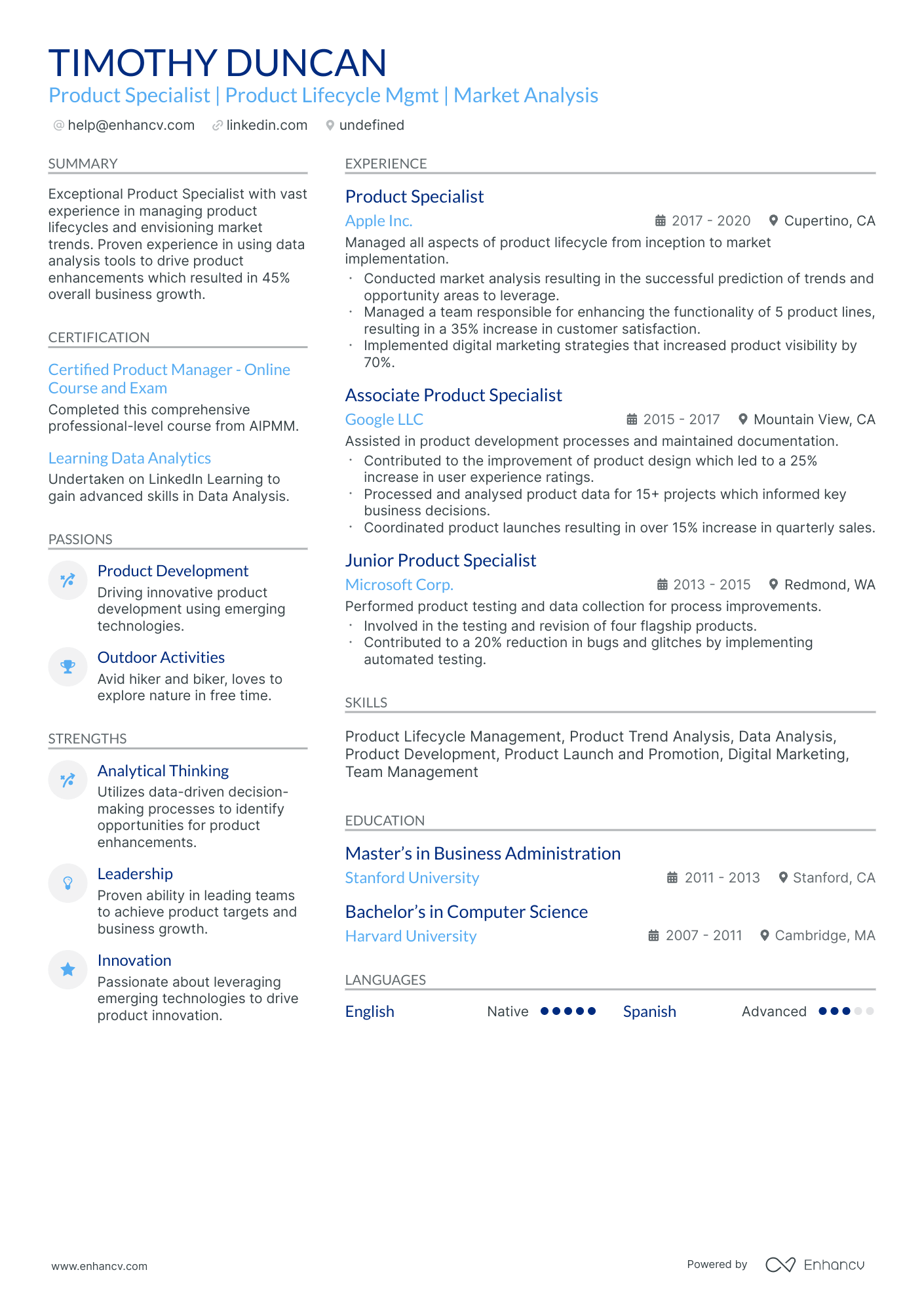
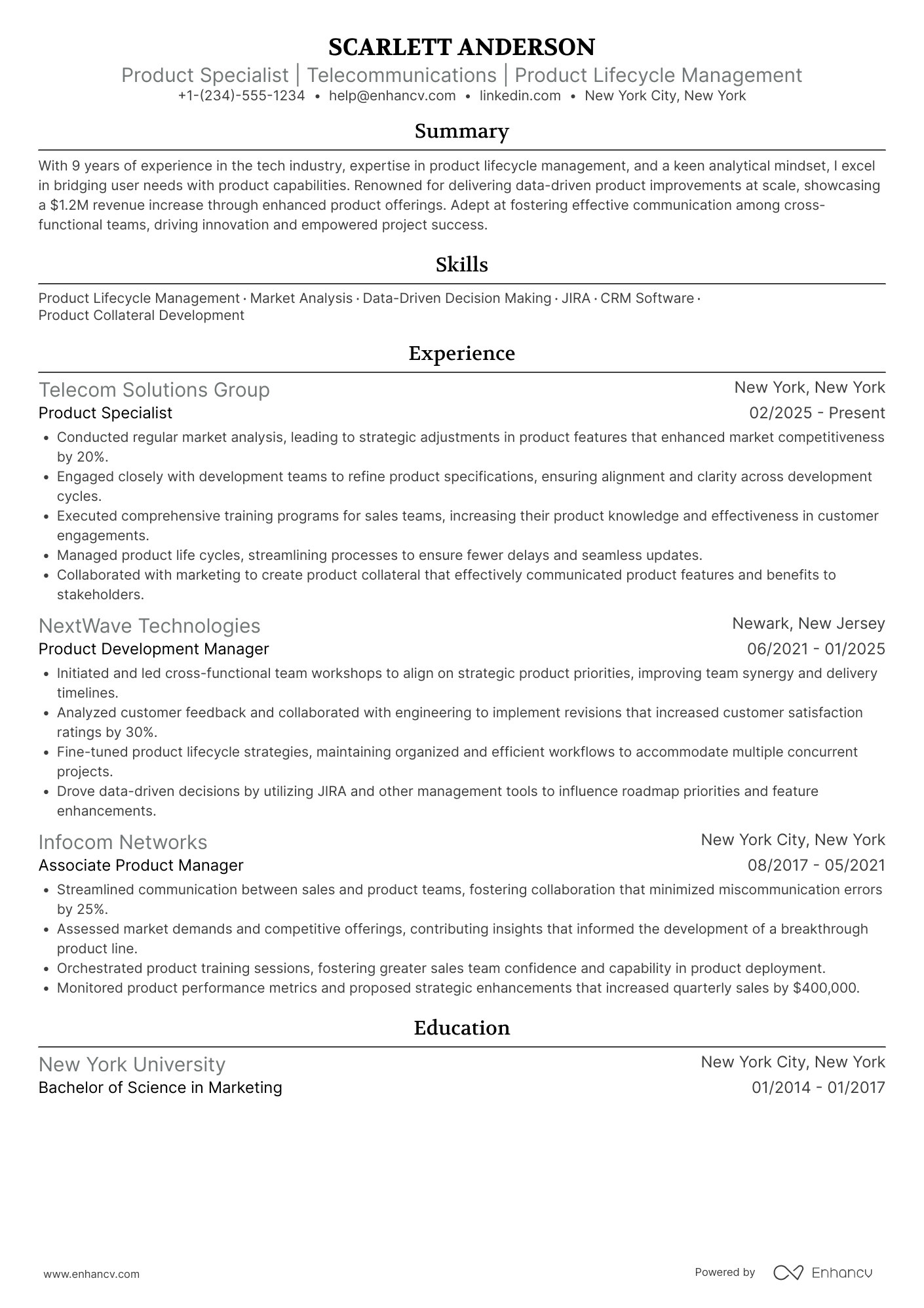
Many product specialist resumes fail because they read like task logs and miss how you drove adoption, revenue, or retention. This product specialist resume guide shows how to earn attention in ATS screening, fast recruiter scans, and crowded applicant pools.
A strong resume proves outcomes, not tools. Knowing how to make your resume stand out means you'll highlight launch results, conversion lift, churn reduction, pipeline influence, and fewer support tickets. Show scope and pace, like accounts supported, regions covered, time-to-resolution, release readiness, and customer satisfaction gains.

Key takeaways
- Quantify product outcomes like adoption, retention, and revenue instead of listing tasks.
- Use reverse-chronological format if experienced and hybrid format if switching careers.
- Tailor every experience bullet to mirror the job posting's tools and terminology.
- Place skills above experience when junior and below experience when senior.
- Demonstrate skills through measurable results in your summary and experience sections.
- Add certifications in product management, analytics, or CRM to strengthen your candidacy.
- Use Enhancv to turn vague duties into quantified, recruiter-ready resume bullets faster.
Job market snapshot for product specialists
We analyzed 726 recent product specialist job ads across major US job boards. These numbers help you understand role specialization trends, regional hotspots, top companies hiring at a glance.
What level of experience employers are looking for product specialists
| Years of Experience | Percentage found in job ads |
|---|---|
| 1–2 years | 12.5% (91) |
| 3–4 years | 9.1% (66) |
| 5–6 years | 8.8% (64) |
| 7–8 years | 2.3% (17) |
| 9–10 years | 0.7% (5) |
| 10+ years | 2.1% (15) |
| Not specified | 62.8% (456) |
Product specialist ads by area of specialization (industry)
| Industry (Area) | Percentage found in job ads |
|---|---|
| Finance & Banking | 46.7% (339) |
| Manufacturing | 18.6% (135) |
| Healthcare | 13.2% (96) |
| Retail & E-commerce | 12.9% (94) |
| Education | 4.8% (35) |
| Government | 1.5% (11) |
Top companies hiring product specialists
| Company | Percentage found in job ads |
|---|---|
| FASTSIGNS | 20.8% (151) |
| Sherwin-Williams | 7.3% (53) |
| American International Group | 4.3% (31) |
| Boeing | 4.3% (31) |
| Medtronic Inc. | 3.0% (22) |
| Camping World | 2.5% (18) |
| Ferrellgas | 2.2% (16) |
| Penske | 1.5% (11) |
Role overview stats
These tables show the most common responsibilities and employment types for product specialist roles. Use them to align your resume with what employers expect and to understand how the role is structured across the market.
Day-to-day activities and top responsibilities for a product specialist
| Responsibility | Percentage found in job ads |
|---|---|
| Excel | 7.3% (53) |
| Project management | 6.2% (45) |
| Microsoft office | 6.1% (44) |
| Quality assurance | 6.1% (44) |
| Adobe illustrator | 4.1% (30) |
| Crm | 3.6% (26) |
| Laminating | 3.6% (26) |
| Vinyl application | 3.6% (26) |
| Outlook | 3.0% (22) |
| Powerpoint | 2.9% (21) |
| Printer operation | 2.9% (21) |
| Microsoft excel | 2.6% (19) |
Type of employment (remote vs on-site vs hybrid)
| Employment type | Percentage found in job ads |
|---|---|
| On-site | 85.1% (618) |
| Hybrid | 9.5% (69) |
| Remote | 5.4% (39) |
How to format a product specialist resume
Recruiters evaluating product specialist resumes prioritize cross-functional collaboration, product knowledge depth, and measurable contributions to product adoption, retention, or revenue. Choosing the right resume format ensures these signals surface quickly during both ATS parsing and the initial human scan.

I have significant experience in this role—which format should I use?
Use a reverse-chronological format to present your product specialist career in a clear, progression-driven narrative. Do:
- Lead with your most recent role and highlight scope of ownership—product lines managed, teams supported, and stakeholder relationships maintained.
- Feature role-specific tools and domains such as CRM platforms, product analytics suites (Mixpanel, Amplitude), A/B testing frameworks, and go-to-market coordination.
- Quantify outcomes tied to product adoption, customer satisfaction, revenue influence, or process improvements.
I'm junior or switching into this role—what format works best?
A hybrid format works best, letting you lead with relevant skills and product knowledge while still showing a concise work history. Do:
- Place a dedicated skills section near the top, spotlighting product management fundamentals, data analysis, customer research methods, and any relevant certifications.
- Include projects, internships, or cross-functional experiences that demonstrate product thinking—even if they come from adjacent roles like customer success, sales engineering, or QA.
- Connect every listed action to a clear outcome so recruiters see cause and effect, not just task descriptions.
Why not use a functional resume?
A functional format strips away the timeline and context recruiters need to evaluate how your product knowledge was applied in real working environments, making it harder to assess growth and reliability.
- Career changers moving into product specialist roles who have no direct product experience but have transferable skills from adjacent fields like technical support, sales, or UX research.
- Candidates with limited work history, such as recent graduates, who need to foreground coursework, product case competitions, or capstone projects.
- Professionals re-entering the workforce after an extended gap who want to emphasize updated skills and recent certifications over employment dates.
Once your layout and formatting choices are in place, the next step is deciding which sections to include so each one reinforces your qualifications as a product specialist.
What sections should go on a product specialist resume
Recruiters expect you to present product knowledge, customer-facing execution, and measurable business impact in a clean, easy-to-scan resume. Understanding what to put on a resume helps you prioritize the right content for this role.
Use this structure for maximum clarity:
- Header
- Summary
- Experience
- Skills
- Projects
- Education
- Certifications
- Optional sections: Awards, Languages, Volunteering
Strong experience bullets should emphasize revenue influence, adoption and retention outcomes, cross-functional scope, and quantified results from launches, enablement, and customer support.
Is your resume good enough?
Drop your resume here or choose a file. PDF & DOCX only. Max 2MB file size.
Once you’ve organized your resume with the right core components, the next step is to write your product specialist experience so it fits that structure and highlights your impact.
How to write your product specialist resume experience
The work experience section is where you prove you've shipped real work—showing hiring managers the products you've supported, the tools and methods you've used, and the measurable outcomes you've driven. Hiring managers prioritize demonstrated impact over descriptive task lists, so every line should connect what you did to a result that mattered.
Each entry should include:
- Job title
- Company and location (or remote)
- Dates of employment (month and year)
Three to five concise bullet points showing what you owned, how you executed, and what outcomes you delivered:
- Ownership scope: the specific products, platforms, market segments, or product lines you were directly accountable for as a product specialist.
- Execution approach: the tools, frameworks, or methods you relied on—such as competitive analysis, user research, product demos, CRM platforms, or go-to-market planning—to inform decisions and deliver work.
- Value improved: the changes you drove in product adoption, customer satisfaction, onboarding efficiency, feature utilization, support resolution, or risk reduction tied to your product specialist responsibilities.
- Collaboration context: how you partnered with product managers, engineering teams, sales, marketing, customer success, or external stakeholders to align on priorities and move initiatives forward.
- Impact delivered: the business outcomes your work produced, expressed through results and scale—such as revenue influence, retention improvements, expansion into new segments, or faster time to value—rather than activities performed.
Experience bullet formula
A product specialist experience example
✅ Right example - modern, quantified, specific.
Product Specialist
Crestline Health | Remote
2022–Present
Supported a HIPAA-compliant patient engagement platform used by two hundred provider groups to automate intake, messaging, and payments.
- Led discovery and triage for product issues in Jira and Zendesk, cutting median time-to-resolution from five days to two days and reducing repeat tickets by 18%.
- Built and maintained product documentation in Confluence and Notion, improving first-contact resolution by 22% and lowering onboarding time for new specialists by 30%.
- Partnered with product managers and designers to run monthly Voice of Customer reviews using Gong and Salesforce data, prioritizing six workflow fixes that lifted activation by 9% quarter over quarter.
- Analyzed funnel and feature adoption in Amplitude and Looker, identifying a drop-off in the payment flow and collaborating with engineers to ship changes that increased completion rate by 12% and reduced chargebacks by 7%.
- Delivered client enablement for enterprise launches via webinars and in-app guides, supporting twenty-three go-lives and contributing to $1.4M in retained annual recurring revenue through improved renewal health scores.
Now that you've seen how a strong experience section comes together, let's look at how to adjust yours to match the specific role you're targeting.
How to tailor your product specialist resume experience
Recruiters evaluate your product specialist resume through both applicant tracking systems and manual review. Tailoring your resume to the job description ensures your qualifications connect directly with what the hiring team needs.
Ways to tailor your product specialist experience:
- Match the exact tools and platforms listed in the job description.
- Mirror the product lifecycle stages the posting emphasizes.
- Use the same terminology for methodologies like Agile or Scrum.
- Reflect KPIs or success criteria the role specifically measures.
- Include relevant domain experience such as SaaS or healthcare.
- Highlight cross-functional collaboration models referenced in the posting.
- Emphasize quality assurance or compliance work when the role requires it.
- Align your customer engagement approach with their stated workflows.
The goal is to present your real accomplishments using language that directly reflects the job requirements, not to force keywords where they don't belong.
Resume tailoring examples for product specialist
| Job description excerpt | Untailored | Tailored |
|---|---|---|
| "Lead cross-functional go-to-market launches for SaaS products, partnering with sales enablement and customer success teams to drive adoption." | Helped launch products and worked with different teams across the company. | Led three cross-functional go-to-market launches for SaaS products, collaborating with sales enablement and customer success to increase user adoption by 34% within the first quarter post-launch. |
| "Conduct competitive analysis and synthesize VOC data using Pendo and Salesforce to inform product positioning and messaging." | Researched competitors and gathered customer feedback to support marketing efforts. | Conducted quarterly competitive analyses and synthesized VOC data from Pendo analytics and Salesforce case records to refine product positioning, directly shaping messaging that improved win rates against two key competitors by 18%. |
| "Own product training and enablement materials for internal stakeholders, ensuring alignment with evolving feature roadmaps." | Created training documents and presentations for internal teams. | Built and maintained a product enablement library—including demo scripts, feature one-pagers, and FAQ docs—for 45 internal stakeholders, updating all materials within 48 hours of each roadmap release to ensure sales and support alignment. |
Once you’ve aligned your experience with the role’s priorities, the next step is to quantify your product specialist achievements so hiring teams can see the impact behind those choices.
How to quantify your product specialist achievements
Quantifying your achievements proves you improved outcomes, not just activity. Focus on adoption, cycle time, accuracy, revenue influence, and risk reduction across launches, support, and cross-functional delivery.
Quantifying examples for product specialist
| Metric | Example |
|---|---|
| Adoption rate | "Increased feature adoption from 28% to 41% in eight weeks by shipping in-app walkthroughs with Pendo and updating help center content." |
| Cycle time | "Cut request-to-resolution time from five days to two days by triaging in Jira, standardizing intake, and adding a weekly stakeholder review." |
| Data accuracy | "Reduced catalog data errors by 35% by building validation rules in Airtable and running a weekly audit across 12,000 stock keeping units." |
| Revenue impact | "Supported upsell motion that added $180,000 in quarterly recurring revenue by packaging three add-ons and enabling sales with one-pagers and demos." |
| Risk reduction | "Lowered compliance exceptions from 14 per quarter to four by tightening approval workflows and documenting controls for two regulated product areas." |
Turn vague job duties into measurable, recruiter-ready resume bullets in seconds with Enhancv's Bullet Point Generator.
Once you've crafted strong bullet points to showcase your experience, you'll want to pair them with a well-organized skills section that highlights both your hard and soft skills.
How to list your hard and soft skills on a product specialist resume
Your skills section shows how you support product decisions and launches, and recruiters and ATS scan it to confirm role fit fast—aim for a balanced mix of hard skills (tools and methods) and soft skills (cross-functional execution). product specialist roles require a blend of:
- Product strategy and discovery skills.
- Data, analytics, and experimentation skills.
- Delivery, execution, and go-to-market discipline.
- Soft skills.
Your skills section should be:
- Scannable (bullet-style grouping).
- Relevant to the job post.
- Backed by proof in experience bullets.
- Updated with current tools.
Place your skills section:
- Above experience if you're junior or switching careers.
- Below experience if you're mid/senior with strong achievements.

Hard skills
- Product requirements documents
- User stories, acceptance criteria
- Backlog management, prioritization
- Jira, Confluence
- Figma, Miro
- SQL, Excel, Google Sheets
- Tableau, Power BI, Looker
- Google Analytics 4, Mixpanel, Amplitude
- A/B testing, experimentation design
- API basics, Postman
- Zendesk, Salesforce
- Go-to-market enablement
Soft skills
- Translate customer needs into requirements
- Align stakeholders on priorities
- Run structured discovery interviews
- Write clear, actionable documentation
- Communicate tradeoffs and risks
- Facilitate cross-functional meetings
- Coordinate timelines and dependencies
- Triage issues and unblock teams
- Make data-informed decisions
- Own outcomes end-to-end
- Partner effectively with sales and support
- Present updates to executives
How to show your product specialist skills in context
Skills shouldn't live only in a dedicated skills list. Browse examples of resume skills to see how other professionals present theirs effectively.
They should be demonstrated in:
- Your summary (high-level professional identity)
- Your experience (proof through outcomes)
Here's what that looks like in practice.
Summary example
Senior product specialist with eight years in B2B SaaS, skilled in competitive analysis, Pendo, and cross-functional roadmap planning. Led a product repositioning initiative that increased enterprise deal close rates by 22%.
- Signals senior-level depth immediately
- Names role-relevant tools and methods
- Leads with a concrete metric
- Shows strategic and collaborative thinking
Experience example
Senior Product Specialist
Torq Systems | Remote
March 2020–Present
- Partnered with product management and engineering to redesign the onboarding flow in Pendo, reducing time-to-value by 34% across 1,200 accounts.
- Conducted quarterly competitive analyses using Klue, directly informing positioning updates that lifted win rates by 18%.
- Led cross-functional enablement sessions for 40+ sales reps, improving product demo conversion rates by 15% within two quarters.
- Every bullet includes measurable proof.
- Skills surface naturally through real outcomes.
Once you’ve demonstrated your product specialist strengths through relevant examples, the next step is to apply that approach to structuring a product specialist resume when you have no experience.
How do I write a product specialist resume with no experience
Even without full-time experience, you can demonstrate readiness through:
- Customer support ticket analysis projects
- Product demos for student groups
- Retail sales product comparisons
- Internship in product operations
- Volunteer CRM data cleanup
- User research interviews and notes
- QA testing of new features
- E-commerce listing optimization work
If you're starting out, our guide on writing a resume without work experience walks you through how to position these types of activities effectively.
Focus on:
- Product knowledge tied to outcomes
- Data-driven insights and reporting
- Customer feedback to product changes
- Tool fluency: CRM, spreadsheets
Resume format tip for entry-level product specialist
Use a hybrid resume format. It highlights skills and projects first, then supports them with education and any relevant roles. Do:
- Add a "Projects" section near top.
- Match keywords to each job post.
- Quantify results with clear metrics.
- List tools used for each project.
- Link to a portfolio or case study.
- Analyzed 250 customer support tickets in Zendesk, tagged top five issues, and delivered a spreadsheet report that cut repeat tickets by 12% in four weeks.
Even without direct experience, your educational background can serve as a strong foundation for your product specialist resume—here's how to present it effectively.
How to list your education on a product specialist resume
Your education section helps hiring teams confirm you have the foundational knowledge needed for the role. It validates your background in business, marketing, technology, or related fields quickly.
Include:
- Degree name
- Institution
- Location
- Graduation year
- Relevant coursework (for juniors or entry-level candidates)
- Honors & GPA (if 3.5 or higher)
Skip month and day details—list the graduation year only.
Here's a strong education entry tailored to the product specialist role.
Example education entry
Bachelor of Science in Marketing
University of Michigan, Ann Arbor, MI
Graduated 2021
GPA: 3.7/4.0
- Relevant coursework: Consumer Behavior, Product Management, Data Analytics, Digital Marketing Strategy
- Honors: Dean's List, Magna Cum Laude
How to list your certifications on a product specialist resume
Certifications on your resume show a product specialist's commitment to learning, hands-on tool proficiency, and industry relevance, helping you stand out in fast-changing product environments.
Include:
- Certificate name
- Issuing organization
- Year
- Optional: credential ID or URL
- Place certifications below education when they're older, less relevant, or you already have strong product specialist experience and recent roles.
- Place certifications above education when they're recent, highly relevant, or they support a pivot into a product specialist role.
Best certifications for your product specialist resume
- Certified Scrum Product Owner (CSPO)
- Professional Scrum Product Owner (PSPO I)
- Pragmatic Institute Product Management Certification
- Google Analytics Certification
- Salesforce Certified Administrator
- HubSpot Content Marketing Certification
- ITIL 4 Foundation
Once you’ve positioned your credentials where hiring teams can find them, shift to your product specialist resume summary to reinforce that expertise in a clear, results-focused snapshot.
How to write your product specialist resume summary
Your resume summary is the first thing a recruiter reads. A strong one immediately signals you're a fit for the product specialist role.
Keep it to three to four lines, with:
- Your title and relevant years of experience in product-focused roles.
- The domain, industry, or product type you know best.
- Core tools and skills such as CRM platforms, analytics software, or product demo expertise.
- One or two quantified achievements that show measurable impact.
- Soft skills tied to real outcomes, like cross-functional collaboration that shortened onboarding cycles.

PRO TIP
At this level, prioritize clarity and relevance over breadth. Highlight specific tools, concrete skills, and early wins that prove you can contribute fast. Avoid vague phrases like "passionate team player" or "motivated self-starter." Recruiters want evidence, not enthusiasm.
Example summary for a product specialist
Product specialist with two years of experience supporting B2B SaaS onboarding. Skilled in Salesforce, Jira, and product demos. Reduced client time-to-value by 18% through streamlined training workflows.
Optimize your resume summary and objective for ATS
Drop your resume here or choose a file.
PDF & DOCX only. Max 2MB file size.
Now that your summary is ready to showcase your value, make sure the header above it presents your contact details and professional identity correctly.
What to include in a product specialist resume header
Your resume header lists your key contact and profile details, and it boosts visibility, credibility, and recruiter screening for a product specialist.
Essential resume header elements
- Full name
- Tailored job title and headline
- Location
- Phone number
- Professional email
- GitHub link
- Portfolio link
A LinkedIn link lets recruiters verify your experience quickly and supports screening.
Don't include a photo on a product specialist resume unless the role is explicitly front-facing or appearance-dependent.
Match your header job title to the posting and keep every link and contact detail current, consistent, and easy to scan.
Example
Product specialist resume header
Jordan Lee
Product Specialist | SaaS Onboarding, Product Demos, Customer Enablement
Austin, TX
(512) 555-12XX
jordan.lee@enhancv.com
github.com/jordanlee
yourwebsite.com
linkedin.com/in/jordanlee
Once your contact details and role branding are clear at the top, add targeted additional sections to reinforce your fit and provide supporting context.
Additional sections for product specialist resumes
When your core sections don't fully capture your expertise, additional sections help you stand out and reinforce your product specialist credibility. For example, listing language skills can be especially valuable if the role involves international products or multilingual user bases.
- Languages
- Certifications
- Industry conferences and speaking engagements
- Publications and thought leadership
- Technical proficiencies
- Professional affiliations
- Volunteer experience in product-related initiatives
Once you've rounded out your resume with the right supplementary sections, it's worth turning your attention to the document that accompanies it—your cover letter.
Do product specialist resumes need a cover letter
A cover letter isn't required for a product specialist, but it helps in competitive searches or when hiring managers expect one. If you're unsure where to start, understanding what a cover letter is and how it complements your resume can clarify when it's worth writing one.
Use a cover letter when it adds clarity and proof:
- Explain role and team fit by naming the product area, stakeholders, and workflows you've supported, and why they match this product specialist role.
- Highlight one or two relevant projects or outcomes, and tie them to metrics like adoption, retention, support deflection, or sales enablement.
- Show understanding of the product, users, and business context by referencing target users, key use cases, and the company's goals or constraints.
- Address career transitions or non-obvious experience by mapping past work to product specialist tasks, and stating what you'll do on day one.
Drop your resume here or choose a file.
PDF & DOCX only. Max 2MB file size.
Once you’ve decided whether a cover letter adds value to your application, you can use AI to strengthen your product specialist resume faster and more consistently.
Using AI to improve your product specialist resume
AI can sharpen your resume's clarity, structure, and impact. It helps tighten language and highlight results. But overuse strips authenticity fast. If you're exploring this approach, our guide on ChatGPT resume writing prompts offers practical starting points. Once your content feels clear and role-aligned, step away from AI.
Here are 10 practical prompts to strengthen specific sections of your product specialist resume:
- Sharpen your summary. "Rewrite my product specialist resume summary to highlight measurable achievements and core competencies in under four sentences."
- Quantify experience bullets. "Add specific metrics and outcomes to each experience bullet on my product specialist resume without inventing any data."
- Align skills section. "Compare my product specialist skills section against this job description and flag missing keywords I should add."
- Strengthen action verbs. "Replace weak or repetitive verbs in my product specialist experience section with stronger, more precise alternatives."
- Tighten project descriptions. "Condense each project entry on my product specialist resume to two lines while preserving scope, tools, and results."
- Improve education relevance. "Rewrite my education section to emphasize coursework and achievements most relevant to a product specialist role."
- Clarify certification value. "For each certification on my product specialist resume, add one sentence explaining its direct relevance to the role."
- Remove filler language. "Identify and remove vague or redundant phrases across my entire product specialist resume."
- Tailor for ATS. "Restructure my product specialist resume bullets to naturally incorporate keywords from this specific job posting."
- Check consistency. "Review my product specialist resume for inconsistent formatting, tense shifts, and misaligned date ranges across all sections."
Stop using AI once your resume sounds accurate, specific, and aligned with real experience. AI should never invent experience or inflate claims—if it didn't happen, it doesn't belong here.
Conclusion
A strong product specialist resume proves impact with measurable outcomes, shows role-specific skills, and follows a clear structure. Use concise bullets, consistent formatting, and targeted keywords to make your experience easy to scan.
Hiring teams want product specialists who can drive adoption, support sales, and improve customer outcomes. A focused, results-based resume shows you’re ready for today’s market and the roles ahead.