Every business analyst cover letter that lands an interview has one thing the rest don’t: a specific number tied to a real problem.
Not “improved operational efficiency.” A dollar figure. A percentage. A cycle-time reduction.
Most applicants rely on generic claims about analytical skills. These don’t hold attention—and hiring managers move on quickly.
The numbers you open with also have to appear, in fuller form, on the resume it ships with — our business analyst resume guide covers how to land the dollar figures, cycle-time deltas, and stakeholder scope in bullet form.
Hiring managers reviewing BA roles scan for evidence of business impact, measurable change, and clear thinking.

Key takeaways
- Open with a quantified business outcome tied to a specific issue.
- Name the company, division, and role—generic letters signal mass applying.
- Include your credential chain early: degree, CBAP, CCBA, PMI-PBA, or technical certifications.
- Show one process or requirements achievement with before-and-after numbers.
- Demonstrate you can bridge business stakeholders and engineering teams.
- Keep it to one page. Hiring managers reviewing BA roles move fast.
What is a business analyst cover letter?
A business analyst cover letter is a one-page document that explains how your work has improved business processes, reduced costs, or supported decision-making.
It complements your resume by adding context—how you approach problems, gather requirements, and translate them into measurable outcomes.
Why most business analyst cover letters fail:
- They describe responsibilities instead of results.
- They don’t include real metrics or outcomes.
- They fail to connect experience to the company’s actual business.
Business analyst cover letter example
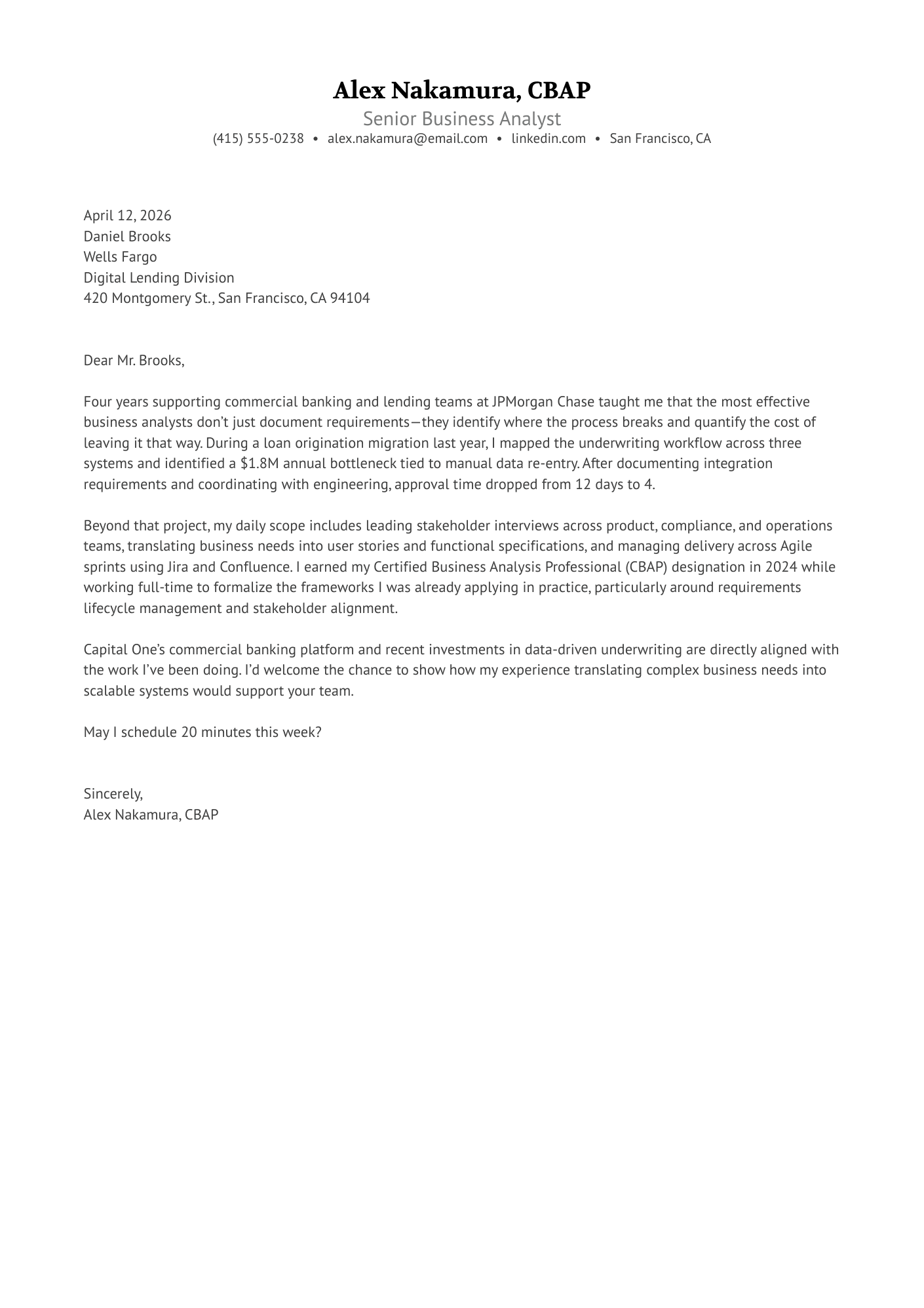
Before breaking down structure and strategy, it helps to see what a strong business analyst cover letter looks like in practice.
Alex Nakamura, CBAP
San Francisco, CA
(415) 555-0238
alex.nakamura@email.com
April 12, 2026
Daniel Brooks
Wells Fargo
Digital Lending Division
Alex Nakamura, CBAP


Why this works:
- Starts with a clear, quantified problem. The $1.8M bottleneck signals immediate impact.
- Follows a logical flow. Problem → approach → result—easy to scan and credible.
- Integrates credentials naturally. CBAP is tied to real work, not listed in isolation.
- Shows cross-functional experience. Highlights collaboration across business and technical teams.
- Targets the company directly. Mentions relevant work aligned with the division.
- Keeps language tight and professional. No filler—every line adds value.
What hiring managers scan for
Hiring managers reviewing BA cover letters run through a simple checklist:
1. Can you gather and document requirements?
- Clearly describe your methodology, including stakeholder interviews, process mapping, user stories, and formal BRDs.
- Show how you structure requirements so they are usable by both business and technical teams.
- Indicate the scale of your work, such as the number of stakeholders, systems, or business units involved.
2. Have you solved a real business problem?
- Name the specific issue, what it was costing the business, and what changed as a result of your work.
- Walk them through your approach, not just the outcome, to show how you arrived at the solution.
- Include measurable results such as cost savings, cycle-time reduction, or error rate improvement.
3. Do you understand this company?
- Reference the company’s product, platform, or business line to show relevant context.
- Connect your experience directly to the challenges or initiatives the company is likely facing.
- Avoid generic statements that could apply to any company or role.
4. Can you work across business and technical teams?
- Show that you can translate business needs into technical requirements and vice versa.
- Demonstrate experience working with both stakeholders and engineering teams.
- Mention specific tools or processes, such as Jira, Agile ceremonies, or backlog management.
Knowing what hiring managers look for is only half the job—the rest is organizing your cover letter so those details are clear at a glance.
Cover letter structure for business analysts
A business analyst cover letter should follow a clean, predictable format.

Required sections:
- Header with contact details and credentials
- Date and employer information
- Named salutation
- Opening paragraph (key achievement)
- Body (impact + tools + alignment)
- Closing paragraph (direct ask)
- Professional sign-off
Formatting rules
- Font: clean, readable (10–12 pt)
- Alignment: left-aligned text
- Length: one page
- Layout: no graphics or unnecessary styling
Hiring managers expect clarity—structured writing reflects structured thinking.
What recruiters look for in business analyst candidates
Recruiters screen for a mix of analytical ability and execution.
They look for:
- Requirements documentation (BRDs, user stories, use cases)
- Quantified outcomes (cost, time, revenue, error reduction)
- Tools: SQL, Tableau, Power BI, Jira, Confluence
- Stakeholder management across teams
- Domain knowledge (finance, healthcare, SaaS, etc.)
- Process methodology (Agile, Lean, Six Sigma, BABOK)
Before any of that matters, your cover letter needs to reach the right person—otherwise even strong content goes unnoticed.
How to address a business analyst cover letter
“To Whom It May Concern” signals zero effort.
For a role built on stakeholder discovery, that’s a red flag.
Check:
- job posting
- company site
Use:
- “Dear [First Name] [Last Name]”
- or “Dear [Team Name] Hiring Team” if necessary
How to open a business analyst cover letter
Your opening paragraph determines whether the rest gets read.
A strong opener includes:
- scope or context
- a measurable result
- clear role positioning
Strong example:
I’m a CBAP-certified business analyst working on JPMorgan Chase’s Consumer Banking BI team. In my most recent project, I identified a $1.8M bottleneck in underwriting during a loan origination migration affecting 2.4M accounts.
Weak example:
I am writing to express my interest in the Business Analyst position.
A strong opening gets attention—now the body needs to back it up with clear, relevant evidence.
How to write the body of your business analyst cover letter
Keep this section focused and structured.
Paragraph 1: Business impact
Show:
- the problem
- your approach
- the result
Business impact example:
Mapped underwriting workflows across three systems, identified duplicate data entry, documented integration requirements, and tracked adoption across 14 branches—reducing approval time from 12 days to 4.
Paragraph 2: Tools and execution
Include:
- SQL, Tableau, Power BI
- Jira, Confluence
- Agile or process frameworks
Paragraph 3: Company alignment (optional)
One sentence is enough:
“Your commercial banking platform aligns with my experience in large-scale financial system migrations.”
What to include vs. skip
| Named tools (SQL, Tableau, Jira) | “Strong analytical skills” |
|---|---|
| Quantified outcomes | Generic responsibilities |
| Stakeholder scale | “Team player” |
| Process improvements | Vague process descriptions |
The body establishes your value—the closing turns it into a next step.
How to close a business analyst cover letter
Strong closing:
I’d welcome the opportunity to discuss how my financial services experience and requirements work could support your team. I’m available for a call this week.
Avoid:
“I look forward to hearing from you.”
Drop your resume here or choose a file.
PDF & DOCX only. Max 2MB file size.
That structure works for experienced candidates—but it needs to be adapted if you’re earlier in your career.
Business analyst cover letter with no experience
You can still write a strong cover letter by focusing on relevant work.
Lead with:
- Academic projects
- Internships
- Data analysis work
- Stakeholder exposure
Entry-level BA formula:
[Degree] + [tools] + [project] + [deliverable] + [result]
No-experience opener
For my capstone project, I conducted stakeholder interviews, documented CRM requirements, and recommended a migration to Salesforce. The resulting document was used for vendor evaluation.
Frequently asked questions
Even strong candidates hesitate on the details. These are the most common questions business analysts ask when writing a cover letter.
What should a business analyst cover letter include?
Your degree, certifications, tools, domain experience, and one measurable achievement tied to a real business problem.
How long should a business analyst cover letter be?
One page. Three to four paragraphs. Hiring managers move fast.
What makes a business analyst cover letter stand out?
Specificity. Real numbers. Clear business impact.
How do I write a business analyst cover letter with no experience?
Focus on projects, coursework, and internships. Structure them as Problem → Approach → Result.

PRO TIP
Time to focus on structuring your experience around real business impact—problem, approach, and measurable result. Enhancv’s Cover Letter Builder helps you organize your content clearly, so you can spend less time formatting and more time showing how your work moved the numbers.
Final thoughts
A strong business analyst cover letter doesn’t try to impress—it shows how you think.
If your letter makes it easy to understand the problems you’ve solved and the outcomes you’ve delivered, you give yourself a real chance of getting more interviews.