Hiring managers at law firms spend about six seconds on the first pass. The legal assistant cover letter that survives that pass does one thing the other 50 don’t: it leads with evidence instead of adjectives.
Most applicants rely on generic phrases like “detail-oriented” or “highly motivated.” These describe nothing—and hiring managers skip them immediately.
Managing partners and office administrators read for specifics—tools you use by name, volumes you’ve managed, and deadlines you’ve owned.
The letter only earns the second read if the resume beside it does the same — our legal assistant resume guide shows how to surface case volume, e-discovery tools, and practice-area scope a hiring paralegal manager screens for.

Key takeaways
- Open with a specific achievement or contribution, not a statement of interest.
- Name your credentials (CLA, ACP, PACE) and tie them to real work.
- Reference the firm's practice area and show how your experience aligns.
- Include at least one number—documents processed, deadlines managed, cases supported.
- Keep it to one page. Attorneys don't read long cover letters.
- Match the tone: formal, precise, direct—the way legal writing is.
- Address to a specific person. "To Whom It May Concern" signals zero research effort.
What is a legal assistant cover letter?
A legal assistant cover letter is a one-page document that explains how your experience supports a law firm’s workflow, case volume, and practice area.
It complements your resume by adding context—how you manage deadlines, support attorneys, and handle legal documentation.
Why most legal assistant cover letters fail:
- They rely on generic traits instead of measurable contributions.
- They don’t reference a specific practice area.
- They fail to show ownership of deadlines or workload.
Legal assistant cover letter example
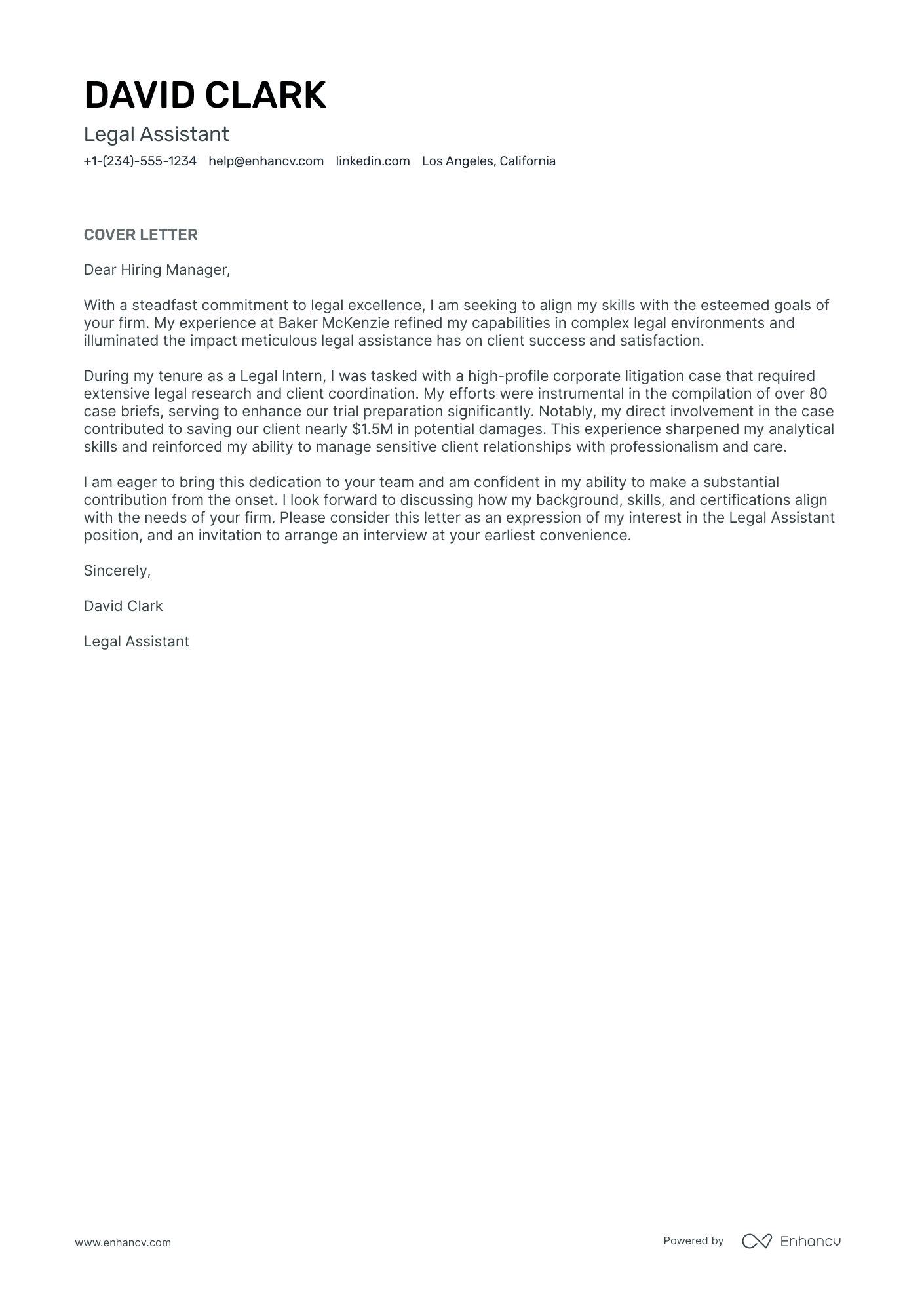
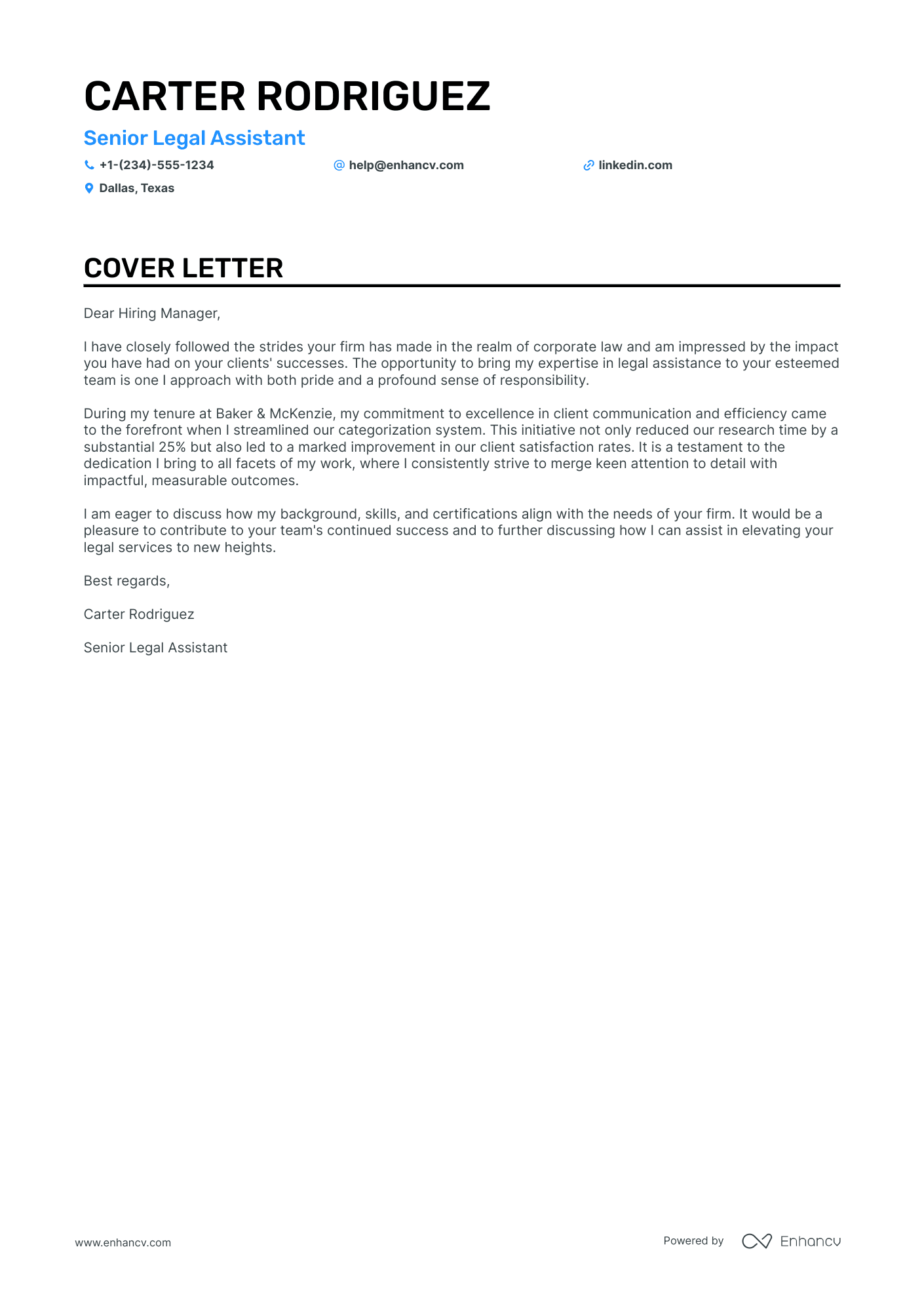
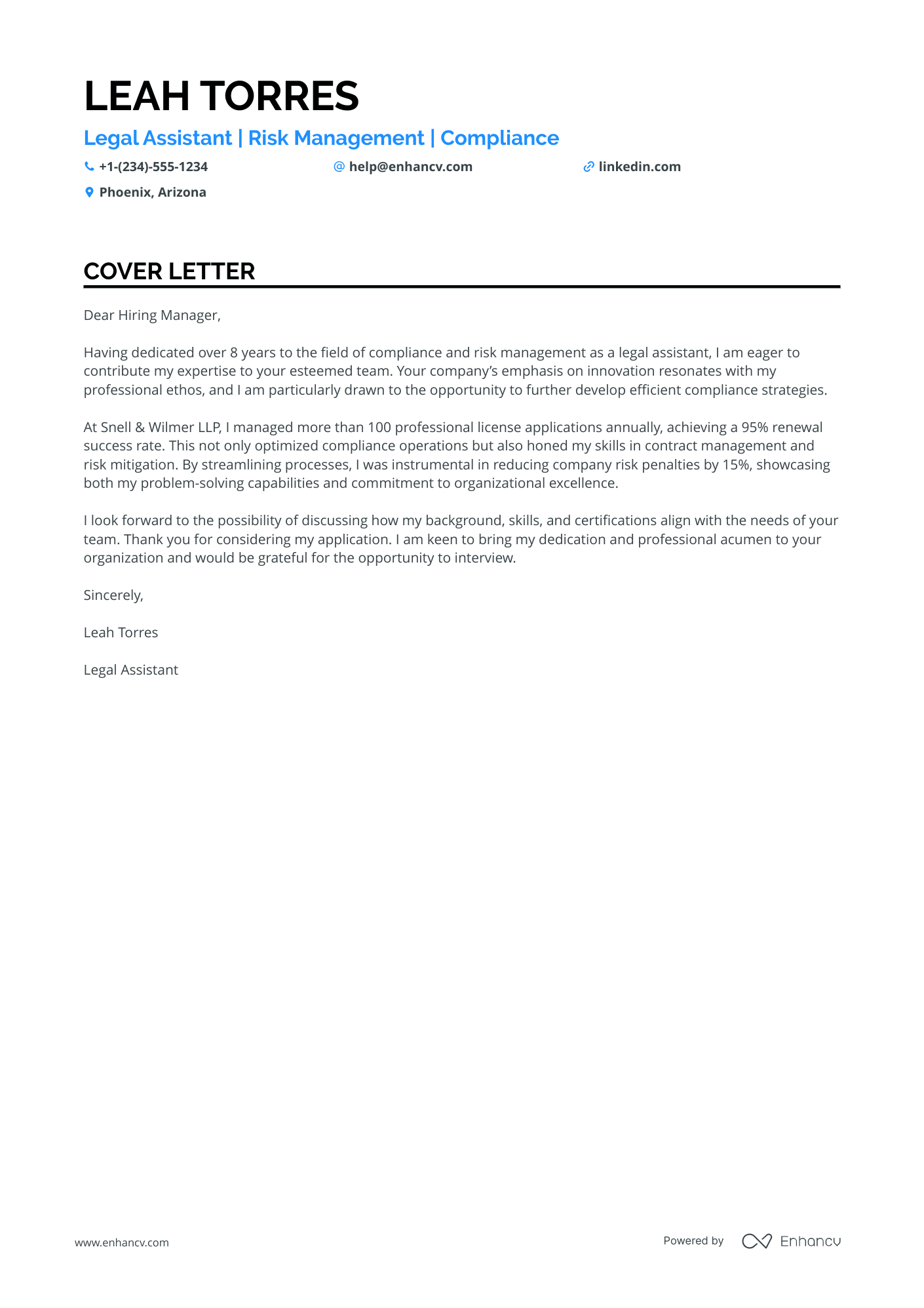
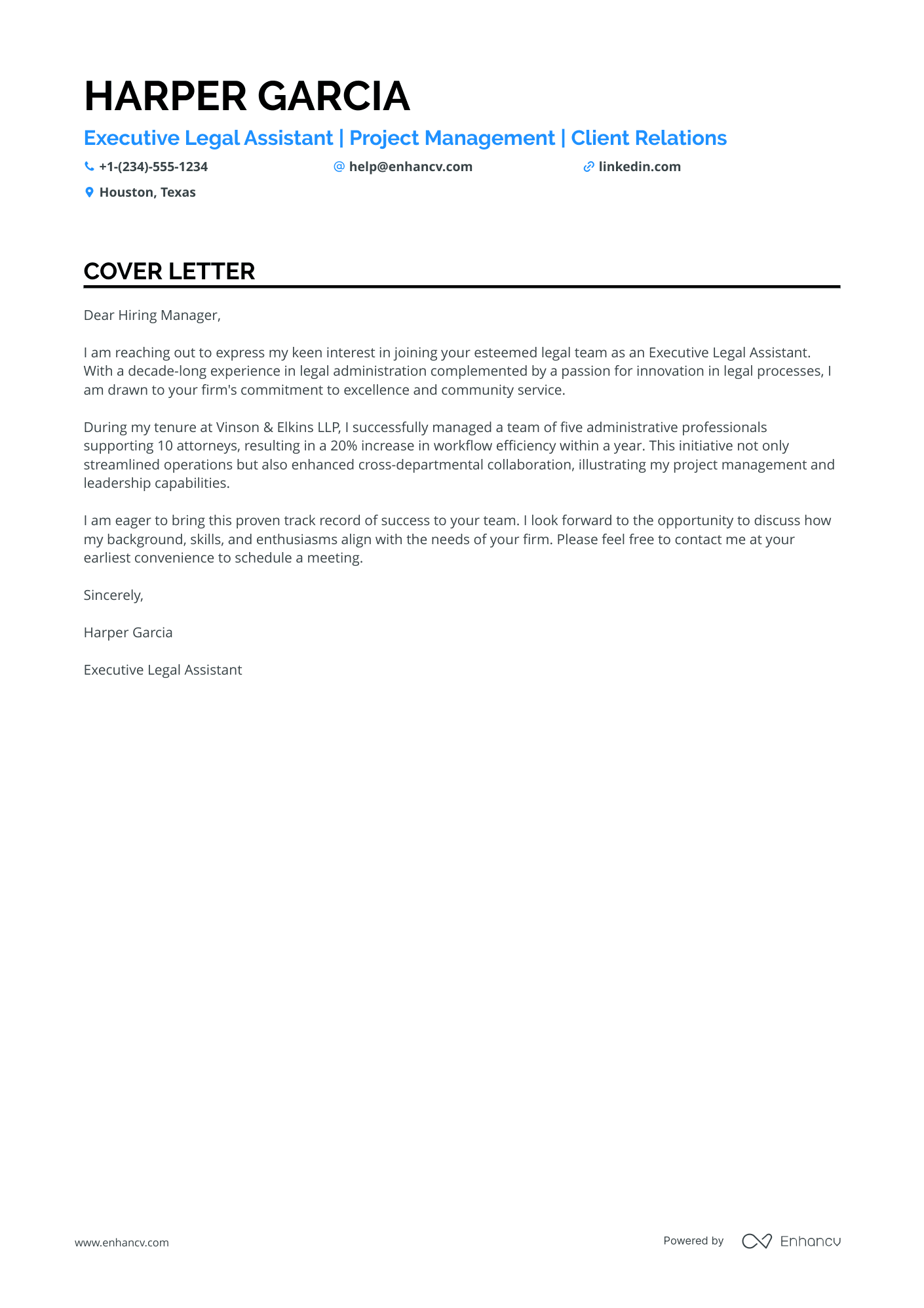
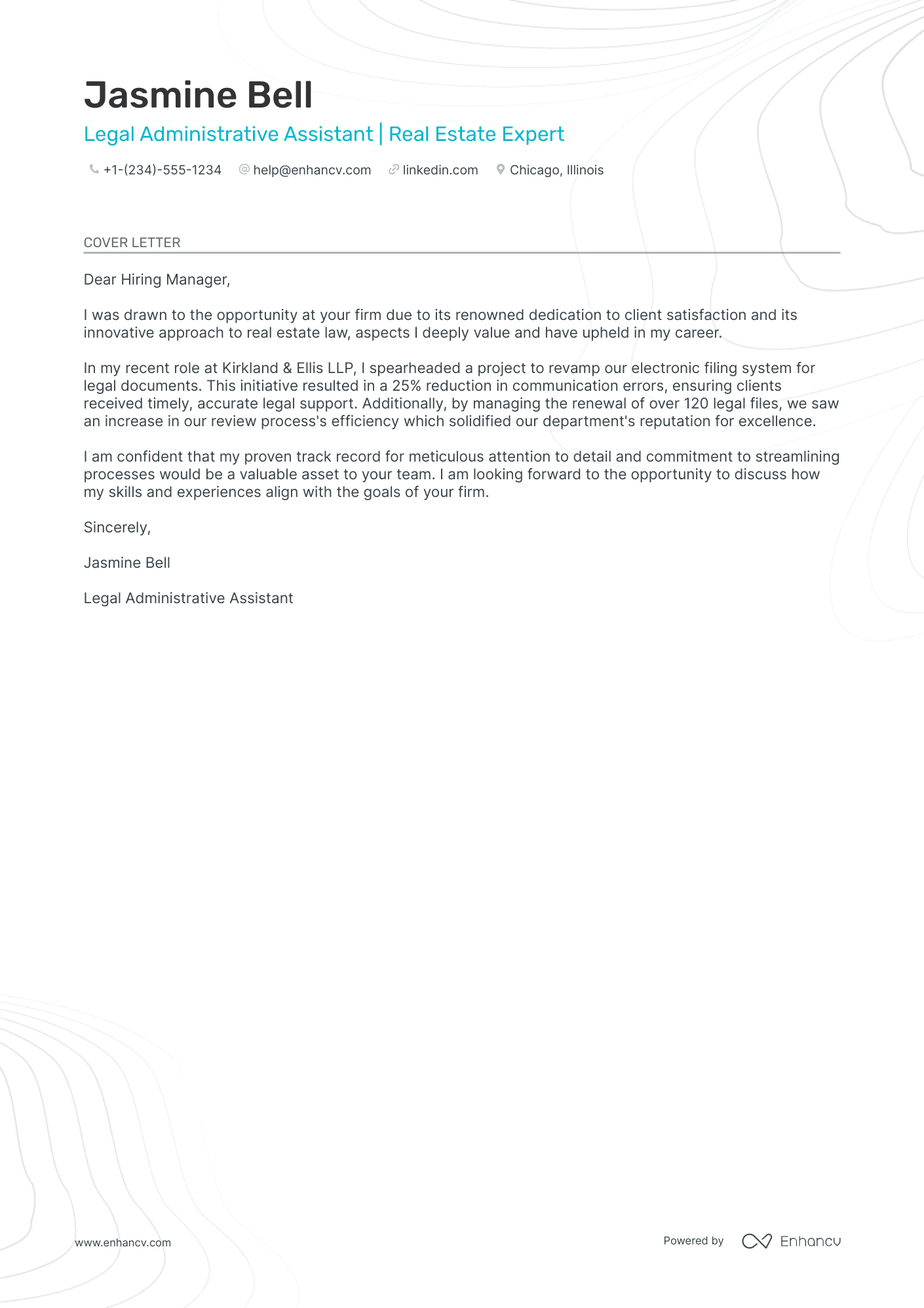
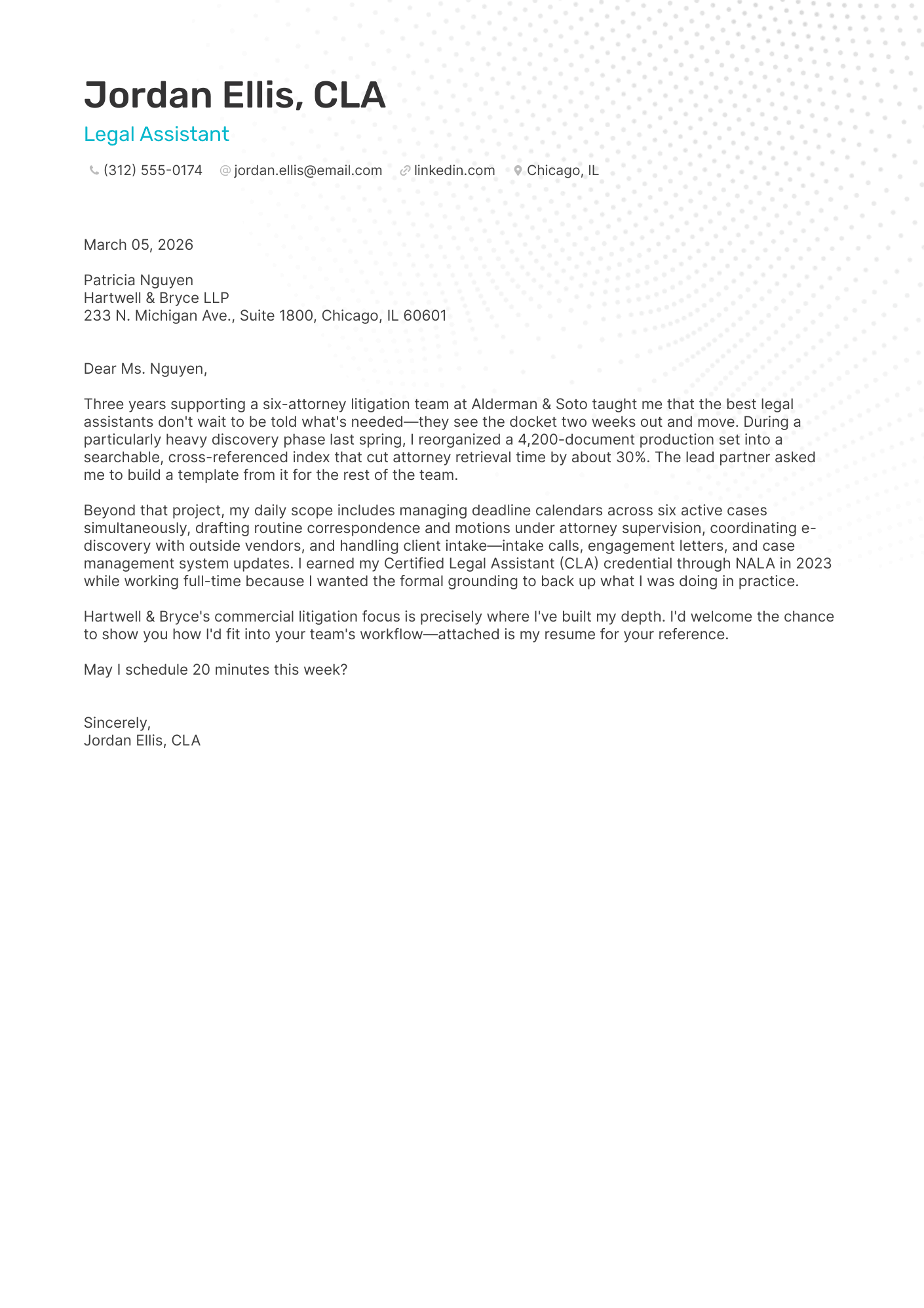
Before breaking down structure and strategy, it helps to see what a strong legal assistant cover letter looks like in practice.
Jordan Ellis, CLA
Chicago, IL
(312) 555-0174
jordan.ellis@email.com


Why this works:
- Opens with a measurable result
- Names tools, scope, and responsibilities
- Connects credential to real work
- Aligns experience with the firm’s practice area
What hiring managers scan for
Hiring managers at law firms run through a simple checklist when reviewing your cover letter:
1. Can you manage workload without supervision?
- Show the scale of your workload, including caseload size, number of active matters, or document volume.
- Demonstrate how you track deadlines and manage competing priorities across multiple cases.
- Indicate that you can anticipate needs and stay ahead of attorneys without constant direction.
2. Do you understand the practice area?
- Clearly name your experience in a specific area, such as litigation, immigration, or real estate.
- Reference the types of documents or processes you’ve handled within that practice area.
- Show familiarity with the pace, expectations, and workflows typical for that field.
3. Are you precise and detail-oriented?
- Demonstrate attention to detail through clean, error-free writing and consistent formatting.
- Show experience handling documents where accuracy matters, such as filings, contracts, or correspondence.
- Make it clear that you can manage sensitive information without mistakes or oversight.
4. Do you fit the firm’s pace and structure?
- Reference the firm’s specialization or type of work to show you understand their environment.
- Align your experience with the firm’s workload, whether high-volume litigation or transactional work.
- Demonstrate that you can adapt to the firm’s expectations, structure, and working style.
Once you understand what hiring managers look for, the next step is structuring your cover letter so those signals are easy to spot.
Cover letter structure for legal assistants
A legal assistant cover letter should follow a clean, predictable format.

Required sections:
- Header with contact details and credentials
- Date and employer address
- Named salutation
- Opening paragraph (key achievement)
- Body (experience + tools + credentials)
- Closing paragraph (direct ask)
- Professional sign-off
Formatting rules for law firms
- Font: Times New Roman, Georgia, or Garamond (11–12 pt)
- Alignment: Left-aligned text
- Length: One page only
- Layout: No graphics, icons, or decorative elements
Law firms expect documents that resemble legal writing—clear, structured, and restrained.
What recruiters look for in legal assistant candidates
Recruiters screen for a mix of technical competence and professional judgment.
They look for:
- Case management tools (Clio, Relativity, iManage)
- E-discovery or court filing experience
- Credentials (CLA, ACP, NALA certification)
- Practice area alignment
- Evidence of reliability (deadlines, accuracy, ownership)
Understanding what recruiters expect is essential—but it only matters if your letter reaches the right person.
How to address a legal assistant cover letter
Find the name of the hiring attorney or office manager. Law firm websites list attorneys and administrative staff by name—a two-minute search usually turns up the right person.
If a job posting lists a contact, use it.
"Dear Ms. Chen" is always better than "Dear Hiring Manager." "To Whom It May Concern" is never right.
For situations where a name truly isn't available, the cover letter salutation guide covers acceptable alternatives—but exhaust your options first.
Use the attorney's formal title when writing to a partner: "Dear Ms. Rodriguez" or "Dear Attorney Rodriguez" depending on firm culture.
How to open a legal assistant cover letter
Your opening paragraph determines whether the rest gets read.
A strong opener includes:
- A timeframe or scope
- A measurable contribution
- Clear role context
Strong example:
Two years coordinating discovery for a six-case docket taught me that legal assistants either build systems or fall behind. I built the systems.
Weak example:
I am writing to express my interest in the legal assistant position.
After establishing a strong opening, the next step is to support it with consistent, relevant experience.
How to write the body of your legal assistant cover letter
Keep this section to two paragraphs.
Paragraph: Track record
Show:
- Type of firm
- Scope of work
- Measurable result
Track record example:
Supported a four-attorney estate planning practice, managed intake for 120+ clients, and maintained a zero-error filing record over 14 months.
Paragraph 2: Tools and credentials
Include:
- Case management systems (Clio, iManage, Relativity)
- Certifications (CLA, ACP)
- Legal research tools (Westlaw, LexisNexis)
Paragraph 3: Firm alignment (optional)
One sentence is enough:
“Your firm’s immigration focus aligns with my experience supporting visa applications and removal proceedings.”
Legal assistant cover letter body—what to include vs. skip
| Include | Skip |
|---|---|
| Named case management or e-discovery software | Proficient in Microsoft Office" without specifics |
| Practice area experience (litigation, real estate, family law) | Strong communication skills |
| Credentials: CLA, NALA, ACP, state bar certifications | Hard-working team player |
| Specific volume: number of cases, clients, or documents | Assisted attorneys with various tasks |
| Court filing experience (state, federal, or appellate) | Anything that could apply to any administrative job |
Legal assistants who include at least one quantified result in their cover letter are significantly more likely to advance past initial screening at law firms.
The body builds your case—the closing moves it forward.
How to close a legal assistant cover letter
Strong closing:
I’d welcome the opportunity to discuss how my litigation support experience fits your team. I’m available for a call this week.
Avoid passive language like:
“I hope to hear from you.”
Drop your resume here or choose a file.
PDF & DOCX only. Max 2MB file size.
That approach works when you have experience—but the strategy shifts slightly if you’re starting out or changing fields.
Legal assistant cover letter with no experience
You can still write a strong cover letter by focusing on transferable skills.
Lead with:
- Academic legal work
- Internships or placements
- Research and documentation skills
- Exposure to legal tools
No-experience opener — paralegal studies graduate
During my paralegal studies at DePaul, I completed a 120-hour placement at Chicago Legal Aid, where I helped prepare discovery documents for 14 active cases. I also built a client intake tracking spreadsheet that the supervising attorney now uses with the entire intake team.
Enhancv's Cover Letter Builder has templates tailored to entry-level legal roles if you want a starting point that doesn't look like a blank page.

Legal assistant job market
Legal assistant and paralegal roles are projected to grow 4% through 2032, with the strongest demand in corporate legal departments, mid-size litigation firms, and immigration practices (Bureau of Labor Statistics, 2024).
Frequently asked questions for a legal assistant cover letter
Even strong candidates hesitate on the details. These are the most common questions legal assistants ask when writing a cover letter—answered clearly and without guesswork.
How long should a legal assistant cover letter be?
One page. Three to four paragraphs. Most hiring attorneys spend under 60 seconds on a cover letter before deciding whether to read the resume. A long letter signals poor editing judgment—the same judgment required to draft legal correspondence.
Should I mention specific software like Clio or Relativity in my cover letter?
Yes, if you have real experience with it. Legal hiring managers use software keywords as filters, especially for roles in litigation or corporate legal. Mention it once in context—"managed document production using Relativity"—not in a list. If you've trained on a platform but haven't used it professionally, say so briefly.
What's the difference between a paralegal and a legal assistant cover letter?
The titles overlap but aren't identical. Paralegals generally hold formal credentials and perform substantive legal work under attorney supervision. Legal assistants often handle more administrative coordination alongside legal support tasks. If a firm uses a specific title, mirror it exactly—and match your stated experience to the scope of the role.
Do I need to include my CLA or ACP credentials in the cover letter?
Yes. Credentials belong in your header (e.g., "Jordan Ellis, CLA") and should be referenced once in the body when you describe how you applied them. A credential listed only on your resume is easy to miss. Naming it in the letter reinforces that it's current and relevant to this application.

PRO TIP
Ready to start building? The how-to-write-a-cover-letter guide walks through every section step-by-step. Pair it with Enhancv's cover letter templates to get formatting out of the way and focus on what you actually want to say.
Final thoughts
A strong legal assistant cover letter doesn’t try to impress—it proves competence.
If your letter shows how you manage workload, support attorneys, and handle legal processes with precision, you give yourself a real chance of getting more interviews.
If you’re starting from scratch, using a structured template—like those in Enhancv’s Cover Letter Builder—can help you avoid formatting mistakes and focus on what actually matters: your experience.