Most interior designer cover letters read like a mood board turned into text.
“Creative. Detail-oriented. Passionate about spaces.”
Every applicant says this. None of it helps a hiring manager decide who to call.
The problem isn’t your experience—it’s how you explain it. You’ve spent your career shaping environments, balancing aesthetics with function, and managing real constraints. But when it comes to writing about that work, the focus often shifts to vague descriptors instead of outcomes.
A strong cover letter works more like a design concept: it’s built around one clear idea—a space you transformed, a constraint you solved, or a measurable improvement you delivered.
Let’s learn how to turn your interior design experience into a clear, structured narrative that hiring managers can quickly understand.
The letter only works if the resume next to it carries the same clarity — our interior designer resume guide shows how to translate space transformations, square footage, and budget control into bullets a design director will actually read.

Key takeaways
- Lead with credentials (NCIDQ, LEED, degree)—not a design philosophy statement.
- Name the firm, the studio, and the specific role.
- Direct the reader to a specific project in your portfolio and tell them why.
- Include at least one project number: budget, square footage, timeline, guest satisfaction score.
- Address the firm's design approach and recent work—not generic flattery.
- One page maximum. Design directors review 50–100 applications per senior opening.
- Include your portfolio URL in the header. Not linking it is a disqualifying omission for design roles.
What is an interior designer cover letter?
An interior designer cover letter is a one-page document that explains how you approach space, constraints, and client needs—not just how your work looks.
It complements your portfolio by showing:
- How you think.
- How you solve problems.
- How you execute projects.
Why most interior designer cover letters fail:
- They focus on aesthetics instead of outcomes.
- They list tools instead of decisions.
- They ignore budget, timeline, and execution realities.
- They don’t connect experience to the firm’s actual work.
Interior designer cover letter example
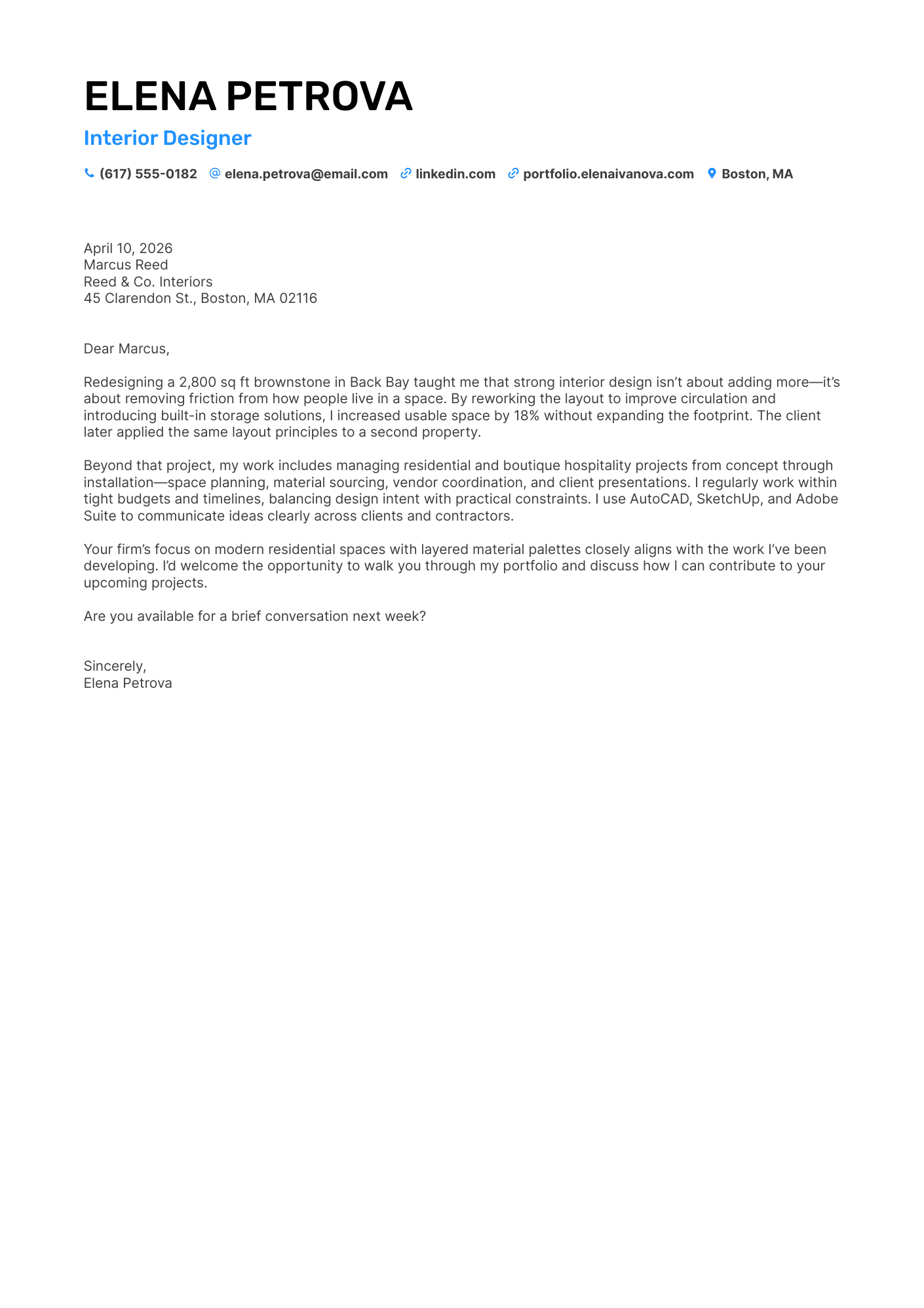
Before breaking down structure, it helps to see what a strong interior designer cover letter looks like in practice.
Elena Petrova
Boston, MA
(617) 555-0182
elena.petrova@email.com
Marcus Reed
Reed & Co. Interiors
45 Clarendon St., Boston, MA 02116
Sincerely,
Elena Petrova


Why this works:
- Opens with a real spatial problem and measurable improvement.
- Shows design thinking tied to function, not just aesthetics.
- Demonstrates project ownership from concept to execution.
- Mentions tools and workflow without overloading detail.
- Aligns with the firm’s style and project type.
- Ends with a clear next step.
Design directors who receive cover letters with specific project budgets and outcomes are significantly more likely to open the attached portfolio. Numbers make the difference between a generic application and a memorable one.
What your interior design cover letter needs to show
Design directors run through four questions when they read your letter. Most applicants answer one—if that.
1. Can you execute at this level?
- Show the scale of projects you’ve handled, including square footage, budget size, and overall scope.
- Demonstrate experience coordinating multiple stakeholders, including contractors, vendors, and clients.
- Prove you can manage real constraints such as timelines, permitting, and material sourcing.
- Your credentials (NCIDQ, LEED, or relevant degrees) should support your experience—not replace it.
2. What’s your strongest project story?
- Focus on one project and walk through the full story from constraint to outcome.
- Clearly explain the problem, your design approach, and what changed as a result.
- Include measurable details such as budget savings, timeline improvements, or space optimization.
- Your goal is to prove execution—not summarize your portfolio.
3. Why this firm?
- Show that you understand the firm’s design perspective and project focus.
- Reference specific work, recent projects, or the firm’s approach to design.
- Connect your experience directly to the type of work the firm does.
- Your letter should make it clear that you’re applying to this firm—not just any firm.
4. How do you think beyond aesthetics?
- Demonstrate that you understand the business side of design, including budgets and timelines.
- Show how you manage client expectations and navigate changing requirements.
- Highlight your experience working with vendors, materials, and real-world constraints.
- Your goal is to prove that your design decisions are practical, not just visually strong.
Drop your resume here or choose a file.
PDF & DOCX only. Max 2MB file size.
Sections to include and how to format your cover letter
A strong interior design cover letter follows a standard structure—but each section has a specific job.
Required sections
- Full header: name, credentials, contact info, portfolio URL
- Date and employer address
- Named salutation
- Opening paragraph (project + result)
- Body (project story + firm alignment)
- Closing (portfolio walkthrough + availability)
- Professional sign-off

PRO TIP
Reference specific portfolio pages or projects by name in your cover letter. Telling a design director exactly where to look saves their time and shows you think like a designer who respects the user experience.

Formatting rules
- Length: one page (300–400 words)
- Font: clean and professional
- Layout: simple, left-aligned
- No overdesign—this is a business document
Your formatting reflects your design judgment. A cluttered layout contradicts your message.
What recruiters look for in interior design candidates
Design directors screen for a mix of technical skill and execution ability.
What they scan for first:
- Credentials (NCIDQ, LEED, WELL)
- Project complexity (budget, size, scope)
- Software (AutoCAD, Revit, SketchUp, Adobe)
- Knowledge of codes and regulations
- Alignment with the firm’s work
- Professional growth and specialization
How to address an interior designer cover letter
“To Whom It May Concern” signals zero effort.
For a detail-driven field like design, that’s a fast rejection.
Find:
- studio director
- principal designer
- hiring manager
Use:
- “Dear [Name]”
- or “Dear [Studio Name] Design Team”
How to open an interior designer cover letter
Your opening should feel like a project headline—not an introduction.
Strong opener
Redesigning a compact studio apartment to accommodate both living and remote work increased functional space by 22% without structural changes.
Weak opener
I am writing to apply for the Interior Designer position.
How to write the body of your interior designer cover letter
The body should read like a case study.
Paragraph 1: Project story
Structure:
- constraint
- design approach
- measurable result
Para. 1 example
A 14-month hotel renovation required a 10% budget reduction without sacrificing scope. By sourcing regional materials and consolidating vendor contracts, I delivered the project $340K under budget with zero change orders in the final phase.
Paragraph 2: Firm alignment
Show:
- Why this firm.
- How your experience fits.
Para. 2 example
I’ve been following your firm’s recent hospitality projects, particularly your focus on material layering and spatial flow. My experience in boutique hotel design aligns directly with that approach.
Examples of how to quantify project manager achievements on your resume
| Job posting says: | Your cover letter should include: |
|---|---|
| Hospitality experience | Project type, size, budget |
| Revit proficiency | Tools used in real projects |
| Client-facing skills | Presentation examples |
| Sustainability | Certifications + project application |
| Leadership | Team size, coordination experience |
How to close your interior designer cover letter
- Reinforces your value.
- Suggests a next step.
Strong closing for an interior designer cover letter
I’d welcome the opportunity to walk you through my portfolio and discuss how my residential and hospitality work aligns with your studio’s current projects. I’m available for a call or studio visit at your convenience—the Back Bay brownstone redesign is on pages 6–10 of the attached portfolio.
Sincerely,
Elena Petrova
Weak closing—avoid this pattern
Thank you for considering my application. I’m very passionate about interior design and would love the opportunity to join your team. I look forward to hearing from you.
Sincerely,
Elena
Interior designer cover letter with no experience
You have more experience than you think.
What counts:
- academic projects
- thesis work
- internships
- freelance or personal redesigns
Example content
For my senior thesis, I designed a 3,200 sq ft adaptive reuse concept for a historic warehouse, including full construction documents, FF&E specifications, and a $185K material budget.
That shows:
- scope
- technical skill
- design thinking
Frequently asked questions
Even strong candidates hesitate on the details. These are the questions interior designers ask most often—and where small mistakes cost interviews.
Should I talk about my portfolio in the cover letter?
Yes—but briefly.
Your cover letter should:
- Direct the reader to your portfolio.
- Explain how to read your work.
Think of it as context, not duplication.
Do I need to include software like AutoCAD or SketchUp?
Yes—but only in context.
Instead of:
“Proficient in AutoCAD, SketchUp, Adobe Suite”
Write:
“Used AutoCAD and SketchUp to develop construction drawings and communicate layout changes with contractors.”
Tools matter—but how you use them matters more.
How do I write a cover letter if I only have academic projects?
Treat academic work as real projects.
Focus on:
- scope (square footage, type of space)
- constraints (budget, brief, limitations)
- deliverables (drawings, FF&E, presentations)
That shows readiness. “Recent graduate” does not.
Should I customize my cover letter for each firm?
Yes—this is one of the biggest differentiators.
At minimum:
- Reference one project the firm has completed.
- Mention their design style or specialty.
- Explain why your experience fits.
Generic letters are easy to spot—and easy to ignore.
What’s the biggest mistake interior designers make in cover letters?
Focusing on aesthetics instead of outcomes.
Hiring managers already assume you care about design.
What they want to know is:
- Can you manage a project?
- Can you work within constraints?
- Can you deliver results?
Your cover letter should answer those questions directly.
Should I include credentials like NCIDQ or LEED?
Yes—if you have them.
Include:
- in your header
- once in your body
Don’t overemphasize them. Credentials support your experience—they don’t replace it.
Do interior designers actually need a cover letter?
Yes—especially at mid to senior levels.
Your portfolio shows what you designed. Your cover letter shows how you think.
That distinction matters when:
- Projects get complex.
- Budgets increase.
- Teams grow.
At that point, decision-making matters as much as design.
What should I do before sending my cover letter?
Quick checklist:
- Portfolio link works and is easy to find.
- Header matches your resume.
- One project is clearly explained.
- The firm is referenced specifically.
- No generic phrases or filler.
If all five are true, you’re ahead of most applicants.

Ready to start building?
The how-to-write-a-cover-letter guide walks through each section step-by-step, so you can structure your content around a real project, not generic statements. Pair it with Enhancv’s cover letter templates to keep your layout clean and your portfolio easy to navigate—so the focus stays on how your design decisions translate into real results.
Final thoughts
A strong interior designer cover letter isn’t about sounding creative—it’s about proving how you think.
If you show how you solve spatial problems under real constraints, you make it easy for hiring managers to see your value—and click your portfolio.
If you’re starting from scratch, Enhancv’s AI Cover Letter Generator can help you structure your experience around real projects and outcomes—so you spend less time formatting and more time showing how your work performs in the real world.