A financial analyst cover letter is a one-page document that shows your work in depth—something that can’t be done as easily on a resume. While your financial analyst resume focuses on very concrete achievements presented concisely, writing a good cover letter means taking the time to explain why you’re the perfect fit for the role.
Most letters this quarter open with a tools list and the words "detail-oriented." Neither is evidence of analytical ability. They're just claims, and hiring managers at FP&A teams, investment shops, and corporate finance groups will have stopped reading them by the second line.
This guide talks about the version that gets past that filter. You'll get a full sample with header and address block, the four-paragraph structure that works across FP&A, corporate finance, and investment analysis, plus the specific signals that move a financial analyst cover letter from the maybe pile to the yes pile.

Key takeaways
- Lead with one specific project and its measurable outcome, not a skills list.
- Quantify both scope (budget size, business units, time period) and impact (% improvement, dollars saved).
- Name technical tools you've used in production: Excel, Python, SQL, Tableau, Anaplan, Adaptive Insights.
- Show you can translate financial analysis to a non-finance audience.
- Demonstrate genuine alignment with the company's work, not boilerplate enthusiasm.
- One page, four paragraphs, 300–400 words.
Financial analyst cover letter example
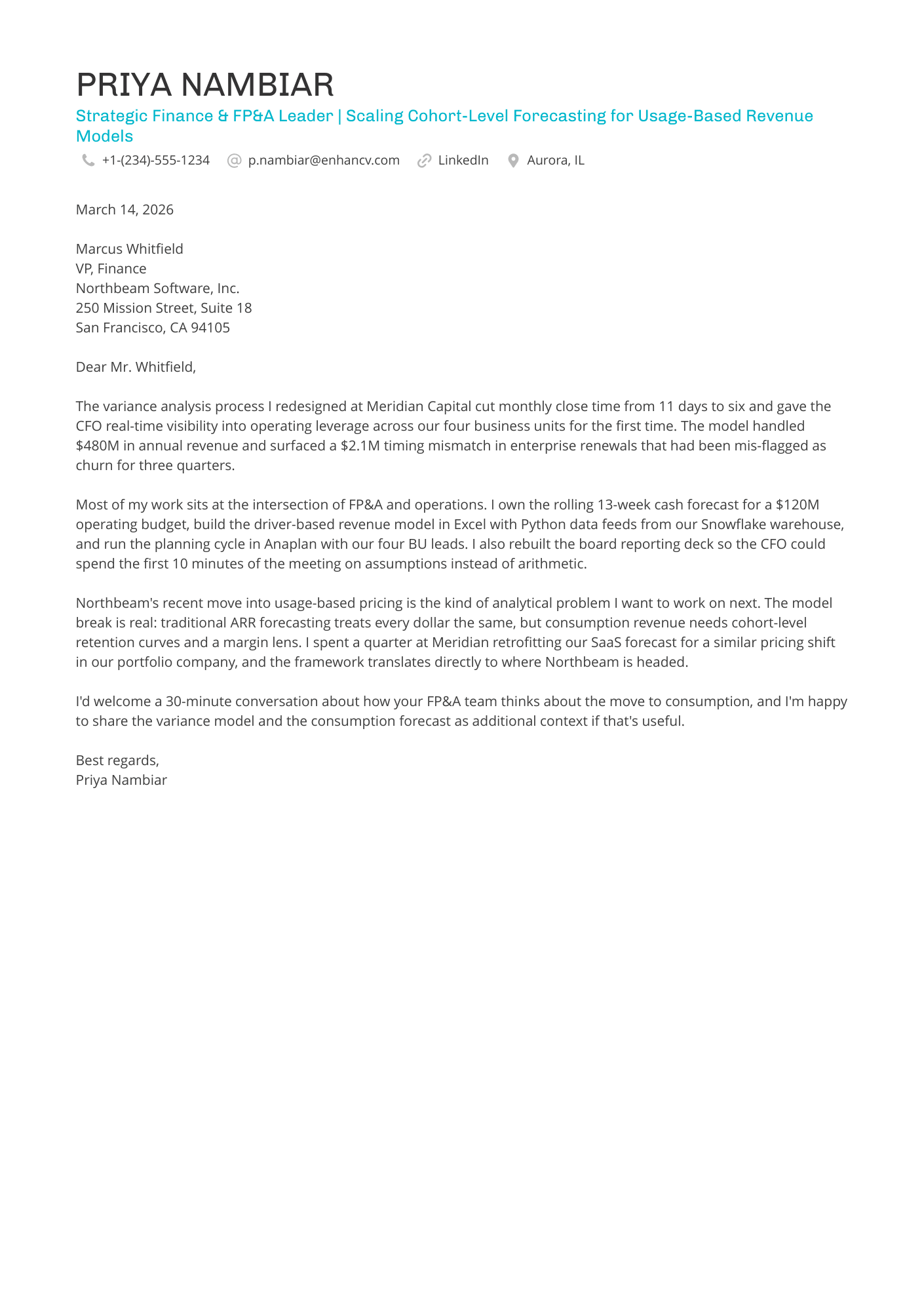
This example covers the full header, address block, and four-paragraph structure that works for mid-level financial analyst roles in corporate finance or FP&A. The candidate is a CFA Level II Candidate moving from a public-company FP&A seat to a growth-stage SaaS company.
Priya Nambiar
Aurora, IL
+1-(234)-555-1234
p.nambiar@enhancv.com


That letter works because it leads with a specific project and a measurable outcome, names the scope of the candidate's ownership, shows a real read on the company's business, and ends with a concrete ask. Every sentence is doing something.
What to cover in a financial analyst cover letter
The hiring manager reading your financial analyst cover letter is asking four questions.
1. What financial problem have you actually solved?
Not "I supported the FP&A team." What specific problem did you own? What was broken before you touched it, and what changed? The more concrete, the more credible. Thequantify achievements framing used in resumes applies just as cleanly to the opening line of a cover letter.
2. What is the scope of your analytical work?
Budget size matters. Number of business units matters. Complexity of the model matters. Scope signals whether your experience is relevant to the role in question.
3. Do you know the tools, and have you used them in a real environment?
Listing Excel on a resume is table stakes. But "built a driver-based forecasting model in Excel with Python data feeds, integrated into Anaplan for the planning cycle" is a claim worth reading.
4. Can you communicate financial analysis clearly?
Finance teams don't operate in isolation. Your ability to translate variance analysis into operational decisions, or explain a forecast to a CFO, is often more valuable than raw model-building speed. Thecover letter format guide shows how the structure of your letter itself signals communication ability.
Sections to include and formatting tips
A financial analyst cover letter should be clean, precise, and easy to navigate, which happens to also describe good financial modeling.
- Header and contact block: Full name, credentials if relevant (CFA, CPA, FRM), email, phone, city and state. LinkedIn URL is worth including. Date and full employer address block below. Use a cover letter template that’ll order your information neatly. For CFA Level progress or FMVA-style credentials, the rules on listingcertifications on a resume carry over cleanly to the cover letter header.
- Salutation: Find a name. Check LinkedIn, the company's leadership page, the job posting. "Dear Hiring Manager" is acceptable if you've genuinely exhausted the options, but finance hiring managers notice when a candidate can't find a publicly available name.
- Four-paragraph body: First paragraph: your best credential, one project, one outcome. Second paragraph: scope and technical depth. Third paragraph: why this company's work is relevant to what you do. Fourth paragraph: direct, confident ask.
- Closing line: One sentence. First name or full name. Skip "I look forward to hearing from you" because it adds nothing.
- On length: one page, no exceptions for analyst roles. Choose a legible, sans-serif font and keep your design clean and professional.

PRO TIP
Enhancv's Cover Letter Builder handles formatting automatically. Set the layout once and focus on the financial substance, the part that actually gets you the interview.

What recruiters look for in a financial analyst
- Quantified work, not "analyzed financial data" but "built a three-statement model for a $45M Series B transaction." The number and the context together make the claim meaningful.
- Model ownership. Who built it, who maintains it, what decisions does it inform? Recruiters want to know whether you're building infrastructure or running reports someone else designed.
- Technical stack depth. Financial modeling in Excel is expected. Python and SQL signal you can work with larger datasets. Tableau or Power BI suggests you can present findings to non-finance audiences. Certifications like CFA or CPA belong in the header.
- Business judgment. Can you interpret what the numbers mean for the business, not just report them? One sentence that shows business reasoning ("the variance traced back to a timing shift in enterprise renewals, not a true revenue miss") is worth a paragraph of technical description.
- Industry fluency. FP&A in a SaaS company looks different from FP&A in a manufacturing firm. If your background matches the industry, make that explicit. If it doesn't, explain why the analytical skills transfer.
How to address a financial analyst cover letter
Use the hiring manager's name. In finance, thoroughness is part of the job signal. Not finding a publicly available name before writing a letter is a small but real mark against a candidate.
Check LinkedIn (search the company plus "VP Finance" or "CFO" or "Recruiting"), the company website, and the job posting itself. If the posting came through a recruiter, address the recruiter by name.
If no name is findable after a real search, "Dear Hiring Manager" is clean and acceptable. Just don’t rely on tired and outdated openings like “To Whom it May Concern” or “Dear Sir/Madam”.

Financial analyst job market
Financial analyst roles are projected to grow 9% through 2032, faster than average. The highest demand sits in FP&A, investment analysis, and data-driven finance functions at mid-market companies.
How to open and close a financial analyst cover letter
Both the first and last paragraphs of a financial analyst cover letter should behave like the executive summary of a model: tight, specific, and oriented to a decision. The opening earns the read while the closing converts it.
- Opening: Start your cover letter with the most impressive concrete thing you've done. Rather than a soft skill, headhunters for this role are looking for a project, a number, a specific result.
- Closing: Be direct—optimally, close in one sentence. Make an offer to provide something useful: a model sample, a case study, or additional context on a project. Skip the filler phrase "I look forward to hearing from you at your earliest convenience.” End your cover letter with something that moves the conversation forward.
Strong opening for a financial analyst cover letter
The variance analysis process I redesigned at Meridian Capital cut monthly close time from 11 days to six and gave the CFO real-time visibility into operating leverage for the first time.
Strong opening for a financial analyst cover letter
I'd welcome a conversation about your FP&A team's priorities, and I'm happy to share documentation from the forecasting model if that would be useful context.
How to write the body of a financial analyst cover letter
Four paragraphs, each doing something different. Skip any one and the letter starts to feel generic.
- Paragraph one: the hook. Covered above. One project, one quantified outcome, in the first sentence.
- Paragraph two: scope and technical depth. This is where you establish the scale of your work. Budget size, business unit complexity, model architecture, tools. Don't just list—give enough context to make the scope meaningful. "Owned the annual budget for a $120M operating budget across four business units" beats "managed budget process."
- Paragraph three: company alignment. Why this company's financial challenges are ones you've worked on. Reference their industry, their stage, a recent financial move if it's public. One specific observation about their business signals more preparation than a full paragraph of general enthusiasm.
- Paragraph four: the ask. A direct invitation to a conversation, with an offer attached: a model walkthrough, a case study, anonymized output from a comparable project. Be confident—finance hiring managers are reading for someone who knows the value of their own work.

Financial analyst cover letter body formula
In my role as [title] at [company], I [built/redesigned/owned] [specific model or process] that [quantified result]. The work involved [technical method or cross-functional scope]. At [target company], I'd bring that same approach to [specific analytical challenge you see in their business].
Financial analyst cover letter with no experience
No experience doesn't mean you have nothing to show. Try out these options:
- Academic projects with quantitative rigor. A valuation model built in a corporate finance course, a case competition entry, a thesis with data analysis: all count. Frame them the same way you'd frame a work project. What was the problem, what did you build, what did the output show?
- Internship ownership. Even a supporting role in an internship produces evidence. What data did you handle, what models did you run, what did you deliver? Be specific about your contribution, not the team's.
- Certifications and credential progress. CFA Level I, Bloomberg Market Concepts, Excel financial modeling certificates: these signal investment in the craft. Name them in the header and reference them in the body where relevant.
- Transferable analytical work. Accounting coursework, statistics, data analysis in a non-finance context: frame the analytical method and show you understand how it applies to financial work.
Entry-level financial analyst cover letter: what to highlight instead of direct experience
| What you have | How to frame it | Example phrasing |
|---|---|---|
| Academic model | Methodology and output | Built a DCF model for a pharmaceutical company as part of my equity research course, valued at $18/share vs. consensus of $21, defended the divergence on growth assumptions |
| Internship | Specific contribution, not team credit | Supported the FP&A team during a 10-week internship by building the monthly actuals reconciliation that previously took the analyst two days, reduced to four hours |
| CFA progress | Level and relevant application | CFA Level I candidate, applying the fixed income framework directly to the portfolio analysis work in this role |
| Data analysis outside finance | Method transfer | Led regression analysis on customer churn data in my operations role; the same modeling approach applies directly to revenue forecasting |
Frequently asked questions about financial analyst cover letters
Got any more questions about your financial analyst cover letter? Check the section below.
Should I include my GPA in a financial analyst cover letter?
Only if it's above 3.5 and you're applying to a role where academic credentials are explicitly screened: investment banking, certain consulting firms, or structured training programs. For most FP&A and corporate finance roles, your project work and technical skills are more relevant.
How technical should a financial analyst cover letter be?
Name the tools and methods you've used (Excel, Python, SQL, Tableau, Anaplan, Adaptive Insights) but don't list every function you know. The goal is to show depth in the tools most relevant to the role, not breadth for its own sake.
Do I need a different cover letter for investment analyst versus FP&A roles?
Yes. Investment analysis letters should emphasize valuation work, research, and deal experience. FP&A letters should emphasize budgeting cycles, variance analysis, and business partnering. The technical overlap is real, but the framing should match the role.
Let Enhancv do the heavy lifting. With our Cover Letter Generator, you can get a draft document in seconds—perfectly aligned with modern design requirements. Then, you can move on to creating content that shines.
Drop your resume here or choose a file.
PDF & DOCX only. Max 2MB file size.