What does a software developer cover letter actually do in 2026?
A software developer cover letter is a one-page note attached to your resume. It names the team you want to join and describes one engineering problem you have solved that maps to their stack. Two-thirds of recruiters spend under 30 seconds on a cover letter, so the opening matters most.
A developer cover letter has a narrower job than most career sites suggest. Recruiters skim it for one answer: does this candidate already understand what we build, and do they have a reason to want this specific team? Everything else—the personality throat-clearing, the restated resume bullets, the long wind-up—gets skipped or counts against you.
The cover letter format most engineering recruiters expect is conservative—header, greeting, three short paragraphs, close. What varies is the evidence you pack into those paragraphs, and that evidence should be different for a 30-person Series A than for a bank with a 900-person engineering org. The letter earns its keep when it removes ambiguity from your resume: an unclear job title, a gap, a stack mismatch, or a career pivot into a new domain.

Key takeaways
- Name the role and the team in the first sentence. Generic openings (“I am writing to apply”) get skipped.
- Open with one concrete number—a latency drop, a shipped feature’s usage, a refactor outcome.
- The middle is one proof paragraph and one fit paragraph. That is the whole job.
- Put the CTA (portfolio link, GitHub, scheduling link) in a separate block below the sign-off, never inside the closing paragraph.
- Adapt the register by employer: FAANG wants scale numbers, startups want breadth and ownership, enterprise wants compliance, agency wants polyglot.
- 250–350 words total. The density of specific nouns beats word count.
Drop your resume here or choose a file.
PDF & DOCX only. Max 2MB file size.
Senior software developer cover letter sample (Series B fintech)
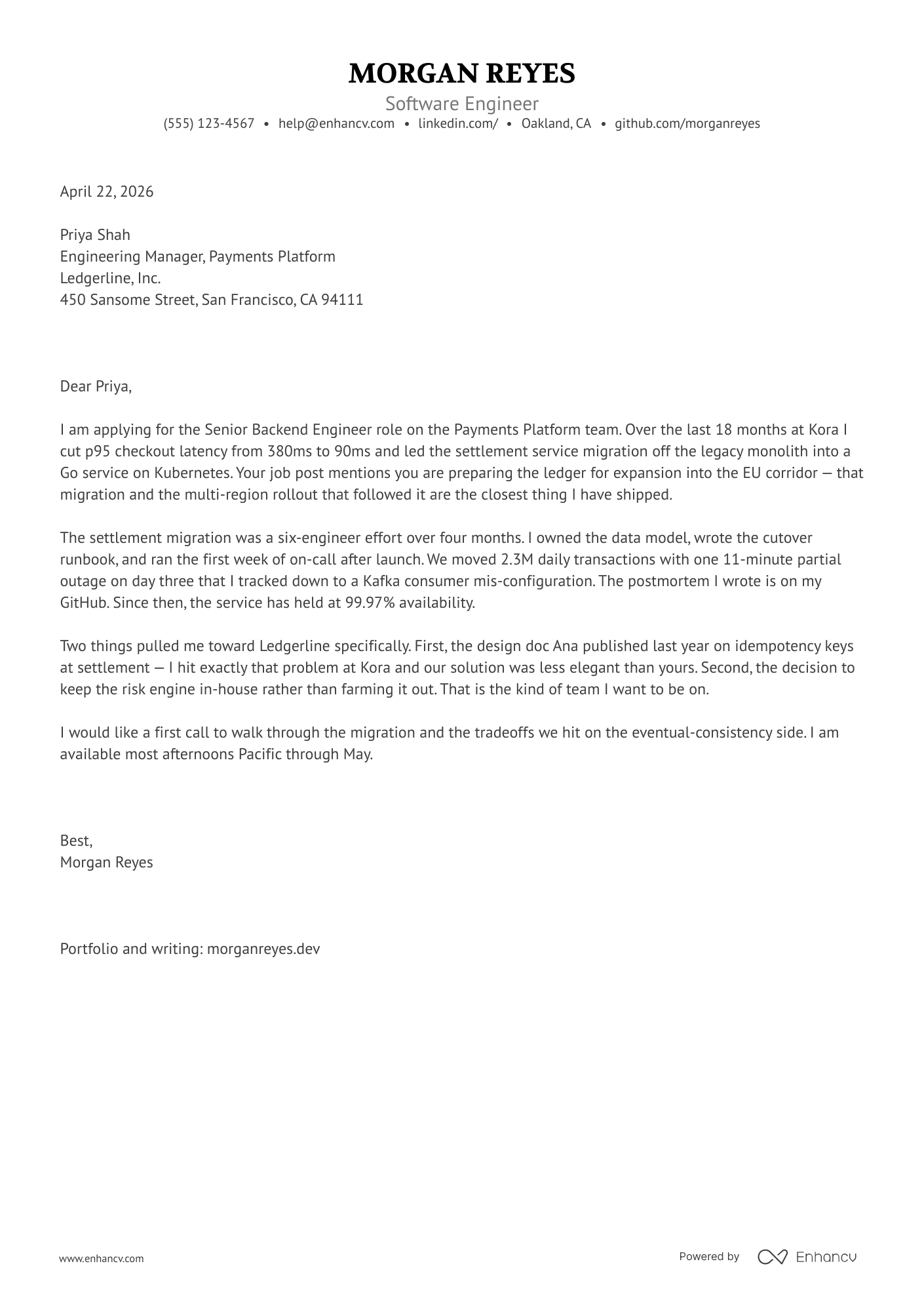
Role: Senior Backend Engineer, Payments Platform. Candidate: Morgan Reyes, seven years’ experience, last role at a payments infra startup.
Morgan Reyes
Oakland, CA
(555) 123-4567
help@enhancv.com


A few things to note about this letter. The opening number is concrete, not rounded. The middle paragraph names a tool (Kafka) and a real number of engineers, which makes it checkable. The fit paragraph names two specifics—a published design doc and a staffing decision—that are public but not obvious. The close offers a call with a clear topic, and the portfolio link lives in a separate block below the sign-off.

What makes this letter checkable
This is the dev-native frame the letter hinges on. A staff engineer doing a 60-second pre-screen is not reading for style—they are reading for claims they can verify.
- p95 latency 380ms → 90ms. Cross-references against a published postmortem, a resume bullet, or a dashboard screenshot in the portfolio. The numbers are not rounded.
- 2.3M daily transactions and 99.97% availability. Specific, odd-decimal figures beat “scale” or “high reliability” every time. A staff reviewer can sanity-check against the named company’s public traffic.
- Kafka consumer mis-configuration as the incident root cause. A technical detail a bluffer would not include. The reviewer either recognizes the failure mode or flags it for the interview.
- Named public reference (Ana’s idempotency design doc). Signals the candidate read the team’s published work. Any lie here gets caught in the first ten minutes of the call.
- Linked postmortem on GitHub. A staff engineer who clicks into the linked postmortem pre-call is the reason the technical detail is checkable at all. Every extra click between the claim and its proof costs you reviewers.
Who reads your software developer cover letter, and what are they looking for?
Three people read it, in this order, and they are looking for different things.
First is the recruiter or sourcer. They have dozens of candidates in the same queue. They skim for the named technologies in the job description, years of experience, and whether you wrote the letter for this role or copy-pasted a generic one. If you mention their product by name and describe one relevant problem you have shipped, you usually get through.
Second is the hiring manager. They read the letter after the recruiter forwards the top shortlist. They are looking for one thing the resume did not tell them—a reason you chose their team, a signal that you have worked in their kind of codebase, or a piece of context that explains something odd in your background. A well-written cover letter introduction speaks directly to this reader.
Third, on some teams, is a staff engineer doing a pre-screen. They rarely read the whole letter. They scan for specific technical words—the database you used, the incident you led, the refactor you owned. If those words match what they are hiring for, they flag you as “worth the interview slot.”
These three readers care about different details. The letter that works covers all three in under 300 words.
How does the cover letter change by employer type?
A letter that works at a 25-person startup will often be ignored at a FAANG company, and the opposite is also true. Four employer types read for different things—the table below covers the split, and the three openers after it show the same candidate’s first paragraph written three ways.
Software developer cover letter: how it changes by employer type
| Employer type | Who reads first | How to open | Proof to lead with | Common mistake |
|---|---|---|---|---|
| Large tech (FAANG-scale) | Recruiter with rubric | Scale number (QPS, uptime, users) | A system you owned end-to-end | “Passionate about building scalable systems” |
| Early-stage startup (Series A–C) | Founder or tech lead | Shipping velocity or solo ship | Product area owned from design through on-call | Over-polished corporate prose |
| Enterprise / bank | Engineering manager + HR reviewer | Compliance or reliability reference | Regulated-system experience (SOX, PCI, HIPAA) | Jokes or casual tone |
| Agency / consultancy | Client lead or partner | Polyglot breadth | Two or three stacks plus one client-facing win | Single-stack framing |
Opener 1 — FAANG (Meta L5 Infrastructure)
I am applying for the L5 Software Engineer role on the Meta Infrastructure team. My last system at Kora served 2.3M daily payment events at p95 90ms across a three-region Kubernetes deployment, with 99.97% uptime over the 11-month window since cutover. The Infra job post mentions the global routing rewrite—the multi-region settlement migration I led is the closest thing I have shipped at that scale.
Opener 2 — Early-stage startup (Series B fintech)
I am applying for the Senior Backend Engineer role on the Payments Platform team. Over the last 18 months at Kora I cut p95 checkout latency from 380ms to 90ms and led the settlement service migration off the legacy monolith into a Go service on Kubernetes. Your job post mentions you are preparing the ledger for expansion into the EU corridor—that migration is the closest thing I have shipped.
Opener 3 — Enterprise (regional bank, payments modernization)
I am applying for the Senior Backend Engineer position within the Payments Modernization program. At Kora I led the settlement service migration off a legacy monolith to a distributed Go platform—the rewrite landed inside the 11-month program deadline with documented audit trails and a fully replayable cutover runbook. Your team’s move of the core ledger off the mainframe is the closest thing I have worked on at this complexity.
Same person, same project, three different first paragraphs. The FAANG version foregrounds scale and uptime. The startup version foregrounds shipping and direct impact. The enterprise version foregrounds audit trails and program-level delivery. Picking the wrong register is the most common reason a strong resume gets a “no interest” reply.
What should the opening paragraph say?
The opening does three things in two or three sentences. First, it names the role and the team. Second, it puts one concrete result on the table—a latency improvement, an incident you led, a refactor that shipped, a feature with measurable usage. Third, it links that result to what the team is hiring for. That three-beat structure is the practical answer to how to start a cover letter at this level.
The Morgan Reyes sample above opens exactly this way. It names the role and team: Senior Backend Engineer on the Payments Platform. It puts a concrete number on the table: p95 checkout latency cut from 380ms to 90ms. Then it links straight to what the team is hiring for—the EU corridor migration.
Notice what is not in there: no “I am writing to express my interest,” no “passionate about software engineering,” no throat-clearing about how you found the job. Those openings get skipped. The cover letter salutation handles the introduction—the first paragraph should go straight to evidence.
What goes in the middle paragraphs?
One paragraph on proof, one on fit. That is the whole middle.
The proof paragraph expands on the opening. Pick one project and describe it in four or five sentences—the constraint, what you did, what shipped, what the measurable result was. If the role calls for a specific skill (say, Kubernetes operators, or React performance work, or data pipeline refactors), make sure the project you describe touches that skill directly. A short cover letter earns its length here; the proof paragraph is where the word count goes.
The fit paragraph is shorter. It explains why this company and not another. Name something specific—a product they ship, a technical blog post they published, an engineering principle they have written about publicly, a customer problem you understand from the outside. Generic praise (“I admire your culture of innovation”) reads as filler. Two sentences of real, researched specificity beats a paragraph of flattery.
If you are changing stacks—moving from Java to Go, from backend to infra, from monolith to distributed—spend a line acknowledging it honestly. Engineering managers appreciate direct language about what you are ramping on.
How do you close a software developer cover letter?
The cover letter ending has one job: tell the reader what you want to happen next. Two sentences is enough.
Don’t recycle the opening. Don’t restate your qualifications. Say something concrete: ask for a first call to walk through the payments migration, name on-site availability for the next three weeks, or offer a short design doc you have already written on a similar problem. Then sign off.
The CTA does not belong inside the closing paragraph—it lives in a separate line below the sign-off, usually a link to your GitHub, portfolio site, or scheduling page. Keeping the two separate keeps the letter from reading like a sales email. Pair this letter with a strong software developer resume—the letter should reference the resume, not duplicate it.
Common objections
Dev readers come to this page with specific priors that a generic FAQ doesn’t address. Here are the five we hear most.
“Cover letters are dead for tech roles.”
Not at Series A–C startups or mid-size companies where a real person reads every application. ResumeGo's 2020 field experiment of 7,287 applications to ZipRecruiter, Glassdoor, and Indeed found tailored cover letters produced a 53% higher callback rate than applications with no cover letter at all. The question of whether cover letters are necessary is always employer-specific — the claim holds best at FAANG-scale pipelines with heavy referral traffic, and even there a short in-application note often helps. The letter is dead only if your GitHub and referrals are strong enough to skip it. Everyone else is self-selecting out of the top of the funnel.
“My GitHub speaks for itself.”
Tech recruiters and hiring managers do look at GitHub — but briefly, and usually only when something in the letter or resume tells them what to look at. The letter is what makes the reviewer care about your GitHub in the first place. A letter that names the one repo worth reading — and the specific line of its README worth reading first — does more for your GitHub than the GitHub does alone.
“I’ll just generate one with ChatGPT.”
AI use in applications roughly doubled year-over-year — around 29% of job seekers used AI to draft applications in 2025, up from 17% in 2024 — so recruiters at scale employers are seeing a lot more AI-written letters, and the way to use ChatGPT for cover letters that actually works is narrower than the first-draft approach suggests. The tells on bad AI letters are consistent—“passionate about,” “proven track record,” tidy parallel structure, zero specific nouns. A generic AI letter counts against you faster than no letter at all. Use the model to draft, then strip every sentence that does not name a tool, a number, or a real product.
“The job post says a cover letter is optional.”
Optional usually means “we’ll read it if you write it.” At startups, skipping the letter signals low interest. At FAANG with referral-heavy pipelines it sometimes does not matter. The decision rule: if you have a specific reason you want this team—one you can put in two sentences—write it. If you don’t have that reason, fix that before applying. Pay attention to cover letter length either way; one page is the expectation, not a suggestion.
“What if I’m entry-level or switching careers?”
The letter matters more, not less, when the resume is thin. Lead with what you have built—a repo you own, a freelance build, a meaningful pull request into an active open-source project—and describe it concretely. “I built X, here is what broke, here is what I shipped” beats any amount of enthusiasm. The junior software developer and web developer pages cover these variants. For a specialist role, the full-stack developer and front-end developer pages have focused samples.
“Should I put salary expectations in the letter?”
Not unless the posting requires it. If it does, salary requirements in a cover letter follow a narrow rule: give a range with a basis—your current comp, a published band, a geographic figure. A fixed number anchors you low. Put it in the closing paragraph, not the opening.