

Resume.io is a tool built for finishing, not competing. It gets you to a polished document fast and stops there.
The builder is fast, the templates are clean, and the path from blank page to downloadable resume is about as smooth as this category offers. For someone who needs a professional document quickly and doesn't want to think about formatting, it delivers.
What it doesn't deliver is strategy. There's no meaningful tailoring, no positioning guidance, and no feedback that helps you stand out—only tools that help you show up. The career toolkit adds job tracking and interview prep, but these feel like additions rather than strengths.
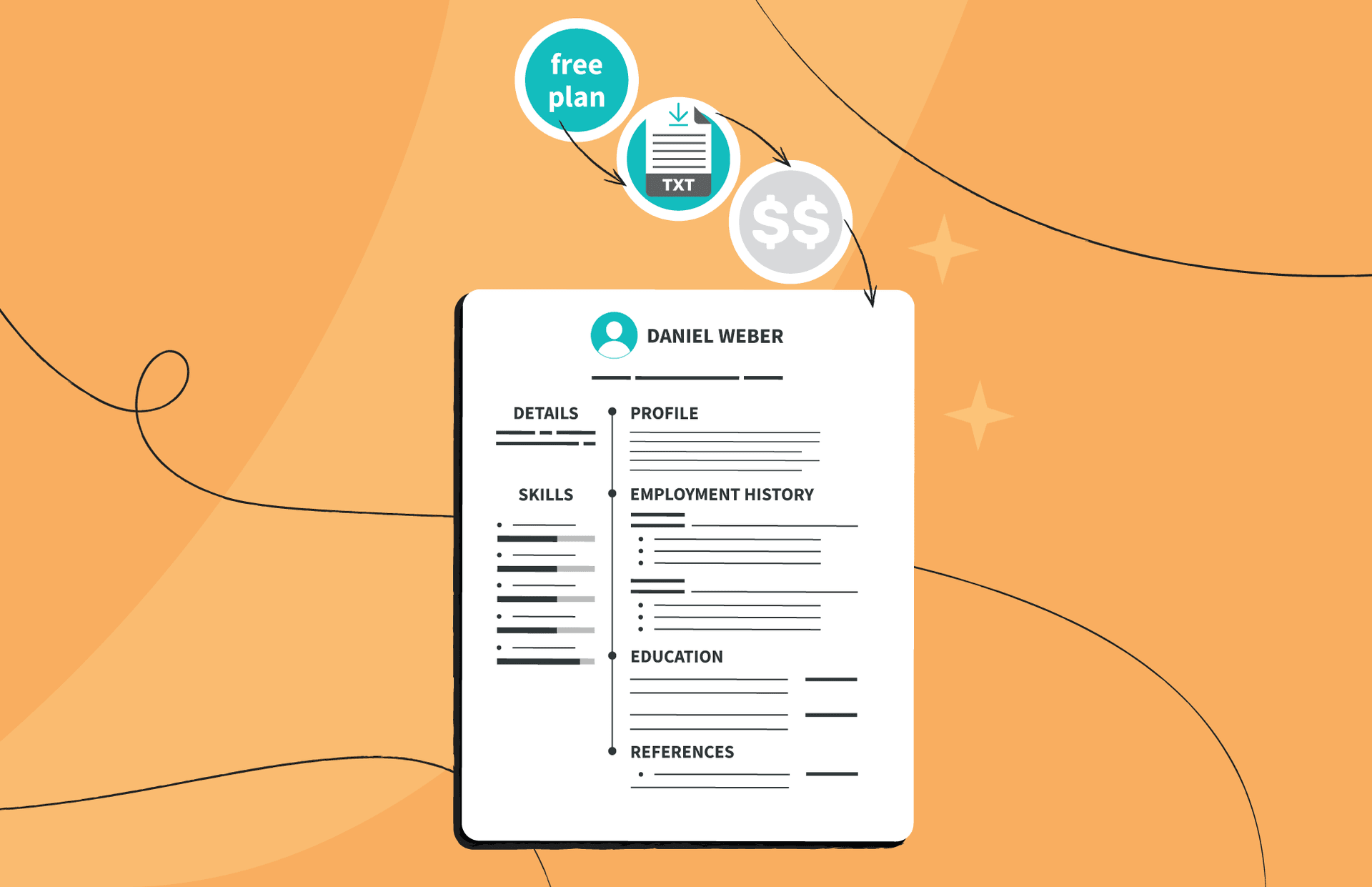
And before you start, understand the pricing model. The free plan won't get you a usable file, and the trial auto-renews. For how Resume.io compares to the wider field, see our full resume builder breakdown.
What Resume.io is and what it isn’t
Resume.io is a subscription-based resume builder designed around one core promise: get you to a finished, professional-looking document as fast as possible.
It does that well.
The platform gives you a structured editor, a library of professionally designed templates, and enough AI assistance to push through writer's block without requiring much independent thought. From signup to downloaded PDF, the experience is intentionally frictionless.
It’s not a strategy tool. It’s not a career coaching platform. It’s not built for tailoring applications to specific roles.
That distinction matters more than it might seem.
Resume.io markets a career toolkit—job tracker, interview prep, salary analyzer—and positions itself as a broader job search companion. In practice, these features exist at the edges of the experience. The resume builder is the product. Everything else is supplementary.
The platform also sits within a larger ecosystem. Resume.io was acquired by Talent Inc. in 2021 and now operates under the Career.io group—a suite of professional career services that includes human resume writers and coaching. Resume.io is the self-serve, entry-level tier of that offering.
That context is worth keeping in mind: the platform is designed to serve users who aren't yet ready to pay for a professional writer, not users who want to compete at the highest level on their own.

PRO TIP
Resume.io helps you produce a resume. It doesn't help you build a better one. That gap becomes more visible the further along you are in your career.
Onboarding and first impressions
Getting started on Resume.io is genuinely easy. The onboarding follows a stepped flow—Personal Details, Professional Experience, Education, Skills, Summary, and Additional Sections—with a progress bar and a resume score that updates as you complete each step.
The score nudges are a nice touch: you can see exactly how much each section is worth before you fill it in. For a first-time resume writer or someone returning to the job market, that structure is a real advantage.
What you notice quickly is where the experience ends. There's no intake process, no questions about your target role or industry, no guidance that personalizes the experience to your career stage. You move through the steps, fill in the fields, and arrive at a finished document. The platform tells you what to add—it doesn't tell you what to say.
For speed, that's a feature. For strategy, it's a gap.
The paywall appears early too. The moment you want a PDF, which is the moment the product becomes functional, you're directed toward a paid plan. For many users, that's the first sign that "free" means something narrower than it did on the signup page.
Core features
Resume.io's feature set is broader than most resume builders in the category. The resume builder and editor are the clear centerpieces, supported by a template library, keyword matching, AI writing tools, a cover letter builder, and a career toolkit that extends into job tracking and interview prep.
What follows is an honest assessment of each: what works, what doesn't, and who it's actually built for.
Resume builder and editor
The editor is Resume.io's strongest asset. The split-screen layout—inputs on the left, live preview on the right—is polished and responsive, and switching templates without losing your content is a genuinely useful feature that saves real time.
The Customize tab offers more control than the editor's clean surface suggests. You can select primary and secondary fonts, adjust line height and font size, and fine-tune margins and padding at the section level. This includes the header and footer, top and bottom, left and right, and the spacing between individual content blocks. For most users, that's enough flexibility to make a template feel like their own.
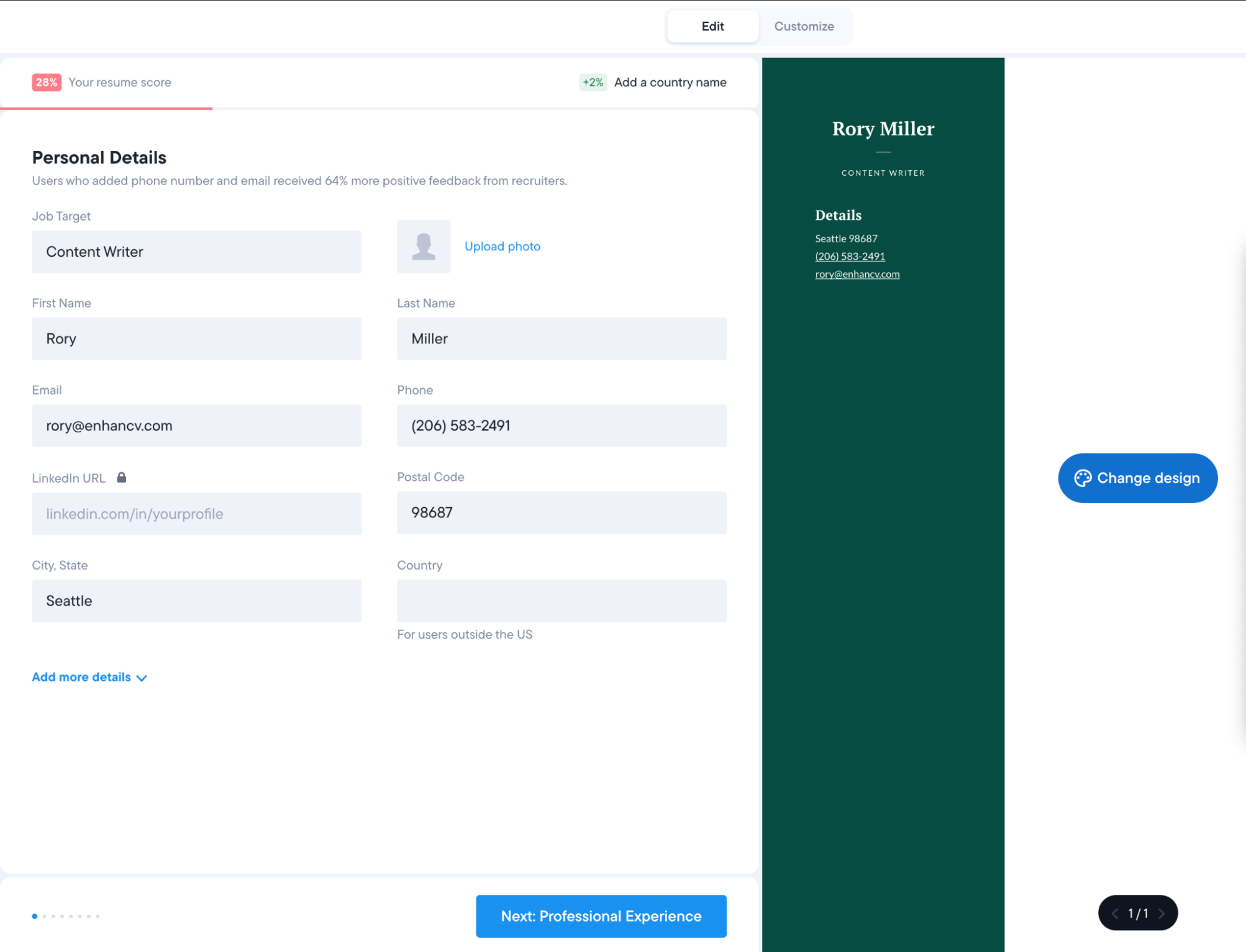
The limits show up at the structural level. Column structure and overall layout stay within each template's constraints. Font, spacing, and margin controls exist, but they won't help if you need a fundamentally different resume format.
- Best for: Anyone who wants a clean, formatted resume without managing layout or design manually.
- Watch for: Structural layout is fixed within each template. If your role or industry requires a specific format, the templates can be resistant to meaningful changes beyond fonts and spacing.
Templates
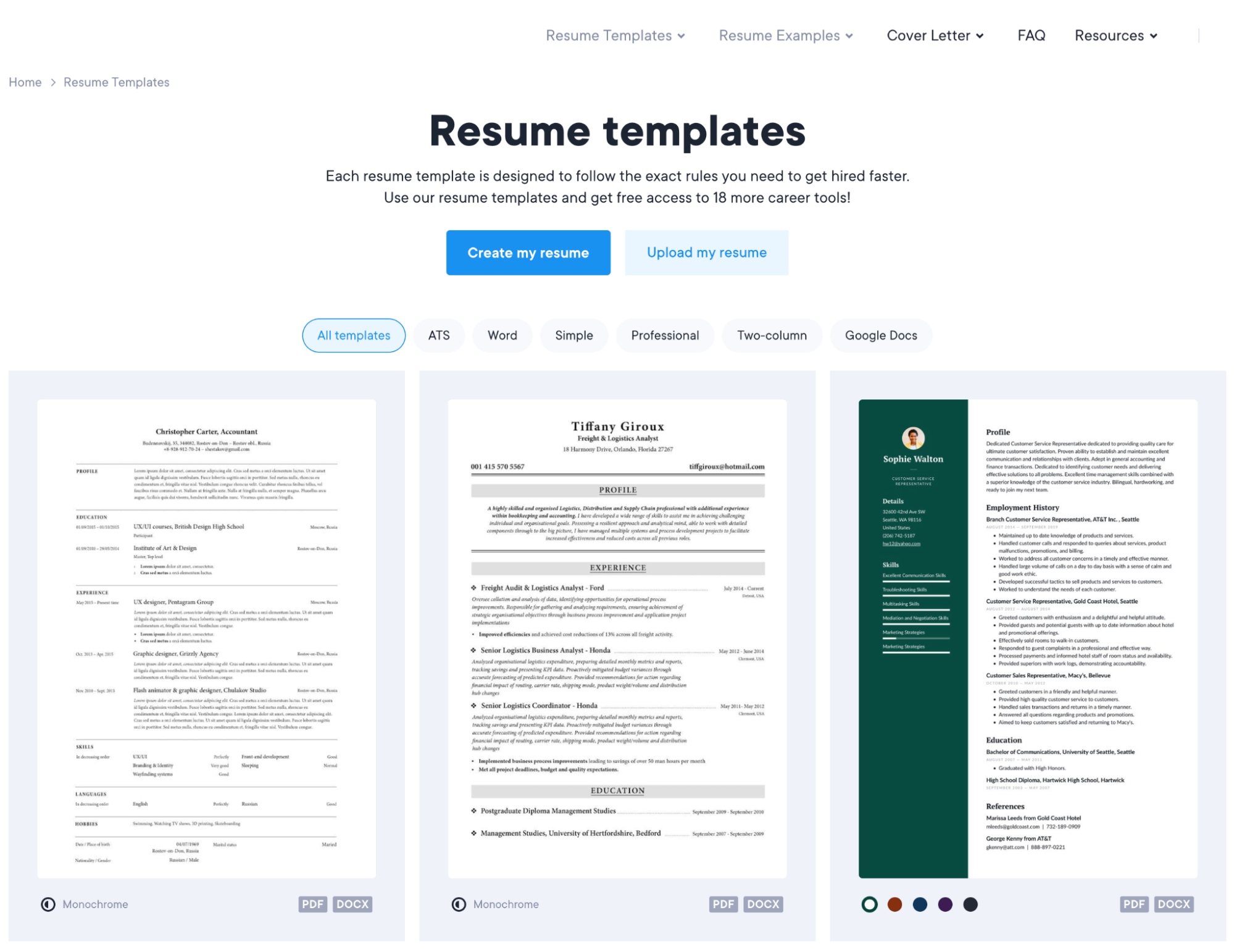
Resume.io offers around 30 templates across five categories: Professional, Modern, Simple, Creative, and a dedicated applicant tracking system (ATS) collection. The Professional and Modern templates are the clearest strengths—clean without being generic and reliable across corporate, finance, legal, and government contexts.
The ATS-specific templates—Prime ATS, Simple ATS, and Pure ATS—use single-column layouts and standard headers that parsing systems handle reliably. The Creative templates are a different story: some use two-column structures and visual elements that can cause parsing issues. Resume.io acknowledges this: if ATS compatibility matters, stick to the dedicated ATS collection.
- Best for: Professionals in traditional industries who want a polished document without design risk.
- Watch for: The Creative templates carry real ATS risk. Despite the variety, most templates feel like variations on the same underlying layout.
ATS tools and keyword matching
Resume.io's keyword matching tool lets you paste a job description directly into the platform. It identifies missing keywords and flags gaps in your resume. On premium plans, auto-tailoring can incorporate those keywords automatically. On the free tier, you get manual suggestions only.
The tool works as a basic alignment check. What it doesn't do is help you integrate keywords meaningfully. The suggestions are mechanical—a list, not a strategy. Generic keyword insertion can make a resume pass the scan and read as formulaic to the human reviewer who comes next.
- Best for: Users applying to clearly defined roles where the keyword gap is straightforward to close.
- Watch for: Keyword matching isn’t ATS optimization. The tool identifies gaps but doesn't help you close them well.
AI writing tools
Resume.io's AI covers bullet point suggestions, resume summary generation, and cover letter assistance. The bullet suggestions and summary generator are useful for getting past a blank page, but the output leans generic by default. Action verb, vague responsibility, no metrics. Both need editing before they're ready to submit.
The cover letter builder is the strongest of the three. It generates a structured letter tied to your resume and target role, with AI sentence suggestions and a grammar checker built in. Faster than writing from scratch and more coherent than most tools at this price point.
- Best for: First-time resume writers who need a starting point rather than a finished product.
- Watch for: AI output requires meaningful editing across all three tools. First-draft submissions are one of the most common mistakes users make here.
Career toolkit
Beyond the resume, Resume.io includes a job tracker, salary analyzer, AI interview prep, and a built-in job board. All four exist and function. None of them are reasons to choose the platform.
The job tracker is basic compared to dedicated tools like Teal. The salary data works for rough benchmarking but not serious negotiation prep. The interview prep offers standard questions and standard frameworks with no role-specific depth.
Resume.io is a resume builder that added a career toolkit—not the other way around. That distinction matters when deciding what to use it for.
- Best for: Users who want everything loosely in one place and don't need any single tool to perform at a high level.
- Watch for: If job tracking or interview prep matter to you, dedicated tools will outperform these significantly.
Pricing, plans, and the trial model
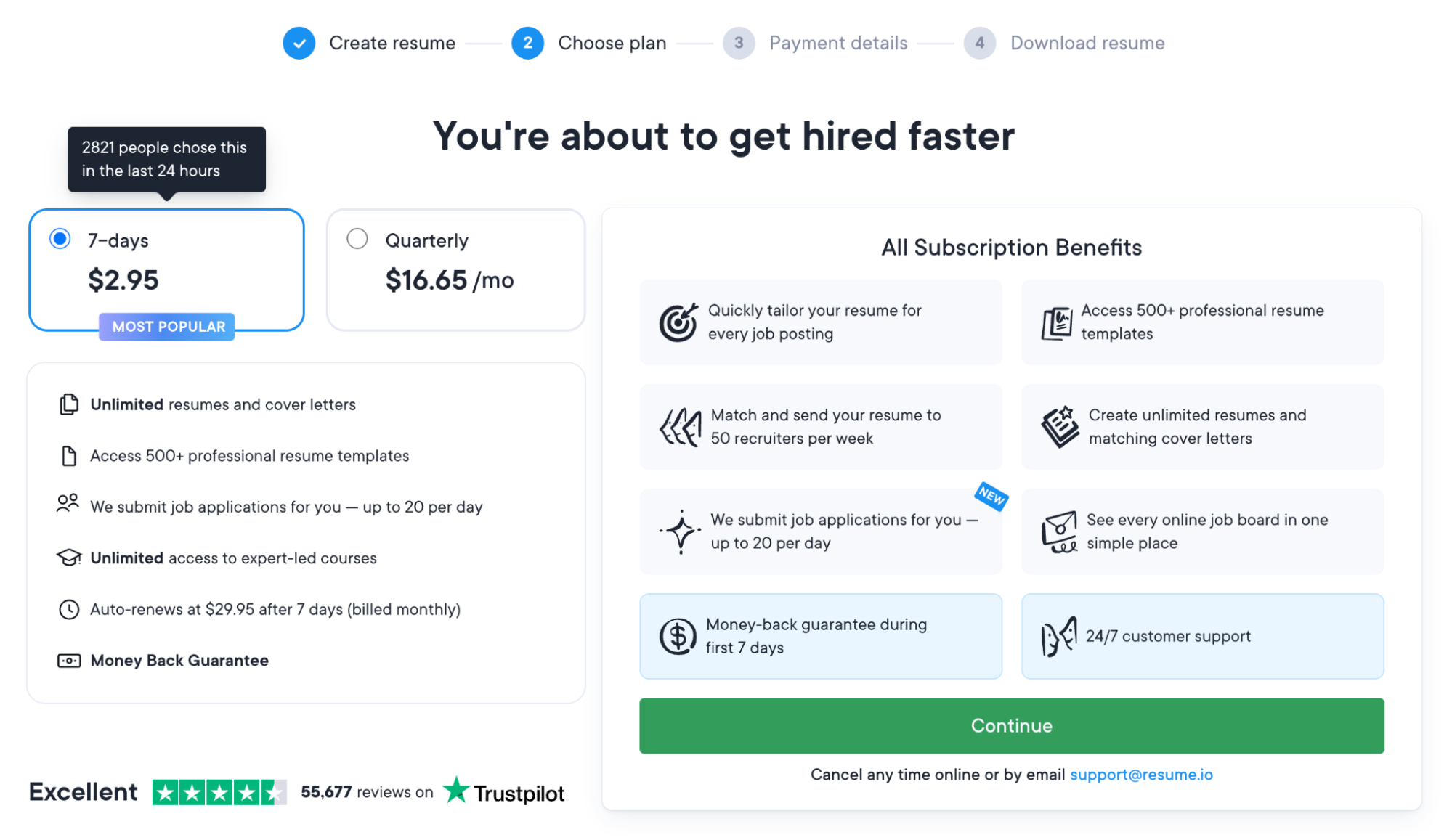
Resume.io offers four tiers: a free plan, a low-cost trial, a monthly subscription, and an annual plan. The structure looks straightforward. The details are worth reading before you enter a payment method.
Pricing Structure
| Tier | Price | Key Features |
|---|---|---|
| Free | 0$ | Build one resume using the Vancouver template. Downloads are limited to TXT format only—not usable for real job applications. |
| 7-Day Trial | $2.95 | Full access to all templates, tools, cover letters, and download formats. Auto-renews to a monthly plan if not canceled within 7 days. |
| Monthly | $24.95/4 weeks | Full access to all features. Billed every four weeks—not per calendar month. Set a cancellation reminder before subscribing. |
| Annual | $74.95/year | Best value at ~$6.25/month. Recommended for anyone running an extended job search. |
Is Resume.io free?
Technically, yes. But the free plan restricts downloads to TXT format only, which isn't accepted by job applications. You can experience the builder. You can't use it for its actual purpose. A paid plan is effectively required from the start.
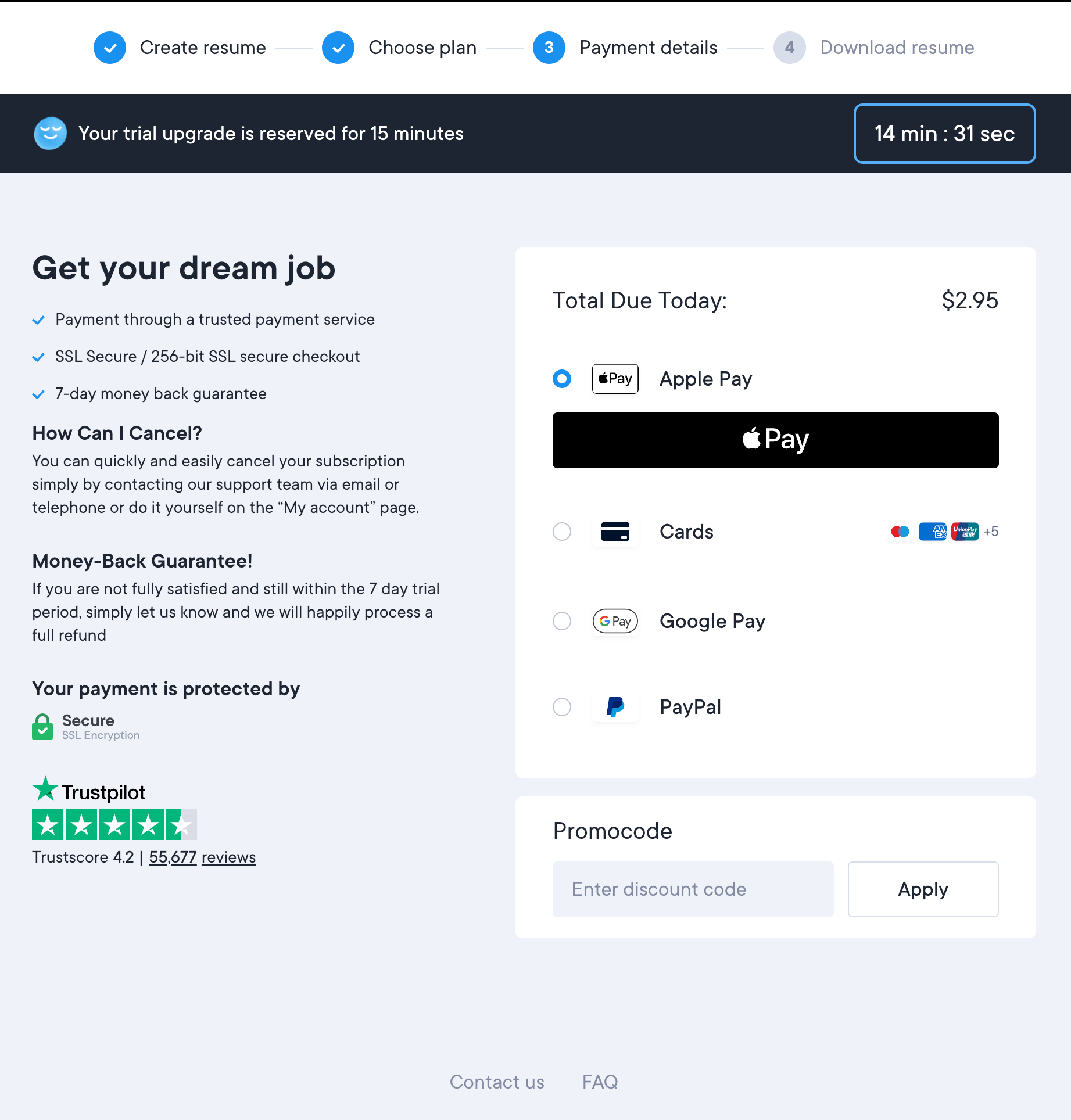
The $2.95 trial gives full access for 7 days and is genuine value if you build, download, and cancel immediately. The problem is that cancellation is active—miss the window and the subscription rolls into the monthly plan automatically. At $24.95 billed every four weeks rather than per calendar month, some users see three charges in a two-month period.
The annual plan at $74.95 (roughly $6.25 per month) is the clearest value for anyone running an extended job search and removes the four-weekly billing cycle entirely.
If you use Resume.io, set a cancellation reminder before you enter your payment details.
Pricing note: Resume.io's own documentation states that pricing can vary by location and may differ from previously published rates. The figures above reflect what multiple independent sources confirmed as of early 2026—verify directly on the pricing page before subscribing.
What real users say
Resume.io's reputation splits cleanly by platform, and the split tells you something useful.
Trustpilot
Resume.io holds a 4.2 out of 5 rating based on over 55,000 reviews.
Positive feedback is consistent: the editor is intuitive, the templates look professional, and the process is faster and less stressful than expected.
Negative reviews follow an equally consistent pattern. Unexpected charges after the trial, difficulty canceling, and unresponsive support.
One reviewer, writing just days before publication, described being billed for several months despite multiple cancellation emails—and ultimately had to contact their bank to stop payment. Read the review on Trustpilot.
ProductHunt and Reddit
On ProductHunt, the rating drops to 1.3 out of 5.
The complaints are almost entirely about billing: trial fees converting to recurring charges without clear warning, failed cancellations, continued billing after cancellation attempts, and refund refusals.
Reddit tells the same story—frustration is almost never aimed at the builder itself, almost always at what happens after you subscribe.
Why the ratings split
Trustpilot skews toward users who built a resume, downloaded it, and moved on. ProductHunt and Reddit skew toward users who stayed subscribed and encountered problems. Both groups used the same product—just different parts of it.
Resume.io is a legitimate product. The builder works, the templates are well-regarded, and even angry reviewers rarely criticize the resume output itself. The trust problem is the business model, and the complaints are too consistent across too many platforms to dismiss.
Pros and cons of Resume.io
| ✅ Pros | ❌ Cons |
|---|---|
| One of the fastest resume builders in the category. | The free plan is functionally useless—TXT-only downloads aren't accepted by job applications. |
| Clean, intuitive split-screen editor with live preview. | Trial auto-renews to a monthly subscription after 7 days—the most documented complaint across all platforms. |
| Well-designed template library with a reliable, dedicated ATS collection. | Cancellation difficulties were reported consistently across Trustpilot, ProductHunt, and Reddit. |
| The cover letter builder is a genuine, usable inclusion. | AI output is generic by default and requires significant editing before submission. |
| Low trial cost makes short-term use genuinely good value. | Limited structural customization—templates resist meaningful layout changes. |
| Career toolkit consolidates job tracking and interview prep in one place. | Career toolkit features are surface-level compared to dedicated tools. |
| Strong performance for traditional industries and corporate roles. | No strategic guidance—the platform helps you finish a resume, not build a better one. |
Who Resume.io is best for
Resume.io is best suited for users whose primary need is speed and whose primary obstacle is getting started.
It works particularly well for:
- First-time resume writers. The structured editor, pre-written content suggestions, and live preview remove most of the decisions that make resume writing feel overwhelming. If you've never written a resume before, Resume.io is one of the most accessible places to start.
- Career returners. If you haven't updated your resume in years and need to produce something professional quickly, Resume.io's frictionless onboarding and clean templates get you to a usable document faster than almost anything else in the category.
- Traditional industry applicants. The ATS template collection performs reliably for corporate, finance, legal, government, and healthcare roles. If you're applying through structured hiring pipelines in established industries, the formatting is safe and the output is credible.
- Short-term users. The $2.95 trial is genuinely good value if your plan is to build your resume, download it, and cancel before the 7 days are up. As a one-time production tool, Resume.io is hard to beat at that price point.
Resume.io is less well suited for:
- Experienced professionals who need to differentiate. The platform helps you produce a resume. It doesn't help you think about positioning, tailor to a specific role, or build a document that makes a senior-level case for your candidacy. The ceiling arrives quickly for anyone with a complex career story to tell.
- Active job seekers tailoring to multiple roles. Keyword matching exists, but the tailoring is largely manual. If you're applying to ten different roles with meaningfully different requirements, the platform won't do much of that work for you.
- Users on a tight budget who expect a genuinely free option. The free plan creates the impression of accessibility without delivering it. If cost is a real constraint, the trial model requires careful management to avoid unexpected charges.
- Anyone who values design flexibility. The template library is polished but constrained. If your industry or personal brand calls for a distinctive layout, Resume.io's structural limits will frustrate you early.
Final verdict
Resume.io is a well-built product wrapped in a business model that undermines trust in it.
The builder is fast, the templates are clean, and the editor is among the smoothest in the category. For the right user (someone who needs a refined document quickly and understands the trial terms), it delivers exactly what it promises.
The gap between what "free" implies and what it actually offers is wide enough to frustrate a significant number of users before they ever reach those strengths. The billing complaints across Trustpilot, ProductHunt, and Reddit are too prevalent to ignore.
It’s not a scam. It’s not a bad product. It’s a good resume builder that rewards users who go in with clear expectations and punishes those who don't.
Choose Resume.io if you need a clean, professional resume fast and you're comfortable managing the trial carefully.
Choose Enhancv if you want a resume that does more than look professional—one built to position you strategically, tell your career story clearly, and give you confidence that what a recruiter sees reflects your actual value.
Author's take
Make one that's truly you.