An Enhancv user landed an interview at Amazon and eventually got hired. An experienced professional with an impressive work history applying at a notable company and getting the job. A true success story. We used their resume (with permission) to test the best resume checkers.
We ran that same document, paired with a real Amazon job description (JD), through 10 of the most popular tools. Shockingly, the scores ranged from 21 to 76% match.
Such a wide spread across various resume checkers seems like a mystery. But the explanation behind the gap is the most useful thing you should know when using these tools. Each evaluates what they measure differently. None of them can measure if you're a hireable candidate. The proof we used got hired before we started testing.
Here’s what we uncovered.

Key takeaways
- No single score from the current tools on the market can tell you whether you'll land an interview.
- A low match score usually means keyword mismatch, so don’t treat it as a rejection: our test resume "failed" three tools and still earned an interview.
- Every tool agreed on the same fixable basics. Those free fixes are worth more than chasing a higher score.
- Treat missing keywords as suggestions, not must-haves. Don’t add keywords you can’t defend in an interview.
- Several checkers showed scary low scores and locked the actual advice behind a paywall, so judge a tool by the quality of its feedback, not by the score it flashes.
The results at a glance
Every checker in this test looked at the identical resume that earned the interview at Amazon. The tools that gave it a low score were judging a resume that already won the job.
Resume checkers scoreboard
| Tool | JD match | Overall score | Notable |
|---|---|---|---|
| Enhancv | 59% | 80/100 | caught certificate match, keyword gaps, achievement relevance |
| Resume Worded | 76/100 ("needs improvement") | 78/100 | flagged missing job title |
| Novorésumé | 74/100 ("weak alignment") | 71–100 by area | contradicts itself: format 100/100 in one view, 72/100 in the email-gated teaser |
| Kickresume | n/a | 75/100 ATS score | tailoring beta rewrote the resume—and added "OSHA 29 CFR 1910 Advanced" as a skill the person may not have |
| Zety | No JD matching | 69/100 | can't do JD matching at all |
| SkillSyncer | 23/100 | n/a | "your resume will likely be passed over"—said about a resume that got the job |
| Teal | 21% | 50% | harshest number, most gated behind Teal+ |
| Jobscan | "Low" (number hidden on free plan) | n/a | won't even show the number on free anymore; 16 hard-skill "issues" |
| MyPerfectResume | No JD matching | 60/100 ("fair") | generic advice only |
| Rezi | No score shown (chatbot review) | n/a | first upload failed; advice was actually specific and good |
How we tested (and why this test is different)
Most "best resume checker" roundups score the tools on the feature they have and how much they cost. While these are useful, they don’t unlock critical knowledge. What we did was a calibration test instead: give every tool a resume with a known, verified outcome, and see which ones give advice that matches reality.
Our own Enhancv Resume Checker got no special treatment. We’re showing the results as they are.
The control resume we used to test the checkers belongs to a safety professional with seven years in site safety management and two decades of military leadership before that.
Here it is (we switched the layout to fit the document here):
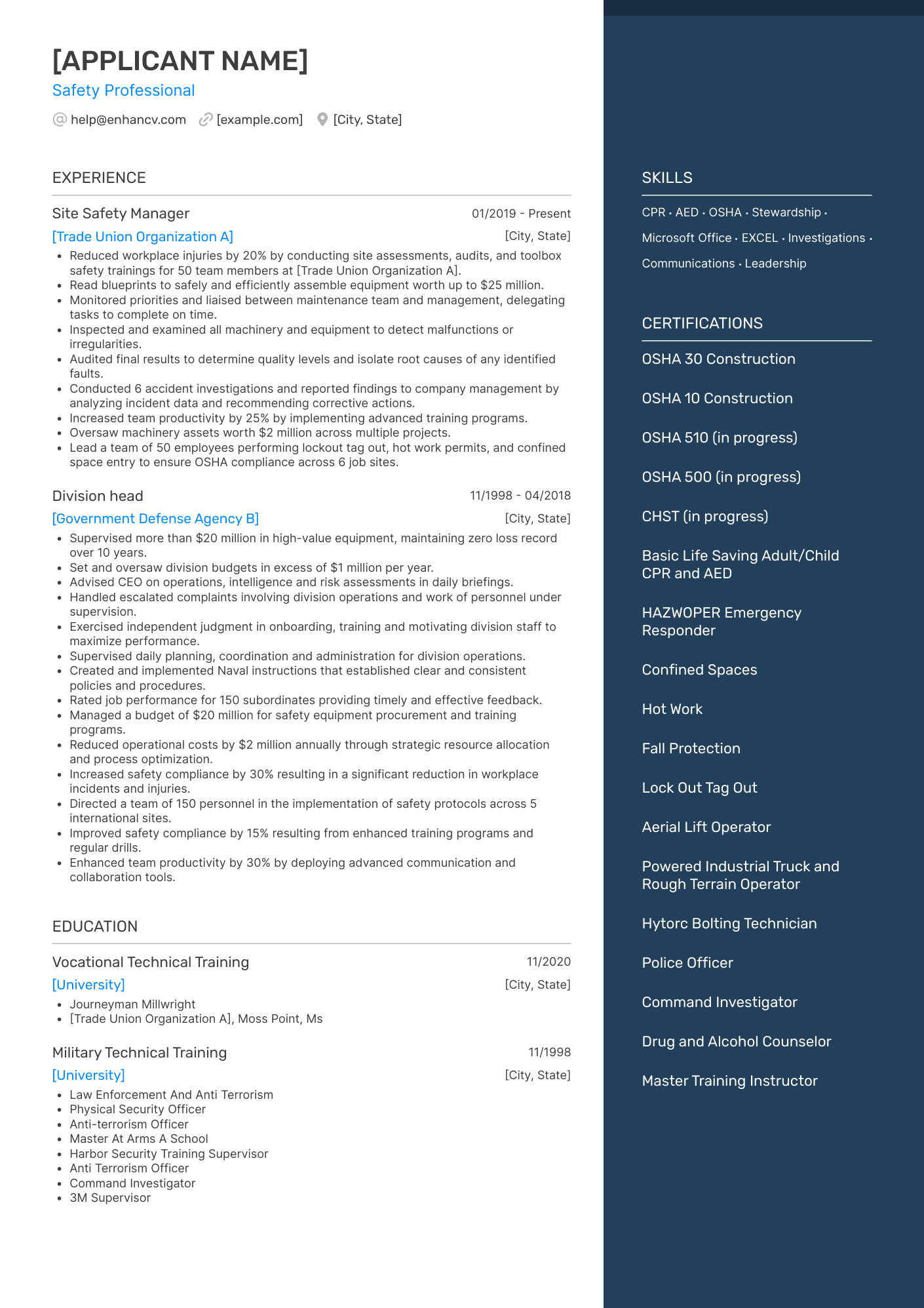
They applied to Amazon through the amazon.jobs portal, interviewed, and got hired.
Note: Originally, the candidate applied with a plain, single-column, two-page PDF file with standard section headings. We used the same resume to conduct the testing, but anonymized the document (this lowers the resume scores all across the board due to missing details).
Meanwhile, the job description is (at the time of the testing) an Amazon EHS Specialist posting from the same Workplace Health and Safety job family as the verified hire.
The original posting came down after the role was filled, which is standard at Amazon, so we disclose that pairing openly.
Finally, we uploaded the resume (and the JD, where possible) to the 10 different resume checkers, and documented every score and recommendation.

What does a resume checker actually measure?
Generally, resume checkers parse resumes the way an applicant tracking system (ATS) do. After that, they score what they find.
Typical checks include:
- Keywords compared against a job ad
- Section structure
- Measurable results
- Contact details
- File readability
- Qualifications
- Spelling
- Skills
The better tools explain each finding. The weaker only flag problems without explanation.
However, what no checker measures is human judgment.
For example, our test resume lists OSHA 30 Construction certifications, and the Amazon JD asks for knowledge of OSHA 29 CFR 1910, which is the general industry standard. In this case, resume checkers see a missing keyword. The recruiter saw a safety veteran who could learn the adjacent rulebook, and hired accordingly.
Best resume checkers of 2026, tested one by one
We gave every tool the same resume, and they disagreed on what constitutes a hirable candidate. In fact, out of the 10 tested resume checkers, we decided that two should fall off the list because they don’t have JD matching.
Let’s go over each test and see what stood out.
Enhancv: best overall resume checker
Scores on our test: 80/100 general, 59% JD match
Enhancv's Resume Checker does 27 checks across content, structure, and style, and it was among the few JD-matching tools in the test whose numbers landed near reality: 80/100 for a resume that got its owner hired is a well-calibrated score.
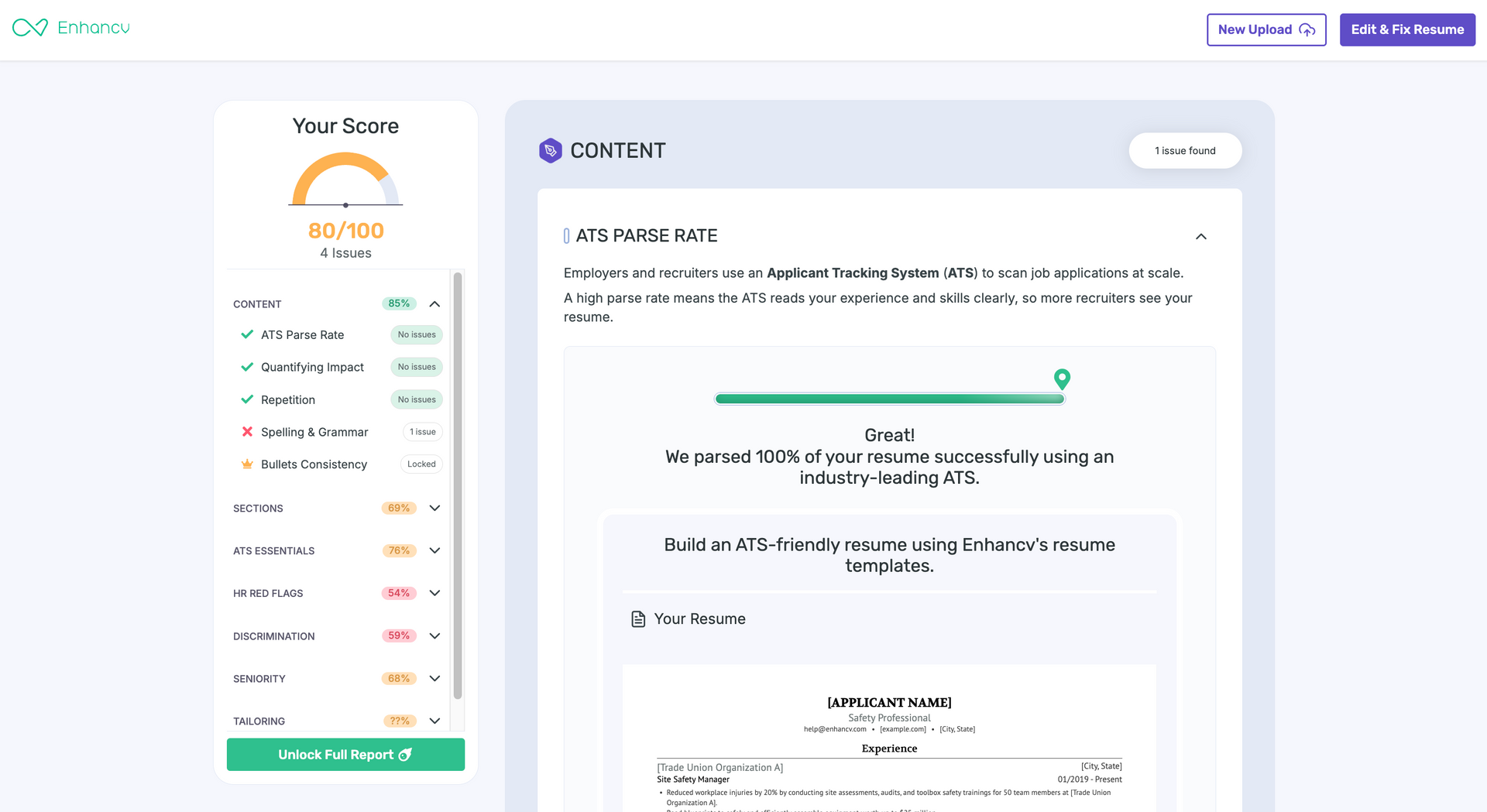
Meanwhile, the 59% match to job descriptions honestly reflects the construction-versus-general-industry keyword gap without panicking about it.
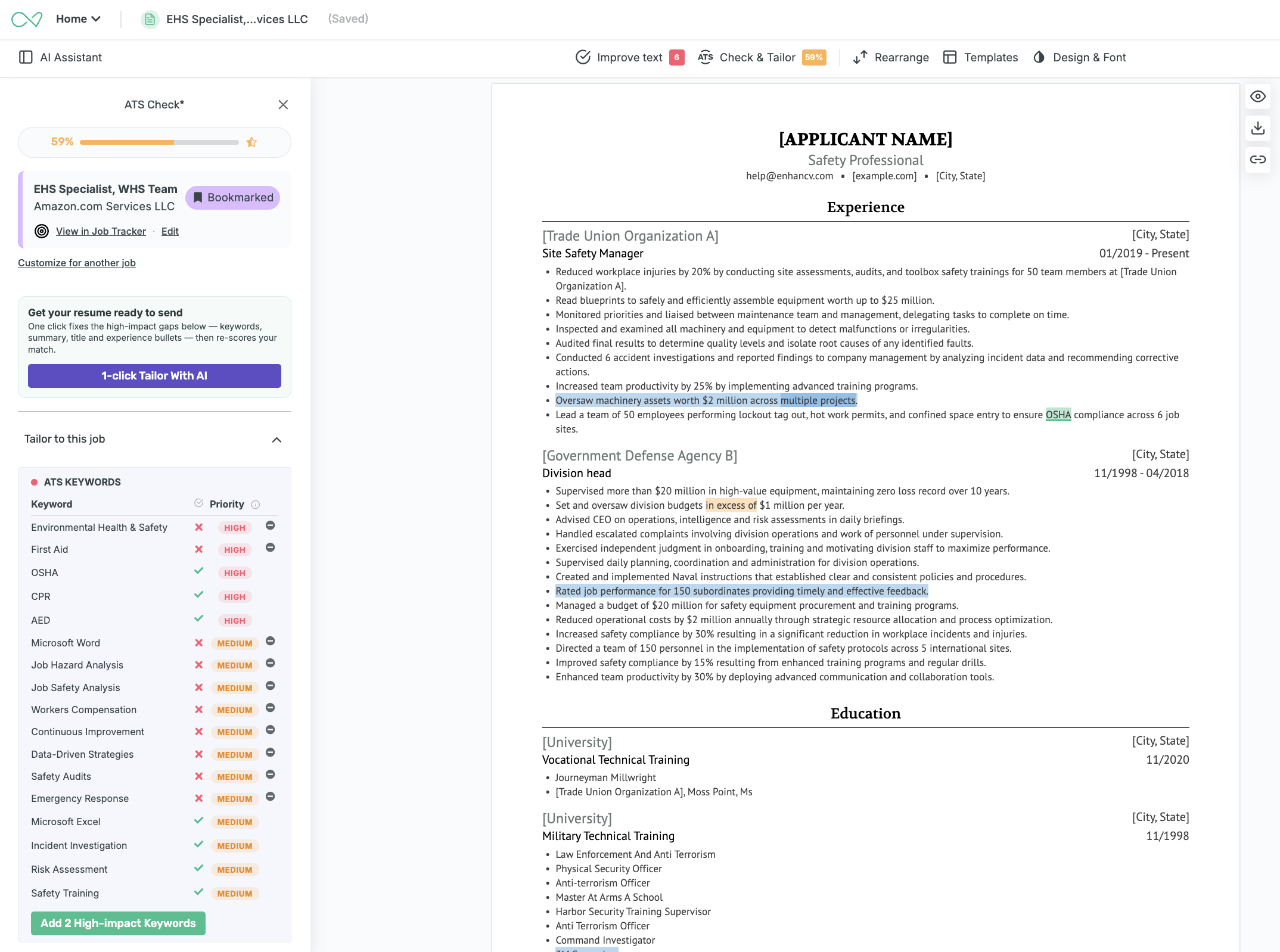
The report includes other fair catches. It flagged a real spelling issue, a missing LinkedIn URL, and the thin skills section. It also confirmed what mattered most for this role: every certification the posting requires already appears on the resume, including the First Aid, CPR, and AED line that Amazon treats as a start-date requirement.
The JD-match view splits keywords by priority, marks which ones already appear, and offers a one-click tailor that re-scores as it goes. In a separate user testing involving 150 senior professionals, Enhancv was often picked as the preferred resume tool for its precise job-description tailoring.
Most tools are obsessed with ATS checks but Enhancv goes a step beyond with several “human checks” such as HR red flags, seniority, and discrimination risks.
Watch for: The deepest checks (bullet consistency, full report) sit behind the paid plan, and you'll need an account for everything.
Resume Worded: best free second opinion
Scores on our test: 78/100 overall, 76/100 relevancy
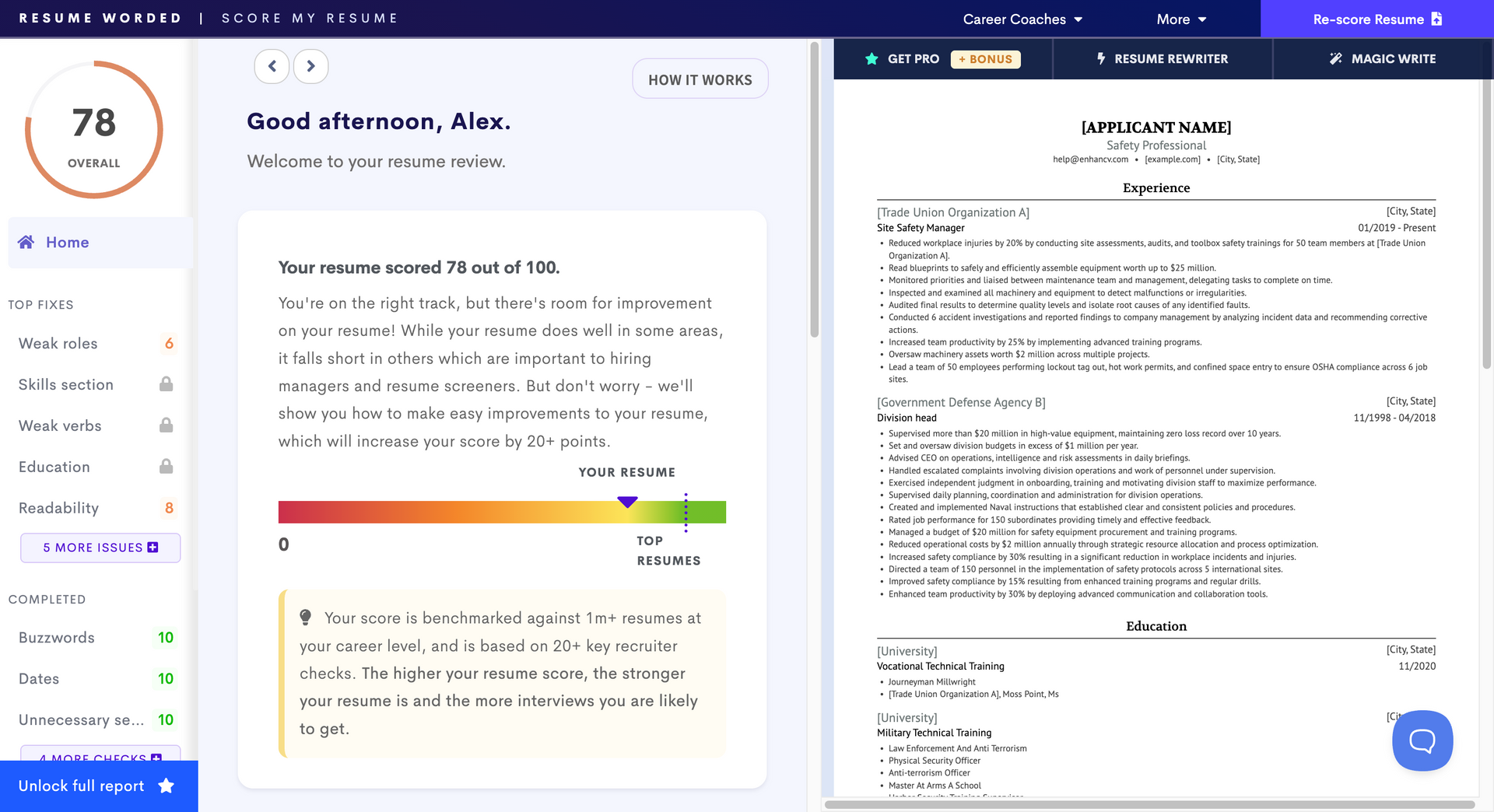
Resume Worded split its verdict into two scores from two tools: Score My Resume grades the document itself, while Targeted Resume grades your JD match.
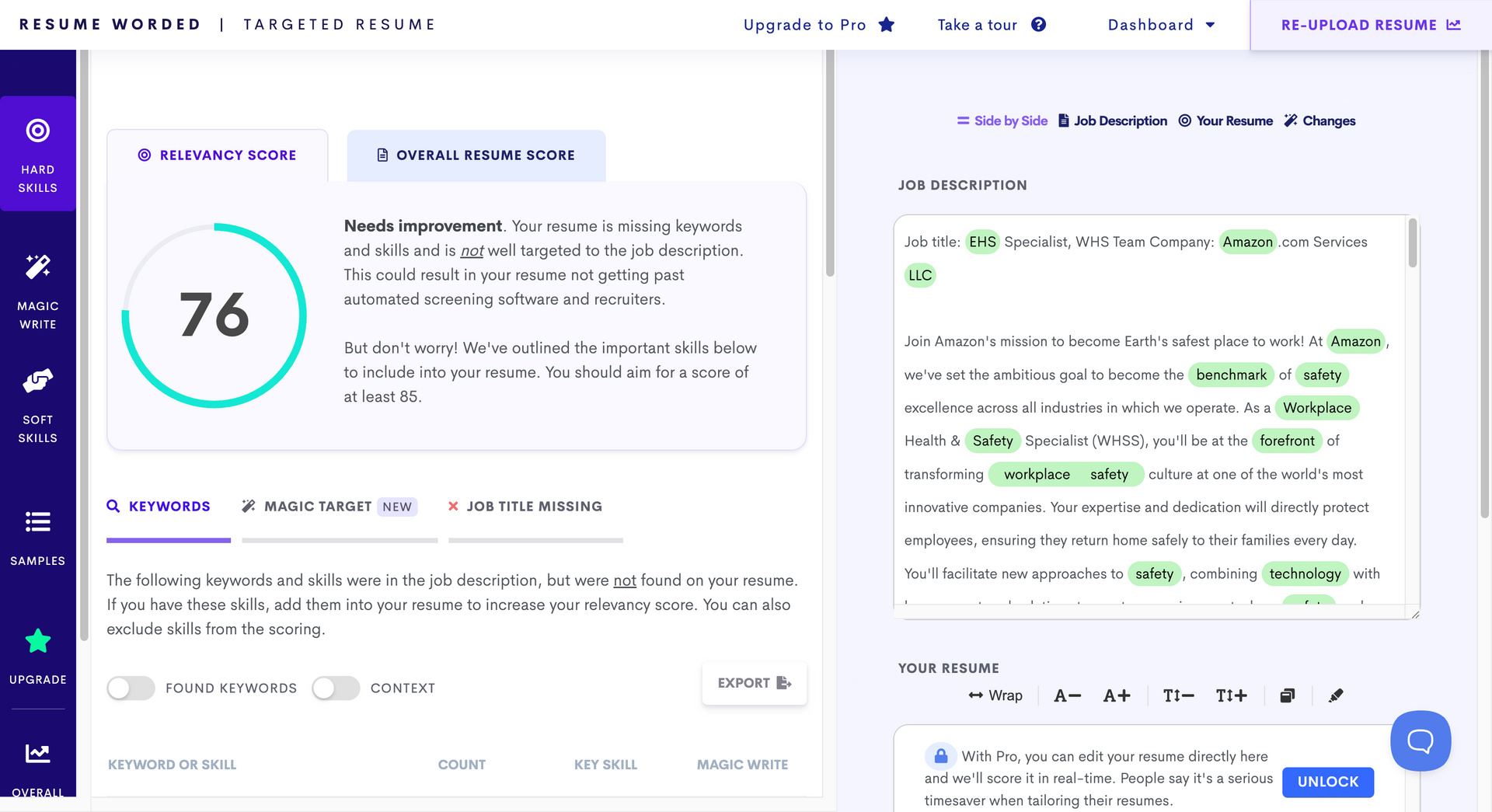
Both landed in the believable 70s on our test, and the report explains itself line by line.
The best catch was the job title gap. The resume says Site Safety Manager, the posting says EHS Specialist, and Resume Worded was the tool that flagged the mismatch most clearly and explained why titles carry weight in recruiter scans.
If you've held an equivalent role, mirroring the job title on your resume is a great way to improve the alignment of your application
Author’s take
Watch for: The two-score system pushes you between two products, and the JD-specific fixes live mostly behind the paid tier.
Novorésumé: most contradictory scoring
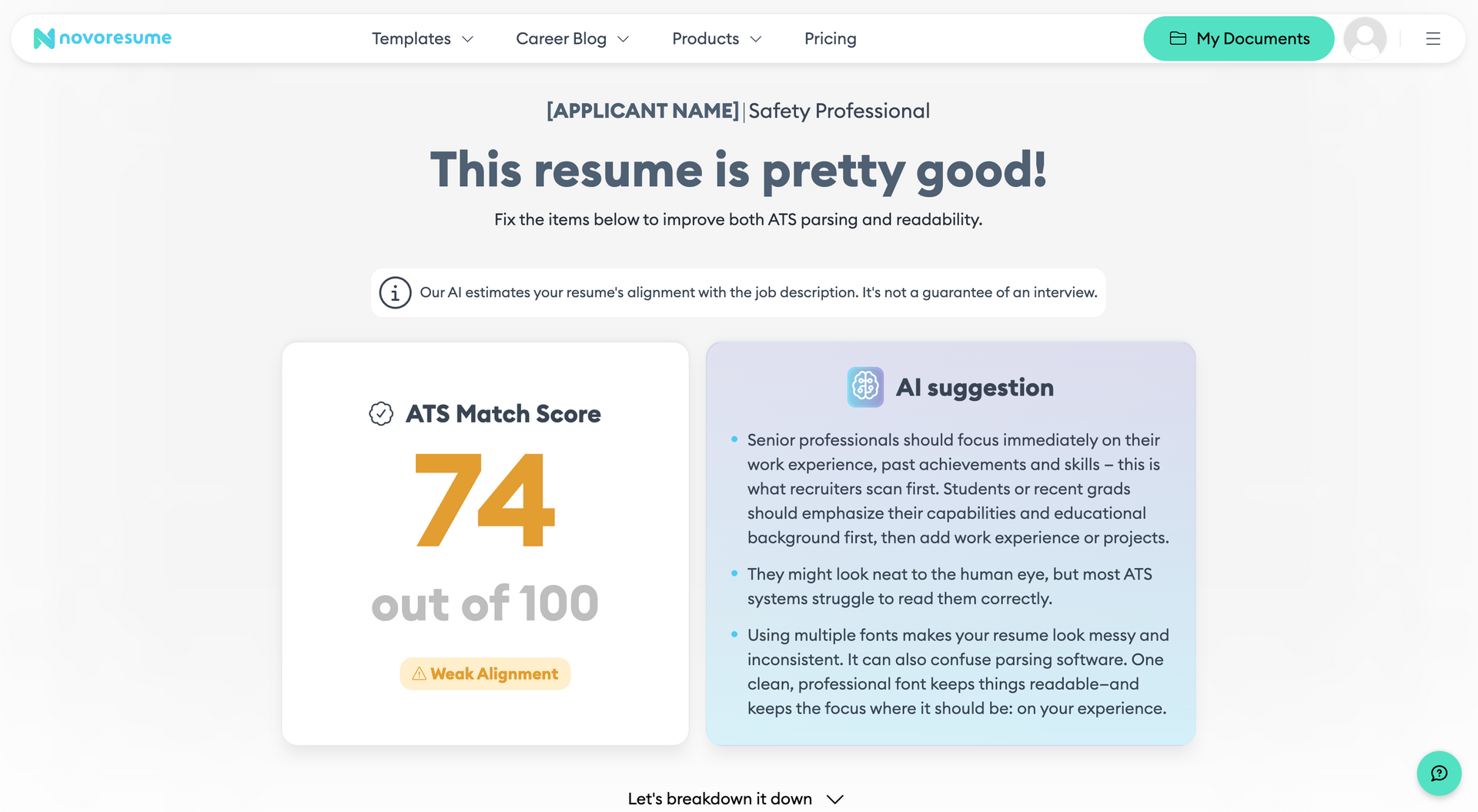
Scores on our test: 74/100 match, with sub-scores from 62 to 100
Novorésumé told us "This resume is pretty good!"
But the 74/100 score was tagged as "Weak Alignment."
Which is it, Novo?
Unfortunately, the breakdown didn't offer any clarity: Format and Structure earned 100/100 in the main report, while the email-gated "Full ATS Report" teaser scored the same category 72/100 and keywords 55/100.
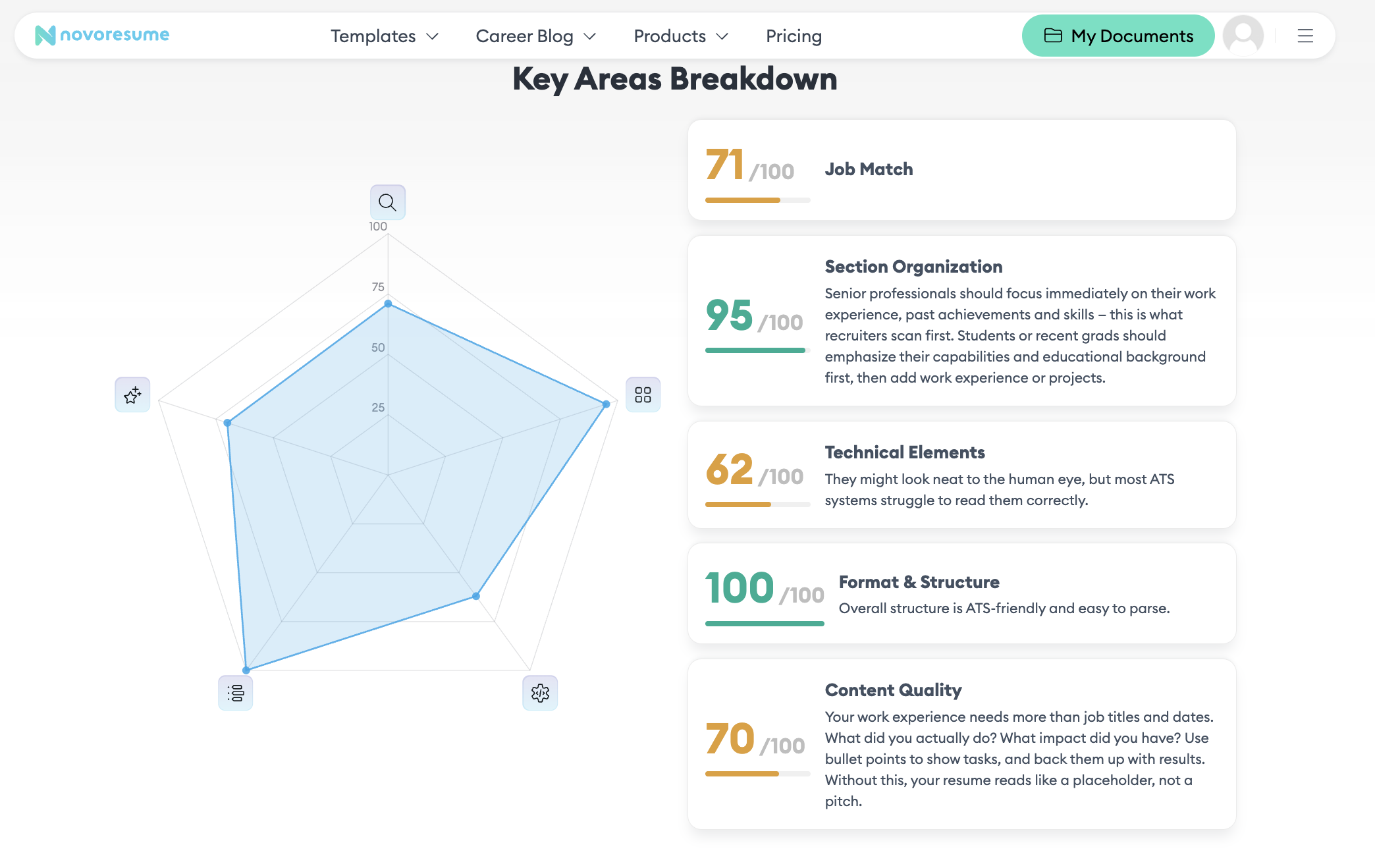
Credit where due: The section-organization advice is thoughtful, and its note that senior professionals should lead with experience rather than education is exactly right for this candidate. To its credit, the tool also states plainly that its score "is not a guarantee of an interview."
Watch for: The same resume earning three different format verdicts depending on which screen you're reading.
Kickresume: builder-integrated checking with an honesty problem
Scores on our test: 75/100 ATS score (Design 85, Structure 48, Content 100)
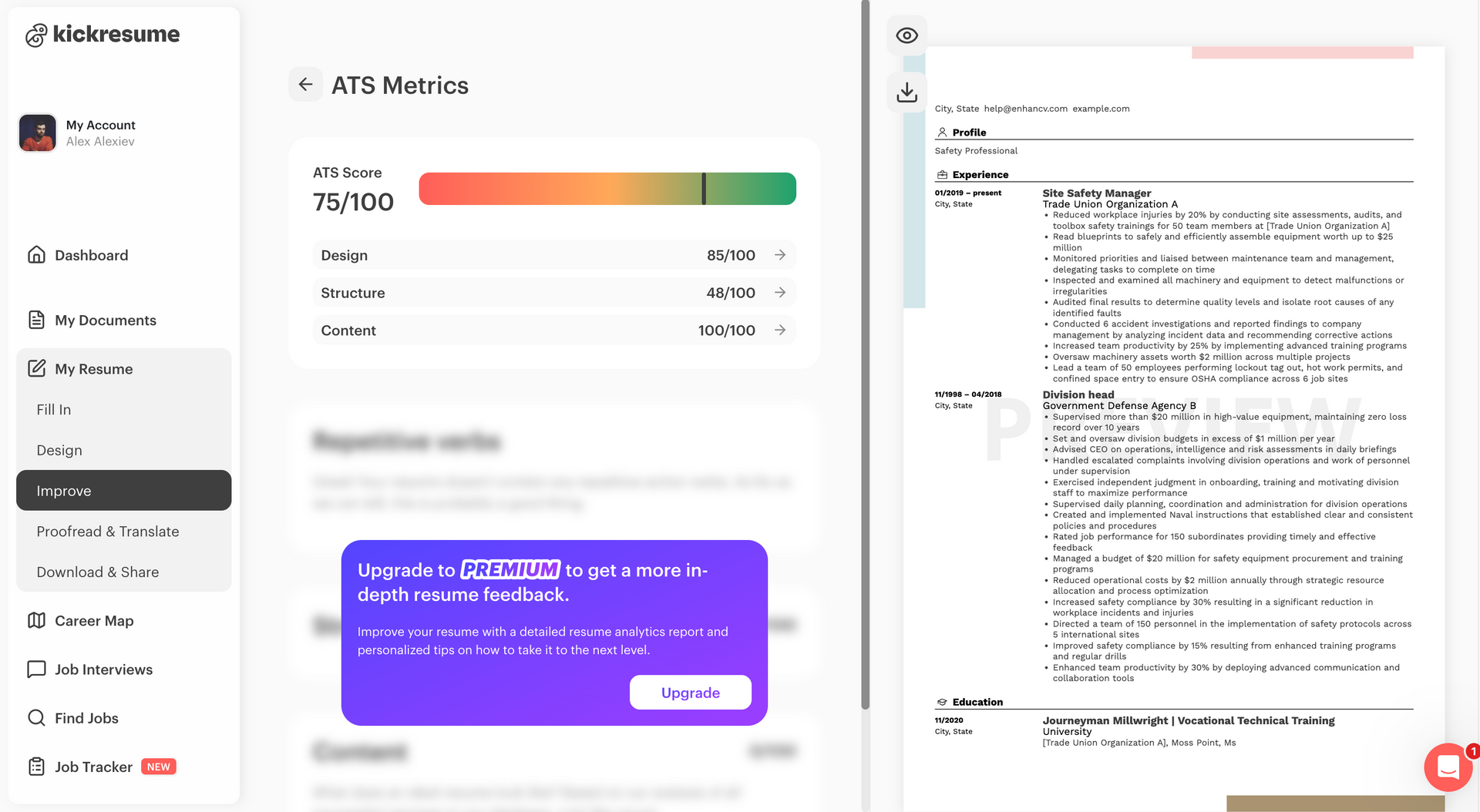
Kickresume's ATS Metrics view gave the resume a reasonable 75 and full marks for content, though the interesting details behind Structure 48/100 sit under a premium screen. As a checker, it's serviceable.
The alarming part came from its tailoring beta. When we asked it to optimize the resume against the Amazon JD, it generated a polished rewrite that listed "OSHA regulations 29 CFR 1910: Advanced" and "Workers Compensation Case Management: Intermediate" as skills. However, in the original resume, the candidate never claimed either.
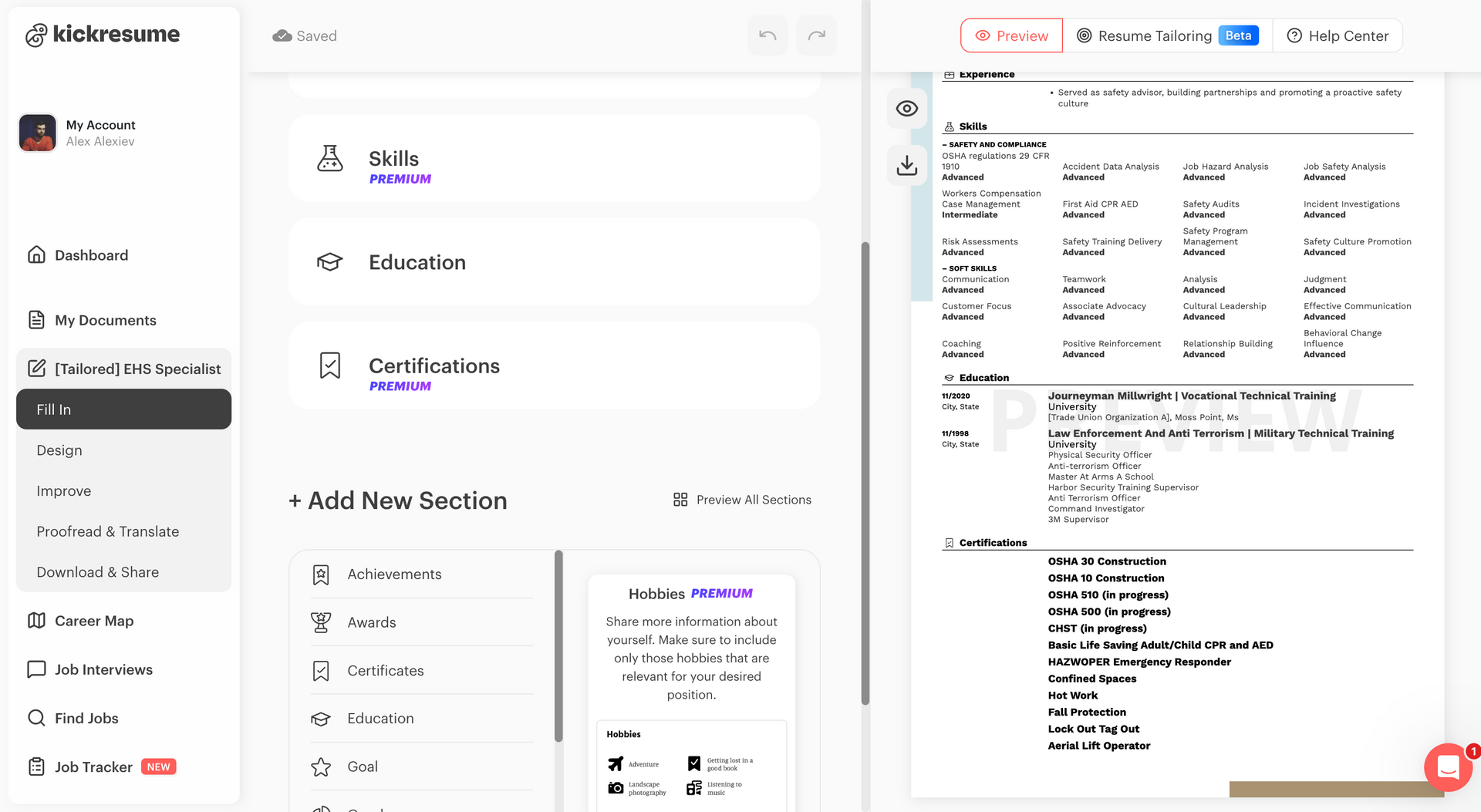
A tool that invents qualifications to close keyword gaps will put you in an interview you'll have to survive. And lying on a resume can have serious consequences.
Watch for: Review every line an AI tailor writes before you send it. Match your resume to the posting with keywords you can actually defend.
Teal: strong tracker, harsh and heavily gated checker
Scores on our test: 21% match, 50% overall
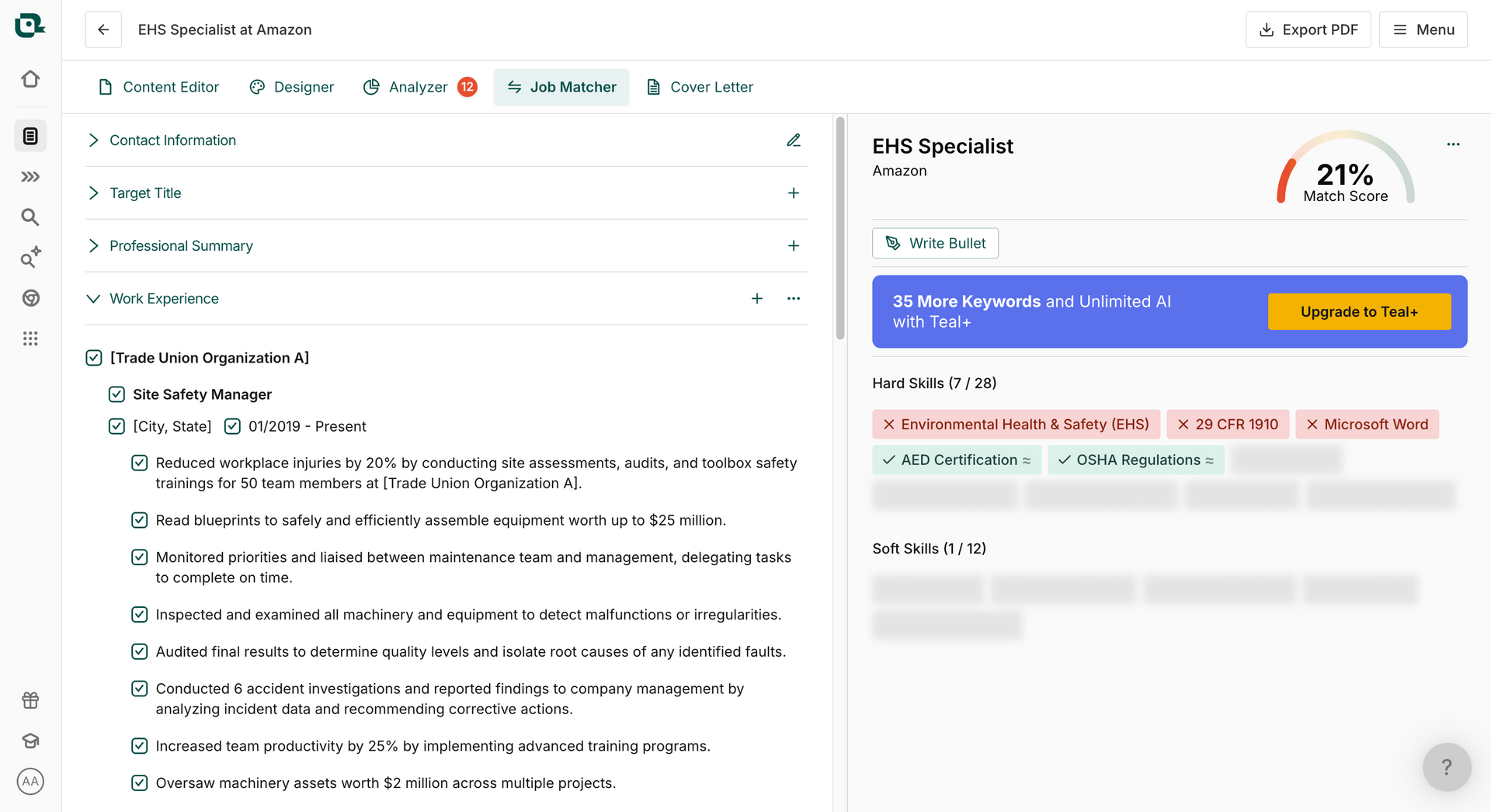
Teal gave our Amazon-hired resume the lowest match score in the test: 21%, with 7 of 28 hard skills found.
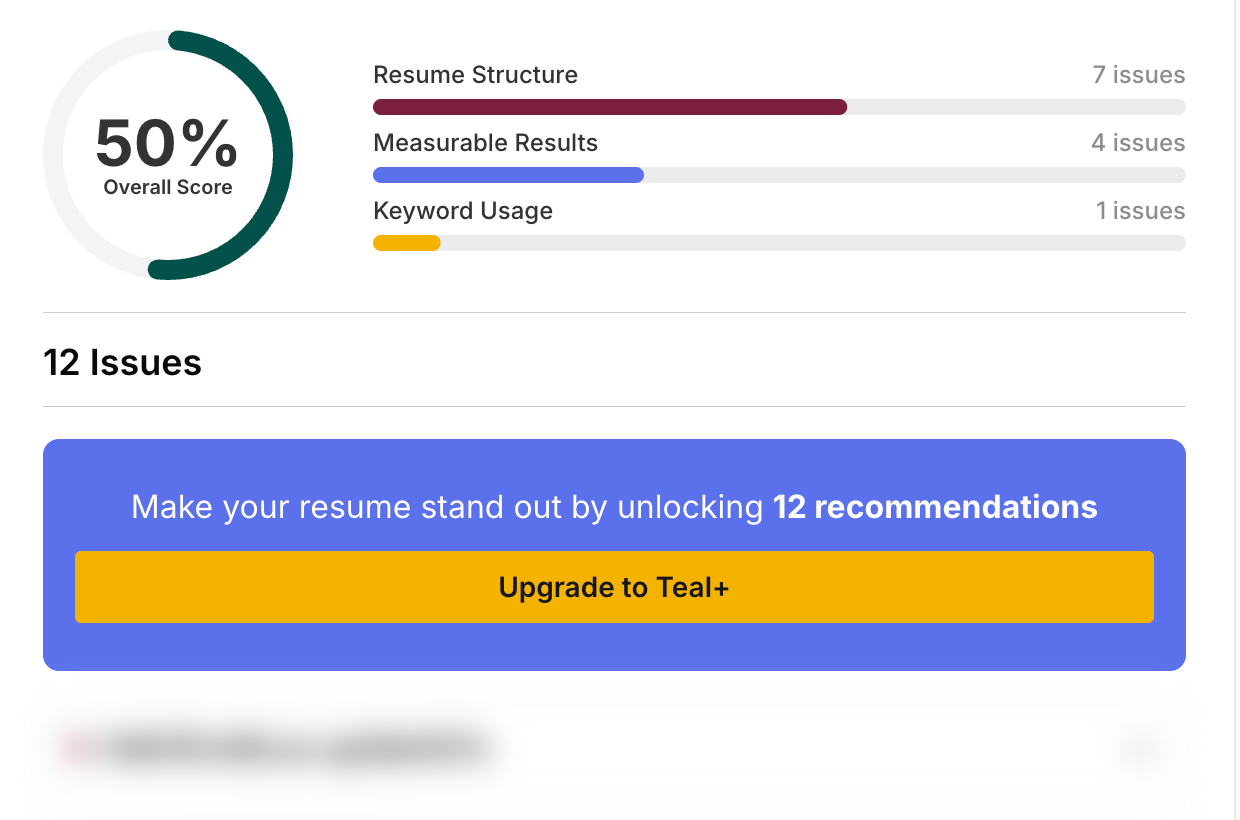
The overall score view counted 12 issues, then locked all 12 recommendations behind Teal+. On the free plan you learn that you have problems, but not what they are.
Teal's genuine strength is its job tracker, which is generous on the free tier and pairs bookmarked postings with resume versions cleanly.
However, as a resume checker, the calibration here is way off: a 21% verdict on a hired resume mostly measures how strictly Teal counts synonyms. "Safety audits" appears on the resume; the JD's "daily safety audits" still registered as a miss.
Watch for: The free score is a teaser. Budget for Teal+ if you want the actual advice.
SkillSyncer: the harshest verdict in the test
Scores on our test: 23/100.
SkillSyncer told us that the resume is "critically below the recommended score of 80" and that it "will likely be passed over for stronger candidates."
This would honestly sound scary if we didn’t know the candidate already landed the interview.
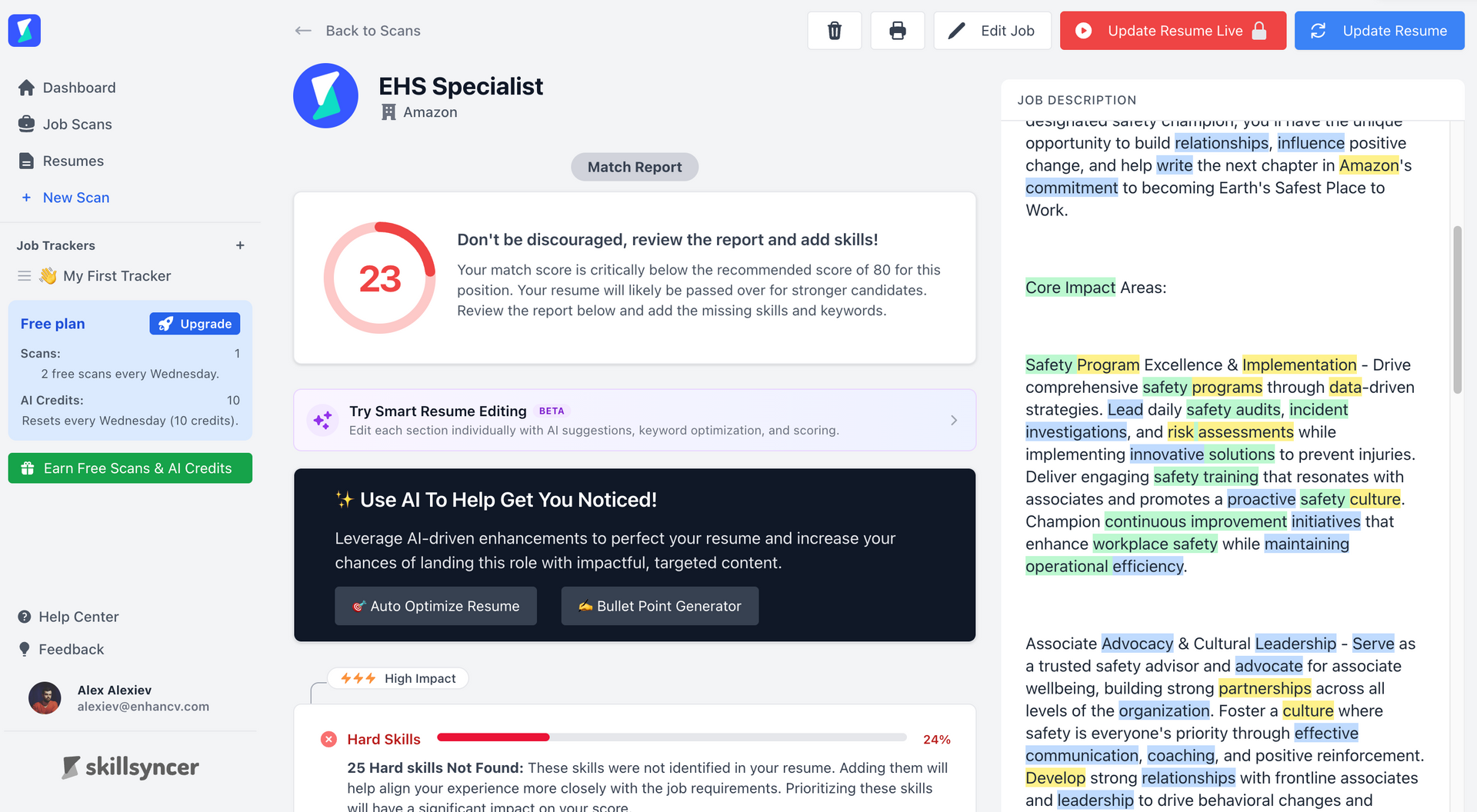
Under the alarming headline is a genuinely detailed free report. It counted 21 quantifiable accomplishments, flagged the missing phone number, caught that the posting prefers a bachelor's degree the candidate doesn't hold, and noted the resume's 474 words run under its recommended range. Those are fair, checkable observations, and the hard-skills and soft-skills gap lists are specific.
Watch for: The tone. Treat the 23 as a keyword inventory, and remember this exact 23 got hired at Amazon.
Jobscan: deep diagnostics, disappearing numbers
Scores on our test: "Low." That's it.
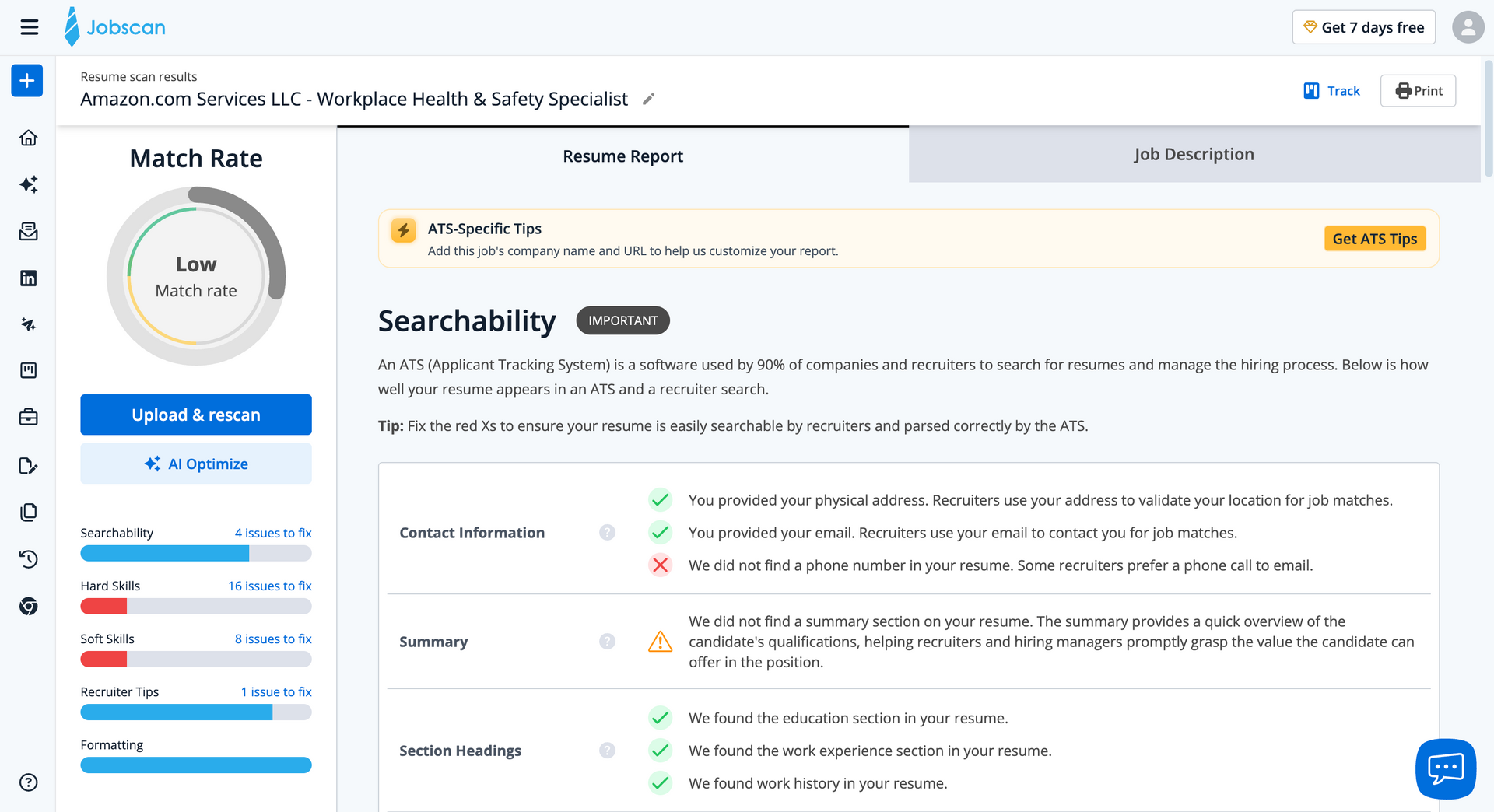
Jobscan is the go-to reference tool for per-keyword JD diagnostics, and its searchability checks stay sharp: it flagged the missing phone number, the absent summary section, and confirmed the section headings parse cleanly.
But on the free plan, our match rate displayed as the word "Low" with the number hidden, alongside 16 hard-skill issues and 8 soft-skill issues whose details push toward the paid plan at $49.95 per month, the steepest price in this test.
Watch for: Five free scans a month, and bring patience for the upsells.
Rezi: a chatbot review instead of a score
Scores on our test: none shown.
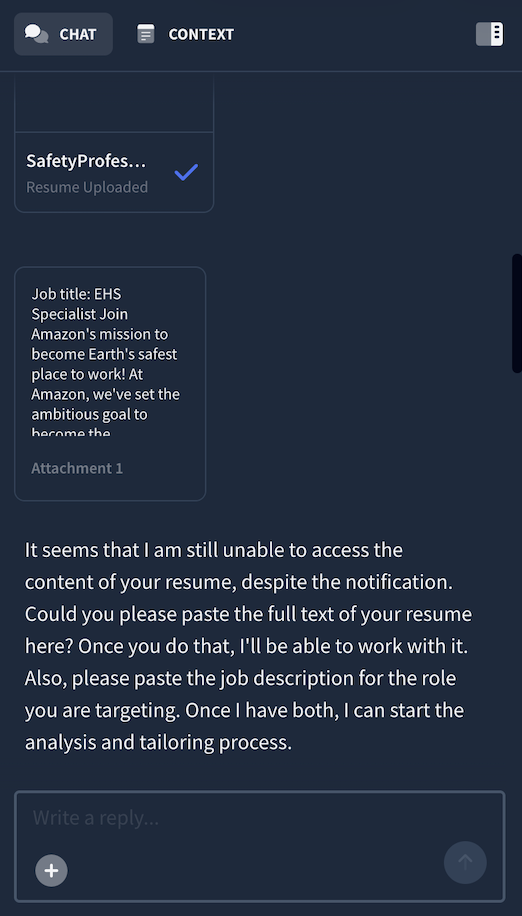
Rezi does its checking in an AI chat workspace. Our first upload failed, with the bot asking for a paste of the resume text.
We had to retry and it worked. It produced the most conversational feedback in the test: it concluded that "Microsoft Office EXCEL" should read "Microsoft Excel," recommended adding Job Hazard Analysis and workers' compensation terms, and suggested reframing bullets around the JD's "Core Impact Areas."
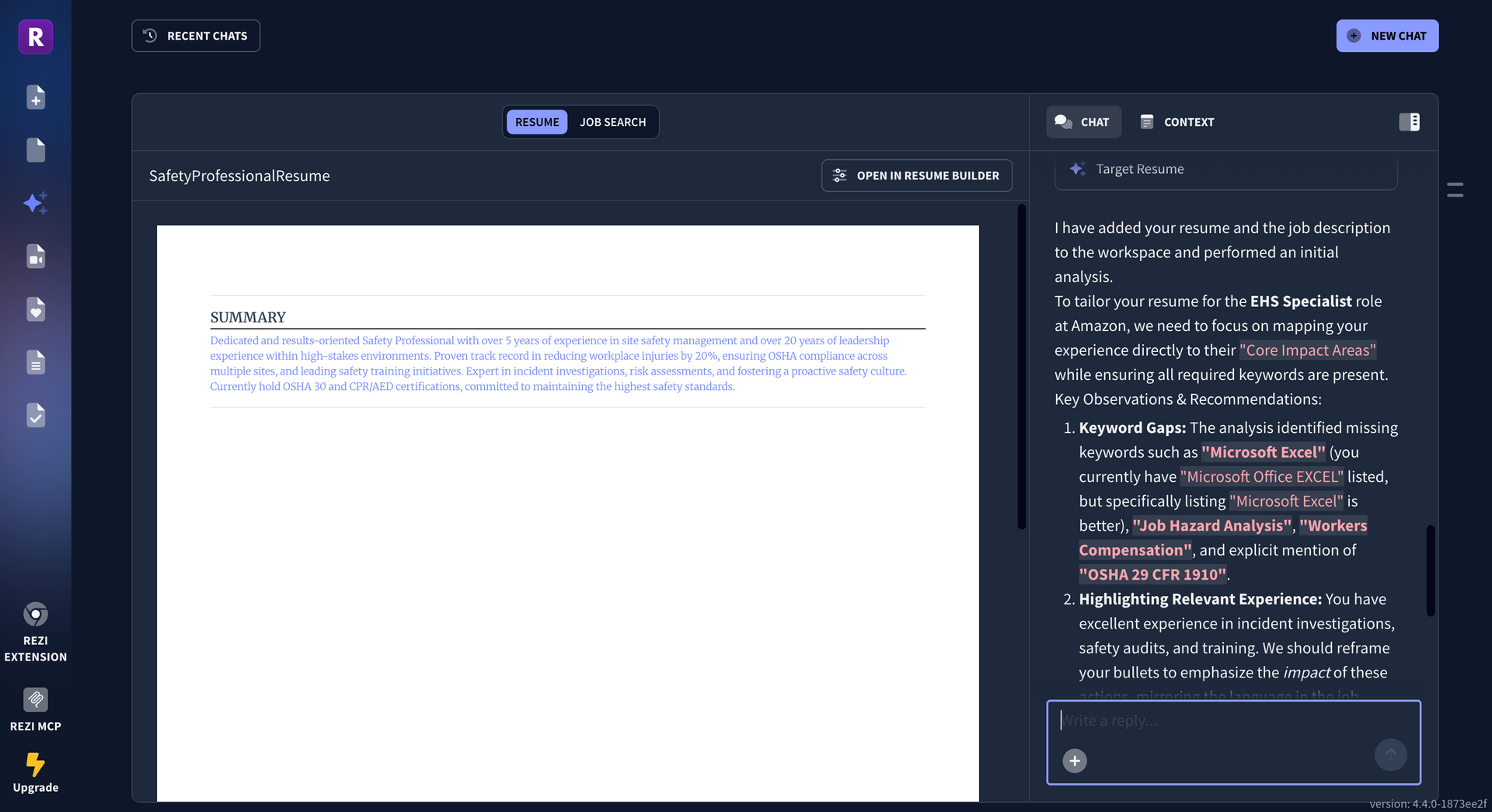
We’re giving them credit. That's real advice, close to what a human coach would say. But without a number, you can't track whether edits move you, and the freeform chat makes results hard to compare across tools.
Watch for: Upload reliability, and the absence of a stable score to iterate against.
Who didn't make the cut, and why
Zety scores resumes inside its builder (our test resume: 69/100), and the suggestions are reasonable checklist items: add a summary, complete contact details.
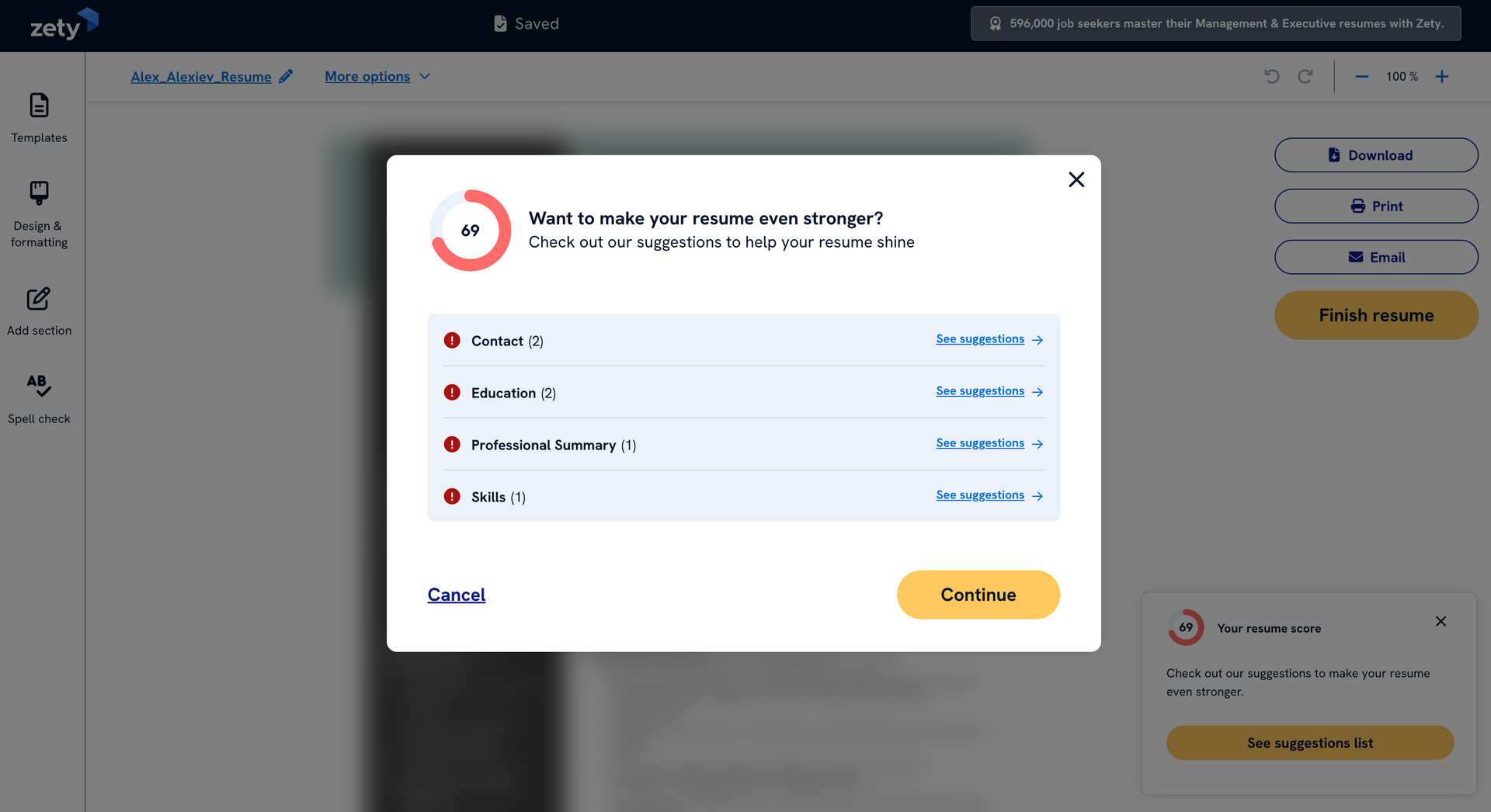
But Zety has no JD-matching feature at all. You can't paste a posting and get a match score, which disqualifies it as a resume checker in 2026. Our Zety review covers what it does well as a builder.
MyPerfectResume gave the resume a 60 "Fair" and a set of generic pointers about contact info, summary statements, and word choice, none of it connected to the specific job.
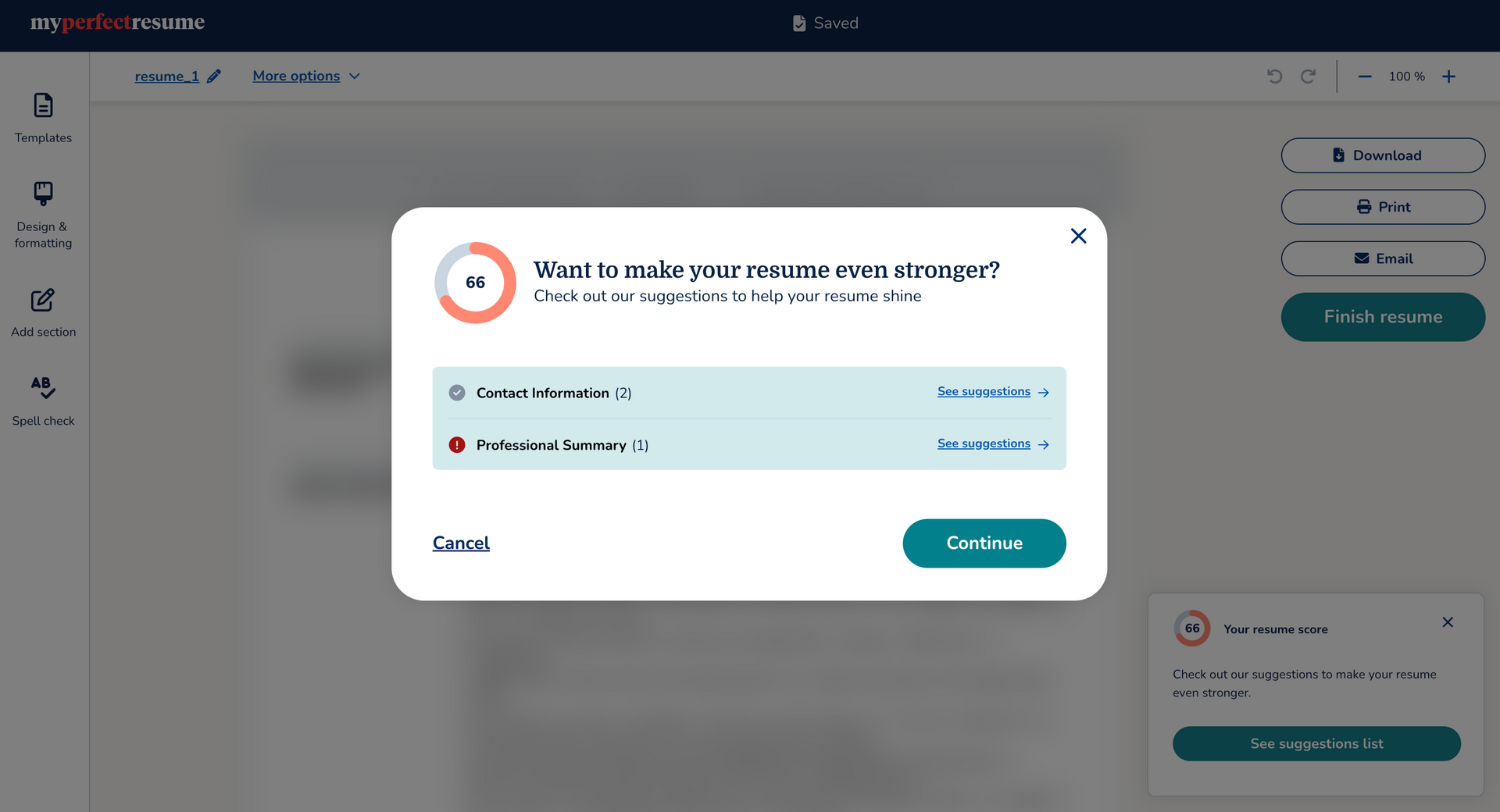
By the way, we searched for the JD-tailoring feature its marketing implies and couldn't find it.
Worth knowing: Both tools belong to the same parent company, BOLD, which explains the near-identical checking experience. If your goal is matching a resume to a specific posting, it seems neither is built for the job.
How should you actually use a resume checker?
The big lesson here is that scores from resume checkers are useful simulations, but they’re not a final verdict on how hireable you are. Imagine if the owner of the resume we used to conduct these tests had knowledge of these scores before they applied. What would have happened then?
What if they were discouraged from applying at all? What if they wasted precious time obsessing over scores rather than putting forward their best effort to land the interview?
Use a checker as a tailoring aid before you apply, then stop and don’t overthink the score.
Here's the workflow the test data supports:
- Test your resume against the real posting. A generic scan tells you about the general state of your resume. A JD scan tells you about fit, and fit is what gets you shortlisted. The second is way more valuable.
- Fix the obvious catches immediately. Across all 10 tools we tested, the same real issues surfaced: no phone number, no summary section, a thin skills section, and near-duplicate bullets. Those fixes are free and take minutes to solve.
- Add only the keywords you can defend. Our candidate genuinely does job hazard analyses and knows their way around general industry standards. Naming those on the resume is honest alignment, and tailoring your resume to the job description increases your chances to land interviews the most.
- Ignore score anxiety across tools. If your resume scores 21 in one tool and 80 in another, keep in mind that your resume didn't change. The measuring instrument did.
A resume that scores well and reads honestly still has one more job: to impress the human recruiter.
Quantified bullets, a clear title, and certifications listed where a recruiter can find them win the ten-second scan that comes after going through the ATS.
Honestly, the moral of the story here is that despite all the measuring and technicalities, our test candidate's 21 quantified achievements almost certainly did more for them than any keyword-matching.
Author’s take
Frequently asked questions about resume checkers
All the testing and results are in the books, now let’s go over some common follow-up questions.
Can a resume checker predict whether you'll get interviews?
No. A resume checker measures the quality of your document against pre-set criteria. In our testing, the same hired-at-Amazon resume scored anywhere from 21% to 80/100 across the 10 tools in this study.
Do ATS systems automatically reject low-scoring resumes?
No. In fact, in our survey of U.S. based recruiters, we found out applications are rarely rejected automatically. Those instances are related to hard knock-out criteria, such as missing essential credentials, or not being willing to relocate for a job.
Why do resume checkers give the same resume different scores?
Each tool uses its own keyword extraction, synonym handling, and evaluation between content and formatting. Our testing showed that one tool counted "safety audits" as matching the JD, another counted it as missing because the posting says "daily safety audits." Technically, neither is lying. They’re just handling the measurements differently, hence the different scores across the board.
Methodology: All 10 tools were tested in July 2026 with the same anonymized PDF resume and the same Amazon EHS Specialist job description, pasted in full. The resume's owner verified the Amazon hire. All resume-relevant information was verified by a CPRW. Screenshots of every score and paywall were captured during testing. Enhancv's checker received no special treatment, and its scores are published exactly as they appeared. Prices and free-tier limits were checked at test time and may change.
Make one that's truly you.