



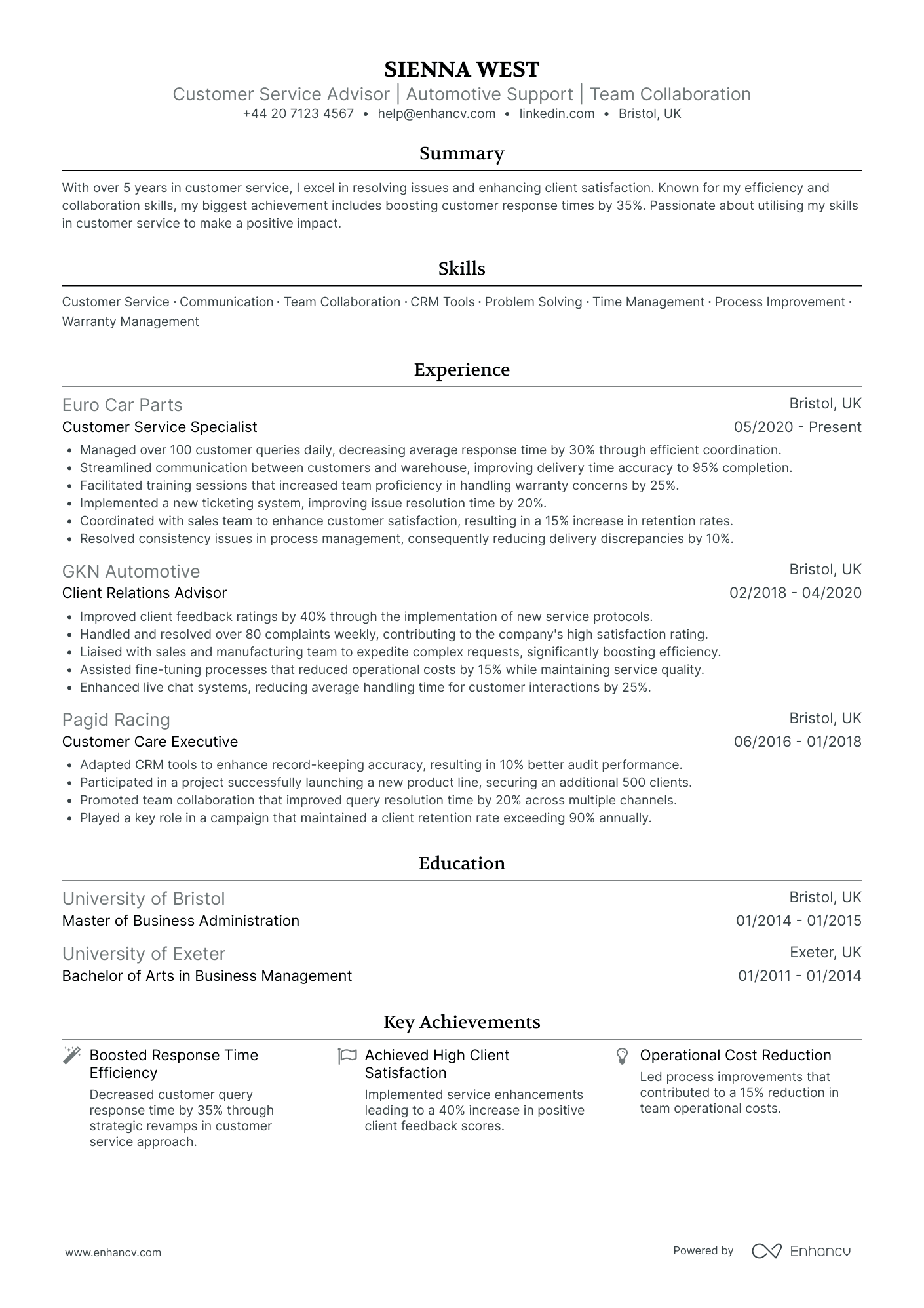
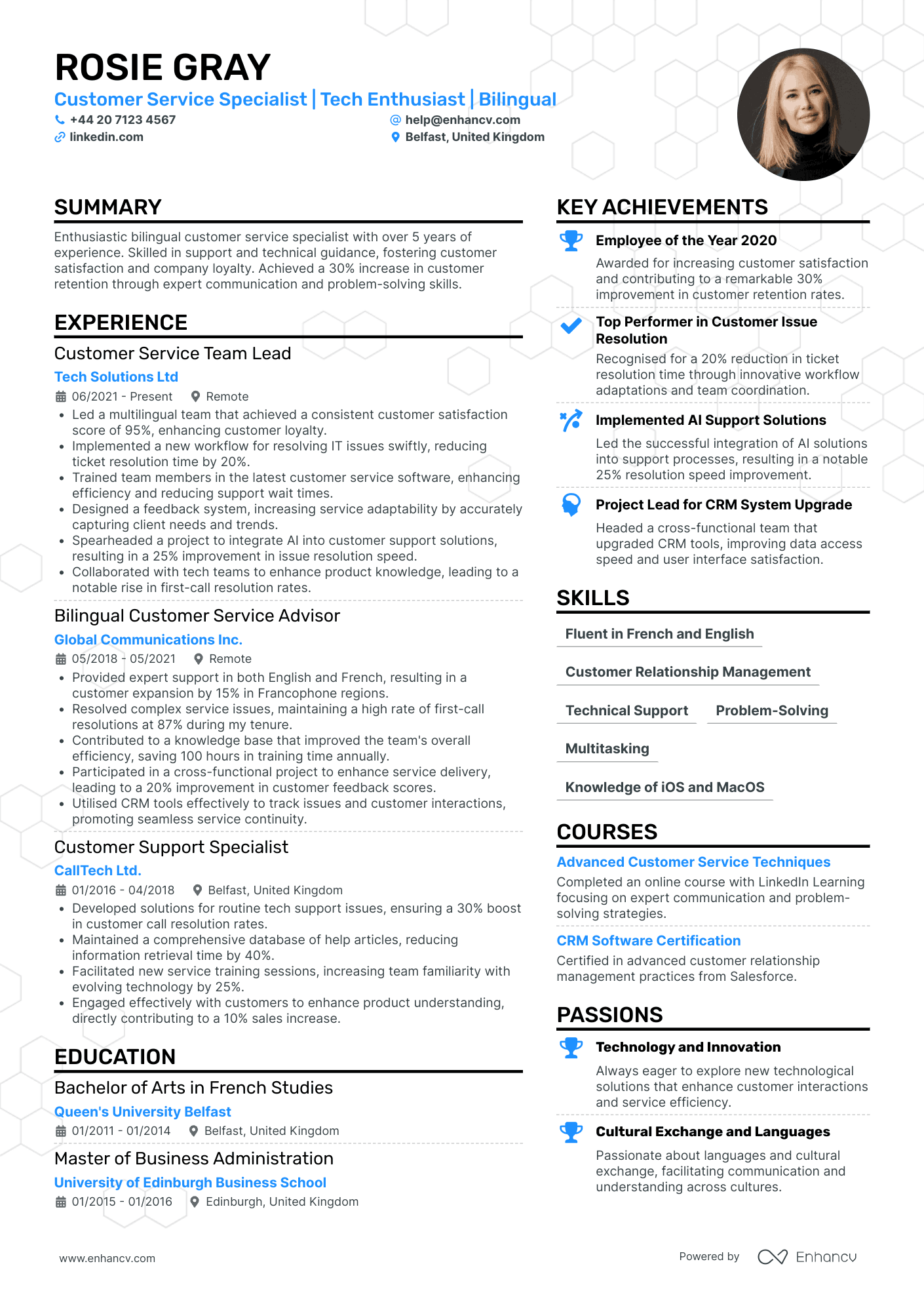
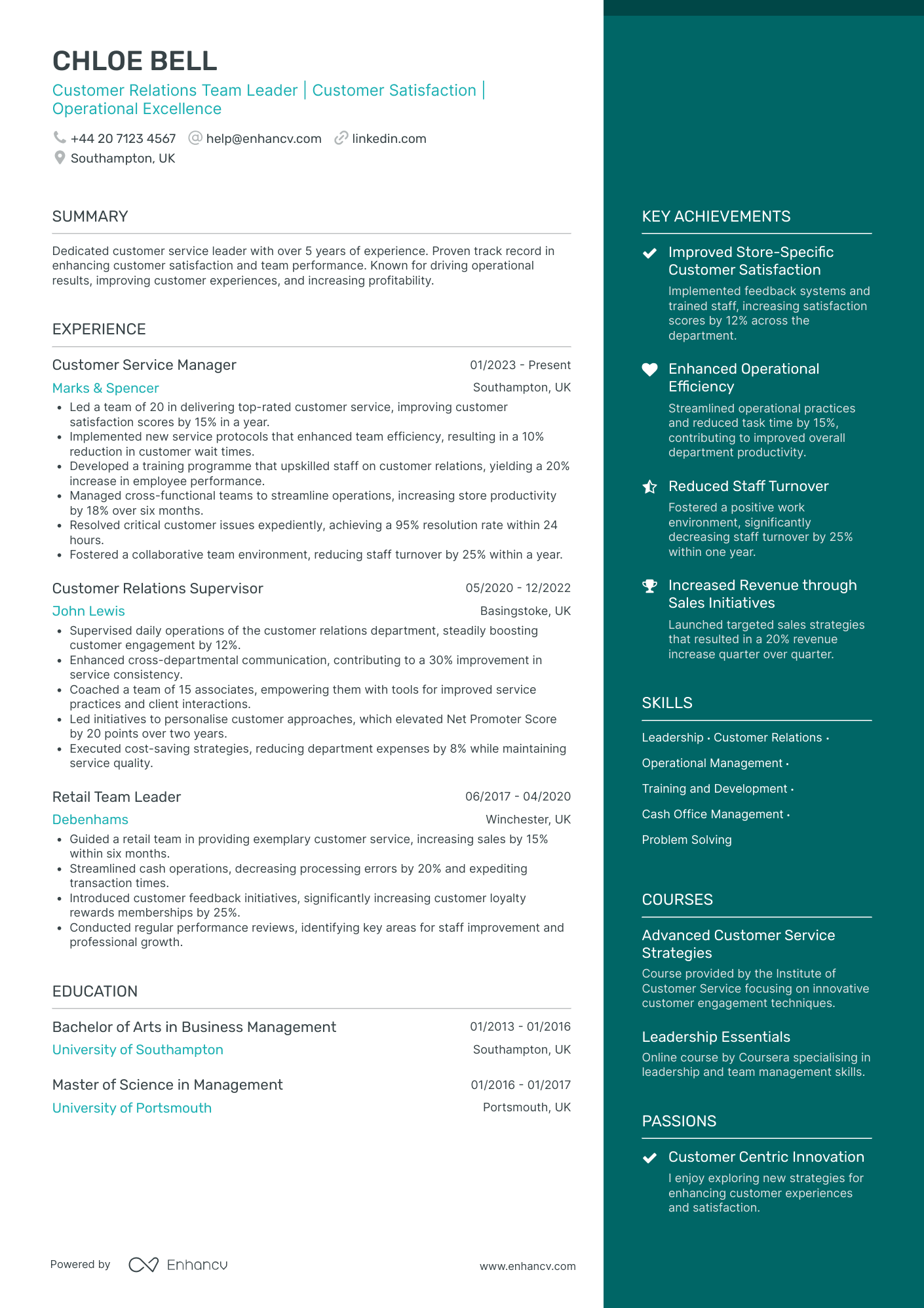
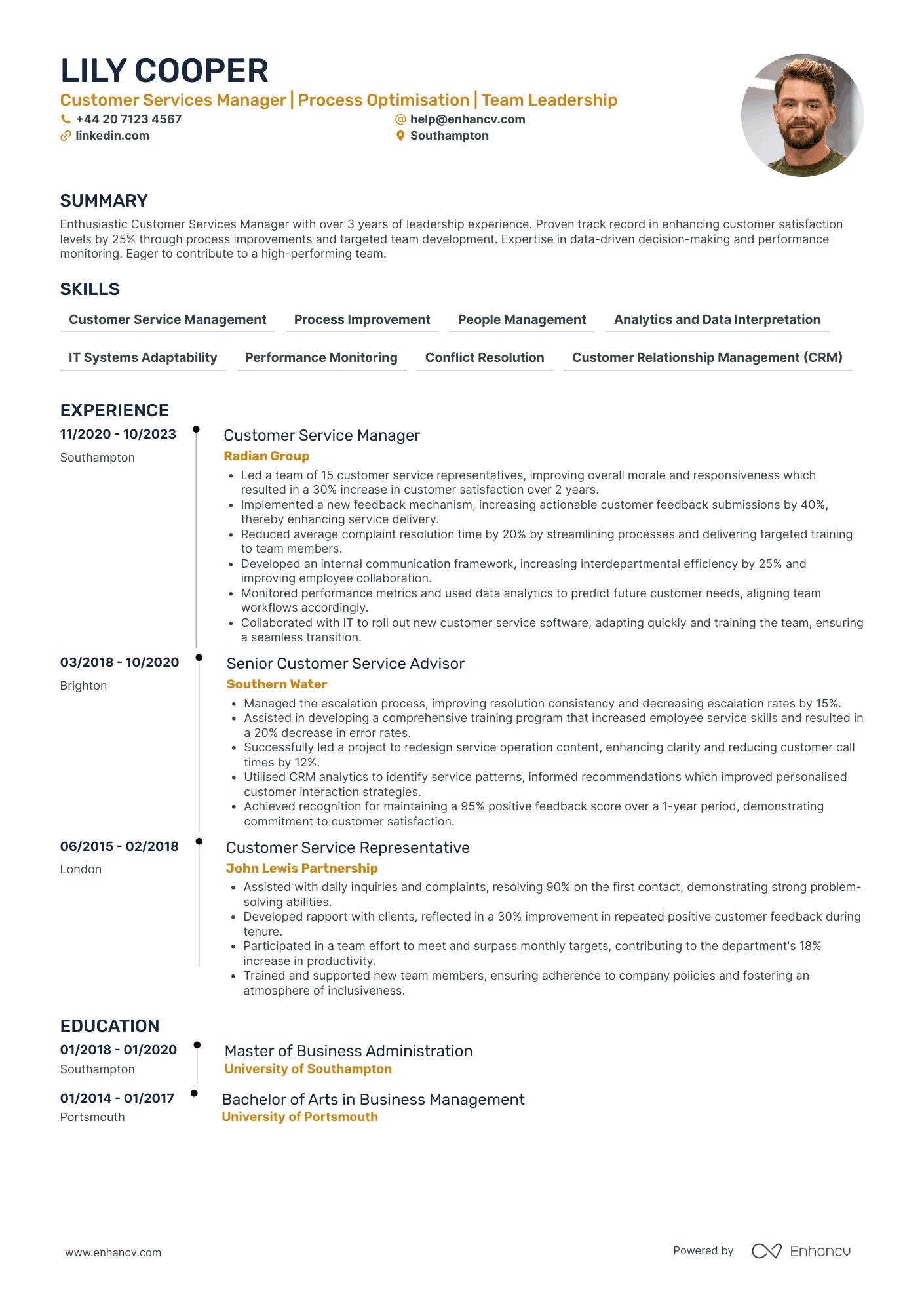
Most customer service CVs read like the job advert copied into bullet points. Answered calls, resolved complaints, worked the till. Everyone applying writes those same lines, so a hiring manager learns nothing from them.
The CVs that earn interviews prove each skill with a number, a named system, and a result a manager can picture. Lead with capability, because that is the first thing a customer service employer screens for.

Key takeaways
- Lead with skills and name the tools. A CRM by name, Microsoft Office, and the channels you have handled matter more than a duty list.
- Prove every skill with a number: tickets closed, satisfaction scores, first-contact resolution, or wait times you brought down.
- Most UK customer service work is onsite, so put your location and a reliable commute near the top.
- Open with a short personal statement built on one measurable result, not a string of adjectives.
- Keep it to two pages, reverse chronological, and send a PDF unless the advert asks for a Word file.
- No direct experience is fine. Retail, hospitality, and volunteering all count when you write them in customer service language.
Top skills for your customer service CV
Read a stack of live UK customer service adverts and the same demands repeat. Customer service, CRM, and Microsoft Office are the skills that recur most often in UK customer service postings, and they turn up in the exact words the advert uses.
Across 934 UK customer service postings in the last 30 days on Enhancv's internal job feed, the skills that come up most are customer service itself, CRM, Microsoft Office, Excel, and process improvement. Those are your hard skills, so list them in the advert's language, not your own.
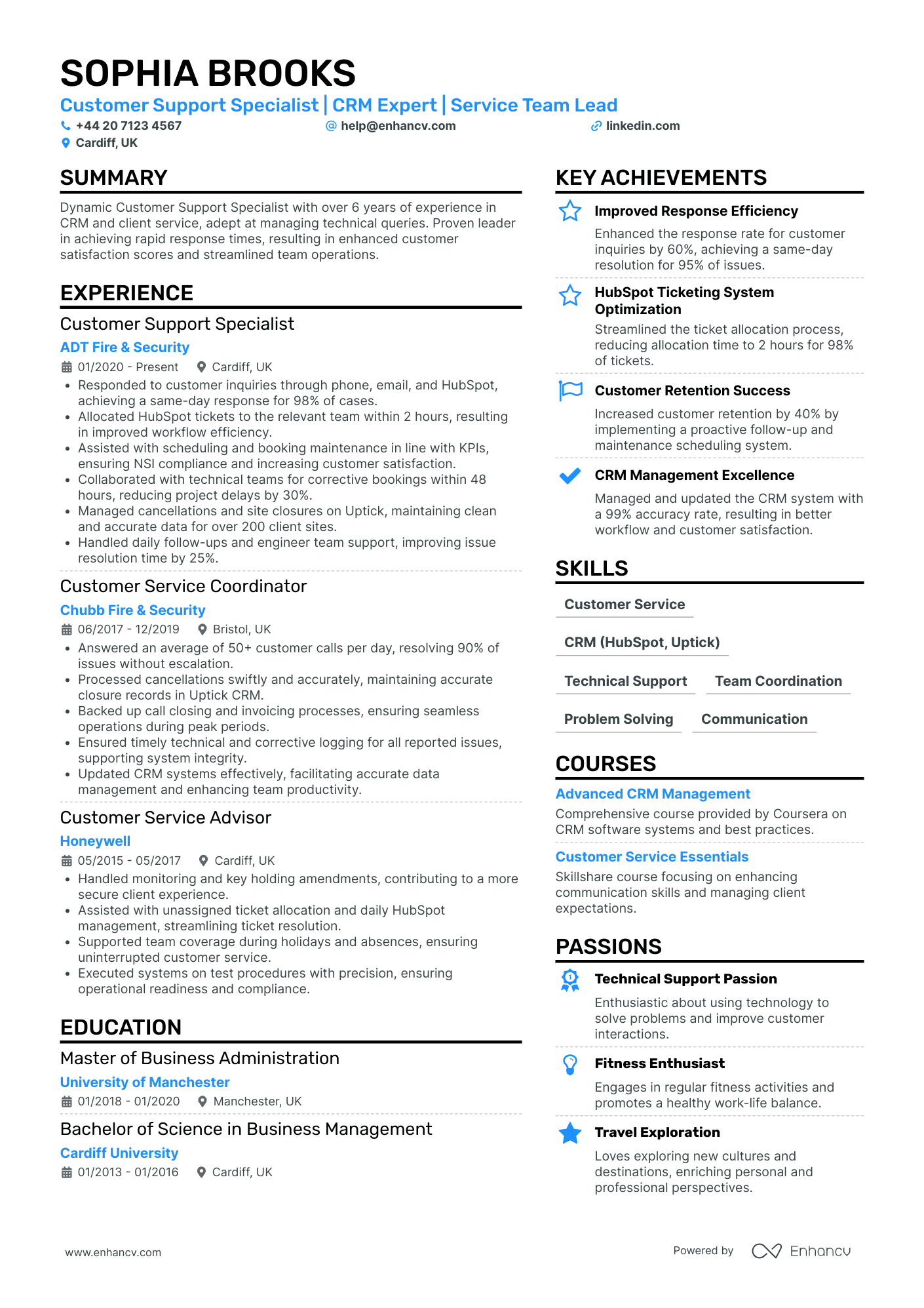
Name the CRM instead of writing "CRM software". Salesforce, Zendesk, Freshdesk, or HubSpot each tells a recruiter something specific about what you can pick up on day one.
Do the same with channels and metrics. Phone, live chat, email, and social are different jobs, and a manager wants to know which you have run. CSAT, first-contact resolution, and average handling time are the numbers that prove you ran them well.
Here is how each reads as evidence rather than a label:
- CRM: "Managed 1,200 customer records in Salesforce at a 99% data-accuracy rate."
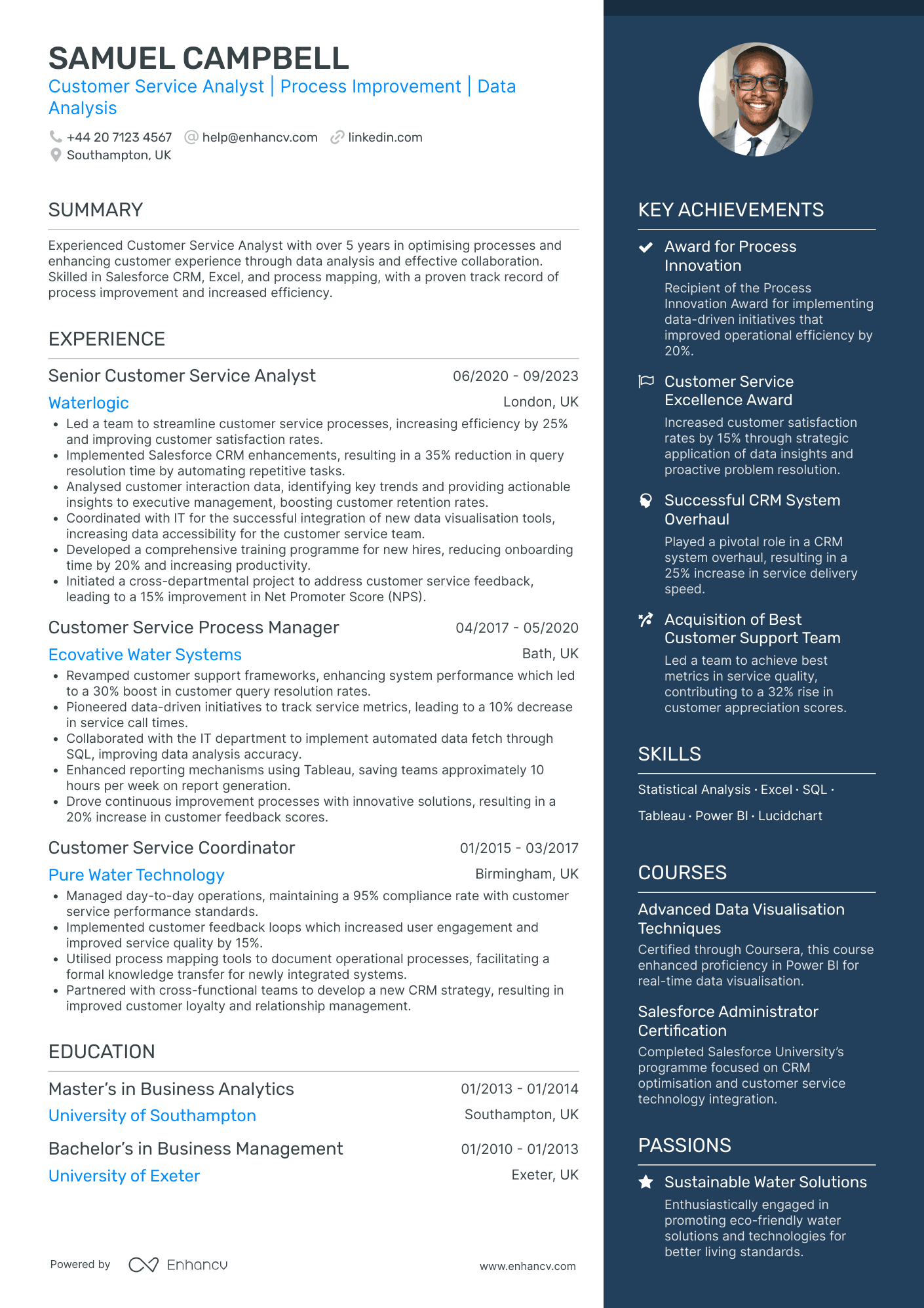
- Excel: "Built a weekly SLA tracker in Excel that cut reporting time from two hours to twenty minutes."
- Process improvement: "Redesigned the returns flow, removed two steps, and dropped average handling time by 18%."
- Complaint handling: "Resolved 88% of escalations at first contact, ahead of the 80% team target."
The soft skills that matter here are checkable, not decorative. Communication, empathy, patience, active listening, and problem-solving carry the role, so treat them the way strong customer service skills read on a CV and prove each in a bullet.
Match the depth to the role. A contact-centre advert leans on call metrics and CRM notes, while a B2B support desk weighs stakeholder management and process improvement more heavily. Read which one you are applying to, and lead with the skills it names first.
List only what you can defend in an interview. A tight, honest skills section beats a long one padded with words you cannot back up.

The three strengths that carry a customer service CV
When a manager scans your CV, three strengths do most of the work:
- Communication that de-escalates. Clear, calm, and quick to reach a resolution the customer accepts.
- Problem-solving under pressure. Reading a situation fast and fixing it without escalating every time.
- Reliability. Turning up, following the process, and keeping records clean so the next person can pick up the thread.
Top skills for your customer service CV:
CRM software (Salesforce, Zendesk, HubSpot)
Complaint and escalation handling
Microsoft Office and Excel
Order, billing, and returns processing
Live chat and email support
Process improvement
Stakeholder management
KPI and SLA reporting
Communication
Empathy
Patience
Active listening
Problem-solving
Teamwork

PRO TIP
Customer service adverts name their tools. Mirror the ones you have used exactly as they appear: "Salesforce", "Zendesk", "Freshdesk", "live chat", "CSAT", "first-contact resolution". If you were trained on a system, name it rather than writing "various CRMs".
What the UK customer service market looks like
Knowing the market shapes the CV. Here is where the work happens and what employers ask for most.
| What | UK customer service roles |
|---|---|
| Where the work happens | Onsite 85%, hybrid 14%, remote 1% (792 of 934 UK postings onsite in the last 30 days, Enhancv's internal job feed) |
| Experience level asked for | Entry 73%, mid 16%, lead 10% (934 postings, last 30 days) |
| Most-listed skills | Customer service, CRM, Microsoft Office, Excel, process improvement |
Two of those numbers should shape your CV.
Customer service work is overwhelmingly onsite, so a recruiter needs to see you can get there reliably. Put your town near the top, and mention a driving licence or a short, dependable commute if it helps.
Nearly three-quarters of postings are pitched at entry level, which is why a first customer service CV is realistic rather than wishful. The demand sits with front-line roles, and most employers hire for attitude and train for the systems.
The skills column is your keyword list. Where those terms are true of you, use them word for word, because that is what the advert and the tracking software are scanning for.
Remote customer service exists, but at 1% of postings it is rare, so do not build the CV around it. If you can work onsite, say so plainly and near the top.
Writing your customer service personal statement
Three or four sentences at the top: who you are, the customer service strengths you bring, one measurable result, and the kind of team you want to join. Keep it concrete, and if you are stuck on the opening line, these CV personal statement examples help.
Skip the adjective soup every other CV opens with. "Hard-working, friendly, and passionate about helping people" tells a recruiter nothing they can check, and they have read it a hundred times this week.
Name the employer's world, not just yours. A statement aimed at a busy contact centre reads differently from one aimed at a retail floor or a B2B help desk, so tune the channels and the metrics to the advert in front of you.
Lead with evidence instead.
Customer service CV personal statement example
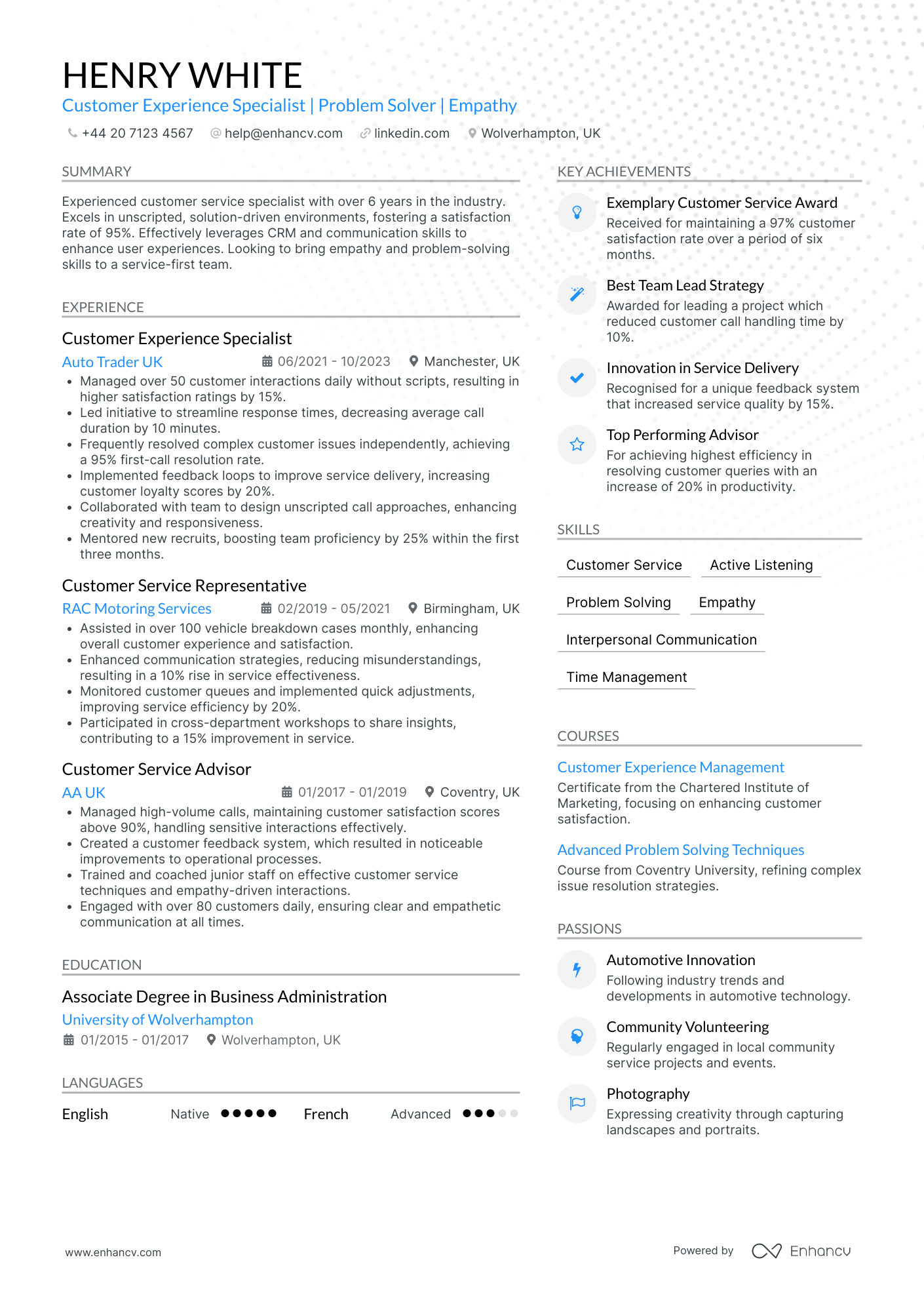
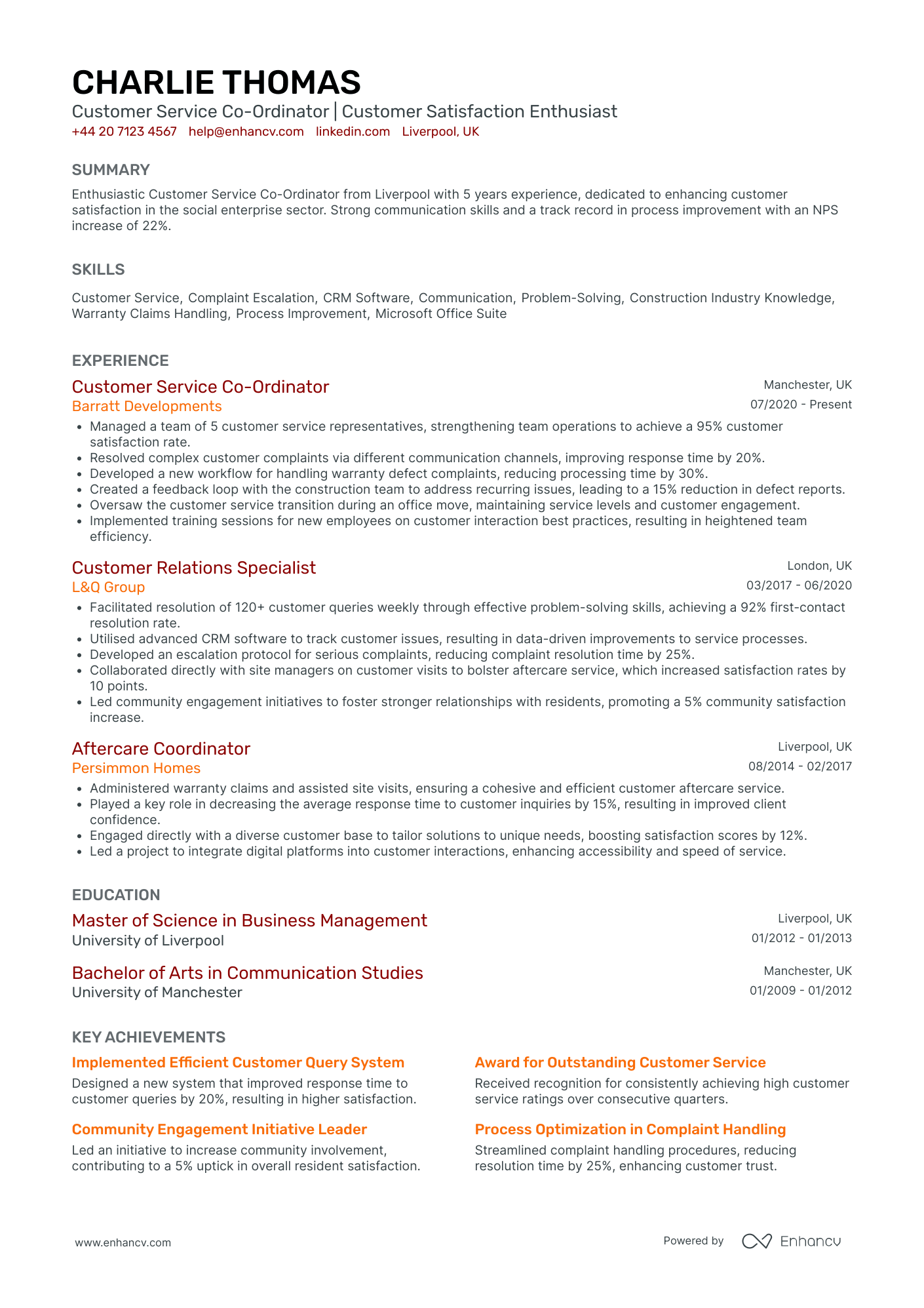
Customer service advisor with four years in a high-volume contact centre, handling up to 60 calls a day across phone, live chat, and email. Held a 94% customer satisfaction score and cut average handling time by 18% by rewriting the returns script. Confident in Salesforce and Zendesk, and looking to bring calm complaint resolution to a retail support team in Manchester.
What to avoid
Hard-working and friendly team player who is passionate about delivering excellent customer service and going the extra mile. A quick learner with great communication skills, seeking a challenging role in a dynamic company where I can grow and develop.
The customer service statements that land open with a number, not a personality trait. "94% satisfaction across 60 calls a day" tells us how you work before we have read a single bullet. Anyone can write "passionate about helping people", and everyone does, so it counts for nothing. Name the channels, name the systems, and give us one result we can picture. That is the difference between a CV we read to the end and one we skim.
Writing your customer service experience section
Write each role the same way: a dated heading, then bullets that lead with a verb and close on a result. For the mechanics, see how to structure work experience on a CV.
Customer service is more measurable than it feels. Calls or tickets handled, satisfaction scores, resolution rates, wait times, upsell figures, and complaints turned around are all CV achievements a manager can weigh.
Compare two versions of the same line. "Responsible for answering customer emails" is a duty. "Cleared a 200-email backlog in a week and held response time under four hours" is an achievement, and it is the one that gets read.
Tailor every application. Pull the systems and duties from the advert and mirror them where they are true of you, which is what a well tailored CV does better than a generic one.
Give each role its scale. "Busiest queue in a 30-seat contact centre" or "lone advisor covering weekend shifts" tells a manager the pressure you worked under, and it makes the numbers mean more.
Reliability is part of the story here too. Shift cover, low absence, and a clean handover matter in customer service, so work them in where they are true.
- Handle up to 60 inbound calls and 40 live-chat conversations a day, holding a 94% customer satisfaction score across the team's busiest queue
- Resolve billing and connection complaints at first contact 88% of the time, cutting repeat calls and escalations to the technical team
- Rewrote the returns and refunds script, reducing average handling time by 18% with no drop in satisfaction
- Log every case in Salesforce and flag recurring faults to the product team, which fed two process fixes in the last year
Rewriting bullets for each advert is slow by hand. Enhancv's CV tailoring feature reads the job ad and suggests the wording that matches it, so you spend your time on the result rather than the reformatting.
Common customer service CV mistakes to avoid
A few habits sink customer service CVs before the skills even get read, and they are the most common CV mistakes in the pile.
- Listing duties with no numbers. "Handled customer queries" says nothing a hundred other CVs do not.
- Adjective soup in the personal statement. "Passionate, friendly, hard-working" is unprovable and forgettable.
- Hiding the systems. If you know Salesforce or Zendesk, it belongs near the top, not buried in a final skills line.
- One generic CV for every advert. Customer service teams can tell, and so can the tracking software.
- Burying your location when most roles are onsite. A recruiter should not have to hunt for where you are.
Fix each one and the CV climbs the pile without a single new qualification.
Formatting your customer service CV
Use a reverse chronological layout once you have customer-facing roles behind you, with your most recent job first. If you are just starting out, a skills-led order works better, and there is more on that below.
Keep it to two pages. UK employers expect two, and a customer service CV rarely needs a third, so do not spill over to fill space.
One column, standard headings, and a clean CV format read fastest. Team leaders skim between shifts, so make the scan effortless.
Send a PDF for direct applications so the layout holds, and keep a Word copy for the agencies that reformat CVs into their own template.
Contact-centre applications often pass through tracking software, so keep the structure simple for an ATS-friendly CV. Build it from a tested layout rather than a blank page, and Enhancv's CV templates export to a clean PDF.
Customer service CV with no experience
Customer service is one of the most open fields in the UK, and 73% of the postings in the feed are pitched at entry level. Employers hire for attitude and train for the systems, so a first CV can compete.
Lead with a skills-based CV: personal statement, then skills, then any customer-facing experience, with paid work history lower down. If you want the fundamentals first, start with how to write a CV.
Mine what you have already done for real customer service evidence. It is almost always there.
- Retail or hospitality: handling complaints, working the till, calming a busy queue, and hitting service targets.
- Volunteering on a helpline, in a charity shop, or at community events, where dealing with the public is the whole job.
- Any role facing customers or the public: reception, deliveries, tutoring, or running a club or society.
Write those in service language. "Resolved up to 40 customer queries a shift on a busy Saturday till" is a customer service bullet that happened in retail.
Give volunteering a dated entry like a job, because volunteering on a CV is experience for this role, not filler. For the overall shape of a first application, our CV examples for a first job show the structure.
One line lifts a first CV higher: a customer service NVQ or a systems course in progress. It signals you are already on the path, even before your first paid role.
Education and training for a customer service CV
Most customer service roles do not need a degree, so keep the education section short unless it is recent or directly relevant. GCSEs including English and maths, plus any A levels or a diploma, cover the majority of adverts.
Training carries more weight here. List product or systems training, an NVQ in Customer Service, safeguarding or data-protection modules, and any first aid, worded exactly as the advert names them.
Naming the certificates you hold saves the employer a question and signals you take the role seriously.
Conclusion
Lead with the skills a customer service employer screens for, prove each one with a number, and name the systems in the words the advert uses.
Keep the format clean and onsite-friendly, then pair the CV with a short cover letter that says why this team. That is what turns a quick scan into an interview.
Author's take - the Enhancv team
The customer service statements that land open with a number, not a personality trait. "94% satisfaction across 60 calls a day" tells us how you work before we have read a single bullet. Anyone can write "passionate about helping people", and everyone does, so it counts for nothing. Name the channels, name the systems, and give us one result we can picture. That is the difference between a CV we read to the end and one we skim.