



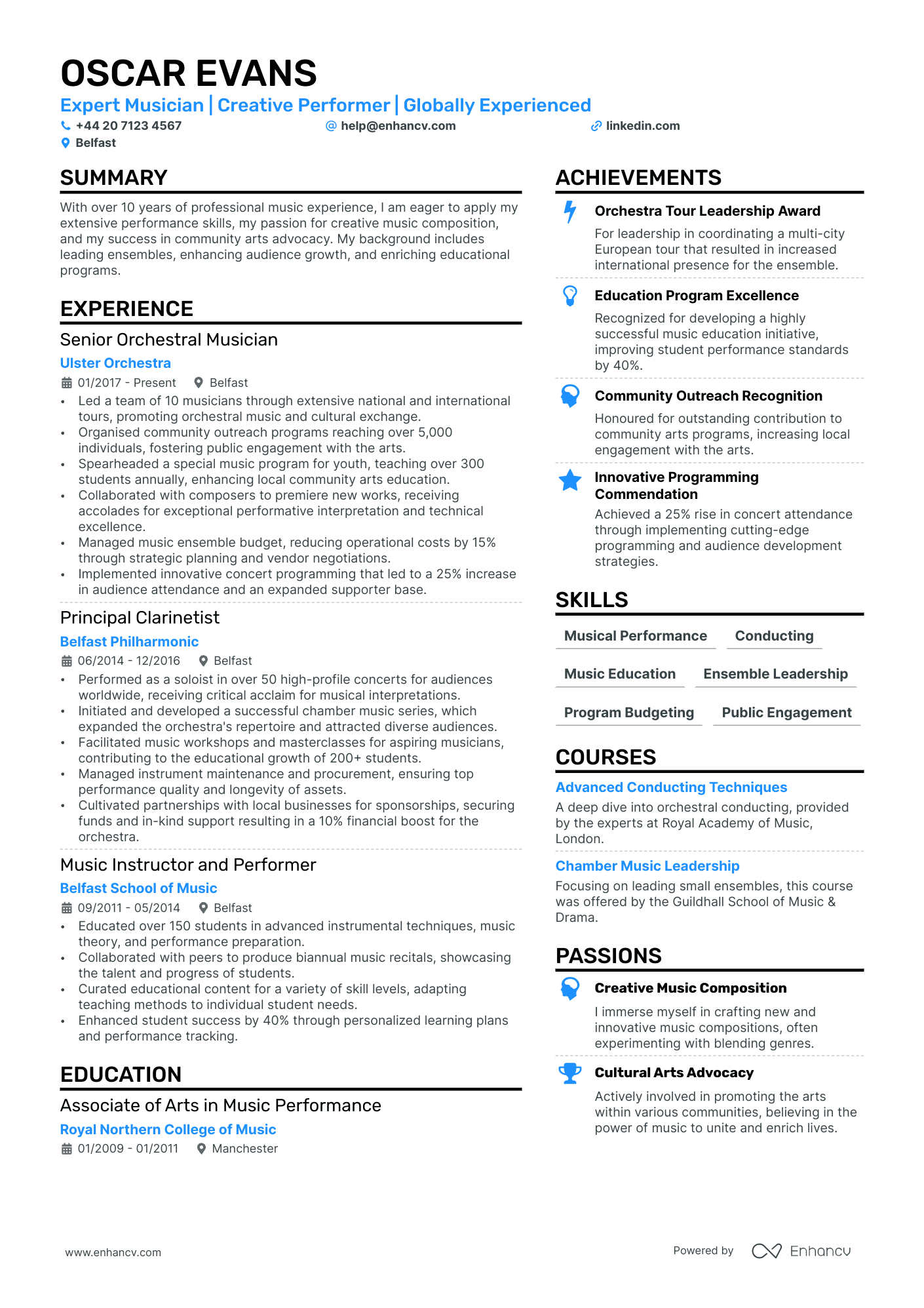
Most musician CVs read like a set list with the dates left in, every gig from the last ten years dumped in reverse order. A booker or a head of music does not read to the bottom.
The CVs that win the audition or the teaching post do one thing first. They tell the reader, in the top third of the page, what kind of musician you are and where you sit in your career. For the underlying mechanics, see how to write a CV.

Key takeaways
- Lead with your career stage. A student CV foregrounds training, a working musician's foregrounds credits, an established player's foregrounds names.
- Keep a performance CV to one or two pages. Classical and academic CVs run longer, with a repertoire list and named conductors.
- Most musicians run a portfolio career. Foreground the strand the advert is hiring for and keep the rest as supporting proof.
- Open with a short personal statement that names your instrument, genres, level, and one or two real credits.
- Name names. Specific ensembles, venues, and grades persuade where adjectives cannot.
- Keep repertoire lists, certificates, and a discography in their own sections or an appendix.
Structure your musician CV around your career stage
Where you sit in your career decides what belongs in the top third of the page. A conservatoire leaver and a twenty-year session player are selling different things, so their CVs should not look the same.
Work out which of three stages you are in, then lead with what that stage rewards.
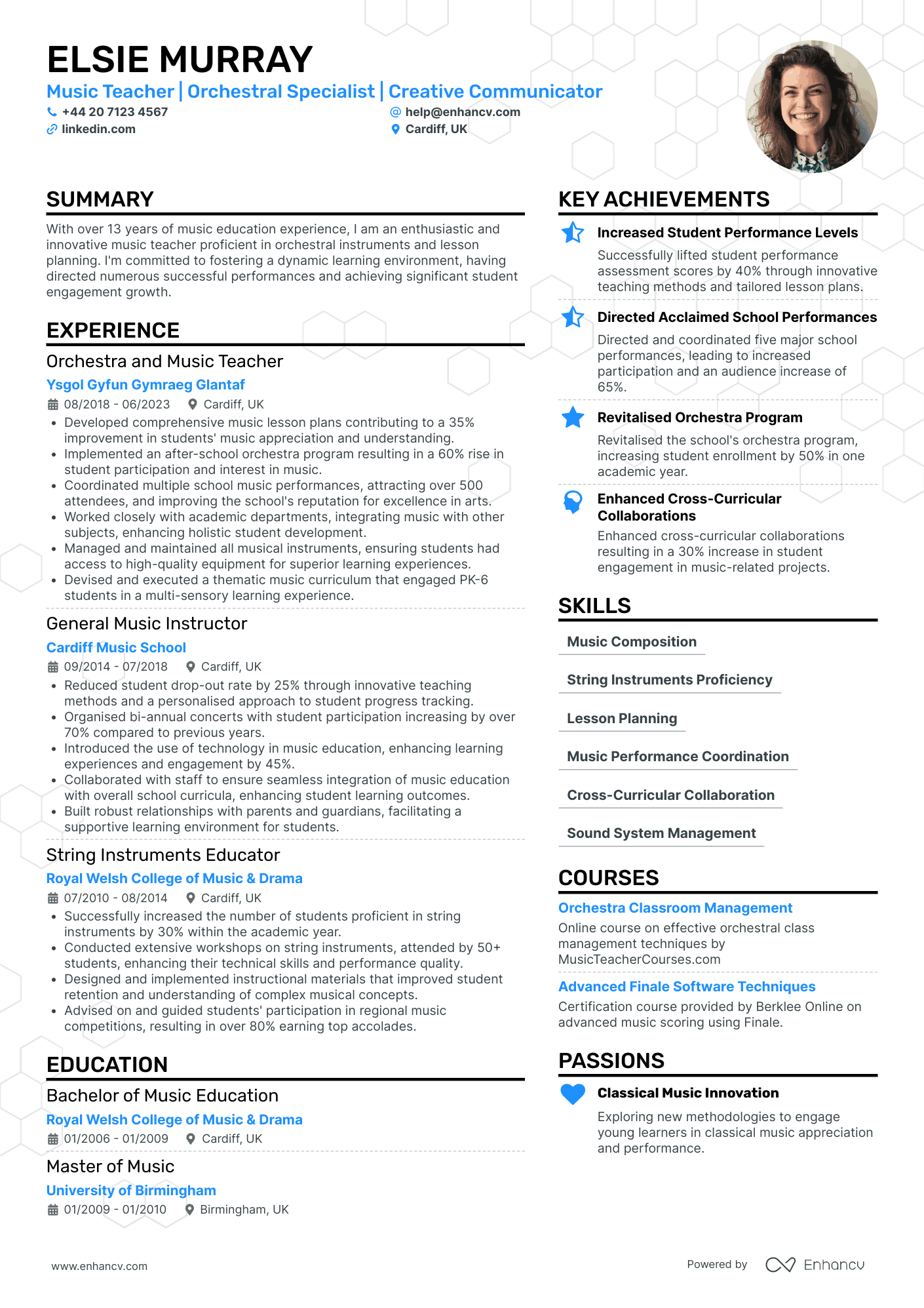
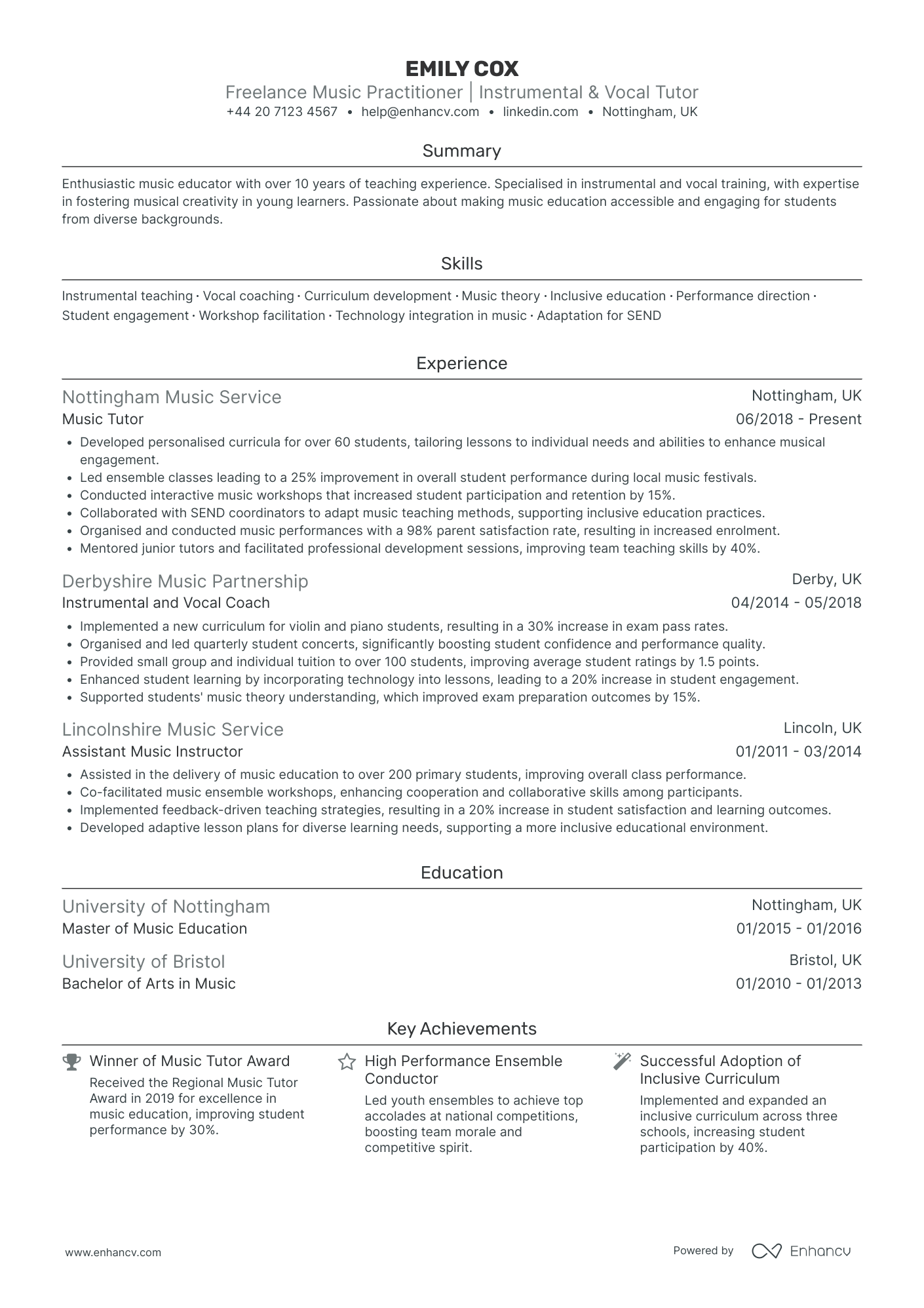
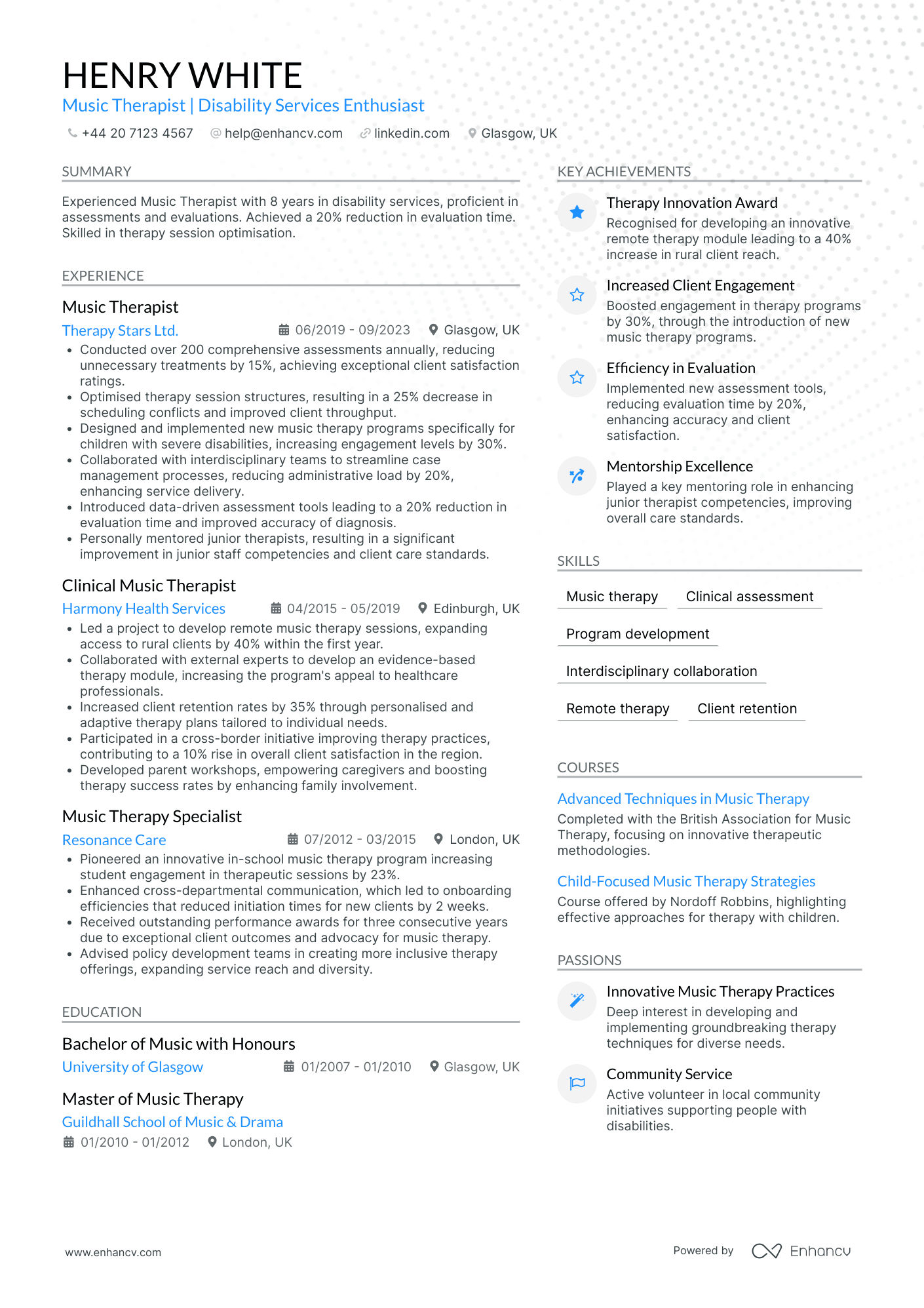
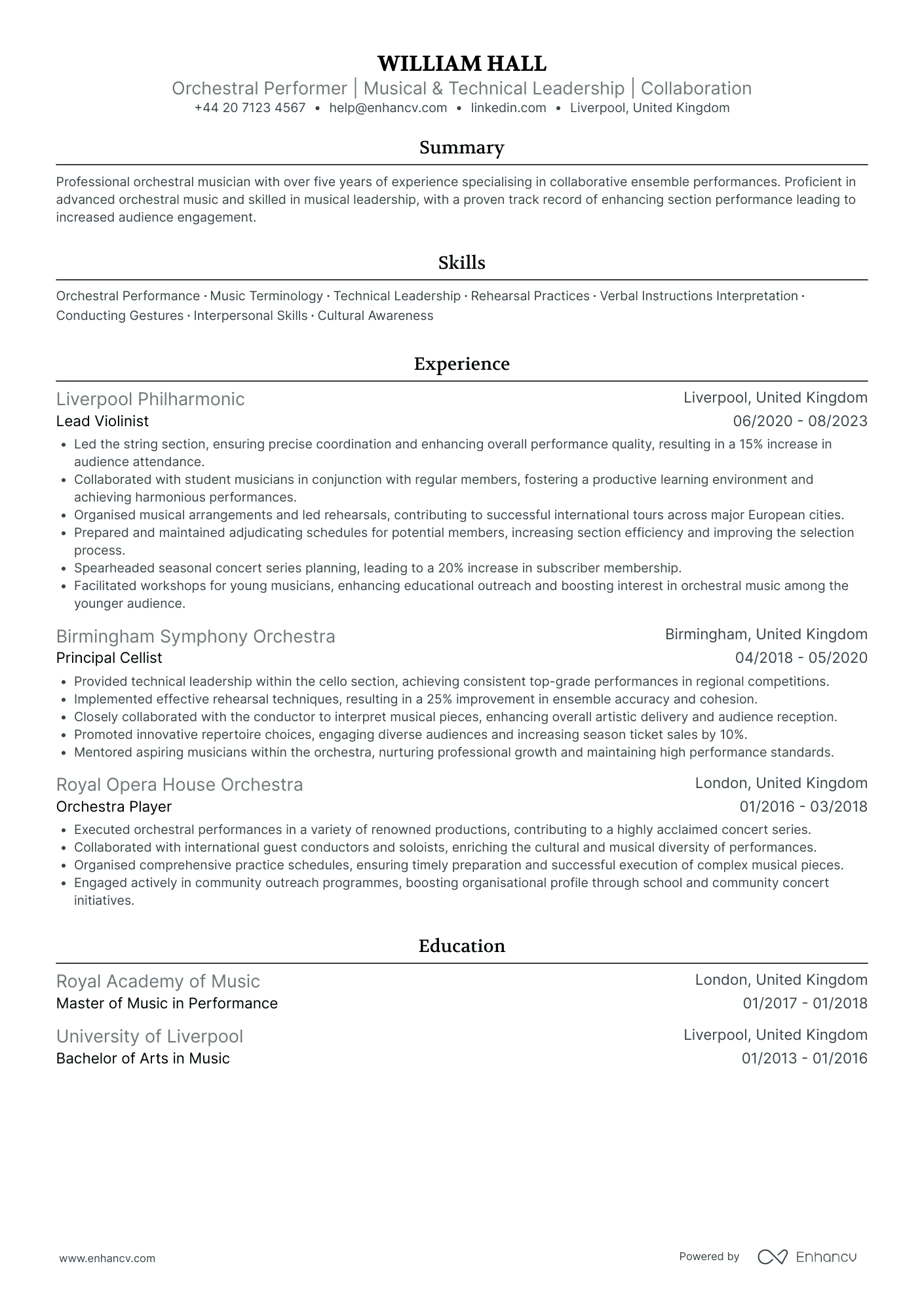
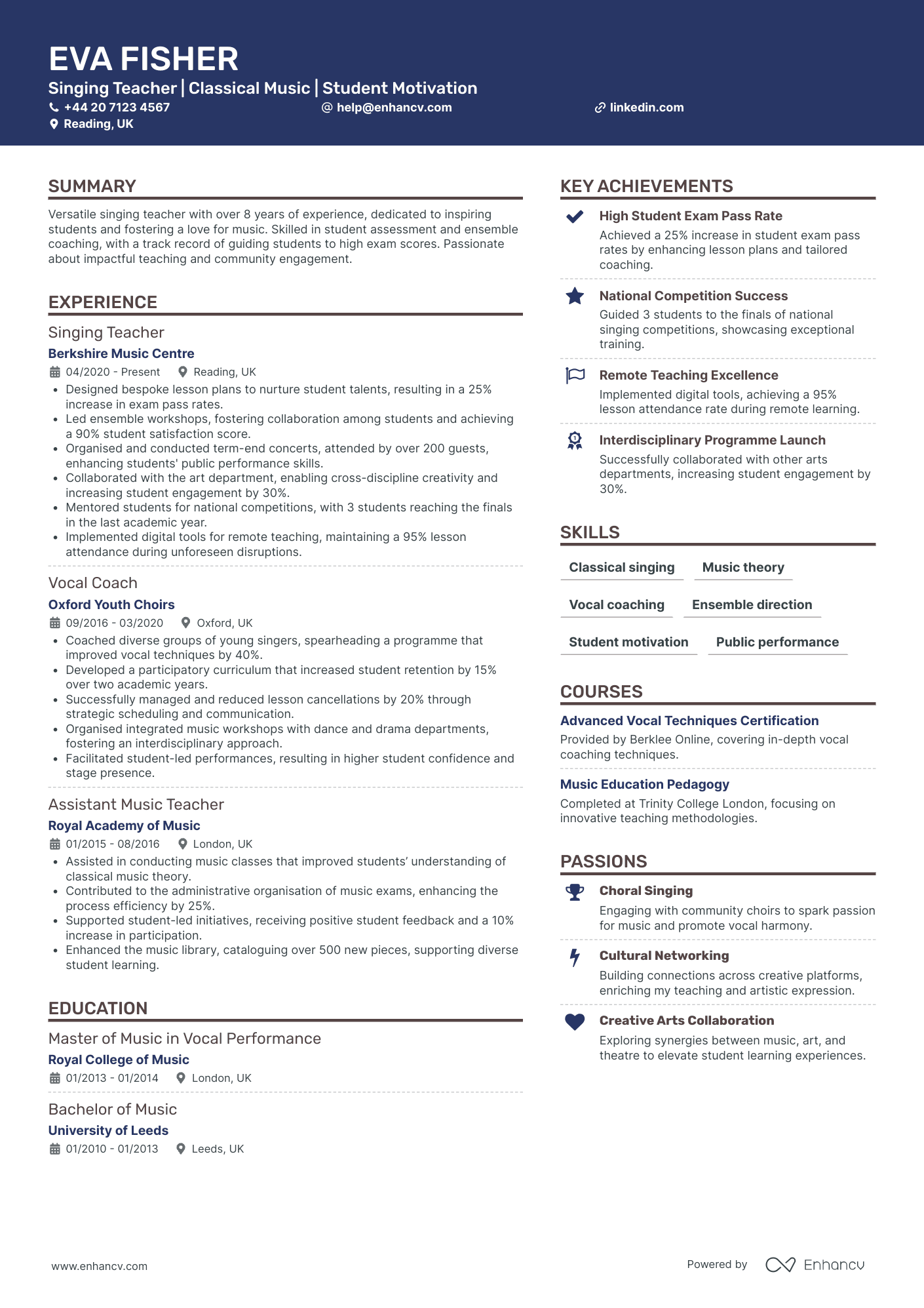
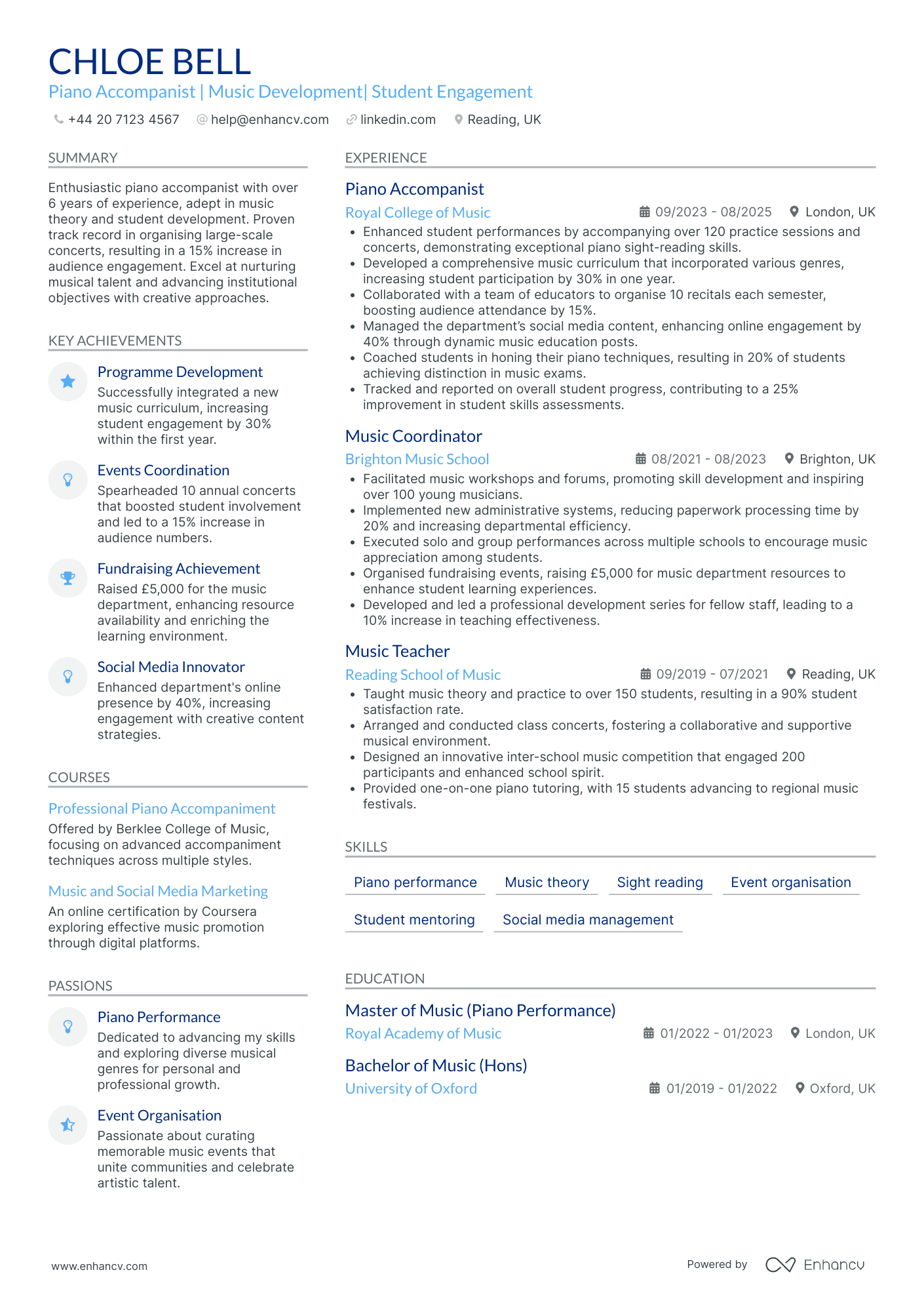
Emerging or student. You have training and a handful of credits rather than a long history. Lead with your principal study, your institution and grade, and the performances that carry weight: competitions, festivals, masterclasses, and the ensembles you have played in. A skills-led structure lets your training and repertoire come before a thin gig list.
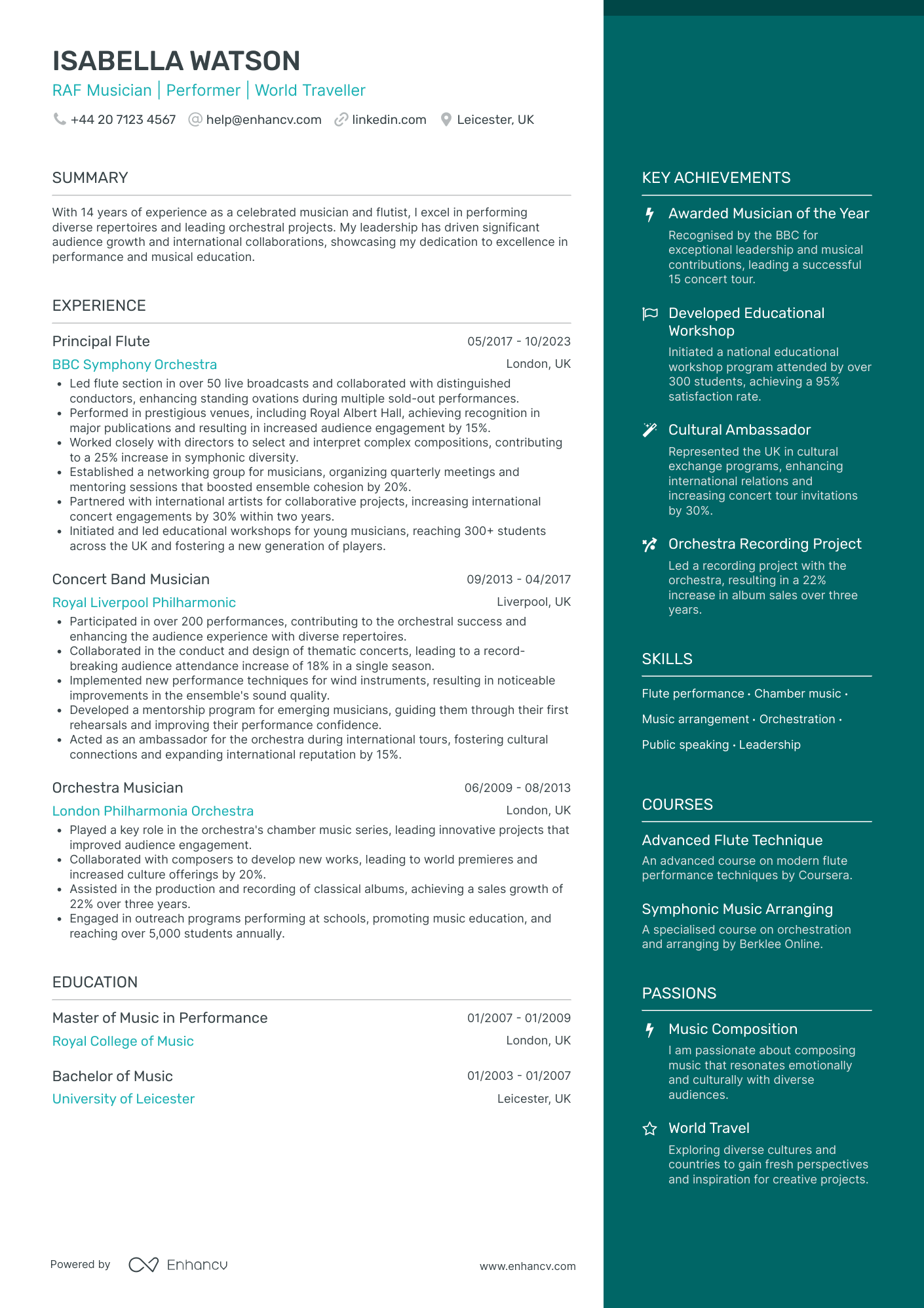
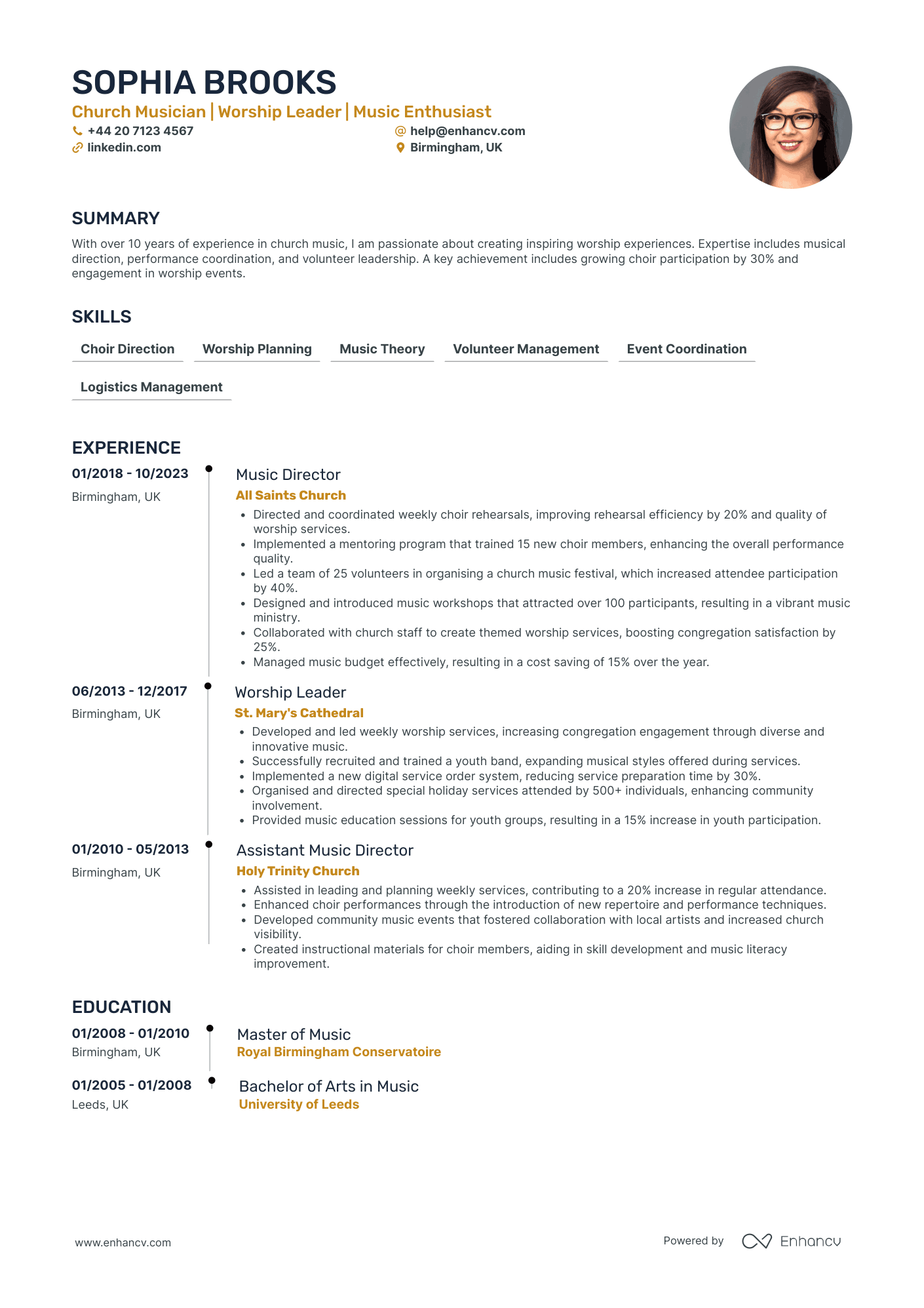
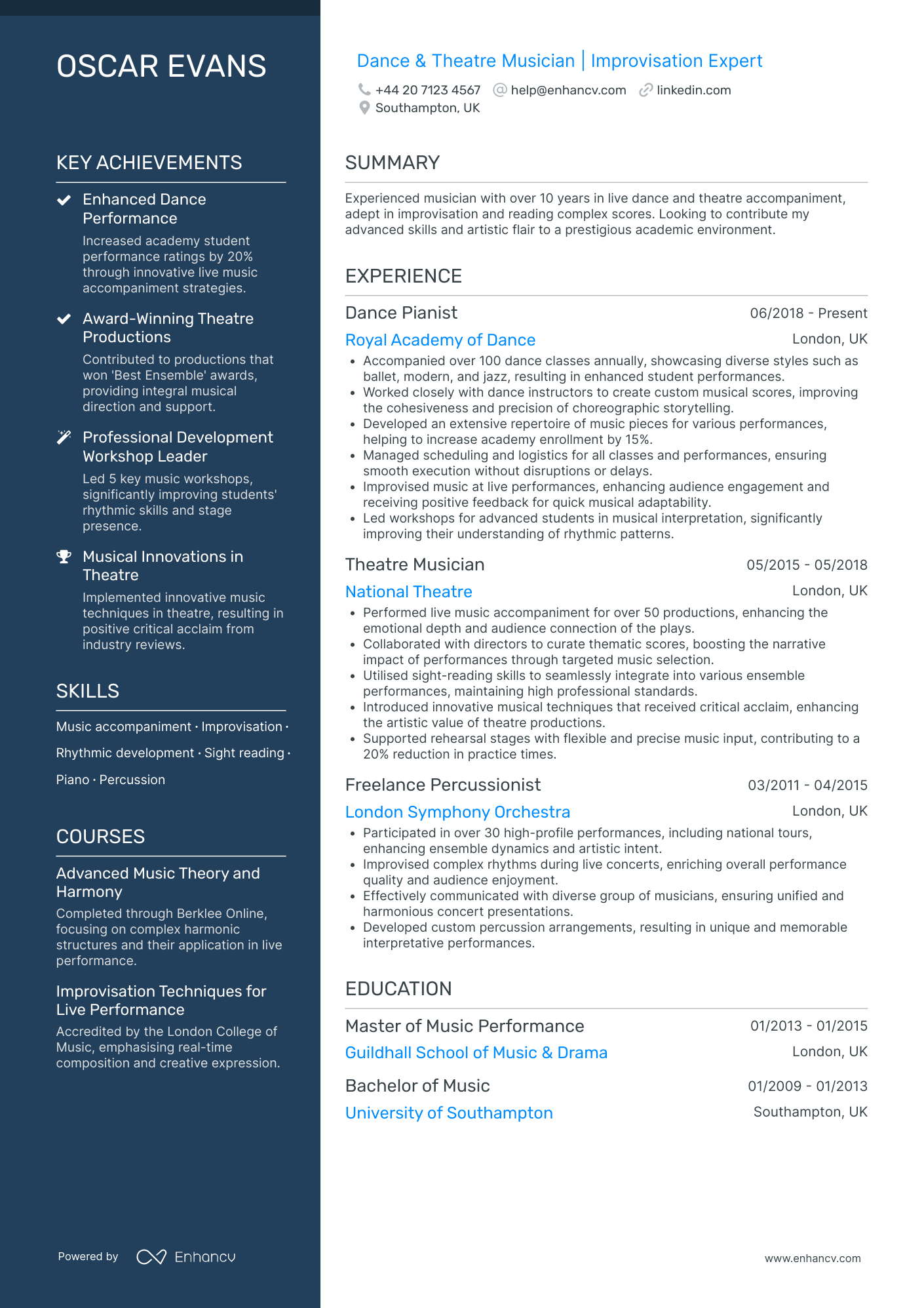
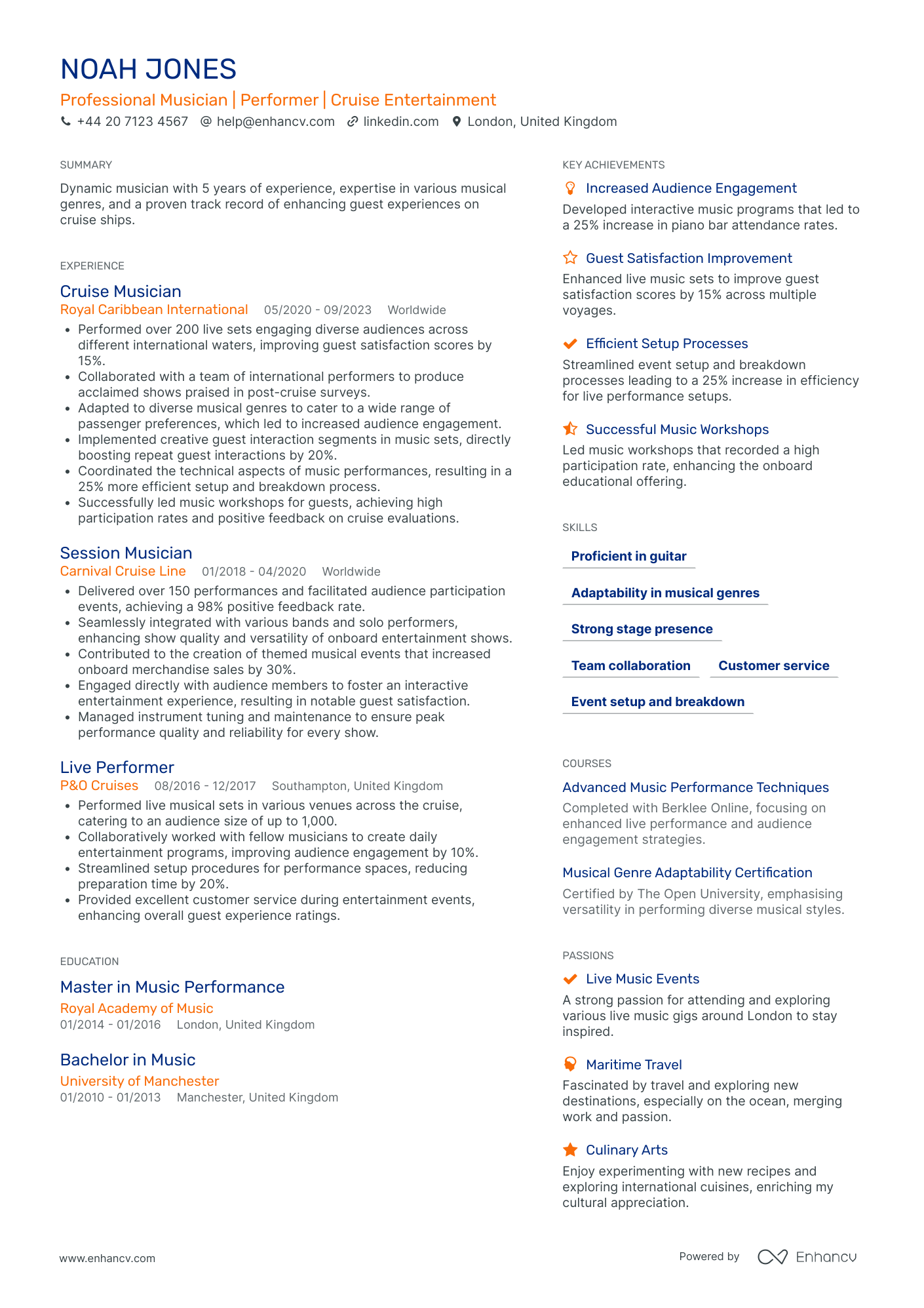
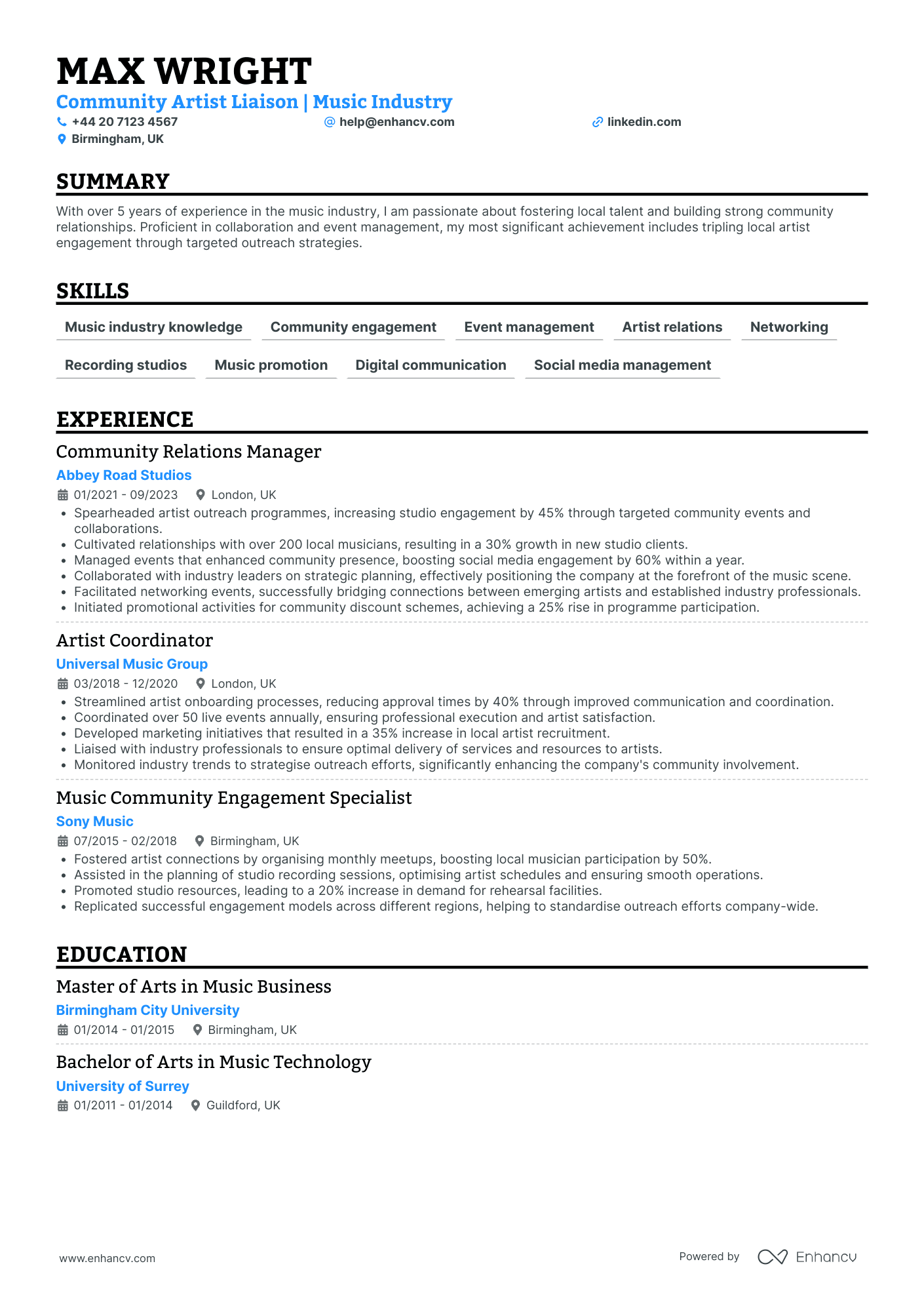
Working and gigging. Most professional musicians run a portfolio of performing, depping, teaching, and session work in some mix. Open with a short profile that names your instrument and genres, then group similar work so a reader sees the shape of your practice rather than a scramble of one-off dates.
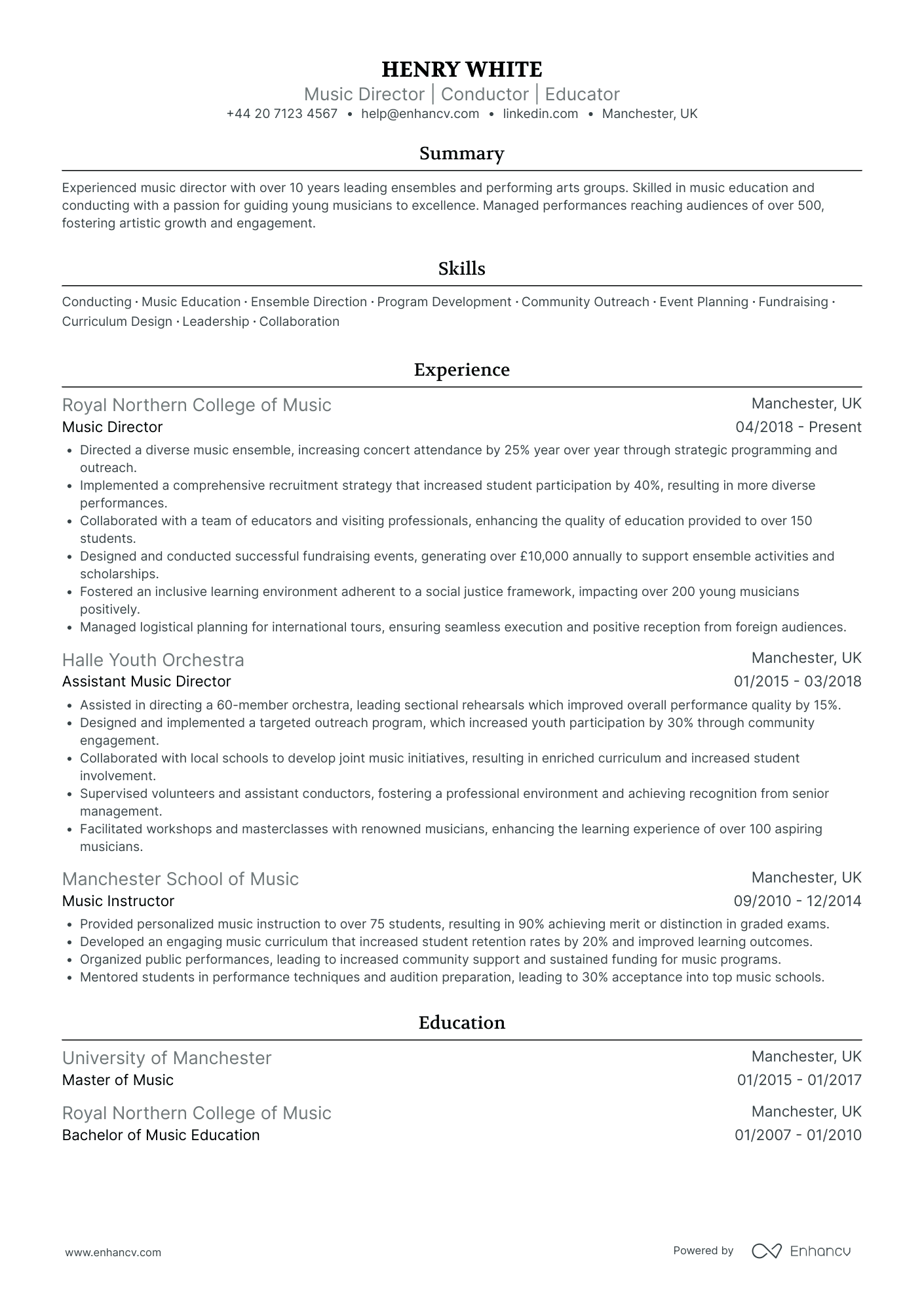
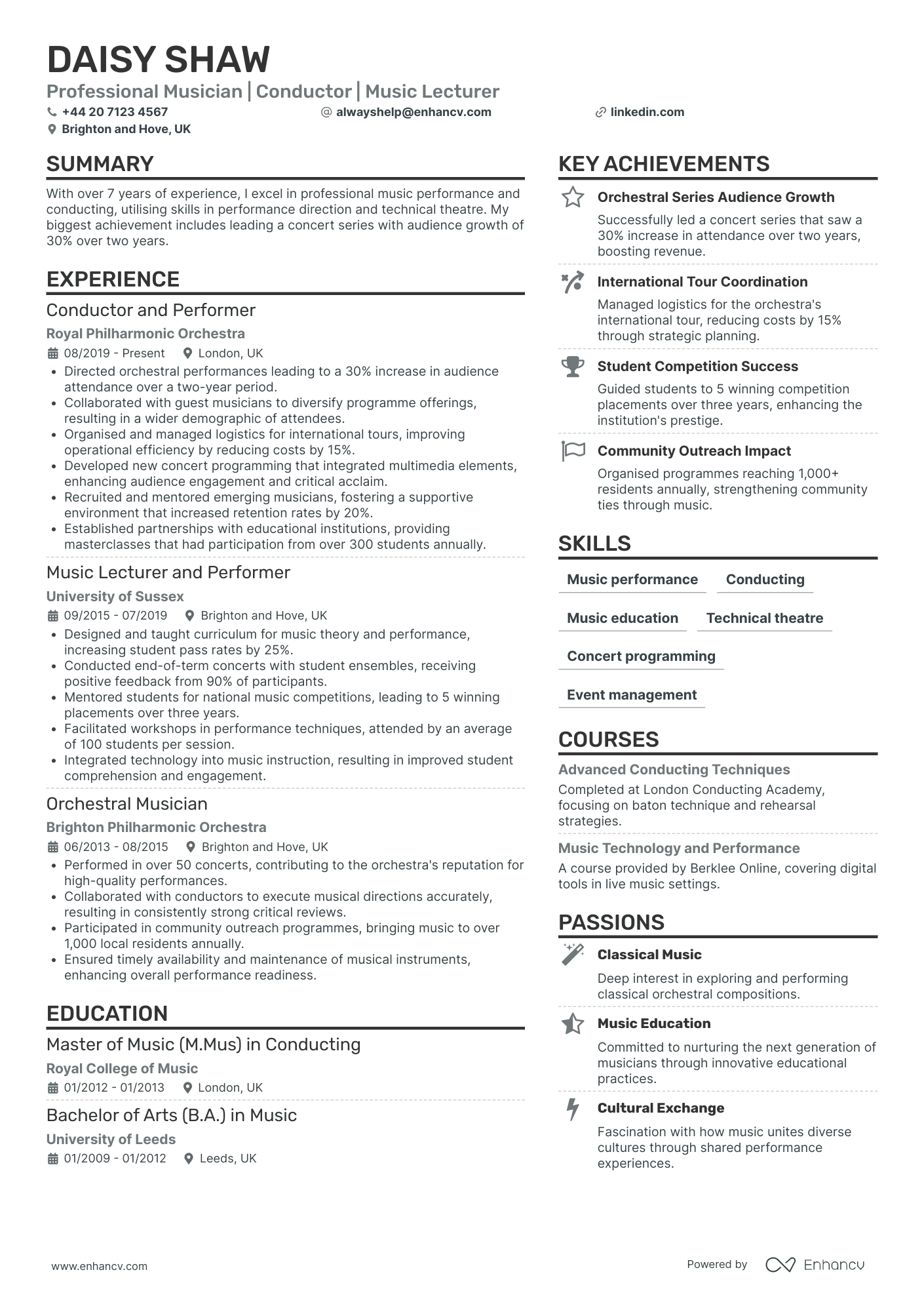
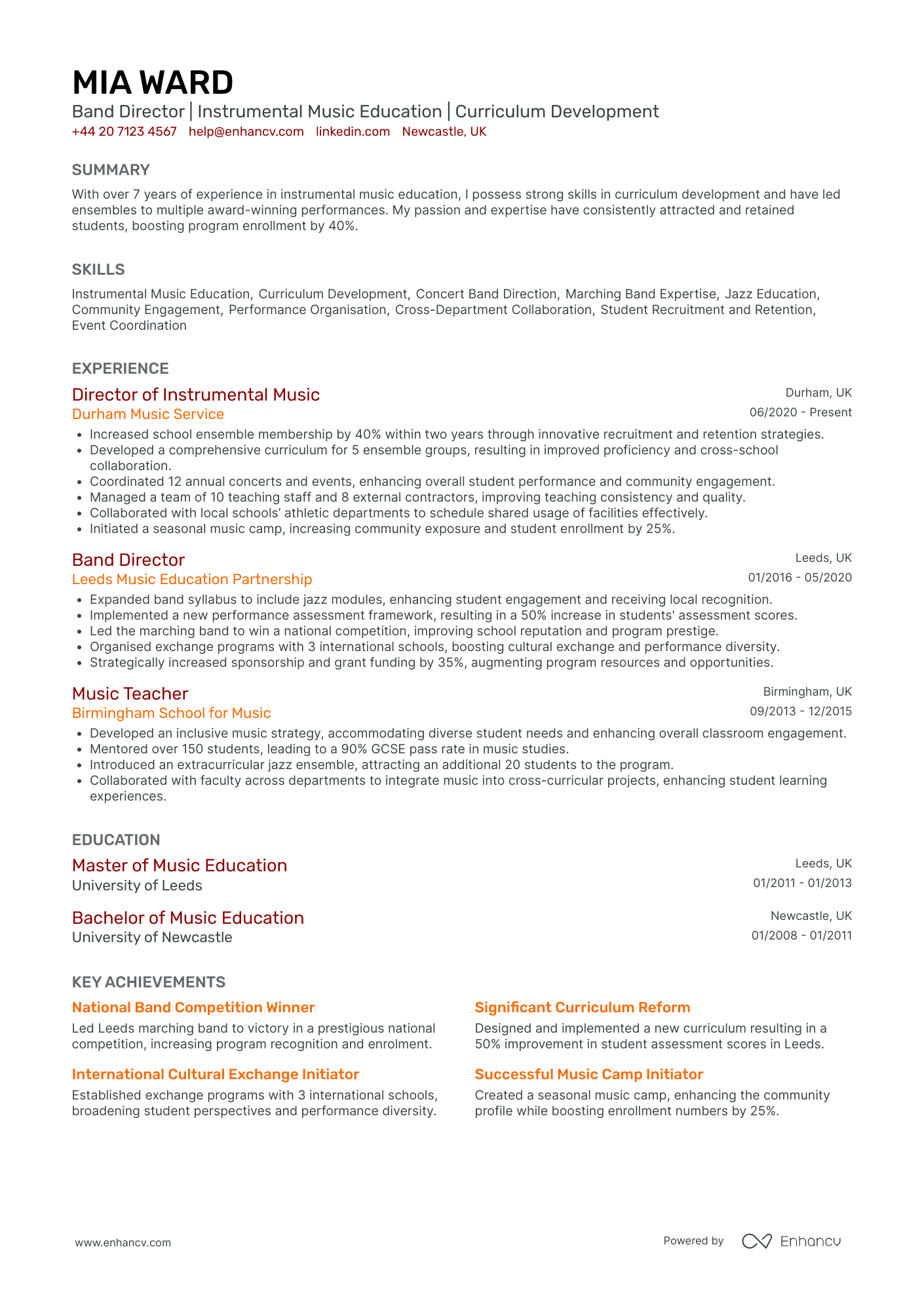
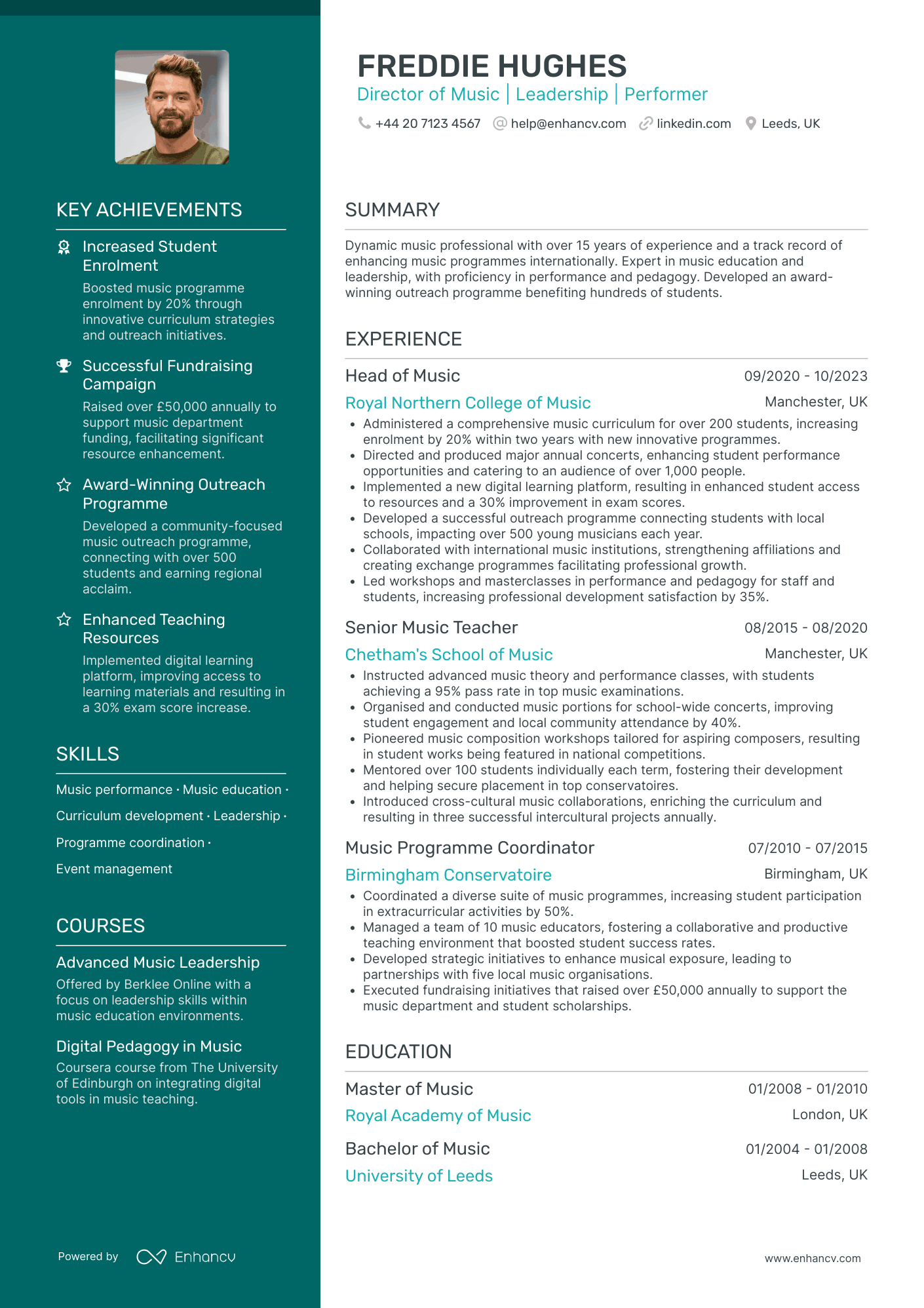
Established. You have headline credits, named venues, recordings, and maybe a principal chair or a teaching post. Put the biggest names and the most recent work first in reverse chronological order, and trust the reader to recognise them.
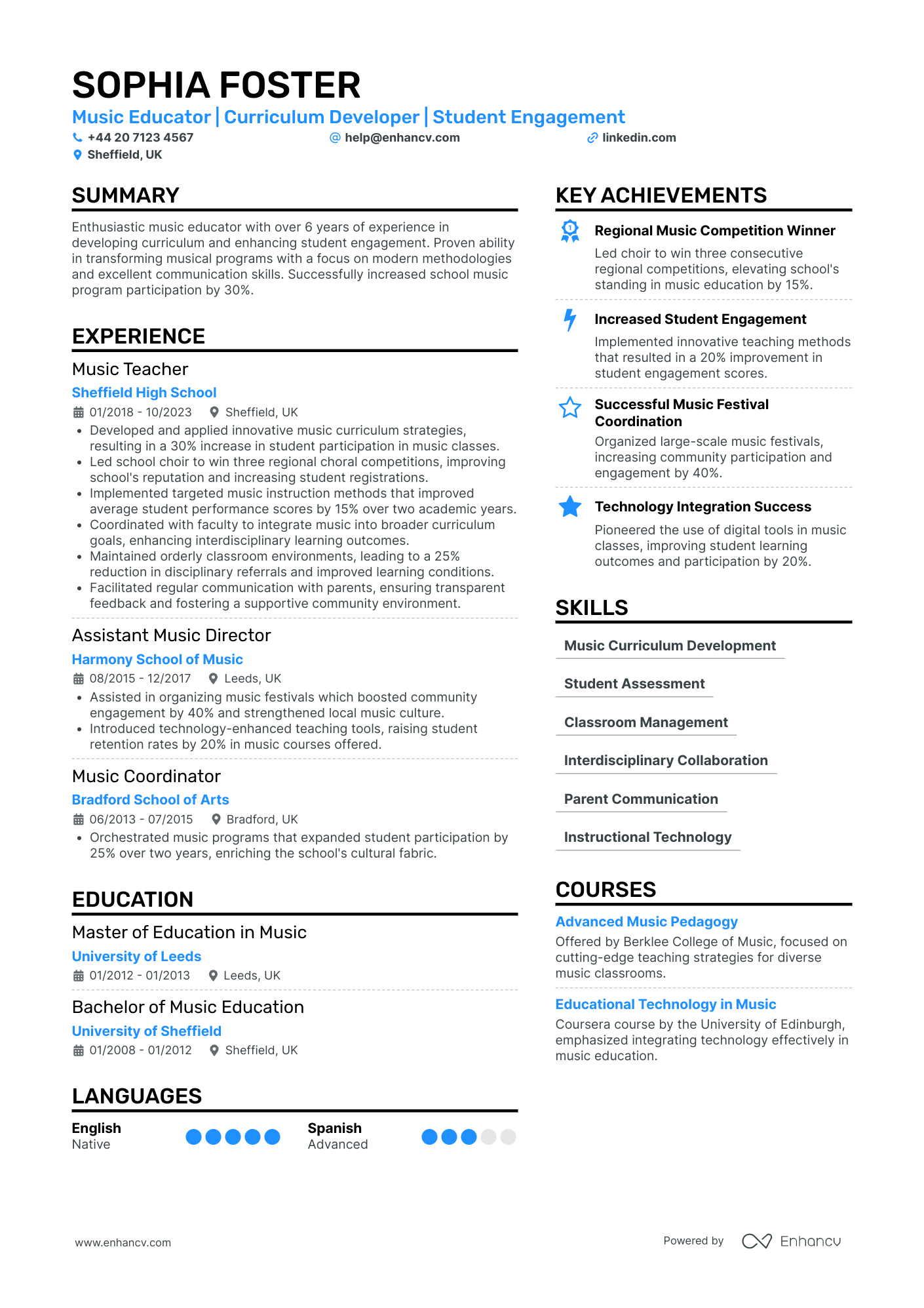
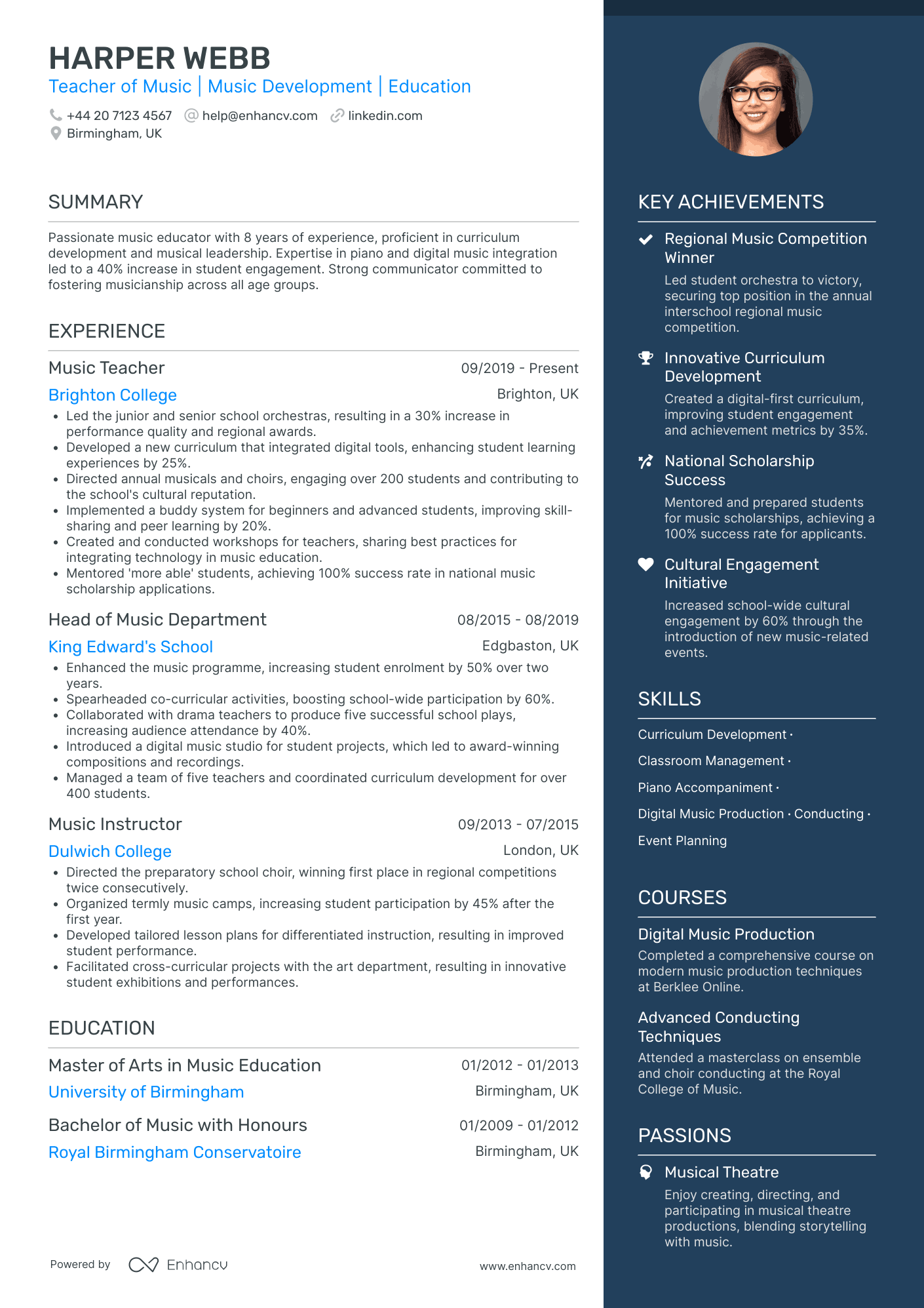
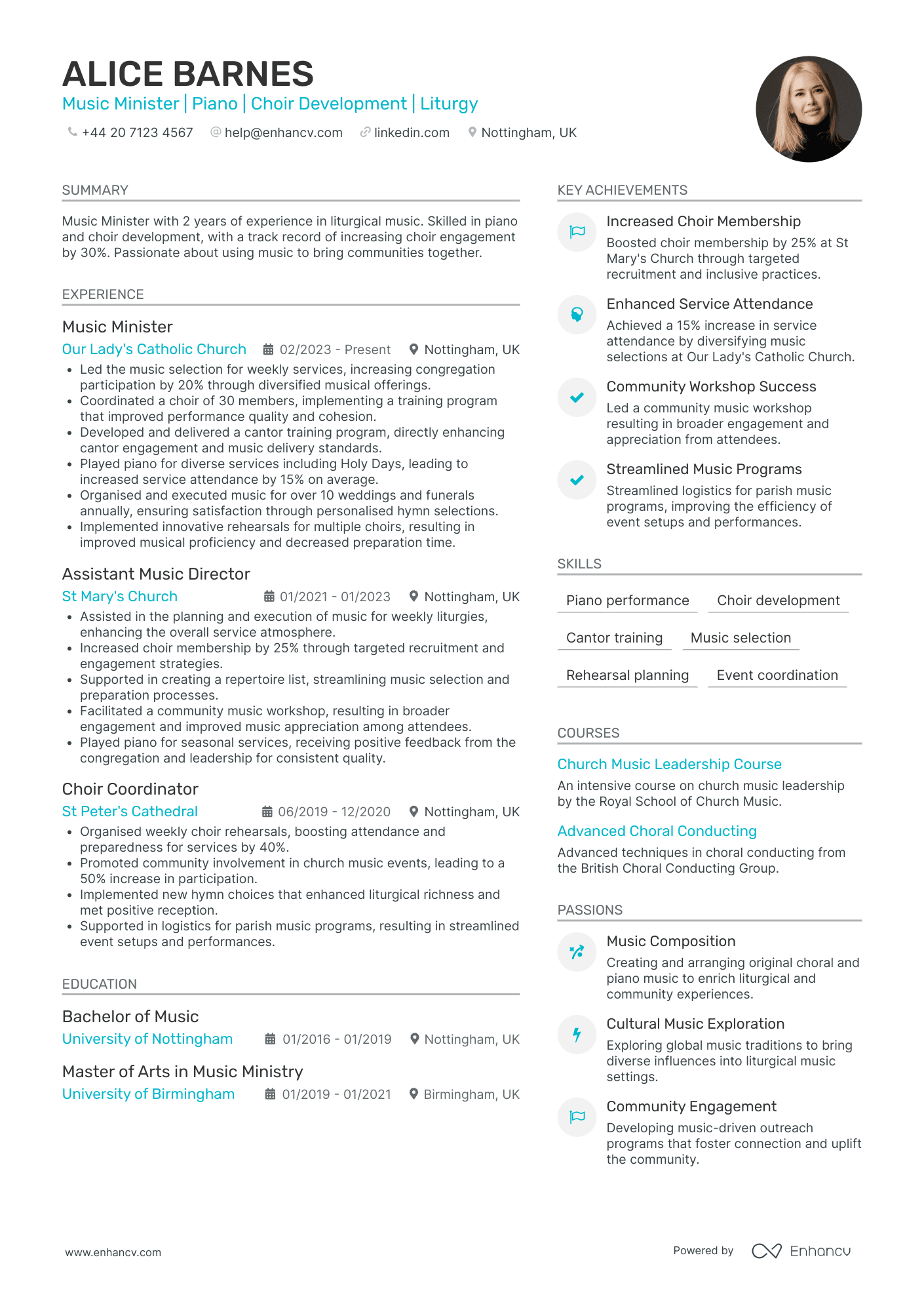
If you are moving between strands, say from full-time performing into teaching, treat it like a career change and lead with the transferable proof: the performing pedigree that makes you credible in front of a class, then the teaching you have already done.
Whichever stage you are in, the test is the same. A booker, a fixer, or a head of music should know what you do and how good you are before they reach the fold.
How long should a musician CV be?
For most working musicians, one to two pages. A booker scanning for a dep wants your instrument, your credits, and your contact details fast, not a complete performance history.
The exception is the classical and academic world. Audition panels, orchestras, and conservatoire posts often expect a longer CV with a repertoire list, named conductors and soloists, competition results, and sometimes a discography. Two to four pages is normal there, and cutting it too hard reads as thin.
Match the length to the reader. A function band leader and a symphony orchestra fixer want opposite things, so keep a short performance CV and a longer academic one and send whichever the advert asks for. For the general rule, see how long a CV should be.
Whatever the length, spend the first page well. A fixer decides in seconds whether to keep reading, so your instrument, your headline credits, and your contact details all belong above the first fold. Detail that earns its place, a full repertoire list or a discography, can follow on later pages.

PRO TIP
Keep your repertoire list as a separate page or an appendix, not buried in the body. Order it by composer or by ensemble type, mark the works you can perform from memory, and refresh it before every audition so the panel sees current, relevant repertoire first.

What goes in a musician CV header
Give a fixer everything they need to book you in five seconds: your name and principal instrument (with voice type or fach if you sing), your location and how far you will travel, one curated portfolio or audio link, a phone number, and a professional email. Add Musicians' Union membership if you have it, and your DBS status if you teach.
What the UK musician market rewards
There is no single musician job with one salary and one route in. Most careers are stitched together from performing, teaching, session work, and musical direction, and the balance shifts year to year.
That portfolio reality should shape the CV. Rather than one generic document, foreground the strand you are applying into and keep the others as supporting evidence.
It also changes how you read an advert. A function agency, a recording studio, a music service, and an orchestra are hiring for different things under the same word, so the version you send should answer the one in front of you.
| Strand of work | What your CV should foreground |
|---|---|
| Live performance | Instrument and genres, named ensembles and venues, standout dates, and your reliability at sight-reading and depping. |
| Teaching | Grades and exam boards, student outcomes, current DBS check and safeguarding training, and the settings you teach in. |
| Session and recording | Studio credits, releases and film or TV scores, your home-studio setup and remote tracking, and typical turnaround times. |
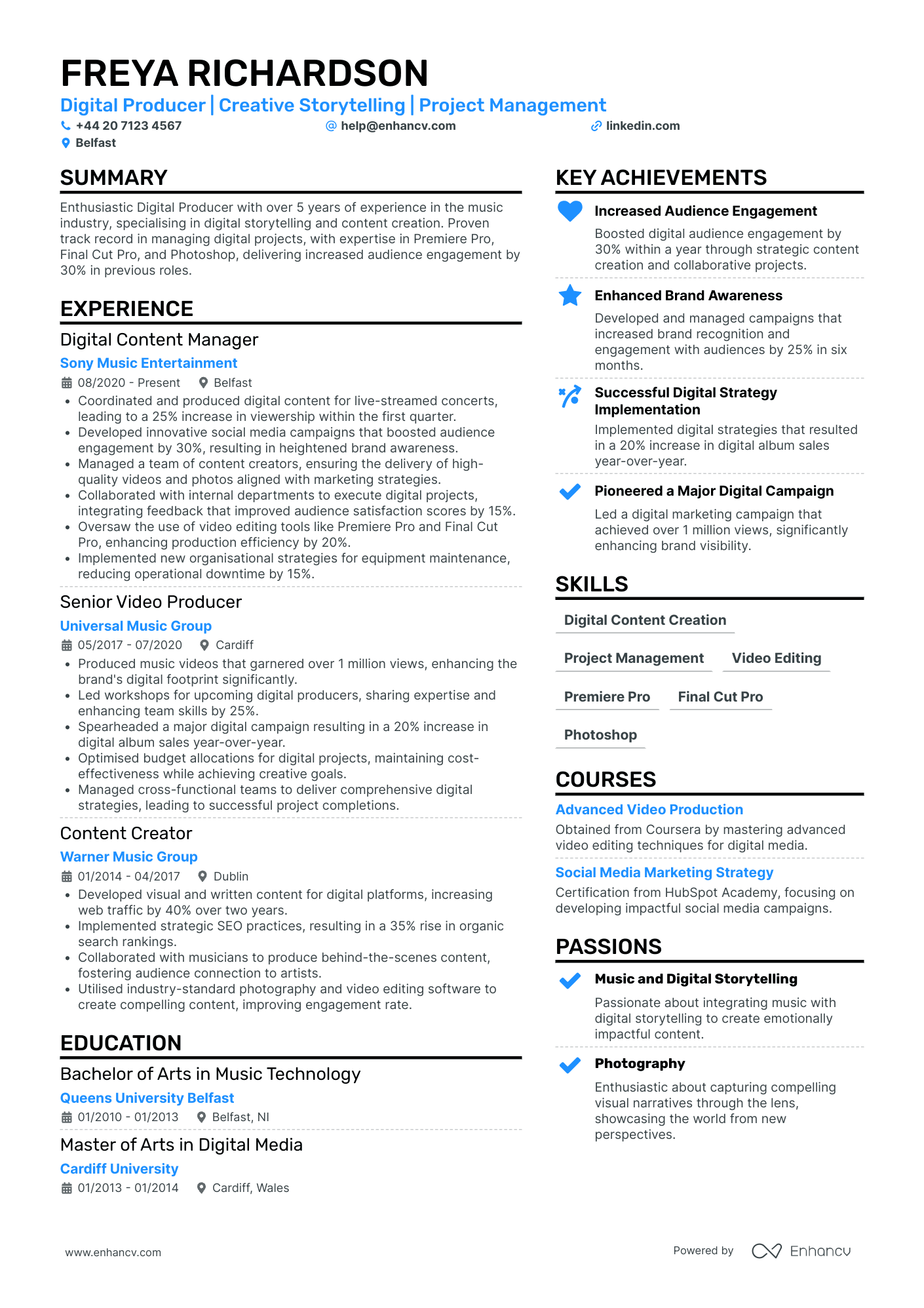
| Musical direction and composition | Productions or ensembles led, arranging and notation software, commissions, and any published or performed work. |
Pick the strand the advert is really hiring for and let it lead. The rest belongs lower down, proof that you are versatile rather than the headline act.
Linking your recordings and portfolio
A musician CV that names credits but lets no one hear you is doing half its job. The link to your playing is often the reason a fixer picks up the phone, so make it easy to find and easy to trust.
Put one clean link in your header, next to your name and instrument. A personal site, a SoundCloud or Bandcamp page, or a YouTube channel all work, as long as the first thing a visitor meets is your best two minutes.
Curate hard. Three or four short, well-recorded excerpts that match the work you are applying for beat a wall of phone footage. Chasing function work, lead with a tight live set. Chasing session work, lead with clean studio takes.
Label every clip so the reader knows what they are hearing: the work, your role, the ensemble, and the date. An unlabelled track asks the listener to do the work, and most will not.
Keep the link live and current. A dead page or a channel that stops in 2021 does more harm than no link at all.
Writing your musician personal statement
Three or four sentences at the top: your instrument and genres, your level and training, one or two credits that prove it, and what you are looking for. Concrete beats atmospheric. See more personal statement examples if the opening line will not come.
Skip the adjective pile every other CV opens with. "Passionate, versatile and dedicated" tells a fixer nothing they can check, and they have read it a hundred times this month.
Lead with evidence a reader can picture:
Musician CV personal statement example (working professional)
Versatile session and orchestral cellist with eight years of professional experience, from the Manchester Camerata deputy list to remote scoring sessions for independent film. Grade 8 distinction, BMus (First) from the Royal Northern College of Music, and a private studio of 18 students. Looking to join a busy function and recording setup in the North West where reliable sight-reading and quick turnarounds matter.
Now the version that fills the same space and says nothing:
Personal statement to avoid
Passionate and hardworking musician with a love of all genres and a lifelong dedication to music. A team player who also works well independently. Seeking an exciting opportunity to grow and develop as an artist.
The second one could belong to any musician, or to someone who has never been paid to play. No instrument, no genre, no credit, and nothing a fixer can act on. The first names an instrument, a standard, a school, and a working practice, so a reader knows within a sentence whether you fit the job.
The fastest way to date a musician CV is to list every gig you have ever played. When we review one, the first thing we look for is a clear sense of who you are now, a principal instrument, a genre, a career stage, then the three or four credits that prove it. A tight profile and your strongest work in the top third beats a two-page gig log every time.
Writing your performance and experience section
Treat every strand of work the same way: a dated heading, then bullets that show what you played, where, and to what standard. Lead each bullet with a verb and pull in numbers where they exist. For the mechanics, see work experience on a CV.
Musicianship is more measurable than it feels. Dates played a year, students retained, releases recorded, and ensembles depped for are all achievements a reader can weigh.
Resist the urge to list every venue. Group the small dates into one line and give the credits that matter their own room: the recording that got airplay, the tour, the principal chair, the pupil who won a place at a conservatoire.
Irregular work is normal in this profession, so do not apologise for it. A quiet spell spent teaching, writing, or building a studio is a line of its own, not a gap to explain away, and a reader who books musicians already knows the work comes in waves.
Tailor each application to the booking or the post, and mirror the instrument, genre, and setting the advert names where they are true of you. Enhancv's CV tailoring feature reads the advert and suggests the matching edits, which saves rewriting from scratch for every gig.
- Perform 80 to 100 dates a year across orchestral, chamber, and function work, from deputy lists to West End pit covers
- Recorded cello parts for 30-plus independent releases and two feature-film scores, tracking remotely from a home studio
- Built and retained a private teaching studio of 18 students, with three distinctions at ABRSM Grade 8 in the last two years
- Depped at short notice for 12 different ensembles, sight-reading unseen repertoire on the day
PRO TIP
Name names. "Depped with a professional orchestra" is vague, "depped on second cello for Manchester Camerata" is checkable. Fixers and panels recognise ensembles, venues, and conductors, so the specific credit does the persuading for you.
Skills for your musician CV
Split them the way a reader does. Your hard skills are the technical, checkable ones: your principal instrument and grade, sight-reading, theory and aural, studio work, and notation software.
Your soft skills matter too, but only when you can back them: reliability under pressure, collaboration in an ensemble, and adaptability across genres. Prove each in a credit rather than listing it as an adjective.
Name your instrument and level exactly. "Piano" tells a fixer nothing, "Grade 8 distinction piano, jazz and classical" tells them whether to call you.
List the genres and settings you are comfortable in, and any instruments you double on. A player who reads well, improvises, and covers keys as well as accordion is more bookable than a specialist, and the CV should say so plainly.
Top skills for your musician CV:
Principal instrument (name it and grade)
Sight-reading
Music theory and aural
Ensemble and orchestral playing
Improvisation
Studio recording and DAWs
Notation software (Sibelius, Finale)
Arranging and transposition
Reliability
Collaboration
Adaptability
Stage presence
Time management
Education, training, and repertoire
List your training the way the field expects: your degree and classification, your conservatoire or university, your principal study teacher where the name carries weight, and graded exams such as ABRSM or Trinity with the grade and mark. See how to present education on a CV.
Ongoing study counts, so include masterclasses, summer schools, and short courses that are relevant and recent. For teaching work, a current DBS check and any safeguarding training belong here too, since a head of music will look for them before anything else.
You do not need a degree to build a strong musician CV. Plenty of working players came up through grades, private study, and years on the bandstand, so lead with the playing and let the training support it rather than the other way round.
Keep certificates and a full repertoire list in their own sections or an appendix so the main CV stays readable. Name the certificates you hold rather than describing them at length.
Conclusion
Lead with your career stage, name your instrument and your strongest credits in the top third, and match the length to the reader in front of you.
Build it from a proven layout rather than a blank page. Enhancv's CV templates export to a clean PDF that holds its formatting when you email it to a fixer. Pair the CV with a short cover letter that says why this ensemble or this post, and you give a busy booker an easy yes.
Author's take - the Enhancv team
The fastest way to date a musician CV is to list every gig you have ever played. When we review one, the first thing we look for is a clear sense of who you are now, a principal instrument, a genre, a career stage, then the three or four credits that prove it. A tight profile and your strongest work in the top third beats a two-page gig log every time.