



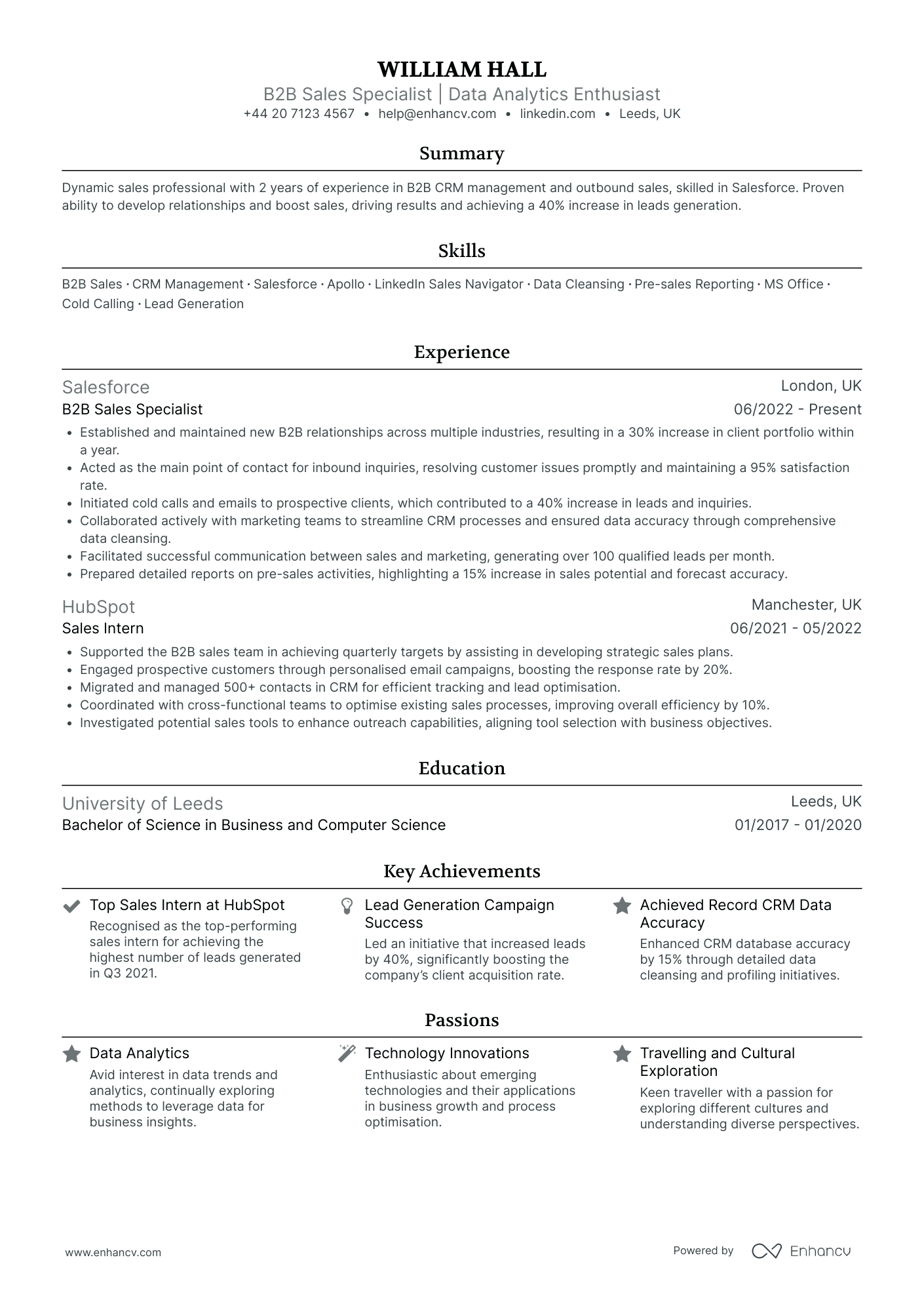
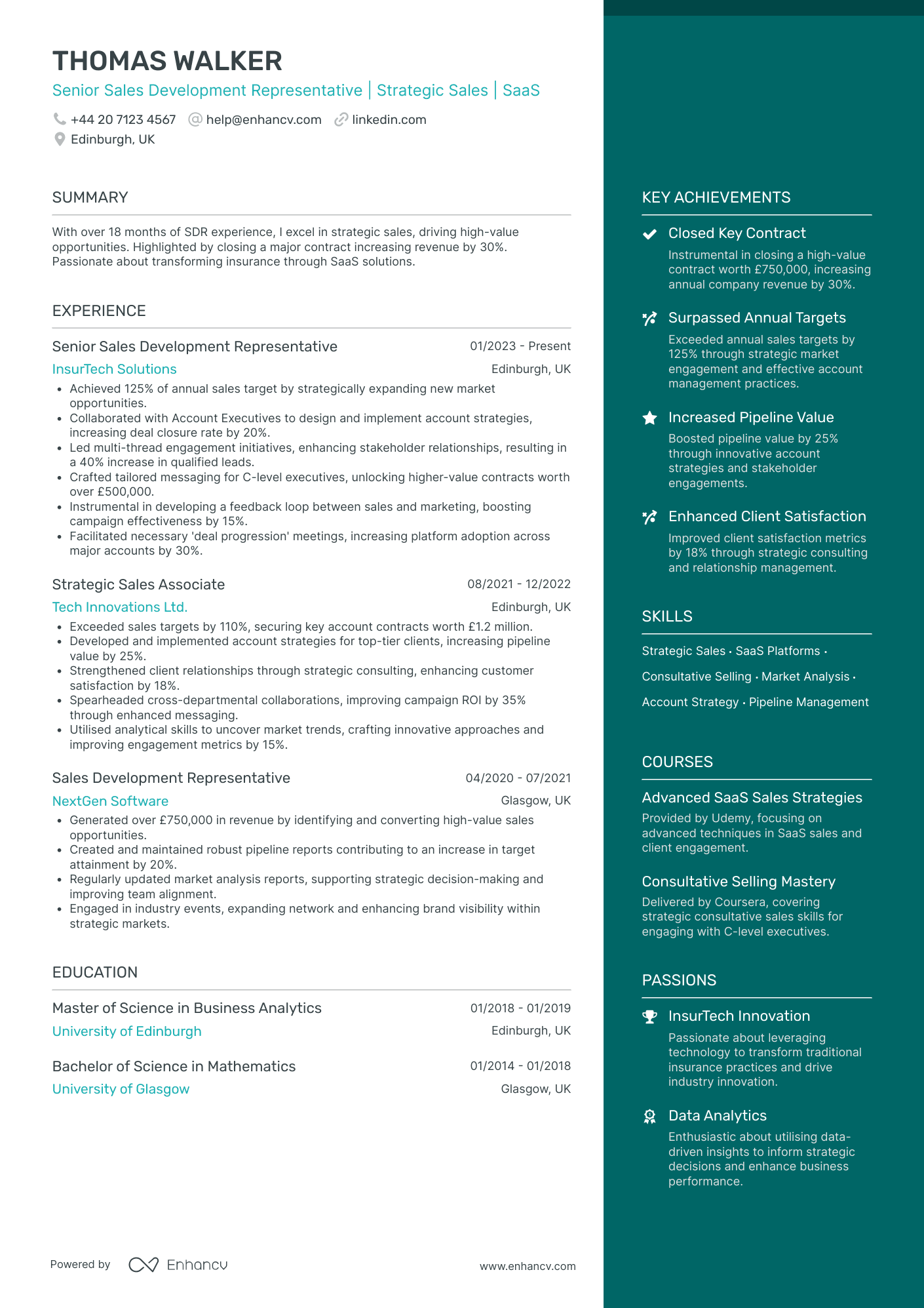
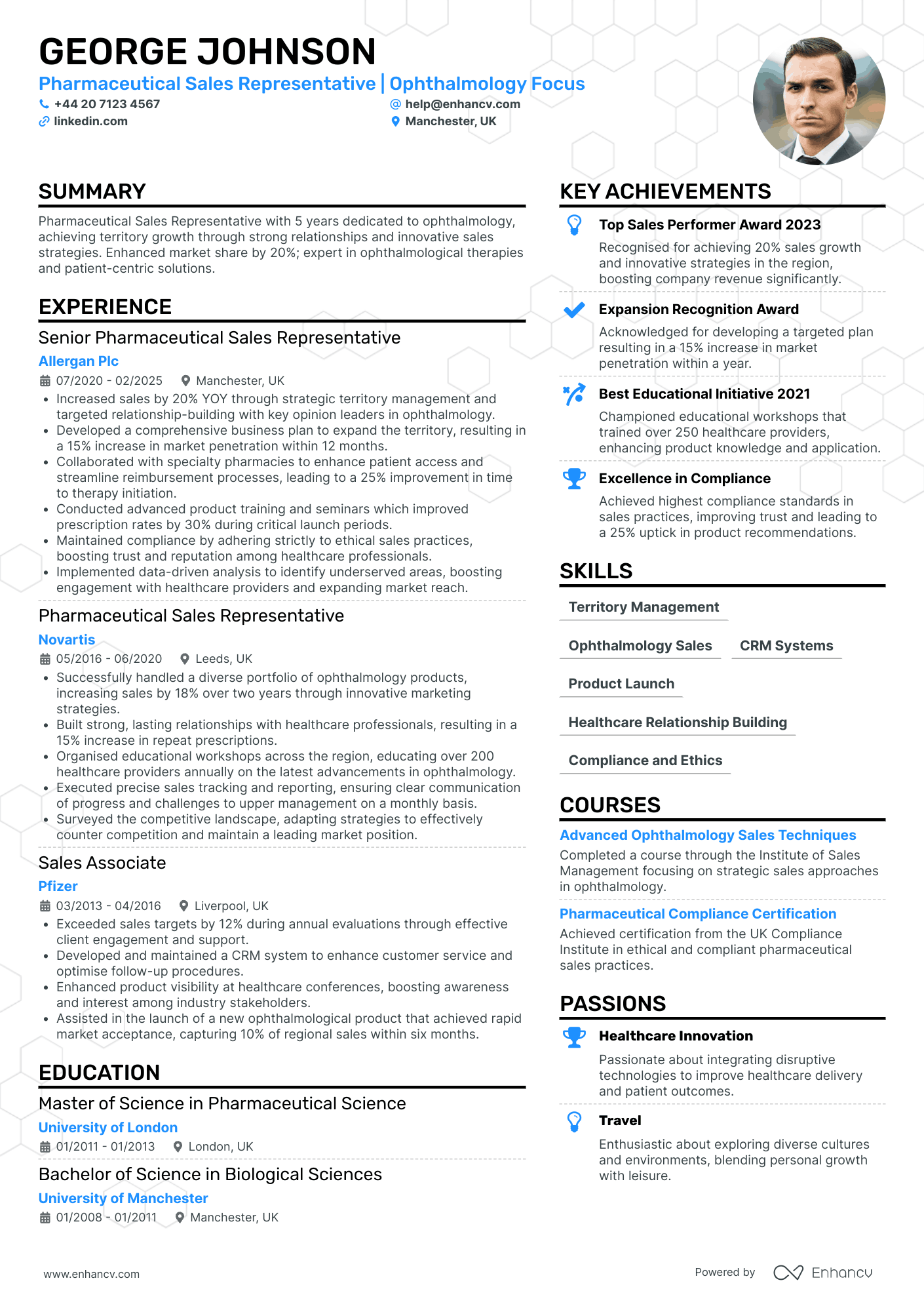
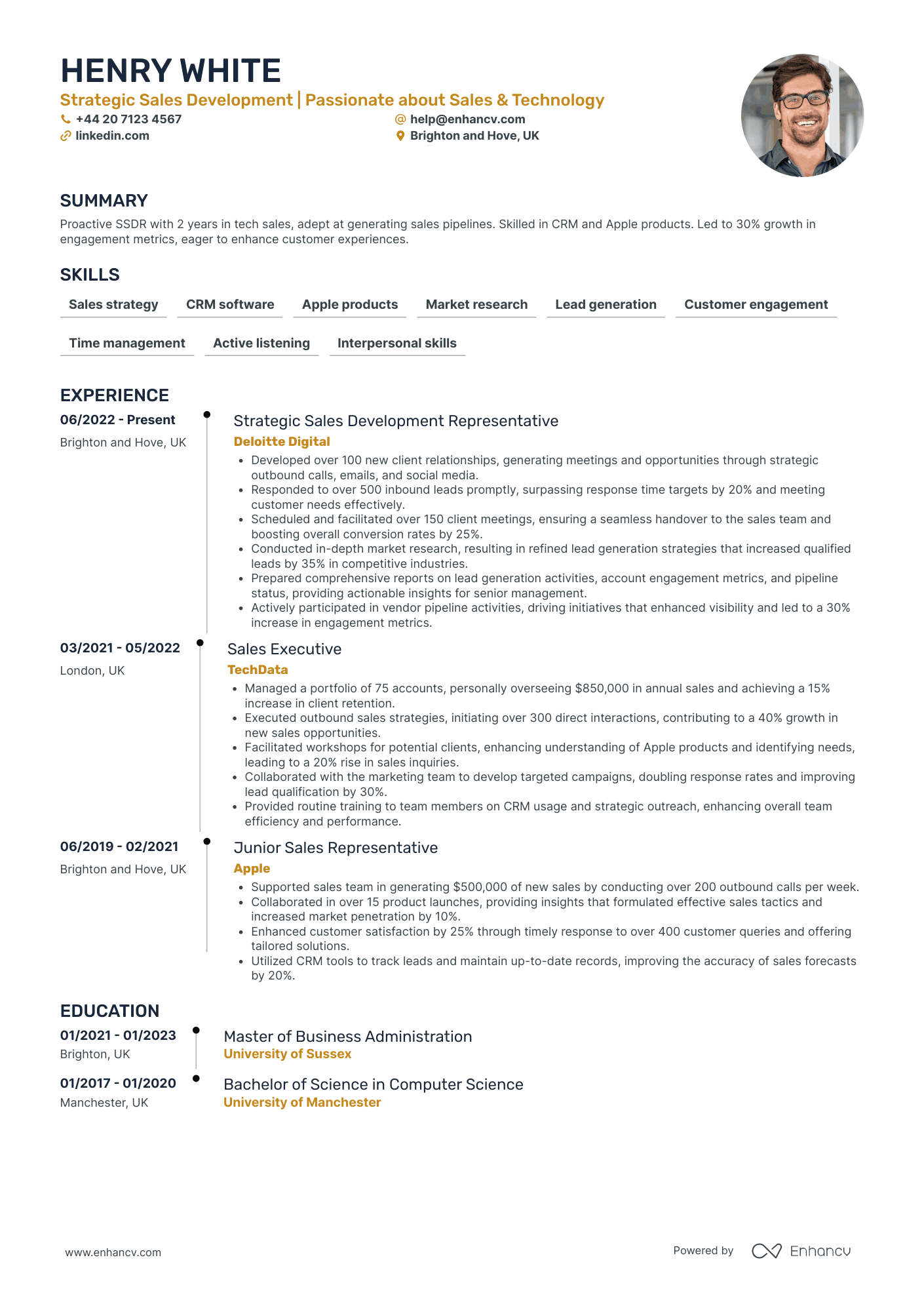
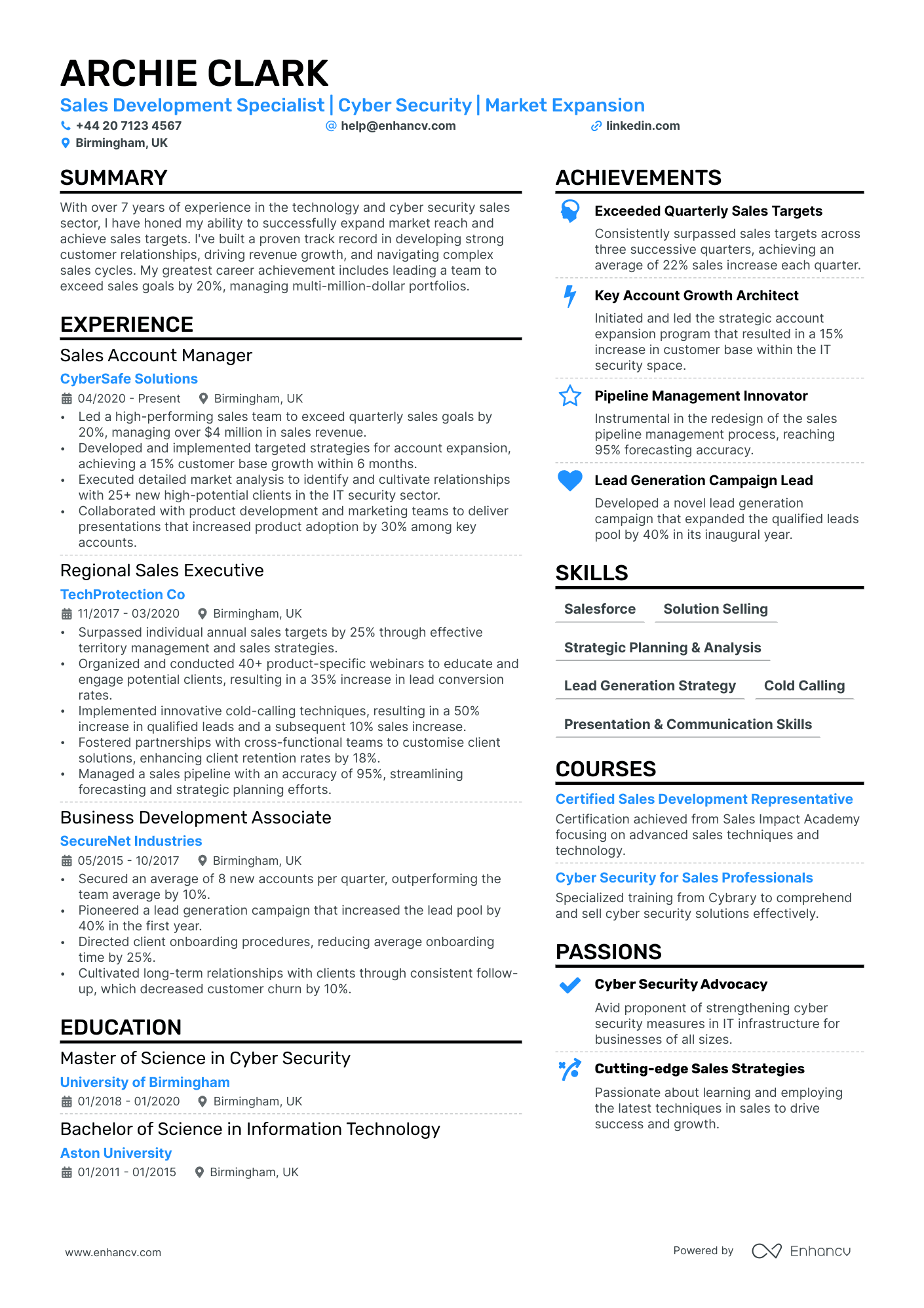
Most sales development representative CVs read like a tools list with a sales cliche stapled on top. A recruiter has already read a hundred that promise a "results-driven self-starter" and prove none of it.
The CV that earns the call shows two things instead: you can start a conversation with a stranger, and you can take a no and dial again. You can evidence both without a single quota-carrying job behind you, which is where most SDR applicants start.

Key takeaways
- No sales job yet is normal for this role. Lead with a skills-led structure, transferable target-based work, and any CRM you have touched.
- Prove the two behaviours that define the job: starting conversations and handling rejection. One concrete example beats five adjectives.
- Name the tools employers actually list. Salesforce appears in more UK postings than anything else.
- Quantify everything. SDRs are measured on activity and meetings booked, so your bullets should carry numbers.
- Most postings are hybrid or on-site, so put your location in the header and say where you can work.
- One page while you are starting out, sent as a PDF unless the advert asks for a Word file.
Writing a sales development representative CV with no experience
SDR is one of the most entry-friendly roles in B2B sales. Employers hire on attitude, coachability, and how you sound on a call, then train the process once you start. Close to seven in ten UK postings are pitched at entry level (78 of 112 in the last ~30 days on Enhancv's internal job feed), so a first CV with no quota history is realistic here rather than wishful.
That changes how you build it. Use a skills-led structure: personal statement, then skills and evidence of outreach, then education, with any work history framed for the sales behaviours underneath it. If you want the fundamentals first, see how to write a CV.
Mine your life for real evidence of prospecting, persistence, and hitting a target. It is almost always there:
- Retail or hospitality: sales targets hit, add-ons and upsells, handling objections, working to a script under pressure.
- Any target-based work: fundraising, charity canvassing, promotions, market stalls, telesales.
- Cold outreach of any kind: student ambassador roles, society committee recruitment, event sign-ups, running a side hustle.
- Customer service or call-centre work: handling volume, staying calm on a difficult call, following a process.
Then write it in SDR language. "Cold-called 40 local businesses a week to sell event advertising and booked an average of six meetings" is a sales development bullet, even though the job title was something else.
A hiring manager reading a no-experience CV is really screening for two things: can you open a conversation a stranger did not ask for, and can you take a knock-back and go again ten minutes later. Every bullet you choose should answer one of those questions. A part-time role where you upsold to walk-in customers proves the first. A fundraising target you kept chasing after a run of noes proves the second.
If you have volunteered or run anything of your own, give it a dated entry like a job, with duties and results. Volunteering on a CV counts here as long as it involved persuading, organising, or contacting people, so a society membership drive or a charity collection earns its place next to paid work.
One line lifts a no-experience CV up the pile: name the CRM and outreach tools you have touched, even from a course or a placement. "Completed HubSpot Sales Software certification" or "Built prospect lists in Salesforce during a two-week placement" signals you already speak the language a hiring manager uses all day.
Treat your first CV as proof of behaviour, not a record of titles. That framing is what makes the no-experience route work, and it is why a graduate with the right retail job often beats a career changer who only lists responsibilities.
What the UK sales development representative market looks like
What employers ask for tells you what to move to the top of the CV. Here is what UK adverts repeat right now.
| What | UK sales development representative roles |
|---|---|
| Sample | 112 UK sales development representative postings, last ~30 days (Enhancv's internal job feed) |
| Where the work happens | Hybrid 38%, on-site 35%, remote 28% |
| Experience level asked for | Entry 70% · mid 20% · senior 8% |
| Tools that recur most | Salesforce (69 of 112 postings), CRM, LinkedIn Sales Navigator, Outreach, HubSpot |
Two of those numbers should shape your CV.
Only 28% of postings are fully remote, and the rest expect you in an office at least part of the week, so a recruiter needs to see where you are based. Put your town in the header and say plainly whether you can commute or cover their hours.
Salesforce shows up in 69 of those 112 postings, more than any other single tool. CRM fluency, in one form or another, is the most repeated requirement of the lot. If you have touched Salesforce, HubSpot, or LinkedIn Sales Navigator, even in a course, name the exact tool rather than writing "CRM software".
Pay for the role is normally a base salary plus commission or on-target earnings, which is why hiring managers screen so hard for evidence you can hit a number. Lead with that evidence rather than asking about the figure.
The experience mix matters too. With only 8% of postings pitched at senior level, most SDR openings are genuinely first or second sales jobs, and the people reading them expect to teach the methodology. That takes the pressure off proving deep sales knowledge and puts it back where it belongs, on proving you can be taught and can do the volume.
Top skills for your sales development representative CV
The five skills that matter most on an SDR CV are not a mystery, because the adverts spell them out. CRM fluency, outreach across phone and email, lead qualification, resilience, and clear communication come up again and again. Everything else is a bonus.
Your hard skills should be listed in the exact words the postings use. Salesforce, CRM, and LinkedIn Sales Navigator recur most often across UK sales development postings, followed by Outreach and HubSpot. Name the ones you have used, and put anything you are still learning under training rather than skills.
The soft skills here are real and checkable, not filler. Resilience, active listening, and coachability decide who survives the first quarter, so prove each one in a bullet instead of claiming it in a list. "Kept a 45-call daily average through a slow quarter" says resilience without using the word.
Coachability is the one most applicants forget to evidence, and it is the trait SDR managers ask about most, because the whole role is built on taking feedback between calls. Show it with a moment you changed your approach after coaching and the number moved: "Reworked my opening line after a call review and lifted my connect-to-meeting rate from 8% to 14%."
Do not list a tool you cannot demonstrate. If Salesforce sits on your CV, expect a screening question about how you used it, so keep the claim to what you can talk through. A short, honest skills section beats a long one that unravels in the first interview.
Top skills for your sales development representative CV:
Salesforce (CRM)
HubSpot
LinkedIn Sales Navigator
Outreach and sales cadence tools
Cold calling
Email prospecting
Lead qualification (BANT, MEDDIC)
Pipeline and CRM hygiene
Communication
Resilience
Active listening
Coachability
Time management
Formatting your sales development representative CV
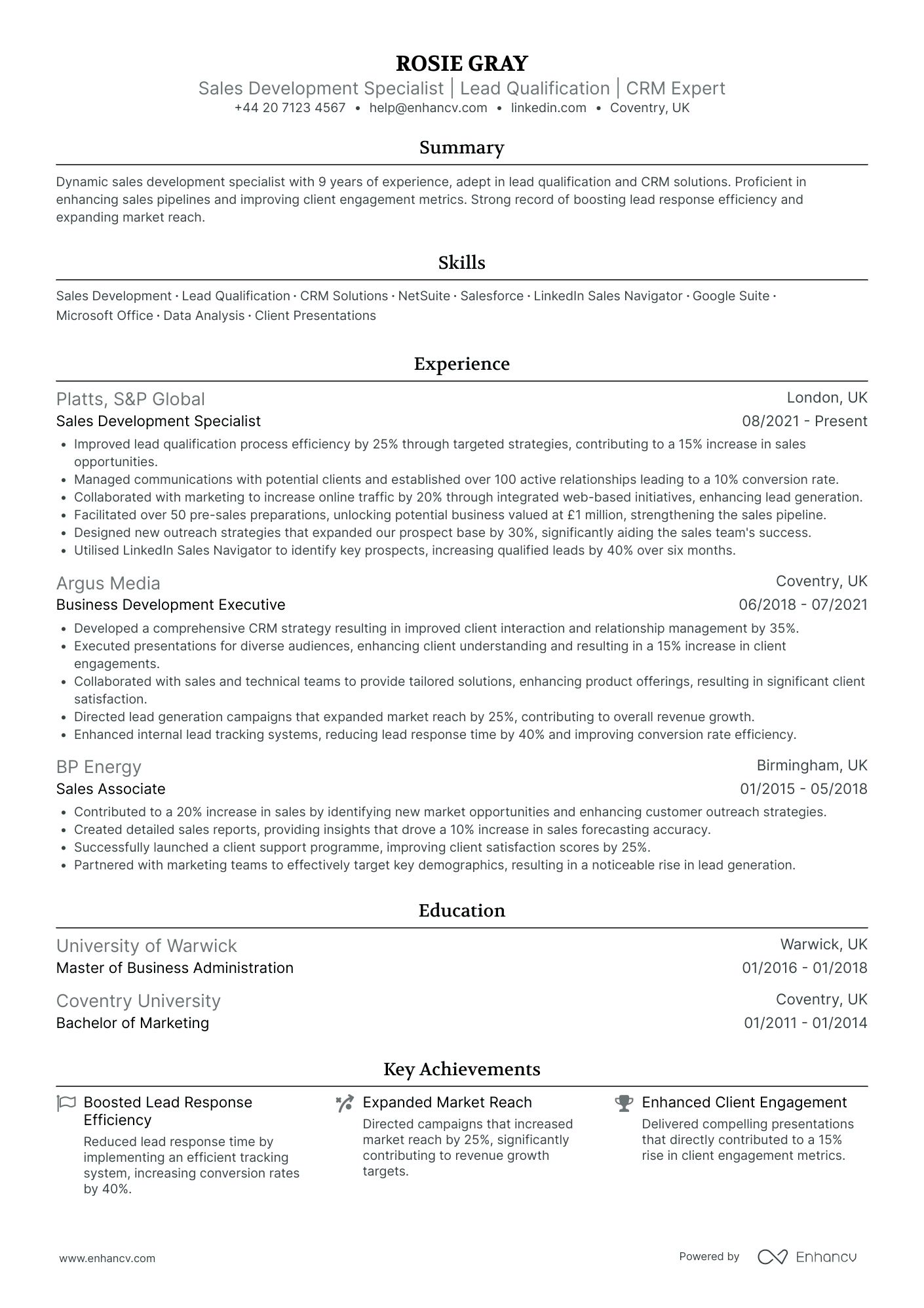
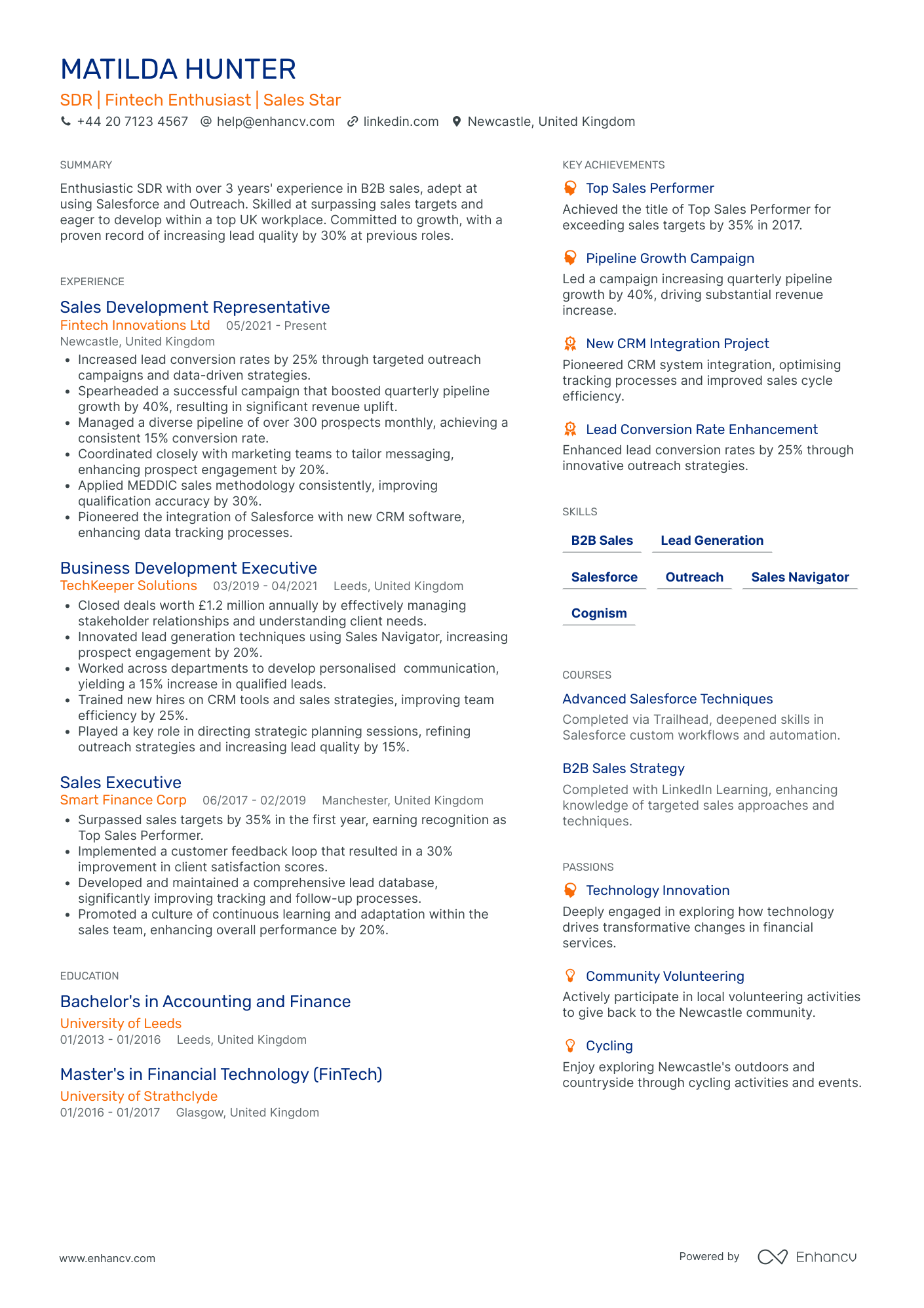
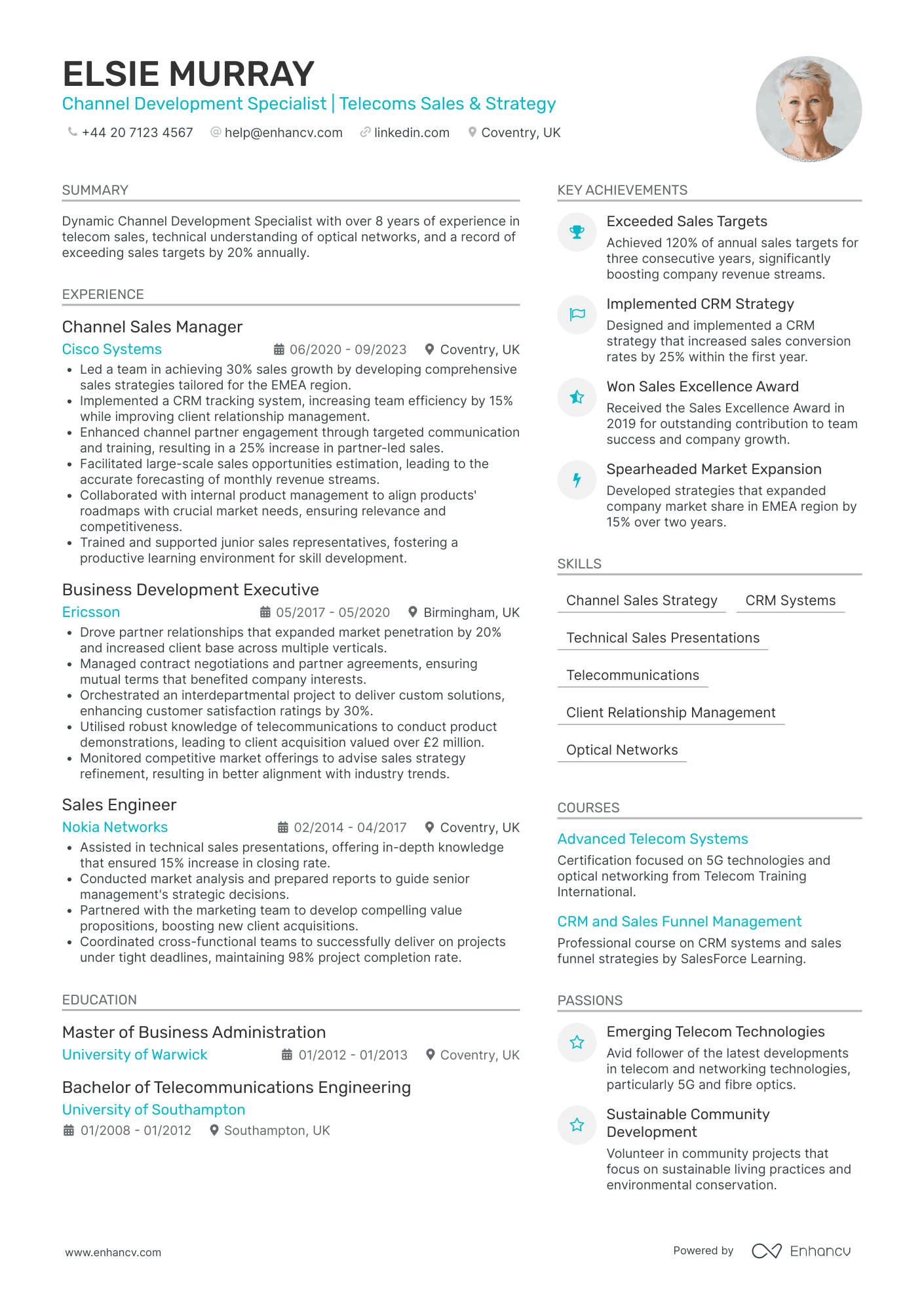
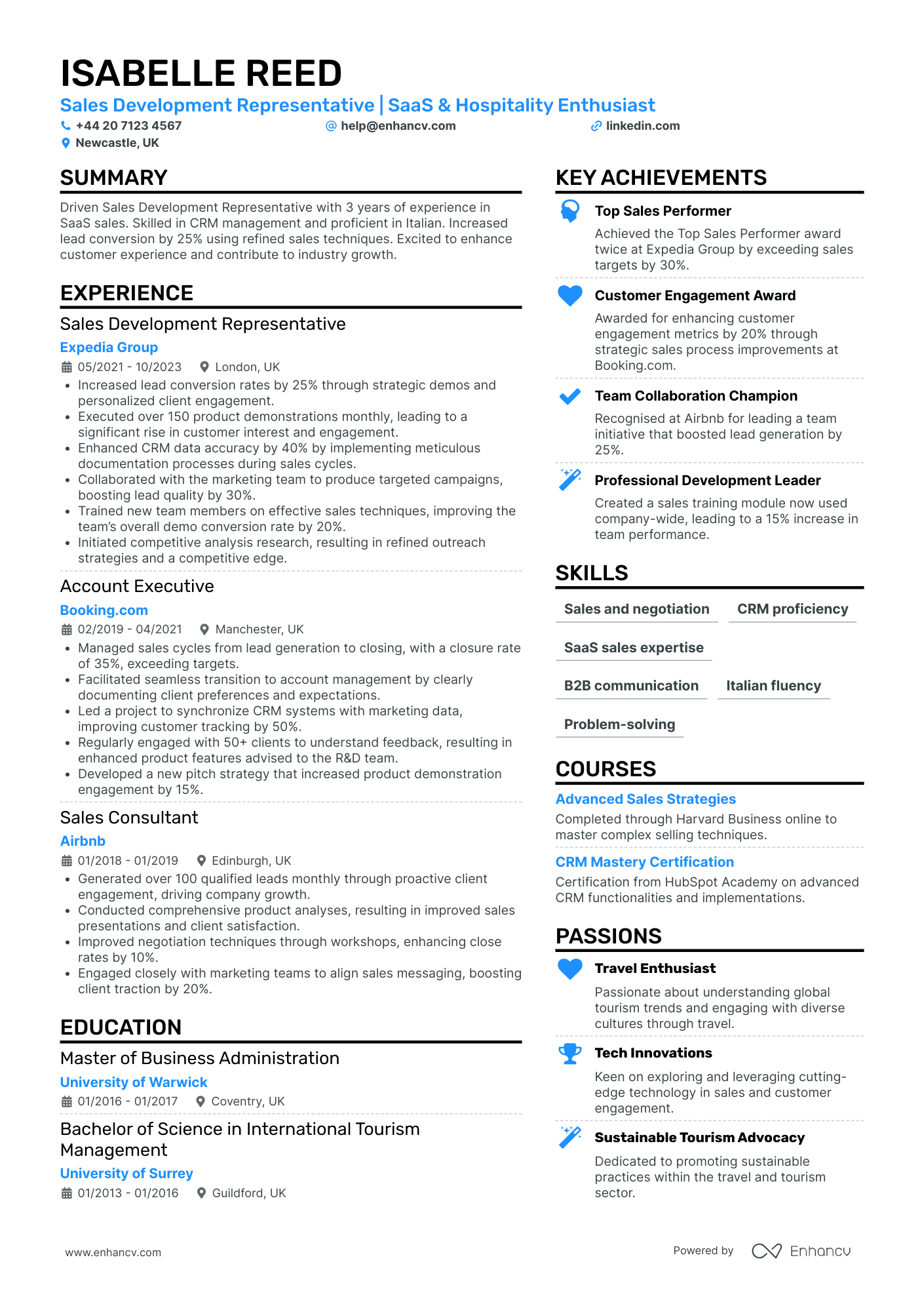
While you are starting out, keep it to one page. One column, standard headings, a readable font. A sales manager skims a stack of these between meetings and rewards the one they can read in ten seconds. Move to two pages only once you carry real quota history worth the space.
Use a skills-led or combination layout so your skills and outreach evidence sit above a thin work history. Switch to reverse chronological once you have SDR roles to lead with.
Send a PDF for direct applications so the layout holds, and keep a Word copy for recruitment agencies, which place a large share of sales roles and reformat CVs into their own template. If the advert names a file type, follow it.
SDR applications almost always pass through tracking software, so keep the layout clean and the headings standard for an ATS-friendly CV. Build it from a tested layout rather than a blank page. Enhancv's CV templates export to a clean PDF that parses without scrambling your job titles.
Writing your sales development representative personal statement
Three or four sentences at the top: who you are, the sales behaviours you can already evidence, one concrete number, and the kind of team you want to prospect for. See more personal statement examples if the opening line will not come.
Skip the adjective soup every other applicant uses. "Motivated, ambitious, and passionate about sales" tells a recruiter nothing they can check, and they have read it forty times this week. Lead with evidence instead:
Sales development representative personal statement example (no experience)
Driven psychology graduate with a year of part-time retail sales, consistently in the top three for add-on sales across a team of twelve. Comfortable on the phone and used to hearing no, having cold-called local businesses for a student fundraising drive that raised £4,200. HubSpot Sales Software certified and looking to book qualified meetings for a B2B software team in Manchester.
Compare that with the version a recruiter has already read a dozen times this morning and skims straight past:
What to avoid
A highly motivated and ambitious individual with a passion for sales and excellent communication skills. Hard-working team player seeking a challenging SDR role in a fast-paced environment where I can grow and develop my career.
When I read an SDR CV with no sales title on it, I am looking for one thing: evidence the person can handle rejection and keep dialling. A line like "cold-called 40 businesses a week and booked six meetings" tells me more than any adjective. Name the real activity, the number, and the tool you used to track it. That, plus a CRM certification you finished on your own time, beats a polished CV that only lists qualities.
The Enhancv team
Writing your sales development representative experience section
Whether the work was paid, voluntary, or a side hustle, write each entry the same way: a dated heading, then bullets that show what you did and what it produced. Lead each bullet with a strong verb. For the mechanics, see work experience on a CV.
SDR work lives and dies on numbers, so your bullets should too. Calls made, emails sent, meetings booked, conversion rate, position against target. Those are your CV achievements, and they translate straight from a retail or fundraising job into sales language.
If a number feels small, keep it anyway. "Booked six meetings a week" is concrete and believable, and a recruiter trusts it more than a rounded-up claim with no source. Show the trend where you can, since "grew from two to nine meetings a month over a quarter" tells a manager you improve with reps, which is the whole point of hiring an SDR.
Tailor every application: pull the tools and metrics from the advert and mirror them where they are true of you. Enhancv's CV tailoring feature reads the advert and suggests the matching edits, which saves rewriting from scratch for each firm.
- Consistently rank in the top three of a twelve-person team for accessory and insurance add-ons, averaging 118% of monthly target
- Open 30 to 40 conversations a day with cold footfall, qualifying needs before recommending a plan
- Handle objections on price and contract length daily, converting roughly one in four browsers to a sale
- Log every sale and follow-up in the store CRM, keeping records clean for the wider team

PRO TIP
SDRs are hired against activity, not adjectives. Every bullet should carry a number a manager can picture: calls per day, meetings booked, conversion rate, or position against target. If a bullet has no metric, either find the number or cut it.
Education and certifications for a sales development representative CV
You rarely need a specific degree to start as an SDR, which is part of why the entry-level route works. A 2:1 in anything, paired with evidence you can sell, clears most bars. List your education plainly and give the space to proof of behaviour instead.
Where you can add real weight is a self-started certification, because finishing one signals the coachability the role runs on. Name the ones that map to the tools in the adverts: HubSpot Sales Software, Salesforce Trailhead, LinkedIn Sales Navigator, or a recognised methodology course such as SPIN or Sandler. Put them in a short certifications block near the top while your work history is thin.
Listing a qualification you are still working towards is fine and expected. "HubSpot Sales Software certification, in progress" shows a hiring manager you are already moving in the right direction.
Conclusion
Lead with the two behaviours that define the job, starting conversations and handling a no, and prove both with numbers a recruiter can picture. Name the CRM tools the adverts ask for, and keep the format to one clean page.
Pair the CV with a short cover letter that says why sales and why this team, and you turn no experience into a credible first application.

Author's take - The Enhancv team
When I read an SDR CV with no sales title on it, I am looking for one thing: evidence the person can handle rejection and keep dialling. A line like "cold-called 40 businesses a week and booked six meetings" tells me more than any adjective. Name the real activity, the number, and the tool you used to track it. That, plus a CRM certification you finished on your own time, beats a polished CV that only lists qualities.