
Every job seeker knows the Sunday night ritual: opening 20 browser tabs, uploading the same resume to 20 different portals, and hoping something sticks.
Two weeks later, the silence is deafening.
When we analyzed behavior across 260,000 job seekers on Enhancv over the past year, one data point stood out clearly. Candidates who treated their job hunt as a batch task rarely made it to the offer stage.
The candidates who landed offers treated their search like an active pipeline, managing each application through distinct stages from lead to negotiation.
Here is why pipeline management beats batch applying in 2026, and how to structure your search for maximum interview conversion.

Quick takeaways
- The batch-apply trap: Blasting 50 applications on a Sunday afternoon leads to high rejection rates and fast burnout.
- The active tracker advantage: Candidates who actively updated application stages were five times more likely to convert interviews into signed offers than one-time resume downloaders.
- The four critical transitions: Managing the transitions between Saved, Applied, Interviewing, and Negotiating turns an overwhelming job hunt into a predictable process.
The numbers behind the batch-apply breakdown
Why does submitting 50 resumes at once fail so consistently?
Our data shows that successful job hunts rely on timing and tailored follow-through rather than sheer volume:
- Over 178,000 users in our dataset tracked a single job and stopped, yielding minimal interview progression.
- Candidates with 6 to 15 active tracked roles — a useful floor for how many jobs you should apply for — showed the highest conversion rate from application to interview.
- The median callback took 10 days. Batch applicants frequently forgot what they submitted by the time a recruiter called, missing the critical window to prepare role-specific talking points.
When you spray generic resumes, you lose context on what you applied to, which version of your resume you sent, and when to follow up.
Volume is a bad bet in this market anyway. BLS JOLTS counts roughly 7.3 million open roles against about 5.1 million hires in a month, and our ghost jobs research puts the market candidates actually face around a quarter smaller than the headline vacancy count.
The 4-stage pipeline that converts
Candidates who logged offers followed a disciplined four-stage workflow.
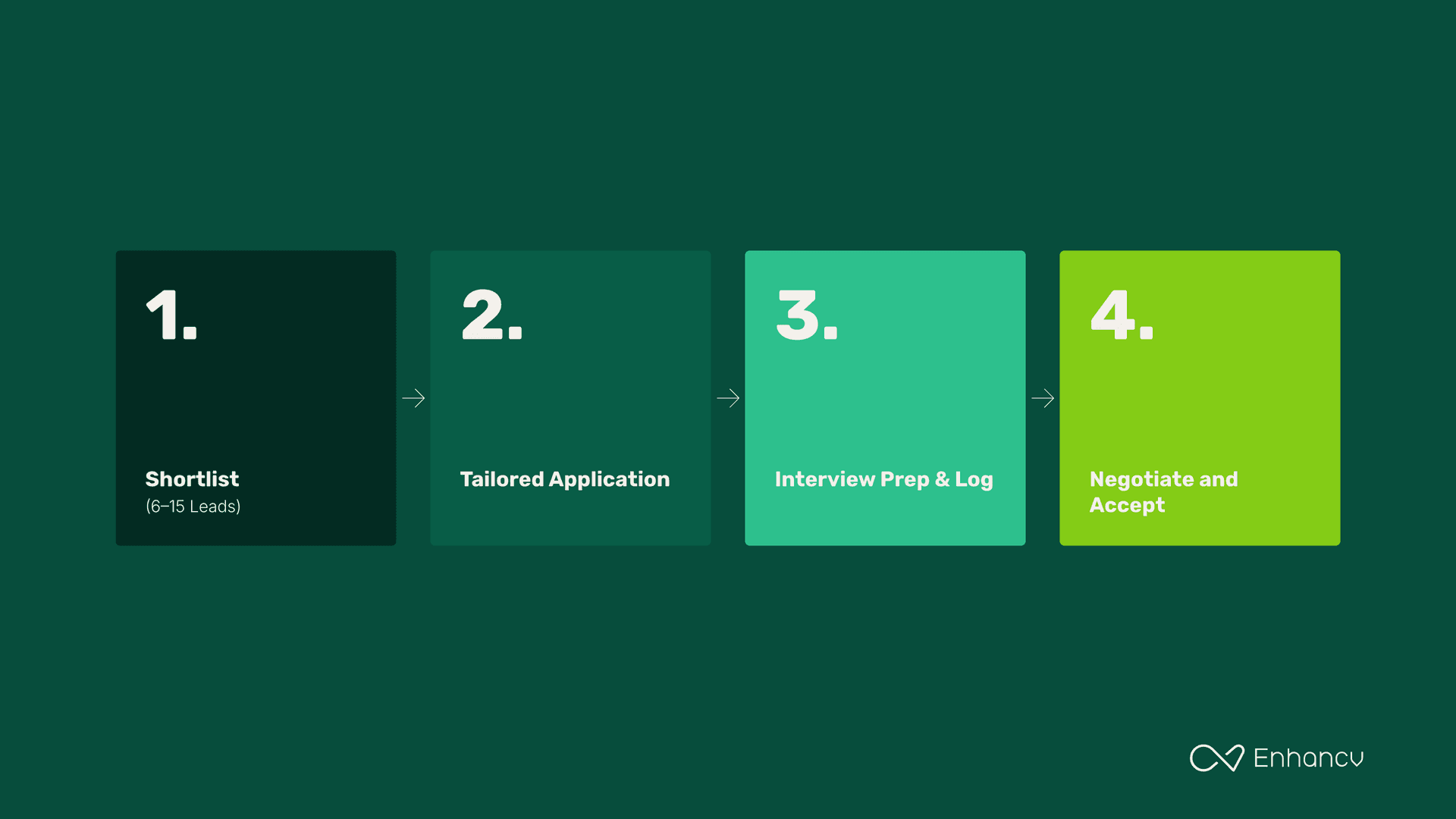
Stage 1: Build a rolling shortlist (6 to 15 roles)
Instead of applying the second you spot an opening, save it to a central board first.
- Why it works: Saving roles gives you time to read the requirements properly and pull out the keywords that matter before investing effort into an application.
- How to run it with Enhancv: Use Enhancv's Chrome extension to save openings from LinkedIn, Indeed, or career portals directly into your Job Application Tracker. Use Job Search to discover roles matched directly to your existing resume.
Stage 2: Submit tailored applications with verified ATS alignment
Once a role makes your shortlist, spend 10 to 15 minutes adjusting your resume for that specific posting.
- Why it works: Applicant tracking systems scan for exact skill matches — our ATS testing found the layout rules candidates obsess over matter much less than that. Tailoring three to four bullet points and running a match score before submission ensures your resume clears the parser cleanly and earns human attention.
- How to run it with Enhancv: Use AI Resume Tailoring to customize your phrasing, and run an ATS check in Enhancv's resume checker to verify your keyword match score before exporting.
Stage 3: Manage the 10-day callback window
In our data, 10 days was the median wait time between submitting an application and receiving an interview invite.
- Why it works: Active candidates use this window to log recruiter contacts, research the hiring team, attach the exact resume version sent, and plan a follow-up for when there is no response. When the recruiter calls, you know exactly what you applied for.
- How to run it with Enhancv: Move your card to Interviewing, record salary and team notes, and use AI Interview Help to generate practice interview questions and draft answers based on the job ad.
Stage 4: Track multi-round progress through negotiation
Final rounds and negotiations took a median of 27 days in our study.
- Why it works: Candidates who reach multiple final rounds gain immediate negotiation leverage, especially once you can say you are interviewing with other companies. Tracking active conversations side by side allows you to coordinate decision deadlines and ask for more money with a BLS wage benchmark for your occupation behind it.
- How to run it with Enhancv: Move your cards to Negotiating and Offer as conversations advance, keeping your notes, offers, and deadlines in one central dashboard.
How to switch from batch applying to pipeline tracking this week
Transitioning to an active pipeline takes less than an hour:
- Stop batch applying: Clear out stale browser bookmarks and create a clean master resume in Enhancv's resume builder.
- Set up your board: Open Enhancv's Job Application Tracker and add six to eight high-fit positions to your Bookmarked column.
- Tailor and submit: Tailor your resume for your top two roles today, checking the resume keywords against each posting, submit them, and move the cards to Applied.
- Log your routines: Set a reminder to check your board twice a week to log status updates, follow up on pending applications, and practice interview questions.
Treat your job search like a pipeline, not a lottery. Start tracking your applications on Enhancv today.
Make one that's truly you.