



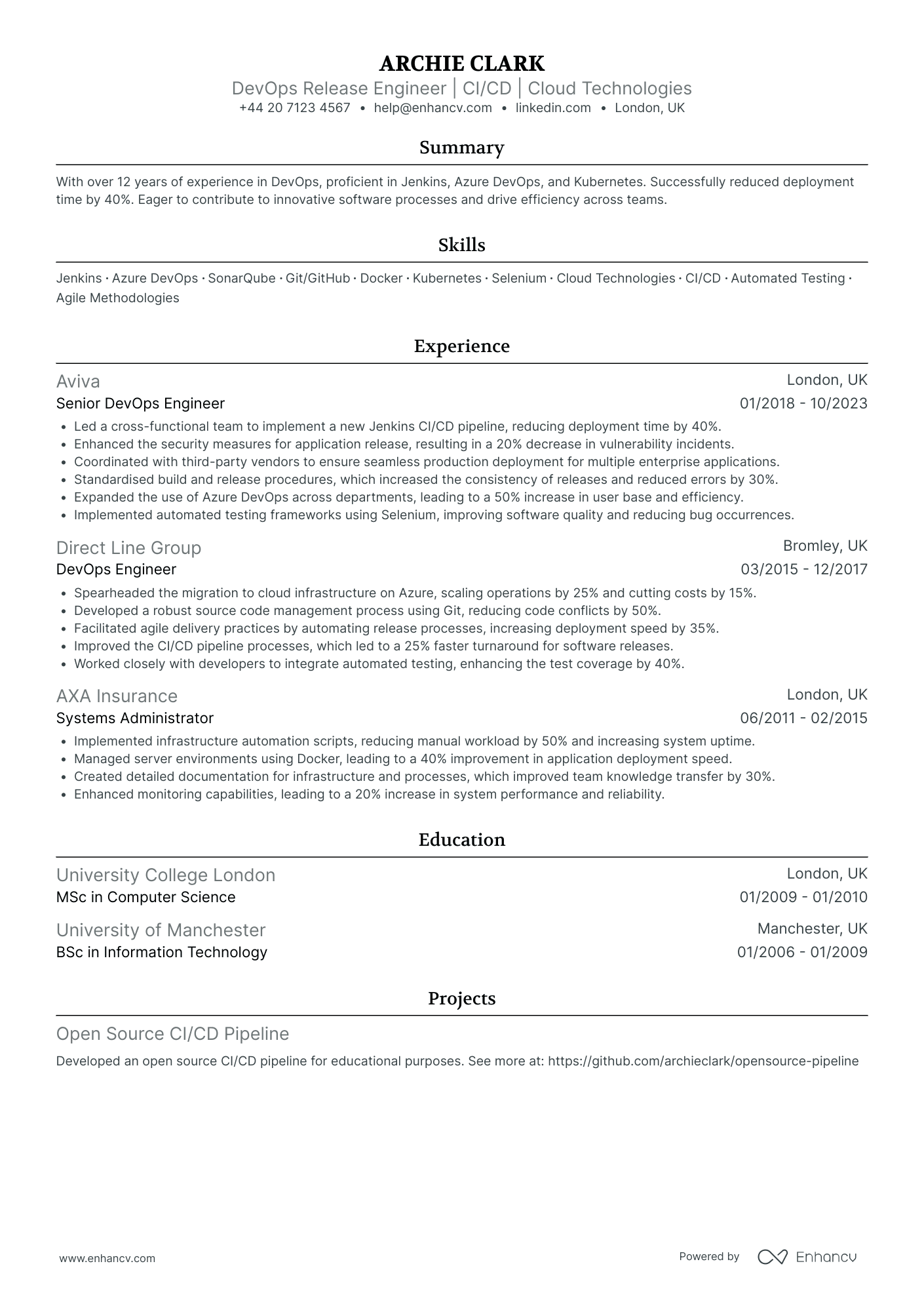
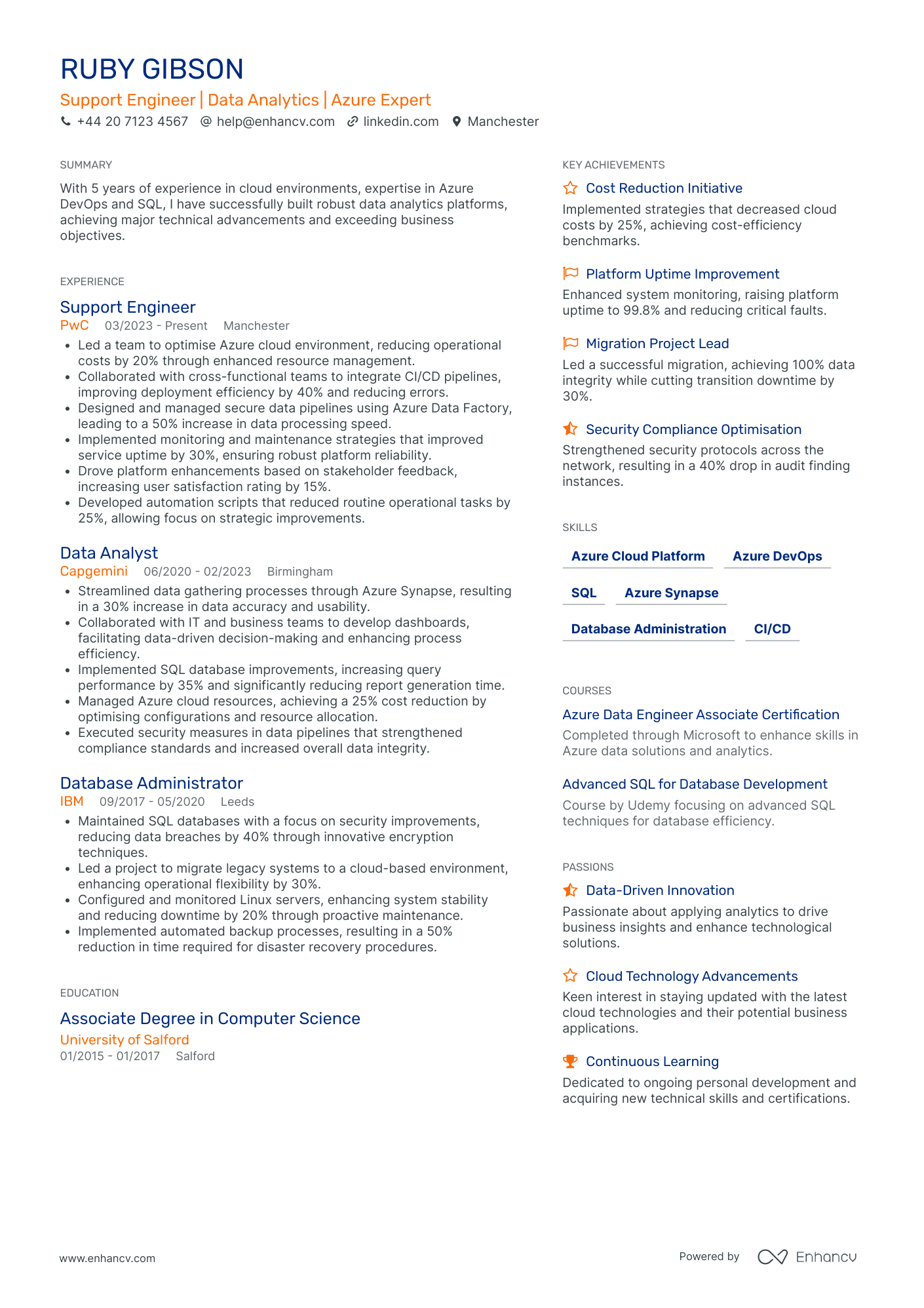
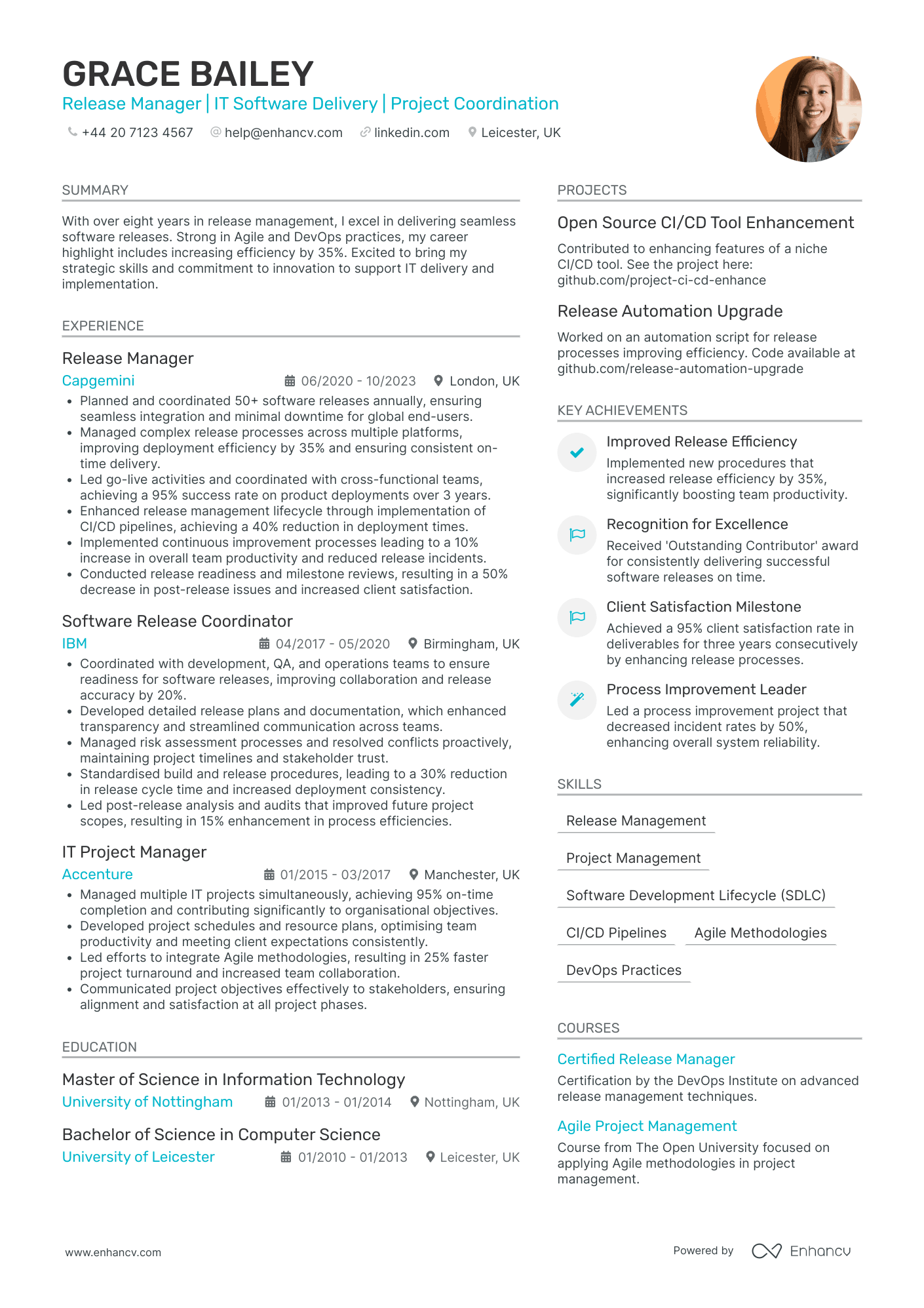
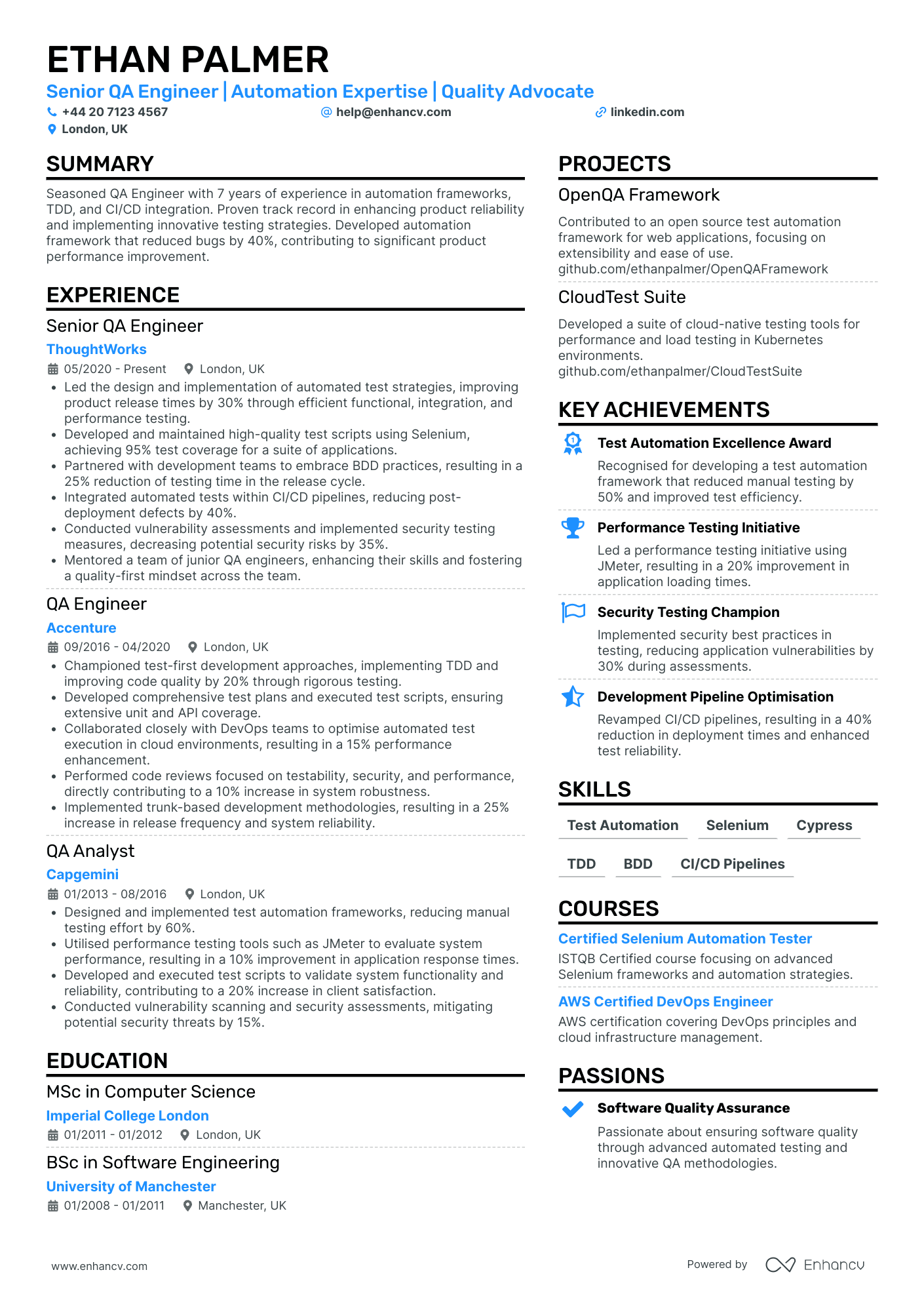
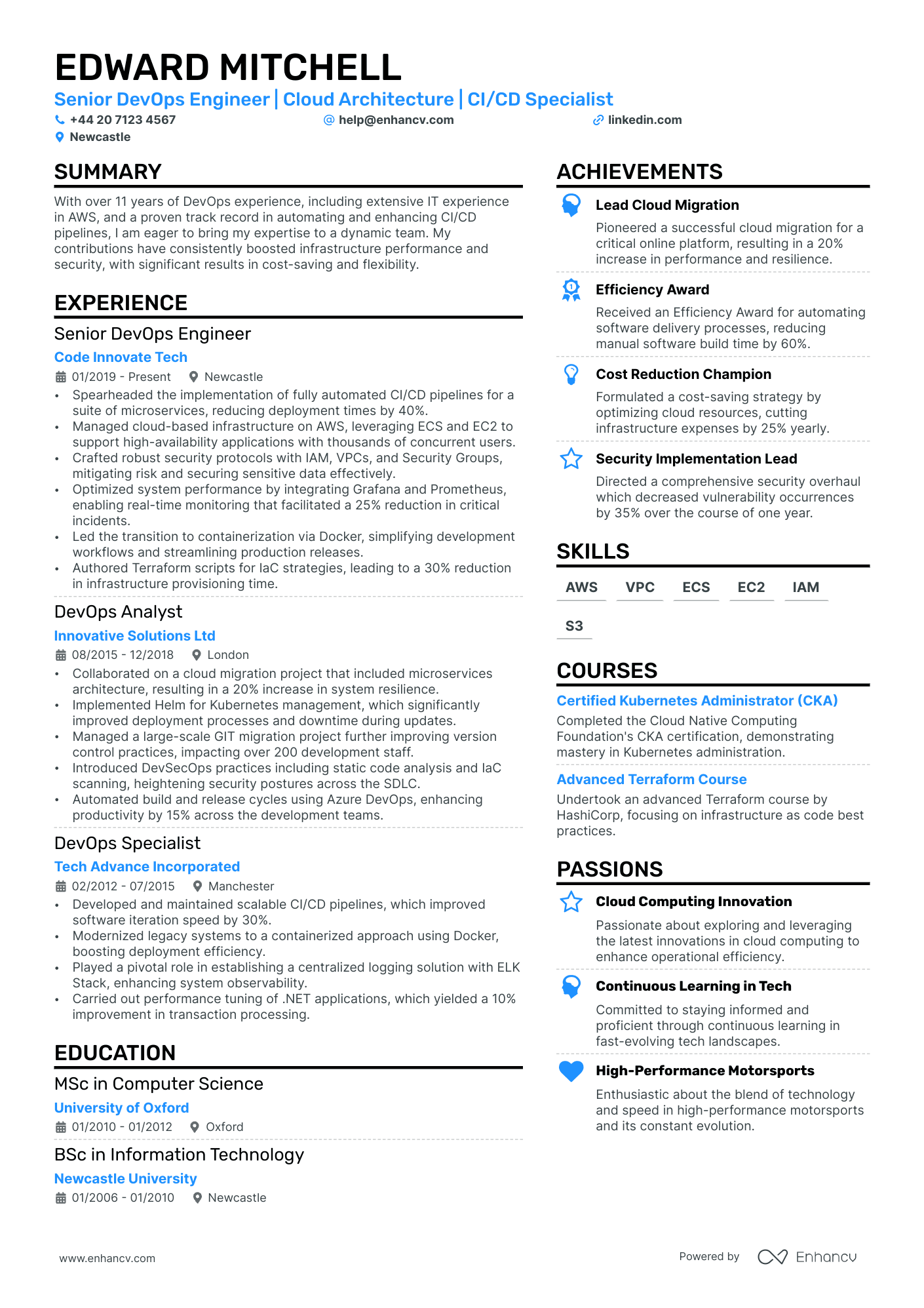
Most DevOps CVs read like a tools inventory. Every technology the candidate has ever touched, dumped into one long list, with nothing that proves they can keep a pipeline healthy in production.
The CV that gets the call leads with the toolchain this role is screened on and backs it with numbers: deployments shipped, uptime held, mean time to recovery cut. Get the fundamentals right with how to write a CV, then make Kubernetes, Terraform, and CI/CD the first things a hiring manager sees.

Key takeaways
- Lead with your toolchain. Kubernetes, Terraform, and CI/CD are the terms UK employers screen for first, so put them where a recruiter sees them in ten seconds.
- Quantify everything. Deployment time cut, uptime held, cloud spend saved, incidents reduced. One real number beats a paragraph of adjectives.
- Use a clean, one-column, ATS-safe layout, and drop the skill-percentage bars and graphics that parse as noise.
- Two pages, reverse chronological, for an experienced engineer. One page if you are early in your career.
- Send a PDF unless the advert or agency asks for a Word file. Keep a Word copy ready, because agencies reformat CVs.
- Put certifications like AWS, CKA, and Terraform Associate near the top. This field checks for them early.
Top skills for your DevOps CV
This is the section a DevOps hiring manager reads first, so it carries the most weight on the page. Read a dozen live adverts and the same toolchain repeats, so list your hard skills in the tools' own names, because that is exactly what recruiters and ATS filters search for.
Group them the way the work splits: cloud and infrastructure as code, then containers and orchestration, then CI/CD and automation. Put the most-requested items at the front of each group, and see key skills for a CV for the wider pattern.
Top skills for your DevOps CV:
Kubernetes
Terraform
CI/CD pipelines (Jenkins, GitLab CI)
AWS (EC2, S3, EKS)
Docker and containerisation
Python and Bash scripting
Linux administration
Infrastructure as code
Monitoring and observability (Prometheus, Grafana)
Ansible configuration management
Troubleshooting
Incident response
Collaboration with dev teams
Documentation
Communication
Across UK postings, Kubernetes, Terraform, and CI/CD recur most often, followed by AWS, Docker, Python, Jenkins, and Bash. Mirror the exact terms from the advert where they are true of you, in the words the posting uses.
Do not list a tool you cannot defend in an interview. "Kubernetes" on the page invites a question about how you handle a failing rollout or a stuck pod, so keep the line honest. If you have only run it in a lab, say so in the project entry rather than the top skills block.
The soft skills that matter here are the checkable ones: calm incident response, clear documentation, and close collaboration with the developers whose code you ship. Each belongs in an experience bullet that proves it, not in a list of adjectives.
Show the direction of travel too. If you are moving from scripted automation towards infrastructure as code and GitOps, name the shift. It signals you can manage systems at scale, not server by server.
Put the grouping to work on the page. A recruiter should see "AWS, Terraform, CloudFormation" on one line, "Kubernetes, Docker, Helm" on the next, and "Jenkins, GitLab CI, Ansible" on a third. Three tight clusters read faster than one wall of twenty tools, and they show you understand how the stack fits together.
So answer the question employers actually ask, which is what your top skills are. For a DevOps engineer in 2026 that is cloud, usually AWS, infrastructure as code with Terraform, container orchestration with Kubernetes, and a solid CI/CD and scripting foundation. Everything else on the page supports those four.
What the UK DevOps market looks like
Before you format a line, know what this market screens for. Here is where the work happens and what employers ask for, drawn from 142 UK DevOps postings in the last ~30 days on Enhancv's internal job feed.
| What | UK DevOps roles |
|---|---|
| Where the work happens | Hybrid 52% · onsite 40% · fully remote 8% (142 UK postings in the last ~30 days, Enhancv's internal job feed) |
| Experience level asked for | Mid 40% · senior 39% · lead 20% · almost none at entry level |
| Most-listed skills | Kubernetes, Terraform, CI/CD, AWS, Docker, Python, Jenkins, and Bash |
Two things in that table should shape your CV.
The work is mostly hybrid or onsite, with fully remote roles the exception at 8%, so a recruiter wants to see you can reach the office. Put your town and a note on hybrid availability in the header.
The roles skew mid to senior, 40% mid and 39% senior, with a further 20% at lead level and almost nothing pitched at entry. Employers expect real depth on a named stack, not a broad tour of every tool you have read about. If you are just starting out, the early-career section below is written for you.
The toolchain repeats with striking consistency. Kubernetes, Terraform, and CI/CD lead, followed by AWS, Docker, Python, Jenkins, and Bash. Read that as a tailoring instruction. If a posting leans on AWS and Terraform, move your cloud and infrastructure-as-code work up the page for that application.
Formatting your DevOps CV
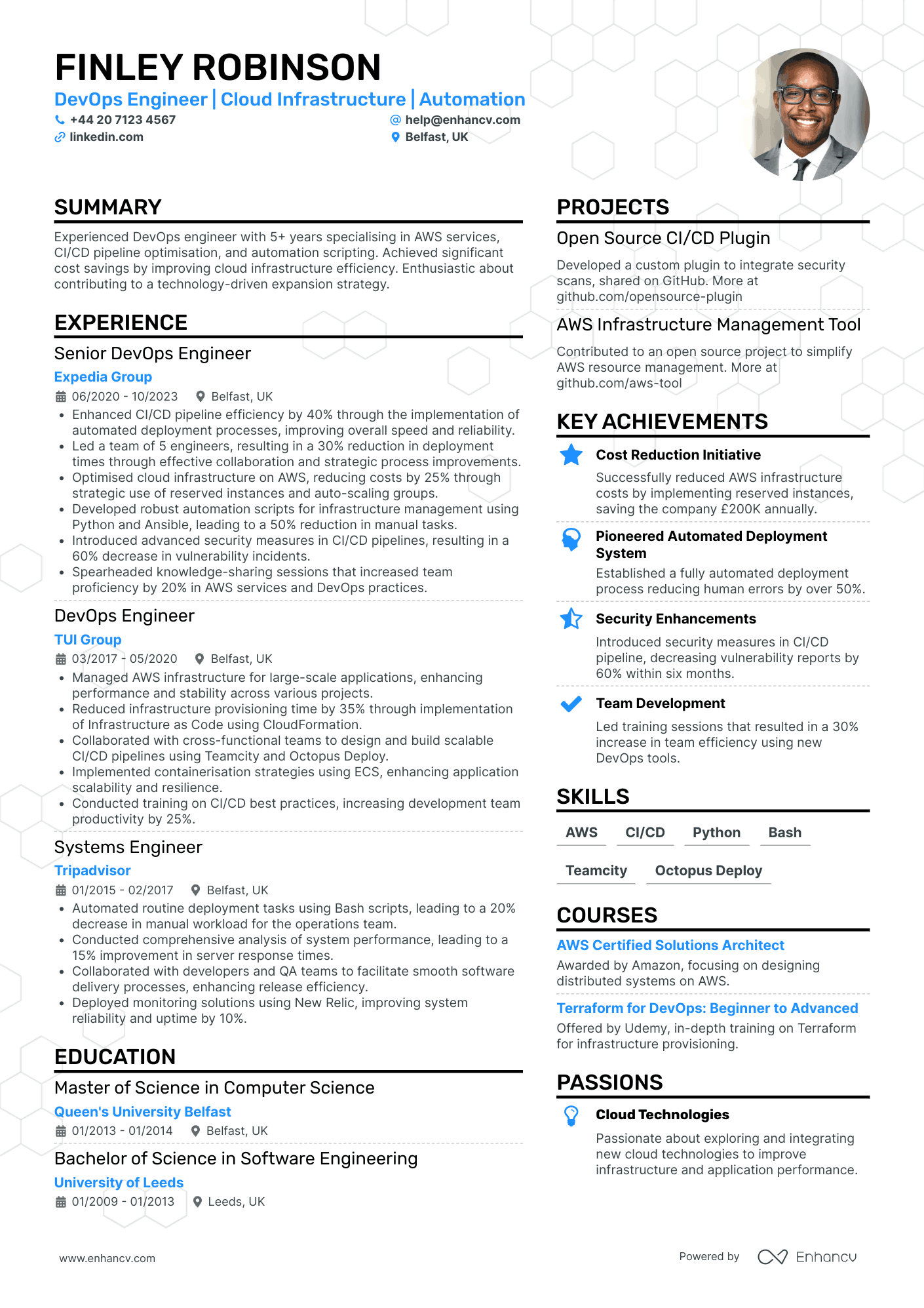
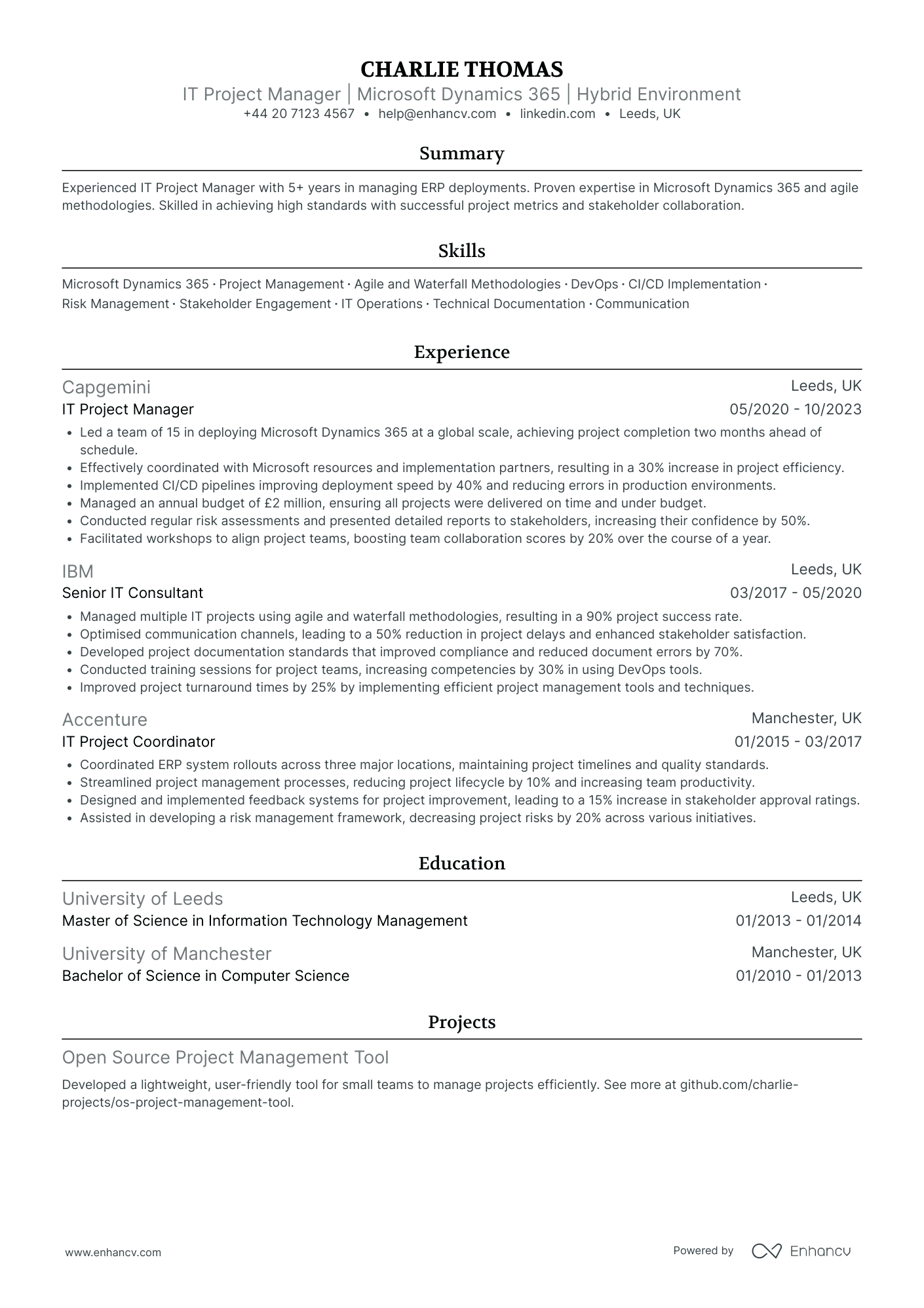
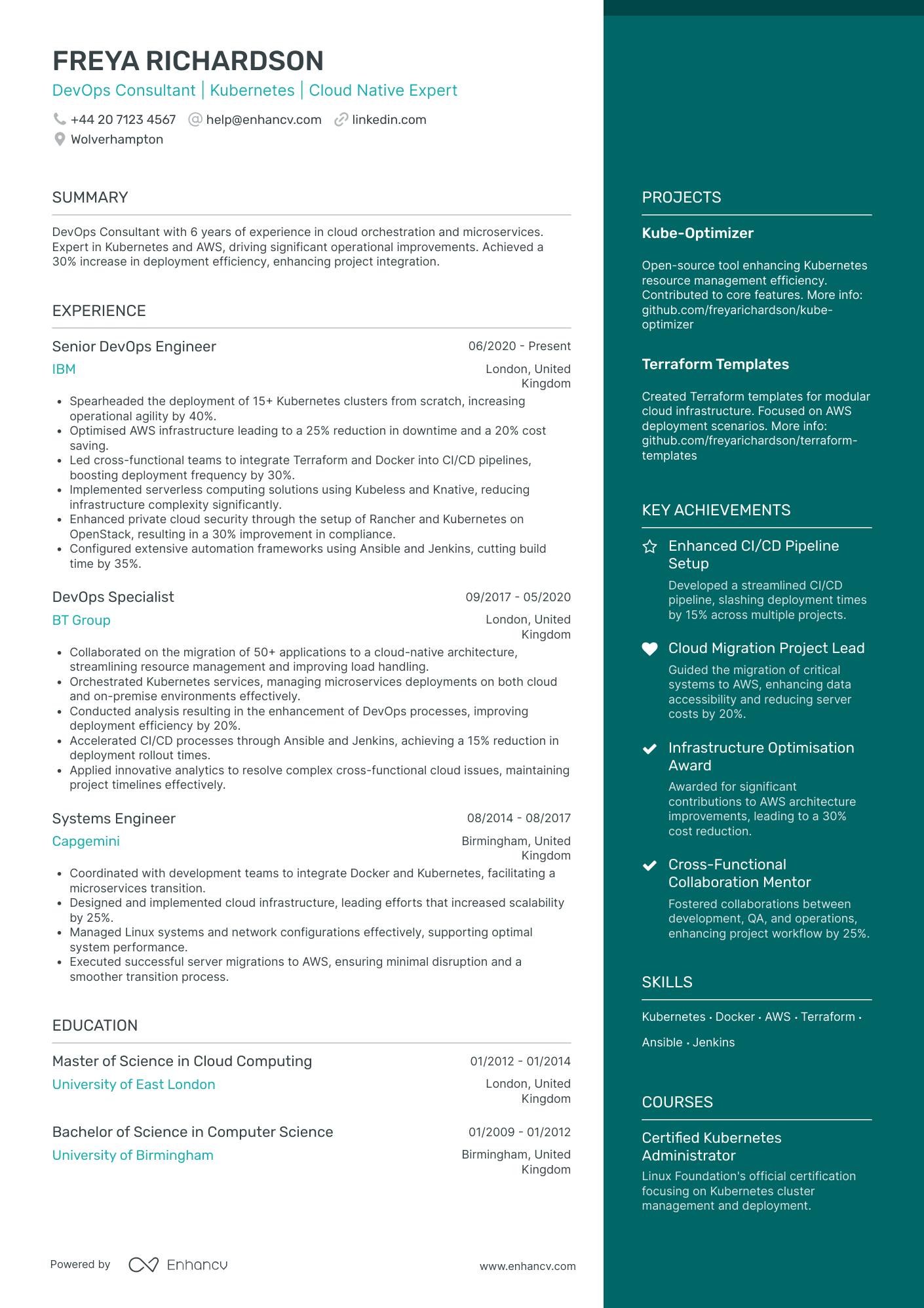
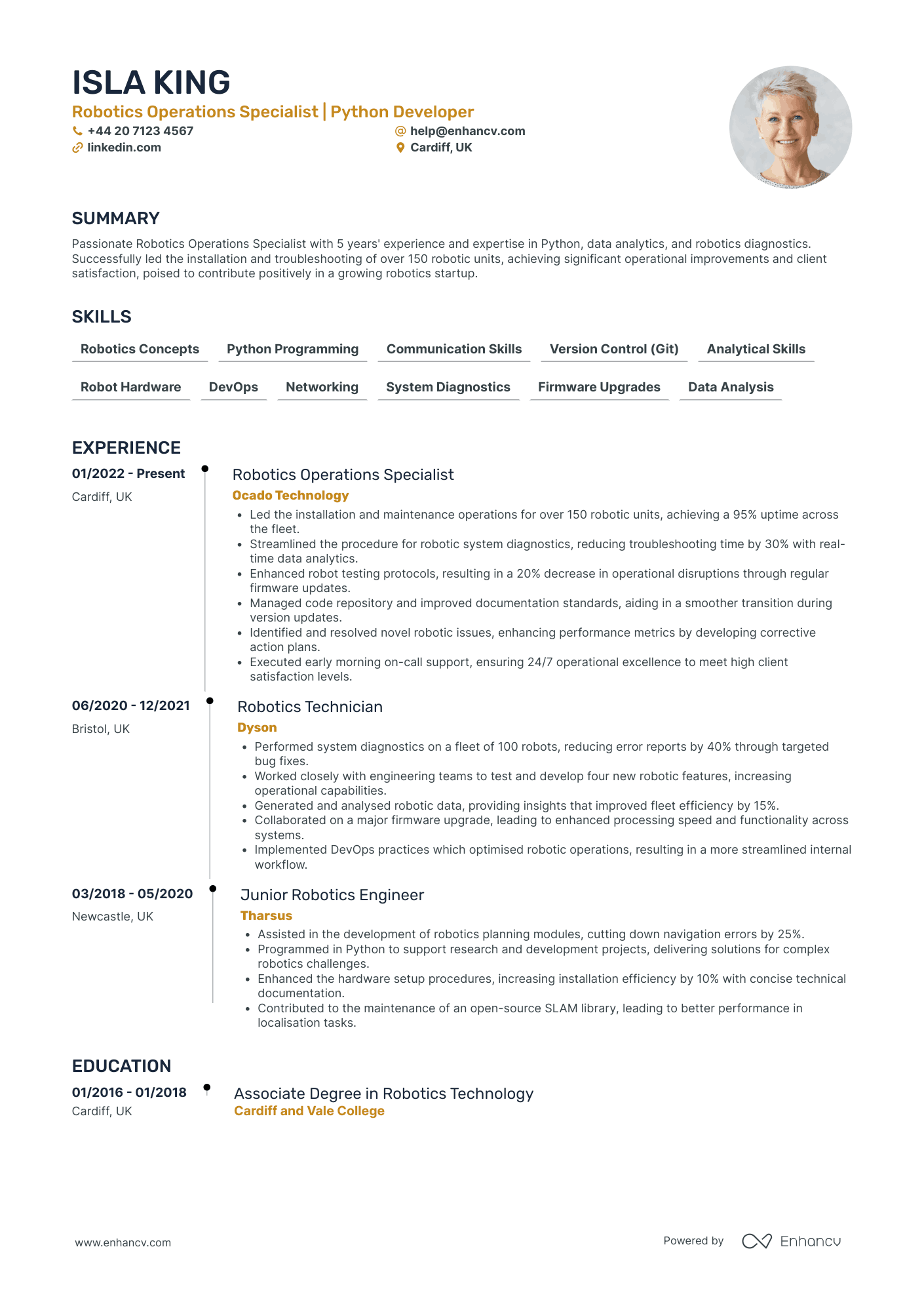
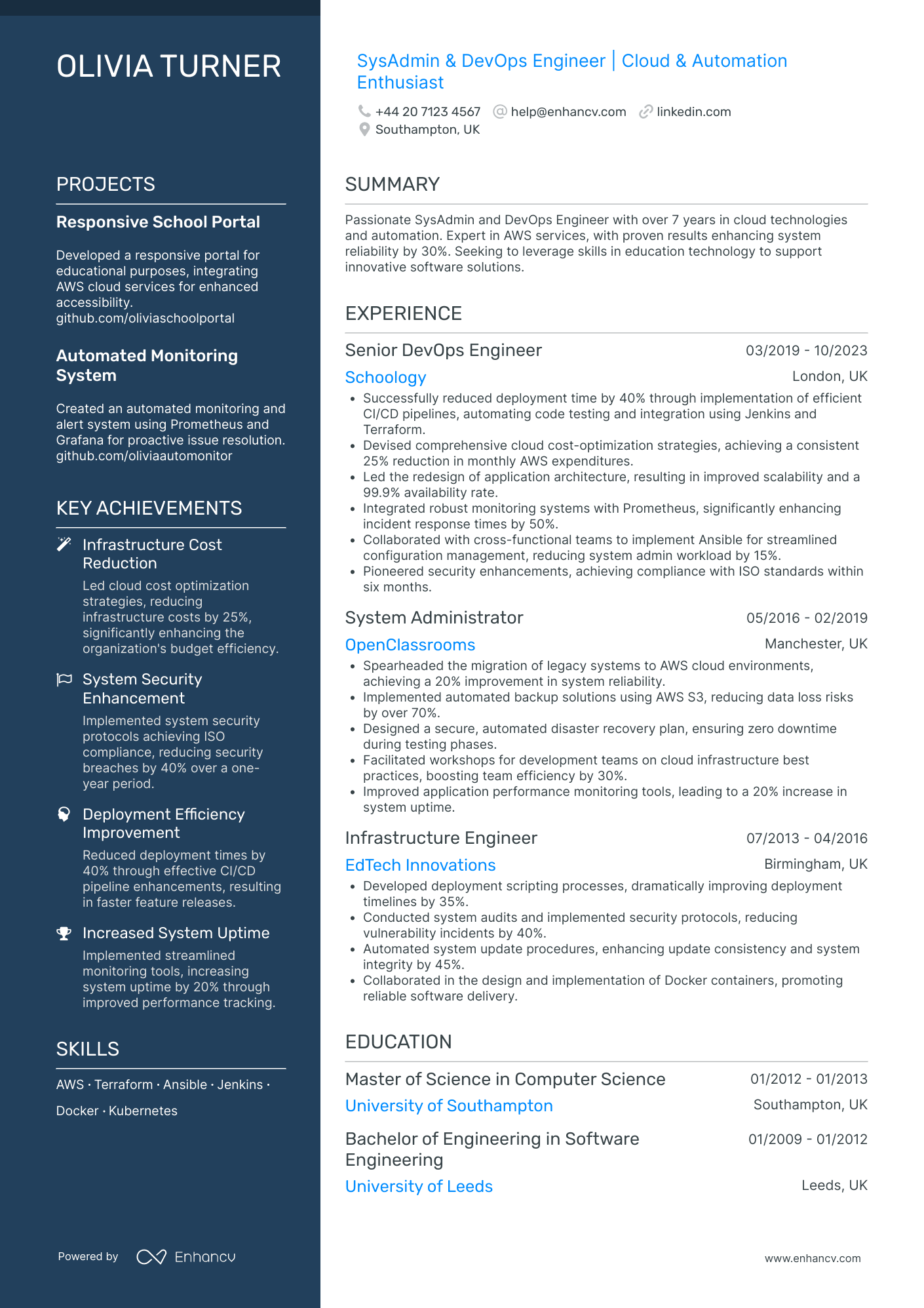
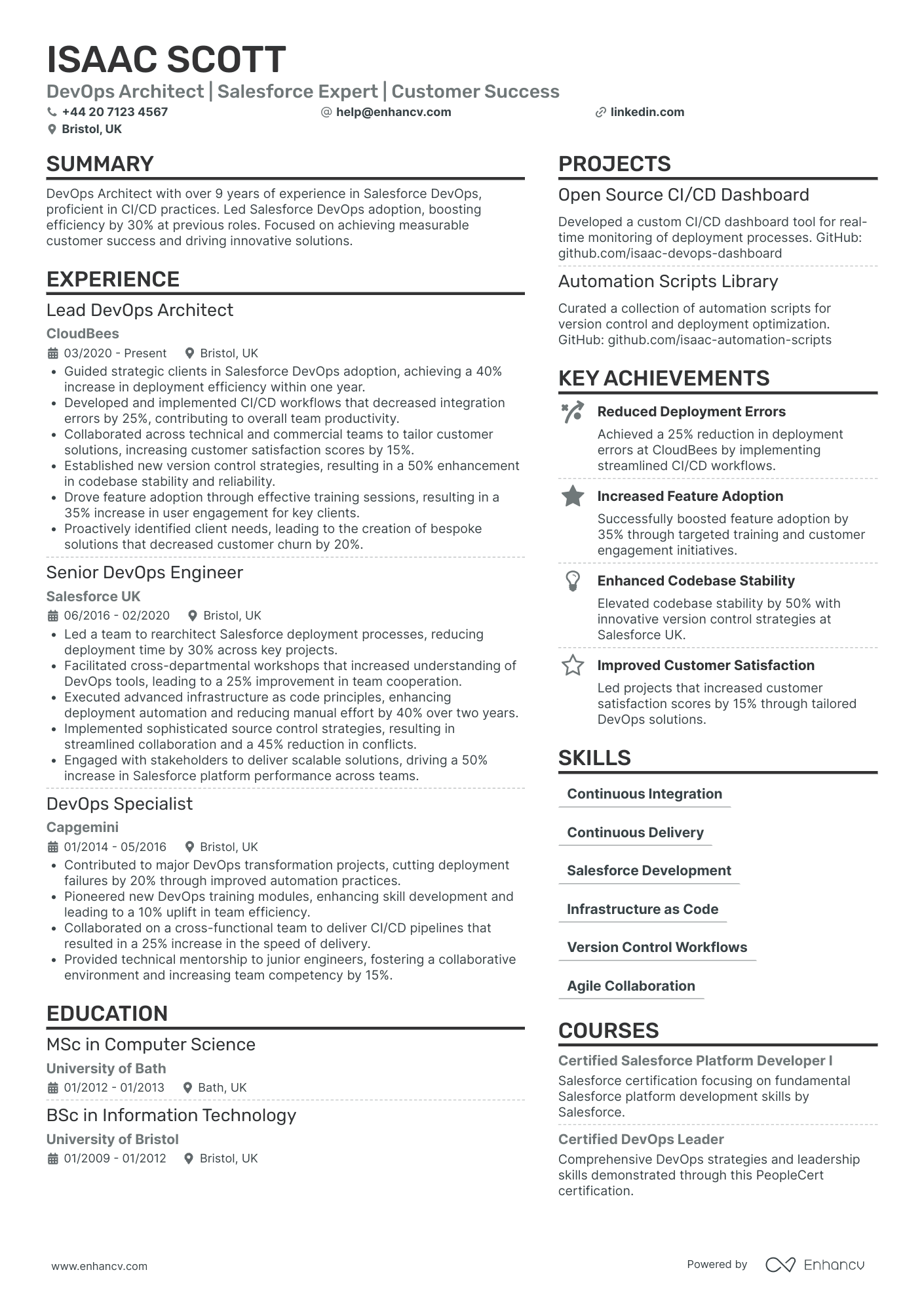
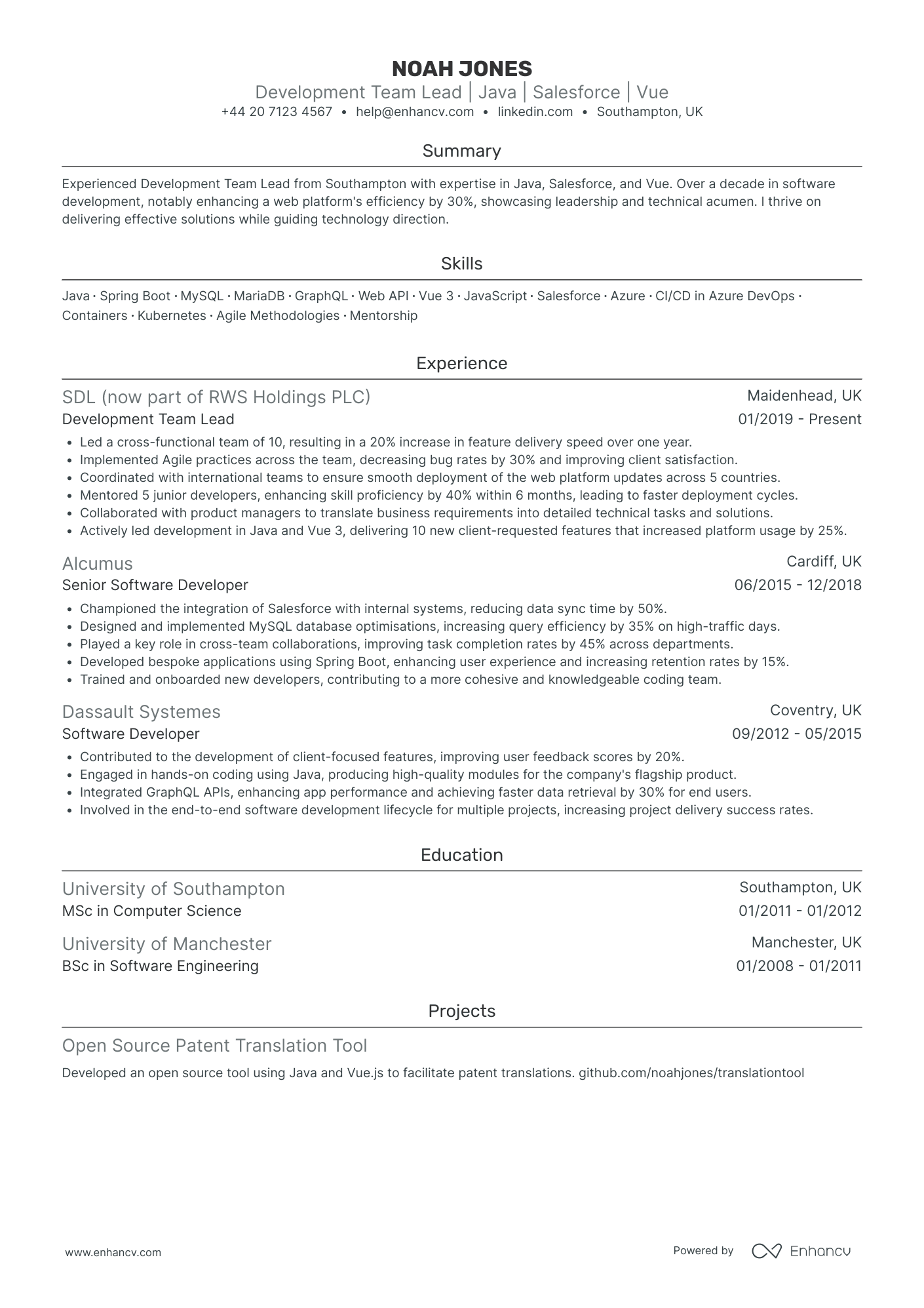
This role rewards structure over decoration. Use a single-column, reverse chronological layout with standard headings, so a recruiter and an applicant tracking system read the same clean file.
Lead with a tight header: your name, the title you are targeting, your location, and a line on hybrid or onsite availability. Then run the sections in the order this field expects.

The DevOps CV template, in order
- Header: name, target title, location, and hybrid or onsite availability.
- Personal statement: three or four lines, your cloud, certifications, and the pipelines you have run.
- Key skills: grouped by cloud and infrastructure as code, containers and orchestration, then CI/CD and automation.
- Experience: reverse chronological, with quantified bullets.
- Certifications: level and year, anything in progress flagged.
- Education: kept short, near the foot of the CV.
Keep it to two pages once you have a few years behind you. One page suits a junior or a first move, and a third page rarely earns its place.
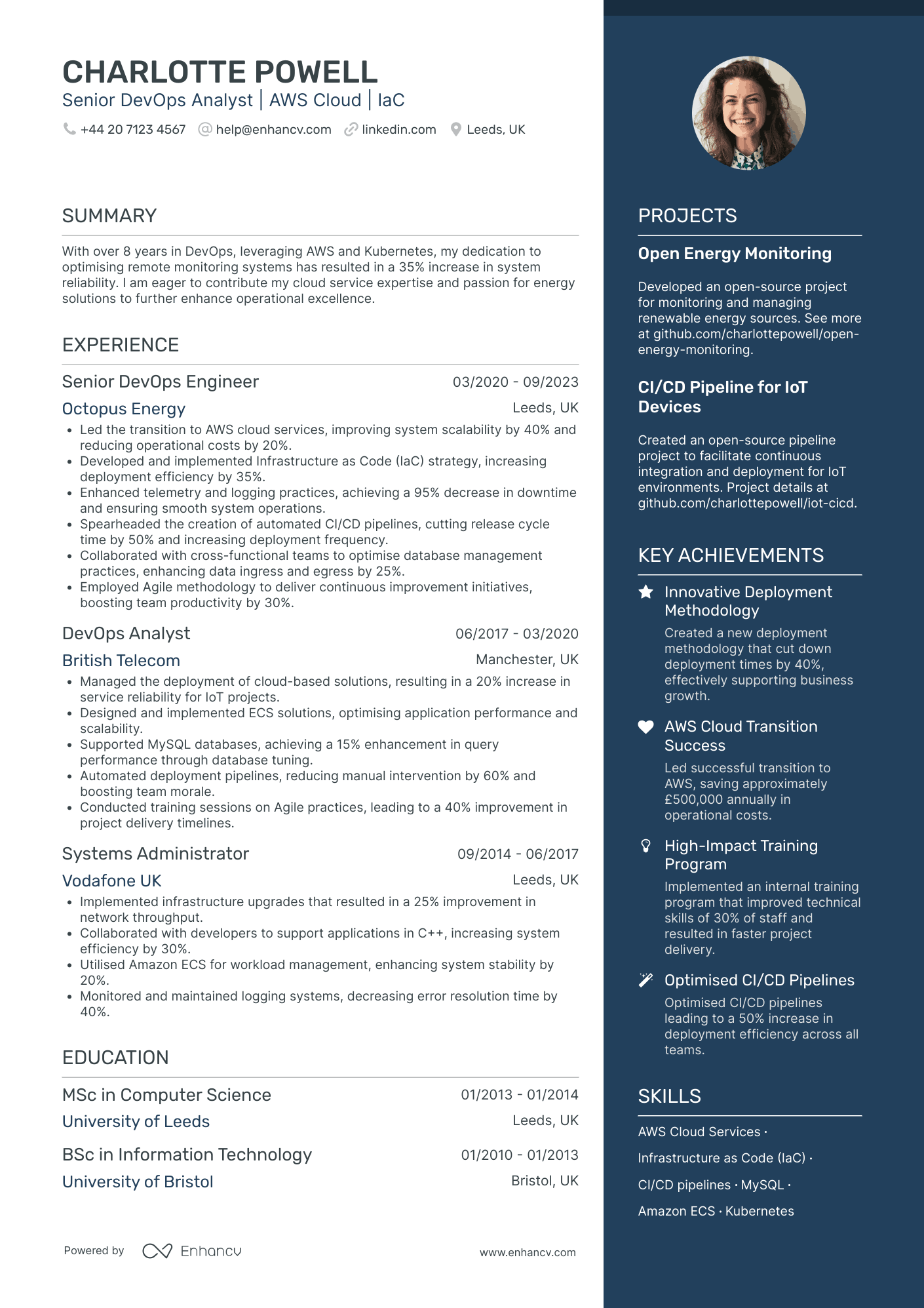
Leave off the photo, the date of birth, and the skill-percentage bars. None of them help a DevOps hire, and the bars in particular tell a recruiter nothing that a real project bullet would not say better.
Send a PDF for direct applications so your layout holds on any screen. Keep a Word copy ready for recruitment agencies, which place a large share of UK DevOps roles and reformat CVs into their own template. If an advert names a file type, follow it exactly.
Name the file like a professional. "Priya-Shah-DevOps-Engineer-CV.pdf" beats "cv final v3", and it is the first small signal of the tidy engineer behind it.
DevOps CVs almost always pass through tracking software before a human sees them. Keep the headings standard, the fonts readable, and drop the charts and icons that parse as noise. An ATS-friendly CV is a structured one, not a plain one.
Build it from a tested layout rather than a blank page. Enhancv's CV templates export to a clean PDF and keep the structure ATS-safe, so you spend your time on the content, not the margins.
Is your resume good enough?
Drop your CV here or choose a file. PDF & DOCX only. Max 2MB file size.
Writing your DevOps personal statement
Three or four sentences at the top: your cloud, your certification level, the pipelines and infrastructure you have run, and the role you want next. Keep it concrete. See more personal statement examples if the opening line is hard to start.
Skip the adjective soup. "Hard-working, detail-oriented team player" tells a DevOps manager nothing they can test.
Lead with evidence instead:
DevOps CV personal statement example
AWS-certified DevOps engineer with six years building and running CI/CD pipelines for a high-traffic SaaS product serving two million users. Comfortable owning Kubernetes and Terraform across multi-account AWS, with a recent migration that cut deployment time from 40 minutes to under 6 and halved failed releases. Looking to bring infrastructure as code, observability, and a strong on-call record to a senior DevOps role in a hybrid team near London.
DevOps personal statement to avoid
Passionate and hard-working IT professional with strong knowledge of the cloud and a keen eye for detail. A great team player who thrives under pressure and is always looking to learn new technologies and take on new challenges in a fast-paced, agile environment.
The weak version names no cloud, no tool, and no number. It could belong to any applicant in any IT role, which is exactly why a DevOps manager skips it.
When we screen a DevOps CV, the first two lines decide it. Put the cloud you run, your certifications, and one hard number like deployment time cut or uptime held right at the top. Bury that under a paragraph about being an agile team player and a skimming hiring manager moves on. The engineers who get called first make their Kubernetes, Terraform, and CI/CD experience impossible to miss in ten seconds.
Writing your DevOps experience section
Give each role a dated heading, then bullets that show the systems you ran and what changed because of you. Lead every bullet with a verb and pin it to a number. For the mechanics, see work experience on a CV.
DevOps work is measurable even when it feels invisible: deployment frequency, lead time, uptime, mean time to recovery, cloud spend, and the failed-release rate. Those are your CV achievements, and they separate you from a list of duties.
Order bullets by impact, not by chronology within the role. A deployment time cut or an uptime figure belongs above a routine maintenance line.
Give context a manager can weigh. "Managed the pipeline" says little, while "ran CI/CD for 30 microservices across three AWS accounts" says exactly how big the job was. Scale, tool, and outcome in one line is the pattern to repeat.
Frame incidents as wins, not confessions. "Led the response to a production outage and cut recovery time to under 15 minutes" shows judgement under pressure, which is half of what a DevOps manager is hiring for.
Tailor every application. Pull the tools and certifications from the advert and mirror the ones true of you. Enhancv's CV tailoring feature reads the job ad and suggests the matching edits, which saves rewriting from scratch each time.
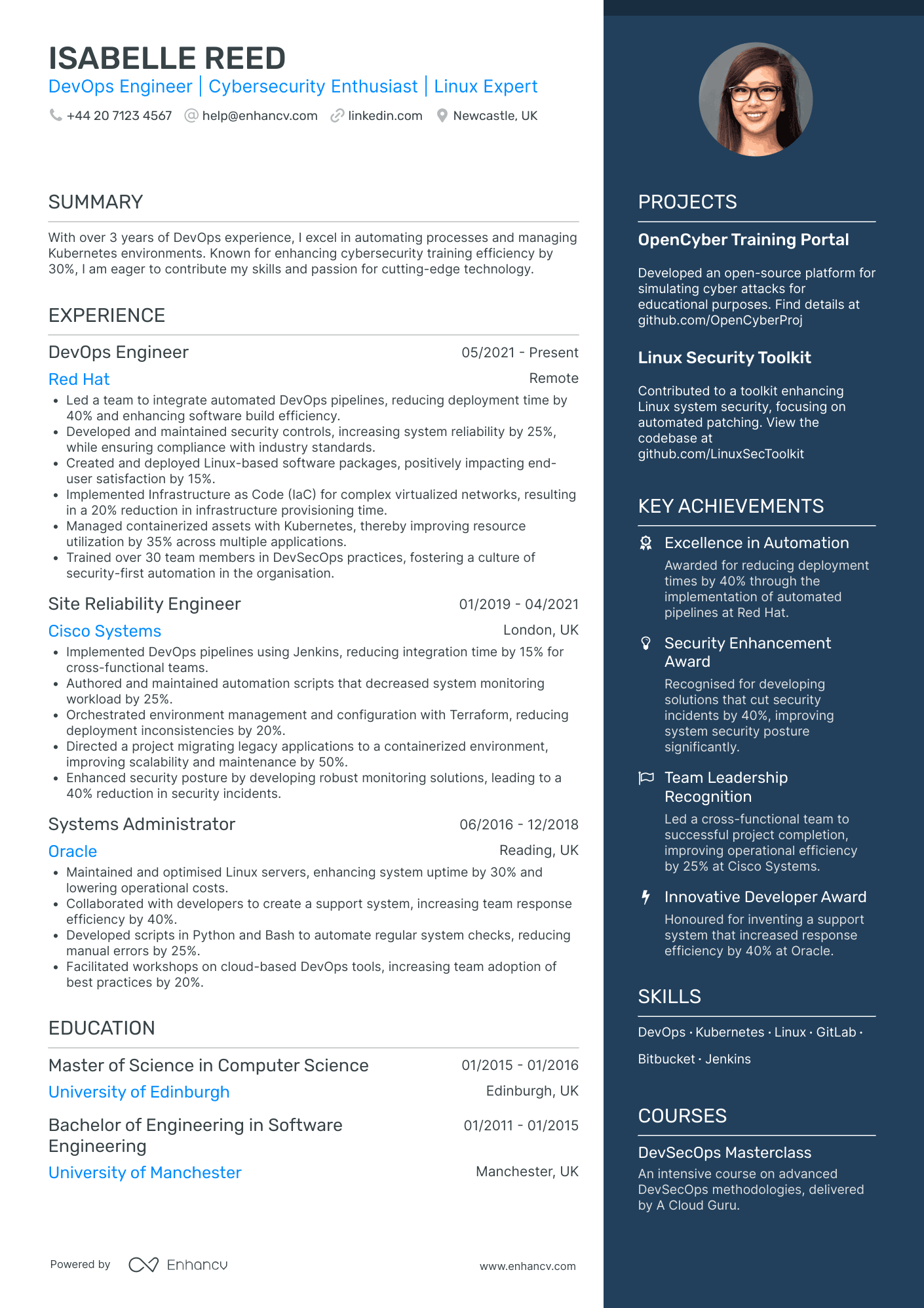
- Built and maintained CI/CD pipelines in Jenkins and GitLab CI for 30 microservices, cutting mean deployment time from 40 minutes to under 6
- Migrated a monolith to Kubernetes on AWS EKS, provisioned with Terraform, holding 99.95% uptime through the transition
- Cut cloud spend by 28% by right-sizing EC2, introducing spot instances, and adding autoscaling
- Reduced failed releases by 45% with automated testing gates and blue-green deployments
- Built Prometheus and Grafana dashboards and on-call runbooks that cut mean time to recovery from 90 minutes to 25

PRO TIP
Mirror the advert's exact stack. If it lists "EKS, Terraform, and GitLab CI", use those precise names where they are true of you, not "various cloud and CI tools". Recruiters and ATS filters both search for the specific product names.
Certifications for a DevOps CV
Certifications carry real weight in DevOps, so give them their own section near the top rather than the footer. List each with the level and the year, and flag anything in progress.
The certifications UK employers screen for cluster around the cloud and the toolchain: AWS (Solutions Architect or DevOps Engineer Professional), the Certified Kubernetes Administrator (CKA), HashiCorp's Terraform Associate, and increasingly an Azure or Google Cloud equivalent. Name the exact certificate, not "various cloud qualifications".
Pair them with a short education line. A degree in computer science helps, but a strong certification stack and hands-on production experience carry a DevOps CV further than the degree alone.
Keep the wording precise. "CKA, 2024" is a fact a recruiter can verify, while "Kubernetes certified" is vague enough to raise a question you do not want asked. If a certification has lapsed, either renew it or mark the year honestly rather than leaving it open.
Certifications matter more here than in most engineering fields because the tools move fast. A current AWS or Kubernetes badge tells a hiring manager your knowledge is recent, which a five-year-old degree cannot.
Early-career and junior DevOps CVs
Almost nothing in this market is pitched at entry level, so a first DevOps role is won on proof you can run the tools, not on years of service. Lead with your certifications, your home lab, and any hands-on projects, then let a thin work history sit lower, the way a good first-job CV does.
A home lab is the strongest signal a junior can send. Describe what you built: a CI/CD pipeline for a side project, a Kubernetes cluster on minikube or a Raspberry Pi, an AWS free-tier environment provisioned with Terraform. Give it a dated entry like a project, with the tools named.
Pull real evidence from adjacent work too. A support or sysadmin role that touched Linux, scripting, or deployment automation is DevOps experience, so write it in the toolchain's words. One line about an AWS or CKA certification in progress moves a junior CV up the pile.
Frame the lab like production. Instead of "set up a home server", write "provisioned a three-node Kubernetes cluster with Terraform, automated deployments with GitHub Actions, and added Prometheus alerting". The vocabulary is what tells a hiring manager you will fit their environment.
Conclusion
Lead with the toolchain this role screens for, prove it with numbers from the systems you have run, and keep the format clean and ATS-safe.
Pair the CV with a short cover letter that says why this team and this stack, and you turn a solid CV into an interview.
Author's take - The Enhancv team
When we screen a DevOps CV, the first two lines decide it. Put the cloud you run, your certifications, and one hard number like deployment time cut or uptime held right at the top. Bury that under a paragraph about being an agile team player and a skimming hiring manager moves on. The engineers who get called first make their Kubernetes, Terraform, and CI/CD experience impossible to miss in ten seconds.