



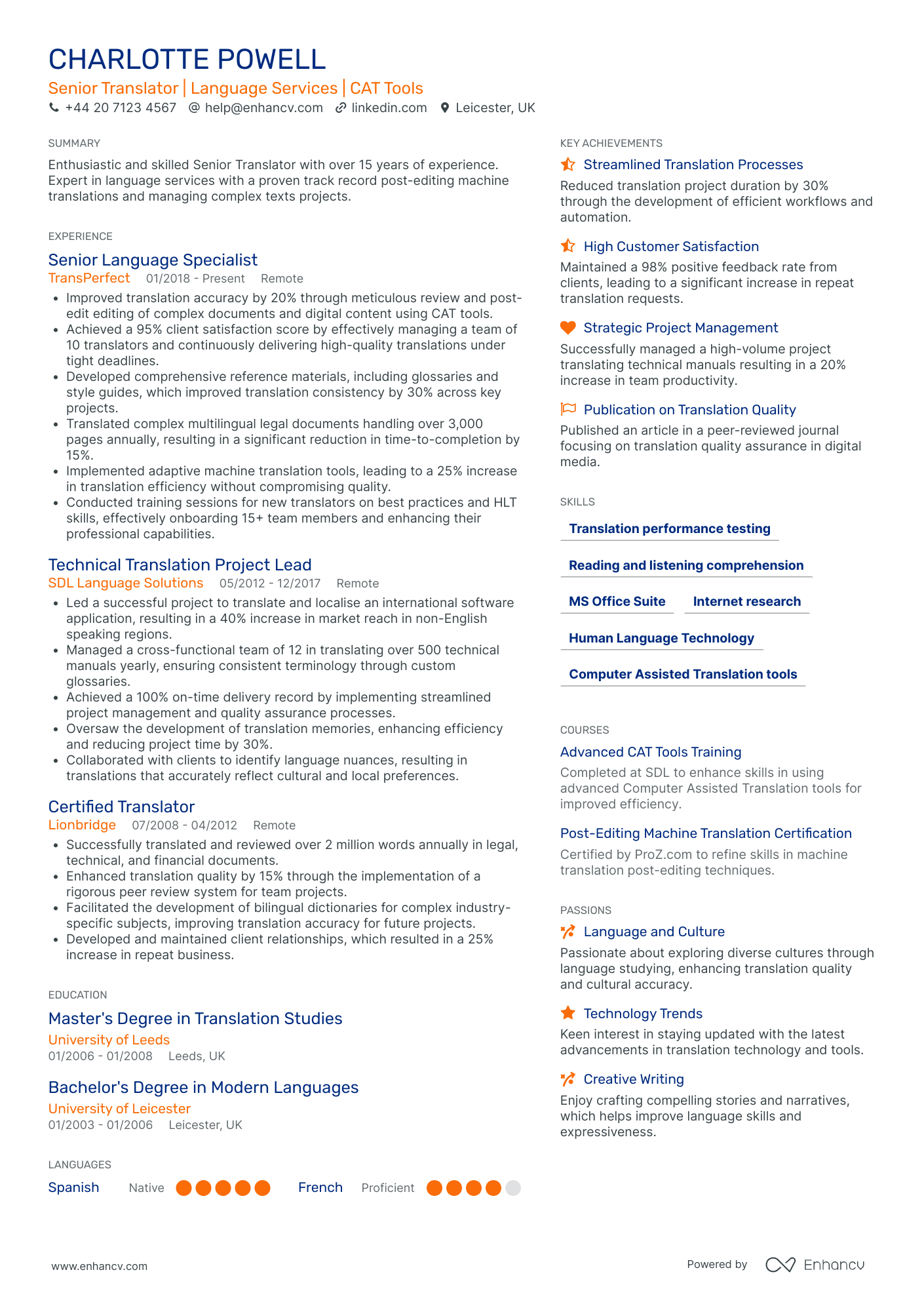
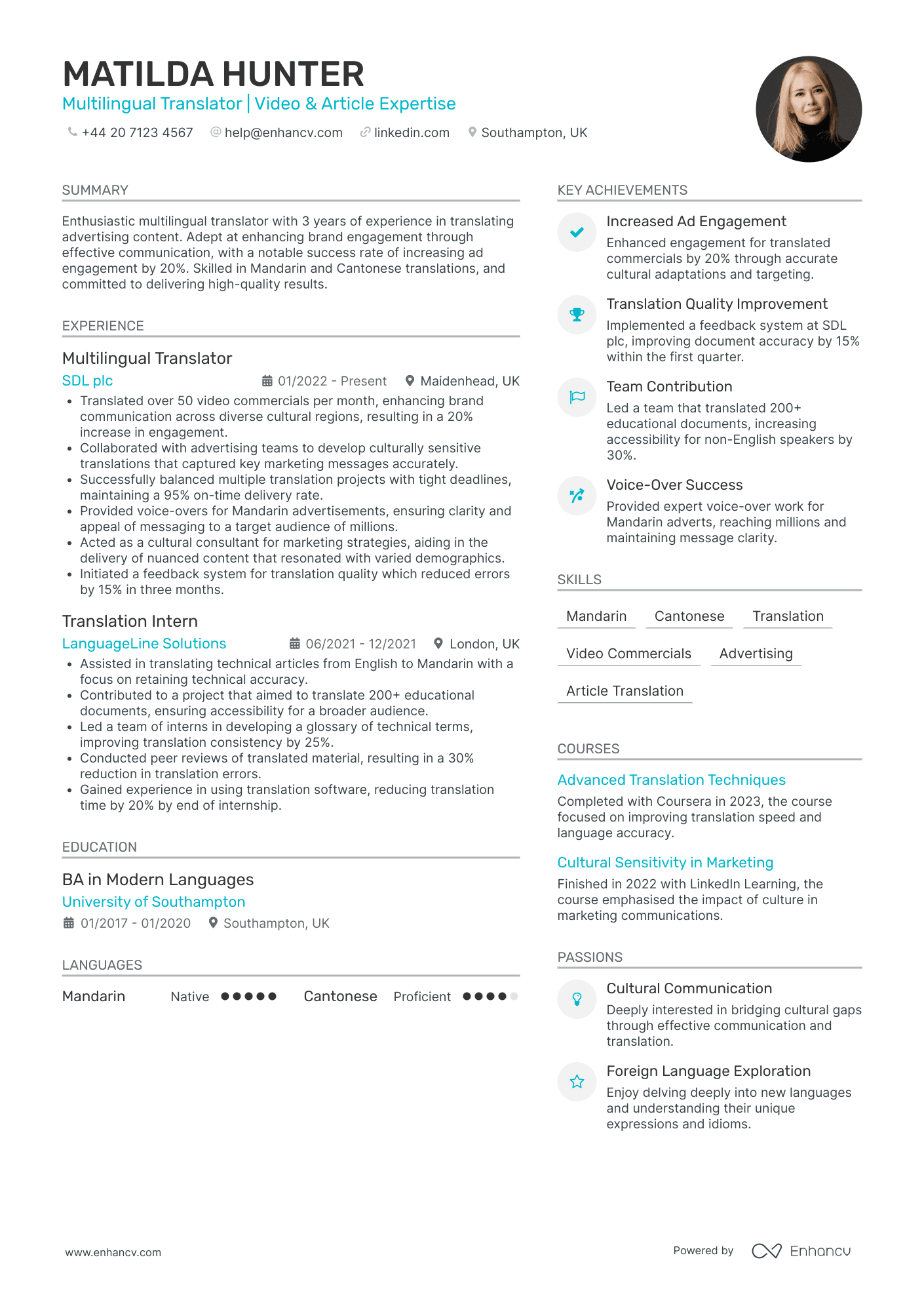
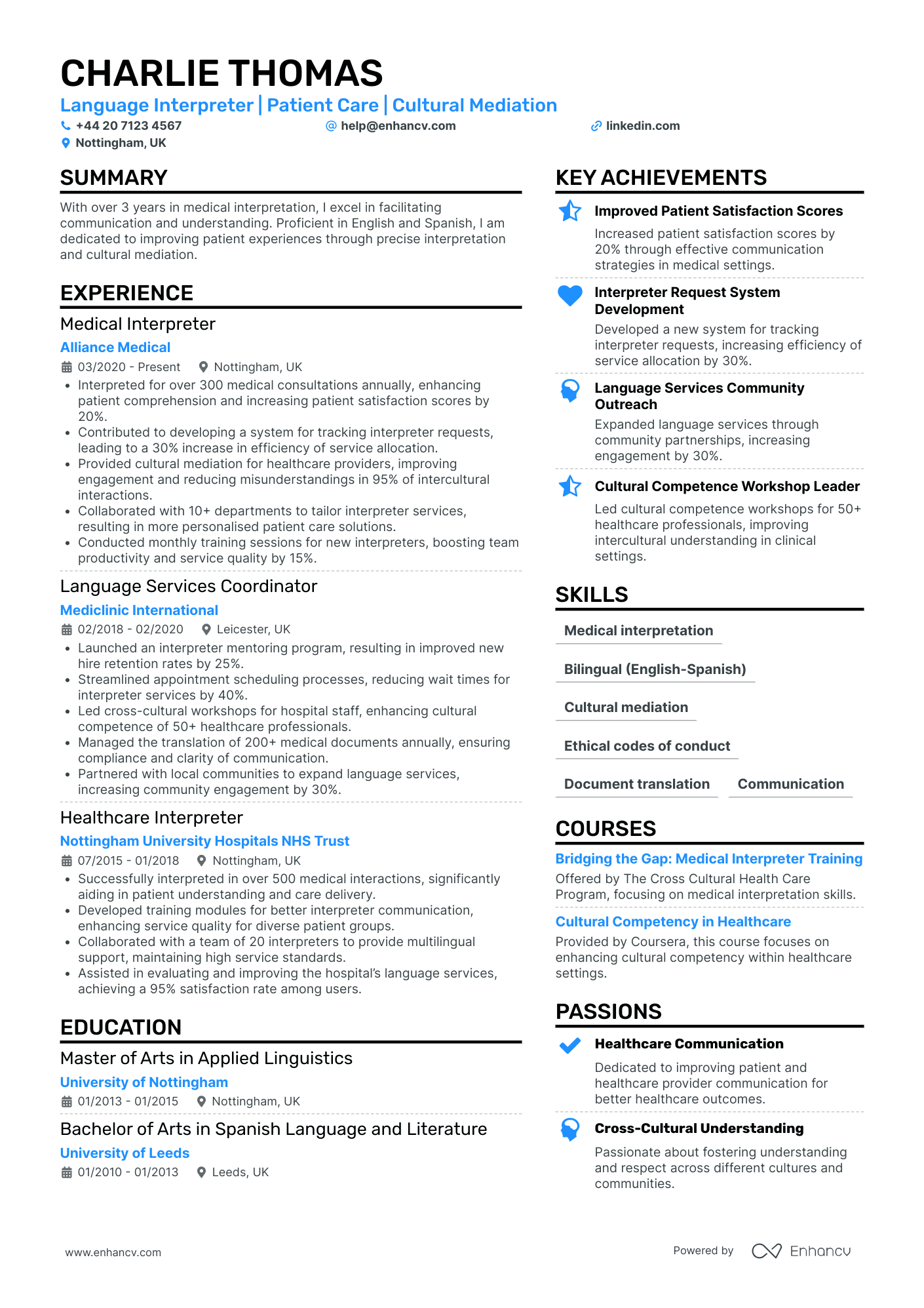
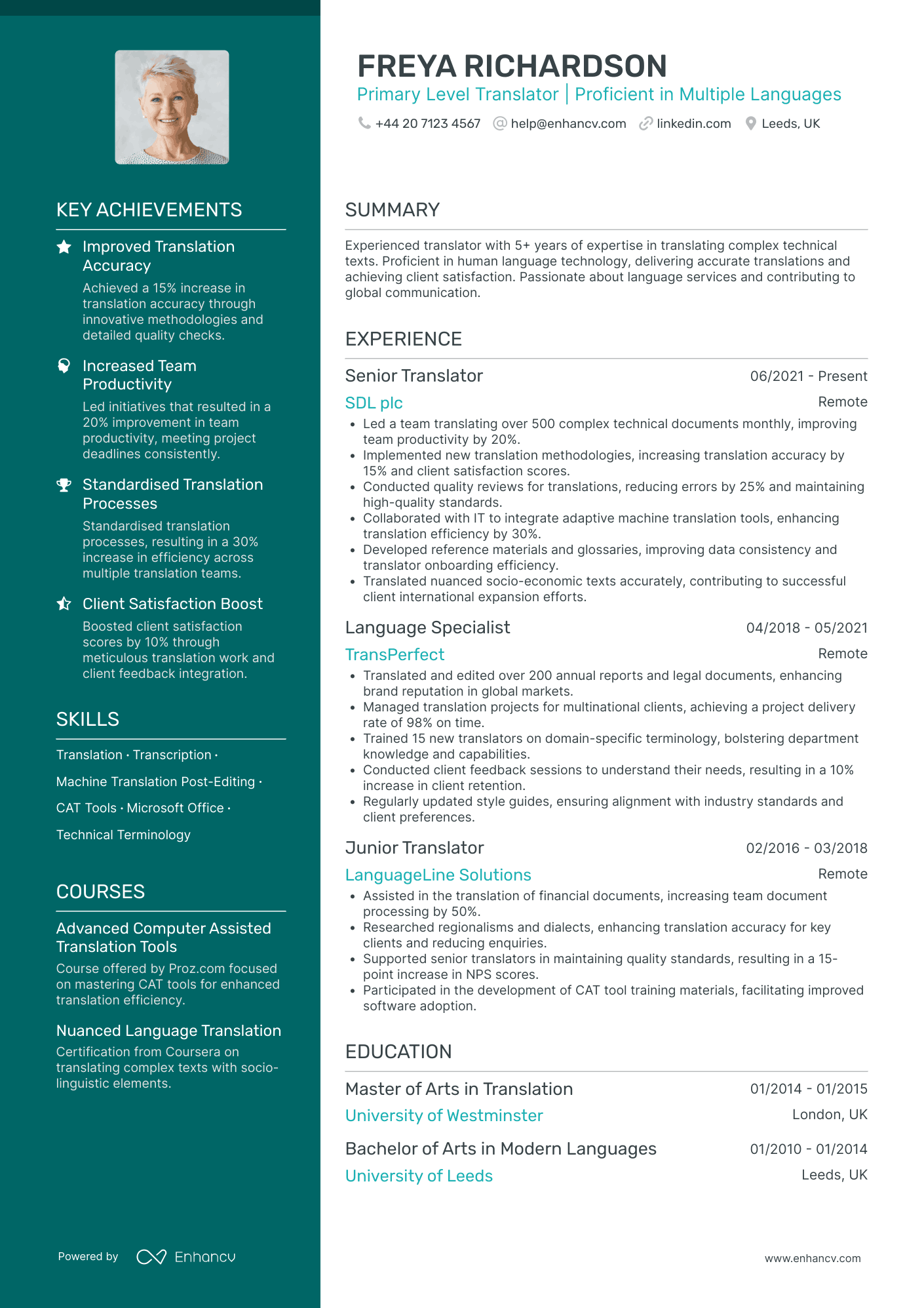
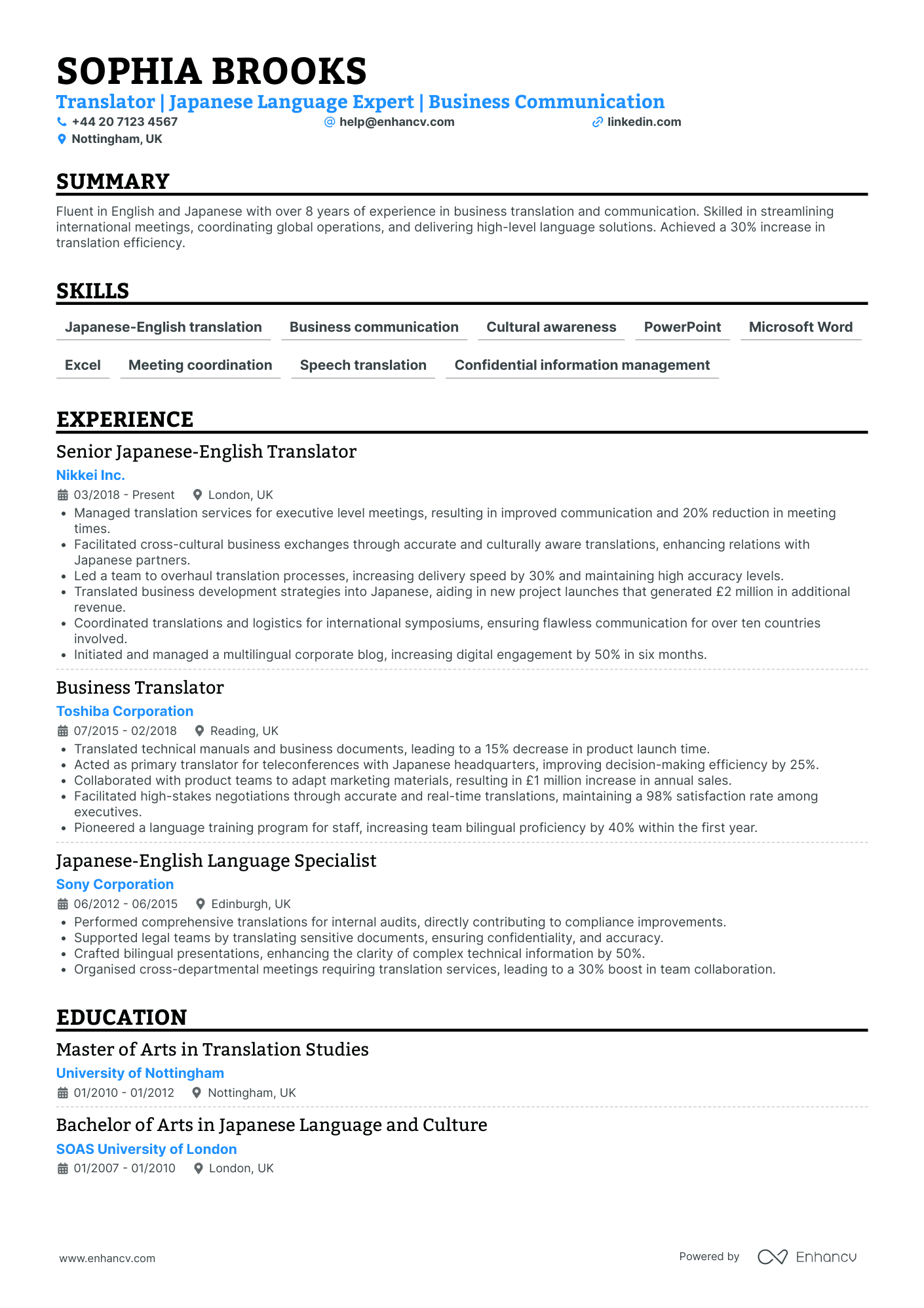
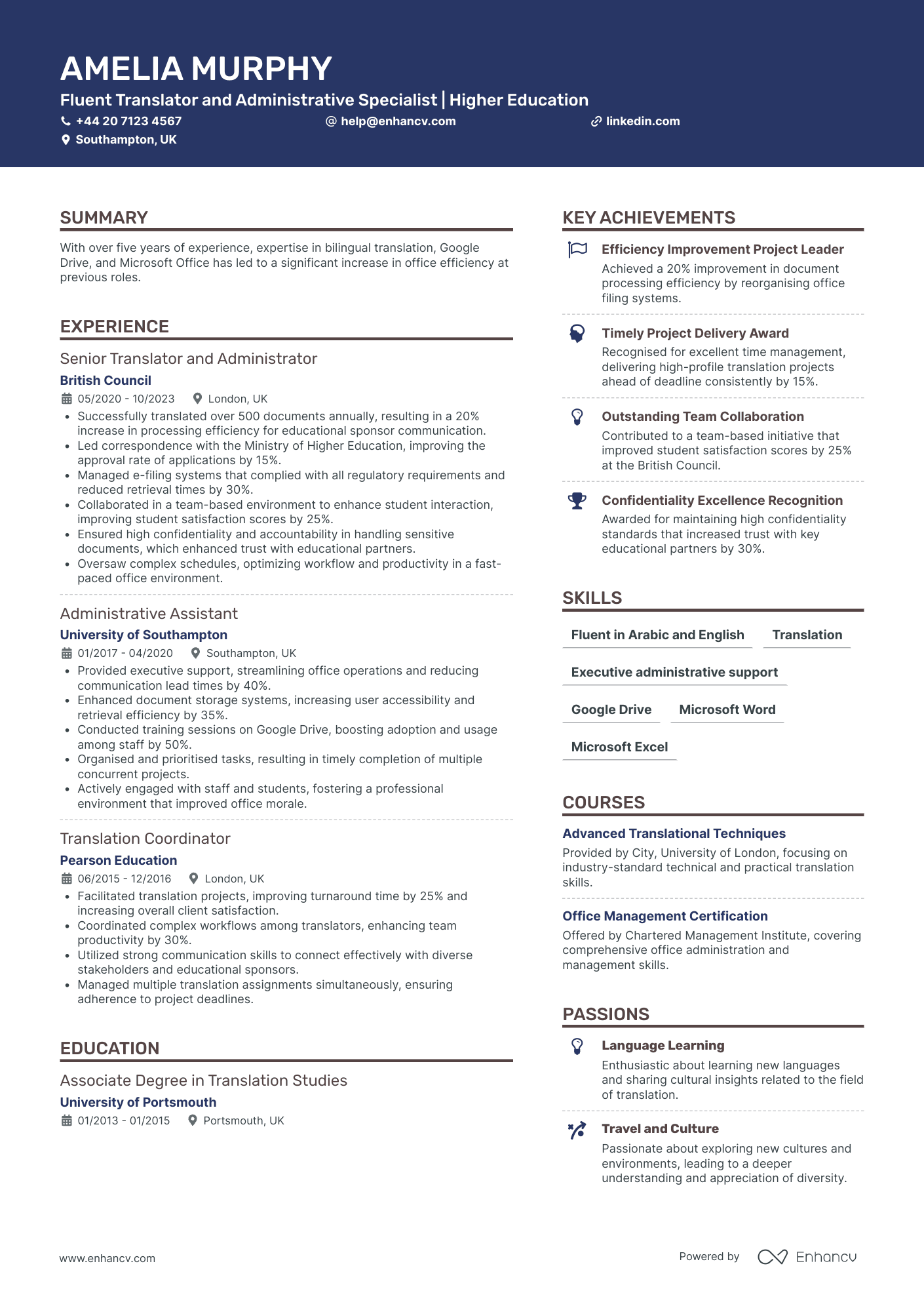
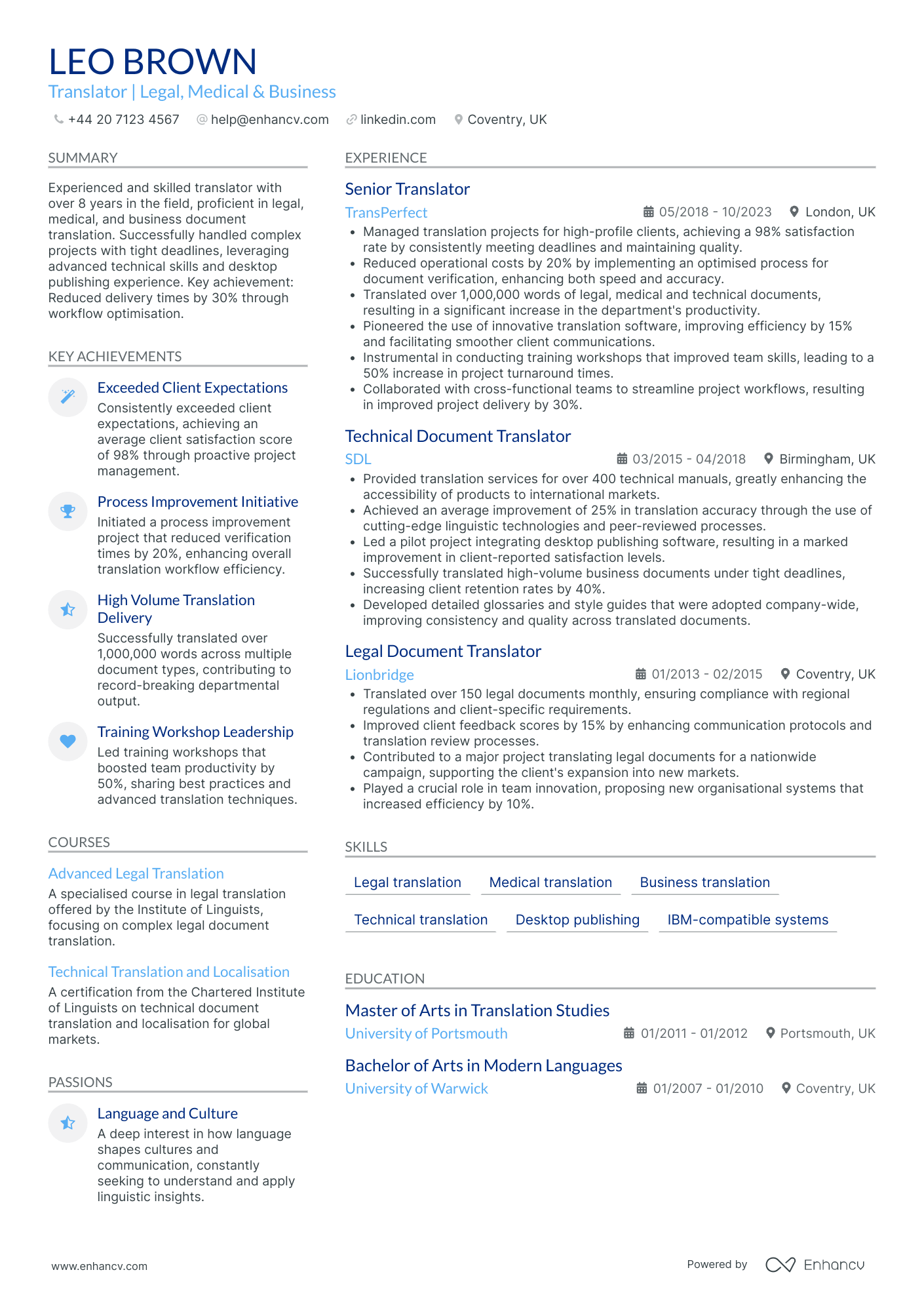
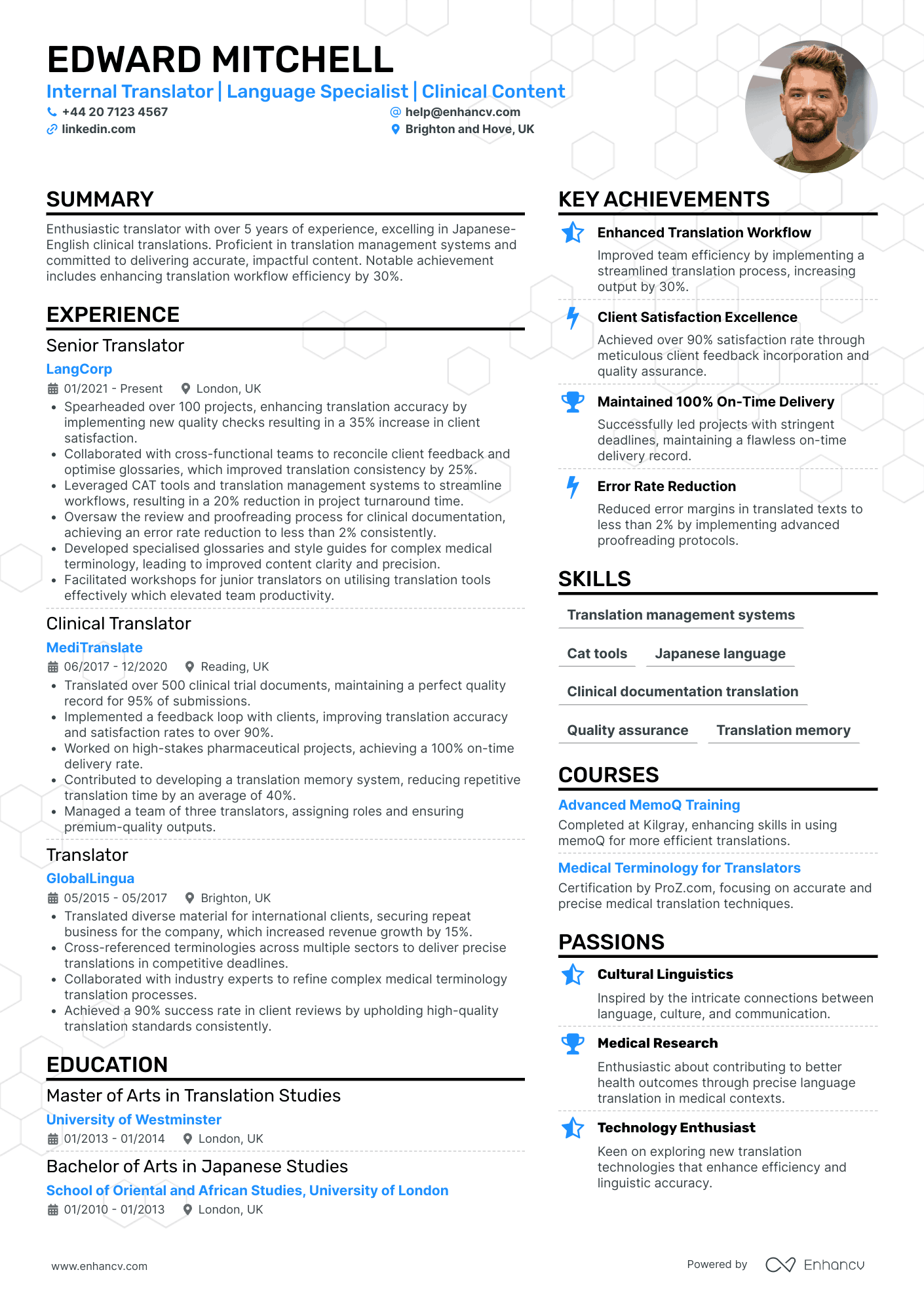
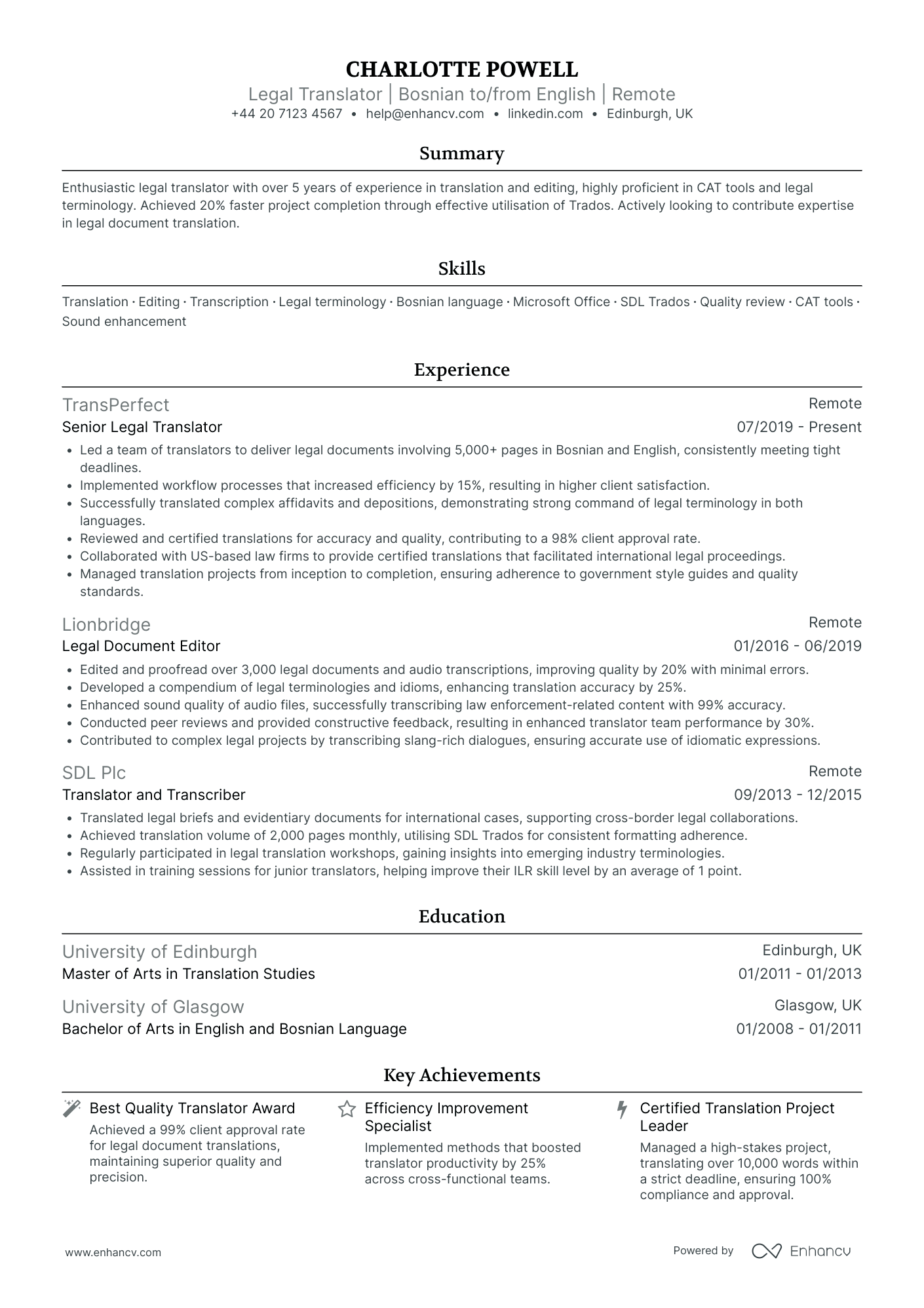
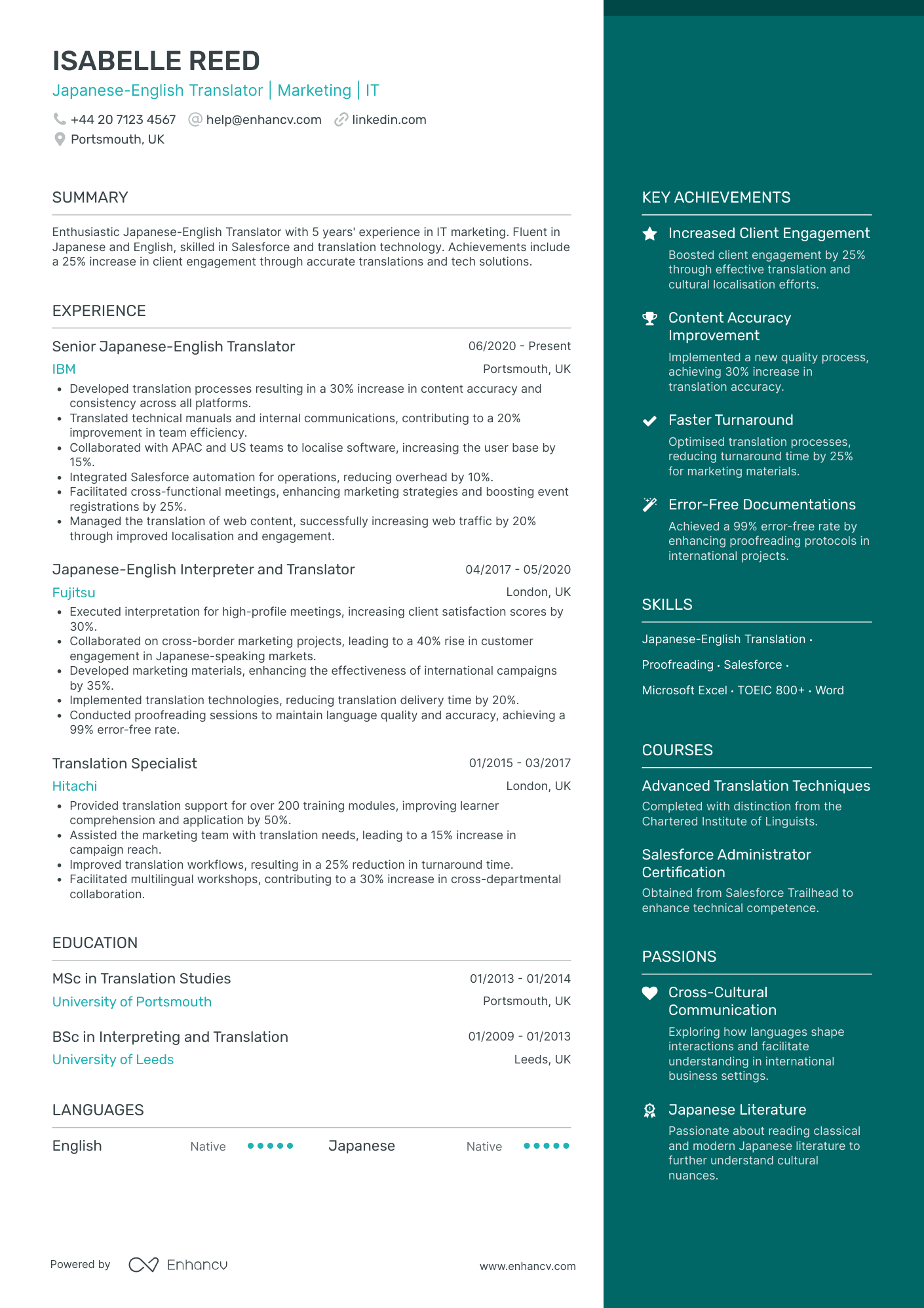
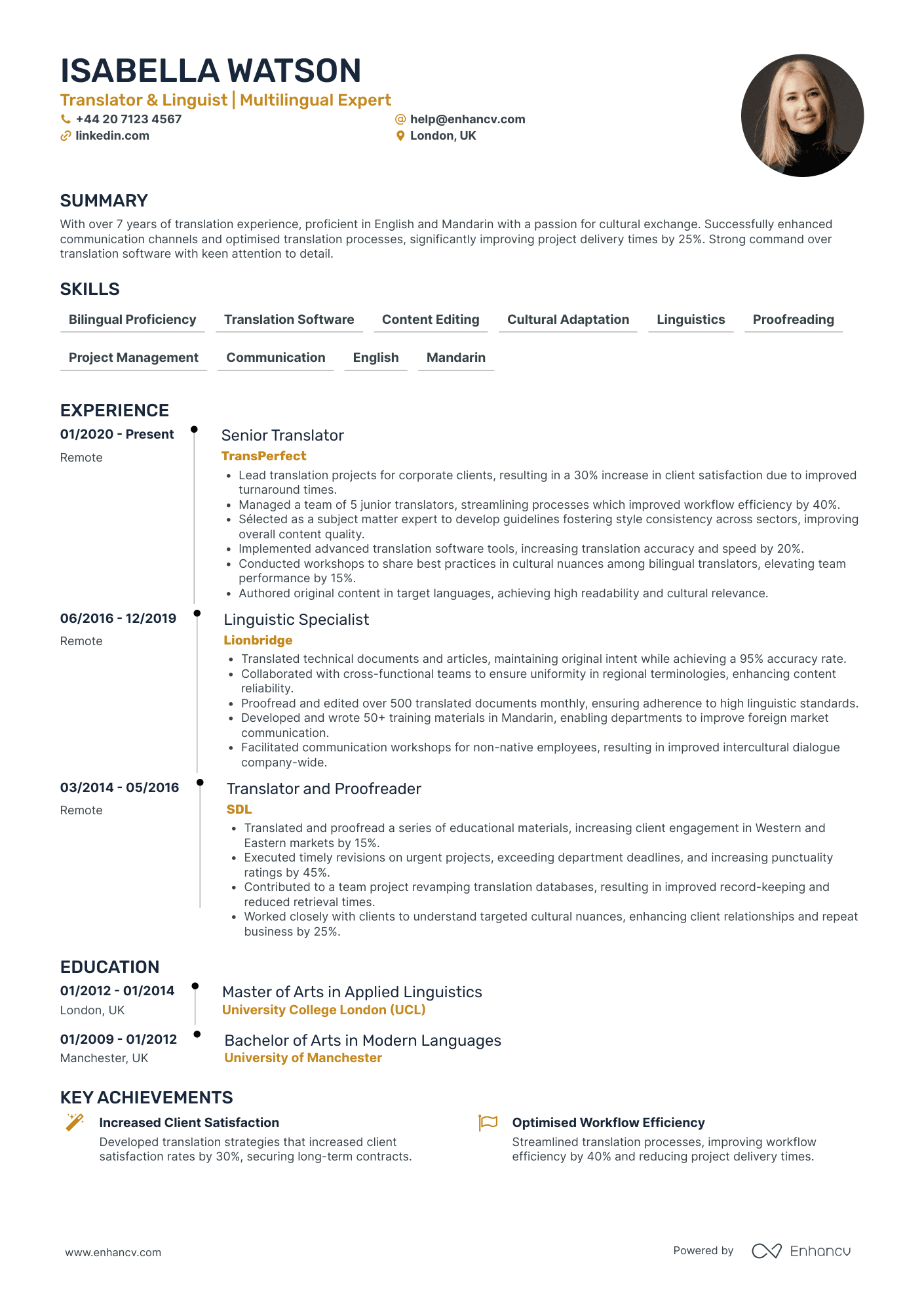
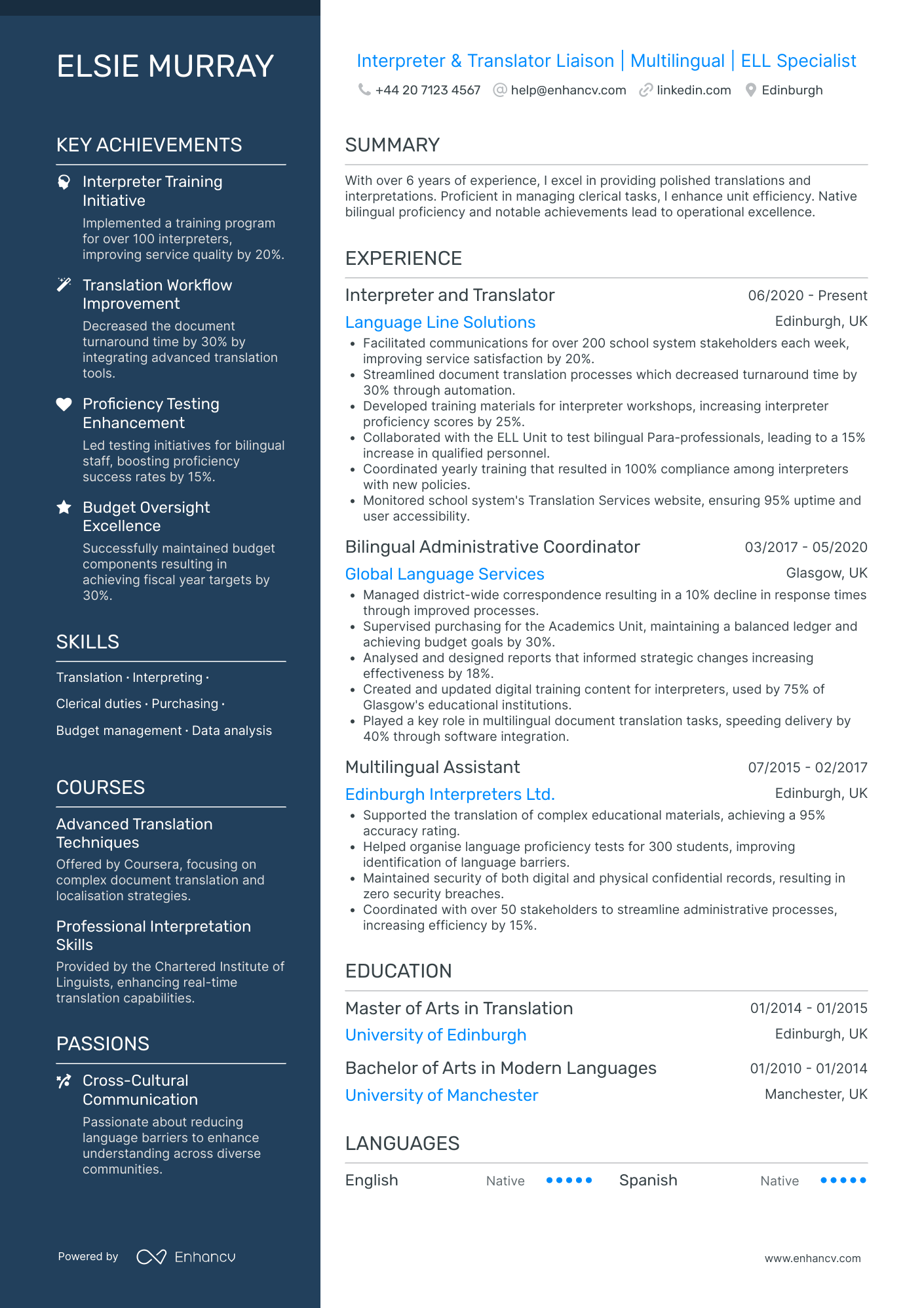
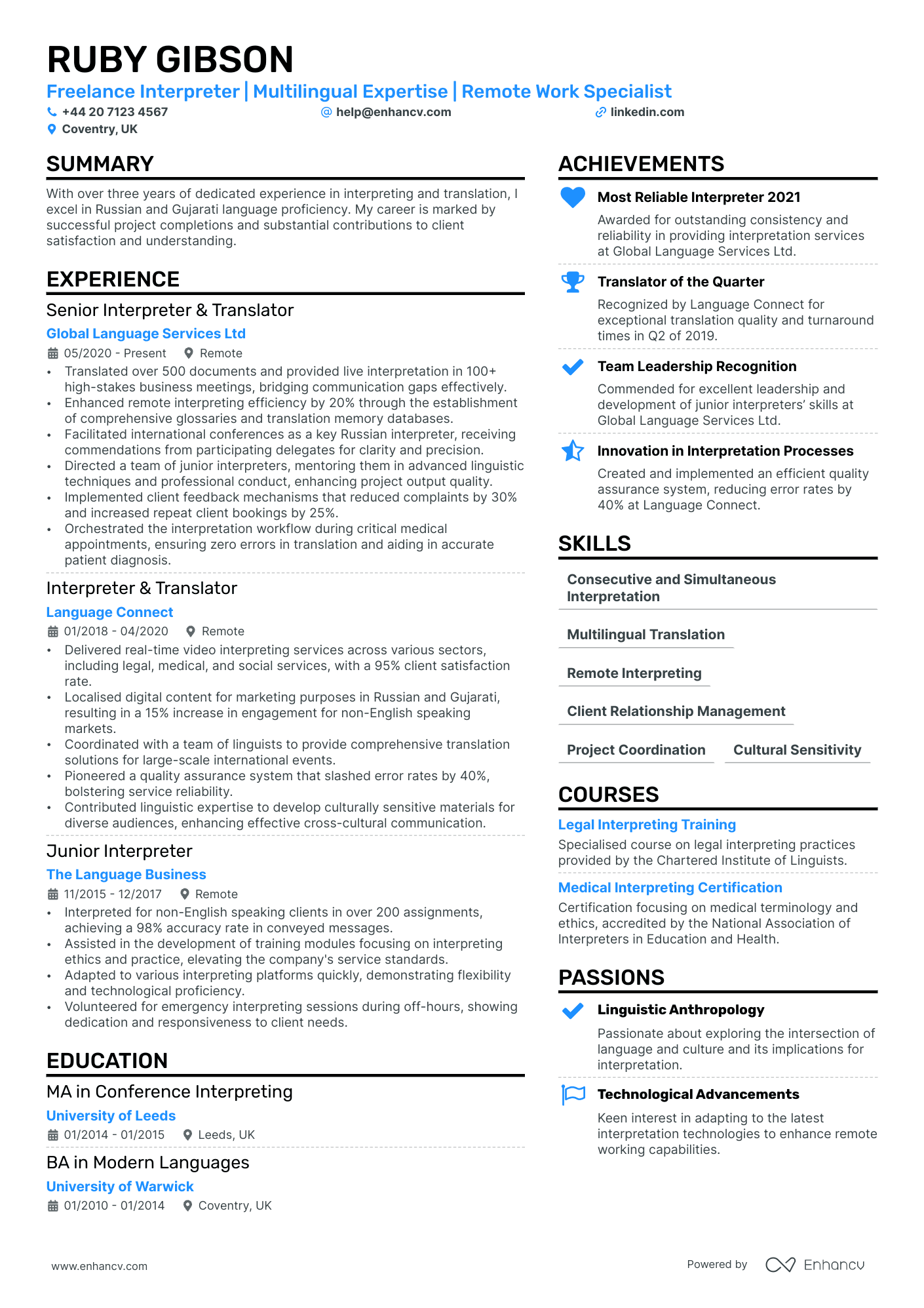
Most translator CVs list every language pair and every CAT tool the applicant has ever opened, then stop. The strong ones prove something harder to fake: that you deliver accurate meaning, to a brief, before the deadline.
A translation project manager checks two things first. Which language pairs you genuinely work into, and whether you can be trusted with a live client, a house style, and a tight turnaround. Lead with that evidence and the rest of the CV falls into place.

Key takeaways
- Lead with your language pairs and their direction. A recruiter needs to see "into English" or "EN into FR" before anything else.
- Name your CAT tools. SDL Trados, memoQ, and Wordfast are checkable skills, not buzzwords.
- Pick a specialism and prove it. Legal, medical, and technical work pays more and screens harder than general translation.
- Quantify throughput and quality: words per day, volumes handled, and QA pass rates.
- One or two pages, reverse chronological for staff roles, skills-led if you are freelance or breaking in. Send a PDF unless the client asks for Word.
- Back yourself with the real credentials: a DipTrans, CIOL or ITI membership, or a languages degree.
Top skills for your translator CV
Strong translation skills are specific, and they split cleanly into what you can do and how you work.
The hard skills a UK employer or agency scans for are technical: mastery of your language pairs, CAT tools, terminology management, proofreading and editing, quality assurance, and a named subject specialism. List them in the words the adverts use, so both a person and an ATS read them the same way.
Machine translation post-editing (MTPE) belongs here too. It is now a core part of most agency workflows, and naming it signals you work the way modern language service providers do rather than pretending the technology does not exist.
The soft skills that matter are the ones a client can feel in the work: attention to detail, cultural awareness, research, discretion with confidential material, and the discipline to hit a deadline without dropping quality. Prove each one in an experience bullet rather than listing it as an adjective.
Be precise with CAT tools, because they are the most googleable claim on the page. Name the software and, where it helps, the version, so "SDL Trados Studio 2022 and memoQ" beats a vague "translation software". A project manager who runs the same tools reads that as one less thing to train.
List only what you can defend in a test translation. Agencies routinely set one, and a skill you cannot back under timed conditions costs you the relationship, not just the job.
Top skills for your translator CV:
Language pairs (source and target)
CAT tools (SDL Trados, memoQ, Wordfast)
Translation and localisation
Terminology management
Proofreading and editing
Quality assurance (QA)
Machine translation post-editing (MTPE)
Subject specialism (legal, medical, technical)
Attention to detail
Cultural awareness
Research
Discretion and confidentiality
Deadline management
Written communication

PRO TIP
General translation competes with everyone and with machine output. A named specialism does not. If you have handled contracts, medical records, patents, or financial reports, say so in the header and again in your skills, because specialist work is where the rates and the repeat clients are.
How to list your languages and language pairs
This is the section a project manager reads first, so make it unambiguous.
Give the pair and the direction, not just the language. "Spanish into English" tells a client what you actually do. "Spanish and English" leaves them guessing whether you translate both ways, which most professionals do not.
State your native or A language plainly, because the industry norm is that you translate into your mother tongue. If you genuinely work into a second language at professional standard, label it, and be ready to prove it.
Use CEFR levels (A1 to C2) for any working language rather than vague words like "fluent" or "conversational". A recruiter reads "C2" as a fact and "fluent" as an opinion. The rest of the usual guidance on language skills on a CV applies, with one change: for a translator the levels go near the top, not buried at the foot of page two.
If you interpret as well as translate, separate the two. They are different services with different skills, and blurring them makes a specialist look like a generalist.
Order the pairs by how much you actually work in them, strongest first. A client scanning quickly assumes the top line is your bread and butter, so a rarely used pair at the top oversells you and a core pair buried lower undersells you.

A clear languages block
Native language: French
Working pairs: English into French (C2), Spanish into French (C1)
Specialisms: legal and EU institutional
CAT tools: SDL Trados Studio, memoQ
What translation work in the UK looks like
Before you format anything, picture who reads the CV, because it shapes every choice below.
Most UK translation work reaches you through one of two doors: language service providers who subcontract to freelancers, and in-house roles at law firms, publishers, and public bodies. The freelance route dominates, which is why a translator CV doubles as a capability statement a client can skim between jobs.
The work clusters around a familiar toolset. Expect CAT tools, terminology management, proofreading and editing, quality assurance, and localisation to appear in most briefs, whichever specialism you sit in.
| What | UK translator roles |
|---|---|
| Where the work comes from | Mostly freelance through language service providers, plus in-house roles in law, publishing, and the public sector |
| How you are engaged | Per-word or per-project briefs, retained agency panels, and a smaller number of salaried posts |
| Core toolset | CAT tools such as SDL Trados, memoQ, and Wordfast, plus terminology management and QA software |
| What sets your rate | Your specialism and language pair, far more than your job title |
| What proves you | A test translation, a recognised qualification, and references |
Pay tracks specialism and language pair more than job title, so a rare pair or a regulated field like legal or medical will out-earn general work. That is the single strongest reason to niche.
It also changes what the CV needs to do. A freelancer is pitching for a place on a panel, so the document has to read as a standing offer, current, specific, and easy to file. A staff applicant is competing for one post and can lean harder on a single employer's needs. Decide which reader you are writing for before you choose the structure below.
Formatting your translator CV
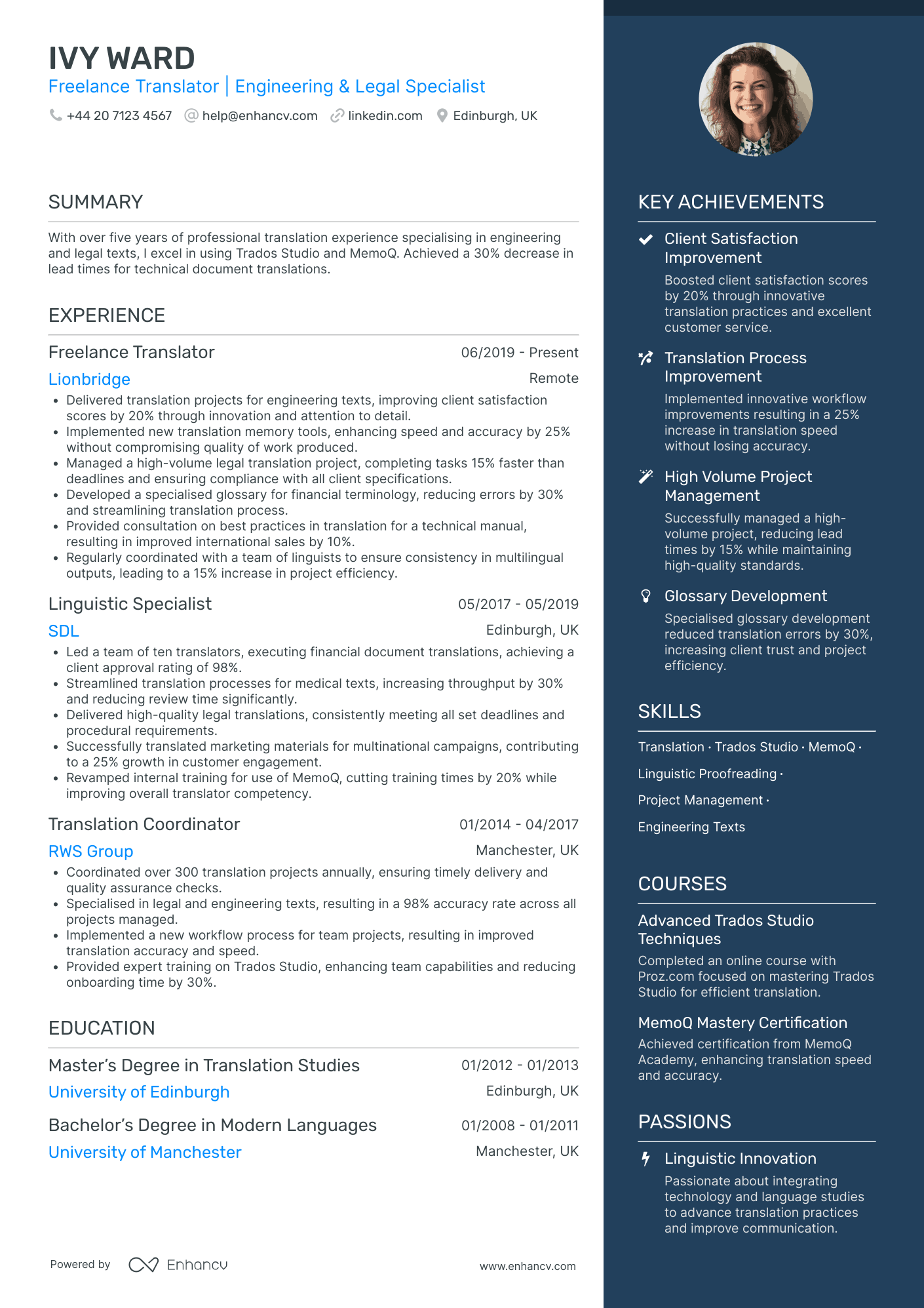
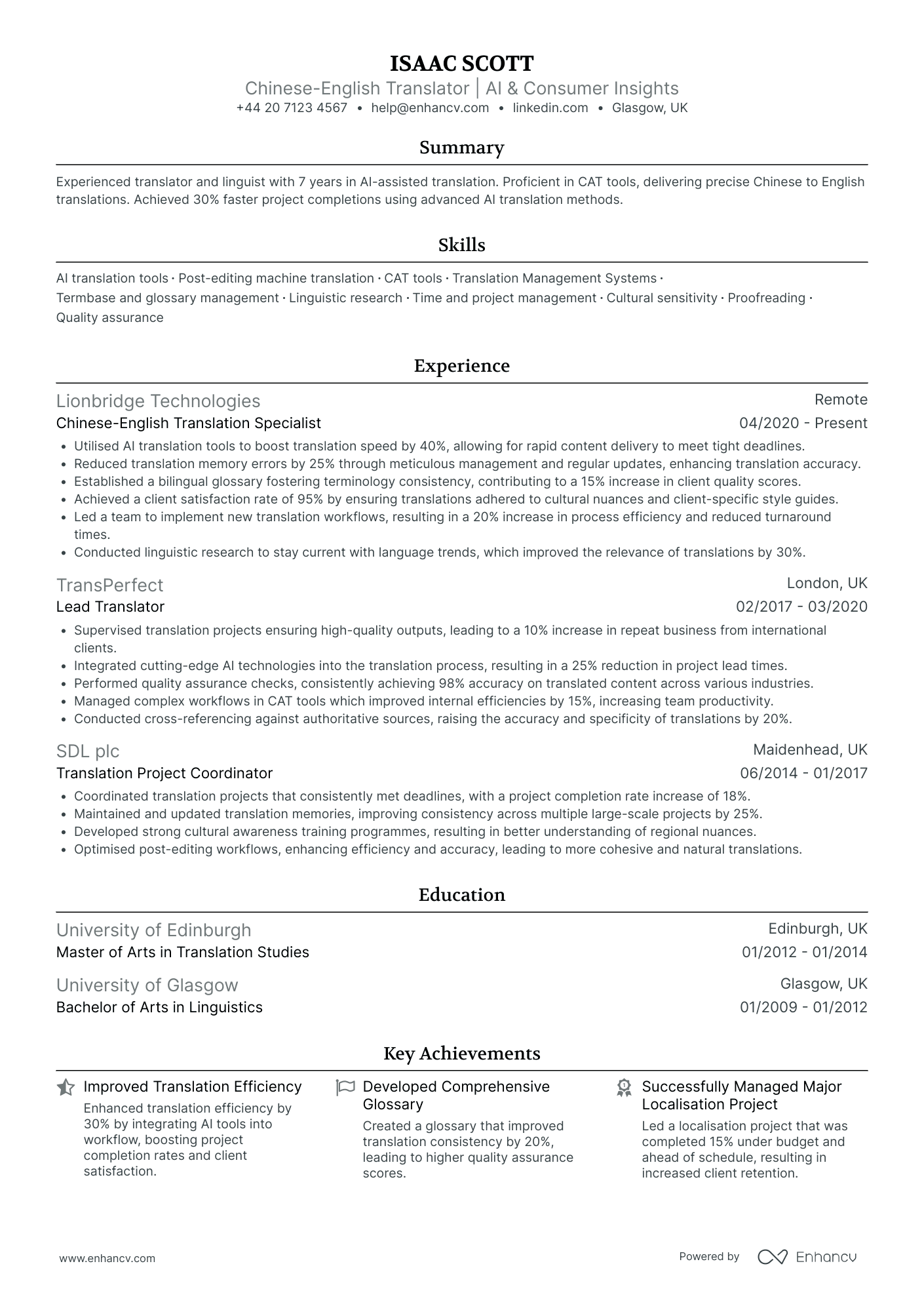
For a staff or in-house role, use a reverse chronological layout so your track record leads. For freelance work or a first role, a skills-led structure puts your pairs, specialisms, and tools first, where a project manager wants them.
Keep it to one page if you are early on, two pages if you have the projects to justify it. UK readers expect two pages at most and will not thank you for a third.
Put your language pairs, specialisms, and CAT tools in the top third, not below your work history. For a translator those are the header, functionally.
Send a PDF so your accented characters, non-Latin scripts, and layout survive the trip. Keep a Word copy for agencies that reformat CVs into their own template. If the advert names a file type, follow it.
Agency portals and larger employers run CVs through tracking software, so keep the headings standard and the layout clean for an ATS-friendly CV. Build it from a tested layout rather than a blank page: Enhancv's CV templates export to a clean PDF that holds your formatting.
Writing your translator personal statement
Three or four sentences at the top: your language pairs and direction, your specialism, your strongest proof, and what you are looking for. This is how you answer the "how do I describe myself as a translator" question without resorting to adjectives.
Skip the adjective soup. "Meticulous, passionate, detail-oriented linguist" tells a client nothing they can check, and every other CV in the pile opens the same way. If you are stuck on the opening line, work from proven personal statement examples.
Lead with the pair, the field, and a number instead:
Translator personal statement example (experienced)
DipTrans-qualified translator working Spanish and French into English, specialising in legal and financial documents. Six years translating contracts, court filings, and annual reports for two London language service providers, averaging 2,500 words a day at a 99% first-pass QA rate. Looking for a senior freelance panel or an in-house role with a City law firm.
That version names the pairs, a specialism, a throughput figure, and a quality metric. Here is the opposite, the version that lands in the pile far too often:
What to avoid
Passionate and hardworking linguist with excellent communication skills and a love of languages. Fluent in several languages and able to translate a wide range of documents to a high standard. Seeking an exciting opportunity to grow and develop.
When we read a translator's personal statement, we are looking for the pair, the direction, and one number we can trust. A line like "Spanish into English, 2,500 words a day at a 99% QA pass rate" does more work than a paragraph of adjectives. Name the field you know best, show the throughput, and let the fluency claims live in a CEFR level further down. Specificity is what separates a professional from a hobbyist on paper.
The Enhancv team
Writing your translator experience section
Whether the work was salaried, freelance, or agency, write each entry the same way: a dated heading, the client or employer, then bullets that show volume, specialism, and outcome. Lead each bullet with an action verb. For the mechanics of each entry, see work experience on a CV.
Translation is more measurable than most people write it. Words and projects delivered, turnaround times, QA pass rates, repeat clients, glossaries built, and MTPE volumes are all CV achievements a client understands instantly.
Name the tools and the subject matter in the bullet, not just the skills box. "Translated 40,000 words of medical device documentation in memoQ" carries the pair, the field, the tool, and the scale in one line.
Tailor each application: pull the specialism, tools, and document types from the brief and mirror them where they are true of you. Enhancv's CV tailoring feature reads the advert and suggests the matching edits, which saves rewriting from scratch for every panel.
- Translate contracts, court filings, and compliance documents averaging 2,500 words a day across two active agency panels
- Maintain a 99% first-pass QA rate over roughly 600,000 words a year, working in SDL Trados Studio and memoQ
- Build and maintain client-specific termbases that cut repeat queries and keep terminology consistent across long projects
- Post-edit machine translation on high-volume compliance work, flagging segments that need full human retranslation
PRO TIP
Tailor the specialism to the advert. A firm hiring for patent translation wants to see "patents" and the relevant CAT tool in your first three bullets, not on page two. Mirror the exact terms the brief uses wherever they are genuinely true of you.
Qualifications and credentials for a translator CV
You do not need a single mandatory licence to translate in the UK, which is why credentials do heavy lifting on the CV. They are how a client trusts you before the test translation.
List the recognised ones plainly: the Diploma in Translation (DipTrans), a Master's in translation or a modern languages degree, and membership of the Chartered Institute of Linguists (CIOL) or the Institute of Translation and Interpreting (ITI). Qualified Member (MITI) or Chartered Linguist status is worth its own line.
Put these in your education section or a dedicated credentials block near the top. For a freelancer, a professional membership and a relevant certification often reassure a new client more than the degree does.
If you specialise, name the subject training too. A legal translation course or a background in medicine, law, or engineering explains why you can be trusted with the terminology, and it is a certification worth listing.
Writing a translator CV with no experience
A first translator CV carries its weight differently, though the fundamentals of how to write a CV still apply. Lead with a skills-led structure: language pairs, specialism, tools, and qualifications first, with any paid history lower down.
Build real evidence rather than waiting for it. Volunteer translation for charities, subtitling for community video projects, localisation for open-source software, and a sample portfolio of self-selected texts all count as proof you can do the work.
Take the test translation seriously, because for a new translator it matters more than the CV. Agencies use it to verify everything you have claimed, so the CV's only job is to earn you that test.
If you translate a single strong pair, say English into French or French into English, build the CV around that pair and the field you know rather than claiming a long list of languages at shallow depth. A first job CV that proves one solid pair beats one that spreads thin.
Conclusion
Lead with your language pairs and direction, name your CAT tools and specialism, and prove throughput and quality with real numbers.
Pair the CV with a short cover letter that names the field you want to work in, and you turn a list of languages into a credible professional profile.
Author's take - the Enhancv team
When we read a translator's personal statement, we are looking for the pair, the direction, and one number we can trust. A line like "Spanish into English, 2,500 words a day at a 99% QA pass rate" does more work than a paragraph of adjectives. Name the field you know best, show the throughput, and let the fluency claims live in a CEFR level further down. Specificity is what separates a professional from a hobbyist on paper.