



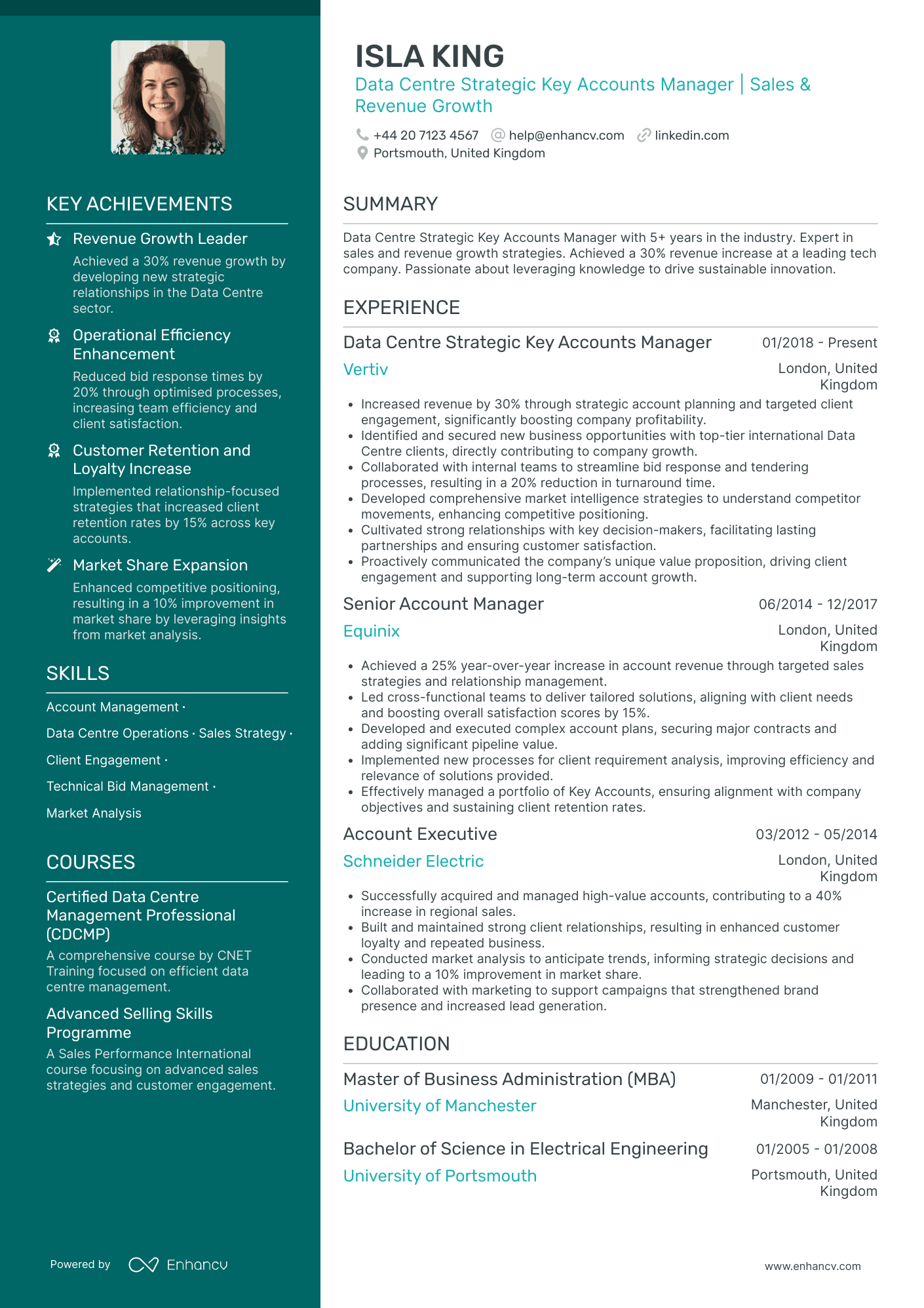
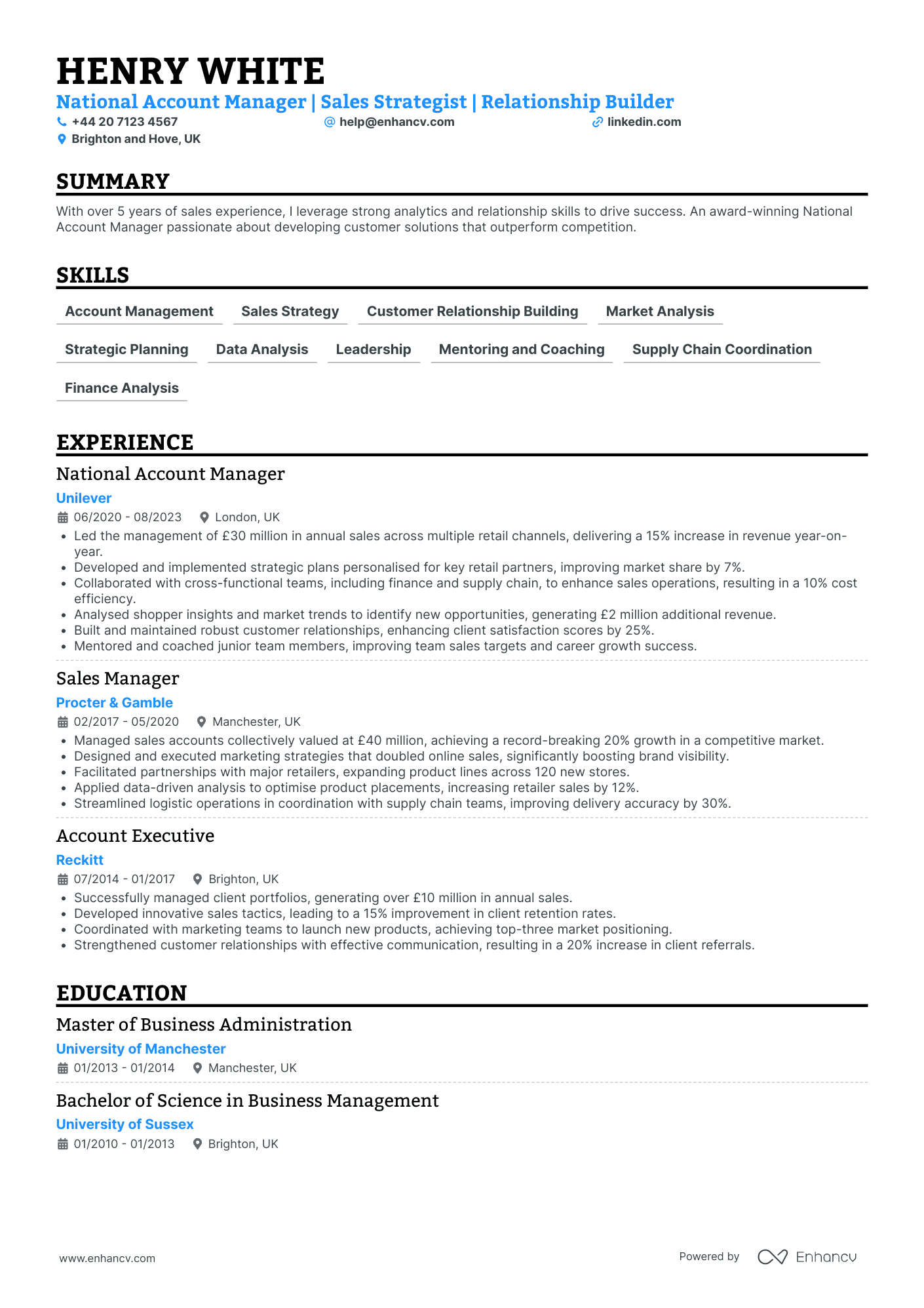
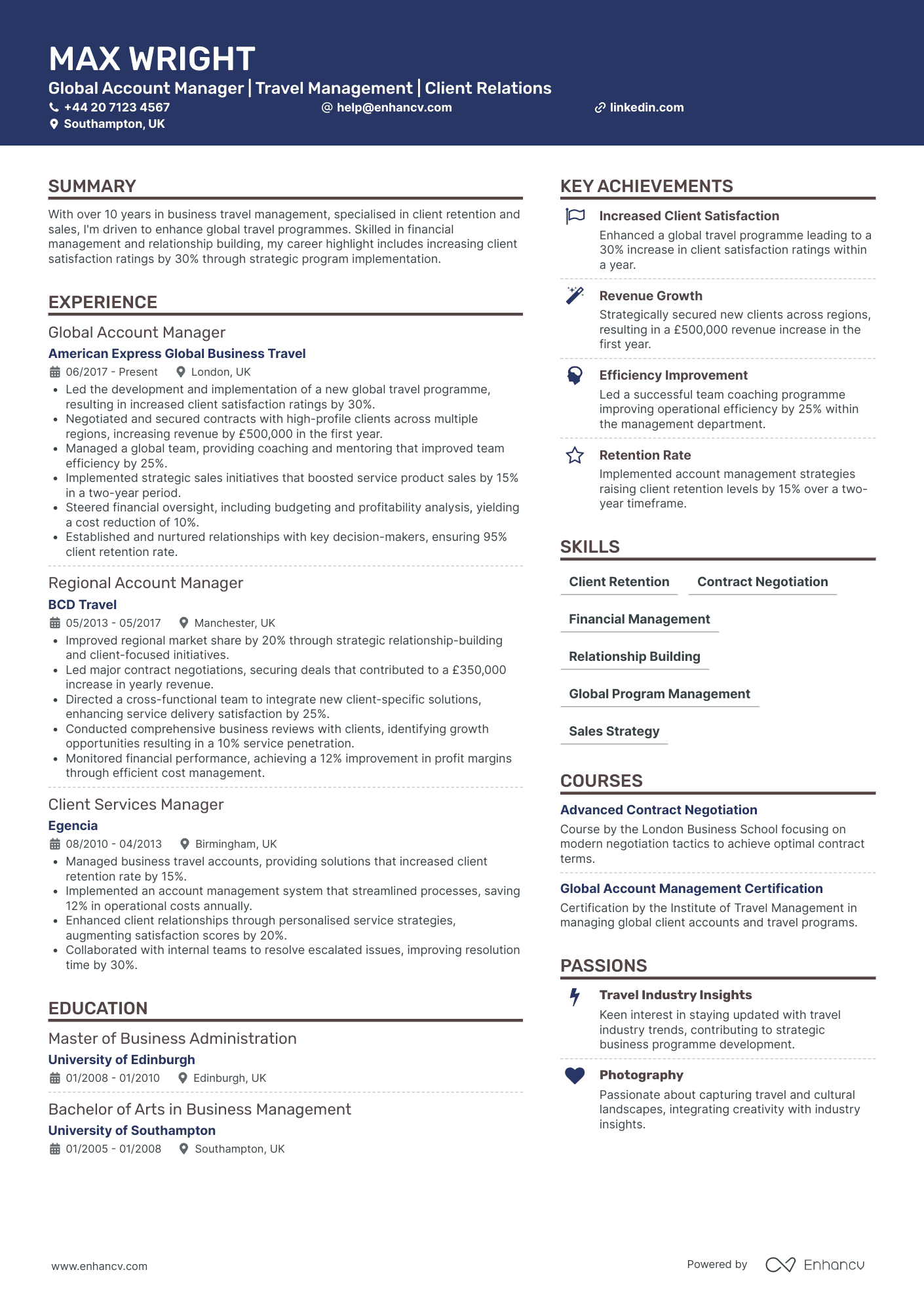
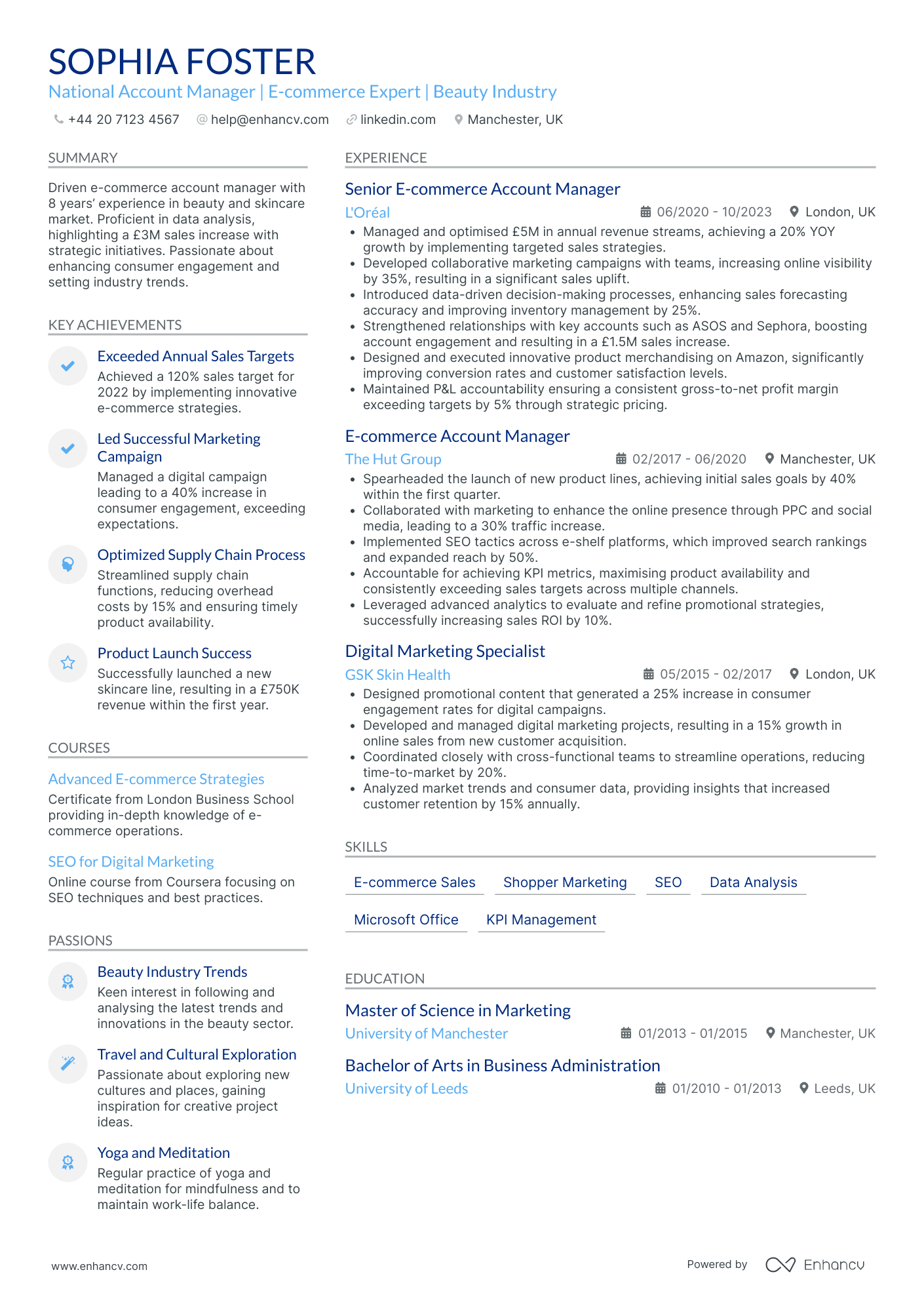
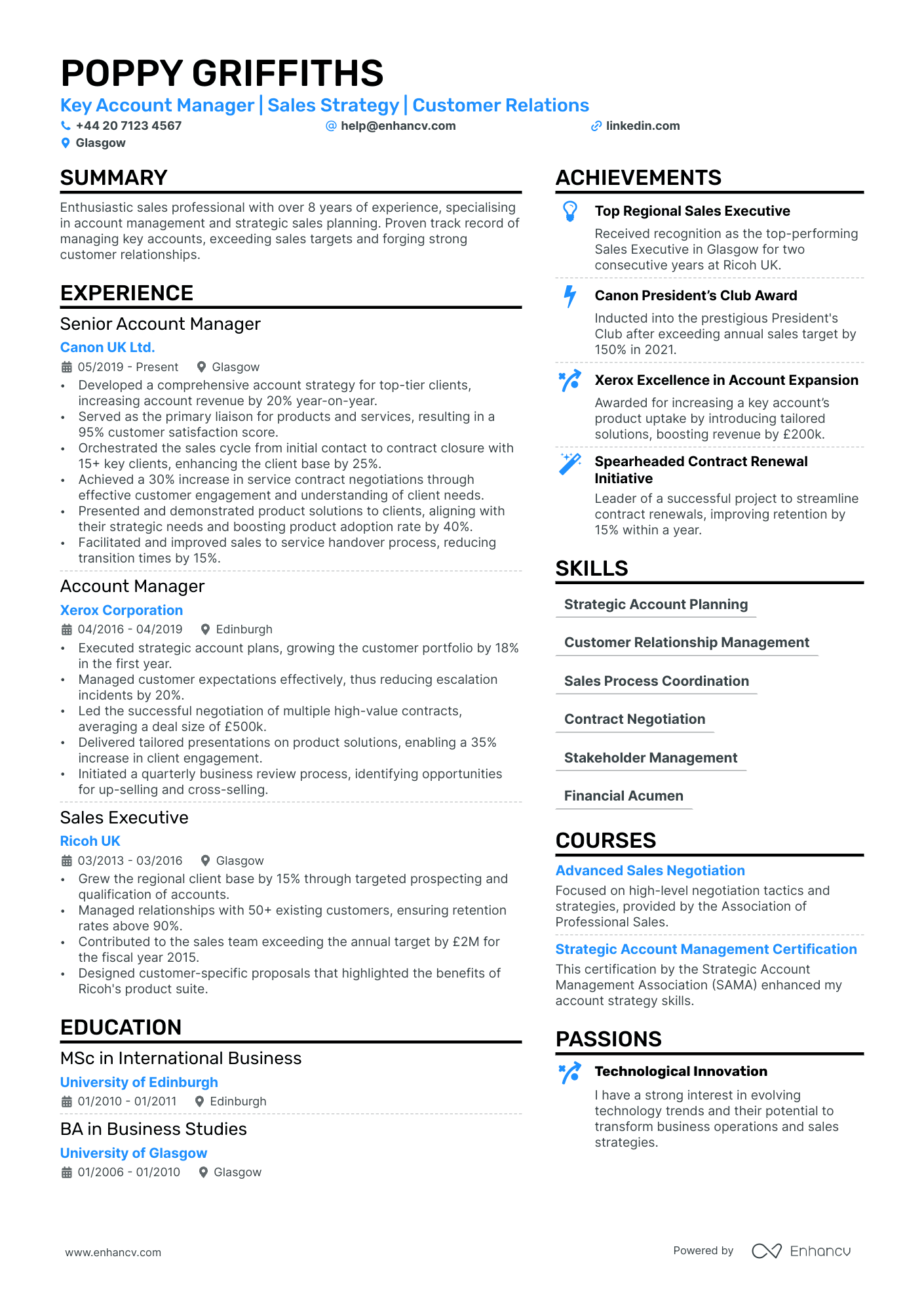
The strongest key account manager CV I read last month opened with one line: "grew a £4.2m portfolio of six strategic accounts by 22% in eighteen months." Everything a hiring manager needed sat in that sentence.
Most key account manager CVs bury that kind of proof under responsibilities lifted straight from the job advert. The ones that get interviews prove they can grow revenue and hold onto the accounts that matter, and they prove it with numbers. If you want the fundamentals first, see how to write a CV.

Key takeaways
- Lead with retention and growth numbers. You are hired to keep and grow revenue, so put the money in the top third of the CV.
- Name the skills UK adverts list most: data analysis, negotiation, and stakeholder management.
- Build your personal statement around one portfolio-level result, not a string of adjectives.
- Most postings are pitched at mid to lead level, so match the CV to the seniority the advert asks for.
- Two pages, reverse chronological, sent as a PDF unless the advert asks for a Word file.
- Quantify every experience bullet: account value, retention rate, upsell, and renewal.
Top skills for a key account manager CV
Ask what a key account manager actually does and the skill list writes itself. You analyse an account, negotiate the renewal, keep every stakeholder aligned, and plan the next year of growth.
UK adverts back that up. Across 109 key account manager postings, data analysis, negotiation, and stakeholder management are the three skills that recur most often (Enhancv's internal job feed, last ~30 days).
Five skills belong on almost every key account manager CV:
- Data analysis: reading account performance, spotting churn risk, and building the numbers behind a renewal.
- Negotiation and deal making: renewals, upsells, and multi-year contracts held together under pressure.
- Stakeholder management: keeping procurement, end users, and your own delivery team pulling the same way.
- Strategic account planning: turning a client relationship into a growth plan with real targets.
- Commercial and market analysis: knowing where an account sits against its market and its competitors.
If a CV only has room for five skills, those are the five. They map onto the whole job: analyse, negotiate, align, plan, and read the market. Everything else is a supporting detail.
Key account management is not the same job as general account management, and the CV should say so. A key account manager owns the handful of relationships a business most depends on, so the skills that matter are the ones that protect and grow high-value revenue rather than simply service it.
Split them the way a recruiter reads them. Your hard skills are the tools and methods you can be tested on, and your soft skills are how you operate across a business, each one earning a bullet that proves it.
Top skills for your key account manager CV:
Data analysis
CRM software (Salesforce, HubSpot)
Contract negotiation
Strategic account planning
Market and competitor analysis
Forecasting and pipeline reporting
Project management
Commercial reporting
Stakeholder management
Cross-functional collaboration
Relationship building
Communication
Influencing
Strategic thinking
Whatever goes in the skills section of a CV, list only what you can prove. Do not just write "negotiation". Show it: "renegotiated a three-year contract with the account's procurement team, protecting £600k of annual revenue." One proven skill outweighs a wall of unproven ones.
List CRM systems by name. If an advert names Salesforce and you have used it, put it in the skills box and again in a bullet where it did something measurable. The same goes for the analytics tools you run reviews on, from Power BI to a well-built spreadsheet.
Stakeholder management and cross-functional collaboration are the two soft skills recruiters most doubt, because everyone claims them. Prove them with a moment of friction you resolved: a supplier switch you kept quiet, a delivery slip you managed the client through, or a renewal you saved by getting product and finance in the same room.
Order the skills box by what the advert weights most, not alphabetically. If the role is renewal-heavy, put negotiation and retention analytics first. If it is a growth seat, lead with account planning and pipeline forecasting.
Most applications are screened for CV keywords before a human reads a word, so use the advert's exact terms where they are true of you. Data analysis is the skill most worth evidencing well, because it sits behind every renewal argument, so show the analytical skills behind a decision and not just the outcome.

PRO TIP
Mirror the advert's own words. If it lists "portfolio management" and "commercial acumen", use those exact phrases where they are true of you. Most key account manager roles are screened by an applicant tracking system first, so aligning your CV with the advert is how you clear it without stuffing keywords.
What the UK key account manager market looks like
Knowing the market shapes the CV. Here is where the work happens and what employers ask for.
| What | UK key account manager roles |
|---|---|
| Where the work happens | On-site 52%, hybrid 33%, remote 15% (57, 36, and 16 of 109 UK postings, last ~30 days, Enhancv's internal job feed) |
| Seniority asked for | Mid 57%, lead 35%, senior 8% (of the same 109 postings) |
| Skills that recur most | Data analysis, negotiation, stakeholder management, cross-functional collaboration, project management |
| Also named often | Market analysis, deal making, strategic planning |
Two numbers should shape your CV.
Just over half of these roles are on-site and another third are hybrid, so a recruiter needs to see where you are based and how you cover a patch. Put your location and any travel radius near the top, because key account work still runs on face-to-face relationships.
And more than a third of postings are lead roles. Read the advert's seniority before you decide how much account strategy to foreground against day-to-day portfolio work.
Fully remote roles are the exception rather than the rule here, so do not build the whole CV around a remote pitch. If you want remote or hybrid, say so plainly and show you have run accounts across distance before.
Is key account manager a senior role?
It sits above a standard account manager and below a head of key accounts. In the UK data, most postings are mid-level, just over a third are lead roles, and fewer than one in ten are pitched as senior (Enhancv's internal job feed, last ~30 days).
So it is a position of real responsibility. You own named revenue and the relationships behind it, often the accounts a business cannot afford to lose.
Pitch your CV to the level in the advert. A lead role wants evidence you set account strategy and can show leadership skills, while a mid-level role wants proof you can run a portfolio day to day. The progression is clear on the page when account size and results climb through your last two roles.
Formatting your key account manager CV
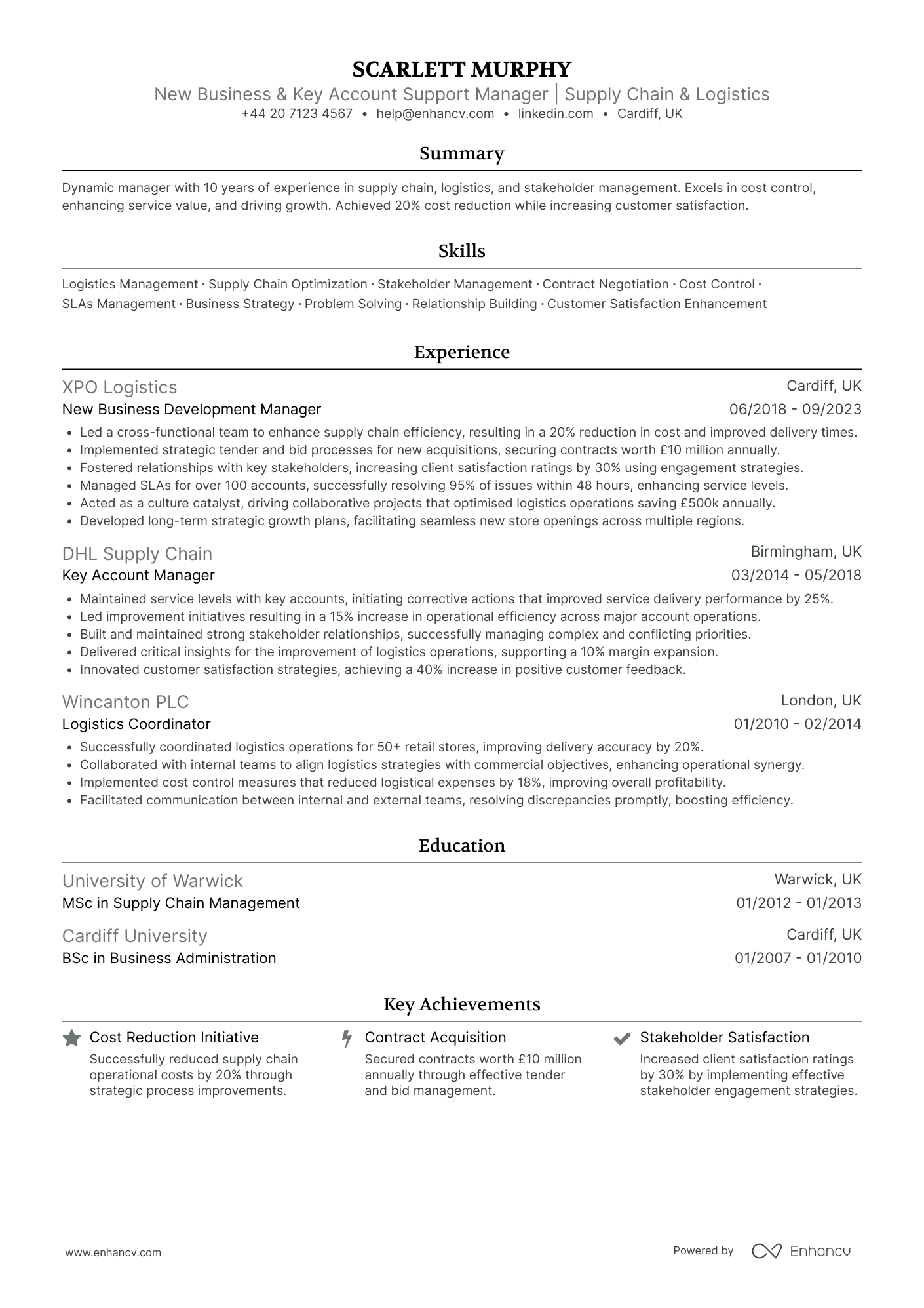
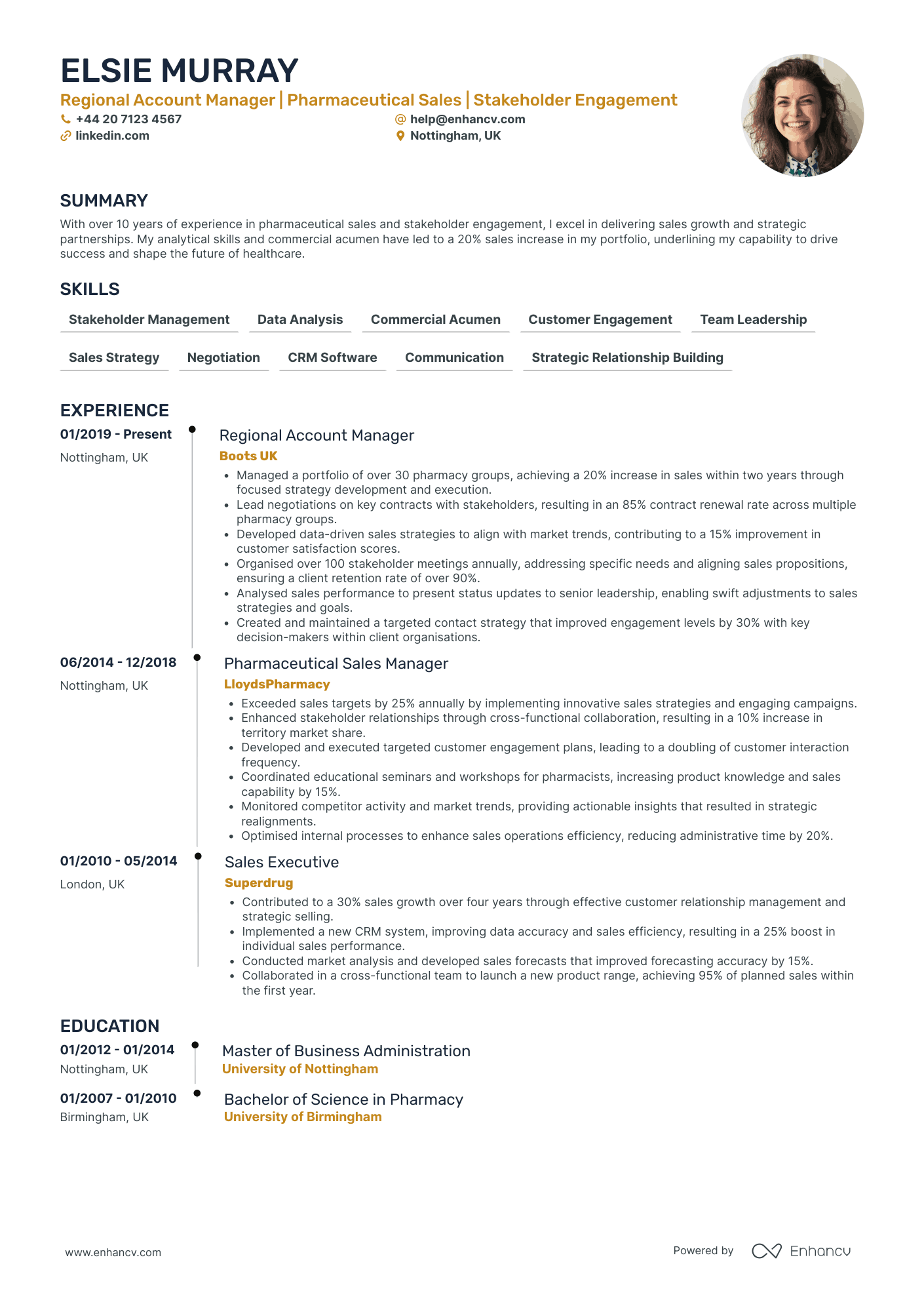
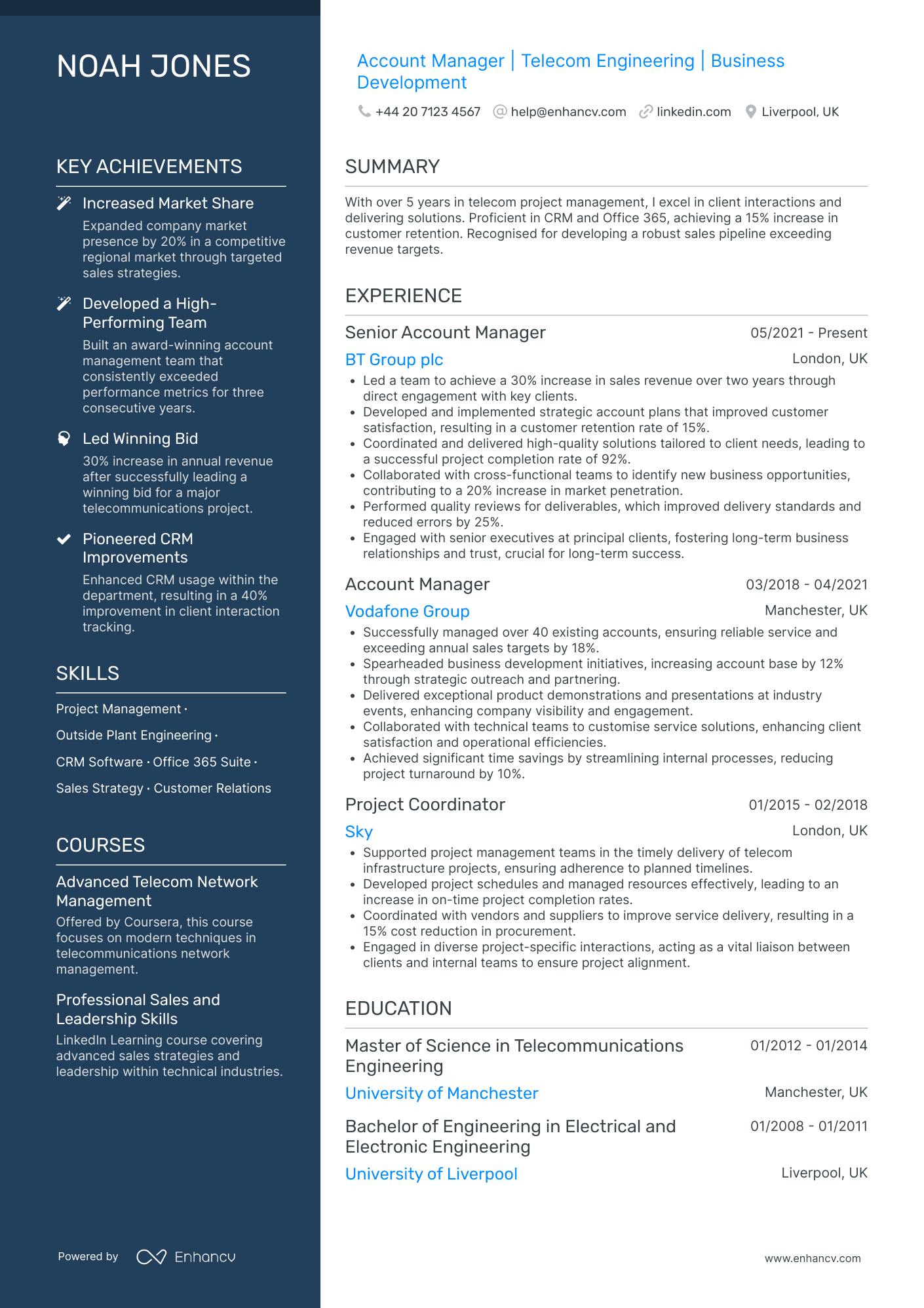
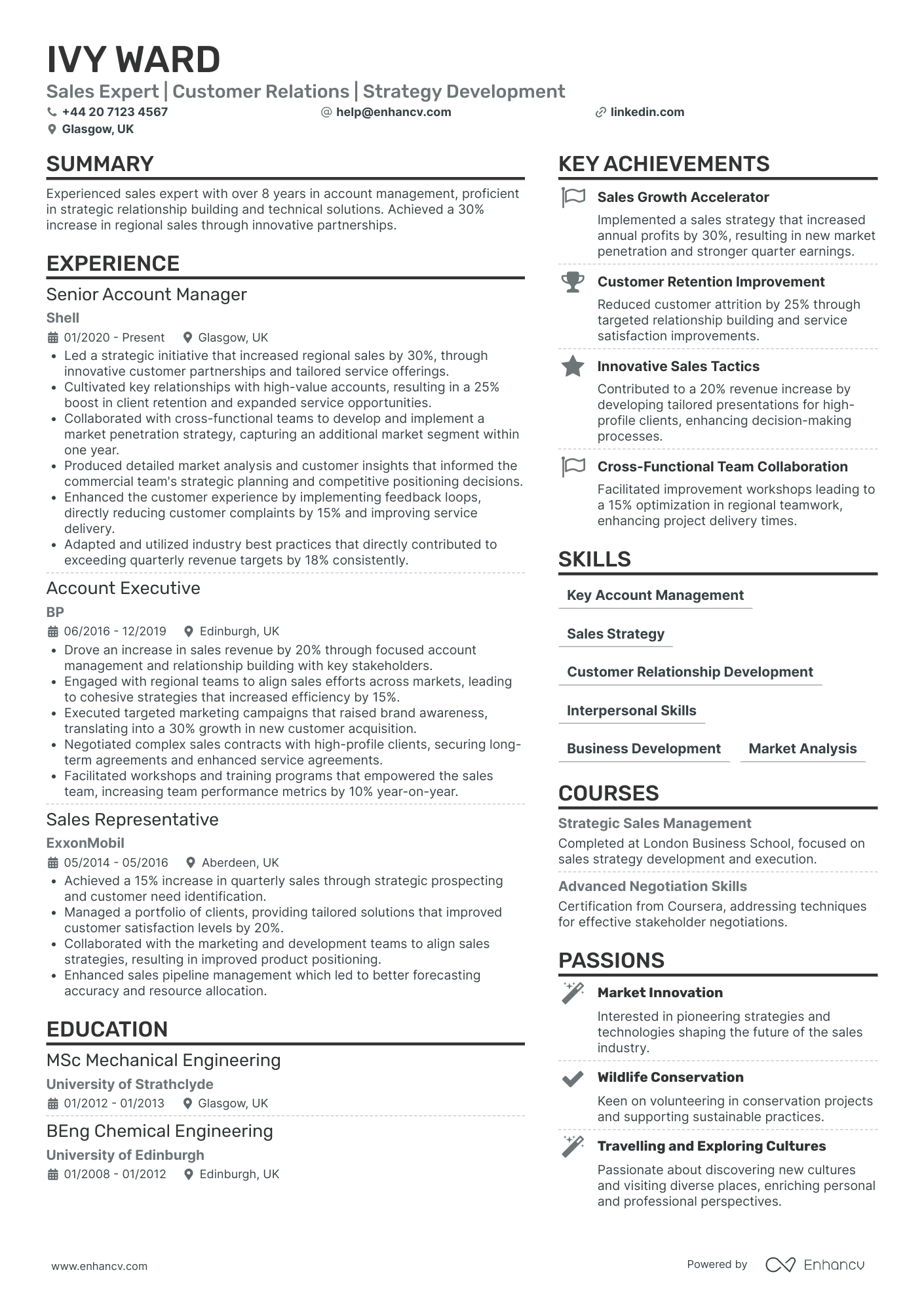
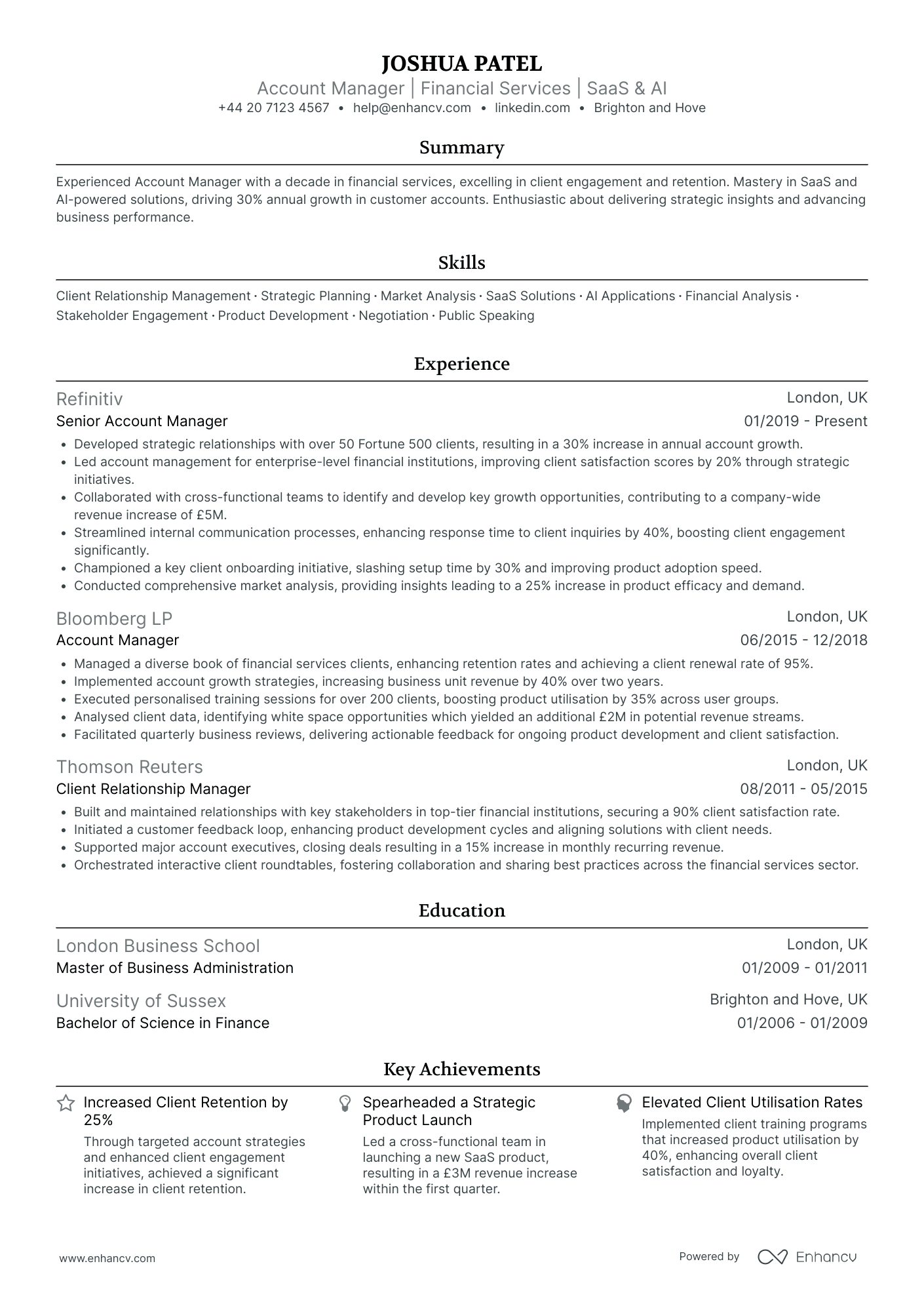
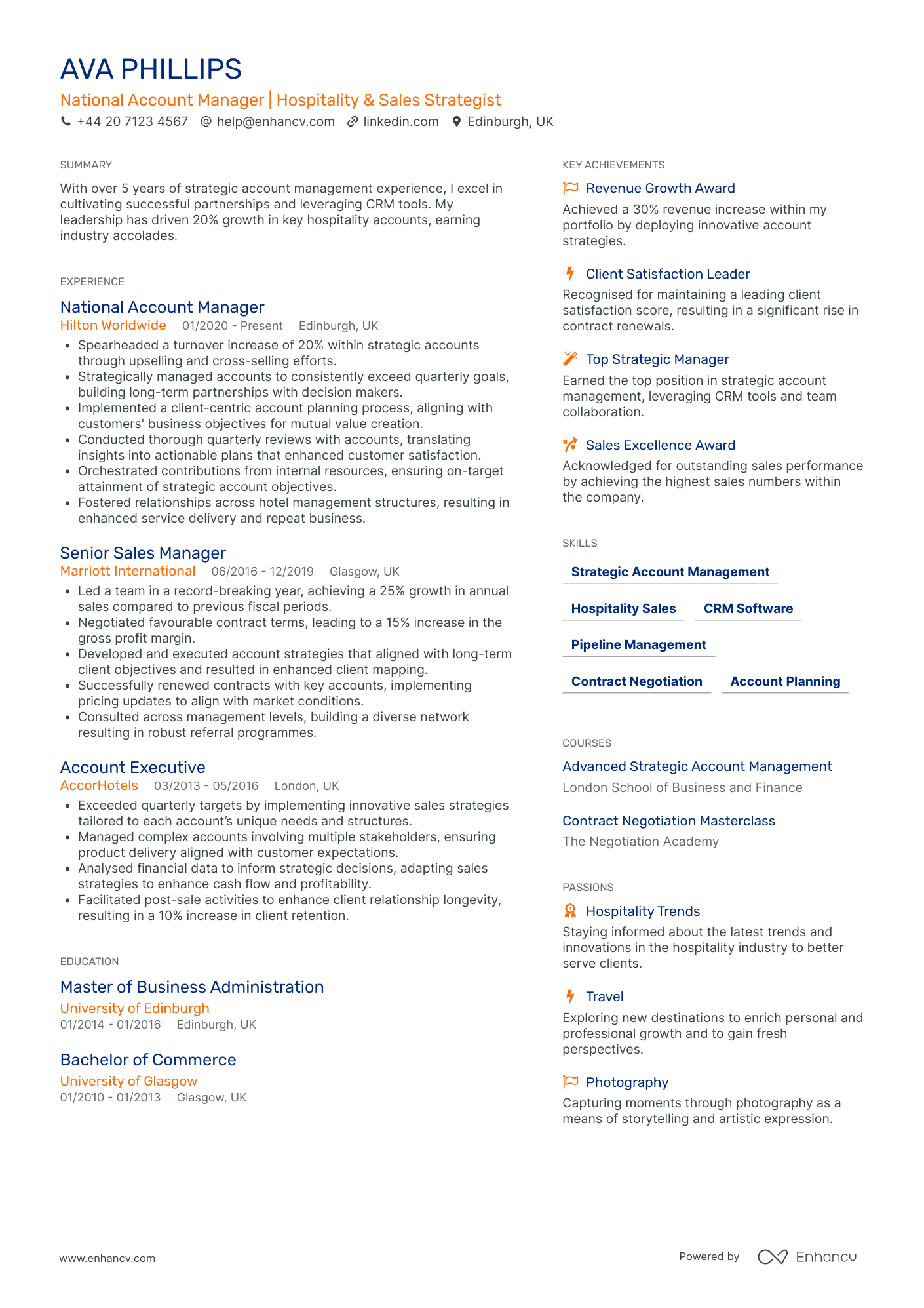
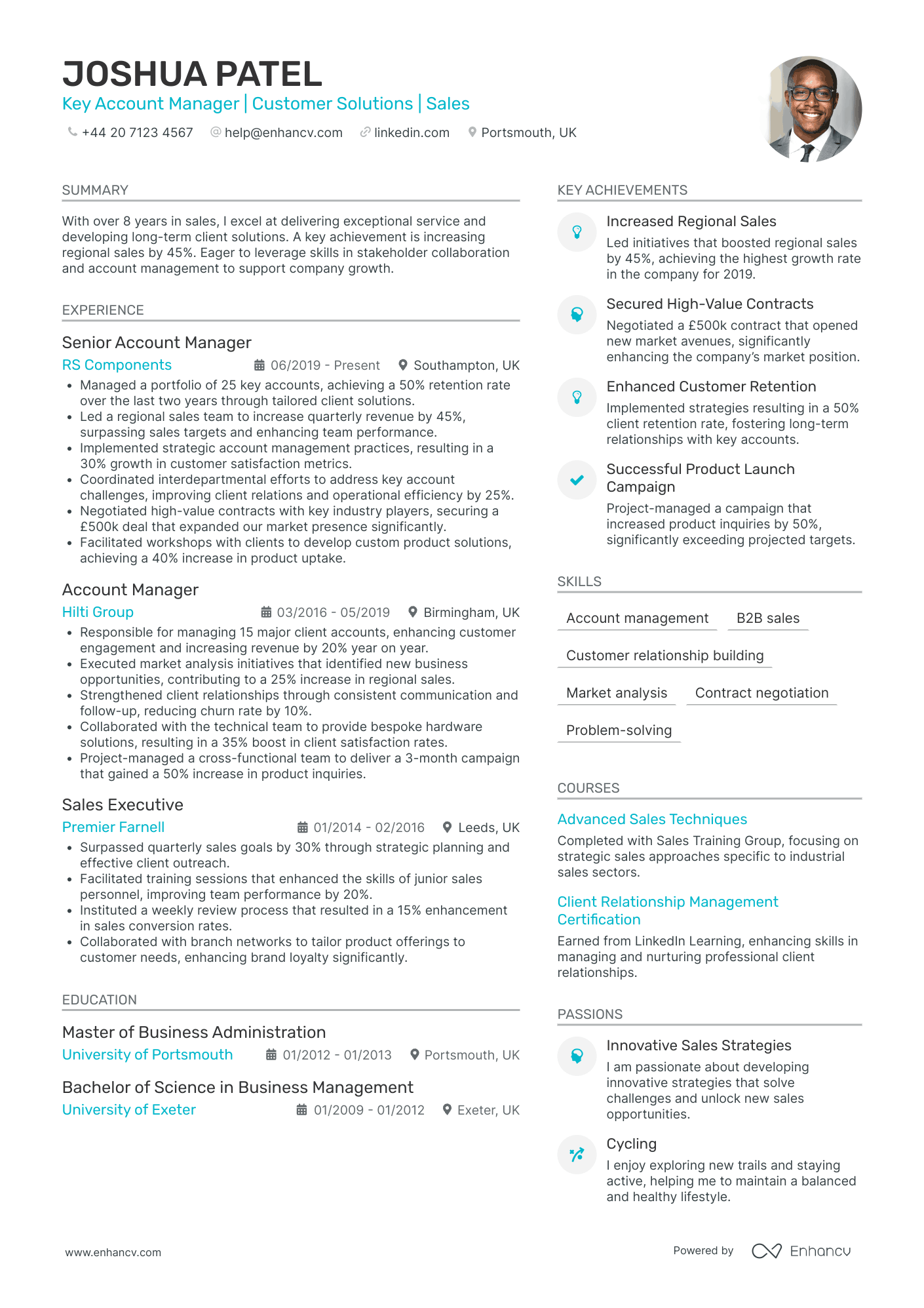
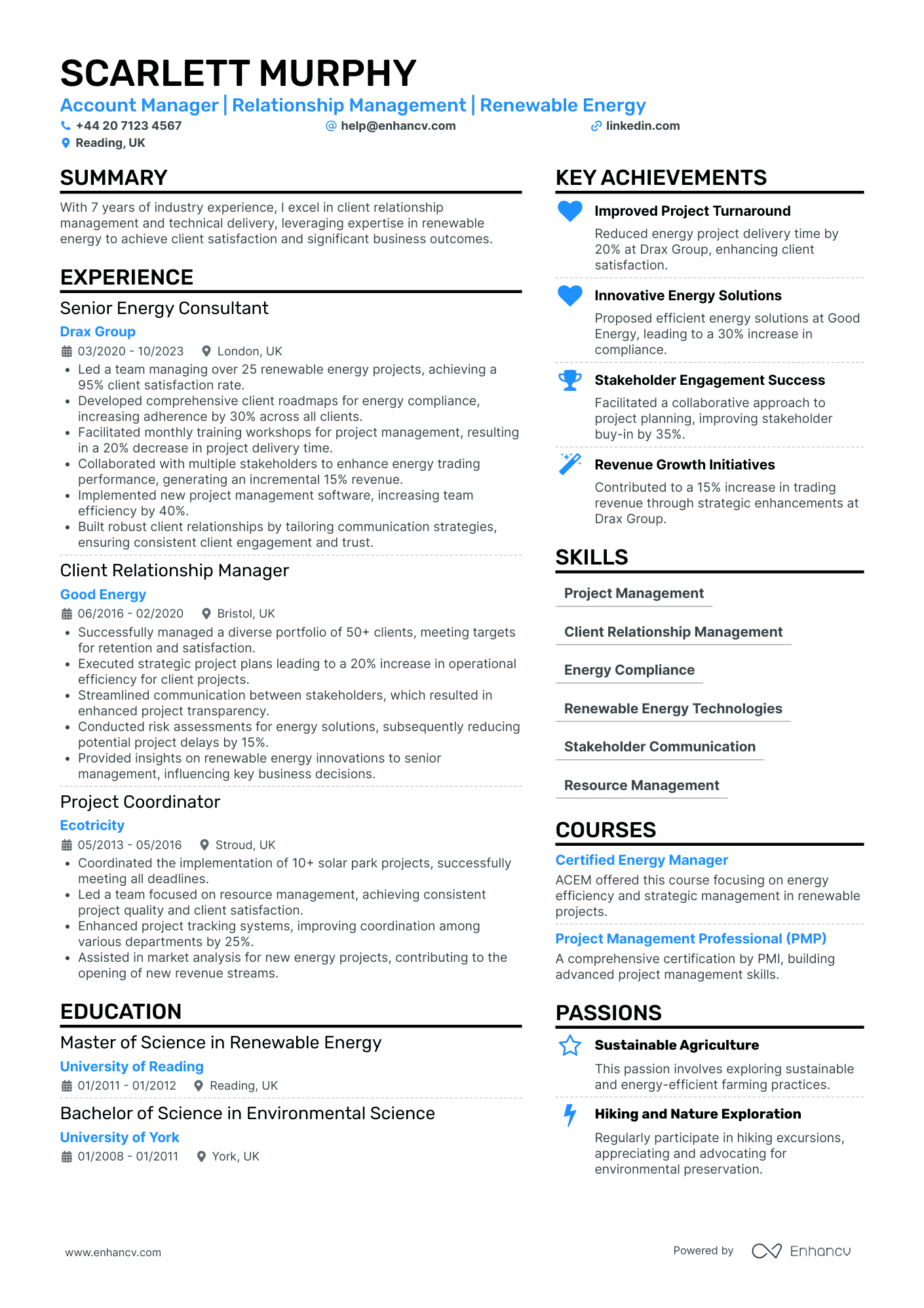
Use a reverse chronological format. Key account management is a track-record job, and employers want to see account size and results grow down the page.
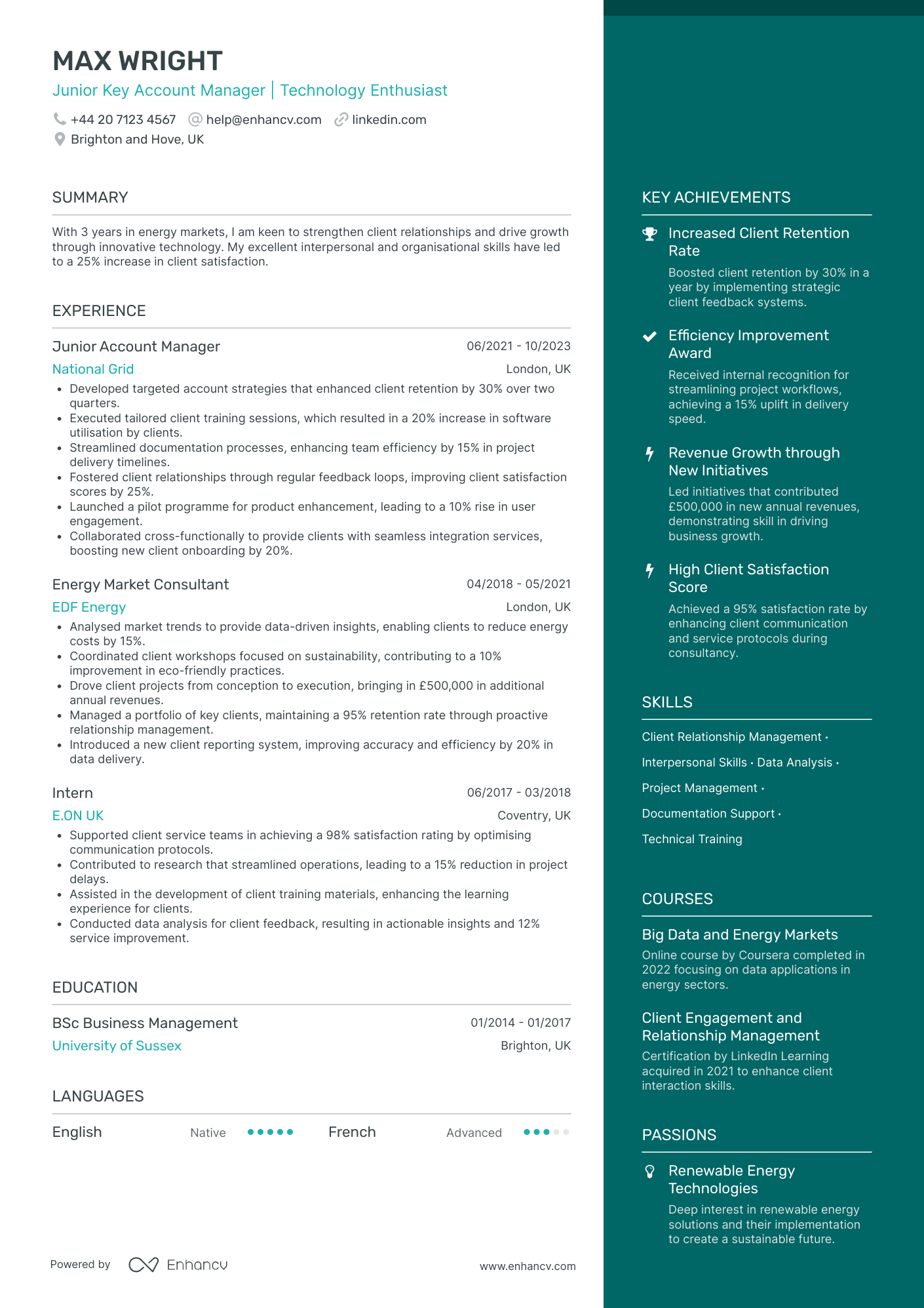
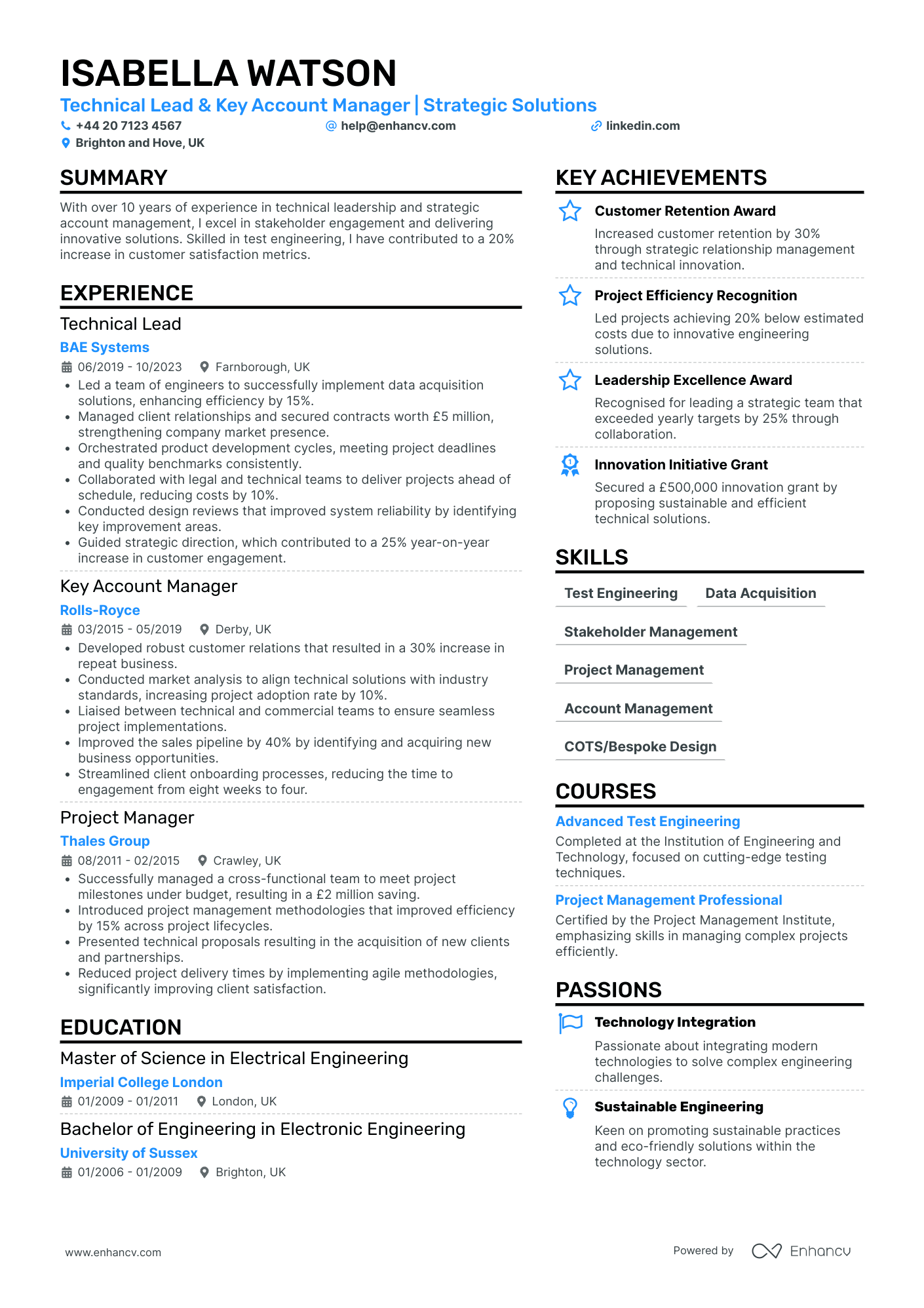
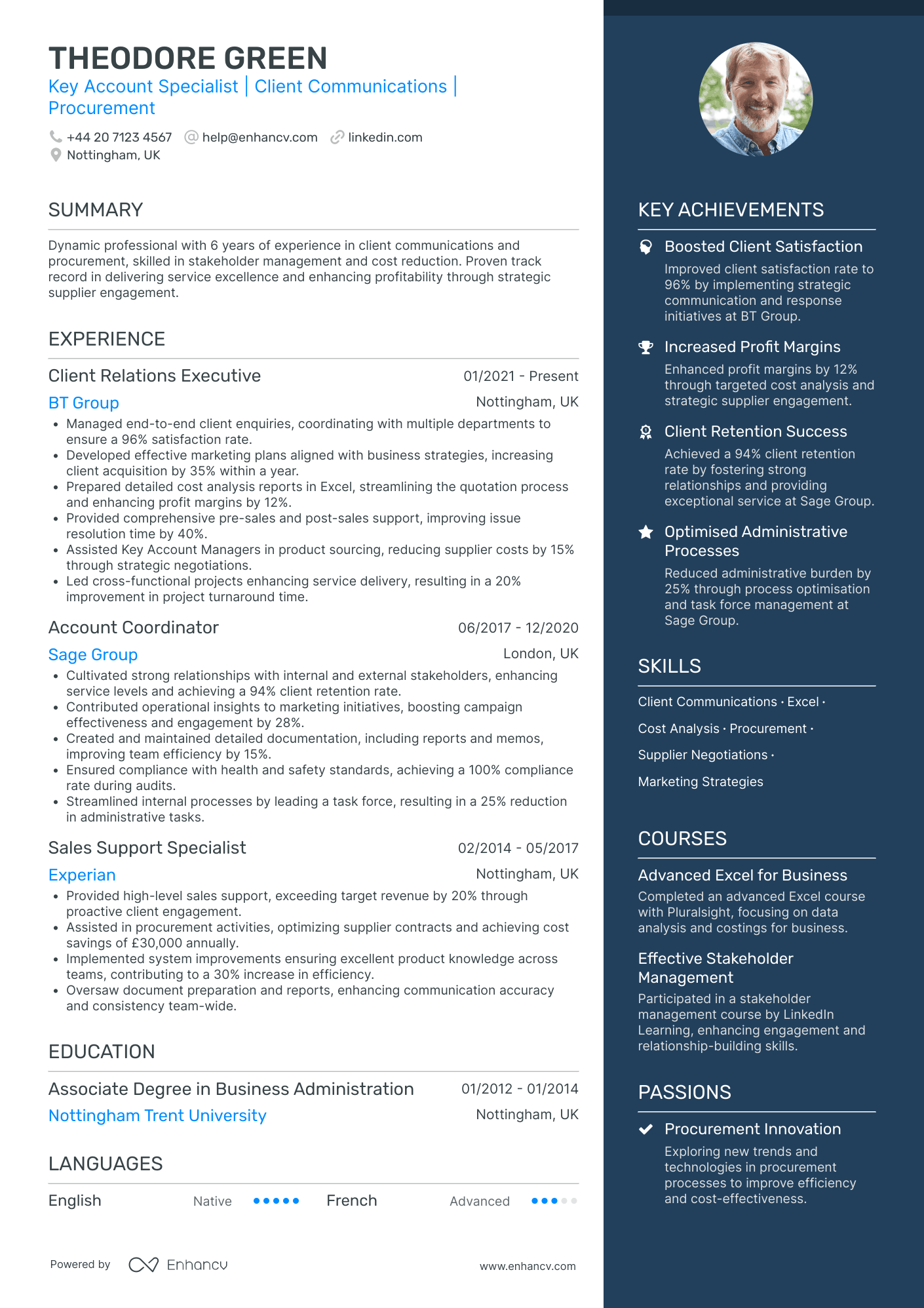
Keep it to two pages, one column, standard headings, and a readable font. Hiring managers skim for numbers first, so make revenue, retention, and growth easy to find. If you are weighing the structure, start from a standard CV format.
Send a PDF so the layout holds, unless the advert asks for a Word file. Most applications pass through tracking software, so keep the headings standard for an ATS-friendly CV.
Put a clean CV header at the top: your name, the job title you are targeting, location, phone, email, and a LinkedIn URL. Skip a photo, your age, and a full street address, none of which a UK employer needs.
Build it from a tested layout rather than a blank page. Enhancv's CV templates export to a clean PDF that reads well on both a screen and a tracking system.
Writing your key account manager personal statement
Three or four sentences at the top: who you are, the size of book you have managed, one headline result, and the kind of accounts you want next. Keep it commercial. If the opening line is where you get stuck, work from proven personal statement patterns.
Skip the adjective soup. "Results-driven, dynamic account manager" tells a recruiter nothing they can check.
Lead with a number instead:
Key account manager personal statement example
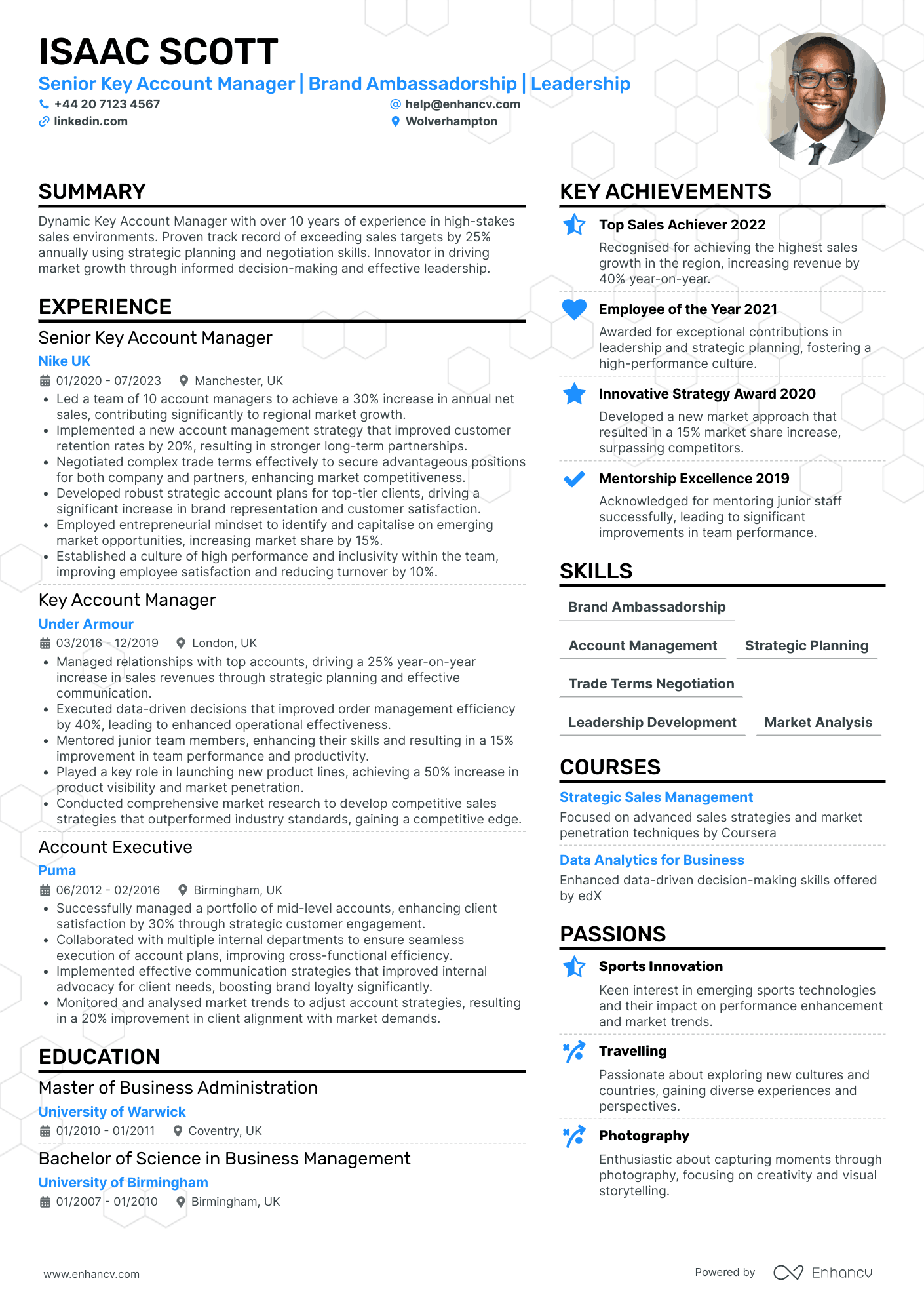
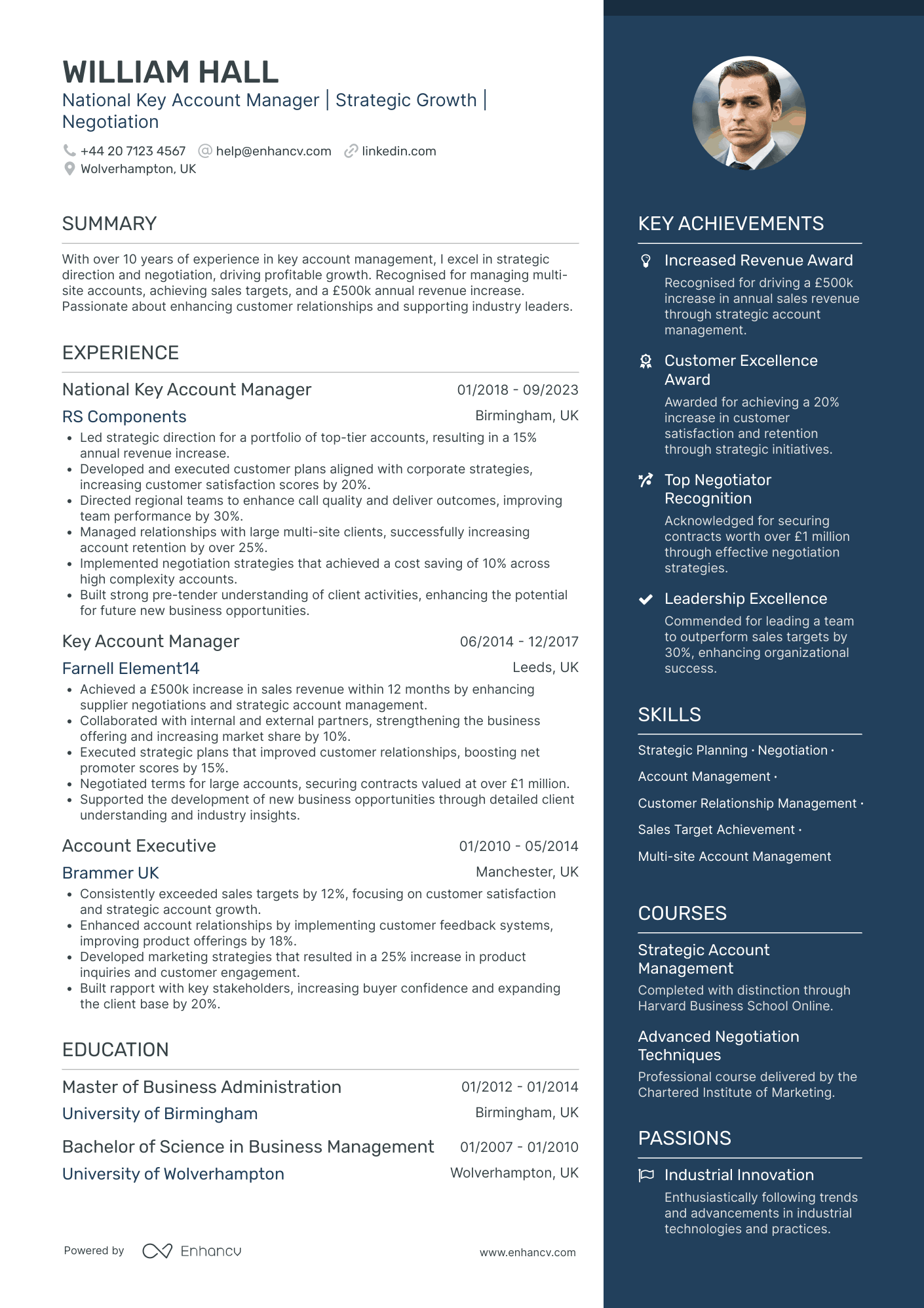
Key account manager with eight years managing enterprise SaaS accounts across UK retail and logistics. Grew a £5.2m portfolio by 19% last year and renewed 94% of contracts by value. Skilled in data-led account planning, contract negotiation, and aligning procurement, product, and delivery teams. Looking to take on a lead role owning a strategic account base in a high-growth technology business.
What to avoid
Results-driven and passionate key account manager with excellent communication skills and a proven track record of success. A team player who thinks outside the box and consistently exceeds expectations across a range of accounts.
The difference is not polish, it is proof. The first version names a portfolio size, a growth figure, and a retention rate, so a recruiter can picture the scale you work at. The second could describe anyone in any sales job.
Rewrite the statement for each application. Lead with the result that matches the advert: growth for a scale-up, retention for a business protecting its base, and negotiation for a role heavy on renewals.
Close on the accounts or sector you want next, not a generic ambition. "Looking to own strategic retail accounts in a high-growth SaaS business" tells a recruiter you have read the advert and aimed the CV.
When I read a key account manager CV, I go straight to two numbers: how much revenue you looked after, and how much of it you kept. A candidate who writes "retained 96% of a £4m book through a supplier switch" has already won the first round. Everything else on the page explains how they did it. Lead with the money you protected and grew, then show the relationships and the planning behind it.
the Enhancv team
Writing your key account manager experience section
Write each role as a dated heading, then bullets that lead with a verb and end in a result. For a key account manager, the result is almost always revenue, retention, or growth. For the mechanics, see work experience on a CV.
Quantify everything: portfolio value, number of accounts, retention rate, upsell, renewal rate, and deal size. One real number beats five lines describing your responsibilities.
Tailor each application to the advert. Enhancv's CV tailoring feature reads the job description and suggests the account-management terms and metrics to mirror, which saves rewriting from scratch. If you would rather do it by hand, here is how to tailor your CV.
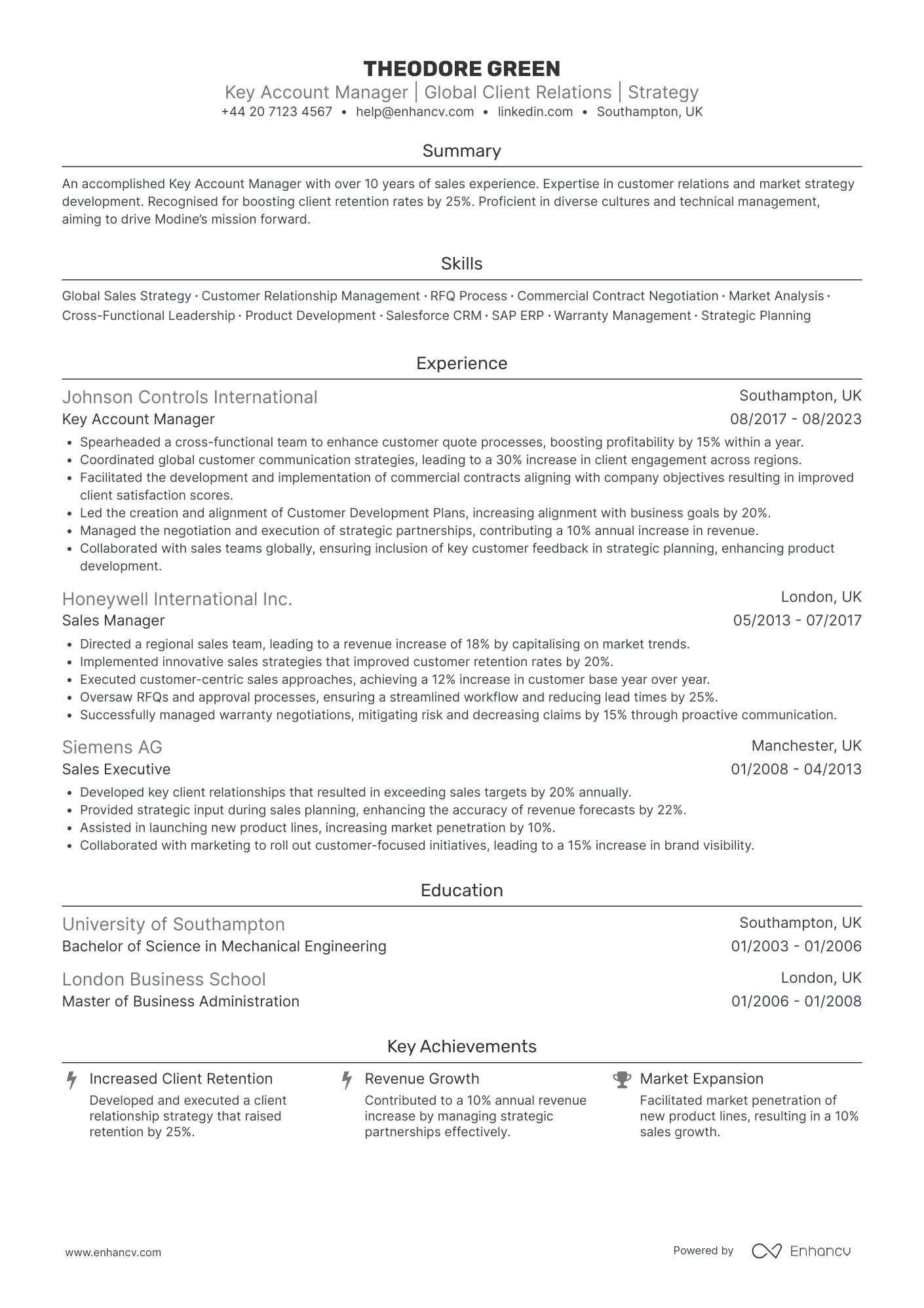
- Own a £6.4m portfolio of 14 enterprise accounts across retail and logistics, reporting to the commercial director
- Grew portfolio revenue 23% in two years through structured upsell and cross-sell account plans
- Renewed 95% of contracts by value, including a £1.2m multi-year renewal negotiated through a procurement restructure
- Ran quarterly business reviews using Salesforce and Power BI data that cut churn-risk flags by a third
- Aligned product, delivery, and finance teams on a joint growth plan for the three largest accounts
- Managed 30 mid-market accounts worth £2.1m in combined annual revenue across the North West
- Lifted net revenue retention from 88% to 101% over three years by rebuilding the renewal process
- Closed £480k of upsell in a single year by mapping each account to a documented growth plan
- Promoted to lead the region's key accounts after two consecutive years above target
PRO TIP
One number per bullet, at the front where it gets read. "Grew the account 23%" lands harder than "responsible for account growth". If a bullet has no number, ask what changed because you were there, then measure that.
If you are not sure what to measure, key account managers almost always have these to hand: portfolio value, year-on-year growth, gross and net revenue retention, renewal rate, average deal size, and the number of accounts you carry. Pick the three that make you look strongest and put them where a six-second scan will catch them.
Frame the biggest bullet as a short story: the situation, what you did, and the number that changed. "Inherited a £3m account at risk of churning, rebuilt the relationship with a 90-day plan, and renewed it at 110% of the previous value" carries more weight than three separate lines about relationship building.
Education and qualifications for a key account manager CV
You rarely need a specific degree. Most UK adverts care more about your commercial track record than your qualifications, so keep this section short and let experience carry the CV.
List your degree with its classification, then anything that signals commercial depth. A degree in business, marketing, or a numerate subject helps, and so does formal sales or negotiation training. Put the detail in your education section.
Name the credentials worth having if you hold them: a CRM certification such as Salesforce, an ISM or APS sales qualification, or a project management credential where the role spans delivery. A short list of certifications on a CV saves the employer a question.
An MBA or a continuing-education course in commercial strategy earns a line if you have one, but it never outranks a proven track record. Keep the section to a few lines so it does not crowd out your account results.
Conclusion
Lead with the revenue you have grown and kept, name the skills UK adverts actually list, and pitch the CV to the seniority in the advert.
Pair it with a short cover letter that names the accounts or sector you want to work in, and you turn a strong track record into interviews.

Author's take - the Enhancv team
When I read a key account manager CV, I go straight to two numbers: how much revenue you looked after, and how much of it you kept. A candidate who writes "retained 96% of a £4m book through a supplier switch" has already won the first round. Everything else on the page explains how they did it. Lead with the money you protected and grew, then show the relationships and the planning behind it.