



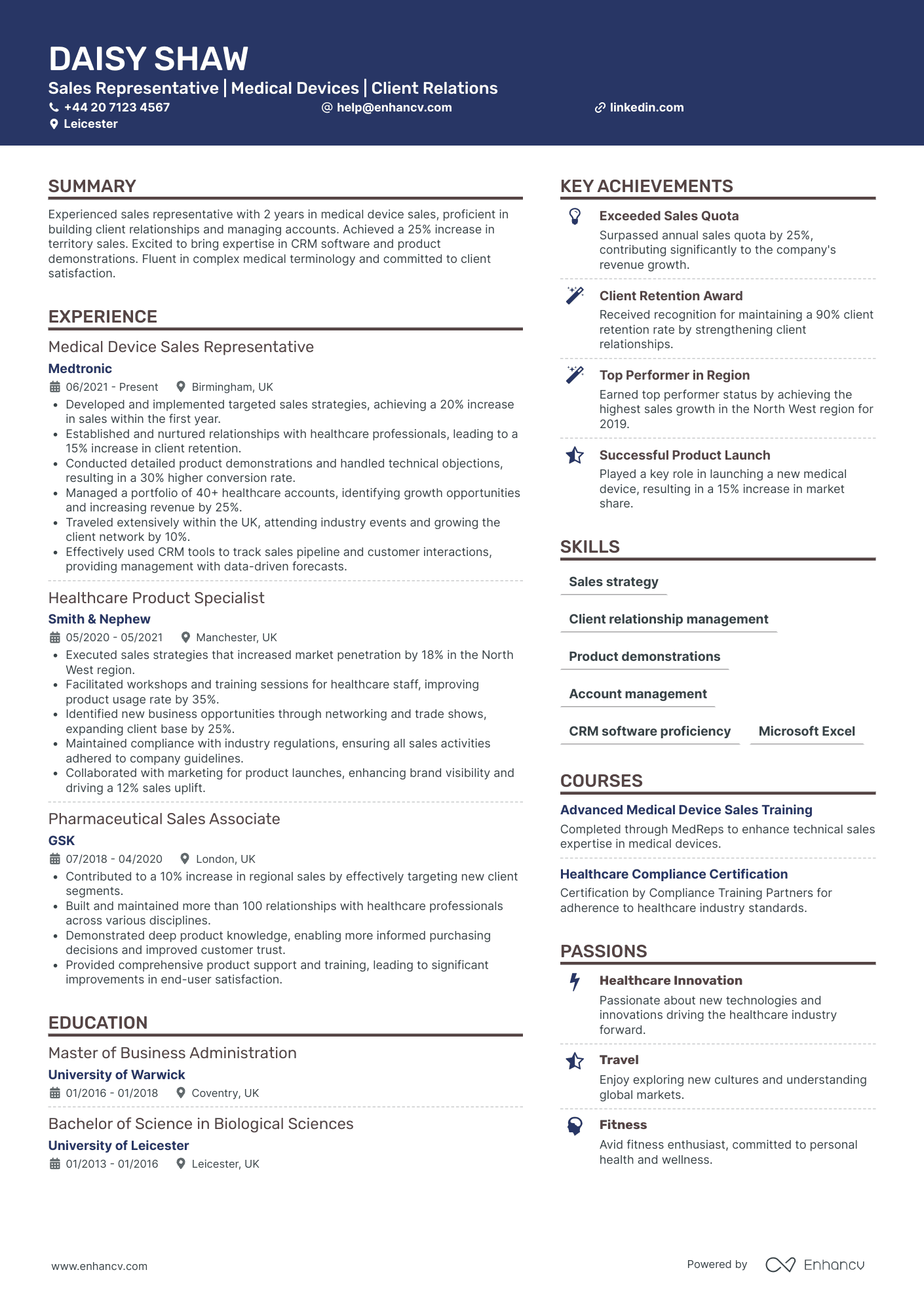
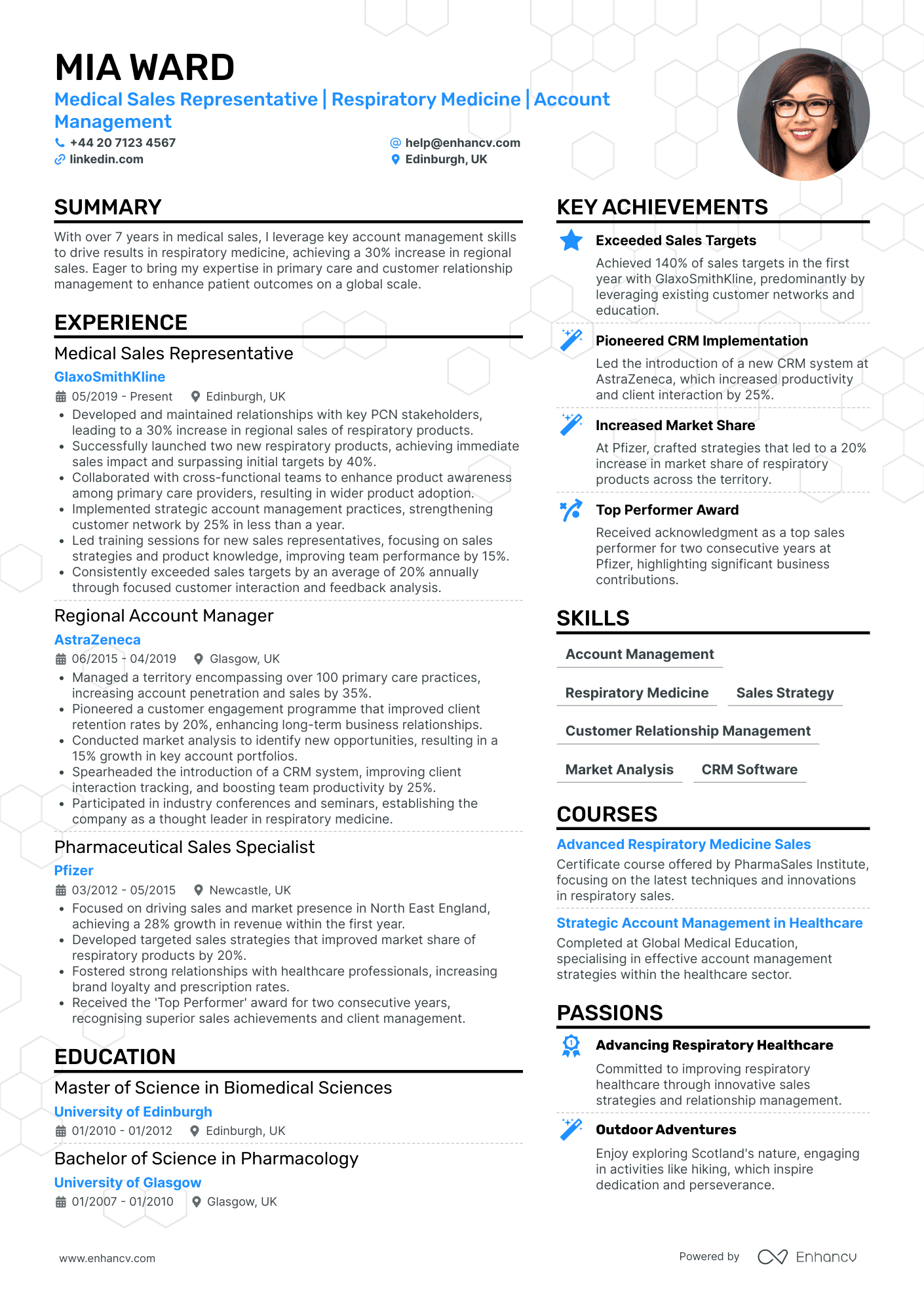
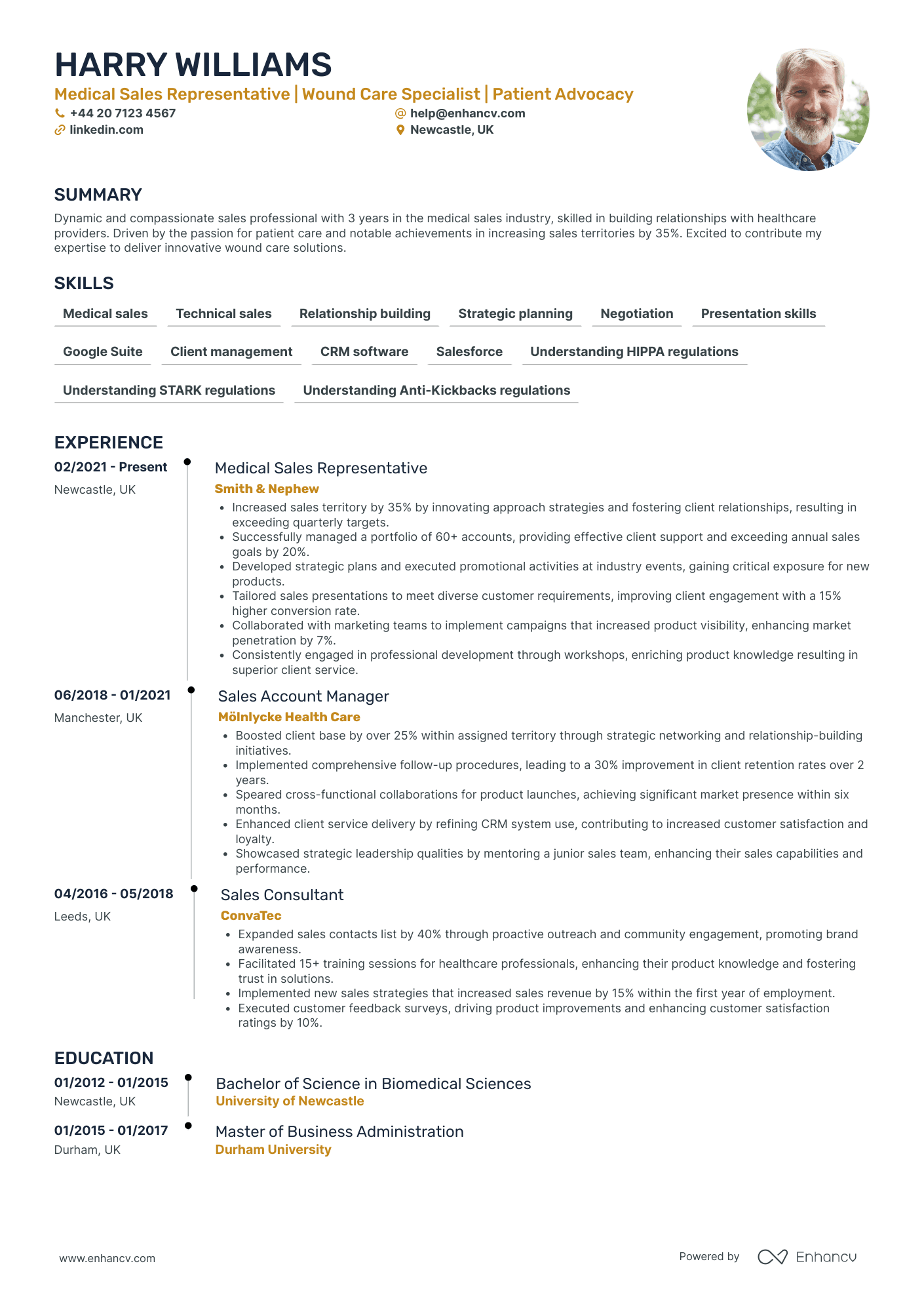
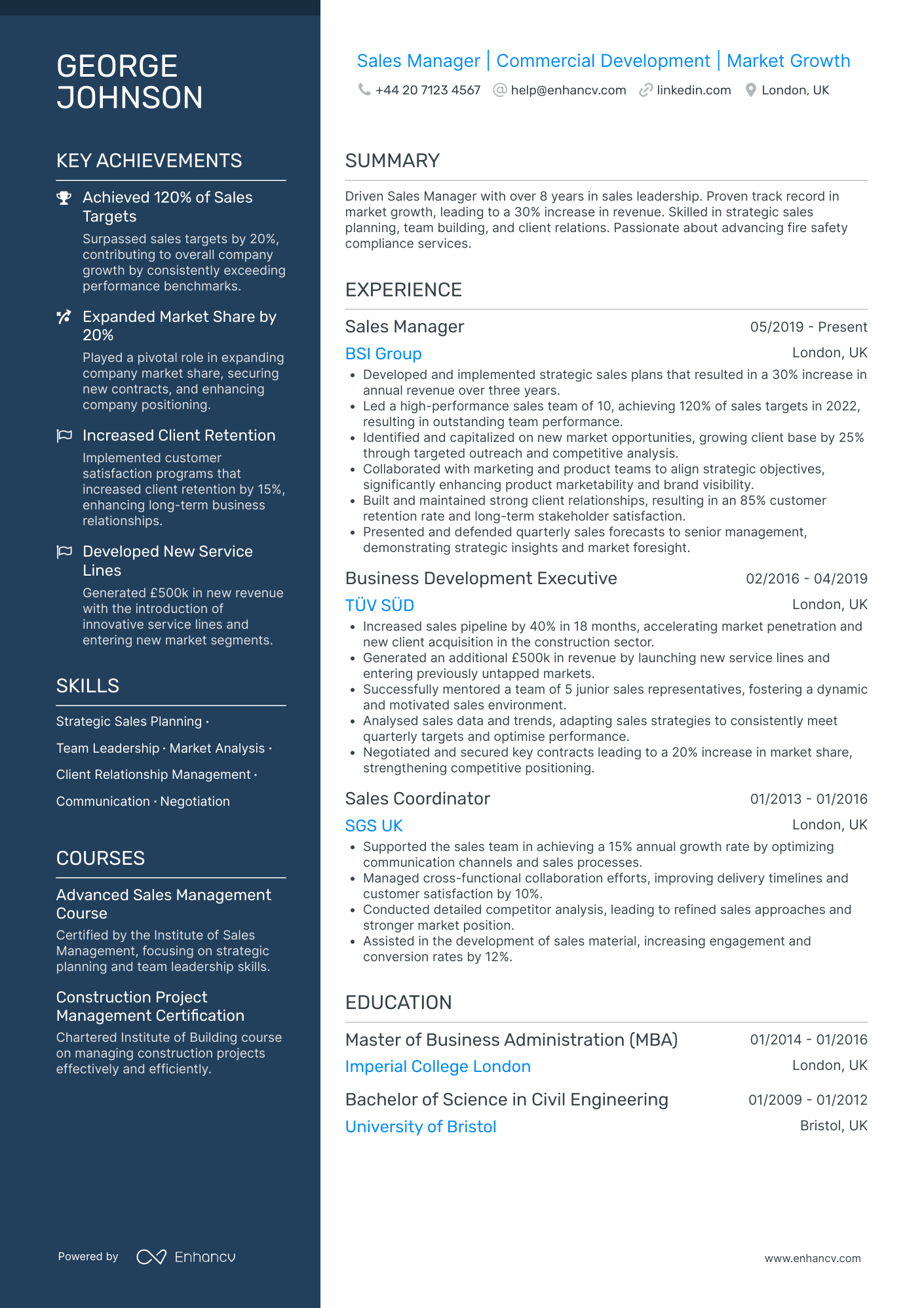
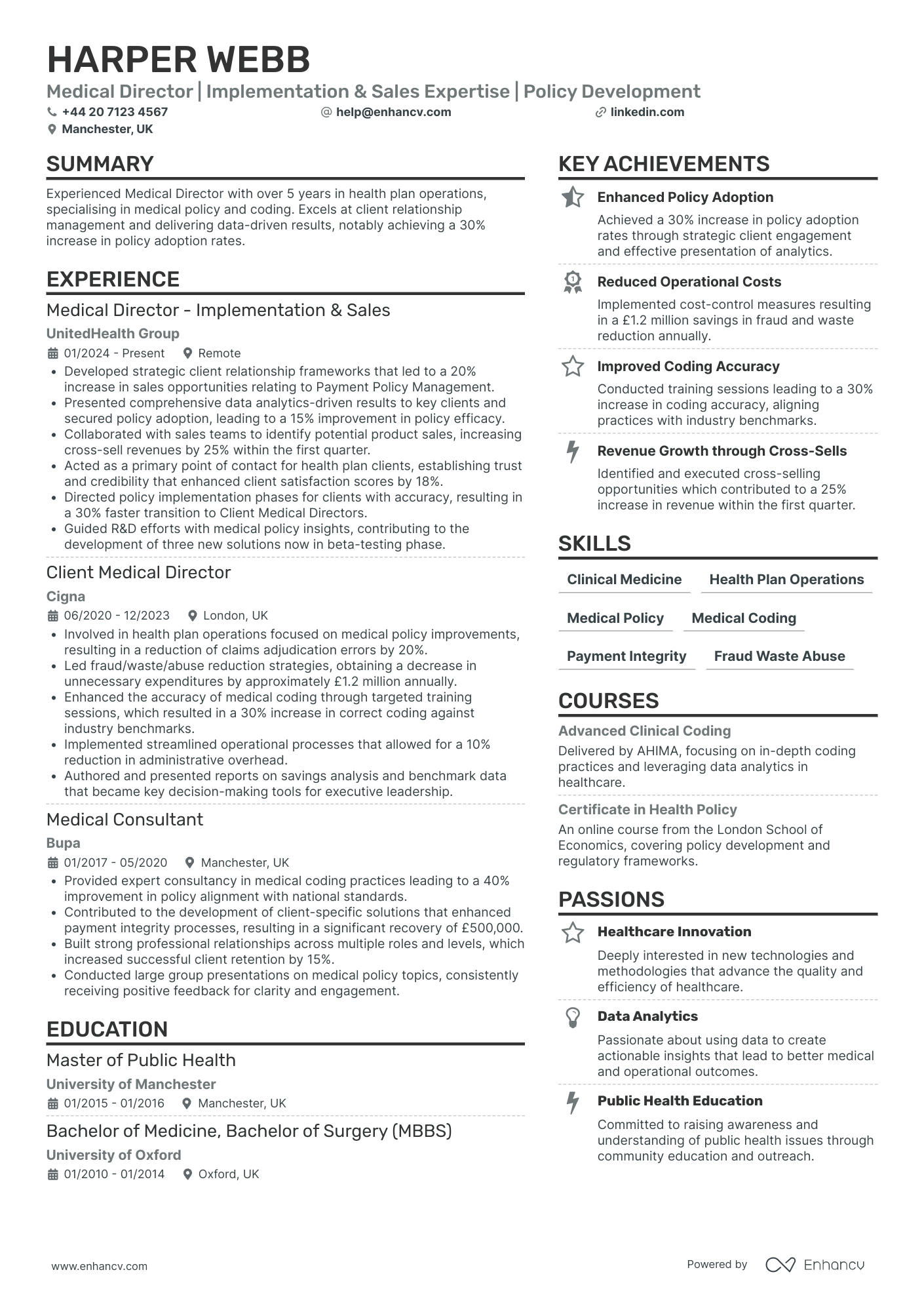
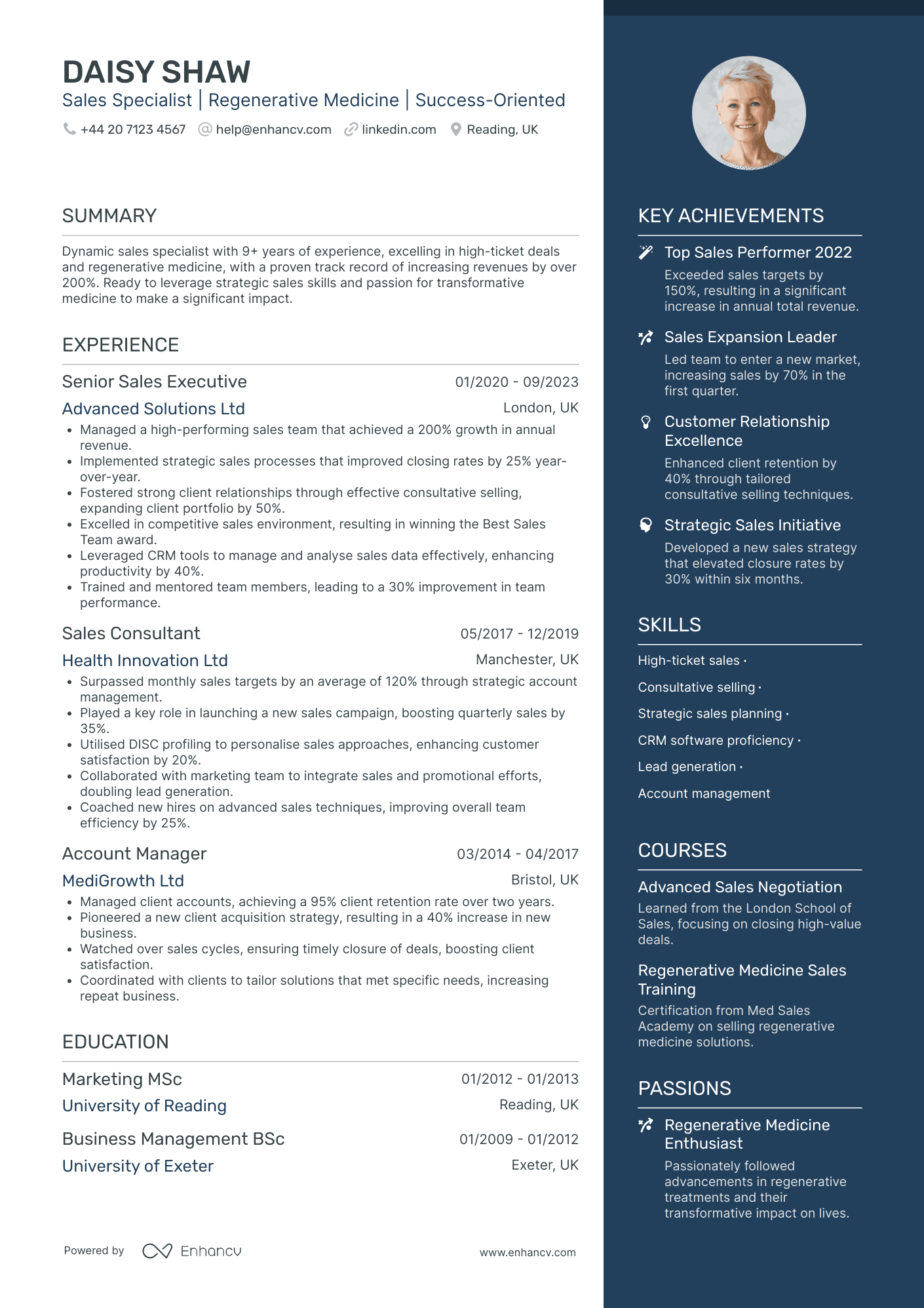
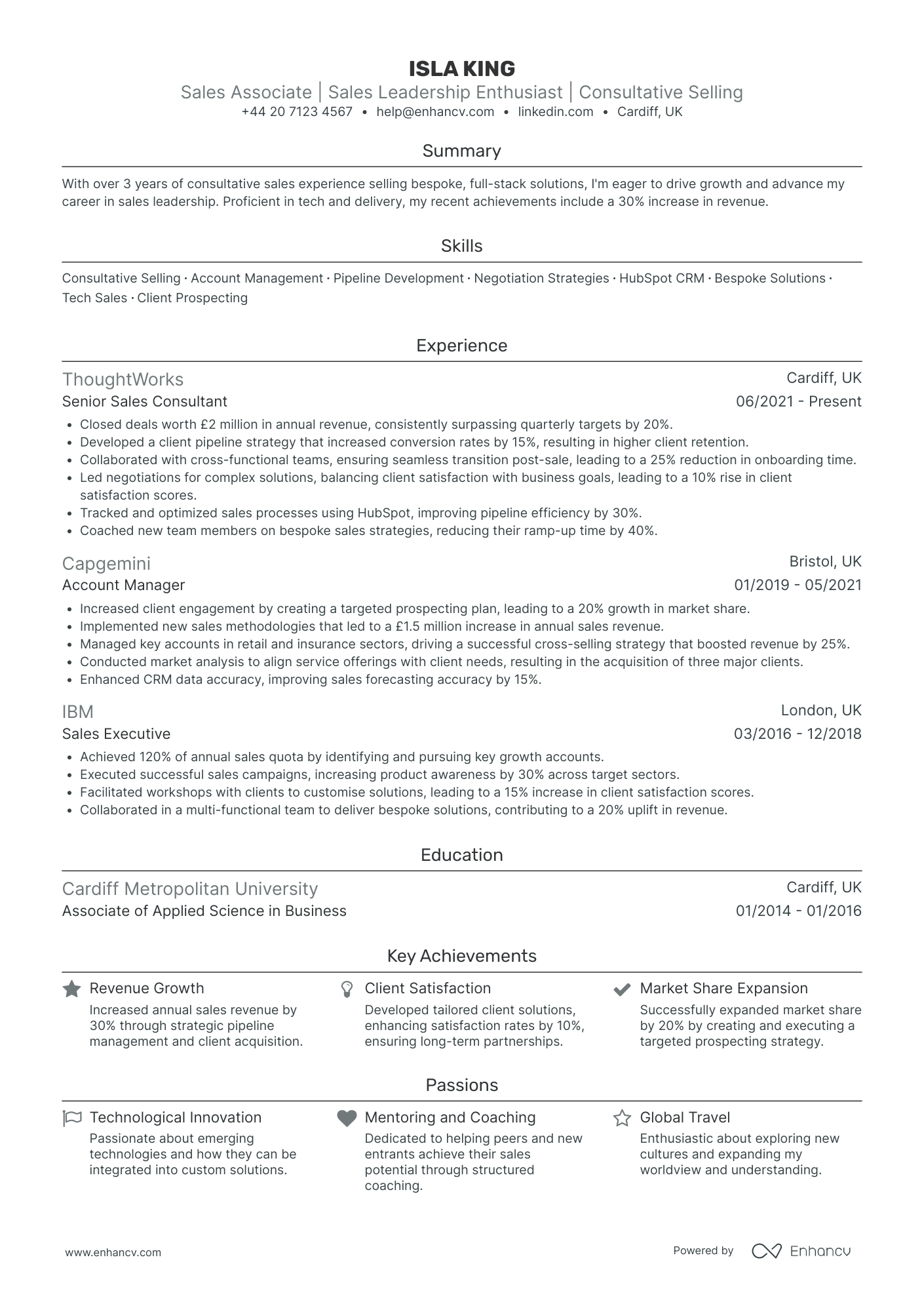
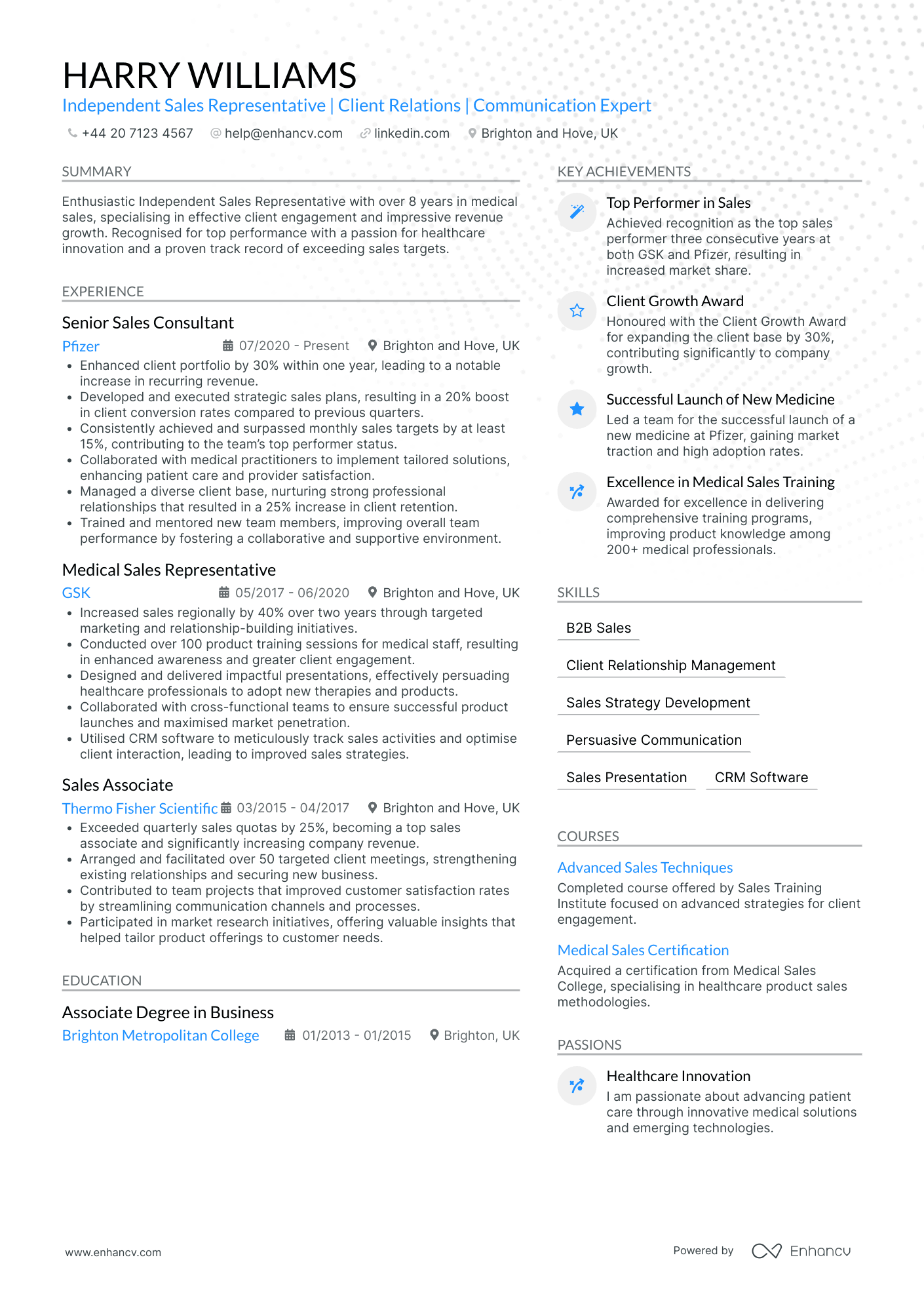
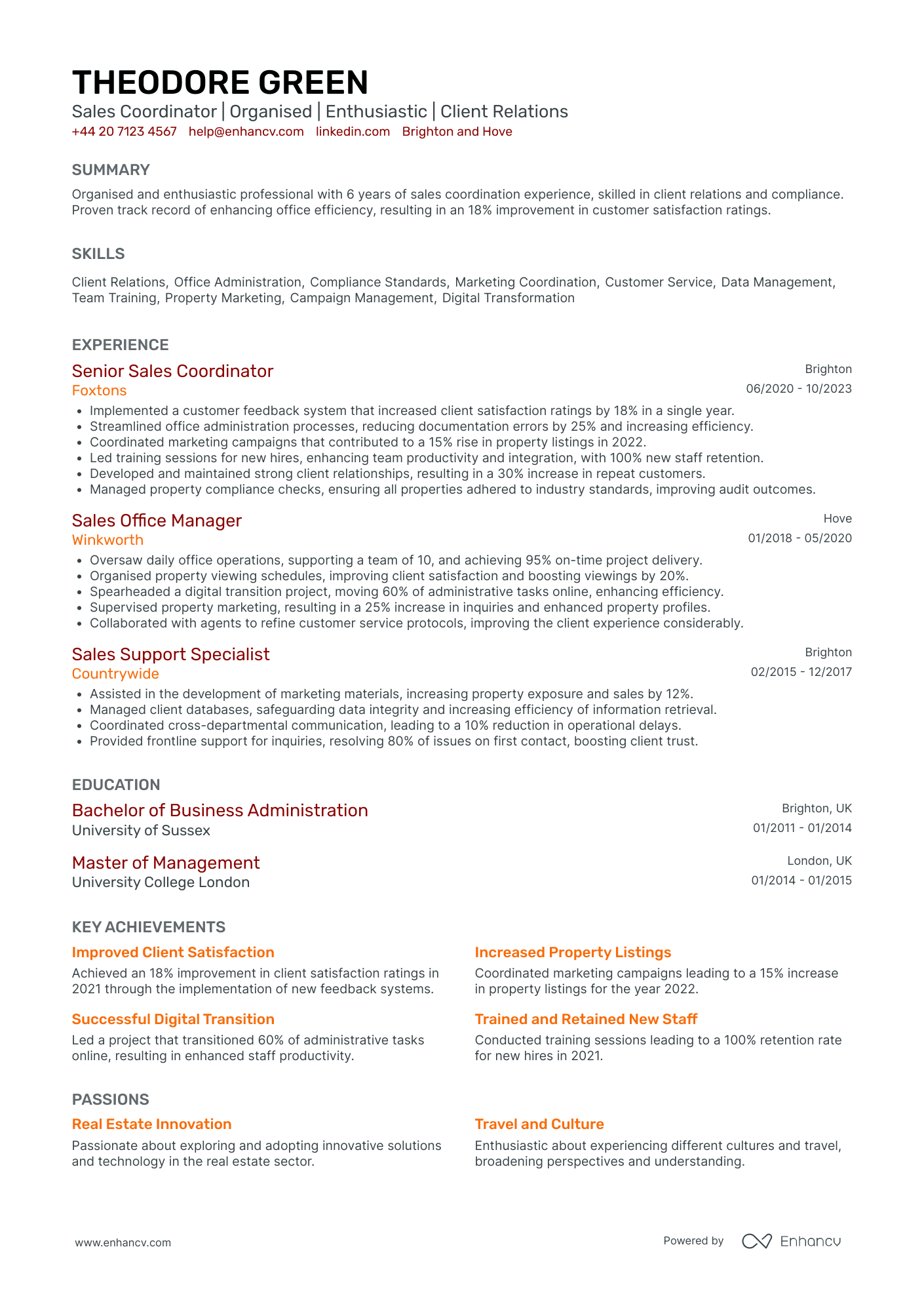
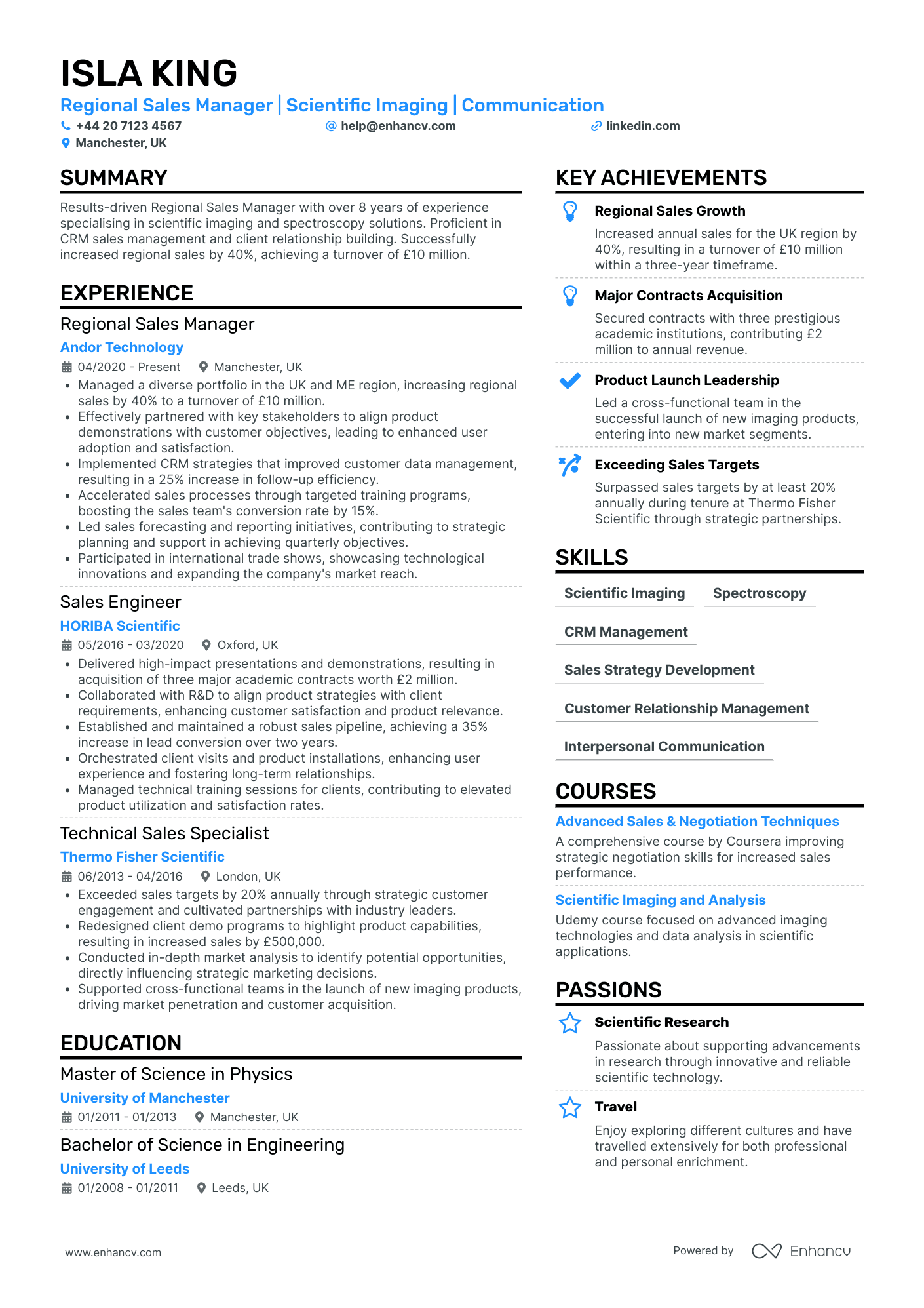
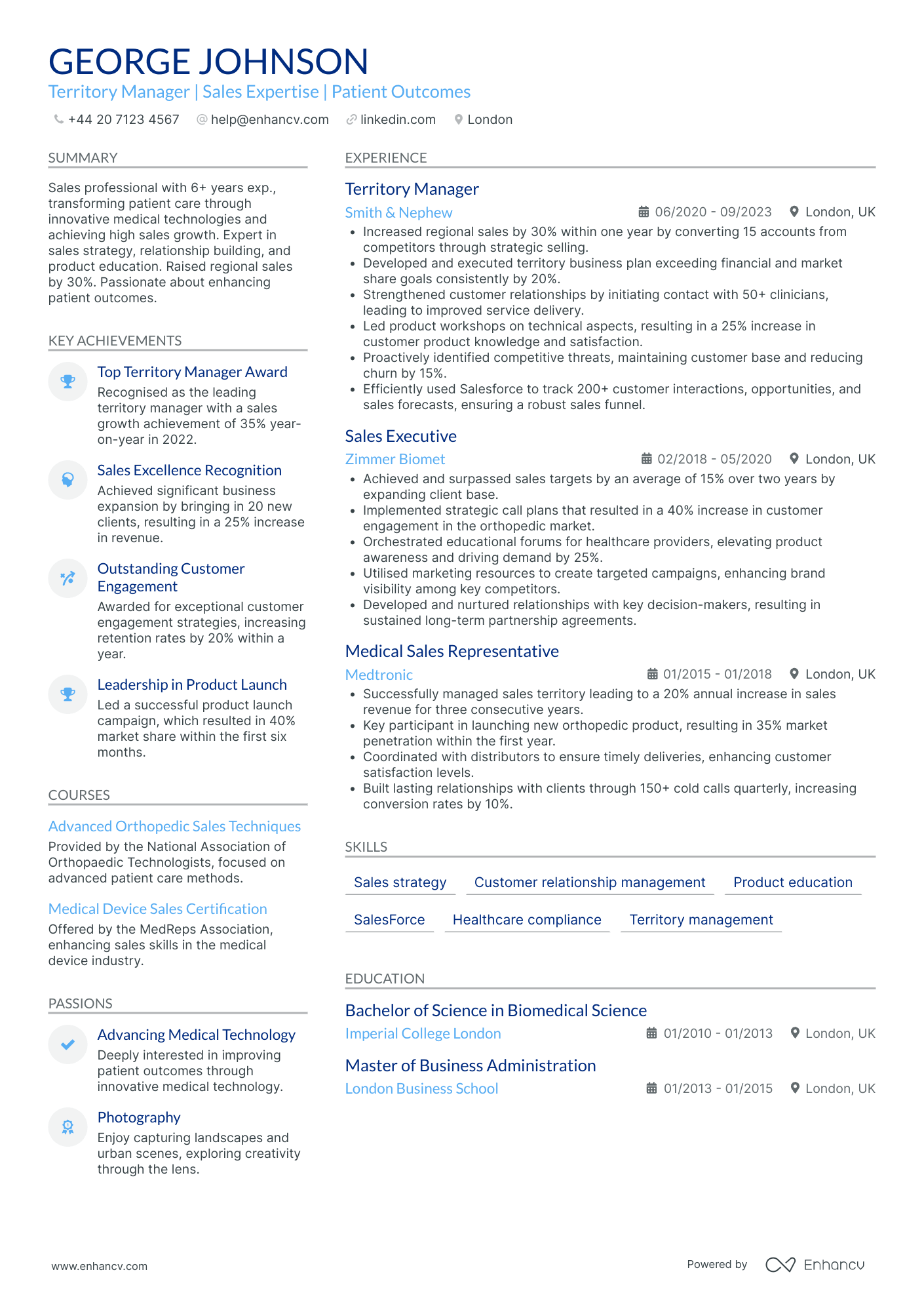
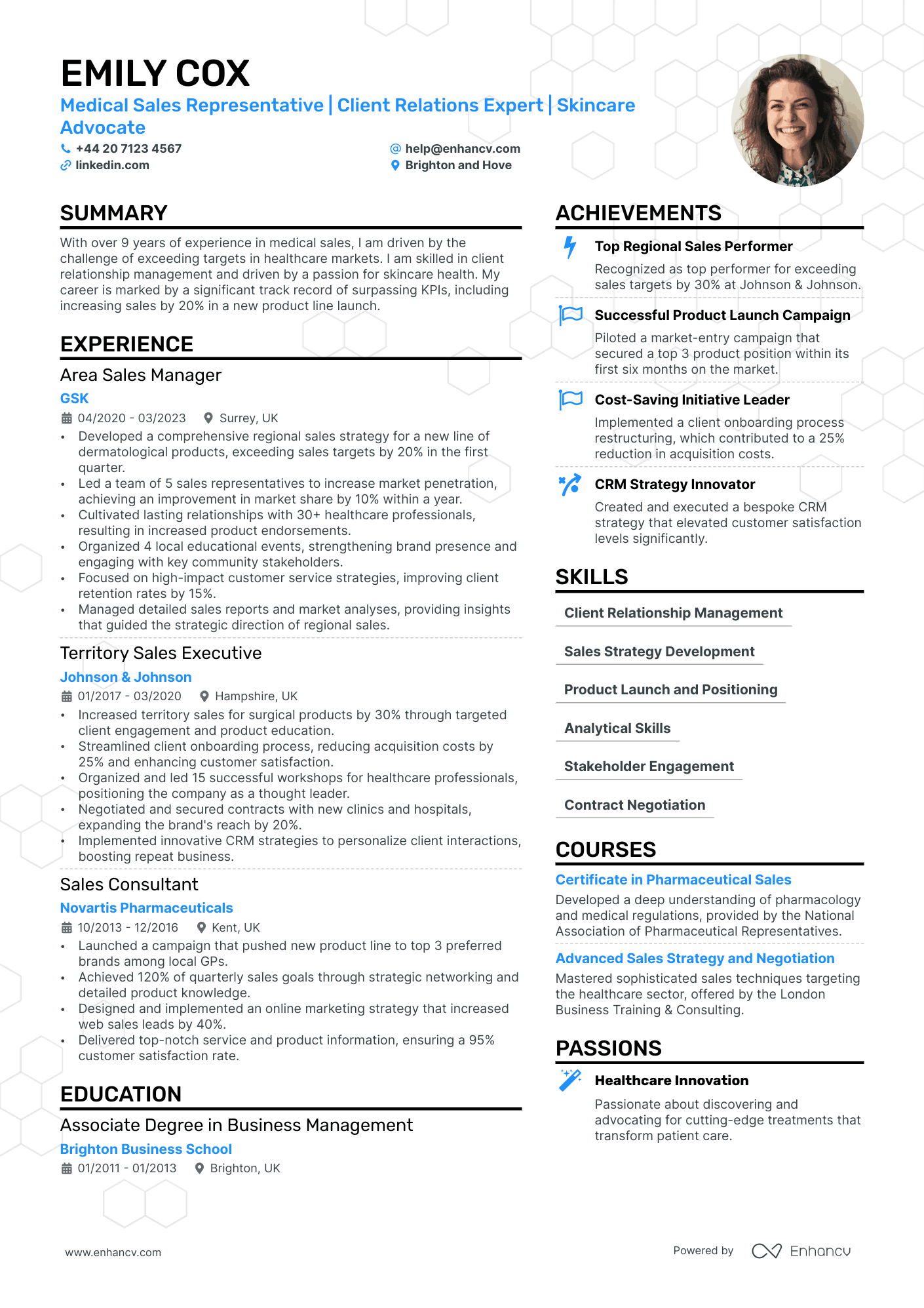
In medical device sales, the interview is won on one question. Can a rep carry a revenue number into a boardroom and clinical credibility into an NHS lab in the same week. The CVs that get shortlisted answer that on the first line.
Most medical sales CVs bury the answer under a profile full of adjectives and a duties list copied from the advert. The strong ones lead with territory, quota, and the clinical fluency to sell diagnostics and devices to the people who actually use them.

Key takeaways
- Lead with quota and territory results. One line like '112% of a £1.4m target' beats a paragraph of soft skills.
- Prove clinical credibility. Name the products, the settings such as NHS labs, theatres, and clinics, and the buyers you have sold to.
- Mirror the advert's language: CRM, territory management, tender and framework work, and contract negotiation.
- Quantify everything you can: revenue, growth, win rate, new accounts, and quota attainment.
- Keep it to two pages, reverse chronological, and send a PDF unless the advert asks for Word.
- The role is field-based, so put your territory coverage and a full driving licence near the top.
What sets a medical device sales CV apart
You are selling regulated kit into clinical settings, so a recruiter reads your CV for two things at once. Can you sell, and will clinicians trust you in the room.
Lead with commercial proof. Territory value, quota attainment, revenue growth, new accounts opened, and win rate on tenders. Put the single strongest number in your personal statement, then repeat the evidence in your experience section.
Then show clinical credibility. Name the product categories you know, such as point-of-care diagnostics, laboratory analysers, or theatre consumables. Name the settings, such as NHS pathology labs, trusts, and private clinics. Name the buyers, such as procurement leads, lab managers, biomedical scientists, and consultants.
Territory management is a skill in its own right. Show how you planned coverage, prioritised accounts, and forecast a pipeline, not just the headline sales figure at the end of the year.
The NHS buys through frameworks and tenders, not handshakes. If you have won, renewed, or defended framework business, say so plainly. It tells a hiring manager you understand the procurement route, not only the pitch.
Medical sales is a long game, so show relationships that lasted. A contact you kept for three years, an account you grew across two product launches, or a trust that came back for a second framework all prove you can hold a territory, not just open it.
Show that you sell to a committee, not a single person. Medical purchases clear clinical, financial, and procurement sign-off, so a bullet that names the stakeholders you aligned proves you can move a deal through the whole buying unit rather than charm one contact.

PRO TIP
Before you send a medical sales CV, map the buying unit for your best win and put it in a bullet. Naming who signed off, from the lab manager to procurement to the clinical lead, shows you can navigate a complex NHS sale rather than sell to one friendly contact.
The UK medical device sales landscape
Before you write a line, be clear on who you sell to and how they judge a rep. That shapes every bullet on the page.
| What | Medical device sales in the UK |
|---|---|
| What you are selling | Diagnostics, laboratory analysers, point-of-care kit, surgical and theatre consumables, and the service contracts around them |
| Who you sell to | NHS procurement and pathology labs, trust clinicians and biomedical scientists, and private healthcare providers |
| How the role runs | Field-based across a defined territory, on a base salary plus commission or bonus against a quota |
| What CVs are judged on | Quota attainment, revenue and territory growth, tender and framework wins, and clinical product knowledge |
Two things follow from that table. First, your CV has to prove commercial results and clinical trust together, because the role sits between the two.
Second, pay is almost always a base salary plus commission or bonus, so an on-target-earnings figure means little on its own. There is no verified UK salary benchmark for this exact role to quote here, so treat any single number you read online with caution and ask for the base-to-commission split early in the process.
Writing your medical sales personal statement
Three or four sentences at the top: who you are, your headline number, the products and settings you know, and the kind of territory or role you want next.
Name your region or the therapy area you know. A hiring manager filling a South East cardiology patch wants to see that geography and that specialism on the first line, not on page two.
Avoid the adjective soup that opens most sales CVs. 'Results-driven team player with excellent communication skills' tells a hiring manager nothing they can check.
Lead with evidence instead. Compare these two openers.
Medical device sales CV personal statement example
Medical device sales specialist with six years selling point-of-care diagnostics into NHS pathology labs across the North West. Grew territory revenue from £900k to £1.4m in two years and finished 2025 at 112% of quota. Trusted by lab managers and procurement for straight answers on validation, service, and total cost. Looking to bring that consistency to a regional account manager role in diagnostics.
What to avoid
Passionate, results-driven sales professional with excellent communication skills and a proven track record of exceeding targets in a fast-paced environment. A natural relationship builder who thrives under pressure and always goes the extra mile.
When we read a medical device sales personal statement, we skip the adjectives and look for one number and one setting. 'Grew a diagnostics territory to £1.4m across NHS labs in the North West' tells us more than a paragraph about being results-driven. Give us the figure, the products, and the buyers you have earned trust with, and you have already cleared most of the pile.
Building your medical sales experience section
Every entry is a dated heading followed by bullets that lead with a verb and land on a number. In sales, the number is the point of the bullet, not a nice extra at the end.
Show the whole arc: the target you were set, what you did, and the result. 'Managed a territory' is weak. 'Grew', 'won', 'renewed', and 'converted' carry the weight.
Give the figures context so they mean something. Patch size, account count, product lines, and where you ranked against your peers all turn a raw number into a track record.
If your revenue figures are commercially sensitive, use percentages and rankings instead of absolute pounds. 'Grew the territory 55% against a 20% team average' is safe to share and still lands the point.
Cut the generic duties. 'Responsible for managing customer relationships' sits on every CV in the pile and says nothing. A hiring manager wants the accounts you held, the value you carried, and what changed on the territory because you were the rep.
Tailor each application to the advert. Enhancv's CV tailoring feature reads the job description and flags the metrics and terms worth mirroring, which saves rewriting every bullet for each new territory.
- Grew a North West diagnostics territory from £900k to £1.4m in 24 months, finishing 2025 at 112% of a £1.25m quota
- Won a three-year NHS pathology framework worth £600k, displacing the incumbent supplier after a full validation trial
- Opened 14 new accounts across private clinics and GP labs, lifting point-of-care product revenue by 38%
- Ranked 2nd of 11 reps nationally on quota attainment and 1st on new-account growth in 2025
- Ran quarterly business reviews with procurement and lab managers, cutting the average sales cycle from five months to three
PRO TIP
Pull the exact metrics the advert cares about and mirror them where they are true of you. If the role is measured on new business, lead your bullets with new accounts and territory growth, not renewals.
Skills for your medical sales CV
Medical sales adverts repeat the same demands, and they split cleanly into commercial and clinical.
Your hard skills are the ones you can prove with a number or a named system: CRM discipline, territory management, contract negotiation, tender and framework bids, pipeline forecasting, and genuine product or clinical knowledge.
Soft skills matter here because you sell to sceptical clinical buyers, but only when you prove them in a bullet rather than list them. 'Built trust with a lab manager over a six-month validation' beats the word 'trustworthy'.
One differentiator worth flagging is compliance. Selling into the NHS means working within procurement rules and, for pharma, the ABPI code, so any evidence that you sell cleanly inside those constraints is worth a line.
Treat the CRM line as proof of process, not a tool logo. Reps who keep a clean pipeline forecast accurately, and accurate forecasting is exactly what a sales director loses sleep over, so a line about the discipline behind the number counts more than the software name.
List only what you can defend in an interview. If you have not used a CRM in anger, do not claim it.
Top skills for your medical sales CV:
CRM (e.g. Salesforce)
Territory management
Contract negotiation
Tender and framework bids
Pipeline forecasting
Competitor analysis
Point-of-care diagnostics knowledge
Key account management
Relationship building
Influencing
Resilience
Clinical credibility
Communication
Breaking into medical sales without direct experience
Two routes lead into this field, and your CV should make yours obvious from the top. The first is a commercial background, strong B2B or field sales in another sector. The second is a clinical or scientific background, a nursing, biomedical, or life-sciences record with the drive to sell.
If you are coming from sales, translate your track record into the language of the role. Quota attainment, new business, long sales cycles, and selling to committees rather than to one individual all map directly onto medical device sales.
If you are coming from a clinical or lab setting, your edge is credibility. You already know the products, the workflow, and the pressures your buyers face. Pair that with any evidence of persuasion or commercial awareness, from managing a budget to winning departmental funding.
Either way, name the gap and close it on the page. A line such as 'completed a manufacturer product-training programme in point-of-care diagnostics' shows an employer you are serious about the switch rather than just testing the water.

What a results snapshot looks like
A three-line band under your personal statement, before your work history: '2025 quota: 112% of £1.25m. Territory grown from £900k to £1.4m in 24 months. Won a three-year NHS pathology framework worth £600k.' The reader sees the case for you before scrolling.
Formatting your medical sales CV
Use a reverse chronological structure, two pages, one column, with standard headings and a readable font. Sales managers skim CVs between meetings, so make the results easy to find.
Your header does the quiet work. Put your name, phone, email, base location, and a LinkedIn URL at the top, and add the territory you can cover if the role is regional. Recruiters filter on patch before they read a word of your history.
Put a short results snapshot under your personal statement: quota attainment, territory value, and your top two or three wins. That way the numbers land before the reader scrolls to your history.
Send a PDF for direct applications so the layout holds everywhere. Keep a Word copy for recruitment agencies, which place a large share of medical sales roles and reformat CVs into their own template. If the advert names a file type, follow it.
Keep the layout ATS-clean. Standard headings, no text hidden inside images or graphics, and your key metrics in the body text where a parser can read them. Build it from a tested layout rather than a blank page, and Enhancv's CV templates export to a clean, ATS-friendly PDF.
Education, certifications, and compliance
You do not always need a science degree, but a life-sciences, biomedical, or nursing background helps when you sell into labs and theatres. List your classification, such as a First or 2:1, when it is recent and strong.
For pharmaceutical and some device roles, the ABPI examination is often expected or preferred. Name it if you hold it or are working towards it, because it signals you understand the compliance side of selling into the NHS.
Manufacturer product training and any sales methodology certifications, such as MEDDIC or Challenger, belong in a short courses or training block near your education.
If you are moving in from another sector, a short professional development line showing you are learning the clinical side, from a manufacturer course to shadowing in a clinical setting, reassures an employer you take the technical bar seriously.
A full, clean driving licence is close to mandatory for a field-based territory. Put it near the top of the CV, not buried at the bottom.
Conclusion
Lead with the number, prove the clinical credibility, and mirror the advert's language. That is the whole game in medical sales.
Pair the CV with a short cover letter that names the territory and one relevant win, and you turn a strong track record into interviews in 2026.
Then keep the document alive. Update the quota figure and the top win after every quarter, so the CV you send is always your best number, not last year's.
Author's take - the Enhancv team
When we read a medical device sales personal statement, we skip the adjectives and look for one number and one setting. 'Grew a diagnostics territory to £1.4m across NHS labs in the North West' tells us more than a paragraph about being results-driven. Give us the figure, the products, and the buyers you have earned trust with, and you have already cleared most of the pile.